Introduction
In the United States of America (USA), the Affordable Care Act of 2010 mandated a transition to person-centred care for long-term care facilities (Administration for Community Living 2014). Both before and subsequent to this legislation, the culture change movement has championed the idea that institutions should provide home-like services and amenities tailored to individual resident needs and choices, as opposed to treating residents like medical patients (Rahman and Schnelle Reference Rahman and Schnelle2008). Despite mandated and professional imperatives for nursing homes to transition to person-centred care, recent studies reveal uneven commitment and unclear performance records (Grabowski et al. Reference Grabowski, Elliot, Leitzell, Cohen and Zimmerman2014). While there are numerous examples of innovation in this area, studies confirming the success of person-centred care in achieving its goals are lacking (Rahman and Schnelle Reference Rahman and Schnelle2008; Williams et al. Reference Williams, Hadjistavropoulos, Ghandehari, Yao and Lix2013). One potential obstacle is the high base rate of cognitive impairment in residents (Sloane et al. Reference Sloane, Hoeffer, Mitchell, McKenzie, Barrick, Rader, Stewart, Talerico, Rasin, Zink and Koch2004). From a practical standpoint, it can be difficult to determine choice preferences, needs and values for individuals with cognitive impairment if they are unable to communicate them clearly to facility providers. Furthermore, mild cognitive impairment (MCI) and dementia are frequently under-detected and misdiagnosed (Cahill et al. Reference Cahill, Diaz-Ponce, Coen and Walsh2010; Gaugler et al. Reference Gaugler, Ascher-Svanum, Roth, Fafowora, Siderowf and Beach2013), which can lead to sub-optimal individualised care. This issue is further complicated by the fact that US nursing homes are not monolithic institutions, but consist of at least two different types of resident sub-populations: long-term care and short stay. Whereas long-term care residents typically remain in the facility for an extended period of time, short-stay residents have a transitory status. This later group is generally ‘skilled’ for rehabilitation and other short-term services before going home (e.g. community dwelling, assisted living).
The fact that there are high base rates of dementia and MCI in US nursing homes in general is well documented (Department of Health and Human Services, Centers for Medicare & Medicaid Services 2013; Magaziner et al. Reference Magaziner, German, Zimmerman, Hebel, Burton, Gruber-Baldini, May and Kittner2000; Mansbach, Mace and Clark Reference Mansbach, Mace and Clark2014). However, our understanding of the unique prevalence of cognitive levels in long-term care and short-stay residents is limited. First, most of the prevalence and occurrence-based studies have focused on the long-term care resident, and not on the short-stay resident (i.e. sub-acute rehabilitation patient); or they have combined the two as one group. Second, the largest source of data concerning cognitive functioning of US nursing home residents comes from reported Minimum Data Set information. The Minimum Data Set cognitive screening measure is the Brief Interview for Mental Status, which has been shown to be poor at differentiating among cognitive levels (Mansbach, Mace and Clark Reference Mansbach, Mace and Clark2014). Should empirical investigations show that these two nursing home sub-populations are different from one another, and yet both have high levels of cognitive impairment, facility staff would have more information to provide person-centred care successfully.
The aim of the present study is to increase our understanding of cognitive impairment among long-term care and short-stay nursing home residents. Better information about cognitive capacities and deficits can help facility staff in valuing their residents, treating them as individuals, creating positive social environments and providing optimal care. We investigated two primary questions. First, what is the prevalence of specific cognitive levels in long-term care and short-stay residents? Second, are there significant differences between these two groups in terms of these cognitive levels? We discuss the implications of these empirical findings in terms of facilitating person-centred care uniquely for both long-term care and short-stay nursing home residents.
Methods
Participants
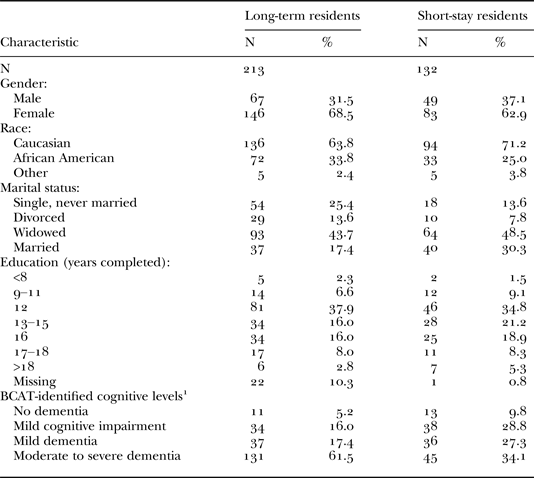
A total of 579 individuals residing in 18 skilled nursing facilities in Maryland were randomly selected for inclusion in the present study (February 2014 to November 2014). All participants were either long-term care or short-stay nursing home residents. Residents were considered long-term care if they had been in the nursing home facility for more than 100 days at the time of the study. Residents were considered short stay if they had been in the nursing home for less than 100 days at the time of the study and were receiving sub-acute rehabilitation following a hospitalisation. There were 345 residents who met inclusion criteria for data analysis, which required a completed Brief Cognitive Assessment Tool (BCAT; Mansbach, MacDougall and Rosenzweig Reference Mansbach, MacDougall and Rosenzweig2012), long-term care or short-stay nursing home resident status, age > 49 and proficiency in English. Participants with medical or psychiatric impairments too severe to complete a BCAT were excluded. Individuals with severe dementia were not excluded so long as they could complete the BCAT. Of the 345 participants who met inclusion and exclusion criteria for participation, 213 (61.7%) were long-term care and 132 (38.3%) were short-stay nursing home residents. Table 1 presents key demographic features and levels of cognitive functioning for the long-term care and short-stay nursing home sub-samples.
Select demographics and diagnoses of participants
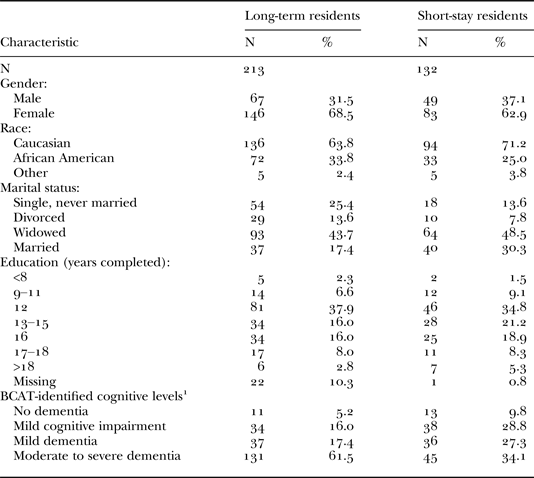
Note: 1. Determined by participant Brief Cognitive Assessment Tool (BCAT) scores.
In the total sample, 51 per cent had moderate to severe dementia, 21 per cent had mild dementia, 21 per cent had MCI and 7 per cent had normal cognitive functioning based on BCAT scores. Participants in the total sample ranged in age from 50 to 100, with a mean age of 79.41 (±10.79). Sixty-six per cent of participants were female, 67 per cent were Caucasian, 45 per cent were widowed and 50 per cent had 12 years of education or less.
Skilled nursing facilities
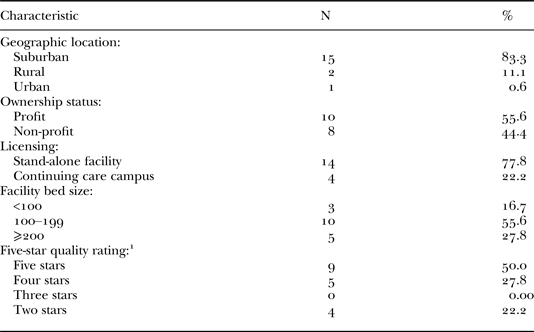
Table 2 presents key demographics for the facilities that were included in this study. Eighty-three per cent of facilities were suburban, 56 per cent had for-profit ownership status and 78 per cent had stand-alone licensure. Seventeen per cent of facilities had less than 100 beds, 56 per cent had 100–199 beds and 28 per cent had 200 or more beds.
Key characteristics of the facilities included in the present study

Notes: N = 18. 1. Based on Centers for Medicare & Medicaid Services five-star quality rating system.
Procedure
Data for the present study were collected, and procedures approved, as part of a grant (‘Improving Dementia Care Through Improved Assessment Practice’) awarded to the Beacon Institute by the Maryland Office of Health Care Quality (OHCQ), who regulate nursing facilities in the state. In order to determine the total number of individuals eligible for participation, all facilities were instructed to compile a list of long-term care and short-stay residents aged 50 or older and who had proficiency in English. Then, a computerised pseudo-random number generator was used by the researchers to randomly select up to 15 long-term care and 15 short-stay nursing home residents from each list for inclusion in the study. Using this method prevented facility staff from determining participation and allowed all eligible residents to have an equal likelihood of being selected for this population-based study. In order to prevent potential bias, facility staff members were masked from the participant selection process and the researchers responsible for randomisation did not have access to identifying information of the residents eligible for inclusion.
Then, long-term care nursing home residents completed a BCAT over a one-month period in February 2014, and short-stay nursing home residents completed a BCAT in October 2014. Participants who were unable to complete a BCAT, for medical or physical reasons, were excluded and replaced by additional randomly selected participants until up to 15 long-term care and 15 short-stay residents were selected from each facility. Individual facility social work staff (55%), nursing staff (25%), recreation staff (17%) and therapy staff (2%) completed all of the testing for this study. All participating facility staff attended a formal training session on the study protocol and demonstrated proficiency in administering the BCAT in a post-training test. A random audit of BCAT tests completed by facility staff also confirmed accuracy of administration and scoring.
Measures
The Brief Cognitive Assessment Tool (BCAT)
The BCAT (Mansbach, MacDougall and Rosenzweig Reference Mansbach, MacDougall and Rosenzweig2012) was selected by the Beacon Institute as the cognitive evaluation tool for this study and was approved for inclusion by the Maryland OHCQ. This 21-item, zero to 50-point instrument was designed to assess cognitive functioning, and it can be individually administered (by licensed provider or para-professional) in approximately 15 minutes. It has been validated in skilled nursing facilities (Mansbach, Mace and Clark Reference Mansbach, Mace and Clark2014) and various other settings (MacDougall et al. Reference MacDougall, Mansbach, Clark and Mace2015; Mansbach, MacDougall and Rosenzweig Reference Mansbach, MacDougall and Rosenzweig2012). The BCAT produces a total score suggesting specific cognitive levels, and it yields a Contextual Memory Factor (CMF) score and an Executive Control Functions Factor (ECFF) score. The BCAT CMF indicates memory abilities and is comprised of both word list and story recall items. The ECFF measures executive functions and includes several diverse items capturing several types of executive skills. Total CMF and ECFF scores range from zero to 15 and zero to 7, respectively. In the original BCAT development study, psychometric analyses confirmed strong evidence for internal reliability (Cronbach's α = 0.92), test–retest reliability (r = 0.99), and evidence of the construct validity of BCAT score inferences through convergent, discriminant and predictive validity analyses (Mansbach, MacDougall and Rosenzweig Reference Mansbach, MacDougall and Rosenzweig2012). The BCAT is sensitive to the full spectrum of cognitive functioning (normal, MCI, mild dementia, moderate to severe dementia) (Mansbach, MacDougall and Rosenzweig Reference Mansbach, MacDougall and Rosenzweig2012). The BCAT had an internal consistency reliability of 0.84 (Cronbach's α based on standardised items) in the current study.
Statistical analysis
All statistical analyses were performed using SPSS. Descriptive statistics were used to report participant demographics and cognitive levels. Contingency tables, independent sample t-tests and Pearson's chi-square tests for independence were used to compare subjects from the long-term care and short-stay nursing home sub-samples to determine whether there were significant differences in key demographic variables. These include age, gender, marital status, education and race. Contingency tables and Pearson's chi-square tests for independence were also used to determine whether there were significant differences in levels of cognitive functioning (normal, MCI, mild dementia, moderate to severe dementia) between the long-term care and short-stay nursing home sub-samples. Cramer's V, Phi and the odds ratio were used to measure effect sizes for the chi-square tests for independence when appropriate. Differences in the classification of MCI sub-types were also explored between the two sub-samples. A one-way multivariate analysis of variance (MANOVA) was used to investigate mean differences of BCAT and BCAT factor scores (CMF, ECFF). Partial eta-squared was used to measure MANOVA effect sizes.
Results
A Pearson's chi-square test for independence indicated that there was not a significant association between gender and long-term care or short-stay status, χ2(1, 345) = 1.17, p = 0.28. Similarly, education was not significantly different between the long-term care and short-stay nursing home residents, χ2(7, 322) = 7.93, p = 0.34. Race was also not significantly different between the long-term care and short-stay nursing home residents, χ2(5, 345) = 6.00, p = 0.31. Long-term care nursing home participants were not significantly older (mean = 78.85, standard deviation (SD) = 11.57) than short-stay nursing home patients (mean = 80.32, SD = 9.36), t(343) = −1.23, p = 0.22. Only marital status was significantly different between the long-term care and short-stay nursing home residents, χ2(4, 345) = 19.41, p = 0.00. The effect size, as estimated by Cramer's V, was medium (ϕ c = 0.24) (Gravetter and Wallnau Reference Gravetter and Wallnau2008; Lowry Reference Lowry2012). The long-term care nursing home sub-group had a significantly greater proportion of single residents, while the short-stay nursing home sub-group had a significantly greater portion of married residents.
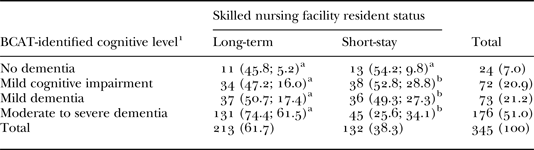
A contingency table of cognitive levels (normal, MCI, mild dementia, moderate to severe dementia) by nursing home residential status (long-term care, short stay) is reported in Table 3. Based on BCAT scores, 78.9 per cent of the long-term care residents had dementia and 21.1 per cent did not have dementia. Of the short-stay residents, 61.4 per cent had dementia and 38.6 per cent did not have dementia based on BCAT scores. A Pearson's chi-square test for independence indicated that long-term care and short-stay nursing home residents had significantly different levels of cognitive functioning in general, χ2(3, 345) = 24.77, p = 0.00. The effect size, estimated by Cramer's V, was medium to large (ϕ c = 0.27) (Gravetter and Wallnau Reference Gravetter and Wallnau2008; Lowry Reference Lowry2012). At a more granular level, the long-term care and short-stay nursing home residents significantly differed in their proportions of MCI, mild and moderate to severe dementia at the p < 0.05 level. Only the proportion of residents with normal cognition was not significantly different between the two sub-samples. The short-stay nursing home sub-sample had a significantly greater proportion of residents with MCI and mild dementia at the p < 0.05 level. The proportion of residents with moderate to severe dementia was significantly greater at the p < 0.05 level for the long-term care nursing home sub-sample. Based on an odds ratio, the odds of having moderate to severe dementia were 2.76 times greater for nursing home residents who were long-term care compared to short stay.
Cross-tabulation of Brief Cognitive Assessment Tool (BCAT) cognitive levels and resident status
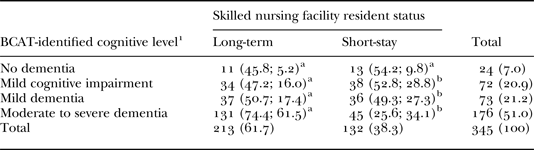
Notes: χ2(3, 345) = 24.77, p = 0.00, ϕ c = 0.27. 1. Determined by participant BCAT scores. Numbers in parentheses indicate: (row %; column %).
Significance level: Sub-categories with different superscript letters indicate column proportions that are significantly different at the p < 0.05 level.
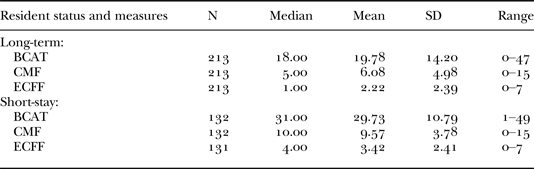
A one-way MANOVA was conducted to explore the mean differences of the BCAT and the BCAT factor scores between the long-term care and short-stay nursing home residents. The BCAT and BCAT factor scores by nursing home sub-group are presented in Table 4. There was a statistically significant difference in BCAT scores between long-term care and short-stay nursing home residents, F(1, 342) = 46.84, p = 0.00. Likewise, there was a statistically significant difference in CMF scores between long-term care and short-stay nursing home residents, F(1, 342) = 46.49, p = 0.00. Finally, there was a statistically significant difference in ECFF scores between long-term care and short-stay nursing home residents, F(1, 342) = 20.47, p = 0.00. The effect sizes, calculated using partial eta-squared, for the differences in BCAT, CMF and ECFF scores, were 0.12, 0.12 and 0.06, respectively.
Descriptive statistics for Brief Cognitive Assessment Tool (BCAT) and BCAT factor scores by resident status

Notes: SD: standard deviation. CMF: Contextual Memory Factor. ECFF: Executive Control Functions Factor.
Discussion
From the standpoint of cognitive functioning, the findings of the present study support the view that short-stay and long-term care residents differ in their deficits and preserved strengths. Looking at general cognition based on BCAT scores, short-stay residents have significantly higher cognitive functioning than long-term care residents, although both groups can be described as having high prevalence of cognitive deficits. Based on BCAT scores, 79 per cent of the long-term care residents had dementia compared to 61 per cent for short-stay residents. Our finding that 79 per cent of long-term care residents have dementia is notably higher than previously reported (Magaziner et al. Reference Magaziner, German, Zimmerman, Hebel, Burton, Gruber-Baldini, May and Kittner2000; Mansbach, Mace and Clark Reference Mansbach, Mace and Clark2014). We offer two possible explanations for this difference. First, we used the BCAT, which has demonstrated excellent utility in differentiating MCI and dementia (Mansbach, MacDougall and Rosenzweig Reference Mansbach, MacDougall and Rosenzweig2012; Mansbach, Mace and Clark Reference Mansbach, Mace and Clark2014), whereas many previous studies have used screening tools that may be less sensitive to identifying specific cognitive levels. Second, many of the previous studies have blended long-term care and short-stay residents, possibly obscuring actual differences between the two nursing home sub-populations.
The short-stay sub-sample had a mean BCAT score that is ten points higher than the mean score for the long-term care group. In comparing the short-stay and long-term care sub-groups, cognitive status stands out as a key variable because most of the demographic characteristics (age, education, race) did not differ in the present sample. Only marital status was found to be significantly different, with a significantly greater proportion of single residents in long-term care and married residents receiving short-stay services. This was not surprising, as marital status, in the context of family structures, has been identified as a potential buffer against placement in long-term care (Noël-Miller Reference Noël-Miller2010).
At a more granular level, both groups demonstrate a high occurrence of memory and executive deficits, as measured by the CMF and ECFF scores, respectively. However, short-stay residents function cognitively better in terms of both domains than their long-term care peers. Furthermore, short-stay residents are more likely to have MCI and mild dementia, whereas long-term care residents are more likely to have moderate and severe dementia. This is consistent with the odds ratio, which estimates that moderate to severe dementia is almost three times more frequent for nursing home residents who are long-term care as compared to short stay. This has particular relevance for long-term care residents, because those with moderate and severe dementia may have difficulties communicating their needs and participating in care decisions. Therefore, it is very important that facilities ensure that family, friends and other social supports be integrated into person-centred decisions. At the same time, nursing facility staff should make every effort to include long-term residents in care decisions, but may need to work diligently and patiently to ensure that these residents do indeed have a voice in their care.
Both short-stay and long-term care residents had relatively low proportions of residents with normal cognition. The finding that short-stay residents typically have cognitive deficits is important, not only from a person-centred care perspective while they are in the nursing home, but this also has implications for when they leave. Discharge planners should be particularly mindful that short-stay residents with cognitive impairment have increased risks of incident disabilities and subsequent functional declines (Dodge et al. Reference Dodge, Kadowaki, Hayakawa, Yamakawa, Sekikawa and Ueshima2005). Since communication of cognitive status is a critical variable in the success of care transitions (Snow et al. Reference Snow, Beck, Budnitz, Miller, Potter, Wears, Weiss, Williams and Williams2009), facility staff have a unique and important opportunity to impact post-nursing home care positively through sharing information about the cognitive functioning of discharged residents.
Generally, US nursing homes do not routinely utilise cognitive measures that are sensitive to the full spectrum of cognitive functioning levels. Yet, this study underscores the importance of utilising instruments that accurately identify specific cognitive levels (i.e. normal, MCI, mild dementia, moderate dementia, severe dementia). At the same time, our results reveal that long-term care and short-stay residents cognitively function quite differently from one another. Certainly facilities and clinicians who utilise instruments that are sensitive to the cognitive continuum are in a better position to optimise care decisions that are affected by cognitive status for both short-stay and long-term care residents.
Nursing home employees have difficult jobs. This is particularly the case for frontline workers such as nursing and personal care aides, who often work long hours, are prone to job-related injuries and are poorly paid (Deutschman Reference Deutschman2000; Zimmerman et al. Reference Zimmerman, Williams, Reed, Boustani, Preisser, Heck and Sloane2005). Furthermore, stress associated with, and negative attitudes towards, residents with dementia can undermine person-centred care (Zimmerman et al. Reference Zimmerman, Williams, Reed, Boustani, Preisser, Heck and Sloane2005). The success of person-centred care largely depends on the quality of the relationships between workers and residents (Kitwood Reference Kitwood1997). Therefore, a critically important target for improving care is to invest in the people who provide it. There is empirical evidence that attitudes towards residents with cognitive impairment and skills for taking care of them can be improved through staff training (Gurnik and Hollis-Sawyer Reference Gurnik and Hollis-Sawyer2003; McKenzie and Peragine Reference McKenzie and Peragine2003). For both short-stay and long-tem care residents, person-centred care will likely be better in facilities that value training, especially training in dementia care (Zimmerman et al. Reference Zimmerman, Williams, Reed, Boustani, Preisser, Heck and Sloane2005). We recommend, based on our findings, that training emphasises improving communication patterns, particularly as they pertain to residents with moderate to severe dementia. Certainly communication is a two-way process. However, residents with significant cognitive deficits often have difficulty both processing communication from front-line staff as well as making their needs understood. In working with persons with more severe dementia, especially long-term care residents who are most likely to have severe cognitive deficits, staff are reminded to use short phrases, start questions with the main point (avoid ‘left-branching’ statements), minimise background noise and use repetition strategies.
There are limitations to the present study that bear consideration. While the BCAT has demonstrated strong validity and reliability in previous research, it is a unitary test that was administered by facility staff. We did not rely on clinician-administered comprehensive cognitive evaluations, which may have produced somewhat different occurrence rates of cognitive impairment. Whereas the resident participants in this study were randomly selected, the participating facilities were not. Facilities were contacted and asked if they wanted to participate in this research. Perhaps these facilities were more motivated to improve person-centred care than non-participating facilities. While we included participants with severe dementia, residents with medical or psychiatric impairments too severe to complete the cognitive assessment were excluded. This could have skewed the results of our population-based study towards more cognitively competent residents. Random selection and lenient eligibility criteria were used to enhance the generalisability of our findings to residents in skilled nursing facilities with severe impairments. Despite these limitations, enhanced understanding of the cognitive functioning of both short-stay and long-term care residents offers an opportunity for all facility staff to impact resident care positively.
Acknowledgements
Special thanks to The Beacon Institute and the Maryland Office of Health Care Quality (OHCQ) for their support of this research. Data for the present study were collected, and procedures approved, as part of a grant (‘Improving Dementia Care Through Improved Assessment Practice’) awarded to the Beacon Institute by the Maryland OHCQ, who regulate nursing facilities in the state. The Beacon Institute obtained grant funding, assisted in the study design, and aided facility and participant recruitment. W. E. Mansbach is the principle investigator, designed the study, assisted with data interpretation, and wrote the Introduction and Discussion sections. R. A. Mace assisted with the design of the study, supervised data collection, analysed and interpreted the data, and wrote the Method and Results sections. K. M. Clark assisted with the study design, supervised data collection, and assisted with the reviewing/revising of the manuscript. I. E. Firth obtained grant funding, and assisted with the study design and the reviewing/revising of the manuscript. All authors read and approved the final paper and are aware of its submission. There are no conflicts of interest.