INTRODUCTION
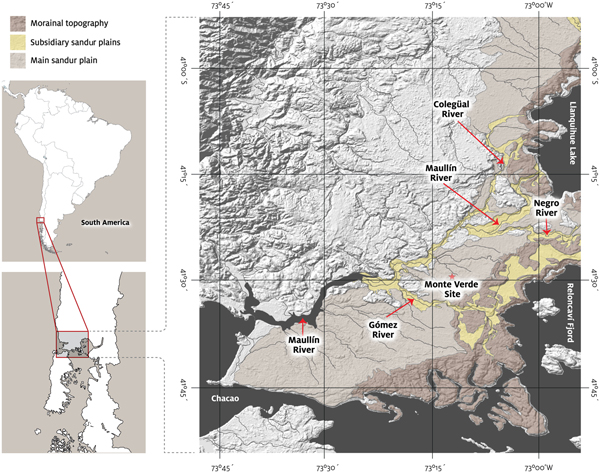
The initial peopling of the Americas is more complex than current migration models have depicted (Bryan, Reference Bryan and Bryan1986; Dillehay, Reference Dillehay2000; Goebel et al., Reference Goebel, Waters and O'Rourke2008; Meltzer, Reference Meltzer2009; Graf et al., Reference Graf, Ketron and Waters2013; Stanford and Bradley, Reference Stanford and Bradley2013; Politis et al., Reference Politis, Gutierrez and Scabuzzo2014; Braje et al., Reference Braje, Dillehay, Erlandson, Klein and Rick2017). Models become even more complex when attempts are made by specialists to examine the same corpus of data to reconcile current archaeological, paleoecological, human skeletal, and genetic records (Bryan and Gruhn, Reference Bryan and Gruhn2003; Neves, and Hubbe Reference Neves and Hubbe2005; Hubbe et al., Reference Hubbe, Harvati and Neves2011; Bodner et al., Reference Bodner, Perego, Huber, Fendt, Röck, Zimmermann and Olivieri2012; Battaglia et al., Reference Battaglia, Grugni, Perego, Angerhofer, Gomez-Palmieri, Woodward, Achilli, Myres, Torroni and Semino2013; Skoglund et al., Reference Skoglund, Mallick, Chennagiri, Reich, Skoglund, Patterson, Bortolini, Salzano, Hunemeier and Petzl-Erler2015). Each of these records is inconclusive and permits multiple interpretations. At the moment, the most reliable interdisciplinary evidence points toward a human presence in the New World around or likely before ~16,000 cal yr BP, characterized by regionally diverse lifestyles and technologies. An optimistic view can be taken that the existence of various interpretative positions indicates that a continuum exists across different models and disciplines that will permit their eventual reconciliation. At a fundamental level, however, much more interdisciplinary archaeological and paleoecological data from all regions of the Americas are required to achieve this reconciliation. In light of this need, reported here are new archaeological data from the Chinchihuapi I (CH-I) locality of the Monte Verde site complex in south-central Chile (Fig. 1) and their meaning with respect to other localities within the study area and beyond.
Location of the Monte Verde site complex.

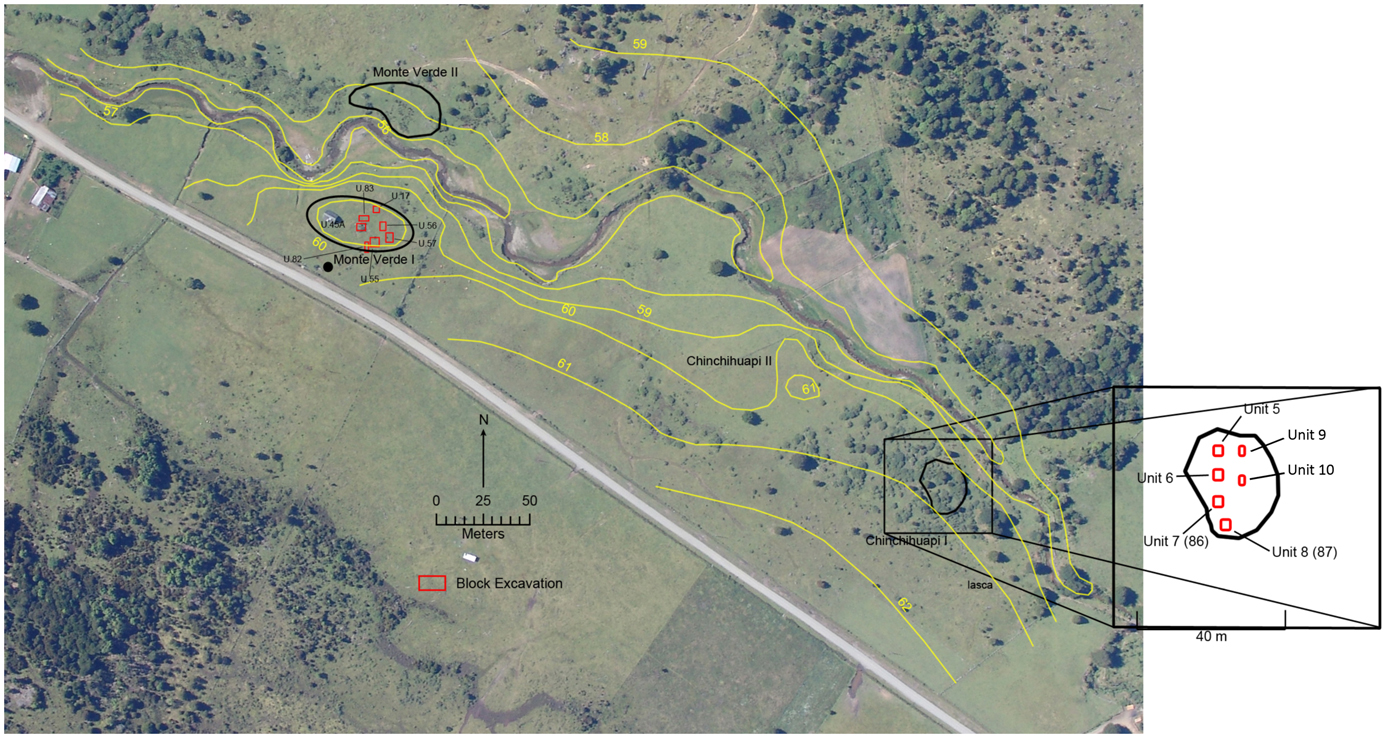
Investigation of the Monte Verde complex along Chinchihuapi Creek has a long tradition beginning in 1976 (e.g., Dillehay Reference Dillehay1989, Reference Dillehay1997). Four open-air sites in the complex (Monte Verde I [MV-I], Monte Verde II [MV-II], Chinchihuapi I [CH-I], Chinchihuapi-II [CH-II]) yielded late Pleistocene and/or Early Holocene artifacts and cultural features dated between ~9000 and at least ~14,500 cal yr BP (Dillehay et al., Reference Dillehay, Ocampo, Saavedra, Sawakuchi, Vega, Pino and Collins2015; Fig. 2). In the 1970s and 1980s, test pits were placed in the CH-I site, which at the time yielded a few stone flake tools and one burned mastodon or gomphothere rib fragment (Casamiquela and Dillehay, Reference Casamiquela, Dillehay and Dillehay1989; Dillehay, Reference Dillehay1997). These materials were recovered at approximately the same stratigraphic level as Use-surface 3 defined here. The results reported here for the 2017 and 2018 excavations at CH-I are three stratigraphically ordered, diagnostic use-surfaces (US-1, US-2, US-3) characterized by light scatters of unifacial and bifacial lithic tools, unretouched debitage flakes, and small burned features containing scant floral and faunal remains. (Based on the additional evidence reported here, we now prefer to term these “artifact-bearing layers” rather than “thin, cultural horizons.” “Use-surface” is considered here to be a visibly thin, horizontal layer [0.5–2 cm thick] of ash, charcoal, floral and faunal remains, and cultural artifacts indicative of human occupation and/or limited activity.) The use-surfaces are thin, are vertically and horizontally intermittent, and represent ephemeral recurrent human activities generating absolute assays by accelerator mass spectrometry (AMS) on wood charcoal, burned seeds, and bone fragments from features dated between ~9000 and 14,500 cal yr BP. Macrobotanical, pollen, starch grain, and phytolith analyses were performed on feature sediments from all three use-surfaces. In deeper levels below the use-surfaces, one isolated unifacial flake and one spheroid stone were excavated and dated ~20,100 cal yr BP. These latter materials were not associated with use-surfaces, and their context is culturally inconclusive. The new findings from CH-I are similar to those recovered during our 1983 and 2013 excavations at this site and to previous results in the nearby localities of MV-I, MV-II, and CH-II (Fig. 2).
Location of Monte Verde sites and excavation units in site CH-I.

CH-I is an approximately 1.3 by 17 by 22 m low rise located on the south terrace of Chinchihuapi Creek about 500 m east of the MV-II site (Figs. 1 and 2). It was discovered in 1978 by subsurface testing (Units 1–2) that yielded burned wood, ghomphothere bone fragments, and unifacial flakes dated ~14,500 cal yr BP (Dillehay, Reference Dillehay1997; Casamiquela and Dillehay Reference Casamiquela, Dillehay and Dillehay1989). The site was reexcavated in 2013 in a series of 2 by 2 m block units (Units 3–6) that produced two stratigraphically layered cultural horizons, which we now term use-surfaces, dated ~9000 and 14,500 cal yr BP (see Dillehay et al., Reference Dillehay, Ocampo, Saavedra, Sawakuchi, Vega, Pino and Collins2015). Previously, the younger cultural horizon contained Paijan-like projectile points, unretouched flakes, burned animal bone fragments, burned seeds of edible plants, and small fire pits, which stratigraphically and chronologically correspond with US-2 reported here. The previous ~14,500 cal yr BP, deeper horizon exhibited several spherical stones, local and exotic retouched and unretouched flakes, and grinding stones, which correspond with US-3 (described in this study). Not found previously was US-1, which stratigraphically lies above US-2 (Figs. 3 and 4). Stone artifacts and features from deeper levels below US-3 also were reported previously at CH-I (Dillehay et al., Reference Dillehay, Ocampo, Saavedra, Sawakuchi, Vega, Pino and Collins2015). Units 7–10 were opened during the 2017 and 2018 field seasons.
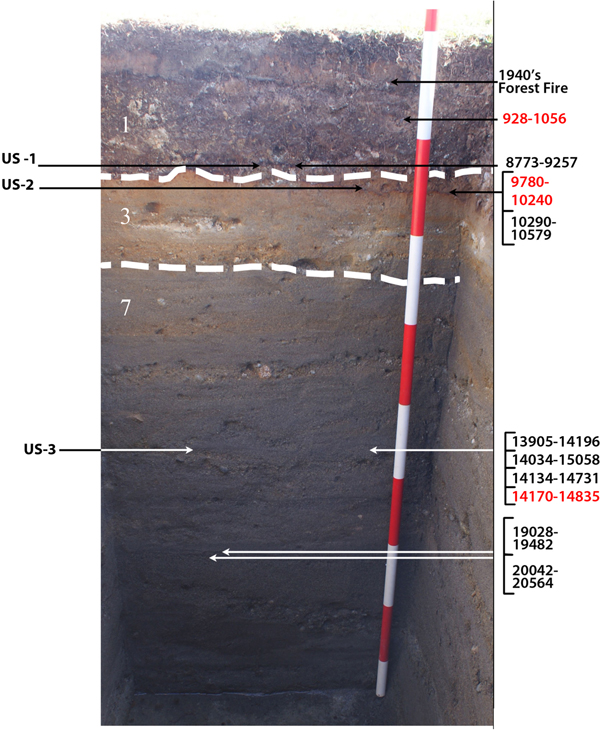
Stratigraphic profile of Unit 7 showing geological strata and AMS-dated (cal yr BP) US-2 and US-3 (scale is 20 cm segments). Assays in red are derived from dated material from use-surfaces in Unit 7: assays in black are derived from dated material in nearby Units 5, 6, and 8, which are schematically placed in profile here to show chronostratigraphic correlation between dates and strata across units in the site (see Table 1).

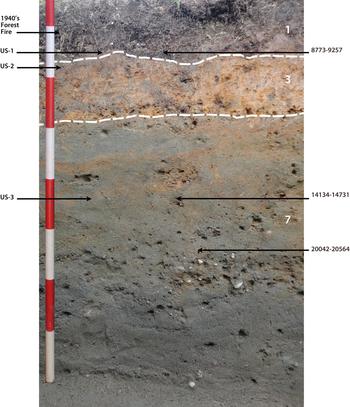
Stratigraphic profile of Unit 8 showing geological strata and AMS-dated (cal yr BP) US-1 and US-3 (scale is 20 cm segments).

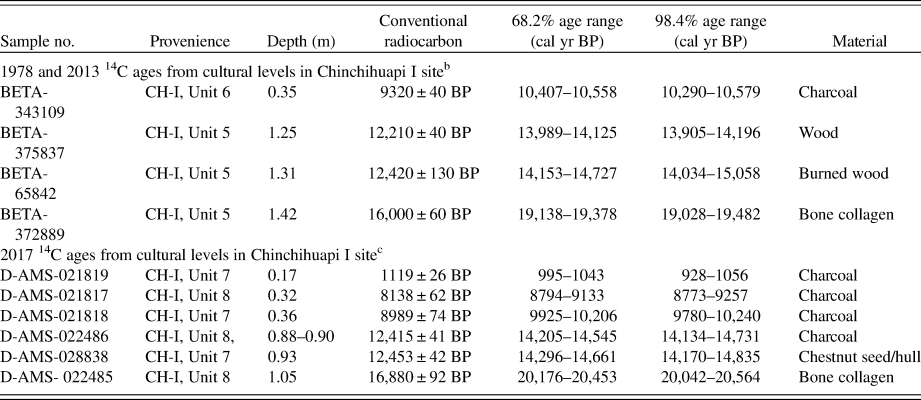
2017 and 2013 radiocarbon age for excavation units in CH-I.a

a All dates calibrated with CALIB v. 7.1 using the Southern Hemisphere calibration curve (Stuiver and Reimer Reference Stuiver and Reimer1993; Hogg et al., Reference Hogg, Hua, Blackwell, Niu, Buck and Heaton2013).
b Assays from excavated units where stratum MV-2 is present.
GEOLOGICAL SETTING AND STRATIGRAPHY
The climate and environment of the late Pleistocene period in south-central Chile are characterized by the shift from a cold, periglacial, sandur setting in the site area to an intermittent cold to cool temperate rain forest from ~11,000 to 19,000 cal yr BP (Heusser et al., Reference Heusser, Heusser and Lowell1999; Denton et al., Reference Denton, Lowell, Heusser, Schlüchter, Andersen, Heusser, Moreno and Marchant1999; Dillehay et al., Reference Dillehay, Ocampo, Saavedra, Sawakuchi, Vega, Pino and Collins2015). This shift was accompanied by vegetational changes that facilitated a human presence during warm months and probably limited human activity during cold months, particularly in the Andean mountains 40 km east of Monte Verde, where glaciers existed until about ~17,500 cal yr BP. Deglaciation and climatic amelioration after ~17,500 cal yr BP resulted in the development of the cool temperate, open rain forest and precordillera lakes present in the area today (Denton et al., Reference Denton, Lowell, Heusser, Schlüchter, Andersen, Heusser, Moreno and Marchant1999; Moreno et al., Reference Moreno and León2003, Reference Moreno, Denton, Moreno, Lowell, Putnam and Kaplan2015). Drier conditions and increased forest fires occurred in the area after ~6500–7000 cal yr BP (Abarzua and Moreno, Reference Abarzua and Moreno2008). During this entire period the coastal climate and environment, located ~60 km west of Monte Verde, were generally milder and more hospitable to human occupation.
Four previously defined natural stratigraphic layers (MV-1 to MV-3 and MV-7; Pino, Reference Pino and Dillehay1989; Dillehay and Pino, Reference Dillehay, Pino and Dillehay1989), excluding the cultural horizons reported previously (Dillehay et al., Reference Dillehay, Ocampo, Saavedra, Sawakuchi, Vega, Pino and Collins2015) and the use-surfaces described here, have been identified in most areas of CH-I, with a total exposed thickness varying between ~1.3 and 1.5 m (Figs. 3 and 4). CH-I is higher in elevation and farther away from the paleochannel of the Chinchihuapi Creek than site MV-II, thus strata MV-4 to MV-6, which are associated exclusively with the creek and lower terrace basins, are not present (see Pino, Reference Pino and Dillehay1989, Dillehay and Pino, Reference Dillehay1997). At the time of human use of CH-I, the paleochannel was about 30 m farther north, 6–7 m lower than the cultural horizons in site CH-I, and about 2 m wide.
Stratum MV-1 is a developed sod zone of friable soil of weak to moderate granular structure and has a relatively uniform thickness of ~15–40 cm in the Monte Verde area. The color is 10YR 3/4 to 10YR 3/2 (dark yellowish brown to dark brown). This stratum contains intermittent yet extensive evidence of forest fires that occurred primarily in the 1930s and 1960s and is absent or thin (2–3 cm) in some areas due to erosion from yearly heavy rainfall after vegetation burn-off. For instance, at site MV-II, there is no evidence of burning in stratum MV-1 (see Supplementary Fig. 18 in Dillehay et al., Reference Dillehay, Ocampo, Saavedra, Sawakuchi, Vega, Pino and Collins2015). Where it does exist in other areas, its thickness varies significantly depending upon differential vegetation loss and erosion. The extant base of stratum MV-1 at the CH-I site is radiocarbon dated to 928–1056 cal yr BP (D-AMS-021819; Table 1).
MV-2 is an oxidized medium to orange-gray to dull yellow-orange (10YR 3/6 and 10YR 6/4) sandy sediment that varies from 15 to 55 cm in thickness when it is present at CH-I. MV-2 was initially deposited sometime around or after ~5600 cal yr BP (Dillehay, Reference Dillehay1997). Due to increased forest fires and erosion from rainfall beginning ~6000–7000 cal yr BP (Abarzua and Moreno, Reference Abarzua and Moreno2008), as well as fire and erosion in the last century, this stratum varies in presence and thickness at CH-I. MV-2 is present in Units 1–3 and 5–6 but absent in Units 7–10 at CH-I (see Supplementary Figs. 1 and 2). The absence of stratum MV-2 produces a nonconformity between strata MV-1 and MV-3 at site CH-I. Where stratum MV-2 is present in the site (Units 1–3 and 5–6), the three use-surfaces are ~30–45 cm deeper from the reference datum at ground surface (Supplementary Fig. 2). Where it is absent due to erosion (e.g., Units 7 and 8), the use-surfaces are ~30–45 cm more shallow from the reference datum than they are in Units 1–3 and 5–6 (cf. Figs. 3 and 4, Supplementary Figs. 1 and 2). Nonetheless, the presence or absence of stratum MV-2 has no bearing on the integrity and chronostratigraphic correlation of the use-surfaces, which are in complete agreement in the deeper, older strata MV-3 and MV-7.
MV-3 is a hard, compact, heavily oxidized, yellowish-red to reddish-yellow (5YR 3/2 to 5YR 6/8) soil layer that directly overlies stratum MV-7 in site CH-I. The thickness ranges from ~20 to 50 cm. The layer is characterized by interbedded facies of small clasts of iron oxides and hematite–limonite and thin lenses of brown peat and white clays, especially in its lower part. The lower layer at site CH-I is radiocarbon dated between ~9000 and 10,800 cal yr BP (Beta-6753; Dillehay, Reference Dillehay1997).
The underlying upper MV-7 stratum is composed of medium and fine gray sands (7.5YR/N6) with occasional thin, small gravel lenses (0.5–2.5 cm thick). MV-7 roughly dates between 12,000–15,060 and 36,262–38,828 cal yr BP (Dillehay, Reference Dillehay1997), from top to bottom, and varies from ~1.5 to 3 m in thickness. Strata MV-3 and MV-7 reveal no burning and erosion due to extensive fires and heavy rains, although the upper layer of MV-3 likely has been slightly eroded in areas where stratum MV-2 eroded.
Where stratum MV-2 is absent, the slightly undulating use-surfaces US-1 to US-3 reported here are located at approximate depths of 22–23, 28–32, and 88–95 cm, respectively (Figs. 3 and 4), from the reference datum at ground level in Units 7–10. Where stratum MV-2 is present in other areas of site CH-I (Units 1–3 and 5–6), the three use-surfaces are 30 to 45 cm deeper from the reference datum, that is, approximately 60, 70, and 130–135 cm in depth, respectively (see Dillehay et al., Reference Dillehay, Ocampo, Saavedra, Sawakuchi, Vega, Pino and Collins2015). That is, due to the presence, absence, or thinness of stratum MV-2 across site CH-I, depth discrepancy below reference datum among use-surfaces varies from unit to unit (cf. Figs. 3 and 4, Table 1, Supplementary Figs.1 and 2). Despite this discrepancy, the stratigraphic chronology and numerical dating of the natural strata and cultural use-surfaces are in agreement across the site. Table 1 presents the 2013 and 2017 radiocarbon dates for the use-surfaces.
US-1 is located in the uppermost layer of stratum MV-3, almost at its interfacing nonconformity with the base of stratum MV-1 in Units 7 and 8; US-2 is located a few centimeters below, also in the upper level of MV-3; and US-3 lies in the middle layer of MV-7. US-1 and US-2 are separated by ~5–8 cm of culturally sterile sediments. Approximately 55–65 cm of sterile sediment exists between US-2 and US-3. The three use-surfaces vary in thickness from ~1.0 to 1.5, 1.3 to 3.2, and 0.5 to 1.1 cm, respectively.
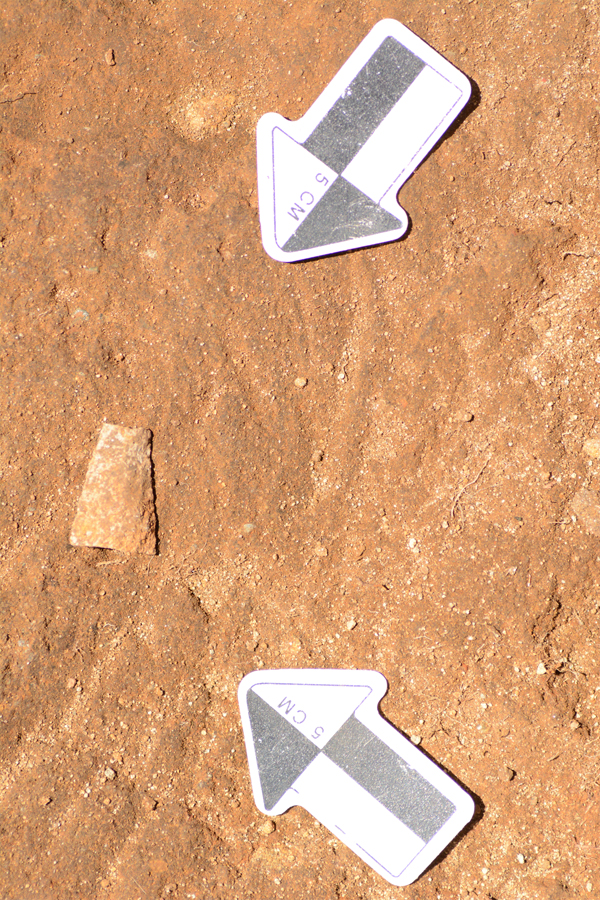
The analysis of horizontal orientations on the planar use-surfaces was a primary interest of the field analysis, focusing on the thin lenses of associated artifacts and intact burned features deposited upon and embedded within the fine-grained sediments of the use-surfaces (Fig. 5). The use-surfaces are thought to be minimally impacted by the complications of any taphonomically charged site-formation processes. That is, we observed no obvious postdepositional processes that may have obscured latent structure in the configurations of features and artifacts.
(color online) Projectile point fragment recovered from US-2. Note darker areas of a burned feature to the left.

More specifically, we observed the strike (horizontal orientation) and dip (vertical orientation) of artifacts for any disturbance by overbank stream flow, pedoturbation by biological activity, and other forces. The configuration and spatial distribution of the in situ artifactual materials exhibited heterogeneity of orientations among elongated objects of lithics, which is consistent with a deposition that is not a function of, or substantially displaced by, water flow. That is, the horizontal orientations of elongated lithics were not aligned with the direction of the river flow at the time of the deposition. Only two excavated flakes were estimated to have dips greater than 45°, and these were in US-2. Furthermore, we recovered no artifactual material, cultural features, or charcoal from sterile sediments between the use-surfaces, suggesting no downward filtration of lithics, bone, or charcoal occurred. In these cases, the stratigraphic and taphonomic analyses confirm the integrity of the cultural deposits. As noted, there is no observable evidence of burning and fluvial erosion in strata MV-3 and MV-7, in contrast to strata MV-1 and MV-2.
CHRONOLOGY
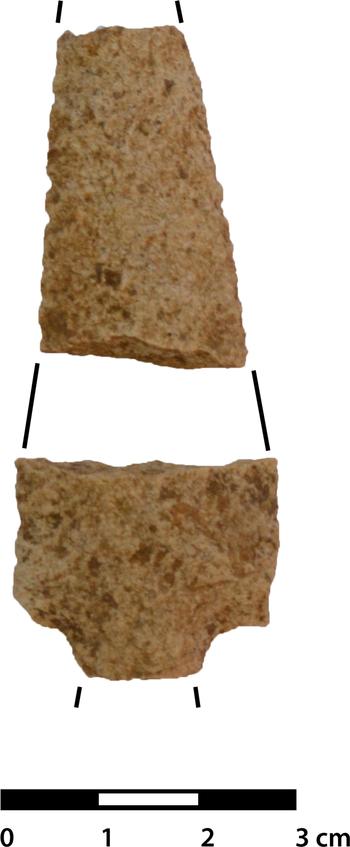
Numerical dating was conducted by AMS on single pieces of wood charcoal and a burned chestnut (Luma apiculata) seed in small hearths in the three use-surfaces and on a burned bone associated with lithics in the underlying deeper levels (Table 1). The AMS data for the recent excavations indicate ages of 8773–9257 cal yr BP (D-AMS-021817) on charcoal for US-1. This is the level associated with an end scraper made of an exotic gray chalcedony, with a heavily ground and polished bifacial fragment, and with unretouched lithic debitage (see Supplementary Figs. 3 and 4). An age of 9780–10,240 cal yr BP (D-AMS 021818) was obtained for US-2 in Unit 7, which was associated with two fragmented Paijan-like projectile points (Fig. 6). This age chronologically overlaps with the assay of 10,290–10,579 cal yr BP (Beta-343109) derived from charcoal in a hearth associated with a Paijan-like point excavated at approximately the same level at CH-I in 2013 (Dillehay et al., Reference Dillehay, Ocampo, Saavedra, Sawakuchi, Vega, Pino and Collins2015). The age range of the new and previous dates for US-2 indicates that it was deposited during the Early Holocene, around four millennia after the ~14,500 cal yr BP occupation at the MV-2 site (Dillehay and Pino, Reference Dillehay, Pino and Dillehay1997; Dillehay et al., Reference Dillehay, Ramírez, Pino, Collins, Rossen and Pino-Navarro2008). An AMS date on wood charcoal of 14,134–14,731 cal yr BP (D-AMS-022486) was recovered from US-3 in Unit 7, roughly the middle level of stratum MV-7, and associated with the medial section of a rhomboidal-formed biface, a probable projectile point, made of an exotic white quartz (Fig. 6). A date of 14,170–14,835 cal yr BP (D-AMS-028838) was obtained from a burned chestnut seed from a small hearth at the same level of the biface and the assay of 14,134–14,731 cal yr BP in Unit 7. The 2013 date for a comparable stratigraphic cultural level, 14,034–15,058 cal yr BP, is present in stratum MV-7 of Unit 5 at CH-I (Beta-65842) and overlaps with these two new assays. An unretouched, percussion-struck flake of local rhyolite, a spherical stone (see Supplementary Figs. 5 and 6), and a burned bone fragment of an unidentified small animal, possibly deer or paleo-camelid, were recovered from a deeper level of stratum MV-7 and dated at 20,042–20,564 cal yr BP (D-AMS-022485: see BETA-372889 assay in Dillehay et al., Reference Dillehay, Ocampo, Saavedra, Sawakuchi, Vega, Pino and Collins2015). In the nearby MV-I and MV-II sites, 55 previous 14C and optically stimulated luminescence dates for strata MV-3 to MV-7 generally agree with the dates and stratigraphic order presented for US-3 in CH-I (Dillehay 1998; Dillehay et al. Reference Dillehay, Ocampo, Saavedra, Sawakuchi, Vega, Pino and Collins2015). There is no evidence of Holocene-dated cultural materials, and thus no presence of US-1 and US-2, in the sediments overlying the MV-I, MV-II, and CH-II sites as there is for the CH-I site.
(color online) Fragmented Paijan-like projectile point from US-2 dated around ~9780–10,240 cal yr BP.

ARTIFACTS AND FEATURES
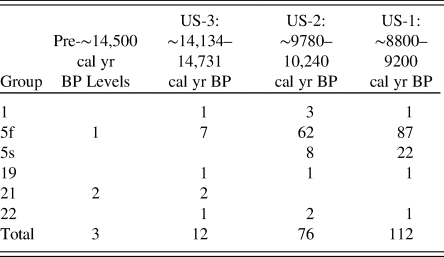
All artifacts at site CH-I were recovered from stratified layers, almost exclusively from the use-surfaces. The assemblages from use-surfaces include projectile point and biface fragments, an end scraper, grinding-stone fragments, a perforator, subspherical and spherical stones, nonstandardized flake tools, discarded flakes, shatters, other lithic debris (see Table 2, Supplementary Figs. 7 and 8a), plant remains, and a small burned bone fragment. Technologically, with the exception of the bifaces, all lithic tools show evidence of simple reduction sequences, whether reduced from a pebble or prepared core, and typological variation, all of which do not differ from previous assemblages recovered at MV-I, MV-II, CH-I, and CH-II.
Temporal placement of lithic groups by specimen type frequencies.

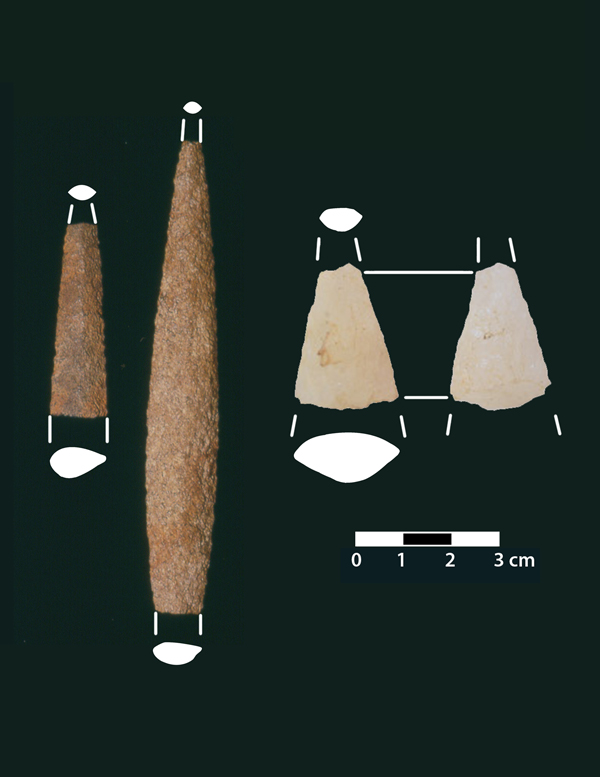
At CH-I, the artifacts recovered in 2017–2018 are divided into two scales of variation according to typological and technological change: simple tools made of local basalt, andesite, rhyolite, granite, and exotic obsidian and chalcedony, and bifacial tools made of exotic quartz and local basalt. Formed artifacts from the use surfaces are limited in number (n = 10) and characterized by a reductive technique. Others are predominantly an expedient knapping strategy. Flakes are the most abundant artifacts in the use-surfaces, accounting for a large majority of the total assemblage, most of them ranging from small to medium size (<60 mm). The frequencies of each lithic type for each use-surface are described in Table 2 (see Supplementary Material). There were some small-sized tools made from basalt and andesite flakes, 15 of which are struck from pebbles, which are similar to those found at the MV-II site dated around 14,500 cal yr BP (Collins, Reference Collins and Dillehay1997; Dillehay et al., Reference Dillehay, Ocampo, Saavedra, Sawakuchi, Vega, Pino and Collins2015). An end scraper from US-1 was made from a large, exotic gray chalcedony flake (Supplementary Fig. 3). The rhomboidal biface fragment of white quartz, directly associated with charcoal and a chestnut seed, both dated ~14,500 cal yr BP in US-3, reveals a reductive sequence very similar to the three rhomboidal point fragments previously recovered from site MV-II (Fig. 7), also dated ~14,500 cal yr BP. To date, this type of quartz has been found only along the Pacific coast to the west. A flake of an exotic dark greenish-brown chalcedony also was recovered in US-3 (Supplementary Fig. 8b). Its source is unknown but like from the Andean mountains to the east. Except for the obsidian and chalcedony flakes and the quartz biface fragment, no further exotic artifacts were found in the deposits. The nearest obsidian sources are ~50–60 km to the northeast in the mountains. One large secondary flake of rhyolite and two spherical stones, one formally pecked and ground and showing an impact scar (see Supplementary Figs. 5 and 6), were recovered from deeper levels in stratum MV-7.
Fragments of bipointed rhomboidal projectile points recovered at site MV-II (two specimens on left) and from US-3 at site CH-I (specimen on right), all dated around 14,500 cal yr BP.

Preliminary refitting analyses were carried out for US-1 and US-2, which contained the largest number of flakes and burned features. Lithic debris from US-3 was minimal and not conducive to this type of study. Five and eight conjoining sets were recovered from US-1 and US-2, respectively, suggesting limited campsite sites or specialized activity areas with minimal postdepositional process. The lithic refits likely represent small moments in time and were probably derived from one to two basalt and andesite cores on each use-surface. The preliminary strike and dip results mentioned previously, coupled with the refitting sets, suggest intact use-surfaces. Nonetheless, we cannot presume that, because there are refitting sets, it follows that the spatial patterning of the distribution of lithics in relation to the burned features has not been slightly disturbed.
Functional and micro-usewear studies suggest that the simple tools and unmodified flakes had limited microwear, indicating sparse use, while the end scraper, the prepared and modified bifaces, and the perforator were used more intensively and for a longer time. As shown in Supplementary Figure 9, the micro-usewear patterns on the distal tip of the perforator from US-3 (Supplementary Fig. 8a) exhibits hinge and step fractures and bright polish more suggestive of punching and gouging than twisting and drilling. Edge wear on the quartz biface fragment was difficult to establish due to the hardness of this material and the brightness reflected under high-power microscopic light. Nonetheless, minute grain loss and slight rounding of a few aspects along the two edges of this piece suggest some use (Benson et al., Reference Benson, Franco and Dillehay2017).
Four burned features were discovered: one from US-1, two from US-2, and one from US-3 (Fig. 5, Supplementary Fig. 10), ranging from roughly 15 to 40 cm in diameter. Three of the four were thin lenses (~0.5–1.0 cm) composed of small flecks of charcoal, lithic debris, and occasional burned bone carbonized plant material. One moderate-sized hearth excavated in US-2 contained the remains of grasses possibly used as fuel or food (Scott-Cummings and Kovacik, Reference Scott-Cummings and Kovacik2017; Silva, Reference Silva2017). The burned features are not the result of burning associated with the upper MV-1 stratum or with more ancient fires, which would be evidenced by widespread horizontal burning, such as that seen in stratum MV-1 in Figures 3 and 4 and Supplementary Figures 1 and 2. The burned features also are not products of pyroclastic flows, which are present only 40–50 km to the east in the Andes. Such flows have never reached the Monte Verde area. Moreover, pyroclastic flows are sinuous and not semicircular or amorphous in form. Finally, the burned features on use-surfaces are associated with cultural artifacts and debris, unlike natural fire deposits and pyroclastic flows.
CH-I is located on a slightly higher terrace than the MV-II site, with no thick, permanently humid, peat lenses overlying the use-surfaces, and it therefore has poor preservation of organic materials. The macrobotanical remains from the burned feature in US-3 yielded carbonized seeds of chestnuts (Supplementary Fig. 11), which are available only at the end of summer or fall months (Silva, Reference Silva2017). The burned bone fragment recovered in the deeper level and associated with flakes and spherical stones in a slightly charred area was not identified to species. Macrobotanical analysis also indicates the site occupants used wood from unspecified conifer and hardwood trees/shrubs as fuel. Recovered lignified parenchymous tissue fragments could reflect unknown fruit or seed processing. However, they also may indicate other large fleshy plant organs, such as roots, leaves, cones, or bark, burned in fire. Phytolith and starch analyses also were conducted on a hearth fill in US-2 (Scott-Cummings and Kovacik, Reference Scott-Cummings and Kovacik2017). The phytolith signature indicates a local grass population dominated by cool-season grasses and including short grasses that thrive in the heat of summer. At least one of the local grasses belonged to the Stipeae tribe. One dicotyledonous plant accumulated silica, although it could not be identified. No starches were observed that might inform concerning use of this hearth.
DISCUSSION
Based on the new ages, lithics, and burned features embedded in the three use-surfaces reported here, coupled with prior findings from the site, we can place the human presence during the late Holocene between ~9000 and 10,500 cal yr BP and during the late Pleistocene around ~14,500 cal yr BP and possibly earlier. These findings, coupled with previous ones in the Monte Verde site complex, continue to suggest that two types of stone tool technologies were contemporaneous in the area beginning around 14,500 cal yr BP, a time of increased fires and charcoal deposits in the geological record that is suggestive of a greater human presence in the region (Moreno et al., Reference Moreno, Lowell, Jacobson and Denton1999). An edge-trimmed pebble-tool flake industry appears first and perhaps dates to at least ~16,000 cal yr BP (Dillehay et al., Reference Dillehay, Ocampo, Saavedra, Sawakuchi, Vega, Pino and Collins2015). The bipointed rhomboidal point type from the MV-II site is dated ~14,500 cal yr BP and represents the earliest diagnostic bifaces. The rhomboidal biface of quartz reported from CH-I also dates around ~14,500 cal yr BP and stylistically fits those at MV-II, thus technologically and chronologically linking these two sites. The later Paijan-like points appear around 10,500 cal yr BP at CH-I. If this point type truly is a Paijan-related style, then it is a few hundred years younger than its counterpart in Peru (Chauchat, Reference Chauchat2006), which may suggest continued movement of people farther south, perhaps along the Pacific coast, at the end of the Pleistocene. In addition, there are other lithics, wood charcoal, and burned bone dated between ~16,000 and at least 20,000 cal yr BP that were not found with use-surfaces but were recovered from the lower stratified, intact layers (Dillehay et al., Reference Dillehay, Ocampo, Saavedra, Sawakuchi, Vega, Pino and Collins2015). These features and materials and sequences require more contextual evidence and firm dating.
With specific reference to the use-surfaces reported here, these findings represent continuity of ephemeral cultural events along Chinchihuapi Creek and the exploitation of similar ecological zones over a period of ~5000–6000 years. These events likely represent only a particular facet of a more complexly organized hunter–gatherer society characterized by certain seasonal extractive tasks performed by small groups in specific localities for short periods of time. In the case reported here, the limited content and configuration of the archaeological evidence combine to support the proposition that CH-I also was an ephemeral hunting–gathering camp, from which limited plant and animal resources were occasionally extracted and initially processed for limited consumption and/or transport to other residential consumption locations. More recognition of the patterning inherent in such a limited distribution of features and artifacts may require a considerably more extensive excavation to demonstrate the real or complete scale of intermittent occupation at CH-I, which is different from the more intense scale and diversity of occupation within the larger, more extensive MV-II site complex.
CONCLUSION
As more archaeological research is carried out in the Monte Verde area, we continue to discover new activity areas in different places at different scales at different times, extending from ~14,500 to perhaps at least 16,000–18,000 cal yr BP. Beyond the MV-II site, the evidence from sites MV-I, CH-I, and CH-II suggests ephemeral use of the area, probably associated with seasonal movements between the Pacific coast to the west and the Andean mountains and lakes to the east. A chronological and habitational threshold in the area seems to have been reached around 14,500 cal yr BP, when a more extensive and longer occupation occurred at the MV-II site, as evidenced by a thicker use-surface; more diagnostic hearths; dwelling remains; a wider variety of domestic debris, including numerous species of local and nonlocal plants and animals; and an internal structure representative of a more diversified tasks. Before this date, between ~15,000 and perhaps 18,000 cal yr BP, the records at MV-I , CH-I, and CH-II are much less diagnostic and more discontinuous and ephemeral, associated with small burned features, unifacial lithics of local and limited exotic raw materials, and when preserved, a few bone and plant remains. Although the integrity and human intervention of some of the pre-14,500 cal yr BP records have been questioned at Monte Verde (Gibbons, Reference Gibbons2015), the similarity in and repetition of their stratigraphy and cultural deposits in MV-I, CH-I, and CH-II are consistent and reveal certain types of cultural trait continuities in the MV-II site (see Supplementary Material).
As single cultural markers, bifacial projectile points and the reductive technique generally have been treated as the most significant tool type during the late Pleistocene period in South America (cf. Dillehay, Reference Dillehay2000; Mendez, Reference Mendez2014). As with other regions of the Americas, point-bearing sites have been selectively studied to explain the development of early cultural traditions. Contrary to some traditional approaches, point technological sequences in South America (e.g., Fishtail, Paijan) increasingly appear not to have been universal across the continent until ~12,000–13,000 cal yr BP. On the other hand, simple unifacial tools at sites have generally been treated as insignificant or supplementary types. However, recent studies have suggested that lithic assemblages comprising simple or crudely made core and flake pebble tools seemingly produced by direct percussion possibly existed at least as early as ~15,000 to 16,000 cal yr BP and are distributed in several regions of the continent (Richardson, Reference Richardson and Bryan1978; Dillehay et al., Reference Dillehay, Goodbred, Pino, Vásquez Sánchez, Rosales Tham, Adovasio and Collins2017), yet more widely reported in Brazil (A.V. Vialou, Reference Vialou2005; D. Vialou, Reference Vialou2011; Lahaye et al., Reference Lahaye, Hernandez, Boëda, Felice, Guidon, Hoeltz and Lourdeaux2013; Aimola et al., Reference Aimola, Andrade, Mota and Parenti2014; Boëda et al., Reference Boëda, Clemente, Fontugne, Lahaye, Pino, Felice and Guidon2014a, Reference Boëda, Lourdeau, Lahaye, Felice, Viana, Ignacio, Mario, Graf, Ketron and Waters2014b). In several cases, such simple tools are not only incorporated in point assemblages, such as sites in the Monte Verde area, but also appear independently during coeval periods, with point industries at and after ~13,000 cal yr BP. The survival of such simple tool assemblages over extensive periods of time and space offers the opportunity for new studies of early human behavior across the continent that have not yet been fully recognized due to conservative, limited approaches.
SUPPLEMENTARY MATERIAL
For Supplementary Material referred to in this article, please visit https://doi.org/10.1017/qua.2018.145.
ACKNOWLEDGMENTS
The authors thank the Consejo de Monumentos Nacionales and Ignacio Kuschel for permission to excavate the CH-I site. Thanks also are extended to the local Monte Verdinos for their support and to the National Geographic Society, the Municipalidad de Puerto Montt, and Vanderbilt University for financing the project.