Introduction
Forests in tropical regions are being lost at an alarming rate across the world (Achard et al., Reference Achard, Eva, Stibig, Mayaux, Gallego, Richards and Malingreau2002). Among the anthropogenic causes, deforestation and urbanization are the major determinants of species loss (Marzluff, Reference Marzluff, Marzluff, Bowman and Donnelly2001; McKinney, Reference McKinney2002; Miller and Hobbs, Reference Miller and Hobbs2002). Natural and semi-natural habitats are undergoing hasty alterations; as a result, a number of species are facing an increased risk of extinction. Unlike other forms of habitat disturbance (e.g. logging), where forests may regenerate over time through ecological succession (Sheil and Burslem, Reference Sheil and Burslem2003), urbanization often irreversibly replaces natural habitats (e.g. primary forests) with persistent artificial ones (e.g. human cities), resulting in long-lasting negative impacts (e.g. species extinctions) on the native biodiversity (Stein et al., Reference Stein, Kutner and Adams2000; Koh and Navjot, Reference Koh and Navjot2004). The economic and political constraints of preserving large tracts of pristine habitats, as well as the rapidity and ubiquity of urban sprawl, have galvanized some ecologists to reconsider the traditional conservation strategies of reserving and restoring natural habitats through proper revegetation (Dale et al., Reference Dale, Brown, Haeuber, Hobbs, Huntly, Naiman, Riebsame, Turner and Valone2000; Miller and Hobbs, Reference Miller and Hobbs2002; Daily, Reference Daily2003; Rosenzweig, Reference Rosenzweig2003). The creation and maintenance of artificially revegetated habitats (butterfly parks, safaris, etc.), where certain native species can persist (Kendle and Forbes, Reference Kendle and Forbes1997), may be a viable conservation strategy in highly urbanized landscapes (Koh and Navjot, Reference Koh and Navjot2004).
Lepidoptera have been proposed as surrogate species to monitor the environmental changes by several authors (Kremen, Reference Kremen1992; Fleishman et al., Reference Fleishman, Murphy and Brussard2000). They have a wide distribution, are relatively easy to sample both as individuals and as species, and exist abundantly in different ecosystems (Blair, Reference Blair1999; Ricketts et al., Reference Ricketts, Daily and Ehrlich2002). They are strongly influenced by local weather and are highly sensitive to environmental changes (Spitzer et al., Reference Spitzer, Jaroš, Havelka and Lepš1997).
Due to large-scale destruction of habitats and unscientific agricultural practices, many species are on the verge of extinction. Butterfly gardens help to increase the population abundance, and through careful selection of host plants and restoration of habitats, a diverse assemblage of butterflies could be sustained even in urban areas. It is necessary to gather information on the impact of habitat recreation through such gardens and their effectiveness in increasing the population abundance. Updates on the seasonality and population assemblage in butterfly gardens are required to make modifications in future plans. In this context, the role of butterfly gardens in the conservation of butterfly populations and the seasonal trends in population abundance were studied at the Butterfly Safari Park, Thenmala.
Materials and methods
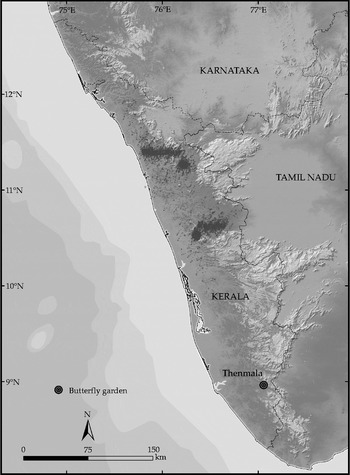
The Butterfly Safari Park at Thenmala is the first of its kind in Asia. Thenmala, located at 8°57′0″N and 77°4′0″E, is a forest-bearing tract of the Shendurney Wildlife Sanctuary in Kollam District, Kerala (Fig. 1). The Shendurney River passes through the sanctuary, the banks of which support dense forests on either side. The area was proclaimed a Wildlife Sanctuary in 1984. The Butterfly Safari Park in the Thenmala Ecotourism project area is situated in a 3-ha forestland. The terrain is undulating and the forest is slightly disturbed. A large number of butterfly host plants have been introduced in the Safari on either side of the path. Citrus, Albizia, Cassia, Cinnamomum, Aristolochia, Asclepias (milkweeds), Tylophora, Wattakaka and Mussaenda are some genera of larval host plants and Ixora, Lantana, Mussaenda, Tagetes, Cuphea, Zinnia and Clerodendron are some genera of nectar plants introduced in the Safari. As butterflies are highly mobile organisms that are adapted to specific ecological conditions, a carefully chosen location was selected in the Safari and another location was selected in the adjacent natural forest as the control plot. The plot selected as control was near the Butterfly Safari Park and closer to the inner natural forest with a closed canopy of big trees.
Map of Thenmala, Kerala, India.

Data collection
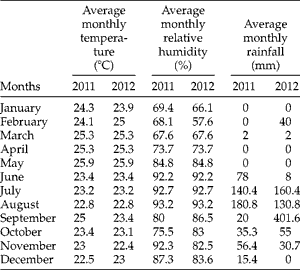
Line transect counting is the most popular method to estimate butterfly abundance (Pollard, Reference Pollard1977). The study was carried out from January 2011 to December 2012. Butterfly surveys were standardized by restricting recording to prescribed minimum weather conditions (i.e. no rain) and between 10.00 and 15.00 h, corresponding to peak butterfly flight activity (Pollard and Yates, Reference Pollard and Yates1993). The counts were made by recording the papilionid butterflies encountered at an approximate distance of 5 m on either side while walking along a fixed transect route (175 m long and 1.2 m wide) traversing the Safari regularly at 15-day intervals during the two-year period. A 30-min visual survey was done during each transect walk; the walking pace was slow but constant. The sampling period covered the flying periods of most species. The identity of butterflies, date of observation, and number of species and individuals encountered were recorded. All observations were made during the forenoon hours between 10.00 and 11.30 h during which the butterflies exhibit maximum activity. Initially, unfamiliar species were collected for identification and later released. Identification of butterflies was done using the literature (Reference LarsenLarsen, 1987a , Reference Larsen b , Reference Larsen c ; Reference Larsen1988; Wynter-Blyth, Reference Wynter-Blyth1957) or by referring to the insect collection at Kerala Forest Research Institute, Peechi, Kerala. Weather data from the Automatic Weather Station in Thenmala and those maintained by the Ground Water Department, Kollam, were collected for correlating the seasonal abundances of butterflies with the weather parameters, particularly temperature, rainfall and humidity (Table 1).
Monthly weather data of Thenmala Butterfly Safari Park

Data analysis
Data generated from the fixed transects of the study site were pooled species-wise and year-wise and analysed. The total abundance of swallowtail butterflies observed in different seasons in the study site over the study period was computed and graphically plotted. The differences in the mean abundances of butterflies sampled between seasons were compared using one-way analysis of variance. For calculating the seasonal index of each swallowtail, the number of butterflies sighted during each sampling was recorded separately for each species and the total number of butterflies sighted during each month during the study period (24 months from January 2011 to December 2012) was calculated. For comparing the butterfly population trends, the seasonal index for each month was calculated using the following formula:
 $$Seasonal\ index = month\hyphen wise\ mean/overall\ mean\times 100, $$
where the month-wise mean is the number of butterflies for a given family sighted during a particular month and the overall mean is the mean of all month-wise means. By calculating the seasonal index, it is possible to interpret the mean occurrence of each butterfly in a month in relation to the overall mean monthly sightings. The total number of butterflies sighted per month belonging to each species was recorded. The mean monthly temperature, humidity and rainfall for a period of 24 months from January 2011 to December 2012 were calculated from daily weather recordings. The correlation coefficients between the number of sightings per month and each of the above weather parameters were computed for each species.
Results
Swallowtail sightings
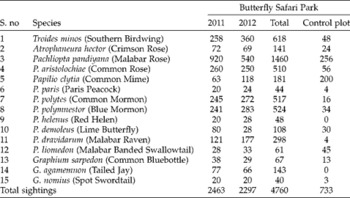
A total of 4760 individuals comprising 15 papilionid species from five different genera were recorded. Continuous monitoring of the Safari revealed 2463 individuals during the first half of the study and 2297 individuals in the second half, of which nine species are common in this area and the remaining are found only in specific seasons. Of the various species recorded, Troides minos, Pachliopta pandiyana, Pachliopta aristolochiae, Graphium agamemnon, Graphium sarpedon, Papilio polytes, Papilio clytia, Papilio demoleus and Papilio polymnestor comprised the resident populations, while species such as Atrophaneura hector, Papilio helenus, Papilio dravidarum, Papilio paris, Papilio liomedon and Graphium nomius were observed only occasionally. In each of the study years, mud puddling by the Common Bluebottle, G. sarpedon, was observed during the month of February. Among the recorded species, three species (Chilasa clytia, A. hector and P. liomedon) had protected status under different schedules of the Indian Wildlife Protection Act, 1972 (GOI, 1972), six species (T. minos, P. pandiyana, A. hector, P. polymnestor, P. liomedon and P. dravidarum) were endemic to the Western Ghats (Gaonker, Reference Gaonker1996) and two species (P. helenus and G. nomius) were extremely rare (Table 2).
Sightings of butterflies at Thenmala (January 2011–December 2012)

Of the various species recorded, eight species, namely T. minos, P. aristolochiae, P. pandiyana, P. polytes, P. polymnestor, P. dravidarum, P. clytia and G. agamemnon, had continuous resident generations throughout the year in the Butterfly Safari Park, while the remaining were recorded only during certain seasons. Species such as A. hector, P. paris, P. demoleus, P. liomedon, G. nomius and G. sarpedon were found in the Safari only during certain seasons.
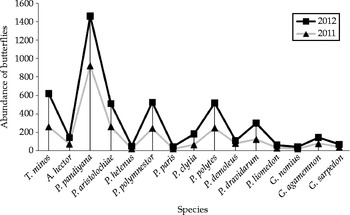
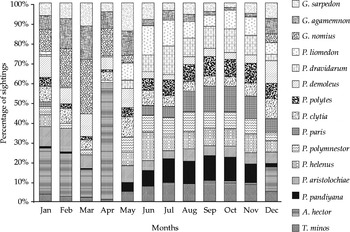
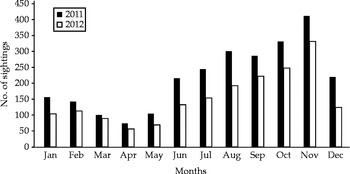
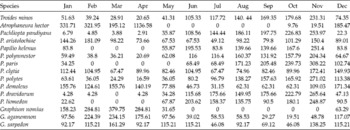
Species-wise population trends of various swallowtails in the Butterfly Safari Park are shown in Fig. 2. Troides minos, P. aristolochiae, P. polymnestor, P. polytes, P. dravidarum and P. clytia exhibited good population build-up in the second year. However, P. pandiyana and A. hector exhibited relatively high species abundance in the first year than in the second year. Data generated by pooling the total number of sightings of swallowtail butterflies from January 2011 to December 2012 showed that most members of the family were able to efficiently exploit the available resources of the Safari as good population abundance was observed throughout the year (Fig. 3). The maximum number of sightings was recorded in November 2011, and moderate population abundance was observed during December, January and February, after which there was a sharp decline from March to May in both years (Fig. 3). The number of sightings was highest during 2011 and 2012 than in the previous years, which might be due to the establishment of host plants. The butterfly populations exhibited an upward trend from June and reached its peak during November and then declined gradually till May. This may be related to nectar availability or due to appropriate climatic conditions of the Safari. Population density was maximum during the monsoon and post-monsoon periods and minimum during the pre-monsoon period. The drier months of the year appeared to be less favourable to these groups. The dry periods were the least favourable and, probably due to water scarcity, poor nectar availability and dry vegetation, resulted in low survival and less abundance of butterfly populations. It may be noted that due to habitat improvement and conservation, more and more rare species such as G. nomius, P. paris, P. dravidarum and P. liomedon were regularly sighted in the study area (Fig. 4). So, the overall population trend in the Butterfly Safari Park showed that the species abundance increased gradually from the beginning of the monsoon season and reached its maximum during September–November and exhibited a minor decrease during winter and a sharp decline in summer (Table 3).
Species-wise population trends of swallowtails in Thenmala, Kerala, India.

Seasonal abundance pattern of papilionid butterflies in different months in the Butterfly Safari Park at Thenmala, Kerala, India (January 2011–December 2012).

Seasonal index of papilionids in the Butterfly Safari Park at Thenmala, Kerala, India.

Seasonal index of swallowtails sighted in the Butterfly Safari Park during 2011–2012

Correlation between butterfly abundance and weather parameters
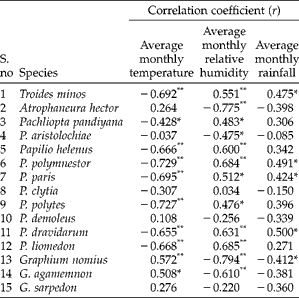
A significant negative correlation was observed between the population abundance of the swallowtails in Thenmala, namely T. minos, P. pandiyana, P. polymnestor, P. paris, P. dravidarum, P. helenus, P. polytes and P. liomedon, and monthly average temperature. These papilionids had high seasonal indices during the months of low temperature. However, a significant positive correlation was observed between the population abundance of species such as G. nomius and G. agamemnon and average temperature (Table 4). A significant positive correlation was observed between the population abundance of T. minos, P. pandiyana, P. polymnestor, P. paris, P. dravidarum, P. helenus, P. polytes and P. liomedon and humidity. The seasonal indices of these species showed correspondingly higher values during the months of high humidity. A significant negative correlation was observed between the population abundance of A. hector, P. aristolochiae, G. nomius and G. agamemnon and average humidity. A significant positive correlation was observed between the population abundance of four species, namely T. minos, P. paris, P. polymnestor and P. dravidarum, and rainfall; these species had high seasonal indices during rainy months. A significant negative correlation was observed between the population abundance of G. nomius and G. agamemnon, which are more predominant during summer months (March–April), and rainfall.
Correlation coefficient for butterfly abundance and weather parameters at Thenmala

* Correlation is significant at the 0.05 level (two-tailed).
** Correlation is significant at the 0.01 level (two -tailed).
Discussion
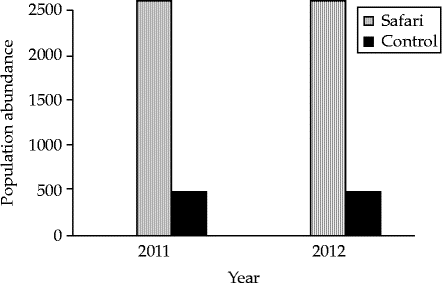
Butterfly gardens are the ‘gateways’ to protect butterfly populations and to promote in situ conservation (Mathew and Anto, Reference Mathew and Anto2007). Butterfly gardens also attract visitors, especially children and students, and thus offer opportunities for generating awareness on biodiversity conservation. Butterfly diversity may also provide surrogate measures of plant diversity because it is directly dependent on plants, often in highly coevolved situations. The Thenmala Butterfly Safari Park is located in the Shendurney Wildlife Sanctuary, and the Shendurney River, the banks of which support dense forests on either side, passes through the area. Habitat enrichment and introduction of various host plants have led to a marked increase in the number of butterflies visiting the Safari. Koh and Navjot (Reference Koh and Navjot2004) have recently reported the co-extinctions of butterflies and their host plants in Singapore and predicted that the number of extinct butterflies would increase exponentially with that of extinct host plants. They have also reported that urban parks adjoining forests have higher butterfly species richness than those that are isolated. A comparison of the overall abundance of the butterfly populations in the Safari and the control plots was also made (Fig. 5). The overall butterfly abundance revealed that the Butterfly Safari Park had the highest butterfly populations compared with the control plot, present in the adjoining natural forest in Thenmala. There was a significant difference in butterfly diversity along the Safari and control plots. Comparison of the Shannon diversity index (H), dominance index (D), Simpson's diversity index, Margalef's diversity index and Fisher's α index revealed higher butterfly diversity in the Butterfly Safari Park than in the adjoining natural forest (Table 5). The proximate mechanism underlying butterfly–host plant specificity is primarily chemical in nature (Ehrlich and Raven, Reference Ehrlich and Raven1964), although their evolutionary and ecological bases are less well understood (Gilbert, Reference Gilbert, Vane-Wright and Ackery1984). The establishment of effective conservation habitats of butterflies will depend on the selection of suitable larval and nectar host plants and the construction of various niches that attract dispersing individuals. It was also found that nectar and larval host plant availability, predator avoidance and mate locations are some important factors that affect the resource utilization and habitat exploitation of any species confined to a given geographical region.
Overall abundance of butterfly populations in the Butterfly Safari Park compared with that in the natural forest (control).

Diversity indices and abundance scores for papilionids in the Butterfly Safari Park and control plot

** Significant at 0.01 level.
Correlation between butterfly abundance and weather parameters
With regard to the species-wise abundance, T. minos, P. aristolochiae, P. pandiyana, C. clytia, P. polytes and P. polymnestor maintained more or less constant population abundance throughout the year. Their sightings revealed a strong positive correlation with weather parameters, being most abundant during the monsoon season. Some endemic and rare swallowtails such as P. dravidarum, P. paris, P. helenus and P. liomedon were sighted during the monsoon season, and the abundance of these species showed a significant negative correlation with temperature and a significant positive correlation with humidity and rainfall. Therefore, it can be assumed that the sightings of these papilionids decrease with increasing temperature and increase with increasing humidity and rainfall and vice versa. Similarly, the abundance of the species such as G. nomius, which was sighted in Thenmala during February–May, showed a significant positive correlation with temperature and a significant negative correlation with humidity and rainfall. This shows the influence of weather parameters on butterfly populations. Spitzer et al. (Reference Spitzer, Novotny, Tonner and Lepš1993) have shown positive relationships between butterfly diversity and environmental variables such as climate, habitat complexity and plant diversity. Until now, there have been few studies carried out on the role of butterfly gardens in butterfly conservation. Butterflies are often used to study the effects of climate change because of their sensitivity to climatic variables. Temperature strongly affects butterflies throughout their life cycle (Manzoor et al., Reference Manzoor, Bin Sadat and Hina2013). Direct or indirect effects of temperature have been observed on the choice of oviposition sites, egg-laying and larval development and survival rates, and range shifts and expansions (Davies et al., Reference Davies, Shaw and Etterson2005). Habitat associations of butterflies can be directly related to the availability of food plants (Thomas, Reference Thomas and Pullin1995). Each habitat has a specific set of microenvironments. More recently, Ngongolo and Mtoka (Reference Ngongolo and Mtoka2013) have reported that revegetation has positive effects on butterfly diversity.
We suggest that the number of butterfly species visiting/sighted in recreated habitats depends on the prevailing weather conditions and the availability of potential larval host plants and adult nectar plants. To determine the value of gardens in the conservation of butterflies as a whole, further studies, including all the different species in various families, are required. Proper assessments of the use and survival of butterflies in the gardens will determine their role in biodiversity conservation.
Acknowledgement
This study is a part of the PhD work of the first author carried out with financial support from the Kerala State Council for Science Technology and Environment.