Early exposure to language is often in the form of child-directed speech (CDS). According to usage-based theories of language acquisition (e.g., Tomasello, Reference Tomasello2000), CDS (speech directed toward the child in normal day-to-day interactions) facilitates language acquisition due to the availability of lexically specific (e.g., Eat X) and item-based frames (e.g., Drink X, Drink to X) that children abstract from the input, store, and retrieve either verbatim or adapted as appropriate once their knowledge becomes “productive” (Thomas & Mayr, Reference Thomas, Mayr and Morris2010). Such practices are particularly useful during the early stages of language development (Cameron-Faulkner, Lieven, & Tomasello, Reference Cameron-Faulkner, Lieven and Tomasello2003), and studies have identified a clear relationship between the frequency of items within CDS and children's eventual uptake of those items (Hart & Risley, Reference Hart and Risley1995; Huttenlocher, Haight, Bryk, Seltzer, & Lyons, Reference Huttenlocher, Haight, Bryk, Seltzer and Lyons1991; Weizman & Snow, Reference Weizman and Snow2001). Not all children are in receipt of CDS when learning language, however, particularly when introduced to a second language (L2) at school. Depending on the age at which they begin to learn an L2, many children miss out on some of the distinctive features of CDS that happen naturally in one-to-one, parent–child interactions (e.g., focused and sustained joint attention to a subject; mutual understanding of the child's utterances; playful references to child-specific usages) that are almost impossible to sustain in a large classroom environment. This is more likely the case for successive bilinguals and L2 learners (those whose first exposure to an L2 happens after the age of 3 years, usually outside the home; McLaughlin, Reference McLaughlin1985) than for simultaneous bilinguals (those whose first exposure to both languages happens before the age of 3 years, leading to “bilingual first language acquisition”; De Houwer, Reference De Houwer, Fletcher and MacWhinney1995) if exposure to both languages happens within the first month. Child L2 acquisition, the acquisition of a second language during childhood (Hoff et al., Reference Hoff, Core, Place, Rumiche, Señor and Parra2012), relies on a number of factors, not least having ample exposure to the linguistic features of the language (Unsworth, Reference Unsworth2014). In contexts where children are learning two or more languages, exposure to L2 input can be limited in terms of frequency (Gathercole & Thomas, Reference Gathercole and Thomas2009; Gathercole, Thomas, & Hughes, Reference Gathercole, Thomas and Hughes2008; Hoff, Reference Hoff2013; Oller & Eilers, Reference Oller and Eilers2002), is often delivered by nonnative speakers with varying degrees of success as compared to native speakers (Chondrogianni & Marinis, Reference Chondrogianni and Marinis2011; Hulk & Cornips, Reference Hulk, Cornips, Unsworth, Parodi, Sorace and Young-Scholten2006; Unsworth, Reference Unsworth2013), and is often domain specific (Oller, Reference Oller, Cohen, McAlister, Rolstad and MacSwan2005). These limitations in terms of input can lead to delayed development of vocabulary and of certain aspects of morphosyntactic knowledge (Chondrogianni & Marinis, Reference Chondrogianni and Marinis2011; Paradis, Reference Paradis2010; Paradis, Nicoladis, Crago, & Genesee, Reference Paradis, Nicoladis, Crago and Genesee2011; Paradis, Tremblay, & Crago, Reference Paradis, Tremblay and Crago2014; Thordardottir, Reference Thordardottir2011) relative to that of monolingual or first language (L1) children during the early stages of L2 language learning, particularly when the L2 is a minority language (Gathercole, Laporte, & Thomas, Reference Gathercole, Laporte, Thomas, Cohen, McAlister, Rolstad and MacSwan2005; Gathercole & Thomas, Reference Gathercole and Thomas2009; Montrul, Reference Montrul2008; Nicoladis, Reference Nicoladis, Altarriba and Heredia2008; Oller & Eilers, Reference Oller and Eilers2002; Rhys & Thomas, Reference Rhys and Thomas2013; Thomas, Gathercole, & Hughes, Reference Thomas, Gathercole, Hughes and Gathercole2013; Thomas, Williams, Jones, Davies, & Binks, Reference Thomas, Williams, Jones, Davies and Binks2014). In societies where two languages coexist but one dominates over the other in terms of prestige, number of speakers, and/or domains of use, gaining enough native input and exposure to the “minority” language is a challenge. As a result, children learning a minority language as an L2 often fail to achieve fluency, retaining only passive or “incomplete” knowledge of that language (Montrul, Reference Montrul2008; Thomas et al., Reference Thomas, Gathercole, Hughes and Gathercole2013). In the face of these challenges, therefore, it is necessary to turn to alternative sources of minority language input as means of supporting L2 acquisition when native-speaker input is limited. This paper examines the effectiveness of two potentially rich sources of early linguistic input within education in increasing L1 English-speaking children's exposure to native models of Welsh in a dominant L1 English society: Welsh storytelling and Welsh language children's television.
STORYTELLING
Shared book reading (or storytelling) provides children with a rich source of linguistic input. Shared book reading with young children has been shown to develop vocabulary (Collins, Reference Collins2005; Farrant & Zubrick, Reference Farrant and Zubrick2012, Reference Farrant and Zubrick2013; Robbins & Ehri, Reference Robbins and Ehri1994; Sénéchal & Cornell, Reference Sénéchal and Cornell1993; Sénéchal, LeFevre, Hudson, & Lawson, Reference Sénéchal, LeFevre, Hudson and Lawson1996), develop problem-solving abilities (Murray & Egan, Reference Murray and Egan2014), trigger higher levels of frontal brain activation (Ohgi, Loo, & Mizuike, Reference Ohgi, Loo and Mizuike2010), and help develop reading skills (Burgess, Reference Burgess1997; Lonigan, Anthony, Bloomfield, Dyer, & Samwel, Reference Lonigan, Anthony, Bloomfield, Dyer and Samwel1999; Reese & Cox, Reference Reese and Cox1999). For a comprehensive review see work by Fletcher and Reese (Reference Fletcher and Reese2005). In addition to the benefits of shared book reading, story books have been shown to contain far more examples of lower frequency, complex structures than does CDS, such as those involving a subject and a predicate and those involving two lexical verbs (Cameron-Faulkner & Noble, Reference Cameron-Faulkner and Noble2013). In comparison, while CDS contains more questions than book stories, CDS and shared book reading provide overlapping structures, but there are distinct differences in the frequency of the types of structures they contain. Stories thus offer an additional level of richness to a child's linguistic input.
Shared book reading has also been associated with gains in vocabulary development that have been explained as a by-product of the joint attention behavior that the act itself affords (e.g., Farrant & Zubrick, Reference Farrant and Zubrick2012; see Aram & Aviram, Reference Aram and Aviram2009; Hindman, Connor, Jewkes, & Morrison, Reference Hindman, Connor, Jewkes and Morrison2008; Mol, Bus, de Jong, & Smeets, Reference Mol, Bus, de Jong and Smeets2008). Joint attention has long been identified as a precursor to later linguistic development (e.g., Tomasello & Farrar, Reference Tomasello and Farrar1986), and shared book reading provides an easy context for dyadic interaction. Consequently, “[p]arents should be encouraged not merely to provide language input to their children through reading or storytelling, but also to engage their children in two-sided conversations” (Zimmerman et al., Reference Zimmerman, Gilkerson, Richards, Christakis, Xu and Gray2009, p. 342). In general, then, studies tend to highlight positive rather than negative effects of reading stories to/with children.
TELEVISION
Another potential source of language input that may provide additional types of linguistic content is television. In contrast to the known benefits of listening to stories (Cameron-Faulkner & Noble, Reference Cameron-Faulkner and Noble2013), advocating television as a means of promoting language development has long been contested, and many state that television viewing is associated with delayed language development, reduced attention span, lack of interest in school, and a range of behavioral problems such as aggressive behavior and obesity (Ohgi et al., Reference Ohgi, Loo and Mizuike2010; Paquette & Rieg, Reference Paquette and Rieg2008; Paradis, Reference Paradis2010). For example, Zimmerman, Christakis, and Meltzoff (Reference Zimmerman, Christakis and Meltzoff2007) found that exposing young children to television was associated with adverse effects on cognitive development, although Ferguson and Donnellan (Reference Ferguson and Donnellan2014) found contrary effects from reanalyses of the same data set, while Chonchaiya and Pruksananonda (Reference Chonchaiya and Pruksananonda2008) concluded that children who started watching television younger than 12 months of age for more than 2 hr a day were approximately six times more likely to show language delays. Similar findings have been found in relation to infant-directed media such as the Baby Einstein series, which has been linked to lowering vocabulary scores (Richert, Robb, Fender, & Wartella, Reference Richert, Robb, Fender and Wartella2010). Consequently, the American Academy of Paediatrics recommends that children limit television viewing to 2 hr per day, and that children under the age of 2 should not watch television at all, although Ruangdaraganon et al. (Reference Ruangdaraganon, Chuthapisith, Mo-suwan, Kriweradechachai, Udomsubpayakul and Choprapawon2009) report no association between time spent viewing television and delayed language development.
Other studies have identified positive effects of television viewing. For example, in a meta-analysis of 24 studies, which included over 10,000 children in 15 different countries, Mares and Pan (Reference Mares and Pan2013) found that children who were exposed to Sesame Street made significant gains across a series of cognitive outcomes, including literacy and numeracy, although these gains were more prominent among younger children (those between the ages of 3 and 5 years) than older children (6-year-olds). Others have identified the social and informational value of educational television programs (Calvert et al., Reference Calvert, Kotler, Murray, Gonzales, Savoye, Hammack and Hammar2001), as well as their positive links to reading achievements (Linebarger, Reference Linebarger2000) and vocabulary development among children (Rice, Huston, Truglio, & Wright, Reference Rice, Huston, Truglio and Wright1990; Wright et al., Reference Wright, Huston, Murphy, Peters, Pinon, Scantlin and Kotlin2001).
While there are benefits noted both for shared book reading and television viewing, the context within which these activities occur, along with their audiovisual delivery, may influence their ultimate effects on the listener/viewer in addition to the linguistic content of the stories/programs themselves. For shared book reading, the interactive nature of the activity itself, along with the necessity for joint attention, may contribute to the child's engagement with the language used during the activity (Cameron-Faulkner & Noble, Reference Cameron-Faulkner and Noble2013; Trivette, Dunst, & Gorman, Reference Trivette, Dunst and Gorman2010). As social environmental factors are key in providing children with a rich vocabulary, complex structures, and communicative interaction (Hoff, Reference Hoff2006; Tomasello, Reference Tomasello2000), engaging with a responsive partner is all the more important. When parental interaction is not possible, “talking books” (Chambers, Cheung, Madden, Slavin, & Gifford, Reference Chambers, Cheung, Madden, Slavin and Gifford2006; Chera & Wood, Reference Chera and Wood2003) have also been shown to help develop children's literacy skills, in the same way as “interactive” computer games may also lead to enhanced phonological awareness among “at-risk” children (Barker & Torgesen, Reference Barker and Torgesen1995).
In the case of television, real-life social interaction with an adult during viewing has been shown to lead to better verb learning among 30-month-old children, although older children (age 3+) seem able to learn verbs from video alone (Roseberry, Hirsh-Pasek, Parish-Morris, & Golinkoff, Reference Roseberry, Hirsh-Pasek, Parish-Morris and Golinkoff2009). According to Singer and Singer (Reference Singer, Singer, Asamen and Berry1998), preschoolers who watched 10 preselected episodes of Barney and Friends over a period of 2 to 3 weeks in a daycare setting showed gains in their vocabulary when compared to children who did not watch the same Barney episodes. Their gains were even larger if children participated in 30-min lessons about the episodes after viewing, suggesting that the learning experience from television is enhanced through adult involvement. This is supported by the literature showing that the more parents talk to their children, the more advanced their children's vocabulary will be (Linebarger & Piotrowski, Reference Linebarger and Piotrowski2010). It therefore seems that parental/adult mediation/co-viewing or being actively engaged is important in order to receive the full benefits offered by television. Nonetheless, some studies maintain that these benefits are achievable regardless of parental/adult mediation (for a short review, see Hoff, Reference Hoff2006).
Moreover, some television programs, such as Dora the Explorer, Arthur, Blue's Clues, and Dragon Tales, have shown a positive impact on children's expressive and receptive knowledge of vocabulary, whereas others, such as Teletubbies and Barney and Friends, have yielded much lower (expressive) vocabulary scores (Linebarger & Walker, Reference Linebarger and Walker2005). These findings suggest a strong correlation between the linguistic style and content of programs and children's abilities to enhance their vocabulary development. Linebarger and Piotrowski (Reference Linebarger and Piotrowski2010) found similar results in relation to variations within educational characteristics of programs.
The positive effects of television viewing, as reviewed above, have been explored mainly in relation to vocabulary learning and reading, and its possible effect has not been considered on other aspects of language, such as grammar. The majority of the studies have also looked at the effects of English-language television on English vocabulary and reading in contexts where English is the majority language. Very little is known about how television may facilitate learning of a minority L2 language in a majority L1 English community, such as is the case in Wales.
THE WELSH CONTEXT
The education system in Wales has been widely acknowledge as playing a principal role in sustaining the Welsh language (Thomas, Apolloni, & Lewis, Reference Thomas, Apolloni and Lewis2014; Thomas, Lewis, & Apolloni, Reference Thomas, Lewis and Apolloni2012; Thomas & Roberts, Reference Thomas and Roberts2011). Since the formation of the Welsh Language Act in 1993, local authorities have been required to provide Welsh language instruction in schools. While children are learning Welsh at school, however, how this learning is achieved varies greatly among different counties and teaching establishments, from those that adopt a Welsh immersion approach to those that are predominantly English medium, teaching Welsh as an L2 subject for a small portion of the academic week (Jones & Lewis, Reference Jones, Lewis, Thomas and Mennen2014; Lewis, Reference Lewis2008). Even though all schools in Wales are obliged to teach Welsh, either via its delivery as a medium of instruction or as an L2, many L2 teachers are themselves in the early stages of learning Welsh and often do not have the required competence or fluency to teach Welsh effectively. There is currently a shortage of fully bilingual practitioners in some regions, with less than 2% of primary school teachers outside the Welsh-medium sector able to speak Welsh (Burrowes, Bryer, Bryer, Campbell, & Charles, Reference Burrowes, Bryer, Bryer, Campbell and Charles2011, p. 45). Consequently, many children outside the Welsh-medium sector have little access to native-speaker models, and nonnative-speaker models have been shown to lessen the support for language acquisition as compared to native-speaker input (cf. Chondrogianni & Marinis, Reference Chondrogianni and Marinis2011; Hulk & Cornips, Reference Hulk, Cornips, Unsworth, Parodi, Sorace and Young-Scholten2006; Place & Hoff, Reference Place and Hoff2011; Unsworth, Reference Unsworth2013). Under such circumstances, it is logical to look for alternative sources of input that can support the delivery of Welsh-medium teaching, particularly during the early foundation years.
The purpose of this study was to investigate the effectiveness of increasing L1 English children's exposure to native Welsh models at school via television viewing (either alone or in interaction with an adult) and via storytelling, and to measure the impact of these input sources on L2 Welsh language development for vocabulary and grammar.
RESEARCH QUESTIONS
We developed our study around three core research questions:
-
1. Can TV viewing be as useful as storytelling in developing and supporting speakers’ beginning knowledge and awareness of words and patterns in a minority L2?
-
2. Are there additional benefits to co-viewing in the same way as there are additional benefits to shared book reading?
-
3. Can increasing minority language input through television and storytelling help develop all aspects of linguistic knowledge or are its effects limited to one aspect, such as vocabulary?
METHODS
Participants
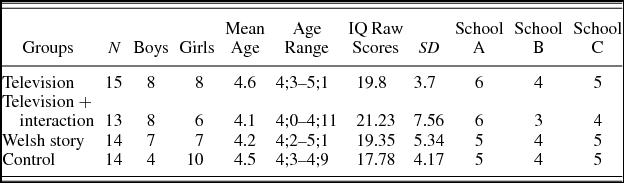
A total of 57 L1 English-speaking children (26 boys and 30 girls) between the ages of 4 and 5 years (M = 4.3 years) were recruited for this study (Table 1). All parents (bar one) reported that their child had a typical developmental history with no known cognitive disabilities. The one remaining child was receiving speech and language therapy and was thus excluded from the present study. For the remaining 56, parents reported no concerns regarding their speech or language development. All children received 100% English input at home, according to parents’ responses to a language background questionnaire and confirmed by the teachers at school and by the results of a pretest measure of knowledge of Welsh, reported below. All children were recruited from within the county of Conwy, situated in North Wales, where 27.4% of the population is Welsh speaking (Welsh Government, Reference Government2011). None of the children had previously attended any Welsh-medium nursery schools or daycare facilities where Welsh was used, according to the parents. This was established in order to ensure that the children had limited or no exposure to Welsh beforehand, such that any increases in children's knowledge over the course of the study were likely due to the test variable itself (intervention type) rather than to their previous, or current, exposure to Welsh.
Participant sample

Note: IQ Raw scores represents the mean raw score per group.
Three schools were recruited for the study. All schools were English-medium schools teaching Welsh as an L2 curricular subject. According to the office of Her Majesty's Inspectorate for Education and Training in Wales, Estyn, children's progress in Welsh is a concern in over a third of English-medium schools in the county. Schools are not required to record individual children's progress in Welsh, so no formal assessment data are available. Consequently, there is no way of tracking children's development with Welsh (Jones, Phillips, & Roberts, Reference Jones, Phillips and Roberts2013). In many schools in the region, teachers who are teaching Welsh are not native Welsh speakers, and have limited knowledge of Welsh. By focusing recruitment in this region, it was possible to recruit children who had little or no previous (direct or indirect) exposure to Welsh at home or at school, and to explore the effectiveness of the various interventions employed in this study in increasing their exposure to native-speaker Welsh in a region where Welsh is under threat of becoming marginalized in education. In two of the schools, class teachers were fluent Welsh speakers, which meant that the children would hear the teachers speak informally to each other in Welsh outside the class, but the teaching assistants in these schools were all L1 English speakers, meaning that all conversations within the classroom were in English unless Welsh was taught. In the remaining school, the teachers and classroom assistants were all L1 English speakers.
Children in each school were randomly assigned to one of four groups (see below). Distribution across genders was balanced in all three experimental groups, but there was a sampling bias toward female participants in the control group (Table 1). This was due, in part, to the randomization procedure, but also to our intention to ensure that children were assigned to all four groups in each school. We return to discuss the implications of this imbalance, particularly in light of previous evidence suggesting that gender differences do exist in relation to language development (Simonsen, Kristoffersen, Bleses, Wehberg, & Jørgensen, Reference Simonsen, Kristoffersen, Bleses, Wehberg and Jørgensen2014), in the Discussion section. Each group contained children from a variety of socioeconomic (SES) backgrounds, as measured by information offered by the parents. SES score was calculated based on parents’ occupations. Data were transformed into salary estimations using an online service (https://www.learndirect.co.uk/improve-your-job-prospects/promotion/salary-calculator/) as a crude proxy for SES. This provided estimates of an individual's average salary according to their occupation and location. A one-way analysis of variance (ANOVA) revealed no significant difference among groups, F (3, 53) = 0.32, p = .969. Further analyses also revealed that the children in each group were matched for nonverbal intelligence, F (3, 55) = 0.959, p = .419, as measured by a subset of the Kaufman Brief Intelligence Test IQ test (Kaufman & Kaufman, Reference Kaufman and Kaufman1990).
Ethical considerations
The study complied with the ethical guidelines for conducting research with children, as outlined in the British Educational Research Association (Hammersley & Traianou, Reference Hammersley and Traianou2012) and the British Psychological Society (2010) guidelines, and was approved by what was then Bangor University's College of Education and Lifelong Learning Ethics Panel. Consent forms, questionnaires, and information regarding the study were sent to the parents of each child, and each child took part on a voluntary basis. Each child was given the right to withdraw at any given time, and this was explained to them in child-friendly language.
Procedure
The design of the study followed an ABA (pretest (baseline), intervention (treatment), posttest (outcome)), experimental design (Cohen, Manion, & Morrison, Reference Cohen, Manion and Morrison2011). The contents of the pre- and posttests were different since the pretest was given in order to establish a baseline measure (i.e., the child's current knowledge of Welsh) and the posttest was carefully designed in order to establish any treatment effects (i.e., whether children had attended to some specific features within the stories or the programs received). Each group received the same pre- and posttest measures, but received different intervention procedures, as detailed below.
Phase 1: Pretest
Two tests were administered to the children before introducing the interventions. These included a subset of the Kaufman Brief Intelligence Test IQ test (Kaufman & Kaufman, Reference Kaufman and Kaufman1990), mentioned above, and a Welsh language test, containing a variety of picture referents for various Welsh words, including nouns, adjectives, and verbs, in order to measure any prior knowledge of Welsh. Because there is no standardized vocabulary test for children under the age of 7 in Welsh, our test was developed specifically for this study. Children were asked to identify 15 pictures that illustrated the Welsh word spoken out loud by the researcher. The words were chosen from Cronfa Electroneg o Gymraeg (Ellis, O'Dochartaigh, Hicks, Morgan, & Laporte, Reference Ellis, O'Dochartaigh, Hicks, Morgan and Laporte2001), a 1,000,000 word corpus of Welsh words coded for frequency, and included a list of high-frequency words that were likely to label and describe objects and actions that are easily accessible in young children's environments. There were six pictures on each page, and the child was asked to point to the correct picture. All words were different from the words in the posttest to avoid testing and practice effects (Carrier & Pashler, Reference Carrier and Pashler1992). If the child had five consecutive scores of 0 on the task (i.e., could not identify the correct picture to accompany the word), the test was terminated and the child was included in the study. None of the children tested showed any knowledge of the words, and the test was terminated very early for all children.
Phase 2: Intervention
Each child was randomly assigned to one of four groups:
-
Group 1: television
-
Group 2: television + interaction
-
Group 3: Welsh story
-
Group 4: control group
The number of children per group is outlined in Table 1.
Each group received their intervention three times a week for a period of 6 weeks. All intervention sessions lasted no more than 20 min in total. In each school, all children in a group received the intervention together. Any absences were noted and “catch-up” sessions arranged for those children as appropriate. All three interventions and the control group sessions were delivered by the same researcher, who also administered all of the pre- and posttests. For this reason, the researcher was not blind to the intervention received by a given child. The interventions began during the first few weeks of the first term at primary school (Welsh primary schools start at age 4 years, early in September).
Children in Group 1 (television) and Group 2 (television + interaction) watched 15 different Welsh television programs over the course of the intervention. These were provided by Sianel Pedwar Cymru (S4C), the Welsh language television channel, and were downloaded onto 15 separate DVDs. The programs shown were ones that had not been scheduled for broadcast or shown on the “Cyw”Footnote 1 website during the course of the study. Each DVD was played on a Samsung 15-inch screen laptop. Children in Group 1 (television) simply viewed the programs. Children in Group 2 (television + interaction) viewed the programs alongside the researcher, who interacted with the children throughout. This interaction included drawing, gaining and maintaining children's attention, repeating words, following/imitating dance moves, asking questions, and joining in with sing-alongs. The researcher followed the same “interaction script” when working with Group 2 (television + interaction) in all three schools so that the same cues, both linguistic and nonlinguistic, were presented to children receiving this intervention to avoid any confounding variables.
Children in Group 3 (Welsh story) and the control group did not see the television programs. Instead, they received 15 different stories that were read out to them by the researcher during a “storytime” activity, in Welsh for Group 3 (Welsh story) and in English for the control group. We purposefully chose to read the stories out loud given the age range of the children and the fact that they were all L2 learners of Welsh, but research has also suggested that orated stories lead to better vocabulary learning than independent reading (Suggate, Lenhard, Neudecker, & Schneider, Reference Suggate, Lenhard, Neudecker and Schneider2013). Each Welsh story was written by the researcher and contained the same story and target words that were contained in the television programs. Each story was printed out in color on A4 cardboard sheets and was bound together by a printing unit to form a storybook. The pictures in each storybook were screen-shots of the television programs. The 15 English storybooks (control group) were popular English storybooks that were deemed suitable for the target age group. The English stories received by the control group were not translations of the Welsh stories because we wanted to ensure children relied on their developing knowledge (or lack thereof) of Welsh as much as possible when responding to the test items in the posttest phase, to avoid direct carryover effects from their knowledge of the test items from English into Welsh.
Phase 3: Posttest
Following the 6-week intervention period, the researcher returned to the schools and proceeded to test each child individually on a series of eight linguistic tests (see Table 2). These tests were created purposefully for this study for the reasons noted below.
Linguistic tests

First, it was important to use words in the test that were present in the programs shown during the intervention. This was because the intervention was the main source of Welsh language for these children during this phase of the study, and vocabulary development is known to be context specific (i.e., one can only know the meaning of a word if one comes across the word) and is thus learned in a piecemeal, item-by-item manner (Tomasello, Reference Tomasello2000). Second, standardized tests (if available) rely on children's ability to generalize from their stored knowledge in a productive manner. As this was an exploratory study, with a relatively short exposure period, we wanted to have a clear measure of potential impact on the early stages of lexical and morphosyntactic awareness. We felt also that it was important to measure expressive and receptive knowledge, as well as to encourage children to make forced choices so that they could demonstrate a range of abilities when responding to the tests. Such tests are not always freely available, particularly in a minority language like Welsh. Third, in contrast to past research that measured the effects of television on vocabulary development only, we also wanted to broaden the scope of the study to measure children's developing awareness of specific grammatical patterns in Welsh. Because there are no reliable standardized measures of Welsh grammar available for this age group, as discussed above, we developed two grammatical judgment tasks ourselves.
Six of the eight tests were presented on an HB touchscreen slate tablet. The tablet recorded each participant's answer and transferred their responses to an extractable Excel file. The researcher also noted each child's answer on an A4 answer sheet. The remaining two tasks involved a real puppet, a yellow toy car, and a red box. The puppet was 15 in. tall and looked like a boy so that the children could direct the puppet to do things or judge the appropriateness of the puppet's actions and/or utterances in relation to the linguistic information provided.
Each test contained demonstrations and example trials to ensure each child understood their task fully (Table 2). The details of each linguistic test is outlined below.
Vocabulary tests
The items used in each vocabulary test were chosen purposefully from among the words used during the television programs. The linguistic content of each program was transcribed, and words were selected based on their overall frequency of occurrence across the programs. For each test, therefore, only the most frequent items were chosen.
TEST 1: NOUNS
Ten items were presented in this test. For five of the items, children were required to point to the picture referent of a given word, from a choice of three (as a measure of receptive vocabulary). The two distracter items were chosen to link to the target item, either by shape or by taxonomy (e.g., the picture referent for the target noun haul “sun” was presented to the children alongside blodyn “flower” [presented in a similar shape] and seren “star”). For the remaining five items, children were required to name the picture referents presented individually on the screen, as a measure of their expressive vocabulary.
TEST 2: WORD JUDGMENT
In this task, a small puppet was introduced to the child. The puppet (controlled by the researcher) was made to look at a series of seven pictures on the HD slate touch screen computer and name the picture on the screen in Welsh. The child's task was to decide if the puppet's response was correct or not. Because there was an odd number of items, three versions of the test were developed in order to counterbalance the items across groups and across children. Version A included three correct matches and two incorrect matches. Version B included a different set of three correct and two incorrect matches. Version C included four correct matches and one incorrect match. The incongruent words used were closely related to the correct target word either semantically or phonetically (e.g., tafod “tongue” (semantic) and diwedd “end” (phonetic) for dannedd “teeth”). Test versions were assigned such that versions were distributed approximately equally within and among the treatment groups.
TEST 3: ADJECTIVES
Ten words selected from the television programs measured children's productive and receptive knowledge of adjective forms. In order to measure expressive knowledge, children were shown five pictures that depicted particular adjectives and were asked to label the pictures using adjectives in Welsh. As a measure of receptive knowledge, children were asked to judge whether the puppet (controlled by the researcher) produced the correct adjective for a given picture each time. Again there were five items, two that were correct and three incorrect. A range of adjectives was used, including color terms, emotion terms, and terms depicting visual states (e.g., blêr “messy”).
TEST 4: VERBS
Twelve verbs were chosen from the Welsh television programs. Six measured productive knowledge, and the remaining six measured receptive knowledge. Each child saw an animated clip of cartoon animals “acting out” each verb. For the expressive aspect of the task, children were asked to produce the Welsh verb for the animation taking place. For the receptive aspect, the puppet produced a verb to accompany the animated clip. Half of the puppet's productions (3/6) were correct, and half were incorrect. The child had to decide if the verb produced by the puppet was the appropriate verb form to name the action in the clip.
TEST 5: PREPOSITIONS
The final vocabulary task was created to measure children's receptive knowledge of prepositions. While prepositions are considered to be at the interface between the lexicon and syntax (Bordet & Jamet, Reference Bordet and Jamet2010), we classified our preposition task as a vocabulary task simply because children responded to the prepositions as isolated “words” (i.e., outside any syntactic context).
Eight simple prepositions that had been previously used during the Welsh interventions were chosen. Four required the child to “act out” the preposition given, and four required the child to judge the appropriateness of the form used. For the “act out” task, each child was given a small yellow toy car and the researcher (using the target prepositions) asked the child to place the car, for example, ar “on . . .” o dan “under . . .,” or wrth “by . . .” the red box in front of them. For the judgment task, a puppet was made to follow the same process of placing the toy car in the correct location following the researcher's instructions, and the child's task was to decide if the puppet had placed the car in the correct or incorrect place. In two of the instances, the positioning of the car was incongruent with the preposition given, and in the remaining two instances, the positioning of the car was congruent with the preposition.
Grammar tests
TEST 6: PLURAL MORPHOLOGY
A set of 12 plural forms was presented to the children, half of which measured receptive abilities and half measured expressive abilities. Welsh plural morphology is complex, involving a variety of suffix additions to singular stems, singular–plural suffix alterations, and singular suffix deletion, all with or without additional sound alterations to the stem, internal vowel changes alone, and a small set of additional suppletive forms (see Thomas, Williams, et al., Reference Thomas, Apolloni and Lewis2014). In the receptive task, each child saw a picture (e.g., afal “apple”) and the researcher gave them three potential plural form options (stem + one of three potential plural suffix markers), two of which were incorrect (e.g., *afal od and *afal s ) along with the correct target form afal au “apples.” The task was to select the correct plural form that accompanied the given picture from among the three options. In the productive task, the child saw two pictures, one containing a single example of the referent (e.g., a picture of a dog) and the other containing several pictures of the same referent (e.g., a picture of multiple dogs). The child's task was to produce the plural form (in this case, cŵn “dogs” for ci “dog”) by naming the picture containing the multiple referents.
TEST 7: RECEPTIVE KNOWLEDGE OF SYNTACTIC STRUCTURE
This test targeted children's knowledge of noun + adjective order and Welsh sentential expressions.
-
Part 1: Noun + adjective word order: Welsh word order generally follows the noun + adjective format (with minimal exceptions), whereas English word order follows the reverse adjective + noun pattern. A total of 12 two-word statements (containing a noun and an adjective) were used in this test, 6 following the correct noun + adjective Welsh format (e.g., het bach “small hat”) and 6 following the incorrect English adjective + noun format (e.g., *bach het Footnote 2 “*hat small”). The researcher read out both the correct (noun + adjective) and the incorrect (adjective + noun) statements that were displayed on the HP touchscreen in front of the child, and the child's task was to decide which two-word statements were correct in Welsh and which were not.
-
Part 2: Sentential expression: Ten sentences were chosen for this part. Half were grammatically correct (e.g., ‘Dw i yn hapus “I am happy”). The remaining half included errors, some of which are typically heard among L1 English speakers who are L2 learners of Welsh, reflecting a reliance on the underlying structure of English word order (see Gathercole & Thomas, Reference Gathercole, Thomas, Cohen, McAlister, Rolstad and MacSwan2005; Thomas, Cantone, Davies, & Shadrova, Reference Thomas, Cantone, Davies, Shadrova, Thomas and Mennen2014, for issues relating to cross-linguistic transfer in Welsh-speaking bilinguals), while others were developmental errors that are heard by L1 and L2 speakers but are sustained for longer among learners than native speakers. These errors included the use of the masculine numeral dau “two” and pronoun (f)o “him, it” for a feminine referent and the erroneous person realization of the present-tense (affirmative) form of the verb bod “to be”: *mae fi is-I “*I is” versus rydw i am-I “I am.” The researcher would read out both correct and incorrect sentences that were displayed on the HP touchscreen, and the child's task was to decide which sentences “sounded right” and which ones “sounded wrong” in Welsh to the child.
TEST 8: MORPHOPHONOLOGY: WELSH MUTATION SYSTEM
A total of 20 simple, two-word sentences were read out to the children in conjunction with a picture seen on the screen. Half contained correct mutations, and half contained an incorrect mutation. Mutation in Welsh is a morphophonological process whereby a closed set of initial consonant sounds undergoes phonological change (lenition, nasalization, or aspiration) when in certain syntactic contexts (see Thomas & Gathercole, Reference Thomas and Gathercole2007; Thomas & Mayr, Reference Thomas, Mayr and Morris2010). For example, words with an initial /p/ sound undergo mutation to a /b/ sound if occurring after the preposition ar “on” (e.g., pêl “ball” /pɛl/, ar bêl /ar bɛl/ “on (a) ball”). The child's task was to decide which sentences “sounded right” and which “sounded wrong.”
RESULTS
Based on findings from previous studies, we hypothesized that children would perform as follows:
-
1. All children receiving some kind of Welsh input, Group 1 (television), Group 2 (television + interaction), and Group 3 (Welsh story), would show some gains in Welsh knowledge, over and above those demonstrated by the control group.
-
2. Within the intervention groups, however, the dyadic element of storytelling (Group 3: Welsh story) and interactive television viewing (Group 2: television + interaction) would result in greater performance than passive engagement with the television (Group 1: television).
-
3. The effects of interaction would be evident in both the vocabulary and the grammar tasks.
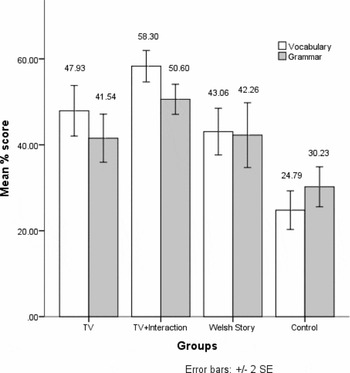
Each child scored 1 point for each correct answer and 0 for each incorrect answer on each task. These scores were then transformed into percentages. Mean scores and standard deviations obtained from the cumulative percentage scores are presented in Figure 1.
Mean percentage score per group on vocabulary and grammar tests with standard error bars.

A one-way ANOVA involving intervention group (Group 1: television, Group 2: television + interaction, Group 3: Welsh story, and control group) as a between-groups independent variable and cumulative score on vocabulary tests as a dependent variable revealed a main effect of intervention group, F (3, 55) = 30.27, p < .001. Tukey's post hoc analysis revealed that the significance associated with intervention group was due, first, to a difference between all intervention groups and the control group (p < .001 in all cases), Group 1 (television): M = 47.92, SD = 11.34; Group 2 (television + interaction): M = 58.29, SD = 6.61; Group 3 (Welsh story): M = 43.06, SD = 10.16; control group: M = 24.79, SD = 8.4, where all intervention groups performed better than the control group, as predicted; and, second, to a difference between Group 2 (television + interaction) and Group 3 (Welsh story; p = .001), and Group 2 (television + interaction) and Group 1 (television; p = .026) with children in Group 2 (television + interaction) selecting, correcting, and producing more correct items than children in Group 3 (Welsh story). There was no significant difference between Group 1 (television) and Group 3 (Welsh story).
A second one-way ANOVA involving intervention group as a between-groups independent variable and cumulative score on grammar tests as a dependent variable also revealed a main effect of intervention group, F (3, 55) = 8.69, p < .001. A Tukey post hoc analysis revealed that the significance was due to all intervention groups gaining higher scores on the grammar tests than the control group, Group 1 (television) vs. control group, p = .026; Group 2 (television + interaction) vs. control group, p < .001; Group 3 (Welsh story) vs. control group, p = .019. Mean scores and standard deviations for each group were as follows: Group 1 (television): M = 41.54, SD = 10.81; Group 2 (television + interaction): M = 50.60, SD = 6.93; Group 3 (Welsh story): M = 42.25, SD = 14.09; control group: M = 30.22, SD = 8.968. Unlike the vocabulary data, no significant differences were found between intervention groups in relation to the grammar tests.
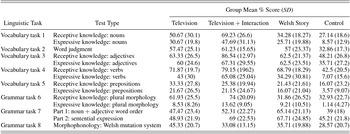
These analyses provide clear support for Hypothesis 1. The intervention groups performed better than the control group, both in relation to the vocabulary tests and in relation to the grammar tests, as predicted. Support for Hypotheses 2 and 3 is less clear, however. Contrary to the expectation laid out in Hypothesis 2, Group 3 (Welsh story) did not yield significantly greater scores than Group 1 (television). Group 2 (television + interaction) performed significantly better than Group 3 (Welsh story) in relation to the vocabulary tests. Contrary to Hypothesis 3, performance in relation to the grammar tests was nonsignificant across the three intervention groups. In order to explore these patterns further, visual inspection of the data was undertaken and revealed some interesting trends in relation to each hypothesis (see descriptive data per test in Table 3). These additional patterns are reviewed briefly below.
Mean percentage scores for each test per intervention group

First, contrary to the general patterns for all other vocabulary tests, the preposition tests showed no marked differences among groups, although the greatest performance was found among children in Group 1 (television). Given that all groups performed relatively low on this task (the highest mean performance was only 33.33%), prepositions may be too subtle in natural speech input for children to pick up within the time frame of this intervention, and a greater critical mass of examplars (Maratsos, Reference Maratsos2000) may be required for noticeable development in this domain. We return to this point later in the discussion. Similarly, no discernible difference was found among the groups’ results on the mutation task. Given that all groups performed relatively low on this task, this pattern may be indicative of the morphophonological complexity of the structure and the subtlety of its overt realization in speech. Children may require much more exposure to linguistic systems of this type as compared to other aspects of grammar or of vocabulary, as tested in this study, in order to abstract out discernible patterns from the input.
Second, regarding the performance of children in dyadic interactions versus passive contexts of learning, watching television while interacting resulted in greater increases of receptive knowledge of Welsh words than storytelling, with Group 3 (Welsh story) gaining the weakest scores regarding their performance on the nouns tests. Little difference was seen between Group 3 (Welsh story) and the control group, which is contrary to Hypothesis 1, although expressive abilities of the control group children were consistently weaker, as one might expect. Contrary to Hypothesis 2, however, watching Welsh television, with (M = 74.00%) or without (M = 61.93%) interaction with an adult, resulted in higher scores on receptive knowledge of plural forms as compared to listening to a Welsh story alone (M = 31.86%), with the control group performing at a similar level (M = 32.93%). Performance on the productive element was equally low for all groups.Footnote 3
Finally, although there were no significant differences in general across the three intervention groups on the grammar tasks, the highest scores in relation to receptive knowledge of aspects of the syntactic structure of Welsh were seen among children in Group 3 (Welsh story) on the noun + adjective word order, and among children in Group 2 (television + interaction) on sentential expression, which partly supports Hypothesis 2.
DISCUSSION
The present study was designed to explore the potential role of two types of minority language input sources (orated stories and minority language television) in increasing L1 English-speaking children's exposure to and early development of the Welsh language. In general, the results suggested that exposing children to Welsh via the medium of television was equally as beneficial, if not more so in some cases, as storytelling, particularly within the context of social interaction. This suggests a useful and effective role for the use of television programs in relation to L2 language development in minority language contexts.
Returning to our hypotheses, our study revealed that children exposed to some kind of Welsh input, Group 1 (television), Group 2 (television + interaction), and Group 3 (Welsh story), did show greater gains in their knowledge of Welsh than children in the control group, as per Hypothesis 1. Whether or not the fact that there was a gender imbalance within the control group in favor of girls had any bearing on these results is not clear from this study. As girls are often believed to have superior linguistic abilities to boys, however, these results remain interesting.
Contrary to Hypothesis 2, however, which predicted that the dyadic element involved in storytelling (Group 3: Welsh story) and co-viewing of television (Group 2: television + interaction) would lead to greater effects than passive television viewing alone (Group 1: television), performance of children in Group 2 (television + interaction) on cumulative vocabulary scores was significantly different from those in Group 3 (Welsh story), and children in Group 3 (Welsh story) did not differ significantly from those in Group 1 (television). On the grammar tests, there was no significant difference in performance across the three intervention groups. These results are contrary to what was predicted for Hypotheses 2 and 3.
The results relating to each hypothesis are discussed in turn below, including (a) the role of increased exposure to L2 in supporting children's acquisition of a minority language, (b) the role of social interaction in supporting language development, and (c) the effects of different mediums of linguistic exposure on the development of vocabulary and grammar.
L2 Exposure
As was predicted, watching age-appropriate Welsh language television programs and listening to Welsh stories led to significantly greater gains in the Welsh vocabulary and grammar knowledge of L1 English-speaking 4- and 5-year-olds, in comparison to the control group. These gains in knowledge were particularly salient in relation to vocabulary, and most striking among children in Group 2 (television + interaction). This positive relation between vocabulary development and interaction is consistent with several other past findings, as outlined above (Cameron-Faulkner & Noble, Reference Cameron-Faulkner and Noble2013; Trivette et al., Reference Trivette, Dunst and Gorman2010; Zimmerman et al., Reference Zimmerman, Gilkerson, Richards, Christakis, Xu and Gray2009), and is consistent with Tomasello's usage-based theory (Tomasello, Reference Tomasello, Good and Yu2012), which argues that languages are learned through environmental and social opportunities. Our findings are consistent with previous studies that show positive links between television viewing and vocabulary development in English (Rice et al., Reference Rice, Huston, Truglio and Wright1990; Wright et al., Reference Wright, Huston, Murphy, Peters, Pinon, Scantlin and Kotlin2001), and suggest that, in contexts where exposure to an L2 may be limited, such as is the case for Welsh in certain parts of Wales, exposing children to an L2 via television can serve a useful role during the beginning stages of L2 learning.
Social interaction
It was clear from this study that exposure to native Welsh models on television, with or without interaction with the researcher, resulted in similar or better gains in knowledge than exposure to storytelling, particularly when the programs were viewed while interacting with an adult. Only one test (noun + adjective word order) reported higher scores for the Welsh story group. The benefits of interaction during television viewing may be linked to the nature of the interaction itself as much as the linguistic content of the programs. Similar findings have been revealed in relation to shared book reading (Cameron-Faulkner & Noble, Reference Cameron-Faulkner and Noble2013; Reese & Cox, Reference Reese and Cox1999). Whether or not our findings would be different if the adult interacting with the child was a nonnative speaker, however, is unknown. Further research on the implications of native versus nonnative input is required, particularly in contexts where a child's primary exposure to a minority language may be via nonnative teachers at school. Even then, the fact that TV viewing itself resulted in linguistic gains that were akin to those observed in the storytelling condition in many of the tasks suggests that providing Welsh-medium TV programs constructively to children as part of a carefully designed language curriculum may aid those teachers who are unable themselves to provide the appropriate nativelike modeling for learners (cf. Durkin & Conti-Ramsden's, Reference Durkin and Conti-Ramsden2014, notion of “constructive use” of new media with children with language impairments). Further studies are now needed to explore in more detail the quality and types of interactions that lead to better learning.
It is important to note here that Group 2 (television + interaction), Group 3 (Welsh story), and the control group required some level of interaction with an adult (in this case, the researcher). The level of interaction differed across groups, however. In Group 2 (television + interaction), the interaction largely consisted of drawing, gaining, and maintaining children's attention; repeating words; following/imitating dance moves; asking questions; and joining in with sing-alongs (actions that are known facilitators of early language development; Good, Russo, & Sullivan, Reference Good, Russo and Sullivan2014; Hoff, Reference Hoff2013). In this context, therefore, children were receiving additional examples of Welsh that were reinforced nonverbally. Conversely, for Group 3 (Welsh story) and the control group, the “interaction” was limited to the researcher's performance itself, including exaggerated facial expressions, enhanced prosodic features in her speech, and bodily gestures. That is, the researcher's “performance” was the complete input source for both Group 3 (Welsh story) and the control group, whereas the researcher complemented and enriched the linguistic input source provided for Group 2 (television + interaction). In both story groups, the researcher refrained from diverting from the text itself, eliciting less direct interaction while retaining the children's interest and attention. Television programs may have sustained and captured children's attention for longer than books as there was more “going on.” Past research has also suggested that visual and audio cues aid vocabulary learning (Al-Seghayer, Reference Al-Seghayer2001). The television programs included actual visible movement (very useful for the development of verbs) and scenes backed up by actions (useful to help develop word–meaning links), purposeful use of noise, and varied intonation patterns (to accentuate certain parts of speech). Finally, repetition and the use of rhymes and songs may have all influenced the success of children's retention of information from television, thus facilitating their vocabulary development. This is consistent with findings reported in Hoff (Reference Hoff2006), who noted that repeated exposure to words via television enhanced learning even without coviewing.
Our data therefore suggest that watching television can be as beneficial as hearing a Welsh story, but if the television viewing is conducted within an interactive context, the linguistic gains are even stronger. Whether or not similar patterns would have been seen in the story group had the researcher been more interactive (i.e., should the researcher have diverted from the story text in a way that would complement the story content) is beyond the scope of the present study, but evidence to date on the merits of sticking to story text (or not) is mixed (Cameron-Faulkner & Noble, Reference Cameron-Faulkner and Noble2013).
While insufficient by itself as a means of providing the necessary linguistic experience that a child requires to learn a language, our results suggests that television foreground viewing (when the child's main activity is watching television) may support minority language development, particularly in relation to the development of the lexicon, and may be useful as part of a planned classroom activity. While the programs used in the present study were not claimed by S4C to have been developed specifically as educational programs (they were classified more as entertainment), they nevertheless showed their potential to act as “informal educators” (Linebarger & Piotrowski, Reference Linebarger and Piotrowski2009). Whether or not “educational” Welsh television would provide similar patterns of behavior is an avenue for future research. It may be beneficial, therefore, for schools with nonnative teachers who may not feel confident enough to read Welsh language stories at the end of the school day to instead show a 10-min Welsh television program to children.
Components of language
Contrary to prediction, the beneficial effects of interaction were only observed in relation to vocabulary development. No significant differences were found across the intervention groups in relation to the grammar tests. Further investigation of the data revealed that there were no significant effects among all four groups on two specific tasks: the preposition task (a vocabulary task) and the Welsh mutation task (a grammar task). All groups performed relatively poorly on both. In terms of their performance on the mutation task, since studies have shown that even 9-year-old, native Welsh-speaking children are still in the process of developing this system (Thomas & Gathercole, Reference Thomas and Gathercole2007; Thomas & Mayr, Reference Thomas, Mayr and Morris2010), it is not entirely surprising that 4-year-old L2 learners were unable to demonstrate a beginning awareness of the system. The system is highly complex, and the resulting sound changes that are applied within the various syntactic contexts are very subtle. Prepositions, in contrast, often have a variety of meanings (Lorincz & Gordon, Reference Lorincz and Gordon2013). For example at in Welsh can mean to and toward; i can mean for and to, and so on. Learners have shown some confusion when trying to determine prepositional meanings in order to use them correctly (Lorincz & Gordon, Reference Lorincz and Gordon2013). Moreover, since prepositions typically contain few syllables, they also have subtle features, especially in oral speech (Lam, Reference Lam2009), rendering their abstraction from a speech stream more of a challenge for the young listener than it is for content words. L2 learners can also not depend on prepositional knowledge from their first language in learning the labels for the same concepts in their L2. For example, in Welsh, “in” is expressed in two ways, depending on the definiteness of the object. That is, in a house is expressed as mewn tŷ (in-(a) house), whereas in the house is expressed as yn y tŷ (in-the-house). Consequently, it seems that prepositions are challenging for learners and, like the Welsh mutation system, require substantial input and exposure that may not be captured easily via the types of interventions explored in this study. Since vocabulary and grammar have been shown to be strongly linked in early language development (e.g., Bates & Goodman, Reference Bates, Goodman and MacWhinney1999; Benasich & Tallal, Reference Benasich and Tallal2002; Marchman, Martínez-Sussmann, & Dale, Reference Marchman, Martínez-Sussmann and Dale2004; Newman, Ratner, Jusczyk, Jusczyk, & Dow, Reference Newman, Ratner, Jusczyk, Jusczyk and Dow2006), it may be that children only excel at these types of tasks when targeting the types of constructs used in this study once they have received a critical mass of vocabulary and/or linguistic “frames” from which they can start to build their own repertoire of grammatical structures (Thomas & Mayr, Reference Thomas, Mayr and Morris2010). Further studies need to investigate the linguistic content of Welsh language television programs and Welsh language stories in order to explore the types of constructions afforded by them.
Limitations
Due to timing and resource issues, one obvious limitation of this study was its focus on one specific region of North Wales and the relatively small sample size obtained per treatment group. In order that all children involved had minimal access to Welsh prior to the study, testing had to proceed during the first few weeks of the school term with children who were attending school for the very first time. This made recruitment difficult, and limited the number of schools and children able to take part. In addition, as the study was conducted by one researcher, it was not possible for the researcher to be blind to the intervention condition received by a given child, which could have inadvertently influenced posttest outcomes. Potential bias was minimized, however, through adhering to strict standardized protocol at each test phase. Given these limitations, the findings of this study should be interpreted carefully and should not be overgeneralized to the broader community based on this study alone. Further studies involving larger sample sizes and involving schools in various regions of Wales are now required.
Conclusion and implications
This study provided four different groups of monolingual English-speaking children with one of four different types of linguistic exposure: Welsh language television, Welsh language television with added interaction by the researcher, a Welsh story, and an English story (as control). Results revealed some gains in knowledge among those exposed to Welsh, as predicted, but these gains were more pronounced for vocabulary than for aspects of grammar and more obvious when exposed to Welsh via television than through listening to a story, particularly when co-viewing with an adult. Our results suggest that the linguistic content of television programs, especially when viewed within the context of joint attention with a caregiver and/or as part of a carefully designed program of academic study, has the potential to help facilitate minority L2 language learning in general, and L2 vocabulary acquisition in particular.
ACKNOWLEDGMENTS
Knowledge Economy Skills Scholarships (KESS 2) is a pan-Wales higher level skills initiative led by Bangor University on behalf of the HE sector in Wales. It is partly funded by the Welsh Government's European Social Fund (ESF) convergence program for West Wales and the Valleys.