Introduction
The presence of cognitive defects in patients suffering from schizophrenia is well established (Mesholam-Gately et al., Reference Mesholam-Gately, Giuliano, Goff, Faraone and Seidman2009; Schaefer et al., Reference Schaefer, Giangrande, Weinberger and Dickinson2013). While the earlier ‘Kraepelinian’ view was one of deteriorating cognitive functioning, more recent studies have found that cognitive deficits tend to be stable or improve over time (Szoke et al., Reference Szoke, Trandafir, Dupont, Meary, Schurhoff and Leboyer2008; Bozikas and Andreou, Reference Bozikas and Andreou2011). Cognitive impairments are associated with poorer functional outcomes (Fett et al., Reference Fett, Viechtbauer, Dominguez, de, Penn, van Os and Krabbendam2011) and understanding the factors that influence cognitive functioning is critical for understanding how to improve cognitive and functional outcomes in patients suffering from schizophrenia.
As most patients diagnosed with schizophrenia are treated with antipsychotic medication as a first-line treatment, it can be difficult to determine the natural course of cognition and effects of antipsychotic medications on cognitive functioning. Some studies have suggested that second generation antipsychotics might have to enhance the effect on cognitive functioning (Keefe et al., Reference Keefe, Seidman, Christensen, Hamer, Sharma, Sitskoorn, Lewine, Yurgelun-Todd, Gur, Tohen, Tollefson, Sanger and Lieberman2004b; Désaméricq et al., Reference Désaméricq, Schurhoff, Meary, Szöke, Macquin-Mavier, Bachoud-Lévi and Maison2014). However, these studies have mostly relied on a comparison group of patients treated with first generation antipsychotic medication and therefore cannot conclude that second-generation antipsychotics per se enhance cognitive functioning in patients diagnosed with schizophrenia (Harvey and Keefe, Reference Harvey and Keefe2001). A placebo controlled trial (n = 19), with a mean follow-up time of 24.5 days, found that cognitive functioning was enhanced when patients were treated with antipsychotic medication compared to when they were on placebo (Weickert et al., Reference Weickert, Goldberg, Marenco, Bigelow, Egan and Weinberger2003). Contrasting findings have been reported in naturalistic follow-up studies. For example, a 9-year follow-up study indicated that lifetime cumulative exposure to antipsychotic medication was negatively associated with verbal learning and memory performance over time (Husa et al., Reference Husa, Rannikko, Moilanen, Haapea, Murray, Barnett, Jones, Isohanni, Koponen, Miettunen and Jääskeläinen2014). Other studies have also found that high doses of antipsychotic medication are linked to decreased cognitive functioning (Elie et al., Reference Elie, Poirier, Chianetta, Durand, Gregoire and Grignon2010; Knowles et al., Reference Knowles, David and Reichenberg2010; Takeuchi et al., Reference Takeuchi, Suzuki, Remington, Bies, Abe, Graff-Guerrero, Watanabe, Mimura and Uchida2013). Together, these findings suggest that prolonged or higher dose antipsychotic use is associated with adverse cognitive outcomes. This could, at least partly, be explained by confounding by indication, meaning that patients treated with high dose antipsychotics for a longer time probably also have the worst illness trajectory.
Discontinuation studies of antipsychotic medication show that discontinuation leads to an increased risk of psychotic relapse (Leucht et al., Reference Leucht, Arbter, Engel, Kissling and Davis2009). However, discontinuation might be associated with benefits in other clinical domains such as cognition. One randomized discontinuation study compared patients in maintenance treatment to patients in a reduction or discontinuation group (N = 53), and found that patients in the discontinuation group improved significantly in processing speed compared to those on maintenance antipsychotics over the course of the 4–6 months follow-up (Faber et al., Reference Faber, Smid, Van Gool, Wiersma, Van and Bosch2011). Long-term follow-up studies of patients diagnosed with schizophrenia show that substantial percentages (34–40%) of patients are not treated with antipsychotic medication and many of them have no psychotic symptoms (Harrow et al., Reference Harrow, Jobe and Faull2012; Moilanen et al., Reference Moilanen, Haapea, Miettunen, Jääskeläinen, Veijola, Isohanni and Koponen2013; Wils et al., Reference Wils, Gotfredsen, Hjorthøj, Austin, Albert, Secher, Thorup, Mors and Nordentoft2016). Given a large number of patients who discontinue medication in real-world clinical practice, it is important to establish whether there is a neutral, improving or harmful association between antipsychotic medication and cognitive functioning.
Aims of the study
Using data from a randomized clinical trial (N = 400) testing the effect of prolonged specialized early intervention in first episode schizophrenia spectrum disorders (Albert et al., Reference Albert, Melau, Jensen, Emborg, Jepsen, Fagerlund, Gluud, Mors, Hjorthøj and Nordentoft2017) we aimed to examine: how many participants discontinued their medication and to compare the cognitive functioning of these participants to the participants who continued their antipsychotic treatment.
Methods
Participants
This study uses data from a previous trial in which 400 participants were recruited and randomized to either 2 or 5 years of specialized early intervention (OPUS treatment), for full description see (Albert et al., Reference Albert, Melau, Jensen, Emborg, Jepsen, Fagerlund, Gluud, Mors, Hjorthøj and Nordentoft2017). Participants were all diagnosed within the schizophrenia spectrum (ICD 10 – schizophrenia F20, schizotypal disorder F21, persistent delusional disorder F22, acute and transient psychotic disorder F23, induced delusional disorder F24, schizoaffective disorder F25, other non-organic psychotic disorder F28, and unspecified non-organic psychosis F29) (World Health Organization, 1993). Diagnoses were validated using the Schedule for Clinical Assessment in Neuropsychiatry (SCAN) (Wing et al., Reference Wing, Sartorius and Üstun1998). Participants were recruited from the established specialized early intervention teams (OPUS) in Denmark and were aged between 18 and 35 when they started treatment. Participants with moderate to severe mental retardation are not treated in the OPUS teams and thus excluded from this trial. For this study, we excluded patients who were not prescribed antipsychotic medication at baseline (n = 67) and those diagnosed with a schizotypal disorder (ICD 10 – F21), n = 83. See Fig. 1, flowchart.
Flowchart; discontinuation group and continuation group.

Main study and treatment
The main study aimed to compare 5 years (intervention group) with 2 years (control group) of OPUS treatment (Albert et al., Reference Albert, Melau, Jensen, Emborg, Jepsen, Fagerlund, Gluud, Mors, Hjorthøj and Nordentoft2017). The OPUS treatment is a psychosocial treatment program for patients with first episode schizophrenia spectrum disorders. The treatment is based in a multidisciplinary team with each case-manager having a case load between 12 and 15 patients. The three main pillars of the treatment are based around social skill training, psychoeducation and family involvement. The use of antipsychotic medication was not an operationalized part of the trial and the decision to initiate or discontinue medical treatment was the decision of the clinician and the participant. In general, antipsychotic treatment in both the intervention and the control group followed the Danish national guidelines that recommend a low dose of second generation antipsychotic medication for first episode patients. The guidelines generally recommend at least 1 year of remission from psychotic symptom before discontinuation should be attempted (Fink-Jensen et al., Reference Fink-Jensen, Rasmussen, Viuff, Larsen, Scmidt, Peacock, Stenstrøm, Glintborg, Brøsen, Gudik-Sørensen, Glenthøj, Pagsberg and Baandrup2016).
For a full description of the study and intervention see (Melau et al., Reference Melau, Jeppesen, Thorup, Bertelsen, Petersen, Gluud, Krarup and Nordentoft2011) and (Albert et al., Reference Albert, Melau, Jensen, Emborg, Jepsen, Fagerlund, Gluud, Mors, Hjorthøj and Nordentoft2017).
Assessments
Due to the design of the overall study, a baseline assessment was conducted 18 months after initiation of OPUS treatment and a follow-up assessment was conducted 5 years after initiation of treatment (3.5 years post baseline).
Participants’ diagnosis and comorbid substance abuse were assessed at baseline and follow-up using the SCAN (Wing et al., Reference Wing, Sartorius and Üstun1998). Psychopathology was assessed using the Scale for Assessment of Positive Symptoms (SAPS) and the Scale for Assessment of Negative Symptoms (SANS) (Andreasen, Reference Andreasen1984). Remission was operationalized as no score of more than 2 (2 = mild symptoms) on any global SAPS or SANS domains during the last 3 months. Level of functioning was assessed using the Personal and Social Performance Scale (PSP) (Morosini et al., Reference Morosini, Magliano, Brambilla, Ugolini and Pioli2000). Prescribed medication and dose were obtained based on the participant self-report. Use of antipsychotic medication was assessed for the last month prior to the interview and thus patients not-treated with antipsychotic medication had been drug free for at least 1 month. Chlorpromazine equivalents were calculated using Gardner's consensus study (Gardner et al., Reference Gardner, Murphy, O'Donnell, Centorrino and Baldessarini2010). Where the paper did not provide an algorithm, WHO's Defined Daily Doses (DDD) was used. Adverse drug reactions were rated using the short form of Udvalg for Kliniske Undersøgelser (UKU) side effect rating scale (Lingjaerde et al., Reference Lingjaerde, Ahlfors, Bech, Dencker and Elgen1987). The scale rates four areas of adverse effects (psychic, neurological, autonomic, etc.). The neurological domain includes dystonia, parkinsonism, hyperkinesia, tremor, and akathisia. Sociodemographic information was obtained both at baseline and follow-up.
The data from the interviews were supplemented with data from the Danish national registers. Information regarding hospitalization and outpatient contacts was obtained from the Danish National Patient Register (Lynge et al., Reference Lynge, Sandegaard and Rebolj2011). The Danish Ministry of Employment supplied data on the use of social benefits and labor market affiliation (Statistics Denmark, n.d.).
Cognitive functioning
Cognitive functioning was assessed using the Brief Assessment of Cognition in Schizophrenia (BACS) (Keefe et al., Reference Keefe, Goldberg, Harvey, Gold, Poe and Coughenour2004a). The BACS includes six individual subtests; List learning, Digit Sequencing Task, Token Motor Task, Verbal Fluency (semantic and letter), Symbol Coding and Tower of London. The six subtests have been shown to cluster into three distinct cognitive domains; Verbal Learning and Memory (List Learning and Digit Sequencing Task), Speed of Processing (Token Motor Task, Verbal Fluency and Symbol Coding) and Reasoning and Problem Solving (Tower of London) (Keefe et al., Reference Keefe, Goldberg, Harvey, Gold, Poe and Coughenour2004a; Nuechterlein et al., Reference Nuechterlein, Barch, Gold, Goldberg, Green and Heaton2004). The six subtests can further be used to construct a composite score as an estimate of global cognitive function. All subtests, domains, and global scores were converted into z-scores using means and standard deviations (s.d.) of healthy controls from two different Danish trials (n = 82) [(Glenthøj et al., Reference Glenthøj, Fagerlund, Randers, Hjorthøj, Wenneberg, Krakauer, Vosgerau, Gluud, Medalia, Roberts and Nordentoft2015) second not published].
Discontinuation of antipsychotic medication
Discontinuation of medication was defined as regularly (at least 4 days a week) taking antipsychotic medication at baseline, in any dosage, and not taking antipsychotic medication within the last month prior to follow-up. Continued medication was defined as taking antipsychotic medication at both baseline and follow-up, in any dosage.
Statistical analysis
Attrition and the non-cognitive outcome variables were analyzed using ANOVA for the continuous measures and χ2 for dichotomous measures. Mann–Whitney U test was used for outcomes with a skewed distribution. Variables with a skewed distribution are marked with a footnote c in Tables 1 and 2 and online Supplementary material.
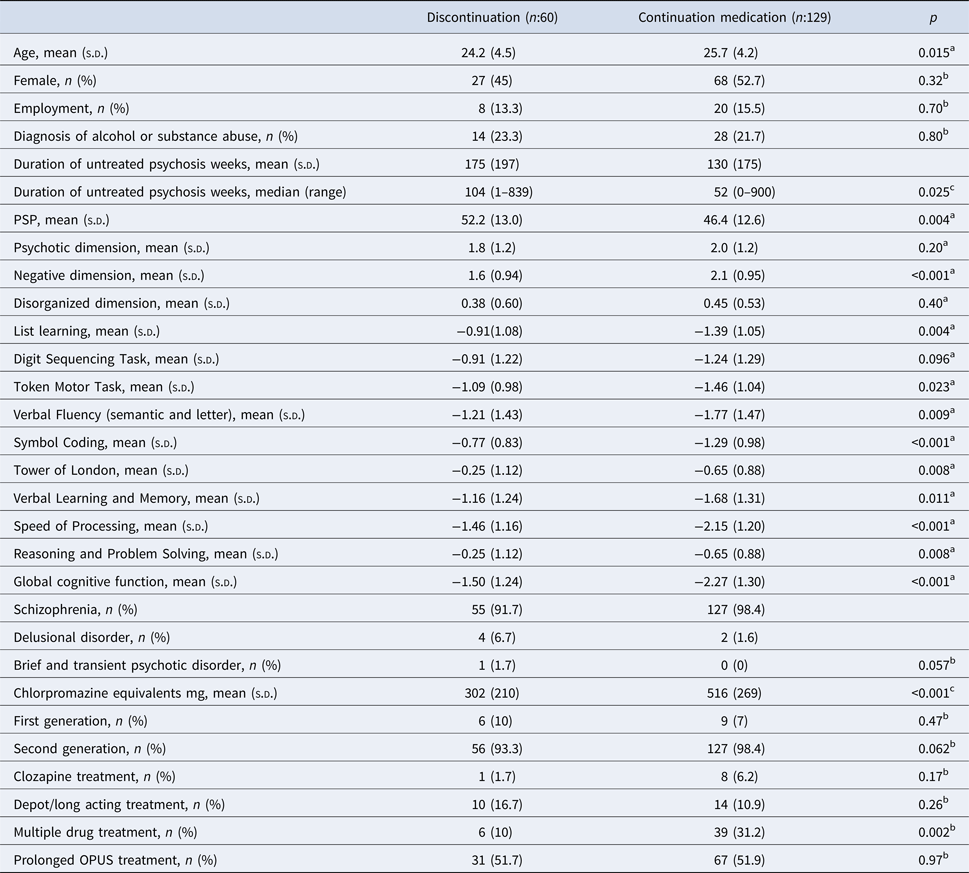
Baseline characteristics of discontinuation v. continuation medication groups

PSP, Personal and Social Performance scale.
a ANOVA.
b χ2.
c Mann–Whitney U test.
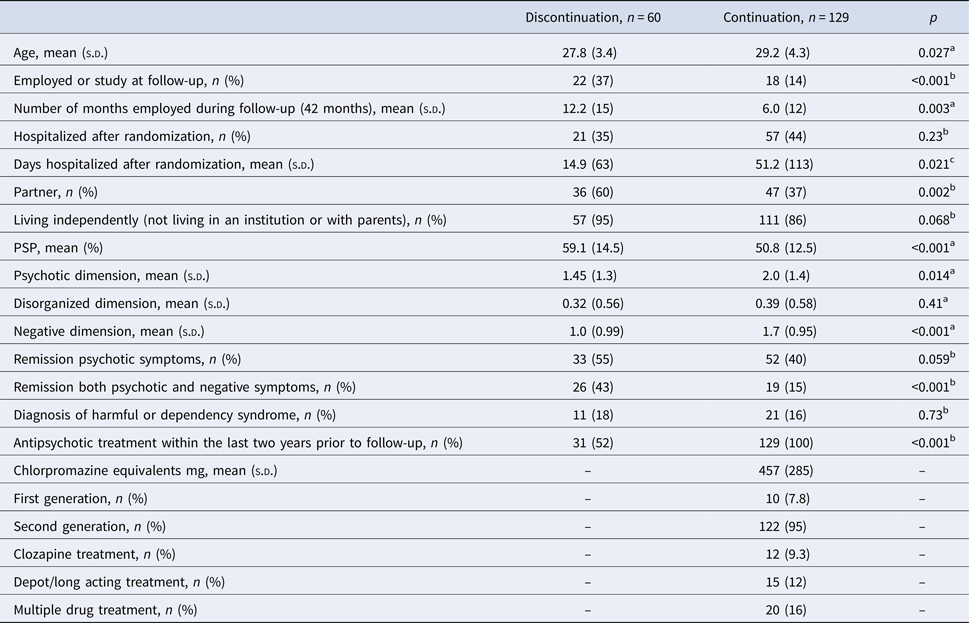
Social, functional and psychopathological outcomes at 5-year follow-up

PSP, Personal and Social Performance scale.
a ANOVA.
b χ2.
c Mann–Whitney U test.
Baseline and follow-up means and change from baseline to follow-up within each group (discontinuation and continuation medication groups) were analyzed separately using a paired sample t test.
The cognitive outcomes between groups were analyzed using linear mixed modeling with repeated measures, using Compound Symmetry as repeated co-variance type. We also included the interaction between group and time to account for the large baseline differences between groups. Estimates were corrected for the possible effect of age, gender and baseline level of functioning and negative symptoms. To avoid an effect of the randomization, the randomization variable was included with the co-variates in a sensitivity analysis.
Interrater reliability
All raters were certified in using the SCAN and the BACS. Equally the raters were trained in using the SAPS and the SANS. The intra-class correlation coefficient varied between the baseline and the follow-up period from 0.63 to 0.77 for the negative dimension and 0.7 to 0.9 for the psychotic dimension.
Results
Included sample
Of the 277 participants assessed at baseline 204 (73.6%) attended the follow-up interview. Of these, complete data regarding cognition and use of medication were available for 189 (68.2%) at both baseline and follow-up. At the follow-up assessment 60 (31.7%) of these had discontinued their antipsychotic medication (discontinuation group) and 129 (68.3%) were still in treatment with antipsychotics (continuation group). See Fig. 1, flowchart.
Characteristics at baseline
The discontinuation group was significantly younger at baseline compared to the continuation group. Negative symptoms were significantly lower and level of functioning was significantly higher in the discontinuation group compared to the continuation group. Mean standardized scores showed deficits were evident across all cognitive domains in both groups; however, cognitive scores were significantly higher in the discontinuation group compared to the continuation group. The discontinuation group was treated with significantly lower doses of antipsychotic medication and significantly fewer were treated with multiple drugs. The groups did not differ in proportion allocated to prolonged OPUS v. treatment as us usual in the original trial. A full overview of baseline characteristics can be seen in Table 1.
Attrition
Comparing those who did attend the follow-up interview with those who did not, there were significant differences with regard to the negative, disorganized and psychotic dimension, with those illest at baseline being less likely to attend the follow-up interview. For a full overview, see the online Supplementary material.
Characteristics at follow-up
Table 2 shows the characteristics of the two groups at the 5-year follow-up. The discontinuation group had a significantly higher level of employment and more participants had a partner compared to the continuation group. The level of functioning was significantly higher (mean = 59.1, s.d. = 14.5 v. mean = 50.8, s.d. = 12.5, p < 0.001), and the psychotic symptoms (mean = 1.45, s.d. = 1.3 v. mean = 2.0, s.d. = 1.4, p = 0.014) and negative symptoms (mean = 1.0, s.d. = 0.99 v. mean = 1.7, s.d. = 0.95, p < 0.001) were significantly lower in the discontinuation group compared to the continuation group. More than half were in remission of their psychotic symptoms (55%), and 43% were in remission of both psychotic and negative symptoms in the discontinuation group, while in the continuation group 40% were in remission of psychotic symptoms and only 15% were in remission of both psychotic and negative symptoms. Of the discontinuation group 52% had not had antipsychotic treatment during the last 2 years. Of the participants in the continuation group, 95% were treated with second generation antipsychotic medication, 9.3% were on clozapine treatment, 12% were treated with long acting antipsychotic medication and 16% were on multiple drug treatment. Of the 60 who had discontinued their antipsychotic medication 57 (95%) answered that they, not the clinician, had initiated the discontinuation.
Cognition
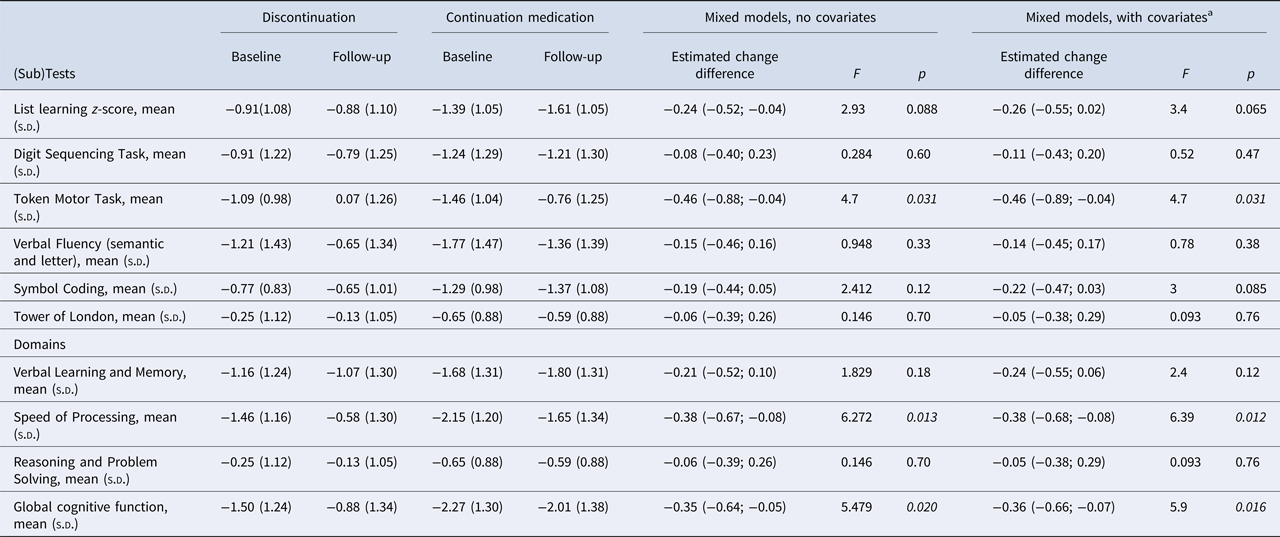
At the 5-year follow-up the discontinuation group had improved on all six cognitive tests, the three domains and global level of cognition. The change in z-score from baseline to follow-up was significant for the Token Motor Task (mean change 1.2, 95% CI 0.84–1.5, p < 0.001) and Verbal Fluency (mean change 0.56, 95% CI 0.31–0.81, p < 0.001), the Speed of Processing domain (mean change 0.88, 95% CI 0.66–1.1, p < 0.001) and global cognition (mean change 0.61, 95% CI 0.40–0.83, p < 0.001). For the continuation group, the cognitive z-scores worsened for the List Learning test and for the Verbal Learning and Memory Domain but improved for all other tests, domains and global cognition. The worsening was significant for List Learning (mean change −0.22, 95% CI −0.38 to −0.06. p = .006) and the increase was significant for the Token Motor Task (mean change 0.70, 95% CI 0.45–0.94, p < 0.001), Verbal Fluency (mean change 0.41, 95% CI 0.23–0.58, p < 0.001), the Speed of Processing Domain (mean change 0.50, 95% CI 0.32–0.68, p < 0.001) and global cognition (mean change 0.27, 95% CI 0.09–0.44, p = .003). Z-scores, but not mean changes or p values, are shown in Table 3. At the time of the follow-up, the discontinuation group had a significant higher cognitive score on all items, domains and composite scores in the univariate analyses. When the co-variates (age, sex, level of functioning and negative symptoms) were entered into the model the differences remained significant for all but the Digit Sequencing Task.
Z-scores for individual tests, domains and global cognitive functioning for discontinuation and continuation groups at baseline and follow-up. Mixed models show the difference in change over time between the two groups

a Covariates: age, sex, level of functioning (PSP) at baseline and negative symptom score (SANS) at baseline.
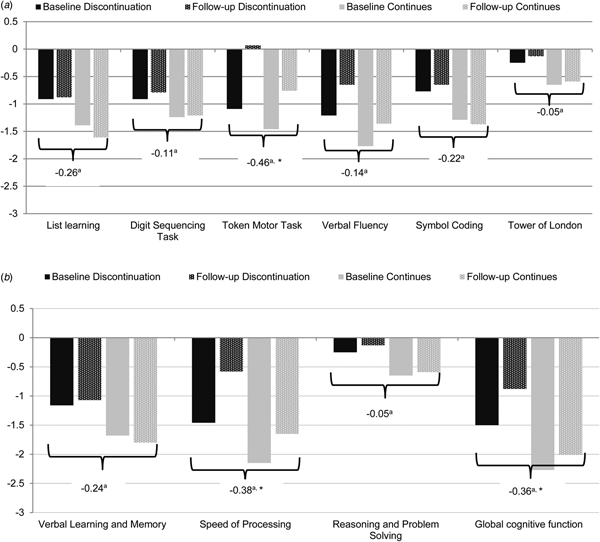
When the baseline and follow-up scores were entered into a mixed model analysis for both groups without any co-variates the change difference was significantly higher in the discontinuation group on the Token Motor Task, the Speed of Processing Domain and for global cognition; meaning that the discontinuation group had a significantly larger improvement on these scores. The inclusion of co-variates (age, sex, baseline level of functioning and negative symptoms) in the model did not change the overall results. See Table 3 and Fig. 2. The inclusion of the randomization variable did not change the outcomes.
Cognitive z-scores at baseline and follow-up for participants who discontinued or continued their antipsychotic medication. (a) Individual tests from the BACS, (b) Domains and global level of cognitive functioning. a: Estimated mean change difference from baseline to follow-up between the discontinues and continues group, *: p < 0.05.

The Token Motor Task might be influenced by extrapyramidal side effects (dystonia, tremor, akathisia, parkinsonism, and hyperkinesia) and we, therefore, conducted sensitivity analyses first including a dichotomous variable rating the presence of any neurological side effects in the multivariate models. This did not affect the results. Second, we excluded all participants reporting mild or above neurological adverse drug effects (n = 67 excluded). When these participants were excluded the change difference between the discontinuation and continuation groups were no longer significant, but the trend was still favoring the discontinuation group. When we excluded only participants reporting moderate or severe extrapyramidal side effects (n = 47 excluded) the change difference remained significant for Token Motor Task (p = 0.033), speed of processing (p = 0.032) and global cognition (p = 0.028).
Discussion
In this study, we prospectively investigated cognitive functioning in a large sample of people in the early course of schizophrenia who did and did not continue antipsychotic medication over a 3.5-year period. Of the 189 participants included at baseline, 60 (32%) had discontinued their antipsychotic medication 3.5 years later, 48% of these had discontinued their medication more than 2 years prior to the follow-up assessment. Those who discontinued their medication had higher cognitive scores at both baseline and follow-up compared to those who continued medication. In the discontinuation group cognition improved over the follow-up period, whereas some decline in cognition was observed in the continuation group. Using linear mixed models we found that the participants who discontinued their antipsychotic medication improved significantly more than those who continued their medication on the Token Motor Task, the Speed of Processing Domain and on global cognition. The linear mixed model's findings remained the same after controlling for gender, age, level of functioning and negative symptoms.
Prior findings in relation to antipsychotics and cognition
The 32% discontinuation rate is in line with prior long-term follow-ups of patients with schizophrenia showing that 31–40% of patients stop taking their antipsychotic medication (Harrow et al., Reference Harrow, Jobe and Faull2012; Moilanen et al., Reference Moilanen, Haapea, Miettunen, Jääskeläinen, Veijola, Isohanni and Koponen2013; Wils et al., Reference Wils, Gotfredsen, Hjorthøj, Austin, Albert, Secher, Thorup, Mors and Nordentoft2016). Prior studies of the relationship between antipsychotic medication use and cognition show mixed results. Some studies have found that second generation antipsychotic medication was associated with better cognition (Keefe et al., Reference Keefe, Seidman, Christensen, Hamer, Sharma, Sitskoorn, Lewine, Yurgelun-Todd, Gur, Tohen, Tollefson, Sanger and Lieberman2004b; Désaméricq et al., Reference Désaméricq, Schurhoff, Meary, Szöke, Macquin-Mavier, Bachoud-Lévi and Maison2014), but these results are most likely due to the lack of a placebo group and that the comparison group was treated with the first generation antipsychotic medication (Harvey and Keefe, Reference Harvey and Keefe2001). Two small studies found that in patients on stable antipsychotic treatment with a mean duration of illness over 10 years, a shift to placebo medication was significantly associated with decreased cognitive functioning and a worsening of clinical symptomatology compared to those who remained on stable antipsychotic treatment (Potkin et al., Reference Potkin, Fleming, Jin and Gulasekaram2001; Weickert et al., Reference Weickert, Goldberg, Marenco, Bigelow, Egan and Weinberger2003). Other longitudinal studies have found that higher lifetime exposure and higher dosage of antipsychotic medication may have a negative effect on cognition (Elie et al., Reference Elie, Poirier, Chianetta, Durand, Gregoire and Grignon2010; Takeuchi et al., Reference Takeuchi, Suzuki, Remington, Bies, Abe, Graff-Guerrero, Watanabe, Mimura and Uchida2013; Husa et al., Reference Husa, Rannikko, Moilanen, Haapea, Murray, Barnett, Jones, Isohanni, Koponen, Miettunen and Jääskeläinen2014), with verbal memory implicated in one study (Husa et al., Reference Husa, Rannikko, Moilanen, Haapea, Murray, Barnett, Jones, Isohanni, Koponen, Miettunen and Jääskeläinen2014) in line with the memory decline observed in the continued antipsychotic group of the current study. A meta-analysis using data from 15 studies and including 865 patients with schizophrenia and 565 comparison subjects also found that the dosage of antipsychotic medication had a significant negative effect on Speed of Processing (Knowles et al., Reference Knowles, David and Reichenberg2010). One randomized clinical trial (n = 53) testing the effect of guided dose reduction or discontinuation v. maintenance treatment found that the participants in the reduction/discontinuation group improved significantly on several tests within the Speed of Processing Domain (Faber et al., Reference Faber, Smid, Van Gool, Wiersma, Van and Bosch2011). These findings are consistent with our findings, and together, suggest that of all cognitive domains, Speed of Processing may be especially vulnerable with respect to antipsychotic use.
Methodological considerations
This is a nested naturalistic study using secondary data from a randomized trial in which the intervention was not designed to test the effect of antipsychotic medication on cognition. As seen at the baseline assessment the participants who later discontinued their medication had significantly better cognition, functioning, and mental health than those who did continue their medication. We controlled for this difference using mixed models, but given the design of the study, no definitive conclusions regarding causal effects of antipsychotic medication on cognition can be drawn. We did not correct for years of education which could be an important confounder. A major concern with naturalistic studies such as this is confounding by indication. We do believe that to a large degree the overall positive trajectory seen in the discontinuation group is due to a positive selection of the participants with the most benign illness trajectory. Also, the lower use of antipsychotic medication at baseline could be a marker of a more benign illness trajectory, but it could also be that the lower dose of antipsychotic medication to some degree protected the participants from any long term adverse effect of antipsychotic medication on their cognitive abilities. We do not argue that all patients can discontinue their medication and experience an improvement on their level of cognitive functioning, but rather that for some patients who are able to discontinue their medication there might be an additional positive benefit to their cognition by discontinuation.
Some of the changes on the Token Motor Task might be ascribed to the discontinued group not experiencing extrapyramidal side effects from the medication. Including extrapyramidal side effects as a dichotomous covariate did not change the results, but excluding all participants in the continuation group reporting extrapyramidal side effects did result in a loss of significance. The UKU is a rather crude measurement and the effect of discontinuation seen in Speed of Processing might be due to subtle extrapyramidal side effects which are not detected using the UKU. One other explanation for the change in significance could be the loss of power after excluding 67 participants from the analyses; this is likely to at least be a partial explanation, because the trend still seemed to favor a higher mean change in the discontinuation group, and when we only excluded participants reporting moderate to severe adverse effects (n = 47) there was no change in significance. Also, there was a significant increase in the Token Motor task score for the participants who continued their antipsychotic medication even if there were no substantial reduction in their antipsychotic doses.
Further, only 68% of the original sample was included in the analyses and those participants who were lost to follow-up had higher psychopathological scores at baseline and we have no information regarding their medication status at follow-up. All information regarding medication is based on participant report, which might be flawed. Also, we have no information regarding the duration of antipsychotic treatment prior to inclusion in the trial. This could have been an interesting variable to include in the analyses. Even if 95% of the participants answered that they had initiated the discontinuation of medication, we do not know whether discontinuation was done in cooperation with the clinician or without their knowledge, which would have been interesting to know when interpreting the results. The same rater who collected the medication data also administered the BACS at each assessment and this could have affected the test results. Participants were administered the BACS at two time points and there were 42 months between the baseline and the follow-up assessment, therefore the risk of a practice effect is rather low. However, given the large interval between baseline and follow-up assessment, the course of illness over this long period was not captured, which may be relevant to examine in future studies. Further, the only information available regarding the use of antipsychotic medication during the follow-up period was whether the participants had taken antipsychotic medication within the last 2 years. We therefore are unable to distinguish between a participant in the continuation group who had taken medication regularly for the entire follow-up period and a participant who had discontinued his or her treatment for a period and then started again prior to the follow-up interview. Although this study had a long follow-up relative to previous studies, even longer follow-up periods will be important for determining whether cognition (i.e. processing speed) further improves with discontinuation. A further question is if continued use of antipsychotics is associated with a significant decline in domains such as verbal memory. Randomized clinical trials are needed to determine whether there is a causal relationship between antipsychotic medication and cognitive function.
We believe the study has high external validity due to the large sample of participants. Of the 468 patients assessed for eligibility for the study 85% were included into the main study (see Fig. 1, flowchart). The participants were enrolled in a randomized clinical trial, but the intervention did not affect any cognitive, functional or psychopathological outcomes. The distribution between the participants who discontinued and continued their antipsychotic treatment was equal between the intervention and the control group. We therefore do not believe that the trial affected the current results, and we consider them to be generalizable to a clinical population.
We did not conduct a predictor analysis in this study, but Table 1 shows the baseline differences between the discontinuation and the continuation groups. From these results, it seems that those who later discontinue their medication have lower level of psychopathology, a higher level of functioning, lower doses of antipsychotic medication and fewer received multiple drug treatment. They were also younger and had a longer DUP. While longer DUP is associated with poorer outcomes in general (Marshall et al., Reference Marshall, Lewis, Lockwood, Drake, Jones and Croudace2005; Perkins et al., Reference Perkins, Gu, Boteva and Lieberman2005), a recent meta-analysis found that the relationship between DUP and most cognitive domains is not significant, particularly for studies with DUP longer than 1 year (Allott et al., Reference Allott, Fraguas, Bartholomeusz, Diaz-Caneja, Wannan, Parrish, Amminger, Pantelis, Arango, McGorry and Rapado-Castro2017), as was the case for this study.
Conclusion
Our study found that patients diagnosed with schizophrenia improve on most cognitive domains over time, and this is not likely due to a practice effect. Further, there does not seem to be any sign of cognitive deterioration among those who discontinue their medication, contrarily they seem to improve more than those who continue their medication. After controlling for clinically relevant baseline factors we found that some of this improvement could either be accounted for by discontinued use of antipsychotic medication or unmeasured factors associated with discontinuation. The decision to discontinue antipsychotic medication, either by a clinician or by patients themselves, should always be weighed against the possible distressing consequences of a psychotic relapse. Given the potential harmful effect of antipsychotic medication on cognition and functional outcome (Wunderink et al., Reference Wunderink, Nieboer, Wiersma, Sytema and Nienhuis2013; Husa et al., Reference Husa, Rannikko, Moilanen, Haapea, Murray, Barnett, Jones, Isohanni, Koponen, Miettunen and Jääskeläinen2014) the continued administration of antipsychotic medication should not be taken lightly and one should try to identify which patients who can discontinue their antipsychotic medication without suffering a psychotic relapse (Murray et al., Reference Murray, Quattrone, Natesan, Van Os, Nordentoft, Howes, Di Forti and Taylor2016).
Supplementary material
The supplementary material for this article can be found at https://doi.org/10.1017/S0033291718001836.
Acknowledgements
This study was funded by The Danish Agency for Science and Technology and Innovation (271-08-0568) and the TrygFonden (7-10-1057). The Capital Region Denmark and The Central Region Denmark funded the clinical part of the trial. KA is supported by a Ronald Philip Griffiths Fellowship, Faculty of Medicine, Dentistry and Health Sciences, The University of Melbourne. The funding sources had no part in the planning of the study, collecting or analyses of the data, interpreting the results, writing the manuscript or decision to submit the manuscript.
Data
A full dataset will be made available at the Danish National Archives (Rigsarkivet). Statistical codes are available from the corresponding author at nikolai.albert@regionh.dk.
Conflict of interest
None.
Ethical standards
The authors assert that all procedures contributing to this work comply with the ethical standards of the relevant national and institutional committees on human experimentation and with the Helsinki Declaration of 1975, as revised in 2008. All participants gave written informed consent to participate in the trial. The protocol was approved by the regional ethics committees for the Capital Region for review (journal no H-C-2009-035) and by the Danish Data Protection Agency (2009-41-3314). The trail from which the data were used is registered at ClinicalTrials.gov NCT00914238.