What, by the way, is one to make of a white youngster who, with a transistor radio, screaming a Stevie Wonder tune, glued to his ear, shouts racial epithets at black youngsters trying to swim at a public beach—and this in the name of the ethnic sanctity of what has been declared neighborhood turf?
—Ralph Ellison,“The Little Man at Chehaw Station,” American Scholar…to be white is to be culturally broke. The classic thing white students say when you ask them to talk about who they are is, ‘I don't have a culture.’ They might be privileged, they might be loaded socio-economically, but they feel bankrupt when it comes to culture … They feel disadvantaged, and they feel marginalized. They don't have a culture that's cool or oppositional.
—Matt Wray, quoted in Hua Hsu, “The End of White America?” The AtlanticINTRODUCTION
In this article I compare strong White racial identities: members of a White nationalist group I call “National Equality for All” and a White antiracist organization I call “Whites for Racial Justice.” The former is a politically conservative organization that advocates separation from, and superiority over, non-White people. The latter is a progressive organization that recognizes the presence of racial inequality as antidemocratic and immoral. While they employ seemingly antagonistic ways of navigating the contemporary meanings of race, they also make meaning of Whiteness and racial “others” in surprisingly similar ways. Both groups navigate a sense of their White racial selves by drawing upon dominant racial schema. They approach Whiteness as dull, empty, lacking, incomplete and meaningless, and they search to alleviate these feelings through various levels of interaction with objects, discourses, and people coded non-White.
Attention by both scholars and laypeople to White racial identity has recently burgeoned (Delgado and Stefancic, Reference Delgado and Stefancic1997; Doane and Bonilla-Silva, Reference Doane and Bonilla-Silva2003; Feagin Reference Feagin2009; Fine et al., Reference Fine, Weis, Prutt and Burns2004; Hartmann et al., Reference Hartmann, Gerteis and Croll2009; Rasmussen et al., Reference Rasmussen, Nexica, Klinenberg and Wray2001; Twine and Gallagher, Reference Twine and Gallagher2008). Such awareness reflects wide concern over Whites' place in society—from demographic changes in the United States that will soon result in the loss of White majority, the resilient connection of Whiteness to privilege and status, the diverse White “backlash” to the presidential election of Barack Obama, to the vast heterogeneity of the White populace crosscut by divisions of class, gender, age, geographic regionalism, and political attitudes (Andersen Reference Andersen, Bonilla-Silva and Doane2003; Bonilla-Silva (Reference Bonilla-Silva2010); Doane Reference Doane, Doane and Bonilla-Silva2003; Feagin Reference Feagin2000, Reference Feagin2006; Gallagher Reference Gallagher, Doane and Bonilla-Silva2004; Hughey Reference Hughey2007, Reference Hughey2010, Reference Hughey2011; Lewis Reference Lewis2004; Winant Reference Winant, Fine, Weis, Prutt and Burns2004a, Reference Winant2004b). Perhaps most importantly, a wide array of research established a paradoxical yet robust finding among the attitudes and actions of “everyday Whites”—those mainstream Whites not explicitly conscious of racial issues. On the one hand, Whites often express support for racial and cultural assimilation into a de facto category of White normativity, driven by latent beliefs in non-White cultural inferiority and race-based patriotism, while they also remark that Whiteness is “cultureless” (Perry Reference Perry2002, p. 100; Rodriquez Reference Rodriquez2006, p. 646), “bland” (Myers Reference Myers2005, p. 66), “incomplete” (Jackson Reference Jackson1999, p. 45) and “empty yet superior” (Gallagher Reference Gallagher, Delgado and Stefancic1997, p. 6–11). On the other hand, many Whites express fear that they will lose “face” (Goffman Reference Goffman1955, p. 213) through the label of “racist” (Bonilla-Silva Reference Bonilla-Silva2010, p. 53), and seemingly long for racial inclusion, interracial friendship, and ethnic and racially affiliated commodities. In sum, mainstream Whites frequently demonstrate concurrent feelings of normativity and superiority, coupled with self-perceptions of racial emptiness and longing for contact with non-Whites.
This arrangement poses both a theoretical puzzle and an empirical dilemma: in the former, how do we conceptualize a theoretical understanding of White racial identity that accounts for such intimate contradictions? And in the latter, does this paradoxical dynamic extend beyond racially unconscious, mainstream Whites to Whites with conscious and “strong” racial identities? Given this background, a fundamental task is to conceptualize if, why, and how Whites with strong identities across varied—even antithetical—contexts make meaning of Whiteness in strikingly similar ways, especially through schema of White racial “culturelessness” and potency of racial “otherness.” As Paul Croll (Reference Croll2007) writes, “There is a significant relationship between boundary maintenance and claiming a strong white racial identity…. By and large, scholars have either focused their research on racist organizations or on anti-racism activities, rarely have they looked at both” (pp. 634–635). I take up that task here.
Drawing on two ethnographic case studies, one of White nationalists and one of White antiracists, I illumine distinct ideological (political) differences alongside schematic (cultural) similarities in their interactions and descriptions of the world. This arrangement finds clarification via the conceptual framework of “White debt” and “Color capital.” White debt is shorthand for the feelings and practices associated with Whites' perceptions that their racial identity is “bland,” “cultureless,” yet also “empty yet superior.” Color capital is an object, discourse, and/or actor coded as non-White and which signifies a primordial association with exoticism, carnality, and “soul.”Footnote 1 I demonstrate different dimensions of social order in which racially conscious Whites wield Color capital toward the alleviation of White debt. These interactions serve as crucial elements in an ongoing process of White racial identity formation and help to reproduce both the logics of racial difference and the material realities of White privilege.
BEYOND GOOD AND EVIL: THE “CHANGING SAMENESS” OF WHITE RACIAL IDENTITY
In 1920, W. E. B. Du Bois published the prescient text Darkwater, in which he interrogated “the souls of white folk.” Du Bois ([Reference Du Bois1935] 1999) wrote that because White workers eschewed solidarity with non-White workers, they received a “public and psychological wage” (p. 700)—a set of symbolic and material privileges. For Du Bois (Reference Du Bois1920), the category of “Whiteness” sprang from the social relations of not identifying as a person of Color, while concurrently and paradoxically borrowing and appropriating from people of Color (p. 41). Moreover, Du Bois ([Reference Du Bois1899] 1996) provided a robust overview of how the creation of Whiteness as a field of power was maintained by Whites being “unconscious of any such powerful and vindictive feeling” (p. 322).
Du Bois's earlier insights propel the contemporary study of Whiteness (Twine and Gallagher, Reference Twine and Gallagher2008). One of the modern precepts of the social scientific inquiry of Whiteness is its continued significance as a category of unmarked normativity and invisible privilege (Delgado and Stefancic, Reference Delgado and Stefancic1997; Frankenberg Reference Frankenberg1993; McIntosh Reference McIntosh1988). Among mainstream Whites today, White racial identity is elusive at best, and as Blumer (Reference Blumer1958) notes, is often experienced more as a “sense of group position” (p. 3; Perry Reference Perry2007) in relation to non-Whites. Because Whites often consider their race as “normal,” it may acquire salience when Whites reflect on its meaning in relation to non-White “others.” Hence, Feagin and Vera (Reference Feagin and Vera1995) write, “The sincere fictions of whites encompass more than negative images of the out-group; they also involve images of one's self and one's group” (p. xi).
Contemporary scholarship recognizes that mainstream White racial identity is marked by Whites' concurrent feeling of normativity and superiority, coupled with perceptions of racial emptiness and longing for racial meaning via contact with non-Whites. Blazak (Reference Blazak, Flynn and Brotherton2008) calls such phenomenon “ethnic envy” (p. 172). Perry (Reference Perry2001, Reference Perry2002, Reference Perry2007) found that Whites in two demographically different high schools saw their Whiteness as “cultureless” and “normal,” yet they also sought out objects, discourses, and people marked as non-White to supplement an uncomfortable feeling of White culturelessness and anomie. Rodriquez (Reference Rodriquez2006) found that White youths often appropriated Black-coded aspects of hip-hop in order to give their lives a sense of racial meaning, while they concurrently code those actions as “color-blind” aesthetic choices. So also Dipiero (Reference Dipiero2002) found that Whites saw themselves as “empty yet superior” (p. 39), Myers (Reference Myers2005) remarked that Whites described themselves as “bland” (p. 66), and Jackson (Reference Jackson1999) found that Whites saw themselves as “incomplete” (p. 40). Yet, alongside these feelings, Whites also were materially privileged and evidenced attitudes of normality and superiority in reference to people of Color.
In concert with this corpus of research, many scholars emphasize that Whiteness is not one-dimensional, but exemplifies what Gilroy (Reference Gilroy1993) calls a “changing sameness” (p. xi). Gender, historical context, socioeconomic status, sexual orientation, and political affiliation crosscut White identity (Allen Reference Allen1994, Reference Allen1997; Berube Reference Berube, Rasmussen, Nexica, Klinenberg and Wray2001; Brodkin Reference Brodkin1998; Buck Reference Buck2001; Croll Reference Croll2007; Ferber Reference Ferber2000; Jacobson Reference Jacobson1998; Steinberg Reference Steinberg1995; Stoddart Reference Stoddart2002; Winant Reference Winant, Fine, Weis, Powell and Wong1997, Reference Winant2004b). Different political orientations and racialized worldviews manifest amidst particular locations of Whiteness. Also, while prior research (Blazak Reference Blazak2001; Blee Reference Blee2002; Bonnett Reference Bonnett2000; Kivel Reference Kivel2002; O'Brien Reference O'Brien, Vera and Feagin2007; Thompson Reference Thompson2001) has explored the complicated interplay of racially conscious and socially marginalized Whites in relationship to mainstream norms and values, sociological research has yet to interrogate whether or not the simultaneous display of White superiority and normativity alongside Whites' ethnic envy (Blazak Reference Blazak, Flynn and Brotherton2008, p. 172) exists among Whites with what Croll (Reference Croll2007) describes as a “strong white racial identity” (p. 634) across the political spectrum.
Most scholarship on White nationalism and supremacy centers on activist attempts to maintain racial purity and distance—as intimate contact with non–Whites and their cultural forms translates as racial contamination (Daniels Reference Daniels1997; Kaplan and Bjørgo, Reference Kaplan and Bjørgo1998; Ridgeway Reference Ridgeway1990). Blee (Reference Blee2002) finds such groups promote “a sense of racial distinctiveness and superiority among whites, condemning as ‘whoredom’ all forms of intercultural exchange, integration, and marriage or dating” (p. 57). When White nationalists do engage with people of Color, most scholars frame such interactions as rationally planned, political maneuvering, rather than the outcome of racial schema and symbolic interactions (Cooter Reference Cooter2006; Dobratz and Shanks-Meile, Reference Dobratz and Shanks-Meile1997, Reference Dobratz, Shanks-Meile and Ferber2004; Perry Reference Perry2000). For example, Berbrier (Reference Berbrier1998) finds that White supremacists intentionally deploy “cultural pluralist” rhetoric as a “conscious packaging of ‘hate-free’ racism” (p. 431). These conclusions are influenced by what Kathleen Blee (Reference Blee2007) calls an “externalist” bias (p. 120). Most scholarship relies on publicly available data (propaganda from newsletters, flyers, and Internet sites; newspaper accounts; speeches). Blee argues that scholars should examine White racist culture via “internalist” studies:
Music, clothing, style, bodily disciplines, ritual, identity, and performance are critical for recruiting new members and solidifying the commitment of participants in far-right groups. Cultural features … take on a particular salience in racist and far-right movements…. Cultural practices are essential in this process, by creating bonds among members and normalizing the ideas and actions of the far right
(Blee Reference Blee2007, p. 124).Given the lack of research of this ilk, the literature on the White far right fails to empirically verify whether the rhetoric of White racial purity and superiority might intersect with feelings of White racial emptiness and a longing for racial “otherness.”
On the other side of the conventional political spectrum, O'Brien (Reference O'Brien2000, Reference O'Brien2001, Reference O'Brien, Vera and Feagin2007, Reference O'Brien2009) finds forms of White antiracist activism range in their use of “color-blind” discourse and worldviews. There is diversity of White antiracist experience—from educational and consulting agencies to antiracist skinheads (Bonnett Reference Bonnett2000; George Reference George2004; Kivel Reference Kivel2002; Perry Reference Perry2000; Thompson Reference Thompson2001; Thompson et al., Reference Thompson, Schaefer and Brod2003; Warren Reference Warren2010). Other scholars denote the emotive demands of White antiracist organizing—settings which seemingly require precise affectations of remorse, anger, and sadness in order to perform a socially authentic White antiracist identity (Hughey Reference Hughey, Brewer and Firmin2006; Srivastava Reference Srivastava1996, Reference Srivastava2005, Reference Srivastava2006). Accordingly, Eichstedt (Reference Eichstedt2001) finds that White antiracists spend a great deal of time negotiating a positive White antiracist identity in a context which often reifies Whiteness as little more than a synonym for oppression. Whilst sociological inquiry on White antiracism is considerably more “internalist” than studies of the White far-right, little work examines how a desire for racial “otherness” intersects with White antiracist guilt and perceptions of racial dullness.
In this vein, the literatures on White racism and White antiracism both tend to assume, rather than validate or falsify, stark variation between Whites with conscious and strong racial identities and “unconscious” Whites, whether on the political fringe or in the mainstream. Moreover, rather than conceive of White racial identity as either a uniform project or as a reflection of essentially different political ideologies, we might examine the similarities between the “strongest” White racial identities. Based on data culled from a nationally representative sample, Paul Croll (Reference Croll2007) writes:
Racist organizations embrace whiteness as a source of strength and solidarity whereas anti-racist organizations come to terms with whiteness in a process of becoming aware of white privileges and of whites' role in perpetuating a system of racial inequality. It is quite possible that the strongest white racial identities lie at both ends of the spectrum, for whites who are part of either racist or anti-racist organizations. The movements for white supremacy and the movements against racial inequality may both lead to heightened White racial identities, albeit for very different reasons
(p. 618).Accordingly, the data herein provide direct evidence of similarities in understandings of White racial identities within these two extremes that was previously unavailable (Croll Reference Croll2007). However, two persistent analytic dilemmas constrain the development of sociological theory on this topic: (1) a White “culture war” and (2) overemphasis on political and resource determination.
The White “Culture War”
Many contemporary scholars note the presence of a supposed White racial “culture war” (Hunter Reference Hunter1994; Hunter and Wolfe, Reference Hunter and Wolfe2006) that denotes an ideological bifurcation within the white population of the United States (Winant Reference Winant, Fine, Weis, Prutt and Burns2004a, Reference Winant2004b). A chasm, so the story goes, is growing: White neoconservatives versus progressives; moralists versus relativists; racists versus antiracists. Many point to this split as indicative of the modern “crisis” of White identity (Doane Reference Doane, Doane and Bonilla-Silva2003; Doane and Bonilla-Silva, Reference Doane and Bonilla-Silva2003; Kincheloe et al., Reference Kincheloe, Steinberg, Rodriguez and Chennault1998; Vera and Gordon, Reference Vera and Gordon2003). Hence, Alastair Bonnett (Reference Bonnett2000) writes that the story of White racism and antiracism, “… is staged with melodrama, the characters presented as heroes and villains: pure anti-racists versus pure racists, good against evil” (p. 10). So also, Jack Niemonen (Reference Niemonen2007) remarks that we often “… paint a picture of social reality in which battle lines are drawn, the enemy identified, and the victims sympathetically portrayed…. between ‘good’ whites and ‘bad’ whites” (pp. 165–166). By substituting abstract values for “culture” and by concentrating on the extremities of explicit political rhetoric, many remain convinced that white actors constitute an increasingly bifurcated population.
Political and Resource Determination
Prominent sociological work demonstrates that competition over objective and political resources structures divisions of white racial identity (Bonacich Reference Bonacich1976; Hartigan Reference Hartigan1999; Nagel Reference Nagel, Olzak and Nagel1986; Olzak Reference Olzak1992; Tomaskovic-Devey and Roscigno, Reference Tomaskovic-Devey and Roscigno1996; Wilson Reference Wilson1980; Winant Reference Winant, Fine, Weis, Prutt and Burns2004a). Winant (Reference Winant, Fine, Weis, Prutt and Burns2004a) argues that material and political resources help to polarize White actors into antagonistic “white racial projects” (pp. 5–12) that moved in “reactionary direction” (p. 3). In this vein, Winant distills White identity into a political spectrum:
Existing racial projects can be classified along a political spectrum, according to explicit criteria drawn from the meaning each project attaches to “whiteness.” … focusing on five key racial projects, which I term, far right, new right, neoconservative, neoliberal, and new abolitionist
(Winant Reference Winant, Fine, Weis, Prutt and Burns2004a, p. 6).Such political and resource-based work is important, largely because of its generalizable reach. However, political and resource-based explanations tend toward oversimplification (via resource typology) and reduction (via political ideology).
Schemas and Narratives
“Culture war” and “political/resource-based” models tend to assume, rather than demonstrate, that different groups of Whites hold distinct understandings of their White racial identities. While there is no shortage of well-known work that explores the connection between political orientation, material resources, and White racial identity, if we wish to construct empirically based accounts of the subjective meanings of White racial identities and actions, we must provide insights into how White actors navigate the racial symbolic order (Bourdieu Reference Bourdieu1998; Burke Reference Burke1969; Weber Reference Weber, Henderson and Parsons1947). For example, Charles Tilly stressed the import of schemas and narratives in making us/them boundaries meaningful resources for constraining and enabling strategies of action. I take seriously the charge from Tilly (Reference Tilly1998) that we should study the mechanisms of identity formation that “… lock categorical inequality into place” (p. 7) and which “… operate in similar fashion over a wide variety of organizational settings” (p. 11). Hence, contemporary sociological inquiry should address why and how differently politicized Whites make meaning of Whiteness in similar ways. As McDermott and Samson (Reference McDermott and Samson2005) write, “Navigating between the long-term staying power of white privilege and the multifarious manifestations of the experience of whiteness remains the task of the next era of research on white racial and ethnic identity” (p. 256).
HISTORICAL BACKGROUND: THE DOMINANT CULTURAL LOGICS OF WHITENESS
In order to grasp how racially conscious Whites navigate the symbolic order, a caveat is necessary. Scholars point to two historically entrenched logics as defining the racial landscape of the United States: assimilation and pluralism (Bell and Hartmann, Reference Bell and Hartmann2007; Blazak Reference Blazak, Flynn and Brotherton2008; Cose Reference Cose1992; Daniels Reference Daniels2002; Klinkner and Smith, Reference Klinkner and Smith1999; Richeson and Nussbaum, Reference Richeson and Nussbaum2004; Takaki Reference Takaki1993; Taylor Reference Taylor1992; Vickerman Reference Vickerman2007). These are “cultural logics”—the mutual supposition of particular meanings that provide social actors with common repertoires and strategies of action (Enfield Reference Enfield2000).
From Anglo Conformity to Color Blindness
Michael Omi (Reference Omi, Smelser, Wilson and Mitchell2001) makes clear that most expected native peoples and the majority of immigrants to shed their languages, values, and customs for burgeoning U.S. holidays, civic rituals, and the English language through its institutionalization in public schooling, common law, Protestant beliefs, and social services (pp. 125–126). Between 1880 and 1920, this model of what Gordon (Reference Gordon1964) termed “Anglo conformity” (p. 85) affected roughly twenty-four million immigrants, many hailing from Southern and Eastern Europe. Some European immigrants were stubbornly ethnicized while other Europeans found themselves “white on arrival” (Guglielmo Reference Guglielmo2003, p. 6). White assimilation was an underlying premise of the U. S. Naturalization Law of 1790 that was limited to “free white persons” (Daniels Reference Daniels2002, p. 116). The Chinese Exclusion Act of 1882, the policy of “Kill the Indian, and save the Man” (Pratt Reference Pratt1892, p. 265), and the Immigration Act of 1924 reinforced the primacy of select European immigration (Brodkin Reference Brodkin1998; Daniels Reference Daniels2002; Ignatiev Reference Ignatiev1995; Jacobson Reference Jacobson1998; Roediger Reference Roediger2002). Scholars now point to Anglo conformity as the foundation for the modern ideology of “colorblindness” (Bonilla-Silva Reference Bonilla-Silva2010; Novkov Reference Novkov2007; Takaki Reference Takaki1993). As assimilation into Whiteness was part and parcel of the national ideal, Anglo cultural practices were increasingly normalized as indelibly nonracial; they became neutral characteristics and behaviors to which individual citizens should aspire and adopt, rather than markers of a distinct and privileged racial group at the center of the nation's founding (Goldberg Reference Goldberg1993; Jacobson Reference Jacobson1998).
From Pluralism to Multiculturalism
A strong counterweight to the idea of WASP assimilation was the notion of “cultural pluralism” (Feuer Reference Feuer1991). While some gently critiqued the Anglo conformity approach with the more utopian and egalitarian notion that the United States was “God's Crucible, the great Melting Pot” (Daniels Reference Daniels2002, pp. 17–18), others went so far as to say that one should not relinquish prior acculturation. For some, this argument spelled the end of European dominance, while for others it represented the balkanization of heritage and legacy at the expense of time-honored western traditions (Trotman Reference Trotman2002). Hence Schlesinger (Reference Schlesinger1998) suggests that “unmeltable ethnics” mounted the attack on both Anglo conformity and the melting-pot ideology (p. 125). Americans of non-European origin then later attacked the British foundations of American culture and social order. As various 1960s Civil Rights bills passed into law, immigration policy was revised, and challenges to Eurocentric doctrines in education, family, law, and religion were mounted in diverse registers—pluralism morphed into the widely espoused ideology of “multiculturalism” (Higham Reference Higham1975; Lieberson Reference Lieberson1980). Milton Vickerman (Reference Vickerman2007) wrote, “Cultural pluralism's new guise, multiculturalism, is much broader and stronger than cultural pluralism ever was…. This ethnic and racial diversity is beyond anything ever faced by U.S. society…” (p. 150). As a consequence, ethnic and racial pride movements gained influence, and the implicit assumption that “Whiteness” equaled “Americanness” suffered robust challenge.
FROM LOGICS TO IDENTITIES: WHITENESS AS “SUPERIOR” YET “CULTURELESS”
The simultaneous existence of the two intertwined cultural logics of colorblindness and multiculturalism remain explicitly connected to the creation and reproduction of White racial identity today. Bell and Hartmann (Reference Bell and Hartmann2007) argue that the adoption of color-blind rhetoric allows White Americans to “downplay the existence of fundamental racial differences and persistent racial inequalities” while “the core assumptions and understandings underlying diversity talk are anything but colorblind…. This paradox is key to the historical distinctiveness, cultural power, and social problems of the current American way” (p. 905). This double helix of the nation's DNA—the intertwined strand of color blindness and the thread of multiculturalism—naturalizes and legitimates the racial status quo, especially with respect to Whiteness and White privilege (Bell and Hartmann, Reference Bell and Hartmann2007; Gallagher Reference Gallagher, Doane and Bonilla-Silva2004).
In this vein, Charles Taylor (Reference Taylor1992, Reference Taylor1994) argues that the quest for “equal recognition” in modernity has been propelled by two distinct worldviews—each of these legitimating and naturalizing the status of the dominant racial or ethnic group. First, we moved from hierarchical social orders that implied “honor” by virtue of comparative social position to the recognition of a collectivist “politics of dignity” for humans and citizens. Once universal dignity was established as a human and civic right, the boundaries of who qualified as human or citizen became a major point of contention. Under this purview, the recognition of racial difference was framed as antiegalitarian, disunifying, and as a betrayal of the (supposedly) neutral laws and folkways that defend human and civic dignity. Yet Taylor (Reference Taylor1994) holds that the “supposedly neutral set of difference-blind principles of the politics of equal dignity is in fact a reflection of one hegemonic culture” (p. 43). Second, Taylor (Reference Taylor1994) demonstrates that a simultaneous commitment to individualist ideology legitimates the “politics of recognition” whereby everyone's identity should be recognized (p. 25). In this logic, equality is achieved through acknowledgment that different identities and cultures are inherently equal, or otherwise put, one should acknowledge what is universally present—everyone has a peculiar identity. The tension between a color blind, race-neutral approach to social interaction and a color conscious recognition of racial inequality and difference structures the meanings of distinct White and non-White identities though the recognition and nonrecognition of “others.” As Taylor (Reference Taylor1992) makes clear:
The thesis is that our identity is partly shaped by recognition or its absence, often by the misrecognition of others, and so a person or group of people can suffer real damage, real distortion, if the people or society around them mirror back to them a confining or demeaning or contemptible picture of themselves. Nonrecognition or misrecognition can inflict harm, can be a form of oppression, imprisoning someone in a false, distorted, and reduced mode of being
(p. 25).Howard Winant (Reference Winant, Fine, Weis, Prutt and Burns2004a) relates Taylor's argument to White racial identity: “The contemporary crisis of whiteness—its dualistic allegiances to privilege and equality, to color-consciousness and color-blindness, to formally equal justice and to substantive social justice—can be discerned in the contradictory character of white identity today” (p. 5). In this sense, the logic of color blindness and assimilation structured Whiteness as a category devoid of cultural markings, but complicit with a supposedly neutral and moral American identity. Mike Hill (Reference Hill1997) writes:
… [W]hite neutrality … is less the unspoken identity of privilege into which one is, or is not, “naturally” born than it is a set of historical relations through which … immigrants played out a host of competing economic and natural interests…. [Whiteness] is the practice of resolving political conflicts by choosing coherence in that falsely configured, depoliticized cone of white racial neutrality
(pp. 144–145).Yet, the logic of pluralism complicated White de-ethnicization in favor of an empty and cultureless White racial identity of American “normality” and “neutrality.” The intermingled logics of assimilation and pluralism not only stratified different racial identities but created them; Whiteness emerged as a superior yet normal, neutral, and “cultureless” identity, while non-Whites were marked with a strange admixture of stigmatized yet exotic “primordial ethnicity” (Eller and Coughlin, Reference Eller and Coughlin1993). Legal scholars (Haney-López Reference Haney-López2006; Harris Reference Harris1993) argue that Whiteness holds recognizable meanings only in relation to a symbolic “other,” and note landmark legal cases in which U. S. courts throughout the nineteenth century defined Whiteness as the negation of Black, Indian, and Asian identities.
As many non-Whites publically advocated racial and cultural pride during the Civil Rights Movement of the 1960s, many Whites argued they had no seat at the “multicultural table” (Ferber Reference Ferber1999). Such a phenomenon was understood as a threat to the psychological livelihood of Whites. Congress hastily passed the Ethnic Heritage Act of 1974Footnote 2 (Halter Reference Halter2000), which instituted nationwide educational programs with the express purpose of restoring Whites' “lost” cultural heritage. Hence, cultural critic bell hooks (Reference hooks1992) wrote that non-White racial “otherness”:
… is offered as a new delight, more intense, more satisfying than normal ways of doing and feeling. Within commodity culture, ethnicity becomes spice, seasoning that can liven up the dull dish that is mainstream white culture … fantasies about the Other can be continually exploited, and that … exploitation will occur in a manner that reinscribes and maintains the status quo [emphasis in original]
(pp. 21–22).The dynamic of White “neutrality” and non-White “spice”—what Sullivan (Reference Sullivan2006) calls “racist alchemy” (p. 145)—occurs in an array of historical and contemporary contexts: from the Indian impersonators of the Boston Tea Party, the Boy Scouts' “Order of the Arrow” movement (Deloria Reference Deloria1998), and White actors of blackface minstrel shows (Lott Reference Lott1993), to Whites' escalation of Kanji symbol tattooing (Nemoto Reference Nemoto2006), New Yorkers' “Kill Whitey”Footnote 3 parties, sexualized private settings (Nagel Reference Nagel2003), and virtual domains (Nakamura Reference Nakamura2002).
WHITE DEBT AND COLOR CAPITAL
Mentioned previously, White debt refers to the feelings and practices associated with Whites' perceptions of their racial identity as “bland” (Myers Reference Myers2005, p. 66) and “cultureless” (Perry Reference Perry2002, p. 100) while also “empty yet superior” (Dipiero Reference Dipiero2002, p. 39). Color capital refers to the essentialist objectification of people of Color as accoutrements for White credentialism and legitimation—a deceptive kind of worth and valor.
Varying Social Dimensions of White Interaction
I found that the Whites in both a White nationalist and White antiracist organization engaged in the appropriation of Color capital toward the alleviation of White debt within the scope of distinct forms of patterned social interaction. These terms become shorthand concepts of the aggregation of multiple forms of collectively performed ritual interactions. I highlight four dimensions in which this racialized exchange operated:
1. Interactive Ties: The relationships, networks, and associations with non-Whites that result in a durable network of acquaintance and recognition.
2. Embodied Dispositions: The aesthetic tastes, ways of communicating, styles, and performances associated with non-Whites.
3. Material Culture: The objects and items symbolically coded as non-White that are in turn possessed, owned, and “consumed.”
4. Institutional Credentials: Officially sanctioned information associated with non-Whites.
Although a different connection of White debt to Color capital defined each narrative, all were wedded to the pursuit of a valorized form of White identity.
DATA, METHODOLOGY, SETTING, AND LIMITATIONS
I came to both organizations with an interest in the varying strategies of action for White racial meaning-making. I wished to compare the processes of racial identity formation that members employed, and were structured by, in their everyday lives. As research progressed, I was shocked at the similarities. It is important to note that my unit of analysis is the discursive interaction of White racial actors, not the groups in question. For over one year (May 2006–June 2007) I spent at least one day a week with members of one or the other (and sometimes both) of the White nationalist organization “National Equality for All” (NEA) and the White antiracist organization “Whites for Racial Justice” (WRJ). Access to this data allowed me to derive a model sensitized to both the long-term staying power of White superiority and the varied expressions of White racial identity across contexts (McDermott and Samson, Reference McDermott and Samson2005).
National Equality for All
NEA is a nationwide “White nationalist” organization founded in the early 1980s. The headquarters is located in a mid-Atlantic city I call “Riverside.” They report that there are over twenty chapters throughout the United States and they boast a roll of over 500 dues-paying members. They claim that their national newspaper—billed unofficially by members as a “manifesto of white rights”—has a circulation of approximately 1000 within the United States and is printed four to six times a year. Their headquarters is staffed by twenty-four “part-time” volunteers. All identified themselves with pride and exuberance as “White.” NEA members explicitly advocate a racial definition (or redefinition) of the nation-state, so that racial groups are officially segregated from one another with separate social institutions, customs, and limited interactions. As one NEA member told me during an interview, “We believe that for a nation to be a nation, and not just an incoherent group of people, it must consist of people that share the same culture, language, history and aspirations … it must be people of the same race.”
Whites for Racial Justice
The headquarters for WRJ is located just a couple hours' drive from Riverside in another metropolitan area I call “Fairview.” WRJ, founded in the 1970s, has developed into a nationwide organization of over thirty chapters with a membership of about 800. All twenty-one members of the headquarters chapter consider themselves White. The individual chapters are organized around teaching Whites how they can end “racial oppression.” Both on a national and local level, WRJ generates publications, gives workshops, and promotes media events about what White people can do to eliminate racism from both their daily lives and from the social structures that surround them (education, religion, family, and work). WRJ supports a variety of political and social agendas: from theoretical indictments of the White supremacist underpinnings of capitalism, to the more active disruption of White nationalist events, to the more mainstream activities such as counseling and training-focused organizations that operate with complicity within corporate business structures. They believe that by coming together just as Whites, they are taking responsibility to fight racism within their specific racial community.
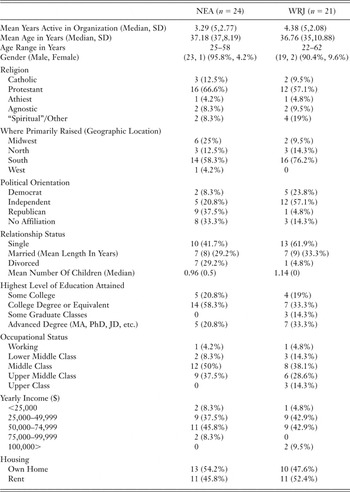
In sum, Tables 1 and 2 outline the demographic comparison between the members in NEA and WRJ. On average, members of NEA are slightly more likely to own a home and hold slightly higher education and income levels than members of WRJ. NEA members are more likely to hold no political party affiliation or identify with the Republican Party, whereas WRJ members are more likely to identity with the Democratic or Independent Parties. The majority of both groups are quick to self-identify as religious, as being raised in the Southern United States, and as either middle or upper-middle class. While both groups have members with high status occupations, NEA members are more likely to hold positions of higher status than WRJ members (e.g., bankers, lawyers, accountants, and business managers versus writers, car salesman, teachers, and retail salespersons). On average, members of WRJ are slightly younger and more likely to be single (never married), while members of NEA are seven times more likely to be divorced. Indicators suggest that members of both groups are much better off than most White Americans. Footnote 4
Membership

Descriptive Statistics

Ethnographic Access, Limitations, and Reflexivity
In order to receive Institutional Review Board (IRB) approval, all potentially identifying information regarding NEA and WRJ was changed and replaced with pseudonyms. I selected these two groups by their relative proximity to one another, their size as national associations, and as the headquartered “chapter” of each organization. I gained access after writing to the leaders of both organizations, in which I pitched my research proposal: to observe how members discussed, made meaning of, and interpreted racial identity. After conducting several separate meetings in which members from both organizations questioned my intentions, I was granted permission to interview members, attend meetings, and collect data via internal documents and archives of their publications.
I should note that the majority of active members in both headquartered chapters were men (forty-two out of forty-five members, or 93%). The three female members between these two organizations were marginalized and disallowed leadership responsibilities. As a result, I highlight the intersection between Whiteness and masculinity. I neither suggest an essentialist connection between masculinity and White racial identity, nor argue that White nationalist and White antiracist sites are exclusively male locations. Along with Chabram-Dernersesian (Reference Chabram-Dernersesian and Frankenberg1997) I make the case that, “… whiteness is generally linked to specific agents of domination—imperialist masculinities, dominant masculinities …” (p. 114). Moreover, Daniels (Reference Daniels1997) wrote, “… [the] conflation of ‘whiteness’ and masculinity [demonstrates] … the inextricable connection between race and gender” (p. 36). Such a relation is deeply historical. Carroll (Reference Carroll2003)—drawing from Du Bois ([Reference Du Bois1935] 1999, pp. 700–701)—made the connection between Whiteness and masculinity explicit: “… white racial identity was a fundamental element of working-class manhood and provided an additional ‘wage’ for male workers” (p. 381).
The gender bias and the limitations of the two groups disallow generalizable conclusions to “strong” White racial identities writ large. However, they do not disrupt the illumination of “transferable” and “generalizing effects.”Footnote 5 As James A. Holstein (Reference Holstein2006) wrote, “‘Ethnography’ highlights concrete modes of inquiry used to discover and describe these activities. The researcher's goal … is not to generalize about the people under study, but to identify and explain social processes that have generalizing effects” (p. 293). Following Burawoy (Reference Burawoy1998), the slow aggregation of ethnographic case studies makes generalizability a process rather than an end point (Vaughan Reference Vaughan, Hedstrom and Bearman2009). Cases are compared not to formulate some general law but rather, according to Blumer (Reference Blumer1954) to advance “sensitizing concepts” (p. 7). Hence, this ethnographic study builds upon existing theory to illuminate particular interactions and meaning-making strategies across diverse settings (Fine Reference Fine2003).
Moreover, the limitations of the data led to a distinct advantage in access to the settings. As a White male who was able to enact—via clothing, language, aesthetic tastes, and various dispositions—members of both groups often understood me as similar to them, but not “radical” enough in ideology. Hence, both groups often sought to challenge my inquiries, question my intent, and convert me. Rather than serving as a barrier, my race and gender supplied me with countless opportunities to engage in heartfelt discussions with nationalists and antiracists. As Charles Gallagher (Reference Gallagher, Twine and Warren2000) wrote, “While the majority of whites enjoy many privileges relative to other racial groups, one must nevertheless critically assess where one's social location, political orientation, religious training, and attitudes on race fit in with the research process” (p. 69).
Racial Narratives
Erving Goffman (Reference Goffman1961, Reference Goffman1981) emphasized how identity formation relies on regular, patterned, discursive negotiations of reality, both externally (others, the world, objects) and internally (self-identity). Contemporary scholarship on race and discourse has further refined this position. Discursive constructionists emphasize the emergent properties of identity within specific interactions. Critical scholars examine how discursive strategies among Whites connect to historical patterns of unequal relations and privilege. Drawing from the insights of both, I understand racial narratives as interactions related to specific needs that are organized and propelled by dominant schemas.
Shared narratives assist cohesion in racial groups. Yet narratives are neither exclusively localized and individual, nor are they always directed at racial out-groups. Racialized discourse is rooted deeply in the in-group's sense of position in the racial hierarchy (Blumer Reference Blumer1958; Perry Reference Perry2007). Group positioning entails certain expectations and accountabilities that may differ by context. Yet Schwalbe et al. (Reference Schwalbe, Godwin, Holden, Schrock, Thompson and Wolkomir2000) write, “… the power to hold others accountable in one setting depends upon relationships, that is, a larger net of accountability with actors outside the setting” (p. 442). Narratives provide techniques that assist in the reproduction of expected racial identities and predictable responses; according to Howard (Reference Howard2000), “Identities are thus strategic social constructions created through interaction, with social and material consequences…. At the most basic level, the point is simply that people actively produce identity through their talk” (pp. 371–372).
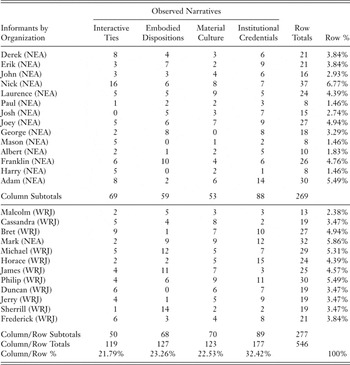
In order to illuminate the relationship between narratives and identity formation, I triangulated (Downward and Mearman, Reference Downward and Mearman2007; Golafshani Reference Golafshani2003; Miles and Huberman, Reference Miles and Huberman1994; Olson Reference Olson and Holborn2004) the data via: (1) ethnographic fieldwork (I attended fifty-eight meetings in total; n = 31 with NEA, n = 27 with WRJ), (2) semistructured in-depth interviews with members (n = 24 with NEA, n = 21 with WRJ), and (3) content analysis inclusive of newsletter issues (n = 7), flyers (n = 22) and any textual information such as e-mails and office memos (n = 467). This approach necessitates examination of how dominant practices are negotiated among local settings. There are two steps to this process. The first remains the descriptive task of identifying the narratives through which actors make sense of their identity. Drawing from Burawoy (Reference Burawoy1998), the multiple narratives of actors in their various situations are aggregated into social processes. Footnote 6 The second step is to explain the logic of these narratives. Somers (Reference Somers1994) and Steinmetz (Reference Steinmetz1992) hold that collective narratives are emergent properties. Hence, while such narratives are empirically observable among individuals, they are not present whole cloth among solitary actors. Hence, one must highlight two key characteristics: (1) a stable set of characters and (2) recognizable plots that connect actors and events through causal explanations (Gerteis Reference Gerteis2002; Jacobs Reference Jacobs1996). The relevant characters and plots are the White racial selves, racial “others,” and the rising and falling action of supplementing White debt with Color capital as a concrete frame of interest. Gerteis (Reference Gerteis2002) wrote, “Collective narratives can be said to emerge when regularly occurring plots connect to key characters in an empirically stable way” (p. 593). Hence, how these narratives emerge in actual social space becomes an empirical problem. See Table 3.
Schematic Narratives

THE SOCIAL DIMENSIONS OF WHITE DEBT AND COLOR CAPITAL EXCHANGE
Interactive Ties
Here I describe how color capital operates via the relationships, networks, and associations with non-Whites that result in durable networks of acquaintance, recognition, and even “friendship,” toward the alleviation of White debt. It might well be thought of as the trite phrase often deployed by Whites seeking to avoid the label of “racist”: “I'm not racist, one of my best friends is Black.” While neither WRJ nor NEA members explicitly invoked this phrase, similar discourses were deployed to “fill in” and credential their Whiteness. As NEA member Daniel told me: “Despite my politics I have quite a few good Black friendships.” [Author: “So they know you are a member of [NEA]?”] “Some do. Some don't. I mean we disagree about some things, but who doesn't? But they're good Black people; they have jobs, families, are intelligent people. We see each other a lot at the gym. I have lunch at least once a week with one of them…. you can't say I'm some redneck, ignorant racist now, can you?” So also, another NEA member named Will told me in an interview:
I often try to hang out at a bar around the corner from my house…. It generally has a lot of race mixing in it … now you know I don't agree with that or think that's the best for anyone, but it gives me an advantage. [Author: “How so?”] Because I have lots of Black friends, I learn a lot about things I wouldn't otherwise know about … in the end it shakes up what people think of White nationalists as “bigots” and whatnot. I know all the latest [Black] music, sayings, and what their community is thinking about. I'm far from a dull White guy…. and I can use that information if anyone wants to equate White nationalism with racism. [Laughing.] It's like a get-out-of-jail-free card. [Laughing.]
Both Daniel's and Will's explanations illuminate that interracial social ties work as a form of capital that can credential them among others, particularly those who would label White nationalists as “ignorant racists.”
In like manner, various members of WRJ spoke the same language. One WRJ member I call Andre stated:
I'm really excited about my neighborhood now…. I have two Black neighbors on either side of my house…. We're an Oreo cookie! [he said with a hearty laugh]. I guess I can't say I live in a segregated neighborhood anymore. [Author: “Did saying that before worry you?”] Yeah, I mean, wouldn't it worry you? I don't ever want to live in an all-White neighborhood. I mean, especially around here, I wouldn't want to get made…. I mean, it's just bad. [Author: “Go ahead and finish what you started to say.”] It's nothing … I mean … ok … honestly [he takes a deep breath and is silent for some time]. I feel like others [in WRJ] would really give me a hard time about being in an all-White neighborhood. I just joined a while ago and I don't want to mess up. Now I feel like I have something to use, like it's a medal or something. No one can call me out for that, I mean, in reality I really do have two Black neighbors and I'm great friends with them. It's safe you know? [Author: “Safe where? Your neighborhood?”] Well, yeah … but I was referring to [WRJ] [my emphasis].
As a member of WRJ, one is expected to live an antiracist life, not simply show up to meetings. Andre's specific comments reveal that the expectation to possess close social ties with people of Color often feels like an intense pressure to conform. In following up the discussion with Andre I asked him how having two Black neighbors directly influenced his life both in and outside of WRJ. He responded:
… I told you before that it affords me a bit of breathing room here [WRJ]. There's less pressure that I am not living up to the expectations. I really believe in what we are doing and I think segregation is flat out wrong and so, I mean, that's good, you know … and I guess outside of [WRJ] I feel like I earn a bit of respect from others who think that we're just a bunch of crazy radicals. I use the fact that I have two Black neighbors to show others that we live what we say; it earns me respect. [Author: “What earns you respect?”] Oh, the fact that I have two Black neighbors, I get an advantage from it … I mean, I brought [one of his Black neighbors] by [WRJ] the other day and it was great. He was asking me questions about what we did and he seemed to look at me in a different light, and to the other guys [in WRJ] I became one of the good White people.
After I turned off the audio recorder Andre further explained that he felt “cool” when he brought his Black neighbor to meet his fellow WRJ members and that it reminded him of being in elementary school during “show and tell.”
Andre's explanation that his friendship with his Black neighbors is like “a medal,” “affords breathing room,” “earns respect,” gets “advantage,” and was like “show and tell,” are all telling. It is clear that his friendship with his two Black neighbors often becomes a commodity to buy respect and space for being a competent White antiracist. His developing friendship with his neighbors is a network of acquaintance that buys him recognition and status as “one of the good White people.” The impulse to gather diverse friendships and avoid residential practices of racial homogeneity is a result of the dominant interpretation of the logic of pluralism whereby diversity is interpreted as an end in and of itself. Combined with the logic of Anglo conformity via Colorblindness, Andre does not regard his relationship with his neighbors as a form of racial objectification. Rather, these logics provide Andre with a schematic map in which he can negotiate both the micro-demands of local organizing in WRJ, as well as the larger compulsion to inject positive meaning into the perceived emptiness of his White racial identity.
In both NEA and WRJ, such objectified familiarity with non-White people works to alleviate White debt through both bolstering status and through assuaging a sense of who they are as White people. Such a dynamic is illuminated no more clearly than the comparison of the following two statements. As one guest speaker at an NEA event told a small crowd of members and those investigating the organization:
White civilization has fallen off and been led astray, often by Black and Latino people … at the same time, the passion and commitment of Blacks is something we presently lack … we can reclaim our former glory and rightful place by building relationships and friendships with people of Color. Become their friends, explain to them our agenda and how it helps both of us. Let them know we do not hate them, we only wish to separate. Take with you their passion for racial identity … and use your friendships with them as a valuable commodity … that will build a new White nationalism, a new White identity….
So also, WRJ member Duncan told fellow members in a private meeting:
I think what we need to do, as conscious, thinking, aware human beings who have decided to take a stand against racism, is what we can, or rather, need [his pitch emphasizing the word] to do to stop racism in our own lives as well as take a stand against it structurally, is … well … to constantly ask ourselves, “How can I become less ‘White’?” … Make friendships with people of Color, and I mean, really guys, use those relationships, learn from them, become more of a human and less an oppressor, and build a new kind of Whiteness up from the grassroots that can partake in multiculturalism as less of an exploiter.
As WRJ and NEA construct differing worldviews and wish for different futures of race relations, it is important to take into account that despite differences in the use of Color capital within this social dimension, they serve a similar function of the objectification of black and brown bodies. While both organizations may explicitly and consciously advocate differing ideologies (NEA promotes a Nativist approach whereby Whiteness is the de facto proper cultural and racial identity of the United States; WRJ promotes an agenda based on multicultural inclusion of various racial groups and cultural traditions), the members of both groups are clearly affected by the synthesis of these logics. Members of both groups engage in the alleviation of White debt through social relationships, networks, and associations with non-Whites. These relationships are converted into a potent form of color capital that, within this social dimension, temporarily fills the emptiness of Whiteness.
Embodied Dispositions
This dimension can be thought of as the aesthetic tastes, ways of communicating, styles, and performances that are symbolically associated with non-Whites. In this sense, the Color capital that operates in this dimension is often reified as the properties of one's individual self. For instance, the mastery of a particular language could be considered a form of Color capital. As Rosaldo (Reference Rosaldo1982) puts it, people “do things with words” (p. 203) that often transcend the dictionary definition to become what Goffman (Reference Goffman1963) describes as “a sequence of moves” (p. 252) in which speaking reproduces the context in which the words are spoken. Other aspects of the presentation of self like styles of dress, bodily and facial expressions, the schemes of appreciation and understanding, and the aesthetic tastes for a certain music, art, literature, or sport are all constitutive of this dimension. The operation of Color capital on this level was most noted via my ethnographic observations and recorded in my field notes. Because I was in the field for fourteen months with both groups, I was eventually invited into people's homes and more private settings away from their headquarters. It was here, more than in any other place, where I empirically observed how both groups shared many of the same tastes and dispositions for things coded as an essential characteristic of people of Color.
Whether it was the tattoos of Asian symbols that members of both groups possessed, their taste for “magical realism” literature of various Latino authors and African American literary classics of Ellison, Morrison, and Hughes, their reverence for the jazz of Miles Davis, John Coltrane, and Charlie Parker, or even a desire for pornography that was almost exclusively dedicated to women of Color—both groups were united via collective aesthetic tastes of a racialized manner. As I began to notice these similarities, I asked members to try to explain why they possessed such tastes. It was during these question-and-answer sessions that the use of embodied Color capital toward the alleviation of White debt was revealed.
For example, when I asked NEA member Laurence as to why he possessed (and prominently displayed in his living room) an extensive CD collection of Black jazz, he replied that he simply “liked that type of music.” When I pressed him as to why there was no jazz by White artists in his collection he told me:
… Black jazz is not like White jazz. It's carnal and full of emotion. White jazz is more laid back—elevator music like, softer somehow…. Black artists have a soul and a … [long pause]. I don't know … they have something underneath the music, it's the rhythm or something…. Maybe it's because of discrimination or whatever … maybe after a few hundred years of reverse racism then Whites will play jazz like that but I doubt it…. There's a harsh quality to it … it goes back to Africa and has been passed on genetically. Whites don't have it, so I listen to it. I just like it.
When I noticed a similar phenomenon of almost exclusive ownership of music performed by Black artists in the homes of several WRJ members, I inquired as to why they had little to no music performed by White artists. Replies were varied, from “I just like that style,” to “I don't know,” to “I love Black music.” WRJ member Blake told me:
I like hip-hop and jazz mostly, because the music is more real to me. I feel better when I listen to it, like I am more in touch with the human side of me. Even with the more hard-core rap music, I don't like as much of it, but it's like it really hits me here you know [pointing to his heart], it's valid here. [Author: “So you like artists like Kenny G. or Eminem?”]. Get out of here! [said laughing], they are jokes, I mean, no, … listen … I like it because it's real, it expresses something I wouldn't be able to get otherwise. I'm not Black so I can't really get it, but I get closer to it when I listen to it you know. [Author: “What do you mean by ‘it’ when you say you really can't get ‘it’?”] I mean, the Black experience, I get closer to it with hip-hop, I guess that's why I like it. It fits with my whole life and being in [WRJ].
The equating of Black music with soul, carnality, validity, and realness reveals many of the racist and essentialist features embodied in the very dispositions of WRJ and NEA members. In this sense, what might appear as individual choices and musical tastes, are rather a “group style” (Eliasoph and Lichterman, Reference Eliasoph and Lichterman2003) structured by White debt and Color capital.
In particularly disturbing instances, the actual fetishization of non-White people as cultural objects for consumption by a White gaze was illuminated. Upon my arrival at an NEA meeting, I learned it was cancelled. Another member named Joey showed up at the same time. Joey and I had a tense relationship throughout my study; he often expressed that I was a “race traitor”—meaning that I had consciously turned my back on White nationalism and thus, “the good of the White race.” Hence, I was shocked when he invited me back to his place to both watch a basketball game and to interview him so I would “get White nationalism right.” When we arrived, Joey asked me to make myself at home as he turned on the television and left the room. As the picture came into view, I saw the title screen for a pornographic DVD that was dedicated to women of Color. As Joey came back into the room, he blushed and said, “Is this one thing we can agree on?” I quickly turned on my audio recorder and took the chance to follow up on his choice of pornographic material. “So …” I asked, “… why do you watch this kind of porn exactly? I mean, why Black and Latina women?” He responded:
I mean … yeah … I tried White porn for a while, but I just didn't get as much out of it…. Man, those Black girls do some crazy stuff, they are so much more free and expressive. You think I'm crazy? Ask, uh … [Nick] and [Erik], those guys love this stuff. We used to get together and watch it more often, but you know, it's the school year and they're busy. But yeah, I like it because, [long pause] this is awkward you know, talking about this. But I mean, yeah, they are just more sexy and voluptuous. [Author: “So, that's the kind of woman you are looking to settle down with one day?”] Oh hell no! I would only marry a White girl…. but I can take some tricks from watching that will sure liven up my ordinary sex life and whatever normal White girl I settle down with.
I never discovered explicitly “pornographic” material in the possession of any other NEA or WRJ members, but there was a collectively shared “taste” for women of Color as a way of improving the quality of a “dull” White sexuality. WRJ member Michael told me, “Black women have a way about them that is simply sexual. White women have been socialized to be prudes. That's continued because there is too much guilt associated with sexual expression. White civilization has been too uptight; it has restricted sexuality. Black girls don't have that problem.”
Both “racist” and “antiracist” Whites continue to equate Blacks and Latinos with hypersexuality. The synthesis of sexist and racist narratives has deep historical roots in our social structures, and is reproduced on the micro level via both groups' desires and tastes. In this light, the approach of racial practice illuminates the simultaneous presence, and reinforcement, of racial, gender, and sexual power and inequality. In so doing, both White identity projects of NEA (that explicitly advocates racial-sexual purity and interracial distance), as well as WRJ (which argues that interracial marriage and increased interracial contact is good and necessary), are reproducing White identity (here, via heterosexuality) as dull, boring, and ordinary. These performances evolve from what Yancy (Reference Yancy2008) calls “white discursive practices, centripetal processes of white systemic power and white solipsism” that conceal “the fact that whites deployed and continue to deploy a racist iconography to maintain power. Indeed, white discursive practices are inextricably linked to forms of political and social power” (p. xviii). In consideration of these intersecting power relations—and to unabashedly draw from Marvin Gaye—the fetish of straight, non-White, female “otherness” serves as “sexual healing” for Whites. Once these subjects transform into a sexualized commodity, their consumption is normalized and takes place as a seemingly harmless and even natural (and personal) disposition among varied Whites.
Material Culture
The third dimension is framed by the objects and items symbolically coded as non-White that can be possessed, owned, and consumed by Whites as a way of eliminating White debt. This is akin to the “crumbs” of reified and essentialized non-White authenticity. Authenticity, as Walter Benjamin (Reference Benjamin, Arendt and Zohn1936) claims, requires “uniqueness” (p. 230). That is, the authenticity of any given thing, that which distinguishes it from anything else, needs a “distance” in a particular time, place and history. The segregated space of NEA and WRJ, that requires “authentic others” to alleviate White debt, constructs non-White forms as authentic, unique, and imbued with a special essentialist power. Bonnie writes:
The authenticity generated by the context in which the objects are displayed, performed, or used becomes a property of objects themselves … because authenticity must be linked to a high national culture, racialized [in this context, non-white] people are at a disadvantage. They are seen as people from colonized places so they [and others] must seek their authenticity in a past before or beyond colonial status
(Urciuoli Reference Urciuoli1996, p. 34).The dominant relational construction of Whiteness as inauthentic and non-Whiteness as “primordially authentic” (Eller and Coughlin, Reference Eller and Coughlin1993) dictates much of the value of objectified Color capital. Its value can be measured in so far as Whites have a contextual ability to accumulate Color capital and spend it within this social dimension in order to become “knowledgeable and worldly” people. One conversation with several WRJ members illuminates this dynamic:
Author: Since your organization is entirely White do you ever feel like you are missing anything because of the decision to organize in this way?
Blake: That's funny. I mean, no offense, but we know a lot about things other than ourselves. That is part of the point of what we are doing. We are trying to re-create our Whiteness, some even say “abolish it” don't they?
Author: Yes, some do.
Blake: Yeah, thought so. So we are abolishing it through knowledge of Black, Brown, Red, whatever cultures. That's the power of diversity; it remakes you less White and more human.
Bret: Very true. For me, I remember reading the Autobiography of Malcolm X and something about a White girl coming up to him asking what she could do to help Black people and he replied that she should “go work with other whites,” or when Huey Newton told Whites to form their own White Panther Party—I feel like that is what we are doing. Maybe it's not as radical, but look, like he said [pointing at Blake] knowledge of difference is something I use …
Sean [interrupting]: That's the point right there, how many other Whites even have read Malcolm X or know who [Huey P.] Newton was. We are better people because we know about this stuff. You don't buy it from the mainstream, but I sure do spend it there.
Author: What do you mean?
Sean: I mean, you can't get this knowledge of diversity through just going through the motions in an artificial way, you have to get, well, authentic things from people of Color that really oppose racism. That stuff is not commodifiable, it's above that. It's real.
Samuel: I came to this organization because, I mean, I don't know if you feel this way, but I often wanted to be less White, like it's empty or has a hole in it or something … I mean, being in WRJ brings me in contact with lots of history about African Americans, music, styles, … I learned about César Chávez in our ed [educational] session a few weeks ago. And now I get to use that information, it's a part of me… the more I learn about Blacks and Latinos the more complete I feel … I know it sounds crazy, but no one can say I'm racist or boring.
For members of WRJ, the objects, styles, and knowledge symbolically coded as non-White were a common fixture in weekly “ed sessions.” Often those discussions featured topics such as the difference in racial hair textures and the “process” by which Black hair is made straight, why “Black people wear baggy clothes,” to how the genre of “hip-hop” could be used as a window into the “soul” of Black people. Likewise, for members of NEA, there was a subsequent push to learn about non-White history, styles, and political attitudes so that members could evade any claims that they were, as one member put it, “racially myopic,” or put in a position in which their White-nationalist beliefs could be blamed for an ignorance of, and hostility toward, non-Whites. Whites in NEA often spoke of their affection for and knowledge of what they considered to be essentially non-White cultural products. I wrote the following in my field notes from one day at the NEA office:
Sitting at main office table are [Derek, Ronald, and Samuel] discussing what's “good” about African American “culture.” Ronald said jazz, food, and some art (paintings and sculpture) are beautiful. [Derek] said a Harlem Renaissance class he took in college—learned that Black people are smart, but felt the class was propaganda/biased. [Samuel] agrees—states that he loves blaxploitation films because they are funny. [Ronald] comments on skill of Miles Davis, Charlie Parker, other Black jazz musicians. They begin all speaking about knowledge of Black athletes (esp. basketball, football stars). [Samuel] says he loves talking with Black people at bars about these topics because it shows he doesn't think all Black people are bad. He comments that he loves doing this in mixed racial crowds and then getting the White people alone later to talk about [NEA]. He states: “They can't understand us as racist then.”
The supposed affection and even reverence for items coded Black among White supremacists is a paradox of modern race relations. Such findings illuminate that varied, diverse, and even progressive behaviors among Whites must be analyzed within the context of their meaning and the cultural logic of the group in which such discursive strategies are enacted. As NEA member Paul told me in an interview:
I admire Black people. I do. It's not like we're hatemongers. They have a style and substance to them that is admirable … we can learn from Black power, Black pride whatever. When they say that “Black is beautiful,” well, “White is beautiful” too. We have to take this strategy … well, that's not it … it's not like this is a strategy, it's their natural style and flair. [Author: “What do you mean exactly? Can you give me some examples?”] Yeah, okay, look at the, uh, okay the Black power movement and how that was transferred over to actual items like black leather jackets, afro combs, berets, and other things that became romantic icons for their agenda. We don't have that. People think Whites are boring. [Laughing.] I mean, sometimes we're pretty plain. But when Blacks talk and organize they do it with a charismatic flair that is natural to them … anyway, we have to take this kind of natural style or flair or whatever and fill in the gaps in how we organize and speak about White nationalism. Don't get me wrong, I don't mean like, you know, pollute things, but … take what works and fill in the holes.
Whites in both WRJ and NEA understood that co-opting objectified Color capital could afford distinct advantages in their own personal lives and racial identity as well as for the strategic goals of their antiracist or nationalist agenda.
Institutional Credential
The fourth dimension of Color capital and White debt's operation is ordered by formal records and/or qualifications that are sanctioned by a particular organization, association, and/or institution. For example, several members of the antiracist WRJ organization possessed associate or bachelor degrees in social scientific or humanities disciplines in which they studied race relations or some particular aspect of ethnic studies. Often praised for their expertise and knowledge of “otherness,” the holders of these degrees symbolically distanced themselves from the perceived emptiness of Whiteness. I was surprised to find that two NEA members attended classes at Howard University (a premier historically Black university). Their attendance served to credential their activism and their racial identity. As NEA member George told me, “I learned a lot about Black history there [Howard]. I got an insider view if you will of things. It's effective here … lot of folks see me as an expert on race relations now, simple because I went to Howard.” Author: “So you'd say you got a good education there?” “I didn't go to get an education, I had that already.”
Official academic credentials were not the only forms of Color capital in circulation in this dimension. Both groups offer training courses and certificates in various aspects of racial consciousness/awareness, Black history, and race relations for anyone willing to devote the time to take the course. Members that complete these courses are often afforded a higher level of status because of their credential—understood by others as an important element in White racial activism. Such “official” knowledge of Black history and race relations is frequently used to “fill in” a perceived emptiness of Whiteness.
During one discussion of an upcoming public event organized around the celebration of “diversity” and “multiculturalism,” at which WRJ was planning on displaying an information table, I observed the following dialogue:
Wayne: Alright, it's getting late … it's not like we have no clue as to how to organize this—talk to [Andre], he wrote a paper on the Klan when he was in school.
Mark [interrupting]: Very true, didn't [Blake] write some paper last year on White supremacy and …
Christina: He has a degree in psychology, studied racism mainly I think, no wait, it was a thesis on multiculturalism.
Michael: He [Joseph] majored in English. I think he wrote something about colonialism or something.
Mark: No, that's not quite it, it's not about Black or Latino oppression. He might know…
Wayne [interrupting]: All right, we need to make sure [Blake] and [Joseph] are at the event, agreed? [Members nodded their heads in affirmation.] I think they're examples of what we are talking about, you know, that it's important to learn and dedicate yourself to the struggle…. ah, we can present them as “panel experts.”
Colin: Oh! Ask them to bring their diplomas and we can set them on the table…. we always get criticism as being hippies or what not, that should, you know, throw them off …
Mark: That could come off a little pretentious, but it would buy us some legitimacy.
As the members continued to discuss which members possessed the “right” forms of Color capital to credential the group as authentically “antiracist,” Mark turned to me and in a whispered tone asked, “Didn't you write your thesis on the Black Panther Party?” “Yes, I did” I replied in an equally hushed tone. “Well …” he continued. “… they should be asking you what to do. You're like the least White person in here.” [Christina overhearing, giggling: “Yeah, so true.”]
I include this reflexive moment of research in which my Color capital was brought into the economy of racial meaning at WRJ; my possession of it temporarily alleviated my White debt. Within this dimension, the exchange of Color capital often structured their activities and assisted in members' active meaning-making as to what members were the right people for the job. Within the scope of an activity dedicated to the valorization of multiculturalism—in which they felt their commitment to a politically just and efficacious antiracist position was in jeopardy—Color capital became a valued resource toward both organizing the event and validating their identities as authentically belonging.
A similar dynamic exists among NEA members. As NEA member Steven explained:
It's not like we think we need anything, but at the same time, people need tangible things … [long pause] that's very real to people. I myself, I mean, I went through our courses, went to the sessions like “The African Mind” at the conferences and what not. I was lacking crucial information on others that someone in my position needs to be able to defend his position. White identity politics are a tricky matter … I guess you could say my presentation of Whiteness was lacking…. Going through the courses gives me credentials that I can sell.
This dimension demonstrates that these credentials are not simply static objects with a fixed meaning behind them, but they are given active significance in their moments of usage. In this sense, the shared economy of racial meaning is dynamic and shifting. Unlike a dollar or an identification card in one's pocket that holds a particular value, purchasing power, and effect upon its presentation to another, these White actors must make a case (in the lived moment of social interaction) that one's particular institutionalized Color capital has a value and significance that alleviates White debt.
CONCLUSION
This article engaged the question of how strong White racial identities demonstrate concurrent feelings of normativity and superiority, coupled with perceptions of racial emptiness and a longing for contact with people, objects, and styles coded as non-White. Such an economy of racial meaning-making—constituted by the interplay of “Color capital” and “White debt”—operated in four dimensions: (1) interactive ties, (2) embodied dispositions, (3) material culture, and (4) institutional credentials. These dimensions simultaneously constrained and enabled the interaction order in which performance expectations and definitions of the situation were navigated.
The cultural contradictions embedded in the contemporary meanings of Whiteness enable diverse strategies of action—whether apolitical, nationalist, or antiracist in orientation. And while these strategies manifest in sundry ideological goals, they remain intertwined with rather robust logics that reaffirm and rationalize White dominance, normativity, and agency (Goldberg Reference Goldberg1993; Mills Reference Mills1997). For example, NEA understands racial differences as biologically determined, and interprets non-White styles as the natural outgrowth of non-White carnality, eroticism, and physical prowess; WRJ comprehends racial differences as the product of cultural and historical forces, and construes non-White performances as potent styles full of life, virility, and spice. In both scenarios, the symbolic order of dominant racial meanings is reproduced. Among NEA, tales of non-White virility are accompanied with nostalgic narratives of Whites' prior control of such skills coupled with accusations of their unfair theft. Such a tale helps to rationalize White control over interracial relationships and further entrenches the association of non-Whites with criminality, immorality, and lack of intellectual acumen. Among WRJ, the expectations that people of Color are more culturally attuned to music, food, dance, and racial authenticity encourage Whites to approach interracial relationships as appropriators and exploiters. Such a multileveled dynamic demonstrates how White racial projects are constrained and enabled by the racialized interaction order (Goffman Reference Goffman1963, Reference Goffman1961).
These findings gesture toward several implications. First, despite increased discourse about reaching a post-racial state in the “age of Obama,” the deployment of racialized schema across disparate White racial formations certainly signals the retention of salient racial categorization. This schema finds purchase across a wide range of White racial actors, regardless of political orientation or resource attainment.
The second implication piggybacks off the latter. The data herein provides a glimpse into how understandings of White debt and Color capital extend beyond the White mainstream to varying and antithetical political margins. The theoretical issue at stake is how to present an empirically grounded theoretical framework that avoids reduction to, or conflation with, political ideology or resource attainment. Moreover, the paradox of White desire and superiority amidst a wide range of White racial formations is one that established White politically based and resource-based conflict and interaction theories have difficulty explaining. Rather than engage in a polemic coup de main in which I argue cultural schema trumps political ideology and material resources, I propose a different tack. The findings imply that we should approach how political orientations and resources are interpreted through the dominant cultural logics of assimilation and pluralism and how those logics become internalized as strategies of action in Whites' everyday lives. If with Sewell (Reference Sewell1992) we approach the meanings of White racial identity as semiautonomous cultural schemas—as “fundamental tools of thought, but also the various recipes, scenarios, principles of action, and habits of speech and gesture built up with these fundamental tools” (pp. 7–8)—then we may gain more ground on how racialized bodies, objects, and symbols are not only read, but how those readings are generative of the subjectivities inhabiting them. This is precisely what Sewell (Reference Sewell1992) calls the “depth” of schema, deriving here from the historical development of assimilation and pluralism, that structures the dominant expectations of racial meaning-making across an array of various, even antithetical, social spaces.
Third, while significant similarities between these two politically antagonistic groups certainly exist, they should not wash over the intraracial variations that were found. In specific, both groups held in common various ideals of what Whiteness should look like, which guided Whites' interactions and how they made meaningful racial identities. Such racialized ideals are what Lewis (Reference Lewis2004) and I (Hughey Reference Hughey2010, Reference Hughey2011) together call “Hegemonic Whiteness”:
Whiteness works in distinct ways for and is embodied quite differently by homeless white men, golf-club-membership-owning executives, suburban soccer moms, urban hillbillies, antiracist skinheads, and/or union-card-carrying factory workers … In any particular historical moment, however, certain forms of whiteness become dominant [my emphasis] … Hegemonic whiteness thus is a shifting configuration of practices and meanings that occupy the dominant position in a particular racial formation and that successfully manage to occupy the empty space of “normality” in our culture
(Lewis Reference Lewis2004, p. 634).Yet members' ability to attain those ideals and practices was tenuous at best. The unequal pursuit and attainment of these ideals is a two-pronged process of White racial identity formation: (1) through positioning those marked as “White” as essentially different from and superior to those marked as “non-White”, and (2) through marginalizing practices of “being White” that fail to exemplify dominant ideals. In regard to the latter, this process reproduces an intra-White hierarchy that orders access to interactional status, esteem, and well-being. The elusive ideal of hegemonic Whiteness vis-à-vis attainment of Color capital created particular racial dilemmas for different Whites as they struggled to perform a socially recognizable and validated Whiteness.
Based on the findings and implications, future research on White racial identity should travel several avenues. First, what is the role of interracial “friendship” in White racial identity? How does color-line camaraderie rely on historical antecedents of racial fetishism and how are such relationships inflected by “post-racial” discourse? Second, we have need to incorporate empirical analysis of emotions into race theory. The “feeling rules” (Hochschild Reference Hochschild1979) in which members of both organizations engaged were certainly contextually specific. Future inquiries should examine how certain emotional displays become racialized in larger domains, how displays connect to systems of reward and punishment, and how emotions serve as mechanisms for the reproduction of racial categorization and White supremacy (Wingfield Reference Wingfield2009). Finally, the aforementioned pursuit of “Hegemonic Whiteness” remains neither fixed nor ahistorical, but finds purchase within specific contexts. Hence, the examination of White ideals and expectations on the “micro” level should be studied in relation to the reproduction of patterns often thought “macro”: from White ideals that work in concert with increased racial profiling amidst policing agencies and the expectations that compel the ever-more-privatized prison-industrial complex, to the rising tide of libertarian ideology and neoliberal policy that finds expression in Tea-Party grassroots activism and politics. The interrogation of racial identity as the suture between the “macro” and “micro” is certainly germane for those concerned with the material realities of racial inequality and the continued significance of Whiteness.