The onset of puberty marks the start of the developmental period of adolescence, which encompasses dramatic change in physical, cognitive, emotional, and social characteristics among youth (Dahl & Gunnar, Reference Dahl and Gunnar2009). Assessing adolescents during puberty has the potential to increase our understanding of variation in the onset of positive and negative health trajectories (Dorn et al., Reference Dorn, Hostinar, Susman and Pervanidou2019). Moreover, examining adolescents in their day-to-day lives may shed light on the potential role that pubertal timing, daily experiences, and contexts play in generating health-risk behaviors and well-being over time. Indeed, healthy children experience puberty universally, yet puberty is an individualized experience. Each child progresses through puberty at his or her own pace, and these complexities should be recognized in order to fully understand the influences of pubertal timing on later health-risk outcomes (Deardorff et al., Reference Deardorff, Hoyt, Carter and Shirtcliff2019). Individual differences in the timing of pubertal development may affect daily experiences and well-being through two general processes. First, pubertal timing may act to shape the daily experiences that adolescents encounter because (a) earlier versus later maturing adolescents may seek out different experiences and social contexts and (b) environments may react differently to adolescents’ pubertal timing. Indeed, earlier versus later maturing adolescents may elicit specific and different responses from others. Second, pubertal timing may increase adolescents’ sensitivity to everyday experiences (Crone & Dahl, Reference Crone and Dahl2012), such that the experiences of daily life may have stronger immediate effects on affective and behavioral well-being.
In order to understand how adolescents’ pubertal timing may interact with day-to-day experiences, methods that allow for an examination of these processes in situ are needed. Ecological momentary assessment (EMA) offers a number of methodological strengths relevant to the study of the relationship between pubertal timing, everyday experiences, affect, and behaviors. First, EMA enhances ecological validity by assessing adolescents’ everyday experiences in their naturalistic contexts, as opposed to reports being assessed in a research setting. Second, EMA seeks to reduce recall bias by narrowing the recall window of self-reports of typically routine social contexts and behaviors and therefore gets closer to measuring respondents’ experiences as they occur rather than depending on their potentially reconstructed memory. Third, EMA allows the current study to generate within-person coupling parameters to capture the dynamic interplay between daily social stressors that adolescents are likely to experience in daily life across multiple domains (i.e., family, peer, and school hassles), conduct problems, and affect, repeatedly within individuals over time (Russell & Gajos, Reference Russell and Gajos2020; Shiffman et al., Reference Shiffman, Stone and Hufford2008). Indeed, the ability to measure everyday experiences is a strength of the current study as prior research suggests that the “mundane” occurrences (e.g., or mild/moderate stressors) of daily life have an impact on adolescent health and behavioral outcomes (Hertzman & Boyce, Reference Hertzman and Boyce2010), and that repeated exposures to common and chronic everyday stressors (e.g., parental irritability, chaotic household exposures such as noise, crowding, etc.) may more profoundly impact these outcomes than more severe, but less frequently occurring stressors (e.g., maltreatment, extreme neglect) (Odgers & Jaffee, Reference Odgers and Jaffee2013).
In the current study, we integrated data on adolescents’ pubertal timing (i.e., the difference between an adolescent’s self-reported pubertal maturational status and their pubertal maturational status predicted by their age, separately by sex) with EMA data in order to examine the exposure and reactivity to daily experiences (measured as hassles across three main spheres of an adolescent’s life: home, peer group, and school) among earlier and later maturing adolescents. Two important points are worth noting here: First, our measure of pubertal timing characterizes adolescents’ pubertal maturation as a continuous measure of earlier versus later timing, by regressing pubertal status on chronological age within female and male groups among the full EMA sample. Although previous research has examined pubertal development by utilizing pubertal status rating scales, as well as indicators of pubertal timing (i.e., pubertal status residualized by respondent age) (Hamlat et al., Reference Hamlat, Stange, Abramson and Alloy2014; Mendle et al., Reference Mendle, Harden, Brooks-Gunn and Graber2010; Susman et al., Reference Susman, Dockray, Schiefelbein, Herwehe, Heaton and Dorn2007), we believe the conceptualization of adolescents’ pubertal timing as earlier versus later – as expected for his or her age – offers a more interpretable measure of individual differences in adolescents’ pubertal development. Second, EMA uses multiple assessments of the same individuals over time to test how pubertal timing may moderate the within-person relationships between daily conduct problems and affect as a function of hassle experiences across various social contexts. Specifically, we seek to understand whether adolescents’ earlier versus later pubertal maturational timing, relative to the average for their age and sex, is associated with their (a) daily affective states and conduct problems; (b) exposures to daily hassles across family, peer, and school contexts; and (c) differential affective and behavioral responsivity to these day-to-day hassles. To this end, we asked three specific questions.
Question 1: Is earlier versus later pubertal timing associated with adolescents’ daily conduct problems and affect?
Although prior work supports the relationship between earlier pubertal timing and risk for negative outcomes (particularly among girls), the current study seeks to explore the relationship between pubertal timing and daily averages of reported conduct problems and affect. Exploring these relationships in daily life may add to the body of research reporting significant relationships between pubertal timing and behavioral and psychological outcomes with traditional methodologies (e.g., annual reporting).
Question 2: Are earlier versus later maturing adolescents more likely to encounter daily exposures to hassles within family, peer, and school contexts?
The second question examines whether the daily lives of earlier versus later maturing adolescents differ. Measuring respondents’ experiences as they occur reduces recall bias and also adds to prior research that examines environmental risk factors among earlier versus later maturing youth.
Question 3: Are the same-day associations between adolescents’ conduct problems, affect and experienced hassles stronger among groups of earlier versus later maturing adolescents (i.e., is earlier pubertal timing correlated with greater behavioral/psychological reactivity to daily hassles)?
The third question is concerned with examining whether pubertal timing is a moderator of the within-person coupling between average daily affect, behavior and hassles. The repeated assessments utilized in the current study allows for a test of adolescents’ sensitivity to everyday experiences and whether these relationships differ between earlier versus later maturing adolescents. The capturing of within-day coupling of hassles and behavioral and emotional reactivity is a novel feature of the current study, as prior research has examined these relationships with point in time measurements, relied on retrospective self-reports, or measured changes across long periods of time.
We outline the background and rationale for each of these questions in more detail below.
Question 1
The first research question concerns whether earlier versus later pubertal timing is associated with adolescents’ daily conduct problems and affect. Adolescence constitutes a period of increased sensitivity to environmental risk factors in the development of psychopathologic outcomes, such as depression, anxiety, and aggression (Crone & Dahl, Reference Crone and Dahl2012; Dahl & Gunnar, Reference Dahl and Gunnar2009) and maturing off-time may be linked to heightened insecurities and maladaptive responses to social stressors. Earlier pubertal timing, in particular, may increase the risk for both internalizing symptoms and externalizing behaviors because adolescents will have to face the physical, psychological, and behavioral changes and challenges associated with puberty without acquiring the necessary socio-emotional and cognitive development first (Graber, Reference Graber2013; Rudolph et al., Reference Rudolph, Troop-Gordon, Lambert and Natsuaki2014). Boys and girls characterized by an advanced (i.e., earlier) pubertal stage at age 14, for instance, have been shown to exhibit higher levels of aggression and delinquency than their same-age, same-sex peers with less advanced pubertal stages (Najman et al., Reference Najman, Hayatbakhsh, McGee, Bor, O'Callaghan and Williams2009).
Nonetheless, important sex differences in the relationship between pubertal timing and risk for maladaptive psychosocial outcomes have been reported (Negriff & Susman, Reference Negriff and Susman2011). A large body of research has implicated earlier pubertal timing among girls to be a key risk factor for the development of a range of health-risk behaviors and psychosocial difficulties, including delinquency, substance use disorders, eating disorders, and depressive disorders (Caspi & Moffitt, Reference Caspi and Moffitt1991; Graber, Reference Graber2013; Klump, Reference Klump2013; Mendle et al., Reference Mendle, Turkheimer and Emery2007). The biological changes that early maturing girls go through (e.g., menarche, increased body weight/mass, etc.) may be associated with increased psychological distress and social stress. Indeed, earlier maturing girls are likely to experience more depressive symptoms and greater negative affect than do later or on-time maturing girls (Graber et al., Reference Graber, Seeley, Brooks-Gunn and Lewinsohn2004; Mendle et al., Reference Mendle, Harden, Brooks-Gunn and Graber2010; Rudolph et al., Reference Rudolph, Troop-Gordon, Lambert and Natsuaki2014). Evidence also suggests that earlier maturing girls show an increased susceptibility to social stressors, such as influences from deviant peers, thereby increasing the risk for delinquency during early adolescence (Mrug et al., Reference Mrug, Elliott, Davies, Tortolero, Cuccaro and Schuster2014).
Research on the influence of earlier versus later pubertal timing for boys, however, has yielded less consistent evidence for its role in the risk for internalizing and externalizing disorders (Ge et al., Reference Ge, Conger, Elder and Glen2001; Negriff & Susman, Reference Negriff and Susman2011). Traditionally, earlier pubertal timing has been viewed as advantageous for boys, such that the biological changes that boys face during pubertal development (e.g., increased height and muscle mass) have been hypothesized to increase their social status among peer groups. Nonetheless, previous reviews of the literature suggest that earlier pubertal timing for boys may be associated with the manifestation of negative psychological and behavioral health outcomes (Mendle & Ferrero, Reference Mendle and Ferrero2012; Ullsperger & Nikolas, Reference Ullsperger and Nikolas2017). Other research finds that later developing boys may also be at risk for internalizing and externalizing behavior problems (Graber et al., Reference Graber, Lewinsohn, Seeley and Brooks-Gunn1997, Reference Graber, Seeley, Brooks-Gunn and Lewinsohn2004). Due to the support found for risk among both earlier and later maturing boys, prior research has highlighted the importance of specificity between the associations of earlier versus later pubertal timing and emotional and behavioral problems among boys (Kaltiala-Heino et al., Reference Kaltiala-Heino, Marttunen, Rantanen and Rimpelä2003).
Question 2
The second research question concerns whether groups of earlier versus later maturing adolescents are more likely to encounter daily exposures to hassles within family, peer, and school contexts. The associations between individual-level characteristics and the exposure and responsivity to environmental factors have been examined previously (Bolger & Zuckerman, Reference Bolger and Zuckerman1995; Scarr & McCartney, Reference Scarr and McCartney1983) and mounting evidence suggests that pubertal maturation may play a role in the shaping of everyday experiences among adolescents (Mendle et al., Reference Mendle, Turkheimer and Emery2007; Moore et al., Reference Moore, Harden and Mendle2014; Negriff et al., Reference Negriff, Ji and Trickett2011; Seaton & Carter, Reference Seaton and Carter2019). However, relatively few studies have tested whether the daily lives of earlier versus later maturing adolescents differ. Early maturing adolescents may be exposed to different environments (as well as experience these environments differently) than do their same-sex and same-age peers who have not matured as quickly. Assessing the exposure(s) to daily hassles across three salient social contexts during adolescence – that is, family, peer, and school contexts – may increase the understanding of the associations between pubertal timing and experiences during adolescence.
Indeed, the onset of puberty impacts family relationships because adolescents’ physical and psychological development may lead to changes in interactions with parents and siblings (Steinberg & Silk, Reference Steinberg, Silk and Bornstein2002). For example, changes in adolescents’ physical appearance may be associated with new parental responses toward their children. Moreover, parents and siblings will likely have to adapt to the fluctuations in adolescents’ irritability, affect, and aggression, which are likely associated with – but not necessarily caused by – hormonal changes during this developmental period (Mendle, Reference Mendle2014). Adolescents may feel emotionally distant from their parents/family, which is also likely implicated in changing familial dynamics. Evolutionary-based theory suggests that the onset of puberty results from, as well as evokes responses from, the familial environment, such as the initiation of parent–adolescent conflict (Belsky et al. Reference Belsky, Steinberg and Draper1991, Reference Belsky, Steinberg, Houts, Friedman, DeHart, Cauffman, Roisman, Halpern-Felsher, Susman and Network2007; Steinberg, Reference Steinberg1988, Reference Steinberg, Adams and Gullotta1989). Familial relationships and interactions have been shown to have salient influences on adolescent subjective well-being, mental health symptoms, and substance use behaviors (Moore et al., Reference Moore, Cox, Evans, Hallingberg, Hawkins, Littlecott, Long and Murphy2018). This research highlights the importance of testing the association between adolescents’ pubertal timing and daily experiences within the family environment.
Early maturing boys and girls may also be exposed to and/or select into adverse peer contexts, without having the cognitive maturity to effectively manage peer influences and pressures to engage in delinquency and other forms of risk behaviors (Negriff et al., Reference Negriff, Ji and Trickett2011). Indeed, earlier pubertal timing is associated with heightened sensation-seeking and/or an increased likelihood of engaging in risk-taking behaviors (Steinberg et al., Reference Steinberg, Albert, Cauffman, Banich, Graham and Woolard2008; Steinberg, Reference Steinberg2005), such as increased substance use and disruptive behaviors in early maturing girls versus on-time or late-maturing girls (Graber et al., Reference Graber, Lewinsohn, Seeley and Brooks-Gunn1997). The increase in these risk behaviors – which are associated with the timing of brain development that coincides with puberty onset – appears to operate partially through shifting peer environments and exposures that accompany pubertal maturation (Moffitt, Reference Moffitt1993; Negriff et al., Reference Negriff, Ji and Trickett2011). Moreover, early maturing adolescents may disproportionately experience more stressful peer environments than adolescents who reach puberty on-time or later. Similar to the shifting relationships within family contexts during the onset of puberty, early maturing girls have been shown to elicit greater negative responses from their peers (e.g., increased arguing, engagement in and exposure to bullying, etc.) (Su et al., Reference Su, Chen, Li, Elgar, Liu and Lian2018). Finally, experiences and interactions with teachers and staff within school contexts may also shift during the onset of puberty. Adolescents’ reports of school connectedness (i.e., feeling accepted and cared for by their teachers) has previously been implicated in adolescent health and well-being (Moore et al., Reference Moore, Cox, Evans, Hallingberg, Hawkins, Littlecott, Long and Murphy2018). School experiences and relationships may be important to examine because they represent interactions between adolescents and non-familial environments during a large proportion of time experienced in daily life. Therefore, the ability to assess daily exposures to family, peer, and school hassles among earlier and later maturing adolescents would help to increase ecological validity in this area of research and reduce recall bias in identifying the routine contexts adolescents experience.
Question 3
The third research question concerns whether the same-day associations between adolescents’ conduct problems, affect, and daily hassles are stronger among groups of earlier versus later maturing adolescents (i.e., examine whether earlier pubertal timing is correlated with greater behavioral/psychological reactivity to experiencing daily hassles). The potential for individual-level characteristics to be associated with both the exposure and behavioral/psychological reactivity to environmental factors has been examined previously (Bolger & Zuckerman, Reference Bolger and Zuckerman1995; Scarr & McCartney, Reference Scarr and McCartney1983). The onset of puberty introduces a period of developmental sensitivity to the vulnerabilities and opportunities that adolescents may encounter. For example, adolescents’ neurological development of social-affective processing may increase the salience of peer rejection, thereby making adolescents more biologically reactive to such environments during puberty (Crone & Dahl, Reference Crone and Dahl2012). Adolescents’ reactivity to environments during puberty, therefore, may be modeled within a framework of developmental change. Adolescents’ daily experiences in certain contexts – such as in family, peer, and school environments – may be especially salient for psychological and behavioral outcomes. Previous research that has utilized EMA to examine the daily lives of adolescents has found same-day associations between violence exposure within neighborhood, home, and school contexts and mental health symptoms, such as anger, depression, and conduct problems (Odgers & Russell, Reference Odgers and Russell2017). Moreover, violence exposure was linked to next-day reports of depression and irritability.
A number of explanations exist for why adolescents who reach puberty earlier may be more behaviorally and/or psychologically reactive to their social experiences (see Ge & Natsuaki, Reference Ge and Natsuaki2009 for a review on this topic). The maturation disparity hypothesis, for example, suggests that adolescents who reach maturity earlier than their same-sex and same-age peers are at a disadvantage because they are forced to adapt to a number of stressors associated with puberty (e.g., hormonal and emotional changes, experiencing sexual attraction, new peer relationships, and parental expectations) without the necessary emotional and cognitive tools to successfully adapt to such changes (Ge & Natsuaki, Reference Ge and Natsuaki2009; Mendle et al., Reference Mendle, Harden, Brooks-Gunn and Graber2010). In turn, experiencing these milestones at an earlier chronological age may help to explain the increased rates of depression, anxiety, and risk behaviors among earlier maturing adolescents. Previous research has found evidence that earlier maturing adolescents who experience stressful life events are at an increased risk for depression, compared to their later maturing peers who also report stressful life events. These findings held for girls and boys but differences were observed across racial/ethnic groups (i.e., effects were observed for early maturing White girls and early maturing African American boys) (Hamlat et al., Reference Hamlat, Stange, Abramson and Alloy2014).
The current study tests whether earlier pubertal timing is associated with the exposure to daily hassles, affect, and conduct problems. Moreover, we examine whether earlier versus later pubertal timing moderates the within-person relationships between daily conduct problems, affect, and hassles across family, peer, and school contexts by testing whether earlier maturing adolescents have stronger same-day relationships between conduct problems, affect and daily hassles (i.e., is earlier pubertal timing associated with greater reactivity to daily hassles?). The present study is well positioned to build on previous knowledge related to the association between pubertal maturation and adolescent health and well-being with the addition of fine-grained assessments of adolescents’ daily lives that characterize adolescents’ lived experiences via EMA to understand the relationship between behavior, affect, and context during adolescence (Russell & Gajos, Reference Russell and Gajos2020).
Method
Sample and study design
The Research on Adaptive Interests, Skills, and Environments (RAISE) study recruited children and adolescents enrolled in North Carolina public schools (Grades 3–6) (N = 2,104). The sampling frame was determined by administrative data from the North Carolina Department of Public Instruction and is representative of youth attending North Carolina public schools with respect to socioeconomic status, gender, and ethnicity. During the administration of the Adolescent Survey (i.e., baseline survey) in April to August of 2015, parents and their children provided their consent/assent to participate in the study during a 90-minute telephone interview. Participants reported on demographics, home environments, physical and mental health, and problem behaviors. During the time of the Adolescent Survey, participants were enrolled in Grades 5–8, aged 9–15 (M = 12.36, SD = 1.12). Moreover, the majority of parents (n = 2,048; 97.3%) provided consent to link survey data to administrative data from the North Carolina Department of Public Instruction and gave permission to contact their child for future studies (n = 1,867; 88.7%). These participants comprise the RAISE sample.
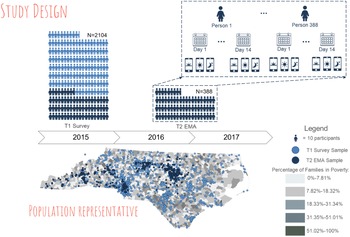
The RAISE study used EMA via mobile phones to measure the daily experiences, problem behaviors, and emotion regulation among a subsample of 395 adolescents attending public schools in North Carolina, aged 10–15. This subsample of adolescents was selected from the larger 1,867 sample (referenced above) and recruited to participate in a home visit and a 14-day EMA between April 2016 and February 2017 for two weeks that were considered normal or typical for the adolescents (e.g., were not on a holiday break, were not ill, etc.). Adolescents were selected to participate in the 14-day EMA based on their (1) proximity to two distinct geographical locations (central, urban NC and western rural NC) that allowed staff to make in-person home visits (1,275 adolescents were eligible) and (2) representation of economic disadvantage, gender, race, and ethnicity in regards to the statewide public school population. Adolescents were recruited among this eligible sample until the target N = 400 was reached (Jensen et al., Reference Jensen, George, Russell, Lippold and Odgers2021b). The 395 adolescents who agreed to participate in the EMA were more likely to be White (60.6% vs. 51.3%) and less likely to be economically disadvantaged (indicated as current receipt of free/reduced lunch; 40.8% vs. 55.4%) compared to the overall state public school population (Jensen et al., Reference Jensen, George, Russell and Odgers2019). Home visits were conducted by two interviewers who installed MetricWire (Version 3; MetricWire Inc., Kitchener, ON, Canada), a phone-based survey application used to deliver the EMA on the participant’s own mobile phone or a study-administered phone (49.9% of adolescents elected to use their own phones). EMA surveys were administered three times a day (morning, afternoon, and evening) during the 14 consecutive days. Of the EMA subsample, 388 adolescents completed at least one EMA survey during the study period and are therefore included in the current analyses. Thus, daily hassles, affect, and conduct problems were assessed in the EMA surveys 12–18 months post the administration of the Adolescent Survey (baseline survey). See Figure 1 for a representation of the study design (Jensen et al., Reference Jensen, George, Russell and Odgers2019). Eighty percent of the survey prompts were answered, yielding 13,017 total observations over 5,270 study days. All procedures, protocols, and measures were approved by the Duke University Institutional Review Board for the RAISE study (Approval D0396).
Study design. Jensen, Odgers et al (2019) Clinical Psych Science.

Measures
Pubertal maturation was a self-reported measure adapted from the Pubertal Development Scale (PDS, Petersen et al., Reference Petersen, Crockett, Richards and Boxer1988) during the administration of the Adolescent Survey in 2015 to the full sample of RAISE adolescents (N = 2,104). The original five items from the PDS and an additional item asking about perceived pubertal development were scored on a 4-point categorical response scale (scaled 0–3). We included the perception item with the 5-item PDS because the PDS was intended to measure status, not timing. Thus, the perception item may help improve the measure’s validity to index pubertal timing, especially for adolescents that may have already reached maturity (please see Graber et al., Reference Graber, Lewinsohn, Seeley and Brooks-Gunn1997 for a discussion on the validity and reliability of self-reported perceived timing). For instance, both girls and boys answered questions about general pubertal development, which included a growth spurt in height, body hair, skin changes (e.g., growth in height has not yet begun to spurt = 0, has barely started = 1, is definitely underway = 2, or seems completed = 3). The perceived timing item asked whether they believed that their development was much earlier = 3, somewhat earlier = 2, about the same = 1, or somewhat later = 0 than girls/boys their age. Questions about pubertal development specific to participant sex were also asked. For instance, boys were asked about the deepening of their voice and facial hair growth. Girls were asked about breast development and whether they had started their period. The mean of the six items were compiled to create a measure of pubertal maturation for girls and boys, respectively. Higher scores on the pubertal maturation measure correspond to earlier pubertal development. We used this pubertal maturation scale to generate our measure of pubertal timing, which was the central predictor in our analyses. Pubertal timing was generated using the residuals from a regression of the pubertal maturation measure on chronological age (self-reported year of age) and was mean-centered for both boys and girls, and estimated separately for boys and girls. This age-norming of pubertal status is recommended by previous research to increase the interpretability and precision of pubertal timing operationalization (Conley et al., Reference Conley, Rudolph and Bryant2012; Dorn et al., Reference Dorn, Susman and Ponirakis2003). Higher scores on measures of pubertal timing are reflective of earlier pubertal timing among boys and girls, as expected for his or her age. The procedure we used to create our residualized pubertal timing score is more fully described in the Analytic strategy and statistical models section.
Conduct problems were assessed in the afternoon and evening surveys, with the prompts, “So far today…” and “Since this afternoon…,” respectively. Participants reported Yes = 1 or No = 0 to six items developed by our research team that asked about problem behaviors (e.g., “I hit or hurt someone” and “I damaged someone else’s property”). The answers to these items were summarized within day to create a daily score of conduct problems and were dichotomized as a binary variable due to the nonnormal distribution of the count data. If adolescents reported engaging in at least one type of problem behavior (either during the afternoon or evening) the daily score was coded as 1 (4%) and the absence of daily conduct problems was coded as 0 (96%). Intraclass correlation coefficients (ICCs) were calculated using linear multilevel models with no predictors in order to separate the variance of the EMA variables into between- and within-person components. The ICC for average daily conduct problems is 0.28, indicating that 28% of the variance in day-level conduct problems is between adolescents, whereas the remaining 72% of the variance is explained within adolescents over time.
Negative affect was assessed in the morning, afternoon, and evening surveys with items adapted from the child version of the Positive and Negative Affect Schedule (Laurent et al., Reference Laurent, Catanzaro, Joiner, Potter, Lambert, Osborne and Gathright1999). The adolescent reported on a series of items that asked whether they currently felt (i.e., “Right now, I feel…”): “mad,” “nervous,” “sad,” “lonely,” “worried about something,” “tired,” and “stressed” on a scale ranging from 1 (not at all) to 100 (very). The mean was taken from all of the items and rescaled so that the maximum daily score was 10 in order to reduce the variance and aid in interpretation (grand mean: M = 1.73, SD = 1.66, α = 0.84). The ICC for average daily negative affect is 0.54, indicating that 54% of the variance in day-level negative affect is between adolescents, whereas the remaining 46% of the variance is within individuals over time.
Positive affect was also assessed with items adapted from the child version of the Positive and Negative Affect Schedule (Laurent et al., Reference Laurent, Catanzaro, Joiner, Potter, Lambert, Osborne and Gathright1999) during the morning, afternoon, and evening surveys. The adolescent reported whether they currently felt (i.e., “Right now, I feel…”): “calm,” “full of energy,” “excited,” and “happy” on a scale ranging from 1 (not at all) to 100 (very). The mean of the items was taken to create a daily measure of positive affect and rescaled to make the maximum value 10 to also reduce the variance and aid in interpretation (grand mean: M = 5.13, SD = 2.40, α = 0.73). The ICC for average daily positive affect is 0.49, indicating that 49% of the variance in day-level positive affect is between adolescents, whereas the remaining 51% of the variance is within adolescents over time.
Exposure to hassles were administered during the afternoon and evening surveys with the prompts, “Since this morning…” and “Since this afternoon…,” respectively… Question items were adapted from the Microstress Events Inventory (Ham & Larson, Reference Ham and Larson1990), the BALES (Shahar et al., Reference Shahar, Henrich, Reiner and Little2003), the Daily Life Stressors Scale (Kearney et al., Reference Kearney, Drabman and Beasley1993), and the Daily Life Protocol (Evans et al., Reference Evans, Vermeylen, Barash, Lefkowitz and Hutt2009) to assess adolescents’ experiences with daily hassles across family, peer, and school contexts. Each of these contexts were assessed with separate items, which were then summarized to create a daily score of family, peer, and school hassles, respectively (see Jensen et al., Reference Jensen, George, Russell, Lippold and Odgers2021a for an example of how these items have been administered in prior EMA research ). A full list of daily hassle items across family, peer, and school contexts (along with their endorsement rates) are presenting in Supplemental Table 1. For example, family hassles were measured with eight items that asked adolescents, “Since this morning/afternoon, did any of these things happen with your family?” Responses were Yes or No to questions such as, “Argued with a parent,” “Brother or sister bugged me,” and “There was too much chaos at home” (grand mean: M = 0.32, SD = 0.76). The ICC for daily family hassles is 0.27 (27% of the variance is between adolescents, whereas the remaining 73% of the variance is within individuals over time). Peer hassles were measured with responses Yes or No to six items that asked questions like, “Friends left me out or ignored me,” “Friends did something behind my back,” and “Had problems with the girl/boy I like” (grand mean: M = 0.12, SD = 0.44). The ICC for daily peer hassles is 0.27 (27% of the variance is between adolescents and 73% of the variance is within adolescents over time). Finally, school hassles were assessed during the weekdays with Yes or No responses to seven questions like, “Got a bad grade,” “Schoolwork was too hard,” and “Teacher or coach was mean to me” (grand mean: M = 0.40, SD = 0.88). The ICC for daily school hassles is 0.39 (39% of the variance is between adolescents and 61% of the variance is within adolescents over time).
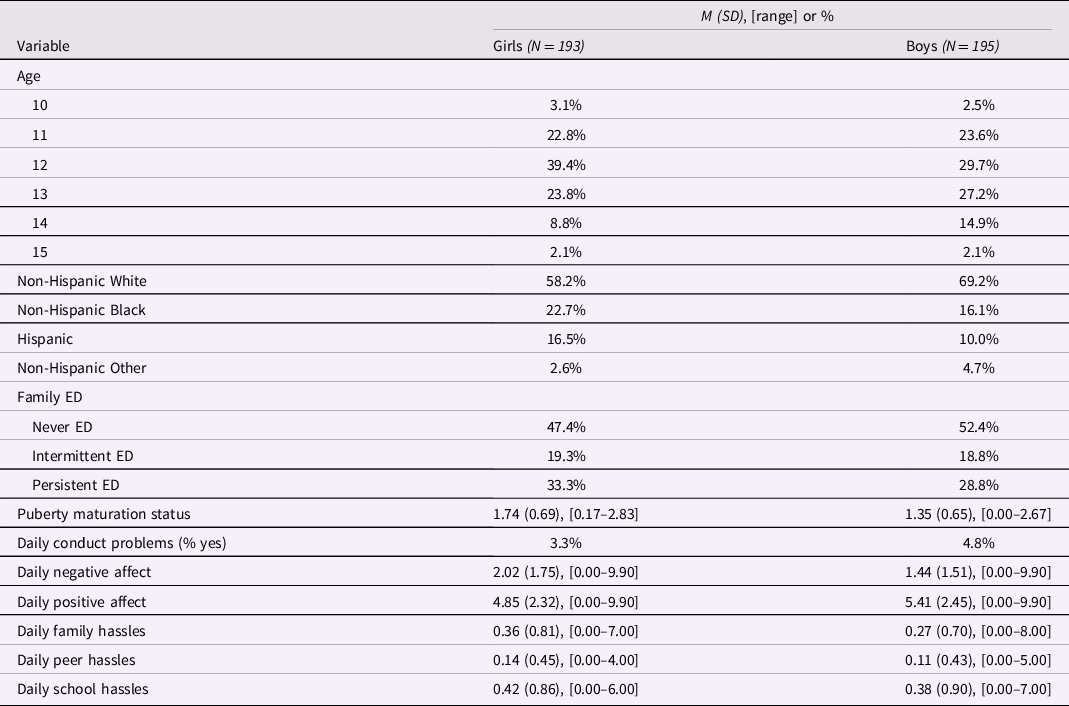
Demographic and study characteristics of the RAISE EMA study sample, by gender

Note. M = mean, SD = standard deviation; ED = economic disadvantage.
Demographic information was assessed during the Adolescent Survey administered to the full sample of RAISE adolescents. We include the covariates of adolescent race/ethnicity and an indicator of family socioeconomic status (i.e., family economic disadvantage) in our models. Race and ethnicity (Hispanic, Latino, Spanish) were self-reported by the adolescents and assessed with two separate items. These two items were combined to create four independent race/ethnicity categories (1 = yes, 0 = no): non-Hispanic White, non-Hispanic Black, Hispanic, and non-Hispanic Other Race. Non-Hispanic White was used as the reference category in all models. Family economic disadvantage was determined based on the eligibility for free and/or reduced lunch using school administrative records. Schools use verified household income to determine eligibility; cutoffs vary with household size and are on the order of 175% the federal poverty level. On average, information on participants’ family economic disadvantage was available for 91.4% of possible observation years. The longitudinal assessments were used to create a variable with three categories: never eligible (0), intermittently eligible (1), and persistent or always eligible (2). Moreover, for the moderation analyses (i.e., Question 3), the race/ethnicity variables and socioeconomic status were mean-centered and included as interaction terms with the daily hassles examined. Descriptive information for the study variables and covariates is reported by gender within the EMA subsample (n = 388) in Table 1.
Analytic strategy and statistical models
Pubertal timing
The residualization of pubertal status on chronological age was performed using separate regression models for boys and girls, as indicators of pubertal maturation are qualitatively different for each sex. The regression models included the full sample of RAISE adolescents (N = 2,104) so that pubertal timing estimates would be relative to the average for a representative sample of the local population. Equation (1) shows the regression model estimating the association between pubertal maturation (
 ${Puberty}_{i}$
) and chronological age (
 ${ Age}_{i}$
).
 $$Pubert{y_i} = {\beta _0} + {\beta _1}\left( {Ag{e_i}} \right) + {\delta _i}$$
In Equation (1),
 ${Puberty}_{i}$
represents the recorded pubertal maturation level for adolescent i. The regression line, defined by
 $\beta _{0}+\beta _{1}\left({ Age}_{i}\right)$
, is a vector of the pubertal maturation levels that would be expected given each adolescent’s chronological age. This predicted score is hereafter denoted using
 ${\widehat{Puberty^i}}$
. The residual (δ
i
) represents the difference between the observed pubertal maturation and the predicted pubertal maturation for their age (
 ${\delta_i = Puberty_i - \widehat{Puberty^i}}$
), and thus represents a discrepancy score informing whether and to what degree their pubertal development is earlier or later than what is typical for their same-sex (because models were run separately by sex), same-age peers. The residual from this model was saved as a separate variable for each adolescent and served as the measure of pubertal timing, with positive values indicating earlier than average development, and negative values indicating later than average pubertal development. To enhance interpretability, our pubertal timing indicator was divided by its sex-specific standard deviation (SD) to generate a sex-specific Z-score (
 ${PubTiming}_{i}$
, with M = 0, SD = 1 for each sex). All models using this variable were run separately for boys and girls.
Question 1: Is earlier versus later pubertal timing associated with adolescents’ daily conduct problems and affect?
We used generalized multilevel modeling to examine whether adolescents with later pubertal timing relative to their peers tended to report more behavioral and affective problems in their everyday lives. Equation (2) shows an example model, where negative affect, assessed via EMA for adolescent i at time t (
 ${ NA}_{it}$
), is predicted by our residualized measure of pubertal timing described previously (
 ${ PubTiming}_{i}$
).
 $$N{A_{it}} = {\beta _0} + {\beta _1}\left( {PubTimin{g_i}} \right) + {u_{0i}} + {e_{it}}$$
The β
1 coefficient associated with pubertal timing represents the effect of earlier or later pubertal timing on the mean of NA for adolescent i. Because
 ${PubTiming}_{i}$
has a mean of 0 for each sex, the intercept β
0 represents the amount of mean NA for a typically maturing adolescent. The random intercept u
0i
captures the remaining between-adolescent variability in NA after the effect of pubertal timing is removed; the within-adolescent residual e
it
captures the time-specific deviation in NA from the predicted mean for adolescent i. Linear models were run for continuous outcomes (NA and PA); modified Poisson models were run for the binary outcome of conduct problems. Modified Poisson has emerged as an alternative to logistic regression models given that it more directly models differences in probability (as opposed to differences in odds), allowing interpretations of its coefficients as increases or decreases in likelihood (Zou, Reference Zou2004). This involves using a Poisson model to estimate the probability of a binary outcome variable, using empirical standard errors to relax the variance expectation for a Poisson outcome (σ
2 = μ), thereby allowing the variance expectation and derived standard errors to naturally approach the expectation for binary outcome (where σ
2 = μ * (1−μ)). Exponentiation of the coefficients from the modified Poisson model gives the prevalence ratio (PR), which is evaluated using 1 as the null and provides an estimate of proportional increase (if greater than 1) or proportional decrease (if smaller than 1) in the predicted probability (Zou, Reference Zou2004).
Question 2: Are earlier versus later maturing adolescents more likely to encounter daily exposures to hassles within family, peer, and school contexts?
The number of hassles over the last few hours (across family, peer, and school contexts) were modeled separately using conventional multilevel Poisson models, where the count of hassles was modeled as a dependent variable following a Poisson process. Equation (3) shows an example model, where the natural log of the mean number of hassles across adolescents i at time t
 $(\ln [E\{{ FamHassles}_{it}\}])$
is modeled as a function of pubertal timing. The random intercept u
0i
captures between-adolescent variability in the probability of experiencing family hassles across all moments.
 $${{ln}}\left( {E\left( {FamHassle{s_{it}}} \right)} \right) = {\beta _0} + {\beta _1}\left( {PubTimin{g_i}} \right) + {u_{0i}}$$
Question 3: Are the same-day associations between adolescents’ conduct problems, affect and experienced hassles stronger among groups of earlier versus later maturing adolescents (i.e., is earlier pubertal timing correlated with greater behavioral/psychological reactivity to daily hassles)?
Here we tested the effect of pubertal timing on reactivity to events – testing whether earlier or later pubertal maturation was associated with greater sensitivity or reactivity to day-to-day experiences. Equation (4) provides an example, using current family hassles as a predictor of concurrent NA.
 $$\matrix{
{N{A_{it}}} \hfill & = \hfill & {{\beta _0} + {\beta _1}\left( {PubTimin{g_i}} \right) + {\beta _2}\left( {FamHassle{s_{it}}} \right)} \hfill \cr
{} \hfill & {} \hfill & { + {\beta _3}\left( {PubTimin{g_i}*FamHassle{s_{it}}} \right)} \hfill \cr
{} \hfill & {} \hfill & { + {\beta _4}\left( {{{\overline {FamHassles} }_i}} \right) + {u_{0i}}} \hfill \cr
{} \hfill & {} \hfill & { + {u_{1i}}\left( {FamHassle{s_{it}}} \right) + {e_{it}}} \hfill \cr
} $$
In Equation (4), NA for adolescent i at time t is predicted by pubertal timing, the number of family hassles reported over the last few hours (
 ${ FamHassles}_{it}$
) and the cross-level interaction between pubertal timing and hassles, which tests whether the within-person association between family hassles and NA is stronger or weaker based on the adolescents’ pubertal timing. The model includes a random intercept (u
0i
) and a random slope for family hassles
 $(u_{1i}[{ FamHassles}_{it}])$
, the variance of which gives an estimate of how much the within-person association between family hassles and NA varies between adolescents. The model also adjusts for the mean number of family hassles experienced by each adolescent (
 $\overline{{ FamHassles}}_{i}$
), which removes all between-person variance in the family hassles predictor and ensures that model parameters associated with
 ${ FamHassles}_{it}$
describe within-person associations between family hassles and NA. Linear models were used for PA and NA; modified Poisson models were used for binary conduct problems. Interactions were unpacked by estimating simple effects of hassles directly from the model at one SD above average sex-specific pubertal timing (referred to as earlier maturing) and at one SD below sex-specific average pubertal timing (later maturing).
Results
Question 1: Is earlier versus later pubertal timing associated with adolescents’ daily conduct problems and affect?
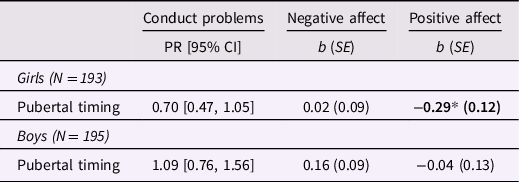
As shown in Table 2, pubertal timing was found to be significantly associated with average daily positive affect among earlier maturing girls (b = −0.29, p ≤ 0.05), such that girls who have reached pubertal maturity earlier relative to their same-sex and same-age peers reported experiencing less positive affect in their daily lives. Pubertal timing was not significantly associated with average daily reports of positive affect among adolescent boys. Moreover, pubertal timing was not significantly associated with average daily conduct problems or negative affect among boys or girls.
Association between pubertal timing and daily conduct problems and affect

Note. Higher scores on pubertal timing represent earlier pubertal timing among girls and boys.
All models adjust for family economic disadvantage and race/ethnicity.
PR = Prevalence ratio.
*p ≤ 0.05; **p ≤ 0 .01. Significant findings are presented in bold.
Question 2: Are earlier versus later maturing adolescents more likely to encounter daily exposures to hassles within family, peer, and school contexts?
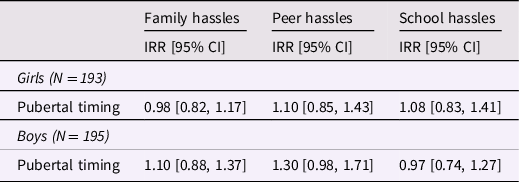
The results reported in Table 3 reveal no evidence for the association between girls’ nor boys’ pubertal timing and daily experiences related to hassles across family, peer, and school contexts.
Association between pubertal timing and daily exposures to hassles

Note. Higher scores on pubertal timing represent earlier pubertal timing among girls and boys.
All models adjust for family economic disadvantage and race/ethnicity.
IRR = Incident rate ratio.
*p ≤ 0.05; **p ≤ 0 .01. Significant findings are presented in bold.
Question 3: Are the same-day associations between adolescents’ conduct problems, affect and experienced hassles stronger among groups of earlier versus later maturing adolescents (i.e., is earlier pubertal timing correlated with greater behavioral/psychological reactivity to daily hassles)?
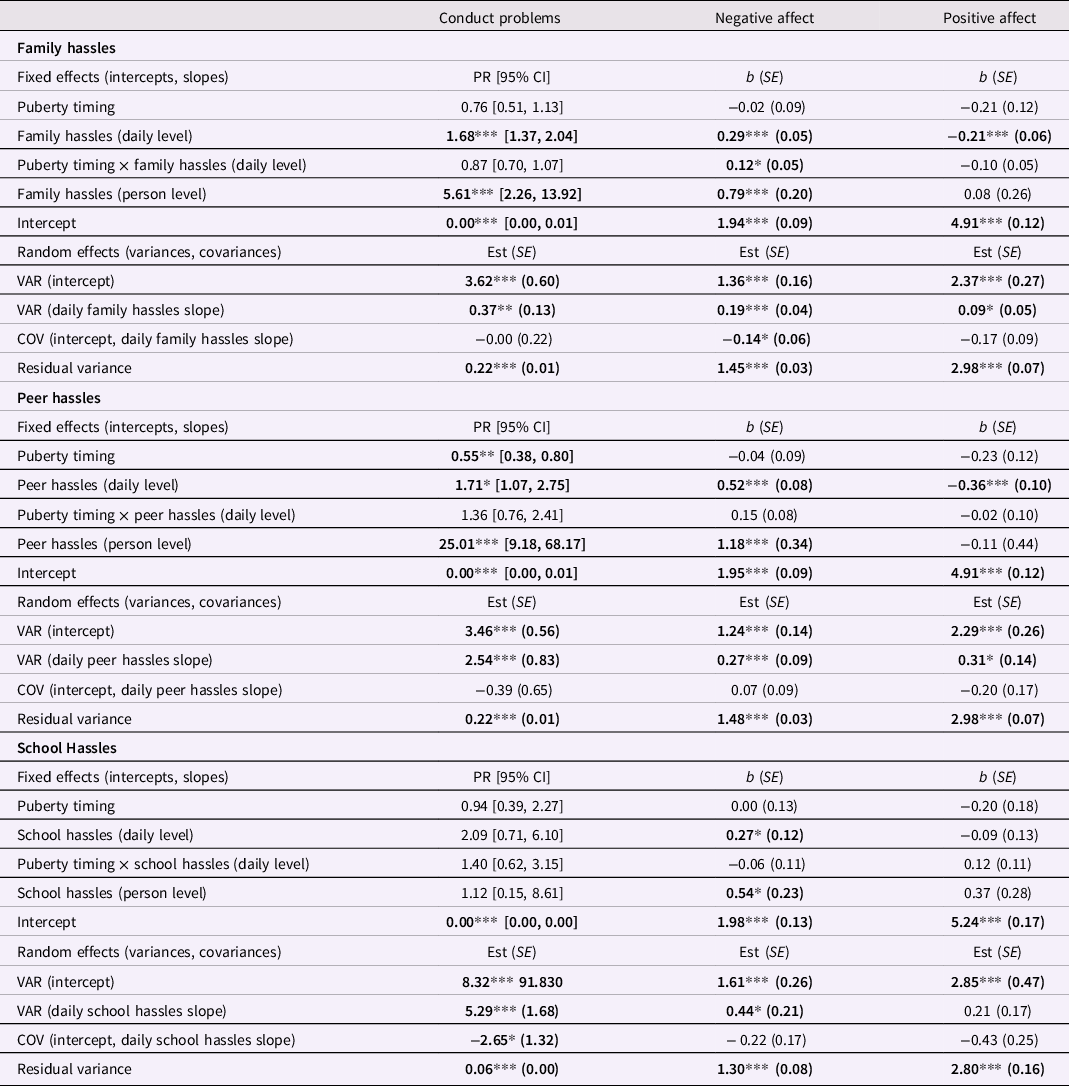
Tables 4 and 5 show the associations between hassles, conduct problems, and both negative and positive affect by pubertal timing for girls and boys, respectively. Beginning with the results for girls, Table 4 shows the associations between daily behavior and affect and daily hassles across family, peer and school contexts. The significant main effects of daily hassles suggest that on average, within-person effects of hassles were associated with same-day reports of affective/behavioral outcomes across varying pubertal timing in girls. For instance, daily family hassles were significantly associated with a greater likelihood of conduct problems, higher negative affect, and lower positive affect for girls. Significant associations – reported in the same directions – were also reported, on average, between conduct problems and peer hassles, as well as for negative and positive affect and peer hassles. Daily school hassles were significantly associated with greater negative affect in girls, but not with a greater likelihood of conduct problems or lower positive affect. Moreover, girls’ pubertal timing significantly moderated the relationship between daily family hassles and negative affect (b = 0.12, p = 0.02). The significant interaction indicated that for earlier maturing girls, daily experiences with family hassles were more strongly associated with greater negative affect (predicted simple slopes, b = 0.42, 95% CI: 0.27, 0.56) than hassles were for later maturing girls (predicted simple slopes, b = 0.17, 95% CI: 0.02, 0.32).
Moderation of girls' pubertal timing on the daily relationship between conduct problems, psychological affect, and hassles

Note. Higher scores on pubertal timing represent earlier pubertal timing. All models adjust for family economic disadvantage (ED) and race/ethnicity and include interactions between family ED and hassles and race/ethnicity and hassles to test the moderation of pubertal timing. *p ≤ 0.05; **p ≤ 0 .01; ***p ≤ 0.001. Significant estimates are in bold.
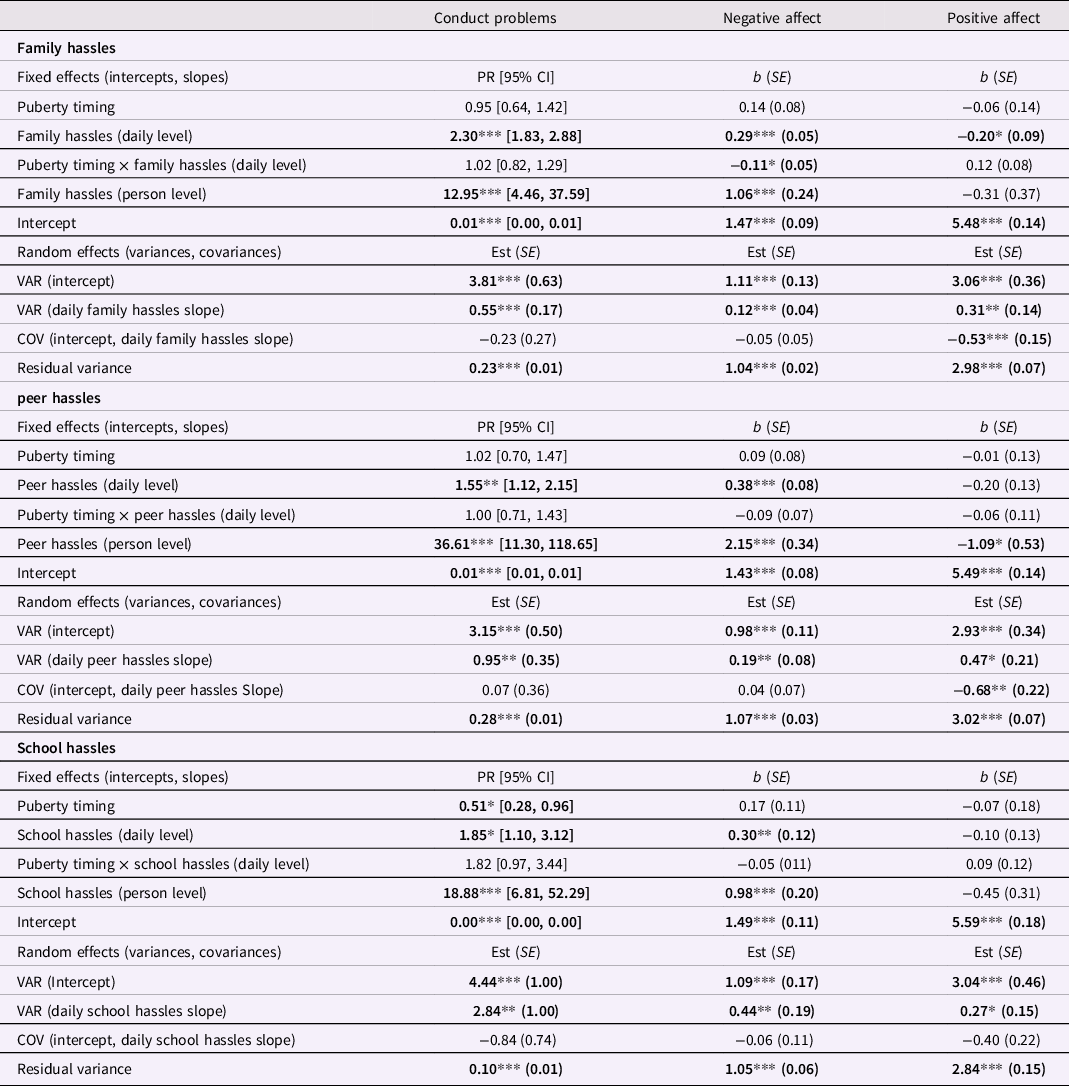
Moderation of boys' pubertal timing on the daily relationship between conduct problems, psychological affect, and hassles

Note. Higher scores on pubertal timing represent earlier pubertal timing. All models adjust for family economic disadvantage (ED) and race/ethnicity and include interactions between family ED and hassles and race/ethnicity and hassles to test the moderation of pubertal timing. *p ≤ 0.05; **p ≤ 0 .01; ***p ≤ 0.001. Significant estimates are in bold.
Table 5 shows the associations between hassles, conduct problems, and affect by pubertal timing for boys. Similar to girls, daily hassles across family, peer and school contexts were associated with behavior and negative and positive affect in boys. The significant main effects of hassles suggest that family, peer, and school hassles were associated with same-day reports of affective/behavioral outcomes across varying pubertal timing in boys. For example, the within-person effects of daily family hassles were significantly associated with a greater likelihood of conduct problems, higher negative affect, and lower positive affect in boys. Significant associations – reported in the same directions – were also reported, on average, between conduct problems and peer and school and hassles, as well as for negative affect in the contexts of peer and school hassles. However, peer and school hassles were not significantly associated with boys’ positive affect. Finally, pubertal timing was also found to significantly moderate the relationship between daily family hassles and negative affect in boys (b = −0.11, p = 0.02). This significant interaction suggests that the relationship between daily family hassles and negative affect was significantly stronger for later maturing boys (predicted simple slopes, b = 0.41, 95% CI: 0.26, 0.55), relative to earlier maturing boys (predicted simple slopes, b = 0.18, 95% CI: 0.04, 0.32).
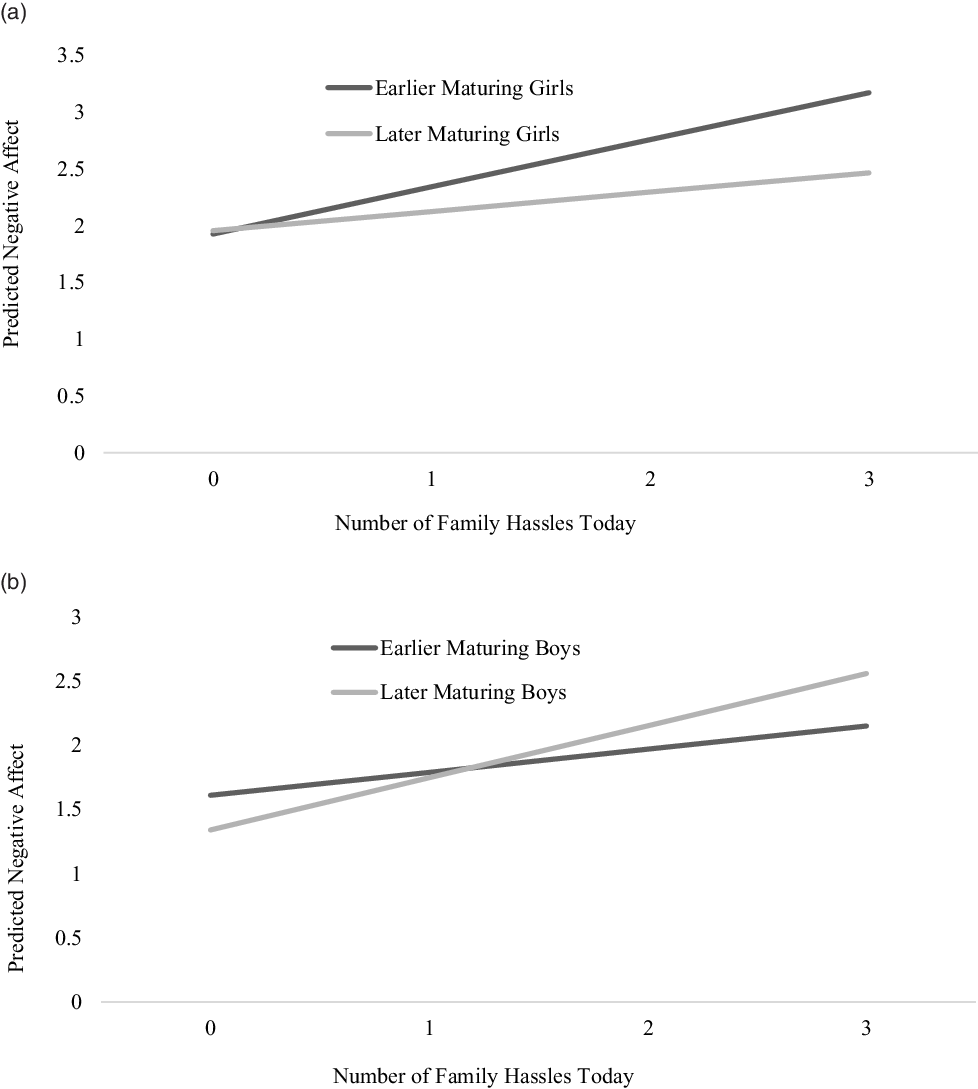
To assess the form of these significant 2-way interactions, we plotted the predicted simple slopes for negative affect for girls and boys in Figure 2. Figure 2, panel (a) shows the association between negative affect and the number of daily family hassles for earlier versus later maturing girls. The predicted simple slopes show that earlier maturing girls experience a 0.42 increase in daily negative affect for each additional family hassle experienced during the day (p < 0.001). In contrast, later maturing girls experience a 0.17 increase in daily negative affect with each additional family hassle and this increase was also significant (p = 0.03). Figure 2, panel (b) shows the relationship between the number of daily family hassles and the predicted simple slopes for negative affect among earlier versus later maturing boys. With each additional family hassle experienced during the day, later maturing boys experienced a 0.41 increase in daily negative affect that was significant (p < 0.001). However, earlier maturing boys experienced a 0.18 increase in daily negative affect that was also significant (p = 0.01).
Predicted negative affect as a function of pubertal timing and family hassles for girls (a); predicted negative affect as a function of pubertal timing and family hassles for boys (b).

Sensitivity and post hoc analyses
Given that our conceptual framework suggests that earlier versus later maturing youth may be more sensitive to daily hassles and therefore show stronger coupling between hassles and affect, we conducted a sensitivity analysis by excluding the morning surveys (e.g., in order to account for the possibility that affect reported in the morning may influence whether hassles are experienced or perceived). The initial results held except for the addition of one significant interaction between girls’ pubertal timing and family hassles for positive affect (b = −0.16, p = 0.01), thereby suggesting that for earlier maturing girls, daily experiences with family hassles were more strongly associated with lower positive affect (predicted simple slopes, b = −0.40, p < 0.0001) than family hassles were for later maturing girls’ positive affect (predicted simple slopes, b = −0.09, p = 0.33).
Regarding the findings for Question 1 (i.e., early maturing girls reporting lower levels of positive affect than did later maturing girls), we conducted a post hoc analysis to examine whether within-day effects may exist for early maturing girls (e.g., whether positive affect was lower in the morning, afternoon, or evening surveys). These exploratory analysis revealed that early maturing girls reported lower positive affect on the morning surveys (b = −0.35, p ≤ 0.01). This pattern was also evident in the afternoon and evening surveys (i.e., early maturing girls report lower positive affect), but these associations were not statistically significant. We believe examining within-day differences in affect among earlier versus later maturing girls is an interesting avenue for future research.
Discussion
The current study utilized EMA to examine the association between pubertal timing, daily affect and conduct problems, and the exposure to daily hassles across family, peer, and school domains in a sample of youth residing in North Carolina. Repeated assessments across 14 days of the same adolescents in their naturalistic environments allows for an understanding of how daily experiences are associated with health and well-being during puberty. The findings suggest that pubertal timing may play an important role in shaping and qualifying adolescents’ daily affective states within family contexts. Moreover, earlier maturing girls were found to report significantly lower daily positive affect than their same-age and same-sex peers. This finding is consistent with previous research suggesting that earlier timing of puberty among girls is a strong predictor of psychological distress during adolescence (Mendle et al., Reference Mendle, Harden, Brooks-Gunn and Graber2010).
In addition, the current study revealed that pubertal timing was not significantly associated with daily exposures to hassles across any of the social contexts examined. Nonetheless, pubertal timing was found to moderate the relationship between reports of average daily negative affect for both girls and boys and the frequency of experiencing family hassles, suggesting greater sensitivity to everyday experiences among earlier versus later maturing adolescents. Evidence of this within-person coupling between average daily affect and family hassles captures the dynamic interplay between individual-level characteristics (e.g., pubertal timing) and environmental factors (hassles) within individuals over time. Indeed, because girls and boys were used as their own control in the analyses, the same-day coupling of negative affect with reported family hassles suggests that this association is not entirely driven by shared family risk or other common contextual factors (Odgers & Russell, Reference Odgers and Russell2017).
These findings also suggests that the experience of daily hassles, specifically those related to family environments, may be influential on early maturing girls’ and later maturing boys’ reports of daily affect more so than previously understood. Indeed, much of the prior work on pubertal timing has focused on the influence of individual differences in pubertal timing within peer and other social contexts (Caspi et al., Reference Caspi, Lynam, Moffitt and Silva1993; Negriff et al., Reference Negriff, Ji and Trickett2011). More generally, these findings suggest that pubertal timing may increase adolescents’ awareness and sensitivities to negative home environments (Ge et al., Reference Ge, Conger and Elder1996), thereby increasing the saliency of daily family hassles for adolescent affect. These findings align with previous research suggesting that early maturing girls may show greater reactivity to hassles/stressors than later maturing girls (Mendle et al., Reference Mendle, Turkheimer and Emery2007). However, the finding that later maturing boys showed more reactivity to family hassles is in contrast to some prior research suggesting that earlier maturing boys may show more reactivity (i.e., develop externalizing hostile feelings) in the context of stressful life events (Ge et al., Reference Ge, Conger, Elder and Glen2001). These reported differences across studies may be due to the operationalization of stressful events (i.e., “big” events such as victimization events, versus “small” events, such as family hassles). Without more temporally micro-level assessments like EMA, we are unable to sort out what are “big” and “small” events, and importantly, what influence does the accumulation of “small” events have on behavioral health outcomes.
Moreover, certain types of affective states or behaviors, such as sensation-seeking or externalizing behaviors, may be more prevalent in earlier versus later maturing adolescents. However, our results do not find evidence for a relationship between pubertal timing and daily negative affect or conduct problems in girls, nor for negative and positive affect or conduct problems in boys. The low means/frequencies reported on daily negative affect and conduct problems during the 14-day period may have impacted these findings. Early maturing girls, nonetheless, did report lower levels of positive affect than did later maturing girls. Estimates garnered from different research designs (e.g., daily versus longitudinal assessments taken once a year or every six months) may represent different relationships between pubertal timing and adolescent affect and behavior. Indeed, previous research using lab-based designs has found emotionally charged situations to be especially important for influencing adolescents’ mental health and behaviors during puberty, whereas low affective contexts do not operate similarly for these outcomes (Figner et al., Reference Figner, Mackinlay, Wilkening and Weber2009). For example, risk-taking behaviors may primarily occur in affective salient social contexts (e.g., when adolescents are with their peers or when they believe they are being observed by their peers) (Crone & Dahl, Reference Crone and Dahl2012). However, the current study did not find evidence to suggest that pubertal timing was associated with daily reports of family, peer, and school hassles, nor that pubertal timing was associated with affective/behavioral reactivity to peer and school hassles. Despite the lack of support for the significant relationship between pubertal timing and daily hassles, the current study’s reported effect sizes of exposures to daily hassles are comparable to previous research examining the associations of pubertal timing and the likelihood of exposure to hassles and stressful environments (e.g., peer victimization, peer delinquency) using data from traditional longitudinal designs or cross-sectional studies (Mrug et al., Reference Mrug, Elliott, Davies, Tortolero, Cuccaro and Schuster2014; Su et al., Reference Su, Chen, Li, Elgar, Liu and Lian2018). This highlights the need for future research to replicate the current study’s findings in order to fully understand the relationship between pubertal timing and the daily exposures to risky/stressful environments.
The current study has several limitations that should be noted. First, although EMA offers a number of methodological strengths, our observational research design does not allow causal inferences to be made. The relationship between pubertal timing, affect, conduct problems, and daily exposures to family, peer, and school hassles were estimated as concurrent associations. Therefore, the current study sought to examine whether conduct problems and positive and negative affect may represent reactivity to contexts characterized by stressors/hassles in earlier/later maturing adolescents. Second, our measure of daily hassles likely encompasses both exposure and appraisal of experiencing hassles due to the reliance on adolescent self-reports instead of informant reports or observational data. Third, the daily reports of conduct problems were relatively low in the study population, which may have impacted our ability to detect significant relationships between conduct problems, pubertal timing, and hassles in daily life. Future work could build on the present results by exploring these relationships in study populations that report greater prevalence of conduct problems and/or employ EMA over longer periods of time to increase the likelihood of observing conduct problems – which are relatively rare instances reported by adolescents in general populations. Fourth, pubertal timing was estimated from the Adolescent Survey prior to the start of the EMA collection (approximately a year apart). The ability of this measure to serve as a proxy measure for pubertal timing at the time of the EMA relies on the stability of the relative standing of pubertal status across this roughly one-year interval. However, certain factors may diminish that stability – in both girls and boys for whom puberty had not yet begun to manifest – and if differences in pubertal tempo result in changes in adolescents’ relative standing. Nonetheless, this approach may have captured early maturation with reliability as adolescents who matured later were not able to be characterized as early maturers at the start of the EMA collection. Additionally, there is difficulty in separating late from on-time development in boys because many assessments of pubertal status were completed before age 14. This is also considered a limitation given later pubertal changes reported in boys (Brix et al., Reference Brix, Ernst, Lauridsen, Parner, Støvring, Olsen, Henriksen and Ramlau-Hansen2019). In addition to pubertal timing, another source of intraindividual variation in pubertal development that may be important to examine within daily life is pubertal tempo (i.e., characterized as fast versus slow in reference to an adolescent’s own previous development or the rate of pubertal change observed over time). A greater amount of evidence currently exists in support of the role of pubertal timing for influencing adolescent psychological and behavioral health, but pubertal tempo (i.e., how quickly adolescents progressed through puberty) has previously been identified as an important risk factor associated with increased psychological distress among boys (Mendle et al., Reference Mendle, Harden, Brooks-Gunn and Graber2010). Future longitudinal research assessing pubertal maturation across multiple time points would be needed to examine this additional source of intraindividual variation in the context of EMA of adolescents. Moreover, the findings from the current study may not align with prior work that has employed different operational definitions of pubertal timing. Recall that our measure of pubertal timing was characterized as a continuous variable including the entire EMA sample of adolescents. Our measurement construction may have limited the ability to replicate previous findings in the literature which classify adolescents’ pubertal maturation based on their relative distribution in the sample (Caspi et al., Reference Caspi, Lynam, Moffitt and Silva1993; Ge et al., Reference Ge, Conger and Elder1996) and because our measure represents a modified version of the original 5-item PDS (Petersen et al., Reference Petersen, Crockett, Richards and Boxer1988) since we included an additional item that asked adolescents to report their perception on whether their development was earlier or later than most other girls/boys their age. Finally, although race/ethnicity was included as a covariate in our models, as well as interactions between race/ethnicity and hassles (i.e., in Question 3), future research may wish to directly examine racial differences in the relationships between daily affect, behavior, and environments among earlier and later maturing adolescents. Indeed, previous research has found early pubertal timing to moderate the relationship between stressful life events and the development of depression symptoms differently between racial groups, where earlier maturing White girls and African American boys were the most susceptible to this relationship (Hamlat et al., Reference Hamlat, Stange, Abramson and Alloy2014).
Despite these limitations, the current findings add to our limited understanding of the role that daily life plays in influencing adolescents’ well-being during puberty. Indeed, puberty has been identified as a critical “window of opportunity” for improving health and well-being during adolescence, as well as across the life course (Dorn et al., Reference Dorn, Hostinar, Susman and Pervanidou2019). Puberty may provide an important opportunity for prevention and intervention efforts because adolescents display heighted sensitivity to rewards during this developmental period. Although this increased sensitivity makes some adolescents vulnerable to pleasurable, but potentially health-hazardous behaviors like drug use and risky sexual behaviors, acknowledging the importance of social-affective engagement during this period has implications for understanding how adolescents engage in cognitive systems that are associated with high motivation, which in turn, facilitate learning and problem-solving (Crone & Dahl, Reference Crone and Dahl2012).
EMA offers the potential to increase our understanding of the impact of pubertal timing on health-risk outcomes by offering important opportunities to study the daily affective, behavioral, and contextual experiences of adolescents. Examining the relationship between pubertal timing, experiences, behavior, and affect in daily life can further increase our understanding of the individual characteristics and contextual experiences that are most important during adolescence for long-term health and well-being (Schulenberg & Maslowsky, Reference Schulenberg and Maslowsky2015). Moreover, examining the daily social and affect dynamics among adolescents may inform our understanding of reactivity to social stressors, as well as resilience to withstand daily hassles during this important developmental period of sensitivity (Forbes et al., Reference Forbes, Stepp, Dahl, Ryan, Whalen, Axelson, Birmaher and Silk2012). Indeed, an understanding of how between-person differences operate in daily life may have important implications for tailored prevention and intervention strategies aimed at improving adolescent health and well-being (Russell & Gajos, Reference Russell and Gajos2020). The current study revealed that earlier maturing girls and later maturing boys may display greater sensitivity to everyday experiences, and that experiences within family contexts may be important points of intervention for improving adolescents’ daily affective states.
Acknowledgements
This research was supported by the National Institute on Drug Abuse to the Center for the Study on Adolescent Risk and Resilience (C-StARR) Grant P30 DA023026 (PI: R. H. Hoyle). Jamie M. Gajos received funding from the Prevention and Methodology Training Program (T32 DA017629; PI: L. M. Collins) and awards P50 DA039838 (PI: L. M. Collins) and K01 DA054262 (PI: J. M. Gajos). The content is solely the responsibility of the authors and does not necessarily represent the official views of the National Institute on Drug Abuse or the National Institutes of Health.
Conflicts of interest
None.