Implications
Provision of nitrate to ruminal microorganisms has been reported to diminish methane (CH4) production. The objective of this study was to investigate the effect of cattle diet from which rumen inocula were derived and cell wall to starch ratio on in vitro nitrate disappearance, nitrite accumulation, CH4 production and volatile fatty acids profile in the rumen. When the inoculum was derived from donor cattle adapted to a nitrate-containing diet, in vitro results indicated that this management of the donor made it possible to detect that initial nitrate disappearance was more rapid, subsequent nitrite accumulation was not significantly affected, acetate : propionate ratio was larger, and CH4 accumulation was suppressed.
Introduction
Nitrate metabolism in vivo can cause nitrite poisoning in ruminants if nitrite is not reduced to ammonium quickly enough (Lewis, Reference Lewis1951a; Holtenius, Reference Holtenius1957). Nitrate itself is not inherently toxic. The reduction of nitrite to ammonia is apparently slower than the reduction of nitrate to nitrite; thus, a dangerous concentration of nitrite may be built up (Dawson and Allison, Reference Dawson and Allison1988). High levels of nitrite might cause an acute intoxication to host animals, and also inhibit the growth of many kinds of ruminal microbes, especially cellulolytic bacteria, methanogenic archaea and protozoa (Iwamoto et al., Reference Iwamoto, Asanuma and Hino2002). Nitrite in the rumen is absorbed into the blood where it oxidizes hemoglobin to methemoglobin, which is incapable of carrying oxygen (Broekhoven et al., Reference Broekhoven, Davies and Geurink1989). Since the discovery of toxicity, numerous investigations of nitrate metabolism have been conducted. The toxicity of nitrate is related to many factors, such as nitrate dose rate, animal type and adaptation period (O'Hara and Fraser, Reference O'Hara and Fraser1975; Pfister, Reference Pfister1988). Sinclair and Jones (Reference Sinclair and Jones1964) demonstrated an increased rate of nitrate reduction when rumen microorganisms were adapted to high-nitrate feed. Animals that consume a high-nitrate diet can adapt by reducing nitrate and nitrite more rapidly because of a large increase in nitrate-metabolizing microbes in the rumen (Allison and Reddy, Reference Allison and Reddy1984). Morgavi et al. (Reference Morgavi, Forano, Martin and Newbold2010) reported that nitrate is an alternative electron sink, which competes with methanogenesis. In adapted animals, nitrite does not accumulate in plasma (Kemp et al., Reference Kemp, Geurink, Haalstra and Malestein1977; Cockrum et al., Reference Cockrum, Austin, Ludden and Cammack2010). The accumulation of the toxic nitrite intermediate from a given nitrate dose is less when readily available carbohydrate (glucose) is present (Barnett and Bowman, Reference Barnett and Bowman1957; Holtenius, Reference Holtenius1957). For this reason, the ratio of slowly to rapidly degraded carbohydrate was of interest. Alfalfa cell walls are more slowly digested than starch, and inclusion with non-fibrous carbohydrate led to a significant depression on cellulose disappearance rate (Rezaii et al., Reference Rezaii, Danesh Mesgaran and Heravi Mousavi2010). Enhanced nitrite reduction rates are of prime importance for increased tolerance to high-nitrate diets. Co-existence with cellulolytic bacteria facilitated the growth of Selenomonas ruminantium, which has been reported as a nitrate-reducing bacterial species and consequently increased nitrite reduction, whereas co-existence with amylolytic bacteria resulted in increased nitrite accumulation, so it was suggested that it may be important to enhance fiber digestion to suppress nitrite accumulation in the rumen (Yoshii et al., Reference Yoshii, Narito and Hino2003). Therefore, the objective of this study was to investigate the effect of nitrate adaptation and cell wall to starch ratio on in vitro nitrate disappearance, nitrite accumulation, methane (CH4) production and volatile fatty acid (VFA) profile in the rumen.
Material and methods
All procedures involving animals were conducted with the approval of the China Agricultural University Institutional Animal Care and Use Committee.
Rumen fluid sources
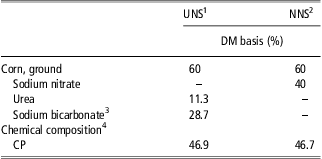
Four Limousin × Fuzhou crossbred steers (average BW ∼400 kg) fitted with permanent rumen cannulas were divided into two groups. Each group had two animals, which were used as rumen fluid sources in connection with feeding the two experimental diets in a crossover design. Either the urea-N diet (UND, 8.8% CP) or the nitrate-N diet (NND, 8.8% CP) was fed twice daily (0800 and 1600 h). The basal diet consisted of (dry matter (DM) basis) 80% corn silage and 20% concentrates (consisting of 9% ground corn, 2.77% soybean tofu residue, 2% distillers dried grains with solubles (DDGS), 5% urea-N supplement or nitrate-N supplement (UNS and NNS, Table 1), 0.23% salt and 1% vitamin and mineral premix). Water was freely accessible to the animals.
Ingredients of the UNS and NNS
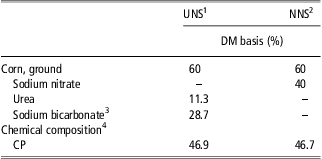
UNS = urea-N supplement; NNS = nitrate-N supplement.
1Added to the urea-N diet.
2Added to the nitrate-N diet.
3To balance the concentration of sodium in the supplements.
4Actual determination.
There were two feeding periods. In the first period, the UND-fed steers received the UND. The NND-fed steers received incremental dietary dosages of nitrate that was accomplished by stepwise substitution of NNS for UNS (1 : 4, 2 : 3, 3 : 2, 4 : 1 and 5 : 0) in the basal diet. Each increment was fed for 3 days until adaptation to the NND was completed after 15 days. In the second period, the diet fed to each group was switched (from UND to NND, and from NND to UND), and again 15 days were allowed for adaptation to NND.
At the end of each 15-day period, rumen contents were obtained 5 h after the morning feeding from each steer and separately strained through four layers of cheesecloth and then brought immediately to the laboratory for the in vitro study.
In vitro substrates
Cell wall source
Alfalfa that was harvested at early-bloom stage was ground to pass through a 1-mm-pore size screen. After boiling for 1 h in a 1% SDS solution, the insoluble residue was extensively washed before freeze-drying (FD-4, Beijing Boyikang Medical Equipment Co., Beijing China).
In vitro substrates
Sodium nitrate (S5506, Sigma-Aldrich Chemical Co., St Louis, MO, USA) was provided as the sole nitrogen source in the substrates, whereas the blank incubations had no substrate added. The two different cell wall to starch (CW : S) ratios were 20 CW : 80 S (17.5% alfalfa cell wall, 69.9% starch and 12.6% sodium nitrate) and 80 CW : 20 S (69.9% alfalfa cell wall, 17.5% starch and 12.6% sodium nitrate) and the N concentration of the in vitro substrates was equivalent (12.5% CP) for both treatments.
Incubation methods
Incubations were conducted anaerobically for 24 h using the gas production method of Menke et al. (Reference Menke, Raab, Salewski, Steingass, Fritz and Schneider1979). Rumen fluid filtrates from the two replicate donor steers were pooled into an anaerobic buffer solution under a constant flow of O2-free CO2 (the ratio of rumen fluid : buffer = 1 : 2). Then, 30 ml or 50 ml of inoculated buffer solution were pipetted with an automatic pump into replicate glass syringes (100 ml total volume, HFT000025, Häberle Maschinenfabrik GmbH, Baden-Württemberg, Germany), which were pre-warmed to 39°C. The filled syringes were incubated in a shaking water bath at 39°C. Blank syringes that contained only inoculated buffer solution with no substrate addition were simultaneously incubated. Each treatment had its own three blank syringes. Aliquots of 30 ml of inoculated culture medium with 0.20 g (DM) substrate were incubated for gas production and composition measurements. Aliquots of 50 ml with 0.37 g substrate were incubated for nitrate and nitrite determinations and for fermentation parameter determinations. Three syringes were sampled at each sampling time.
Sampling and analysis
Three milliliters were collected at 3, 6, 12 and 24 h to immediately determine pH with a pH meter equipped with a glass electrode (Model PHS-3C, Shanghai Leici Scientific Instrument Co., Ltd, Shanghai, China). Then each sample was centrifuged for 15 min at 3000 × g. The supernatants were divided into three equal parts for later determination of nitrate (NO3-N), nitrite (NO2-N), ammonia-N (NH3-N), and volatile fatty acid (VFA) concentrations. The first part of the supernatants was mixed with 25% phosphoric acid, and then frozen at −20°C overnight. After thawing, the acidified samples were centrifuged for 15 min at 6000 × g and the supernatant was analyzed for NO3-N and NO2-N concentrations using an ion chromatograph (Model Dionex-2500, Dionex Co., Ltd, CA USA) with an Ionpac AS11-HC 2-mm analytical column. The eluent system was multi-concentration eluent flow at 1.2 ml/min as follows: 22.5 mmol/l NaOH before 6.7 min, 40 mmol/l NaOH during 6.7 to 12.0 min and 22.5 mmol/l NaOH from 12.1 to 13.0 min. Standard solutions were obtained from National Information Infrastructure for Certified Reference Material (Beijing).
The second part of the supernatants was mixed with 25% phosphoric acid, which had 2g/l 2-ethyl-n-butyric acid as the internal standard, and then frozen at −20°C overnight for VFA concentrations measurement. After thawing, the procedure was similar to that of nitrate and nitrite measurement. The detailed procedure was described by Guo et al. (Reference Guo, Schaefer, Lehmkuhler and Meng2009). The third part of the supernatants was measured for NH3-N concentration (Broderick and Kang, Reference Broderick and Kang1980).
Gas volume and composition (H2, CH4 and carbon dioxide) of the headspace gas of each treatment at 3, 6, 12 and 24 h incubation were determined. A gas sample was obtained from each incubation syringe using a 2 ml glass syringe (Guo et al., Reference Guo, Schaefer, Lehmkuhler and Meng2009). The needle of the 2 ml glass syringe was pushed through the silica gel tube, which was connected to the 100 ml incubation syringe, and then the plunger of the incubation syringe was depressed to make headspace gas in the incubation syringe flow into the 2 ml syringe. The composition of the gas sample was then analyzed with a gas chromatograph (TP-2060T, Beifen Ruili Analytical Equipment Co., Beijing, China) equipped with a thermal conductivity detector (column: TDX-01, 1 m × 3 mm × 2 mm; injector temperature; 150°C; column temperature, 120°C; detector temperature, 150°C; carrier gas, argon; gas flow, 50 ml/min; injection volume, 1 ml).
Statistical analysis
All data were analyzed as a crossover design using two-factor PROC MIXED of SAS (SAS Institute, 2008). The model was Yijk = μ + Xi + βj + αβij + ε 11k + ε 12k + ε 21k + ε 22k, in which i was ratio (20 CW : 80 S and 80 CW : 20 S), j was adaptation (donor fed UND v. NND), and k was syringe. Means were analyzed using the least squares means (LSMEANS) procedure. Multiple comparisons were done with Tukey's range test.
Results
NO3-N and NO2-N
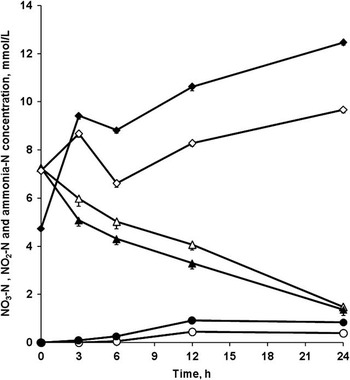
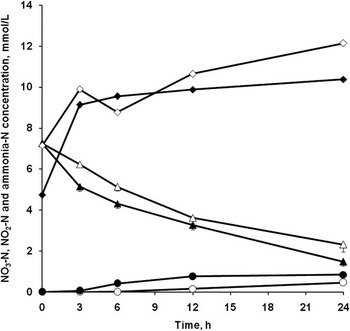
The main effects of donor diet and CW : S ratio is shown in Figures 1 and 2. Across the four sampling times, nitrate concentration decreased (P < 0.01) and nitrite concentration increased (P < 0.01) with duration of incubation. There was no interaction between donor adaptation to NND and CW : S ratio in terms of nitrate disappearance, nitrite accumulation or NH3-N concentration, and CW : S ratio (20 CW : 80 S in Figure 1, and 80 CW : 20 S in Figure 2) had no effect on nitrate disappearance and nitrite concentration (P > 0.05). The initial concentration of sodium nitrate supplemented into the substrate mixture was 7.26 mmol/l. Nitrate disappearances after 3 and 6 h incubation was more rapid by nitrate-adapted animal than un-adapted animal (P = 0.003 and P = 0.007, respectively). Whether UND or NND was fed to donor cattle did not affect nitrite concentration during 24 h of in vitro incubation (P > 0.05). The concentration of NH3-N was greater after 6 h incubation when the inoculum was obtained from NND-fed steers and the incubations contained 20 CW : 80 S (P = 0.02, Figure 1).
The effect of donor diet on concentrations of nitrate- (NO3-N), nitrite- (NO2-N), and ammonia-nitrogen (NH3-N) at 3, 6, 12 and 24 h of in vitro incubation with 20 cell wall : 80 starch ratio. Open symbols refer to results with inoculum from urea-fed donors. Closed symbols refer to results from nitrate-adapted donors. □, ▴ NO3-N concentration; ○, ● NO2-N concentration; ◊, ⧫ NH3-N concentration (P < 0.05).

The effect of donor diet on concentrations of nitrate- (NO3-N), nitrite- (NO2-N), and ammonia-nitrogen (NH3-N) at 3, 6, 12 and 24 h of in vitro incubation with 80 cell wall : 20 starch ratio. Open symbols refer to results with inoculum from urea-fed donors. Closed symbols refer to results from nitrate-adapted donors. □, ▴ NO3-N concentration; ○, ● NO2-N concentration; ◊, ⧫ NH3-N concentration (P < 0.05).

Gas production
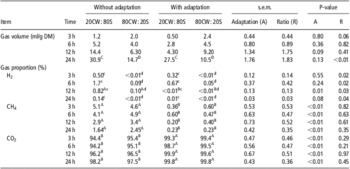
Gas volume as well as the gas composition (H2, CH4 and carbon dioxide) results are presented in Table 2. There was no interaction between donor adaptation to NND and CW : S ratio for gas volume and gas composition (P > 0.05).
The effect of dietary nitrate adaptation and cell wall to starch (CW : S) ratio on gas production and composition during 24 h incubation in vitro 1

DM = dry matter.
1The first letter in each superscript series is associated with the largest mean value.
A,BMeans with a different superscript denote the highly significant difference of adaptation (P < 0.01).
c,dMeans with a different superscript denote the significant difference of CW : S ratio (P < 0.05).
C,DMeans with a different superscript denote the highly significant difference of CW : S ratio (P < 0.01).
Nitrate adaptation
Adaptation to exogenous dietary nitrate did not affect total gas volume. Gaseous H2 proportion was lower after adaptation (P = 0.01) at 12 h. Rumen inocula from donors adapted to dietary nitrate resulted in less CH4 proportion (P < 0.01) and CO2 percentage was greater during the incubations (P < 0.01).
Cell wall to starch ratio
Total gas volume, CH4 and CO2 proportions were not affected (P > 0.05) by these ratios, except at the 24 h sampling time, when total gas volume was greater for the 20CW : 80S ratio. High starch in the substrate resulted in greater H2 proportion in the headspace gas (P < 0.05).
Sampling time
Total gas volume increased (P < 0.01) with incubation time. H2 proportion decreased in higher starch substrate, whereas in higher fiber substrate it remained at 0.1% or less; CH4 proportion decreased in both adaptation and cell wall to starch ratio during the 24 h incubation (P < 0.05), besides, there was no difference in CO2 proportion by adaptation or ratios (P > 0.05).
Fermentation characteristics
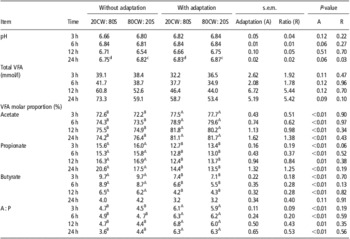
The effects of donor adaptation to NND and CW : S ratio on in vitro fermentation parameters are presented in Table 3. There was no interaction between donor adaptation and CW : S ratio for fermentation characteristics (P > 0.05). At 24 h, supernatant pH was greater in 80 CW : 20 S substrate (P < 0.05), and no effect was observed because of donor adaptation and CW : S ratios at other sampling times (P > 0.05). Across all incubation durations, CW : S ratio did not affect acetate, propionate and butyrate molar proportions (P > 0.05); however, donor adaptation to nitrate increased acetate molar proportion and acetate to propionate ratio while decreasing propionate and butyrate molar proportions (P < 0.01).
The effect of dietary nitrate adaptation and cell wall to starch (CW : S) ratio on fermentation parameters during 24 h incubation in vitro 1

VFA = volatile fatty acid.
1The first letter in each superscript series is associated with the largest mean value.
A,BMeans with a different superscript denote the highly significant difference of adaptation (P < 0.01).
c,dMeans with a different superscript denote the significant difference of CW : S ratio (P < 0.05).
C,DMeans with a different superscript denote the highly significant difference of CW : S ratio (P < 0.01).
Discussion
Nitrate is known to act as a terminal electron acceptor in anaerobic metabolism of several microorganisms (Lewis, Reference Lewis1951a; Fewson and Nicholas, Reference Fewson and Nicholas1961; Nason, Reference Nason1962; Farra, Reference Farra1969).
The disappearance of nitrate was rapid after adaptation regardless of the CW : S ratio in the incubation. This observation is consistent with Pfister (Reference Pfister1988) who reported that microorganisms are able to increase the conversion rate of nitrate to nitrite, but require 3 to 5 days to acclimatize. As nitrate reductase adaptation has been demonstrated in several isolated species (Fewson and Nicholas, Reference Fewson and Nicholas1961; Nason, Reference Nason1962), this ability may be expected in at least some of the many microbial species in the rumen (Hungate, Reference Hungate1966). In this experiment, increased nitrate reduction due to adaptation of the donor animal to dietary nitrate was observed mainly before 6 h of in vitro incubation. Bryant and Ulyatt (Reference Bryant and Ulyatt1965) reported that nitrate and nitrite disappeared within 5 to 8 h of nitrate dosing.
Nitrite accumulated during the incubations and was not affected by whether the inoculum was derived from a nitrate-adapted donor. Similarly, Yoshida et al. (Reference Yoshida, Nakamura and Nakamura1982) showed that in co-cultured ruminal bacteria and protozoa, nitrite accumulation did not differ after adaptation to nitrate. Iwamoto et al. (Reference Iwamoto, Asanuma and Hino2001) and Yoshii et al. (Reference Yoshii, Narito and Hino2005) reported that maximum nitrite accumulation occurs after about 10 h of in vitro incubation by non-nitrate adapted nitrate-reducing bacteria. This is similar to the result here in which nitrite concentrations were highest during 12 to 24 h of incubation.
High fiber rations may favor nitrite-reducing bacteria by maintaining a higher rumen pH. Yoshida et al. (Reference Yoshida, Nakamura and Nakamura1982) reported that during 12 h incubation in vitro, nitrite concentration was greater when the substrate was concentrate rather than forage because the incubation pH was more acidic. Yoshii et al., (Reference Yoshii, Narito and Hino2003) showed that the percentage of nitrate- and nitrite-reducing S. ruminantium in the total number of S. ruminantium was increased by feeding a high-nitrate diet added to a roughage diet for 12 weeks. In contrast, Barnett and Bowman (Reference Barnett and Bowman1957) reported nitrite accumulation during in vitro nitrate reduction studies with cellulose as substrate but not with glucose, suggesting that a readily available carbohydrate source in the ration would reduce the toxicity of a given amount to nitrate because nitrite would not accumulate. Previous demonstrations are not consistent with each other.
Nitrate adaptation did not suppress total gas volume or CO2 proportion; however, it reduced CH4 proportion. CH4 presents both a loss of 2% to 12% of the feed gross energy (Johnson and Johnson, Reference Johnson and Johnson1995) and is a source of greenhouse gas. Inhibition of CH4 production by ruminants would have significant economic and environmental benefits (Van Nevel and Demeyer, Reference Van Nevel and Demeyer1996). When CO2 is not used for CH4 production, an increase in CO2 production was expected, and was observed. The suppression of CH4 production was not associated with an increase in H2 accumulation. H2 and carbon dioxide are end products of carbohydrate fermentation and the main precursors for methanogenesis in the rumen (Hungate, Reference Hungate196). In vitro studies showed gaseous H2 to be the most efficient electron source for nitrate reduction (Lewis, Reference Lewis1951b). At the expense of decreased CH4 production, it is reasonable that H2 concentration diminished too. From this trial, nitrate-N could be used as an electron acceptor in place of CO2. However, Zhou et al. (Reference Zhou, Meng and Yu2011) showed that sodium nitrate also significantly decreased methanogen population using qPCR.
The ammonia concentrations in the incubation vessel differed at the start of the incubation. The rumen contents were obtained 5 h after morning feeding from donor animals. Hydrolysis of urea releases ammonia quickly. However, nitrate reduction to ammonia needs microorganisms and an electron donor, and the rate is slower. Nitrate adaptation did not change total VFA, but had significant effect on molar proportion of individual acids. Esdale et al. (Reference Esdale, Broderick and Satter1968) found that about 60% of the ruminal butyrate was formed from extracellular acetate, and acetate reduction involves the utilization of four electrons. It was suggested that butyrate formation from acetate served as an electron sink. Nitrate was a logical compound metabolized by rumen microflora to ammonia with concurrent removal of eight electrons. Nitrate can act as an electron sink in place of butyrate fermentation, so acetate concentration was increased and butyrate concentration decreased. Decreased concentration of other reduced end products such as propionate was also detected. Bryant and Ulyatt (Reference Bryant and Ulyatt1965) suggested the cause was because of a change in microbial population and the effects were not noted until 24 h after nitrate dosing. Because cell wall to starch ratio did not have effect on nitrite concentration, we conclude that this factor does not influence nitrate disappearance or nitrite accumulation. However, the diet of the donor animal should include nitrate so that the inoculum for in vitro studies reflects the metabolic effects that probably occur in the rumen.
Acknowledgment
This work was supported partly by Research Fund for the Doctoral Program of Higher Education of China (No. 200800190003), National Natural Science Foundation of China (No. 31101738), and China Agricultural Research System (CARS-38).