1 Introduction
Premodifying present participles are (de)verbal forms in -ing that function as attribute to a noun, as in (1).
- (1)
(a) [he] stopped short with the gasping goldfish in his hand. (FLOB)
(b) One of the problems with a sloping garden is that it may be overlooked by many other houses. (BNC)
(c) The prevailing winds originate from the south and south-west (BNC)
Their single form hides the fact that premodifying present participles can actually serve widely different functions in discourse, which have hitherto not been adequately described. In turn, the absence of a clear understanding of the various functions that premodifying present participles can take up has prevented diachronic shifts in their usage from being detected.
Both these aspects are to be addressed in this article. On the one hand, the article provides a systematic characterization of the functions fulfilled by premodifying present participles, against the background of a broader understanding of participial semantics (informed by De Smet & Heyvaert Reference De Smet and Heyvaert2011) and the functional organization of the English noun phrase (informed by Langacker Reference Langacker1991 and Halliday Reference Halliday1994). On the other hand, using corpus data, it is shown that the resultant functional classification permits the identification of a number of changes affecting the use of premodifying present participles over the course of the Late Modern and Present-day English periods. Specifically, premodifying present participles have become more clausal, in that they have come to be increasingly used to denote situations that are temporally aligned to the situation in the matrix clause. This ‘clausalization’ of premodifying present participles takes place primarily at the functional level, having at most minor consequences at the level of syntax.
In this respect, the history of premodifying present participles throws light on the functional developments that must precede or accompany the better-studied syntactic changes whereby noun phrases or adjective phrases develop into syntactically fully fledged non-finite clauses (Disterheft Reference Disterheft1981). A well-known example is the development of English gerund clauses, as in (2a), out of earlier nominal constructions, as in (2b) (see e.g. Fanego Reference Fanego1998).
- (2)
(a) All fish love eating tubifex and will gorge themselves silly on the worm. (BNC)
(b) Þe licome luuað muchele slauðe and muchele etinge and drunkunge. (c.1175, OED)
‘The body loves great slothfulness and great eating and drinking.’
In such clausalization processes, the syntactic reorganization of a phrase into a clause is the most eye-catching aspect of change, but recent research has shown that the formal changes are closely linked to – and may in fact be driven by – underlying functional changes (on gerunds, see De Smet Reference De Smet2009; Fonteyn et al. forthcoming). Clausalization, then, is not a purely syntactic phenomenon, but is a development that also – and perhaps primarily – affects the level of meaning and use in discourse. As is to be shown here, this is certainly true in the case of premodifying participles, whose history reveals a broad functional change with only modest syntactic consequences.
The article is organized as follows. Section 2 discusses the corpus data underlying both the functional and diachronic analysis. Section 3 develops the functional classification of English premodifying present participles. Section 4 shows how the functions predominantly served by premodifying present participles have shifted between eighteenth-century and Present-day English. The results are summarized in section 5.
2 Corpus data
The following discussion is based on corpus data drawn from the extended version of the Corpus of Late Modern English Texts (CLMETEV), the Freiburg–Lancaster–Oslo–Bergen Corpus (FLOB) and the British National Corpus (BNC). The CLMETEV covers the Late Modern period, with a subdivision into three seventy-year subperiods (1710–80, 1780–1850 and 1850–1920). FLOB and the BNC represent Present-day English, containing data mostly from the 1990s. All three corpora exclusively contain British English material.
Most of the discussion is based on samples drawn from the CLMETEV and FLOB, while the BNC has been used to find additional illustrative material for particular phenomena. The corpora have been queried for any words ending in -ing preceded by the, a or an. While the query fails to find all premodifying present participles, it vastly decreases the amount of noise in the data, offering a workable compromise between exhaustive searches and manageable datasets.Footnote 2 From the resultant concordances, samples have been collected as follows. For each subperiod, two samples have been made, each consisting of 200 randomly selected hits. The reason for taking two samples per subperiod is that comparison between the samples gives an idea of how reliably the samples reflect frequencies in the corpus as a whole.Footnote 3 In this way, 1,600 examples, spread over the four subperiods, have been collected, about two-thirds of which turned out not to contain a premodifying present participle,Footnote 4 ultimately leaving 533 relevant instances for closer analysis – more precisely, 125, 160, 113 and 135 instances for the respective subperiods (see the Appendix). The samples have been analysed ‘blindly’, meaning that all examples have been entered into a single datasheet and have been mixed randomly, with their precise origin hidden from the analysts during analysis. The blinded procedure is to guard against the analysts unconsciously imposing historical trends on the data. More precisely, while it is inevitable that specific examples can be approximately dated even when their source is hidden, the random ordering of examples keeps quantitative historical trends from being detected until after the analysis.
For genre consistency, the samples have been drawn from the fiction sections of the corpora. However, while fiction is the only genre sufficiently well-represented over the four subperiods, and therefore the most reasonable choice, it turns out to be something of a moving target in its own right. Specifically, fictional texts become increasingly narrative over time – narration being defined here as the sequential rendering in text of temporally connected situations of limited duration (following Labov Reference Labov2013). The result is that the average twentieth-century novel contains a considerably larger portion of pure narration than the average eighteenth-century novel. Thus, in the corpus material, narrative passages, as in (3a), become more dominant with time, while non-narrative text, as in (3b), loses in prominence.
- (3)
(a) Trim came in, erect and happy as an emperor; and having shut the door, Yorick took a book from his right-hand coat-pocket, and read, or pretended to read, as follows. (1759–67, CLMETEV)
(b) This young gentleman was indeed absolutely master of those insinuating qualifications which few women of passion and sensibility can resist; and had a person every way adapted for profiting by these insidious talents. He was well acquainted with the human heart, conscious of his own power and capacity, and exercised these endowments with unwearied perseverance. (1751, CLMETEV)
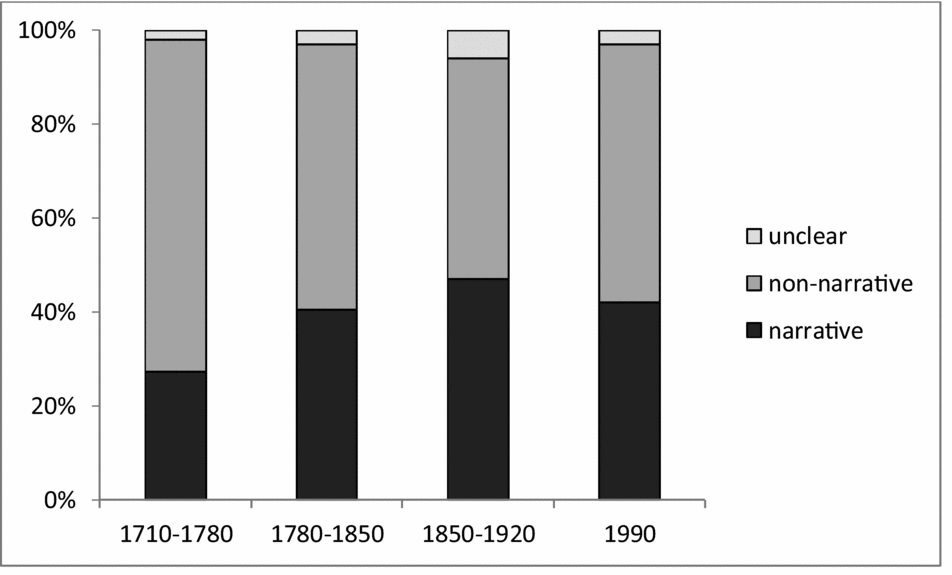
The magnitude of this shift has been estimated in the data by selecting from each subcorpus a sample of random passages centred around a target word and checking whether the target word is in a narrative section of the text or not. Figure 1 shows the results thus obtained in terms of the percentage of narrative passages per subperiod (based on 100 randomly selected and blindly analysed passages per period).
Portion of narrative text per subperiod in the fiction sections of the CLMETEV and FLOB

Figure 1 shows a visible increase in the amount of pure narration from just below 30 per cent in the first subperiod to over 40 per cent in the third and fourth subperiods. This trend may have influenced some of our research results, as discussed further below (see section 4).
3 Functions of premodifying present participles
In exploring the kind of functions they fulfil in discourse, premodifying present participles can be approached from two different angles. On the one hand, their meaning potential reflects that of present participles in general. On the other hand, premodifying present participles function within the functional complex that is the noun phrase. Accordingly, section 3.1 briefly outlines the meaning of present participles, whereas section 3.2 shows that premodifying participles also take up various roles in the functional complex of the noun phrase. In combination, these two perspectives produce a basic classification of premodifying present participles, covering the various ways in which they are exploited in constructing discourse. This classification is presented in section 3.3.
3.1 The meaning of present participles
The meaning of present participles has been largely neglected in reference grammars of English. Most descriptive statements are to the effect that present participles are sometimes but not always progressive in meaning (Quirk et al. Reference Quirk, Greenbaum, Leech and Svartvik1985; Declerck Reference Declerck1991; Huddleston & Pullum et al. Reference Huddleston and Pullum2002) or that present participles often express simultaneity (Jespersen Reference Jespersen1940; Wierzbicka Reference Wierzbicka1988). A more systematic account is developed in De Smet & Heyvaert (Reference De Smet and Heyvaert2011), where it is shown that the claims of reference grammars are not incorrect but seriously understate the meaning potential of present participles. De Smet & Heyvaert (Reference De Smet and Heyvaert2011) argue that present participles almost invariably construe the situation denoted by the verbal stem as a time-stable (i.e. unchanging) property holding over some period of time that at least includes a contextually evoked temporal reference point. In essence, this general characterization is shared with adjectives. However, in the case of present participles, it interacts with the often dynamic semantics of a verbal stem, as a result of which it can effectively translate into a broad range of aspectual meanings, such as progressive, iterative, habitual or gnomic. All these specific shades of meaning are attested in premodifying present participles as well, as shown by the respective examples in (4).
- (4)
(a) [progressive] the scene was lit by the warm glow of the setting sun (1888, CLMETEV)
(b) [iterative] With a beating heart I pushed open the door (FLOB)
(c) [habitual] He was a forgiving sort of man, she could tell. (FLOB)
(d) [gnomic] they found some difficulty in opening one of the folding doors (1777, CLMETEV)
For present purposes, the meanings distinguished in De Smet & Heyvaert (Reference De Smet and Heyvaert2011) are too fine-grained to provide a usable framework. In corpus data, many examples are highly ambiguous between a range of interpretations. For example, bending in (5) could be iterative (‘the wizard bends repeatedly’), progressive (‘the wizard is in the process of bending’), temporary stative (‘the wizard has assumed a bent over posture’) or gnomic (‘the wizard is a bent over old man’).
(5) for immediately a fragrant smoke arose that curled around the bending form of the wizard (1844, CLMETEV)
However, as De Smet & Heyvaert (Reference De Smet and Heyvaert2011) point out, their classification is essentially subordinate to a two-way distinction that can be applied to premodifying adjectives as well. A premodifying adjective denotes a state that is either a permanent characteristic of the nominal referent to which it is attributed, or a temporary quality that characterises the nominal referent in the specific situation evoked by a sentence or broader linguistic context (Bolinger Reference Bolinger1967; Quirk et al. Reference Quirk, Greenbaum, Leech and Svartvik1985: 434). The distinction is a manifestation of the contrast between stage-level and individual level predication (Carlson Reference Carlson1977; Kratzer Reference Kratzer, Carlson and Pelletier1995). An attributed characteristic can be time-stable all through the existence of its nominal referent, as in (6a), or just for the duration of (at least) the situation in which the nominal referent figures, as in (6b) (from De Smet & Heyvaert Reference De Smet and Heyvaert2011).
- (6)
(a) The master, a red-faced man with a pleasant voice, was called Rice (Google)
(b) A red-faced man, slamming the cabin door behind him and stumping out on the deck, interrupted my reflections (Google)
The classification of De Smet & Heyvaert (Reference De Smet and Heyvaert2011) outlines the various ways this basic distinction can play out in the aspectual readings assigned to present participles in context. But in itself the present participle underspecifies these interpretative possibilities, just as it underspecifies the distinction between a permanent or temporary characteristic.
A revised classificational framework can usefully rely on the more basic distinction between permanent and temporary characteristics. For example, the examples in (4) above divide easily into two classes, with the present participles in (4a–b) denoting temporary characteristics and the ones in (4c–d) denoting permanent features. The simplified description has the advantage of reducing the ambiguities in natural corpus data. For instance, re-examining (5) above, the fourfold ambiguity reduces to a more basic two-way ambiguity, whereby bending can be interpreted as a temporary feature of the wizard's form (allowing an iterative, progressive or temporary stative reading), or as a permanent feature (allowing a gnomic reading). Time-stability thus aligns itself either with the time-frame evoked by the clause or with the existence of the nominal referent. As argued further below (in section 3.3) these different types of alignment can be envisaged as different orientations of the characterization contributed by the participle.
Note that, in general, premodifying elements tend to express permanent features, while temporary features are most typically encoded by postmodifying and predicative elements (Bolinger Reference Bolinger1967; König Reference König1971; Markus Reference Markus1997). For example, this tendency explains why adjectives may have different default interpretations in attributive and predicative positions (cf. an eager student vs the student is eager) (Bolinger Reference Bolinger1967: 15), or why adjectives such as sorry or asleep, which denote an inherently temporary state, can only be used predicatively (cf. the girl is sorry vs *a sorry girl) (Bolinger Reference Bolinger1967: 3). From this, one would also predict a tendency for premodifying present participles to encode permanent features, but the generalization is no hard-and-fast rule (Markus Reference Markus1997) and, as we will show, premodifying present participles have increasingly come to violate it.
3.2 The functional organization of the noun phrase
Premodifying present participles not only partake in the general semantics of the present participle, but also take their place in the functional organization of the noun phrase. In the most general terms, the organization of the English noun phrase can be thought of as dominated by two functional poles – one the nominal head, the other the determiner (Langacker Reference Langacker1991; Halliday Reference Halliday1994). These poles correspond to different functional demands. The nominal head is concerned with describing a general type of entity, while the determiner is concerned with the identification and quantification that turn a general type into an actual discourse referent. Premodifying adjectives typically elaborate the type description provided by the nominal head, but it has been shown that they can gravitate towards the other functional end of the noun phrase, supplementing the determiner in realizing identificational and quantificational functions (Davidse et al. Reference Davidse, Breban and Van linden2008). For example, old is originally a descriptive adjective characterizing a nominal referent as ‘advanced in years’, as in (7a), but can also be used without reference to age, to aid referential identification, as in (7b), where it singles out one possible referent of pope by specifying his place in the papal succession vis-à-vis the current pope.
- (7)
(a) There's an old man who comes in sometimes to show them how to make musical instruments. (BNC)
(b) He pointed to some pictures hung in a corner of the room, toward the end of the counter, along with a picture of the Virgin and John Kennedy and the old pope, John. (COCA)
Like premodifying adjectives, premodifying present participles typically provide information that refines the type description of the head, but some premodifying present participles gravitate towards the determiner end of the noun phrase. They often aid identification by specifying the relation between different discourse elements. For instance, following in (8a) identifies a specific month, March, by situating it in time relative to the time whose events are the current focus of the discourse; adjoining in (8b) identifies one room through its spatial relation to another room with which the reader is assumed familiar; remaining in (8c) singles out a subset of issues from a larger, contextually available set of issues, thereby narrowing down the referential scope of the definite noun phrase.
- (8)
(a) The first time she left her chamber was at the commencement of the following March. (1847, CLMETEV)
(b) The red-haired lieutenant with pince-nez was upon his feet looking at her curiously as she entered the adjoining room. (1920, CLMETEV)
(c) With these general observations I now turn to consider the remaining issues. (BNC)
Note that many of the participles that are regularly used with an identifying function, as in (8) above, can also occur with a purely descriptive value. For instance, following in (9) simply describes a police car as being in pursuit, without relating it to another, discursively given police car.
(9) At one stage he turned the car round and rammed a following police car, nudging it aside. (BNC)
3.3 A classification of premodifying present participles
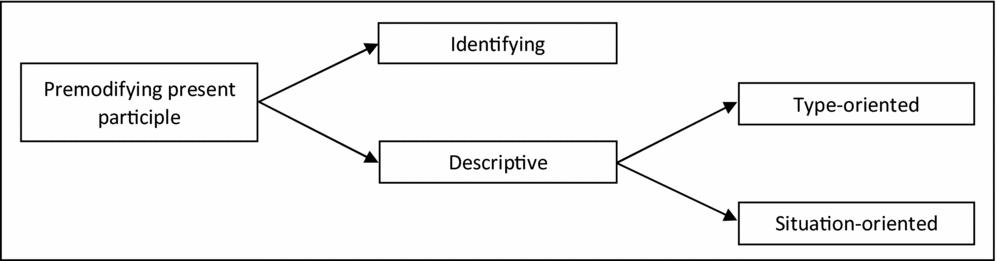
Based on the preceding discussion, a simple classification can be worked out for English premodifying present participles, taking into account both the aspectual versatility of the present participle, and the different functions that can be taken up by premodifiers in the noun phrase. Three main uses of premodifying present participles can be distinguished. The first type, illustrated by coming in (10), is primarily identifying. Here, the participle aids identification of a nominal referent by relating it to the time and place of the current discourse, or to some other referent or referential set that is assumed to be identifiable, either because it figures in the previous discourse or belongs to the common ground. The relation that is exploited may be temporal (as in (10), or (8a) above), spatial (as in (8b) above) or textual (as in (8c) above).
(10) A lesson Jess was to learn time and again in the coming weeks. (BNC)
The second and third type are primarily descriptive but differ in their relation to the type specified by the head noun they modify. Type-oriented premodifying present participles, illustrated by cooling in (11), refine or supplement the type-description of the head noun, typically delimiting a subtype of the more general type denoted by the noun. The characteristic denoted by a type-oriented participle is therefore a permanent, intrinsic feature of the nominal referent.
(11) I should recommend a cooling draught of some kind. Look in at a chemist's as you walk on. (1891, CLMETEV)
In contrast, situation-oriented premodifying present participles, illustrated by dripping in (12), focus on how a nominal referent engages in the situation evoked by the context. Rather than denoting a permanent, intrinsic feature, situation-oriented participles typically denote temporary characteristics that hold through the duration of the main clause situation.
(12) She went up to the dripping window and strained her eyes into the darkness. (1908, CLMETEV)
The functional classification of premodifying present participles outlined here is summarized in figure 2.
Functional classification of premodifying present participles
The three major uses of premodifying present participles – identifying, type-oriented and situation-oriented – are idealizations. Distinct readings may coexist in specific examples or may be neutralized by specific discourse contexts. This is true both of the distinction between identifying and descriptive uses, and that between type-oriented and situation-oriented uses. Moreover, the above classification misses some finer distinctions that can be drawn in the use of premodifying present participles. In what follows, sections 3.3.1 and 3.3.2 outline the main areas of ambiguity as relevant to the classification proposed, focusing respectively on the distinction between identifying and descriptive uses, and that between type-oriented and situation-oriented uses. Section 3.3.3 points out some further, independent distinctions that apply to the use of premodifying present participles.
3.3.1 Identifying vs descriptive
Identifying participles (as in (8) and (10) above) can be recognized as a discrete subset of premodifying present participles because they aid referential identification by relating the referent of their head noun to some other easily identifiable element in the discourse or discourse context. However, the difference with descriptive participles is not absolute, as there are various points of overlap.
Most identifying participles still describe a particular constellation in the world evoked by the discourse and are, in that sense, not purely identifying. This is clearest when the identifying relation is spatial or temporal.Footnote 5 For example, while surrounding in (13) specifies and restricts the referential scope of its noun phrase by linking it to a contextually given spatial reference point (the princely mansion and its parks and plantations), it obviously also describes a relation of spatial adjacency that exists in the world of the discourse.
(13) It is indeed a princely mansion, with suitable parks and plantations, rendered still more striking by the nakedness of the surrounding country (1771, CLMETEV)
Conversely, some clearly descriptive participles, too, implicitly relate one discourse referent to another referent, simply because many verbs through their default argument structures relate multiple argument roles. For example, a full interpretation of scrutinizing in (14) may involve the inference that what is being scrutinized is the female subject of the main clause (a similar example is given in (9) above).
(14) she was more willing to encounter the forbidding looks of this lady, than to continue silently abashed under the scrutinizing eyes of Sir Robert (1782, CLMETEV)
Finally, in principle, any defining characteristic of a given referent can be highlighted to aid identification, regardless of whether this characteristic is inherently relational or not. For example, in choose the red door, used in a context with a red and a blue door, the adjective red can help to single out the correct referent. Folding in (15) functions similarly.
(15) I’ll get a chair for him – one of the folding canvas ones. (FLOB)
These points of overlap between identifying and descriptive uses are in a way to be expected. They follow from the fact that identifying uses probably develop from descriptive uses, as well as from the inherently relational meaning of the verbal stems on which participles are built. Often, the overlap is unproblematic, and in most cases the distinction between identifying and descriptive uses can be maintained. Thus, the interpretation of surrounding in (13) crucially depends on other elements in the context and is in turn instrumental in establishing the correct referent of the full noun phrase the surrounding country. In contrast, in (14) above, identification of Sir Robert's eyes is not helped by the inferred relation to their object of scrutiny – i.e. as far as referential identification is concerned, scrutinizing is redundant. Folding in (15) happens to aid identification, but its discriminating effect relies on its subcategorizing a type of chair that corresponds to one of the types of chair whose availability in the speech situation is shared knowledge between speaker and addressee – i.e. it relies completely on lexical meaning, not on the capacity of folding to link one discourse referent to other referents or the speech situation.
Only occasionally is there genuine ambiguity or vagueness. For instance, while most identifying participles belong to a small set of lexically-specific items whose relational meaning is configurational (in the sense of Talmy Reference Talmy2000: 47) – some identifying participles convey additional lexical information that subcategorizes the type denoted by their head noun. For instance, culminating in (16a) identifies a stroke as the last in a sequence, but simultaneously indicates that the stroke is particularly severe. Similarly, answering in (16b) identifies a sound in relation to another, but at the same time indicates that this sound is a prearranged or at least meaningful signal.
- (16)
(a) The next morning brought the culminating stroke; she had been expecting it long. (1874, CLMETEV)
(b) I sent up such a yell across the water that made the night seem to shake in its bed. We waited breathless for a minute, and then – oh! divinest music of the darkness! – we heard the answering bark of Montmorency. (1889, CLMETEV)
3.3.2 Type-oriented vs situation-oriented
As proposed above, descriptive premodifying present participles divide further into type-oriented and situation-oriented uses. In general, this difference coincides with the difference between permanent and temporary characteristics, as illustrated by passing in (17a–b) (see also (4a–b) vs (4c–d), or (11) vs (12) above).
- (17)
(a) [permanent; type-oriented] She had a passing recollection of the death of Mrs. Manners, and of the child's being sent to school; but since then she had heard no more of her. (1850, CLMETEV)
(b) [temporary; situation-oriented] Swinging on her heel, she grabbed a glass of champagne from the tray of a passing waiter. (FLOB)
To arrive at a more solid understanding of the distinction, a number of points need to be elaborated. The distinction between type-oriented and situation-oriented generalizes over a more complex typology of descriptive premodification. Further, while its association with the permanent/temporary contrast offers an easy diagnostic for telling the two types of descriptive participles apart, an overly strict application could misrepresent the actual data. Finally, there is a range of contexts that show ambiguity between type-oriented and situation-oriented participles.
The distinction between type-oriented and situation-oriented uses is only one way of carving up the domain of descriptive premodification. The distinction is motivated by its relation to the permanent/temporary contrast, as well as by its relation to the different aspectual interpretations of present participles (see section 3.1). Nevertheless, it dichotomizes a more intricate premodification cline, glossing over a number of finer distinctions.
All type-oriented participles denote an inherent feature of the head noun they modify and, as a result, they interact with the type-description conveyed by the nominal head. The interaction with type-description can, however, assume different forms. In classifying uses, the combination of modifier and head functions as a unit, whose interpretation presupposes conventionalized world knowledge, as it names a node in an established taxonomical network (Halliday Reference Halliday1994: 164). A straightforward example is commanding in Commanding Officer in (18).
(18) the signature [should be] witnessed by the Commanding Officer or an officer appointed by him to do so. (BNC)
In other cases, type-modification merely qualifies the type-description by foregrounding a feature potentially shared by some of the members of a larger class, as in (19).Footnote 6
(19) [the village] has no centre but is, rather, a rambling collection of houses (BNC)
Finally, type-modification may redundantly foreground a characteristic that is already part of the type-specification conveyed by the nominal head. For example, grovelling in (20) does not single out a subset from the set of caterpillars – all caterpillars grovel – but foregrounds a contextually salient characteristic of the class.
(20) to regret the exchange of earthly pleasures for the joys of Heaven, is as if the grovelling caterpillar should lament that it must one day quit the nibbled leaf to soar aloft and flutter through the air (1848, CLMETEV)
True situation-oriented participles, finally, do not interact with nominal type-description at all – e.g. passing in (17b) above does not define a type of waiter. Their descriptive value consists in specifying how a nominal referent engages in the situation evoked by the main clause. In line with this, situation-oriented participles are temporally ‘grounded’ (see Langacker Reference Langacker1991) through the main clause, presenting a verbal process as (approximately) simultaneous to the main clause situation. The result is an integration of different processes with multiple participants into a single complex scene, as in (21).
(21) So he went on, surveyed by the wondering ladies (1898, CLMETEV)
Consider now the relation between type-oriented and permanent characterization on the one hand, and situation-oriented and temporary characterization on the other. On the whole, the two dichotomies coincide reliably, but discrepancies can be contextually triggered (Kratzer Reference Kratzer, Carlson and Pelletier1995). For one thing, dynamic processes that affect a nominal discourse participant temporarily but over a comparatively long stretch of time, may be construed as permanent characteristics. Compare the dancing girls and the crumbling walls in (22a). Here dancing is unambiguously situation-oriented, presenting a temporary activity of the referent of the nominal head as part of a highly dynamic scene that unites several processes taking place within roughly the same time-frame (glided to and fro, flaunting, wave in unison and dance). In contrast, the process denoted by crumbling, though strictly speaking dynamic and non-intrinsic, extends far beyond the time-frame of the scene and, in practice, simply characterizes a type of wall rather than the way that wall engages in the unfolding activity. The same applies to ageing in (22b).Footnote 7
- (22)
(a) And as they glided to and fro, the wild roses and ivy and long tendrils of the vine flaunting it on the crumbling walls seemed to wave in unison and dance round the dancing girls. (1885, CLMETEV)
(b) Their suitcases had been seized by the hall porter and an ageing bell-boy, both avid for Kent cigarettes. (BNC)
The opposite effect also occurs, whereby a permanent characteristic is construed as part of the dynamics of the unfolding scene. In (23a), a permanent configuration relating to the denseness of vegetation in a spatial setting is presented as a change that unfolds in simultaneity to the movement of the main clause subject. Somewhat more speculatively, winding in (23b) could be interpreted as describing the subjective experience of the path as it is travelled by the main clause subject.
- (23)
(a) He descended briskly, glad of the shade the thickening trees afforded. (BNC)
(b) Shutting her eyes to the inevitability of what lay ahead, she gave herself up to the ride as he took her higher and higher into the peaks, following a winding route off the main road that was little used. (BNC)
What the examples in (22)–(23) show is that the way a situation is construed is flexible and can adapt to contextual demands. Depending on the context, temporary features can sometimes be presented as intrinsically characterizing (resulting in a type-oriented reading), whereas permanent features may be integrated in the dynamics of a broader scene (resulting in a situation-oriented reading).
Next to this flexibility in relation to the temporary/permanent contrast, the distinction between type-oriented and situation-oriented is also complicated by simple ambiguities, involving alternate readings of the same sentence. A straightforward example of ambiguity is given in (24), where flashing can be interpreted as an intrinsic characterization of the green crossing light (i.e. type-oriented), or as a situation simultaneous to the main clause subject's pausing at an intersection (i.e. situation-oriented).
(24) I will sometimes pause at an intersection till the red hand has replaced the flashing green man (FLOB)
Not all ambiguities can be systematically predicted, but some occur more or less predictably in a number of neutralizing contexts. The following briefly discusses two such contexts.
First, ambiguity arises in contexts that suspend the normal referential character of a noun phrase, such as comparisons. Tension here springs forth from the integration of different mental spaces (Fauconnier & Turner Reference Fauconnier and Turner2002). Consider like a panting baby in (25), which – depending on how far the metaphor is allowed to extend – either names a timeless type, devoid of any specific referent and isolated from any specific situation, or evokes an imaginative world parallel to that described in the main clause, in which a baby pants while sleeping. On the former reading, panting is type-oriented, describing a type that is detached from any actual referent; on the latter it is situation-oriented, describing the behaviour of a referent in a parallel scene.
(25) But his head had fallen down on his breast, and he breathed like a panting baby. (1821, CLMETEV)
Second, ambiguity is very commonly triggered by what can be called situation nouns. Situation nouns are atypical nouns in having nominal referents whose existence is more or less restricted to the duration of the situation in which they occur. In this they differ from typical nouns, whose referents are durable entities (people, animals or physical objects), with an existence that normally outlasts any particular situation (see Langacker Reference Langacker1987: ch. 5). When situation nouns are premodified by a present participle, the duration of the situation denoted by the participle typically aligns itself both with the existence of the nominal referent and with the (approximate) duration of the matrix clause situation, since both time-frames are more or less indistinguishable.Footnote 8 The result is that the contrast between type-oriented and situation-oriented modification is neutralized. For example, as blushes and rain in (26a–b) are situation nouns, their premodifying participles burning and pouring can be simultaneously type-oriented and situation-oriented.
- (26)
(a) She covered her face with her hands, to hide the burning scarlet blushes, which even dyed her fingers. (1848, CLMETEV)
(b) it shocked Joey to find him like that, a solitary figure unmoving in the pouring rain (FLOB)
Interestingly, durable entities may sometimes be introduced as though their existence is bound to a situation. The most striking example is when proper names are used with an indefinite article and descriptive participle, describing one form under which the person referred to by the proper name may temporarily appear, as in (27a). The proper name is thus treated as a common noun that generalizes over the range of forms a person may assume, one of which is introduced in the discourse, as though it is a new instance of a general type. A similar situation noun construal is commonly used with nouns denoting body parts, particularly the heart and voice, where they metonymically index a person's state of mind, as shown in (27b–c).
- (27)
(a) by Sunday she felt quite stunned and had gone to sleep during the rector's sermon, only to be prodded awake by Matey, to a smiling Dr Neil's amusement. (BNC)
(b) With a beating heart I pushed open the door (FLOB)
(c) Booth at length, wondering that the serjeant did not speak, asked him, What his business was? when the latter with a stammering voice began the following apology (1751, CLMETEV)
Summarizing, the distinction between situation-oriented participles generalizes over (but does not conflict with) a more fine-grained cline of descriptive modification. Its relation to the permanent/temporary contrast is, on the whole, reliable, but can be manipulated in specific discourse contexts. Finally, the distinction is subject to ambiguities (or at least ambivalences), but to an important extent these can be linked to well-circumscribed grammatical contexts, such as when participles combine with non-referring noun phrases or with situation nouns. Ambiguity in such cases can be reliably predicted and accounted for as a natural consequence of the features of the context.
3.3.3 Further distinctions
The functional classification of premodifying present participles outlined above glosses over a number of additional, more or less independent distinctions. Two such distinctions are of some relevance here and need to be discussed briefly.
First, it is well known that participles can acquire fully adjectival status (Quirk et al. Reference Quirk, Greenbaum, Leech and Svartvik1985: 413–15; Vartiainen Reference Vartiainen, Rayson, Hoffmann and Leech2012). For instance, in (28a) convincing is premodified by very, giving an unambiguous indication of its adjectival status. This adjectival character may come at the expense of the transparent relation between a participle and the verbal stem on which it is built. Going by intuitive judgment, interesting in (28b) does not strongly activate the meaning of the verb interest. Consistently operationalizing the degree of semantic relatedness between a participle and its verbal stem, however, presents an almost intractable problem, since it can be assumed that derivational dissociation is a gradient phenomenon (see Hay & Baayen Reference Hay and Baayen2005). For example, it is well possible that charming in (28c) hints at an ability to charm – hence more or less directly activates the semantics of its verbal stem.
- (28)
(a) I suppose that he would not have been able to give a very convincing answer (BNC)
(b) as works manager, I had an interesting and responsible job (BNC)
(c) The charming maid is ignorant of her conquest (1744, CLMETEV)
With Quirk et al. (Reference Quirk, Greenbaum, Leech and Svartvik1985: 413–15) we take it that a premodifying participle has come to be strongly dissociated from its verbal stem when it can occur in predicative position following the verb seem. Participles answering to this criterion are considered strongly adjectival. They include becoming, charming, daring, fitting, striking, surprising, touching, etc. While, from a theoretical point of view, we believe the resultant dichotomy is possibly more discrete than the semantics of the items actually support, from a methodological point of view, it offers a way of checking whether the degree of derivational transparency influences these items’ behaviour (see section 4 below).
Second, premodifying participles are as a rule pragmatically controlled by their head noun, such that the referent of the head noun is the understood subject of the situation denoted by the participle.Footnote 9 Interestingly, however, this is not always the case, as shown by the examples in (29).
- (29)
(a) The dog stopped and he was just about to congratulate himself on his authoritative and successful method of summoning her, when she made a plunging dart forward and seized the mass of cloth in her mouth (BNC)
(b) Getting to the Health Centre was a tedious business involving a bus and a clanking ride for a few stops on the underground (BNC)
We label participles as in (29) as non-controlled, though in some cases a controller can be contextually retrieved through a metonymic relation between the head noun and some other discourse referent – for instance, between wail and Lord Vartha in (30a). Historically, it may have been this type of metonymic link that allowed a reinterpretation of control relationships in (potentially) ambiguous examples like (30b) (Vancayzeele Reference Vancayzeele2011).
- (30)
(a) With a despairing wail Lord Vartha slid, scrabbled and finally plummetted [sic] down into darkness (FLOB)
(b) ‘Indeed you must stay,’ she added, in a coaxing tone (1837, CLMETEV)
As the examples in (29)-(30) show, non-controlled participles typically occur with situation nouns (see section 3.3.2).
4 Historical developments
The use of premodifying present participles saw considerable shifts in the course of the Late Modern and Present-day periods. These shifts appear to support the validity of the above classification, in as far as the different functions distinguished also fared differently over time. The changes suggest that the use of participles has been moving away from the core functions of nominal premodification – viz. type-description and referential identification – to functions more closely associated with verb phrases or clauses – viz. temporary characterization and temporal integration of events.
This is apparent from an analysis of the data samples from the CLMETEV and FLOB (described in section 2), which have been annotated in terms of the uses distinguished above. Classification has been carried out as follows. Examples have been classified as identifying, type-oriented or situation-oriented. Ambiguous examples have been classified as being ambiguous between identifying and descriptive, or between type-oriented and situation-oriented. The ambiguities encountered correspond to those described in section 3.3 above. Among the ambiguous examples, the largest group is where a descriptive participle premodifies a situation noun. Because this group makes up a substantial portion of the data, examples of this type have been classified separately. Other ambiguous examples have been ignored in the counts presented below. Since they are comparatively few, it is unlikely that their omission had any impact on the results. The full quantitative results of the analysis are given in the Appendix.
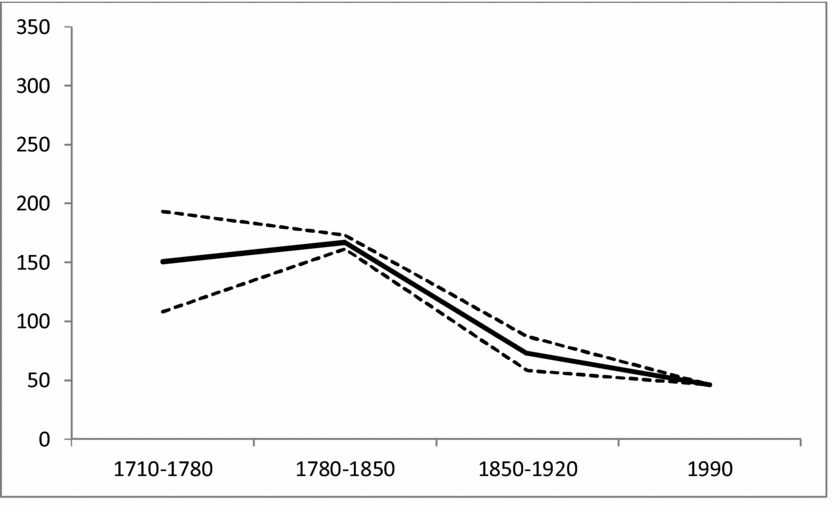
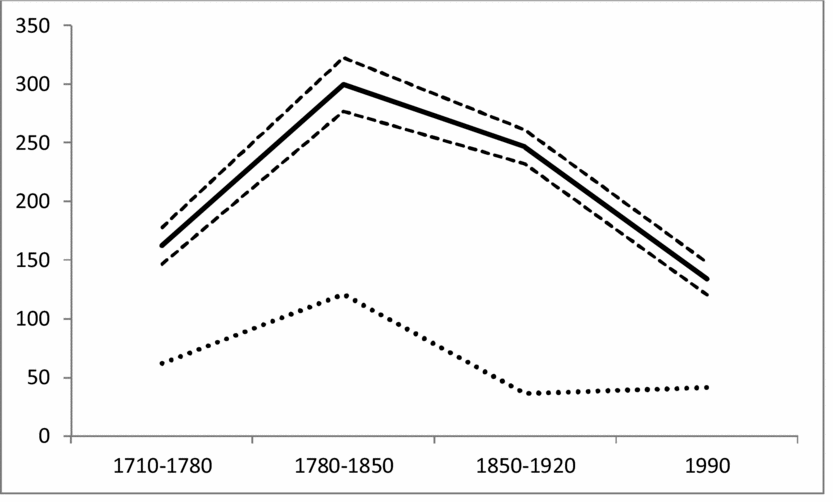
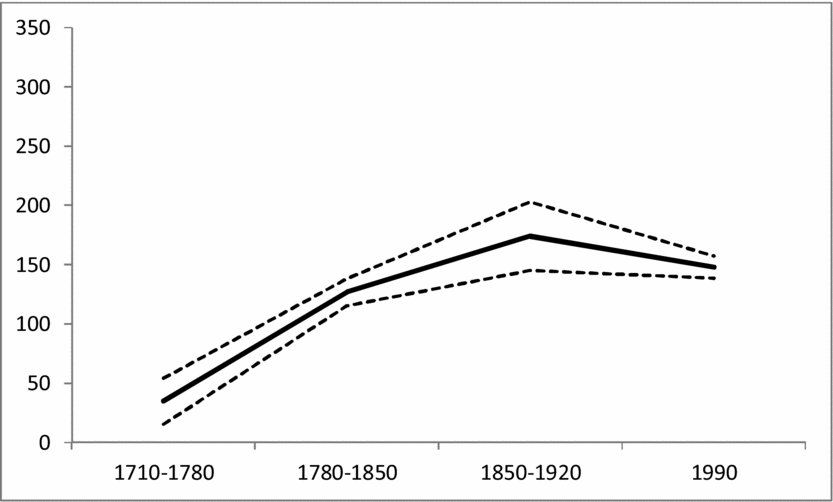
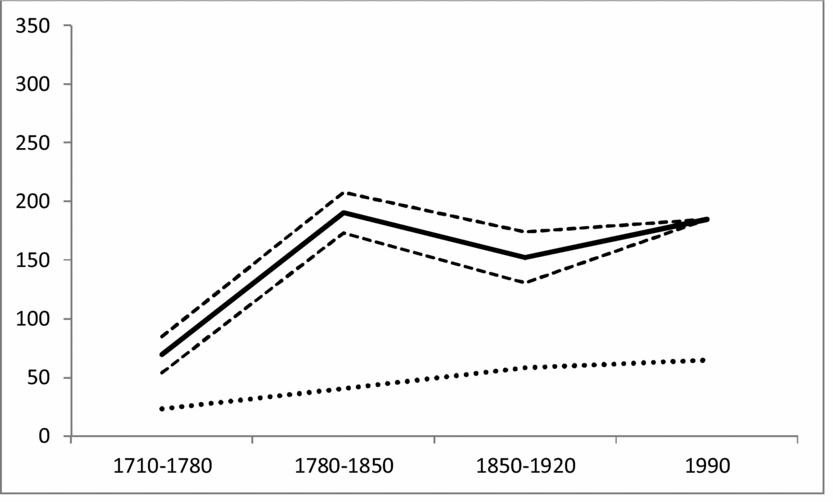
The main trends revealed in the data are represented graphically here in figures 3 through 6. The graphs show the frequency (normalized per 1 million words) of the different types of premodifying participle over time, as estimated from the samples. As pointed out earlier (section 2), for each subperiod two samples have been analysed, in order to check how well frequency in the whole corpus can be estimated from the smaller data sets actually analysed. The dashed lines in the graphs represent the highest and lowest estimates obtained in this way, whereas the full line represents the average frequency across the two samples, which is assumed to be the best approximation of the frequency in the corpus as a whole. Although the difference between the two samples is sometimes fairly large, there appears to be no reason to believe that the figures seriously misrepresent the overall trends in the corpus data. The extra dotted lines in figures 4 and 6 show the frequency of strongly adjectival participles as a subgroup of the whole set of premodifying participles (type interesting, amazing, etc. – see section 3.3.3). The graphs indicate that their frequency development follows the general trends in the data, so their inclusion or exclusion makes no great difference to the interpretation of the results.
Estimated normalized frequency of identifying premodifying present participles in the fiction sections of the CLMETEV and FLOB
Estimated normalized frequency of type-oriented present participles in the fiction sections of the CLMETEV and FLOB
Estimated normalized frequency of situation-oriented present participles in the fiction sections of the CLMETEV and FLOB
Estimated normalized frequency of present participles with situation nouns in the fiction sections of the CLMETEV and FLOB
The main trends that appear are as follows. Identifying participles (figure 3) undergo the most spectacular drop in frequency, which sets in in the second half of the nineteenth century at the latest and continues into the Present-day period. Type-oriented participles (figure 4) similarly drop in frequency, but only after an initial increase. In contrast, the use of situation-oriented participles (figure 5) sees a clear rise, probably levelling out in the Present-day period. Participles with situation nouns (figure 6), where the contrast between type-oriented and situation-oriented is neutralized, are on the increase in the first half of the nineteenth century but then remain more or less stable.
In interpreting these developments, it is first necessary to consider the possible distorting effect of genre discontinuity in the corpus data. As shown earlier, over time there is an increase in the portion of narrative text in the novels excerpted in the CLMETEV and FLOB (section 2). This could particularly influence the frequency of situation-oriented participles and participles with situation nouns, which are strongly associated with narrative passages. If narrative text is defined (as in section 2 above) as the sequential rendering of temporally connected situations of limited duration, approximately four fifths of all attested situation-oriented participles and participles with situation nouns are found in the narrative sections of the corpus – an example of each is given in (31).
- (31)
(a) Then came some three or four of the pressgang with a struggling sailor in their clutches, with nothing but his trousers on – his shirt riven from his back in the fury. [. . .] And these were followed by the wailing wife of the pressed man, with her five bairns, clamouring in their agony to heaven against the king and government for the outrage. (1822, CLMETEV)
(b) Then he swung her round so she was away from the window, let go of her and, before she could fall, gave her a final, open-handed blow that sent her spinning across the room. As she went down, her head slammed into the washbasin, setting up an echoing vibration. When it died away, Angela was lying immobile on the thin strip of carpet beside the bed. (FLOB)
This means that the later corpus material, which is more narrative in character, provides more occasions for using situation-oriented participles and participles with situation nouns, and so the shifting quality of the texts can explain at least part of the increase in those two types. In a similar vein, changing practices in novel-writing may also partly account for the decline in identifying premodifying participles. Particularly, text-referential phrases such as the following speech or the preceding chapter have virtually disappeared from twentieth-century novels, possibly because they are now felt to give too much prominence to the textual character of the novel or to the narrator as the person organizing the text, thereby distracting from the ongoing action or from the atmosphere being created.
In neither case, however, can changes in novel-writing practices fully account for the trends observed in the data. The frequency shifts are too marked to be sufficiently explained by the growing portion of narrative text or by a decline in text-referential phrases. For situation-oriented participles and participles with situation nouns, the usage frequency more than triples, while the portion of narrative text doubles at most (compare figure 1 and figures 5 and 6). For identifying participles, it is not only the text-referential uses that decline, but also temporal and spatial uses, as in the following day or the neighbouring church.
It is therefore likely that the trends observed in figures 3 through 6 partly reflect genuine changes in the use of premodifying present participles, at least within written and (predominantly) narrative texts. The overall effect of these changes appears to be that premodifying present participles are increasingly used in ways that are uncharacteristic of nominal premodifiers. Instead of refining the type-description imparted by the head noun or aiding referential identification, the dominant function of premodifying present participles shifts to integrating one situation in another. In this light, the increase in situation-oriented participles and participles with situation nouns can be thought of as two closely related developments, each of which promotes the use of premodifying present participles in contexts where they help build up a complex scene with multiple events taking place roughly simultaneously. Premodifying present participles thus detach themselves from noun-phrase-internal functions, behaving less like premodifiers to a nominal head, and relating increasingly like subordinate clauses to a main clause.
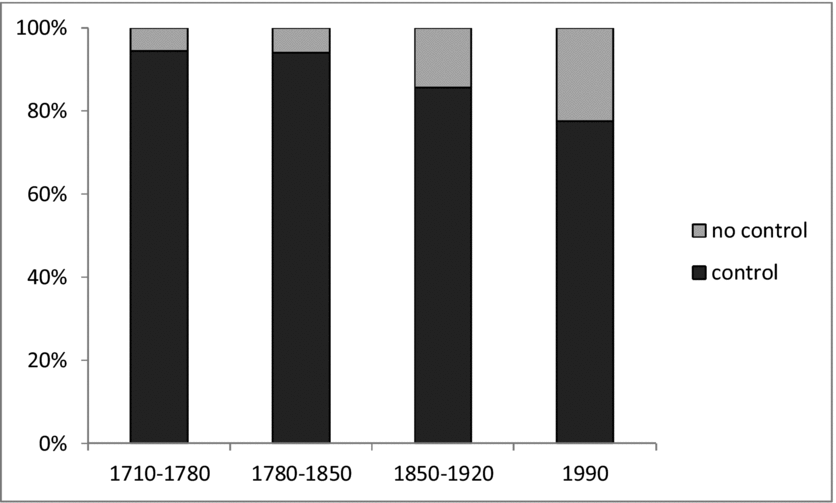
This functional clausalization of premodifying present participles is confirmed by two more marginal syntactic trends in the data. First, within the set of participles with situation nouns, a further change takes place whereby participles without control by the nominal head, as in (32) (see also the discussion in section 3.3.3 above), become increasingly common, as is shown by the bar chart in figure 7.
Controlled and non-controlled present participles premodifying situation nouns in the fiction sections of the CLMETEV and FLOB
(32) Everything still seemed to be fogged at the edges. He listened to the drumming patter of raindrops on the roof. (FLOB)
Arguably, the rise in non-controlled participles represents a further step in the trend for premodifying participles to denote situations, because the head noun is increasingly being reduced to a vessel for adding a situational qualification to the main clause. That is, the combination of participle and noun comes to primarily denote a situation rather than a thing. Note that a similar shift in the focus of the participle-noun combination may be found in examples as in (33), whose focus is on events (the changes of the seasons) rather than on things (the seasons per se), though without a violation of normal control behaviour. Strikingly, although they are too uncommon for their occurrence to be reliably quantified, examples of this type have only been attested for Present-day English.
(33) Some [Jewish feasts] were timed to coincide with the changing seasons (BNC)
Second, along with the rise of situation-oriented participles, there is a rise in the use of premodifying participles with VP-adverbs. When VP-adverbs occur with premodifying participles, as in (34), they foreground the verbal character of the participle, which then unambiguously functions as the head of a verb phrase embedded within a noun phrase.
- (34)
(a) In the absorbing interest, however, with which we watched the deliriously whirling figure, unconscious of aught but the music, we took but little note of the lightning. (1885, CLMETEV)
(b) The mere fact of being in a swiftly moving carriage which wayfarers had to avoid nimbly, maintained their spirits. (1908, CLMETEV)
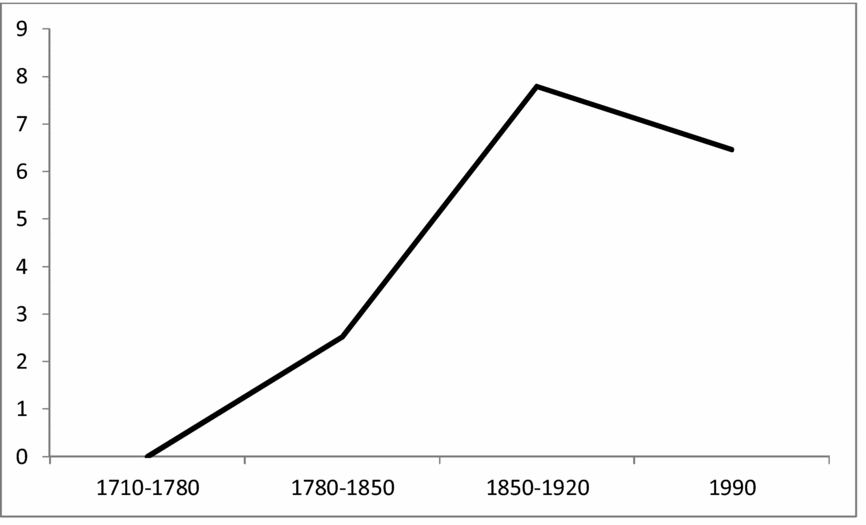
An exhaustive search has been conducted of any form ending in -ing preceded by the, a or an and a form in -ly in the fiction sections of the CLMETEV and FLOB. Analysis of the results gives the graph in figure 8, showing a steep increase in the use of VP-adverbs with premodifying participles, peaking by the end of the Late Modern period. While the pattern remains infrequent throughout the data, its diachronic development supports the idea that premodifying present participles abandon their noun-phrase internal functions for more clause-like behaviour.
Normalized frequency of present participles with VP-adverb in the fiction sections of the CLMETEV and FLOB
A number of trends in the data can thus be understood as a single phenomenon – specifically, the rise in situation-oriented participles, the rise in participles with situation nouns, the rise of non-controlled participles and the rise of VP-adverbs with premodifying participles. Even though the present investigation cannot produce definitive answers, it is hard to resist speculating on the deeper causes of these changes.
The changes fit two long-standing developments in the history of English. One is the increasing reliance on noun phrases as the template of choice for coding various kinds of grammatical and lexical information in the sentence, possibly in response to the functional demands of written usage (Mair et al. Reference Mair, Hundt, Leech and Smith2002; Biber & Gray Reference Biber and Gray2011; Van de Velde Reference Van de Velde2011). Noun phrases have been growing longer and more frequent, and they have come to encode a growing range of functional contrasts. Against that background, the rising use of situation-oriented participles could be seen as another functional enrichment of the noun phrase, assigning functions typically associated with relative and adverbial clauses to the domain of nominal premodification.Footnote 10
But there may be more to it. The rise in situation-oriented participles and related patterns comes in the wake of the dramatic rise in the use of the progressive construction (Strang Reference Strang and Anderson1982; Arnaud Reference Arnaud and Jacobson1983; Smitterberg Reference Smitterberg2005; Kranich Reference Kranich2010), with which they share at least the form of the present participle, as well as a typically imperfective meaning and a backgrounding function (see e.g. Strang Reference Strang and Anderson1982; Labov Reference Labov2013). Both developments can be linked to a broad tendency in Modern and Present-day English to present situations in narrative text as aspectually unbounded and grouped into larger complexes of roughly simultaneous events (Carroll & Von Stutterheim Reference Carroll, von Stutterheim and Ramat2003; Los Reference Los2009, Reference Los, Meurman-Solin, López-Couso and Los2012; Petré Reference Petré2014). The rise of situation-oriented participles can therefore be seen to contribute to a broader shift towards greater reliance on unbounded narrative structures in English.Footnote 11
To what extent these possible relations to other changes are real, however, remains to be further investigated. Another question that cannot yet be resolved is if and how the upward trend in the use of situation-oriented participles and related patterns links up to the decline in identifying and type-oriented participles. Even if the latter developments add to the picture of premodifying participles migrating away from typical noun-phrase-internal functions to functions associated with clausal subordination, there is no very compelling reason why the exploitation of one aspect of the functional potential of premodifying participles should go at the expense of the other aspects of their functional potential. The different uses of premodifying participles are not synonymous forms that compete over the same function. At most, they might represent distinct functions that compete over the same form. This kind of ‘polysemy avoidance’ could be a recurrent phenomenon in language change (see e.g. the gradual functional shifts described in Ghesquière & Van de Velde Reference Ghesquière and Van de Velde2011), but if so, its underlying mechanisms are certainly not yet well understood.
5 Conclusions
English premodifying present participles can fulfil a number of functions, which integrate participial semantics with the functional organization of the noun phrase. Based on corpus data, we have set up a broad classification that captures the range of functional possibilities. The main divisions are between identifying and descriptive uses and (within the latter) between type-oriented and situation-oriented uses. Neither division is entirely discrete. Overlap between identifying and descriptive uses arises primarily because the identifying uses actually exploit the descriptive value of premodifying participles to aid referential identification. Ambivalence between type-oriented and situation-oriented is typical in specific neutralizing contexts, such as when the referential value of the nominal head is suspended, or when the participle modifies a situation noun, whose existence roughly coincides with the matrix clause situation. Such ambiguities support the functional classification proposed, because their occurrence is predictable from the characterization of the major functions of participles and the features of specific linguistic contexts.
The functional characterization of premodifying present participles is also indirectly justified by the historical development of different uses through the Late Modern and Present-day periods, in that the various uses develop differently over time, at least in written fiction texts. However, separate developments also suggest an overall historical trend. Specifically, the developments attested conspire to a clausalization of premodifying present participles. Premodifying present participles are being increasingly exploited to temporally integrate a backgrounded situation into the matrix clause situation, and simultaneously get dissociated from more typical noun phrase internal functions, particularly referential identification and type modification. This functional clausalization is matched by smaller syntactic changes, such as an increase in the use of VP adverbs with premodifying participles and increasing lenience in control relations between the participle and its nominal head. While the use of premodifying participles has thus evidently been undergoing changes in the last three centuries, further research is required to identify the deeper causes of these shifts and to explain their timing, as well as to examine the degree to which they are interconnected.
Appendix
Table A1 shows the frequency for the various categories distinguished in the analysis of premodifying present participles (I = identifying; I/D = identifying/descriptive; SO = situation-oriented; SO/TO = situation-oriented/type-oriented; TO = type-oriented), along with the size of the relevant subcorpora (N) and the total number of hits from which samples have been collected (H).
Raw frequencies for different uses of premodifying present participles in the fiction sections of the CLMETEV and FLOB