Modern health care and disaster response are inextricably linked to high volume, reliable, and quality power. Disasters place major strains on energy infrastructure in affected communities. As the response proceeds, significant resources must be dedicated solely to restoring power, importing fuel, and managing energy utilization. All modern disaster response assets, from disaster medical assistance teams to urban search and rescue to Carolinas MED-1 rely heavily on traditional diesel-powered generators. This dependence requires that response agencies either use scarce local fuel sources or maintain a complex logistics and supply system. For example, Superstorm Sandy decimated parts of New York and New Jersey and demonstrated the fragility of both utilities and fuel supplies, which left millions without power, fuel, or heat.Reference Neuman1, Reference Domm2
Advances in renewable energy and microgrid technology offer the potential to improve the capabilities of an off grid (untethered) mobile disaster medical response. However, very little is known about the energy requirements of disaster response, and investigation into incorporating alternative power sources has been minimal. A gap analysis of the energy components of modern disaster response reveals multiple deficiencies including a knowledge gap regarding disaster response asset energy usage and energy requirements, a lack of familiarity with alternative energy sources, and a lack of existing metrics to compare energy utilization in disaster response. Further, no system currently exists for directly monitoring energy usage while providing clinical care in the post-disaster setting. The Carolinas MED-1 (MED-1) team initiated the MED-1 Green Project (M1G) to begin addressing these key operational knowledge gaps.
MED-1 Green (M1G) Project
Carolinas HealthCare Systems is a nonprofit health care system that operates the MED-1 mobile hospital fleet. MED-1 is uniquely capable of providing comprehensive medical care in disaster relief situations and mass gathering public events. The MED-1 fleet comprises 1 treatment vehicle and 6 support vehicles. MED-1 also provides advanced medical capabilities, including 2 operative suites, 4 intensive care unit beds, cardiac monitoring, portable radiology, and telemedicine.
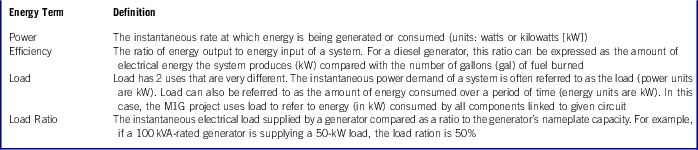
The M1G project is an ongoing academic-private sector partnership among Carolinas HealthCare System, Lime Energy Co, and SEWW Energy, Inc, designed to drive innovation in smart energy use during disaster response. M1G has been executed as a multiphase project designed to identify energy utilization inefficiencies, decrease demands on diesel generators, and employ modern energy management strategies to expand operational independence. This approach allows for longer deployments in potentially more austere environments and minimizes the unit's environmental footprint. The ultimate goal is to develop a framework on which other mobile medical units can identify energy requirements and create strategies for energy independence. The Table outlines basic key energy terminology for reference.
Energy Conservation Terminology

The initial components of the M1G project were an energy audit (EA), the deployment of an energy analytics program, and the utilization of an energy microgrid in support of mobile clinical operations for the 2012 Democratic National Convention (DNC) in Charlotte, North Carolina. The M1G project sought to identify the energy requirements to deploy Carolinas MED-1, the deployment fuel usage and requirements, the strategies to reduce reliance on fossil fuel while maintaining advanced care capabilities to expand operational capabilities, and the existing or developmental technologies that can build a comprehensive, smart energy solution. In addition, the project sought to delineate the broader energy use and conservation implications for mobile disaster response assets and fixed facility emergency management.
Phase 1: M1G Energy Audit
Phase 1 of M1G consisted of an EA to address the first 3 operational questions. Traditionally, an EA is defined as a standardized assessment of the energy needs and efficiency of a building or buildings. During the past 20 years, global efforts to perform EAs at health care facilities have been scattered.Reference García Sanz-Calcedo, Cuadros and López Rodríguez3, Reference Santamouris, Dascalaki, Balaras, Argiriou and Gaglia4 However, to our knowledge, no EA or energy-use data for any private, federal, or state-run mobile disaster response asset has been published to date. The M1G project EA quantified the energy usage of MED-1 and identified and prioritized specific energy conservation measures (ECMs). The M1G EA was the first of its kind to quantify ECM in a large-scale prehospital medical response.
The EA began with a facility walkthrough on June 29, 2012, during a MED-1 training deployment at the Charlotte Speedway in Concord, North Carolina. The EA established baseline energy requirements and fuel usage during the 48-hour deployment (June 29-30, 2012), identified specific ECMs, and created a projected conservation model. The ECM recommendations identified immediate upgrade opportunities (detailed here) and future system redesign considerations.
The EA focused on efficiency in energy use and energy production. The major energy use drivers in MED-1 are the heating, ventilating, and air conditioning (HVAC) system (~60%) and the lighting system (9%). This plan was consistent with EA performed at fixed facilities such as hospitals and retail businesses.Reference García Sanz-Calcedo, Cuadros and López Rodríguez3, Reference Santamouris, Dascalaki, Balaras, Argiriou and Gaglia4 Interestingly, patient monitors only accounted for 2% of total energy use. The “other” category included computers, communication platforms, medical devices (eg, radiology, intravenous pumps, and ultrasound), and powering the kitchen truck. The EA identified ECMs to address each of the major energy-use components (Figure 1). Initial estimates suggested that implementation of noted ECMs could improve the MED-1 total energy efficiency by 22%.
Energy Conservation Measures (ECM). Abbreviations: HVAC, heating, ventilating, and air conditioning; LED, light-emitting diode.
The EA identified a more fundamental challenge regarding energy production. Two 100-kW truck-mounted, diesel generators produced all of the power for MED-1. The EA revealed that the generators consumed approximately 147gal/day of diesel fuel to support advanced-level care. With diesel generators, controls set the minimum loading at which the fuel consumption remains constant to ensure full fuel combustion and reliable generator operation under low load conditions. This design translated to a point on the fuel consumption curve that is referred to as the generator's minimum loading ratio (MLR). Below the MLR any decrease in the load no longer corresponds to a decrease in fuel consumption. For example, with a 100-kW generator that has a MLR of 30%, loads of 10 kW, 20 kW, and 28 kW all consume the same amount of fuel as a 30-kW load.
Determining the MED-1 fleet load profiles and generator MLR are critical to developing a comprehensive smart energy strategy. The M1G team used a microgrid assessment tool (MAT) that incorporated EA data to generate the initial load analysis and load profile. The MAT (Figure 2) captured both granular load profiles and the power quality for use in the preliminary microgrid feasibility report (ie, quantity and quality of energy output). As the electrical consumption and power quality of the MED-1 facility was completely unknown at the start of this project, the MAT provided an essential starting point for the microgrid modeling.
Online Microassessment Tool (MAT).
The MAT measured load profiles during the DNC and found that MED-1 deployments have large electrical usage patterns due to the heavy reliance on the HVAC system for air conditioning in hot and humid conditions. The measured composite DNC load profile was the average of the measured load profiles over 5 days for actual daytime operations covering the convention (Figure 3). HVAC loads were found to account for 57% of the load, on average, and varied between 44% and 66%. Higher percentages were observed between 11:00 am and 5:00 pm, when outdoor temperatures were the highest. Most medical care was performed between 4:00 and 11:00 pm, emphasizing the fact that HVAC requires far more power than the energy requirements of patient care.
Composite Daytime Operations Load Profile at Democratic National Convention (DNC). Abbreviation: HVAC, heating, ventilating, and air conditioning.
The 100-kW MED-1 generators have an MLR of 30% or 30 kW.The EA and MAT revealed that the 2 generators of MED-1 were generating approximately 20 to 24 kW. This discrepancy in MLR versus actual load led to significant energy waste (~6-10 kW). Accordingly, as the MED-1 power plant was already functioning below its optimum load, implementing ECM would reduce further the required generator output but have no effect on fuel utilization. Creating a reservoir for this excess energy in the form of a battery pack would greatly improve the efficiency of the system by preventing wasted energy production by the generators.
Phase 2: Modeling of a Deployable Microgrid
The energy-use data recorded during the DNC was analyzed to create energy utilization models that integrate advanced battery technology, solar photovoltaic (PV), and ECMs to create the optimal microgrid design and improve future disaster response operations. The second phase of the M1G project was a feasibility model for integrating a mobile microgrid into the system. A microgrid is a localized grouping of electricity generation (eg, solar, diesel, and wind), energy storage, and loads, and allows for real time energy analytics and more nuanced control of energy use. The project used data from the EA audit and partnered with SEWW Energy to deploy the HOMER Energy LLC analytics program to perform a load analysis, determine load profiles, and create a series of potential deployment support models.
Several scenarios were modeled using the HOMER hybrid power system optimization.Reference Bernal-Agustín and Dufo-López5 Among the parameters considered were presence or absence of ECM, photovoltaic array size, and battery bank size. The parameters were modeled in several different load profile scenarios. HOMER used a MED-1 deployment model based on 12-hour active daily operations. The load profile reflected this usage pattern: a higher consumption during the day and lower consumption at night, when the sun not heating the exterior of the unit decreases the heating load, and decreased internal heat loading by limited staff occupancy.
Photovoltaic (PV) arrays (eg, solar panels) of 0, 4.5, 9, and 13.5 kW were modeled for this preliminary study. It was estimated that 4.5 kW could be added to the top of each tractor trailer with minimal impact on fleet operations. Additional PV generation could be added to other structures via portable ground mount arrays (ie, free standing) assembled on site or thin film modules integrated into tents or other structures.
Battery arrays have been the most critical component of an operational microgrid system. Arrays were modeled to estimate fuel savings due to energy storage. The commonly used Surrette KSP25P battery was modeled configured in 48-V strings. Since each battery is 4 V, each serial string has 12 batteries. Higher battery bank voltages could be used to save on conductor costs, but the modeling results would not change significantly. The 4KS25Ps are 1900 Ah lead-acid batteries that weigh 315 lb each. The study modeled 3 battery bank sizes—no battery bank, small bank (12 batteries, 90-kW total capacity, and 3780-lb weight), and large bank (5 strings with 60 batteries, a 450-kW total capacity, and 18 900-lb weight). The large battery bank was the maximum that could be supported using the weight capacity rating of a standard 20-ft trailer using advanced battery technology. Advanced battery technologies such as lithium ion batteries decrease the weight of the battery bank by 3-fold and the storage capacity by nearly 6-fold.
Based on modeling data, projections of generator run time and diesel fuel consumption were calculated. The effect of incorporating upgrades into the system such as ECM, variably sized PV arrays, and battery packs were modeled to demonstrate the individual and cumulative benefits of these modifications. The results of these analyses were used to calculate differences in fuel consumption and the number of additional days of deployment that would be possible assuming a fixed volume of fuel. For example, deployment of a 4.5-kW PV array combined with ECMs would reduce fuel consumption by more than 50% and extend operational time by 0.3 day for every day deployed (Figures 4 and 5). At full integration, deployment of a 13-kW PV array in conjunction with a large battery pack and ECM during a daytime hours-only operation (12-hour shift), the system would add an additional 1.36 days/day of deployment (Figure 5).
Modeling of Fuel Usage With and Without Energy Conservation Measures (ECM). Abbreviation: PV, solar photovoltaic.
Modeling for Additional Days of Deployment With and Without Energy Conservation Measures. Abbreviation: PV, solar photovoltaic.
CONCLUSIONS
Large-scale disasters create immediate and ongoing energy challenges. The integration of microgrid technology into mobile medical assets and field hospitals allows for smarter energy use and expanded disaster response operations. Disruption of the power grid, loss of water and sewage systems, disabled communication infrastructure, and interruption of routine logistics impede disaster response and emergency medical care.
Research has shown that all-cause mortality increases during severe power outages.Reference Lysiak, Sandoval, Smith and Mcshane6, Reference Halupke7 Several recent natural disasters demonstrate the fragility of our infrastructure and our reliance on fossil fuels. The August 2003 blackout in New York City resulted in a 28% overall increase in mortality with a 122% increase in accidental deaths and a 25% increase in non-accidental deaths when compared with data from the 2 preceding and 2 following years.8 The tornado in Joplin, Mississippi, on May 23, 2011, was another recent example of the fragility of medical and community infrastructure. The tornado flattened a 1- by 6-mile path through the downtown area that affected the local hospital, nursing homes, schools, and houses. Nearly 35% of the population was without power. During the storm an emergent surgical case had to be performed by flashlight.Reference Redlener and Reilly9
In the aftermath of the 2012 Superstorm Sandy, 196 health care facilities and 39 hospitals in New Jersey lost power. In New York, New York University's Langone Medical Center lost primary power and had inoperable back-up roof-mounted reserve generators. The Medical Center was forced to evacuate the entire hospital and transfer multiple critically ill patients on advanced life support. Two weeks after the storm, power remained unreliable or absent. The Federal Emergency Management Agency was able to provide reliable diesel fuel for federal response assets, distributing 313 000 gallons of gasoline and 157 000 gallons of diesel fuel in the first 2 weeks. However, civilian entities were less fortunate, and individuals were often forced to wait in line for up to 16 hours for gasoline.1 In addition, it was estimated that 9 of the 40 fatalities from Sandy were secondary to carbon monoxide poisoning from diesel generators.Reference Halupke7, 8
In their recent article in the New England Journal of Medicine, Redlener and Reilly noted 4 critical concerns for response operations in the aftermath of a storm such as Sandy: (1) identification and treatment of casualties requiring urgent intervention, (2) attempt to minimize public health risks causes from flooding, (3) restoration of essential supply chains, and (4) access to care.Reference Redlener and Reilly9 Provision of reliable power was critical to achieving all of the critical concerns ranging from powering triage and staging tents to running water purification systems to shifting the logistics burden from providing fuel to providing medications or shelter. In both the Missouri and New Jersey disasters, a deployable microgrid system could circumvent the need for this austerity, allow critical operations to continue, and dramatically improve community health.
Small-scale efforts have been made in the past to utilize solar power in disaster and emergency response. During the response to Hurricane Hugo in 1989, small portable PV and battery systems were deployed in St. Croix to power 12-V DC fluorescent lights, radios, and shelter fans. In 1992, the Florida Solar Energy Center and SANDIA National Laboratories deployed 5 PV systems that contained a 1-kW PV array, battery bank, controller, and DC/AC converter to medical clinics in South Dade County.Reference Young10 In spite of significant improvements in the weight, durability, and efficiency of various renewable energy sources and advances in energy management technology, no documented use of an integrated microgrid exists for powering advanced medical care post-disaster.
Creating a Microgrid Energy Management System
Carolinas MED-1 has a long history of disaster response and innovation. In the aftermath of Hurricane Katrina, MED-1 deployed for 40 days to Waveland, Mississippi, and cared for over 7500 patients (187.5 patients/day).Reference Blackwell and Bosse11 This deployment demonstrated the unit's capacity to provide access to care when existing health care institutions were suddenly off line. Patients were treated for a wide range of medical and surgical diseases including deep space abscesses, heart attacks, stroke, and lung diseases. However, MED-1's technologically advanced care capabilities were still reliant on diesel fuel resupply. The M1G project demonstrated that MED-1 used approximately 146 gallons (553 liters) of diesel fuel/24 h. Using this as the MED-1 disaster response baseline fuel consumption, the unit consumed approximately 0.78 gal (2.95 L) of diesel fuel for every patient encounter in Hurricane Katrina. The inflation-adjusted cost was $3.17 of fuel per patient encounter, based on the average cost of diesel fuel in March 2013 in the United States ($4.07/gal). By comparison, the deployment of ECMs and microgrid technologies would reduce the fuel consumption to approximately 0.60 gal (2.27 L) per patient encounter ($2.44 of fuel per patient encounter). Over the 40-day deployment, $7843.70 would be saved in energy cost alone. These savings would have extended MED-1's time on station by 13.2 days without additional fuel requirements.
The M1G project demonstrated that a microgrid energy management system and a modern battery system maximizes the MED-1 generators’ output and can extend time on station. Using a 450-kW battery bank and 13.5-kW PV array, deployment operations time could be more than doubled before refueling. This achievement marks a dramatic increase in patient care capabilities and has significant public health implications including, but not limited to, decreased ambient noise pollution for responders, reduced carbon monoxide and greenhouse gas generation, and reallocation of scare energy resources to maintain critical public health services. The M1G study indicated that a comprehensive energy strategy that incorporates ECM, power storage, and smart energy utilization through microgrid technology will advance the provision of advanced medical care in austere environments and expand cost-effective, high-quality prehospital medical response.
M1G also demonstrated that energy usage is very sensitive to the generator MLR. This sensitivity was most pronounced in the scenarios using the daytime operations load profile—10 to just over 20 kW each day. With these loads, only 33% to 66% of the fuel being consumed by the generator was used to directly power the loads. Adding battery arrays to the microgrid would capture and store for later use the excess electricity from the generator (what is not used directly by power loads, ie, HVAC, lighting, equipment). The model suggested that integrating a modern battery array into the microgrid has a larger impact for fuel savings than either ECMs or adding a PV array. This observation would make sense, as neither efficiency measures nor PV generation will cut fuel consumption if the generator loads are already below the MLR. However, ECMs and PV array would make a difference in fuel consumption when an energy storage system is added. By lowering the net load, ECMs would allow more energy to be shifted to the battery array and increase the time the generator could be off line. Likewise, PV increased generator downtime by providing an alternate source of energy to the batteries. A mobile microgrid would be necessary to manage these alternate power sources.
Incorporating Distributed Energy Systems
Microgrids have seen increasing popularity as they allow a degree of independence from the centralized power grid. While little if any utilization of microgrids in mobile applications have been found outside of the military, incorporating them into MED-1's generation system would offer several benefits. First, it creates the possibility of distributed energy generation. Distributed generation allows multiple energy sources to be harnessed and integrated into a single energy system. The ability to use distributed energy generation introduces greater flexibility into the system and permits the incorporation of solar (as modeled here), wind, biodiesel, or as yet undiscovered fuel sources. As weather conditions are variable post-disaster, the ability to draw on multiple fuel sources is critical. Deploying this robust generation system could even allow MED-1 to act as a short-term power utility (ie, power plant) for other operations in the immediate vicinity. Second, the microgrid supports integration of an energy storage system (eg, batteries). A comprehensive battery array would enable the generators to operate at their maximum efficient load by diverting surplus power into the storage system. MED-1 could then alternately operate off the batteries and the generators, meaning the generators could be intermittently shut down, creating a substantial fuel savings. This strategy is the concept behind commercial hybrid vehicles. Finally, a mobile microgrid offers conditioned power. The electricity produced by diesel generators is highly variable. A power conditioner provides increased power quality: less variation in voltage magnitude, less transient changes in voltages and currents, and improved harmonic content in the AC waveform. Improved energy quality extends the lifetime of the sensitive electronic equipment such as mechanical ventilators, cardiac monitors, and computer systems employed during patient care in MED-1.
The improved energy efficiency of MED-1 that couples ECM and microgrid technology has clear operational, financial, and environmental benefits. These beneficial advances will allow MED-1 to extend time on station while decreasing reliance on local fuel resources or extensive logistical supply chains. A fully integrated energy management system will make MED-1 the most flexible, mobile advanced disaster medical facility in the nation. Integrated into a larger response, MED-1 will require less fuel and less water, reducing the strain on external logistics and resupply efforts. This study demonstrates that the MED-1 microgrid energy optimization capabilities would be invaluable in directly addressing a majority of the critical concerns detailed in the post-Hurricane Katrina and post-Hurricane Sandy after-action reports. The M1G project serves as proof of concept for deployment of mobile microgrids in austere disaster operations, with applicability to all mobile medical assets nationwide.