Introduction
When two parts of an electric conductor are held at different temperatures, charge carriers diffuse from the hot to the cold regions, producing a voltage difference that is the basis for the thermoelectric (TE) Seebeck effect. The Seebeck coefficient, S, is the voltage difference resulting from a temperature gradient and a measure of thermopower. It can be positive (for hole conductors) or negative (for electron conductors), ranging from a few μV/K, typically for metals, to more than 1000 μV/K, observed in lightly doped semiconductors. Reference Rowe1 A TE generator (TEG) is a solid-state device that takes advantage of the Seebeck effect to directly convert a temperature gradient into electricity.
The efficiency of a TE conversion device is determined by the figure of merit of the materials comprising the device:
 $$ZT = {{S^2 \sigma T} \over \kappa } ,$$
where σ is the electrical conductivity, T is the average temperature, κ is the thermal conductivity, and S 2σ (W/mK2) is the power factor (PF) of the material. Materials that combine high values of S and σ/κ are therefore attractive for TE applications. There is no theoretical limit on the value of ZT; however, finding materials with ZT significantly greater than 1 is challenging due to the interdependencies that exist among the parameters.
A large S requires that σ (or electronic density of states) near the Fermi level E F change rapidly, Reference Heremans, Jovovic, Toberer, Saramat, Kurosaki, Charoenphakdee, Yamanaka and Snyder2 as indicated by the Mott expression for S:
 $$S = {{\pi ^2 } \over 3}{{\kappa _{\rm B} } \over q}\kappa _{\rm B} T\left\{ {{{d\left[ {ln\left( {\sigma \left( {\rm E} \right)} \right)} \right]} \over {dE}}} \right\}_{E\, = \,E_F } ,$$
where k
B is the Boltzmann constant, and q is the elementary charge. Materials such as lightly doped semiconductors for which the density of states at the Fermi level,
 $n{\left( E \right)_{E\, = \,{E_F}}}$
, changes rapidly with energy are expected to have large S values; however, such materials also tend to be poor electrical conductors since the free-carrier concentration is low, and therefore, the ZT factor is low. A compromise between maximizing S and σ favors low-bandgap semiconductors (doping ∼1019–1021/cm3), such as Bi2Te3 and its alloys.
Designing materials with optimum ZT is further complicated by the relationship between κ and σ. κ is the sum of lattice thermal conductivity, κl, and the electronic thermal conductivity, κe. According to the Wiedemann-Franz Law, κe/σ = LT, where the Lorenz number L = 2.4 × 10⁻⁸ J2K–2C–2 for a free-electron metal. For semiconductors with relatively low free-carrier concentrations (<10–19/cm3), κ is dominated by the lattice contribution. Weathers et al. Reference Weathers, Khan, Brooke, Evans, Pettes, Andreasen, Crispin and Shi3 and Liu et al. Reference Liu, Wang, Li, Coates, Segalman and Cahill4 recently demonstrated that, as electronic carrier concentration and mobility increase, so does κ e , including in the case of conducting polymers such as poly(3,4-ethylenedioxythiophene) (PEDOT). Hence another major thrust in TE material engineering is minimizing the lattice contribution, κl, to achieve the lowest total thermal conductivity κ and a maximal PF.
Thermoelectric materials
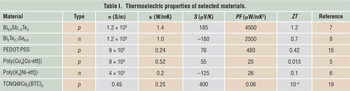
Inorganic semiconductors such as Bi2Te3 and some of its alloys with Sb and Sn (see Table I ) Reference Sheng, Sun, Jiao, Di, Xu and Zhu5,Reference Sun, Sheng, Di, Jiao, Xu, Qiu and Zhu6 have adequate efficiency for a variety of niche applications, Reference Poudel, Hao, Ma, Lan and Minnich7,Reference Yan, Poudel, Ma, Liu, Joshi, Wang, Lan, Wang, Chen and Ren8 but have not been widely adopted because they are difficult to deposit over complex or high-surface-area structures, can be toxic, and are too expensive for many applications. Nanostructuring and superlattices have yielded structures with ZT > 2, but these complex materials still remain impractical and too expensive for widespread applications such as integration with solar cells or for powering wearable electronics/sensors powered by body heat. Reference Kanatzidis9
Thermoelectric properties of selected materials.

Note: PEDOT, poly(3,4-ethylenedioxythiophene); PSS, polystyrene sulfonate; ett, 1,1,2,2-ethenetetrathiolate; TCNQ, tetracyanoquinodimethane; BTC, benzene 1,3,5-tricarboxylate; σ, electrical conductivity; κ, thermal conductivity; S, Seebeck coefficient; PF, power factor; ZT, figure of merit.
As an alternative to inorganic materials, conducting polymers have recently attracted attention for TE applications, motivated by their low material cost, ease of processability, nontoxicity, mechanical flexibility, and low thermal conductivity. Reference Bahk, Fang, Yazawa and Shakouri10–Reference Chen, Zhao and Liang12 Conducting polymers such as polyacetylene, polyaniline, polypyrrole, and PEDOT consist of long, conjugated molecular chains with varying degree of crystallinity. Reference Heeger13 In virtually all cases, obtaining significant σ in polymers requires doping. The dopants are typically organic or inorganic acids that remove electrons from the valence band of the polymers, but are themselves insulators that can occupy significant volume fraction, as well as cause structural disorder, decrease chain-to-chain electronic coupling, and depress carrier mobility. Reference Bubnova, Khan, Wang, Braun, Evans, Fabretto, Hojati-Talemi, Dagnelund, Arlin, Geerts, Desbief, Breiby, Andreasen, Lazzaroni, Chen, Zozoulenko, Fahlman, Murphy, Berggren and Crispin14 Minimizing the dopant volume and exercising precise control of the oxidation state recently yielded PEDOT:PSS (PSS = polystyrene sulfonate) with a PF of 480 μWm–1K–2. Reference Kim, Shao, Zhang and Pipe15 However, the interpretation of this result was confounded by the fact that σ and κ were not measured for the same specimens or in the same direction with respect to the specimen geometry. Reference Weathers, Khan, Brooke, Evans, Pettes, Andreasen, Crispin and Shi3
TEGs require both p- and n-type elements arranged such that holes and electrons flowing from the hot to cold ends recombine to generate a current ( Figure 1a). Unfortunately, achieving chemically stable n-type conducting polymers is challenging because the position of the lowest unoccupied molecular orbital (LUMO) level relative to the vacuum level (i.e., the electron affinity [EA]) is low for most linear chain-conjugated organic polymers. Reference Russ, Robb, Brunetti, Miller and Perry16 Recently, electron-deficient conjugated systems with EA below –4.0 eV have emerged, but the best performing among these, benzodifurandion poly(p-phenylene vinylene) (BDPPV) doped with N-DMBI N-([4-(1,3-dimethyl-2,3-dihydro-1H-benzoimidazol-2-yl)phenyl]dimethylamine), yielded a PF of 0.28 × 10⁻⁴ Wm–1K–2, well below the values achieved for p-type polymers.
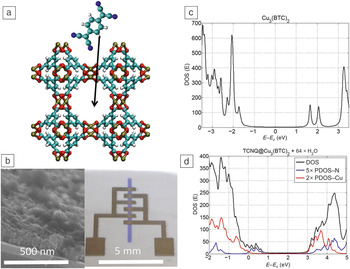
(a) Tetracyanoquinodimethane (TCNQ) above a Cu3(BTC)2 with arrow pointing to the pore. Color code: white, H; blue, N; cyan, C; red, O; ochre (light brown), Cu. Reprinted with permission from Reference Reference Zhuang, Ar, Yu, Liu and Terfort21. © 2013 Wiley. (b) (left) Scanning electron microscope image of Cu3(BTC)2 deposited using liquid-phase layer-by-layer growth and (right) an optical image of Cu3(BTC)2 (blue line) with Ag electrodes all deposited on paper by inkjet printing. (c) Electronic density of states (DOS) calculated ab initio—for Cu3(BTC)2 E F is in the electronic gap. (d) For TCNQ@Cu3(BTC)2, E F is near the metal–organic framework (MOF) valence band. The blue curve indicates the partial density of states (PDOS) obtained by projecting the wave functions on the TCNQ N atoms, while the red curve indicates the PDOS obtained by a similar projection on the MOF Cu atoms. Despite the relatively large Seebeck coefficient, the electrical conductivity and the power factor need to increase by ∼103 for practical applications. Reprinted with permission from Reference Reference Allen, Feldman, Fabian and Wooten24. © 1999 Taylor & Francis. Note: BTC, benzene 1,3,5-tricarboxylate; E, energy; E F, Fermi energy.

An alternative approach is to consider coordination polymers (CPs), which are composed of repeating units of metal–organic coordination complexes. Unlike all-organic conjugated polymers for which the valence and conduction bands are associated with the delocalized π and π* orbitals of the carbon backbone, respectively, the electronic structure of CPs is dominated by the transition-metal d electrons and their interaction with the organic ligands. Reference Pajerowski, Watanabe, Yamamoto and Einaga17,Reference Gliemann and Yersin18 In fact, the CP poly(K x [Ni-ett]), composed of Ni(II) ions coordinated to 1,1,2,2-ethenetetrathiolate (ett) with potassium used to balance the charge, currently holds the record as the n-type polymer with the highest ZT at room temperature. Unfortunately, a solution-based processing route to poly(K x [Ni-ett]), which is particularly suitable for mass production, has not yet been demonstrated.
Conducting metal–organic frameworks as thermoelectrics
Metal–organic frameworks (MOFs) share many of the advantages of all–organic polymer TEs for applications requiring large-area processable, nontoxic, and low-cost materials. Additionally, MOFs and MOFs with guest molecules (Guest@MOF) materials offer higher thermal stability (up to ∼400°C in some cases) and have long-range crystalline order, which could be harnessed to improve charge mobility. MOFs offer tremendous synthetic and structural versatility for optimizing the electronic structure for high p- and n-type ZT through appropriate choices of metal and ligand. The long-range crystalline order of MOFs promotes high-charge mobility to increase σ without adversely affecting S. A further aspect that differentiates MOFs from the broader class of nonporous CPs is their ability to adsorb a large variety of molecules and nanostructures within their pores to further tune or dramatically change the material’s electronic and thermal-transport characteristics (see the article by Allendorf et al. in this issue). The field of MOF-based TEs is still in its infancy, however, and to date, only one MOF has been explored for TE applications: the TCNQ@Cu3(BTC)2 Guest@MOF system (TCNQ, tetracyanoquinodimethane; BTC, benzene 1,3,5-tricarboxylate). Reference Erickson, Leonard, Stavila, Foster, Spataru, Jones, Foley, Hopkins, Allendorf and Talin19
TCNQ@Cu3(BTC)2 thermoelectric
The Cu3(BTC)2 MOF forms face-centered-cubic crystals consisting of Cu(II) dimers coordinated by four BTC linkers (Figure 1a). The Cu3(BTC)2 MOF can be deposited by a variety of methods, including solution-based thin-film growth and inkjet printing. Reference Talin, Centrone, Ford, Foster, Stavila, Haney, Kinney, Szalai, El Gabaly, Yoon, Leonard and Allendorf20,Reference Zhuang, Ar, Yu, Liu and Terfort21 The latter is particularly attractive for low-cost TE fabrication since relatively thick layers with desired pattern and current collectors can be rapidly deposited on low-cost substrates such as paper and fabrics, as demonstrated in Reference Reference Zhuang, Ar, Yu, Liu and Terfort21 and in our laboratory (Figure 1b, right-hand side).
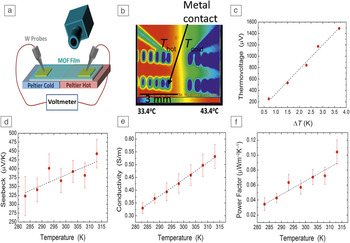
When Cu3(BTC)2 is infiltrated with TCNQ, the TCNQ molecules bridge the Cu(II) dimers, forming TCNQ@Cu3(BTC)2 and an electronic conduction pathway and increasing σ from <10–9 S/m to ∼0.1 S/m. Reference Talin, Centrone, Ford, Foster, Stavila, Haney, Kinney, Szalai, El Gabaly, Yoon, Leonard and Allendorf20 When a thin film of TCNQ@Cu3(BTC)2 is placed onto a stage with a thermal gradient, a positive voltage is measured between the cold and hot sides (see Figure 2a–b) with S ∼ 400 μV/K at room temperature (Figure 2c–d), indicating that holes are the dominant electronic charge carriers in the infiltrated framework.
Thermoelectric characterization of metal–organic framework (MOF) thin-film devices. (a) Two Peltier coolers are used to heat and cool the two sides of the substrate, and an infrared (IR) camera is used to measure the temperature T profile. (b) IR image taken during one of the measurements. The electrical contacts appear cold in the image because of their different emissivity compared with the MOF. (c) Measured voltage as a function of ΔT (where ΔT = T hot – T cold). The Seebeck coefficient S is extracted from the linear fit. (d) S as a function of T. The dashed line is a linear fit. (e) Electrical conductivity σ as a function of T. The dashed line is a linear fit that could represent a thermally activated process with activation energy of 50 meV. (f) Power factor as a function of T. The dashed line is a linear fit. The low value of the power factor is largely due to low electrical conductivity. Reprinted with permission from Reference Reference Allen, Feldman, Fabian and Wooten24. © 1999 Taylor & Francis.

The positive S is consistent with the calculated density of states that shows how E F in Cu3(BTC)2 moves from the mid-gap to the valence band upon infiltration with TCNQ (Figure 1c–d). This can be rationalized by the fact that the LUMO levels of TCNQ lie close to the Cu3(BTC)2 valence band due to the large electron affinity of TCNQ. The blue line in Figure 1d indicates that the TCNQ LUMO levels are situated just above E F, whereas the Cu3(BTC)2 valence band (red line) is located just below E F. Despite the large S, the relatively low σ results in a comparatively low PF of ∼0.06 μW/mK2 (see Table I for comparison).
To determine the figure of merit ZT, κ for TCNQ@Cu3(BTC)2 was measured using time-domain thermoreflectance (TDTR). This is an optical pump-probe technique that utilizes ultrafast laser pulses (typically sub-picosecond) to monitor the surface temperature of a sample as a function of time. In TDTR, a modulated train of pump pulses heats the sample, creating both a time- and frequency-domain heating event in the sample of interest, and probe pulses, which are time delayed relative to the pump pulses, monitor the change in reflectivity of the sample surface, which is related to the temperature change. Reference Cahill22 The TDTR measurements on the TCNQ@Cu3(BTC)2 sample yielded a room-temperature value of 0.27 ± 0.04 Wm–1K–1. Reference Erickson, Leonard, Stavila, Foster, Spataru, Jones, Foley, Hopkins, Allendorf and Talin19 This low κ value, which helps maximize the figure of merit in Equation 1 with all other factors being equal, is comparable to those of the best thermoelectric polymers and an order of magnitude smaller than that for Bi2Te3. To understand the factors that dominate this low thermal conductivity, we used molecular dynamics simulations to calculate κl of crystalline Cu3(BTC)2 and TCNQ@Cu3(BTC)2, obtaining a κl of 0.58 Wm–1K–1 for the uninfiltrated crystalline MOF and 3.84 ± 0.27 Wm–1K–1 for the infiltrated crystalline MOF. The addition of TCNQ significantly increases κl, which is, at least in part, due to the increased density of phonons in the low-frequency/high-group-velocity range. The fact that the calculated values are for a single crystal rather than a polycrystalline material accounts for some of the differences with the experimental values.
Inserting the experimental values we measured for S, σ (=0.45 S/m), and κ in Equation 1, we obtain
 $ZT \approx 7 \times {10^{ - 5}}$
at 298 K, a value well below those of the best inorganic thermoelectric materials (see Table I). While S for the MOF is more than five times larger than that for PEDOT:PSS and κl is comparable, it is clear that σ for TCNQ@Cu3(BTC)2 is the main reason for the reduced performance. Improving crystallinity will likely increase σ, but may also increase κ.
Thermal transport in MOFs
A maximum ratio of σ/κ, which appears in Equation 1, is a goal in designing an ideal TE material, giving rise to the well-known quest for a phonon-glass/electron crystal. (In other words, a material that maximizes phonon scattering, leading to the phonon-mediated thermal conductivity, κl, while minimizing electron or hole scattering, leading to both the electrical conductivity, σ, and the electronically mediated thermal conductivity, κe.) Reference Slack and Rowe23 The quest to synthesize solids with ultralow κl has focused on disordered or amorphous phases where structural periodicity and thus phonons (in the strict definition of this quasiparticle) are absent. Reference Allen, Feldman, Fabian and Wooten24 In this case, the length scales of vibrational energy exchange that contribute to the thermal conductivity can be on the order of the atomic spacing, Reference Shenogin, Bodapati, Keblinski and McGaughey25–Reference Braun, Baker, Giri, Elahi, Artyushkova, Beechem, Norris, Leseman, Gaskins and Hopkins27 akin to Einstein’s original theory of how energy moves through solids. Reference Einstein28,Reference Cahill, Watson and Pohl29 However, introducing disorder in the atomic structure may also have detrimental effects on σ. Therefore, maintaining crystallinity while reducing κl via limiting the length scales of vibrational energy transfer and other means is a more viable path to achieving maximal material ZT.
In the context of the widely adopted kinetic theory, we know that low κl = 1/3 Σ m (cvℓ) m results from weak bonding, high atomic mass, complex atomic structures, and high anharmonicity, each of which systematically decreases c, the heat carried per mode m; v, the speed of propagation; and ℓ, the mean free path of the carrier, via different nanoscale mechanisms. MOFs are composed of a variety of atomic species with different masses and heterogeneous bonds. This heterogeneity in masses and bond stiffness directly affects ℓ for any given phonon mode leading to low κl. Huang et al. Reference Huang, McGaughey and Kaviany30 calculated that the intrinsic κl of MOF-5 is 0.3 Wm–1K–1, resulting from a characteristic ℓ = 0.83 nm, which is considerably smaller than the lattice constant of 2.6 nm and relatively independent of temperature. Wang et al. Reference Wang, Guo, Xu, Chung, Kaviany and Huang31 also used first-principles calculations to determine that, due to its large and complex unit cell, MOF-74 has a large population of optical phonons, which result in more than 50% of the energy being carried by phonons with ℓ < 2 nm.
The open, mechanically soft structure of MOFs leads to relatively low-energy propagation velocities. Huang et al. Reference Huang, McGaughey and Kaviany30 calculated an atomic density of 24.6 atoms/nm3 and a sound speed of 1184 m/s for MOF-5. The open structure and large-porosity ratios in MOFs can lead to strong scattering of all phonons at near room temperature, resembling the phonon-glass concept, and a heat capacity that is below the upper, classical limit given by Dulong-Petit. Reference Cahill and Pohl32 However, it is important to note that increasing the porosity of a MOF will likely have detrimental effects on electrical conductivity and hence ZT.
The introduction of guest molecules into MOFs can have a variety of effects on κl. Weakly interacting, light molecules such as infiltrated water will likely have no significant effect unless they are in abundance; however, heavier, loosely bound rattling atoms in the MOF pores can significantly reduce κl, as has been previously observed for zeolites, skutterudites, and clathrates. Reference Nolas, Cohn and Slack33–Reference Tadano, Gohda and Tsuneyuki38 In particular, “rattlers” reduce κl due to the creation of localized modes, enhancement of anharmonicity, and reduction of group velocities. Reference Tadano, Gohda and Tsuneyuki38 Indeed, acoustic phonons in MOFs have been described to exhibit “rattling-like behavior,” which results in exceptionally high anharmonicity of these modes. Reference Tadano, Gohda and Tsuneyuki38 This implies that the acoustic modes in MOFs could be close to the situation where phonons are “equally strongly damped,” as in amorphous and disordered materials. Reference Cahill and Pohl32,Reference Tadano, Gohda and Tsuneyuki38
Furthermore, while the use of infiltration to achieve the Guest@MOF can lead to bond stiffening, the resulting variable and complex bonding environments could, in principle, be tuned to enhance vibrational scattering and reduce ℓ. An increase in bond heterogeneity could increase the “rattling-like” behavior of the acoustic modes, increasing anharmonicity and decreasing thermal transport of the affected modes. Reference Qiu, Xi, Wei, Ke, Yang and Zhang39 The infiltration approach could potentially be engineered to create further reductions in the heat-carrying phonons, while providing significant improvement to σ, as discussed.
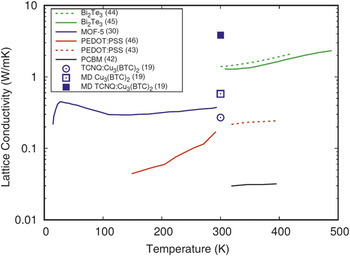
The temperature dependence of κl is also of interest for TE applications given that the temperature difference (ΔT) between the hot and cold sides may be >100 K. Ordinarily in defect-free, crystalline materials above their Debye temperature, κl is dominated by anharmonic phonon scattering (such as Umklapp scattering Reference Kittel40 ), which leads to a T –1 scaling. However, experimentally measured κ values of typical semiconducting organic materials Bi2Te3 and MOF-5 exhibit only slightly increasing trends, similar to glassy/amorphous materials as shown in Figure 3 . Reference Liu, Wang, Li, Coates, Segalman and Cahill4,Reference Erickson, Leonard, Stavila, Foster, Spataru, Jones, Foley, Hopkins, Allendorf and Talin19,Reference Huang, Ni, Millward, McGaughey, Uher, Kaviany and Yaghi41–Reference Jiang, Xu, Lu, Xie, Huang and Li46
Lattice thermal conductivity κl as a function of temperature T for several materials. All of these materials display little temperature dependence because of their atomic structure. Note: MOF, metal–organic framework; PEDOT, poly(3,4-ethylenedioxythiophene); PSS, polystyrene sulfonate; PCBM, [6,6]-phenyl-C61-butyric acid methyl ester; TCNQ, tetracyanoquinodimethane; BTC, benzene 1,3,5-tricarboxylate; MD, molecular dynamics.

Summary
The need for low-cost, mechanically flexible, and environmentally friendly TE energy-conversion devices has led to increased attention to organic and hybrid organic–inorganic TE materials. Despite impressive progress, substantial challenges remain to increase charge mobility due to inherent and dopant-induced structural disorder, as well as the scarcity of n-type organic conductors. In this article, we have asserted that electrically conducting MOFs could solve the disorder problem common to polymers, providing within a single material the highly ordered structure of inorganic conductors with the tunable properties and low cost of organics. Furthermore, we have used the example of TCNQ@Cu3(BTC)2 framework to illustrate how structure-inherent nanoscale porosity of MOFs provides a route to tuning the electronic properties of these materials with guest molecules without increasing structural disorder. Although σ of TCNQ@Cu3(BTC)2 is still too low to make it an attractive TE, the recent emergence of several inherently conducting, porous frameworks whose electronic and thermal transport properties could be further tuned using guest molecule infiltration, makes MOFs and Guest@MOFs promising for further exploration for TE energy-conversion applications.
Acknowledgments
The authors thank A. Cruz for assistance with inkjet printing. This work was supported by the Sandia Laboratory Directed Research and Development Program. Sandia National Laboratories is a multiprogram laboratory managed and operated by Sandia Corporation, a wholly owned subsidiary of Lockheed Martin Corporation, for the US Department of Energy’s National Nuclear Security Administration under Contract DE-AC04–94AL85000. P.E.H. is grateful for support from the Army Research Office Grant #W911NF-16–1-0320.

A. Alec Talin has been a member of the technical staff at Sandia National Laboratories since 2002. He is also an adjunct associate professor of materials science and engineering at the University of Maryland. He received a BA degree in chemistry from the University of California, San Diego in 1989, and a PhD degree in materials science and engineering from the University of California, Los Angeles, in 1995. Prior to joining Sandia, he spent six years at Motorola Labs, and was a project leader at the Center for Nanoscale Science and Technology at the National Institute of Standards and Technology. His research focuses on areas of novel electronic materials, energy storage and conversion, and national security. He is a principal editor of the journal MRS Communications. Talin can be reached by phone at 925-294-2495 or by email at aatalin@sandia.gov.

Reese E. Jones is a staff scientist at Sandia National Laboratories. His research ranges from the atomic and molecular scales to the scales at which continuum models become appropriate. Recently, he has been developing and applying methods to interpret and use molecular information in continuum contexts. He has concentrated on extracting transport properties at the nanoscale and devising methods of simulating long-range and large-scale effects on molecular systems. Jones can be reached by email at rjones@sandia.gov.

Patrick E. Hopkins is an associate professor of mechanical and aerospace engineering at the University of Virginia. He was a Harry S. Truman Fellow at Sandia National Laboratories (2008–2011). He received his PhD degree in mechanical and aerospace engineering in 2008, and a BS degree in mechanical engineering and a BA degree in physics in 2004, all from the University of Virginia. He is a recipient of Young Investigator Awards from the Air Force Office of Scientific Research and the Office of Naval Research, The American Society of Mechanical Engineers Bergles-Rohsenow Young Investigator Award in Heat Transfer, and the Presidential Early Career Award for Scientists and Engineers. His interests include thermal-energy transport and photonic interactions in condensed matter, soft materials, liquids, vapors, and their interfaces. Hopkins can be reached by phone at 434-982-6005 or by email at phopkins@virginia.edu.