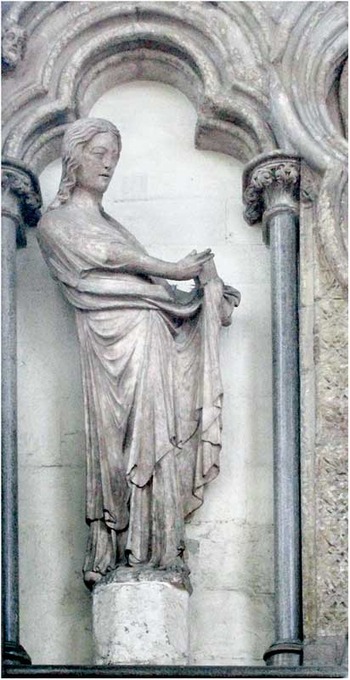
Two of the finest sculptures in Westminster Abbey were hidden from public view for around a century and a half. The thirteenth-century Annunciation group of the Virgin Mary and the Angel Gabriel (fig 1) originally stood in high niches on either side of the inner entrance to the Abbey’s Chapter House.Footnote 1 From the middle of the sixteenth century the Chapter House was progressively commandeered by the state as a repository for public records. In 1719, a House of Lords committee reported that ‘from the outward door leading to the Chapter House, and within the said Chapter House there is a great deal of room, and it is altogether very lightsome to receive many more records’.Footnote 2
Westminster Abbey Chapter House: thirteenth-century statue of the Angel Gabriel. Photograph: author, courtesy of the Dean and Chapter of Westminster

During the succeeding years the space was partitioned and galleried to provide a home for an ever-increasing number of records. The statue of the Virgin was shut up in her niche behind wooden presses built to accommodate the document rolls. She was not seen again until the 1850s when George Gilbert Scott, making preparations for his restoration of the Chapter House, peered into a gap behind one of the presses and noticed something amid the accumulated debris: ‘I let down into it by a string a small bull’s-eye lantern, when, to my extreme delight, I saw that the mysterious object was the head of a beautiful full-size statue in a niche’.Footnote 3 The entombed Virgin Mary had survived undamaged.
The Angel Gabriel did not fare so well. His wings and outstretched arms extended beyond the confines of his niche. He could not simply be blocked in by a press placed flush to the wall. Instead, the statue was shorn of its wings and scroll and removed to the sill of a blind window in the vestibule of the Chapter House. There it stood beside a new staircase leading to the inserted first-floor gallery and the office of the Chief Clerk of the Record Office. The vestibule was divided along its length by filling in the central arcade. The architect and antiquary John Carter was appalled by the alterations: they ‘have disfigured one of the finest pieces of ancient architecture in the kingdom’, he wrote.Footnote 4 Four years later, he added: ‘it is with the utmost difficulty I can restrain my rising thoughts; observers will find little to admire but modern carpenters’ work, vast rolls of parchment, dust and rubbish’.Footnote 5 Even the official report of the Deputy Keeper of the Public Record for 1807–8 admitted that the documents packed into the vestibule were ‘covered with dirt and in great confusion’.Footnote 6
In this filthy sea of chaos the statue of Gabriel stood largely ignored. With empty wing sockets turned to the wall, there was no hint of his angelic status. In its mutilated form the statue was consigned to anonymity or misidentification by the few people privileged enough to gain entrance to the Chapter House, which could be obtained only with prior permission from the Public Record Office at Rolls House in Chancery Lane.
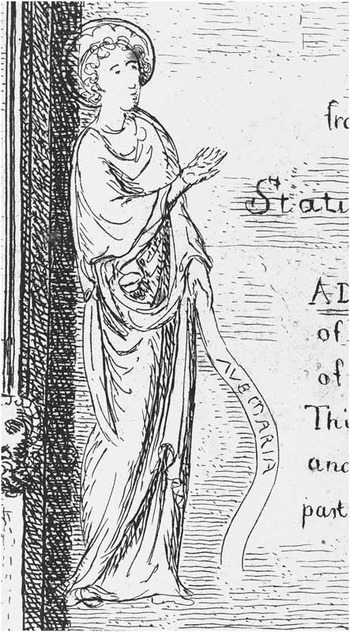
Given its eye-level position and the quality of its workmanship, it is surprising that the statue should have escaped the notice of the voraciously observant John Carter during his many visits to the abbey in the late eighteenth century. It would be gratifying to see an echo of the figure in a drawing of Gabriel on the title-page of his Specimens of Ancient Sculpture and Painting. Engraved in November 1780, the page presents a capriccio of architectural and sculptural remains from various English abbeys and cathedrals.Footnote 7 Like the Chapter House statue, Carter’s Gabriel is unusual in being an angel without wings (fig 2). Unfortunately, Carter himself gives a different source. In his explanation of the title-page he writes: ‘the statues on each side of the supposed cross are painted on an oak case, containing a large ancient map of the world ... from Hereford Cathedral’.Footnote 8 The Hereford figures of Gabriel and the Virgin Mary were painted in the 1290s on the inner sides of the case’s doors, opening to form a triptych and closing to protect the Mappa Mundi. The figures are only roughly sketched in Carter’s preliminary design for the engraving,Footnote 9 while the wooden case is clearly indicated: the printed version ignores the case and shows the figures isolated from their original context.
Detail of the title-page of John Carter’s Specimens of Ancient Sculpture and Painting, 1787. Photograph: author

Someone who would have passed the statue by the Chapter House stairs more often than most was the young Henry Cole, an assistant keeper of the Record Office. Cole was no bland civil servant. He came to play a major role in Victorian public life as a driving force behind the introduction of the Penny Post, the organisation of the Great Exhibition of 1851 and the establishment of the expanding railway network. His talents were artistic as well as administrative. As a young man, he had taken lessons in perspective and watercolour painting. Throughout his life Cole pursued a practical interest in the arts and architecture, writing books and articles and influencing product design as an ‘art manufacturer’.Footnote 10 These activities he pursued under the pseudonym of Felix Summerly, a ruse to circumvent the convention that barred a public servant from publishing or engaging in commerce under his own name.
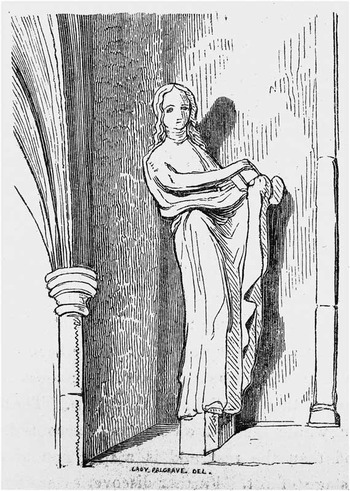
It was behind the mask of Felix Summerly that Henry Cole published his Hand-Book for the Architecture, Sculpture, Tombs, and Decoration of Westminster Abbey in 1842. The title-page boasts ‘fifty-six embellishments on wood engraved by ladies’. Among these illustrations is, in Cole’s words: ‘a statue on a pedestal, in a very stiff attitude, called “St John”. No copy of this sculpture (said to be one of the oldest in the Abbey) has ever been published until the present, I believe’ (fig 3).Footnote 11
Statue of ‘St John’, drawn by Elizabeth, Lady Palgrave and engraved by Charlotte Bond. Photograph: author

This is, indeed, the first certain publication of the Westminster Abbey statue of the Angel Gabriel in body, if not in name.Footnote 12 Cole gives no reason for identifying the statue as St John. The fact that he puts the saint’s name in inverted commas suggests that he may have had some misgiving over what might have been a traditional identification, perhaps inferred from the figure’s youthful and androgynous features, often found in representations of St John the Evangelist. There had been a chapel and altar to the saint in the abbey’s north transept during the Middle Ages. The statue’s outstretched hand was open to misinterpretation. Deprived of its salutatory scroll, it could be imagined as grasping something quite different, and a common attribute of St John is a chalice with a snake or demon emerging from it, held out at arm’s length.Footnote 13
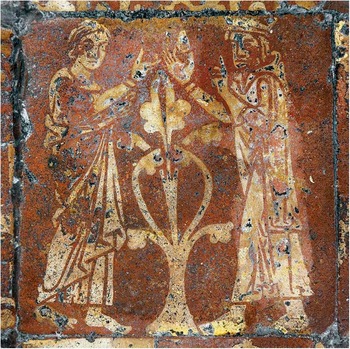
An alternative interpretation of the statue’s outstretched arm would have had greater relevance to the abbey, built as it was to honour the shrine of St Edward the Confessor. The medieval Golden Legend tells of a meeting between the king and a beggar. King Edward, having no treasurer with him, took a ring from his finger and gave it to the poor man. Some years later, two English pilgrims encountered the same man in the Holy Land. As they discussed the king’s health, the poor man revealed himself to be none other than St John the Evangelist. He bade the pilgrims to return the ring to the king and tell him that ‘within six months he shall be in the joy of heaven with me, where he shall have reward for his chastity and good living’.Footnote 14 Illustrations of the beggar reaching out to take the ring appear on the thirteenth-century tiles of the Chapter House floor (fig 4), hidden beneath the floorboards of the Record Office until Scott’s restoration.
King Edward the Confessor and St John the Evangelist disguised as a beggar: a thirteenth-century floor tile from the Westminster Abbey Chapter House. Photograph: David Lambert; © the Dean and Chapter of Westminster

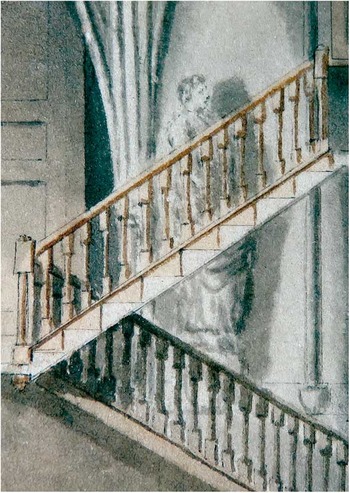
Henry Cole may have been, as he asserts, the first to publish a drawing of the Chapter House statue, but it had already been recorded, albeit incidentally and anonymously, some thirty-five years earlier. It appears as a small ghostly detail (fig 5) in two elegant watercolour cross-sections of the Chapter House Record Office, produced by J & W Newton in 1807.Footnote 15 Though partly obscured by the inserted staircase, the figure’s location and the little that can be seen of its attitude confirm its identity as the Angel Gabriel.Footnote 16
Detail of a cross-section of the Westminster Abbey Chapter House, 1807. Photograph: author, courtesy of The National Archive (TNA, MPB/1/2/99/5)

Though the humble wood engraving presented in Henry Cole’s 1842 Hand-Book is unprepossessing in itself, the making of it gives an insight into his thinking and his relationship with one of the most remarkable families of the nineteenth century: the Palgraves. As he noted on the title-page, most of Cole’s illustrations were drawn and engraved on wood by ‘ladies’. For some time, Cole had been on a crusade to promote wood engraving as a suitable occupation for women in a world that ‘would probably allow the practice of this art to be one of few employments not degrading to them’.Footnote 17 Writing anonymously in the London and Westminster Review, he addressed ‘that large portion of educated gentlewomen of the middle classes, who now earn a subsistence chiefly as governesses’ and pronounced engraving on wood to be ‘befitting in every way to their sex and sensibilities’. Even better, it was so easy even women might learn it! ‘All that can be taught of the art may be learnt in a few lessons, and thus an acquirement made, which will afford no slight protection against misfortunes to which, in this commercial country, even the richest are exposed.’Footnote 18
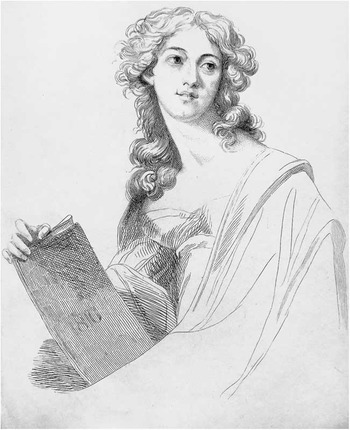
The woman who drew the statue of Gabriel for Henry Cole needed neither money nor condescension. Elizabeth, Lady Palgrave (fig 6) was the second daughter of Dawson Turner, a prosperous and cultured Norfolk banker. Turner was a Fellow of the Society of Antiquaries and had interests ranging across the arts and sciences. He was first in the list of ‘distinguished antiquaries’ who produced a revised edition of John Carter’s Specimens of Ancient Sculpture and Painting in 1838. Elizabeth’s mother, Mary, was a gifted amateur engraver. Their house in Yarmouth was furnished with a very fine library and a beautiful collection of prints. Every Saturday morning the Misses Turner were given drawing lessons by John Sell Cotman, whose career was promoted by their father.Footnote 19
Elizabeth, Lady Palgrave, engraved by her mother from a drawing by J P Davies; reproduced in Palgrave Family Memorials (Tucker and Palgrave Reference Tucker and Palgrave1878, pl 28). Photograph: author

The family, and Elizabeth in particular, attracted the attentions of Francis Ephraim Cohen, who worked for a London solicitor but reserved his passion for the study of history. After a lengthy courtship, Francis married Elizabeth in 1823, but not before he had converted to Christianity and adopted her mother’s maiden name as his new surname. Earlier that same year, one Henry Cole, then aged fifteen, had left Christ’s Hospital School and started working in Cohen’s office at 1 King’s Bench Walk, Temple. Immediately after his wedding, Francis Palgrave sent a note to Cole asking him to ‘be so good as to direct Mr Egerton to paint out the name “Cohen” on the door and over the same, and to paint the name “Palgrave”, do not let him alter the other lettering as it will thus better show that the name only has been altered and not the person’.Footnote 20 Thus began a long, but sometimes uneasy, working relationship between Palgrave and Cole.
At that time Palgrave was a sub-commissioner of the Record Commission, work for which he would be knighted in 1832. At the end of his life, Cole recalled that his duties in Palgrave’s office ‘consisted in making transcripts from the original public records written in Latin and French, which were chiefly deposited in the Tower of London, and from other manuscripts to be found in the Chapter House of Westminster Abbey, and at the British Museum’.Footnote 21 By 1838, Sir Francis Palgrave was Deputy Keeper of the Public Record and based at the Chapter House, and Henry Cole had become one of his four senior assistant keepers.
Lady Palgrave’s artistic ability was matched by her intelligence (she was an unofficial reader for the publisher, John Murray)Footnote 22 and her sense of humour. In a letter to her father she describes her eldest son, Francis, as being distracted from his studies of the Latin authors by his making of ‘models and inventions to find out perpetual movement, which I tell him is nearest attained by his own tongue’.Footnote 23 From their correspondence, the Palgraves appear to have been attentive and unusually tolerant parents. When the family returned from a trip to Italy with fifteen-year-old Francis, she wrote to her father: ‘since our return Frank’s taste for drawing has quickened, and he is engaged at every spare minute in executing frescos on the walls both in and outside the house’.Footnote 24
Among Henry Cole’s stable of artistic ladies, Lady Palgrave was the obvious choice to draw the statue known as St John since she had ready access to the Chapter House through her husband, the keeper. ‘I truly like the time honoured neighbourhood of Westminster, the Cloisters, & the adjoining Abbey, extremely’, she wrote to her father in 1839, ‘but I do not like the damp & cold for my dear Husband, who ought not to sit, day after day, in that cellar-like air.’Footnote 25 The unhealthy atmosphere of the Chapter House had long been a cause for complaint. For two years, from 1817, Francis Palgrave’s predecessor, John Caley, had written repeatedly to the Surveyor General of the King’s Works about conditions he considered injurious to both people and documents.Footnote 26 His letters went ignored. Matters only got worse: as late as 1850, Francis Palgrave had to report that ‘many of the documents deposited in the porch were found to be decayed, in consequence of the overflowing of a drain’.Footnote 27
It was probably late in 1841 that Lady Palgrave’s ‘artistic pencil’ delineated the statue ‘in all its quaintness of form and attitude’.Footnote 28 On 14 January the following year, Cole wrote to thank her for the trouble she had taken and to let her know he ‘had proposed that a Miss Clarke, sister of Mr Bellenden Ker, should have engraved your drawing, but circumstances preventing it, my sister in law will undertake it & I hope will do it justice’.Footnote 29 Harriet Ludlow Clarke was in fact sister-in-law to the law reformer Charles Bellenden Ker.Footnote 30 It was perhaps under his influence that she used the money she made from her successful career as a wood engraver to build two model homes for labourers in Cheshunt. Among some 250 blocks she engraved during her lifetime were engravings that appeared in the Penny Magazine and the Art-Journal. Harriet Clarke was also a successful glass painter, designing windows for churches, including Canterbury Cathedral. Almost certainly, she would have done better justice to Elizabeth Palgrave’s drawing than did Cole’s sister-in-law, Charlotte Bond. The quality of the original drawing is unknown. However, Bond’s engraving shows none of the artistic precision and sensitivity so evident in Palgrave’s drawings and watercolours made on her European tours.Footnote 31
There are no doubts about the quality of the second drawing of the Chapter House Gabriel. In 1827, when Francis Palgrave and Henry Cole were transcribing ancient manuscripts in their office at 1 King’s Bench Walk, one William Twopeny moved into number 9 at the other end of the Walk, where he practised as a conveyancer.Footnote 32 Like his neighbours, Twopeny had a passion for history. In a pamphlet decrying the fashion for collecting antique fragments as ‘false in its foundation’ and ‘mischievous in its effects’, he describes himself as an ‘amateur architectural draughtsman’ and argues for the dissemination of accurate drawings as a preferable alternative to collecting.Footnote 33 He published competent, if uninspired, etchings of architectural details and expressed concern for the development of an architectural language at a time when the academic vocabulary of Gothic architecture was still in its infancy: ‘a good nomenclature in this particular would be a most useful gift to all who pay attention to our ancient architecture’, he wrote; ‘the name given should, as nearly as possible, describe the form of the thing named, so that a person who has never seen or observed the particular ornament or form in question, may, from its name, with perhaps sometimes the assistance of a slight additional description, have a tolerably correct idea of its shape.’Footnote 34
Eight years after the first publication of Henry Cole’s Westminster handbook, Notes and Queries announced a forthcoming volume that would be an object of especial interest ‘to the citizens of London, to its occasional visitors, as well as absent friends and relatives of those who dwell within its walls ... The artistic portion will, we believe, be mainly founded on the collection of drawings in the possession of William Twopeny, Esq.’.Footnote 35Vestiges of Old London was published the following year, 1851. Its illustrations were not by Twopeny’s own hand but by an artist he had sponsored: John Wykeham Archer.
Wykeham Archer, who was born in Newcastle, came to London around 1830 to work as one of many assistants in the studio of William and Edward Finden, who engraved illustrations for a great diversity of publications. However, as his obituary in The Art-Journal explained, changes of taste in book illustration,
threw Mr Archer and many other engravers out of their usual employ, and he found work, neither very lucrative or constant, in engraving animals & etc., for the New Sporting Magazine. During the intervals arising from the uncertain nature of their labours, he turned his attention to water-colour painting, choosing for subjects many of the places of the metropolis, which were remarkable for their antiquity.Footnote 36
Archer tried to sell his collection of drawings to the British Museum, but its directors were not interested. Eventually he found a buyer in William Twopeny, who further ‘commissioned Mr Archer to execute for him twenty drawings each year of the relics of by-gone days, which were to be found scattered about in the highways and by-ways of London’.Footnote 37
It was from this collection of seventeen portfolios that the illustrations for Vestiges of Old London were selected. As the title suggests, Wykeham Archer cast his eye over some of the hidden and everyday sights that were then disappearing. Its highways and byways included the streets of Westminster. Archer’s plain depiction of an unassuming room in ‘The King’s Arms, Tothill Street’,Footnote 38 for example, has a distinctly documentary feel, as does a ‘Wooden carving of the original sign of the Cock, Westminster’.Footnote 39
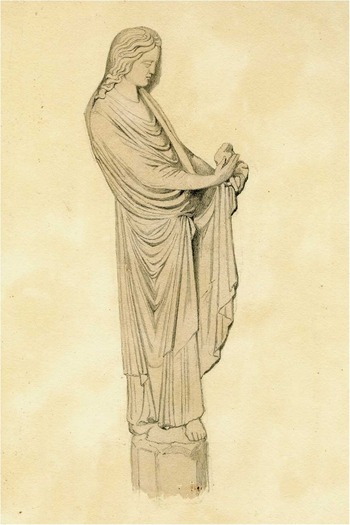
One drawing in Twopeny’s collection that failed to find its way into the published volume is simply labelled ‘In the Chapter House, Westminster’ (fig 7).Footnote 40 Drawn in pencil with watercolour wash, it is an elegant depiction of the statue of the Angel Gabriel. Item 21 in Portfolio 12 has no date; however, from other dated items in the same portfolio, it may be assumed to have been drawn between 1842 and 1859. The British Museum, forgetting its earlier disdain of Archer’s drawings, bought the collection from William Twopeny’s estate after his death. In 1898 the statue of Gabriel was catalogued by Laurence Binyon. Misled by its androgynous features, like others before him, he still described it as a ‘Female statue in the Chapter House’.Footnote 41 This despite George Gilbert Scott’s restoration of the Chapter House having been completed twenty-six years before. Scott had cleared the partition from the middle of the Chapter House vestibule as early as 1853. Some two years later he had produced a drawing of his proposed restorationFootnote 42 in which the mysterious statue, once exiled by the staircase, had emerged from the shadows of confused anonymity to take its rightful place facing the Virgin Annunciate, his identity no longer in doubt.
‘In the Chapter House, Westminster’, John Wykeham Archer (c 1842–59). Photograph: courtesy of British Museum (1874,0314.279); © The Trustees of the British Museum

ABBREVIATIONS AND BIBLIOGRAPHY
Abbreviations
Abbreviations
- BL
British Library, London
- BM
British Museum, London
- TNA
The National Archive, Kew
- UUL
Uppsala University Library, Uppsala