Introduction
Major depressive disorder (MDD) is a prevalent and disabling condition that accounts for high social costs and significant impairment of patients’ quality of life and functioning.Reference Wittchen and Jacobi1
It has been estimated that less than 25% of MDD patients receive proper treatment and that up to 20–30% of those adequately treated show residual symptoms and incomplete remission.Reference Kirino and Gitoh2 Given the high frequency of partial/no response to standard antidepressants during a major depressive episode (MDE) (Bauer et al, 2013),Reference Bauer, Pfennig and Severus3 as well as the poor outcome and high risk of chronicity in patients with a long duration of untreated illness,Reference Altamura, Buoli and Serati4 an early and targeted treatment should be advisable in order to prevent relapses and to improve the prognosis of MDD patients.Reference Buoli, Cumerlato Melter, Caldiroli and Altamura5
The selective serotonin reuptake inhibitors (SSRIs) together with the selective serotonin and noradrenaline reuptake inhibitors (SNRIs) represent the mainstay of the pharmacological interventions, with comparable efficacy but greater tolerability compared to tricyclic antidepressants and monoamine oxidase inhibitors (MAOIs).Reference Chang and Fava6
However, first-line treatments (SSRIs and SNRIs) for an MDE have some clinical limitations that are represented by no remission in a relevant number of patients (about 50% for SSRIs and SNRIs),Reference Machado, Iskedjian, Ruiz and Einarson7 delayed effectiveness,Reference Buoli, Dell’Osso, Bosi and Altamura8 and troublesome side effects, including sexual dysfunction,Reference Dell’Osso, Buoli, Baldwin and Altamura9 insomnia or sedation,Reference Fava10 and worsening of anxiety during the first days of treatment.Reference Fava, Hoog, Judge, Kopp, Nilsson and Gonzales11
Of note, some antidepressants (citalopram, clomipramine, and trazodone)Reference Altamura, Dell’Osso, Buoli, Zanoni and Mundo12, Reference Altamura, Dell’Osso, Buoli, Bosi and Mundo13 are available as an intravenous formulation, with a potentially more rapid onset of action compared to oral administration.Reference Gastpar, Ngo Khac, Gilsdorf and Baumann14–Reference Moukaddam and Hirschfeld17
Clomipramine is the most selective serotonergic molecule among the tricyclic antidepressants, with a weak noradrenergic action due to its hepatic metabolite (desmethylclomipramine).Reference Kelly and Myers18 Some open-label studies have documented the effectiveness of i.v. clomipramine in improving the symptoms of patients affected by MDD.Reference Luscombe, Wright and Jain19–Reference Pollock, Perel, Nathan and Kupfer21 Similar results have been reported with pulse-loading regimens of clomipramine in two samples of depressed adolescents.Reference Sallee, Pollock, Perel, Ryan and Stiller22, Reference Sallee, Vrindavanam, Deas-Nesmith, Carson and Sethuraman23 Finally, a more recent randomized placebo-controlled study reported the effectiveness of augmentative low-dose i.v. clomipramine in improving symptoms of patients with an MDE, although low-dose i.v. citalopram was found to be more incisive on anxiety and somatization.Reference Altamura, Dell’Osso, Buoli, Zanoni and Mundo12
Trazodone performs its pharmacodynamic action as a 2A and 2C serotonin receptor (5-HT2A and 5-HT2C) antagonist and as a serotonin reuptake inhibitor. For these reasons, it belongs to the pharmacological class of serotonin antagonist and reuptake inhibitors.Reference Stahl24 With regard to side effects, the combined action of trazodone allows one to obtain an antidepressant effect while avoiding the unpleasant side effects of SSRIs (e.g., sexual dysfunction) mainly due to binding to the 5-HT2A and 5-HT2C receptors.Reference Khouzam25 In addition, the antihistamine properties of trazodone may be particularly advantageous for depressed patients with severe insomnia.Reference Fagiolini, Comandini, Catena Dell’Osso and Kasper26, Reference Savarese, Carnicelli, Cardinali, Mogavero and Federico27
Numerous randomized and controlled studies have demonstrated the efficacy of oral trazodone in patients with MDD.Reference Fagiolini, Comandini, Catena Dell’Osso and Kasper26, Reference Goracci, Forgione, De Giorgi, Coluccia, Cuomo and Fagiolini28 Furthermore, some of the available clinical data regard samples with elderly depressed patients.Reference Gerner, Estabrook, Steuer and Jarvik29–Reference Schroeck, Ford and Conway34 In contrast, i.v. trazodone, which has been scarcely studied, showed its efficacy in improving depressive symptoms in a small sample of organic depressed patients,Reference Roccatagliata, Abbruzzese, Albano, Cocito and Gandolfo35 whereas Berzewski (1988)Reference Berzewski36 reported positive results in an open trial with high doses of i.v. trazodone. In addition, until now, no studies have compared i.v. trazodone with other i.v. antidepressants in terms of efficacy in MDD patients.
Trazodone and clomipramine are two antidepressants with intravenous formulations. Clomipramine is a more selective inhibitor for the serotonin transporter, especially when administered intravenously, whereas trazodone has the additional properties of antagonizing the binding of serotonin to the 5-HT2A and 5-HT2C receptors. The choice to start with an intravenous formulation is supported by the fact that intravenous antidepressants are thought to have a faster onset of efficacy than oral compounds.Reference Guelfi, Strub and Loft16
For these reasons, the purpose of the present paper was to compare the effectiveness of i.v. trazodone versus clomipramine in the acute treatment of MDD and to evaluate the maintenance of clinical response during a follow-up period with the oral formulations of these compounds.
Methods
Sample
A total of 42 patients (13 males and 29 females) were recruited at the outpatient service (Day Hospital for Mood Disorders) affiliated with the Department of Psychiatry at the University of Milan.
Patients had to be older than 18 years of age, have a diagnosis of MDD, and a current MDE according to the DSM–537 to be included in our study.
The exclusion criteria included:
1. resistant depression, defined as a history of no response to at least two antidepressants from different classes, administered for an adequate period of time and at adequate dosesReference Wijeratne and Sachdev38
2. pregnancy, breastfeeding, and postpartum also for the effects of hormone fluctuations on mood
3. comorbid medical conditions influencing the severity of depressive symptoms and treatment response (e.g., hypothyroidism or dementia)
4. medical therapies that could modify pharmacokinetics markedly (e.g., antiretrovirals) or cause depression (e.g., corticosteroids)
5. psychiatric comorbidity with the exclusion of substance misuse
In addition, the patients must have discontinued any prior pharmacotherapy for at least 2 weeks.
All included subjects were visited, treated, and followed up after giving their written informed consent and after receiving a full explanation of the study protocol, which had been previously approved by the local ethical committee.
Treatment schedule
In the first phase, patients were assigned to i.v. trazodone (25–100 mg in 250 mL of saline) or clomipramine (25–75 mg in 250 mL of saline) for 1 week according to clinical judgment (type of depressive symptoms, insomnia or anxiety, somatization vs. melancholic features, medical comorbidities, tolerability of side effects). The infusion started in the morning and lasted approximately 1.5 hours for the two treatment groups. Dosages of intravenous treatment were decided according to the severity of depressive symptoms.
Finally, the second phase of the protocol involved shifting to oral administration of the extended-release trazodone (150–300 mg/day) or clomipramine (50–225 mg/day) for 4 weeks.
Intravenous trazodone was substituted with the oral extended-release formulation (150–300 mg per day). This novel formulation (Contramid®) was recently developed and commercialized in the United States and Europe.Reference Fagiolini, Amodeo, Goracci and Blardi39 The extended-release tablets are administered once a day, ensuring maintenance of appropriate levels of drug concentration and better tolerability. Furthermore, this formulation allowed for administration once a day, encouraging better compliance.Reference Fagiolini, Amodeo, Goracci and Blardi39
Of note, i.v. trazodone is a formulation available only in Italy.
Psychometric scales were performed at baseline (T0), after 2 weeks (T1), and after 6 weeks (T2), as well as after 1 week of intravenous antidepressant administration (T1/2). Patients did not receive any additional medication aside from the trazodone or clomipramine.
Assessment
The raters were blinded with respect to the pharmacological treatment prescribed to each patient. All the raters were trained in clinical scale administration, and they achieved good interrater reliability. In addition, the raters had received specific training for administration of the rating scales.
The Hamilton Depression Rating Scale (HAM–D),Reference Hamilton40 the Montgomery–Åsberg Depression Rating Scale (MADRS),Reference Montgomery and Åsberg41 and the Hamilton Anxiety Rating Scale (HAM–A)Reference Hamilton42 were administered by raters blinded as to the treatment administered to each patient at baseline (T0), after 1 week (T1/2), after 2 weeks (T1), and at 6 weeks (T2). Physical examination was performed. In addition, electrocardiogram and basic laboratory tests were prescribed to all subjects to exclude potential contraindications to intravenous treatment.
The main demographic and clinical variables of the sample were collected: age, gender, duration of untreated illness, number of previous depressive episodes, seasonality, family history of psychiatric disorders in first-degree relatives, number of suicide attempts, number of hospitalizations, lifetime history of psychotic symptoms, presence of atypical symptoms, lifetime substance abuse, type of abuse, and rate of responders/remitters at the end of the protocol.
Safety and tolerability were assessed at each visit after baseline, considering spontaneously reported side effects.
Treatment response was defined by a reduction ≥50% in HAM–D total score, whereas full remission was defined by a score on the HAM–D <8.Reference Amsterdam, Horning and Nierenberg43
Statistical analysis
Descriptive analyses of the subgroups divided according to received antidepressant were performed.
The two treatment groups were compared in terms of demographic and clinical variables, using multivariate analysis of variance (MANOVA) for continuous variables and the χ2 test for categorical ones.
In order to assess the effect of time, treatment, and time-by-treatment in the two groups of patients divided according to assigned antidepressant, repeated-measures analyses of variance (ANOVAs) (T0–T2) was performed. In addition, a further repeated-measure ANOVA was performed to compare the effectiveness of the two antidepressant treatments after the first week of intravenous administration (T0–T1/2).
For all the analyses, the level of statistical significance was set at 0.05. All statistical analyses were performed using SPSS (v. 23.0, SPSS Inc., Chicago, Illinois).
Results
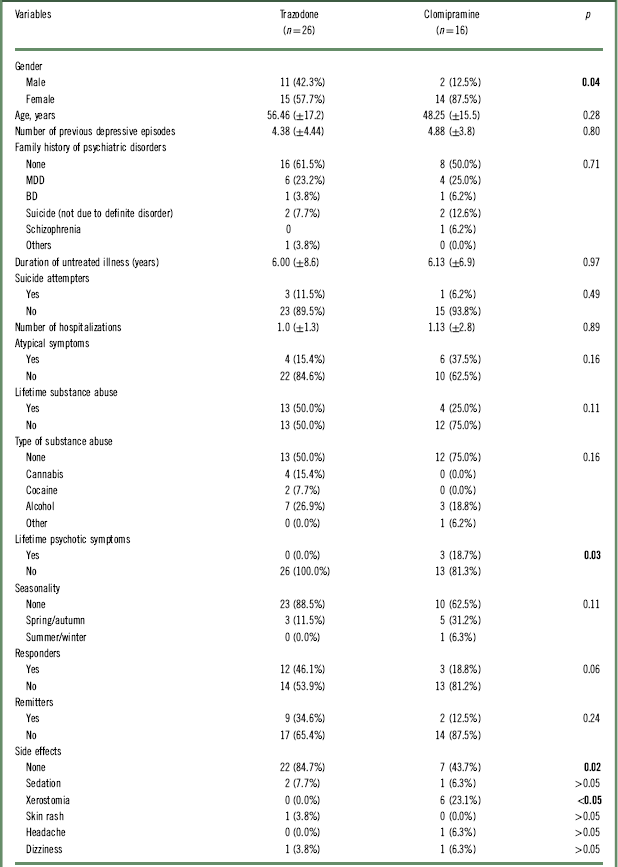
The sample included a total of 42 subjects (13 males and 29 females): 26 patients were treated with i.v. and oral trazodone and 16 with i.v. and oral clomipramine. The sample size was considered adequate, hypothesizing a confidence interval of continuous variables of 15 and an original population of 300 subjects. In this case, a sample of 37 is sufficient to have reliable results.Reference Flight and Julious44 Trazodone has been administered at mean doses of 44.23 (±10.96) mg i.v. and 161.54 (±67.40) mg orally. Clomipramine has been administered at mean doses of 29.69 (±9.30) mg i.v. and 98.44 (±59.92) mg orally. For each patient, i.v. and oral doses were not changed for the duration of the protocol. The demographic and clinical variables of the two treatment groups are summarized in Table 1.
Demographic and clinical variables of the two subgroups of patients divided according to treatment

Statistically significant differences in bold type. For continuous variables, standard deviations are reported in brackets. BD=bipolar disorder; MDD=major depressive disorder.
The groups were not significantly different in terms of seasonality (χ2=4.46, df=2, p=0.107); family history of psychiatric disorders (χ2=2.930, df=5, p=0.711); number of suicide attempters (χ2=1.438, df=1, p=0.487); presence of atypical symptoms (χ2=2.001, df=1, p=0.157); lifetime substance abuse (χ2=2.569, df=1, p=0.109); kind of substance abuse (χ2=6.635, df=4, p=0.156); age (F=1.215, p=0.284); number of previous depressive episodes (F=0.067, df=1, p=0.798); duration of untreated illness (F=0.001, p=0.973); number of hospitalizations (F=0.019, p=0.891), HAM–D baseline total scores (F=2.66, p=0.11); HAM–A baseline total scores (F=0.06, p=0.82); and MADRS baseline total scores (F=2.02, p=0.16).
A statistically significant difference was found between the two treatment groups in terms of gender (χ2=4.118, df=1, p=0.042) and presence of lifetime psychotic symptoms (χ2=5.058, df=1, p=0.025). In particular, the clomipramine group included significantly more females than males with respect to the trazodone group (p<0.05), and lifetime psychotic symptoms were significantly more common in patients treated with clomipramine than in those treated with trazodone (p<0.05).
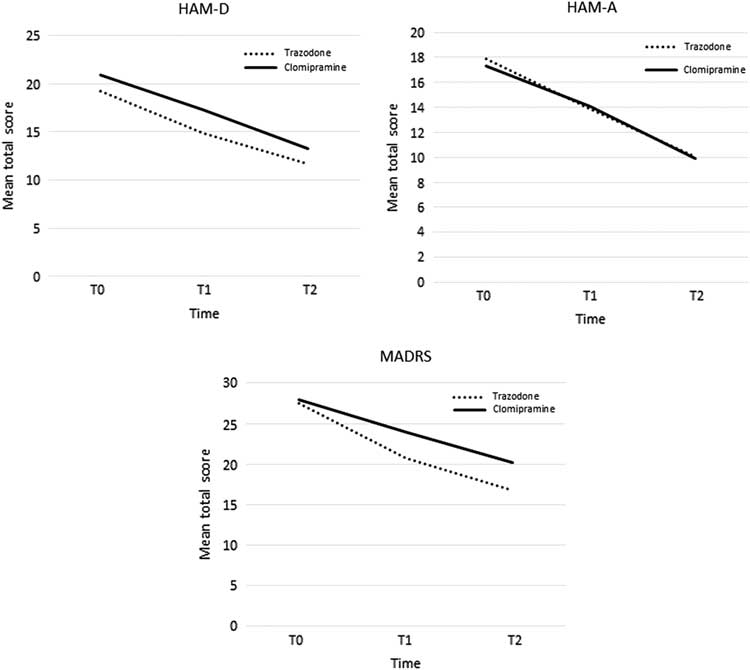
At endpoint, both two treatment groups showed a significant improvement in HAM–D total scores over time, but no differences were found between the two antidepressants (time effect F=123.919 [p<0.001]; treatment effect F=1.614 [p=0.213]; time-by-treatment effect F=0.001 [p=0.974]). The same results were found for HAM–A (time effect F=87.968 [p<0.001]; treatment effect F=0.010 [p=0.922]; time-by-treatment effect F=0.069 [p=0.795]); and MADRS scores (time effect F=92.702 [p<0.001]; treatment effect F=1.064 [p=0.310]; time-by-treatment effect F=2.499 [p=0.124]) (Figure 1). Of note, no differences on total scores of rating scales were found between the two treatment groups after the first week of i.v. treatment [HAM–D (treatment effect: F=2.29, p=0.14); HAM–A (treatment effect: F=0.011, p=0.97); MADRS (treatment effect: F=1.6, p=0.21)]. In contrast, an early improvement in terms of symptoms was found for both treatment groups (after one week of i.v. treatment for all rating scales: time effect p<0.001).
Mean total scores change of the psychometric scales over time in the two treatment groups. HAM–A: Hamilton Rating Scale for Anxiety; HAM–D=Hamilton Depression Rating Scale; MADRS=Montgomery–Åsberg Depression Rating Scale . Statistics: HAM–D time effect (F=123.919, p<0.001); treatment effect (F=1.614, p=0.213); time-by-treatment effect (F=0.001, p=0.974). HAM–A time effect (F=87.968, p<0.001); treatment effect (F=0.010, p=0.922); time-by-treatment effect (F=0.069, p=0.795). MADRS time effect (F=92.702, p<0.001); treatment effect (F=1.064, p=0.310); time-by-treatment effect (F=2.499, p=0.124).

At endpoint, 46.1% of patients in the trazodone group responded to the treatment, while the responder rate was 18.8% in the clomipramine group (χ2=8.39, df=1, p=0.06); the remitters were 34.6% of patients treated with trazodone and 12.5% of patients treated with clomipramine (χ2=6.04, df=1, p=0.24).
During the treatment period, side effects were reported by 15.4% of patients in the trazodone group and by 56.3% of patients in the clomipramine group, though none of them discontinued the treatment because of serious adverse events (χ2=26.74, df=1, p=0.02). In particular, in the trazodone group, the following side effects were observed: sedation (7.7%), rash (3.8%), and dizziness (3.8%). In the clomipramine group, the most common side effects were xerostomia (23.1%), sedation (6.3%), headache (6.3%), and dizziness (6.3%). Of note, xerostomia was found to be significantly more frequent in the clomipramine group than in trazodone patients (p<0.05).
Discussion
The main result of the present study was the absence of statistically significant differences between trazodone and clomipramine on mean total rating scale scores over time, although both drugs demonstrated improved symptoms in major depressed subjects. Intravenous trazodone and clomipramine, followed by oral maintenance, therefore seem both to be valid options for the acute treatment of MDD. A borderline significant difference was found with regard to rate of responders in favor of trazodone. This phenomenon may be due to the specific pharmacodynamic properties of trazodone (e.g., 5-HT2A antagonism and the related dopamine release in the frontal cortex)Reference Stahl24 or to baseline major symptom severity of patients in the clomipramine group. Of note, patients in the clomipramine group presented more frequently with lifetime psychotic symptoms, although there were no differences in mean baseline rating scale scores. In addition, global rates of remitters and responders are lower than those reported in the literature, perhaps as a result of the major symptom severity of included outpatients (Day Hospital Unit).Reference Nil, Lütolf and Seifritz45
This finding is a bit surprising given the reputation of these compounds, where trazodone is often considered a “weak” antidepressant and more frequently used as a hypnotic. It may also mean that trazodone, often neglected as a full-dose antidepressant, should be more often considered as such.
Trazodone was more tolerated than clomipramine. The clomipramine group presented more frequent xerostomia, which is a troublesome side effect that potentially affects patients’ quality of life.Reference Greenspan46
Whether i.v. administration ensures a more rapid onset of action than the oral route is open to debate. In our sample, both treatment groups showed a significant improvement of symptoms only after one week of i.v. treatment. Similarly, a randomized placebo-controlled study demonstrated a speedy efficacy of low-dose i.v. augmentative citalopram in partial/nonresponder MDD patients,Reference Altamura, Dell’Osso, Buoli, Bosi and Mundo13 and some studies demonstrated a faster action of the i.v. antidepressant treatment compared to the oral route.Reference Guelfi, Strub and Loft16 On the other hand, some authors reported the same efficacy for intravenous pulse loading and oral administration (without more severe side effects) in MDD patients,Reference Pollock, Perel, Nathan and Kupfer21 as also reported in a literature review.Reference Moukaddam and Hirschfeld17
Nevertheless, in clinical practice, i.v. administration presents some advantages. First, it avoids hepatic metabolism, with the consequent achievement of a fast peak plasma concentration and reduced production of metabolites (e.g., desmethylclomipramine), which potentially affect the pharmacodynamic profile of antidepressants.Reference Núñez and Perel47 Second, avoiding first-pass metabolism, lower doses are needed to reach the same plasma levels as oral administration.Reference Kasper and Müller-Spahn48 Finally, i.v. administration guarantees treatment compliance.Reference Bouchard, Strub and Nil49
Some limitations of the present research should be discussed. First, the lack of double-blind and randomized conditions may have biased the results, but the design of the present trial is more adherent to clinical practice. Second, the setting of our study may have influenced the results, as day hospital units usually ensure higher compliance and a stronger therapeutic alliance.Reference Hosaka, Aoki, Watanabe, Okuyama and Kurosawa50 Finally, the present paper presents just preliminary results from a small nonrandomized study, one without a placebo control. Further studies with larger samples and double-blind randomized conditions are encouraged to confirm and extend our findings.
Conclusions
Taken as a whole, the results of the present research are preliminary and seem to indicate that trazodone and clomipramine are equally effective in acute treatment of MDD patients, although the first compound is better tolerated, and we demonstrated the utility of short-term intravenous administration of these antidepressants to obtain a more rapid improvement of symptoms.
Disclosures
The authors do not have any conflicts of interest with respect to the contents of the present article. This study was not supported by any pharmaceutical financial interests.
Massimiliano Buoli reports that he has been a Lundbeck consultant.
Chiara Rovera, Sara Maria Pozzoli, Laura Cremaschi, and Alice Caldiroli have nothing to disclose.
Alessio Fiorentini is an Angelini consultant and is also on their speakers bureau.
A. Carlo Altamura has been a Merck and Astra Zeneca consultant and is also on the speakers bureau for Sanofi, Lilly, and Pfizer.