Introduction
Crisis management has increasingly become an emerging organizational research area in the past decades (Bavik, Shao, Newman, & Schwarz, Reference Bavik, Shao, Newman and Schwarz2021), especially since the financial crisis of 2008 (e.g., Stoker, Garretsen, & Soudis, Reference Stoker, Garretsen and Soudis2019). The ongoing Covid-19 pandemic has further consolidated the salience of this organizational research area. So far, most existing organizational studies on crises are observational and based on the performance of managers in crisis situations or prescriptions for preferred behaviors (Jaques, Reference Jaques2012: 366). In those organizational studies, managers have been chiefly discussed and positioned in relation to their leadership qualities in crisis response, communication roles, and postcrisis sensemaking without taking into consideration the context of telework modality.
Today much research is needed on the intersection between managerial telework and crises considering that many line managers are virtually leading their organizations from home in response to the Covid-19 (Collings, Nyberg, Wright, & McMackin, Reference Collings, Nyberg, Wright and McMackin2021). An organizational reality that is unique to the history of management and since the rise of Taylorism. The pandemic has not only pushed managers to work full-time from home but has also led managers to rethink their roles within organizations (Lewis, Reference Lewis2020).
Reflecting on this pandemic, this study aims to explore the behaviors of managers when teleworking during the lockdown. Telework is studied herein in relation to working full time from home on a regular basis for the simple reason that much of the current literature on public sector telework is limited to hybrid telework or part-time telework (e.g., Mahler, Reference Mahler2012; Mele, Belle, & Cucciniello, Reference Mele, Belle and Cucciniello2021; Taskin & Edwards, Reference Taskin and Edwards2007). The emphasis is put on teleworking within the home environment because organizational theorists such as Porter (Reference Porter1996) and Osborn, Hunt, and Jauch (Reference Osborn, Hunt and Jauch2002) have argued that the attitude of managers differs by circumstances and is affected by organizational context (Stoker, Garretsen, & Soudis, Reference Stoker, Garretsen and Soudis2019). In situations of crises, managers often adjust their behaviors, priorities, and managerial styles to meet the changing needs of their organizations (Stoker, Garretsen, & Soudis, Reference Stoker, Garretsen and Soudis2019). Moreover, this study is structured into three parts with the first part discussing the literature review, the second part discussing the research method, and the third part presenting the findings that were generated through a narrative interview approach and a case study model.
Literature review and theoretical consideration
Covid-19, telework benefits, and outcomes
The pandemic ‘has been hugely disruptive, complex and fraught with ambiguity’ for managers (as stated by Collings, Nyberg, et al., Reference Collings, Nyberg, Wright and McMackin2021). From supply chain disruption to work and spatial reorganization, the pandemic has altered the work environment, work processes, and roles of managers. It has led managers and employees to think differently about their work roles as they adjust to a new work environment that they are not used to or have never imagined (Bingham, Reference Bingham2020; Lewis, Reference Lewis2020). Research suggests that managers associate the disruption caused by this crisis with the rise of role strains due to more paperwork processes (e.g., drafting emergency communication procedures) and providing moral support to the millions of workers who have been laid off or furloughed (Collins, Landivar, Ruppanner, & Scarborough, Reference Collins, Landivar, Ruppanner and Scarborough2021; Lewis, Reference Lewis2020). According to Bingham (Reference Bingham2020), what managers are experiencing now may not necessarily be a novel experience because before this crisis, they were already working under pressure. What the pandemic has changed in managers' job content and role expectations is that it has made their role performance more complex.
However, considering that research on the teleworking behaviors of managers in public organizations in situations of crises is scant, the research questions of this study were developed by drawing from the mainstream literature on telework. Generally speaking, research on telework suggests that this work arrangement is associated both with a difficult labor process and negative work outcomes such as work-life conflicts (Sewell & Taskin, Reference Sewell and Taskin2015), the impairment of managerial supervision over employees (Felstead, Jewson, & Walters, Reference Felstead, Jewson and Walters2003), and work stress (Barley, Meyerson, & Grodal, Reference Barley, Meyerson and Grodal2011).
On the supervision of subordinates, Felstead, Jewson, and Walters (Reference Felstead, Jewson and Walters2003), for example, argued that the supervision of team members who work from home is challenging for managers to do. This outcome occurs because the conventional managerial strategies used by managers on-site office are eroded in the home environment. This erosion occurs because the onsite-based managerial culture that has been dominating the supervision of workers in offices and factories since the advent of industrial capitalism has not really evolved in relation to the changing technology-enabled work arrangements of this 4.0 Industry era (Felstead, Jewson, & Walters, Reference Felstead, Jewson and Walters2003). Sewell and Taskin (Reference Sewell and Taskin2015) argue that the transition from office-based work to home-based work demands new expectations and the development of new meanings among organizational members. As such, the question on how the teleworking behaviors of managers unfolded when remotely supervising their team members was included in the design of interview questions.
But according to Sewell and Taskin (Reference Sewell and Taskin2015) and Golden and Veiga (Reference Golden and Veiga2005), telework is not only associated with negative outcomes but with intangible benefits (e.g., job satisfaction) as well. Golden and Veiga (Reference Golden and Veiga2005) noted that telework increases work engagement and job satisfaction. Telework offers employees a sense of flexibility and permeability in the performance of their work roles. It provides a release from the constraints of office-based hours work and enables women to combine their domestic role (e.g., childcare) with their professional obligations (Grant, Wallace, & Spurgeon, Reference Grant, Wallace and Spurgeon2013). Organizations, too, see many advantages in using telework because it is instrumental for the retention of skilled employees (Grant, Wallace, & Spurgeon, Reference Grant, Wallace and Spurgeon2013). A case study by Sewell and Taskin (Reference Sewell and Taskin2015) on managers and teleworkers at a biopharmaceutical company shows that while setting constraints on the manner they work in remote environments, telework provides employees with a sense of autonomy.
However, the above negative and positive outcomes raised in scholarly debates on telework have not been explicitly discussed in relation to managers in public managers as actual teleworkers. But there is a dense body of literature on these organizations as virtual bureaucracies where managers are chiefly discussed and positioned as implementors and observers of telework. For example, Taskin and Edwards (Reference Taskin and Edwards2007) studied how teleworking affects working in two Belgian public organizations. But these authors did not explore the working behaviors of public managers in relation to how they telework. The organizational members that were defined and discussed as teleworkers were mainly subordinates (e.g., translators). Nonetheless, the findings of Taskin and Edwards (Reference Taskin and Edwards2007) study revealed that telework alters the spatial and temporal framework of work and reorganizes the conduct of work that affects employment relationships in different ways.
Mahler (Reference Mahler2012) investigated the advantages and drawbacks posed by telework in the US federal government. Akin to Taskin and Edwards (Reference Taskin and Edwards2007), the emphasis of that study was chiefly on subordinates as teleworkers and managers were not discussed as such. Findings of that study suggest that there was a sense of dissatisfaction among federal workers whose jobs may be eligible for teleworking, but whose managers did not provide them with the opportunities to telework. Mahler (Reference Mahler2012) concluded her study by raising questions about the consequences of expanding telework to larger populations of public workers and argued for the need of further research on the managerial and personnel challenges of telework in public organizations. In the same vein, Mele, Belle, and Cucciniello (Reference Mele, Belle and Cucciniello2021) explored and investigated the attitude of 1,000 nonteleworking European public workers towards their teleworking colleagues but without any reference to managers as public sector teleworkers.
Moreover, although not specifically related to the context of telework, research on managers leading public organizations in the context of office-based work also points to some of the above organizational outcomes. For example, findings from a recent study by Dandalt (Reference Dandalt2021) on the virtual working behaviors of N = 283 public managers suggest that they are satisfied with performing their informational and decisional tasks online. A study by Blau and Presser (Reference Blau and Presser2013) on N = 500 public organizations in Israel suggests that managers in these bureaucracies positively associate virtual work with making better data-based decisions and improving organizational climate.
Contingency theory of management
Considering that this study aims to discuss the teleworking behaviors of public managers during the pandemic, the positive and negative telework outcomes (Golden & Veiga, Reference Golden and Veiga2005; Sewell & Taskin, Reference Sewell and Taskin2015) outlined above were intersected with the rationale of contingency theory to develop the research questions that were used to interview these managers. Contingency theory was also used herein in relation to the analysis and interpretation of interview data. Contrary to universalist theories of organizations that argue that there is no ‘one best way’ of managing organizations (Donaldson, Reference Donaldson2001, Reference Donaldson2005; Weitz & Shenhaav, Reference Weitz and Shenhaav2000), contingency theory argues that managing organizations is a situational task that requires adapting to organizational changes or uncertainties to maintain organizational effectiveness and avoid loss of performance.
An adaption that has been studied by management scholars in relation to the components of environment, organizational size, and strategy (Donaldson, Reference Donaldson2001, Reference Donaldson2005). Of these three components, the role of managers has mostly been studied in relation to how they adapt their working behaviors and decisions to fit the situation that reflects their new work or organizational environment. As argued by Donaldson (Reference Donaldson2005), managers' choices are determined by contingencies. In consideration of the aim of this study, only the contingency of the environment was used to develop the themes of interview questions. In these questions, the notion of environment was defined in term of crisis and telework arrangement.
However, generally speaking, much of the research on contingency theory has studied organizational structure (Donaldson, Reference Donaldson2001) when the research emphasis is not exclusively limited to the role of managers. But in this study, the emphasis is not put on attempting to understand how this crisis has reshaped or transformed the organizational structure of public bureaucracies. Nonetheless, the contingency of environment was partially interrelated to the idea of organizational structure to frame questions that could help this study to situate the teleworking behaviors of managers in relation to their access to the organizational resources needed when working from home.
Moreover, using contingency theory in the analysis data herein was appropriate because it provides a proposition, namely the notion of uncertainty that is key in understanding and interpreting the patterns of human behaviors in complex organizations. First introduced by Crozier (Reference Crozier2017) as a source of power, the notion of uncertainty is viewed by organizational theorists such as Pfeffer (Reference Pfeffer1981) and Weitz and Shenhaav (Reference Weitz and Shenhaav2000) as being central to managerial thinking and decisions on how to regulate and mitigate contingencies in the workplace. It presents a rational lens that facilitates the formulation of the behaviors of managers as related to their use of rational authority or power and resources to obtain preferred organizational outcomes (Pfeffer, Reference Pfeffer1981). A rational lens that suggests that managerial behaviors cannot be predicted a priori (Weitz & Shenhaav, Reference Weitz and Shenhaav2000: 245).
Arguably a contingency analysis of the teleworking behaviors of managers in this study necessitates interpreting the meanings attached by these organizational members to this work arrangement to the idea that their managerial practices and behaviors may be different from what they were when working from office before the pandemic. Contingency theory is not applied herein from a comparative stance, only from the understanding of new organizational realities as perceived by these managers. Donaldson's (Reference Donaldson2005) argument that ‘contingency theory in its classic variant is more correct than newer variants and offered detailed argumentation’ was taken into consideration in this study by limiting the application of this theory in its classical sense (p. 171).
Data and methods
Organizational context
A case study model is used herein by reducing the definition of public organizations to public schools in Canada as an organizational research context. Managers only refer to high-status street-level bureaucrats (principals) leading these public bureaucracies. The research emphasis is deliberately put on these organizations and bureaucrats for the simple reason that Raffel (Reference Raffel2007), and Rosenbloom, Kravchuck, and Clerkin (Reference Rosenbloom, Kravchuck and Clerkin2022) lamented that public education continues to be understudied in public management as a research context. To address this research gap, they argue for the need for management and public administration scholars to study the organizational realities of these public bureaucracies as well. Raffel (Reference Raffel2007) argued that scholars should not only limit their research focus to federal government agencies and other street-level bureaucracies (e.g., municipality) given the significance of public education in the public sector in terms of the size of expenditures and the numbers of public employees in that industry. Rosenbloom et al. (Reference Rosenbloom, Kravchuck and Clerkin2022) stated that ‘public administration is everywhere’ and public organizations should therefore be studied in their variety.
Lastly, public schools provide a proper organizational context for exploring the teleworking behaviors of managers during this crisis because there are ones of the public organizations that were the most affected by the organizational disturbances caused by the Covid-19 lockdown. Under the Quarantine Act, these bureaucracies were completely closed by the government during the lockdown with the delivery of all learning services (e.g., in-person learning) being virtually offered to clients. Thus, compared to managers in other public organizations such as hospitals, managers leading schools were more likely to find themselves in a regular teleworking situation as a full-time work modality.
Data collection
A narrative interview approach with semi-structured interviews comprised of open-ended questions was used to collect data among public managers working full-time from home during the pandemic. Using open-ended questions (e.g., What are the organizational challenges that you have encountered when working from home? How your work was affected by the uncertainties of this pandemic?) are suitable because they lead respondents to not provide yes or no answers. They allow respondents to answer in a nonpremeditated and unconstrained way (Hair, Page, & Brunsveld, Reference Hair, Page and Brunsveld2019). However, while this method presents advantages, it also presents some drawbacks, especially in relation to coding data. Coding data collected through open-ended questions is much more difficult as respondents' answers are more likely to be lengthy and varied (Hair, Page, & Brunsveld, Reference Hair, Page and Brunsveld2019). Nonetheless, this method is more and more used in management research today as scholars are starting to embrace this qualitative method in their study of employees, managers, and other organization members' attitudes or behaviors.
Managers were randomly selected from public organizations (schools) in two Canadian provinces (Quebec, Ontario) by sending out research invitations through their work emails found in their organizational directories. Purposeful sampling was used to select these managers. This involved clearly stating in the research invitations that only those who self-identified as actually leading their organizations from home during this crisis and teleworking full-time could accept to participate in this study. Both selection criteria (job-tenure and full-home-based work) were drawn from the contextualized definitions of telework provided above.
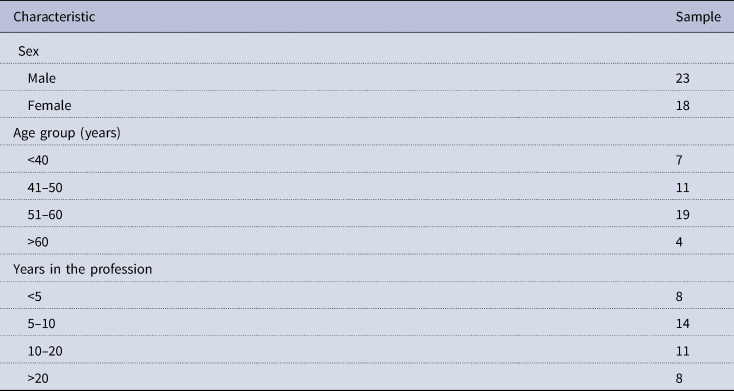
Only N = 41 managers accepted to be interviewed online via phone or videoconference (e.g., Zoom). Each interview lasted around 40 min, was conducted in a conversational style and the whole process of collecting interview data lasted around 2 months. However, the conversational interview style that was used presented some limitations such as the issue of response accuracy. Some of the responses by managers did not align with some of the questions that were asked by the researcher. But this issue was mitigated by probing these participants to ensure that their responses aligned with those questions. Overall, managers were satisfied with how the interviews were conducted by the researcher. The only issue that some of these managers raised with the whole process of organizing interviews was the timeline as their work schedule was too busy. This concern was taken into consideration by the researcher by respecting the interview time limit agreed upon with these participants (Table 1).
Sample characteristics

Data analysis
All the interview data were manually transcribed and underwent a thematic analysis to identify, organize, describe, and report the teleworking behaviors and patterns of these managers by highlighting similarities and differences, and generating unanticipated insights about their lived experience. A thematic analysis was applied because as argued by Braun and Clarke (Reference Braun and Clarke2006), it can enable the researcher to generate reliable and insightful results. It provides a flexible approach to analyzing data while at the same time also providing a rigorous analytical process. However, while arguing so, the researcher was also aware that thematic analysis has some disadvantages such as the difficulty of ensuring credibility and confirmability (Nowell, Norris, White, & Moules, Reference Nowell, Norris, White and Moules2017). But these disadvantages were mitigated by examining referential adequacy as a way to scrutinize preliminary findings and interpretations against raw data.
The interpretation of preliminary findings was conducted through the lens of contingency theory. This involved analyzing the task-oriented and relationship-orientated behaviors of managers within the context of uncertainties (crisis-related organizational disturbances). An analytical focus was put on identifying the individual-level perspective of managers as related to their teleworking experience, organizational resources, bureaucratic practices, and work-related challenges to draw the perceived benefits and disadvantages that they associate with teleworking.
Study findings
The findings suggest that much of the narrative of managers on teleworking during this crisis was related to discussing or describing their role performance in relation to their micro-level organizational perspective. However, a brief narrative was provided in relation to their macro-level organizational perspective. This narrative focuses on their perspective as related to having access to the organizational resources of technical nature to perform their bureaucratic roles. These organizational resources were centralized and provided by the government, and consisted of knowledge sharing, technical support, and guidance on ‘how to work remotely’ and to manage work and productivity. On managing work, for example, managers stated receiving guidance on how to organize their workflow in term of work scheduling, knowledge management, communication with their staff, and monitoring their emails.
But managers complained about not being given the opportunity by their centralized hierarchy to participate in the planning process of organizational resources. Managers felt that the resource-based mobilization method used by the government or their hierarchy did not take into consideration the different organizational realities that are specific to each organizational division. For that reason, they argued that a horizontal resource planning model was needed as this model could capture all the work-related challenges encountered at the micro-level of their organization. Meaning, that the current vertical or unilateral planning model implemented by the government does not effectively address all the crisis-related organizational disturbances in their virtual workspace.
Moreover, the findings reflect the theoretical framework of positive and negative telework outcomes that was used to design the interview questions and analyze the preliminary data through contingency theory. Negative telework outcomes were discussed by managers in relation to issues associated with organizational empathy, managerial supervision, and redundant communication. Positive telework outcomes were discussed by managers in relation to easing the performance of talent management tasks, improving work-life balance, and raising their preference for a hybrid work model. As such, these findings are presented in the following two categorical themes: (1) work-related organizational challenges and (2) telework intangible benefits.
Work and organizational issues
Organizational empathy
Compared to their prepandemic workflow system, managers stated that their role responsibilities were not only limited to performing tasks of bureaucratic nature. Their role set also comprised of performing more tasks of communal nature. These communal tasks involved, for example, addressing ‘the psychological needs’ of subordinates through empathy. The cause that led to the adoption of this communal working behavior was related to the challenge felt by their subordinates to adjust to a new form of work as this was the first time that many of these employees were teleworking full-time. Plus, the uncertainties and organizational disturbances caused by the Covid-19 hurt the morale of these employees in the form of stress and anxiety.
Nonetheless, the fact that managers created a virtual work environment for their subordinates that was underscored by a climate of organizational empathy implies that they were effectively leading their organizational divisions in the right manner. This interpretation of managers' communal behavior is trustworthy as previous research on organizational change has defined effective leadership in times of crises with the same communal behavior (Gentry, Hannum, Ekelund, & de Jong, Reference Gentry, Hannum, Ekelund and de Jong2007). A recent strategic management report by McKinsey, for example, suggests that practicing empathy toward employees during the Covid-19 pandemic is one of the four effective leadership practices (awareness, compassion, empathy, vulnerability) that managers need to espouse right now (D'Auria & De Smet, Reference D'Auria and De Smet2020).
But managers stated not receiving the same psychological support from their organization despite experiencing more work-related anxieties during this crisis. They stated that even the psychological support that they provided to subordinates came out of their own leadership initiative. Meaning that the organizational resources received from their hierarchy were only bureaucratic or technical and not of communal quality. Hence, it is fair to conclude that the organizational empathy that emerged during this crisis was an informal enterprise and an outcome of the discretionary power of managers.
Another cause of managers' anxieties was the issue of professional isolation as they stated that this crisis represents one of the few moments in their professional life when they have ‘really’ felt isolated from their subordinates and team members. For some managers, the anxieties caused by increasing crisis-related job demands were manageable as they are already used to working under pressure from the office before the pandemic. This crisis was just experienced as an exacerbation of their anxieties with the issue of professional isolation being a novel experience.
Managers described this professional isolation in relation to having fewer opportunities to socialize with their subordinates or team members due to the spatial distance created by home-based telework arrangement (Dahlstrom, Reference Dahlstrom2013). According to them, telework has created a virtual work environment whereby normal hierarchical and interpersonal relationships are disrupted, and where there is a need for organizations to provide organizational members with organizational resources of communal nature as well. The organizational resources of technical nature cannot address the issue of professional isolation and other psychological needs. Only organizational resources of communal nature can meet those intangible needs.
Managerial supervision
The performance of work roles among managers as related to employee supervision (Bailey & Kurland, Reference Bailey and Kurland2002; Taskin & Edwards, Reference Taskin and Edwards2007) involved ensuring that their subordinates had access to the right organizational ‘resources to do a good job.’ Another supervisory role involved monitoring the work and productivity (teaching effectiveness) of subordinates. But these managers complained that it was a little bit difficult to remotely emulate their control over subordinates in the same way as they did in the context of office-based management. Although not explicitly mentioned by these managers in the data, the theoretical rationale developed by leading technology scholars (Autor, Reference Autor2014; Diamond, Reference Diamond2018) could help explain their frustration. These scholars argue that using information technologies for work creates invisible boundaries in virtual workflow processes where the performance of some complex tasks demands emotional intelligence, flexibility, judgment, and common sense, interpersonal skills that we understand only tacitly (Autor, Reference Autor2014: 136). A theoretical explanation that is accurate considering that the labor process of managers was enabled by the use of information technologies such as ‘emails’ and management software.
To mitigate the impact of turnover on organizational effectiveness, managers used the strategy of role switching. This management strategy involved to temporarily reassigning an employee with different skill sets or responsibilities to perform new tasks or the work of another organizational member (Anicich & Hirsch, Reference Anicich and Hirsch2017). As mentioned by one of the managers, ‘We had to take a person that is out of the classroom such as an interventionist who is serving kids with moderate to severe needs and push them into a classroom to teach an online class of children.’
In addition to the challenge represented by the issue of employee turnover, managers stated using the strategy of role switching because they did not ‘have the money to sign somebody up’ for the positions (teaching) that were ‘essentially left vacated.’ Reflecting on this practice of role switching, it is fair to argue that it might be emotionally challenging for employees assigned to those new work roles to disengage from a task that requires familiar skills and one mindset and engage in another task that requires a very different mindset and different skills that are not part of their formal function (Anicich & Hirsch, Reference Anicich and Hirsch2017).
Another challenge encountered by managers with supervising employees consisted of some unintended technical issues such as online communication breakdowns. These technical issues were described by managers in term of impairing the structure of collaborative work processes at the micro-level of the organization. This concern was epitomized in statements such as ‘everyone is trying to do their job, but email and Webex are highly imperfect ways of getting things done when people need to work together as a group.’ However, these technical issues did not entirely impair their workflow process as they felt that they were still able to work collaboratively with their team members or subordinates. Nonetheless, managers felt that they struggled to establish and enforce organizational standards and processes during this crisis, and to communicate effectively with subordinates because of those technical issues (Jaques, Reference Jaques2012).
Redundant communication
Compared to working from the office before the pandemic, managers felt that the frequency of receiving from other stakeholders (e.g., parents) and sending out emails when working from home was ‘much higher’ during this crisis. This frequency was underscored by redundant communication, leading managers to develop a sense of digital fatigue. Arguably, the findings of this study consolidate those of previous studies (Barley, Meyerson, & Grodal, Reference Barley, Meyerson and Grodal2011; Leonardi, Neeley, & Gerber, Reference Leonardi, Neeley and Gerber2012) on managers in the private sector. Those studies also found that while managers like using digital tools such as emails for work, they abhorred redundant communication (e.g., high volume emails). Redundant communication is abhorred because it increases role expectations and blurs the boundaries between professional work and personal life. Meaning that some similarities exist in the reactions and assessment of technology use among managers in both the public sector and the private sector.
Faced with the issue of redundant communication, managers herein felt that they need to develop new communication skills ‘to keep up with’ the pace of online social exchanges. The intent behind this job upskilling was to effectively communicate to subordinates the sporadic bureaucratic policies sent by the government ‘without notice.’ By effective communication, they mean clearly setting directions and building consensus over meeting the goals set in those government-sponsored policies. An organizational priority that did not exist in the context of on-site management and before this crisis.
This issue of job upskilling is also substantiated by the findings of a survey study by PricewaterhouseCoopers (PwC) (2021) on 32,000 workers in 19 countries that show that the pandemic has globally accelerated digital upskilling among workers. Hence, organizations across the spectrum must train and equip managers with telework-informed communication competencies as it is argued by organizational theorists (Collings, Nyberg, et al., Reference Collings, Nyberg, Wright and McMackin2021) that this pandemic will have a lasting impact on the organization of work.
Intangible telework benefits
Talent management
But managers did not only associate teleworking with the above challenges or negative outcomes as they stated that leading their organization remotely has facilitated their hiring role. This facilitation involved using a digital hiring process that was perceived to be input saving. The hiring process was more and more done through ‘Zoom interviews’ with job applicants (teaching job seekers). Managers saw this talent management mode as simple and plan to use this staffing modality even after they return to their prepandemic on-site management work system. This managerial attitude differs from some existing organizational studies that show that managers are against the digitalization of human resource (HR) functions in the public sector (e.g., Tufts, Jacobson, & Stevens, Reference Tufts, Jacobson and Stevens2015).
A consideration of the above managerial perspective raises practical implications for public organizations to further adopt innovative HR network systems considering that these organizations are known for lagging behind private organizations in adopting innovative work processes. As pointed out in a study report by the OECD (Organization for Economic Co-operation and Development) (2018) on HR and leadership strategies for building innovative public bureaucracies, the digitalization of HR management systems in these bureaucracies is still in its infancy and should be studied closely.
Another benefit associated to teleworking during this crisis consisted of the reduction of time allocated to monitoring the performance of subordinates. Managers stated felt that this crisis has created a situation whereby fewer demands were made by their organization ‘to evaluate teachers as the school board district has put a temporary hold’ on this talent management practice. As a result of that macro-level decision, they felt ‘being freed’ from one of the bureaucratic obligations that they don't like performing the most. This crisis did not provide an environment that would facilitate managers to evaluate subordinates because the ‘TPA is an o observation-based measure.’ By that, they mean that evaluating employees requires observing the ‘behavior of teachers’ in the workplace (in-person learning and classroom context). An organizational context that did not exist during this crisis because the processes of delivering most public services (learning) to clients (students) were transferred online.
Theoretically speaking, this reaction of managers could be explained by the fact that managers across most organizations hate performing performance appraisal tasks (Meinert, Reference Meinert2015). Hence, it is logical to argue that the impact of this crisis on these managers consists of both role extension and role mitigation. Simply put, the organizational disruptions caused by this crisis have eroded some traditional work roles while simultaneously creating new work roles in the form of job upskilling in the role set of these managers.
Hybrid-work aspiration
Despite experiencing a sense of anxiety with the performance of their work roles virtually and remotely, most managers stated that home-based full-time teleworking was ‘an eye-opener’ on the intangible and tangible benefits (e.g., work flexibility) associated with this new form of work. For that reason, these managers stated that once this crisis was over and the government decided to overhaul or phase out the current full-time telework arrangement, they would like to see the government introduce a long-term hybrid telework program in the public service sector. Managers argued so on the belief that some administrative tasks related to their bureaucratic functions or job characteristics could be performed remotely without the necessity of being present in the office. As stated by one of the managers, ‘I would argue that office hours can be conducted virtually and again do not need to occur in office. I prefer a blend of the two. A couple days in office and a couple days home.’ Arguably, this crisis has altered the working style preference of these managers, from on-site work to hybrid work attachment. It has led managers to develop a sense of auto-work reorganization as related to the idea of tasks fragmentation.
Thus, this belief system around working conditions raises a practical implication for public service and public sector organizations in general, that public employees will no longer accommodate the idea of work processes being the same after this crisis. In the future, the creation of working conditions that enhance job satisfaction will partly necessitate democratizing employees' access to hybrid work opportunities. Hybrid work as a sine qua non for enabling work-life balance needs therefore to become part of government's strategic HR management policies in the foreseeable future. A prospect that has also been raised by two-thirds (66%) of Canadian workers who want their employers to implement a hybrid-work model once the restrictions of the pandemic are lifted and people return to working in offices (Dunham, Reference Dunham2021).
This aspiration for long-term hybrid work arrangements could also have implications on collective bargaining contentions in the future. Most often, bargaining contentions in organizations have been only limited to issues of fair pay and workload. But with the rise of workers' aspiration for hybrid work, trade unions across all industries need to adjust their bargaining priorities and strategies to the work-life balance needs of a future flexible workforce. In a world with increasing complexity, interconnectedness, and decreasing predictability, public sector organizations need to innovate their workflow system and operation to become more efficient (OECD [Organization for Economic Co-operation & Development], 2018).
Work-life balance
Despite encountering role overloading and redundant communication during this crisis, these work-related issues were not perceived by managers as antecedents of work-life conflicts. The factors that were associated with work-life conflicts were related to nonwork. Family obligations were perceived by managers as interfering with the performance of their managerial roles from home. But despite this nonwork interference, managers still felt that they had enough time to spend on family socialization. On few occasions, work was perceived as interfering with family obligations, and only when such work was performed on weekends, and this view was only shared by few managers. Implying that although most managers aspire for having access to a long-term hybrid-work arrangement, they are still attached to standard-work schedules rather than nonstandard work arrangements. Hence, the theoretical takeaway that can be drawn from these findings is that some managers want changes in how work is done and not on when work is done. They still hold to an ideal type of how telework conditions should be like. Anecdotal to the above organizational perspective were statements such as ‘I've socialized more with my spouse while working from home’ and ‘Work-life balance is improving.’
But some managers felt that working from home was like ‘living at work.’ Meaning that teleworking during this crisis has altered the traditional way that managers usually define their home environment. The home sphere is now defined as a formal and real workplace and this organizational perspective could be linked to the fact that for the first-time teleworking from home was a full-time and regular virtual work modality for these managers.
Furthermore, the belief held by managers that teleworking frees time for family socialization reveals the need for public organizations to implement a long-term hybrid-work program for these bureaucrats considering that research across most paid occupations suggests that employees value family socialization (Friedman & Greenhaus, Reference Friedman and Greenhaus2000) as part of their social reward. For employees having enough opportunities to have a good time with family members is just as important as thriving in their professional careers and making economic gains (e.g., wages). This is true for both men and women in the workforce, especially for women who pay the penalty of motherhood and struggle to balance their careers with domestic labor due to the issue of gender segregation in the workplace and within the home environment (Friedman & Greenhaus, Reference Friedman and Greenhaus2000).
Contributions and implications for research
The above findings suggest that contingent and environmental factors more than actual roles performance constitute a disruptor to managerial telework process. In consideration of this fact, it is necessary for management scholars to consider all nonwork-related factors (external and internal to bureaucracy) to have a holistic understanding of the different environmental forces influencing the process of roles performance among public managers.
Compared to some empirical studies that show that managers often engage in defensive crisis response strategies (e.g., denial, defiance, scapegoating) when faced with business crises (Bundy, Pfarrer, Short, & Coombs, Reference Bundy, Pfarrer, Short and Coombs2017), this study suggests that managers herein engaged in accommodative crisis response strategies (expressions of empathy) when navigating this health crisis. No scapegoating or shifting blames on other organizational actors or members was made by these managers. A plausible reason to explain why these teleworking managers were not defensive could be because they stated receiving enough information from the government on the scale of this crisis and how to deal with its organizational disruptions.
Such a theoretical explanation echoes what Bundy et al. (Reference Bundy, Pfarrer, Short and Coombs2017) said about the causal factors underlying accommodative behaviors in organizations. Bundy et al. (Reference Bundy, Pfarrer, Short and Coombs2017) argue that negative perceptions among stakeholders are reduced when the organization is the first to release crisis information. Meaning that the stage models used by the government to deal with this crisis at the public sector level were somehow effective in enabling these managers to perform their managerial or bureaucratic roles.
This study contributes to management scholarship (de Vries, Tummers, & Bekkers, Reference de Vries, Tummers and Bekkers2019; Mele, Belle, & Cucciniello, Reference Mele, Belle and Cucciniello2021) by highlighting that the roles performed by managers in public organizations are not only bureaucratic as usually discussed in that literature. But that their roles are also characterized by communal tasks (psychological support) of leadership nature. Arguably, management scholars need to study managers in these organizations not just as rational bureaucrats but also as communal leaders. According to Mau (Reference Mau2020), research on the leadership practices of managers in public sector continues to lag behind that on private sector managers despite making some progress in the past two decades. This observation is not a surprise considering that until the 1990s, management scholars had written very little about the concept of leadership as applied to public organizations, chiefly because of the belief that ascribing a leadership role to public workers undermined democratic theory (Mau, Reference Mau2020).
Moreover, in the absence of a narrative in the above findings discussing the existence of professional conflicts between these managers and their subordinate or team members, it is logical to theorize that the bureaucratic interactions between these organizational members during this pandemic were embedded by positive stakeholder relationships rather than negative stakeholder relationships. But this conclusion should not be taken at face value as the above findings are only limited to the individual-level perspective of managers and not of their team members or subordinates (Eichenauer, Ryan, & Alanis, Reference Eichenauer, Ryan and Alanis2021). For that reason, it is essential for management scholars to investigate and explore the leadership behaviors of teleworking managers from the perspective of subordinates.
Plus, recent research on the organizational outcomes of Covid-19 suggests that 65% of teleworking employees have experienced workplace conflicts with their coworkers, and managers were pointed among the main protagonists with whom they were in conflict (O'Connell, Reference O'Connell2021). Workplace conflicts, which have always been around, are increasing in remote and virtual work environments during this crisis because telework limits face-to-face interactions and personalized feedback or communication, which in turn lead to professional isolation, role confusion and knowledge sharing impairment (Felstead, Jewson, & Walters, Reference Felstead, Jewson and Walters2003; O'Connell, Reference O'Connell2021).
This study contributes to management scholarship by suggesting that similar to the private sector, teleworking is an antecedent of social isolation among managers in the public sector. Thus, management scholars could consider this issue of managerial isolation to further their research on the effects of telework on human behaviors in public organizations as the literature in that regard remains scant (as argued by Mele, Belle, & Cucciniello, Reference Mele, Belle and Cucciniello2021). Doing so is important because organizational members are not atomized individuals or decision-makers. Logics underlying the formation of their work environment and their norms of behavior cannot be removed from the contexts of social interaction within which they perform their social roles (Hayton, Chandler, & DeTienne, Reference Hayton, Chandler and DeTienne2011). An in-depth study of the teleworking behaviors of managers will require positioning their individual experience within the context of social interactions and how the lack of these organizational realities affect or hamper their role performance in situations of crises.
Most importantly, this study raises the issue of digital fatigue as one of the intangible organizational outcomes that negatively affect the satisfaction of public managers. An organizational issue that has been barely discussed in public sector telework scholarship. Nonetheless, managers' sense of digital fatigue moves the bar of debates on the impact of job demands on public employees further by suggesting that technology-enabled work process is much a source of job dissatisfaction as organizational restructuring or red tape. But to date, as argued by Borst and Knies (Reference Borst and Knies2021), much of the research on job demands in public sector has not integrated the technology dimension among the causal factors of employee dissatisfaction and well-being impairment.
Furthermore, based on the above findings, the other following two research implications were drawn. First, the decision of managers to continue to telework and use digital hiring processes after the pandemic raises the need for management scholars to further investigate the dynamics of the digitalization of HR functions in public sector, especially in relation to talent management processes. Most often, organizational research on the digitalization of HR functions has been limited to managerial employees in the private sector (Tufts, Jacobson, & Stevens, Reference Tufts, Jacobson and Stevens2015). Even with regard to the private sector, research on the digitalization of HR functions is still too immature (Zhou, Liu, Chang, & Wang, Reference Zhou, Liu, Chang and Wang2020).
So far, there are two research trends on the digitalization of HR functions in the private sector with the first trend focusing on making the workplace and personnel management more digitalized (Zhou et al., Reference Zhou, Liu, Chang and Wang2020). The second research trend pertains to investigating how information technologies are enabling HR analytics to become more an evidence-based decision-making process. But there is still a lack of theoretical foundations and a clearly defined paradigm in relation to both research trends (Bondarouk, Parry, & Furtmueller, Reference Bondarouk, Parry and Furtmueller2017; Zhou et al., Reference Zhou, Liu, Chang and Wang2020).
Moreover, this study has a few limitations such as the lack of using a gendered comparative approach. The lived experience of female managers as related to teleworking was not compared with that of male managers. Perhaps a gendered comparison of their role set could have yielded different findings considering that it has been theoretically (Belasen, Reference Belasen2017) proven that women in management do not share the same lived experience with men when teleworking (Collins, Landivar, et al., Reference Collins, Landivar, Ruppanner and Scarborough2021).
Women, more than men, are more likely to experience role conflicts between work roles and domestic roles due to gender segregation. As such, women in management suffer more from work-life imbalance and poor job performance (Belasen, Reference Belasen2017; Collins, Landivar, et al., Reference Collins, Landivar, Ruppanner and Scarborough2021). For that reason, it is essential for management scholars who want to take this research to the next level to consider the demographic variable of sex in their study of the teleworking experience of managers during this crisis.
Conclusion
This study extends the literature on managerial teleworking in the public sector from a noncrisis context to a crisis context by identifying some of the behaviors and perceived practices of managers during this pandemic. Behaviors that involved managers leading public organizations through communal and supervisory practices in a context of environmental challenges such as anxieties and redundant communication. Similar to the dualistic theoretical discourse of organizational research literature on telework, this study suggests that managers associate teleworking with both positive (e.g., work-life balance improvement) and negative outcomes (e.g., professional isolation). On the positive outcomes, this study contributes to the literature on telework by suggesting that managers believe that telework improves the performance of their talent management practices in term of virtual hiring practice. Most importantly, considering that the above sample size does not warrant the generalization of findings and the data collection method was limited to a narrative-interview approach, there is a need for these scholars to use quantitative or mixed-methods designs and larger samples to collect more expansive and generalizable data.
Ed Dandalt graduated with a PhD from McGill University and is a management researcher. He is a visiting scholar at the Samuel Dewitt Proctor Institute. His research interests are in public management, work organization, and organizational behavior. He is the sole author of this study.