Introduction
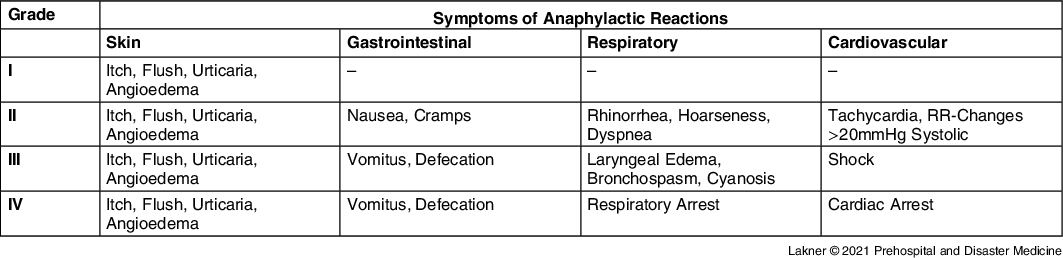
Anaphylactic reactions are acute systemic reactions caused by an immediate-type allergic response which can involve skin symptoms, gastrointestinal complaints, respiratory problems, or cardiovascular symptoms (Table 1). These symptoms may come to a standstill at any stage, but they may also show directly or progress to a potentially life-threatening situation.Reference Johansson, Bieber and Dahl1–Reference Simons, Ardusso and Bilò3 Progression of the symptoms is also possible after given therapy or after a symptom-free interval. Therefore, stationary monitoring is recommended until safe and lasting remission of anaphylaxis for at least 24 hours.Reference Ring, Beyer and Biedermann4 Since the definition and the classification systems of anaphylaxis are not globally consistent, the present study adopted the classification modified according to Ring and Messmer.Reference Ring and Messmer5 Depending on the clinical symptoms, anaphylactic reactions are classified by grades of severity from I to IV (Table 1).
Severity Grading of Anaphylactic Reactions According to Ring and MessmerReference Ring and Messmer5

Studies from Great Britain, Australia, and the USA show incidence rates of anaphylaxis of 7.0 to 50.0 per 100,000/year.Reference Decker, Campbell and Manivannan6–Reference Sheikh, Hippisley-Cox, Newton and Fenty8 Allergy-related conditions may account for 0.2%-1.0% of emergency consultations.Reference Moneret-Vautrin, Morisset, Flabbee, Beaudouin and Kanny9 There is also a high number of unreported cases.
There are many triggers for anaphylactic reactions, such as insect venom, drugs, and foods. All age groups can be affected. Regarding children, food is the most common trigger (>50%), followed by insect bites and drugs. Anaphylactic reactions regarding adults are most commonly triggered by insect venom (>50%), followed by drugs and foods.Reference Ring, Beyer and Biedermann4,Reference Worm, Eckermann and Dölle10
The acute treatment is based on different international guidelines. This study refers to the Arbeitsgemeinschaft der Wissenschaftlichen Medizinischen Fachgesellschaften e. V. (AMWF) guidelineReference Ring, Beyer and Biedermann4 from 2021. According to the AMWF guideline, immediate therapy depends on the severity classification according to Ring and Messmer.Reference Ring and Messmer5 Therapy with Histamine-H1 (H1)-receptor antagonists, Histamine-H2 (H2)-receptor antagonists, and glucocorticosteroids is recommended for Grade I reactions. In case of a Grade II or III anaphylactic reaction, the first line therapy is the immediate intramuscular injection of adrenaline, followed by antihistamines and glucocorticosteroids injected intravenous. Under intensive care conditions, such as air rescue, the intravenous application of adrenaline is recommended. In case of dyspnea or bronchial obstruction, application of oxygen and administration of inhaled adrenaline and inhaled β2-sympathomimetics is indicated.Reference Ring, Beyer and Biedermann4 In some cases, endotracheal intubation becomes necessary (Grade III-IV). An important aspect of anaphylaxis is the resulting hypovolemia which is treated with volume substitution.Reference Vincent and De Backer11,Reference Walther and Böttiger12 Cardiac or circulatory arrest (Grade IV) requires cardiopulmonary resuscitation (CRP), including defibrillation in the case of ventricular fibrillation. Since there are few studies on emergency treatment for anaphylaxis, management often remains empirical. The present study analyses retrospectively data gathered by emergency physicians of the Air Rescue Dresden/Germany. The study sought to determine the emergency therapy administered for anaphylaxis in children and adults. Focus was placed on therapy with adrenaline. In addition, the study aimed to investigate demographic data, triggers, and hospitalization rates of the different severities of anaphylaxis.
Material and Methods
From 2008 through 2015, the data on emergency treatment of anaphylaxis were collected from prehospital emergency missions, performed by the Air Rescue Dresden/Germany. A well-trained emergency doctor was on site for all missions. Using the standardized application protocol EPRO-5.0 (MIND 3) from DokuFORM (Lübeck, Germany),13 the patient data were recorded. This procedure is based on the recommendation of the German Interdisciplinary Association for Emergency and Intensive Care Medicine (DIVI; Limassol, Cyprus).14 Until 2011, the digital data acquisition was carried out with the program MEDAT (DRF Stiftung Luftrettung gemeinnützige AG [DRF Luftrettung]; Filderstadt, Germany). Thereafter, the data were entered using the program HEMSDER (DRF Luftrettung; Filderstadt, Germany). Thus, every emergency mission was documented both handwritten (EPRO-5.0) and electronically (MEDAT, HEMSDER). All database terms and elements used in the EPRO-5.0 (MIND 3), MEDAT, and HEMSDER-protocol have pre-determined definition of value or meaning. All emergency physicians of Air Rescue Dresden/Germany were trained in the same manner to enter the data into the emergency protocol correctly and reliably.
The study was approved by the Ethics Committee “Ethikkommission an der Technischen Universität (TU) Dresden” (Dresden, Germany; Reference Number EK98052006).
All emergency protocols of Air Rescue Dresden/Germany from 2008 through 2015 were screened for the following keywords: “anaphylaxis,” “anaphylactic reaction,” “allergy,” or “anaphylactic shock.” To minimize the possible selection bias and/or information bias, all emergency protocols were selected by two independent and well-trained emergency physicians using cross checking. These two physicians are highly familiar with the EPRO-5.0 (MIND 3), MEDAT, and HEMSDER-protocol, as well as with the topic of acute treatment of anaphylaxis. Complete data documentation was no criteria for the selection.
Inclusion criteria for data analysis was: any patient age (children 0-18 years, adults >18 years), presence of an anaphylactic reaction, time period from 2008 through 2015, emergency missions performed by the Air Rescue Dresden/Germany, and complete emergency protocol regarding age, sex, symptoms, trigger, treatment, and hospitalization.
Exclusion criteria were exclusively allergic local reactions without documented anaphylactic reaction. Therefore, seven of 36 children had to be excluded in the data analysis.
The collected demographic data included the age as well as the gender of the patients. Overall, the data included 186 patients (152 adults and 36). Based on the reported symptoms in the emergency protocol, the degree of anaphylaxis was classified according to Ring and Messmer.Reference Ring and Messmer5 The anaphylactic reactions were classified by degrees of severity from I to IV (Table 1). In addition, the triggers of anaphylaxis were documented. The data also showed which emergency treatment the patients received and whether they were hospitalized. Because of the standardized protocol, analyzed data were complete for all patients.
Results
Overall, the data included 186 patients; 152 adults (73 female, 79 male) from 18 to 87 years (mean 50.5 years) and 36 children (11 female, 25 male) from 1 to 16 years (mean 7.5 years) were analyzed. Regarding the group of 36 children, seven children did not show any anaphylactic reaction when the emergency doctor arrived. As a result, the study focused on the 29 children (9 female, 20 male) from 1 to 16 years (mean 7.5) with anaphylactic reactions.
Regarding adults, the most frequent trigger for anaphylaxis was insect venom, followed by drugs and foods. Insect venom and foods were the most frequent triggers of anaphylaxis in childhood (Table 2). The triggers of Grade II to Grade IV anaphylactic reactions in children and adults are also shown (Table 2).
Triggers of Anaphylactic Reactions Regarding Children and Adults

In the group of children (total n = 36), there were 19% (n = 7) with a local allergic reaction without any documented anaphylactic reactions. These seven children were excluded from further analysis. In 29 children, 48% (n = 14) had a Grade I anaphylactic reaction, 35% (n = 10) Grade II, and 17% (n = 5) Grade III. No Grade IV anaphylactic reaction was documented in the children’s data.
In the group of adults (n = 152), there were 26% (n = 40) Grade I, 31% (n = 47) Grade II, 42% (n = 63) Grade III, and one percent (n = 2) Grade IV anaphylactic reactions, according to the classification of Ring and Messmer.Reference Ring and Messmer5
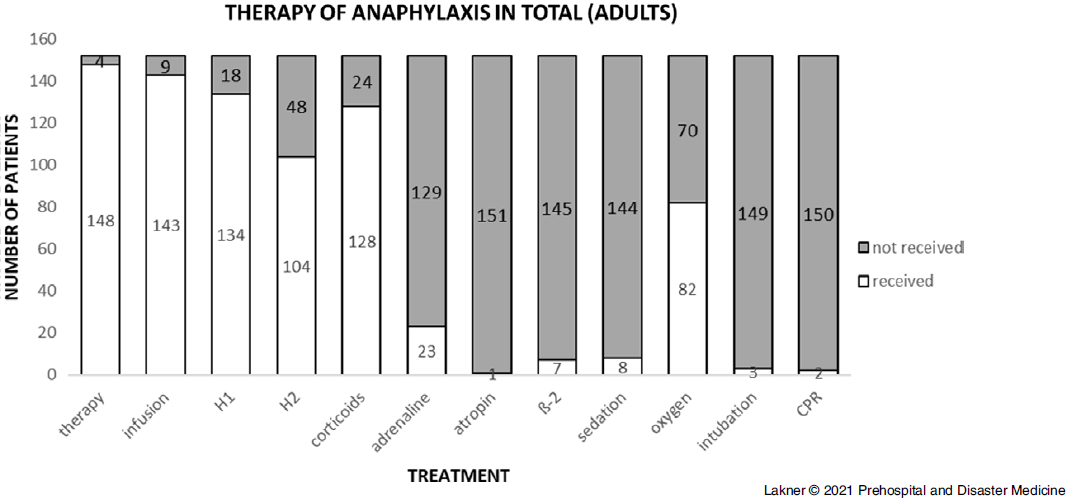
Further, the data included the administered therapy of anaphylaxis regarding children and adults. Ninety-seven percent (n = 148) of the adults received an emergency treatment. Most of them (94%, n = 140) received volume substitution in form of an infusion. In 88%, H1-receptor antagonists (n = 134) and in 68%, H2-receptor antagonists (n = 104) were given. Eighty-four percent of the adults with anaphylaxis received glucocorticosteroids (n = 128). Twenty-three patients (15%) got adrenaline. In five percent, inhaled β2-sympathomimetics (n = 7) and in 54%, oxygen (n = 82) was given. Two percent of the adults (n = 3) had to be intubated; CPR was performed in one percent (n = 2; Figure 1).
Treatment of Anaphylaxis (Grade I-IV) Regarding Adults.
Abbreviations: H1, Histamine-H1; H2, Histamine-H2; CPR, cardiopulmonary resuscitation.

Considering only Grade I reactions (n = 40), 95% of the patients (n = 38) were treated. Included, H1- receptor antagonists were given in 90% (n = 36), and H2-receptor antagonists were given in 63% (n = 25). Eighty-eight percent of the adult patients (n = 35) received glucocorticosteroids and 22% (n = 9) received oxygen.
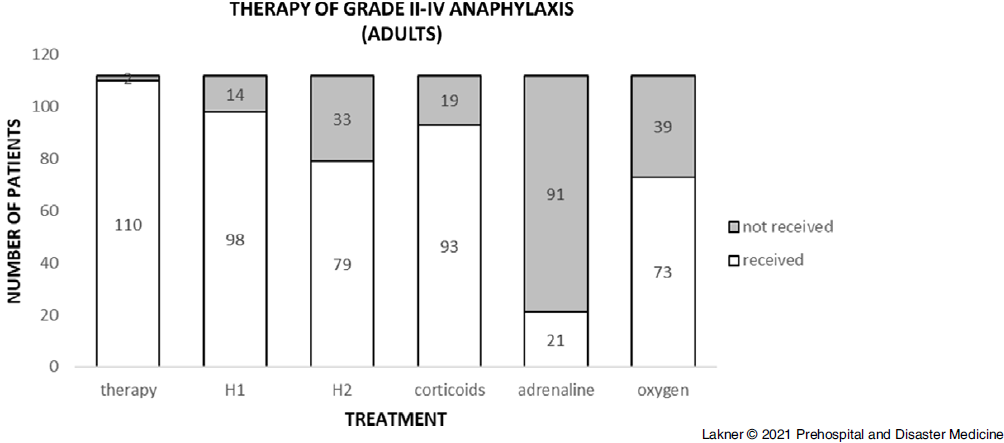
In the group of Grade II-IV anaphylactic reactions of adults (n = 112), 88% of the patients (n = 98) received H1-receptor antagonists and 71% (n = 79) received H2-receptor antagonists. Eighty-three percent of the adults (n = 93) were treated with glucocorticoids and 19% (n = 21) with adrenaline intravenous. Sixty-five percent (n = 73) of the adults received oxygen (Figure 2).
Therapy of Grade II-IV Anaphylaxis Regarding Adults.
Abbreviations: H1, Histamine-H1; H2, Histamine-H2.

One percent of adults (n = 2) was diagnosed with Grade IV anaphylaxis. Both patients received adrenaline intravenous. In addition, both were intubated, and in both cases, CPR was performed successfully.
Within the group of children (n = 29) with anaphylaxis, 76% (n = 22) received a therapy. Fifty-two percent (n = 15) were treated with a H1-receptor antagonist and 17% (n = 5) with a H2-receptor antagonist. Forty-five percent of the children (n = 13) received glucocorticoids and seven percent adrenaline intravenous (n = 2). Twelve children (41%) got volume substitution. In six cases (20%), oxygen was given, and two children (7%) received β2-sympathomimetics as inhalation.
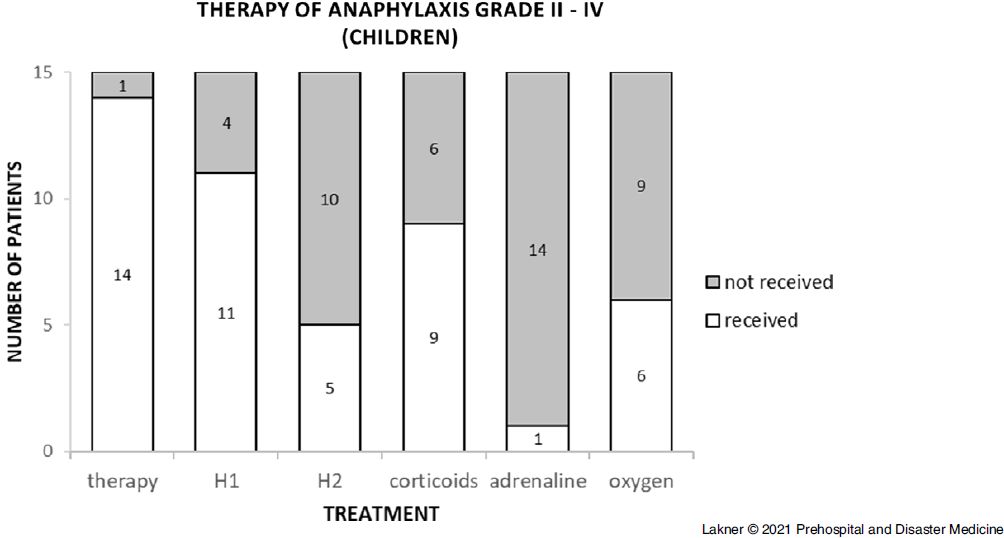
In the group of children with Grade II-IV anaphylactic reactions (n = 15), 93% received a therapy (n = 14). Seventy-three percent (n = 11) were treated with H1-receptor antagonists and 33% (n = 5) received H2-receptor antagonists. Forty percent of the children (n = 6) received oxygen. Sixty percent of the children (n = 9) were treated with glucocorticoids and seven percent (n = 1) with adrenaline intravenous (Figure 3).
Therapy of Grade II-IV Anaphylaxis Regarding Children.
Abbreviations: H1, Histamine-H1; H2, Histamine-H2.

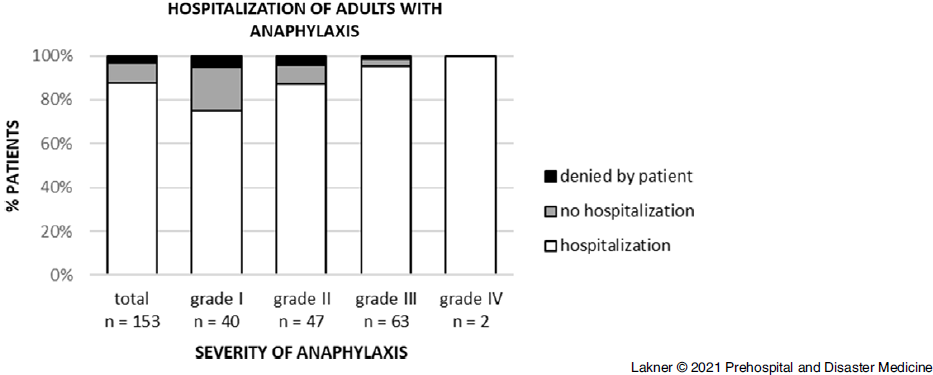
The data also showed whether the patients were hospitalized or not. In the group of adults (n = 153), 87.5% were transferred to hospital; 9.2% of adults were not hospitalized; and 3.3% of the adult patients refused hospitalization despite the emergency physician’s recommendation. Adults with Grade II or higher anaphylactic reactions (n = 112) were hospitalized in 92%. Three percent refused hospitalization despite recommendation and five percent were not transferred to hospital. Hospitalization rates depending on the severity of anaphylaxis are shown in Figure 4.
Hospitalization of Adults with Anaphylaxis in Total and Depending on the Severity.

In 83% (n = 24) of the cases, children (n = 29) were hospitalized. Seventeen percent (n = 5) were not admitted to hospital. There was no refusal, 100% of the children with Grade II-IV anaphylaxis (n = 15) were hospitalized.
All adults and children with anaphylactic reactions survived the acute emergency treatment without apparent adverse outcomes.
Discussion
Currently, there are only a few studies focusing on the treatment of anaphylaxis. The retrospective evaluation of prehospital emergency missions of the Air Rescue Dresden/Germany from 2008 through 2015 provided in total data from 152 adults and 29 children. The quality of the emergency documentation was differing and partly incomplete. In all cases, the documentation of gender, triggers of anaphylaxis, as well as symptoms, emergency treatment, and hospitalization were complete. A complete retrospective evaluation of these factors was possible. Within seven years, a total number of 181 patients with anaphylactic reactions were reported. Since the data of the Air Rescue Dresden/Germany were evaluated, the data may be related to local characteristics or demographic distributions.
The collected data show that there are 48% female and 52% male adults with anaphylaxis. This is consistent with information in the research literature describing that men and women are almost equally affected.Reference Worm, Edenharter and Ruëff15 According to the anaphylaxis registry (Germany, Austria, Switzerland) ANAPHYLAXIE.net,16 53% of adult patients with anaphylaxis are female and 47% are male. The deviation from the collected data is only marginal and may be due to the low number of cases (n = 152) compared to 9,933 recorded patients in the registry. As described in literature,Reference Worm, Edenharter and Ruëff15 boys (n = 20; 69%) suffer more frequently from anaphylaxis than girls (n = 9; 31%) do.
The study of the severity distribution shows that 48% of the children had Grade I reactions, 35% of the children showed a Grade II, and 17% a Grade III reaction. No Grade IV reaction was documented. The literatureReference Worm, Eckermann and Dölle10 indicates that Grade I and Grade IV reactions are very rare with children. This cited studyReference Worm, Eckermann and Dölle10 relies on the anaphylaxis registry. Inclusion in the anaphylaxis registry requires cardiovascular and/or pulmonary anaphylactic reactions. Only during a short period, Grade I anaphylactic reactions were reported to the registry. Therefore, Grade I responses are under-represented in this cited study and in the anaphylaxis registry. This may explain the deviation from the data analyzed here.
The present analysis shows that children have more Grade II (35%) reactions than Grade III (17%). This observation is consistent with the data derived from the literature.Reference Worm, Eckermann and Dölle10 The high number of documented Grade I (48%) anaphylactic reactions may be due to the rapid alerting of the emergency physician by anxious or insecure parents. Often the trigger of these reactions was not observed with certainty by the parents. In one case, the emergency physician documented that the parents were not sure whether it was a mosquito bite or a wasp sting. The assessment of the emergency physician may also influence the high number of Grade I reactions. Eventually, a local skin reaction was equated with a Grade I anaphylactic reaction. For example, in two cases, after a visit to a public pool, an eczema was considered a Grade I anaphylactic reaction. Therefore, there could be a bigger bias in the group of Grade I reactions. In addition, the small number of children (n = 29) must be considered.
In the group of adults, 26% showed a Grade I reaction, 31% had a Grade II, and 42% a Grade III reaction. Only one percent of the adults showed a Grade IV anaphylactic reaction. Again, many Grade I anaphylactic reactions have been documented in comparison to the previously cited literature.Reference Worm, Eckermann and Dölle10 The anaphylactic registry16 reports only anaphylactic reactions with cardiovascular and/or respiratory symptoms. Only in a short period of time, Grade I anaphylactic reactions were reported. Therefore, only a few Grade I reactions were evaluated in the comparative study.Reference Worm, Eckermann and Dölle10 Thus, the current data situation does not allow a detailed comparison of severity distribution of anaphylaxis with other studies.
The shown data reveal that the most common triggers for children are insect venom (34%) and foods (24%), while 32% of the triggers were unknown. The most frequently documented triggers for anaphylaxis regarding adults are insect venom (62%), drugs (12%), and foods (15%). In 12% of the cases, the triggers were not known.
Analyzing retrospectively 4,000 cases from the anaphylaxis registry,16 the most frequently reported triggers for severe allergic reactions in children were foods (>50%), followed by insect venom (25%). Meanwhile in the group of adults, the most common triggers are insect venom (>50%), drugs (approximately 20%), and food (15%). This distribution is consistent with the described triggers in the AMWF guideline.Reference Ring, Beyer and Biedermann4
Considering only the triggers of Grade II-IV anaphylactic reactions, a different distribution shows: in the group of children with severe anaphylactic reactions, the most common triggers are foods (33%), followed by insect venom (27%), while 27% of the triggers are documented as unknown. Due to the small number of children documented (n = 15) with Grade II-IV anaphylactic reactions, the statistical significance regarding the triggers is low.
In addition, no trigger was found in 27% of the cases. Either the emergency physician did not document the trigger or it was not known. This could be due to the difficult questioning of the child or the fact that the parents could not identify the trigger.
In adults, the most frequently triggers of Grade II-IV anaphylactic reactions are insect venom (59%), drugs (15%), and foods (13%). These results correspond to the published literature.Reference Worm, Eckermann and Dölle10
Prior studies prove the positive influence of adrenaline on the survival of anaphylaxis patients. Adrenaline is recommended as the drug of choice for the treatment of severe allergic reactions (Grade II-IV), although there are no prospective controlled studies.Reference Ring, Beyer and Biedermann4,Reference Dhami, Panesar and Roberts17–Reference Pumphrey and Gowland19 The evaluated data show that 21 out of 112 adults (19 %) with Grade II to IV anaphylactic reactions received adrenaline as an emergency treatment. In 81% of the cases, adrenaline was not administered. In the group of children, only seven percent received adrenaline. Based on study data from different countries, it has been asserted that in case of anaphylaxis, guideline-based therapy often is not performed.Reference Clark, Bock, Gaeta, Brenner, Cydulka and Camargo20,Reference Helbling, Müller and Hausmann21 This may be due to inadequate training of emergency physicians regarding the assessment and treatment of anaphylaxis.Reference Nowak, Farrar and Brenner22 The severity of the symptoms of an acute anaphylactic emergency may vary from case to case. To evaluate the anaphylaxis and its course, an extensive allergological experience is required.
Another possible reason for the reluctance of using adrenaline in the emergency treatment could be the fear of side effects. Regarding cardiovascular diseases, adrenaline can lead to complications and an overdose can be fatal.Reference Simons, Gu and Simons23
The initial symptoms of anaphylaxis usually appear abruptly. Since the process and the severity of anaphylactic reactions can be unpredictable and fatal, the treatment must be quick and targeted. Due to the unclear dynamic and outcome, hospitalization for 24 hours surveillance is recommended in the case of severe anaphylactic reactions (Grade II and higher).Reference Ring, Beyer and Biedermann4 Analysis of the data showed that 100% of the children with Grade II or higher reactions were hospitalized. Five percent of the adults with Grade II or higher anaphylactic reactions were not transferred to hospital. This may be due to a misjudgment and lack of allergological expertise of the emergency physician.
For Grade II or higher anaphylaxis, the AMWF guidelineReference Ring, Beyer and Biedermann4 for anaphylaxis recommends an immediate therapy with intramuscular/intravenous injection of adrenaline as well as hospitalization for at least 24 hours. The same guideline informs and warns about an abrupt and unpredictable course of anaphylaxis, even with initially mild symptoms (Grade I). These statements are contradictory. An adequate and consistent emergency therapy is thus made more difficult.
After an anaphylactic reaction, referral to an allergist for further diagnostic and possible therapy is necessary. All patients with severity Grade II or higher must receive an emergency set for self-help.Reference Simons, Ardusso and Dimov24 This set should include an adrenaline auto-injector, antihistamines, and glucocorticoids. The patient must be informed about and trained at the practical use of the emergency medications. Children, parents, and possibly teachers must be instructed. The emergency medication, and in particular the adrenaline auto-injector, must always be carried with the patient.Reference Simons, Ardusso and Bilò3,Reference Ring, Beyer and Biedermann4,Reference Rudders and Banerji25 In addition, patients must be informed about the avoidance of the triggering allergens. If possible, allergen-specific immunotherapy should be started.Reference Ring, Beyer and Biedermann4
Limitations of the Study
Limitations of this study include the fact that only the data from the Air Rescue Dresden/Germany were evaluated. Regional or local demographic characteristics or distributions cannot be ruled out. Thus, generalizability of the data and the results cannot be established. By evaluating only air rescue data, there could be a bias regarding the severity of anaphylaxis. A comparison with ground rescue data would be interesting.
Sample size should also be mentioned as a limiting factor. Considering the children (total n = 29), the sample sizes for the different severities of anaphylaxis are very small (Grade I: n = 14, Grade II: n = 10, Grade III: n = 5, and Grade IV: n = 0). In adults (total n = 152), there were only two cases of Grade IV anaphylaxis.
Another limitation of the data analysis is that the results do not allow any conclusions to be drawn about the long-term course of the patients, as no data were collected in this regard.
Conclusion
As described and proven in several studies, guideline-based therapy of anaphylactic reactions is rarely performed.Reference Clark, Bock, Gaeta, Brenner, Cydulka and Camargo20,Reference Helbling, Müller and Hausmann21 Analysis of data from the Air Rescue Dresden/Germany shows that despite existing recommendations, only 19% of adults with severe anaphylaxis received adrenaline. Among children, only in seven percent was a treatment with adrenaline performed.
On the other hand, all patients survived the acute emergency treatment without apparent adverse outcomes. Thus, further studies are needed to determine the proper use of adrenaline in anaphylactic reactions.
Conflicts of interest/funding
This work was not supported by any funding agency. No potential competing/conflicts of interest were reported by the authors.