


Introduction
A common hindrance in the delivery of psychological therapy is premature termination or ‘drop-out’. Whilst drop-out is a concern in any treatment setting, particular emphasis in recent times has been placed on the high rates of disengagement that occur in clients with post-traumatic stress disorder (PTSD) (Szafranski et al., Reference Szafranski, Smith, Gros and Resick2017). Reviews of randomised controlled trials indicate that 14–18% of people with PTSD are likely to drop out from treatment (Lewis et al., Reference Lewis, Roberts, Gibson and Bisson2020). Rates of drop-out in PTSD also appear to be higher than several other anxiety-based disorders including generalised anxiety disorder (15.2%), panic disorder (15.4%), obsessive compulsive disorder (16.3%), and social anxiety (18.0%; Swift and Greenberg, Reference Swift and Greenberg2014). Drop-out rates from individual studies of PTSD treatment are highly variable and range from 13 to 68% (Garcia et al., Reference Garcia, Kelley, Rentz and Lee2011; Hundt et al., Reference Hundt, Ecker, Thompson, Helm, Smith, Stanley and Cully2018), suggesting that rates of drop-out may be influenced by a multitude of factors including sample characteristics and methodological processes. A review paper specifically focusing on the treatment of military veterans found the rate of drop-out to be 36% in studies that primarily used trauma-focused therapies (Goetter et al., Reference Goetter, Bui, Ojserkis, Zakarian, Brendel and Simon2015).
There are a broad range of negative impacts of drop-out that can be seen to affect the whole mental health system in one way or another (Berke et al., Reference Berke, Kline, Wachen, McLeand, Yarvis, Mintz and Litz2019). Clients who drop out can experience demoralisation and reticence regarding further help-seeking (Berke et al., Reference Berke, Kline, Wachen, McLeand, Yarvis, Mintz and Litz2019). Therapists may experience reduced productivity and low morale, with clinicians reporting that drop-outs are often seen as therapeutic failures (Scamardo et al., Reference Scamardo, Bobele and Biever2004), while treatment providers may experience loss of revenue and financial waste (Barrett et al., Reference Barrett, Chua, Crits-Christoph, Gibbons and Thompson2008).
It is unfortunate that the progression of the literature in this area has been limited by inconsistent definitions and operationalisation of drop-out used (Barrett et al., Reference Barrett, Chua, Crits-Christoph, Gibbons and Thompson2008). Common operationalisations of drop-out used within PTSD research include: attending less than a specified number of sessions (Baekeland and Lundwall, Reference Baekeland and Lundwall1975); failure to complete a pre-determined goal or element of the therapeutic process (e.g. a manualised programme or a structured therapeutic intervention; Swift and Greenberg, Reference Swift and Greenberg2012); failure to attend a scheduled appointment and any future appointments (Hatchett et al., Reference Hatchett, Han and Cooker2002); ceasing treatment without making clinically significant gains (Hatchett and Park, Reference Hatchett and Park2003); and therapists’ judgement of clients’ reasons for disengagement (Swift and Greenberg, Reference Swift and Greenberg2012). The Clinical Data Interchange Standards Consortium (CDISC, 2011) advises that drop-out should be defined as a participant who ‘for any reason fails to continue in the trial until the last visit or observation required’. Several recent studies have operationalised drop-out in line with this recommendation (Berke et al., Reference Berke, Kline, Wachen, McLeand, Yarvis, Mintz and Litz2019; Gros et al., Reference Gros, Yoder, Tuerk, Lozano and Acierno2011; Imel et al., Reference Imel, Laska, Jakupcak and Simpson2013).
While each of these operationalisations has utility, researchers often provide insufficient reasoning for the approach chosen or apply thresholds in a way that is inconsistent with other studies. For example, the specified number of sessions used as the cut-off point for drop-out is often not justified or explained and varies tremendously between studies [e.g. drop-outs were anyone who attended less than 50% of sessions (Holder et al., Reference Holder, Holliday, Wiblin, LePage and Surís2019); less than 66% of sessions (Jeffreys et al., Reference Jeffreys, Reinfeld, Nair, Garcia, Mata-Galan and Rentz2014), and less than 75% of sessions (Rizvi et al., Reference Rizvi, Vogt and Resick2009)]. Thus, where an individual could be counted as a drop-out in one study, they would be classed as a treatment completer by another study’s method. This methodological inconsistency is further exacerbated by studies that fail to define their method of drop-out entirely, such as Doran and DeViva (Reference Doran and DeViva2018) and van Minnen et al. (Reference van Minnen, Arntz and Keijsers2002).
A large proportion of PTSD research focuses on military personnel as they have an increased risk of experiencing trauma due to the nature of their work. Rates of PTSD in veterans from the USA, UK and Australia range from 2 to 35% (Xue et al., Reference Xue, Ge, Tang, Liu, Kang, Wang and Zhang2015). First responders (police, paramedics, fire-fighters, life-savers, and other front-line responders) also have increased trauma risk with the prevalence of PTSD in first responders ranging from 8 to 22% (Klimley et al., Reference Klimley, Van Hasselt and Stripling2018). Despite this, first responders as a group have been studied relatively little in comparison with military personnel or civilians.
However, first responders who experience occupational trauma – trauma that is directly attributable to someone’s occupational activity – can be conceptualised as distinctly different from civilians with personal trauma experiences (Graham, Reference Graham2012). For first responders, trauma can occur in the workplace under many circumstances including witnessing or experiencing physical violence and being exposed to trauma narratives through working with victims. Four out of five (84%) first responders report experiencing traumatic events as part of their work (Klimley et al., Reference Klimley, Van Hasselt and Stripling2018). Additionally, compared with civilians, first responders can be exposed to multiple traumas throughout their careers. Another unique aspect of occupational trauma is the impact that employers can have on how people respond to instances of trauma. For example, police who were given shorter periods of recovery time by employers and police who felt unsupported by their employer were more likely to develop PTSD following an instance of occupational trauma (Marchand et al., Reference Marchand, Nadeau, Beaulieu-Prévost, Boyer and Martin2015). It is surprising that despite these distinct characteristics of first responders, no research to date has explored treatment drop-out in this sample.
Research on predictive factors for PTSD drop-out in both military and civilians has thus far predominantly focused on demographic variables. Younger age is one of the most consistent predictors of drop-out (Garcia et al., Reference Garcia, Kelley, Rentz and Lee2011; Gros et al., Reference Gros, Yoder, Tuerk, Lozano and Acierno2011; Rizvi et al., Reference Rizvi, Vogt and Resick2009), as is gender, with several studies showing that men have higher drop-out rates than women (Lange et al., Reference Lange, van de Ven, Schrieken and Emmelkamp2001; Sijbrandij et al., Reference Sijbrandij, Olff, Reitsma, Carlier, de Vries and Gersons2007). Marital status has also been found to influence treatment drop-out in several studies. Intriguingly, the results have varied from married veterans being associated with greater treatment completion (DeViva, Reference DeViva2014), to single and widowed veterans completing more sessions (Doran and DeViva, Reference Doran and DeViva2018). Other demographic variables that have been associated with poorer treatment completion include unemployment (DeViva, Reference DeViva2014), racial/ethnic minority identity (Doran et al., Reference Doran, Pietrzak, Hoff and Harpaz-Rotem2017), and lower levels of education and intelligence (Rizvi et al., Reference Rizvi, Vogt and Resick2009).
Clinically relevant co-morbid factors for PTSD have also been examined in several different studies and contexts in relation to drop-out. Similar to other variables, depression has been found to be both a predictor of treatment drop-out (Doran and DeViva, Reference Doran and DeViva2018; Garcia et al., Reference Garcia, Kelley, Rentz and Lee2011), and also not associated with drop-out (Clifton et al., Reference Clifton, Feeny and Zoellner2017; van Minnen et al., Reference van Minnen, Arntz and Keijsers2002). Alcohol and substance abuse, which commonly occur with PTSD, have also been linked to higher treatment drop-outs in some studies (Bedard-Gilligan et al., Reference Bedard-Gilligan, Garcia, Zoellner and Feeny2018; Zandberg et al., Reference Zandberg, Rosenfield, Alpert, McLean and Foa2016).
While demographic characteristics and co-morbidities offer a degree of explanatory power for drop-out, these factors only account for a part of the variance associated with drop-out in PTSD treatment (Szafranski et al., Reference Szafranski, Smith, Gros and Resick2017). This indicates that there are other characteristics or symptoms particular to the experience of trauma that influences clients’ ability to reliably attend treatment.
One such symptom that may be associated with drop-out is anger. Anger has been well documented as a problematic emotional response in individuals with PTSD (Taft et al., Reference Taft, Creech and Murphy2017) and has been associated with greater PTSD symptom severity (Taft et al., Reference Taft, Street, Marshall, Dowdall and Riggs2007). Importantly, when people with high levels of pre-treatment PTSD also endorse anger, they are especially likely to show a poor response to treatment (Owens et al., Reference Owens, Chard and Cox2008). As anger has been hypothesised to be an avoidance mechanism (Foa et al., Reference Foa, Riggs, Massie and Yarczower1995), it follows that clients with intense anger may be more avoidant of their trauma-related emotions. This may be an obstacle to successful exposure therapy and lead to premature termination (Clifton et al., Reference Clifton, Feeny and Zoellner2017). Aggression and the expression of anger are also observed to create interpersonal difficulties in therapy. In particular, clients with high anger may be less trusting, hence may have difficulty establishing a therapeutic alliance (Taft et al., Reference Taft, Creech and Murphy2017). Finally, some researchers suggest that PTSD may invoke a ‘survival mode’ pattern of functioning (Chemtob et al., Reference Chemtob, Novaco, Hamada, Gross and Smith1997), whereby reminders of traumatic events – as may arise in therapy – are thought to activate threat-confirmation biases and behaviours that may be counterproductive for ongoing engagement in therapy. For instance, anger may be expressed towards a therapist following an otherwise innocuous trauma reminder, creating additional challenges for the therapeutic relationship and ongoing therapeutic engagement.
It is noteworthy that problematic anger is a potentially modifiable factor so far as treatment is concerned. Thus, to the extent to which anger serves as a predictor of treatment drop-out, existing programmes could be revised to better identify participants with problematic anger at admission as well as to address prominent anger during the course of therapy.
Compared with civilians, there is a stronger association between anger and PTSD in military personnel (Orth and Wieland, Reference Orth and Wieland2006). In help-seeking military veterans, anger was the most commonly reported concern (Rosen et al., Reference Rosen, Adler and Tiet2013). There could be several reasons for this relationship: anger can be advantageous in military training and combat, which may reinforce its presence (Forbes et al., Reference Forbes, Parslow, Creamer, Allen, McHugh and Hopwood2008); the nature of military trauma and moral injury may evoke more anger (Litz et al., Reference Litz, Stein, Delaney, Lebowitz, Nash, Silva and Maguen2009); or military veterans with PTSD may have co-morbid issues such as chronic pain, which exacerbate anger (Cash et al., Reference Cash, Varker, McHugh, Metcalf, Howard, Lloyd and Forbes2018). In several studies, greater levels of anger have been found to interfere with treatment, leading to poorer outcomes (Forbes et al., Reference Forbes, Parslow, Creamer, Allen, McHugh and Hopwood2008; Lloyd et al., Reference Lloyd, Nixon, Varker, Elliott, Perry, Bryant and Forbes2014).
To date, three studies have examined anger as a predictive factor for drop-out, each with varying results. van Minnen and colleagues (Reference van Minnen, Arntz and Keijsers2002) failed to find an association between anger and drop-out in civilians seeking PTSD treatment. In contrast, anger did predict drop-out among female sexual assault survivors receiving prolonged imaginal exposure therapy, yet no such effect was found for those who received cognitive processing therapy (Rizvi et al., Reference Rizvi, Vogt and Resick2009). In the most recent study of civilians, there was a moderate association between anger and fewer sessions completed (Clifton et al., Reference Clifton, Feeny and Zoellner2017). Despite the findings that military veterans with PTSD have higher rates of anger compared with civilians, no research to date has examined if anger is predictive of drop-out in military participants. This is an important gap in the literature given that anger has otherwise been associated with non-response to therapy among veterans (Forbes et al., Reference Forbes, Creamer, Hawthorne, Allen and McHugh2003).
This study aims to examine pre-treatment predictors of drop-out from a group PTSD treatment in a mixed sample of military veterans and first responders. It is hypothesised that as the expression of anger is a potential avoidance mechanism (Foa et al., Reference Foa, Riggs, Massie and Yarczower1995) and may be linked with interpersonal difficulties and distrust (Taft et al., Reference Taft, Creech and Murphy2017) that it would be predictive of drop-out. In particular, it is hypothesised that anger would be more predictive of drop-out in military participants as there is a stronger relationship between anger and military veterans with PTSD (Orth and Wieland, Reference Orth and Wieland2006). Finally, it is expected that there may be differences in the characteristics between military and occupational trauma civilian participants due to the unique nature of each group.
Method
Participants
Participants were adults who were referred to the PTSD treatment program at St John of God Health Care, Richmond Hospital. Participants were assessed using the Clinician-Administered PTSD Scale for DSM-5 (CAPS-5) and met criteria for PTSD as per the fifth edition of the Diagnostic and Statistical Manual of Mental Disorders (DSM-5; American Psychiatric Association, 2013). Standard demographic information was collected as part of the assessment process. Patients who were engaged in the treatment programme but declined to participate in data collection were not included in the study. The research sample consisted of 95 participants between the ages of 28 and 64 years (mean age 46 years). Participants were predominantly men (n = 82, 86%) with a smaller proportion of women (n = 13, 14%). The occupation of participants included military veterans, police, paramedics or other emergency workers, and a very small number of train drivers who had experienced occupational trauma (e.g. witnessing injuries on train tracks). For ease of reporting, participants’ occupations are described in two separate groups: military veterans (n = 38, 40%), and first responders (n = 57, 60%). Referrals to the programme were not necessarily restricted to particular occupational groups; however, the predominance of veterans, current serving military and first responders reflects the funding support that was accessible for group attendees (through the Department of Veteran’s Affairs, Department of Defence, and a number of workers’ compensation agencies aligned with first responders). It is possible that some first responders had military backgrounds; however, data reflect each participant’s identified main occupation.
Treatment procedures
The treatment programme is a Department of Veteran Affairs accredited PTSD treatment programme. Recruitment took place over a 3-year period from 2015 to 2018. The programme consisted of a 4-week residential phase and two treatment sessions at 3 months and 9 months following the residential phase. The programme was developed as a residential programme for three reasons: first, to assist with accessibility to the programme given the multiple daily sessions across the first 4 weeks of the programme; second, because programme members travel from multiple distant locations across the state to attend; and finally, the location of the hospital beyond the outer fringes of a major metropolitan area would otherwise require lengthy daily commutes for members to attend. During the residential phase, treatment was cognitive behavioural therapy (CBT)-based and occurred predominantly in a group setting with the following interventions utilised: psychoeducation about PTSD; de-arousal strategies; cognitive restructuring; cognitive processing of trauma-related themes such as trust, safety, power and control; and relapse prevention. The manual for the programme ensured broad consistency in content across groups, but the fidelity of adherence to the manual was not monitored. The programme included a small amount of content on anger management skills, but typically no more than 2 hours of the initial 4-week residential phase. Prolonged exposure was also included in the residential phase and took place during concurrent individual therapy sessions. At 3 months, participants attended a 3-day treatment session that involved a review of clinical progress and therapeutic interventions focused on relationships and communication. Most participants had a partner or family member attend one day of this session for therapeutic work. The 9-month treatment session took place over one day, and primarily focused on relapse prevention and recovery needs, as well as reviewing participants’ clinical progress.
Drop-out and attendance
Participants completed questionnaires when they attended key time points during the treatment programme: the start of treatment, the end of the 4-week residential period, the 3-month treatment session, and the 9-month treatment session. As all participants completed questionnaires when they attended a session, completion of the questionnaires was used as a record of participants’ attendance at each time point. Following recommendations on the definition of drop-out provided by the CDISC (2011), any participant who failed to attend the treatment programme until the last appointment was considered to have dropped out. Conversely, all participants who attended the final session were marked as treatment completers.
Further analysis focused on different patterns of attendance or drop-out. Among the participants who completed the programme, two patterns of attendance were examined: consistent attendance and inconsistent attendance. Participants were classified as being a treatment completer with consistent attendance if they attended every time point. If a participant completed the programme but failed to attend one or more time points during treatment then they were classified as a treatment completer with inconsistent attendance. Drop-outs, or treatment non-completers, were also categorised into two distinct groups: early drop-outs and late drop-outs. Any participant who discontinued treatment during the residential phase was classified as an early drop-out, whilst participants who completed the residential phase but dropped out at the 3-month or 9-month treatment sessions were counted as late drop-outs.
Measures
Participants completed questionnaires in paper-and-pencil format upon attending the group at the start of the residential programme, on the final day of the programme and at each of their follow-up visits.
Posttraumatic Stress Disorder Checklist-5 (PCL-5)
The PCL-5 is a self-report measure with 20 items that correspond to each of the DSM-5 diagnostic criteria for PTSD. Responses are scored from 0 to 4 with the descriptors ‘Not at all’, ‘A little bit’, ‘Moderately’, ‘Quite a bit’ and ‘Extremely’. A total score ranging from 0 to 80 is obtained by summing all items. The PCL-5 is suitable to use with military and civilians and has been validated in both samples (Blevins et al., Reference Blevins, Weathers, Davis, Witte and Domino2015; Bovin et al., Reference Bovin, Marx, Weathers, Gallagher, Rodriguez, Schnurr and Keane2016). In this sample, the internal consistency was α = 0.87.
State-Trait Anger Expression Inventory – Second Edition (STAXI-2)
The STAXI-2 (Spielberger, Reference Spielberger1999) is a comprehensive assessment of anger. It is made up of six scales which each measure a different component of anger. This study utilised the Anger Expression Index, which is a measure of how much a person expresses their anger externally or attempts to suppress their anger, as well as an inability to control their feelings of anger. The index is made up of 32 items that are rated on a 4-point Likert scale from ‘Almost never’ to ‘Almost always’. The STAXI-2 is the most widely used assessment of anger and has been validated in a variety of clinical and non-clinical populations (Lievaart et al., Reference Lievaart, Franken and Hovens2016). In contrast to the scoring procedures outlined in the STAXI-2 manual, for the present study, we derived a total score by summing all items after all anger control items were reverse-scored. The anger expression index had an internal consistency of α = 0.91.
Hospital Anxiety and Depression Scale (HADS)
The HADS (Zigmond and Snaith, Reference Zigmond and Snaith1983) was developed as a means of identifying anxiety and depression in hospital patients and has been used in the general population as well as psychiatric patients (Bjelland et al., Reference Bjelland, Dahl, Haug and Neckelmann2002). The measure has two separate scales, one for anxiety and the other for depression, each with seven items. Answers are rated from 0 (‘Not at all’) to 3 (‘Most of the time’), with the responses for each scale summed to give a total score. Despite the relatively high co-morbidity between anxiety and depression, the HADS has been shown to have an excellent 2-factor structure and has comparable sensitivity to lengthier measures of anxiety and depression (Bjelland et al., Reference Bjelland, Dahl, Haug and Neckelmann2002). The internal consistency in this sample was α = 0.79 for the anxiety scale and α = 0.73 for the depression scale.
Additional measures
Additional measures, which were not a focus for the present study, were completed by participants including the Perceived Injustice Experience Questionnaire (PIEQ) developed by the researchers for a separate study, and a range of other measures assessing physical health impacts (e.g. alcohol use), emotional states (e.g. guilt) and social factors (e.g. relationship satisfaction). The majority of these measures, including an additional anger-related questionnaire [the Dimensions of Anger Reactions-5 (DAR-5); Novaco, Reference Novaco1975] were administered for programme accreditation purposes and so are not able to be analysed or reported as part of the present study.
Data analysis
All data preparation and analyses were performed using SPSS Statistics. Participants who completed the required data at baseline, including demographic information and at least 70% of questionnaire data, were included in the analyses. Missing data were imputed for participants missing up to 30% of questionnaire data using the expectation maximisation approach. Collinearity diagnostics identified that some multicollinearity was present among the selected predictor variables. We thus used standardised z-scores for all the following regression analyses, which addressed this issue.
Demographic characteristics were summarised for the total sample, as well as for military and first responders separately. Individual samples t-tests were conducted to identify any significant differences between these two groups. Participants were coded as drop-outs or treatment completers following the methodology previously outlined, including further grouping based on their pattern of attendance. As a preliminary exploratory analysis, the PCL total scores and changes in PCL total scores from intake to each respective assessment point were compared between treatment completers and non-completers using the ‘last (available) observation carried forward’ (LOCF; Salkind, Reference Salkind2010), to determine whether there were differences in PTSD symptoms or changes in PTSD symptoms between those who did and did not complete treatment.
Point biserial correlations between drop-out and the selected demographic and symptom variables were analysed. Three logistic regressions examined the selected demographic and pre-treatment variables (age, gender, occupation, anger, anxiety, depression, and PTSD symptom severity) as predictors of drop-out in the following samples: all participants, military participants, and first responder participants. Occupation was not included as a variable in the military or civilian regressions. Two further regressions were conducted to analyse if the selected demographic and pre-treatment variables predicted different patterns of drop-out (early or late drop-out) and attendance (inconsistent or consistent attendance).
Statistical power for logistic regression analyses is hard to estimate, as it requires assumptions about the probability of a participant dropping out when each of the predictor variables are at their mean value (e.g. see the Stata program Powerlog; Ender, Reference Endern.d.), as well as the correlation among predictor variables – which are difficult to estimate and cannot be easily ascertained from previous research. Nevertheless, for a standard linear regression analysis to detect a medium size effect, with a non-directional alpha rate of .05, 102 participants would be required (Cohen, Reference Cohen1992). This is broadly similar to our final sample.
Results
Sample demographics and characteristics
The overall sample consisted of 18 separate groups of mixed occupational background with a mean of 5.94 participants (SD = 1.51) in each. The characteristics of the sample are described in Table 1, which lists sample sizes, means and standard deviations of the key variables used throughout data analysis. Independent samples t-tests between military and first responders were conducted and identified that first responders had significantly higher depression at baseline pre-treatment (t = 2.04; d.f. = 72.2; p = .045). Results approaching significance (p = .052), showed that a greater proportion of first responders were female. A slightly higher percentage of military participants (63%) dropped out compared with first responders (56%), although there was no significant association between drop-out and occupation. No other significant differences were found between participants.
Demographics, sample characteristics, and t-test comparisons between military and first responders

HADS, Hospital Anxiety and Depression Scale; PCL-5, Posttraumatic Checklist for DSM-5; STAXI-2, State-Trait Anger Expression Inventory-2.
Overall, programme participants improved on key symptom-based outcomes across the 9-month programme (i.e. reductions in PCL total score from start of treatment to 9-month treatment session; p = 0.01); however, changes were typically only small to medium in magnitude (mean PCL total score difference of 6.12). Independent samples t-tests were used to compare LOCF data for PCL total scores, as well as PCL difference scores (compared with intake), between completers and non-completers. There were no significant differences at any assessment point (p≥0.05), suggesting that participants who discontinued treatment had similar levels of PCL symptoms and similar levels of improvement in PCL symptoms to those who completed the programme.
Rates of attendance and drop-out
The rates and numbers of participants who attended or dropped out of treatment are reported in Table 2. Overall, 41% of participants completed the treatment programme, whilst 59% of participants dropped out. Amongst the treatment completers, the majority (74%) attended all sessions consistently. Of participants who did not complete the programme, only a smaller minority dropped out during the residential phase (23%) with the larger proportion (77%) disengaging treatment during the post-residential treatment sessions.
Number and rates of drop-outs and treatment completers

Correlations
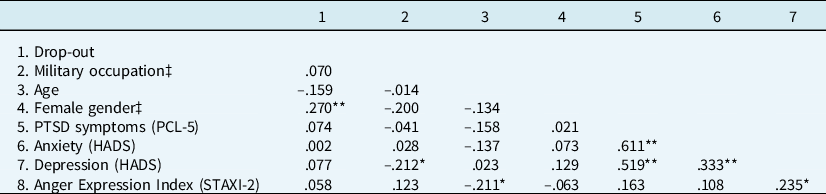
Point biserial correlations were analysed between drop-out and the following variables: age, gender, occupation group, PTSD symptom severity, anxiety, depression, and anger. The results of these correlations are reported in Table 3. Female gender was the only variable that was significantly correlated with drop-out (r = .270; p = .008). First responder occupation (i.e. non-military) was found to be correlated with greater depression (r = –.212; p = .039) which aligns with the previous t-test findings that first responders had significantly higher levels of depression. There was a significant correlation between younger age and anger (r = –.211; p = .040) and anger was also significantly correlated with depression (r = .235; p = .022). Greater PTSD symptom severity was significantly correlated with both anxiety (r = .611; p≤.001) and depression (r = .519; p≤.001). Lastly, there was a correlation between depression and anxiety (r = .333; p = .001).
Correlations between drop-out, demographics and symptom measures

*p<.05; **p<.01. ‡We note that gender and occupation were binary variables and so conducted chi-square tests for these variables with drop-out. In line with the correlations shown above, occupation was not associated with drop-out (χ² = 0.464; p = .496) whilst female gender was significantly associated with drop-out (χ² = 6.929; p = .008).
Predictors of drop-out
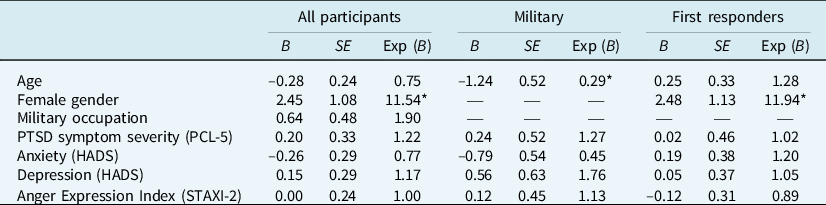
The results of three regressions analysing predictors of drop-out are summarised in Table 4. In the whole sample, female gender was found to significantly predict drop-out from treatment (B = 2.45; SE = 1.08; OR = 11.54; p = .024) with female participants found to have 11 times greater odds of drop-out. Similarly, amongst first responders, female gender was also predictive of treatment drop-out (B = 2.48; SE = 1.13; OR = 11.94; p = .028) with the odds of drop-out almost 12 times greater for women. Gender was excluded from the regression with military participants due to the very small number (n = 2) of females in this group. Within military participants, younger age was identified as a significant predictor of drop-out (B = –1.24; SE = 0.52; OR = 0.29; p = .018) where younger participants had very slight increased odds of drop-out. Occupation group, PTSD symptom severity, anxiety, depression and anger were not found to be significant predictors of drop-out in any of the three samples (all participants, military, and civilians).
Regressions on predictors of drop-out

*p<.05. HADS, Hospital Anxiety and Depression Scale; PCL-5, Posttraumatic Checklist for DSM-5; STAXI-2, State-Trait Anger Expression Inventory-2.
Predictors of patterns of attendance and drop-out
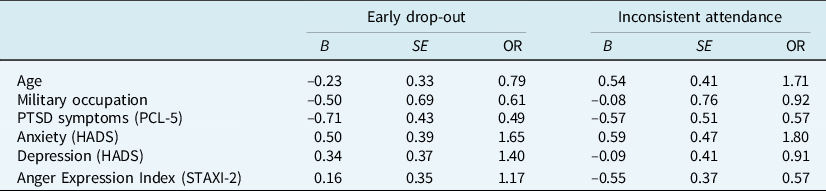
Two further regressions analysed how baseline variables may predict patterns of attendance and drop-out. These results are described in Table 5. In the sample of treatment completers there was a large gender imbalance (38 men and one woman), as such gender was excluded as a variable from this regression. Demographic variables, depression, anxiety, PTSD symptom severity and anger were not found to be significant predictors of either early/late drop-out or inconsistent/consistent attendance.
Regressions on predictors of attendance/drop-out patterns

Post-hoc analyses: PCL-5 Anger item as a predictor of drop-out
We also repeated the above regression analyses, but with item 15 of the PCL-5 (‘Irritable behaviour, angry outbursts, or acting aggressively?’) used to predict drop-out instead of STAXI-2 Anger Expression subscale score. The results of these analyses are reported in the Supplementary material (Tables S1 and S2). The overall pattern of results was the same as when STAXI-2 was included.
Discussion
Drop-out is a critical barrier to treating PTSD that impacts both clients and clinicians negatively (Berke et al., Reference Berke, Kline, Wachen, McLeand, Yarvis, Mintz and Litz2019). This study is the first to investigate drop-out from PTSD treatment in first responders. Furthermore, it is also the first study to examine how anger relates to drop-out in military veterans and first responders. In contrast to many other studies, we applied the CDISC (2011) recommended definition of drop-out wherein any participant who did not remain in treatment until the final session was considered to have dropped out. Rates of drop-out from the present sample were high (59%), probably due to the routine treatment setting in which the programme was conducted and the fact that many participants had not benefited from other interventions previously.
Previously, there have been mixed results surrounding whether anger predicts PTSD drop-out in civilian samples (Clifton et al., Reference Clifton, Feeny and Zoellner2017; Rizvi et al., Reference Rizvi, Vogt and Resick2009; van Minnen et al., Reference van Minnen, Arntz and Keijsers2002). We hypothesised that anger would be predictive of drop-out in our sample of military and first responder participants, in particular for military as there is a stronger association with anger (Orth and Wieland, Reference Orth and Wieland2006). However, in this study, anger was not supported as a predictor of drop-out in either military or first responders. This finding suggests that while anger is a common emotion for people with PTSD – especially military personnel – it is not related to a person’s consistency in attending treatment. One speculative explanation for this is that despite high rates of pre-treatment anger in our participants, de-arousal strategies introduced in treatment were used effectively by participants to manage their anger. This may have reduced anger-related avoidance and interpersonal difficulties that can be damaging to treatment progress (Foa et al., Reference Foa, Riggs, Massie and Yarczower1995; Taft et al., Reference Taft, Creech and Murphy2017). Alternatively, it is possible that anger acted as a commonality between participants who felt they had been treated unjustly by their employers and as such became a bonding mechanism for group members. Finally, correlations between anger and PTSD symptoms (r = .16) were lower than in previous studies (Bhardwaj et al., Reference Bhardwaj, Angkaw, Franceschetti, Rao and Baker2018; Novaco et al., Reference Novaco, Swanson, Gonzalez, Gahm and Reger2012) and lower than that reported in the meta-analysis of Orth and Wieland (Reference Orth and Wieland2006). Thus, it is possible that some group participants were experiencing non-PTSD-related anger confined to other life domains, such as relationships and family, which may have not necessarily influenced their decision making about persisting with PTSD treatment.
In line with previous research (Garcia et al., Reference Garcia, Kelley, Rentz and Lee2011; Gros et al., Reference Gros, Yoder, Tuerk, Lozano and Acierno2011; Rizvi et al., Reference Rizvi, Vogt and Resick2009), younger age was found to be predictive of drop-out, but only in military participants. Younger age was also significantly correlated with anger. This is consistent with research that has found younger age to be predictive of explosive anger in a sample of civilians exposed to recurrent periods of mass conflict (Silove et al., Reference Silove, Mohsin, Tay, Steel, Tam, Savio and Rees2017) and that younger veterans were more likely to display greater verbal and physical aggression (Renshaw and Kiddie, Reference Renshaw and Kiddie2012). Given these results, it is likely in our sample that younger military participants who dropped out experienced high levels of anger, despite anger not being directly related to drop-out.
In first responders and across the whole sample, female gender was significantly predictive of drop-out and was also correlated with drop-out. Interestingly, female gender has previously been linked with remaining in treatment while males were more likely to drop out (Lange et al., Reference Lange, van de Ven, Schrieken and Emmelkamp2001; Sijbrandij et al., Reference Sijbrandij, Olff, Reitsma, Carlier, de Vries and Gersons2007). This begs the question of why females were more likely to drop out in this sample. Albeit speculative, it is possible that in a male-dominant treatment programme, some women may have felt out of place or uncomfortable sharing their trauma experiences and so were more likely to drop out of treatment. As no other research has previously examined drop-out in first responders, it is also possible that women in this group present with different treatment needs and so found it difficult to engage in this group setting. For instance, despite the commonalties of certain occupational environments, there are nonetheless gender-related differences in the rates at which different types of trauma are experienced (Ditlevesen and Elklit, Reference Ditlevesen and Elklit2012), such that there may be benefit for modifying treatment programmes to better allow for this. This study has introduced the first piece of evidence on drop-out in first responders, yet substantial future research is needed to build a greater understanding of why these participants discontinue PTSD treatment.
We furthered our analysis by examining different patterns defining how participants attended treatment (consistent or inconsistently) or dropped out (early drop-out or late drop-out). Although we were unable to find any demographic or symptom-related variables that were predictive of different patterns of attendance or drop-out, one interesting finding is that the majority (77%) of drop-outs dropped out during the post-residential phase. This could imply that participants considered these sessions to be less important or that they were less willing to travel for shorter 1- to 3-day long sessions as participants lived across the whole New South Wales state.
In line with our hypothesis that there would be some differences between military and first responders, we found that first responders had significantly higher rates of depression than military participants. Depression was also significantly correlated with first responder occupation. In the Australian police force, 37.3% of police personnel were found to be in the clinical range for depression (Lawson et al., Reference Lawson, Rodwell and Noblet2012). With such high rates of depression in first responders and strong co-morbidity between PTSD and depression (Spinhoven et al., Reference Spinhoven, Penninx, van Hemert, de Rooij and Elzinga2014), it is possible that this may impact treatment of PTSD for first responders. This is an avenue of research that should be explored more.
It is noteworthy that the degree of improvement in PTSD symptoms from the programme was small in magnitude when compared with other studies (Beidel et al., Reference Beidel, Frueh, Neer and Lejuez2017; Zalta et al., Reference Zalta, Held, Smith, Klassen, Lofgreen Nomand, Brennan, Rydberg, Boley, Pollack and Karnik2018). On the one hand, persisting symptoms following completion of the residential phase may have contributed to lower rates of attendance at the follow-up appointments. On the other hand, drop-out may not be directly associated with symptom persistence and many programme attendees lived significant distances from the hospital, such that attending follow-up appointments may have been logistically challenging when significant travel was involved. However, this is speculative and unfortunately, the reasons for drop-out from treatment were not assessed.
The outcomes of this study should be interpreted with respect to some limitations. First, although our final sample size was reasonably close to that required to detect results of medium effect size, several of our analyses focused on smaller groups which reduced sample size and weakened our statistical power. Furthermore, in some analyses we had an unbalanced distribution of group numbers and also had an unequal gender ratio throughout. Although some researchers may have elected to exclude women from the analysis to create a uniform sample, we wanted this study to be a true reflection of treatment for military and first responders – two fields of work that are generally male dominant. Third, we relied only on one main measure of anger (STAXI-2 Anger Expression Index). We note that while the Anger Expression Index has been subject to extensive psychometric validation, it also includes items that refer to what the developers consider to be the inward ‘expression’ of anger (such as ‘I keep things in, I withdraw from people’). However, the inward suppression of anger as indicated by these items might not in other respects be considered ‘expression’. Thus, this index might better be considered as a broader construct than simply the external expression of anger given that it incorporates both the internalisation and externalisation of anger. We also note that while our results were consistent when we used an alternative single-item measure of anger, there remains a need for further studies to confirm our findings using multiple measures. Fourth, a small number of people who commenced the treatment programme declined to participate in this study, thus while we can make inferences about our sample we are not able to extend these to the treatment programme as a whole. Finally, we note that the 4-week residential format of the present programme differed from the delivery format of most effectiveness studies. Thus, we could not determine the extent to which our high overall rates of drop-out when compared with other programmes may have been contributed to by the residential format of the programme.
Despite these limitations, the results of this study have practical value and relevance for PTSD treatment. As the first study to analyse drop-out specifically in first responders, we identified that female first responders had greater odds of disengaging from treatment. This implies that clinicians treating first responders should place a greater emphasis on building a strong therapeutic alliance with female participants. Additionally, it should be explored whether treatment for female participants conducted in separate groups from men would give women a greater sense of unity and support. While anger was not found to be predictive of drop-out, the relationship between anger and PTSD should not be discounted as unimportant. Instead, this opens avenues to explore how military and first responder participants are able to manage their anger in treatment and what purpose it may serve in group treatment. Furthermore, the relationship between anger and drop-out should continue to be investigated in other samples to add to the limited evidence base on this topic. Our sample has unique characteristics of occupational trauma, and it is possible that other civilian samples may find different results. Continuing to build an understanding of who is more likely to drop out from treatment is of vital importance in improving treatment for PTSD, particularly for military personnel and first responders who have greater vulnerability to experiencing trauma.
Acknowledgements
We thank the clinicians and clients of the St John of God Richmond Hospital PTSD programme for their assistance.
Financial support
This research was supported by a National Health and Medical Research Council (NHMRC) Early Career Fellowship (GNT1122203) awarded to D.B. The NHMRC had no role in the design of the study, data collection, data analysis, interpretation of data, or in the writing or revision of the manuscript.
Conflicts of interest
None to declare.
Ethics statement
All study participants provided informed consent and the study was approved by the St John of God Health Care Human Research Ethics Committee (reference no. 839).
Data availability statement
The data that support the findings of this study are available from the corresponding author, D.B., upon reasonable request.
Author contributions
E.H., Z.S. and D.B. designed the study. D.H. and D.B. contributed to the data collection. E.H. and D.B. conducted preliminary analyses of the data and E.H. and D.B. conducted the final analyses. The first draft of the manuscript was created by E.H. All authors critically reviewed the manuscript and approved the final version.
Supplementary material
To view supplementary material for this article, please visit: https://doi.org/10.1017/S1352465821000382






Comments
No Comments have been published for this article.