INTRODUCTION
Plectranthus edulis (Vatke) Agnew (Family: Lamiaceae or Labiatae), syn. Coleus edulis Vatke, is one of the economically important tuber-bearing species of the genus Plectranthus, together with Plectranthus parviflorus (Sudan potato; e.g. Tindall Reference Tindall1983), Plectranthus rotundifolius (Madagaskar potato; e.g. Jansen Reference Jansen, Flach and Rumawas1996) and Plectranthus esculentus (Livingstone potato; Tindall Reference Tindall1983; Allemann et al. Reference Allemann, Robbertse and Hammes2003; Allemann & Hammes Reference Allemann and Hammes2006). P. edulis is cultivated mainly for its tubers; the stem tubers are produced below ground on stolons. It is grown in mid- and high-altitude areas (>1500 m asl) in northern, southern and south-western Ethiopia (Westphal Reference Westphal1975). Depending on the area where it is grown, it is called Wolaita dono, Dinicha Oromo, Gamo dinich, Gurage dinich, Agew dinich or Ethiopian potato (Taye et al. Reference Taye, Lommen and Struik2007). There is a large diversity of genotypes available (Garedew et al. Reference Garedew, Tsegaye, Tesfaye and Mohammed2009), but there are no distinct differences in diversity between regions (Yeshitila Mekbib 2007).
Agronomic and physiological information on P. edulis is scarce. It is grown as a sole crop in agricultural systems which also include cereals (wheat (Triticum spp.), barley (Hordeum vulgare), maize (Zea mays) and/or teff (Eragrostis tef), leguminous crops (bean (Phaseolus vulgaris) and/or pea (Pisum sativum)) and root and tuber crops (enset (Ensete ventricosum), Irish potato (Solanum tuberosum), sweet potato (Ipomoea batatas), cassava (Manihot esculenta) and/or taro (Colocasia esculenta); Taye et al. Reference Taye, Lommen and Struik2007). It is planted at the onset of the rainy season between January and the end of April and harvested usually from September, October or November onwards, depending on the region (Taye et al. Reference Taye, Lommen and Struik2007; Yeshitila Mekbib 2007). Seed tuber pieces are planted with sprouts intact or after de-sprouting. Slightly more than half of the farmers plant de-sprouted tubers (Taye et al. Reference Taye, Lommen and Struik2007) and most farmers plant in furrows (Taye et al. Reference Taye, Lommen and Struik2007). When plants are c. 0·15 m, the apical parts of the main stem and the larger branches are removed, including one or two leaf pairs; this practice is called ‘tipping’ and can be repeated once or twice (Taye et al. Reference Taye, Lommen and Struik2007, Reference Taye, Lommen and Struik2011). Farmers often apply manure and no chemical fertilizer. Similar to Irish potato, the crop is hilled during growth, i.e. soil is piled up around the stem, up to three times (Taye et al. Reference Taye, Lommen and Struik2007).
Tuber pieces are obtained by breaking whole tubers into two to four pieces, depending on the size of the seed tuber. Planting patterns vary, but most farmers in Wolaita and Chencha, Ethiopia, plant two or three tuber pieces closely together in one planting hole, with spaces of 0·60–1·00 m between rows and 0·40–0·75 m within a row. Using tuber pieces and planting them in clusters is also a common practice in growing P. esculentus in countries such as South Africa and Zimbabwe (Tindall Reference Tindall1983; Dhliwayo Reference Dhliwayo2002) and in growing Irish potato (Beukema & van der Zaag Reference Beukema and van der Zaag1979).
Seed piece size and the number of seed pieces planted/hole may affect the performance of a tuber crop through their effects on number of stems produced per hill (a hill is defined as the cluster of plants grown from the seed (pieces) planted together in one planting hole) and the quantity of mineral and carbohydrate reserves in the tuber piece available for early growth. The two are often interrelated. In Irish potato, smaller seed size decreases the number of main stems/seed tuber and the growth vigour of the individual stems, and consequently the number of tubers/plant and the tuber yield/ha (Struik & Wiersema Reference Struik and Wiersema1999). Earlier studies by Wurr (Reference Wurr1974) also showed that small-sized seed tubers resulted in a small number of stems but in more tubers/stem as compared with large seed tubers. Bremner & Taha (Reference Bremner and Taha1966) reported lower yield/stem but higher tuber yield/plant from larger seed tubers than from small seed tubers.
There is no scientific information available for P. edulis on the effects of seed piece size and number on tuber yield, yield components and tuber size distribution. Therefore, the objective of the present paper was to establish the effect of breaking seed tubers into pieces, and of the effects of seed piece size and number on the yield components, yield and tuber size distribution of P. edulis.
MATERIALS AND METHODS
Experimental sites
Three experiments were carried out at each of the locations, Awassa (7°03′N, 38°30′E, 1650 m asl) and Wondogenet (7°06′N, 38°37′E, 1850 m asl), in southern Ethiopia. Awassa is relatively warmer and less humid than Wondogenet; the average temperatures during the experimental period were 20·2 and 18·4 °C, respectively, while the average daily temperature ranged from 15·3 to 23·7 °C and 14·9 to 21·6 °C in Awassa and Wondogenet, respectively. The rainfall was 819 mm in Awassa and 989 mm in Wondogenet during the experimental period. The soils at both experimental sites are sandy loams, with pH-water at 6·94 and 6·14, organic matter concentration 24 and 29 g/kg, nitrogen concentration 1·0 and 1·1 g N/kg and phosphorous concentration 14·4 and 15 mg P/kg in Awassa and Wondogenet, respectively.
General experimental design
In all experiments a split-plot design was used. The seed tuber treatments (see below) were the main factor and harvest time (see cultural practices) was the split factor. There were five replicate blocks in Expt 1 in Awassa and six blocks in all other experiments. Each experimental plot had a gross size of 3·60×3·75 m with rows at 0·90 m and a distance of 0·75 m between planting holes within a row, i.e. 1·48 holes/m2. Observations were taken from the inner six hills (2 rows×3 hills).
Seed tubers and treatments in the different experiments
The intact seed tubers typically had a length of 0·12–0·15 m and an average fresh weight of 65–70 g. Seed tubers originated from the previous year's harvest and were stored – according to farmer practices – in soil covered with manure, to protect them from sunlight. Tubers were de-sprouted and divided by breaking them a few hours before planting. Seed tuber pieces were planted and covered with a layer of c. 0·05 m soil. Cultivar Lofuwa was grown in Awassa and cvar Chankua in Wondogenet.
In Expt 1, the effects of breaking a mother tuber into different numbers of seed tuber pieces were investigated. Treatments were: (a) one intact tuber per planting hole (1×1/1 tuber); (b) one tuber broken into two pieces planted in the same hole (2×1/2 tuber); (c) one tuber broken into three pieces planted in the same hole (3×1/3 tuber); (d) one tuber broken into four pieces planted in the same hole (4×1/4 tuber).
In Expt 2, the effects of the size of the seed tuber piece when only one seed tuber piece was planted per hole were investigated. Treatments were: (a) one whole seed tuber planted per hole (1/1 tuber); (b) one tuber piece per hole of a seed tuber broken into two pieces (1/2 tuber); (c) one tuber piece per hole of a seed tuber broken into three pieces (1/3 tuber); and (d) one tuber piece per hole of a seed tuber broken into four pieces (1/4 tuber).
In Expt 3, the effects of different numbers of seed tuber pieces of the same size planted per hole were investigated. Seed tubers were broken into pieces of equal size (c. 0·04 m) and were randomly picked for planting. Treatments were: (a) one seed tuber piece per hole; (b) two seed tuber pieces per hole; (c) three seed tuber pieces per hole; and (d) four seed tuber pieces per hole.
Crop management
The experimental fields were ploughed and disked to a depth of 0·2 m. A furrow of c. 0·25 m was made by hand and the seed tuber pieces planted and covered by c. 0·05 m soil. Planting took place on 21 April 2004 in Awassa and on 22 April 2004 (Expt 1) and 23 April 2004 (Expts 2 and 3) in Wondogenet. Plants were tipped 73–75 days after planting (DAP). At least one leaf pair per branch remained after tipping. The field was cultivated twice during growth to remove weeds. Plants were hilled (i.e. the soil was piled up around the lower part of the stem) three times, following farmers’ practices (Taye et al. Reference Taye, Lommen and Struik2007). No manure or chemical fertilizers were applied.
Harvesting was carried out twice. The first harvest was carried out 133 DAP in Awassa and 133 DAP (Expt 1) and 132 DAP (Expts 2 and 3) in Wondogenet; the second harvest was 242 DAP in Awassa and 243 DAP (Expt 1) and 242 DAP in Wondogenet.
Observations and calculations
Number of main stems, primary, secondary and tertiary branches, stolons and tubers were recorded as well as tuber fresh weight. Records on main stems and tubers were taken from six hills per plot, while records on numbers of branches and stolons were from three hills per plot. Numbers of main stems, branches and stolons were assessed in the first harvest and tuber numbers and weights in the second harvest. Data were analysed by ANOVA using the statistical package GenStat 13·3. The effects of treatments were tested for existence of a linear component.
RESULTS
Experiment 1: effects of breaking seed tubers
Stem and branch development
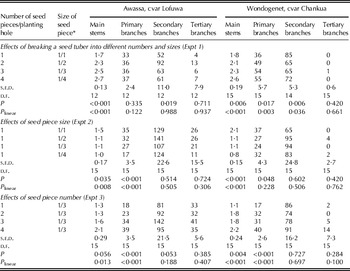
Breaking a standard-sized tuber into an increasing number of seed pieces before planting them together in a single planting hole significantly increased the number of main stems/hill in both experiments (Table 1); it did not affect the number of primary branches in the Awassa experiment, but increased the number in the Wondogenet experiment (Table 1). The number of secondary branches per hill differed significantly among treatments with the largest numbers being found for mother tubers broken into two seed pieces in the Awassa experiment and the unbroken seed tubers in the Wondogenet experiment (Table 1). There was no effect of breaking on the number of tertiary stems; tertiary stems were only occasionally observed in Wondogenet (Table 1).
Effects of different seed tuber piece sizes and numbers on the number of main stems and primary, secondary and tertiary branches/hill in six experiments in Awassa (cvar Lofuwa) and Wondogenet (cvar Chankua). Data from 133 DAP (Awassa and Expt 1 in Wondogenet) or 132 DAP (Expts 2 and 3 in Wondogenet)

* Size is expressed as the proportion of one whole mother tuber of 0·12–0·15 m long, in which 1/1=one unbroken mother tuber, 1/2=half a mother tuber, etc.
Yield components
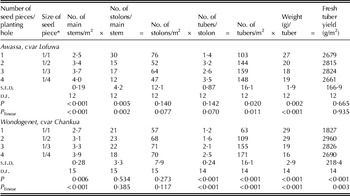
The increase in number of main stems was accompanied in Awassa by a decrease in the number of stolons/main stem when breaking one mother tuber into an increasing number of pieces, whereas the number of stolons/main stem was not significantly affected in Wondogenet (Table 2). The resulting number of stolons/m2 was not significantly affected by breaking in both experiments (Table 2). Breaking increased the number of tubers/stolon in the Wondogenet experiment but not in the Awassa experiment (Table 2). Nevertheless, breaking the mother tuber into more pieces clearly increased the number of tubers/m2 in both experiments (Table 2). Average tuber size significantly decreased by breaking into more pieces. The combined effect of this was that the fresh tuber yield/m2 was not affected by breaking at Awassa, but significantly increased at Wondogenet by breaking one mother tuber into two to four seed pieces (Table 2).
Effects of breaking one seed tuber into different numbers of pieces (Exp. 1) in Awassa (cvar Lofuwa) and Wondogenet (cvar Chankua) on tuber yield and underlying variates. Numbers of main stems and stolons were assessed at 133 DAP, numbers of tubers 243 DAP

* Size is expressed as the proportion of one whole seed tuber of 0·12–0·15 m long, in which 1/1=one unbroken tuber, 1/2=half a tuber, etc.
Tuber weight distribution
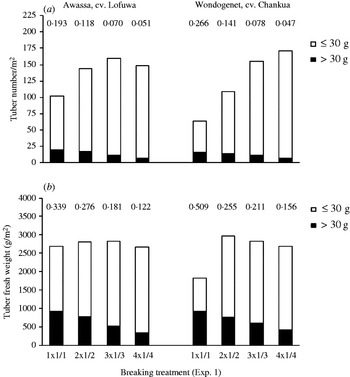
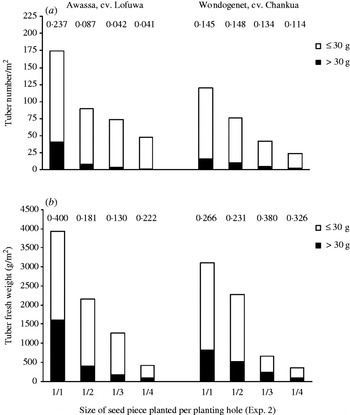
In both experiments, breaking a mother tuber into more pieces resulted in an increase in the number and weight of small tubers (⩽30 g) and a decrease in number and weight of larger tubers (>30 g; Fig. 1). Small tubers usually constituted the majority of the number and weight of the tubers. The fraction of large tubers decreased consistently when seed tubers were broken into more pieces, to on average 0·05 of the tuber number and 0·14 of the tuber weight when seed tubers were broken into four pieces (Fig. 1).
Effects of breaking a seed tuber into an increasing number of smaller pieces before planting all in one planting hole (Expt 1) on (a) number and (b) fresh weight of tubers in two weight classes (⩽30 g and >30 g/tuber), in Awassa (cvar Lofuwa) and Wondogenet (cvar Chankua). Values in the upper parts of the diagrams are the proportions of tubers >30 g. 1×1/1=planting one unbroken tuber per planting hole, 2×1/2=planting two halves per planting hole, 3×1/3=planting three pieces of a seed tuber broken in three pieces per planting hole, 4×1/4=planting four pieces of a seed tuber broken into four pieces in one planting hole. s.e.d. for tuber number in Awassa are 15·03 (d.f.=12), 1·84 (d.f.=12) and 0·0117 (d.f.=12) for tubers ⩽30, >30 and the proportion >30 g respectively, s.e.d. in Wondogenet are 16·10 (d.f.=14), 1·24 (d.f.=15) and 0·0230 (d.f.=14) for the respective variates. s.e.d. for tuber weight in Awassa are 148·8 (d.f.=12), 84·0 (d.f.=12) and 0·0271 (d.f.=12) for tubers ⩽30, >30 and the proportion >30 g, respectively, s.e.d. in Wondogenet are 169·6 (d.f.=15), 80·6 (d.f.=15) and 0·0212 (d.f.=15) for the respective variates.

Experiment 2: effect of seed piece size
Stem and branch development
Planting smaller seed pieces at a rate of one piece/planting hole decreased the number of main stems/hill at both locations (Table 1). For the smallest size planted, not all pieces successfully established a plant, as shown by the number of main stems/hill being <1. Also fewer primary branches developed on plants from smaller tuber pieces in Awassa but not clearly in Wondogenet, whereas the number of secondary and tertiary branches on plants grown from different-sized seed tuber pieces was not significantly different in both experiments (Table 1).
Yield components
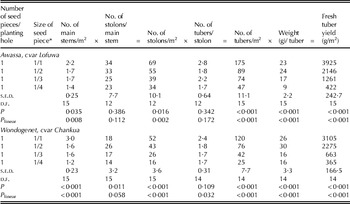
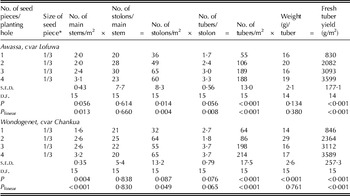
The number of stolons/main stem and the number of tubers/stolon were not affected at Awassa by the size of the seed piece, whereas at Wondogenet, while there was no linear effect on number of stolons/main stem at Wondogenet, there was a reduction in the number of tubers/stolon when seed pieces were smaller (Table 3). Nevertheless, the number of stolons/m2 and the number of tubers/m2 significantly decreased with a decrease in the individual seed piece size. In addition, the average individual tuber weight was reduced in the case of the smaller seed pieces (1/3 and 1/4). Fresh tuber yield declined more than proportionally with a decrease in individual seed piece size over the entire range in both experiments (Table 3).
Effects of the size of the seed tuber piece planted (one piece/planting hole) on tuber yield and underlying variates (Expt 2) in Awassa (cvar Lofuwa) and Wondogenet (cvar Chankua). Numbers of main stems and stolons were assessed at 133 DAP in Awassa and 132 DAP in Wondogenet, numbers of tubers were assessed at 243 DAP in Awassa and 242 DAP in Wondogenet

* Size is expressed as the proportion of one whole seed tuber, in which 1/1=one unbroken tuber of 0·12–0·15 m long, 1/2=half a tuber, etc.
Tuber weight distribution
The tuber number and weight in both weight classes, ⩽30 g and >30 g, significantly decreased when the seed piece size decreased in both experiments (Fig. 2). At Awassa, the relative decrease in tuber number was largest in the >30 g class, resulting in a decreasing proportion in number of large tubers across all treatments (Fig. 2a) and a decreasing proportion of the weight of large tubers across the range between whole seed tubers down to 1/3-sized seed pieces (Fig. 2b). At Wondogenet, the proportion of large tubers was not affected by planting smaller seed pieces (Fig. 2a), whereas the proportion by weight in the larger tuber class tended to increase when planting smaller seed pieces (Fig. 2b).
Effects of the size of the seed of the seed piece planted (Expt 2) on (a) number and (b) fresh weight of tubers in two weight classes (⩽30 g and >30 g/tuber), in Awassa (cvar Lofuwa) and Wondogenet (cvar Chankua). Values in the upper parts of the diagrams are the proportions of tubers >30 g. 1/1=one whole tuber, 1/2=one half tuber, 1/3=one piece of a tuber broken into three, 1/4=one piece of a tuber broken into four. s.e.d. for tuber number in Awassa are 9·45 (d.f.=15), 4·17 (d.f.=15) and 0·0223 (d.f.=15) for tubers ≤30, >30 and the proportion >30 g respectively, s.e.d. in Wondogenet are 7·60 (d.f.=14), 0·98 (d.f.=15) and 0·0292 (d.f.=14) for the respective variates. s.e.d. for tuber weight in Awassa are 128·0 (d.f.=15), 175·1 (d.f.=15) and 0·0521 (d.f.=15) for tubers ⩽30, >30 and the proportion >30 g respectively, s.e.d. in Wondogenet are 112·3 (d.f.=14), 72·2 (d.f.=15) and 0·0411 (d.f.=14) for the respective variates.

Experiment 3: effect of seed piece number
Stem and branch development
When planting more tuber pieces of the same size per planting hole, the number of main stems and primary branches/hill increased linearly in both experiments (Table 1). The numbers of secondary and tertiary branches/hill were not affected.
Yield components
The number of stolons/main stem was not significantly affected by the number of seed tuber pieces planted (Table 4). The number of stolons/m2 increased when the number of seed tuber pieces planted/hill increased from one to two or three, and then levelled off. The number of tubers/stolon usually showed higher values when more seed tuber pieces were planted per hill, and consequently the number of tubers/m2 significantly increased as the number of seed tuber pieces of similar size per hill increased. The weight/tuber varied and did not show any clear tendency with changing number of pieces planted. Tuber fresh weight/m2 increased over the whole range, in both the Awassa and Wondogenet experiments (Table 4).
Effect of the number of seed pieces/planting hole (Expt 3) on tuber yield and underlying variates in Awassa (cvar Lofuwa) and Wondogenet (cvar Chankua). Numbers of main stems and of stolons were assessed at 133 DAP in Awassa and 132 DAP in Wondogenet, numbers of tubers were assessed at 243 DAP in Awassa and 242 DAP in Wondogenet

* To create similar-sized tuber pieces, one standard-sized seed tuber of 0·12–0·15 m long was broken into three pieces. As standard-size seed tubers were limited in number, also large tubers (a fraction of c. 0·30 of all tubers used) were broken into four pieces to create the desired size. The weight of each tuber piece was 15–18 g.
Effects on tuber weight distribution
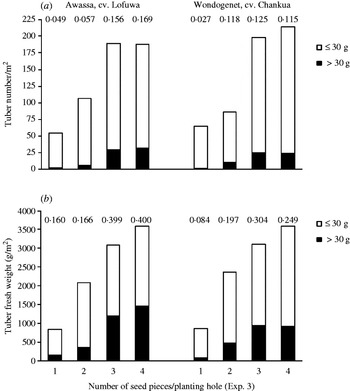
Planting more seed pieces/planting hole increased the number and weight of tubers in both weight classes, ⩽30 g and >30 g, as well as the proportion by number and weight of the large tubers (Figs 3a and b).
Effects of the number of seed pieces planted per planting hole (Expt 3) on (a) number and (b) fresh weight of tubers in two weight classes (⩽30 g and >30 g/tuber), in Awassa (cvar Lofuwa) and Wondogenet (cvar Chankua). Values in the upper parts of the diagrams are the proportions of tubers >30 g. For size of seed pieces, see explanation with Table 4. s.e.d. for tuber number in Awassa are 12·67 (d.f.=15), 5·65 (d.f.=15) and 0·0263 (d.f.=15) for tubers ⩽30, >30 and the proportion >30 g, respectively, s.e.d. in Wondogenet are 15·66 (d.f.=15), 2·79 (d.f.=15) and 0·0112 (d.f.=15) for the respective variates. s.e.d. for tuber weight in Awassa are 142·4 (d.f.=14), 125·1 (d.f.=14) and 0·0379 (d.f.=14) for tubers ⩽30, >30 and the proportion >30 g, respectively, s.e.d. in Wondogenet are 127·1 (d.f.=15), 145·1 (d.f.=15) and 0·0359 (d.f.=15) for the respective variates.

DISCUSSION
Main stem formation from seed tuber pieces
The tuber of P. edulis is a stem tuber and possesses compound ‘eyes’ with buds that can sprout and produce stems, as also occurs in the Irish potato. The formation and survival of main stems were logically the result of (a) differences between the seed tuber pieces in amount of reserves (carbohydrate and mineral) and number of buds available for initial stem growth, (b) the intra-plant competition between main stems from the same tuber piece, and (c) the inter-plant competition between plants produced from different pieces in one hill.
Breaking a mother tuber of 0·12–0·15 m into two to four pieces before planting increased the number of tuber buds that grew successfully into main stems (Expt 1, Table 1). This practice is sometimes also applied in other tuber crops such as Irish potato to increase the number of stems by circumventing the dominance of nearby stems (e.g. van der Zaag & Demagante Reference Vander Zaag and Demagante1989). Planting more pieces/hole after breaking outweighed the negative effect of a lower weight of the individual seed pieces on number of main stems (Expt 2, Tables 1 and 3). Breaking a medium-sized P. edulis tuber into more than two pieces (3×1/3 or 4×1/4 tuber) before planting, however, reduced the success rate of an individual seed tuber piece to produce a surviving main stem to less than one and the number of main stems/hill was lower than the number of pieces planted (Table 1). Also, planting two or more 1/3-sized pieces in Expt 3 reduced the success rate to less than one main stem/seed piece (cf. Table 1). These low success rates may be caused by weaker stems from smaller (1/3- and 1/4-sized) seed tuber pieces, that were less likely to survive early inter-plant competition between plants within the same hill. It is unknown whether treatment of tuber pieces, as is common practice when planting, e.g., sets of yam (e.g. Morse et al. Reference Morse, McNamara and Acholo2009), would have enhanced survival. The low success rate was not merely caused by a lack of tuber reserves or buds of the seed tuber piece, because planting the same size of tuber pieces alone without competition resulted in more stems/piece being established, e.g. planting a single 1/3 tuber piece/hole resulted in more than one main stem in Expts 2 and 3 (Table 1). Nevertheless, lack of buds or tuber reserves might have had an additional role in limiting the stem production of small seed pieces (Expts 1 and 2, Table 1), because several tuber buds had already produced sprouts during storage and these sprouts were removed before planting. The observation that not all 1/4-sized pieces did produce a main stem when planted individually in Expt 2 (Table 1) supports this interpretation.
Relations between number of main stems, number of stolons, number of tubers and tuber yield
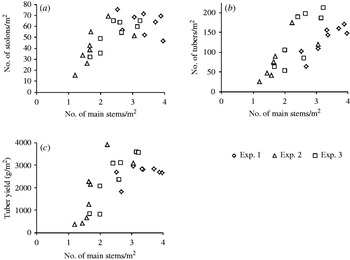
The number of main stems ranged between 1·19 (Table 4) and 3·95/m2 (Table 2), as summarized in Fig. 4. More main stems per unit area were achieved by planting more pieces/planting hole or by planting larger-sized pieces. In the individual experiments, clear and comparable effects of treatments were found on number of main stems/m2 and number of tubers/m2, whereas the effects on number of stolons/m2 were not found when breaking seed tubers. The latter is in contrast with what is common in Irish potato, where the fraction of stolons forming a tuber is rather constant over a wide range of agronomically relevant conditions resulting in a close relationship between stolon number and tuber number (Struik et al. Reference Struik, Haverkort, Vreugdenhil, Bus and Dankert1990, Reference Struik, Vreugdenhil, Haverkort, Bus and Dankert1991).
Scatter plots showing the associations across experiments between number of main stems and (a) number of stolons, (b) number of tubers and (c) tuber fresh yield. Data from Tables 2–4.

Across all experiments, more main stems/unit area resulted in more stolons up to about two main stems/m2, whereas at 2·5 main stems/m2 and higher the number of stolons seemed to reach a plateau (Fig. 4a). This would explain why the effects of breaking (Expt 1, Table 2) on number of stolons were not significant: most of the treatments in these experiments resulted in a high number of main stems. Numbers of stolons were reduced when smaller tuber pieces were planted at one per planting hole (Table 3), or when fewer 1/3-sized tuber pieces were planted per planting hole (Table 4). These treatments resulted in fewer stolons and fewer stems.
More main stems also resulted in more tubers, but in this case the increase with number of stems continued across almost the full range of stem numbers (Fig. 4b); relations between numbers of tubers and stems were visible in all experiments (Tables 2–4, Fig. 4b), but there was a considerable influence of the experiment on the relationship.
It is not clear why the numbers of stolons and tubers were differentially related to number of stems, but it might be that the number of stolons was limited by the number of lower stem buds on main stems and primary branches from which stolons could originate, whereas the potential number of stolon tips where tubers could be initiated could enlarge by branching of stolons. In addition, some tubers were produced by swelling of the middle parts of stolons.
Tuber fresh yield increased with an increase in the number of main stems up to about three main stems/m2 and then levelled off (Fig. 4c). Below that, the interception of radiation and the allocation of dry matter produced to tubers probably limited tuber production. Radiation interception was not measured in the present experiments, but the significant effects on primary branch numbers in Expts 2 and 3 (Table 1) following the same trends as tuber yields in these experiments (Tables 3 and 4) indicate the relevance of proper haulm development. Treatments with low main stem and primary branch numbers (Expts 2 and 3) seemed to compensate for this by producing extra secondary branches/stem; there were no differences between treatments in the number of secondary and tertiary branches/hill in Expts 2 and 3 (Table 1). This extra vegetative growth might have reduced or delayed the allocation of dry matter produced to the tubers and could explain why tuber yield in hills from small seed pieces was more than proportionally reduced in Expt 2 (Table 3; Fig. 2). This phenomenon is also observed in field crops from minitubers in Irish potato, where smaller minitubers reduce the harvest index of the crop (Lommen & Struik Reference Lommen and Struik1994). In addition, the higher number of tuber sinks in treatments with high numbers of stems may have enhanced net assimilation rates and tuber yield.
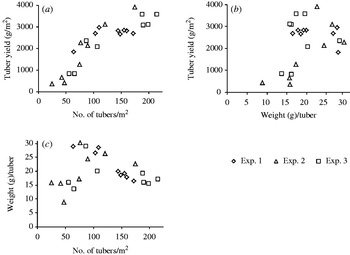
Tuber weight distribution and its manipulation is complex in many tuber crops, including Irish potato (cf. Struik et al. Reference Struik, Haverkort, Vreugdenhil, Bus and Dankert1990, Reference Struik, Vreugdenhil, Haverkort, Bus and Dankert1991). In Irish potato, there usually is a negative relationship between number of tubers produced and average tuber weight, at least when variation in number of tubers is associated with agronomic factors such as water supply and number of stems per unit area. In the present dataset of P. edulis, a negative relationship between number of tubers and average tuber weight was not common (Fig. 5c). A negative association was only observed in the higher range of tuber numbers, whereas in treatments yielding very low tuber numbers the average weight/tuber was relatively low. The latter typically occurred in those treatments in which the total tuber piece weight planted per hole was small (1×1/4 or 1×1/3) (Fig. 5c, Tables 3 and 4). Moreover, when significant effects on fresh tuber yield were observed in the present dataset, then these effects were never realized by an increase in the individual tuber weight alone (Figs 2a and b), but an increase in tuber fresh weight was either achieved by an effect on number of tubers alone (Expt 2) or a combined effect on number of tubers and individual tuber fresh weight (Expt 3). In other cases, opposite effects on numbers of tubers and individual tuber weight cancelled each other out.
Scatter plots showing the overall relationships across experiments between number of tubers, average weight/tuber and tuber yield. (a) number of tubers v. tuber yield, (b) average weight/tuber v. tuber yield, (c) number of tubers v. average weight/tuber. Data from Tables 2–4.

Comparison to farmers’ yields
The fresh tuber yield level obtained in the present set of experiments was two to four times higher than the yields reported by farmers, who traditionally plant two or three pieces/hole of a size of 1/2 of tuber of 0·10–0·15 m (2–3×1/2 tuber) and report yields of 500–1000 g/hill (Taye et al. Reference Taye, Lommen and Struik2007). The treatments in the present work that were closest to these traditional practices were: breaking a tuber into two pieces in Expt 1 (2×1/2 tuber) and planting three pieces of 1/3 tuber in one hole in Expts 1 and 3 (3×1/3 tuber). These treatments resulted in 2815, 2814 and 3093 g fresh weight/m2, respectively, in Awassa and 2960, 2826 and 3112 g fresh weight/m2, respectively, in Wondogenet, on average 2937 g/m2 or 1982 g/hill.
Yield levels in the present set of experiments, obtained in c. 8 months, were >50% higher than the highest values reported thus far for this crop, under comparable conditions but in only c. 7 months (Taye et al. Reference Taye, Lommen and Struik2011), suggesting that crop yield benefits from a long growing period.
Implications
The optimum for farmers would be to strive towards approximately three main stems/m2 in order to achieve high yield levels. This is usually achieved by planting sufficient seed tuber material (equalling at least one medium-sized mother tuber per planting hole) and breaking seed tubers into two or three pieces. This is in accordance with farmers’ practice (Taye et al. Reference Taye, Lommen and Struik2007). Breaking a seed tuber into seed pieces before planting also increased the total number of tubers/m2, but consistently reduced the number and proportion of larger tubers. Breaking a tuber into more than three pieces strongly decreased the success rate by which main stems establish from seed pieces. At the yield levels of c. 30 t/ha obtained in the present dataset, more stems/m2 did not lead to higher yield, but increased the number of (small) tubers and reduced the average tuber weight further (Tables 2 and 3).