1. Introduction
Proof of concept research is ubiquitous in science. Scientists commonly characterize early stage research as that of proof of concepts or proof of principles (e.g., Gould Reference Gould2005; Servedio et al. Reference Servedio, Brandvain, Dhole, Fitzpatrick, Goldberg, Stern, Van Cleve and Justin Yeh2014).Footnote 1 They employ it in many disciplines, from medicine and theoretical biology to engineering, and it can involve everything from exploratory work and testing causal hypotheses to data mining and computer simulation. Furthermore, funding agencies have developed programs for proof of concept research, although these often focus on translating scientific research into marketable widgets (e.g., NSF 2017). Given this heterogeneity of proof of concept research, how do scientists judge it as successful or not?
Philosophers have just begun to study and articulate general frameworks and evaluation criteria for proof of concept research. A promising route to do so is to study how scientists conduct and evaluate proof of concept research in practice (Plutynski Reference Plutynski2005; Kendig Reference Kendig2016). This strategy aligns with similar efforts for studying and articulating evaluation criteria in kindred parts of science, such as in exploratory experimentation (Elliott Reference Elliott2007), data science (Elliott et al. Reference Elliott, Cheruvelil, Montgomery and Soranno2016; Leonelli Reference Leonelli2016), and simulation science (Winsberg Reference Winsberg and Zalta2015). By studying scientific practices and articulating these frameworks, philosophers better describe varieties of arguments and criteria that scientists use to evaluate their work and that of their peers. Once explicit, these criteria can be further studied, critiqued, and refined, and they can be used to foster epistemological research into understudied institutions of science, such as funding agencies (O—Malley et al. Reference O’Malley, Elliott, Haufe and Burian2009; Haufe Reference Haufe2013).
In this article, I propose a general framework for proof of concept research, and I describe some of the arguments researchers use to evaluate proof of concept research as successful or not. Briefly, researchers who conduct proof of concept research aim to establish a prototype and to argue for the continued development of that prototype in settings beyond those in which it was established. The “concept”? proved in such research is that the prototype achieves functions or results expected or desired of it. The framework includes three primary parts: prototypes; proof of concept demonstrations, which establish that prototypes achieve their expected or desired results; and post facto arguments, which use heuristics to argue pragmatically for the further development of prototypes. This framework knits together and augments various aspects of previous discussions about proof of concept research so as to apply across the sciences. But the framework is not exhaustive. One route to develop it is to describe the varieties or kinds of prototypes, proof of concept demonstrations, and post facto arguments that scientists use in practice in many different fields. I do so here for theoretical evolutionary genetics.
Given long-standing debates about the value of theoretical evolutionary genetics and the results generated within it (Rao and Nanjudiah Reference Rao and Nanjudiah2011; Okasha Reference Okasha and Zalta2016), many have sought to account for how it yields good science. Recently, a team of theoreticians argued influentially that theoretical evolutionary genetics yields models that function as proofs of concepts (Servedio et al. Reference Servedio, Brandvain, Dhole, Fitzpatrick, Goldberg, Stern, Van Cleve and Justin Yeh2014). That argument is consistent with Plutynski's independently developed account of population genetics as providing proofs of principles or of possibilities (Reference Plutynski2004, Reference Plutynski2005, Reference Plutynski2006a, Reference Plutynski2006b). Here, I articulate some of the arguments used to evaluate prototype models in theoretical evolutionary genetics and show how they fit the general framework for proof of concept research. My discussion of these kinds of arguments is not exhaustive, nor are the kinds of arguments articulated here always invoked, but they do reveal how biologists sometimes argue for theoretical evolutionary modeling as worthwhile both epistemically and pragmatically.
To develop and illustrate the general framework and articulate some evaluation criteria used in theoretical evolutionary genetics, I pursue the following strategy. In the next section I review contemporary discussions of proof of concept research, and in section 3 I knit them together and augment them in a general framework. Next I describe a case of a recent project that fits the kind of research characterized as proof of concept by Servedio et al. (Reference Servedio, Brandvain, Dhole, Fitzpatrick, Goldberg, Stern, Van Cleve and Justin Yeh2014). In section 5, I show how the case illustrates my accounts of prototypes and of proof of concept demonstrations. I also articulate two kinds of more specific demonstrations used in the case: coherence models calibration (CMC) and scope demonstration. In section 6, I articulate three heuristics used in post facto arguments, and I illustrate their use in the case study. Given the heterogeneity of proof of concept research, I do not claim that my discussion here exhausts it. Instead, I conclude by indicating further routes by which to develop the framework.
2. Contemporary Views of Proof of Concept Research
Among philosophers, Catherine Kendig has done the most to elucidate proof of concept research, illustrating it with cases from synthetic biology (Reference Kendig2016).Footnote 2 For Kendig, proofs are experiments with which researchers show that a hypothetical model, the concept, obtains in a test case. She discusses cases in which researchers first engineered Cyanobacteria to efficiently produce biofuels. These researchers engineered Cyanobacteria, they specified the causal hypothesis about producing biofuel as the focal concept, and they proved the concept with wet-lab experiments involving the bacteria. Kendig says that these experiments, taken as practices, shape knowledge-making categories, of which she highlights the concept of reengineering systems and processes, that enable generalization.
Kendig says an experimental proof shows that a causal hypothesis is possibly true for a wider range of items like the object studied. After the experimental proof in the biofuel case, researchers classed the reengineered Cyanobacteria as good chassis organisms for further biofuel research. For Kendig, the general assumption distinctive of such experimental proof of concept research is that “if it works here, it will also [work] in all cases like this,”? when like cases share causal mechanisms, structures, functions, and so on (Reference Kendig2016, 740). She calls this a projectability assumption, and she indicates a somewhat broader version, arguing that successful test cases provide “justification in practice of the potential transportability of that research,”? including both the concept proved and the practices used to do so (737). This second assumption involves only potential transportability, whereas the first implies a stronger projection to all like cases.
Kendig's discussion is a good starting point, providing several aspects for further development. First, the two projectability assumptions, and their application in cases, might be fruitfully elucidated to indicate how the assumptions are used differently. Second, it is not clear how the projectability assumptions Kendig proposes differ from those used in other experimental projects not normally classed as proof of concept research. Consider situations in which synthetic biologists show how to use the already established Cyanobacteria chassis to produce biofuel more efficiently or with a slightly altered component set. Both of Kendig's projectability assumptions apply in these situations, indicating that research that involves perhaps any tweak to a research design or object of study should be classed as proof of concept. If so, then a wider array of research than is often presumed should be classed as proof of concept. A different strategy would argue that there are some other aspects of proof of concept research, beyond the application of the projectability assumptions, that more specifically characterize proof of concept research. I later pursue this second strategy by invoking the discipline-relative novelty of prototypes studied. Third, while synthetic biologists often employ computer simulations, Kendig focuses on wet-lab experiments. Her discussion can be complemented with accounts of how researchers evaluate and export computer models from other investigative contexts, especially more theoretical ones.
For theoretical investigations, Gelfert (Reference Gelfert2016, Reference Gelfert, Christian, Hommen, Retzlaff and Schurz2018) argues that proofs of principles provide one criterion for evaluating the success of models. He says that models function as proofs of principles when they establish that a “type of approach or methodology is able to generate potential representations of target phenomena,”? which he illustrates with Lotka-Volterra modeling, and he coins the useful term of “proof of principle demonstrations”? to denote the things that do so (Gelfert Reference Gelfert2016, 85). Ultimately, however, Gelfert's goal is to relate proof of principle research to his broader account of exploratory modeling, and he does not articulate forms for such demonstrations.
For evolutionary genetics in particular, Anya Plutynski argues that theoreticians provide proofs of principle or of possibility. When they demonstrate theorems, as did Fisher with his fundamental theorem of natural selection, they establish which conditions (e.g., population size, drift) influence a process (e.g., natural selection) that yields a general phenomenon (e.g., evolutionary change) and which conditions do not (e.g., orthogenesis, saltation; Plutynski Reference Plutynski2005, Reference Plutynski2006b). When they analytically infer results from models, they prove “what must be so, for any population that fits (ceteris paribus) the description [of] the model”? (Plutynski Reference Plutynski2004, 1205). Either way, theoreticians explain which evolutionary phenomena are possible or necessary within a precise theoretical framework.
Plutynski notes that the role of theoretical models and of analytical results can change over time. Early in a research program, they can establish the explanatory scope of a framework (e.g., mathematized selection), they can obviate competing programs (e.g., orthogenesis), and they can show how to unify seemingly incompatible frameworks (e.g., Mendelism and biometry; Plutynski Reference Plutynski2004, Reference Plutynski2005, Reference Plutynski2006a, Reference Plutynski2006b). Later, they might be used alongside other modeling strategies to provide a consilience of induction for a given evolutionary claim that otherwise lacks more direct evidential support, rendering that claim plausible (Plutynski Reference Plutynski2001).
Plutynski's account suggests several routes for further development. Most importantly, she illustrates a philosophical program for articulating the wider variety of criteria that evolutionary geneticists use in practice to evaluate precision frameworks, theorems, and models. Two such criteria stand out for further articulation: how analytically inferred results relate (1) to results inferred from theories couched in natural language and (2) to results generated via computer simulation, now widely used among theoreticians, as cursorily discussed by Plutynski. Second, Plutynski showed that theoreticians also evaluate analytical results in relation to the prospects for competing research programs. Still to be articulated, however, are the structures of the arguments researchers use in making those assessments, especially in nascent projects.
Among biologists, a team led by Maria Servedio has recently proposed an influential framework for proof of concept research in theoretical evolutionary genetics (Servedio et al. Reference Servedio, Brandvain, Dhole, Fitzpatrick, Goldberg, Stern, Van Cleve and Justin Yeh2014). They propose that a “clear verbal model lays out explicitly which biological factors and processes it is (and is not) considering and follows a chain of logic from these initial assumptions to conclusions about how these factors interact to produce biological patterns”? (2; cf. Plutynski Reference Plutynski2006b, 61). But given that such processes are often complex, reasoning via verbal models alone is often too imprecise to settle disagreements about their soundness. Proof of concept models explicate the verbal model in a precise mathematical framework, make previously implicit assumptions explicit, and enable more precise and explicit chains of reasoning from models to consequences. By doing so, such models have a unique function. “The models themselves are tests of whether verbal models are sound; if their predictions do not match, the verbal model is flawed, and that form of the hypothesis is disproved”? (Servedio et al. Reference Servedio, Brandvain, Dhole, Fitzpatrick, Goldberg, Stern, Van Cleve and Justin Yeh2014, 2”?3).
This account has strengths and weaknesses. It provides a unique role for proof of concept research within theoretical evolutionary genetics, and it captures much of how theoreticians evaluate proof of concept models. But it also conflates concepts of models with that of chains of reasoning that invoke models, saying that mathematical models are themselves tests of verbal models. Furthermore, the account assumes that the only form of reasoning used to evaluate mathematical models as proofs of concepts is via comparison of predictions across verbal and analytical models. There is more to be said about the kinds of reasoning used in proof of concept research, especially for cases involving numerical computer simulations, now widely employed among theorists.
The accounts above miss many of the practical motives researchers have for conducting proof of concept research. Biomedical researchers are more explicit about these motives. For them, proof of concept research is as an aspect of phases 1 or 2 in the standard four-phase evaluation process for therapeutic drugs and vaccines (Schmidt Reference Schmidt2006). They note that such studies aim to roughly estimate treatment effect sizes so that researchers can design later-phase studies about the effectiveness of medicines (Gould Reference Gould2005). Such studies also help researchers decide whether to proceed with further studies, and if successful, they enable researchers to recruit collaborators and secure funding for further studies (Schmidt Reference Schmidt2006).
While all of those previous discussions are suggestive of a general framework for proof of concept research that applies across empirical and theoretical projects, none provides one. Given their focuses on particular sciences (experimental synthetic biology, theoretical evolution, medicine), they can appear narrow in scope. Furthermore, while they discuss the kinds of arguments and evaluation criteria used in proof of concept research, only a few have been sketched. In the next section, I knit together aspects from the previous discussions to address those two issues.
3. A General Framework
Proof of concept research aims to establish that prototypes achieve functions or results desired of them and to argue for their continued development in settings beyond those in which they were established. A general framework for proof of concept research includes prototypes, proof of concept demonstrations, and post facto arguments.
Prototypes are artifacts that are importantly novel compared to their historical forerunners. This novelty, rather than the potential for exportability, distinguishes proof of concept research from later-stage research. Prototypes can be engineered physical items, and they can be theories or models. Forerunners are any items used before a prototype but that may be similar in some sense to the prototype in structure or application and that may provide pieces cannibalized and reused in the prototype. Researchers judge the novelty of prototypes relative to disciplinary norms. What those in one discipline consider novel, those in another might consider just a tweak to an extant artifact. Researchers evaluate prototypes with proof of concept demonstrations. Prototypes can be negatively evaluated, or fall short of the standards of a proof of concept demonstrations, and still be prototypes. They are just failed prototypes.Footnote 3 Kendig, Schmidt, and Gould focus on prototypes as physical artifacts like engineered bacteria cultures or medicines. Plutynski, Gelfert, and Servedio's team focus on models and theories. Regardless, they talk about novel artifacts at the leading edge of science.Footnote 4
Proof of concept demonstrations show that prototypes achieve functions or results desired of them. For physical artifacts, these demonstrations may be performances of a prototype staged for an audience, as with a launch of a novel rocket. More often these demonstrations are chains of reasoning or arguments that can be published. For physical prototypes, as in Kendig's biofuel case, these arguments relate data to descriptions of the prototype for empirical evaluation. For prototype theories or models, taken as abstract artifacts, these arguments show that the prototypes achieve epistemic functions or aims, such as describing, predicting, or explaining phenomena. Furthermore, those demonstrations may be modal, as with how-possible or how-actual explanations. In many cases, the kinds of arguments are not unique to early stage research. Scientists throughout the sciences and throughout different stages of research use arguments to show that theories and models perform epistemic functions. These arguments become proof of concept demonstrations only when they involve prototypes. In such cases, the phenomenon of interest may also be more circumscribed than in later stages of research. This account of proof of concept demonstrations augments Gelfert's (Reference Gelfert2016, Reference Gelfert, Christian, Hommen, Retzlaff and Schurz2018) discussion by explicitly invoking notions of chains of reasoning or arguments, by applying both in theoretical and in empirical investigations, and by acknowledging different modalities of phenomena as legitimate objects of study.
Finally, post facto arguments are arguments that researchers use after they have established a prototype with a proof of concept demonstration. Post facto arguments rely on fallible heuristics to argue for further research that uses the prototypes in question. It is these arguments, and their anticipated uses, that provide scientists with motivations for designing and conducting proof of concept research.
Post facto arguments license practical claims about how prototypes might further be used in new or expanded research projects. Researchers often design prototypes to be simple, with the idea that, if they are positively evaluated, then they provide templates on which to build and evaluate more complex physical artifacts, models, or theories. Despite a demonstrated proof of concept, researchers often lack substantial justifications, characteristic of later stages of research, for exporting these prototypes to further investigative contexts or for projecting early results to larger classes. This lack of substantial justification is due to the simplicity and novelty of prototypes and to the fact that proof of concept research is often at the most distal leading edge of research, where relevant data and analyses are often scarce. Post facto arguments thus rely on fallible heuristics, like the projectability assumptions discussed by Kendig. They also underwrite arguments for comparatively evaluating competing research programs, as discussed by Plutynski. And they license practical issues of research, such as for expending further resources to develop prototypes or protocols or conducting later stage research, as discussed by Gould and Schmidt.
This general framework for proof of concept research knits together and augments earlier insights about proof of concept research. The framework also enables a philosophical program of articulating the different kinds of proof of concept demonstrations and post facto arguments that scientists use in practice. In the sections to follow, I illustrate this program with a case study from theoretical evolutionary genetics.Footnote 5 Unlike previous discussions, I focus on a project that involves computer simulations. I show how the case illustrates each part of the framework, I articulate structures for proof of concept demonstrations heretofore undescribed, and I make explicit the kinds of heuristics the team used in post facto arguments. In so doing, the case study indicates how scientists sometimes judge results from theoretical population genetics as both epistemically and practically valuable.
4. Case Description
Constructing Multimodel Systems
In 1998, Norman Johnson and Adam Porter at the University of Massachusetts, Amherst, began a project to study the genetics of speciation. They focused on speciation due to hybrid incompatibilities (HI), which they had independently studied in animal populations. HI occurs when parents from related but distinct lineages yield hybrid offspring that are less fit than are the parents. Johnson and Porter felt that extant models for the genetics of HI failed to adequately capture how genes functioned in relation to each other, yielding unrealistic models and results. Johnson and Porter focused on epistasis, the phenomenon by which the products of multiple genes affect a single phenotype, and on pleiotropy, the phenomenon by which the products of a single gene affect multiple phenotypes. They thought that the mechanistic details of those phenomena could importantly affect HI and that they could show how with quantifiable precision. I discuss the history of their project up to 2008.
Johnson and Porter began with a rough verbal model, in the sense of Servedio et al. (Reference Servedio, Brandvain, Dhole, Fitzpatrick, Goldberg, Stern, Van Cleve and Justin Yeh2014), of the phenomenon they wanted to study. They later presented that model as a proposition for which they would study its plausibility. “We propose that regulated genetic pathways are a biologically realistic way to provide the complex epistatic gene interaction seen in empirical studies of hybrid fitness reduction. Here we investigate the plausibility of this proposition”? (Johnson and Porter Reference Johnson and Porter2000, 528). The quote indicates a verbal prediction: that gene regulatory processes, when varied across individuals within populations, can affect processes of HI and speciation. To quantifiably investigate the plausibility of that verbal model, Johnson and Porter developed a theoretical system of at least four models. Because of constraints on resources, they opted to evaluate the multimodel system analytically and with individual-based computer simulations, rather than with actual populations. They ran their initial simulations in 1998 and 1999, publishing them in Johnson and Porter (Reference Johnson and Porter2000). The results netted them a National Science Foundation grant in 2000 to sustain their project into the mid-2000s.
The first model in the multimodel system, implicit in the verbal model, was a standard framework for how populations diverged from one another and speciated. In this framework, called the Bateson, Dobzhansky, Muller (BDM) model of speciation, two lineages of a founder population are prevented from interbreeding because of something like barriers or large distances between them. At regular intervals across generations, researchers enable a set of hybrids across the two lineages, and they compare the fitnesses of the hybrids to those of their parents. If the hybrids are less fit than their parents, then the researchers conclude that speciation is underway, and once hybrids are not reproductively viable, the two lineages are distinct species. If Johnson and Porter could show that—in BDM-like situations'selection on the mechanistic details of pleiotropy and epistasis could lead to HI, then they would show that those details influenced speciation processes.
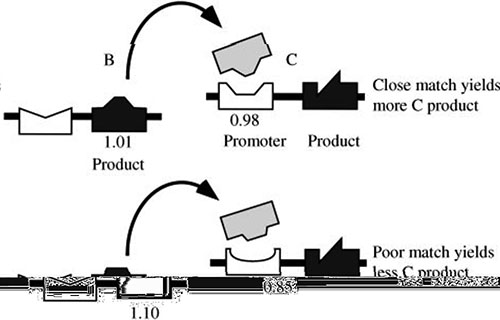
The second model in the system was a mechanistic model for gene regulatory epistasis (fig. 1) that applied at the molecular level within organisms. Developmental geneticists usually study epistasis as a set of regulatory processes that include genes producing RNAs and proteins, those RNA and protein products moving within and between cells, and those products attaching to target genes or putting in motion other molecules that attach to target genes. By attaching to target genes, molecules affect if, when, where in the organism, and how much those targeted genes produce their own products. Simple models often take the form of cartoons that represent a few genes, their products, the movements of those products, and their physical interactions.Footnote 6 Johnson and Porter introduced a concept of binding strength. This concept enabled a numerical assessment of fit between a product or transcription factor protein (tf) from one locus and a binding site or cis regulatory region on another locus. The stronger the bind, the more product the regulated gene produced. The concept of binding strength was roughly interpretable as a feature of molecular processes, and it was programmable for computer simulation.Footnote 7
Gene regulatory pathway. Top, close fit between the transcription factor from the allele at locus B and the cis region for allele C, yielding more products from C than in the bottom interaction, which represents a looser fit. Reprinted with modifications from Johnson and Porter (Reference Johnson and Porter2000, fig. 2).

The third model in the system was a set of three equations that Johnson and Porter wrote with the symbolic toolkit of evolutionary genetics. The first equation quantitatively defined binding strength. The second equation defined an organism's phenotype as the product of all of the binding strengths in its regulatory pathway. Those two equations captured the mechanistic details of gene regulatory epistasis. The third equation defined an organism's fitness as the difference between its phenotypic value and the value of the optimal phenotype for its environment, which Johnson and Porter could define for pure analysis or simulation. With those three equations, they had a precise model with which to study the potential for evolution within lineages due to variations in gene regulatory structures.
The fourth model was of organismal development and generational turnover. Organisms were hermaphrodites with few features, save for carrying the variable molecular interactions of interest. They were born, contributed gametes to a random gene pool, and died before the next generation was born. Each generation the pool of organisms faced two culling events, one random and one due to variation in fitnesses.
Evaluation Strategies
Johnson and Porter used at least three strategies to evaluate their multimodel system. First, they compared results from simulations using their multimodel system to results analytically inferred from a more idealized version of their multimodel system. To create the more idealized system, they used the same four models described above, but they introduced several assumptions on the evolutionary genetic equations.Footnote 8 These assumptions enabled Johnson and Porter to derive probability distributions of expected fitnesses for hybrids of any given parental populations and any given generation. Next, they defined five discrete categories of fitness values (e.g.,  , or
 ), and they derived the expected probabilities for each category from the distributions. For example, the simplest case involved pathways of two genes each with one allele. After enough generations across infinite replications, half of the replicates would yield strongly unfit hybrids. For more complex regulatory structures, the proportion of strongly unfit hybrids would increase (Johnson and Porter Reference Johnson and Porter2000). These expected probabilities showed qualitative similarity with the predictions of the verbal model, and they became quantitative predictions for comparison with simulation results.
For their simulations, Johnson and Porter wrote a custom program that incorporated all of the models described above, performed selection on populations for thousands of generations, made hybrids, and calculated and recorded values for individual and population average fitnesses and phenotypes. For any set of starting conditions, they ran dozens to hundreds of simulations, also called replicates or runs. Then they collected and summarized the distributions of fitness and phenotype values across replicates, which they compared to the expected distributions derived from the more idealized multimodel system.
For a second evaluation technique, Johnson and Porter compared the results of simulations with one set of starting conditions and parameter values against those of the same multimodel system but with different starting conditions or parameter values. They systematically varied parameter values like mutation and migration rates; starting conditions like population size, complexity of regulatory pathways, number of generations; and the type of selection process, such as one-way directional, two-way directional, and stabilizing.
For a third technique, Johnson and Porter developed a multimodel system that shared the organismal and BDM models but had a more standard (multiplicative) model of gene epistasis in place of their (regulatory) model. They compared the results of simulations on similar parameter values across those two multimodel systems.
Results
Johnson and Porter established several primary results. First, their simulated results were quantitatively similar, within 95% confidence limits, to their analytical predictions. For instance, for repeated runs on the simplest case, final hybrid mean fitnesses were very high (>0.8) in 49.7% of runs and very low (<10−4) in 50.3% of runs, which was consistent with their analytical predictions of 50% for each (Johnson and Porter Reference Johnson and Porter2000). As the team increased the complexity of the regulatory model to include up to 10 loci and up to two alleles per loci, the proportion of hybrids with very low fitnesses increased with the complexity of the regulatory model. Furthermore, simulations of the multimodel system that used the standard (multiplicative) model of epistasis yielded radically different results. In none of its runs did hybrids have fitnesses lower than 0.5, and in most they were higher than 0.8.
These results indicated that selection on phenotypes, which arose from regulatory molecular pathways, could lead to HI and speciation much more rapidly than could selection on phenotypes that developed because of genes that were linked via nonregulatory epistasis. Johnson and Porter modified their research system, and reached complementary results, for cases of occasional gene flow between parental populations (Porter and Johnson Reference Porter and Johnson2002) and for cases of pleiotropic gene regulation (Johnson and Porter Reference Johnson and Porter2007).
5. Prototypes and Proof of Concept Demonstrations
Prototypes are artifacts that are importantly novel compared to their historical forerunners. For Johnson and Porter, the prototypes were the verbal model and the precise multimodel systems that included the BDM, gene-regulatory, evolutionary-genetic-equation, and organismal development models. Proof of concept demonstrations establish prototypes by showing that prototypes achieve functions desired of them. For Johnson and Porter, these demonstrations showed that the multimodel systems describe, predict, and explain abstract and general phenomena of rapid speciation. For the rest of this section, I articulate two kinds of proof of concept demonstrations used by Johnson and Porter: CMC and scope demonstration.
Coherence Models Calibration
CMCs are arguments that show that a set of nonidentical models or model systems yield results that are relevantly comparable, that the models are coherent with each other, and that they denote the same target systems. The general structure of CMCs is similar to that for what philosophers call derivational robustness, so it is important to clearly distinguish the two (Weisberg Reference Weisberg2006; Woodward Reference Woodward2006; Wimsatt Reference Wimsatt2007; Kuorikoski, Lehtinen, and Marchionni Reference Kuorikoski, Lehtinen and Marchionni2010). Both aim to infer something about two or more distinct models or multimodel systems by comparing the results derived from those disparate models, which we have no a priori reasons to believe will yield identical results. For derivational robustness, consider a model from which researchers analytically derive a result, and consider that the model is composed partly of assumptions, some of which describe causal mechanisms or processes but others of which introduce known falsehoods to enable the derivation. In such cases, researchers worry that the result may be due to the false assumptions. So they construct a second model, or more, with the same causal assumptions but different false assumptions that also enable the derivation. If researchers derive the same results or theorems from those additional models, then they conclude that theorems or results are robust to different assumptions.
Like derivational robustness arguments, CMCs compare different models that denote roughly the same phenomena or processes, they compare results derived from the different models, and they do so by considering those models under different assumptions. Unlike derivational robustness arguments, CMCs enable comparisons of models developed with different symbolic toolkits. They also enable comparisons of results characterized within those toolkits, even if those results were demonstrated with rules or techniques particular to those toolkits.Footnote 9
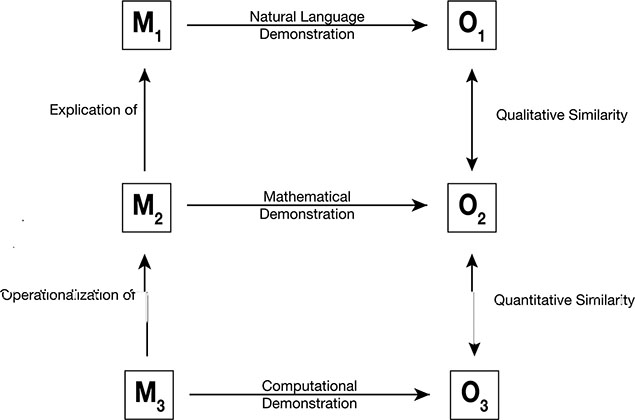
Johnson and Porter's CMC, represented in figure 2, is as follows. There are three multimodel systems, each of which is a prototype, designated as M1, M2, and M3. And there are three outcomes, O1, O2, O3, each of which is specific to its similarly indexed multimodel system. Johnson and Porter's verbal or natural language model is represented by M1, and O1 is the outcome demonstrated via informal verbal reasoning from the model.Footnote 10 For Johnson and Porter, the verbal model encompasses their descriptions of gene regulatory pathways and speciation processes, and the relevant outcome is the claim that selection on the former can influence the latter, as shown by the quoted passage above. The most idealized multimodel system of the two precise systems they created is M2. Importantly, M2 is an explication of M1 in a mathematical framework capable of making precise assumptions and analytic inferences. Johnson and Porter analytically derived O2 from M2, and O2 includes the expected probabilities for discrete fitness categories across infinitely possible replications. Their operationalization of M2 is M3, and it was programed into software to enable simulations of evolving populations. While it shares many idealizing assumptions of M2, it lacks those that enable analytic inferences from M2. To generate results from M3, Johnson and Porter had to run their simulations, which yielded data about, among other things, fitness and phenotype values in parental populations and in hybrids. They then structured these data in models and analyzed them across many replicates to yield proportions of replicates with speciation events, which comprise O3.
Johnson and Porter's coherence models calibration.

Key to Johnson and Porter's evaluation of their CMC is the comparison of results, specifically O2 to O1 and O3 to O2. In figure 2, I label the relevant relations as qualitative similarity and quantitative similarity, respectively. Johnson and Porter used an implicit and somewhat vague notion of qualitative similarity to compare O2 to O1. But they used explicit relations of quantitative similarity or predictive accuracy to compare O3 to O2.Footnote 11 Using their verbal model (M1), Johnson and Porter inferred that selection on gene regulatory networks could lead to HI and eventually speciation (O1). Using a highly idealized set of models couched in the mathematical language of theoretical evolutionary genetics (M2), Johnson and Porter derived probability distributions for hybrid fitnesses. These showed that for the simplest systems, speciation would occur in half of the replicates and more often in more complex systems (O2). This outcome was qualitatively similar to that of the verbal model. After they operationalized those models for computer simulation (M3), Johnson and Porter simulated biological systems and collected results (O3) that were statistically significant and similar to those analytically inferred. Thus, they showed that their M3 could represent, predict, and explain possible speciation processes. Their CMC showed that M1, M2, and M3 are coherent with each other, that they denote the same target phenomenon or process despite being constructed with different symbolic toolkits.
Figure 2 and the discussion above capture much about reasoning practices in theoretical evolutionary genetics. The relations among M1, M2, O1, and O2 make explicit the relations and framework for purely formal work as discussed by Servedio et al. (Reference Servedio, Brandvain, Dhole, Fitzpatrick, Goldberg, Stern, Van Cleve and Justin Yeh2014) and to some extent Plutynski (Reference Plutynski2006b), and they clearly distinguish models from demonstrations. Furthermore, the relations among M2, M3, O2, and O3 indicate how simulation studies, now widely used in the field, fit into Servedio et al.'s approach. Thus, the account of CMCs builds on Servedio et al.'s account of proof of concept research while avoiding its limitations.
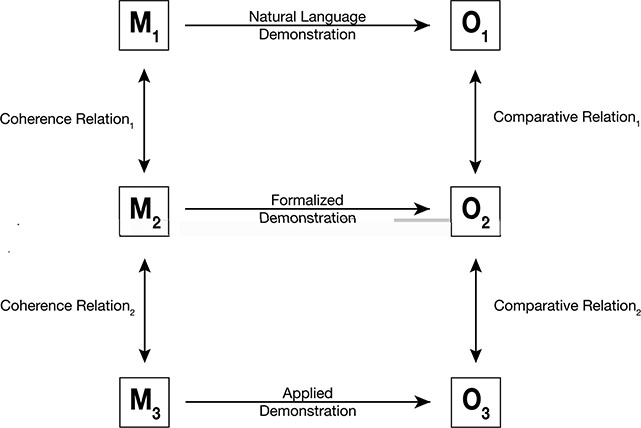
Figure 2 can be generalized. If used in other fields, the overall structure of models and outcomes might be the same, but because of different disciplinary norms and standards, the specific coherence relations between models and the specific comparison relations between outcomes might differ. These relations also depend on the kinds of questions pursued and systems studies. Figure 3 represents a more general structure for CMCs. For it, between models there are coherence relations, of which explicatory and operational relations are kinds. Furthermore, between outcomes there are comparative relations, of which qualitative and quantitative similarity relations are kinds. Demonstrations from M3 to O3 are more generally characterized as applied generalizations, and they can involve computer simulations, tests via empirical data collection, and so on. Importantly, any given project may forgo either analytic or applied demonstrations, or it may combine them. But to use a CMC, a project must compare results or outcomes demonstrated from at least two models or multimodel systems built with different symbolic toolkits.
General framework for coherence models calibrations.

In general a team establishes a prototype via a CMC by arguing as follows:
1. Coherence relation1 between M1 and M2 is met.
2. Standards of inference are met for the natural language and formalized/analytic demonstrations.
3. Comparative relation1 between O1 and O2 is met.
4. Coherence relation2 between M2 and M3 is met.
5. Standards of inference are met for the applied demonstration.
6. Comparative relation2 between O2 and O3 is met.
Two inferences are implicit in proof of concept demonstrations via CMC.
7. If 1-3 are true, then M1 and M2 are mutually coherent; that is, they denote the same target system.
8. If 4-7 are true, then M1, M2, and M3 are mutually coherent; that is, they denote the same target system for at least the starting conditions, parameter values, and assumptions specified.
When researchers show that 1-8 are true, they show that a series of models built from different symbolic toolkits denote the same phenomena or target system. They are conceptually of a piece.Footnote 12
Model calibrating denotes the activities of building an argument like 1”?8, which can be represented in a graphic like figure 3. In the course of a project, a team calibrates their package of models M1 through M3 to each other. They ensure that community or disciplinary standards are met. If any of those standards are violated, then a team must tinker with their package of models. They may adjust parameter values, model structures, or formalisms used to represent their models. In tough cases, they may question and adjust disciplinary standards.
Scope Demonstration
Scope demonstrations are arguments that establish the range of phenomena to which a model or multimodel system applies. A scope demonstration builds on a previously employed demonstration, like a CMC, which is often relative to a singular set of starting conditions, parameter values, and other background assumptions. To determine the range of target systems or phenomena for which the models are coherent with each other, researchers systematically alter those conditions, values, and assumptions, and they recompare the outcomes. This practice of systematic alteration has been discussed in literature related to exploratory experimentation (Elliott Reference Elliott2007), computer simulation (Winsberg Reference Winsberg and Zalta2015), and sensitivity analysis, a second kind of robustness analysis (Weisberg Reference Weisberg2006; Woodward Reference Woodward2006; Wimsatt Reference Wimsatt2007). In a given project, a scope demonstration represents the results of those systematic alterations, and it argues for a range of phenomena to which the model applies. When the alterations are to real world systems, the conclusion is about the range of actual phenomena. When they are to theoretical systems, the conclusion is about the range of possible systems, as in Johnson and Porter's case.
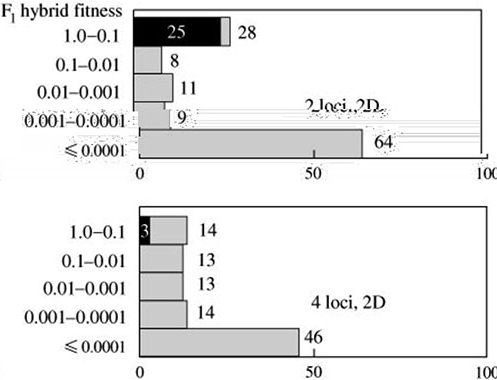
Johnson and Porter employed two kinds of scope demonstration. First, they compared results generated across the same multimodel system but with altered causal complexity (e.g., 2”?10 loci in gene regulatory pathways), different parameter values (e.g., mutation rate, migration rate), or simulation structures (e.g., number of replicates). An example of their results is represented in figure 4. The figure compares the results generated from groups of replicates differing in the causal complexity of the model used. The top of the figure shows a frequency distribution of hybrid fitnesses when the regulatory pathway spans two loci, and the bottom shows a similar distribution when the regulatory pathway spans four loci. The comparison shows that the more complex the pathway, the higher the proportion of hybrids with low fitnesses. Johnson and Porter constructed dozens of these comparisons, some of which showed how much parameter values could be altered before there would be effects on hybrid fitness values.
Frequency distributions of hybrid fitnesses for pathways with two and with four loci. Horizontal axis indicates number of replicates, vertical indicates fitness values discretized into five categories. Black bars indicate fitnesses above 0.5. All other parameter values and starting conditions held constant. The comparison indicates that the more complex the pathway, the higher the proportion of unfit hybrids. Reprinted with modifications from Johnson and Porter (Reference Johnson and Porter2000, fig. 5).

For Johnson and Porter's second kind of scope demonstration, they compared results generated across multimodel systems that differed not in degree of epistasis but in kind and otherwise had identical parameter values, starting conditions, and simulation structures. In particular, they swapped out their gene regulatory mechanistic model and evolutionary genetic equations for a more traditional model and set of equations for additive epistasis. They reran their simulations and developed graphics, like those in figure 4, for replicates using the traditional model. They then compared the new graphics to those developed for their regulatory multimodel system.
From both of these kinds of comparisons, Johnson and Porter established that, unlike the additive epistasis model system, their multimodel system could account for rapid speciations that happened in fewer than several thousand generations in a BDM scenario. These results did not confirm their multimodel system or disconfirm the more traditional account of additive epistasis. Rather, they showed the types of target systems to which each applied. As Johnson and Porter continued their project over the years, scope demonstrations became increasingly important to them, and they devised increasingly sophisticated means of comparing simulated results (Porter and Johnson Reference Porter and Johnson2002; Johnson and Porter Reference Johnson and Porter2007; Tulchinsky et al. Reference Tulchinsky, Johnson, Watt and Porter2014).
6. Post Facto Arguments
Researchers use post facto arguments to license further research beyond the context in which a prototype was established. Post facto arguments employ heuristics in Wimsatt's sense of non-truth-preserving algorithms used by agents of bounded rationality, especially in contexts of transforming intractable problems into tractable ones. Heuristics typically rely on imperfect or false models of the world that sometimes fail in systematic ways (Wimsatt Reference Wimsatt2007, chaps. 5 and 6). In this section, I describe three heuristics that scientists use in arguments after they have established prototypes, illustrating them with Johnson and Porter's case.
The first heuristic involves the portability of the models to further research contexts and phenomena of study.
(H1) If a proof of concept has been demonstrated (e.g., 7 and 8 are true), then the theory, model, or package of models used in the demonstration (e.g., M1, M2, and M3) can be used to study phenomena or target systems for which justifiably similar assumptions and parameter values apply.
Heuristic H1 accommodates Kendig's (Reference Kendig2016) account of the transportability of prototypes and generalizes it to include proof of concept demonstrations in a wider array of investigative contexts beyond wet-lab experiments. Furthermore, when coupled with a scope demonstration, H1 can be generalized to address a range of parameter values, assumptions, and starting conditions from a scope demonstration.
I locate arguments that use H1 not as part of the proof of concept demonstration itself, as Kendig seems to, but as post facto arguments. Doing so enables us to distinguish the epistemic success of a proof of concept demonstration from the dispersive effects of such demonstrations. Not all prototypes are exported to further research contexts, even if they have successfully proved a concept. Drawing this distinction also saves us from having to treat all cases of science that employ a heuristic like H1 as cases of proof of concept research. As a heuristic, H1 can be tweaked to excise talk of ‘proof of concept’, and then it can be seen as a special case of a more general heuristic of empiricism.
Heuristic H1 invokes the phrase “justifiably similar”? to underwrite the scope of exportability. This phrase is important for several reasons. First, those reasons that justify similarity are context dependent. The kinds of reasons that researchers give for exporting models in one discipline may differ quite a bit from the kinds of reasons given in a different discipline. For any given discipline, those local norms must be described to better understand if and how these heuristics are applied and how they may mislead. Second, and more importantly, the phrase enables a place for relations between simple and more complex models that target the same phenomenon, a feature central to the rationale of many proof of concept projects but often overlooked by philosophers. For researchers, many phenomena are too complex to be understood with extant models, so they adopt an iterative approach to achieve understanding (Elliott Reference Elliott2012). They begin by building the simplest model with which they can still account for some key features of the complex phenomenon they are studying. When they can show that those models in fact account for those key features, that is, they provide a proof of concept demonstration for a novel model, then they assert that the models can be exported not just for understanding similar features in related phenomena but for studying further features of the original complex phenomenon. In such cases, the prototype model functions as a template, on which researchers can add and subtract elements to account for increasingly complex phenomena.
In short, the phrase “justifiably similar”? enables models to be exported so as to apply to analogous phenomena in different target systems (e.g., using HI models in different genera or using predator-prey models for cycles of economic growth) and to more complex systems of which the accounted-for phenomena provide but one set of features. This latter export, from simple systems to more complex ones, is a common reason for doing proof of concept demonstrations. Johnson and Porter relied on H1 interpreted in this way to further develop their multimodel systems to include not just epistatic gene regulatory motifs but also migration between organismal populations (Porter and Johnson Reference Porter and Johnson2002), pleiotropic gene regulatory motifs (Johnson and Porter Reference Johnson and Porter2007), and biochemically realistic interactions between genes and molecules (Tulchinsky et al. Reference Tulchinsky, Johnson, Watt and Porter2014). Regardless, Johnson and Porter exported their models and results only to scenarios of BDM-like speciation, which was for them one condition for successful projection.
A second heuristic focuses not on the models themselves but on the practices or tools used to create them.
(H2) If a proof of concept has been demonstrated, then the tools or practices used to construct and evaluate the relevant models or theories might fruitfully be used in justifiably similar research efforts.
Researchers often look to proof of concept demonstrations not for the models themselves but for the practices, strategies, or tools used to construct and evaluate those models. As with H1, proof of concept demonstrations are not necessary to heuristically argue to export practices or tools, but they are often sufficient. The Johnson and Porter case used many practices and strategies that, although not unique to the project, the team suggested others adopt (Reference Johnson and Porter2001). These include using individual-based simulations to operationalize and evaluate analytic theories, quantitatively evaluating speciation hypotheses, and making biologically realistic models of gene interactions and pleiotropy.
A third heuristic is about the allocation of resources for further use of the model. This heuristic is perhaps least appreciated by philosophers but is in many ways central to the rationales for proof of concept projects. Those who discuss proof of concept projects in medical research note that establishing the effectiveness of a treatment, say a drug, is a process fraught with issues beyond the drug's efficacy for ameliorating symptoms (Gould Reference Gould2005; Schmidt Reference Schmidt2006). There are also issues of identifying and weighing the impacts of side effects, of ethical responsibilities to test subjects, and of the resources needed to further establish the efficacy of the drug. Issues of resource allocation are legitimate constraints on all scientific projects, including those in theoretical evolutionary genetics. If researchers are to make progress on understanding a complex phenomenon, such as rapid allopatric speciation, then they must sort through the various strategies and tools for modeling that phenomenon and find those that, given the range of actual alternatives, are most promising. Proof of concept studies provide useful (and socially rewardable) means for doing so.
(H3) If a proof of concept has been demonstrated, then it is worth expending more resources on the development of the prototype model and the use of the strategies, practices, and tools used to construct the model.
The desire to use this heuristic drives much—maybe most—of proof of concept research. Johnson and Porter relied on something like it when they applied and received, because of their initial results, a National Science Foundation grant to continue their work. Funding agencies often rely on H3 when choosing which of several proposals to fund. Johnson and Porter relied on H3 to justify their own time and resources to further develop the model after their initial results.
In such cases, H3 is not the only reason that factors into decisions. When choosing between two models to further fund or develop, decision makers might note that both functioned adequately in proof of concept demonstrations but that one is cheaper (cognitively or financially) to reproduce and redeploy or that both represented phenomena but only one was also predictively accurate. In these cases, additional heuristics are used in decision making. Regardless, H3 provides a baseline heuristic.
7. Conclusion
This article provides a general framework for proof of concept research, and it articulates the structures for some of the arguments used to evaluate such research. These results unify previous discussions of proof of concept research, and they further elucidate how researchers evaluate results from theoretical evolutionary genetics, an often contentious field, especially when pairing analytically derived theorems with computer simulations. These results also contribute to the program of articulating how researchers judge early stage science as successful or not.
This conceptual framework indicates directions for further epistemological research. There are surely other kinds of proof of concept demonstrations and post facto heuristics beyond those discussed here, and those discussed here are not invoked in every case of proof of concept research. If further kinds are identified, articulated, and critiqued, then a wider array of research could become more clearly understood and perhaps be made financially respectable (O—Malley et al. Reference O’Malley, Elliott, Haufe and Burian2009; Haufe Reference Haufe2013; Elliott et al. Reference Elliott, Cheruvelil, Montgomery and Soranno2016).
A particularly fruitful example of a further heuristic is about theory integration (Mitchell Reference Mitchell2003; Laubichler, Prohaska, and Stadler Reference Laubichler, Prohaska and Stadler2018). Often, when researchers provide a proof of concept demonstration, they show their peers that achieving a desired theoretical aim, such as theory integration, can be accomplished and is worth further effort. Such theoretical aims are long-standing features of research in theoretical evolutionary genetics (Plutynski Reference Plutynski2004, Reference Plutynski2005). Johnson and Porter explicitly address theory integration in a review article, in which they feature their multimodel system and modeling practices as examples by which to further develop a mechanistic theory of adaptation (Reference Johnson and Porter2001, 45). With their proof of concept demonstration, they cut through conceptual discussions about the (im)possibility of syntheses between developmental genetics and evolutionary genetics. Implicit is a fourth heuristic, such that if a proof of concept has been demonstrated with models from historically distinct theoretical frameworks, then researchers might fruitfully integrate more aspects of those frameworks to study hitherto intractable phenomena. This heuristic provides a promising object for further study.