


1. Introduction
Many languages display constructions in which the possessor of a noun appears external to the possessive noun phrase and exhibits the behavior of an argument of the verb, a heterogeneous phenomenon generally referred to as ‘external possession’ (see Payne & Barshi Reference Payne and Barshi1999 for a broad typological discussion). Much attention in the theoretical literature has focused on so-called external dative possessors in Indo-European and Semitic languages.Footnote 2 In these constructions a dative specifies the possessor of a (morphologically) unpossessed and typically definite noun phrase. Often, it is required that the predicate in some way ‘affect’ the possessor in an adverse or sometimes positive way.
- (1)
(a) On lui a coupé les cheveux. (French)
imp 3sg.dat has cut the hair
‘They cut his/her hair.’ (Kayne Reference Kayne1975: 159)
(b) Rina kilkela le-Gil et ha-ša'on. (Hebrew)
Rina spoiled to-Gil acc the-watch
‘Rina spoiled Gil's watch.’ (Landau Reference Landau, Shahin, Blake and Kim1997: 1)
Typically discussion of such external dative constructions centers around the syntactic status of the external possessor (and in particular how its Case is licensed) as well as the external possessor's semantic role as an ‘affected’ argument of the verb. I raise these issues below. First, however, I wish to note that even in the limited discussion of Indo-European external dative possessors the constructions under examination do not constitute a homogenous set. In the context of examining external possessor datives in Bulgarian, Cinque & Krapova (Reference Cinque and Krapova2009) review the literature on such constructions and argue that there are two distinct ‘possessor raising’ constructions represented. While both constructions have two properties in common, they differ in three other respects. The similarities and differences are listed in (2) and (3).
(2) Construction A properties
(a) Shows no overt possessive marking on the possessum.
(b) Includes a dative-marked argument or clitic.
(c) Imposes an ‘affected’ reading on the external possessor.
(d) Is limited to inalienable possession.
(e) Shows properties of being base-generated.
(3) Construction B properties
(a) Shows no overt possessive marking on the possessum.
(b) Includes a dative-marked argument or clitic.
(c) Does not impose an affected reading on the possessor.
(d) Is not limited to inalienable possession.
(e) Shows properties of involving movement.
Cinque & Krapova (Reference Cinque and Krapova2009) argue that Construction A is only available in Bulgarian and Romance when a dative clitic can be licensed by predicates that affect their objects and assign to them a benefactive/malefactive theta role, rather than the possessive role assigned inside the DP. They argue that such clitics are base-generated as arguments of the predicate, leaving open exactly how this dative argument gets interpreted as the possessor. External possessors in Construction B, on the other hand, do not get theta roles from the predicate. Rather, they are ‘true’ possessor raising constructions, involving movement of a possessor from inside the possessive DP to a structural position in the verb's functional domain.
This paper seeks to further inform the characterization of the syntax and semantics of external possession by presenting a discussion and analysis of external possessor constructions in Chimwiini, an endangered Bantu language of Somalia. As in European and Semitic languages, external possessors in Chimwiini occupy structural positions outside the possessive phrase and the possessum is unmarked with regard to possession. Unlike European and Semitic, however, Bantu languages lack datives altogether and external possessors have all the properties of nominative or accusative arguments in canonical structural argument positions, depending upon the predicate involved. Furthermore, the constructions examined here would be considered to fall under Construction A by properties (2c, d) since they necessarily involve an affected possessor and inalienable possession. However, I argue that the construction does not show properties of being base-generated or being licensed thematically by the verb in a direct way. Instead, I argue that the syntax of these constructions suggests movement for licensing purposes as familiar from raising constructions. I therefore suggest that whether or not an external possession construction involves movement is independent of whether or not it is restricted by the predication and possessive relations involved. In the case of Chimwiini, I argue that external possession structures are derived via movement, differing from their internal possession counterparts in whether or not the possessor can be licensed within the possessive phrase or not.
2. Varieties of external possession in Chimwiini
2.1 Possessor and possessum raising
Before discussing external possession, it may be helpful to review the two ways that Chimwiini expresses possession that are unrestricted regarding the selecting verb or the possession relationship. One is a series of personal enclitics or words expressing personal possession. Such personal possessive pronominals are bi-morphemic, encoding agreement with the possessum as well as the possessor, as seen in (4a) below. The other is the so-called Bantu associative construction (see Carstens Reference Carstens2000), used in Bantu to express a variety of relationships, including possession, seen in (4b).
- (4)
(a) Omari / Ø-vunz-ile maana / kuulu = y-e.
Omar 3sg-break-pst 1child 9leg = 9agr-3sg.poss
‘Omar broke the child's leg.’
(b) Omari / Ø-vunz-ile kulu y-a maana.
Omar 3sg-break-pst 9leg 9agr-asc 1child
‘Omar broke the child's leg.’
Note that the verb cannot show object agreement with the possessor in either construction (see (6)), even though object agreement with animate objects is typical in Chimwiini (see (5)).Footnote 3
(5) Omari / Ø-m-bish-ile maana.
Omar 3sg-3sg.obj-hit-pst 1child
‘Omar hit the child.’
- (6)
(a) Omari / Ø-(*m)-vunz-ile maana / kuluu = y-e.
Omar 3sg-3sg.obj-break = pst 1child 9leg = 9agr-3sg.poss
‘Omar broke the child's leg.’
(b) Omari / Ø-(*m)-vunz-ile kulu y-a maana.
Omar 3sg-3sg.obj-break = pst 9leg 9agr-asc 1child
‘Omar broke the child's leg.’
With certain verbs, three other constructions are possible in which the possessor is external to the possessive phrase. These constructions are the focus of this paper. I have termed two of these possessor raising constructions, following the generative literature, and the third the possessum raising construction since in this construction it is the possessum, not the possessor, that appears higher in the structure. I will argue that the latter construction has quite a different derivation than the two former constructions. Because it shares several properties with the possessor raising construction, however, I include it for completeness, describing each of these constructions briefly below.
The first construction is the possessor raising to object construction. As argued by Keach & Rochemont (Reference Keach and Rochemont1992) for Swahili (a language closely related to Chimwiini), the possessor in this construction is external to the possessive phrase and serves as a grammatical object of the verb, evidenced by the fact that the possessor controls verbal object agreement, as in (7a), and may passivize, as in (7b). Note that the possessum follows the possessor and the former is unmarked by possessive enclitics or the associative marker.
- (7)
(a) Omari / Ø-m-vunz-ile maana / kuulu.
Omar 3sg-3sg.obj-break-pst 1child 9leg
‘Omar broke the child's leg.’
(b) Maana / Ø-vunz-iḻa kuulu / (na Omari).
1child 3sg-break-pst.pass 9leg by Omar
‘The child's leg was broken (by Omar).’
Possessor raising to object is limited to transitive verbs that have the possessive phrase as an object. Note that unlike in European and Semitic languages, the external possessor is not dative. In fact, it has all the properties of a direct object, being subject to passivization and object agreement. Furthermore, it should be noted that though the possessor is a grammatical object of the verb in (7a) above, there is no evidence that the possessum is oblique.Footnote 4 It is not marked by a prepositional element (typical for obliques in Bantu) nor is there evidence that it is outside the verb phrase. It therefore appears that the verb in (7a) is syntactically a ditransitive verb. For Bantu languages, this is strikingly odd. Aside from pa ‘give’, inherently ditransitive verbs are rare. While it is common for monotransitive verbs to be used as ditransitives, this nearly always requires that the verb's altered argument structure be morphologically reflected by a derivational suffix such as an applicative or causative morpheme.Footnote 5 An example appears in (8).
- (8)
(a) Ali / Ø-pelesh-elee xaṯi.
Ali 3sg-send-pst 9letter
‘Ali sent a letter.’
(b) Ali / Ø-m-pelek-eḻ-eḻe maana / xati.
Ali 3sg-3sg.obj-send-app-pst 1child 9letter
‘Ali sent the child a letter.’
In (8a), a transitive verb takes a single object. In (8b), the same verb can is used ditransitively; however, it has acquired an applicative suffix that is required to introduce the goal argument. Comparing (8b) to the construction in (7a), I see that the secondary object position in the latter comes ‘for free’ without the need to indicate an argument structure change in the verb. The predicate in (7a) thus has one more internal argument than its argument structure can license. This suggests that external possessor in object position needn't be licensed by the predicate's argument structure. I return to this below.
I noted that possessor raising to object is available only with transitive verbs. In unaccusative and stative intransitives, however, a second option is possible. I term this the possessor raising to subject construction. In this construction, illustrated in (9) below, the possessor is the subject, controlling subject agreement on the verb, while the possessum is post-verbal. The verb may be a derived stative (appearing with the stative suffix), or an inherent unaccusative/stative. The example in (10) shows that this construction is not possible with unergatives.
- (9)
(a) Maana / Ø-vund-ish-ile kuulu.
1child 3sg-break-stat-pst 9leg
‘The child's leg is broken.’
(b) Maana/ Ø-fur-iḻe miimba.
1child 3sg-swell-pst 9stomach
‘The child's stomach swelled.’
(10) *Maana / Ø-fakeṯe miilu.
1child 3sg-run.pst 4feet
‘The child's feet ran.’
Note that in this construction, the post-verbal possessum may not trigger object agreement on the verb, even if it is dislocated or absent:
(11) *Maana / Ø-i-fur-iḻe (miimba).Footnote 6
1child 3sg-9agr.obj-swell-pst 9stomach
‘The child's stomach swelled.’
This fact is significant since generally Chimwiini allows optional agreement with inanimates, particularly if the latter are topicalized or absent from the clause, as in (12). I return to this below.
(12) xati, / Muusa / Ø-i-pelesh-ele.
9letter Musa 3sg-3sg.obj-send-pst
‘The letter, Musa sent it.’
The third construction under review here, possessum raising, also occurs only with unaccusatives/statives. In this case, however, it is the possessum that appears as the subject of the clause. This is indicated by the fact that it controls subject agreement on the verb. The possessor controls object agreement on the verb, as shown in (13).
(13) Kuulu / i-m-vund-ish-ile / maana.
9leg 9agr-3sg.obj-break-stat-pst 1child
‘The child's leg is broken.’
It should be noted that word order in Chimwiini is somewhat free and depends upon various factors that have not been fully explored. Thus, some speakers prefer (14a) or (14b) below to (13) above. Note, however, that the agreement relationships in the clause remain the same for all three. I therefore assume that grammatical relations are the same in all three.
- (14)
(a) Maana / kuulu / i-m-vund-ish-ile.
1child 9leg 9agr-3sg.obj-break-stat-pst
‘The child's leg is broken.’
(b) Maana / i-m-vund-ish-ile / kuulu.
1child 9agr-3sg.obj-break-stat-pst 9leg
‘The child's leg is broken.’
As with the possessor raising to object construction, we might ask whether there is evidence (other than agreement) that the post-verbal possessor is a grammatical object of the verb or not. Passivization is trickier here since unaccusatives/statives do not in general passivize. Indeed, in many cases passivization of the possessor is impossible, as with (13):
(15) *Maana / Ø-vund-ish-ila / na kuulu.
1child 9agr-break-stat-pst.pass by 9leg
‘The child's was broken by the leg.’
However, the unacceptability of (15) seems to have a semantic rather than syntactic explanation. In particular, acceptability depends on the relative independence of the possessum and whether or not it might be understood to be imposing some state upon the possessor. Thus, in (15), the leg cannot be understood to be imposing a state of brokenness upon the child. Rather, the leg itself has undergone the change of state and the child along with it. However, verbs like ‘to swell’ and ‘to feel pain’ do allow this interpretation. One can interpret pain in one's leg to be imposing pain on one's self, for example. Thus, we say in English ‘My leg is hurting me’, but not ‘My leg is breaking me’. It is precisely with these predicates that one finds passivization of the possessor to be possible, as seen in (16). I therefore assume that the ungrammaticality of (15) and related sentences is due to semantic restrictions (the details of which I leave vague here), and are not impossible syntactically.
- (16)
(a) Maana / mkono = w-e / u-fur-iiḻe.
1child 3arm-3agr-3sg.poss 3agr-swell-pst
‘The child's arm swelled.’
(b) Mkono / u-m-fur-iiḻe / maana.
3arm 3agr-3sg.obj-swell-pst 1child
‘The child's arm swelled.’
(c) Maana / Ø-fur-iḻa na mkono.
1child 3sg-swell-pst.pass by 3arm
‘The child was swelled by his arm.’
This strongly suggests that the possessor is the grammatical object of the verb in the possessum raising construction while the possessum is the subject. There are, however, reasons for doubting this which I will explore in Section 4.2 below.
2.2 Semantic restrictions
All three of these constructions presented here are subject to the same semantic restrictions, specifically those pointed to by Cinque & Krapova (Reference Cinque and Krapova2009) as being properties of their Construction A as listed in (2c,d) above: affectedness and inalienable possession. First, the Chimwiini constructions are only available with verbs that can be construed to have some effect (directly or indirectly) on the possessor; hence, the following contrast:Footnote 7
- (17)
(a) Omari / Ø-m-vunz-ile maana / kuulu.
Omar 3sg-3sg.obj-break-pst 1child 9leg
‘Omar broke the child's leg.’
(b) *Omari / Ø-m-mene maana / kuulu.
Omar 3sg-3sg.obj-see.pst 1child 9leg
‘Omar saw the child's leg.’
Second, these constructions are also limited by the possessum in that the latter must be inalienably possessed. They are possible, with a few exceptions, only with certain part–whole relations and in particular with body parts.Footnote 8 Other possessive relationships must be expressed in the associative construction or using personal possessive enclitics (such as in (4) above).
- (18)
(a) *Omari / Ø-m-vunz-ile maana / xalamu.
Omar 3sg-3sg.obj-break-pst 1child 9pen
‘Omar broke the child's pen.’
(b) *Maana / Ø-vund-ish-ile xalumu.
1child 3sg-break-stat-pst 9pen
‘The child's pen has broken.’
This section has laid out the basic properties of the three possessor/ possessum raising constructions in Chimwiini. We have seen so far that Chimwiini patterns with Cinque & Krapova's (2009) Construction A constructions in being limited to affective predicates and inalienable possession, but with the important difference that Chimwiini does not have datives but rather licenses the external possessor in canonical structural argument positions (subjects and objects). In the next section, I return to property (2e) of Cinque & Krapova's (2009) characterization: that Construction A displays base-generation–type properties.
3. External possession: Movement or non-movement?
Cinque & Krapova (Reference Cinque and Krapova2009) provide several arguments that Construction A in Romance and Bulgarian displays properties of a base-generated construction. Here I show that the arguments offered by Cinque & Krapova (Reference Cinque and Krapova2009) for this claim do not apply to Chimwiini. Rather, the Chimwini facts suggest a movement analysis. I take this as evidence that the other properties discussed for Construction A external possession, specifically the limitation to inalienable possession and affected predicates, are unrelated to whether or not the construction is derived via movement or base generation.
First, Cinque & Krapova (Reference Cinque and Krapova2009) show that extraction of the dative possessor would sometimes have to cross a PP node, which they argue normally blocks extraction.
(19) Gli hanno urlato [PP ne [DP gli orecchi]]. (Italian)
him.dat have.3pl shouted in the ears
‘They shouted in his ears.’ (Kayne Reference Kayne1975: 159f.)
Putting aside whether or not assumptions could be adjusted to allow movement out of the PP-internal position in (19), Chimwiini simply does not encounter this problem as external possessors never relate to a possessum inside a preposition phrase. The closest thing to such a construction involves locative noun phrases (see fn. 7 above). However, it would be misleading to assume that these are prepositional structures. As many have noted (see e.g. Buell Reference Buell, Kula and Marten2007), locative noun phrases in Bantu behave much more like NPs than PPs, serving as subjects in many languages and triggering locative agreement on the verb.Footnote 9
(20) Kó-Maúnggó-tlá-ya roná maríga. (Setswana)
17-Maung 17agr-fut-go we winter
‘To Maung we shall go in winter.’ (Demuth & Mmusi Reference Demuth and Mmusi1997: 8)
A second argument offered by Cinque & Krapova (Reference Cinque and Krapova2009) is that lack of agreement (in number) between the dative clitic possessor and the possessum suggests base-generation. With external possessors (whether they are singular or plural), the possessum must be singular, as in (21a), but when the possessor is internal to the DP, plural agreement is possible, as in (21b).
- (21)
(a) Le médecin leur a examiné la gorge/*les gorges. (French)
the doctor them.dat has examined the throat/the throats
‘The doctor examined their throats.’
(b) Le médecin a examiné leur gorge/leur gorges.
the doctor has examined their throat/their throats
‘The doctor examined their throats.’ (Vergnaud & Zubizarreta Reference Vergnaud and Zubizarreta1992: 598, 602)
In Cinque & Krapova's terms, this as an argument that the external dative did not originate inside the possessive DP since if it did, it would agree with the possessum.
Putting aside arguments that the lack of agreement in (21a) could be construed as an anti-agreement effect required by extraction (see Boeckx Reference Boeckx2003 for arguments along these lines), the data in Chimwiini does not line up with these facts. Rather, number agreement between the external possessor and possessum is possible, though optional. Thus, the word for ‘head’ in (22) may be singular or plural.Footnote 10
(22) Omari/Ø-wa-vunz-ile wiizi/ zitta. (or: chitta)
Omari 3sg-3pl.obj-break-pst 2thieves 8heads 7head
‘Omari broke the thieves’ heads.’
Cinque & Krapova's (2009) third argument is that some external possessor constructions do not have a DP-internal alternative. This is the case in Bulgarian even though generally the language allows such alternations.
- (23)
(a) Ti mi xodiš po nervite. (Bulgarian)
you me.dat walk.2sg on nerves.the
‘You are getting (lit. walking) on my nerves.’
(b) *Ti xodiš po [nervite mi].
you walk.2sg on nerves.the me.dat (Cinque & Krapova Reference Cinque and Krapova2009: ex. (27))
The logic is that since the external possessor cannot appear internal to the possessive DP, it could not have originated there in the first place. Again, putting aside alternative explanations (one might argue, for instance, that for whatever reason the idiomatic interpretation of (23a) is simply not available in (23b)), I have not found such a case in Chimwiini. All of the external possessor constructions I have found have an alternative expression in which the possessor is internal to the DP (using personal possessive clitics or the associative construction; see (4) above).
To conclude, the arguments put forward by Cinque & Krapova (Reference Cinque and Krapova2009) in favor of a base-generation account of external possessors of the Construction A type do not hold in Chimwiini, even though Chimwiiini's constructions clearly fit the other Construction A criteria of being restricted to inalienable possession and affective predicates. My conclusion is that there is no reason to assume a base-generation account of external possessors in Chimwiini.
4. Accounting for variation
4.1 Inalienable possession and affecting predicates
Above I argued that while, taken at face value, Cinque & Krapova's (2009) arguments suggest a non-movement analysis for Construction A in Bulgarian and Romance, in Chimwiini the arguments are more strongly in favor of movement. In all of these languages, however, the constructions share the properties of being limited to inalienable possession and predicates that affect the possessor. Therefore, these properties must follow independently of a movement/non-movement account. Here I offer an analysis of these two properties.
First, Cinque & Krapova (Reference Cinque and Krapova2009) relate the non-movement properties of Construction A to the restriction that it must occur with verbs that provide a benefactive/malefactive reading on the possessor, arguing that ‘the non-movement option is only available … whenever a Dative clitic can be directly merged in the clausal Dative position licensed by predicates that affect their objects, and assign to them a benefactive/malefactive theta role, rather than the Possessive one assigned inside the DP’ (Cinque & Krapova Reference Cinque and Krapova2009: 86). This suggestion is in line with others, which have argued that external possessors must get a theta role from the verb (Tomioka & Sim Reference Tomioka, Sim, Arunachalam, Scheffler, Sundaresan and Tauberer2005, Lee-Schoenfeld Reference Lee-Schoenfeld2006, among others). Interestingly, Chimwiini provides strong evidence that the external possessor is not licensed thematically by a theta role from the verb. As mentioned briefly above, Bantu languages make extensive use of derivational verb suffixes to reflect an expansion or contraction of the valency of the verb's thematic structure. An intransitive verb, for example, may become transitive by adding a causative suffix or an applicative suffix and an object. Or a transitive verb may be made ditransitive, as in (24). Transitive ∼ ditransitive alternations without a verbal suffix are non-existent. Note that one of the main functions of the applicative suffix is to signify an indirect object with a benefactive/malefactive reading, as in (24b):
- (24)
(a) Ali / Ø-pelesh-elee xaṯi.
Ali 3sg-send-pst 9letter
‘Ali sent a letter.’
(b) Ali / Ø-m-pelek- el-ele maana / xaṯi.
Ali 3sg-3sg.obj-send-app-pst 1child 9letter
‘Ali sent the child a letter.’
This strongly suggests that in possessor raising to object constructions, the external possessor is not theta-licensed as an argument of the verb. If it were, it would need to be added to the verb's argument structure with a derivational suffix (in this case, an applicative would be expected). But this is not the case. In fact, an applicative suffix is not possible in such constructions:
(25) #Omari / Ø-m-vund-il-ile maana / kuulu.Footnote 11
Omar 3sg-3sg.obj-break-app-pst 1child 9leg
‘*Omar broke the child's leg.’
The conclusion that the external possessor is not theta-licensed by the verb raises the obvious question of how to account for the fact that external possessors in Construction A are limited to predicates that affect the possessor. One possibility is that the ‘affected’ interpretation of the possessor does not result directly from theta-role assignment, but is an interpretative effect of the fact that it shares the patient thematic role of the possessum by virtue of its inalienable relationship. Therefore, whatever effect the event has on the possessum necessarily affects the possessor. This is in line with Cuervo (Reference Cuervo2003), who argues that the sense of affectedness arising in such structures in Romance (which Cinque & Krapova (Reference Cinque and Krapova2009) claim to be equivalent to Bulgarian's Construction A) is an indirect consequence of the lexical meaning of the verb, together with the possessive relation between the dative and direct arguments.Footnote 12
A technical approach along these lines can be found in Vermeulen (Reference Vermeulen2005). Vermeulen argues for a process of theta-role ‘re-assignment’ in which the theta role assigned to the patient of a transitive verb can be re-assigned to an external possessor as long as certain conditions are met (namely, the presence of a null pro in the argument structure of the possessum, creating a variable that can be bound by the external possessor). In this way, a transitive verb whose lexical entry allows only one internal argument may license two. However, Vermeulen seems to leave open the nature of the relationship between the external possessor and the null bound pronoun inside the DP. While she takes a non-movement approach to the Japanese and Korean data she examines, in general the re-assignment analysis is compatible with movement or base-generation. The specific details of Vermeulen's analysis are not crucial here. What matters is that re-assignment creates an explicit account of the affected semantics of external possessors that does not require the predicate to have a distinct theta role for external possessors. Bantu languages like Chimwiini, then, seem to provide support for Vermeulen's general approach since they provide clear evidence that the verb does not assign a theta role to the external possessor directly, even though a benefactive/malefactive reading of the possessor is required.Footnote 13 More importantly, this analysis is not predicated on whether external possessors are derived via movement or base generation. It can therefore account for this restriction in movement-type languages like Chimwiini as well as base-generation–type languages like Bulgarian and Romance.
Note that the restriction to relations of inalienable possession also partially follows in Vermeulen's account if, with Nakamura (Reference Nakamura1999), we take inalienably possessed nouns to have inherent internal arguments which can be expressed as overt possessors or by a null pro. Inalienably possessed possessums will therefore always potentially have the null pro in their argument structure that Vermuelen's re-assignment account requires. Alternatively, the pro may be replaced by a trace in cases where the possessor is introduced as a complement to the possessum and movement to some external position is involved.
4.2 Licensing possessors and the DP layer
If the possessor–possessum and possessor–predicate relations restricting Construction A are compatible with both movement and non-movement derivations, why do some languages employ movement while others do not? An exhaustive answer to that question is likely to involve a number of factors which I cannot fully explore here. However, I wish to suggest that a major factor is the ability of the possessive phrase to license a possessor internally. Not surprisingly, this is related in some languages to the amount and kind of functional structure available above the basic NP level.
The ability of the noun phrase to license a possessor internally is also taken to be a major factor in variation among external possessive constructions in Balkan languages, Greek, and Romance by Pancheva (Reference Pancheva and Tomić2004). Briefly, Pancheva argues that Greek, Bulgarian and Macedonian have the ability to license a possessor internal to the DP (genitive for Greek, dative for Bulgarian and Macedonian) while Serbo-Croatian does not. This accounts for the fact that Bulgarian and Macedonian allow DP-internal possessive dative clitics while Serbo-Croatian does not. Pancheva also posits that this variation roughly correlates with the syntactic status of dative clitics in these languages by arguing that in Bulgarian and Macedonian they are initially merged as heads, adjoining to heads of functional projections in the functional domain of nominal/verbal predicates and agreeing in case and phi-features with (sometimes null) dative arguments. In Serbo-Croatian, however, she argues the clitics are arguments themselves, getting abstract dative case during syntax.
The ability to license a possessor DP-internally is also related to the functional structure available to NPs in the language. For example, Pancheva's claim that Serbo-Croatian lacks this ability correlates with claims from Boškovič (Reference Bošković2005, Reference Bošković, Grewendorf and Zimmermann2012) that Serbo-Croatian lacks a DP layer altogether. Boškovič shows that possessor NPs in Serbo-Croation are not licensed in the noun phrase, but are adjuncts adjoined to NP.
Absence of the DP layer, however, is not the only thing that might prevent licensing of an internal possessor. Bulgarian, which does not lack DP, also shows the effect of (the absence of) functional features in the DP. As Cinque & Krapova (Reference Cinque and Krapova2009: 76) show, dative possessor clitics can only be licensed within the possessive DP if the latter is definite:
- (26)
(a) Tja mu ščupi [DP malkija prăst].
she himdat broke.3sg little.the finger
‘She broke his little finger.’
(b) Tja ščupi [DP malkija mu prăst].
she broke.3sg little.the himdat finger
‘She broke his little finger.’
(c) *Tja ščupi [edin mu prăst].
she broke.3sg a himdat finger
‘She broke a finger of his.’
The inability to license a DP-internal possessor, then, may result from lacking a DP-layer entirely, as in the Serbo-Croatian case, or lacking the proper features within the DP needed for licensing, as in the Bulgarian case.
Chimwiini shows some evidence of the influence of both of these factors. Like Serbo-Croatian, Chimwiini lacks evidence for a DP layer. There are no determiners (definite or indefinite) in the language and elements such as determiners, quantifiers and interrogative modifiers line up in their behavior in a way that resembles adjectives: all agree with the nominal and exhibit relatively free word order. An adjunct treatment of these elements therefore seems plausible.
On the other hand, Chimwiini seems to differ from Serbo-Croatian in its ability to license a possessor clitic internal to the possessive noun phrase. Recall the construction introduced in (4) above. Here the possessive phrase exhibits an enclitic on the end of the possessum that expresses the possessor and agrees with the possessum.Footnote 14
(27) Omari / Ø-vunz-ile maana / kuulu = y-e.
Omar 3sg-break-pst 1child 9leg = 9agr-3sg.poss
‘Omar broke the child's leg.’
In (27) the possessor is not external: the verb cannot agree with the possessor and the latter cannot be passivized. However, it is easy to show that the possessor NP has an adjunct status in (27). It may be omitted or adjoined, either within the NP (as suggested by its relatively free word order) or external to the NP in some other clause-adjoined position.Footnote 15
- (28)
(a) Omari / Ø-vunz-ile kuulu = y-e maana.
Omar 3sg-break-pst 9leg = 9agr-3sg.poss 1child
‘Omar broke the child's leg.’
(b) Maana, Omari / Ø-vunz-ile kuulu = y-e.
1child Omar 3sg-break-pst 9leg = 9agr-3sg.poss
‘The child, Omar broke his leg.’
In seems clear, then, that in the construction in (27) the internal possessor is the clitic itself or a null pro in relation with it. Why, then, is this internal possessor licensed in this structure but not in the external possession structure which I have shown takes the possessor NP to be an accusative argument? An answer is suggested by the other features that are present in (27), but absent in the external construction, namely the phi-features expressing agreement with the possessum. The possessive enclitic never appears without them. I take this as evidence that there is a functional head in these possessives that carries these features and is responsible for introducing and licensing the possessive enclitic as well. I take this to be a POSSP headed by the pronominal enclitic and containing unvalued phi-features which are valued against the possessum. The full NP possessor can be adjoined to POSSP when present.Footnote 16
(29)

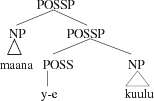
I also assume that the POSS head introduces a functional application that relates the referent of the enclitic to the possessum via a possessive relation. This gives the structure in (29) the potential to license any possessive relationship in Chimwiini, alienable or inalienable.
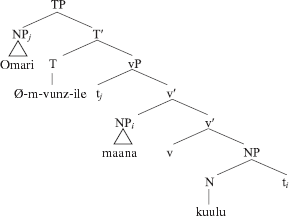
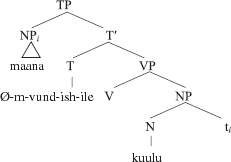
Because the POSSP layer in (29) is responsible for NP-internal licensing of the possessive enclitic as well as introducing the possessor, its absence would disallow both. I propose this is the case in external possession constructions. Because the possessor cannot be licensed NP-internally, it must raise directly into a licensing position in the clause structure, either to an object position (in the case of transitive verbs) or directly to subject position (in the case of unaccusatives). In (30a) below I take the former to be a second specifier position of Spec,vP. I make the standard assumptions that subjects have nominative case licensed by (finite) T while objects have accusative case licensed by v.
- (30)
(a) TransitiveFootnote 17
Omari / Ø-m-vunz-ile maana / kuulu.
Omar 3sg-3sg.obj-break-pst 1child 9leg
‘Omar broke the child's leg.’
(b) Unaccusative/stative
Maana / Ø-vund-ish-ile kuulu.
1child 3sg-break-stat-pst 9leg
‘The child's leg has broken.’
Furthermore, the fact that the POSS head is not present to license the possessive relation between the possessor and possessum also predicts the fact that this construction is limited to inalienable possession: only inalienabily possessed NPs have a possessor as an inherent internal argument and therefore do not require additional functional structure to introduce a possessor.
Chimwiini, then, lacks a DP layer like Serbo-Croatian. Unlike Serbo-Croatian, however, it has a possessor phrase with the ability to license possessor clitics within the extended NP structure. In that sense it is more like Bulgarian in allowing the possessor to be licensed within or without the possessive NP. Unlike Bulgarian, however, the ability to license such clitics internally does not depend upon definite/indefinite features of D (which Chimwiini lacks), but rather on the features of POSS, a head which introduces the possessive clitic as well as phi-features that must agree with the possessum. In contrast to both of these cases, some Romance languages never license dative possessive clitics DP-internally. They therefore must be licensed in the clause structure through inherent dative case (Cuervo Reference Cuervo2003).Footnote 18 In contrast to all of these languages, Chimwiini cannot license dative case (either inherently like Romance or structurally like Serbo-Croatian) and instead employs structural nominative or accusative case to license possessors that cannot be licensed NP-internally.
4.2 The possessum raising construction
Above I offered an analysis of the possessor raising to object and possessor raising to subject constructions. Both result when a possessor is the internal argument of an NP and raises directly into licensing positions in the clause structure in the absence of features that can license the possessor NP-internally, the only difference being their licensing position (object vs. subject position). I have not, however, explained the possessum raising construction. Recall that in this construction the possessor is external and (apparently) in object position since the verb agrees with the possessor and the latter may passivize. The possessum, however, appears in subject position and controls subject–verb agreement:
(31) Kuulu / i-m-vund-ish-ile / maana.
9leg 9agr-3sg.obj-break-stat-pst 1child
‘The child's leg is broken.’
Given the analysis of possessor raising to object outlined, one might take (31) to be the result of (remnant) movement of the NP in (30a) to the subject position. This would be problematic, however, since in the resulting structure the possessor/object would not c-command its trace. Moreover, it would require the possessum/subject to undergo A-movement over the possessor/object, a minimality violation. The construction in (31) could therefore be taken to challenge the analysis for possessor raising outlined so far.
Fortunately, there are empirical reasons to think that the possessum raising construction is not derived via movement of the possessor out of the possessive noun phrase. First, although the possessor in (31) is post-verbal and triggers object agreement on the verb, there are reasons to believe that it is in a different position than the post-verbal possessor in possessor raising to object constructions. First, while agreement with an animate object is preferred in Chimwiini, it is not absolutely required and is often omitted in natural speech as long as the animate object is immediately post-verbal, as (32a) shows. This is even the case in possessor raising to object constructions like (32b), where lack of agreement is marginal. In the possessum raising construction, however, object agreement is absolutely required. Speakers universally rejected the sentence in (32c).
- (32)
(a) Omari / Ø-bish-ile maana. (preferred: Ø-m-bish-ile)
Omar 3sg-hit-pst 1child 3sg-3sg.obj-hit-pst
‘Omar hit the child.’
(b) ?Omari Ø-vunz-ile maana / kuulu.
Omar 3sg-break-pst 1child 9leg
‘Omar broke the child's leg.’
(c) *Kuulu / i-vund-ish-ile / maana.
9leg 9agr-break-stat-pst 1child
‘This leg of the child is broken.’
These facts suggest that in the possessum raising construction, unlike in the possessor raising constructions, object agreement is not with the external possessor itself, but with a null pro. The latter always requires that object agreement be expressed in Chimwiini. This suggests that the post-verbal possessor in (31) is not the structural object of the verb. Rather, a co-indexed pro is. This explains why object agreement is obligatory.
Further evidence that the post-verbal possessor is outside the VP comes from phonological phrasing. As Kisseberth & Abasheikh (Reference Kisseberth, Abasheikh, Bruck, Fox and Galy1974, Reference Kisseberth and Abasheikh2011) have extensively shown, Chimwiini phonological phrasing (in the majority of cases) is based on an alignment between the right edge of a phonological phrase and the right edge of a maximal syntactic phrase. One effect of this is that the verb, as a head, is phrased together with the first maximal constituent within the verb phrase. This may be an object, a post-verbal (in situ) subject, an adverb, or some other constituent.
- (33)
(a) Fatima / Ø-uz-ile baxsha.
Fatima 3sg-buy-pst 9envelope
‘Fatima bought an envelope.’
(b) Wa-fakeṯe w-oṯṯe / ka apo OR w-oṯṯe/wa-fakete ka apo.
3pl-run.pst 3pl.agr-all prep there
‘Everyone ran away from there.’
Note that we also see this played out in possessor raising to object. The post-verbal external possessor is phrased together with the verb, as expected:
(34) Omari / Ø-m-vunz-ile maana / kuulu.
Omar 3sg-3sg.obj-break-pst 1child 9leg
‘Omar broke the child's leg.’
Interestingly, as (35) below shows, in the possessum raising construction, the post-verbal possessor is often not phrased together with the verb, despite the fact that it is immediately post-verbal and agrees with the verb, just as a grammatical object does.Footnote 19
(35) Kulu iyi / i-m-vund-ish-ile / maana.
9leg 9dem 9agr-3sg.obj-break-stat-pst 1child
‘This leg of the child is broken.’
I take this as evidence that the post-verbal possessor in (35) is not in the verb phrase and thus is not phrased together with the verb. This is consistent with my hypothesis above that the true object in possessum raising constructions is not the possessor, but pro. Rather, I take the possessor to be a right-adjoined topic merged, I assume, in the CP domain.
(36) Possessum raising
Kulu iyi / i-m-vund-ish-ile / maana.
9leg 9dem 9agr-3sg.obj-break-stat-pst 1child
‘This leg of the child is broken.’
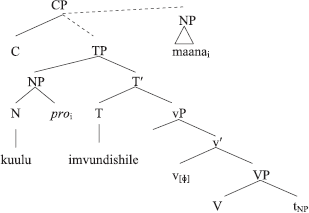
Note also that the derivation in (36) requires an assumption of A-movement reconstruction. This is due to the fact that the null pro possessor must bind the inherent internal argument of the possessee (especially in cases where an overt possessor is absent). The same observation was made by Borer & Grodzinsky (Reference Borer, Yosef and Borer1986) for Hebrew examples such as (37), taken from Landau (Reference Landau1999: ex. (5a)):
(37) ha-kelev ne'elam le-Rina. (Hebrew)
the-dog disappeared to-Rina
‘Rina's dog disappeared.’
Borer & Grodzinsky argued that data such as (37) (as well as the fact that such structures are ungrammatical with unergative intransitives) suggest that it is sufficient for the possessed NP to c-command a trace of the possessee. Possessum raising constructions thus support the notion of A-movement reconstruction.Footnote 20
Given this account of the possessum raising construction, however, a question arises regarding passivization. Recall that in Section 2, I showed that it was possible for the post-verbal possessor to passivize:
- (38)
(a) Mkono / u-m-fur-iiḻe / maana.
3arm 3agr-3sg.obj-swell-pst 1child
‘The child's arm swelled.’
(b) Maana / Ø-fur-iḻa na mkono.
1child 3sg-swell-pst.pass by 3arm
‘The child was swelled by his arm.’
In (36) above, however, I have argued that the possessor NP is not the true object of the verb, pro is. This analysis is compatible with the data in (38), however, if it is assumed that in (38) the possessor is not the true subject of the verb, but a left-peripheral topic that binds pro in subject position, as illustrated in (39).
(39) Passivization
Maana / Ø-fur-iḻa na mkono.
1child 3sg-swell-pst.pass by 3arm
‘The child was swelled by his arm.’
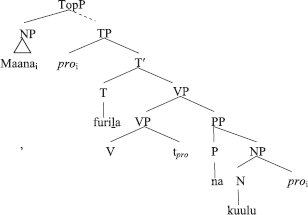
The idea that apparent subjects in Bantu may, in some cases, be left-peripheral topics is not new (see Schneider-Zioga Reference Schneider-Zioga2007). As Demuth (Reference Demuth1995) has argued, one diagnostic for this property involves subject wh-questions. While Bantu languages generally lack wh-movement, many Bantu languages do not allow a subject to be questioned in situ. Demuth interprets this as the result of a conflict in information structure: topics by their nature cannot be focused as questions. Therefore, if subjects are topics, they cannot be questioned in that topic position.
Importantly, Chimwiini has this property. Subjects may not be questioned in situ, but instead must appear as the focused head of a relative clause in a hidden cleft structure.
- (40)
(a) Omari / Ø-ta-kuu-y-a.
Omari 3sg-fut-inf-come-fv
‘Omari will come.’
(b) (ni) naani / Ø-ta-kuu-y-ó?
cop who 3sg-fut-inf-come-fv.rel
‘Who will come?’
(c) *naani / Ø-ta-kuu-ya
Importantly, if pre-verbal subjects are in left-peripheral topic positions in Chimwiini, then the derivation given for the possessum raising construction in (42) is compatible with the passivization facts in (35).Footnote 21
5. Conclusion
In this paper I have examined variation in external possessor constructions in Chimwiini, situating them within the typology of such constructions in Romance, Balkan, and Semitic, especially as discussed by Cinque & Krapova (Reference Cinque and Krapova2009). I have argued that Chimwiini suggests that the derivational nature of these constructions (movement vs. base-generation) is independent of their other properties, such as affectedness and restriction to inalienable possession. Furthermore, I have argued for a movement-based analysis of possessor raising in Chimwiini in which the syntactic features necessary for licensing possessors NP-internally may be optionally absent in the language, requiring movement of a possessor into the clausal domain for licensing purposes. I have also argued that this is a point of variation: some languages (like Serbo-Croatian) never have these licensing features while others (Chimwiini, Bulgarian) have them optionally and still others (Romance) have them obligatorily.


