Why Do We Need an Ecojustice Mindset?
Educators around the world are seeking ways to respond to ecological challenges (e.g., Gale, Davison, Wood, Williams, & Towle, Reference Gale, Davison, Wood, Williams and Towle2015; Harris & Barter, Reference Harris and Barter2015; Kopnina & Cherniak, Reference Kopnina and Cherniak2016). In this article, we argue that there is some value in incorporating an ecojustice mindset in teacher education; provide a brief literature overview of the nature of ecojustice education and identify the need for ecojustice to be centre stage in teacher education programs; analyse our own paths to valuing ecojustice approaches; and set out some of the pedagogical practices we employ and learning experiences we have implemented in teacher education programs in the School of Education at the University of South Australia. We conclude with a framework of core principles for an education that prioritises ecojustice, some of which we have addressed so far in our work, and others yet to be explored.
Ecojustice, which we define in the next section, is an idea that we believe should be placed centre stage in educational programs at all levels, because the available evidence suggests that in many areas, contemporary Western industrial ways of living are degrading natural environments to a point where ecosystems are no longer viable in their present form; and, ‘if we continue with business as usual, civilisational collapse is no longer a matter of whether but when’ (Brown, Reference Brown2011, p. 10).
A growing body of evidence suggests that the time has come for humans to transition from quantitative to qualitative growth (Odum, Reference Odum1998, p. 65). The evidence is there that human wellbeing does not require high levels of consumption (Skidelsky & Skidelsky, Reference Skidelsky and Skidelsky2013; Wilkinson & Pickett, Reference Wilkinson and Pickett2010) and that ‘it is not wealth that stands in the way of liberation but the attachment to wealth; not the enjoyment of pleasurable things but the craving for them’ (Schumacher, Reference Schumacher1973, p. 47). A number of scholars suggest that what we do need, and what other species need, for individual and community wellbeing are healthy, well-functioning ecosystems (Constanza, Reference Costanza, Weinstein and Turner2012a; Goodall, Reference Goodall, van der Zwaan and Peterson2003). Costanza (Reference Costanza, Weinstein and Turner2012a) points out that for humans, ‘the value of our natural and social capital assets (the commons) has become significantly more important to sustaining human happiness and well-being than marketed goods and services (as measured by GDP)’ (p. 99). Popular (Quin, Reference Quinn1992) and technical works have argued that indeed, many of the environmental challenges we face today — loss of biodiversity, global climate change, depletion of renewable resources, and others — are rigid and maintained through culture. But that culture is not static; indeed, its change can be abrupt and dramatic (Westley, Carpenter, Brock, Holling, & Gunderson, Reference Westley, Carpenter, Brock, Holling, Gunderson, Gunderson and Holling2002, p. 111).
A significant barrier to progress towards sustainable ways of living that are also respectful of other species and supportive of resilient ecosystems is the unexamined industrial worldview in which much of the Western world operates day to day, and that the ecological crisis is really a cultural crisis brought about by Western industrial culture. Barrows (Reference Barrows, Roszak, Gomes and Kanner1995) observes that ‘Thomas Berry, Theodore Roszak, Joanna Macy, and others have pointed out, it is only by a construct of the Western mind that we believe ourselves living in an “inside” bounded by our own skin, with everyone and everything else on the outside’ (p 106).
‘To understand the processes leading to the devastation of the world's diverse living systems or the impoverishment of communities, we must look at historically codified patterns of belief and behavior’ (Martusewicz, Lupinacci, & Schnakenberg, Reference Martusewicz, Lupinacci, Schnakenberg and Mueller2010, p. 14) — a daunting task for education. For the Western world, these beliefs can be traced back to: Thomas Aquinas (1225–1274), who argued that humans are ruled by God as rational creature and that all other creatures are directed to them; Francis Bacon (1561–1626), whose focus was on the mastery of nature; René Descartes (1596–1650), who argued that non-humans are machines; and Isaac Newton (1642–1727), who believed humans are graced with free will but biota are mechanistic (Keller, Reference Keller2010).
While modern philosophical and scientific thought has contributed to an inadequate value system, this seems to be only part of the problem. As pointed out by Shepard (Reference Shepard, Roszak, Gomes and Kanner1995), ‘(t)he idea that the destruction of whales is the logical outcome of Francis Bacon's dictum that nature should serve “man,” or Rene Descartes's insistence that animals feel no pain as they have no soul, seems too easy and too academic’ (p. 23). As Diamond (Reference Diamond2005) has shown, many cultures have collapsed. Cock (Reference Cock1991, p. 3) says that:
The great difficulty is that we are unable as yet to face the fact that we are participating in the death throes of a culture, that the arrogance of the last 200 years was misplaced, and that we now have to attempt humbly to reconnect ourselves with each other and with our planet.
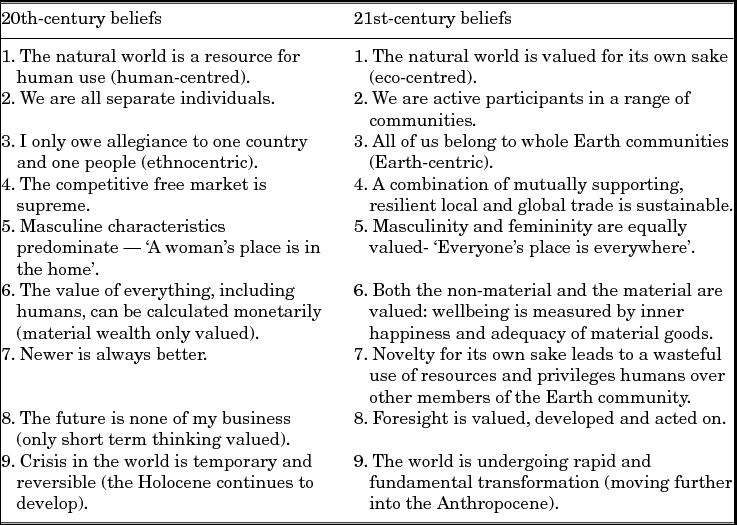
That is, we need a worldview shift that values: (1) the understanding of the natural world (of which humans are a part) through science/ecology; (2) collective (cultural) values that place humans within ecosystems; and (3) the needs of humans — cognitive, affective, and intentional (McIntosh, Reference McIntosh2007; Malone, Reference Malone2016; Martusewicz, Edmundson, & Lupinacci, Reference Martusewicz, Edmundson and Lupinacci2015). We have been informed by Kopnina's recent work and others (e.g., Laszlo, Reference Laszlo2003; Wilber, Reference Wilber2000) and have generated Table 1, which compares a current Western worldview with a futures’ perspective of one that humans need to move towards for sustainable living and the welfare of other species.
20th- and 21st-Century World Views: Corresponding 20th- and 21st-Century Beliefs (Adapted From Kopnina, Reference Kopnina2014 a, Reference Kopnina2014b; Laszlo, Reference Laszlo2003; Wilber, Reference Wilber2000)

A sustainable and desirable future is one that respects biophysical boundaries, distributes resources and responsibilities fairly, and adequately values all members of Earth communities (Costanza, Reference Costanza, Weinstein and Turner2012a). The challenge is to replace the current — and largely unexamined — Western worldview values with ones that are just for all species and their physical, mental, spiritual, and community wellbeing. They are the values of an integral worldview, in which a majority of humans have a worldcentric disposition (Berry, Reference Berry1999; Wilber, Reference Wilber1998). As pointed out by Laszlo (Reference Laszlo2001), to address unsustainable ways of living we need a new consciousness, new thinking and new values; that is, a re-examined worldview and the foresight, courage, and determination to enact it. Such a new worldview would value: a spiritual and affective connectivity to other beings (the heart), an understanding of the way the world works (the head), and the enactment of a changed way of living (the hands). An integral view puts as first place respect for the whole Earth — geosphere, biosphere and noosphere (consciousness). This should not be difficult if, as reported by Wilkinson and Pickett (Reference Wilkinson and Pickett2010, p. 4), a large majority of people want society to ‘move away from greed and excess toward a way of life more centred on value, community and family’ and, we would add, healthy natural environments.
Bowers (Reference Bowers2006) makes the prediction that ‘if the general public, rather than a small minority, were to make the self-renewing capacity of natural systems their main priority we would then see pressure being brought on public schools and universities to make environmental education a central focus of the curriculum’ (p. 4).
While we would contend that ecojustice is important across the curriculum, our focus here is on science education. Connecting school science with social, political and economic concerns is as old as science education itself (Jenkins, Reference Jenkins, Roth and Desautels2002, p. 17). Fensham (Reference Fensham, Fisher and Marsh2003, p. 17) argues that a science education for all citizens should take an interdisciplinary/integral approach because most real-world situations involving science are multidisciplinary, necessarily involving the personal and cultural, as well as the scientific. Similarly, Hodson (Reference Hodson2003) says that ‘there is increasing recognition of the need for science education to look at the wider social, political, economic and ethical issues that surround the practice of science’ (p. 647). An informed ecojustice education, which of its nature requires a clear understanding of the natural world, can identify wider issues. As science educators, we have found it most appropriate to incorporate ecojustice into our courses, which we believe should connect explicitly to students’ everyday lives, both personal and community.
Ecojustice — Its Nature and Place in Education
In this section there are three key components: exploration of aspects of the literature, three autobiographies, and a brief summary of commonalities.
Literature
In our view, education towards the kind of 21st century worldview described above demands new approaches; in this section we discuss that of ecojustice education. The assertion that ‘science without religion is lame; religion without science is blind’, usually attributed to Albert Einstein will, for the purposes of our discussion be interpreted as: Without deep cognition of and compassion for all that is, we are incapable of responding with wisdom to contemporary ecosocial inequities.
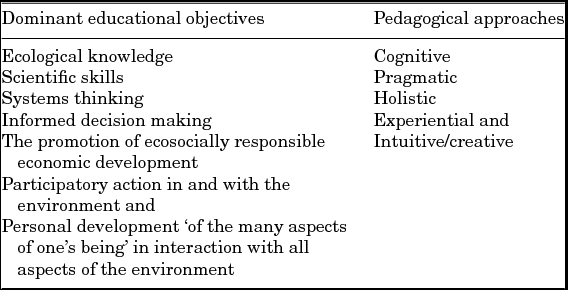
A starting point for understanding ecojustice and the challenges for education is suggested by the work of McBride, Carpenter, Brock, Holling, and Gunderson (Reference McBride, Brewer, Berkowitz and Borrie2013, p. 16), who conclude their search for an answer to the question ‘Environmental literacy, ecological literacy, ecoliteracy: What do we mean and how did we get here?’ with a summary of the nature of ecoliteracy education, as set out in the Table 2.
Elements of Ecoliteracy (McBride et al., 2013)
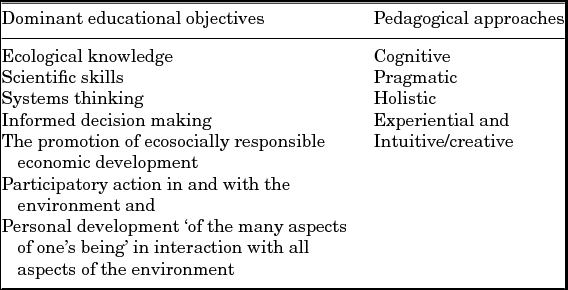
While agreeing that all the tabulated descriptors are necessary aspects of ecoliterate individuals and groups, we believe that they are not sufficient if educators are to comprehensively assist students’ development of ways of thinking, feeling and acting with ecosocial wisdom; a wisdom that necessarily includes science and ethics, knowledge and compassion. Indeed, the ‘knowing places’ of our title refers first to cognitive and compassionate places of ‘knowing’ in mind and in heart. Second, we mean knowledge of the ecosocial places which we inhabit, recognise and relate to. Third, ‘knowing our place’ means knowing where we ‘fit’ as Earth-citizens into the structure of things sentient and non-sentient. And fourth, that we appreciate our rights and responsibilities in that citizenship as we come to practise both knowledge and compassion of place in our ecosocial spaces.
We are at one with the urgency expressed in the Ehrlichs’ suggestion (Reference Ehrlich, Ehrlich, Murray, Cawthorne, Dey and Angrew2012) that ‘no challenge faced by humanity is more critical than generating an environmentally literate public’ (p. 352). However, with Mitchell (Reference Mitchell2009), we propose the necessity of pursuing instead an ecojustice that extends:
social justice to ecological well-being, environmental issues, and a recognition of the significance of preserving the cultural and environmental commons and the role that they play in maintaining the integrity of the Earth. Ecojustice ethics brings into the foreground the moral consideration of species other than humans. (p. 35)
Ecojustice, therefore, seeks to preserve and, where appropriate, enhance ecological wellbeing and the integrity of the ecological commons — the ‘properties’ of the Earth that sustain all life, including human life; properties called ‘ecosystem services’ (Costanza et al., Reference Costanza, d'Arge, Groot, Farber, Grasso, Hannon and Belt1997; Costanza, Reference Costanza2012b) or ‘the larger systems of life that we depend upon’ (Martusewicz et al., Reference Martusewicz, Lupinacci, Schnakenberg and Mueller2010, p. 11). Further, ecojustice is about having the same ‘view-of-care’ for human systems — especially the cultural commons (Bowers, Reference Bowers2009). Finally, the ethical orientations of ecojustice include the notion that all species, not just humans, require ‘moral consideration’, or have ‘rights’ (Nussbaum, Reference Nussbaum2006; Singer, Reference Singer and Keller2010) and ‘standing’ (Stone, Reference Stone2010). This ‘standing’ is ideally, within Earth law, oriented legal systems that attempt to manage the Earth wisely and compassionately (Maloney, Reference Maloney2011, p. 119), where ‘other natural entities are entitled to fulfil their role within the Earth Community’ (Thomas Berry, as cited in Burdon, Reference Burdon2010, p. 86).
Martusewicz et al. (Reference Martusewicz, Lupinacci, Schnakenberg and Mueller2010, p. 12) offer ‘three major goals of an ecojustice framework’ that reflect a shift to a 21st-century worldview. Their list includes two goals that are congruent with ours:
-
1. offer[ing] an alternative way of knowing that recognises humans as just one part of a vast system of communication among all life forms that creates wisdom, beauty, and the sacred;
-
2. identify[ing] and revitalis[ing] the existing cultural and ecological ‘commons’ that offer ways of living more sustainably in our own culture, as well as in diverse cultures across the world.
These propositions are ‘deep green’, possibly to the point of obsession for many ‘modern’ minds for whom the Earth and its living and non-living members are merely ‘objects of use, resources, or machines’ (Edmundson & Martusewicz, Reference Edmundson, Martusewicz, Kulnieks, Roronhiakewen and Young2013, p. 4).
Human being, therefore, requires nothing less than that we ‘moderns’ examine our roots, well beyond the genealogies of present-day human connections, and consider with a deep seriousness and humility the genealogies of our Earth connections — biological, ecological, geological. Boulding's (Reference Boulding1990) ‘200-year present’ (p. 4) requires that we act with reverence to our grandparents and our grandchildren, a ‘worldview’ that Lederach (Reference Lederach2010) employs in his urging that we exercise ‘moral imagination’ so that the present becomes the ‘turning point that orients us towards a new and more humane horizon’ (p. 3). However, if we are to promote ecojustice then our ‘present’ stretches from our emergence as the Homo whose ‘lo-fi’ technology enabled, and required, him/her to live within the company of the wild — from there to several generations ahead, whose lives might be affected by our decisions. Such consciousness of our ‘deep past’ and ‘deep future’ needs to be operative as we also retain our ‘present view’ and the inevitable concerns we have for contemporary ecological wellbeing, including that of humans and other life forms.
Ecojustice and the ‘humane horizon’ of an Earth democracy it pursues has a moral and ethical core — ‘ecojustice ethics express a spiritually grounded moral posture of respect and fairness towards creation, human and nonhuman’ (Hessel, Reference Hessel and Sharma2011, p. 182); Similarly, Shiva suggests that ‘Earth Democracy relocates the sanctity of life in all beings and in all people’ (Reference Shiva2005, p. 8, as cited in Hessel, Reference Hessel2007). It is this core that is essential if we are to build peace with the planet and with the whole Earth community — a proactive exercise characterised by empathy and creativity, not mere avoidance of conflict, using strategies similar to those employed in peace building to avoid conflict between groups of humans. That means, primarily, assisting students of whatever age to be ‘embodied participants’, ‘living as part of the whole’ (Reason, Reference Reason2005, p. 36), within what might be called an ‘economy of affection’, to co-opt Hyden's term (Hyden, Reference Hyden1983), that includes the whole Earth community. Edmundson and Martusewicz (Reference Edmundson, Martusewicz, Kulnieks, Roronhiakewen and Young2013) capture this in their statement:
[t]hat is, our first task is to imagine life in our homeplaces as flourishing in generous, affectionate, and responsible membership, a way of being that comes from offering ourselves to each other in sympathy and care, and accepting the wisdom the living world has to offer us as the very promise of existence. (p. 12)
Further, this includes education for responsibility (Edmundson & Martusewicz, Reference Edmundson, Martusewicz, Kulnieks, Roronhiakewen and Young2013, p. 1) and for the kinds of leadership capable of supporting institutional change oriented towards ecojustice (Barlow & Stone, 2011). Learner-teachers — or co-learners (Okada, Mikroyannidis, Meister, & Little, Reference Okada, Mikroyannidis, Meister, Little and Okada2012) — in ecojustice approaches work, learn and play to establish more peaceful relationships with themselves — such as to realise the artwork and soulwork that is themselves, and to develop their internal awareness, kindness and courage. Realisation best matures as each person practises the same qualities toward other humans — and all other Earth entities — first in their immediate time and place, and later in times and places beyond these. Everyone in an ecojustice education enterprise seeks both the multitude of connections with and within ecological and cultural commons that approach Bateson's ‘ecology of mind’ (Bateson, Reference Bateson1972, as cited in Martusewicz et al., Reference Martusewicz, Lupinacci, Schnakenberg and Mueller2010, p. 17) and the ‘mind of nature’ (Kineman & Poli, Reference Kineman and Poli2014). It is our contention that outcomes such as these can only emerge from integrative, experiential, mentored, project-based learning, and assessment that asks not for ‘facts’ but for ideas and empathies justified, applied and evaluated. These approaches, while not difficult, are certainly approaches uncommon in mainstream national curricula.
The above also responds, in part, to a question posed by McBride et al. (Reference McBride, Brewer, Berkowitz and Borrie2013, p. 16): ‘What roles might intuition, creativity and spirituality play in enhancing ecoliteracy? Alternatively, what are the pitfalls that may be associated with a spiritual approach?’
Clearly, intuition, creativity, and the development of a personal eco-spirituality are the concerns of a pedagogy for ecojustice. It is, indeed, necessary in our view not only to wonder at the question posed by McBride et al. (Reference McBride, Brewer, Berkowitz and Borrie2013) but, further, to turn the question around, asking: ‘What are the pitfalls that might be associated with an approach that values science above intuition, creativity and spirituality?’
For us, an ecojustice orientation is a necessary one for educators who intend to assist their students towards the kinds of ‘whole-Earth’ knowing, wanting and acting that just might enable them to work toward an increasingly whole — and just — Earth community. This would be one within which there would be ‘equitable sharing between all human beings, the natural world, and future generations’ (Jucker, Reference Jucker2004, p. 10), and also many opportunities for each human to become an increasingly embedded participant in that community. Jucker's conclusion (Reference Jucker2004, p. 23) that we need ‘to delearn ourselves, and enable our students to delearn, the deep-seated ideologies of consumerism, individualism, growth, development, and progress, and relearn the central values of many vernacular societies: to live well with little, in humility and with respect, within a community of human and nonhuman relations’ provides a summary presenting no small challenge!
In what follows we describe the paths that have led us, separately and collegially, to this position, and provide examples of the admittedly limited extent to which we have put these ideas into our practice as teacher educators. We conclude with what we see as some of the significant implications these discussions have for the continuing improvement in teacher education experiences.
In employing an autobiographical approach, we have sought, as Settelmaier (Reference Settelmaier, Taylor and Wallace2007, p. 178) suggests, to ‘shape how [our] lives are being told’ — both in this article and in our continuing work — leading, we know, to a maturation of what she calls (after Connelly & Clandinin, Reference Connelly and Clandinin1988) the everyday, ‘practical knowledge’ that guides us, and (after van Manen, Reference van Manen1990) the ‘thoughtfulness’ we apply to our co-learning. Individually and collaboratively, we have involved ourselves in what Settelmaier (Reference Settelmaier, Taylor and Wallace2007, p. 50) describes as ‘critically reflective process[es]’ that can lead to ‘transformative learning’, the same kind of learning that inevitably occurs if education moves co-learners towards lives more engaged with the ecojustice worldviews discussed above.
Three Educators’ Ecojustice Autobiographies
The authors and their work are primarily situated in the Adelaide region of South Australia. We have all been educators and between us we have worked in the primary, secondary, tertiary, and community sectors. We have been together for the last 12 years as teacher educators and also active in our respective communities for many years.
We describe here how we each came to our own understandings of ecojustice and how we applied these understanding to our work as educators in primary, secondary, tertiary, and community settings. We have all been influenced by the literature, our histories, and our colleagues. These histories provide a base against which we can debate with ourselves and others issues of social and ecological justice.
Kathy's Journey: From Rural Beginnings
Being raised in the Riverland, being aware of scarcity of water, having brown water baths, getting excited about rain on the tin roof, watching the large rain drops bounce on the dry parched soil, scattering soil particles, I think contributed to having an appreciation and respect for the ecological and cultural commons (Bowers, Reference Bowers2002). It was and continues to be the magic of noticing small things changing daily, new flowers appearing, birds nesting, vegetable leaves being eaten by caterpillars, watching weather patterns to ensure native birds have water on ‘catastrophic’ days, and using shadecloth to protect young shoots. Being connected and in tune with the natural world has been part of the legacy of my family upbringing; its significance in my development reflects the importance of children being free in wild places (Louv, Reference Louv2008). In my early years, value was put on experiences in the natural world and with friends and family over consumption and an increasing number of possessions (Hamilton & Dennis, Reference Hamilton and Dennis2005; Schumacher, Reference Schumacher1973).
Moving forward to teenage years and a significant event was coming across science. I just loved the discipline, the explanations, and the wonder of the world we lived in. We went to the planetarium, we grew mold, we explored air pressure with oil tins and heat. My science education was engaging and connected to my life world (Paige, Reference Paige2011; Tytler, Reference Tytler2007). For friendship and finding ways to survive the excruciating adolescent years, I joined the Rangers (Senior Girl Guides) — night hikes, cave explorations, abseiling, mountain climbing and sleeping outside under the night sky helped fill the years with adventurous friends. Outward Bound at the end of my second year at teachers' college helped develop my canoeing and sailing expertise. And probably the only time I will be solo in the bush happened when I spent 3 days and 2 nights on my own on a sand dune on the Coorong. I was dropped off by canoe with my bivvy sheet and sufficient rations. It was life changing to embrace the experience and live by myself — no contact with the outside world. No phones in those days. My 1974 diary states: ‘I don't want solo to end it's so peaceful and simple- such that I don't think I have experienced before. I wish I knew what birds made what sounds? Is it nearly 12.00? Sun is about here [reference to the position of the sun].’
We had to select a major and a minor at teachers college; science was my major and mathematics my submajor. It was in the last science course that John Hunwick challenged us to undertake frog counts, explore population growth, and go on a public demonstration to ‘ban the can’. Becoming a naturalist is a process that fosters self-learning, challenging the observer to combine intellect with experience (Leslie & Roth, Reference Leslie and Roth2003); it is mainly self-taught through direct observation and informal knowledge sharing with other naturalists (Leslie & Roth, Reference Leslie and Roth2003). It was these experiences that we have tried to replicate in science and mathematics education courses with primary/middle undergraduates (Paige, Lloyd, & Chartres, Reference Paige, Lloyd and Chartres2008). Extended field trips to Middleback Ranges to explore aridlands vegetation and Mannum Falls to explore geological landforms ensured preservice teachers spent overnight in the bush. Undertaking place-based experiences in urban ecological setting and personal pledges to reduce resource consumption have been other pedagogical practices that have emerged from my eco-justice beliefs (Borget, Brooks, Innes, Seelander, & Paige, Reference Borgelt, Brooks, Innes, Seelander and Paige2009; Paige, Reference Paige2016).
As a beginning teacher, I understood the importance of connecting children to wild places in the natural world — annual camps to local spaces, walks and picnics in the bush, cooking lunch between high and low tide (Littledyke, Taylor, & Eames, Reference Littledyke, Taylor and Eames2009; Wilson, Reference Wilson2012). Whichever setting I was in — Riverland, coastal, or inner city — I found places where children could go to explore. They were engaged, cooperative, excited and challenged by the experience. If I see ex-students years later they say, ‘Remember the beach camp — it was the highlight’. With my own children, camping in the desert, spending time with grandparents at the beach, and holidays away from technology and a hectic pace of life were highlights. I always noticed how much less stressed the children were when we returned from 3 days outside engaging with nature, with regular meals and good nights’ sleep (Sobel, Reference Sobel2008). The focus on learning in ‘place’ with a transdisciplinary mindset that is thinking and working scientifically, mathematically, creatively and environmentally to make sense of the world around them ensured that the learning experiences had an ecojustice frame.
As an early career teacher in the country (8 years) I spent the summers travelling. My first 8-week journey was to India when I was 20. It was a monumental experience, where I ‘got’ that the world was a very unfair place, that I was from the privileged ‘West’; the images of the extremes, rich versus poor, remain with me to this day. Annual collections for canned food for homeless people, personal items for those sleeping rough, and knitting squares for orphanages are some of the ‘walking the talk’ practices that students and staff participate in. I was also fortunate that my long-term partner was an artist, which provided a balance to my science-based worldview. The importance of creativity and artistic expression has been evident through murals, community gardens, and metal cut-outs (Paige & Whitney, Reference Paige and Whitney2008).
After 17 years in the classroom, I returned to study and found myself a teacher educator. During the last 17 years I have worked in an interdisciplinary team embracing EfS as a way to reconnect our preservice educators to science and mathematics (Lloyd, Reference Lloyd2011; Paige et al., Reference Paige, Lloyd and Chartres2008). We ensure graduating teachers are equipped with a knowledge and understanding of EfS and, in particular, an action-orientated curriculum perspective.
The literature suggests that environmentalists can track their inspiration to significant positive or negative experiences, and mentor. I think mine was an embeddedness. It makes so much common sense. There is nothing more important than treading lightly (taking refillable coffee cups and water bottles to meetings), asking the hard questions in the classroom, at school level, and exposing preservice teachers to eco- and social justice practices so that they ‘get it’, both personally and professionally. That is, that they understand the importance of connecting to place, using ‘slow pedagogy’ and incorporating a transdisciplinary approach to teaching science (Payne, Reference Payne2015; Payne & Wattchow, Reference Payne and Wattchow2009). At the conclusion of a recently completed short course, ‘Earth Pilgrim’, at Schumacher College, the question asked was, ‘We are all on a journey. What is your story?’ This is my story.
David's Story: Finding Place
A child born during World War II in the United Kingdom, an immigrant to Australia when 7 years old, a student in urban Adelaide, a teacher in five secondary schools (both country and city), and a lecturer in science education — all provide a history against which I can debate with myself and others issues of social and ecological justice and challenge unexamined or taken-for-granted cultural views.
The natural and built environments have always been such that I had access to interesting places to play and take adventurous journeys with elements of risk; both environments seemed unproblematic to me until much later in life. I have fond memories going back to my early childhood of woods, gardens and beaches while growing up in post-World War II England and then in metropolitan Adelaide. An early memory is of a picnic in the grounds of Crystal Palace, which had housed the Great Exhibition of 1851 and was conceived to show the progress that mankind was making in the 19th century. Another, not so pleasant, is associated with a bomb shelter in the backyard of our home in Surrey — a symbol of the end of Progress.
Emigration to Australia provided the opportunity for the family to continually improve in terms of material comforts, although the pressures on family life, due in no small part to the dislocation from the extended family and familiar local environments, was considerable. My parents were able to provide me with basic material needs, and the schooling system, particularly in secondary school, provided teachers whom I could look up to and who motivated me to learn. Various sporting clubs, particularly tennis, were places where I could develop both physically and socially — they were in many ways more home than home. The scholarship system provided both my brother and I the opportunity for tertiary education and one of many aspects of growing up that made social justice visible — ecological justice came later. While life experiences have in the main been good for me, I have, through study, the media and my own observations, come to understand the social and environmental inequities within this country and globally, and the need for a cultural shift away from a focus on material wealth and towards valuing vibrant, healthy communities and ecosystems.
My own struggles through early life have influenced the way I see the world. In particular, I have developed a social/nature conscience that has directed me to work with, and have empathy for, all living things. The times I feel totally at ease, relaxed and connected is when alone in natural environments in beautiful settings — in my own garden, I see the sun reflecting from large trees moving at ease with the help of a light breeze and harbouring bird life seemingly excited to be there; canoeing on Lake Eyre with the overcast sky and the lake surface seen as one continuous envelope, with the faint shore line the only obvious feature; searching the night sky for constellations on a hot, still summer evening and wondering about the meaning of life. And many other wonderful experiences in nature alone, with family and friends, and with colleagues and groups of students who have accompanied me on field trips and study camps in ‘the bush’. In nature, the affective and the cognitive complement each other, but in essence it is a spiritual experience embracing both of these but going beyond both. Berry (Reference Berry1999) points out that the ‘spiritual and the physical are two dimensions of the single reality that is the universe itself’ (p. 50).
As an educator, mainly in the area of science learning, I have always aimed to connect learning to student interests and their local worlds; for example, measuring water quality in the local river or studying geological structures during day and extended excursions. My commitment to connecting science learning to the lives of the learner was considerably enhanced when in the 1990s I explored the educational value of student images of the future as a Bicentennial Futures Education Project (Lloyd, Reference Lloyd2002).
Prior to 1988, I was unaware of how students viewed futures and, like most of my colleagues, did not think them important; or, more accurately, did not think about them at all. My first experiences with student images of futures in 1988 was by way of demonstration, and then in 1989 and 1990 in my own classroom set me on a path of reflective exploration. I wanted to come to a better understanding of the nature and worth of student images of futures and how they might limit, mislead, direct, enrich, and empower student lives.
A majority of student images revealed dystopic futures, often showing degraded natural and built environments and, on interviewing, concerns for the world in which they were to live. Many of the students who took part in this study seemed to be well aware of the upheavals of our times and the jeopardy that they may bring. Technological determinism was an underlying fear of many students’ views of futures, but not a fear they had power to combat. Students had concerns for both themselves and for others, and were well aware of social injustice, environmental degradation, and the possibility of ecological unsustainability. For many participants, a good place to live in the future will have abundant flora and fauna and people will live in harmony with their built and natural environments. Also of importance was the need for a happy and cohesive community; alienation was a central concern. Students identified demilitarisation and greening of science and technology to meet genuine human and environmental needs. Disastrous futures were not always merely depressing. Some students were able to identify these as a time to avoid rather than as inevitable. Students in the study identified the apparent paradox of our time — spectacular progress yet also ignorance and narcissistic self-centredness. Jucker (Reference Jucker2004) points out that ecojustice is about equitable sharing between all human beings, the natural world, and future generations; and Kopnina (Reference Kopnina2014b, p. 225) notes that ‘Contemplating our possible destiny may move us toward returning to education for something that we value’. It became quite clear from the student futures study that students’ attachment to their environment needed an education that was much more than scientific understanding alone — the conceptual, the affective and the intentional were all needed and confirmed for me the considerable advantages of integration with other subject areas. Such a process would, I believe, lead to a more authentic and empowering curriculum by allowing for differentiation of the various ways of knowing and their integration — an integral approach to learning (Esbjörn-Hargens, Reference Esbjörn-Hargens2007; Lloyd, Reference Lloyd2007; Martusewicz et al., Reference Martusewicz, Lupinacci, Schnakenberg and Mueller2010). ‘An integrated forward-looking view should, now more than ever, be of central importance in how we educate’ (Gidley & Hampson, Reference Gidley and Hampson2005, p. 255).
My own realisation of the need to be intimately connected to the natural world has influenced my journey as an educator and had a significant impact on the way I have directed my classroom practice and, now, my citizen duties with a community garden, the transition movement and local government (Lloyd, Reference Lloyd2013, Reference Lloyd2014, Reference Lloyd2015). My interpretations and insights are coloured by my own past experiences, current interests, and future vision in my personal, family, professional, and community life. Ecojustice, for me a recently studied idea, brings together ideas of social and ecological justice and provides a space for debate about, and decision making and planning for, normative futures. I see ecojustice education as an idea needing integral consideration (Esbjörn-Hargens & Zimmerman, Reference Esbjörn-Hargens and Zimmerman2009; Lloyd, Reference Lloyd2007; Wilber, Reference Wilber1998, Reference Wilber2000). It is about social and ecological justice, and sustainable living and intimate connection with the geosphere, biosphere and noosphere. It relies for effect on the development of our inner personal and cultural lives and our personal and social behaviours — ‘a practical and emotional reality in student's lives’ (Tooth & Renshaw, Reference Tooth and Renshaw2009, p. 2).
Richard's Story: Becoming Part of a Community
I started playing in nature in the early 1970s at the age of about 30, after a solitary childhood and more sociable early adulthood spent largely in books — although childhood and adolescent experiences in the sea and country town swimming pools established my continuing affection for ‘being’ in water. Developing a sense of being and belonging on land really did not arrive until, after a laboratory-based education in secondary school and tertiary science, I began working with science teacher educators who believed in ‘the great laboratory of the outdoors’ and who provided work and play settings in which the collegial, mutually respectful and innovative interplay between staff, and between staff and students — and humans and natural environments — within which I was mentored were the norm. Repeated visits, several days at a time, to the same natural environments while on field trips with students, or with family and friends to ‘bits of bush’ we shared, provided an infrastructure — and locations — where my appreciations of places, and sense of place, developed.
From this early adulthood period onwards, I spent much time and energy sharing motivations, passions, and actions with environmental educators and ecosocial activist groups.
On reflection, these experiences contributed to my structuring of self in a series of circles of solidarity by allowing me to discover in deeply personal ways and by having ‘deep’ discovery learning about several ‘fact(ors) of life’, set out below. In each, I indicate some of the key activities and incidents that contributed to that learning.
1. Community
I was aware of being a valued member of more than one coherent, like-minded group — both human and beyond — and knowing the human groups to be ones pursuing situation improvement in aspects of natural and human ecology, that is, in nature–human connections, in ecosocial justice, and the ‘ways of life more centred on value, community and family’ and ‘healthy natural environments’ we refer to above. The human communities appreciated more than mere science and social science; they have included explorations in arts and environments, drama and music, and the social and socialising experiences of field studies and campfires, and ecosocial activism. A key aspect of this included recognising (and longing for more of) Fowles’ (Reference Fowles and Relf1998) experience described in ‘The Blinded Eye’, that familiarity with a range of organisms and habitats — how ‘things fit’ in similar and different ways in several parts of the world, which brings together the weft and warp of the world and one's place within the Earth community.
2. ‘Inventorship’
In working with students and as an adult student, I was able to invent and develop, and successfully employ several approaches: a field-based Kipp's apparatus that facilitated field anaesthetisation of some insects (and, therefore, opportunities for closer examination of otherwise fast-moving organisms); ways of restraining, and so viewing and photographing, some insects in flight; joining swimming goggles and a jeweller's eyepiece to create an ‘upclosometer’ for viewing ‘mini-worlds’ of leaf litter, mosses and so on, and a specimen vial attachment for observing terrestrial and aquatic organisms; developing the use of field observation techniques such as a seagull posture chart, and an underwater, waterproof field note book for use when rain accompanied our fieldwork, as it often did. I borrowed some of the attention-focusing techniques used by Earth Education and conceptualised a ‘bon-bon’ approach to outdoor natural history studies so that participants were brought from a wide range of ‘headsets’ into supported observing and recording, and encouraged to reflect on this as they re-entered their wider worlds. I presented students with opportunities to be inventive in the design and use of rudimentary human balance testing and measuring devices, and to think critically about ‘experiments’ in diuresis activities that asked about evidence for causation. The core importance of being involved in such processes of invention is well recognised by educators, particularly those working with young children; they ’work’ for big kids, too!
3. Discoverer, taxonomist and etymologist
Fieldwork provided opportunities to pursue the understanding of scientific names and, on realising the often prosaic origins of these high-sounding ‘badges’ of ‘proper’ science and scientists, to employ the strategy of student-staff ‘identification with’, rather than mere identification of, species we ‘discovered’ (because they were new to us) in invention of common, not-so-serious names for other species. We investigated the origins and meaning of common names, such as butterfly, moth, sawfly, hoverfly, dragonfly/nosebiter.
4. Naturalist and ‘maker of friends’
Fieldwork with colleagues and students, and bush outings with family and friends allowed me the excitement of ‘discovering’ species new — or familiar — to me wherever I went and, in doing so: appreciating something of the cornucopia of nature and its seasonal changes in a location; discovering the same or similar species in different locations; and noting how experience becomes a weaving together of familiar threads. We met in several locations and mostly enjoyed: the variations in anatomy and behaviour, and patterns of individual and community activities, including relations with other organisms, of several species of ants (meat, inch – and one whose cadaver-gathering behaviour became a source of fascination, and whose common name became the Big Black Ant, which was much easier to say and comprehend than its scientific name); several eucalypt, acacia and casuarina species, and their interactions with other organisms, including processionary caterpillars and the sometimes alarmingly large ghost or wattle goat moths; and dune caterpillars in South Australia and Western Australia. As I made my ‘friends’ and encouraged students to do the same, we ‘met with’ systems, rather than merely traversing them, coming closer to the communion with ‘life’ that ecojustice values. We appreciated better Britton and Tippins’ (Reference Britton and Tippins2015) ‘all things interacting within a space’ (p. 429).
5. Recognition
The learning and other personal development experiences described above allowed me the being of someone whose opinions and expertise were valued, and one whom others could caricaturise and make genial (not malicious) fun of. These are marks of acceptance and affection that contributed significantly to my construction of self. Being-in-place, I have been able to enjoy some or all the above in particular places, especially ones visited several times.
6. Education and pedagogy
My work has enabled me to develop a feeling for ‘teachership’, in becoming an inventor of rewarding, exciting, awareness-raising, educational activities that had or have an impact on students, many of whom have reported that activities changed their views of themselves and of the other citizens of Earth. This has included: working with motivated and active learners in outdoor education; teacher education students in natural history courses; teacher education students in classroom and field-based courses in science, and in science and social science curriculum courses; learning for my co-learners; and becoming extended by community activism. An ongoing interest in ‘problem-based’, situation improvement learning has often contributed to my learning-and-teaching.
What Does the Literature and Stories Suggest About Ecojustice?
We know that Aristotle's ‘the whole is greater than the sum of its parts’ applies to our autobiographies and to our co-learning with students; the fragments that build — and are — our individual stories have come together in the synergy of our work together. We believe, from discussing our encounters with our students, with them and each other, that Aristotle might have approved; the combined efforts of all we co-learners have brought us to greater appreciation of the (possibly Hindu) notion of the ‘oneness of all beings’. In the activities which descriptions follow, we have tried to provide students with insights and experiences that will, though only fragments, become important contributors to their own developing appreciation of the importance and deep reality of the interconnectedness foundational to working and living towards ecojustice.
While our stories are quite different with respect to time, place and personal lifestyle decisions, there are also common elements. Each of us have (and still do) value our time in nature (with others and alone) and have come to an understanding that being in nature is essential for personal growth, physical and mental wellbeing, and embeddedness in the natural world, which includes both the cultural embedded within the ecological. We have all enjoyed our teaching of science and the opportunity to share our understandings with students, as well as providing them with new experiences in nature. By taking a transdisciplinary/integral approach, we have each been able to include the ideas of social, cultural, and ecological justice.
Educating for Ecojustice: Examples of Practice
Having described our journeys, this section will make connection to our teacher education context. The preparation preservice educators for the 3–9 years of schooling in South Australia in the Bachelor of Education (Primary and Middle) program attempts to address today's changing circumstance that are particular as well as unknown, through a framework of principles relevant to this age group, and consistent with the requirements for registration as a teacher and to assisting in the planning, implementation and evaluation processes. The program has as its aim, ‘to prepare educators who are professionally competent and primarily concerned with learners’ wellbeing and who are committed to social justice, futures thinking, sustainability, education for community living, and sound pedagogical reasoning that is enquiry based’ (Lloyd, Smith, & Paige, Reference Lloyd, Smith and Paige2010, p. 5).
The importance and complexity of the task for this program is complicated by the dynamic nature of our society and the wider world in which it is embedded. The world is undergoing radical social reformation (Laszlo, Reference Laszlo2001; Raskin, Reference Raskin2013) that requires citizens who are well educated in foresight (Beare & Slaughter, Reference Beare and Slaughter1993; Kopnina, Reference Kopnina2014b; Lloyd, Reference Lloyd2011; Slaughter, Reference Slaughter1995, Reference Slaughter1996) and local (Smith, Reference Smith2002) and global politics (Fensham, Reference Fensham, Fisher and Marsh2003), and who are exposed to a curriculum that takes seriously the welfare of ecological, social, cultural, and economic matters (Jucker, Reference Jucker2002; Kopnina, Reference Kopnina2014b).
To ensure preservice teachers ‘get it’, they need ongoing exposure to ideas over the entire 4 years; the idea that behaviour change can be achieved within a 13-week, one-off course is naive. The notion of ‘slow pedagogy’ raised by Payne and Wattchow (Reference Payne and Wattchow2009) ‘allows us to pause or dwell in spaces for more than fleeting moments and therefore encourages us to attach to and receive meaning from that place’ (p. 16). It supports connections to place through experiential learning. Payne and Wattchow (Reference Payne and Wattchow2009) argue that slow pedagogy:
integrally involves sensory, phenomenal experiences of time and effectively highlights the importance of the body in an education with various environments — as those bodies are lived in and over time in natural spaces there needs to be a shift in emphasis from focusing primarily on the ‘learning mind’ to re-engaging the active, perceiving, and sensuous corporeality of the body with other bodies (human and more-than-human) in making-meaning in, about, and for the various environments and places in which those bodies interact and relate to nature. (p. 16)
In this article, we are reporting particularly on our work that focuses on ecojustice in the area of our responsibility — science education. While ecojustice is an idea that has come into use only recently, we recognise that it has been an important aspect of all our courses in a number of ways. However, we do need to acknowledge that in the 4 years of a teacher education program, the idea that it is possible to create a critical social agent on top of 15 years of education is extremely challenging and not at all realistic. This has been made even more difficult in recent years by a social and economic climate that does not value the cultural roots. What we have been able to do is approach the task with an ecojustice mindset. We illustrate this in what follows, briefly describing some enabling pedagogical practices that contribute to the enormous task of ‘unlearning’ (Jucker, Reference Jucker2004), and attempt to ‘reculturalise’ preservice teachers so that by graduation they ‘get’ ecojustice by a small degree.
Leaving the Classroom: Field Trips — Short and Extended
A necessary attribute of ecojustice education is students’ experiencing the ‘territory’. We achieve this in part through short and extended field trips, and service learning placements with organisations that have aspects of ecojustice as their purpose, as well as through guest presentations and processing readings by environmentalists, ethicists, economists, and critical educators, through structured questioning and class discussion.
Guest speakers
We invite experts in their field to discuss the work they do and why they do it. For example, a legal and environmental lawyer tells us about the kinds and extent of human impact on natural systems, an amateur astronomer interested in Aboriginal astronomy show us in the planetarium and at night on field trips how the night sky comes alive in Aboriginal lore, an architect discusses urban ecology and a vision of an ecocity, and a representative from an environmental group discusses the opportunities and challenges for South Australia's energy future. Meeting people with a passion for what they do in the area of ecojustice complements the learning students undertake in workshops and through the literature, and demonstrates the richness that others can bring to the classroom.
Short field trips
Onsite experiences provide for the cognitive and affective development of a sense of place and are a resource for students’ own future teaching. A visit to: the Bureau of Meteorology gives insights into the way we study and report on weather and climates and hear first-hand the evidence for climate change; the Tennyson sand dunes and the St Kilda mangroves assists in the study of, and respect for, coastal and marine environments; the West Beach wetlands provide a place to study freshwater ecology in an urban setting. In a visit to Arbury Park Outdoor School, students learn about ecological processes (head), develop feelings for the natural world (heart), learn how individuals can contribute toward a sustainable future (hands), and develop teamwork and relationships with each other (community). And a visit to Christie Walk, a small piece of ecocity within the Adelaide CBD, demonstrates to students what is possible in sustainable community living — medium density, low maintenance, low-energy homes with rooftop gardens.
Extended field trips
Extended field trips are perhaps the most powerful in connecting students to their natural world. For example, a 5-day field trip to the remote Middleback Ranges in South Australia, with assistance from the local field naturalist and astronomy groups, provides an ideal opportunity for many students to experience arid lands for the first time and to experience a night sky without the dulling effects of urban light pollution. Students undertake identification and transects of plant species and associations; search for and examine scats in order to identify local wildlife; learn about the birds of the area and their migratory habits, and assist in banding; and study rocks, minerals and geological formations of the area. Guest speakers talk about the history and current use of the area, including the iron ore quarries now no longer mined. Evenings are spent cooking and sitting around the campfire, telling stories of the day's experiences or studying the night sky. Students keep personal journals and are given time to sit quietly and alone in a bush setting in order to experience the sights, sounds and odours of a natural bush environment. The field trip experiences and the debriefing that follow help to ‘make relevant the places, people, living creatures, and ecosystems that students are an embedded part of and to help them to make visible the undisputable harm done when we do not acknowledge the interconnectedness among all’ (Lowenstein, Martusewicz, & Voelker, Reference Lowenstein, Martusewicz and Voelker2010, p. 103).
Service and Place-Based Learning
In this pedagogical practice, students work collaboratively with a colleague on service learning projects that work to achieve sustainability outcomes. For example, students learn about places of conservation such as zoos and botanic gardens, while others go to places associated with sustainability practices, such as recycling depots, carbon offsetting companies, community and school gardens, and government or public instrumentalities such as SA Water. Preservice teachers enrolled in a fourth-year professional pathway are required to volunteer for a place-based education experience in urban ecological settings for between 3 to 10 days. Assessment involves constructing a digital narrative focusing on how the setting can be a useful resource for a beginning teacher. Settings in which voluntary work have been undertaken include: coastal dunes where students removed non-indigenous plants; school kitchen gardens, where they worked with groups of children to cook food from ingredients sourced from the garden; Trees for Life, where they attended workshops about propagating trees from seeds; and a Marine Discovery Centre, taking school students on beach walks. The preservice teachers also contribute in an educational sense through developing websites and pamphlets (Paige, Reference Paige2011).
In these service learning activities, students research the chosen placement, visit and participate, and then write and present a report that critiques the sustainability practices of their placement and its educational and personal value to themselves. Taking part in service learning activities and their reports we hope will assist students develop a framework of thinking against which they can judge for themselves issues of social and ecological justice.
Futures Scenario Writing: Collaborative and Individual
Social and ecojustice issues require action in the present that is well informed by where we have come from (history of the past) and where we want to go (history of the future — futures studies). Because images of futures affect powerfully what people believe and how they respond in the present, futures work has a special responsibility to ensure that all members of a learning community are prepared for and proactive about their future (Hutchinson & Herborn, Reference Hutchinson and Herborn2012; Lloyd, Reference Lloyd2011, Reference Lloyd2014; Masini, Reference Masini2013). To live ethically in the present requires us to understand that decisions we make in the present moment influence what the future can become. This is true for personal, collective, and world futures. With this in mind, we offer students in a fourth-year curriculum course and two science general studies courses the opportunity to develop futures scenarios that help them to bring together their understandings of, and visions for, a sustainable world. These assignments are well scaffolded and form part of the course assessment (Lloyd, Reference Lloyd2009, Reference Lloyd2010, Reference Lloyd2011; Paige & Lloyd, Reference Paige and Lloyd2016).
In the final curriculum course for the Bachelor of Education Primary Middle program, students explore transdisciplinary approaches to planning for learning with an assignment, ‘A Place in Time’, that uses three lenses — scientific, mathematical, and sustainability — to gather data about and develop a relationship with a significant tree. As part of this assignment, students construct a futures scenario for their selected special place.
And in the two science general studies courses, Atmosphere, and Climate and Astronomy and the Universe, students construct normative futures scenarios as their final assignment. The futures scenario assignments, ‘Living With Our Climate in the Future’ and ‘Space Travel: Thinking Ahead’, are written to an integral framework that requires students to address both the subjective (personal and cultural) and objective (materials and social/ecological systems) (Lloyd, Reference Lloyd2007; Paige et al., Reference Paige, Lloyd and Chartres2008).
Activity-Based Approaches
Board games
Student group work in playing games of a variety of kinds is a well-recognised strategy towards enhancing learning (Bochennek, Wittekindt, Zimmermann, & Klingebiel, Reference Bochennek, Wittekindt, Zimmermann and Klingebiel2007; Treher, Reference Treher2011). However, the processes we have employed involve students in small groups designing and building a board game that another group ‘road-tests’ and provides feedback in a structured pro-forma. Much richer discussions between constructors, and between constructors and players, have emerged. Some students were able to capitalise on these experiences if in a later year in their award they assisted in judging the games section of a local science fair for K–12 school students.
A similar set of processes has been used in outdoor or nature settings by involving students as participants in an educational trails strategy over several occasions, after which in study groups they were asked to investigate one section of a natural area, to construct a 3–4 station educational trail and to guide another group through their trail. The sharing of experiences and insights was concluded by peer group feedback and evaluation.
Connecting to the arts
Students have been provided with learning situations in which they were supported in outdoor or nature-based settings towards construction of wildlife representations by drawing and photography, much like nature journalling (Warkentin, Reference Warkentin2011), or towards expressive responses to nature experiences and reflection in simple poetic forms. There have been many opportunities to incorporate an artistic focus to enhance the teaching and learning facilities with student artwork. Murals depicting local fauna and flora, night sky, and museum boxes were constructed by preservice teachers with the help of professional artists (Paige & Whitney, Reference Paige and Whitney2008). An early career teacher who had experienced artwork in nature on geological fieldtrips as part of his university degree implemented similar experiences with his class (Sellar, Whitney, & Paige, Reference Sellar, Whitney and Paige2004). Using a creative lens is a component of a transdisciplinary unit of work, A Place in Time; students sketched their tree, did crayon rubbings of leaves and bark, and explored the idea of natural sculptures (Paige, Lloyd, & Chartres, Reference Paige, Lloyd and Chartres2008).
A further example involved preservice teachers working with artists to represent the key principles underpinning educating young adolescents. The key principles of futures thinking, EfS, place-based learning, social justice, equity, and wellbeing and relationships were represented by student drawings that were the basis of metal cutouts that covered the breezeway between two buildings.
Posters
Having employed a ‘report-based’ approach in several assignments, we have also asked students, individually or in small groups, to present in poster format for public consumption and feedback the results of investigations such as: a 2-week comparison of their ‘backyard weather’, with the official record provided by the local Bureau of Meteorology; or a several-week consideration of their baseline and ‘doing better’ carbon or water footprint, and how successful they were in effecting strategies to reduce these footprints.
One of the more intensely involving versions of the ‘poster report’ has been employed as part of extended field-trip experiences. Students worked in small groups, each member having specific navigational and observation-and-recording responsibilities, in a several-hour transect though natural areas with high ‘wild quotient’ or low human evidence. They were then asked to construct a scale ‘drawing/graphic’ which represented the distance, topography and biodiversity that they recorded on the transect. Characteristically, groups worked late into the night to produce for next morning's proud showing, an account 1–2 metres long, and embellished with a rich array of symbols and explanatory legends.
Pledges
Since 2010, preservice teachers undertaking a science and mathematics professional pathway in their fourth year have been required to make an environmental pledge at the beginning of the semester. The aim was for them to select an aspect of their life in which they can make some reduction in resource use. Key areas included: reducing water consumption; buying fresh rather than processed food; reducing distance travelled by car through using public transport and car-pooling; and avoiding using single-use containers. Having identified their pledge, preservice teachers undertake it while collecting data about the consequences of attempting to keep their pledge over the duration of the 15-week course; these experiences are shared at the final workshop (Paige, Reference Paige2016; Paige, Reference Paige2014). For example:
My pledge was to drop my cost of fuel from 80 dollars a week to roughly 40 dollars a week. Thus saving myself money and the environment as well. To achieve this, I rode my pushbike to uni once a week and car-pooled with friends. In the end I spent: $530 rather than $1120. So from this pledge I saved myself $590 in fuel expenses. (Preservice Teacher 1)
After setting the timer for 7 minutes, I began shortening my showers and ended up spending about 5 minutes in the shower compared to my 10–15 at the start of the pledge. This reduction meant that I was only using 315 litres compared to the 576 litres per week. (Preservice Teacher 2)
At the end of 12 weeks I had totalled 50 water bottle fill-ups. Saving me a total of $140. That is 50 plastic bottles that did not go to the dump and create more landfill. (Preservice Teacher 2)
Guerilla gardening
Each year we spend some time in the last class finding a place on campus that needs ‘greening’. Turning up with plants, spades, compost and watering cans, we do a ‘guerilla’ raid, planting without permission. It is a collegial act of green that is appreciated for months to come by everyone walking past — until the summer dry hits. There is a sense of fun and of risk — and a sense that we are making a direct difference. It is often referred to as a favourite part of the semester. I know that many beginning teachers have undertaken similar ‘acts’ with their students. It is interesting that the first year we did guerilla gardening we turned up with beanies and gardening equipment, meeting in a car park on campus on a Sunday afternoon — all a bit nervous that security would drive past and ask difficult questions — and that, as an academic staff member, we might be among those questioned. However, that did not happen; now we brazeningly do it on a Thursday afternoon in full view of staff and students, many passers-by making comments such as ‘So it is you guys’. It is a small act but a powerful one. Goodall (Reference Goodall2014) writes about random acts of gardening in Seeds of Hope as a way to brighten dreary neighbourhoods, and Richard Reynolds provides many examples on the website http://www.guerrillagardening.org/.
Knitting squares
As part of a materials unit in science, it was realised that many students did not know how fabric was put together. After exploring woven, knitted and felted fabric, it was discovered that most could not knit. So, the task was to find a grandparent to assist them in learning to knit and then to knit squares for an orphanage of children with AIDS in South Africa. We started with the goal of 30 squares. But then the momentum started. There were many who contributed to this achievement, including students, grandmas, staff, neighbours, mums, staff, and friends — a grand total of 225 squares, and a learning experience that had multifaceted outcomes, albeit on a small scale, and increased science knowledge, intergenerational activity, and redistribution of wealth.
Walking the talk
Modelling ecojustice practices at work is part of the process of being an environmental advocate (Kopnina, Reference Kopnina2014a). Examples include: taking one's own coffee cup to the coffee shop; bringing water in a reusable container; organising recycling containers and encouraging students to use them; bringing litter-free lunches; organising donations boxes for food at Christmas; using the stairs and not the lift; catching public transport where possible; reducing the amount of printing and using double-sided printing.
In Summary
Our efforts to connect science and pedagogical studies to student life experience and the world (natural and built) are presented in the context of more conventional learning and provide connections to students’ lived experiences and the space to discuss ecojustice topics. They are all part of the course requirements and therefore seen by students as important. They are also transferable to the contexts in which they themselves will teach and their own students’ lived experiences. They all provide the opportunities for our students and their future students to consider the worldview categories we introduced in Table 1, and for their learning towards a new era of living empathetically with the Earth systems on which, in the end, we are all dependent.
Toward a Framework for Ecojustice in Teacher Education
Teacher education programs can contribute to ecological justice learning by introducing and making explicit the ethics and sustainability necessity of valuing all aspects of Earth systems, and of behaving accordingly through science courses that provide conceptual frameworks and mobilise student participation (Ferreira, Ryan, & Davies, Reference Ferreira, Ryan and Davis2015). That is, they structure and enable the direct action that is essential for healthy, resilient communities and ecosystems. As science educators, we have focused primarily, but not exclusively, on the natural world aspects of ecojustice and its application to the places in which we live — that is, our local situations. We understand that our own journeys to ecojustice have been influenced by the places in which we have lived and the people we have come in contact with directly or through the literature, and we wish to provide our students with their own opportunities to see the world as a whole and each of us as part of the world ecology.
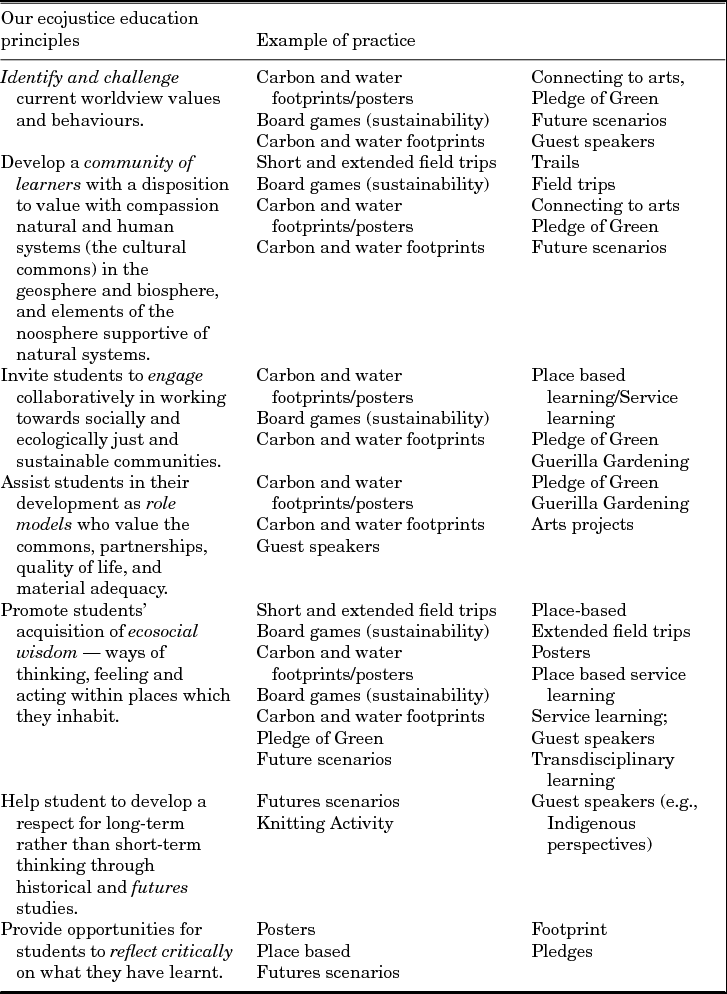
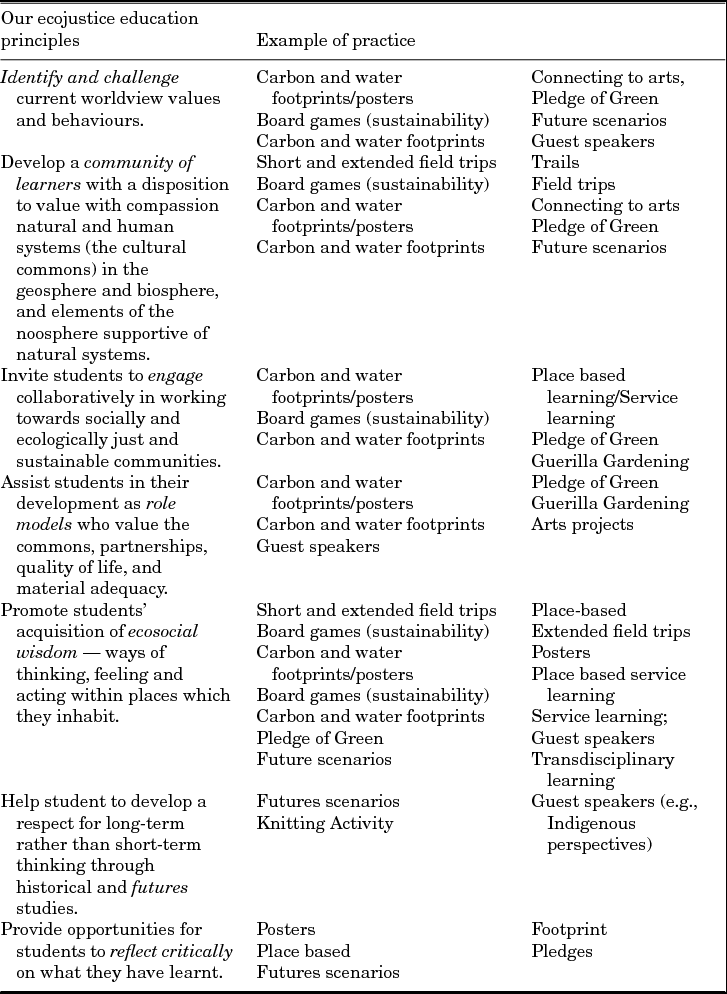
Drawing on literature review, autobiographies, and practices in teacher education, we have identified seven principles that summarise the work we have done over more than 10 years and that can be identified as contributing towards an ecojustice education (see Table 3). The first is about identifying and challenging the worldview assumptions that direct our thoughts and behaviours. This includes challenging the deep-seated ideologies of consumerism, individualism, growth, development, and progress, and relearning the values central to living well with sufficient resources, in humility and with respect, within a whole-Earth community. The second is to encourage the development of a community of learners with a common disposition to valuing with compassion natural systems and human systems (the cultural commons) compatible with and within them, in the geosphere and biosphere, and elements of the noosphere supportive of natural systems. This means promoting ‘knowing our place’ — where we ‘fit’ as Earth citizens into the structure of things. Third, we invite participants to engage collaboratively in enhancing socially and ecologically just and sustainable communities of people and other living things, and the physical systems on which they depend. Fourth, we intend that our graduating educators act as ecojustice role models in their personal lives and in educational communities, and encourage their students to do likewise. Fifth, we aim for the development of ways of thinking, feeling and acting with ecosocial wisdom in places that we inhabit, recognise and relate to, a wisdom that necessarily includes ecological systems thinking and scientific knowledge, skills and practices — the core of science curriculum and science general studies courses. Sixth, we seek to develop a respect for long-term rather than short-term thinking, through historical and futures studies that introduce students to the traditions of past and future communities that have or will have worldview values that respect all aspects of Earth systems. And seventh, we provide opportunities for students to reflect critically on what they have learnt, the impact their learning has had on their perspectives, and how this could influence their future behaviour.
Ecojustice Principles for Teacher Education Programs
Conclusion
The evolution of our work as teacher educators, which has brought about our ecojustice pedagogical practices, has led to the development of a set of guiding principles (Table 3). They are tentative and evolving and provide opportunity for reflection on current and future practices that are sensitive to ecojustice concepts and practices. The development and critique of this work is ongoing and not necessarily currently compatible with, or on the agenda of, others within the School of Education where this work has taken place (Lloyd et al., Reference Lloyd, Smith and Paige2011), nor in the communities in which we live (Lloyd, Reference Lloyd2013). Nevertheless, we see it as an essential aspect of all learning, that is, a cross-curricula theme that needs to be addressed in all the traditional learning areas within teacher education programs, and as an ongoing agenda item with community groups and local governments. We are optimistic that our contribution has made a difference and that the students we have worked with will continue to promote ecojustice.
Postscript
While we have introduced the ideas presented in this article at School of Education staff meetings, seminars and through a teacher education programFootnote 1 (Lloyd, Reference Lloyd2004; Lloyd, Smith, & Paige, Reference Lloyd, Smith and Paige2010, Reference Lloyd2011), there has not been a discernible cultural shift to teacher education that values the primacy of ecojustice in education at the authors’ place of work. Programs remain fragmented, with little connectivity between courses and interdisciplinarity within courses.
We did think it was important to document the legacy of the good work being done by passionate educators in the hope that in different times others will pick up the calling for ecojustice.
Author Biographies
Dr Kathryn Paige is currently a senior lecturer in science and mathematics education at the University of South Australia. Her research interests are place-based education, educating for sustainability, and action-orientated pedagogy.
Dr David Lloyd is currently an adjunct scholar with the School of Education, University of South Australia, and formerly a lecturer in science methods and science general studies at the same university. He has a particular interest in futures in education and community development.
Richard Smith is a retired teacher educator whose areas of work included: curriculum studies in both general and science and mathematics courses, environmental sciences general studies, and practicum supervision. He now pursues interests in active citizenship in education for sustainability and in community/resident groups, and in time within natural environments.