INTRODUCTION
Live zooplankton is used as food for several aquatic species to ensure a significant supply of proteins, lipids with essential fatty acids, carbohydrates, vitamins and minerals. Mysids form an important component of zooplankton and play an important ecological role in the food web of an ecosystem. Whether it is marine or brackish, they form food for fishes and crustaceans (George, Reference George1958; Rao, Reference Rao1970; Bhattacharya & Kewalremani, Reference Bhattacharya and Kewalremani1972; Jhingran, Reference Jhingran1975; Mauchline, Reference Mauchline, Blaxer, Russell and Yonge1980). As an energy converter at different trophic levels, significance of mysids in the ecosystem has been greatly underestimated. Therefore, the analysis of biochemical composition in mysids is important, to understand the nutritional value and flow of energy at different trophic levels. Seasonal variation in body composition yields information which is useful in the understanding of a population ecophysiology (Lehtonen, Reference Lehtonen1996). Mesopodopsis zeylanica (Nouvel) is the most widely distributed mysid in the Indian and Sri Lankan waters (Hanamura et al., Reference Hanamura, Koizumi, Sawamoto, Siow and Chee2008; Biju & Panampunnayil, Reference Biju and Panampunnayil2010). It is an abundant species in the Cochin backwater and their population reproduces continously and exhibits a clear seasonal pattern (Biju & Panampunnayil, Reference Biju and Panampunnayil2010). Even though Biju & Panampunnayil, (Reference Biju and Panampunnayil2010) studied the reproductive biology and ecology of M. zeylanica, information on biochemical composition of this species is not available. In this paper, we analyse the seasonal variation of biochemical composition and the nutritive quality of different age groups of M. zeylanica.
MATERIALS AND METHODS
Sampling procedure and data analysis
Samples for biochemical analysis were collected during the pre-monsoon (March 2010) and monsoon periods (June 2010) using a Working Party net (mesh size 0.2 mm, mouth area 0.6 m2) at a site (Bolghatty) in Cochin backwater. Immediately after collection, the organisms were transported in 10 l containers to the laboratory, where mysids were separated from other organisms. Species then were identified and sorted into mature males, immature males, spent females, females with embryos (brooding female), immature females and juveniles (Biju et al., Reference Biju, Gireesh, Jayalakshmi, Haridevi and Panampunnayil2009). After defecation (for 12–24 hours), samples from each group were lyophilized and refrigerated at –30°C; smaller portions of this material were later weighed and used for the determination of each biochemical constituent (analytical replicates) (Azeiteoro et al., Reference Azeiteiro, Fonseca and Marques2001).
Proteins were quantified according to the Folin phenol method (Lowry et al., Reference Lowry, Rosenbough, Farr and Randal1951) using bovine serum albumin as a standard. The quantification of total carbohydrates was performed according to the colorimetric method using phenol and sulphuric acid (Dubois et al., Reference Dubois, Gilles, Hamilton, Rebers and Smith1956) with glucose as standard. Lipid extraction was carried out according to Bligh & Dyer (Reference Bligh and Dyer1959) by direct elution with chloroform and methanol (1: 2 v: v). The extracted lipids were dried at 80°C for 20 minutes and determined spectrophotometrically after carbonization at 18°C in concentrated sulphuric acid (Marsh & Weinstein, Reference Marsh and Weinstein1966) with tripalmitine solution used as standard.
Statistical analysis
When comparing two groups, the unpaired t-test was applied followed by a F-test to compare variences. Comparisons of groups were perfomed with one-way analysis of variance with Bartlett's test for equal variance followed by Bonferroni's multiple comparison test.
RESULTS
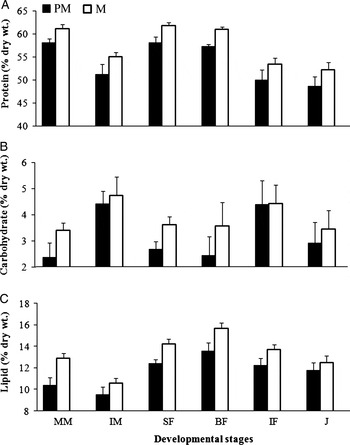
Mesopodopsis zeylanica showed clear seasonal variation in their biochemical composition during pre-monsoon and monsoon period (protein t = 2.51, df = 34, P < 0.05; carbohydrate t = 2.20, df = 34, P < 0.05; lipid t = 3.4, df = 34, P < 0.05) and showed relatively high protein, carbohydrate and lipid content during the monsoon period (Figure 1).
Biochemical composition (% dry weight) of the various developmental stages of Mesopodopsis zeylanica (Nouvel) during the pre-monsoon (PM) and monsoon (M) periods from Cochin backwater. MM, mature males; IM, immature males; SF, spent females; BF, brooding females; IF, immature females; J, juveniles.

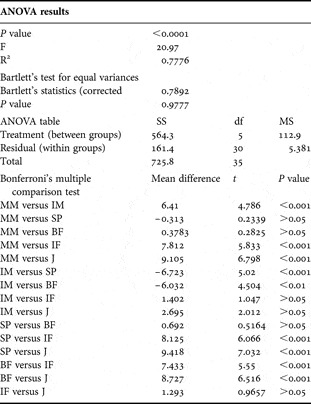
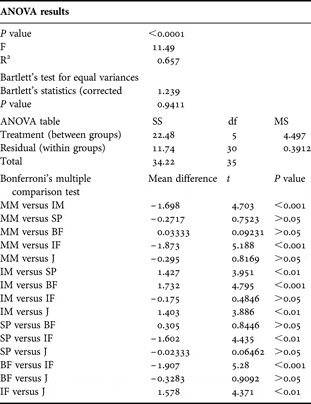
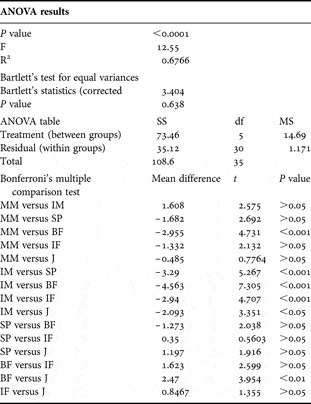
There was a considerable variation in protein, carbohydtate and lipid content both within and between different life-cycle stages of M. zeylanica (Tables 1–3). Our results show the importance of protein content in different stages and it was the primary body component in all the developmental stages. Protein content (% dry weight) varied between 57.7 and 62.1% for mature males, 49.7 and 55.9% for immature males, 56.5 and 62.4% for spent females, 57.3 and 61.5% for brooding females, 47.5 and 54.4% for immature females and 46.9 and 53.6% for juveniles. Comparatively high protein content was observed in adults compared to immature individuals (Figure 1A).
Analysis of variance (ANOVA) and Bonferroni's test for multiple comparisons on protein in Mesopodopsis zeylanica.

Analysis of variance (ANOVA) and Bonferroni's test for multiple comparisons on carbohydrate in Mesopodopsis zeylanica.

Analysis of variance (ANOVA) and Bonferroni's test for multiple comparisons on lipid in Mesopodopsis zeylanica.

The amount of total carbohydrate was low compared to protein and lipid (Figure 1). Carbohydrate content (% dry weight) varied between 2.0 and 3.5% for mature males, 3.9 and 5.5% for immature males, 2.4 and 3.7% for spent females, 2.3 and 4.4% for brooding females, 3.9 and 5.1% for immature females and 2.3 and 3.8% for juveniles. Both immature males and females showed relatively high carbohydrate content compared to mature individuals (Figure 1B).
The study reveals variation in lipid fraction (% dry weight) among different developmental stages between 9.7 and 13.4% for mature males, 9.5 and 11.0% for immature males, 12.1 and 14.4% for spent females, 12.7 and 16.2% for brooding females, 11.5 and 14.1% for immature females and 11.1 and 12.8% for juveniles. High lipid contents were recorded in females especially in the brooding females (Figure 1C).
DISCUSSION
As in other crustaceans, mysids show seasonality in their biochemical component. In the present study M. zeylanica have shown relatively high values of biochemical composition during the monsoon period. This is apparently related to individual nutritional status and breeding cycle (Lehtonen, Reference Lehtonen1996; Pastorinho et al., Reference Pastorinho, Antunes, Marques, Pereira, Azeiteiro and Morgado2003). In Cochin bachwater M. zeylanica shows high feeding and breeding activity during the monsoon period (Biju & Panampunnayil, Reference Biju and Panampunnayil2010). Seasonal variations in the biochemical composition of mysids are mainly associated with environmental and trophic condtions (Azeiteiro et al., Reference Azeiteiro, Fonseca, Pastorinho, Morgado and Marques2003). Different developmental stages of M. zeylanica showed significant variations in biochemical composition and the present results were also consistent with other reports obtained for mysids (Azeiteiro et al., Reference Azeiteiro, Fonseca and Marques2001, Reference Azeiteiro, Fonseca, Pastorinho, Morgado and Marques2003; Biju et al., Reference Biju, Gireesh, Jayalakshmi, Haridevi and Panampunnayil2009).
When compared with carbohydrate and lipid, the large amount of protein observed might suggest that M. zeylanica actively deaminates its body proteins, especially during food shortage. The potential use of protein as a metabolic reserve is reported in marine zooplankton (Bhat & Wagh, Reference Bhat and Wagh1992) and in mysids (Verslycke & Janssen, Reference Verslycke and Janssen2002). Verslycke & Janssen (Reference Verslycke and Janssen2002) reported that, esturine mysid, Neomysis integer (Leach, 1814) can actively use protein as an energy source under starvation or stress conditions. Loss of protein in zooplankton during starved condition suggesting its utilization has also been well documented (Reeve et al., Reference Reeve, Raymont and Raymont1970). Mobilization of protein for metabolic requirements is believed to be essential in tropical zooplankton where lipid reserves are low, as has been reported by earlier observations in coastal zooplankton (Goswami et al., Reference Goswami, Rao and Mantondkar1981; Krishnakumari et al., Reference Krishnakumari, Nair and Gabhiye1993). In the present study, protein content of M. zeylanica varies with different seasons and life stages. In zooplankton, variations in protein content may be associated with seasonality (Raymont et al., Reference Raymont, Srinivasagam and Raymont1969; Reeve et al., Reference Reeve, Raymont and Raymont1970), utility as metabolic substrate (Conover, Reference Conover1964) and difference in salinity (Choe et al., Reference Choe, Deibel, Raymond, Sing and Vivian2003). Ortega et al. (Reference Ortega, Lopez de Pariza and Navarro1984), reported that fluctuations in protein content are related to fluctuations in hydration level of tissues in various life cycle stages which quantifies the protein content of those particular stages and capacity or need for protein in different developmental stages. Unfortunately in the present study, the water content is not measured. High variability of protein reserve in mysids may be partially related to ecdysis (Verslycke & Janssen, Reference Verslycke and Janssen2002). The exoskeleton of mysids contains large amounts of protein and a highly developed exoskeleton thus may be one of the reasons for the large amount of protein reserve in matured individuals (Biju et al., Reference Biju, Gireesh, Jayalakshmi, Haridevi and Panampunnayil2009).
Low carbohydrate values in zooplankton have been reported from both temperate and tropical waters (Stephen et al., Reference Stephen, Panampunnayil, Gopalakrishnan and Sankaranarayanan1979; Krishnakumari & Achuthankutty, Reference Krishnakumari and Achuthankutty1989). The low contribution of carbohydrate is almost identical with that of earlier reports in mysids (Azeitero et al., Reference Azeiteiro, Fonseca and Marques2001, Reference Azeiteiro, Fonseca, Pastorinho, Morgado and Marques2003; Veslycke & Janssen, Reference Verslycke and Janssen2002; Biju et al., Reference Biju, Gireesh, Jayalakshmi, Haridevi and Panampunnayil2009), which suggests that the main energy storage in this group of organisms is not in the form of glycogen, and the usual storage of carbohydrates in mysids does not appear to represent a significant nutritional reserve. Carbohydrates cannot be utilized to any noteworthy degree, since they constitute only a very small fraction in most planktonic organisms (Jagadeesan et al., Reference Jagadeesan, Arivuselvan, Thirumaran, Anatharaman and Balasubramanian2010). Although protein and lipid utilization is variable in crustaceans, in general, carbohydrate is used before protein and lipid as the preferred fuel for the metabolic process (Morris, Reference Morris1999). Variability in carbohydrate may be due to the rapid accumulation and depletion of this easily accessible reserve (Azeiteiro et al., Reference Azeiteiro, Fonseca and Marques2001). In the present study, immature males and females show comparatively high carbohydrate content compared to other developmental stages and may be due to the relatively high storage of glycogen compared to other stages.
Lipids are the second major component in zooplankton (Jagadeesan et al., Reference Jagadeesan, Arivuselvan, Thirumaran, Anatharaman and Balasubramanian2010) and their reported values are comparatively poor in tropical areas compared to reported values from colder regions (Conover, Reference Conover1962; Vinogradova, Reference Vinogradova1964; Raymont et al., Reference Raymont, Srinivasagam and Raymont1969). In warm water environments the rate of primary production far exceeds the rate of consumption by zooplankton (Qazim, Reference Qazim1977). The continuous supply of food in the form of phytoplankton would render lipid reserve unnecessary, which might account for low lipid content in tropical zooplankton (Goswami et al., Reference Goswami, Rao and Mantondkar1981). Azeiteiro et al. (Reference Azeiteiro, Fonseca and Marques2001) reported that, seasonal changes in lipid (especially triglycerides) is mainly related to the functional nutritional cycle while changes in phospholipids and cholesterol appear to be directly related to the reproductive cycle. This suggests that lipid variation is the result of fluctuations in metabolism and reproductive strategy, depending upon the species life cycle (Pastorinho et al., Reference Pastorinho, Antunes, Marques, Pereira, Azeiteiro and Morgado2003). In the present study, all females (especially brooding females) showed high lipid content. The egg of mysids contains high amounts of lipids, and the lipid metabolism of ovigerous females was different from that of males (Verslycke & Janssen, Reference Verslycke and Janssen2002). The variation in lipid metabolism observed might be partially caused by a sex-specific lipid metabolism (Verslycke & Janssen, Reference Verslycke and Janssen2002). Adult females may show relatively high lipid content and this is related to reproduction (Raymont et al., Reference Raymont, Srinivasagam and Raymont1969). Lipid accumulation is the most widespread long-term energy storage strategy in aquatic crustaceans and their reproductive potential is largely dictated by lipid content (Gatten et al., Reference Gatten, Setgeant, Forsberg, O'Hara and Corner1980; Sargent & Henderson, Reference Sargent, Henderson, Corner and O'Hara1986).
The present study revealed that seasonal and developmental variability in biochemical composition of mysids are associated with feeding, reproductive cycle, storage and utilization of reserves. The evaluation of the nutritional composition of mysids indicates that, their biochemical composition during different seasons and different age groups can satisfy the nutrititional needs of a wide variety of fishes and crustaceans and also complies with the recommendations of FAO (1989), indicating the food sources used for aquaculture.
ACKNOWLEDGEMENTS
The authors are grateful to Dr S.R. Shetye, (Director), National Institute of Oceanography (CSIR-India), Goa and Dr P.S. Parameswaran (Scientist-in-Charge), Regional Centre, NIO, Kochi, for facilities provided.