Introduction
Antimicrobial agents are used extensively in poultry production and are usually administered in the feed or drinking water. Use of antimicrobials has been suggested to be a contributor to the transformation of the poultry industry from large numbers of small-scale farmers to a smaller number of large-scale producers who operate at high efficiency (Bywater, Reference Bywater2005). The antimicrobials are used for growth promotion, disease prophylaxis, metaphylaxis, and treatment. The permitted uses vary among countries and regions. For example, use of antibiotics for growth promotion is banned in the European Union (EU) but permitted in the USA and Canada and much of the rest of the world.
The antimicrobial agents that are available for use as growth promoting agents in the USA and Canada include zinc bacitracin, procaine penicillin, tetracyclines, tylosin, virginiamycin and monensin. Antimicrobials that are used for prophylaxis and therapy include amoxicillin, sulfonamides, tylosin, fluoroquinolones, lincosamides, aminoglycosides, tetracyclines, colistin and pleuromutilins.
Accurate data on antimicrobial use are available for Denmark, where a requirement for prescription for all antimicrobials (except coccidiostats in poultry) permits collection of precise data. The 2007 report from DANMAP (The Danish Integrated Antimicrobial Resistance Monitoring and Research Program) (http://www.danmap.org/pdfFiles/Danmap_2007.pdf) identified a number of shifts that have taken place. In broilers, total consumption of antimicrobials (Animal Daily Doses kg−1) had declined by 26% between 2006 and 2007, and use of fluoroquinolones had decreased by 75% over the same time frame. In turkeys, use of amoxicillin for treatments fell to 47% in 2007 compared with 92% of treatments in the previous year, whereas use of fluoroquinolones increased from 7% of treatments to 16%. These swings in antibiotic use are related primarily to variations in outbreaks of disease from year to year and to shifts from one agent to another because of resistance.
Antimicrobial resistance (AMR) data are published primarily for zoonotic pathogens and for indicator organisms that may reflect the pool of AMR genes in the intestine. The major zoonotic pathogens associated with poultry are Salmonella, Campylobacter jejuni, and to a lesser extent, Campylobacter coli. The usual indicator bacteria are Escherichia coli and enterococci. There are variations in results associated with the method of testing for antimicrobial susceptibility. In one study, Nayak et al. (Reference Nayak, Call, Kaldhone, Tyler, Anderson, Phillips, Kerdahi and Foley2007) tested 105 S. Heidelberg isolates for antimicrobial susceptibility by agar disk diffusion, broth microdilution using a Sensititre panel, a broth microdilution done manually, and a Vitek machine with GNS-207 cards. They reported agreements among the four methods of 100% for ciprofloxacin and amikacin; 94–97% for ampicillin, amoxicillin/clavulanic acid, trimethoprim/sulfonamide and chloramphenicol; and 80% for tetracycline and gentamicin. The state of AMR in isolates of these four bacterial species that originate with poultry will be discussed below. The breakpoints that are used also have a profound effect on the results.
AMR in Salmonella from poultry
Most Salmonella serovars, except S. pullorum and S. gallinarum and sometimes S. Enteritidis, are carried by chickens and turkeys without ill effects. However, chickens and turkeys are major sources of Salmonella that cause disease in humans and Salmonella are recovered more frequently from poultry than from red meats. Frequencies of 33% for chicken and 24% for turkey have been compared with 18% for pork and 6% for beef (White et al., Reference White, Zhao, Singh and McDermott2004).
Certain serovars of Salmonella are commonly associated with poultry. These include Salmonella enterica serovars Enteritidis, Typhimurium, Kentucky, Heidelberg, Agona, Senftenberg, Montevideo, Mbandaka, Hadar and Thompson. S. Enteritidis is found primarily in poultry worldwide and is recovered from humans but uncommonly from other animal species. S. Heidelberg is frequently recovered from chickens and eggs in the USA and Canada and has been examined extensively for occurrence of AMR.
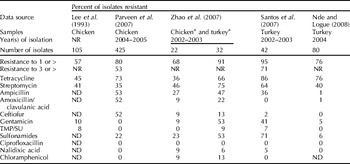
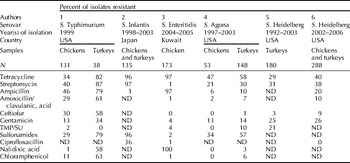
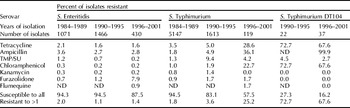
There is remarkable variation in resistance of Salmonella from chickens and turkeys to a wide range of antimicrobial agents (Tables 1–3). As will be discussed later, possession of conjugative or co-transmissible plasmids encoding resistance is often a major factor in dissemination of resistance. Variation in resistance is also associated with turkeys versus chickens, the country, the year, the serovar of Salmonella, broilers versus layers, one farm versus another, and the particular antimicrobial agent. In many studies it is not possible to separate out the influence of these individual factors, but certain trends can be observed. Frequency of resistance tends to be higher in isolates from turkeys compared with isolates from chickens (Tables 1 and 2; Poppe et al., Reference Poppe, Ayroud, Ollis, Chirino-Trejo, Smart, Quessy and Michel2001). Overall frequencies and patterns of resistance can vary remarkably from one country to another. Note, for example, the contrast between the high frequencies of resistance to tetracycline and ampicillin in S. Enteritidis from Kuwait (Table 2) with the low frequencies of resistance to these agents in isolates of the same serovar from the Netherlands (Table 3). Variations over time may be due to differences in serovars. See for example, the increase in tetracycline resistance in S. Typhimurium in the Netherlands between 1990–1995 and 1996–2001 and the absence of an increase for S. Enteritidis and S. Typhimurium DT104 in the same time interval (Table 3).
Percentages of United States Salmonella isolates from poultry that were resistant to selected antimicrobials

a Diseased; ND=not done; NR=not reported; TMP/SU=trimethoprim and sulfonamide.
Percentages of isolates of selected serovars of Salmonella from poultry that were resistant to selected antimicrobials

1, Zhao et al. (Reference Zhao, Fedorka-Cray, Friedman, McDermott, Walker, Qaiyumi, Foley, Hubert, Ayers, English, Dargatz, Salamone and White2005a) ; 2, Shahada et al. (Reference Shahada, Chuma, Tobata, Okamoto, Sueyoshi and Takase2006) ; 3, Al-Zenki et al. (Reference Al-Zenki, Al-Nasser, Al-Safar, Alomirah, Al-Haddad, Hendriksen and Aarestrup2007) ; 4, Douris et al. (Reference Douris, Fedorka-Cray and Jackson2008) ; 5, Kaldhone et al. (Reference Kaldhone, Nayak, Lynne, David, McDermott, Logue and Foley2008) ; 6, Zhao et al. (Reference Zhao, White, Friedman, Glenn, Blickenstaff, Ayers, Abbott, Hall-Robinson and McDermott2008).
ND=not done; TMP/SU=trimethoprim and sulfonamide.
Percentages of Salmonella isolates that are resistant vary with time, serovar, and phage typeFootnote a

a Data from van Duijkeren et al. (Reference van Duijkeren, Wannet, Houwers and van Pelt2003) ; isolates from the Netherlands.
ND=not done; TMP/SU=trimethoprim and sulfonamide.
A dominant clone that carries resistance genes may be the major determinant of resistance patterns. For example, occurrence of the multi-resistant S. Typhimurium DT104 may be responsible for a specific pattern of resistance (Table 3). The high frequency of resistance in S. Infantis from poultry in Japan (Table 2) probably represents another example of dissemination of a highly resistant clone. Interestingly, Nógrády et al. (Reference Nógrády, Tóth, Kostyák, Pászti and Nagy2007) also identified a dominant clone of tetracycline-streptomycin-sulfonamide-resistant S. Infantis in broilers (and humans) in Hungary. On the other hand, some isolates of S. infantis are highly susceptible to antimicrobials
The prevalence of AMR is usually lower among layers than among broilers, likely due in part to limitation of antimicrobial use in layer flocks to prevent the occurrence of antimicrobial residues in eggs. A study on 177 Salmonella isolates from laying farms in the UK between 2004 and 2005 showed that 77% of the isolates were susceptible to 16 antimicrobials that were tested (Snow et al., Reference Snow, Davies, Christiansen, Carrique-Mas, Wales, O'Connor, Cook and Evans2007). The highest frequencies of resistance were to ampicillin (15%), tetracycline (14%), sulfonamides (11%), streptomycin (11%) and chloramphenicol (7%). Most of the resistance was found in S. Enteritidis and S. Typhimurium. Asai et al. (Reference Asai, Esaki, Kojima, Ishihara, Tamura and Takahashi2006) found that the percentages of Japanese Salmonella isolates that were resistant to streptomycin, tetracycline, kanamycin and trimethoprim/sulfonamide were 87, 84, 59, and 44%, respectively, for isolates from broilers compared with 32, 14, 0 and 4% for isolates from layers. This pattern of lower frequency of resistance for isolates from layers has been reported by others (e.g. Li et al., Reference Li, Payne, Santos, Levine, Anderson and Sheldon2007a).
The percentage of resistant isolates from eggs (and other sources) varies markedly with the serotype of Salmonella and the antimicrobial agent. Low frequencies of resistance to ceftiofur were reported by Frye and Fedorka-Cray (Reference Frye and Fedorka-Cray2007), who compared the frequency of 3.6% (28/783) for isolates from eggs with 6.8% (213/3123) and 7.1% (543/7697) for isolates from turkeys and chickens, respectively. In contrast, Musgrove et al. (Reference Musgrove, Jones, Northcutt, Cox, Harrison, Fedorka-Cray and Ladely2006) found that 61% of Salmonella from shell eggs were resistant to ceftiofur, and 60% of the isolates were resistant to 11 or more antimicrobials. Much of the resistance was associated with S. Typhimurium, the most frequently isolated serovar. None of the isolates were resistant to ciprofloxacin, amikacin or trimethoprim/sulfonamide, but 63% were resistant to nalidixic acid. However, some would argue that the breakpoint (4 μg ml−1) set for ciprofloxacin by The National Committee for Clinical Laboratory Standards (NCCLS) is too high (see Poppe et al., Reference Poppe, Ayroud, Ollis, Chirino-Trejo, Smart, Quessy and Michel2001).
Certain general trends have been observed with respect to resistance of Salmonella to individual antimicrobial agents. Resistance to tetracyline and streptomycin tends to occur at relatively high frequency (Tables 1–3). Resistance to gentamicin is usually low among isolates from chickens and often moderate to high among turkey isolates, and resistance to ciprofloxacin is usually absent or very low (Tables 1 and 2).
Multi-drug resistance has been reported in many serovars of Salmonella associated with poultry. Among 38 S. Typhimurium isolates from turkeys in the US, Zhao et al. (Reference Zhao, Fedorka-Cray, Friedman, McDermott, Walker, Qaiyumi, Foley, Hubert, Ayers, English, Dargatz, Salamone and White2005a) found that 12 were resistant to 10 antimicrobials and 10 were resistant to 11 agents. Ten of 131 chicken isolates and 2 of 38 turkey isolates had a typical ACSSuT DT104 penta-resistance phenotype. One chicken isolate and two turkey isolates with this pattern that were tested were phage type DT104. A recent study by Andrysiak et al. (Reference Andrysiak, Olson, Tracz, Dore, Irwin, Ng and Gilmour2008) investigated the genetics of multi-drug resistance among S. Heidelberg from humans and poultry agri-food sources. All eight multi-drug resistant (MDR) chicken isolates and one MDR turkey isolate that had an extended spectrum cephalosporin (ESC) resistance carried the bla cmy-2 gene on a plasmid. One isolate also had resistance to tetracycline mediated by tetB; one carried tetB and strA; and one had tetA, strA, floR and sulI. The association of ESC resistance with large conjugative bla cmy-2 plasmids has been reported by others for this serovar (Kaldhone et al., Reference Kaldhone, Nayak, Lynne, David, McDermott, Logue and Foley2008; Zhao et al., Reference Zhao, White, Friedman, Glenn, Blickenstaff, Ayers, Abbott, Hall-Robinson and McDermott2008), Salmonella Newport (Lynne et al., Reference Lynne, Rhodes-Clark, Bliven, Zhao and Foley2008) and other serotypes (Frye and Fedorka-Cray, Reference Frye and Fedorka-Cray2007).
The bla cmy-2 gene has been detected in Salmonella isolates all over the world. One study in Mexico identified ceftriaxone resistance in 77% of S. Typhimurium from chickens (Zaidi et al., Reference Zaidi, Calva, Estrada-Garcia, Leon, Vazquez, Figueroa, Lopez, Contreras, Abbott, Zhao, McDermott and Tollefson2008). However, the strains were considered resistant at 16 μg ml−1, rather than the 64 μg ml−1 prescribed by the NCCLS. This lower level may be more appropriate but renders comparisons with other data difficult. In Canada, Poppe et al. (Reference Poppe, Martin, Muckle, Archambault, McEwen and Weir2006a) noted that 3 of 35 S. Newport strains resistant to the ESCs, the cephamycins and other antimicrobials contained not only the bla CMY-2 gene but several other drug-resistance genes including the flo st, sulII, tetA, aadA, aadB, dhfr1, qacEΔI-sulI associated with or inserted into the integron intI gene. There is concern about the emergence and spread of ESC resistance because ESCs are important for the treatment of severe salmonellosis, especially in children.
Genes that encode extended spectrum beta-lactamases have also been reported on transposons on transmissible plasmids in Salmonella from poultry (see for example Cloeckaert et al., Reference Cloeckaert, Praud, Doublet, Bertini, Carattoli, Butaye, Imberechts, Bertrand, Collard, Arlet and Weill2007). These researchers showed that ESC-resistant Salmonella from poultry in Belgium carried bla TEM-52 on a Tn3 transposon on an IncI1 plasmid. The antibiotic resistance profile of these strains included resistance to ampicillin, ceftazidime, cephalothin, ceftriaxone and ceftiofur. The researchers provided evidence that the dissemination of the bla TEM-52 gene in many countries in Europe was due to horizontal transmission. A number of strains examined by Cloeckaert et al. (Reference Cloeckaert, Praud, Doublet, Bertini, Carattoli, Butaye, Imberechts, Bertrand, Collard, Arlet and Weill2007) also carried additional drug resistance genes on Salmonella genomic island 1 (SGI1), a complex class 1 integron.
Class I integrons appear to be important in the acquisition and spread of genes that encode AMR in many serovars of Salmonella from poultry. In one study (Riaňo et al., Reference Riaño, Moreno, Teshager, Sáenz, Domínguez and Torres2006), three Salmonella isolates from poultry were shown to possess class 1 integrons that carried bla TEM-1b and bla CTX-M-9 genes as well as dfrA16, aadA2, sul1 and sul2. One of the isolates also had tet(A) in the integron. In another study, 28% of S. Typhimurium isolates from chicken and 24% of isolates from turkeys carried a 1-kb integron with aadA2, encoding resistance to streptomycin/spectinomycin, or a combination of the 1-kb integron and a 1.2-kb integron that carried bla pse-1 that encoded resistance to ampicillin (Zhao et al., Reference Zhao, Fedorka-Cray, Friedman, McDermott, Walker, Qaiyumi, Foley, Hubert, Ayers, English, Dargatz, Salamone and White2005a). Class 1 integrons that carry other bla genes and resistances to other antimicrobial agents have been reported in Salmonella (see for example, Cloeckaert et al., Reference Cloeckaert, Praud, Doublet, Bertini, Carattoli, Butaye, Imberechts, Bertrand, Collard, Arlet and Weill2007).
Nalidixic acid resistant strains show reduced susceptibility to ciprofloxacin (Poppe et al., Reference Poppe, Ayroud, Ollis, Chirino-Trejo, Smart, Quessy and Michel2001) and are more readily converted to high-level fluoroquinolone resistance than are nalidixic acid susceptible strains. Interestingly, a very high frequency of resistance of Salmonella to nalidixic acid has been reported for isolates from Kuwait (100%; Al-Zenki et al., Reference Al-Zenki, Al-Nasser, Al-Safar, Alomirah, Al-Haddad, Hendriksen and Aarestrup2007) and Venezuela (95%; Boscán-Duque et al., Reference Boscán-Duque, Arzálluz-Fisher, Ugarte, Sánchez, Wittum and Hoet2007). Nalidixic acid resistance is associated with mutations in the quinolone resistance-determining region (QRDR) of genes that encode gyrase or topoisomerase IV. Increased efflux of the drug through the AcrAB-TolC efflux system may also mediate resistance to quinolones. Plasmid-borne qnr genes are rarely implicated in fluoroquinolone resistance.
C. jejuni and C. coli
Although there is a lack of internationally standardized methods for antimicrobial susceptibility tests for Campylobacter, there is little variation in the results obtained with the commonly used protocols for disc diffusion, agar dilution, or the Epsilometer-test (E-test) (reviewed by Moore et al., Reference Moore, Barton, Blair, Corcoran, Dooley, Fanning, Kempf, Lastovica, Lowery, Matsuda, McDowell, McMahon, Millar, Rao, Rooney, Seal, Snelling and Tolba2006). AMR to human isolates of Campylobacter is highly variable within and among countries. Padungton and Kaneene (Reference Padungton and Kaneene2003) noted a generally high prevalence of resistance to tetracycline and fluoroquinolones and moderate to low levels for other agents. A similar pattern has been reported for isolates from poultry, which are a major source of campylobacteriosis in humans.
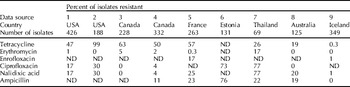
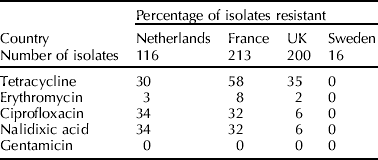
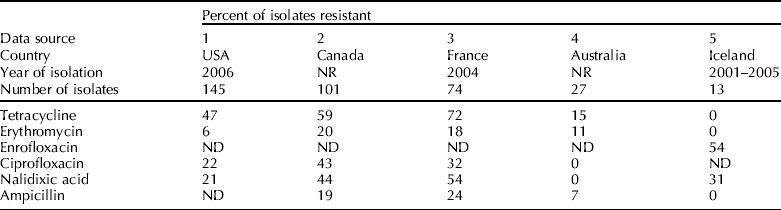
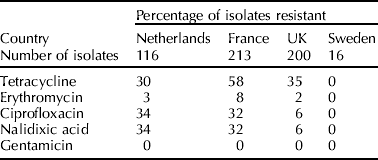
Tetracyclines are used extensively for therapy for infections in poultry in some countries such as the United Kingdom (Piddock et al., Reference Piddock, Griggs, Johnson, Ricci, Elviss, Williams, Jørgensen, Chisholm, Lawson, Swift, Humphrey and Owen2008). There is therefore concern about tetracycline resistance in C. jejuni as resistance is usually carried on a conjugative plasmid with the tet(O) gene. Resistance to tetracycline in C. jejuni has been reported to be as high as 99.5% in one US study (Son et al., Reference Son, Englen, Berrang, Fedorka-Cray and Harrison2007) and as low as 0.3% in Iceland (Table 4). Several studies on AMR in poultry isolates have been conducted in Iceland, a country in which antimicrobial agents are not used in chicken production. Interestingly, the levels of resistance to all the antimicrobials tested are either 0 or no more than 1% in C. jejuni from chickens in Iceland (Thorsteinsdottir et al., Reference Thorsteinsdottir, Kristinsson, Fridriksdottir and Gunnarsson2008; Table 4). Differences in extent of AMR by country are also shown in Table 5, in a single study involving the same procedures and the same time frame for four countries. Although the number of isolates from Swedish poultry was low, it is clear that the general level of resistance was much lower than for the other European countries.
AMR in C. jejuni isolated from poultry

1, NARMS (2006) ; 2, Son et al. (Reference Son, Englen, Berrang, Fedorka-Cray and Harrison2007) ; 3, CIPARS (2005) ; 4, Larkin et al. (Reference Larkin, Van Donkersgoed, Mahdi, Johnson, McNab and Odumeru2006) ; 5, Avrain et al. (Reference Avrain, Humbert, L'Hospitalier, Sanders, Vernozy-Rozand and Kempf2003) ; 6, Roasto et al. (Reference Roasto, Juhkam, Tamme, Hörman, Häkkinen, Reinik, Karus and Hänninen2007) ; 7, Boonmar et al. (Reference Boonmar, Morita, Fujita, Sangsuk, Suthivarakom, Padungtod, Maruyama, Kabeya, Kato, Kozawa, Yamamoto and Kimura2007) ; 8, Miflin et al. (Reference Miflin, Templeton and Blackall2007) ; 9, Thorsteinsdottir et al. (Reference Thorsteinsdottir, Kristinsson, Fridriksdottir and Gunnarsson2008).
Variations in AMR in C. jejuni isolated from chickens in four European countriesFootnote a
Fluoroquinolones are an important part of the antimicrobial arsenal used to treat campylobacteriosis in adults. Quinolone resistance has therefore been monitored in many countries. Important aspects of C. jejuni and C. coli resistance to fluoroquinolones have been reviewed by Zhang et al. (Reference Zhang, Lin and Pereira2003) : resistance is most commonly due to mutations in the QRDR regions of gyrA, with high levels of resistance to ciprofloxacin associated with the Thre-86-Ile mutation and intermediate levels associated with the Asp-90-Asn or the Thr-86-Lys mutation; a functional efflux pump is required for the gyrA mutations to confer resistance; over-expression of the efflux pump is not required for high-level resistance. The fact that a single mutation in gyrA can confer high-level resistance to fluorquinolones indicates that such resistance may occur readily. Furthermore, resistance is not accompanied by increased fitness costs and colonizing ability appears to be enhanced. Selection pressure associated with oral administration of fluoroquinolones in humans or animals results in emergence of fluoroquinolone resistant C. jejuni (Moore et al., Reference Moore, Barton, Blair, Corcoran, Dooley, Fanning, Kempf, Lastovica, Lowery, Matsuda, McDowell, McMahon, Millar, Rao, Rooney, Seal, Snelling and Tolba2006; van Boven et al., Reference van Boven, Veldman, de Jong and Mevius2003; reviewed in Zhang et al., Reference Zhang, Lin and Pereira2003).
A 2001 report from Japan showed that 32% of 68 Campylobacter isolates from broilers were resistant to fluoroquinolones (Chuma et al., Reference Chuma, Ikeda, Maeda, Niwa and Okamoto2001). Resistance was associated with a mutation in gyrA (T(86)→I(86)). In Korea, resistance to ciprofloxacin was detected in 88% of 594 Campylobacter isolates from broilers (Kang et al., Reference Kang, Cho, Yoon, Yu, Kim, Lee and Pyun2006). A pattern of moderately high levels of resistance to fluoroquinolones has been reported in several other countries (Tables 4 and 5). Interestingly the frequency is zero in Australia (Table 4) and in Sweden (Table 5). Miflin et al. (Reference Miflin, Templeton and Blackall2007) have suggested that the absence of resistance to fluoroquinolones in Campylobacter originating from Australian poultry may be because fluoroquinolones have never been licensed for use in poultry in Australia. It is interesting that there were high levels of resistance to enrofloxacin and nalidixic acid in C. coli isolates from Iceland, although antimicrobials are not used in chicken production. The number of isolates examined was low and it is not known whether a similar percentage would be obtained with a larger isolate collection.
Because of a concern with an increase in fluoroquinolone-resistant Campylobacter infections in humans, the Food and Drug Administration in the United States proposed in 2000 that the fluoroquinolone enrofloxacin be withdrawn from use in poultry. This drug had been used for treatment of colibacillosis in chickens and turkeys. The withdrawal went into effect in 2005 after a long legal battle (Nelson et al., Reference Nelson, Chiller, Powers and Angulo2007).
There is also concern about resistance to macrolides in C. jejuni and C. coli from poultry as erythromycin is one of the drugs of choice for treating campylobacteriosis in humans. In the USA and Canada, tylosin is frequently added to poultry feed at subtherapeutic levels as a growth-promoting agent. Resistance to tylosin results in cross-resistance to erythromycin, which belongs to the same chemical class (macrolide) as tylosin. In general, levels of resistance to erythromycin are higher in C. coli than in C. jejuni (Tables 4–6). A Japanese study identified a high level of erythromycin resistance in C. coli isolates but none in C. jejuni isolated from broilers during 1992–1999 (Chuma et al., Reference Chuma, Ikeda, Maeda, Niwa and Okamoto2001). Interestingly, Ladely et al. (Reference Ladely, Harrison, Fedorka-Cray, Berrang, Englen and Meinersmann2007) showed a difference in erythromycin resistance in C. jejuni and C. coli when chickens were exposed to macrolide-susceptible C. jejuni or C. coli and subsequently fed diets with therapeutic or subtherapeutic levels of tylosin. Pooled results showed that erythromycin resistance was present in 71% of the C. coli isolates compared with 37% of the C. jejuni isolates that were recovered from the chickens. Also, 63% of the Campylobacter isolates recovered from chickens on tylosin at the subtherapeutic level were erythromycin resistant whereas only 11.4% of isolates from chickens fed the therapeutic dose were resistant.
AMR in C. coli isolated from broilers
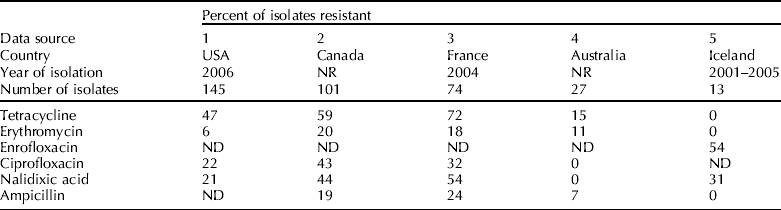
1, NARMS (2006) ; 2, Larkin et al. (Reference Larkin, Van Donkersgoed, Mahdi, Johnson, McNab and Odumeru2006) ; 3, Gallay et al. (Reference Gallay, Prouzet-Mauléon, Kempf, Lehours, Labadi, Camou, Denis, de Valk, Desenclos and Mégraud2007) ; 4, Miflin et al. (Reference Miflin, Templeton and Blackall2007) ; 5, Thorsteinsdottir et al. (Reference Thorsteinsdottir, Kristinsson, Fridriksdottir and Gunnarsson2008).
ND = not done; NR = not reported.
E. coli
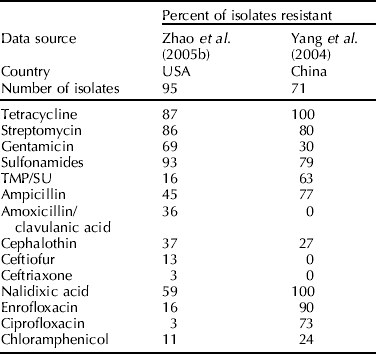
Avian pathogenic E. (APEC) cause primarily a respiratory/septicemic disease in chickens and turkeys and antibiotics are used to treat these infections. Resistance of these strains to antimicrobials is therefore important in the selection of agents for treatment. Typical data for AMR in APEC are shown in Table 7. Zhao et al. (Reference Zhao, Maurer, Hubert, De Villena, McDermott, Meng, Ayers, English and White2005b) tested 95 APEC isolates from northern Georgia, USA (Table 7), and reported that resistance to quinolones was associated with mutations in gyrA, gyrB and parC, and with up-regulation of the multi-drug resistance pump encoded by acrAB. Resistance to three or more antimicrobials was found in 92% of the isolates. Ribotyping of 56 nalidixic acid resistant isolates showed that quinolone resistance was present in multiple ribotypes and could therefore not be attributed to the presence of a few resistant clonal groups. Yang et al. (Reference Yang, Chen, White, Zhao, McDermott, Walker and Meng2004) noted that 80% of 71 E. coli isolated from the livers of chickens that had died on 10 poultry farms in China were resistant to eight or more antibiotics (Table 7). All the isolates were resistant to nalidixic acid and tetracycline, but there was no resistance to the third generation cephalosporins ceftiofur and ceftriaxone, or to amoxicillin/clavulanic acid. The high levels of resistance to fluoroquinolones are in marked contrast to the low levels in the US isolates (Zhao et al., Reference Zhao, Maurer, Hubert, De Villena, McDermott, Meng, Ayers, English and White2005b; Table 7). Fluoroquinolone resistance was associated with the expected mutations in gyrA and parC. Integrons that were 0.7, 1.0 or 1.5 kb were present in 42 of the 72 isolates and encoded resistance to aminoglycosides, trimethoprim and beta-lactams. The qnr gene was not detected in association with the integrons. Similarly high levels of AMR were observed by Li et al. (Reference Li, Wang, Du, Cui, Zhang and Shen2007b) who examined 70 E. coli isolates recovered from diseased chickens in China between 2004 and 2005. The isolates showed frequencies of resistance of 100% to tetracycline and trimethoprim/sulfonamide and 79–83% to chloramphenicol, ampicillin, ciprofloxacin and enrofloxacin. Petersen et al. (Reference Petersen, Christensen, Kuhnert, Bisgaard and Olsen2006) in Denmark described vertical transmission of a pathogenic O45 strain of E. coli that was resistant to fluoroquinolone. They showed that a single clone was responsible and the bacterium recovered from five broiler chicks could be traced back to the broiler parents. The spread of AMR is facilitated by the pyramidal structure of the poultry industry and other studies have traced the spread of Salmonella from primary breeder flocks through multiplier flocks to rearing flocks.
AMR in APEC.
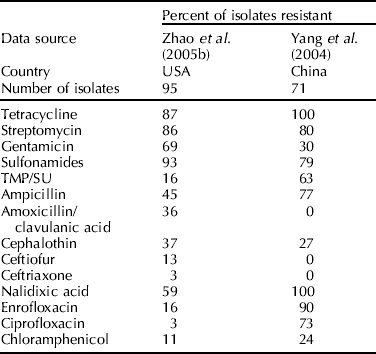
TMP/SU = trimethoprim and sulfonamide.
Large plasmids are commonly found in APEC strains. In 2005, the DNA sequence for a 101-kb transmissible IncF plasmid from an O2 APEC strain was published (Johnson et al., Reference Johnson, Siek, Johnson and Nolan2005). The plasmid has a class 1 integron and encodes resistance to tetracycline, sulfonamides, aminoglycosides, trimethoprim, and beta-lactams as well as resistance to heavy metals. In 2006, the same group (Johnson et al., Reference Johnson, Wannemeuhler, Scaccianoce, Johnson and Nolan2006) reported the DNA sequence of a 241-kb transmissible IncHI2 plasmid which encodes resistance to tetracycline, streptomycin, gentamicin and sulfonamides.
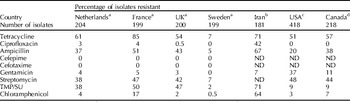
Numerous studies on AMR have been done on commensal E. coli from poultry. European data show a remarkable difference in the low frequencies of resistance to all antimicrobial agents among E. coli from poultry in Sweden compared with high levels for some agents in the other countries (Table 8; Bywater et al., Reference Bywater, Deluyker, Deroover, de Jong, Marion, McConville, Rowan, Shryock, Shuster, Thomas, Vallé and Walters2004). In the Netherlands, France, and the UK, the pattern is one of moderately frequent resistance to tetracycline, streptomycin, ampicillin and trimethoprim/sulfonamide, low frequencies for ciprofloxacin, gentamicin and chloramphenicol, and no resistance to the cephalosporins. This pattern is not always seen in other countries. Moniri and Dastehgoli (Reference Moniri and Dastehgoli2005) noted resistance to nalidixic acid in 100% of 181 E. coli from broilers; resistance to ciprofloxacin was detected in 42% of the isolates. They showed that the frequency of resistance to ciprofloxacin was 50% in flocks which had used flumequine and enrofloxacin and 34% in flocks which had not used these drugs.
AMR in E. coli isolated from broilers

a Data from Bywater et al. (Reference Bywater, Deluyker, Deroover, de Jong, Marion, McConville, Rowan, Shryock, Shuster, Thomas, Vallé and Walters2004) ; bMoniri and Dastehgoli (Reference Moniri and Dastehgoli2005) ; cNARMS (2006) ; dCIPARS (2005).
ND = not done; TMP/SU = trimethoprim and sulfonamide.
Plasmid-mediated quinolone resistance has also been detected at low prevalence and involves Qnr proteins that interact with topoisomerase, a quinolone-acetylating enzyme, and a Qep pump. The Qnr proteins confer low-level resistance but may be important in enhancing selection of high-level fluoroquinolone resistance (Yue et al., Reference Yue, Jiang, Liao, Liu, Li, Chen, Chen, Lü and Liu2008).
In addition to fluoroquinolone resistance, there is considerable interest in resistance to beta-lactams, especially extended spectrum beta-lactams. In one study in Belgium, Smet et al. (Reference Smet, Martel, Persoons, Dewulf, Heyndrickx, Catry, Herman, Haesebrouck and Butaye2008) recovered 295 ceftiofur-resistant E. coli from cloacal swabs of 489 broiler chickens from five farms. This high frequency occurred although cephalosporins have not been licensed for use in poultry in Belgium since 2000. The authors suggest that co-selection based on resistance to other agents may be involved. A total of 45% of these isolates produced ESBL, 43% produced AmpC beta-lactamase, and 12% produced a combination of the two and a wide range of beta-lactamase genes was identified, including the plasmid-borne bla CMY-2. The bla CMY-2 plasmid has been shown by Poppe et al. (2006b) to be readily transmissible in the intestine of turkey poults. A conjugative plasmid carrying the bla CMY-2 gene readily transferred from a commensal E. coli O168:H7 strain to S. Newport and to a commensal E. coli O101:H9 and the E. coli O101:H9 likely transferred the bla CMY-2 back again to susceptible S. Newport bacteria.
A study on 194 E. coli recovered from shell eggs in the US determined that 73% were susceptible to all seven antimicrobials that were tested (Musgrove et al., Reference Musgrove, Jones, Northcutt, Cox, Harrison, Fedorka-Cray and Ladely2006). Isolates that were resistant were mostly resistant to tetracycline (17%). A similarly moderate frequency of resistance was reported for E. coli from 122 laying hens in Switzerland (Lanz et al., Reference Lanz, Kuhnert and Boerlin2003). Highest resistance was to tetracycline and sulfonamides (26%) and streptomycin (17%).
Price and coworkers (Reference Price, Graham, Lackey, Roess, Vailes and Silbergeld2007) tested the hypothesis that workers exposed to live chickens in the broiler industry were at increased risk of being colonized with antimicrobial resistant E. coli. Working with gentamicin resistance, they showed that 50% of the individuals working with poultry were colonized with resistant E. coli, compared with 3% of individuals in the community and 6.3% of hospitalized persons. Johnson et al. (Reference Johnson, Sannes, Croy, Johnston, Clabots, Kuskowski, Bender, Smith, Winokur and Belongia2007) noted that extra-intestinal infections caused by E. coli in humans contribute to illnesses, deaths and healthcare costs and argued that resistance to first-line antimicrobials such as trimethoprim/sulfonamide, quinolones/fluoroquinolones and ESCs in E. coli was therefore a concern. They compared E. coli that were resistant to these agents and E. coli that were susceptible to these antimicrobials, with resistant and susceptible organisms isolated from humans and poultry. They concluded that resistant human isolates were more closely similar to poultry isolates than to drug-susceptible human isolates, whereas drug-resistant poultry isolates were more similar to susceptible poultry isolates. They suggested that it was likely that the drug resistant human isolates were derived from poultry whereas the drug-resistant poultry isolates were derived from drug-susceptible poultry isolates.
Conclusions
Much of the interest in AMR of bacteria that reside in poultry and other food animals is sparked by a concern for human health that is threatened by zoonotic pathogens and by selection for AMR determinants. Increasing AMR also threatens agriculture, as bacterial diseases in animals become more difficult to treat. Prudent use of antimicrobials will be necessary to preserve these valuable drugs for use in both animals and humans. The development of increasing prevalence of resistance to nalidixic acid is of concern as it increases the risk for resistance to fluoroquinolones through a second mutation. The dynamics of transmission of antimicrobial drug resistance and the evolution of populations of bacteria that are increasingly resistant to antimicrobials are very complex (see the article by Boerlin and Reid-Smith). The transmission of drug resistance genes is facilitated by a number of factors (selection and co-selection through the use of antimicrobials in animals and humans; large-scale animal production, food processing and distribution; and absence of regulations and/or oversight in some countries) and is a major contributor to the trends towards bacterial populations with higher frequencies of resistance to antimicrobials.