1. Introduction
When a shock wave obliquely encounters a wedge, shock reflection occurs (Ben-Dor Reference Ben-Dor2007). There are two types of shock reflection, including regular reflection (RR) and Mach reflection (MR) (Mach Reference Mach1878). The RR configuration consists of an incident shock and a reflected shock, while the MR consists of four discontinuities, including an incident shock, a reflected shock, a Mach stem and a slip line. In the MR, the intersection point of the four discontinuities is called the triple point (TP), which is crucial to determine the interactions among those discontinuities. Up to now, steady and pseudo-steady shock reflections have achieved a clear theoretical description, while there are still many unsolved problems in the unsteady shock reflection (Ben-Dor Reference Ben-Dor2007). Generally speaking, the  ${\rm MR} \rightarrow {\rm RR}$ transition and
 ${\rm RR} \rightarrow {\rm MR}$ transition are the two fundamental problems of unsteady shock reflection, and the
 ${\rm MR} \rightarrow {\rm RR}$ transition is closely related to the TP trajectory. Therefore, the TP trajectory and these two transitions have gained extensive attention for decades. The
 ${\rm RR} \rightarrow {\rm MR}$ transition in a wide variety of unsteady shock reflections over a convex or a straight wedge has been investigated (Wang & Zhai Reference Wang and Zhai2020), and it was found that the pseudo-steady criterion is capable of predicting the transition because the corner-generated disturbance cannot overtake the reflection point before the pseudo-steady criterion is reached. Prediction of the
 ${\rm MR} \rightarrow {\rm RR}$ transition and the TP trajectory in the unsteady shock reflection, however, still remains a challenge in theory. Investigation of the TP trajectory in unsteady shock refection remains especially desirable because the TP trajectory not only reflects the flow unsteadiness, but also determines whether and where the
 ${\rm MR} \rightarrow {\rm RR}$ transition would occur. In addition, the flow and transient dynamic load induced by cylindrical/spherical blast wave reflection (Dewey, McMillin & Classen Reference Dewey, McMillin and Classen1977; Dewey & McMillin Reference Dewey and McMillin1981; Liang, Hsu & Wang Reference Liang, Hsu and Wang2001; Liang, Wang & Chen Reference Liang, Wang and Chen2002) and the flow pressure histories and features in shock focusing (Sturtevant & Kulkarny Reference Sturtevant and Kulkarny1976; Skews & Kleine Reference Skews and Kleine2007) are highly related to the unsteady shock reflection process, and, therefore, closely related to the TP trajectory. As a result, the
 ${\rm MR} \rightarrow {\rm RR}$ transition and the TP trajectory have received increasing attention in the unsteady shock reflection study.
The flow behind the Mach stem is subsonic with respect to the TP, which means that the disturbance behind the Mach stem would affect the flow in the TP vicinity. To describe the TP trajectory in the MR, one should properly treat this disturbance under different flow conditions, i.e. pseudo-steady flow or unsteady flow. In the pseudo-steady MR, because the boundary condition is stationary, the wave configuration is stable. Provided that the Mach stem is straight and perpendicular to the wedge (Ben-Dor Reference Ben-Dor2007), the TP movement can be approximately described by the three-shock theory proposed by von Neumann (Reference von Neumann1943a,Reference von Neumannb) and the ray-shock theory which was first proposed by Whitham (Reference Whitham1957) and later modified by Milton (Reference Milton1975) and Itoh, Okazaki & Itaya (Reference Itoh, Okazaki and Itaya1981). We note that a curved Mach stem usually forms in reality, and the theoretical prediction accuracy is often limited. For the unsteady MR, the TP propagation would be affected by disturbances generated at the position where boundary conditions change, causing an unsteady movement of the TP. It will take some time for the disturbances, which carry the information of the variation of boundary conditions, to overtake the TP and affect its movement. In other words, there is a hysteresis in the response of the TP propagation to the variation of boundary conditions, which makes the theoretical prediction of the TP trajectory in unsteady flow very difficult.
The shock reflecting over a wedge is a typical configuration for the shock reflection study. In our previous work (Wang et al. Reference Wang, Zhai, Luo, Yang and Lu2017), a specially curved wedge for eliminating wedge angle effect was designed for convergent cylindrical shock reflection. In other words, when a convergent cylindrical shock reflects over the specific curved wedge, the wedge angle is constant. For convergent cylindrical shock reflection, the shape of the specific curved wedge must be convex. If the curvature of the convex wedge is larger than that of the specific convex wedge, the wedge angle is reduced when a convergent cylindrical shock reflects from the wedge. On the contrary, if the curvature of the convex wedge is smaller than that of the specific convex wedge, the wedge angle is increased when a convergent cylindrical shock reflects from the wedge. Besides, if the wedge is planar or concavely curved, the wedge angle is also increased when a convergent cylindrical shock reflects from the wedge. Similarly, for a divergent cylindrical shock reflection, to guarantee a constant wedge angle, the curved wedge must be concave. If the curvature of the concave wedge is larger than that of the specific concave wedge, the wedge angle is increased when a divergent cylindrical shock reflects from the wedge. On the contrary, if the curvature of the concave wedge is smaller than that of the specific concave wedge, the wedge angle is reduced when a divergent cylindrical shock reflects from the wedge. Besides, if the wedge is planar or convexly curved, the wedge angle is also reduced when a divergent cylindrical shock reflects from the wedge. As a result, there are five types of unsteady shock reflection with the wedge angle increased, including a planar shock reflection over a concave wedge, a convergent cylindrical shock reflection over a straight/concave/convex wedge and a divergent cylindrical shock reflection over a concave wedge; and five types of unsteady shock reflection with the wedge angle reduced, including a planar shock reflection over a convex wedge, a divergent cylindrical shock reflection over a straight/convex/concave wedge and a convergent cylindrical shock over a convex wedge. The differing types of curved shock reflections have been classified and schematically illustrated in our previous work (Wang & Zhai Reference Wang and Zhai2020), where readers can find more details.
The reflections of a planar shock over a concave/convex wedge have been extensively investigated. The study of the planar shock reflecting over a concave wedge is mainly related to the formation of the von Neumann reflection or MR (Skews & Kleine Reference Skews and Kleine2007, Reference Skews and Kleine2009; Gruber & Skews Reference Gruber and Skews2013; Cohen & Skews Reference Cohen and Skews2020; MacLucas, Skews & Kleine Reference MacLucas, Skews and Kleine2020) and the TP trajectory prediction. The first attempt to predict the TP trajectory was carried out by Itoh et al. (Reference Itoh, Okazaki and Itaya1981). By using a modified Chester–Chisnell–Whitham relation (Chester Reference Chester1954; Chisnell Reference Chisnell1957; Whitham Reference Whitham1957), the TP trajectory and the  ${\rm MR} \rightarrow {\rm RR}$ transition angle in cases of weak and moderately strong shock waves were obtained. Based on the length-scale concept proposed by Hornung, Oertel & Sandeman (Reference Hornung, Oertel and Sandeman1979), the
 ${\rm MR} \rightarrow {\rm RR}$ transition has been studied (Ben-Dor & Takayama Reference Ben-Dor and Takayama1985). Assuming that the corner-generated signals move along two different specific paths, two formulas for predicting the
 ${\rm MR} \rightarrow {\rm RR}$ transition angle were proposed. It should be noted that when a shock wave reflects over a curved wedge, disturbances are generated continuously, and, consequently, the TP will be influenced by these disturbances continuously. However, this process was ignored or not fully considered in the models of Itoh et al. (Reference Itoh, Okazaki and Itaya1981) and Ben-Dor & Takayama (Reference Ben-Dor and Takayama1985). To better understand the reflection process, the shock reflection over a curved wedge can be divided into many mini-double-wedge shock reflections (Ben-Dor, Dewey & Takayama Reference Ben-Dor, Dewey and Takayama1987; Li & Ben-Dor Reference Li and Ben-Dor1999; Xie, Han & Takayama Reference Xie, Han and Takayama2005; Krassovskaya & Berezkina Reference Krassovskaya and Berezkina2017; Wang & Zhai Reference Wang and Zhai2020; Yuan et al. Reference Yuan, Zhou, Mi and Ng2020). Based on this concept, the unsteady reflection of a planar shock over various concave ramps has been numerically studied (Krassovskaya & Berezkina Reference Krassovskaya and Berezkina2017), and the wave configurations were found to be determined by complex sub-processes and cannot be described by the three-shock theory. Yuan et al. (Reference Yuan, Zhou, Mi and Ng2020) found that the TP trajectory angle predicted by the three-shock theory is usually larger than that obtained from the computation in the pseudo-steady flow. Then they modified the prediction of the three-shock theory by applying the two-shock theory, and obtained a relatively accurate prediction of the TP trajectory. However, the model proposed by Yuan et al. (Reference Yuan, Zhou, Mi and Ng2020) is only applicable to the planar shock reflection with the wedge angle increased because the trajectory angle of the corner-generated disturbance is still predicted by the three-shock theory. Recently, Koronio et al. (Reference Koronio, Ben-Dor, Sadot and Geva2020) studied the reflection of a planar shock over a concave wedge with different initial conditions (including different ambient gases, different wedge curvatures and different shock strengths) numerically and theoretically. Based on the shock dynamics concept (Han & Yin Reference Han and Yin1993) and gas dynamics point of view, the reflection process and the mechanism of the similarity of it in different initial conditions were interpreted in detail. For a planar shock reflecting over a convex wedge, most studies focused on the
 ${\rm RR} \rightarrow {\rm MR}$ transition (Skews & Kleine Reference Skews and Kleine2009, Reference Skews and Kleine2010; Hakkaki-Fard & Timofeev Reference Hakkaki-Fard and Timofeev2012; Geva, Ram & Sadot Reference Geva, Ram and Sadot2018; Wang & Zhai Reference Wang and Zhai2020), whereas the studies on the TP trajectory after the
 ${\rm RR} \rightarrow {\rm MR}$ transition occurs were rare (Itoh et al. Reference Itoh, Okazaki and Itaya1981; Kleine et al. Reference Kleine, Timofeev, Hakkaki-Fard and Skews2014). Itoh et al. (Reference Itoh, Okazaki and Itaya1981) considered the theoretical position when the
 ${\rm RR} \rightarrow {\rm MR}$ transition occurs as the starting point of the TP trajectory, and studied the TP trajectory by the characteristics method (Bryson & Gross Reference Bryson and Gross1961). The viscosity effect on the TP trajectory has been studied by Kleine et al. (Reference Kleine, Timofeev, Hakkaki-Fard and Skews2014). They found that the viscosity hinders the emergence of the
 ${\rm RR} \rightarrow {\rm MR}$ transition, but has limited effect on the flow once the
 ${\rm RR} \rightarrow {\rm MR}$ transition occurs.
For the remaining types of curved shock reflections, however, there are only a few studies. Zhang et al. (Reference Zhang, Si, Zhai, Luo, Yang and Lu2016) and Gray & Skews (Reference Gray and Skews2017) studied a convergent shock reflection over a straight wedge, and found that the pseudo-steady criterion fails to predict the  ${\rm MR} \rightarrow {\rm RR}$ transition which is highly related to the TP trajectory because of the flow unsteadiness. Assuming that the analysis for the pseudo-steady flow can be applied to the reflection of a blast wave (can be regarded as a divergent shock to a certain extent) over a planar surface, Hu & Glass (Reference Hu and Glass1986) proposed a simple geometrical model for predicting the TP trajectory. By extending the works of Itoh et al. (Reference Itoh, Okazaki and Itaya1981) and Ben-Dor & Takayama (Reference Ben-Dor and Takayama1985) to the convergent circumstance, Ndebele & Skews (Reference Ndebele and Skews2018) achieved the predictions of the Mach stem length variation and the
 ${\rm MR} \rightarrow {\rm RR}$ transition angle in the reflection of a convergent cylindrical shock wave over a cylindrical concave wedge. However, it is still a challenge to establish a general theory to describe the unsteady shock reflection, especially in the planar shock reflection with the wedge angle decreased and in the curved shock reflections. This motivates the present study.
In this study we shall treat the disturbance propagation process by using Skews’ relation, which will be defined later. Then, by assuming the flow in the TP vicinity immediately adapts to the new boundary conditions at the position where the disturbance is generated, the TP trajectory angle is obtained by applying the three-shock theory. In this way, a model for predicting the TP trajectory will be established for all known types of two-dimensional (2-D) unsteady reflections over a single wedge. Then, extensive inviscid numerical simulations are performed for the ten types of 2-D unsteady shock reflections over a single wedge, and the emphasis will be placed on evaluating the model. Note that a relatively straight Mach stem is necessary to assure the accuracy of the three-shock theory. To provide a relatively straight Mach stem, the incident shock with a Mach number of 2.0 and a wedge angle greater than  $20^{\circ }$ are imposed in this work.
2. Model for TP trajectory prediction
In the model proposed by Yuan et al. (Reference Yuan, Zhou, Mi and Ng2020), the three-shock theory was applied to calculate the trajectory angle of the corner-generated disturbance propagating along the Mach stem. However, the three-shock theory is not always solvable especially when a weak shock wave reflects over a wedge with a small angle. For example, when a shock reflects over a wedge with a small angle, von Neumann reflection (vNR), Guderley reflection (GR) and Vasilev reflection (VR) may occur (Guderley Reference Guderley1962; Colella & Henderson Reference Colella and Henderson1990; Vasil'ev Reference Vasil'ev1999; Vasil'ev & Kraiko Reference Vasil'ev and Kraiko1999; Tesdall & Hunter Reference Tesdall and Hunter2002; Skews & Ashworth Reference Skews and Ashworth2005; Tesdall, Sanders & Keyfitz Reference Tesdall, Sanders and Keyfitz2008; Vasil'ev, Elperin & Ben-Dor Reference Vasil'ev, Elperin and Ben-Dor2008; Skews, Li & Paton Reference Skews, Li and Paton2009; Viero, Susin & Defina Reference Viero, Susin and Defina2013). These wave configurations resemble a MR configuration. For vNR, the three-shock theory can provide a non-standard physical solution. However, for GR and VR, the three-shock theory could not provide a physical solution. This phenomenon is known as the von Neumann paradox (Vasil'ev et al. Reference Vasil'ev, Elperin and Ben-Dor2008). Therefore, their model is only applicable when the shock wave is strong. Besides, since the three-shock theory is only applicable when the wedge angle variation is positive, their model can only predict the TP trajectory in the shock reflection with the wedge angle increased. In the 2-D unsteady shock reflection over a single wedge, if the wedge angle varies slowly, the corner-generated disturbances are so weak that they can be treated as sound waves. Skews (Reference Skews1967) once proposed a relation using the theory of sound to calculate the trajectory angle of the first sound wave produced from the corner, and this relation is called Skews’ relation in this work. According to Skews’ relation, for the shock reflection with the wedge angle either increased or decreased, although the type of corner-generated disturbance is different, the disturbance propagation process is the same. The application of Skews’ relation to predict the trajectory angle of the weak disturbance ( $\chi ^{{D}}$) is irrelevant to the disturbance type. As a result, Skews’ relation can be applied to a shock reflection with the wedge angle increased or decreased. This provides a possibility to establish a model for the TP trajectory prediction. The basic principle of the model is to combine Skews’ relation and the three-shock theory to predict the trajectory angles of the corner-generated disturbance propagating along the Mach stem and the TP propagating along the incident shock, respectively. Further, it is assumed that when the TP is overtaken by corner-generated disturbance, the flow in the TP vicinity immediately adapts to the new boundary conditions at the position where the disturbance is generated. In this section we first establish the model for the planar shock reflection and then for the convergent/divergent cylindrical circumstance.
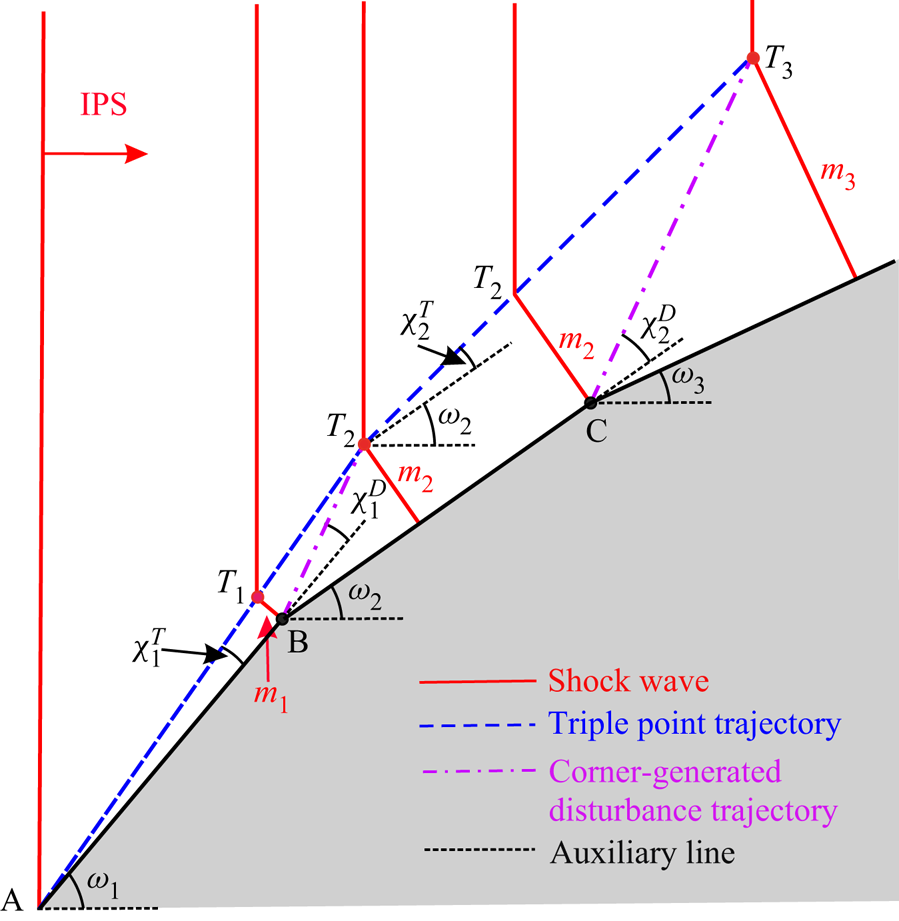
The propagation process of the disturbance when a planar shock reflects over a convex wedge is sketched in figure 1, in which the reflected shock waves and slip lines are ignored for simplicity. The smooth convex wedge can be viewed as an infinite set of straight sub-wedges, and the first sub-wedge is denoted by AB. Provided that the wedge angle of the first sub-wedge  $\omega _1$ is smaller than
 $\omega _{{d}}$ (the
 ${\rm RR} \leftrightarrow {\rm MR}$ transition wedge angle predicted by the detachment criterion), a MR (a direct-Mach reflection in fact) forms with the first TP (
 ${T_1}$) and the first Mach stem
 ${m_1}$ when the incident shock collides with point A. Note that the shock movement over the first sub-wedge AB is a quasi-pseudo-steady flow, and a small Mach stem will form immediately at point A. However, the height of the Mach stem at point A is infinitesimal, and is considered as zero in the following formulation. This treatment has widely been adopted in previous works (Ben-Dor Reference Ben-Dor2007; Dewey & McMillin Reference Dewey and McMillin1985; Ben-Dor et al. Reference Ben-Dor, Dewey and Takayama1987, Reference Ben-Dor, Dewey, McMillin and Takayama1988; Li & Ben-Dor Reference Li and Ben-Dor1999; Xie et al. Reference Xie, Han and Takayama2005). During
 ${m_1}$ moving along the sub-wedge AB, the velocity of
 ${T_1}$ propagating along the incident shock is constant and the trajectory angle of
 ${T_1}$ (
 $\chi ^{{T}}_1$) can be predicted by the three-shock theory. As long as
 $\chi ^{{T}}_1$ is known, the Mach number of
 ${m_1}$ (
 ${{M}}^{{m}}_1$) can be calculated by
 \begin{equation} {{M}}^{{m}}_1 = \frac{{M_0} \cos \chi^T_1}{\cos (\omega_1+\chi^T_1)}, \end{equation}
where  ${M_0}$ is the Mach number of the incident shock. When the Mach stem
 ${m_1}$ meets the next sub-wedge BC, the boundary condition changes and the
 ${m_1}$ is not perpendicular to BC. Because the wedge is convexly curved and the variation of the wedge angle relative to the
 ${m_1}$ is very small (far less than
 $1^{\circ }$), a weak disturbance (rarefaction wave) is formed from point B and propagates along the
 ${m_1}$ (for a concave wedge, a compression wave rather than a shock wave will be formed). The weak disturbance can be taken as a sound wave, and Skews’ relation can be used to calculate its trajectory. In the present work the Mach stem
 ${m_1}$ serves as the ‘incident shock’, and the trajectory angle of the weak disturbance
 $\chi ^{{D}}_1$ can be calculated as long as
 ${{M}}^{{m}}_1$ is known by Skews’ relation (Skews Reference Skews1967), which is expressed as
 \begin{equation} \tan\chi^{{D}}_1 = \left\{ \frac{[({{M}}^{{m}}_1)^2-1][(\gamma -1)({{M}}^{{m}}_1)^2+2]}{(\gamma+1)({{M}}^{{m}}_1) ^4} \right\}^{1/2}, \end{equation}
where  $\gamma$ is the specific heat ratio. We here clarify that (2.2) is an engineering estimate and has limitations in the applicability. Before the corner-generated disturbance catches up with the
 ${T_1}$, the trajectory angle of
 ${T_1}$ remains constant. As a result, there is a hysteresis in the response of the TP propagation to the variation of boundary conditions. Once the disturbance meets the
 ${T_1}$, both the
 ${T_1}$ and the
 ${m_1}$ disappear, and a new TP (
 ${T_2}$) moving along the incident shock and a new Mach stem
 ${m_2}$ form. The coordinates of
 ${T_2}$ when it forms (
 $x^{{T}}_2$,
 $y^{{T}}_2$) can be solved by the following equations:
 $$\begin{gather} y^{{T}}_2 = y_1 + (x^{{T}}_2-x_1)\tan(\omega_1+\chi^{{T}}_1), \end{gather}$$
 $$\begin{gather}y^{{T}}_2 = y_2 + (x^{{T}}_2-x_2)\tan(\omega_1+\chi^{{D}}_1). \end{gather}$$
Here ( $x_1$,
 $y_1$) and (
 $x_2$,
 $y_2$) are coordinates of points A and B in the Cartesian coordinate system, respectively.
Disturbance propagation process in the reflection of a planar shock over a convex wedge, in which reflected shock waves and slip lines are ignored for simplicity. Here IPS stands for incident planar shock;  ${T_1}$,
 ${T_2}$ and
 ${T_3}$ are TPs;
 ${m_1}$,
 ${m_2}$ and
 ${m_3}$ are Mach stems;
 $\omega _1$,
 $\omega _2$ and
 $\omega _3$ are wedge angles of corners;
 $\chi _1^{{T}}$ and
 $\chi _2^{{T}}$ are trajectory angles of the first and second TPs
 ${T_1}$ and
 ${T_2}$, respectively;
 $\chi _1^{{D}}$ and
 $\chi _2^{{D}}$ are trajectory angles of the first and second corner-generated disturbances from corners B and C, respectively.

When the TP is overtaken by the corner-generated disturbance, provided that the flow in the TP vicinity immediately adapts to the new boundary conditions at the position where the disturbance is generated (this assumption will be discussed in Appendix A), the trajectory angle of  ${T_2}$ moving along the incident shock (
 $\chi ^{{T}}_2$) can be calculated by substituting
 $\omega _2$ (the wedge angle of the second sub-wedge BC) and
 ${M_0}$ into the three-shock theory. Similarly, the Mach number of
 $m_2$ and the trajectory angle of the disturbance generated from point C (
 $\chi ^{{D}}_2$) can be obtained. Further, the coordinates of the third TP (
 ${T_3}$) when it forms can be solved by trajectory equations of the
 ${T_2}$ and the disturbance formed from point C. Similar relations can be extended and the coordinates of the
 $i$th TP when it forms (
 $x^{{T}}_i$,
 $y^{{T}}_i$) are solved by
 $$\begin{gather} y^{{T}}_i = y^{{T}}_{i-1} + (x^{{T}}_i-x^{{T}}_{i-1}) \tan(\omega_{i-1}+\chi^{{T}}_{i-1}), \end{gather}$$
 $$\begin{gather}y^{{T}}_i = y_i + (x^{{T}}_i-x_i)\tan(\omega_{i-1}+\chi^{{D}}_{i-1}), \end{gather}$$
where ( $x^{{T}}_{i-1}, y^{{T}}_{i-1}$) and (
 $x_i$,
 $y_i$) are coordinates of the (
 $i-1$)th TP when it forms and the
 $i$th corner, respectively;
 $\omega _{i-1}$ is the wedge angle of the (
 $i-1$)th sub-wedge,
 $\chi ^{{T}}_{i-1}$ and
 $\chi ^{{D}}_{i-1}$ are trajectory angles of the (
 $i-1$)th TP propagating along the incident shock and the disturbance generated at the
 $i$th corner propagating along the (
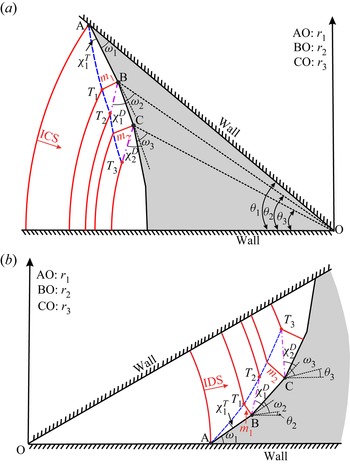
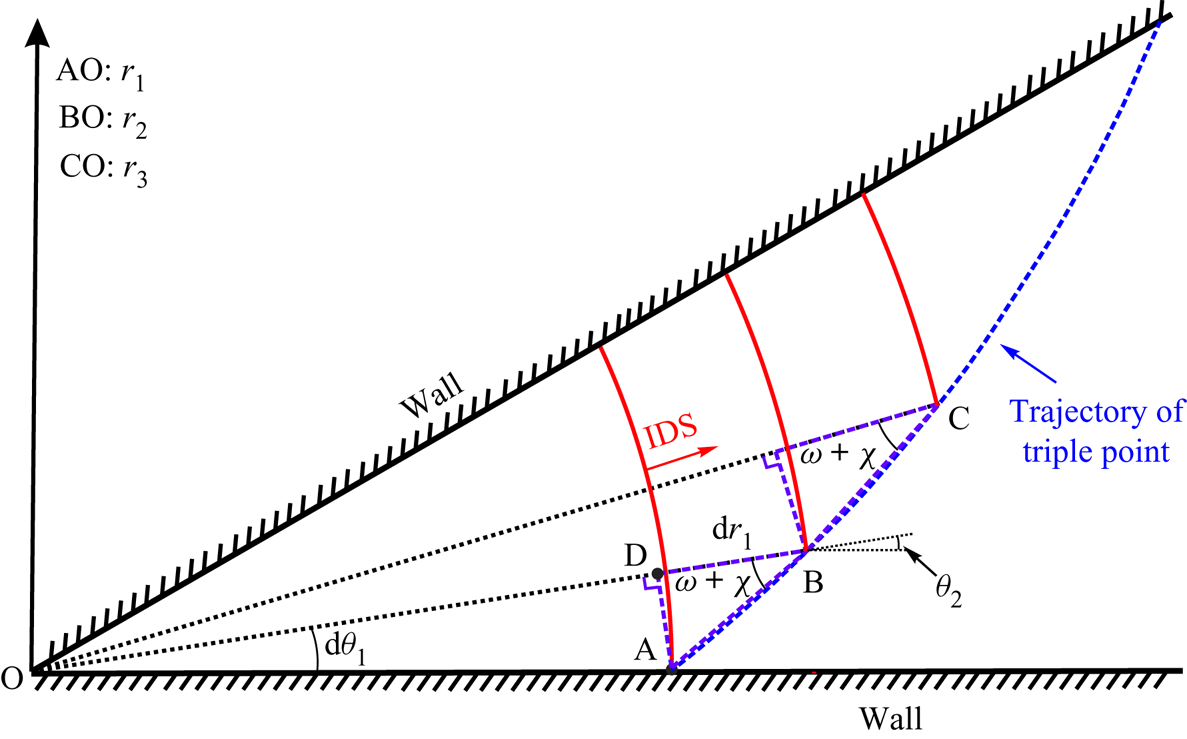
 $i-1$)th Mach stem, respectively. Extending the model from the planar shock reflection to the convergent/divergent shock reflection is rather straightforward. As sketched in figure 2, the convergent/divergent cylindrical shock over a concave wedge with the wedge angle increased is considered and a polar coordinate system centred on the convergent/divergent centre (point O) is established. Provided that
 $\omega _1$ is smaller than
 $\omega _{{d}}$, a MR with
 ${T_1}$ and
 ${m_1}$ forms when the incident shock coincides with point A. Here
 $\chi ^{{T}}_1$ can be calculated by the three-shock theory, and
 ${{M}}^{{m}}_1$ and
 $\chi ^{{D}}_1$ can also be calculated if
 $\chi ^{{T}}_1$ is known. Over the first sub-wedge AB with the constant wedge angle, the intensity of the disturbance propagating along the incident shock is almost unvaried. In our previous work (Wang et al. Reference Wang, Zhai, Luo, Yang and Lu2017), it was found that the behaviour of the disturbance propagating along the incident shock in the curved shock circumstance is the same as that in the planar shock circumstance in an infinitely short reflection process. According to this principle, the trajectory equation of the
 ${T_1}$ can be obtained as
 \begin{equation} r = r_1\, {\rm e}^{(\theta-\theta_1)\cot(\omega_1+\chi^{{T}}_1)}, \end{equation}
where ( $r_1$,
 $\theta _1$) are coordinates of point A. The derivation of this relation for cylindrically convergent shock reflection can be found in our previous work (Wang et al. Reference Wang, Zhai, Luo, Yang and Lu2017), and its extension to cylindrically divergent reflection can be found in Appendix B. The trajectory of the corner-generated disturbance propagating along the Mach stem in the convergent/divergent circumstance can be approximately taken as a straight line as long as the curvature of the Mach stem is limited. The trajectory equation of the disturbance generated at point B is
 \begin{equation} y = y_2 + (x-x_2)\tan(\omega_1+\theta_1+\chi^{{D}}_1). \end{equation}
The coordinates of the second TP when it forms can be solved by (2.7) and (2.8). Similarity,  $\chi ^{{T}}_2$ and
 $\chi ^{{D}}_2$ can be calculated by the three-shock theory and Skews’ relation, respectively. Similar relations can be extended to obtain the coordinates of the
 $i$th TP when it forms,
 $$\begin{gather} r = r^{{T}}_{i-1}\, {\rm e}^{(\theta-\theta^{{T}}_{i-1}) \cot(\omega_{i-1}+\chi^{{T}}_{i-1})}, \end{gather}$$
 $$\begin{gather}y = y_i + (x-x_i)\tan(\omega_{i-1}+\theta_{i-1}+\chi^{{D}}_{i-1}), \end{gather}$$
where ( $r^{{T}}_{i-1}, \theta ^{{T}}_{i-1}$) are coordinates of the (
 $i-1$)th TP when it forms.
Disturbance propagation process of a convergent (a) and a divergent (b) shock reflection over a concave wedge with the wedge angle increased. Here ICS stands for incident convergent shock and IDS stands for incident divergent shock;  $\theta _1$,
 $\theta _2$ and
 $\theta _3$ are polar angles of the first three corners. The other symbols are the same as those in figure 1.

3. Numerical method and wedge design
To study all known types of 2-D unsteady shock reflections over a single wedge and also validate the model proposed above, extensive inviscid numerical simulations are performed. In this work the numerical solver VAS2D (2-D vectorized adaptive solver) (Sun & Takayama Reference Sun and Takayama1999), which has been well validated in shock-body interactions (Zhang et al. Reference Zhang, Si, Zhai, Luo, Yang and Lu2016; Wang et al. Reference Wang, Zhai, Luo, Yang and Lu2017; Wang & Zhai Reference Wang and Zhai2020) and shock-interface interactions (Zhai et al. Reference Zhai, Si, Luo and Yang2011, Reference Zhai, Wang, Si and Luo2014, Reference Zhai, Liang, Liu, Ding, Luo and Zou2018; Zhai, Ou & Ding Reference Zhai, Ou and Ding2019a), is employed. In the numerical algorithm, the 2-D compressible Euler equations are adopted as the governing equations, which can be written in the vectorial form
 \begin{equation} \frac{\partial \boldsymbol{U} }{\partial t} + \frac{\partial \boldsymbol{F}}{\partial x}+ \frac{\partial \boldsymbol{G}}{\partial y}= 0, \end{equation}
where  $\boldsymbol {U}$,
 $\boldsymbol {F}$ and
 $\boldsymbol {G}$ represent the conserved variables, the convective fluxes in the x- and
 $y$-directions, respectively, i.e.
 \begin{equation}
\boldsymbol{U}=\left( \begin{array} {@{}c@{}}\rho \\ \rho u \\
\rho v \\ \rho E \end{array} \right);\quad
\boldsymbol{F}=\left( \begin{array}{@{}c@{}}\rho u\\ \rho
u^2+p\\ \rho uv\\(\rho E+p)u \end{array} \right);\quad
\boldsymbol{G}=\left( \begin{array}{@{}c@{}}\rho v\\ \rho uv\\
\rho v^2+p \\ (\rho E+p)v\\\end{array} \right),
\end{equation}
where  $p$,
 $\rho$,
 $E$,
 $u$ and
 $v$, respectively, represent the pressure, density, total energy per unit mass and velocity components in the x- and
 $y$-directions.
The finite volume method is used to discretize the conservation laws by applying them directly to each non-overlapping control volume. The MUSCL–Hancock approach is adopted to reach a second-order precision in both temporal and spatial scales. To refine the local complex areas and capture the wave configurations effectively, an unstructured adaptive mesh is used. The current criterion for adaptation is based on the truncation error of the Taylor series expansion of density. The truncation error indicator  $\varepsilon_T$ is given by the ratio of the second-order derivative term to the first-order one in Taylor expansion. If
 $\varepsilon_T > \varepsilon_r$, the cell needs to be refined, and if
 $\varepsilon_T < \varepsilon_c$, the cell needs to be coarsened, where
 $\varepsilon_r$ and
 $\varepsilon_c$ are threshold values for refinement and coarsening. In the computations, the ambient air is assumed to be a perfect gas, and the initial temperature and pressure are 293 K and 101 325 Pa, respectively. The initial mesh size of 0.3 mm and the finest mesh size of 18.8
 $\mathrm {\mu }$m in the positions where greater density gradient exists are applied. Grid convergence validation has been conducted in our previous works (Wang & Zhai Reference Wang and Zhai2020; Wang, Zhai & Luo Reference Wang, Zhai and Luo2021), and a grid with a similar size to the previous work is adopted in this work.
In numerical simulations the Mach number of the convergent or divergent shock varies very slowly, which results in a very small variation of  $\chi ^{{T}}$ predicted by the three-shock theory (Ben-Dor et al. Reference Ben-Dor, Dewey and Takayama1987; Wang et al. Reference Wang, Zhai, Luo, Yang and Lu2017). Therefore, the Mach number of the incident shock can be considered as a constant in theoretical calculations. Note that the three-shock theory is relatively accurate in predicting
 $\chi ^{{T}}$ when the Mach stem is straight. However, when the incident shock is weak (
 ${M_0} < 1.5$ for example), the Mach stem tends to be concavely curved (Dewey & McMillin Reference Dewey and McMillin1985; Olim & Dewey Reference Olim and Dewey1992; Henderson et al. Reference Henderson, Vasilev, Ben-Dor and Elperin2003), probably because the disturbances generated by the flow-deflection process overtake the TP and affect the Mach stem shape since the flow behind the reflected shock wave with respect to the TP is subsonic. When the incident shock is strong (
 ${M_0} > 3.0$ for example), the Mach stem tends to be convexly curved (Hornung Reference Hornung1986; Henderson et al. Reference Henderson, Vasilev, Ben-Dor and Elperin2003; Shi et al. Reference Shi, Zhu, Yang and Luo2019), because a wall jet is generated and causes the convex bending of the Mach stem. To provide a relatively straight Mach stem, the incident shock with a Mach number of 2.0 and a wedge angle greater than
 $20^{\circ }$ are imposed in this work. This choice also avoids the problem that the three-shock theory is not always solvable for the MR over a wedge with a small angle (Xie et al. Reference Xie, Han and Takayama2005), especially when the shock wave is weak. Furthermore, to ensure the prediction accuracy and the physical correctness of the application of Skews’ relation for finding
 $\chi ^{{D}}$, the absolute value of wedge angle variation in each iteration should be far less than
 $1^{\circ }$. In this work, the number of iterations in calculation is fixed at 2500 and the wedge angle variation in each iteration is
 $(\omega _{{t}}-\omega _0)/2500$, where
 $\omega _0$ and
 $\omega _{{t}}$ are wedge angles at the leading and trailing edges of the wedge, respectively.
The unsteady shock reflection over a single wedge can be roughly divided into two classes, wedge angle increased and wedge angle decreased. As discussed before, there are five types of shock reflection with wedge angle increased, including a planar shock reflection over a concave wedge, a convergent cylindrical shock reflection over a straight/concave/convex wedge and a divergent cylindrical shock reflection over a concave wedge; and five types of shock reflection with wedge angle reduced, including a planar shock reflection over a convex wedge, a divergent cylindrical shock reflection over a straight/convex/concave wedge and a convergent cylindrical shock over a convex wedge. For investigating curved shock reflection over a curved wedge, the wedge should be carefully designed according to the type of shock (convergent or divergent) and variation trend of the wedge angle (increase or decrease). According to our previous work (Zhang et al. Reference Zhang, Si, Zhai, Luo, Yang and Lu2016; Wang et al. Reference Wang, Zhai, Luo, Yang and Lu2017), during a convergent cylindrical shock moving along a straight wedge, the geometric effect of the convergent shock causes an increase of the wedge angle, and the variation rate of  $\omega$ equals the negative of the variation rate of
 $\theta$ (
 ${\rm d} \omega = -{\rm d} \theta$). Therefore, to design a concave (convex) wedge for a convergent shock reflection in the polar coordinate system, the variation rate of
 $\omega$ must be larger (smaller) than the negative of the variation rate of
 $\theta$, i.e.
 ${\rm d} \omega > -{\rm d} \theta$ (
 ${\rm d} \omega < -{\rm d} \theta$) at each position on the wedge (Wang & Zhai Reference Wang and Zhai2020). Similarly, the geometric effect of the divergent shock causes a reduction of the wedge angle, and the negative of the variation rate of
 $\omega$ equals the variation rate of
 $\theta$ (
 $-{\rm d} \omega = {\rm d} \theta$). As a result, to design a concave (convex) wedge for a divergent shock reflection in the polar coordinate system, the negative of the variation rate of
 $\omega$ must be smaller (larger) than the variation rate of
 $\theta$, i.e.
 $-{\rm d} \omega < {\rm d} \theta$ (
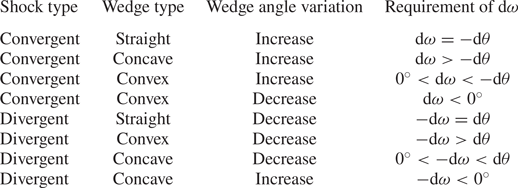
 $-{\rm d} \omega > {\rm d} \theta$) at each position on the wedge. Table 1 summarizes the wedge shapes for convergent/divergent shock reflections with the wedge angle increased or decreased and the requirement of
 ${\rm d} \omega$ at each position on the wedge.
Summary of the wedge shapes for convergent/divergent cylindrical shock reflections with the wedge angle increased or decreased and the requirement of  ${\rm d} \omega$ at each position on the wedge.

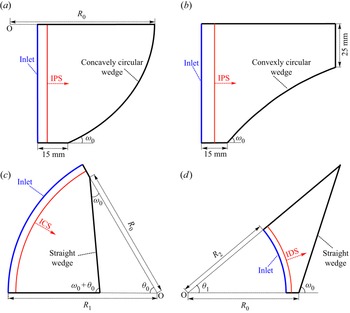
The computational domains are sketched in figure 3 for four typical cases: a planar shock reflecting over a concave wedge, a planar shock over a convex wedge, a convergent shock over a straight wedge and a divergent shock over a straight wedge. Note that the scales in the figure do not reflect the real ones. For all cases, the inlet condition is applied to the left boundary (blue solid lines), while solid-wall conditions are applied to the other boundaries and the wedge (black solid lines). The initial post-shock flow is regarded as uniform, and the density, pressure and post-shock velocity are calculated from Rankine–Hugoniot relations. Note that the post-shock flow of a cylindrical shock is actually non-uniform. For a convergent or divergent cylindrical shock, its intensity varies very slowly when it is far away from the convergent centre or divergent centre (Zhai et al. Reference Zhai, Si, Luo, Yang, Liu, Tan and Zou2012; Li et al. Reference Li, Ding, Zhai, Si, Liu, Huang and Luo2020), and the post-shock flow can approximately be regarded as uniform. In this work, although the initial post-shock flow is uniform, the post-shock flow varies as the cylindrical shock starts to move. In our previous work (Zhai et al. Reference Zhai, Zhang, Zhou, Ding and Wen2019b; Zhou et al. Reference Zhou, Ding, Zhai, Cheng and Luo2020) we numerically investigated the interaction of a convergent cylindrical shock with unperturbed and perturbed interfaces, and a uniform state behind the initially convergent shock was imposed. Through comparing the displacements of several shock waves and interface, and the interface amplitude growth between the numerical and experimental results, it was found that this approximation has a limited effect on the shock dynamics phenomena and post-shock flow features. As a result, a uniform state behind the initial shock is imposed in the present work for convenience.
Computational domains of unsteady shock reflection over a single wedge. (a) A planar shock reflecting over a concave wedge, (b) a planar shock over a convex wedge, (c) a convergent shock over a straight wedge and (d) a divergent shock over a straight wedge.

For planar shock reflections, as sketched in figures 3(a) and 3(b), two different radii of a circular wedge ( $R_0$) are considered: 100 and 150 mm, and the inlet is positioned at 15 mm away from the leading edge of the wedge. Specifically, for a planar shock reflection over a convex wedge, the wedge angle at the trailing edge of the wedge is
 $20^{\circ }$.
The computational domain of a convergent shock reflection over a straight wedge is sketched in figure 3(c). For the reflection of a convergent shock over a curved wedge, the straight wedge in figure 3(c) is simply replaced by a curved wedge with the specific shape, and the sketches of the corresponding computational domains are ignored. For cases with the straight wedge, the polar angle of the leading edge of the wedge ( $\theta _0$) is
 $60^{\circ }$. For cases with the concave wedge,
 $\theta _0 = 40^{\circ }$ while the total variation of
 $\omega$ from the leading to trailing edges is chosen as
 $60^{\circ }$. Besides,
 $\omega$ changes linearly with
 $\theta : \omega = \omega _0 + 1.5(\theta _0 - \theta )$ at each position on the wedge to ensure the concave shape of the wedge. For a convergent shock reflection over a convex wedge with the wedge angle increased,
 $\theta _0=80^{\circ }$ while the total variation of
 $\omega$ from the leading to trailing edges of the wedge is set at
 $60^{\circ }$. To ensure the convex shape of the wedge,
 $\omega$ changes linearly with
 $\theta : \omega = \omega _0 + 0.75(\theta _0 - \theta )$ at each position on the wedge. For a convergent shock reflection over a convex wedge with the wedge angle reduced, to ensure the convex shape of the wedge, the wedge angle
 $\omega$ gradually reduces, and
 $\omega = \omega _0 - 1/3 (\theta _0 - \theta )$ at each position on the wedge. Besides,
 $\theta _0$ is chosen as
 $60^{\circ }$ and the total variation of
 $\omega$ from the leading to trailing edges of the wedge is
 $-20^{\circ }$. For all cases, two different
 $R_0$ (90 and 180 mm) are considered and the inlet is positioned at
 $R_1$ (
 $= R_0 + 10$ mm) away from the convergent centre. Note that for curved shock reflection,
 $R_0$ represents the radius of the leading edge of the wedge. To ensure that the Mach number of the incident convergent shock (ICS) is 2.0 when it meets the leading edge of the wedge, the initial incident shock Mach number is set at 1.9913 and its initial positions are set at 92.5 and 185 mm away from the convergent centre in cases with
 $R_0 = 90$ and 180 mm, respectively.
The computational domain of a divergent shock reflection over a straight wedge is sketched in figure 3(d). For the reflection of a divergent shock over a curved wedge, the straight wedge in figure 3(d) is simply replaced by a curved wedge with the specific shape, and the sketches of the corresponding computational domains are ignored. For cases with the straight wedge,  $\theta _0=0^{\circ }$ and
 $\theta _1=20^{\circ }$ (
 $\theta _1$ is the polar angle of the trailing edge of the wedge). The total variation of
 $\omega$ from the leading to trailing edges of the wedge is
 $-20^{\circ }$. For cases with the convex wedge,
 $\theta _0=0^{\circ }$ and
 $\theta _1=15^{\circ }$. The total variation of
 $\omega$ from the leading to trailing edges of the wedge is
 $-20^{\circ }$, and
 $\omega = \omega _0 - 4/3 \theta$ at each position on the wedge to ensure the convex shape of the wedge. For a divergent shock reflection over a concave wedge with the wedge angle reduced,
 $\theta _0=0^{\circ }$ and
 $\theta _1=30^{\circ }$. The total variation of
 $\omega$ from the leading to trailing edges of the wedge is
 $-20^{\circ }$, and
 $\omega = \omega _0 - 2/3 \theta$ at each position on the wedge to ensure a decreased wedge angle of the concave wedge. For a divergent shock reflection over a concave wedge with the wedge angle increased, the total variation of
 $\omega$ from the leading to trailing edges of the wedge is
 $60^{\circ }$, and the increase of wedge angle ensures the concave shape of the wedge. Here
 $\theta _0$ and
 $\theta _1$ (the polar angle of the trailing edge of the wedge) are set at
 $0^{\circ }$ and
 $40^{\circ }$, respectively. Besides,
 $\omega$ varies linearly with
 $\theta : \omega = \omega _0 + 1.5\theta$ at each position on the wedge. For divergent shock reflections, two other different
 $R_0$ (100 and 150 mm) are considered and the inlet is positioned at
 $R_2$ (
 $=R_0-10$ mm) away from the divergent centre. To ensure that the Mach number of the incident divergent shock (IDS) is 2.0 when it meets the leading edge of the wedge, the initial Mach number of the IDS is set at 2.016 and its initial positions are set at 95 and 142.5 mm away from the divergent centre in cases with
 $R_0 = 100$ and 150 mm, respectively.
4. Results and discussion
We shall first study the unsteady shock reflection with the wedge angle increased and then one with the wedge angle decreased, and the emphasis is given to the TP trajectory. The TP trajectories from the theoretical prediction and the numerical result are compared. In comparison, we will also adopt the same modification proposed by Yuan et al. (Reference Yuan, Zhou, Mi and Ng2020) to see whether this modification is still effective or not in the unsteady case. As discussed before, in pseudo-steady shock reflection, the three-shock theory usually overestimates the TP trajectory angle. To obtain  $\chi ^{{T}}$ more accurately, the value predicted by the three-shock theory was modified by applying the two-shock theory (Yuan et al. Reference Yuan, Zhou, Mi and Ng2020):
 $\chi ^{{T}}_{{mod}}(\omega ) = \chi ^{{T}}_{{ori}} (\omega ) - (\chi ^{{T}}_{{ori}} (\omega _{{d}})/\omega _{{d}})\omega$. The subscripts ‘ori’ and ‘mod’ denote the original and modified predictions by the three-shock theory, respectively. This modification ensures that
 $\chi ^{{T}}_{{mod}} = 0$ when
 $\omega = \omega _{{d}}$. When
 ${M_0} = 2.0$, the detachment angle (
 $\omega _{{d}}$) is
 $50.591^{\circ }$ and
 $\chi ^{{T}}_{{ori}}(\omega _{{d}})$ is
 $1.046^{\circ }$, therefore,
 $\chi ^{{T}}_{{mod}}(\omega ) = \chi ^{{T}}_{{ori}}(\omega ) - (1.046/50.591)\omega$.
4.1. Shock reflection with wedge angle increased
We first consider the unsteady shock reflections with the wedge angle increased, and five different configurations, including a planar shock reflection over a concave wedge, a convergent shock reflection over a straight/concave/convex wedge and a divergent shock reflection over a concave wedge, are investigated. For all cases, three different initial wedge angles  $\omega _0$ (
 $25^{\circ }$,
 $30^{\circ }$ and
 $35^{\circ }$) are adopted.
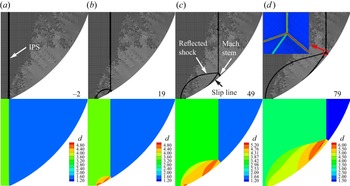
Figure 4 shows the computational meshes (top) and the corresponding density fields (bottom) of a planar shock reflection over a concave wedge with  $\omega _0 = 25^{\circ }$ and
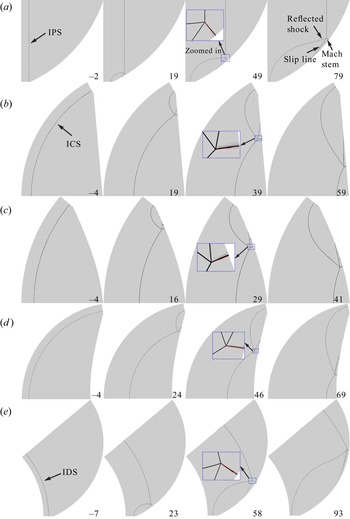
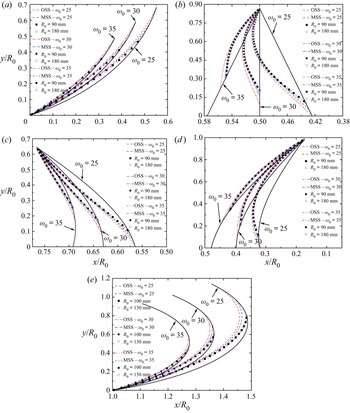
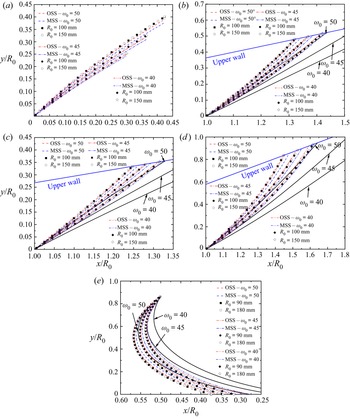
 $R_0 = 150$ mm at different moments. Note that the numerical results are cropped to demonstrate the meshes and density fields more clearly. It can be found that the adaptation procedure refines the mesh in flow regions with a large density gradient (near the shock waves and slip line). The numerical schlieren images in figure 5 show the processes of five types of shock reflection with the wedge angle increased. For all cases, a MR is generated when the incident shock meets the leading edge of the wedge, and the Mach stem length first increases, then starts to decrease from the intermediate stages until the TP reaches the wedge. It is found that under the conditions considered, the Mach stem is always slightly concavely curved in shock reflection with the wedge angle increased, which should be caused by corner-generated compression waves propagating along the Mach stem. In planar and divergent shock reflections, the reflected shock in the vicinity of the TP is slightly convexly curved in the early stages, and gradually becomes slightly concavely curved in the late stages, while the slip line is always concavely curved. For the three types of convergent shock reflection, the reflected shock in the TP vicinity is convexly curved in all stages and its curvature decreases gradually, while the slip line is concavely curved in the early stages, and gradually becomes convexly curved in the late stages. From the comparison, we notice that the convergent shock contributes to making the reflected shock and the slip line convexly curved. The dimensionless TP trajectories from theoretical and numerical calculations are compared in figure 6. The identification method of the TP and the uncertainties of its position (coordinates) are demonstrated in Appendix C. The reflection process of a planar shock over a circular concave wedge, as shown in figure 6(a), is similar in cases with different scales, which is consistent with the previous results (Gray & Skews Reference Gray and Skews2017; Koronio et al. Reference Koronio, Ben-Dor, Sadot and Geva2020). It is ascribed to the linear relationship between the geometric scales of the propagation of corner-generated disturbances and the TP and the scale of the wedge for reflection. Note that previous experimental works (Takayama & Sasaki Reference Takayama and Sasaki1983; Skews & Kleine Reference Skews and Kleine2010) showed that over cylindrical surfaces with different radii, the
 ${\rm MR} \rightleftharpoons {\rm RR}$ transition depended on the Mach strength and the radii of curvature. As the radius of curvature decreases, the deviation between the transition angle in the experiment and the angle predicted by pseudo-steady criterion was increased. They also noticed that when the radius of curvature was considerably increased, the transition occurred very close to the pseudo-steady criterion. However, Hakkaki-Fard & Timofeev (Reference Hakkaki-Fard and Timofeev2012) stated that on experimental images the shock and perturbation fronts have a finite optical thickness, which may be significant, especially for high speed movies which typically have lower resolution than still images. This may lead to difficulties in determination of whether or not a particular disturbance has already merged with the reflection point. It may be conjectured that this type of error may be the reason why the catch-up point obtained experimentally by Skews & Kleine (Reference Skews and Kleine2010) is well ahead (at higher wedge angles) than the theoretical sonic point. In other words, the conclusion obtained by Takayama & Sasaki (Reference Takayama and Sasaki1983) and Skews & Kleine (Reference Skews and Kleine2010) is probably caused by the insufficient spatial and temporal resolutions of experiments, and when the radius of curvature increases, the relative spatial and temporal resolutions would be improved. Also, the discrepancy between the experimental results and inviscid numerical results is related to the existence of viscosity (Kleine et al. Reference Kleine, Timofeev, Hakkaki-Fard and Skews2014).
The computational meshes (top) and the corresponding density fields (bottom) of a planar shock reflection over a concave wedge with  $\omega _0 = 25^{\circ }$ and
 $R_0 = 150$ mm at different moments. Numbers denote time in
 $\mathrm {\mu }$s. The temporal origin is defined as the moment when the incident shock reaches the leading edge of the wedge, and similarly hereinafter.

Shock reflection processes with the wedge angle increased. Planar shock over concave wedge with  $\omega _0 = 25^{\circ }$ and
 $R_0$ = 150 mm (a). Convergent shock over straight wedge (b), concave wedge (c) and convex wedge (d) with
 $\omega _0 = 25^{\circ }$ and
 $R_0 = 90$ mm. Divergent shock over concave wedge with
 $\omega _0 = 25^{\circ }$ and
 $R_0 = 100$ mm (e).

Dimensionless TP trajectories from theoretical and numerical calculations of shock reflections with the wedge angle increased: a planar shock reflection off a concave wedge (a), a convergent shock reflection over a straight wedge (b), a concave wedge (c), a convex wedge (d) and a divergent shock reflection over a concave wedge (e). The solid lines denote the wedge, and the symbols represent the numerical results. Here OSS and MSS represent the theoretical results calculated by  $\chi ^{{T}}_{{ori}}$ and
 $\chi ^{{T}}_{{mod}}$, respectively, and similarly hereinafter.

The results in figure 6(a) show that the predictions based on  $\chi ^{{T}}_{{mod}}$ and
 $\chi ^{{T}}_{{ori}}$ coincide well at the early stages, but deviate from each other quickly from the intermediate to late stages, because the discrepancy between
 $\chi ^{{T}}_{{mod}}$ and
 $\chi ^{{T}}_{{ori}}$ is proportional to the wedge angle. From the comparison, although the model based on
 $\chi ^{{T}}_{{mod}}$ rather than
 $\chi ^{{T}}_{{ori}}$ gives a better prediction to the numerical results, an overestimation is still found from the intermediate stages for both of them. This fact shows that the three-shock theory indeed overestimates the
 $\chi ^{{T}}$ under the conditions considered. In the theoretical calculation, provided that the flow in the TP vicinity adapts to the new boundary conditions immediately when the corner-generated disturbance overtakes it, the new TP trajectory angle is calculated by the wedge angle at the position where the disturbance is generated. For the shock reflection with the wedge angle increased, the corner-generated disturbance is a compression wave, which propagates along the Mach stem and strengthens it. The Mach stem generated when the disturbance overtakes the TP is weaker in intensity relative to the Mach stem generated when an identical shock reflects over a single wedge with the same wedge angle as that at the position where the disturbance is generated (this will be demonstrated in detail in Appendix A). For a given incident shock and wedge angle, the weaker the Mach stem, the smaller the TP trajectory angle. In other words, the TP trajectory angle adopted in theoretical calculations is larger than the actual one, resulting in an overestimation by the theoretical method. In addition, the discrepancy between the numerical and theoretical results would accumulate during the reflection process, which also leads to an overestimation by the theoretical method, especially at the late stages. Besides, some additional factors will result in the difference between the theoretical and numerical results. For example, the accuracy of the three-shock theory in predicting the TP trajectory angle may be inadequate, especially in unsteady shock reflection processes. Also the disturbances caused by the flow diffracting around the curved wedge are not considered in the model, which may affect the movement of the TP. Figures 6(b)–6(d) show the dimensionless TP trajectories from theoretical and numerical calculations of convergent shock reflection over a straight wedge, a concave wedge and a convex wedge, respectively. Similarly, the reflection process of a convergent shock over a wedge is independent of the scale. Generally, the model can predict the development trend of the TP trajectory. The predictions based on
 $\chi ^{{T}}_{{mod}}$ and
 $\chi ^{{T}}_{{ori}}$ deviate from each other quickly, and the former gives a better prediction. The three-shock theory again obviously overestimates the TP trajectory angle when the Mach stem length starts to reduce from the peak. For each case, the discrepancy between the prediction and the numerical result zooms up as the wedge angle increases. One may also conclude that the model is capable of predicting the TP trajectory when a divergent shock reflects over a concave wedge with the wedge angle increased, as illustrated in figure 6(e). For all cases, the model is more accurate for a larger
 $\omega _0$, probably because there is less accumulation of theoretical error in a shorter reflection process.
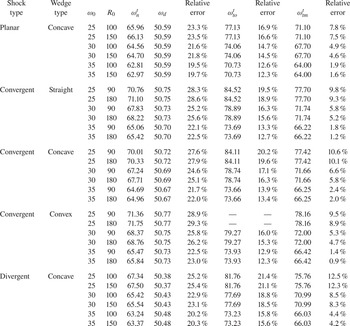
Moreover, the  ${\rm MR} \rightarrow {\rm RR}$ transition wedge angles (
 $\omega ^{{t}}$) obtained from the detachment criterion, theoretical calculations (
 $\omega ^{{t}}_{{t}}$) and numerical simulations (
 $\omega ^{{t}}_{{n}}$) for all cases are presented in table 2. Here
 $\omega ^{{t}}_{{t}}$ is obtained when the theoretical line intersects with the wedge. For cases with different scales, only a very subtle difference exists between the numerical results, which indicates that the transition angle is independent of the scale. Both
 $\omega ^{{t}}_{{n}}$ and its relative error with
 $\omega _d$ decrease with the increase of
 $\omega _0$, which is similar to the conclusion obtained in the work of Takayama & Sasaki (Reference Takayama and Sasaki1983). The difference in
 $\omega ^{{t}}$ between the pseudo-steady flow and unsteady flow is caused by the history of the unsteady reflection process, i.e. the accumulation of unsteady effect. The larger the
 $\omega _0$, the shorter the unsteady reflection process before the
 ${\rm MR} \rightarrow {\rm RR}$ transition occurs, resulting in a smaller difference between
 $\omega ^{{t}}_{{n}}$ and
 $\omega _d$. In all cases, the relative discrepancy of
 $\omega ^{{t}}$ between theoretical and numerical results (
 $|(\omega ^{{t}}_{{n}}-\omega ^{{t}}_{{t}})/\omega ^{{t}}_{{n}}|$) is smaller when
 $\chi ^{{T}}_{{mod}}$ is adopted in a theoretical calculation, and it reduces as
 $\omega _0$ increases. As a result, the initial wedge angle has an effect on the application of the model. Note that in the theoretical results calculated by
 $\chi ^{{T}}_{{ori}}$ when a convergent shock reflects off a convex wedge with
 $\omega _0 = 25^{\circ }$, the TP propagating along the ICS ends at the lower boundary instead of the convex wedge, therefore, the
 ${\rm MR} \rightarrow {\rm RR}$ transition wedge angle is absent.
The  ${\rm MR} \rightarrow {\rm RR}$ transition wedge angles obtained from detachment criterion, theoretical calculations (
 $\omega ^{{t}}_{{t}}$) and numerical simulations (
 $\omega ^{{t}}_{{n}}$) of a shock reflection over a wedge with the wedge angle increased. Here
 $\omega ^{{t}}_{{to}}$ and
 $\omega ^{{t}}_{{tm}}$ are calculated based on
 $\chi ^{{T}}_{{ori}}$ and
 $\chi ^{{T}}_{{mod}}$, respectively, and similarly hereinafter. The unit of angle is degree.

4.2. Shock reflection with wedge angle decreased
Now we consider the unsteady shock reflections with the wedge angle decreased, and five different configurations, including a planar shock reflection over a convex wedge, a divergent shock reflection over a convex/straight/concave wedge and a convergent shock reflection over a convex wedge, are investigated. For all cases, three different initial wedge angles  $\omega _0$ (
 $50^{\circ }$,
 $45^{\circ }$ and
 $40^{\circ }$) are adopted to ensure that the MR always occurs over the wedge.
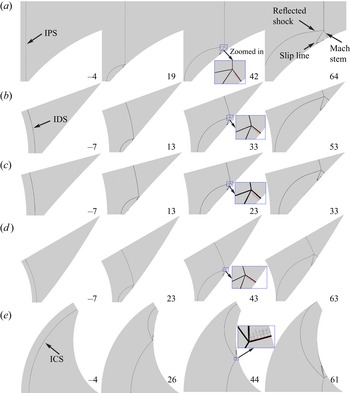
In figure 7 the processes of five types of shock reflection with the wedge angle decreased are shown. In all cases, a MR is generated when the reflection starts, and the Mach stem length continuously increases until the TP meets the wall. Under the conditions considered, the Mach stem is always slightly convexly curved, which should be ascribed to corner-generated rarefaction waves propagating along the Mach stem. Besides, it can be found that a jet is generated around the intersection of the convexly curved slip line with the wedge surface. Such a jet also exists in pseudo-steady shock reflection with the same incident shock Mach number, but it is absent in shock reflection with the wedge angle increased, as discussed above. It seems that the increase of wedge angle inhibits the formation of the jet. Note that for divergent shock reflections with different wedges, as shown in figure 7(b–d), there appears hardly any difference qualitatively in the MR configurations, because the curvatures of the convex and concave wedges are limited. As demonstrated in § 3, to provide a relatively straight Mach stem, a wedge angle greater than 20 $^\circ$ should always be satisfied during the shock reflection over the wedge. As a result, the curvatures are limited for the convex and concave wedges, causing similar MR configurations among different cases.
Shock reflection processes with the wedge angle decreased. Planar shock over convex wedge with  $\omega _0 = 50^{\circ }$ and
 $R_0 = 150$ mm (a). Divergent shock over straight wedge (b), convex wedge (c) and concave wedge (d) with
 $\omega _0 = 50^{\circ }$ and
 $R_0 = 100$ mm. Convergent shock over convex wedge with
 $\omega _0 = 50^{\circ }$ and
 $R_0 = 90$ mm (e).

In planar and convergent shock reflections, the reflected shock in the TP vicinity is slightly concavely curved in the early stages and gradually becomes slightly convexly curved in the late stages. As for the three types of divergent shock reflection, the reflected shock in the TP vicinity is always slightly concavely curved. As a result, the divergent shock contributes to making the reflected shock concavely curved.
From the results above, the Mach stem, reflected shock in the TP vicinity and the slip line generally have different shapes or shape variation trends in shock reflections with the wedge angle increased and decreased, which can probably be ascribed to the corner-generated waves or continuously varying boundary conditions that are needed to be satisfied. As mentioned above, all four discontinuities in the TP vicinity are presumed to be straight when the three-shock theory is applied. Therefore, the difference in the shape or shape variation trend of those discontinuities may cause different performances of the three-shock theory in predicting the TP trajectory angle.
The dimensionless TP trajectories are shown in figure 8 for all cases. The model based on either  $\chi ^{{T}}_{{mod}}$ or
 $\chi ^{{T}}_{{ori}}$ underestimates the numerical results for the planar shock reflection over a convex wedge, as shown in figure 8(a). It is ascribed to the weaker strength of the Mach stem adopted in the theoretical calculation. The intensity of the Mach stem, when the corner-generated disturbance overtakes the TP, is stronger than that of the Mach stem in the shock reflection over a single wedge using the same shock and wedge angle as those at the position where the disturbance is generated (see Appendix A for details). Besides, the error will be accumulated during the reflection process, which finally results in a relatively large underestimation of numerical results, especially at the late stages. As
 $\omega _0$ reduces, the discrepancy between the numerical and theoretical results reduces too.
Dimensionless trajectories of the TP from theoretical and numerical calculations of shock reflections with the wedge angle decreased: planar shock reflection over a circular convex wedge (a); divergent shock reflection over a straight wedge (b), a convex wedge (c) and a concave wedge (d); convergent shock reflection over a convex wedge (e).

The dimensionless TP trajectories when a divergent shock reflects over a wedge from theoretical and numerical calculations are shown in figures 8(b)–8(d) for the straight wedge, convex wedge and concave wedge, respectively. For cases with the straight/convex wedge, the model based on  $\chi ^{{T}}_{{ori}}$ generally predicts well the TP trajectory, whereas the model based on
 $\chi ^{{T}}_{{mod}}$ underestimates the numerical results from the intermediate stages, especially for a larger
 $\omega _0$. For cases with the concave wedge, the model based on
 $\chi ^{{T}}_{{ori}}$ works well for a large
 $\omega _0$, whereas the model based on
 $\chi ^{{T}}_{{mod}}$ works well for a small
 $\omega _0$. Whether the modification of the prediction by the three-shock theory is necessary or not is dependent on
 $\omega _0$. The dimensionless TP trajectories when a convergent shock reflects over a convex wedge from theoretical and numerical calculations are shown in figure 8(e). The model based on
 $\chi ^{{T}}_{{ori}}$ or
 $\chi ^{{T}}_{{mod}}$ only predicts well the TP trajectory at the early stages, and underestimates it from the intermediate stages. Relatively, the prediction based on
 $\chi ^{{T}}_{{ori}}$ instead of
 $\chi ^{{T}}_{{mod}}$ is better.
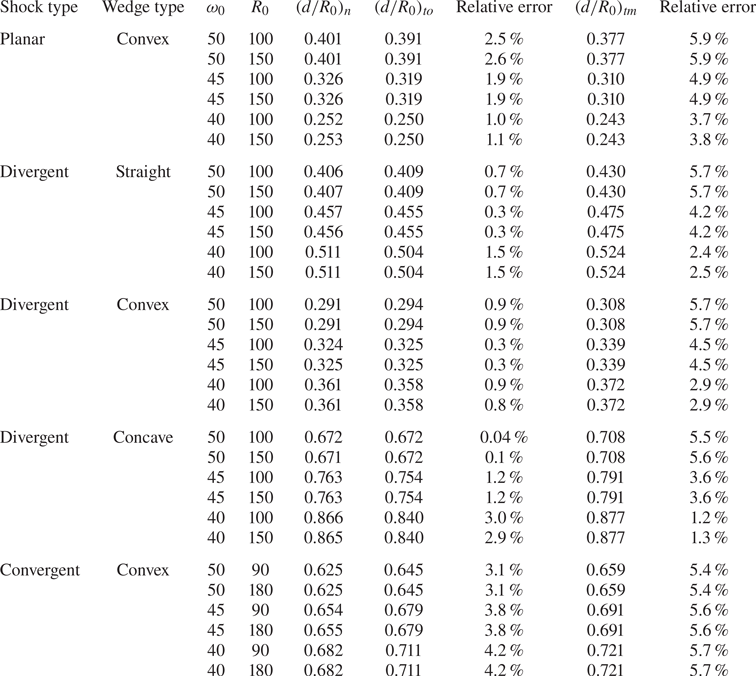
Moreover, the dimensionless vertical (or radial) displacements of the TP from the leading edge of the wedge to the position where the TP meets the boundary ( $d/R_0$) are compared for numerical and theoretical results. As listed in table 3, generally, the predictions based on
 $\chi ^{{T}}_{{ori}}$ instead of
 $\chi ^{{T}}_{{mod}}$ are closer to the numerical counterparts, which is contrary to the conclusion in § 4.1. For some specific cases, such as the case of a divergent shock reflecting over a concave wedge with
 $\omega _0$ of 40
 $^{\circ }$, the prediction based on
 $\chi ^{{T}}_{{mod}}$ instead of
 $\chi ^{{T}}_{{ori}}$ is closer to the numerical counterpart. As
 $\omega _0$ reduces, the relative error between numerical results and predictions based on
 $\chi ^{{T}}_{{mod}}$ generally reduces except for the case of a convergent shock reflection over a convex wedge, in which the model precision has a weak dependency on
 $\omega _0$. However, the relative error between numerical results and predictions based on
 $\chi ^{{T}}_{{ori}}$ varies differently as
 $\omega _0$ reduces. To some extent, the model can predict the TP trajectory when a shock reflects off a wedge with the wedge angle reduced.
Dimensionless vertical (radial) displacement of the TP from the leading edge of the wedge to the position where the TP meets the boundary obtained from theoretical and numerical results when a shock reflects over a wedge with the wedge angle reduced.

5. Conclusions
In this work all known types of 2-D unsteady shock reflections over a single wedge in inviscid perfect air are theoretically and numerically studied, and the emphasis is given to the TP trajectory. By combining Skews’ relation and the three-shock theory, which are used to predict the trajectory angles of the corner-generated disturbance and the TP, respectively, and assuming that when the TP is overtaken by corner-generated disturbance, the flow in the vicinity of TP immediately adapts to the new boundary conditions at the position where the disturbance is generated, a model capable of predicting the TP trajectory is established. Then numerical simulations of 2-D unsteady shock reflections over a single wedge are performed. Specifically, five types of shock reflection with the wedge angle increased, including a planar shock reflection off a concave wedge, a convergent cylindrical shock reflection off a straight/concave/convex wedge and a divergent cylindrical shock reflection off a concave wedge; and five types of shock reflection with the wedge angle reduced, including a planar shock reflection off a convex wedge, a divergent cylindrical shock reflection off a straight/convex/concave wedge and a convergent cylindrical shock reflection off a convex wedge, are considered.
For all cases with the wedge angle increased, the Mach stem is always slightly concavely curved, which should be caused by corner-generated compression waves propagating along the Mach stem. The convergent shock contributes to making the reflected shock and the slip line convexly curved. For all cases with the wedge angle decreased, the Mach stem is always slightly convexly curved, which should be ascribed to corner-generated rarefaction waves propagating along the Mach stem. The divergent shock contributes to making the reflected shock concavely curved. The difference in the shape or shape variation trend of those discontinuities may cause different performances of the three-shock theory in predicting the TP trajectory angle. The new model can reasonably predict the TP trajectory in all known types of 2-D unsteady single wedge reflections, and its performance is related not only to the variation trend of the wedge angle, but also to the type of shock and the initial wedge angle. Specifically, for the cases with the wedge angle increased, the model overestimates the TP trajectory if its trajectory angle is calculated by the three-shock theory, but it can provide a better prediction if the TP trajectory angle is modified. For the shock reflection with the wedge angle decreased, on the contrary, the model provides a better prediction if the trajectory angle of the TP is calculated by the three-shock theory. Through the shock-shock/expansion polar analysis, if the corner-generated disturbance is a compression wave (rarefaction wave), the strength of the Mach stem generated when the corner-generated disturbance overtakes the TP is weaker (stronger) in intensity than that of the Mach stem generated when an identical shock reflects over a single wedge which has the same wedge angle as that at the position where the corner-generated disturbance is generated. As a result, the three-shock theory generally overestimates (underestimates) the TP trajectory angle in unsteady reflection with the wedge angle increased (decreased).
Further development of the model can be achieved by modifying the three-shock theory to improve its accuracy in predicting MR with a curved Mach stem, a curved reflected shock and even a curved incident shock, considering the disturbances induced by flow diffraction along the wedge and the effect of unsteady reflection history. However, what we have to face is that each step forward is an enormous challenge.
Funding
This work was supported by the National Natural Science Foundation of China (Nos. 12022201, 11625211 and 12102425) and Youth Innovation Promotion Association CAS.
Declaration of interests
The authors report no conflict of interest.
Appendix A. Analysis of shock reflection off a double wedge
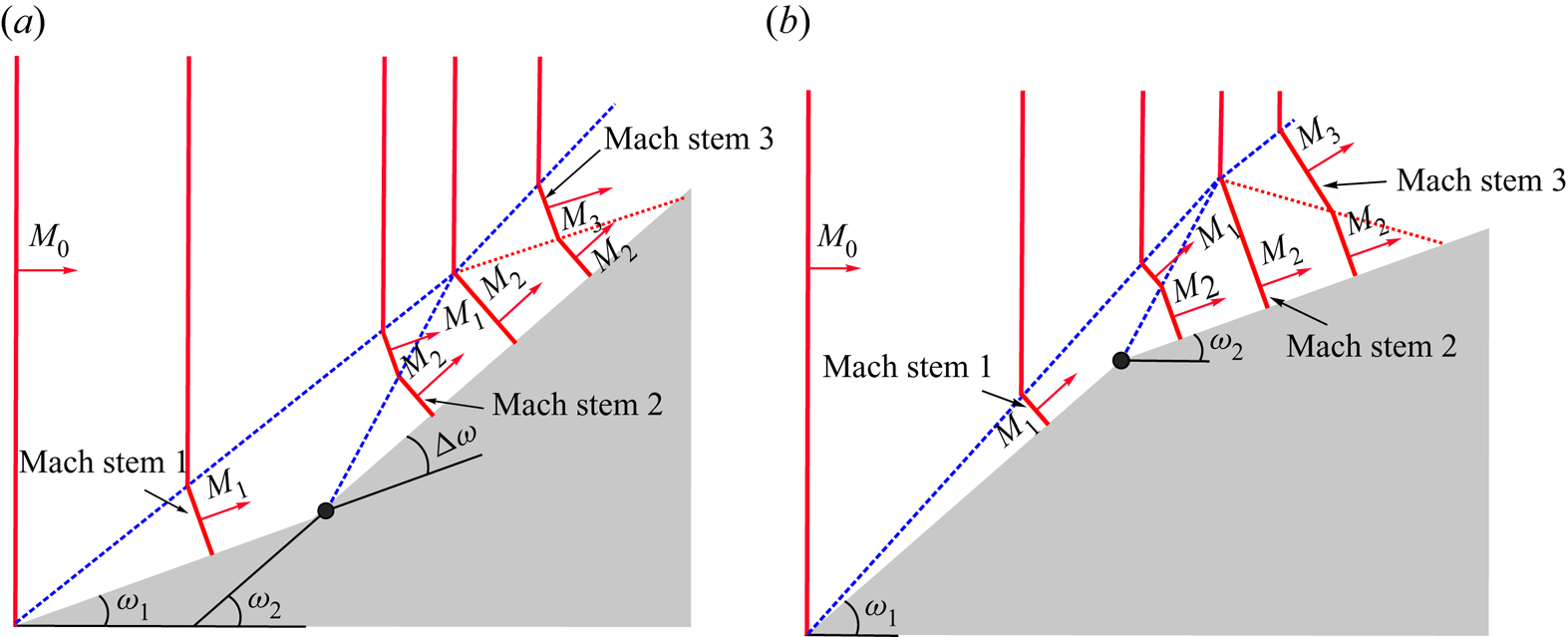
The model is established based on the assumption that the flow in the vicinity of the TP adapts to the new boundary conditions immediately when the corner-generated upward-travelling disturbance overtakes the TP. In this appendix a planar shock reflection over a double wedge is considered based on the shock dynamics (Whitham Reference Whitham1957; Han & Yin Reference Han and Yin1993; Xie et al. Reference Xie, Han and Takayama2005) to discuss the rationality of the assumption. For the reflection of a planar shock over a concave double wedge, if the wedge angle variation is large, the upward-travelling disturbance which carries the information of the sudden variation of the wedge angle is strong (here the strength of the disturbance can be assessed by the variation of the shock Mach number it causes). When the strong disturbance overtakes the TP, an additional downward-travelling disturbance will be generated (Xie et al. Reference Xie, Han and Takayama2005). The additional disturbance repeatedly propagates and reflects between the TP and the wall, changing the strength and orientation of the Mach stem. As time elapses, the additional disturbance becomes weaker, and the MR over the second wedge approaches the MR of an identical shock over a single wedge with the same wedge angle as the second wedge. In other words, it takes a while for the flow in the vicinity of the newly formed TP to adapt to the new boundary conditions. This process is known as the asymptotic process of the MR over the second wedge (Ben-Dor et al. Reference Ben-Dor, Dewey, McMillin and Takayama1988; Xie et al. Reference Xie, Han and Takayama2005). The assumption adopted in the model indicates that the asymptotic process of the MR over the second wedge is completed instantaneously, i.e. the MR over the second wedge when it is just generated can be regarded as the single wedge reflection. In the following analysis, the rationality of the assumption will be discussed.
The reflection of a planar shock over a concave double wedge, as sketched in figure 9(a), is studied. An incident shock with a Mach number of  $M_0$ meets the first wedge with a wedge angle of
 $\omega _1$, and the MR with the Mach stem 1 is formed over the first wedge. When the Mach stem 1 with a Mach number of
 $M_1$ reflects over the second wedge with a wedge angle of
 $\omega _2$, the Mach stem 2 with a Mach number of
 $M_2$ is formed. When the upward-travelling disturbance overtakes the TP, an additional downward-travelling disturbance propagating along the Mach stem 2 is generated, resulting in the formation of the Mach stem 3 with a Mach number of
 $M_3$. This shock reflection phenomenon has been investigated by Xie et al. (Reference Xie, Han and Takayama2005) using the shock-shock polar method. According to the shock dynamics (Han & Yin Reference Han and Yin1993), the shock-shock relation can be expressed as
 \begin{equation} \tan \omega = \frac{{{M}}_\omega}{{{M}}_i} \frac{\left[1-\left(\dfrac{{{M}}_i}{{{M}}_\omega}\right)^2\right]^{{1}/{2}} \left[1-\left(\dfrac{f({{M}}_\omega)}{f({{M}}_i)}\right)^2\right]^{{1}/{2}}} {1+\dfrac{f({{M}}_\omega)}{f({{M}}_i)}\dfrac{{{M}}_\omega}{{{M}}_i}}, \end{equation}
where  $\omega$ is the wedge angle,
 $M_i$ is the initial undisturbed shock Mach number and
 $M_\omega$ is the disturbed shock Mach number, and
 \begin{equation} f({{M}})=\exp\left[-\int \frac{2{{M}}\, {\rm d} M}{({{M}}^2-1)K({{M}})}\right], \end{equation}
where  $K({{M}})$ is a function of
 $M$. Then, the shock-shock polaris of the incident shock (I-polar), the Mach stem 1 (
 $M_1$-polar) and the Mach stem 2 (
 $M_2$-polar) when they serve as the incident shock, respectively, can be obtained by plotting this relation in the (
 $M_\omega /M_0$)–
 $\omega$ plane.
Sketches of a planar shock reflection over a concave (a) and convex (b) double wedge. Blue dashed lines and red dotted lines represent the trajectories of the upward- and downward-travelling disturbances, respectively.

In this work,  $M_0$ and
 $\omega _1$ are set as 2.0 and
 $20^{\circ }$, respectively. It is known that the disturbance intensity is positively correlated with the wedge angle difference (
 ${{\rm \Delta} \omega } = \omega _2 -\omega _1$). To study the effect of the disturbance with different intensities, five different
 ${{\rm \Delta} \omega }$ (20
 $^\circ$, 10
 $^\circ$, 5
 $^\circ$, 1
 $^\circ$, 0.1
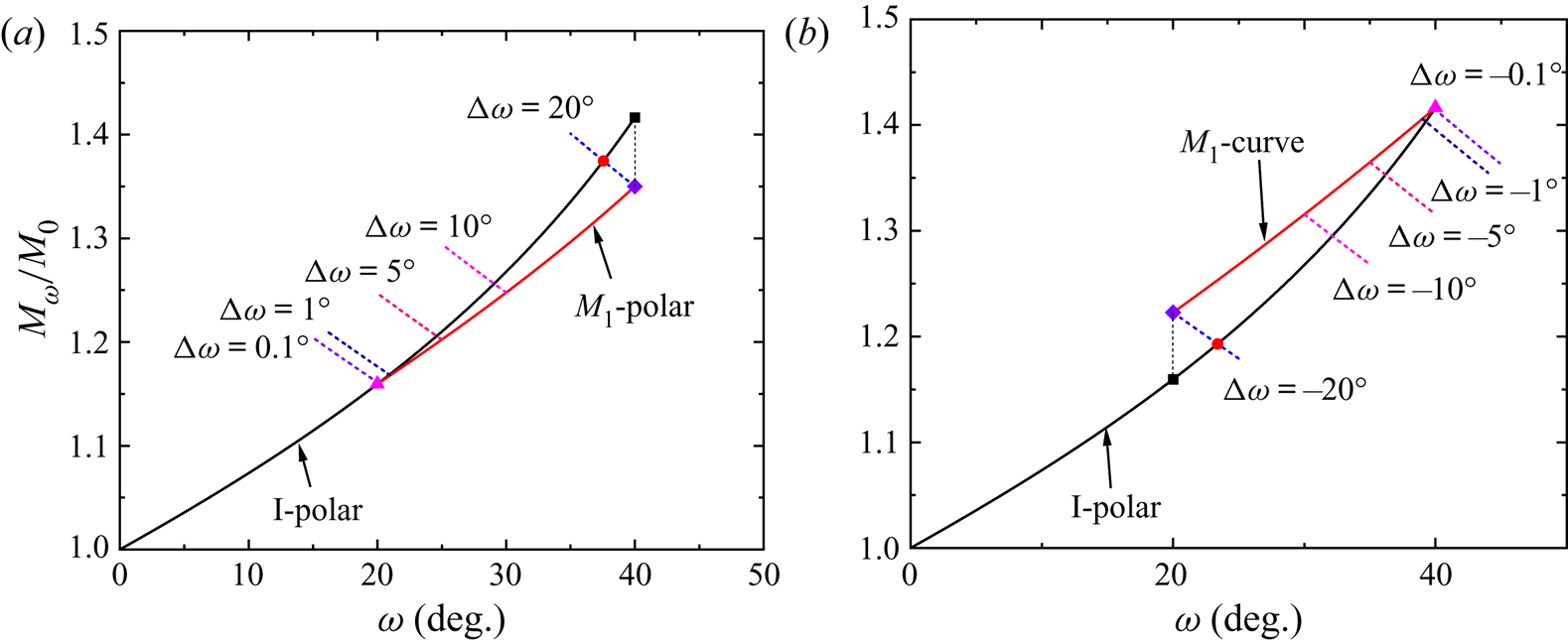
 $^\circ$) are considered. The I-polar,
 $M_1$-polar and
 $M_2$-polar with different
 ${{\rm \Delta} \omega }$ are plotted in figure 10(a). Note that the intersection point of the
 $M_2$-polar with the I-polar represents the state (strength and orientation) of the Mach stem 3. Here
 $M_2 - M_1$ and
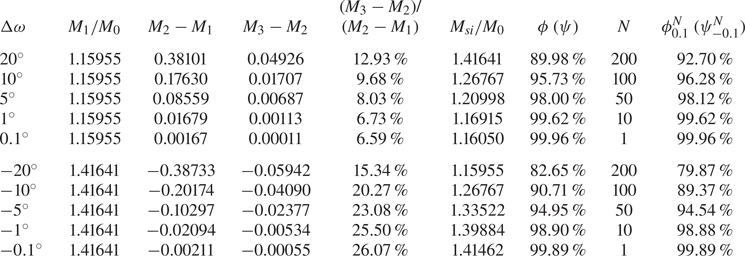
 $M_3 - M_2$ are the shock intensity variations caused by the upward-travelling and downward-travelling disturbances, respectively. As shown in table 4, the downward-travelling disturbance is obviously weaker than the upward-travelling one.
The shock-shock polaris for a planar shock reflection over a concave double wedge with  $M_0 = 2.0$ and
 $\omega _1 = 20^{\circ }$ (a). The shock-shock polar and shock-expansion curves for a planar shock reflection over a convex double wedge with
 $M_0 = 2.0$ and
 $\omega _1 = 40^{\circ }$ (b). The dashed lines are the shock-shock polaris or shock-expansion curves of the Mach stem 2 when it serves as the incident shock of cases with different
 ${{\rm \Delta} \omega }$.

The values of  $M_1/M_0$,
 $M_2 - M_1$,
 $M_3 - M_2$, (
 $M_3 - M_2$)/(
 $M_2 - M_1$),
 $M_{{si}}/M_0$,
 $\phi$ (
 $\psi$) and
 $\phi _{0.1}^{{N}}$ (
 $\psi _{-0.1}^{{N}}$) for cases with different
 ${{\rm \Delta} \omega }$.

Actually, whether to consider the downward-travelling disturbance or not is equivalent to whether to consider the asymptotic process of the MR over the second wedge or not. This can be measured by comparing  $M_3$ with
 $M_{{si}}$ (the Mach number of the Mach stem generated when a planar shock reflects over a single wedge with
 $\omega = \omega _2$). For this purpose, a parameter
 $\phi = (M_3 - M_0)/(M_{{si}} - M_0)$ is introduced. In figure 10(a), for the case with
 ${{\rm \Delta} \omega } = 20^{\circ }$,
 $M_{{si}}/M_0$ and
 $M_3/M_0$ are the ordinates of the points denoted by the symbols of a square and circle, respectively. The values of
 $\phi$ for cases with different
 ${{\rm \Delta} \omega }$ are shown in table 4. The similarity between the MRs over the second wedge and the single wedge increases as
 ${{\rm \Delta} \omega }$ reduces. When
 ${{\rm \Delta} \omega } = 0.1^{\circ }$,
 $\phi$ approaches 1, which means that the difference between
 $M_3$ with
 $M_{{si}}$ is very small and the downward-travelling disturbance can be ignored. As we know, the shock reflection off a curved wedge can be regarded as the combination of many double wedge reflections. Therefore, the difference between the shock reflections off a curved wedge and a single straight wedge will accumulate during the reflection process as the number of double wedge reflections increases. For a rough estimation, it is assumed that the shock reflection over a curved wedge is combined by continuous double wedge reflections with
 ${{\rm \Delta} \omega } = 0.1^{\circ }$ and
 $\phi _{0.1}$ (
 $\phi$ with
 ${{\rm \Delta} \omega } = 0.1^{\circ }$) for each double wedge reflection that is the same as that of the first double wedge reflection. For five different
 ${{\rm \Delta} \omega }$ as mentioned above,
 $N = {{\rm \Delta} \omega }/0.1^{\circ }$ is the number of the double wedge reflection process included. Under the assumptions above and without considering the asymptotic process of the MR over the second wedge,
 $\phi _{0.1}^{{N}}$ can be adopted to estimate the similarity between the final MR over a curved wedge and the MR over a single wedge. The values of
 $\phi _{0.1}^{{N}}$, as given in table 4, are all larger than 92
 $\%$. Besides, if the asymptotic process of the MR over the second wedge is considered, the similarity should be higher. Therefore, for the shock reflection with the wedge angle increased, the assumption that the flow in the vicinity of the TP adapts to the new boundary conditions immediately when the weak corner-generated disturbance overtakes the TP is reasonable, especially when the wedge angle variation is limited.
If the downward-travelling disturbance is also considered, the results will change theoretically. Xie et al. (Reference Xie, Han and Takayama2005) investigated the interaction of two shock-shock disturbances and compared the trajectory angles of the TP with and without considering the downward-travelling disturbance. They found that the discrepancy of the trajectory angles is about  $1.5^{\circ }$ between the two cases for
 $M_0 = 2.0$ and
 ${\rm \Delta} \omega =20^\circ$, and, therefore, the downward-travelling disturbance cannot be ignored. In the present work, the upward-travelling and downward-travelling disturbances are much weaker than those considered in the work of Xie et al., and whether the downward-travelling disturbance is considered or not has limited effect on the Mach number of the Mach stem. Because the trajectory angle of the TP is solely related to the Mach number of the Mach stem for a given incident shock Mach number and wedge angle, the trajectory angle of the TP will not change a lot if the downward-travelling disturbance is considered. The effect of a downward-travelling disturbance can be considered in the model if the double wedge reflection is involved. However, in the shock reflection with the wedge angle changing continuously, infinite disturbances would be generated from corners and complicated interactions would occur among different disturbances. This makes an exact analysis of the disturbance propagation and interaction rather difficult.
Then the reflection of a planar shock over a convex double wedge, as sketched in figure 9(b), is studied. At the corner, the centred rarefaction waves, represented by a single rarefaction wave in the figure for simplification, are generated. The shock-expansion relation (Han & Yin Reference Han and Yin1993) can be expressed as
 \begin{equation} \omega = \int_{{{M}}_i}^{{{M}}_\omega} \left[\frac{2}{({{M}}^2-1)K({{M}})}\right]^{1/2} \, {\rm d} M. \end{equation}
The shock-shock polar of the incident shock (I-polar), the shock-expansion curve of the Mach stems 1 ( $M_1$-curve) and the shock-expansion curve of the Mach stems 2 (
 $M_2$-curve) when they serve as the incident shock, respectively, can be obtained by respectively plotting the shock-shock relation and shock-expansion relation in the (
 $M_\omega /M_0$)–
 $\omega$ plane. In this work,
 $M_0=2$ and
 $\omega _1=40^{\circ }$. Similarly, five different
 ${{\rm \Delta} \omega }$ (
 $-20^{\circ }, -10^{\circ }, -5^{\circ }, -1^{\circ }, -0.1^{\circ }$) are considered. The I-polar,
 $M_1$-curve and
 $M_2$-curve with different
 ${{\rm \Delta} \omega }$ are plotted in figure 10(b). The point that represents the state of the Mach stem 3 must be on the I-polar, and, therefore, the additional downward-travelling wave generated must be a rarefaction wave. As shown in table 4, similarly, the downward-travelling disturbance can be ignored because the difference between
 $M_3$ with
 $M_{{si}}$ is very small. For the shock reflection with the wedge angle reduced, a parameter
 $\psi =1/\phi = (M_{{si}}-M_0)/(M_3-M_0)$ is introduced to characterize the similarity between the MRs over the second wedge and the single wedge. The values of
 $\psi$ for cases with different
 ${{\rm \Delta} \omega }$ are shown in table 4. Similarly, the assumption that the flow in the vicinity of the TP adapts to the new boundary conditions immediately when the weak corner-generated disturbance overtakes the TP is reasonable. Besides, the shock–shock/expansion polar analysis presented here can also partially explain the model performance for predicting the TP trajectory.
Appendix B. Triple point trajectory equation in divergent shock circumstance
For a divergent cylindrical shock reflection with a constant wedge angle, if the variation of the shock intensity is limited, its effect on the TP trajectory angle is negligible. The TP propagation process for such a divergent cylindrical shock reflection is shown in figure 11. The wedge, reflected shock, Mach stem and slip line are ignored for simplicity. Provided that the wedge angle is  $\omega$ and the TP trajectory angle is
 $\chi$, then we have
 $$\begin{gather} {\rm AD} = r_1 \sin (\theta_2 - \theta_1) = r_1 \sin ({\rm d} \theta_1) \approx r_1 \,{\rm d} \theta_1, \end{gather}$$
 $$\begin{gather}{\rm d} r_1 = r_2-r_1 \approx {\rm AD} \cot (\omega + \chi) \approx r_1 \cot (\omega + \chi) \, {\rm d} \theta_1, \end{gather}$$
where AD is the distance between points A and D,  $r_1$ and
 $r_2$ (
 $\theta _1$ and
 $\theta _2$) are the radii (polar angles) of points A and B, respectively,
 ${\rm d} r_1$ and
 ${\rm d} \theta _1$ are the variations of the radius and polar angle of the TP as it moves from point A to point B, respectively. Note that the angle between lines AB and BD is not strictly equal to
 $\omega + \chi$. However, when
 ${\rm d} \theta _1$ is very small, the deviation between them can be neglected. Since the wedge angle and the TP trajectory angle are constant, the same geometrical relation as (B2) must be satisfied for each part of the TP trajectory. Let the variation of polar angle or radius (
 ${\rm d} \theta$ or
 ${\rm d} r$) be infinitesimal and the TP trajectory can be obtained by integration,
 \begin{equation} \int \frac{1}{r}\,{\rm d} r=\int \cot (\omega+\chi)\,{\rm d} \theta. \end{equation}
By integration and combining with the initial conditions, we have
 \begin{equation} r = r_1\, {\rm e}^{(\theta-\theta_1)\cot(\omega +\chi)}. \end{equation}
Triple point propagation process in a cylindrical divergent shock reflection with constant wedge angle.

Appendix C. Triple point identification
As shown in figure 12, the TP is identified as the intersection point of the incident shock with the reflected shock in the numerical results, a similar method has been adopted in our previous work (Wang et al. Reference Wang, Zhai, Luo, Yang and Lu2017; Wang & Zhai Reference Wang and Zhai2020; Wang et al. Reference Wang, Zhai and Luo2021). Note that whether in planar or cylindrical shock reflections, the incident and reflected shocks are nearly planar in the vicinity of the TP, therefore, this method is applicable to both planar and curved shock reflections. Note that the coordinates of the TP are identified manually. Since the size of the grid in the intersection region of discontinuities is quite small (about 18.8  $\mathrm {\mu }$m) and the TP should be located within the blue box shown in figure 12, the error of the manually identified TP coordinates is negligible compared with the scale of the shock reflection process (
 $\sim$100 mm).
Identification of the TP. The blue box represents the area where the TP may be located.