1. Introduction
As a rule, a finite clause contains one verb bearing the finiteness features, that is, tense (aspect, mood) and agreement features. In the mainland West Germanic languages, this finite verb normally occurs in the final position in embedded clauses, whereas it occupies the second position in main clauses, the latter being an instance of the verb second phenomenon (compare Haider & Prinzhorn Reference Haider and Prinzhorn1986, Weerman Reference Weerman1989, Bayer Reference Bayer2008, Holmberg 2013). Compare the following examples from High German:
-
(1)


Alongside simple finite verbs, all West Germanic languages possess periphrastic verb constructions in which a finite dummy auxiliary, normally the light verb ‘do’, combines with an infinitival thematic verb.Footnote 1 Well-known examples are do-support in English (see, among others, Ellegård Reference Ellegård1953, Roberts Reference Roberts1985, Kroch 198Reference Kroch and Ralph9a,b, Garrett Reference Garrett1998, Schütze Reference Schütze2004, Reference Schütze2013) and tun/doon/doen-periphrasis in High German, Low German, and Dutch (see, among others, Keseling Reference Keseling1968, Tieken-Boon van Ostade et al. Reference van Ostade, Ingrid, van der Wal and Leuvensteijn1998, Erb Reference Erb1995, Reference Erb2001, Langer Reference Langer2001, Schwarz Reference Schwarz2004).Footnote 2
Do-support in Standard English involves the obligatory insertion of the dummy auxiliary do in negative and interrogative sentences (and in some other contexts):
-
(2)
In Early Modern English, the use of do-support was less restricted, and this is still the case in South-Western English dialects (compare Klemola Reference Klemola, Tieken-Boon van Ostade, van der Wal and van Leuvensteijn1998).
Tun-periphrasis is obligatory in Standard German in the case of VP-topicalization, as in 3a, but it occurred more generally in the older language, as in 3b, and still does in many German dialects (see Schwarz Reference Schwarz2004 for an overview).
-
(3)
It is shown below that “do-support” and “tun-periphrasis” are merely labels for a class of periphrastic verb constructions in West Germanic which, notwithstanding language-specific particularities and restrictions, have a lot in common (see section 4). In this article, I want to present a construction, which also belongs to this class, but which is extraordinary in a number of ways: First of all, it involves two finite verbs in one clause, the dummy auxiliary in verb-second position and the thematic verb in verb-final position. Second, it contains a dummy auxiliary that is not a variant of ‘do’. Third, it seems to be very unconstrained (as compared with most periphrastic constructions in other West Germanic languages). This construction is (or rather was) found in the North Frisian dialect of the Karrharde, as shown in 4.Footnote 3
-
(4)
In 4, both the dummy auxiliary wer- ([ve:r]) and the thematic verb ferlete ‘to abandon’ are fully inflected.
The mere fact that one finds a general periphrastic construction in Frisian is already interesting in itself; apart from the use of ‘do’ with VP-topicalization, the Frisian dialects do not show any tendency to use periphrastic constructions. In this respect, Frisian seems to team up more with the North Germanic languages than with the other West Germanic languages.Footnote 4 However, most intriguing is the fact that the construction features two finite verbs in one clause. How did this construction arise in Karrharde North Frisian, how should it be analyzed, and how does it relate to the periphrastic constructions in other West Germanic languages?
The article is organized as follows: First, I present the empirical data on finite verb doubling in Karrharde North Frisian (section 2). Next, I try to trace the origin of this construction, especially the provenance of the puzzling dummy auxiliary wer- that fills the verb-second position (section 3). Finally, I give a synchronic analysis of finite verb doubling in Karrharde North Frisian comparing it with do-support and tun-periphrasis (section 4). The article ends with a brief conclusion (section 5).
2. Sources and Data
Karrharde North Frisian is one of originally ten North Frisian dialects.Footnote 5 It was mainly spoken in the parishes Ding (German Enge) and Stääsönj (German Stedesand) in the Karrharde district and is nowadays on the verge of extinction. The dialect is sparsely documented. The only one to have produced a considerable amount of texts in the Karrharde dialect is the schoolmaster and ardent Frisian romanticist Moritz Momme Nissen (1822–1902), who, although born in Stääsönj/Stedesand, grew up in Ding/Enge and was a native speaker of the local dialect (his father and his paternal grandfather came from Ding/Enge, his mother was from Klookris/Klockries in the Bökingharde). Apart from Frisian and High German, he must have had at least passive command of Low German (his wife spoke Low German) and Danish (South Jutish), although he treats both these languages with utter contempt in his work, because he considered them as a threat for Frisian (see Riecken Reference Riecken1994:20–24). Nissen published a volume of verse and a collection of North Frisian proverbs. Additionally, he compiled a comprehensive North Frisian dictionary and wrote two further volumes of poetry, prose, and theatre as well as an epic poem, all of which remained in manuscript form. The material in this article is drawn from those sources.
In fact, the construction that interests me here is nearly only found in the writings of Moritz Nissen (but see note 11). His work provides some 150 occurrences of finite verb doubling (where the proportion of finite verb doubling and simple verb second is roughly 1:100). The few other Karrharde Frisian texts from the 18th, 19th, and 20th century do not yield any examples of the construction. Considering the paucity of the records this could be a coincidence, but finite verb doubling may just as well not have been in common use in Karrharde North Frisian (all texts except Nissen's are from the Stääsönj/Stedesand dialect), and the construction probably became obsolete in the 20th century. It is not recorded in the dictionary of the dialect of Stääsönj/Stedesand by Feddersen (ca. Reference Feddersen1820), and Jabben (Reference Jabben1931) does not mention it in his dissertation on the North Frisian dialect of the Karrharde. Although Nissen may have cultivated the construction a bit in his work or overused it somewhat for rhyming purposes—it provides a handy trick to get the finite verb in final position—there is no reason to have any doubts about the authenticity and reliability of his data. So let us have a look at them.
Consider the sentence in 5.
-
(5)
The main clause in 5 contains two finite verbs, wert and blafft ‘stay, remain’, both bearing 3rd person singular present marking.Footnote 6 The verb wert occupies the verb-second position, whereas the verb blafft is in the verb-final position. The first verb seems to function merely as a placeholder for the second one; it does not seem to contribute anything to the meaning of the sentence.
The verb wer- occupies the position that would host the thematic verb in the simple verb-second construction. As in the simple verb-second construction in North Frisian, see 20, the first sentence position may contain a range of constituents: subjects, as in 6a, objects, as in 6b, adverbials, as in 6c, and predicates, as in 6d.
-
(6)
Wh-phrases also occur in the first sentence position, as subjects, as in 7a, objects, as in 7b, and adverbials, as in 7c.
-
(7)
In polarity questions, as in 8, and in imperatives (see the discussion around 11 below), the first position may remain empty (or contain a covert operator).
-
(8)
The verb wer- is fully inflected for all persons and numbers. Here are some further examples illustrating this:
-
(9)
Besides were's in 9f, one may also find the shortened form wer's (for example, in 15).
The dummy auxiliary wer- is not only inflected for person and number, but also for tense, as shown in 10.
-
(10)
As the past tense marker -d- shows, wer- is a weak verb.
From the above examples it has become clear that the dummy auxiliary wer- may occur in all clause types, not only in declaratives, but also in interrogatives, as in 7 and 9e, and exclamatives, as in 9f. It may also appear in imperatives, both in the singular imperative ending in -φ, as in 11a,b, and in the plural imperative ending in -e, as in 11c.Footnote 8
-
(11)
The first sentence position in imperatives may remain empty, as in 11b, or contain a topicalized object or adverbial, as in 11a,c. Note that the imperative form of the thematic verb occupies the verb-final position here, that is, a position in which imperatives do not normally show up; as a rule they occur in the verb-second position.
In nearly all examples in the corpus, wer- combines with a main verb. The material contains no examples in which wer- supports a modal or aspectual auxiliary. The only auxiliary occurring a few times with -wer is the causative verb lete ‘to let’:
-
(12)
Although many verbs that combine with wer- are eventive, examples involving stative verbs can easily be found. Compare 5 with the verb bliwe ‘to remain, to stay’ and the examples in 13 with the verbs lithe ‘to suffer’, hāge ‘to please’, and dôge ‘to be suited’.
-
(13)
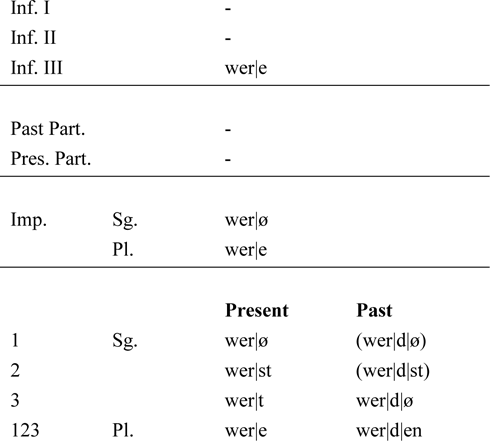
The dummy auxiliary wer- only occurs in the verb-second position. This implies that it has only finite, but no infinite forms, that is, no infinitives and no present and past participle. As I show below, Moritz Nissen explicitly called wer- a verbum defectivum. Interestingly, there is one case in which wer- can have an infinitival form, namely, in the so-called and+infinitive construction, in which an infinitival verb has moved to the verb-second position:
-
(14)
In North Frisian grammar, the fronted infinitive in this construction (which may lose its ending -e in the younger language) is sometimes referred to as infinitive III (see Andersen & Petersen Reference Andersen and Petersen1997:17–18). It is considered to be a third form next to the other two infinitives of Frisian, infinitive I ending in -e (for example, in the complement of modal verbs) and infinitive II ending in -en (for example, in the complement of perception verbs).
The and+infinitive construction is sometimes adduced as evidence that verb second is not triggered by finiteness, or that there may be other triggers than finiteness (see Hoekstra Reference Hoekstra1987, Reference Hoekstra, Lenz, Gooskens and Reker2009; Zwart Reference Zwart2005). A discussion of the status of the verb in the and+infinitive construction would, however, go beyond the scope of this article. The sentence in 14 is, in fact, the only example in the corpus of wer- in the and+infinitive construction. For the present investigation, it is only important to note that the verb wer- appears in all and only those forms that may occupy the verb-second position.
Adding up the observations made in this section one arrives at the following paradigm for wer-:Footnote 9
Table 1. The paradigm of wer-.
The paradigm of wer-.

Moreover, one may conclude that wer- functions as a general filler of the verb-second position. When the dummy auxiliary wer- is in the verb-second position, a thematic verb appears in verb-final position. Both verbs are fully inflected for person, number, and tense.
I have not been able to find any functional (semantic or pragmatic) restrictions on the use of the verb wer-. Finite verb doubling is far outnumbered by verb second, but otherwise Nissen seems to use both constructions in free variation. Compare, for example, the co-occurrence of kirden, werden-leiden, werden-gingen, and skunigden in 10b.
3. The Origin of the Dummy Auxiliary Wer-
Moritz Nissen not only wrote poetry and prose in his native dialect; he also compiled a North Frisian dictionary and glossaries to his works, in which he sometimes provided grammatical and etymological comments. So let us first look at what Nissen himself has to say about the dummy auxiliary wer- and finite verb doubling, even though his remarks may be a bit confusing and hard to interpret sometimes.
In De frėske Sjemstin, one finds the following example of finite verb doubling:
-
(15)
In a footnote, Nissen comments on the dummy auxiliary in 15 as follows: “wer's, kann ich nicht übersetzen. Der Construction nach ist es ein verbum defectivum in der Bedeutung von mögen. Das e hat hier einen geschärften Laut” [wer's, I cannot translate. As far as the construction is concerned it is a verbum defectivum in the function of mögen ‘may’. The e has a sharpened sound here.]Footnote 10
Nissen repeats this description in the entry on wer- in his North Frisian dictionary (Wb. 837–838):Footnote 11
were, v. defect. in der bedeutung von mögen. Furm [Form]: praes. wer, -st, -t; imperf. werd, plur. werden; imp. wer. M[ouringe] were, wer, wiarst, wiart; wiard. – Ulfr. [Old Frisian] were, sondern, aber, auszer. – Wat wert he der maget? [What is he doing there?] Wat werst dü der apsmattst? [What are you throwing up there?] Wat wert he der oufbrāsket? [Why is he bragging like that?] Wat wert hjü hern sage öngungt! [How she is going about her business!] Hum were's nü begrewe? (d. i. wen mögen sie nun begraben?) [Who are they burying now?] Hum wer's ther nü wėll bringe? (In wer's ist das e kurz und geschärft.) [Who are they bringing there now?] Hum werden hjè begroufen? [Who did they bury?]
Nissen is not very clear about the meaning of wer- and is obviously somewhat bewildered by the fact that what appears here is probably a verb that has no meaning at all. On the one hand, he states that wer- is untranslatable; on the other hand, he suggests that it appears in the function of (not necessarily that it has the denotation) mögen ‘may’. Somewhat surprisingly, Nissen nearly only gives examples of wer- in wh-questions, in which—due to the general dubitative nature of questions—one might indeed interpret it as mögen.Footnote 12 However, as I have already shown, the verb can be used in other sentence types as well and in contexts in which the interpretation ‘mögen’ is out of the question. Perhaps Nissen chose to only describe the use of wer- in wh-questions because in these cases, it seems to be possible to ascribe a more or less concrete meaning to wer-. Alternatively, he might have considered the use in wh-questions as the primary use of wer- (see below). In his glossary to Hengist (p. 592), Nissen characterizes wer- as “ein Hülfsverbum, welches aber kein Aequivalent im Deutschen hat.”Footnote 13 He leaves wer- either untranslated (de wert ham bėstig dōrt ‘der bethört sich selber schrecklich’ [He deceives himself terribly]), or renders it with the future auxiliary werden ‘will’, if the verb is in the present tense (sü were we en killhale ‘so werden wir ihn kielholen’ [Then we will keelhaul him]) or the dummy auxiliary tun ‘to do’ (sü werden's eg mor tüten ‘so thaten sie nicht mehr schreien’ [Then they didn't shout anymore]).
Nissen is not very clear about the etymology of wer- either. In his dictionary, he refers to the Old Frisian conjunction were ‘but, unless’ (< ∗ne were ‘be it not’), as I have shown, and after giving the examples he adds (Wb. 838):
Dieses frisische “were” und das englische “are” werden in einzelnen wendungen gleichmäszig gebraucht. Z. b. Wat were dederre mans der due? E. What are those men doing there?—Aus dieser darstellung geht deutlich hervor, dasz das frisische “were” ein hülfsverbum ist und sich aus dem alten verb. aux. “wese” entwickelt hat. Aus diesem hat sich auch das N. wera (v) entwickelt, denn im Altn. heiszt dasselbe “wesa”. Da wird es gebraucht in der bedeutung von “sein” und bei uns in der bedeutung von “mögen”, und kann auch dadurch nicht immer wieder gegeben werden.
[This Frisian “were” and English “are” used similarly in certain phrases, e.g. Wat were dederre mans der due? E(nglish) What are those men doing there?—This exposition shows that Frisian “were” is an auxiliary and has developed from the old verb. aux. “wese”. N(orwegian) wera (v) developed from this verb as well, because in Old Norse it is called “wesa”. There it is used in the function of “to be” and here in the function of “may”. For this reason it cannot always be rendered.]
It is clear that the comparison with the English progressive construction misses the point, and that the derivation of wer- from the Germanic verb stem wes- ‘to be’ (Karrharde Frisian wese–is–was/weren–wesen) that Nissen suggests is problematic. Theoretically, wer- could go back to the Old Frisian past subjunctive/optative form were, but this verb form only occurred as a copula, particularly in the fixed expression hit ne were thet ‘unless’ introducing embedded clauses, or as an aspectual auxiliary construed with a past or present participle. It is hard to see how subjunctive/optative were could have given rise to the development of a dummy auxiliary and finite verb doubling in these contexts. There exists a homophonic verb were ‘to defend’ in Karrharde Frisian, but this can hardly be related to wer- either.Footnote 14 In fact, it seems to be impossible to find any Germanic verb stem that could be the base of wer-.
As far as I can see, there is only one possible source for the dummy auxiliary wer-, namely, the complementizer wer ‘if, whether’, the cognate of English whether (Old Frisian hweder). This complementizer normally introduces embedded questions:
-
(16)
It is generally assumed that the complementizer position is the position occupied by the finite verb in main clauses, that is, the complementizer position would be identical to the verb-second position (see also section 4). If the complementizer position is filled by a complementizer, the verb remains in its final position.
In some West Germanic dialects, complementizers may be inflected for person and number (see van Koppen Reference van Koppen2005), as shown in 17.
-
(17)
In West Frisian, complementizers only inflect for the 2nd person singular, in West Flemish for all persons and numbers. Note, however, that wer- cannot be a (fully dressed up) inflected complementizer. First, it would be the only complementizer in Karrharde North Frisian showing inflection, whereas normally, if a language has complementizer inflection, it has it with all complementizers. Second, it is inflected for tense, whereas inflected complementizers never are. Third, it cannot occur in the complementizer position of embedded clauses, the canonical position of complementizers.Footnote 15
The point of departure for the development of the dummy auxiliary wer- must therefore have been interrogative main clauses introduced by the complementizer wer, as in 18a, or with this complementizer inserted after a wh-phrase, as in 18b-d.Footnote 16
-
(18)
Perhaps the complementizer wer was reanalyzed as a verb in such sentences, because verbs more frequently appear in the first or second position in main clauses than complementizers.Footnote 17 This verb may then have spread from questions to all other sentence types. If the verb wer- derives from the complementizer wer in main clauses, this would immediately account for its defectivity, that is, the fact that it is restricted to the verb-second position. Due to the lack of historical data, it is impossible, however, to track down the development of wer- in any more detail. Thus, one is left with many pressing questions. Did a marginal sentence type like main clauses with wer suffice as the triggering context for the reanalysis of wer as a verb? How did wer- lose its interrogative (dubitative) function, and how did it spread over sentence types and become a general dummy auxiliary? From a grammaticalization point of view, the change from a complementizer into a verb is uncommon, whereas the opposite change is quite general, for example, in the case of the grammaticalization of report verbs into complementizers (Klamer Reference Klamer2000). Note, however, that what one is dealing with here is the change of a contentful grammatical element (an interrogative complementizer) into a semantically void grammatical element (a mere filler of the complementizer position). In this sense, the development of wer- from a complementizer into a dummy auxiliary might represent a natural grammaticalization path after all.
Since finite verb doubling seems to be an exceptional and locally restricted phenomenon, one might consider the possibility that language contact, in particular with Danish (South Jutish), has played a role in the development of wer-. Although the parishes of Ding/Enge and Stääsönj/Stedesand were still predominantly Frisian-speaking in the 19th century, Danish (South Jutish) and Low German were widely used in the Karrharde, and most inhabitants were bi- or multilingual (see Jabben Reference Jabben1931:8–12). Danish has an interrogative particle mon (Diderichsen Reference Diderichsen1971:216–217, Erteschick-Shir Reference Erteschick-Shir, Erteschik-Shir and Rochman2010), which is also inserted in the complementizer position:
-
(19)
Mon derives from a verb (older Danish monne ‘may’, Old Norse munu) historically (see ODS s.v. monneFootnote 1 , monFootnote 4 , Nielsen Reference Nielsen2010). The South Jutish form is mont or mot/mut (Feilberg Reference Feilberg1894–1904). Perhaps this particle has been conducive to the appearance of wer in sentences such as 18b-d and to the further reanalysis of wer- as a verb. The diminishing contact with Danish after the Danish-Low German language shift in Schleswig in the second half of the 19th century (Bock Reference Bock1933, Reference Bock, Hyldgaard-Jensen and Steffensen1969) may then have led to the loss of finite verb doubling. At the moment, however, this is not much more than a shot in the dark.
4. An Analysis of Finite Verb Doubling
In generative grammar, it is generally assumed that complementizers such as dat ‘that’ and wer ‘if’ are merged as the head of a complementizer phrase (Den Besten Reference Besten and Abraham1983).Footnote 18 If the complementizer position C is filled by a complementizer, the verb remains in the verb-final position, that is, it moves string-vacuously from its base position in the VP to a light verb position v, as shown in 20a.Footnote 19 If there is no complementizer in the C-position, as in most main clauses, the finite verb moves from the verb-final position to C, as shown in 20b-e. In declarative main clauses, the subject or some other constituent moves to the first sentence position, the specifier of CP, as in 20b,c. In wh-questions, the wh-phrase moves to this position, as in 20d. In polarity questions and in imperative clauses, the first sentence position may remain empty or contain a covert operator, as in 20e.
-
(20)
Finally, there is the case at hand in which the complementizer position is filled by the dummy auxiliary wer- and the thematic verb remains in the verb-final position, as in 18f.
A longstanding question in Germanic linguistics is this: Why do languages have verb second? Why does the finite verb have to move to the second position of the main clause? A full analysis of verb second is beyond the scope of this article, but I assume that C is the interface between the sentence (proposition) and the discourse (utterance); I also assume that the finiteness features have to be licensed in C in main clauses in order to establish a connection to the temporal coordinates and the participants of the external speech event (Bianchi Reference Bianchi, Guéron and Tasmovski2003). The finiteness (tense and agreement) features are expressed by verbal suffixes in North Frisian. Let us assume that these suffixes are attached to the highest available verb in the structure, normally the topmost verb in the (extended) verb phrase. Since the suffixes containing the finiteness features cannot be separated from the verb (No Stray Affix), the verb must move along to C in main clauses in order to bring the finiteness features into position; verb second is movement of the finiteness features with pied piping of the verb (Bayer Reference Bayer2008). Finiteness in embedded clauses is anaphorically dependent on the finiteness of the main clause. The complementizer that marks this dependency makes movement of the finite verb superfluous/impossible in embedded clauses. In the case of finite verb doubling in Karrharde North Frisian, as in 20f, the suffixes containing the finiteness features are inserted directly in the C-position with the dummy auxiliary wer-. The designated C-verb wer- prevents them from stranding there.
The fact that wer- does not combine with modal and aspectual auxiliaries might then be a consequence of verb second. Modal and aspectual auxiliaries inherently encode finiteness (mood and aspect) features that have to move to C, if possible. Therefore, the suffixes expressing the tense and agreement features must always attach to the highest available modal or aspectual auxiliary. Insertion of wer- would prohibit the mood and aspect features to reach C. Note that the dummy auxiliary ‘do’ in do-support and tun-periphrasis cannot combine with modal and aspectual auxiliaries either.
Below it is argued that the finite dummy auxiliary wer- in finite verb doubling selects a finite VP. As a consequence, the thematic verb bears finiteness features as well. This means that at PF, the clause has two finite verbs, as shown in 21a. At LF, all material that does not contribute to semantic interpretation is deleted, a consequence of the Principle of Full Interpretation (Chomsky Reference Chomsky1995:219–220). Accordingly, the verb stem wer-, which has no other function than to morphologically support the finiteness features in C, and the finiteness features on the thematic verb are deleted, as shown in 21b.Footnote 20
-
(21)
In the case of simple verb second, the verb is pied-piped along with the finiteness features to the verb-second position and leaves a copy in the verb-final position, which is deleted at PF, so that only the higher copy is pronounced, as shown in 22a. At LF, the verb stem is deleted in the verb-second position, where only the finiteness features are interpretable, whereas the finiteness features are deleted in the verb-final position, where only the verb stem is interpretable, as shown in 22b.
-
(22)
This means that at LF, there is no difference between a sentence with verb second, as in 22b, and a sentence with finite verb doubling, as in 21b.
Then the question arises why one finds finite verb doubling next to verb second, or more generally, why periphrastic constructions appear next to verb second. In all West Germanic languages, children seem to go through a phase in which they use periphrastic constructions next to simple finite verbs (see the papers in Blom et al. Reference Blom, van de Craats and Verhagen2013).Footnote 21 Moreover, in many West Germanic dialects, the two constructions co-occur, although the periphrastic construction is quite often more constrained: It either has developed special temporal or aspectual functions, or is only used as a last resort (as, for example, in the case of VP-topicalization). One approach might be to say that both constructions are basically equivalent and might be expected to occur next to each other; but that periphrastic constructions are stigmatized in the standard languages and are therefore avoided, except in contexts with no other option (Langer Reference Langer2001). Alternatively, one could argue that the periphrastic construction can be more economic than verb second in some sense—for example, it does not require movement (Hollebrandse & Roeper Reference Hollebrandse, Roeper, Koster and Wijnenen1996, Van Kampen Reference van Kampen1997); but that other economy considerations—for example, the fact that periphrastic constructions use more words than verb second—can lead to a preference for verb second (Schütze Reference Schütze2013). I leave the question open here.
It can be interesting to see how the dummy auxiliary wer- in C relates to other dummy auxiliaries. I have shown that wer- may combine with the causative auxiliary lete ‘to let’, as in 12. Now consider the example in 23.
-
(23)
This sentence shows that i) a complex VP with lete ‘to let’ (sün Mon dranke lete) may be pronominalized by dat, and that this pronominalized VP is supported by a periphrastic ‘do’, and ii) the dummy auxiliary wer- may combine with this periphrastic ‘do’. Not only wer- can combine with periphrastic ‘do’ in VP-pronominalization; the same is true for do in do-support and ‘do’ in tun-periphrasis:
-
(24)
These data show that wer- in Frisian and ‘do’ in do-support and tun-periphrasis are structurally higher than periphrastic ‘do’ in VP-pronominalization. Whereas wer- and tun are merged in C, do is merged in a special syntactic position in English (I), from where it can move to C in questions (and some other constructions). As periphrastic ‘do’ in VP-pronominalization cannot be in C or I and must be outside VP, it is probably merged in v (for this conclusion, see also Stroik Reference Stroik2001, Hallman Reference Hallman, Christopher, Rose Deal and Zabbal2006, Platzack Reference Platzack, Peter, Alcorn, Heycock, Jaspers, Van Craenenbroeck and Vanden Wyngaerd2012).
Now consider the following example of VP-topicalization in Karrharde North Frisian:Footnote 22
-
(25)
The VP, only containing the (finite) verb sturwed here, has been fronted, and the finiteness features are carried by the dummy auxiliary wert. I have shown that wer- may combine with the periphrastic verb ‘do’ in VP-pronominalization (see 23). The example in 25 and the fact that the corpus does not contain sentences of the type … an sturwe wert ham niman ded ‘and nobody nurses him’, lit. ‘and nurse wer-prs.3sg him nobody does’ may suggest that it is not possible to combine wer- with periphrastic ‘do’ in VP-topicalization. In the case of VP-pronominalization, the two verbs are in different positions and serve different functions: wer- in C bears the finiteness features and ‘do’ in v supports the pronominalized VP. In the case of VP-topicalization, however, wer- and ‘do’ compete for the same position (that is, C) and for the same job (carrying the finiteness features). As a consequence, they cannot co-occur.Footnote 23
The difference between dummy auxiliaries in do-support and tun-periphrasis on the one hand, and dummy auxiliaries in VP-pronominalization on the other also manifests itself through the verbs they may combine with. In German, for example, periphrastic ‘do’ in VP-pronominalization shows selection restrictions: It may only occur with eventive verbs, not with stative verbs:
-
(26)
This restriction would follow from an analysis in which stative verbs are directly merged in v, whereas eventive verbs are merged in V (see Hallman Reference Hallman, Christopher, Rose Deal and Zabbal2006). In that case, stative verbs and periphrastic ‘do’ would compete for the same position. Tun in tun-periphrasis (VP-topicalization) shows no restrictions at all:
-
(27)
As the examples in 13 show, the same is true for wer-.
Finally, one must address the question why the finite verb is doubled in Karrharde North Frisian, whereas this is not possible in periphrastic constructions with ‘do’. I assume that the doubling of the finite verb in Karrharde North Frisian is a direct consequence of the historical source of the dummy auxiliary wer-. Whereas ‘do’ has developed from the auxiliary or light verb ‘do’ that selects an infinitival thematic verb, wer- originates from a complementizer, and historically, the thematic verb was the actual finite verb. The finite complementizer wer selects a finite VP and in this sense agrees with the finite verb (see Weerman Reference Weerman1989:45). I assume that the dummy auxiliary wer- has retained this property; although it has become a finite verb itself, it still selects a finite VP and thus agrees with a finite verb in the verb-final position.Footnote 24
5. Conclusion
In this article, I discussed finite verb doubling in Karrharde North Frisian. Finite verb doubling resembles do-support in English and tun-periphrasis in High German (Low German and Dutch) in that it involves a thematic verb in verb-final position and a (finite) dummy auxiliary in a higher functional verb position. Although the view may be blurred by the fact that finite verb doubling only occurs in written sources (by a single author), the phenomenon seems to be less constrained syntactically and semantically than most cases of ‘do’-support or ‘tun’-periphrasis in other West Germanic languages. This may be due to the historical origin of the dummy auxiliary wer- in finite verb doubling; wer- did not originate as a verb like the dummy auxiliary in ‘do’-support and in ‘tun’-periphrasis but developed from the finite complementizer wer ‘if’ (possibly under language contact with Danish). As such it may have been even more grammaticalized than ‘do’. As far as one can gather from the material, it is a fully meaningless filler of the C-position. The exceptional doubling of the finite verb in Karrharde North Frisian can be traced back to this historical origin as well: Like the former finite complementizer wer, the finite dummy auxiliary wer- selects a finite VP. Unfortunately, due to the lack of historical sources the details of the development of wer- from a complementizer to a dummy auxiliary remain largely in the dark.