Introduction
On the eve of the 1899 elections for the Brazilian National Congress, anticipating the possibility of party-based schisms that would result in a divided Chamber of Deputies, then-president Campos Sales from São Paulo state revised the Chamber's standing orders, altering the articles that regulated the process by which election results were ratified. The reform was intended to give the government greater control over politicians elected as members of the Chamber, allowing it to exclude any potential opposition. In Brazil this phenomenon became known as the habit of depuração (‘checking’) or degola (literally, ‘beheading’ or ‘decapitation’), and it has come to be seen as the standard modus operandi whereby the Chamber gave final approval to election certificates during the First Republic (1889–1930).
This article examines the influence of the 1899 reform of the 1891 standing order and asks whether, and how, the practice of degola during this stage of Brazilian history affected the Republican regime's stability. This has important implications both for historians of Brazil and for those specialising in broader analyses of elections in political regimes at the turn of the twentieth century. For the former, it calls into question common interpretations of the use of degola. Surprisingly few studies detail the actual functioning and effects of the legislative rubber-stamping of election results, even though this practice is uniformly viewed as ‘routine’ in the republic.Footnote 1 Authors limit themselves to citing the best-known cases of ‘beheaded’ members of Parliament, assuming that these specific incidents are representative of the phenomenon as a whole. However, our study is based on more comprehensive data regarding the process by which election certificates were accepted or rejected in the Chamber of Deputies between 1894 and 1930. Our study of the reports from the Chamber's internal committees responsible for assessing election certificates leads us to conclude that it is simply not true that degola was a systematic and normal practice in the Chamber of Deputies. The data show that fewer than 10 per cent of the election certificates were rejected, a relatively low number. Moreover, most of these cases were limited to three election years (1900, 1912 and 1915) and to certain states (Bahia, Rio de Janeiro, the Federal District and Ceará). In the rest of the cases, the Chamber upheld the decisions already made by the local state-level political bodies. In short, Campos Sales institutionalised an existing political dynamic whereby the final approval of elected officials remained essentially contingent on regional and local political competition, but which now recognised as the ultimate arbiter the National Congress, which stepped in only when the state-level political authorities proved to be incapable of fixing the election outcomes.
The second and broader implication of this study relates to the empirical data and current debate about the way in which election results were certified. There has been a marked boom in studies of this period among historians and political scientists. They have not only unearthed much more consistent data about election fraud, voter intimidation, violence at the polls and direct action by those in power to rig the election results at the end of the nineteenth and beginning of the twentieth centuries, but have also adopted new qualitative and quantitative techniques in order to study these practices.Footnote 2 Such research is unquestionably helpful, as Hilda Sabato notes, in gaining a better understanding of electoral practices, which in turn gives us a better grasp of the history of political citizenship in Latin America.Footnote 3
That notwithstanding, our primary criticism of this literature is that it tends to focus its analysis of election fraud on the pre-election and election periods, disregarding the fact that the following stage, the process by which the election results were certified, is crucial to understanding both the election dynamics and, above all, the stability of the political regime of the day. Of course, at that time in both Latin America and Europe it was legislative parliaments, not courts, that acted as the final authorities in rubber-stamping election certificates and therefore determined the final outcome of elections.Footnote 4 In this vein, Margaret Anderson notes that in Germany, ‘when parliament has the authority to invalidate elections, a possibility always exists that the majority will use that authority to achieve what it could not accomplish on the hustings’.Footnote 5
So, was this approval mechanism just one more fraudulent practice used by those in power to maintain control over election results and, ultimately, maintain regime stability? Fabrice Lehoucq has recently argued quite the opposite: that election organisation (using fraud, manipulation and violence), the lack of impartial electoral courts, an opposition continuously kept at bay from institutions of representation and an executive branch that manipulated administrative procedures ‘to impose [its] successors on the presidency and to create pliant legislative majorities’ were actually factors that could generate political crises capable of threatening regime stability.Footnote 6 The case of Brazil allows us to test this interpretation and to show the mechanics by which the certification of election results worked in practice. The study will demonstrate that the ability of the Brazilian Parliament to control its own composition in this way conferred political stability upon the Republican regime during moments of political crisis, and not the contrary. This will become clearer as the article demonstrates that most of the cases where election certificates were not approved by the lower house of the National Congress occurred when more legislators had been elected than the number permitted by law, making it mandatory for the Chamber to deal with the excess election certificates. Thus, contrary to received wisdom, degola was not deployed as a last-ditch fraudulent attempt to alter the election results. ‘Beheading’ was a political decision made in the context of unpredictable elections, which indicates that, in practice, the government used its powers of electoral scrutiny as a form of strategic control only in critical situations. These findings for the case of Brazil suggest that the role of election certificate verification must be taken into account when constructing any interpretative models of nineteenth-century political regimes.
Approval of electoral results as a form of electoral fraud
Conceptually, should the reversal of election results through the invalidation of election certificates and the 1899 reform of the standing order which regulated this process of control be seen as specific forms of electoral fraud? We endorse the majority viewpoint that defines fraud as a series of mechanisms that affect election results and infringe on the law.Footnote 7 While most academics associate fraud with a set of generally secretive activities, this article views the certification of elected officials as a fraudulent act because, although it is a formal procedure, it is also a mechanism at politicians’ disposal that ends up altering individual voters’ choices. We therefore consider fraud to be an act that ‘distorts the voting process in its narrow sense, in any of its multiple steps from the registration of voters to the tally of the vote’.Footnote 8 To an extent we also follow Posada-Carbó, who years ago argued that for Latin America it was ‘crucial to distinguish between the various levels of government intervention and the different levels of fraud’.Footnote 9
Some authors suggest that control of election results does constitute a form of fraud but prefer to refer to rule manipulation. Sarah Birch, for example, defines election corruption as taking three forms: ‘the manipulation of rules, the manipulation of voters and the manipulation of votes’.Footnote 10 By this definition, the 1899 reform is an example of the first type, while degola possessed some characteristics of the third type. The terms ‘manipulation’ and ‘fraud’ tend to get merged into a single concept, however, since election corruption is defined as a form of manipulation. This is a conceptual mistake. Adoption of the definition above would run the risk of seeing any change in the election rules – even in the election system – as a specific type of fraud. Obviously, this is not the case. A definition that conflates manipulation with fraud is overly generic and runs into the problem of misclassification.Footnote 11 We agree with Adam Przeworski that ‘manipulation is not the same as fraud’ since ‘manipulation consists of establishing rules while fraud entails breaking rules’.Footnote 12 We henceforth frame the 1899 reform of the standing order as mere manipulation of the rules, and turn now to determining how the 1899 reform permitted control of the process of verifying election certificates and how degola was effectively utilised to ensure the political stability of the Republican regime.
Certification of Elected Representatives in the First Republic
Before examining how the Chamber reviewed election results in light of the rules contained in the standing order and in the electoral laws, it is useful to reflect on how elections were run at the time.Footnote 13 Despite the literature's insistence on the political instability of the First Republic, analysis shows that elections were held with reasonable regularity. After the Constituent Assembly of 1891, the first election of representatives to the lower house of the National Congress was held in 1894, with subsequent elections held every three years until the revolution of 1930.Footnote 14 According to the 1891 Constitution, the number of deputados was defined by law ‘in a proportion that does not exceed one for every 70,000 inhabitants, with no fewer than four per state’.Footnote 15 Despite periodic interference in electoral legislation, during this period the composition of the Chamber did not vary and was set at 212 legislators. The state that elected the most representatives was Minas Gerais, with 37, followed by São Paulo and Bahia, with 22 apiece, Pernambuco and Rio de Janeiro with 17 seats each, Rio Grande do Sul with 16, and the other states with numbers of legislators ranging from four to ten. São Paulo and Minas Gerais alone held 28 per cent of the seats in the Chamber. These and the other important states in terms of population and economic strength, such as Bahia, Rio Grande do Sul and Pernambuco, together held 54 per cent of all seats.
The states were subdivided into electoral districts, or constituencies, adhering to the criterion of proportionality as much as possible.Footnote 16 The territorial unit immediately below the constituency was the municipality. Each municipality was divided into polling stations in which elections were held and – this is the point that is of interest to us – where the ballots were initially counted once the voting was closed. There, the local chairman (or his substitute), aided by scrutineers, would open the ballot box and count the votes cast in favour of each candidate, recording the result in the minutes of the polling station. Once a copy of the minutes had been drafted, it was sent to the mayor of the headquarter municipality of the district. At that point, the mayor, the top five candidates in terms of votes and the next highest-ranked five candidates would form an election scrutiny board (junta apuradora) and count the votes again. The election results were written up in the general minutes of the elections (the Ata geral da apuração), which contained not only the order of the candidates according to number of votes received but also any complaints submitted to the election board during the vote count or to individual polling stations. The general minutes were very important given the legal provision in the electoral laws whereby the minutes were handed to the elected candidates ‘to serve as their election certificate’.Footnote 17
After the election boards completed their task, there began the last stage of election result-checking, that reserved for the Chamber of Deputies. The 1891 Constitution was clear in this regard, with Article 18 stating that ‘each chamber is authorised to analyse and validate the election certificates of its own members’.Footnote 18 As such, the parliamentarians made the final judgement as to the validity of the election certificates issued by the election boards and also resolved any challenges and complaints submitted during the ballot count. This was called the third scrutiny stage, occurring after the vote and after the work of the local election boards.Footnote 19
The third vote scrutiny stage commonly appears in literature as a process conducted only by the committee generically referred to as the Comissão de Verificação de Poderes (Election Certification Committee). In reality, the process was more complex and conducted in two stages. In the first, candidates’ election certificates were examined by the ‘Committee of Five’, whose five members were assigned by the interim speaker of the Chamber. Based on the list of election certificates submitted by each candidate for deputy and local election boards, the committee prepared an initial list of election certificates considered valid and that apparently met the requisite legal conditions. In order to be considered entirely valid, the list needed to be approved by the full session of the assembly. Since the Chamber could only hold preparatory sessions at this stage, there was no legally constituted plenary assembly. On this point, the Chamber's standing order was very clear and rather cunning: only candidates who ended up on the approved list submitted by the Committee of Five could participate in the plenary vote. In other words, legislators ended up voting to approve their own certificates. These successfully validated legislators were also entitled to participate in the next stage as well as to debate and vote in the plenary assembly during the preparatory sessions. The second stage began when deputados legally approved by the Committee of Five were randomly chosen to sit on the investigation committees (comissões de inquérito), whose duties were to report the total number of election certificates per state, to deal with challenges and complaints and, as the highest authority, to draft official reports concerning the list of election certificates issued by the election boards as well as, potentially, dissenting from the decisions made by the Committee of Five.Footnote 20 In these formal arrangements it is clear that the crux of the entire process of rubber-stamping election certificates was the Committee of Five, since it acted as the initial decision-making body within the Chamber. As José Vieira affirmed in an impassioned report on the legislative session of 1909, ‘for some candidates, the five chosen committee members took on a super-human quality’.Footnote 21
Nevertheless, until the 1899 reform, the standing order proved rather less than functional given that control of election certification was possible via a simple veto by the Committee of Five. Two factors supported this. Firstly, the Chamber's standing orders granted wide discretionary power to the interim speaker by requiring him to designate the Committee of Five. This, inevitably, raised the problem of the appointment of the speaker. According to the standing order approved in 1891, the position of speaker of the Chamber was filled, during the preparatory sessions, by the ‘oldest deputy among those in attendance’, with ‘four deputies who looked to him to be the youngest serving as his clerks’.Footnote 22 Clearly this rule could not guarantee the government full control of the speakership of the Chamber or, consequently, the selection of the deputies by the Committee of Five, since granting the position to the oldest legislator gave no guarantee that he would support the government's position. President Campos Sales stressed this point in his memoirs, saying: ‘the matter thus hinged on a certificate of age. One does not need much astuteness to imagine the numerous situations where fraud could have prevailed.’Footnote 23
Secondly, the standing order did not set out the criteria as to what constituted a legal election certificate, merely describing it as ‘the authentic copy of the general minutes of the election ballot count signed by all members of the municipal or local government in attendance’.Footnote 24 However, in the case of duplicate or triplicate certificates – that is to say, when the losing candidates appeared before the Chamber with a list of apparently legitimate election certificates that challenged the list of those considered winning candidates – the risk for the government was that opposition representatives might be approved.Footnote 25 Thus, there were too many loopholes. Without any formal criteria to decide what constituted a legal election certificate, and with the Committee of Five designated by the oldest member of the house, the capacity of the government to control the certification process was drastically diminished. At moments of conflict between political forces, there was a heightened risk that the Chamber would end up with members from opposition parties.
Emblematic of such an undesirable circumstance was the composition of the Chamber in 1898 due to the split between the concentrados, aligned with Francisco Glicério, the long-time head of the Partido Republicano Federal (Federal Republican Party, PRF), and the republicanos, faithful to President Prudente de Moraes, in power from 1894 to 1898. With the upcoming 1899 elections for the 1900–3 legislature, each political group sought a victory in each state.Footnote 26 Dissent would have been inevitable at the swearing-in of the new Chamber if duplicate or even triplicate election certificates had been presented as each group attempted to approve its own candidates. What criteria would the Committee of Five adopt to select the list of legitimate election certificates? This was the moment when President Campos Sales, elected in 1898, ordered the approval of a small change in the standing order, steered through the Chamber by legislator Augusto Montenegro but resulting from an unwritten pact between the president and the governors of the most important states. The reform, better known as the ‘Montenegro guillotine’, required the position of speaker of the Chamber to be filled during the preparatory sessions by ‘the speaker or any deputy-speaker who had served in the last legislative session’.Footnote 27 This meant that the chosen speaker would be the oldest member only on those occasions when the speakers or vice-speakers serving in the previous legislature had not been re-elected. This way, the government was no longer vulnerable to possible speakers hostile to or not in sympathy with the majority in the Chamber. In this instance the speakership was handed to MP Vaz de Melo from Minas Gerais, a state friendly to Campos Sales’ politics.
The second change made to the standing order defined more clearly what actually constituted a legitimate election certificate, stating that ‘the document must be issued by the majority of the election board’.Footnote 28 The operative word here is ‘majority’, and this was no small modification. In thus defining a legitimate election certificate, the decisions made by the Committee of Five were linked to those made earlier by the election boards in each district. This change not only underscored the decentralised nature of the process for certifying MPs but also, and most importantly, minimised the capacity of the Chamber to influence the process.
It seems counter-intuitive to establish a reform that centralises the process of verifying election certificates in the Chamber and decentralises decision-making to the local level. We will return to this later and show that the roles of the Committee of Five and of the investigation committees in the Chamber were important only when the elections were so confusing and competitive that opposition groups managed to organise duplicate and even triplicate certificates of the election results. What matters is that the change in the standing order governing the certification of votes affected both the parliamentary and electoral arenas by formalising control of the interim speakership and devolving authority for the distribution of election certificates to the local election boards.
There is one curiosity in the 1904 reform of the standing order.Footnote 29 Although this has not been mentioned by a single author, the order struck down the provision introduced in 1899 requiring a majority of the election board to effectively determine the legality of election certificates. Was the 1904 reform a step backwards from the change made in 1899? It certainly would have been if this had signalled a return to the status quo imposed by the electoral law from the onset of the republic, whereby what constituted a legitimate election certificate was not clearly specified. But in fact, in 1904, just after the reform of the standing order, the National Congress approved another electoral law, known as the Rosa e Silva Law. Contrary to previous electoral laws, the new law stated that ‘a legitimate certificate is an authentic copy of the general minutes of the elections signed by the majority of the members acting on the election board’, and that in the case of duplicate election certificates, ‘a simple challenge is established upon the signature of a minority number on the board’.Footnote 30 In other words, the rule established to certify election results was struck from the standing order only to then become a legal precept in electoral law. Thus the formal balance struck by Campos Sales in 1899, with the reform of the standing order, was extended to the electoral sphere in 1904, when it was included in the electoral law itself.
Interpretations of the Campos Sales reform
The literature has addressed the 1899 reform extensively, and all the studies assume that the reform of the standing order was intended to assure the Brazilian president a stable majority in the Chamber so that he could implement his agenda.Footnote 31 In exchange for support for his national policy, the president granted wide autonomy to the governors within their respective states, recognising election victory for those candidates for federal deputy belonging to groups that supported their state's incumbent powers. Any dissidents and opposition politicians were ‘beheaded’ in the preparatory sessions validating the vote tally. The result of this arrangement, dreamt up during the critical situation of the 1900 elections, resulted in what became known as the ‘politics of the governors’ or, as Campos Sales preferred, the ‘politics of the states’. This provided balance to the federative system, and as Campello de Souza observed years later, ‘under its aegis, the Republic would proceed until 1930’.Footnote 32 By certifying only those candidates who were supportive of local incumbents, regardless of the local group with which they were affiliated, the reform enabled power relations to solidify at the state level and, in the words of one legislator at the time, ‘annulled legislative power’.Footnote 33
Nevertheless, it is odd that despite the common emphasis regarding the reform, the literature is unclear about where degola was actually practiced.Footnote 34 Two somewhat opposing interpretations prevail here. In the majority view, degola was carried out in the National Congress when the Chamber signed off on the election results. Murilo de Carvalho, for example, points out that ‘it was the Congress itself, together with the president of the Republic, that approved the ballot count and certified the deputies’.Footnote 35 Boris Fausto stresses that the key element imposed by the reform was the appointment of the speaker of the Chamber, which affected the composition of the Election Certification Committee and its loyalty to the federal government.Footnote 36 Assis Brasil alleges that in this period, ‘the election has become a mere formality … The validation process of election certificates has replaced the election. And what certification it is! The authentic reports from the period, the minutes of the legislative bodies, reveal cases in which one could become a federal deputy by simple amendment, with one name swapped for another.’Footnote 37 This has led to a view that the phenomenon of approving election results began and ended within the parliamentary sphere. This focus solely on the first part of the reform, related to the criterion for choosing the interim speaker of the Chamber, fails to capture the real significance of the 1899 change in the standing order.
Another interpretation, though a minority position, downplays the role of the National Congress in certifying the election results and argues that everything was decided locally. Lessa states, for example, that ‘the elections took place with the results practically already decided before the Election Certification Committee voted on the election certificates’.Footnote 38 This argument is not new. Alcindo Guanabara, a politician and journalist at the time, perfectly summarises this view when he considers how the Committee of Five had its authority reduced since, from that point forward, election results hinged ‘almost completely on ensuring each political group a majority on the election boards in order to reject challenges and confirm as crystal-clear the election certificates of fellow party members’.Footnote 39 This second interpretation allows us to consider the practice of degola in the local setting, particularly as a process that took place within the local election boards, authorised by electoral law to organise and grant the election certificates to the representatives of that state.
Both interpretations are valid and not mutually exclusive. The centralisation of the final rubber-stamping of the election results and the associated participation of the executive in this process is unquestionable, but if we ignore the role of the local election boards, our understanding will be limited to those scandals that occurred in the Chamber. As we will show, the third stage of scrutiny was determinant during moments of electoral uncertainty when local political conflicts were not resolved at the state level. Thus, the Chamber's approval of the electoral results was not a substitute for the election itself, but rather a stage that followed the election. It is this understanding of the mechanism of election certification in Brazil that will frame the following section.
Data on the Practice of Degola
In collecting and analysing data regarding the election certification mechanism in the Chamber of Deputies, we started by trying to establish the actual number of candidates certified by the local election boards but ‘beheaded’ in the Chamber.Footnote 40 The literature has depicted degola as a standard practice.Footnote 41 For example, Edgar Carone refers to what he dubs ‘the great, immortal scandal’ of Paraíba – that is, an episode of ballot-counting headed by Campos Sales whereby all the officially elected candidates were beheaded in order to approve those politicians who were faithful to then-minister Epitácio Pessoa.Footnote 42 He then suggests that such arbitrary actions were repeated in subsequent years until 1930. But there is no clear evidence that beheading was used so frequently, and one cannot rely on the quotes from various sources. As Ian Lustick has keenly observed, the possible interpretations of a phenomenon ‘could just as well be based on the errors, biases, interpretations, omissions, and exaggerations produced by errant historians, as on reliable reports of past political or social realities’.Footnote 43 In order to get a more accurate understanding of the number of degolas and challenges submitted to the house, therefore, we looked at the minutes produced by the investigation committees and published in the Anais da Câmara dos Deputados (Annals of the Chamber of Deputies).Footnote 44
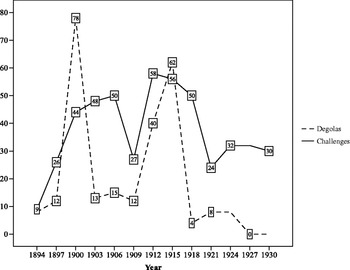
In this article we define ‘degola’ as non-approval, and consequent non-certification by the Chamber of Deputies’ investigation committees, of candidates that the local election boards had deemed elected.Footnote 45 This is consistent with the concept of election fraud discussed earlier, seen as an act that violates the law. In this case, an act that ends up cancelling a certificate issued by the local election board is fraudulent. By ‘challenge’ we mean the number of complaints or requests for review of the election results submitted to the investigation committees by candidates whose election was not approved by the local electoral boards. The practice of degola tells us when an election certificate was nullified post hoc in the Chamber of Deputies, while a challenge informs us of a fraudulent process in the local settings prior to or during the elections. In any case, what stands out is the rather small number of election certificates declared invalid, as can be seen in Figure 1.
Number of Degolas and Challenges by Election Year

Between 1894 and 1930, 260 candidates granted election certificates by the local election boards were subsequently beheaded in the Chamber. As 2,732 election certificates were approved, of the total 2,992 election certificates that reached the Chamber of Deputies, only 8.7 per cent were overturned. The 91.3 per cent of election certificates that did receive final approval suggest that the majority of studies are mistaken in seeing the Chamber's direct involvement in decertifying elected officials during the First Republic as a systematic practice.Footnote 46
Another surprising aspect is the absence of degolas in the 1930 election. This contradicts the dominant view of Carone and other academics that the five candidates from Paraíba and the 14 from Minas Gerais were beheaded in that election by the national legislature.Footnote 47 We excluded the Minas Gerais case from our analysis since this was the only occasion in the history of the republic when the local election boards did not issue any election certificates at all, leaving it to the Chamber of Deputies to make a decision about the election results; clearly, one cannot say that any deputies were beheaded when no certificates were approved and therefore no duplicate election certificates were presented for arbitration.Footnote 48 However, the Paraíba case is different. The Annals reveal that first the Committee of Five and then the investigation committee accepted tout court the local election board's final decision, which issued election certificates to five MPs. In other words, if there was a degola of opposition politicians, this took place at the local election board level, not in the Chamber of Deputies. The words of one of the challengers leave no doubt about this. According to him, the Chamber's investigation committee ‘upheld the fraudulent manipulations of the Paraíba Election Board’.Footnote 49
The data on challenges are also interesting. Although one cannot assume that the challenger had actually been properly elected, the complaints shed light on the possible degolas reported by the candidates who were excluded at the local level. Save for the years 1900 and 1915, the number of challenges was always greater than the number of degolas, which suggests that beheading and election fraud in general occurred more frequently at the local level, before the election certificate fell into the hands of the notorious Committee of Five. However, the variation in the number of challenges should not be associated with a greater or lesser degree of election fraud. As James Woodard notes for the case of São Paulo, where the volume of degolas and challenges was always low, the fact ‘that these elections were for the most part orderly did not mean that they were clean’.Footnote 50 In other words, the data indicate that the conflict rarely reached the Chamber of Deputies, and election fraud was confined to the stages prior to the final approval of elected officials.
In addition, the total number of election certificates invalidated is not a good indicator of the phenomenon. Indeed, Figure 1 shows that some years, specifically 1900, 1912 and 1915, display a high concentration of degolas. These three elections account for 69.2 per cent of the total degolas registered during the First Republic. So, not only are the total number and proportion of beheadings low, but they are also highly concentrated. This shows that the 1899 reform did not invent a new practice in the process of election validation. Data for 1894 and 1897, the two elections prior to the 1899 reform, show that the number of degolas was in fact similar to other election years subsequent to the Campos Sales arrangement.
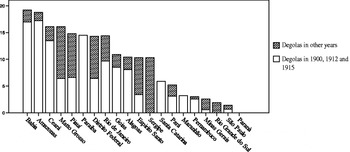
Nor was beheading practised equally across the state. Of the 260 registered rejections, 58.1 per cent were concentrated in Bahia, Rio de Janeiro, the Federal District and Ceará. In the country's most important states, São Paulo, Rio Grande do Sul and Minas Gerais, degolas totalled a mere 8.1 per cent.Footnote 51 However, these data should be weighted by the number of MPs elected from each state (Amazonas and Goiás, for example, elected just four candidates each). In order to do this, we calculated the ratio of degolas by state based on the total number of election certificates granted by the local election boards. The results are shown in Figure 2; to display the data better, the degolas registered in 1900, 1912 and 1915 are grouped separately from the others.
Percentage of Degolas by State, 1894–1930

Figure 2 shows that degolas were arbitrary acts that varied across different state delegations. The greatest total number of elected officials beheaded by state occurred in Bahia, Ceará, the Federal District and Rio de Janeiro; more than 15 per cent of the election certificates in each of these states were declared invalid. However, the interesting statistic concerns the high levels of degolas in states with a small number of deputies, such as Amazonas, Mato Grosso, Piauí and Paraíba. In relation to beheadings by election year, there are states where beheadings occurred predominately in other periods, not just in 1900, 1912 or 1915. This is the case for Sergipe, Mato Grosso, Piauí, Espírito Santo and the Federal District.
Before trying to shed light on these differences, we want to examine one piece of data that has contributed to the myth that beheadings were standard practice. Until now we have dealt with all of the degolas as if they were synonymous with electoral fraud, since we assumed that the beheaded politician had been duly elected and had been unjustly disqualified from taking up the seat to which he was entitled. This would suggest, misleadingly, that all 260 beheadings followed the same pattern. Examination of the formal justifications contained in the Annals for the decision to reject an election certificate, however, reveals that in practice, there were two motives that led to a beheading.
The first was duplicate certificates: the local election board had issued more election certificates than the number of MPs fixed by the electoral law. Sometimes, records of the debates in the Annals show that more than one local election board was set up, each one granting election certificates to a different list of candidates, thus creating duplicate certificates. This is the most evident proof of the emergence of bitter political battles at the local level, disputes that even the governor, through the local election board, was unable to resolve. In this first case, the Chamber was obliged to decide on the validity of those excess certificates – in other words, degolas were unavoidable given the inability of local political bodies to come to a decision.
The second motive related to a real difference of opinion between the decisions taken by the local election board and those taken by the Chamber. When there were no excess election certificates it was the Chamber's investigation committees or plenary assembly that reversed the decision made by the local election board, beheading a representative who had already been named and approving a candidate who had raised a challenge. The challenger, presenting himself as the wronged candidate, would submit innumerable documents, including new minutes of the elections and letters from voters complaining of fraudulent acts during voting or even arguing the ineligibility of the other elected deputy or list of deputies. Everything and everyone was challenged in the attempt to demonstrate that the challenger and his list had been legitimately elected and that the election board had granted him the legal election certificates. At times the challenges were so sophisticated and detailed that the challenger recalculated the votes, presenting what he claimed to be the true list of elected deputies – which turned out to be, most of the time, the opposition list. Clearly all elected deputies lost votes in this process, with deputies reallocated in the final list order or even excluded. This second justification for a degola is important since it clearly indicates the wilful reversal of the majority decision made at the local level and thus points to fraudulent practices implemented during the third scrutiny stage.
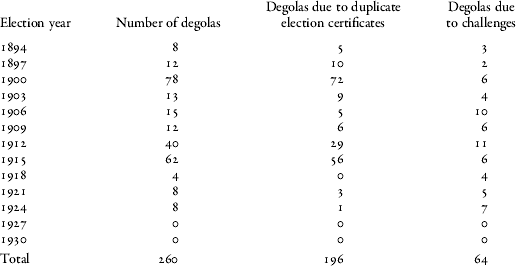
One well-known case in which the Chamber plenary intervened was the 1915 approval of Deputy Barbosa Lima for the first constituency of the Federal District. A congressman since 1890, Barbosa Lima did not win many votes in the 1914 elections, coming in seventh place with 1,118 votes. The last candidate elected, who came in fifth place, received 2,368 votes. Although Barbosa Lima did not receive an election certificate from the election board, the Committee of Five or the investigation committee, thanks to the intervention of Governor Antonio Carlos he managed to garner the support of the state delegations in Congress from Minas Gerais and São Paulo and ended up receiving election certification.Footnote 52 To see whether this case was typical or an exception, we identified the reasons underlying the aforementioned 260 degolas, separating the duplicate election certificates from those where challengers won approval. The data are contained in Table 1.
Number and Type of Degolas by Election Year
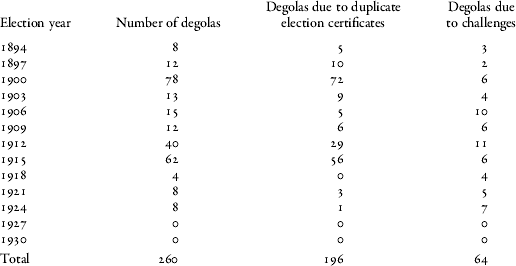
Source: drawn up by the authors on the basis of data from the Annals of the Chamber of Deputies and the Daily Registers of the National Congress. The year 1894 does not include data for Santa Catarina, Rio Grande do Sul or Paraná because elections did not take place in those areas in that year.
The situations in which the challengers emerged victorious are a clear minority. Data gathered from the reports produced by the Chamber's investigation committees show that of the 486 challengers claiming a seat in the Chamber, the Chamber, either via its committees or the full assembly, voted in favour of awarding the challenger an election certificate in a mere 64 cases. This represents 24.6 per cent of the beheading cases registered in this period. So, instances where the decision made by the local election boards was reversed were few and restricted to specific cases, sometimes legitimating an election certificate for personal and not party-related motives. Beheading was a relatively rare fraudulent practice; the true problem for the third scrutiny stage was primarily the instability of the local electoral processes, which resulted in duplicate election certificates and forced the president and his majority in the lower house of the National Congress to publicly take sides in favour of a particular group of candidates.
Explaining the Practice of Degola
What, then, were the conditions that would explain the practice of degola? As demonstrated, the key to understanding the phenomenon was local politics, wherein bitter battles between rival factions would prevent a decision about election results and lead to the emission of duplicate election certificates. Elections were hotly contested, with open opposition to the state government. Both the incumbents and the challengers would declare themselves victorious and present their respective election certificates to the Committee of Five, each claiming final approval. Degola was thus a product of the governors’ inability to control intra-state political battles and, ultimately, the elections. It also meant that the normal instruments of pressure used prior to the elections and on election day were not sufficient to determine the results.Footnote 53
The instability of the state oligarchies is not new and is widely discussed.Footnote 54 Our systematic reading of the reports from the investigation committees, which included challenges made by those who argued that they were entitled to the election certificate, tended to confirm this version for all the elections. One example is the case of Espírito Santo in the 1906 elections. Until then state politics had been dominated by the Partido Republicano Construtor (Constructive Republican Party, PRC) and its leader, Muniz Freire, but Governor Henrique Coutinho, also elected from the ranks of the PRC in 1904, broke with Muniz Freire over his refusal ‘to approve the fellow party members that Muniz Freire had presented to occupy important political positions in the state government’.Footnote 55 The rifts between the internal factions of the PRC manifested in the elections of 31 January 1906, which resulted in a series of duplicate election certificates held both by the list of candidates who supported ex-governor Freire and by those who opposed him. In the end the Chamber approved the election certificates of the former; Coutinho was thus defeated by virtue of the political support raised by Muniz Freire at the federal level.
This case begs further research into the political life of each state. Unfortunately, however, a simple reading of the Annals does not clearly demonstrate the logic of local politics in all cases examined, often failing to elucidate such factors as who the opposition politicians were, which candidates the governor had supported during the campaign or which factions and parties were in dispute. In the absence of such detail, one way of supporting the argument that intra-state political instability was the driver of the practice of degola is to look at counter-factuals – that is to say, elections that did not result in degolas because of the relative political stability in those states.
In the states that were most influential in the republic's political life, such as Minas Gerais, São Paulo and Rio Grande do Sul, the number of beheadings was always low. In order to explain this, one needs to understand how the state-level Republican parties were organised and, more importantly, how they resolved the problem of selecting candidates for elections. In the absence of national parties, candidate selection was conducted by the state-level party. In many cases, including the three states mentioned above, drawing up the candidate list was a highly centralised process in which the local party leaders could either exclude any internal dissidents or decide to include them as a means of forestalling any possible conflict during the campaign and in the voting scrutiny process.
The practice of absorbing the opposition within the Republican parties occurred in Rio Grande do Sul after the death of Castilhos.Footnote 56 In São Paulo in 1912, in the age of the Salvationist Movement led by Hermes da Fonseca, the Partido Republicano Paulista (São Paulo Republican Party, PRP) managed to minimise internal splits. Rodolfo Miranda, leader of the movement in support of Hermes de Fonseca, waived his candidacy for the state governorship on behalf of the Partido Republicano Conservador (Conservative Republican Party, PRC) after managing to negotiate for this party to get one-third of the representatives in the São Paulo state legislature and four legislators in the lower house of the National Congress, as well as participation in the executive committee of the PRP.Footnote 57 As Surama Pinto notes for the case of Rio de Janeiro, political agreements, from the point of view of the government, ‘allowed for conciliation among divergent groups, expanding the government's support base; from the point of view of the opposition, these alliances allowed it to obtain privileges and political posts in addition to a way out of a distinctly unfavourable situation that made it the target of all types of persecution’.Footnote 58
So, if the National Congress was obliged to use degola to resolve political conflicts that had been left unsettled at the local level, could this explanation now be extended to the atypical cases of 1900, 1912 and 1915? We think these were not mere local political conflicts but rather cases of federal intervention –that is, of the president's direct intervention in state politics – which can be interpreted in two ways.
In the first place, there is the question of presidential succession. Existing historiography sees presidential successions in the First Republic as being based on relations between the country's heavyweight states – São Paulo and Minas Gerais – and three or four of the most influential states – Rio Grande do Sul, Rio de Janeiro, Bahia and Pernambuco.Footnote 59 Nevertheless, there were occasional disagreements among the states regarding the nomination for president, which could explain the occasional beheadings of state deputies who opposed the majority decision. Degola might thus have been used in two specific situations: to punish either deputies who did not support the majority candidacy for the forthcoming presidential elections, or those who had not supported the president-elect in the previous elections. However, neither of these examples holds water. In the first case, the question of presidential choice was never up for discussion in federal congressional elections,Footnote 60 and in the second, there is no clear evidence that there was any retaliation against those deputies that had supported an opposition presidential candidate. As the literature discusses, the key issue in the 1900 congressional elections was building a congress that supported the politics of President Campos Sales. The 1910 presidential election was the most troubled election in the history of the republic. São Paulo and Bahia supported the candidacy of Rui Barbosa, who nonetheless lost the elections to Hermes da Fonseca. Although nearly one-third of the degolas in the 1912 federal election occurred in Bahia, this does not in itself prove that they occurred because of disagreements about the presidential nomination. In the first place, the other beheadings occurred in states that had supported the candidacy of Hermes da Fonseca in 1910. Furthermore, no candidate from the state of São Paulo was beheaded in the 1912 congressional elections, even though the state had supported the presidential candidacy of Rui Barbosa. In relation to the 1915 legislative elections, President Wenceslau Braz, elected the previous year, had received solid support from the majority of the states, including Rio de Janeiro, which nonetheless accounted for the majority of degolas in 1915.
We therefore sought an alternative explanation for the phenomenon of degola in these critical years, by taking a broader view and considering the direct intervention of the national president in state politics.Footnote 61 In 1900 degolas occurred at the state level when Campos Sales decided to support the group in power. The case of Mato Grosso is a perfect example. Internal dissidence had arisen in that state regarding the candidature for governor in 1899. The political faction loyal to Joaquim Murtinho, then minister of finance under Campos Sales, won the elections. In the subsequent congressional elections, in January 1900, duplicate election certificates were issued and it was precisely those candidates who had opposed Murtinho who were beheaded.Footnote 62
In the aftermath of the 1910 presidential elections, the troubled congressional elections of 1912 should be understood in relation to the political position taken by President Hermes da Fonseca, which contrasted with that of Pinheiro Machado, the Rio Grande do Sul leader, with respect to the state governors’ election between 1911 and 1912. The intervention of the federal government, better known in historical analyses as the Salvationist Movement, sought to favour the choice of other local oligarchies, which the government justified through a need to ‘purify the republican regime and defend the purity of the democratic institutions’.Footnote 63 The federal government's interventionism had the effect of prompting the emergence of political opposition, leading, in some cases, to the old oligarchies being replaced by ‘new groups that also had oligarchic tendencies’.Footnote 64 Pinheiro Machado's first reaction was to encourage the creation of a new party, the Partido Republicano Conservador (Conservative Republican Party, PRC). This had an impact in the 1912 congressional elections, since ‘the MPs elected for the 1912–1914 legislature reflected the new situations and the increasing prestige of Pinheiro’.Footnote 65 Thus, the process by which election certificates were approved in 1912 should be understood in the context of the dispute between the forces that supported Pinheiro Machado and the new oligarchies that emerged after the interventions.
Our analysis of the challenges published in the Annals shows a clear relationship between federal intervention and beheading. In 1912, of the 40 recorded beheadings, 29 occurred in states where there was federal intervention. In Bahia, which accounted for half the beheadings, the politicians who supported Hermes da Fonseca won the seats in all districts. In Ceará, Governor Nogueira Accioli withdrew a few days before the elections in January, fleeing to Rio de Janeiro. The new elections for governor, in April, resulted in the victory of his opponent, Franco Rabelo. Gracho Cardoso, son-in-law of former governor Nogueira Accioli, managed to get himself elected as federal deputy for Ceará's second district. Yet his election certificate, which had been approved by the Committee of Five, was challenged in the Chamber of Deputies in May of that year and eventually declared invalid.
Finally, the beheadings in the 1915 congressional elections reflect the end of Hermes da Fonseca's term as president in 1914 and of Pinheiro Machado's attempt to reposition himself. Carone notes that ‘during Hermes da Fonseca's first term Pinheiro Machado lost power, but slowly and quietly the latter regained his position’, beginning in 1913.Footnote 66 It seems that this also affected the process of approving election certificates in 1915. Indeed, of the 61 recorded beheadings that year, 49 occurred in states that had been affected by Hermes da Fonseca's Salvationist Movement, particularly Bahia, Ceará and Rio de Janeiro.
Conclusion
So, to answer our opening question, was the rubber-stamping of electoral results by the national Chamber of Deputies one more fraudulent practice that the rulers used to maintain control over electoral outcomes and, ultimately, over the regime's political stability? This study has shown that degolas were actually used rather rarely as an ‘extra guarantee to block enemies’ access to the parliament’.Footnote 67 Neither Affonso Melo's assertion that the Committee of Five was ‘the most important instrument of the certification process’, nor Raimundo Faoro's view that the practice of degola had ‘taken the place of ballot counting’, give us the full picture of election result approval.Footnote 68 The data reveal that this was a minority practice and that degolas were largely used to deal with the problem of duplicate and excess election certificates. Perhaps the government was also discouraged by the fact that the degola was a very politically expensive endeavour since it was public, while election fraud or simple violence during the elections were less publicly visible practices.Footnote 69
Less weight should be given to the conventional historiographical view that sees the crucial third stage of election scrutiny as a mere act of fraud that overturned voter preferences. The literature has erroneously inferred from the witness accounts of the time that degolas were widely used, without actually seeing them as a strategic mechanism. In the critical years of 1900, 1912 and 1915, the third scrutiny stage in congress was indeed as decisive as many historians allege. It is clear that in those years, political battles fought at the state level were not resolved using the regular means available, such as fraud at the ballot box, violence or political co-optation of the opposition, and that the final scrutiny stage in the federal Chamber of Deputies became the institutional grease that kept the wheels of the republican political system turning. The importance of the government's control of the election certification process lay therefore in its strategic use, not its indiscriminate or widespread use, and it was pivotal to regime stability. The case of Brazil disproves Lehoucq's argument that political instability is more likely in the absence of electoral courts, when approval of elected officials is left to the legislature, and when ‘one agent can gain control of the executive and possess a large legislative majority’.Footnote 70 It was in fact precisely the power conferred upon the National Congress to approve or reject election certificates, together with the control exercised by the presidency, that guaranteed the Republican regime's political stability. Thus, the republic's election dynamic depended on a simple equation: vote control at the local level and beheading, as a final resort, in the Chamber of Deputies.
This eminently strategic use of the degola suggests areas for further research. For Brazil, just as elsewhere, a more detailed map is needed of the electoral fraud that occurred prior to or on election day. To date, the literature on fraud in Brazil relies on witnesses and reports obtained from a variety of sources, with the argument that ‘we are not in a situation to objectively evaluate the extent’ of fraud.Footnote 71 This is not true. The minutes of contested elections contained in the Annals of the Chamber of Deputies and used here to analyse the degolas contain all the challenges presented by the candidates and can certainly also serve as a basis for studying election practices at the time, including that of fraud. These minutes could be used to investigate whether fraud occurred as a function of local political instability – the classic argument of political competition among the elite – or if other factors, such as the degree of inequality in society, explain the phenomenon.Footnote 72 Rather than limiting research to federal elections, historians could look more broadly at local electoral politics during the First Republic and study the election of governors and members of state assemblies as well as the choice of municipal mayors. As James Woodard has recently pointed out, the municipal elections in São Paulo ‘served as the starting point for further political careers’.Footnote 73 More generally one should go beyond the standard view that everything was fraud and see that ‘in spite of [there being fraud], holding elections played a key role in the political system at the time’.Footnote 74 Finally, our study's emphasis on the importance of examining fraud in all its phases – pre-election, during the election itself, and post-election – holds implications for further research into the election dynamics of other countries in the nineteenth century. The case of Brazil suggests that the national parliament's power to approve or deny election certification was employed under limited circumstances, when political instability in the form of election competition and local political battles threatened the national political sphere and the federal government's monopoly. It remains for other studies to discover if and how governments in other countries used the same mechanism to guarantee regime stability.