INTRODUCTION
The interaction between crops and plant pathogens is among the most important of the biotic interactions in crop populations (Phillips & Wolfe Reference Phillips and Wolfe2005). One of the main fungal pathogens affecting Spanish crop production is Rhizoctonia solani Kühn anastomosis group (AG) 4, and the most common symptom of R. solani disease is damping off. Many different crops can be affected by damping off (such as sugar beet, tomato, cereals and Lupinus). R. solani attacks parts of plants that are underground such as seeds, hypocotyls and roots, and it is also able to infect aboveground parts (e.g. pods, fruits, leaves and stems). Damping off is characterized by non-germination of severely infected seeds, while infected seedlings may be killed either before or after emergence. Diseased plants have dark-brown to black stems with sunken and constricted lesions at the soil level.
Currently, control of this disease is based on chemical methods and agricultural practices (Van den Boogert Reference Van Den Boogert1999), some of them inadequate due to economic, environmental and sanitary reasons. In fact, methyl bromide (MB), which has been used as a powerful fumigant agent for decades, has disappeared from the market in developed countries since 2005 due to its observed toxic effects on several occasions. It has been shown that its indiscriminate use has contributed to the increased size of the hole in the ozone layer (Ristaino & Thomas Reference Ristaino and Thomas1997). In Spain, 0·33 of MB is used on strawberry crops, mainly in the southeast of the country (Murcia and Alicante; Bello et al. Reference Bello, Escuer, Sanz, López-Pérez, Guirao, López and Mora1997).
Chemical and non-chemical alternatives to MB exist, although they are normally associated with tomato crops (MBTOC 1998). Among the non-chemical alternatives, biofumigation has been applied successfully in Spain (Lacasa et al. Reference Lacasa, Guirao, Guerrero, Ros, López-Pérez, Bello, Bielza, Arvanitakis, Tjamos and Batchelor1999; Bello et al. Reference Bello, López-Pérez, Sanz, Escuer and Herrero2000) and inoculation with plant growth promoting rhizobacteria (PGPR) has been proven to be a useful agro-technique against phytopathogens in a wide variety of crops (Probanza et al. Reference Probanza, Lucas García, Ruiz Palomino, Ramos and Gutiérrez Mañero2002; Cezón et al. Reference Cezón, Gutiérrez Mañero, Probanza, Ramos and Lucas García2003; Lucas García et al. Reference Lucas García, Probanza, Ramos and Gutiérrez Mañero2003; Domenech et al. Reference Domenech, Reddy, Kloepper, Ramos and Gutierrez-Mañero2006). Biological control and incorporation of organic matter (OM) are two possible alternatives for replacing or reducing the use of chemical products that contribute adversely to the environment and increase the risk to consumer's health. Organic agriculture has its roots as a reaction against the development and use of synthetic fertilizers and other agrochemicals (Watson et al. Reference Watson, Walker and Stockdale2008).
With regard to the incorporation of OM, biofumigation originally referred to the use of Brassica species, containing biocidal sulphur compounds, as a green manure or as a rotation crop to control soil-borne pests and diseases (Angus et al. Reference Angus, Gardner, Kirkegaard and Desmarchelier1994). However, many other plants have also shown interesting activities against nematodes and fungi (Djian-Caporalino et al. Reference Djian-Caporalino, Bourdy, Cayrol, Regnault-Roger, Philogène and Vincent2005). Naturally occurring plant-derived volatiles that are fundamental constituents of flavour and fragrance seem to possess antifungal activity; Zeringue et al. (Reference Zeringue, Brown, Neucere and Cleveland1996) suggested that volatile compounds emitted from plants may be responsible for fungal inhibition. These volatile compounds have been studied for their potential as post-harvest inhibitors of spoilage in several fruit species (Vaughn et al. Reference Vaughn, Spencer and Shasha1993; Archbold et al. Reference Archbold, Hamilton-Kemp, Barth and Langlois1997; Neri et al. Reference Neri, Mari and Brigati2006). In the present study, strawberry by-products were used as biofumigants due to their potential fungicidal effects. During biodecomposition of OM, which produces volatile substances with biocidal actions (Sarwar & Kirkegaard Reference Sarwar and Kirkegaard1998; Bello et al. Reference Bello, López-Pérez and García Alvarez2003), the microbial activity of the soil is stimulated (Piedrabuena et al. Reference Piedrabuena, García-Álvarez, Díez-Rojo and Bello2006). When OM is added, a sequence of microbiological changes occurs with a growth of micro-organisms that depends on the amount and properties of OM incorporated. The principal effect is the increase over time in the quantities of nutrients that have an impact on the living portion of the soil. A residual population of beneficial organisms (rhizobacteria, protozoans or fungi) can survive; many of these are biocontrol organisms (Baker Reference Baker1988; Kloepper et al. Reference Kloepper, Lifshitz, Schroth and Anderson1988). It has been demonstrated that biofumigation stimulates the biological activity of soils, increasing the populations of antagonistic organisms of pathogens such as Pseudomonas fluorescens and Bacillus sp., as well as the populations of saprophagous and bacteriophagous nematodes, and decreasing parasitic forms of fungus and nematodes (Piedrabuena et al. Reference Piedrabuena, García-Álvarez, Díez-Rojo and Bello2006). However, other authors have suggested that the effects of biofumigation are caused by competition among rhizospheric organisms (Baker & Cook Reference Baker and Cook1974).
Crop residues are usually considered as ‘waste’ materials without any value, and even as contamination sources. However, since it is known that incorporating crop residues into the soil increases microbial activity (Piedrabuena et al. Reference Piedrabuena, García-Álvarez, Díez-Rojo and Bello2006), the OM incorporation technique can be introduced efficiently into the agricultural production system, at competitive prices, by the use of agro-industrial residues (Bello et al. Reference Bello, López-Pérez and García Alvarez2003).
Rhizobacteria that exert beneficial effects on plant development are referred to as PGPR (Kloepper et al. Reference Kloepper, Leong, Teintze and Schroth1980). Some PGPR are able to promote plant growth by improving their nutrition, making some limiting nutrients, such as phosphate, available to the plants and/or altering their hormonal balance (Yao et al. Reference Yao, Yasmin and Hafeez2008; Idris et al. Reference Idris, Labuschagne and Korsten2009). In addition, PGPR can protect plants from pathogen attack by biocontrol (through competition between the PGPR and pathogenic micro-organisms in the rhizosphere) or by induced systemic resistance (ISR; Van Loon et al. Reference Van Loon, Bakker and Pieterse1998) through the use of certain secondary metabolic pathways. Induced systemic resistance functions independently of salicylic acid, but requires the natriuretic peptide receptor 1 and is regulated by jasmonic acid and ethylene (ET) (Walters & Fountaine Reference Walters and Fountaine2009).
Bacteria of the genera Bacillus and Pseudomonas have been satisfactorily used for the control of phytopathogens that infect different crops (Domenech et al. Reference Domenech, Reddy, Kloepper, Ramos and Gutierrez-Mañero2006). Specifically, different strains of the genus Pseudomonas have been used in numerous studies, which have confirmed the biocontrol capacity of the Pseudomonas chlororaphis strain MA342 against fungal pathogens in barley, oats and wheat (Johnsson et al. Reference Johnsson, Hökeberg and Gerhardson1998). Pseudomonas aureofaciens AB244 and P. fluorescens VO61 are examples of PGPR capable of exerting effective biological control against fungal pathogens, such as Pythium ultimum Trow in tomato (Warren & Bennet Reference Warren and Bennet1999) and R. solani in rice (Vidhyasekaran & Muthamilan Reference Vidhyasekaran and Muthamilan1999), respectively. Field trials have been performed with P. fluorescens, Pseudomonas putida TL3 and P. putida BK1 in potato crops (Burr et al. Reference Burr, Schroth and Suslow1978). Other strains of Pseudomonas have also been the object of various studies in the cultivation of sugar beet (Suslow & Schroth Reference Suslow and Schroth1982; Cakmakci et al. Reference Cakmakci, Kantar and Sahin2001). P. fluorescens (strain AUR6), isolated from Lupinus sp., is able to ISR in Solanum lycopersicum and Capsicum annuum (Domenech et al. Reference Domenech, Reddy, Kloepper, Ramos and Gutierrez-Mañero2006).
The objectives of the present work were: (i) to evaluate two possible control methods against the pathogen R. solani in Lupinus luteus crops: the incorporation of three doses of OM amendments and the use of P. fluorescens as biological control and (ii) to analyse microbial changes during the OM degradation process from two approaches: microbial catabolic abilities (Biolog® substrate utilization profiles) and changes in aerobes, Pseudomonas sp. and ACC-degrading micro-organisms (microbial counts).
MATERIALS AND METHODS
Bacterial strain and plant material used in the OM incorporation assay
A bacterial strain, selected because of its inhibition effect against R. solani AG-4 in potato dextrose agar (PDA medium, Difco Laboratories, USA), was isolated from an agricultural soil in Pampliega (42°12′N; 3°58′W; altitude 809 m asl), Burgos (Spain). Partial sequencing of the 16S ribosomal RNA gene was performed by the Sanger's enzymatic method using an ABI Prism® 377 DNA automatic sequencer (Perkin Elmer Applied Biosystems, USA). Electrophoresis bands were encoded and shown in a chromatogram using the Chromas v.1.45 program. This software processes the data automatically, obtains the base sequences and the results can be compared with others. Using the Fasta Nucleotide Similarity Search Database available from the European Bioinformatics Institute (EMBL-EBI, http://www.ebi.ac.uk/Tools/sss/fasta/nucleotide.html, verified 10 Nov 2010), this bacterial strain was compared with P. fluorescens PfO-1 (EMBL: CP000094) and found to be identical. The sequence length was 6·438·405 bp and the guanine-cytosine (GC) content was 0·605.
In previous studies, an antagonistic assay was carried out between this strain of P. fluorescens and R. solani (Sacristán et al. Reference Sacristán-Pérez-Minayo, Reguera-Useros and López-Robles2007). A 1:10 (v/v) culture of P. fluorescens in brain heart infusion broth (Merck, Germany) was incubated for 24 h at 30°C and then 0·1 ml of this culture was inoculated in PDA medium. After 5 min, this PDA culture was incubated with R. solani and maintained for 5 days at 30°C. R. solani without P. fluorescens was also grown in PDA medium (control assay). In this in vitro assay, P. fluorescens produced a considerable inhibition effect (inhibition halo of 25 mm) against R. solani on PDA medium.
For the development of the OM incorporation assays, strawberry by-products were used as biofumigants at different doses (10, 20 and 40 g biofumigant/kg agricultural soil), according to Piedrabuena et al. (Reference Piedrabuena, García-Álvarez, Díez-Rojo and Bello2006). The variety of strawberry used was Fragaria×ananassa Duchesne cv. Camarosa. The chemical composition of the strawberry by-products was: pH 4·3, moisture content 953 mg water/g fresh weight, 27 g N-NH4/kg, 540 g total organic carbon/kg, 930 g total OM/kg and C/N ratio 20.
Greenhouse evaluation of potential antagonistic effect of OM incorporation process and P. fluorescens against R. solani
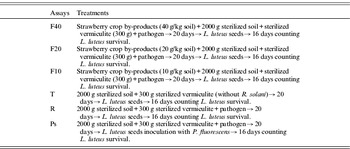
The assays were carried out in 3-litre plastic trays with 2 kg of an agricultural soil (pH 6·5; clay 4·6% by volume; silt 18·4% by volume; sand 77% by volume and OM 11 g/kg) obtained from an experimental plot (40°24′N; 3°51′W; altitude 713 m asl) of University of San Pablo CEU (Madrid, Spain). The soil was autoclaved and 300 g of autoclaved vermiculite was added. R. solani AG-4 was grown on PDA medium (Difco Laboratories, USA) for 10–14 days and the contents of two Petri dishes were blended in 300 ml of sterile, deionized water in a Waring blender (Cartwright & Benson Reference Cartwright and Benson1995). This suspension was then mixed with the soil from each tray of the pathogen treatments (Table 1).
Description of treatments in OM incorporation assays (F40, F20, F10, T and R assays) and P. fluorescens inoculation assay (Ps assay)

To study the effect of OM amendments, sets of trays (Table 1) were mixed with fresh organic wastes (by-products of strawberry mother plants for runner production) from Fragaria×ananassa nursery plants at three different doses: 10, 20 and 40 g waste/kg soil, denoted as F10, F20 and F40 assays, respectively. These were stored in plastic bags at 30°C for 20 days (Bello et al. Reference Bello, López-Pérez and García Alvarez2003). Two other sets of trays were used as controls, both without biofumigant, one without R. solani (T assay) and another with the pathogen (R assay). The last set was used to study the effects of P. fluorescens on R. solani (Ps assay).
After 20 days, the soil was removed from the bags, placed on trays and L. luteus was used as a bioindicator crop to assess the inhibitory effect against R. solani. Three replicate trays were sown, each with 20 L. luteus seeds. Trays were watered daily for 16 days in a culture chamber under controlled conditions (photoperiod 14/10 h light/dark at 27°C/17°C and 70% humidity). In the Ps assay, seeds were inoculated before being sown, by immersion in a culture of P. fluorescens (6×10⁹ CFU/ml) for 6 h at 30°C in a shaker. The effect of the different treatments (seedlings emergence) was observed daily over 16 days.
Community catabolic profiles: Biolog® plates
Bacterial and fungal communities were characterized by their metabolic fingerprints, using Biolog Eco® and FF® micro-plates, respectively (BIOLOG Inc., Hayward, CA). For each treatment and sampling time (0 and 20 days), 2 g of agricultural soil were homogenized in 20 ml of distilled water with an Omnimixer at 16 000 rpm for 1 min. Three replicates per treatment were performed. After centrifugation of soil suspension (750 g, 10 min), the supernatant was filtered through glass wool. Suspensions were diluted 100-fold in sterile water and sown in Biolog Eco and FF plates. Plates were incubated in dark at 25°C. Absorbance values at 595 nm (for Eco plates) and at 492–750 nm (for FF plates) were measured every 24 h until 192 h with an Asys High Tech Expert 96 spectrophotometer and Microwin 2000 analysis software. Absorbance values of the wells were blanked against the control well (corrected absorbance values). All negative values were set to zero. The average well colour development (AWCD) was calculated as the mean of the 31 (Eco) or 95 (FF) blanked absorbance values. Then the absorbance value of each well was divided by the AWCD in order to minimize the influence of inoculum density differences between plates (Baudoin et al. Reference Baudoin, Benizri and Guckert2001). Kinetics of AWCD were represented in order to determine the speed and the level of development of the bacterial and fungal communities using the 31 (Eco) or 95 (FF) substrates provided. Two-way ANOVA were performed for kinetics of AWCD values (see section on Statistical analysis).
With corrected absorbance values at 120 h of incubation of the Biolog plates, the proportions of intensely utilized substrate compounds (those which have an absorbance >AWCD) within each of the substrate categories were calculated for each plate and were termed as substrate richness (Baudoin et al. Reference Baudoin, Benizri and Guckert2002). Also, metabolic diversity using Shannon's diversity index (H=−∑ [n i/N×log n i/N]), where n i is the corrected absorbance value of each substrate and N is the sum of all corrected absorbance values of all substrates of Biolog Eco and FF plates, was measured. One-way ANOVA (see section on Statistical analysis) was carried out for metabolic diversity results.
With the corrected absorbance values of the chosen incubation time (120 h), multivariate statistical analyses (distance-based redundancy analyses (db-RDA) and correspondence analyses (CA): see section on Statistical analysis) were conducted.
Microbiological changes of total aerobes, Pseudomonas sp. and ACC-degrading micro-organisms
In order to determine the microbiological changes of aerobes, Pseudomonas sp. and ACC-degrading populations during the OM incorporation process, different selective media were used. Ten-fold dilutions of substrates from each tray at 0 and 20 days were prepared in peptone water (Difco Laboratories), and later spread-plated on principal coordinate analysis (PCA) medium (Oxoid, UK) for aerobes, KING A medium (Merck) for Pseudomonas and ACC medium (Glick et al. Reference Glick, Karaturovic and Newell1995) for detecting ACC-degrading bacteria. All the plates were grown at 30 °C for 72 h and bacterial numbers were counted every 24 h.
Statistical analysis
One-way and two-way ANOVA were carried out, depending on the cases with the values of the replicates (STATGRAPHICS Plus 5.0 software). Standard errors of difference (s.e.d.) were calculated.
db-RDA (Legendre & Anderson Reference Legendre and Anderson1999) were carried out for Biolog data. This analysis begins with the calculation of distances among replicates (Bray–Curtis index), followed by PCA, and finally, by redundancy analysis (RDA). CA were performed for Biolog data. All these analyses were performed with CANOCO™ v4.5 software.
RESULTS
Greenhouse evaluation of potential antagonistic effect of OM incorporation process and P. fluorescens against R. solani
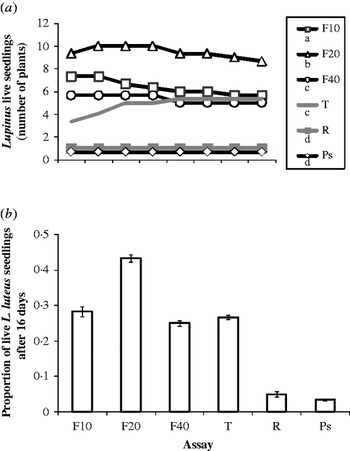
The number of seeds sown for all the assays was 60 seeds/treatment. The survival of L. luteus plants was recorded over 16 days and in that period, the F20 treatment (20 g/kg agricultural soil) had significantly greater numbers of live seedlings (Fig. 1a).
(a) The number of live seedlings (out of 20) of L. luteus in different assays over 16 days. (b) Proportion of live L. luteus seedlings surviving after 16 days (R. solani inhibition). Vertical error bars are s.e.d.

The highest proportion of L. luteus seedling emergences (day 16) was observed under the F20 treatment (0·43) (Fig. 1b). Under the T treatment (control assay without OM and without R. solani) this proportion was 0·27, under F40 (40 g/kg agricultural soil) and F10 (10 g/kg agricultural soil) treatments it was 0·25 and 0·28 respectively, and finally only 0·05 under R (control assay without OM and with R. solani) and 0·03 under Ps (P. fluorescens inoculation assay with R. solani) treatment (Fig. 1b).
Bacterial community catabolic profiles: Biolog® Eco plates
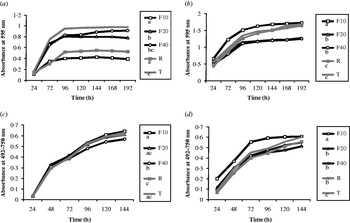
The process of OM incorporation produced relevant changes in bacterial (Eco) and fungi (FF) communities’ catabolic profiles. First, the kinetics of AWCD were represented (Fig. 2) in order to determine the speed and the level of development of the bacterial and fungal communities using the 31 (Eco) or 95 (FF) substrates provided. The bacterial community at day 0 of OM incorporation was significantly smaller in the R and F10 treatments than in the others (Fig. 2a). However, by day 20, F10 was significantly higher than all the others (Fig. 2b). In contrast, bacterial communities from the F20 and F40 treatments had very high values of AWCD at day 0 (at 192 h of incubation) (Fig. 2a) and the lowest values compared to the other treatments at day 20 of the OM incorporation process (Fig. 2b).
Kinetics of AWCD mean average values, (n=3) of: (a) Biolog Eco plates inoculated with bacterial suspension from day 0 OM incorporation process. (b) Biolog Eco plates inoculated with bacterial suspension from day 20 OM incorporation process. (c) Biolog FF plates inoculated with bacterial suspension from day 0 OM incorporation process. (d) Biolog FF plates inoculated with bacterial suspension from day 20 OM incorporation process. F10, F20, F40, R and T are the different treatments (see Table 1).

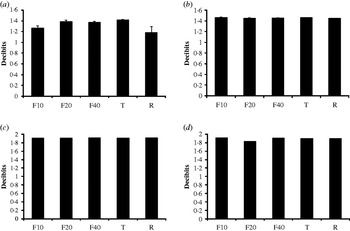
The metabolic diversity of bacterial communities was under 1·4 at day 0 (Fig. 3a), and over 1·4 at day 20 of OM incorporation (Fig. 3b). This increase in metabolic diversity after 20 days of incubation was significant (data not shown), but there were no significant differences between treatments. Bacterial community metabolic diversity seems to be more similar among treatments at day 20, after OM incorporation (Fig. 3b).
Metabolic diversity calculated using Shannon's diversity index with Biolog data (at 120 h of incubation) of: (a) bacterial community (Biolog Eco) from day 0 OM incorporation process. (b) Biolog Eco plates inoculated with bacterial suspension from day 20 OM incorporation process. (c) Biolog FF plates inoculated with bacterial suspension from day 0 OM incorporation process. (d) Biolog FF plates inoculated with bacterial suspension from day 20 OM incorporation process. F10, F20, F40, R and T are the different treatments (see Table 1).

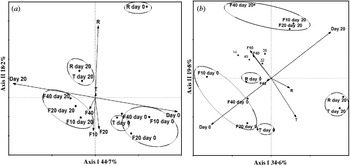
In the ordination provided by the CA of Biolog Eco absorbance values (Fig. 4a), samples of the F40, F20 and F10 treatments were grouped together for both day 0 and day 20. In contrast, samples of T and R treatments were located separately at day 0 but grouped at day 20 (Fig. 4a).
CA ordination performed with absorbance corrected values, measured at 120 h of incubation, of: (a) the 31 substrates of Biolog Eco plate (absorbance 595 nm); (b) the 95 substrates of Biolog FF plate (absorbance 492–750 nm). 14=sebacic acid; 22=succinamic acid; 38=succinic acid mono-methyl ester; 45=p-hydroxyphenylacetic acid. F10, F20, F40, R and T are the different treatments (see Table 1). Day 0 and day 20 correspond to sampling days in the OMincorporation process.

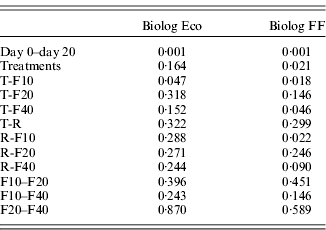
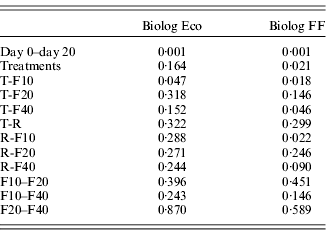
Significant differences between day 0 and day 20 of OM incorporation and between T and F10 treatments were found with a db-RDA carried out with all corrected absorbance values of Biolog Eco plates from all the treatments (Table 2).
P values provided by the db-RDA performed with absorbance (595 nm for Eco and 492–750 nm for FF plates) corrected values of the 31 (Eco) or 95 (FF) substrates of Biolog plate, measured after 120 h of incubation
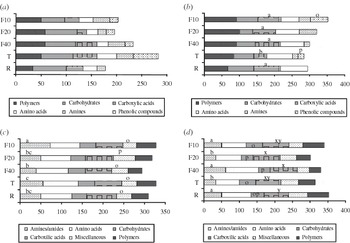
Substrate richness graphs indicate which substrates were intensively used by bacterial (Fig. 5a, b) or fungal communities (Fig. 5c, d). For bacteria, no significant differences were found for the utilization of each group of compounds under the different treatments at day 0 of the incubation period (Fig. 5a), while some differences appeared for carboxylic acids and phenolic compounds at day 20 (Fig. 5b). Phenolic compounds were not used (day 0 or day 20) as a carbon source by the bacterial communities under R treatment (Fig. 5a, b). At day 20, phenolic compounds were not used as carbon source by bacterial communities under R, F40 or F20 treatments, and in the case of R treatments amines were not used either. The highest carbon utilization was found for bacterial communities under T treatment at day 0 (Fig. 5a) and F10 at day 20 (Fig. 5b). Amino acids were used more at day 20 than at day 0.
Proportion of intensely utilized substrates (those which have an absorption >AWCD) within each group of compounds: (a) Biolog Eco day 0, (b) Biolog Eco day 20, (c) Biolog FF day 0 and (d) Biolog FF day 20. F10, F20, F40, R and T are the different treatments (see Table 1). Day 0 and day 20 correspond to sampling days in OM incorporation process. One-way ANOVA.

Fungal community catabolic profiles: Biolog® FF plates
For the fungal community, day 0 of OM incorporation presented significantly lower values of AWCD in F40 treatment than in the others (Fig. 2c). Similar to the bacterial community, the highest values at day 20 were found for the F10 treatment, which showed significant differences compared to others (Fig. 2d).
No significant differences were found for fungal community metabolic diversity in either day 0 or day 20 (Fig. 3c, d).
In the ordination provided by the CA performed with Biolog FF absorbance values (Fig. 4b), similar to what occurred with the bacterial community, the F10, F20 and F40 samples of day 0 were grouped together towards the lowest values of the first axis, and F10, F20 and F40 samples of day 20 were located together towards the highest value of the second axis. Samples R and T were much more separated at day 0 than at day 20.
Significant differences between day 0 and day 20 of the OM incorporation process and between some treatments (T-F10, T-F40 and R-F10) were found with a db-RDA carried out with all corrected absorbance values of Biolog FF plates from all the treatments (Table 2).
Substrate richness for Biolog FF plates (Fig. 5c, d) did not show remarkable differences in carbon source utilization between days 0 and 20. At day 0, amines were significantly more utilized by fungi under the F10 treatment than under the other treatments. At day 20, many differences among treatments appeared for the different groups of compounds.
Microbiological changes of total aerobes, Pseudomonas sp. and ACC-degrading micro-organisms
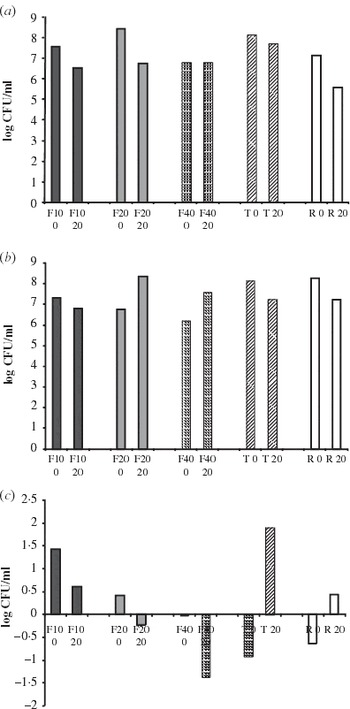
During the OM incorporation process, aerobic population counts decreased in all cases (Fig. 6a). Pseudomonas sp. population counts increased notably under the F20 and F40 treatments, while the other treatments decreased during this process (Fig. 6b).
Changes in population counts during the OM incorporation process of: (a) aerobic population (sown in PCA medium); (b) Pseudomonas sp. population (sown in KING A medium) counts; and (c) ACC-degrading population counts. Samples were sown in ACC and MSACC media. Data shown only for the ACC population (ACC-MSACC).

The incorporation of OM modified the ACC-degrading population; when the biofumigant dose used was higher, the ACC population was lower. Under T and R treatments, an ACC-degrading population was not present at day 0 but was at day 20 (Fig. 6c). Treatments with OM (F10, F20 and F40) increased the number of Pseudomonas sp. after 20 days, while the treatments without OM (T and R) decreased them (Fig. 6b). In the case of ACC-degrading bacteria, exactly the opposite was found (Fig. 6b, c).
DISCUSSION
The present work has evaluated the effect of three doses of application of OM (strawberry crop by-products) and a PGPR as biological control against a fungal pathogen. Microbial changes during the incubation with the OM were also studied.
No significant differences in the effects of the PGPR against R. solani as assessed by the proportion of live L. luteus seedlings between the Ps and R treatments were found (Fig. 1a, b), indicating that the inoculation with the PGPR strain did not protect against the fungal pathogen in spite of the fact that this strain had previously shown inhibition effect against R. solani in vitro (see Materials and Methods section). Moreover, it has been shown that P. fluorescens PGPR strains are capable of showing high antifungal activity against phytopathogenic fungi, including R. solani and Fusarium oxysporum (Kumar et al. Reference Kumar, Arasu and Gunasekaran2002). Nandakumar et al. (Reference Nandakumar, Babu, Viswanathan, Sheela, Raguchander and Samiyappan2001) also showed for rice that three Pseudomonas PGPR strains reduced the incidence of the fungal disease as well as promoting plant growth and development; they obtained reductions in the incidence of R. solani between 30 and 42% using the strains isolated, and between 44 and 49% using combinations of these PGPR (PGPR consortia). In the same way, Jetiyanon & Kloepper (Reference Jetiyanon and Kloepper2002) evaluated and selected PGPR consortia with the capacity to ISR against four pathogens (one of which was R. solani) in vegetable crops.
The highest inhibition effect of added OM against R. solani (43%) was found under the F20 treatment (Fig. 1b), while no significant differences were found between F10 and F40 with respect to the T treatment (Fig. 1b). This could indicate that the biofumigant dose of 20 g/kg of agricultural soil would be the best dose to control the pathogen. The biofumigant dose of 10 g/kg of agricultural soil was second and finally, the least effective inhibition dose was 40 g/kg (Fig. 1a, b).
Microbial changes during the incubation with OM were tested from two approaches, microbial catabolic abilities and microbial counts. For the first, Biolog plates were used to study catabolic profiles and functional diversity of bacterial (Biolog Eco) and fungal (Biolog FF) microbial communities during the OM incubation process. The use of Biolog Eco and FF plates can be considered as a quantitative and qualitative study of catabolism of culturable soil bacterial and fungi community, respectively. Over the years, increased understanding of the Biolog assay has demonstrated the reproducibility of Biolog profiles and supported the view that shifts in Biolog metabolic diversity patterns are related to shifts in community composition (Schutter & Dick Reference Schutter and Dick2001; Crecchio et al. Reference Crecchio, Gelsomino, Ambrosoli, Minati and Ruggiero2004). The Biolog technique provides a rapid and convenient assay for culturable heterotrophic organisms, and a sensitive indicator of changes in soil microbial functional diversity due to different disturbances (Banerjee et al. Reference Banerjee, Burton and Depoe1997; Grayston et al. Reference Grayston, Wang, Campbell and Edwards1998, Reference Grayston, Griffith, Mawdsley, Campbell and Bardgett2001; Pietikäinen et al. Reference Pietikäinen, Hiukka and Fritze2000; Pankhurst et al. Reference Pankhurst, Yu, Hawke and Harch2001; Rogers & Tate Reference Rogers and Tate2001). In this way, Huang et al. (Reference Huang, Xu and Chen2008) detected changes in the behaviour of soil micro-organisms, growing in Biolog plates, obtained from a soil treated with plant residues (mulch treatment) and from control soil (non-mulch treatment).
In this way, the kinetics of AWCD of the Biolog Eco plate throughout plate incubation showed that F10 treatment produced an increase in bacterial metabolic speed after the 20 days of treatment: it presented significantly lower values than the other treatments at day 0 (Fig. 2a) and significantly higher values compared to the others at day 20 (Fig. 2b). In contrast, bacterial communities from the F20 and F40 treatments decreased metabolic speed during the treatment. Since shifts in Biolog catabolic patterns have been related to shifts in community composition (Schutter & Dick Reference Schutter and Dick2001; Crecchio et al. Reference Crecchio, Gelsomino, Ambrosoli, Minati and Ruggiero2004), it can be seen from the present results that after 20 days of incubation with OM, bacterial communities are overall more metabolically active (Fig. 2a, b). Moreover, the F10 treatment seems to stimulate the metabolic speed of bacteria more than the other treatments. It seems that the F10 treatment also increases fungal metabolic speed with regard to the other doses (Fig. 2d), but unlike bacteria, incubation with the different treatments during the 20 days did not increase general metabolic activity.
However, no significant differences between treatments with regard to metabolic diversity value for bacterial or fungal communities were found. In the case of bacteria, metabolic diversity values were significantly higher after the 20-day incubation period (data not shown), indicating that OM added possibly increased genetic diversity related to bacterial metabolism but not to fungi.
No differences were seen in the ordinations provided by CA for either bacterial (Fig. 4a) or fungal (Fig. 4b) communities between treatments (F10, F20 or F40) within each sampling time. However, the separation of samples from both sampling times indicates a higher influence of incubation time than of strawberry crop by-products quantity on bacterial and fungal catabolic profiles. Therefore, it seems that the addition of OM influences microbial catabolic abilities, but the amount of OM (which has been tested) is not so relevant. The opposite was found for the control treatments without OM (T and R), since the R and T samples were grouped at day 20 of sampling, but far apart at day 0 (Fig. 4a, b). This indicates that over the 20 days of incubation the initial differences found were negated. In the case of Biolog FF (Fig. 4b), there was a group of four substrates: sebacic acid, succinamic acid, succinic acid mono-methyl ester and p-hydroxyphenylacetic Acid, which seem to be influencing samples ordination, mainly F10 and F40 samples. This could indicate that these substrates play an important role during the organic biodecomposition.
These results from CA ordinations were confirmed by db-RDA (Table 2), since significant differences between incubation days of OM incorporation in Biolog Eco and FF were found. This reveals that microbial communities were altered during the strawberry biodecomposition. Moreover, other significant differences were found, but none of them between treatments with strawberry (F10, F20 and F40).
Substrate richness (calculated as the proportion of highly used substrates within each substrate category), was increased by the F10 treatment, especially in bacteria. However the F20 and F40 treatments decrease the value of the wealth of the substrate, although the dose of F20 is the best protection dose against the pathogen. All the differences found between treatments and between day 0 and day 20 (Fig. 5) could indicate changes in bacterial and fungal metabolic abilities, since microbial capacity to use the different Biolog plate compounds is a reflection of metabolic capacities of these bacteria at the moment of the sampling (Schutter & Dick Reference Schutter and Dick2001; Crecchio et al. Reference Crecchio, Gelsomino, Ambrosoli, Minati and Ruggiero2004).
Microbial populations typically fluctuate and vary regularly in response to the addition of OM (Van Bruggen & Semenov Reference Van Bruggen and Semenov2000). Microbial plate counts are considered to be a reasonably reliable method for estimating the populations of aerobes, Pseudomonas sp. and ACC-degrading micro-organisms (Stockdale & Brookes Reference Stockdale and Brookes2006). OM incorporation helps the growth and activity of anaerobic micro-organisms (Blok et al. Reference Blok, Lamers, Termorshuizen and Bollen2000; Bello et al. Reference Bello, López-Pérez and García Alvarez2003). A previous study (G. Sacristán, J. I. Reguera, J. López-Robles & B. de Aymerich, unpublished results) demonstrated the highest increase of anaerobic counts when the highest dose of the biofumigant was used. In the present work, aerobic population decreased due to the oxygen decrease in the OMF incorporation process (Fig. 6a).
Pseudomonas sp. counts, under the F20 and F40 treatments, increased notably at day 20 (Fig. 6b). Hence, these OM incorporation doses seem to stimulate Pseudomonas sp. populations. However, OM incorporation did not stimulate the ACC-degrading population (Fig. 6c). In fact, the counts decreased at day 20 in the F10, F20 and F40 treatments, with the highest decrease occurring under F40 treatment (Fig. 6c). No relationship was found between the ability to degrade ACC and a better protection against fungus; since, under the F20 treatment, the dose is more effective in protection against the pathogen (Fig. 1a, b), ACC-degrading bacteria were not found (Fig. 6c). Therefore, it seems that the protective effect against the fungi was not caused by bacteria with this ability, but either by other bacteria or by the volatile antifungal compound(s) in the OM (Zeringue et al. Reference Zeringue, Brown, Neucere and Cleveland1996) or a combination of both. Although the ability of some PGPR to degrade ACC may be related only with the growth promotion because of its effect in decreasing the levels of ET in the plant, there is also a relationship with ISR (Van Loon et al. Reference Van Loon, Bakker and Pieterse1998) through the use of certain secondary metabolic pathways. Although in the present work it was not possible to assess this connection, there are numerous studies that have found a relation between the ability to degrade ACC by PGPR and protection of plants against salt stress (Mayak et al. Reference Mayak, Tirosh and Glick2004; Cheng et al. Reference Cheng, Park and Glick2007; Nadeem et al. Reference Nadeem, Zahir, Naveed and Arshad2007; Saravanakumar & Samiyappan Reference Saravanakumar and Samiyappan2007; Jalili et al. Reference Jalili, Khavazi, Pazira, Nejati, Rahmani, Sadaghiani and Miransari2009).
Furthermore, the control treatment T increased the number of bacteria capable of degrading ACC, and among the treatments with OM, F10 was the one that showed an increased presence of ACC-degrading bacteria (Fig. 6c), coinciding with the one with the greatest stimulation of metabolic speed.
The microbial reduction that occurred in the aerobes and ACC-degrading populations could be caused by other environmental factors, such as the mechanisms of competition for space and/or nutrients and physicochemical changes in the soil. This could be pointing out to a high activity, biomass and microbial diversity, which, in natural and agricultural soils, have been associated with suppression of plant diseases (Mäder et al. Reference Mäder, Fliebbach, Dubois, Gunst, Fried and Niggli2002; Mulder et al. Reference Mulder, De Zwart, Van Wijnen, Schouten and Breure2003).
The treatments with OM, especially F20, increased the number of Pseudomonas after 20 days with OM, while the treatments without OM (T and R) decreased it (Fig. 6b). In the case of bacteria degrading ACC, exactly the opposite was found (Fig. 6b, c). All this might be indicating that the protective effect of OM at 20 g/kg soil (F20) could be due not only to volatile compounds present in the OM but it might also partly be the effect of Pseudomonas strains, which could be both antagonistic to the pathogen and degrading ACC, since many works have reported bacteria from Pseudomonas genus with that enzymatic activity (Jalili et al. Reference Jalili, Khavazi, Pazira, Nejati, Rahmani, Sadaghiani and Miransari2009; Muleta et al. Reference Muleta, Assefa, Hjort, Roos and Granhall2009; Yim et al. Reference Yim, Poonguzhali, Madhaiyan, Palaniappan, Siddikee and Sa2009). There are also many studies showing that plants and crop growth can be improved by inoculating with Pseudomonas sp. containing ACC-deaminase that regulate endogenous ACC levels and thus decrease ET (Mayak et al. Reference Mayak, Tirosh and Glick2004; Cheng et al. Reference Cheng, Park and Glick2007; Nadeem et al. Reference Nadeem, Zahir, Naveed and Arshad2007; Saravanakumar & Samiyappan Reference Saravanakumar and Samiyappan2007).
The following general conclusions can be drawn. Firstly, the addition of OM (organic wastes obtained from strawberry crops) to the soil significantly reduces L. luteus damping off caused by the pathogen R. solani, especially at 20 g OM/kg of soil. However, during incubation of the soil with OM, it was the F10 treatment that showed the largest increase in metabolic activity of soil micro-organisms. In addition, differences in metabolic abilities between the control without the pathogen (T) and that with the pathogen (R) were minimized during the incubation. Finally, aerobic and ACC-degrading populations decreased while Pseudomonas sp. population increased with OM treatments. All these micro-organisms’ shifts could indicate a joint effect of volatile antifungal compounds and micro-organism protective effect of OM, and further studies would be required for a deeper understanding of the involved micro-organisms.
In conclusion, OM amendment applied to control the damping off caused by R. solani is possible; it would also be more environment friendly and have a lower economic cost than chemical controls.
This research was supported by the Project AGL2002-04040-C05-02 from Ministry of Science and Technology of Spain.