Introduction
The species Brassica oleracea has long been of great interest to plant morphologists since it has been bred into a wide range of cultivars, including cabbage, broccoli, cauliflower, and others, which are hardly recognizable as being members of the same species (Evans, Reference Evans1993). ‘Broccolo fiolaro’ (B. oleracea L. convar. Italica) is a local broccoli variety (Fig. 1A) whose cultivation is restricted to a limited area around Vicenza in north-eastern Italy (Fig. 1B; http://www.biodiversitaveneto.it). ‘Broccolo fiolaro’ is particularly appreciated for its leaves and secondary sprouts, which are called ‘fioi’ (meaning ‘offspring’ in local dialect) and give the name to the cultivar. The origin of this cultivar is not well known but its cultivation dates back to some centuries ago and was also mentioned by the famous German poet Goethe in his manuscript ‘Italianische Reise’ (1816). This cultivar reached its most widespread utilization during the 19th century, but the production is now limited to a very few farms in Creazzo (Vicenza) with a total yield of about 30,000–40,000 heads per year (Provincia di Vicenza – Istituto di genetica e sperimentazione agraria ‘N. Strampelli’, pers. commun.).
(A) Plant of ‘Broccolo fiolaro’ ready for the market. (B) Map of Italy showing the origin of the Broccoli varieties analysed.

‘Broccolo fiolaro’ can be included in the Italica subgroup of B. oleracea (Harlan, Reference Harlan1975; Terrell, Reference Terrell1977; Heywood, Reference Heywood1978; Keil and Walters, Reference Keil and Walters1988). It is recognized by the Italian Law as a traditional vegetable cultivar but is not yet listed in the Italian Catalogue (of varieties) of vegetable species. Despite its modest economical impact at the national level, this variety is very important not only to preserve a traditional regional product but also from a biodiversity point of view as a source of genetic variation.
To date, the genetic features of this cultivar as well as its divergence from commonly cultivated varieties of broccoli have been barely investigated. Until now, cultivar identification and property right protection have been based merely on morphological characteristics, which can be inadequate for an accurate distinction of B. oleracea varieties due to the effects of the outcrossing breeding system and the limited germplasm exploited for cultivar improvement. Indeed, in this scenario each cultivar could be better described as a pool of heterogeneous genotypes so that different cultivars can be both phenotypically and genotypically similar.
Alternative and more efficient methods for variety identification and purity-testing include analyses of genetic differentiation based on molecular markers. Simple sequence repeats (SSRs) have become the markers of choice for this kind of genetic analysis in many species (Cooke, Reference Cooke1999; Donini et al., Reference Donini, Cooke, Reeves and Arenciba2000) due to several advantageous features, including being codominant, highly variable, multiallelic and easily assayed by PCR. Although their isolation and characterization from genomic libraries is more expensive and time consuming when compared with alternative markers, the growing availability of genomic information for several plant species, including the genus Brassica, aids in the identification of SSRs in silico. Recently, Tonguç and Griffiths (Reference Tonguç and Griffiths2004) have derived SSRs in B. oleracea from DNA sequence data using GenBank information. Twelve polymorphic SSR loci developed in the latter survey were used in the present study to characterize the distribution of genetic diversity within and among different B. oleracea populations and to estimate their genetic relationships with the aims of (1) determining whether different cultivars can be differentiated on the basis of SSR polymorphism and (2) assessing the degree of genetic differentiation at species level by assigning distinct genotypes to accession groups.
Materials and methods
Plant material
A total of nine Italica group B. oleracea accessions were analysed: four selections of ‘Broccolo fiolaro’ (Meggiolaro, IGSA, Ferrari and Scalchi) and two selections of ‘Broccolo di Bassano’ (IPA and Simonato), collected in the Vicenza area (north-eastern Italy), as well as three cultivars cultivated in southern Italy (‘Broccolo Spigariello’, ‘Broccolo Riccio di Sarno’ and ‘Cavolo Broccolo Liscio di Napoli’). A population of ‘Brussels sprouts’ (B. oleracea L. convar. oleracea var. gemmifera DC) was used as the out-group. The seed material for all the accessions was produced between 2001 and 2002 by Istituto di genetica e sperimentazione agraria ‘N. Strampelli’ (Vicenza, Italy). All the surveyed plants were raised in a growth chamber at 25°C and high humidity between 2002 and 2003. Ten to fifteen days after planting, the two youngest leaves from each plant were harvested and stored at − 80°C. For each accession, 30–32 randomly selected individuals were analysed by SSR markers.
DNA extraction and microsatellite analysis
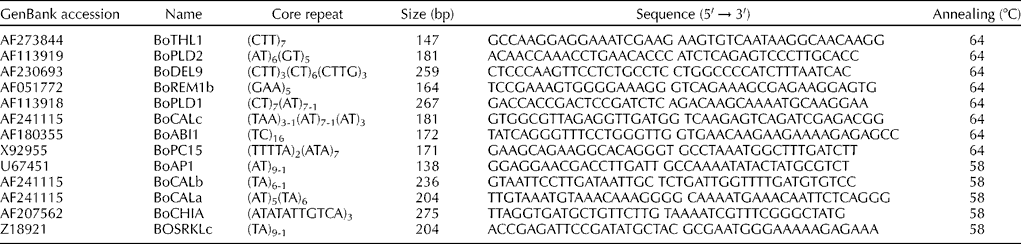
Total genomic DNA was extracted from young growing leaves of the plants from each accession. Frozen leaf tissues were immediately ground in liquid nitrogen. Individual DNA extractions were done using a cetyl trimethylammonium bromide (CTAB) method (Doyle and Doyle, Reference Doyle and Doyle1987). Among the 43 SSR markers developed by Tonguç and Griffiths (Reference Tonguç and Griffiths2004) from expressed sequence tags in B. oleracea, the 13 most polymorphic were chosen to perform the required analysis. The sequences of primers and optimal PCR conditions are given for each locus in Table 1.
Microsatellite core sequences and corresponding primer sequences and PCR conditions

PCR amplifications were conducted in 10 μl of a 1 × Promega buffer solution containing 30 ng DNA template, 400 nM each primer, 200 μM NTPs, 2.5 μM MgCl2, 0.4 μg/μl BSA and 0.04 U Taq polymerase. The forward primers were labelled with one of the three fluorochrome moieties [FAM, 6-carboxyfluorescein; HEX, hexachloro-6-carboxyfluorescein or NED, 7′,8′-benzo-5′-fluoro-2,4,7-trichloro-5-carboxyfluorescein (Applied Biosystems)].
After a denaturating step of 5 min at 94°C, the samples were processed through 30 cycles consisting of 30 s at 94°C, 30 s at an optimal annealing temperature and 50 s at 72°C. The last elongation step was lengthened to 10 min. PCR products were separated with an ABI 3730 DNA sequencer (Applied Biosystems) and the fragments were sized by means of a ladder labelled with a fourth fluorochrome (ROX, 6-carboxy-X-rhodamine).
Data were analysed using the GeneMapper software (Version 3.0, Applied Biosystems).
Population parameters
GenAlEx6 software (Peakall and Smouse, Reference Peakall and Smouse2006) was used to estimate allele number (Na) and expected heterozygosity (He). Because population sample sizes were comparable, Na was a fairly unbiased measure of diversity. A global estimate of fixation index (F is; Weir and Cockerman, Reference Weir and Cockerham1984), measured using the PowerMarker 3.23 software (Liu and Muse, Reference Liu and Muse2004), was used to estimate the inbreeding level within populations. The polymorphism information content (PIC) was computed for each SSR locus according to Botstein et al. (Reference Botstein, White, Skolnick and Davis1980).
Nei's (Reference Nei1978) genetic distance was calculated using the TFPGA software program (Miller, Reference Miller1997). A cluster diagram was constructed based on these distances by the unweighted pair-group method using arithmetic averages (UPGMA; Sneath and Sokal, Reference Sneath and Sokal1973) with the UPGMA treesearching algorithm of the software. A 1000 replicate distance matrices were bootstrapped (Felsenstein, Reference Felsenstein1985) to evaluate the robustness of the trees.
To quantitatively evaluate the ability of the SSR set to assign each individual plant to the correct variety, an assignment test based on genotype frequencies (Piry et al., Reference Piry, Alapetite, Cornuet, Paetkau, Baudouin and Estoup2004) was performed with the Geneclass2 software, using standard Nei's genetic distance and a Monte Carlo resampling approach (1000 simulations, α = 0.01) for probability computation (simulation algorithm according to Paetkau et al., Reference Paetkau, Slade, Burden and Estoup2004).
Results
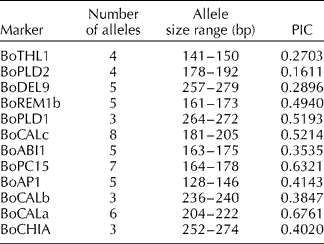
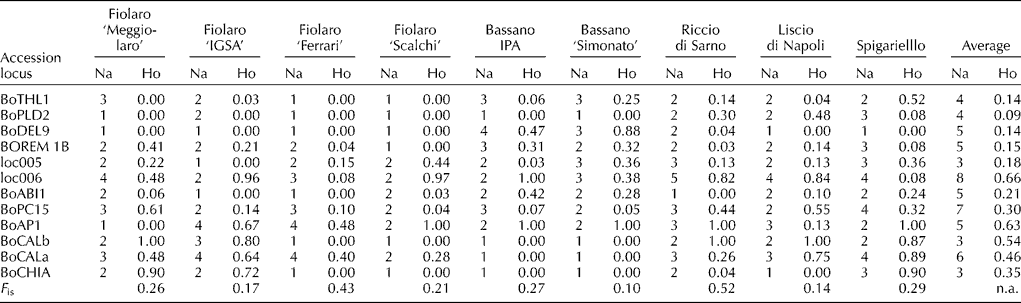
Twelve SSR primer pairs previously developed by Tonguç and Griffiths in B. oleracea (Reference Tonguç and Griffiths2004) were successfully tested over 308 plants, equally distributed among four selections of ‘Broccolo fiolaro’, two selections of ‘Broccolo di Bassano’, three cultivars cultivated in southern Italy (‘Broccolo Spigariello’, ‘Broccolo Riccio di Sarno’ and ‘Cavolo Broccolo Liscio di Napoli’) and a population of ‘Brussels sprouts’ (see Materials and methods). The electropherogram quality was very high with a low incidence of stutter bands and poly-A artefacts. One additional primer combination (BOSRKLc) gave poor amplification and was not considered in the analysis. The 12 loci revealed a total of 58 alleles in the 9 broccoli accessions. The number of alleles per locus varied among these markers, ranging from 3 (BoCALb, BoCHIA, BoPLD1) to 8 (BoCalc), with an average of 4.8. As a measure of the informativeness of microsatellites, the average PIC value was 0.42, within the range 0.16 (BoPLD2) to 0.67 (BoCALa) (Table 2). When comparing microsatellite loci according to the different repeat motifs, those with a high AT content had the highest PIC values, while the 3- and 4-bp motif markers had the lowest number of alleles and PIC values (Table 2). These results are consistent with those reported by Schlotterer and Tautz (Reference Schlotterer and Tautz1992). Since broccoli populations are prevalently allogamous, the F is can be used as a measure of inbreeding related to the genetic variability of populations. The total F is values for the studied populations are reported in Table 3. The values ranged between 0.14 and 0.29 with the exception of ‘Broccolo fiolaro sel. Ferrari’ and ‘Broccolo Riccio di Sarno’, which presented values above 0.40 as an indication of a high level of inbreeding. The number of alleles and observed heterozygosity are reported in Table 3.
Number of alleles, allele size range and polymorphism information content (PIC) of the analysed simple sequence repeat loci

Allele number (Na) and observed heterozygosity (Ho) for each simple sequence repeat locus; fixation index (F is) for each accession analysed

n.a., Not available.
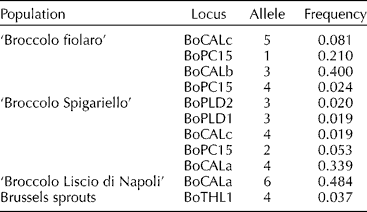
The number of unique alleles in a population (private allelic richness) is a simple measure of genetic distinctiveness (Table 4). Four loci (BoCALc, BoPC15, BoCALb and BoPC15) displayed private alleles in ‘Broccolo fiolaro’ genotypes. Two of them were rather rare with a frequency below 0.10, but the other two loci, with a frequency of 0.20 and 0.40, respectively, could be diagnostic for cultivar identification. A similar figure was observed in ‘Spigariello’ and ‘Liscio di Napoli’, particularly at locus BoCAla where alleles four and six, respectively, had a frequency above 0.30. As expected, Brussels sprouts exhibited the highest level of genetic distinctiveness with two out of three private alleles showing high frequency of 0.40 and 0.45, respectively.
Summary of private alleles by population

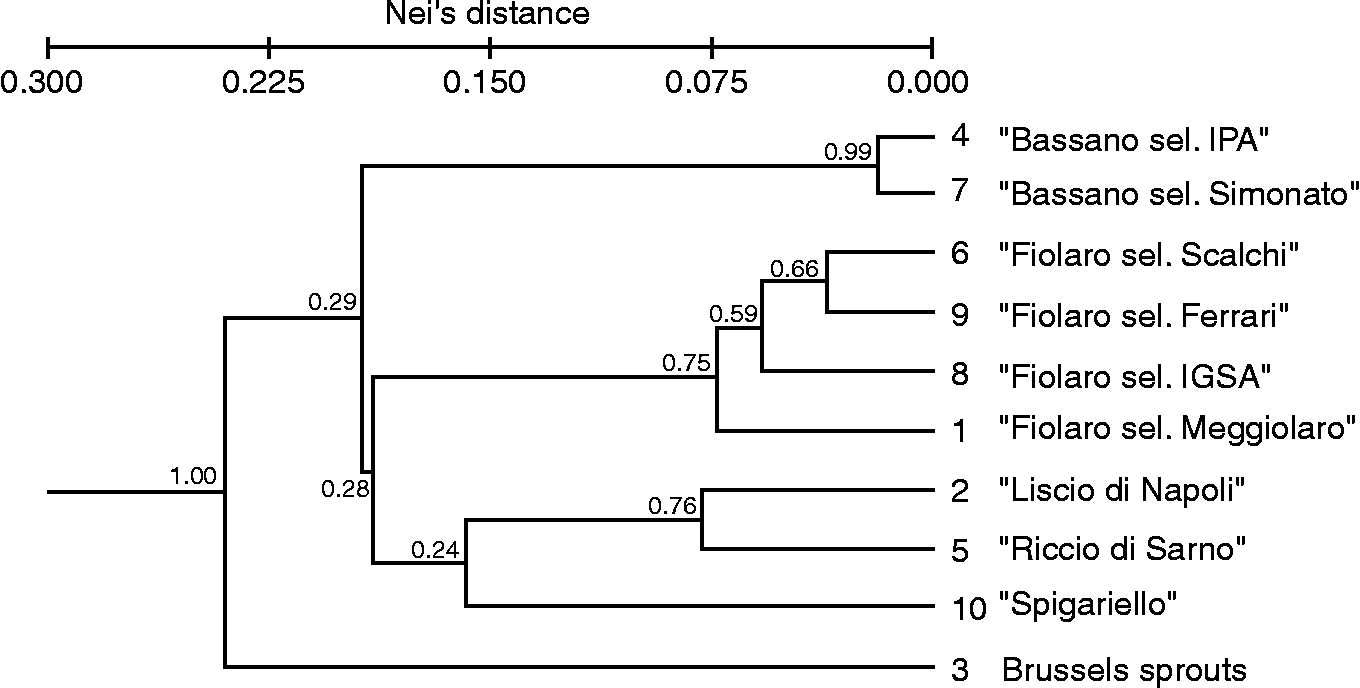
Nei's genetic distance was used to estimate genetic relationships among accessions (Nei, Reference Nei1972). The values ranged between 0.07 and 0.69, with the lower values indicating a closer genetic relationship.
Cluster analysis of genetic distance discriminated accessions into three well-supported groups that clearly reflected the accession origins (Fig. 2). The first group included ‘Broccoli di Bassano’ accessions. The second subgroup contained the ‘Broccolo fiolaro’ selections and was easily distinguished from the genotypes cultivated in southern Italy (‘Broccolo riccio di Sarno’, ‘Broccolo Spigariello’ and ‘Cavolo Liscio di Napoli’).
Cluster diagram based on genetic distance calculated from 58 microsatellite marker alleles of 10 B. oleracea genotypes. Bootstrap proportion of similar replicates after 1000 permutations are indicated at the nodes.

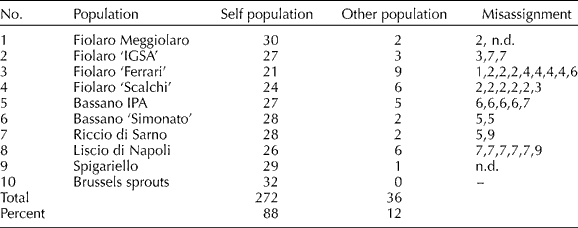
The assignment test (Table 5) showed that 272 plants (88%) could be assigned to the correct populations (α = 0.01), 34 (11%) were misassigned to another population in the panel and the remaining 2 individuals could not be placed, being too divergent from any other group. We observed that most of the misassigned individuals were relocated in different selections of the same main group (‘Fiolaro’, ‘Bassano’ and southern groups, respectively); hence the total percentage of correct assignment tends towards 100% when each of these groups is considered as a whole.
Summary of population assignment test to ‘self’ or ‘other’ population

Note the misassignments are mainly within the ‘Broccolo fiolaro’ and ‘Broccolo di Bassano’ accessions (the numbers refer to populations, n.d. = not determined).
Discussion
In wealthier nations there is a risk that old locally appreciated plant populations and varieties are weeded out because of their relatively minor economic importance in the wider farming context. This is the case for some horticultural species, the knowledge and use of which are generally related to local traditions. The Mediterranean area has been recognized as a centre of origin for several Brassicaceae vegetable crops, most of which were selected in previous centuries. In this study, we focused our attention on ‘Broccolo fiolaro’, which is an endangered type for a small cropping area in north-eastern Italy. In fact, a few growers now select their own seed plants, so there is a risk of it being substituted or imitated by similar crops. The traditional methods for cultivar identification, based on non-molecular approaches, fall short in supporting the identity protection of such varieties, especially when overlapping phenotypically. On the basis of the data obtained by this survey, we showed that their identification can benefit from the progress of the genomic characterization of economically relevant plant species by a cost-effective approach.
In this study, we genetically analysed nine local broccoli accessions that are differently appreciated for their edible parts (e.g. corymbs of ‘Broccolo di Bassano’ and south-Italian varieties, leaves and sprouts of ‘Broccolo fiolaro’). Our dataset of microsatellite polymorphism revealed a robust level of genetic distinctness in some cultivars and the extensive presence of private alleles in four varieties, despite a significant degree of heterozygosity for some loci. This analysis highlighted the genetic distinction of ‘Fiolaro’ selections from the other cultivars and the distribution of polymorphisms confirmed the geographical origin of the other varieties. Nevertheless, the bootstrap analysis failed to support the phylogenetic arrangement of the three main groups (‘Bassano’, ‘Fiolaro’ and southern groups, respectively) to each other; hence the unexpected relationship between the ‘Broccolo fiolaro’ accessions and the southern varieties resulting from clustering should be approached with special caution. Rather, the weak association between the three groups (in particular between ‘Bassano’ and ‘Fiolaro’, being geographically related) combined with the high F is values found may reflect the effects of strong inbreeding from an original genetic pool, which was highly diverse. Indeed, the four selections of ‘Fiolaro’ were moderately differentiated populations according to the classification by Hartl and Clark (Reference Hartl and Clark1997), since F st values ranged between 0.05 and 0.15. This may be due to farmers' breeding practices over time, which have fixed genetic traits in accordance with the peculiar morphological features of the cultivar.
The assignment of several (88%) single plants to the correct cultivars demonstrated that the cluster analysis of multiple SSR markers is effective in discriminating among broccoli cultivars and can circumvent the caveat of partial genetic overlapping between subpopulations in a highly diverse and outcrossing species. Conversely, the high inbreeding level detected in one ‘Fiolaro’ selection (Ferrari) underlined the risks related to the narrow genetic base of specific varieties. Thus, this research emphasizes the opportunity to reinforce the traditional methods for variety identification with molecular approaches, in order to preserve the homogeneity of both phenotypic and organoleptic features, support conservative selection programmes and, at the same time, protect the genetic variability in the whole population.
Acknowledgements
We thank Provincia di Vicenza for the financial support.