Implications
The aim of this study was to clarify the influence of several incubation conditions (IC) for eliminating the negative effects of high altitude (HA) on the symmetrical development of bilateral morphological traits in broilers. Deviations from developmental stability in broilers affect subsequent development by negatively affecting components important for broiler performance and meat production, particularly in high-altitude regions. The highland regions of the world are unlikely to produce high-quality commercial broilers because of the high metabolism of the embryo, but this tendency can be counteracted by activating epigenetic adaptation to altitude by several practices employed during incubation at HA.
Introduction
Incubation conditions influence embryonic development in broilers; therefore, IC must be optimised to meet the requirements for embryonic development at different embryonic stages. The most important IC affecting the development and morphological traits of embryos are incubation temperature (Decuypere and Mitchels, Reference Decuypere and Bruggeman1992) and oxygen (O2) concentration (Lourens et al., Reference Lourens, Van den Brand, Heetkamp, Meijerhof and Kemp2007). A deviation of only 1°C from the optimum incubation temperature has a strong effect on embryonic development relative to the duration of the temperature during embryogenesis. Thus, during the pre-hatch period, this effect may cause modifications in body functions (Tzschentke and Plagemann, Reference Tzschentke and Halle2006; Tzschentke and Halle, Reference Tzschentke and Plagemann2009).
Oxygen provides a continuity of metabolic functions in the cells of living organisms. Although the concentration of O2 in air at any altitude is the same (21%), the barometric pressure decreases as the partial O2 pressure progressively decreases with altitude. Decreased oxygen availability due to reduced partial O2 pressure at HA causes hypoxia, which represents a reduction and insufficiency of O2 levels in the cells and tissues of living organisms and the failure to support their normal functions (Carreau et al., Reference Carreau, Hafny‐Rahbi, Matejuk, Grillon and Kieda2011).
Hypoxia caused by HA or O2 levels⩽17% during incubation negatively affects the development of the embryo, particularly when eggs from sea-level hens are incubated at HA (Giussani et al., Reference Giussani, Salinas, Villena and Blanco2007; Lourens et al., Reference Lourens, Van den Brand, Heetkamp, Meijerhof and Kemp2007). Giussani et al. (Reference Giussani, Salinas, Villena and Blanco2007) reported that the greatest depressive effect on embryonic growth was at day 20 of incubation because of the low uptake of yolk resources when eggs obtained from sea-level hens were incubated at HA. However, the adverse effect of hypoxia can vary based on the age of the embryo and the critical window in the development of different systems. For example, hypoxia occurring in early developmental stages may have substantially different effects (Decuypere and Bruggeman, Reference Decuypere and Mitchels2007) than hypoxic conditions occurring in a late embryonic stage coinciding with a 60% increase in oxygen consumption in the embryo from internal pipping to hatching (Visschedijk, Reference Visschedijk1968).
Asymmetry is defined as deviations from symmetrical growth on the right and left sides for any bilateral trait (Yang et al., Reference Yang, Dunnington and Siegel1997). Four genes responsible for the asymmetrical development of traits control both sides (left and right) of a bilaterally symmetrical trait during gastrulation and the neurula stages in chick embryos (Yost, Reference Yost1995). The developmental stability of bilateral traits depends on many factors, such as genetic structure (Yang et al., Reference Yang, Dunnington and Siegel1997), environmental stress conditions (Helle et al., Reference Helle, Suorsa, Huhta and Hakkarainen2010), age and sex (Campo et al., Reference Campo, Gil, Davila and Munoz2005). Although symmetry is generally expected to grow at equal rates under optimum conditions, the right and left sides of a bilateral trait do not grow at equal rates under negative environmental conditions or stress in each of the pre- and post-hatch developmental periods (Eriksen et al., Reference Eriksen, Haug, Torjesen and Bakken2003; Helle et al., Reference Helle, Suorsa, Huhta and Hakkarainen2010). The deviations from perfect symmetry are determined with stress indicators; fluctuating asymmetry (FA) is the most commonly recommended method of measuring developmental instability (Knierim et al., Reference Knierim, Van Dongen, Forkman, Tuyttens, Špinka, Campo and Weissengruber2007). In addition to developmental stability indicators, allometric growth can be considered when investigating the effect of IC on the developmental stability of bilateral traits. Allometric growth is the relationship between the left and the right side of any bilateral morphological trait (Gould, Reference Gould1966) and demonstrates whether one side is growing at a faster rate than that of the other side for a given trait.
Studies suggest that a deviation of +0.7°C from the optimum incubation temperature or an O2 concentration of 23.5% can eliminate the negative effects of hypoxia caused by HA (1720 m) for optimum embryo development when the incubation temperature is ⩾39.0°C (Janke et al., Reference Janke, Tzschentke and Boerjan2004; Lourens et al., Reference Lourens, Van den Brand, Heetkamp, Meijerhof and Kemp2007) and the O2 concentration is ⩽17% (Lourens et al., Reference Lourens, Van den Brand, Heetkamp, Meijerhof and Kemp2007). Therefore, for hatching eggs obtained from sea level (2 m) and incubated at 1720 m, this study investigated the effects of high incubation temperature and O2 supplementation at different embryonic age intervals on morphological traits during the pre-hatch period and on morphological traits, developmental stability and allometric growth during the early post-hatch period in broilers.
Material and methods
The YYU Animal Use and Care Committee (permit number 2016-04) approved this study.
Experimental design
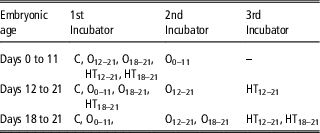
A total of 720 hatching eggs from 45-week-old Ross 308 broiler breeders were obtained from a breeder company (Ege Tav, İzmir, Turkey, at sea level, 2 m). All eggs were divided into six experimental IC groups, with six replicates per group (20 eggs/replicate/group), and incubated at HA (1720 m, Van, Turkey); the experimental design is presented in Table 1. The experiment was conducted in three different incubators assigned to the IC groups (Table 1). One incubator (the control) was maintained at 37.8°C, 21% O2 and 65% relative humidity (RH) from days 1 to 18 of incubation and at 36.8°C, 21% O2 and 75% RH from days 19 to 21 of incubation. The eggs in the second incubator were exposed to 23.5% O2 for 1 h daily from either days 0 to 11 (O0–11), days 12 to 21 (O12–21), or days 18 to 21 of incubation (O18–21). The eggs in the third incubator were maintained at 38.5°C either from incubation days 12 to 21 high temperature (HT12–21) or from incubation days 18 to 21 (HT18–21). At the beginning of the experiment, five of the groups were placed in the control incubator, whereas the O0–11 group was placed in the 2nd incubator. The O0–11 group was transferred to the control incubator from the O2-supplemented incubator, and the O12–21 group was placed in the 2nd incubator and exposed to O2 supplementation at day 12 of incubation. The HT12–21 group was placed in the 3rd incubator. The O18–21 and HT18–21 groups were placed in the 2nd and 3rd incubators, respectively, at incubation day 18. The temperature and RH were maintained at 37.8°C and 65% RH for all treatment groups from days 1 to 18 of incubation and at 36.8°C, 21% O2 and 75% RH from days 19 to 21 of incubation, except for the time points/days of treatment. During incubation, the measured average values of RH, temperature and barometric pressure for the control, HT and O-supplemented incubators were 59.3%, 37.6°C, and 621.8 mm Hg; 57.9%, 37.5°C, and 622.4 mm Hg; and 58.7%, 38.5°C, and 621.9 mm Hg, respectively.
The design of the experiment

C=control; O0–11=23.5% O2 supplementation between days 0 and 11 of embryo development; O12–21=23.5% O2 supplementation between days 12 and 21 of embryo development; O18–21=23.5% O2 supplementation between days 18 and 21 of embryo development; HT12–21=38.5°C high incubation temperature between days 12 and 21 of embryo development; HT18–21=38.5°C high incubation temperature between days 18 and 21 of embryo development.
Because of the feather-sexable characteristic of Ross broilers, males and females of day-old hatched chicks were determined by the type of feathering from the relationship between the coverts (upper layer) and the primaries (lower layer) found on the outer half of the wing; fast-feathering chicks were females, and slow-feathering chicks were males. After sex determination, randomly selected, newly hatched female and male chicks from each of the IC groups (24 chicks/group) were removed from the hatcher. From hatching to day 6, the chicks were raised at a brooding temperature of 32°C for the first 3 d and at 29°C from days 4 to 6 at an altitude of 1720 m. A starter diet of 23.7% CP and 3.028 kcal metabolic energy/kg and water were provided ad libitum to chicks from days 0 to 6.
Morphological traits, relative asymmetry, fluctuating asymmetry and allometric growth
A total of 60 embryos from the groups (10 embryos/group) were randomly selected at each measured embryonic age in the pre-hatch period. The lengths of the embryo/chick (cm) and beak (mm), head diameter (mm) and bilateral traits (mm) were measured using a digital calliper (±0.01 mm) during the pre-hatch (days 13, 15, 17, 19 and 21 of embryonic age) and early post-hatch (days 0, 3 and 6 of chick age) periods. For the early post-hatch period, a total of 72 chicks/sex/group were randomly selected at hatching, and after measuring the lengths of the chick, beak and head diameter, and the left and right lengths of the face, middle toe and shank were measured as described by Babacanoğlu and Yalçın (Reference Babacanoğlu and Yalçın2015), with three replications for each measurement age. Head diameter was measured from ear hole to the same ear hole. Face length was measured from ear hole to the merged point of the beak. Beak length was measured from the beak hole to merged point of the beak. Middle toe length was measured from the beginning of the third toe to the tip of the nail on the third toe. Shank length was measured from the top of the tarsometatarsus to the tip of the nail on the third toe.
Relative asymmetry (RA) was the absolute value of asymmetry of the left (L) minus the right (R) divided by the size of the mean left and right lengths of the face, middle toe and shank: RA=(|L–R|/[(L+R)/2])×100; the mean RA (MRA) was calculated as the average RA of these measured lengths (Babacanoğlu and Yalçın, Reference Babacanoğlu and Yalçın2015). The FA was defined from the absolute differences between sides IR and LI for all bilateral traits in each age. Relative FA was calculated by [2| R-L|/(R+L)]×100. Furthermore, the allometric growth equation ‘Y=aX b ’ was used to describe the relationship between the left and the right face, middle toe or shank lengths, where ‘a’ is the allometric constant or intercept, and ‘b’ is the allometric growth coefficient. For allometric growth, if b>1, then L is growing at a faster rate than R, and vice versa; for isometric growth, if b=1, the left and right traits have similar growth rates.
Statistical analyses
The data for the traits were subjected to ANOVA, with IC group and age (on days 13, 15, 17, 19 and 21 of embryonic age) during the pre-hatch period or IC group, age (on days 0, 3 and 6 of chick age) and sex during the early post-hatch period; the interactions between or among them in each period were determined as the main effects using the GLM procedure from the JMP statistics package (SAS Institute Inc., 2007). A second analysis for the interactions between IC and age with respect to beak length was performed for the O18–21 and H18–21 groups on incubation days 19 and 21 in the pre-hatch period. The significant interactions were subjected to one-way ANOVA with the subclasses as the main effects (IC-chick age) to obtain means comparison of the chick and beak lengths of each group at the same age and with the main effects (IC-chick age-sex) to obtain the MRA means comparison of each IC group at the same age and sex. A two-way ANOVA was used with main factors bird (random) and side (fixed) and their interaction in each sex for the existence of FA. Significant variation between sides indicated variation in directional asymmetry (DA), whereas a significant interaction (bird×side) indicated significant FA (in the absence of anti-asymmetry) and error variance (measurement error) (Van Dongen et al., Reference Van Dongen, Molenberghs and Matthysen1999; Campo et al., Reference Campo, Gil, Davila and Munoz2005). Repeatability (r) of examined bilateral traits was estimated from the difference |L-R| at each age. Three repeated measurements per group were obtained in both sides from a sample size of 42 of each sex for a two-way ANOVA with bird (with degrees of freedom (df)=41) and side (with df=1) and the interaction (with df=41) as the main factors. Least-square means were compared using the Tukey test. Pairwise Pearson’s correlation coefficients were used to evaluate the relationships between the morphological traits and the RA and MRA of the measured bilateral lengths.
Results
Morphological traits
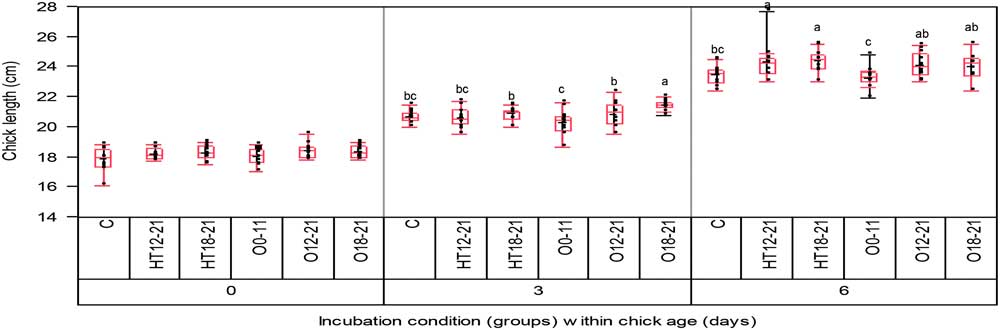
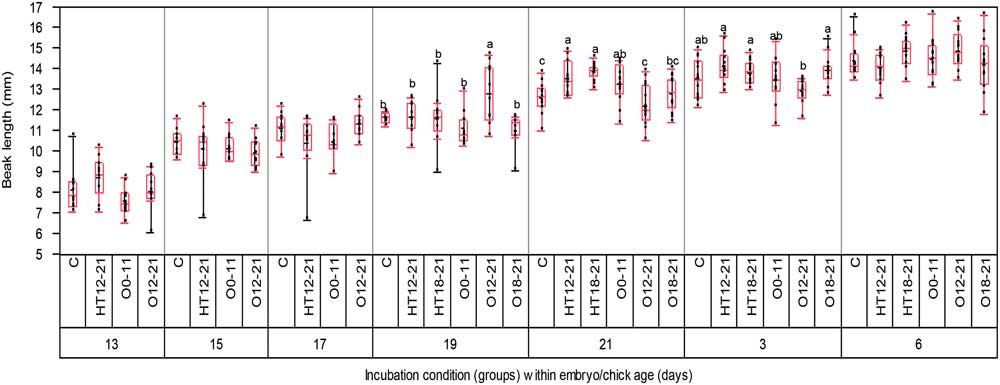
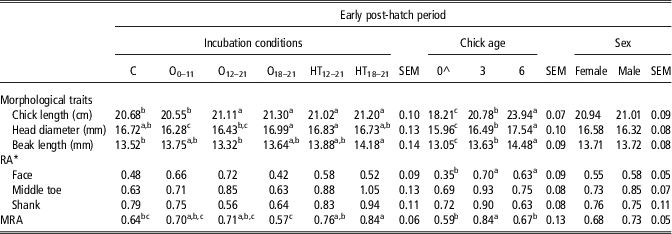
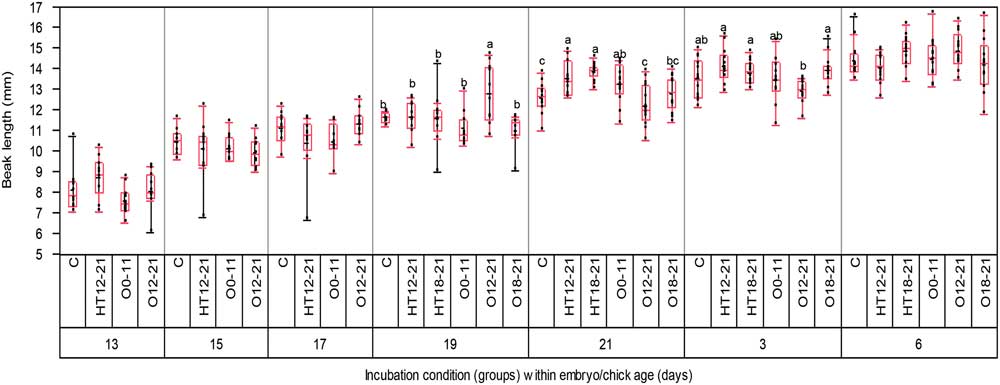
Incubation conditions significantly affected the lengths of the embryos, with shorter lengths observed in the O0–11 group than those of all the other groups, but the lengths of the O0–11 embryos did not differ from those of the HT and control groups (Table 2). The embryo length increased linearly with embryonic age (P<0.05). Chicks in all the O and HT groups, except those in O0–11, were longer than those in the control (Tables 3 and 4). The interaction between IC and chick age with respect to chick length was significant and resulted in longer 6-day-old chicks in the O and HT groups, but the O0–11 group was similar to the control, demonstrating the shortest chick lengths at ages days 3 and 6 (Figure 1). The head diameter did not differ in the IC groups during the pre-hatch period (Table 2). The largest head diameter was measured on day 19 of embryonic age and the smallest head diameter on day 13 of embryonic age (Table 2). The head diameter decreased significantly in the O0–11 group but did not differ from that of the O12–21 group, which was similar to the diameters of the control and HT18–21 groups during the post-hatch period (Tables 3 and 4). Embryo age and IC×embryo age were significant with respect to beak length during the pre-hatch period (Table 2). The IC×embryo age interaction resulted in the longest beak in the H12–21 group on day 19 of embryonic age and the shortest beak in the O12–21 group at hatch (Figure 2).
Chick length with respect to incubation conditions within chick age during the early post-hatch period. C=control; O0–11=23.5% O2 supplementation between days 0 and 11 of embryo development; O12–21=23.5% O2 supplementation between days 12 and 21 of embryo development; O18–21=23.5% O2 supplementation between days 18 and 21 of embryo development; HT12–21=38.5°C high incubation temperature between days 12 and 21 of embryo development; HT18–21=38.5°C high incubation temperature between days 18 and 21 of embryo development. a,b,c Means with no common superscripts differ significantly (P<0.05).

Beak length with respect to incubation conditions within embryo/chick age during the pre- and post-hatch periods. C=control; O0–11=23.5% O2 supplementation between days 0 and 11 of embryo development; O12–21=23.5% O2 supplementation between days 12 and 21 of embryo development; O18–21=23.5% O2 supplementation between days 18 and 21 of embryo development; HT12–21=38.5°C high incubation temperature between days 12 and 21 of embryo development; HT18–21=38.5°C high incubation temperature between days 18 and 21 of embryo development. a,b,c Means for different groups within same age with no common superscripts differ significantly (P<0.05).
The effects of incubation conditions and embryo age on embryo length, head diameter and beak length of broiler embryos during the pre-hatch period

SEM=standard error of means; C=control; O0–11=23.5% O2 supplementation between days 0 and 11 of embryo development; O12–21=23.5% O2 supplementation between days 12 and 21 of embryo development; O18–21=23.5% O2 supplementation between days 18 and 21 of embryo development; HT12–21=38.5°C high incubation temperature between days 12 and 21 of embryo development; HT18–21=38.5°C high incubation temperature between days 18 and 21 of embryo development.
a,b,c,d,e Means within a row with different superscripts differ significantly at P<0.05.
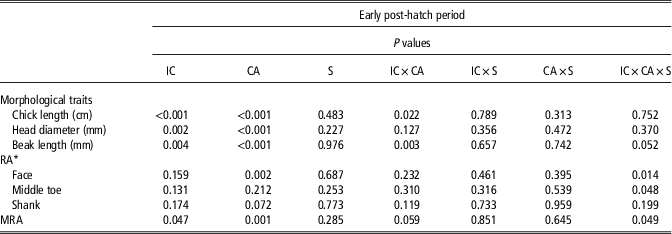
The effects of incubation conditions, chick age and sex on chick length; head diameter; beak length; relative asymmetry of the face, middle toe and shank lengths; and mean relative asymmetry of the broiler chicks during the early post-hatch period

SEM=standard error of means; C=control; O0–11=23.5% O2 supplementation between days 0 and 11 of embryo development; O12–21=23.5% O2 supplementation between days 12 and 21 of embryo development; O18-21=23.5% O2 supplementation between days 18 and 21 of embryo development; HT12–21=38.5°C high incubation temperature between days 12 and 21 of embryo development; HT18–21=38.5°C high incubation temperature between days 18 and 21 of embryo development; RA=relative asymmetry; MRA=average of RA measurements of the shank, face and middle toe lengths.
a,b,c Means within a row with different superscripts differ significantly at P<0.05.
^ Repeated during pre-hatch period.
* RA=[|L−R|/(L+R)/2]×100, where L=left and R=right.
ANOVA for the effects of incubation conditions, chick age and sex on chick length; head diameter; beak length; relative asymmetry of the face, middle toe and shank lengths; and mean relative asymmetry of the broiler chicks during the early post-hatch period

IC=incubation condition; CA=chick age; S=sex; IC×CA=interaction between incubation condition and chick age; IC×S=interaction between incubation condition and sex; CA×S=interaction between chick age and sex; IC×CA×S=interaction among incubation condition, chick age and sex; RA=relative asymmetry; MRA=mean of RA measurements of the shank, face and middle toe lengths.
* RA=[|L−R|/(L+R)/2]×100, where L=left and R=right.
During the early post-hatch period, the shortest beak length was obtained in the O12–21 group and the longest beak length in the H18–21 group, leading to a significant interaction between IC and chick age (Tables 3 and 4). This interaction occurred because the O12–21 group at age day 3 had the shortest beak, which did not differ from that of the control and O0–11 group (Figure 2). All examined morphological traits increased linearly with chick age (Table 3). The effect of sex was not significant for any measure evaluated during the early post-hatch period (Table 4).
Relative asymmetry, fluctuating asymmetry and allometric growth
Relative asymmetry
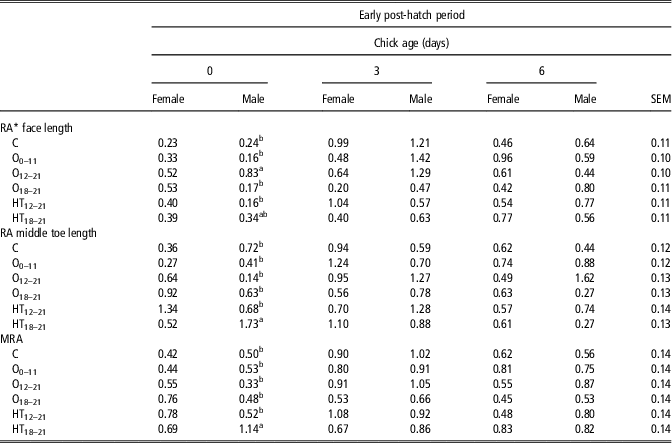
Incubation condition and chick age had no effect on the RA of the face, middle toe or shank lengths, but the face length was greater at age days 3 and 6 than at hatch (Tables 3 and 4). However, the interactions among IC, chick age and sex for the RA of the face and middle toe lengths and the MRA were significant (Tables 4 and 5). The HT18–21 group had the highest MRA, which was significantly different from the values measured for the O18–21 group and control (Tables 3 and 4). The MRA of the bilateral traits decreased significantly at hatch and on day 6 of age compared with that on day 3 of age (Tables 3 and 4). At hatch, male chicks of the HT18–21 had a significantly higher MRA than that of male chicks in the O groups, H12-21 group and control (Table 5), but the MRA did differ in female chicks from the IC groups at hatch (Table 5). The MRA of male chicks was similar to the MRA of female chicks at age days 3 and 6 for all IC groups (Table 5). On day 0, the RA of the face lengths of the male chicks from the O12–21 and HT18–21 groups was higher than that of the other groups, but the RA of face length of the male chicks from HT18–21 was not different from that of the other groups (Table 5). The RA of the middle toe length was the highest in the male chicks from the HT18–21 at hatch (Table 5).
The relative asymmetry of the face and middle toe lengths and mean relative asymmetry with respect to incubation conditions between chick age and sex during the early post-hatch period in broiler

SEM=standard error of means; C=control; O0–11=23.5% O2 supplementation between days 0 and 11 of embryo development; O12–21=23.5% O2 supplementation between days 12 and 21 of embryo development; O18–21=23.5% O2 supplementation between days 18 and 21 of embryo development; HT12–21=38.5°C high incubation temperature between days 12 and 21 of embryo development; HT18–21=38.5°C high incubation temperature between days 18 and 21 of embryo development; RA: Relative asymmetry; MRA=mean of RA measurements of the shank, face and middle toe lengths.
a,b Means with no common superscripts differ significantly (P<0.05).
* RA=[|L−R|/(L+R)/2]×100, where L=left and R=right of the face and middle toe lengths.
Fluctuating asymmetry
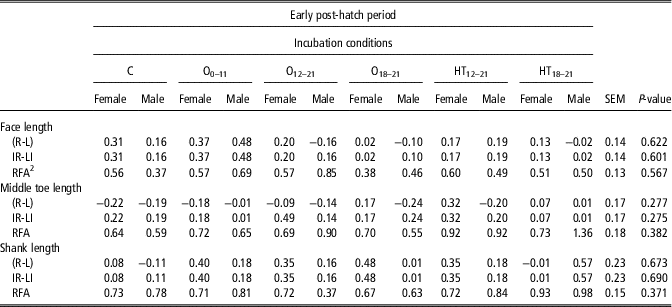
The repeatability of examined bilateral traits was calculated: face length, r=0.86, 0.41 and 0.59; middle toe length, r=0.73, 0.40 and 0.62; and shank length, r=0.66, 0.62 and 0.68 at days 0, 3 and 6 of age, respectively. The FA for the three bilateral traits was determined in females and males from all the groups. The face length had the lowest IR-LI in the females from the O18–21 group and in the males from the HT18–21 group (Table 6). In males, the middle toe length had the lowest IR-LI in the O0–11 and HT18–21 groups compared with both sexes from the other groups (Table 6). The FA of shank lengths of the females from the HT18–21 group and the males from the O18–21 group was lower than that of the other groups (Table 6). The relative FA of all the bilateral traits was not different in both sexes of all the groups (Table 6).
Least-square mean values of incubation conditions and sex for bilateral asymmetryFootnote 1 of the face, middle toe and shank lengths of broiler chicks during the early post-hatch period

SEM=standard error of means; C=control; O0–11=23.5% O2 supplementation between days 0 and 11 of embryo development; O12–21=23.5% O2 supplementation between days 12 and 21 of embryo development; O18–21=23.5% O2 supplementation between days 18 and 21 of embryo development; HT12–21=38.5°C high incubation temperature between days 12 and 21 of embryo development; HT18–21=38.5°C high incubation temperature between days 18 and 21 of embryo development; R=right side; L=left side; RFA=relative fluctuating asymmetry.
1 Fluctuating asymmetry: random differences between the left and right sides, P<0.05.
2 RFA: [2|R-L|/(R+L)]×100.
Allometric growth
Parameter estimates of bilateral traits were based on allometric growth curves generated according to IC and chick age during the early post-hatch period. The IC groups showed significant developmental instability due to allometric growth. Allometric growth was observed at all ages for each of the bilateral traits. The equations for face lengths were: L=1.058.R0.974**, L=1.185.R0.930**, L=1.074.R0.974**, L=1.238.R0.919**, L=1.072.R0.973** and L=1.208.R0.929** for the control, O0–11, O12–21, O18–21, HT12–21 and HT18–21 groups, respectively, and L=0.757.R0.739**, L=1.088.R0.629** and L=1.009.R0.662** for days 0, 3 and 6 of age, respectively (**P<0.01). The growth of the left face length v. that of the right face length was slower in all the IC groups (b<1; P<0.001). A similar pattern was observed for shank length. The equations for shank lengths were L=1.007.R0.998**, L=1.018.R0.991**, L=1.054.R0.981**, L=1.138.R0.955**, L=1.035.R0.986** and L=1.212.R0.931** for the control, O0–11, O12–21, O18–21, HT12–21 and HT18–21 groups, respectively, and L=0.921.R0.702**, L=1.597.R0.513** and L=0.985.R0.714** for the ages of 0, 3 and 6 days, respectively (**P<0.01). The right middle toe length showed a faster growth rate than that of the left middle toe length (b>1; P<0.001) in the O and HT groups at days 18 to 21 of incubation (b=0.967 for O18–21; b=0.908 for H18–21). However, the length of the right middle toe in the control (L=1.057.R1.022**), O0–11 (L=1.023.R1.009**), O12–21 (L=1.015.R1.067**) and HT12–21 (L=1.033.R1.010**) groups showed a slower growth rate than that of the left middle toe length, but the O0–11 and HT12–21 groups were evaluated as isometric based on b values approaching 1. The middle toe length equations were L=0.871.R0.676**, L=1.515.R0.426** and L=1.535.R0.488** for chicks at age 0, 3 and 6 days, respectively. Allometric growth did not change for the bilateral morphological traits when analysed for the effect of sex (b<1; P>0.05).
Correlations
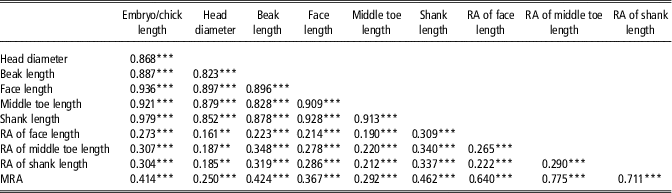
Positive correlations were determined for the head diameters, all lengths, and the RA of the lengths and the MRA (Table 7). Embryo/chick length correlated with head diameter (r=0.868); beak length (r=0.887); lengths of the face (r=0.936), middle toe (r=0.921) and shank (r=0.979); RA of the face length (r=0.273), RA of the middle toe length (r=0.307); and RA of the shank length (r=0.304) and their MRA (r=0.414) (Table 7).
The correlations coefficient among morphological traits, relative asymmetries and mean relative asymmetry of the bilateral lengths in broiler embryos and chicks

RA=relative asymmetry; MRA=mean of RA measurements of the shank, face, and middle toe lengths.
**P<0.01; ***P<0.001.
Discussion
Embryo/chick body length and the lengths of bilateral traits can be measured as an index of growth (Willemsen et al., Reference Willemsen, Everaert, Witters, De Dmit, Debonne, Verschuere, Garain, Berckmans, Decuypere and Bruggeman2008). We observed a positive effect of +0.7°C from the optimum incubation temperature during the second half of embryonic development on chick length at an altitude of 1720 m. This report is the first to investigate the effect of HT. Furthermore, when eggs from sea level were incubated at HA, the length of chicks increased significantly with 1-h, daily 23.5% O2 supplementation to the incubator/hatcher from days 12 or 18 of incubation until hatching compared with the lengths measured for the control and the 1-h, daily 23.5% O2 supplementation from days 0 to 11 of incubation. Giussani et al. (Reference Giussani, Salinas, Villena and Blanco2007) and Salinas et al. (Reference Salinas, Blanco, Villena, Camm, Tuckett, Weerakkody, Kane, Shelley, Wooding, Quy and Giussani2010) reported that chick embryo bodies lengthened when eggs from sea level were incubated at HA with O2 supplementation compared with embryo body lengths measured for eggs from sea level incubated at HA without O2. These results are consistent with those obtained in our study, which showed that chick quality and the subsequent performance of broilers was positively affected by either IC treatment from days 12 or 18 to hatch, but not from days 0 to 11 of incubation at HA. Despite differences in altitude between the studies, that is, 3600 m in the studies by Giussani et al. (Reference Giussani, Salinas, Villena and Blanco2007) and Salinas et al. (Reference Salinas, Blanco, Villena, Camm, Tuckett, Weerakkody, Kane, Shelley, Wooding, Quy and Giussani2010) and 1720 m in this study, all three studies showed that O2 plays a predominant role in controlling growth during incubation at HA by protecting the embryo against the adverse effects of hypoxia. However, we concluded that the 1-h, daily 23.5% O2 supplementation to the incubator from the beginning of incubation until the 11th day of embryonic development at HA was unsuitable for using the body length of broilers as an indicator of growth during the pre- and post-hatch periods. Growth restriction of the embryo with early O2 treatment during hypoxia (Chan and Burggren, Reference Chan and Burggren2005; Zhang and Burggren, Reference Zhang and Burggren2012) or at 1720 m in the present study might be associated with the incomplete activation of the hypothalamic-pituitary-adrenal axis of the embryo until the 11th day of incubation (Sturkie, Reference Sturkie1986), because a significant correlation between adrenocortical activities and growth restriction is described by Salinas et al. (Reference Salinas, Villena, Blanco and Giussani2011). In addition, we reached this conclusion because a depressed plasma corticosterone level is an appropriate homoeostatic response to hypoxia of the embryo at HA (3600 m) (Salinas et al., Reference Salinas, Villena, Blanco and Giussani2011). The altered plasma corticosterone levels caused by altitude differences explain how broiler chickens hatched and reared from eggs transferred from sea level to HA (2000 m) showed higher plasma corticosterone levels than those of broiler chickens at sea level or, vice versa (Hassanzadeh et al., Reference Hassanzadeh, Bozorgmeri Fard, Buyse, Bruggeman and Decuypere2004).
The head diameters of embryos exposed to the IC treatments showed a trend similar to that of the body lengths. This similarity originated from the highly significant correlations among the examined morphological traits. The development of the head of embryos declined with O2 supplementation to the incubator during the first half of embryonic development in the pre-hatch stage. A similar result for chick’ head diameter was obtained with O2 supplementation to the incubator during the second half of incubation in the post-hatch stage. These results might be related to circulation differences in the head caused by early O2 treatment, as explained by Catlin (Reference Catlin1968), who reported that tissues on the right side close to the shell receive O2 by diffusion through the shell when eggs are incubated in an O2-enriched environment; this finding demonstrates that early O2 treatment may not eliminate the detrimental effects of hypoxia. From days 12 to 21 of incubation, the HT group, which might have been affected by increases in surface temperature on the head depending on the HT, showed the largest head diameter, because the chicks were exposed to the longest temperature treatment in the present study. Morita et al. (Reference de Morita, De Almeida, Junior, Vicentini, van den Brand and Boleli2016) concluded that surface temperature on the head was higher than that on other body regions from days 13 to 21 of incubation at a HT of 39°C. At day 19 of incubation, a significant increase in the head diameter of the embryos was observed compared with the head diameters of embryos of other ages examined in this study. This effect might be related to the onset of pulmonary respiration in the embryo, which is an important period considering that heat production by the embryo nearly doubles (Janke et al., Reference Janke, Tzschentke and Boerjan2004).
The results led to an interaction between the main effects on beak length in the present study, which are similar to the findings reported by Chan and Burggren (Reference Chan and Burggren2005) who observed an interaction between hypoxic exposure and development stages with respect to beak length. The late HT treatment caused a significant increase in beak length, particularly in the post-hatch period in this study. Consequently, the effects of the O and HT treatments due to hypoxia caused by HA on increased beak length with age can be assessed as age-specific effects at both developmental stages. Zhang and Burggren (Reference Zhang and Burggren2012) reported no selective hypoxic effects on the growth of the beak. This evaluation is confirmed by evidence provided by Giussani et al. (Reference Giussani, Salinas, Villena and Blanco2007) and Salinas et al. (Reference Salinas, Blanco, Villena, Camm, Tuckett, Weerakkody, Kane, Shelley, Wooding, Quy and Giussani2010).
Hypoxic exposure during critical periods alters developmental trajectories and modifies the phenotype of the embryo (Dzialowski et al., Reference Dzialowski, von Plettenberg Elmonoufy and Burggren2002; Zhang and Burggren, Reference Zhang and Burggren2012). During the last 4 days of incubation, not only did HT exhibit the opposite effect on the allometric growth of the middle toe compared with that observed for the other IC groups, but the relative FA of the middle toe length in male chicks in the same group also increased significantly at HA. This difference between female and male broiler chicks in the HT18–21 group was confirmed by the highest MRA based on the RA of the middle toe length of the male chicks on day 0 of age (at hatch). A similar HT effect on the RA of leg length from day 17 to hatch was reported by Oviedo-Rondón et al. (Reference Oviedo-Rondón, Small, Wineland, Christensen, Mozdziak, Koci and Mann2008). Morphological asymmetry has been suggested as a potential animal welfare indicator because it reflects the ability of an individual to cope with challenges that may affect its growth during a certain period of life (Broom, Reference Broom2006). At hatch, the male broiler chicks from HT altered their morphological developmental trajectories to cope with the challenges of hypoxia caused by HA during the last four days of incubation in the present study. Dzialowski et al. (Reference Dzialowski, von Plettenberg Elmonoufy and Burggren2002) also reported that the timing of hypoxic exposure plays a role in determining the morphological trajectories of developing chicken embryos; thus, more research is required to better understand hypoxic effects on the development of various phases of embryonic development, particularly during the plateau phase at HA. Because the embryo is more sensitive because of the high demand for O2 during the plateau phase (Rahn et al., Reference Rahn, Paganelli and Ar1974), developmental instability of bilateral morphological traits in male chicks from the HT18–21 group might be a result of this sensitivity in the current study. In addition, the HT treatment from days 18 to 21 of incubation led to developmental instability due to the MRA and relative FA values, and when compared with the other treatments, embryos were more sensitive to stress as indicated by the increased FA, which was likely related to increased stress hormone levels in the fertilised egg or blood (Eriksen et al., Reference Eriksen, Haug, Torjesen and Bakken2003; Helle et al., Reference Helle, Suorsa, Huhta and Hakkarainen2010). Thus, the HT treatments at HA should be performed first on day 12 of embryonic development in broilers. The examined bilateral traits induced by HA hypoxia were positively affected by HT in the second half of incubation because the chicks showed no MRA, and additionally, the RA of the bilateral traits showed nearly isometric growth. However, O2 supplementation to the hatcher during the last 4 days of incubation was more effective than HT at HA. This result is consistent with reports by Lourens et al. (Reference Lourens, Van den Brand, Heetkamp, Meijerhof and Kemp2007) who demonstrated that O2 has a greater effect on embryonic development than HT during the 3rd week of incubation. In this study, an increased growth rate caused by changes in broiler production could also parallel changes in the development of bilateral morphological traits depending on age and sex at HA. This tendency was confirmed by the increased RA of the face length of male chicks at age day 0 by incubating these eggs in an O2-enriched environment between days 12 and 21 of incubation. Nääs et al. (Reference Nääs, Sonoda, Romanini, Morello, Neves, Baracho, Souza, Menezes, Mollo, Moura and Almeida Paz2008) showed that lengths of bilateral traits correlated with their asymmetries as specific to sex and age in broilers. Random direct deviations from perfect growth symmetry are generally expected in bilateral traits when morphological development is successfully controlled as a result of both genetic and environmental conditions (Yang et al., Reference Yang, Dunnington and Siegel1997). The accelerated growth of the right side with the delayed growth of the left side of each trait can be altered by abiotic environmental conditions such as temperature and O2 during critical developmental periods of incubation, thereby changing the pattern of gene expression during critical periods (Seta and Millhorn, Reference Seta and Millhorn2004). However, the results of the current study indicated that the growth of the left side for all bilateral morphological traits compared with that of the right side was slower in all IC groups, excluding the growth rate of the middle toe length in the O treatment performed from days 18 to 21 of incubation. This result might be related to the chorioallantoic membrane mass on day 18 of incubation, because the increase in chorioallantoic membrane mass increases O2 delivery to minimise the adverse effects of hypoxia on growth (Chan and Burggren, Reference Chan and Burggren2005). As a result, optimal developmental stability of bilateral morphological traits in broiler chicks was provided by O2 supplementation during the last four days of incubation or by high temperature during the second half of incubation, thereby eliminating the adverse effects of hypoxia caused by HA.
Acknowledgements
The authors acknowledge The University of Van Yüzüncü Yıl Scientific Research Projects (2014-ZF-B222) for funding this project.
Declaration of interest
None.
Ethics statement
None.
Software and data repository resources
None.