Seed quality
Seed quality is a complex trait and comprises many different attributes describing the condition of a seed batch. These attributes include germination characteristics, dormancy, seed and seedling vigour, uniformity in seed size, normal embryo and seedling morphology, storability, absence of mechanical damage, as well as the ability to develop into a normal plant (Dickson, Reference Dickson1980; Hilhorst and Toorop, Reference Hilhorst and Toorop1997). Seed quality is largely established during seed development and maturation, as a result of, often complex, interactions between the genome and the environment. This mechanism is part of the normal adaptation of plants to a varying environment and is aimed at maximizing the probability of successful offspring (Huang et al., Reference Huang, Schmitt, Dorn, Griffith, Effgen, Takao, Koornneef and Donohue2010a).
The practical definition of seed quality is determined by the end user and, therefore, will differ substantially, depending on the use of seeds as propagule or commodity. For farmers or plant growers, high-quality seeds are those seeds that germinate and produce seedlings to a high percentage under a wide range of field conditions. On the other hand, high-quality seeds for use in the food industry may be seeds with a high starch or oil content or oil seeds with a specific fatty acid composition (Nesi et al., Reference Nesi, Delourme, Brégeon, Falentin and Renard2008). As a result of the complexity of seed quality, testing for seed quality in order to predict subsequent behaviour in the field is troublesome and at best an ‘educated guess’ (Powell, Reference Powell and Basra2006). Therefore, seed producers have included additional attributes to the term ‘seed quality’, such as usable plants and seedling and crop establishment. The trait ‘usable plants’ is one of the most important attributes of seed quality used by seed producers and plant growers.
Seed companies may enhance seed quality at all the different steps of the production process. At present, seed companies try to obtain the best possible seeds mainly by varying the time and method of harvest, but especially by post-harvest treatments such as cleaning, sorting, coating and priming, and controlling the storage conditions. Besides these methods, seed quality can also be improved by controlling the production environment. It is known that seed quality is largely acquired during seed development and particularly during the maturation phase, by the successive acquisition of seed-quality attributes such as germinability, desiccation tolerance, dormancy, vigour and longevity (Harada, Reference Harada, Larkins and Vasil1997), and that the environmental conditions during development have a huge impact on these different seed-quality aspects. As a result, the quality of different seed lots that are produced in different seasons and locations will vary. Nevertheless, influencing production environments is difficult, even under greenhouse conditions. Furthermore, since there is a complex interaction between the genome and the environment during development, the final effect of the environment on seed quality is difficult to determine and still largely unknown. However, the genetic component of the interaction between the genome and the environment can be investigated and this variation in genetic adaptation provides great opportunities for seed companies to breed for seed quality.
Natural variation of seed quality
Although abundant natural variation for seed quality exists, genetic components of seed quality have hardly been used in breeding programmes. Exploiting natural variation is a powerful way to find the genes influencing important physiological processes. There are several ways to exploit natural variation but, in plants, quantitative trait locus (QTL) analysis of recombinant inbred line (RIL) populations have been widely used. In this type of analysis, linkage is sought between the genetic variety and the variation of phenotypic traits in the different RILs (Alonso-Blanco and Koornneef, Reference Alonso-Blanco and Koornneef2000), whereby the QTLs represent the genomic regions explaining the phenotypic variation that is identified in this way. QTL analysis in plants has revealed a long list of genomic regions with variation for a broad variety of phenotypes, and several of the genes underlying these QTLs have been cloned (reviewed in Salvi and Tuberosa, Reference Salvi and Tuberosa2005; Gupta et al., Reference Gupta, Mathur, Solanke, Sharma, Kumar, Vyas, Khurana, Khurana, Tyagi and Sharma2009). The complex nature of ‘seed quality’ makes it a perfect trait to decipher with a QTL approach, particularly because different aspects of seed quality have been proven to have sufficient natural variation to tackle this subject. In Arabidopsis thaliana, different QTLs were found for dormancy (Bentsink et al., Reference Bentsink, Hanson, Hanhart, Blankestijn-de Vries, Coltrane, Keizer, El-Lithy, Alonso-Blanco, de Andres, Reymond, van Eeuwijk, Smeekens and Koornneef2010) and several germination characteristics (Clerkx et al., Reference Clerkx, El-Lithy, Vierling, Ruys, Blankestijn-De Vries, Groot, Vreugdenhil and Koornneef2004; Galpaz and Reymond, Reference Galpaz and Reymond2010; Joosen et al., Reference Joosen, Kodde, Willems, Ligterink, van der Plas and Hilhorst2010). In tomato, different QTLs for germination characteristics under stress (Foolad et al., Reference Foolad, Zhang and Subbiah2003, Reference Foolad, Subbiah and Zhang2007) and for seed size (Doganlar et al., Reference Doganlar, Frary and Tanksley2000) have been identified. In Medicago truncatula several QTLs were identified for germination at extreme temperatures (Dias et al., Reference Dias, Brunel-Muguet, Dürr, Huguet, Demilly, Wagner and Teulat-Merah2011) and germination and seedling growth under osmotic stress (Vandecasteele et al., Reference Vandecasteele, Teulat-Merah, Morere-LePaven, Leprince, LyVu, Viau, Ledroit, Pelletier, Payet, Satour, Lebras, Gallardo, Huguet, Limami, Prosperi and Buitink2011). Zeng et al. (Reference Zeng, Guo, Xu, Yasukumi, Zhu and Qian2006) have identified QTLs for seed storability in rice, and in lettuce QTLs have been identified for several germination characteristics, including thermoinhibition (Argyris et al., Reference Argyris, Truco, Ochoa, Knapp, Still, Lenssen, Schut, Michelmore and Bradford2005, Reference Argyris, Dahal, Hayashi, Still and Bradford2008).
In spite of these and other studies on specific aspects of seed quality, an integrated study of the genetics of seed quality is still lacking. A more systematic approach, studying genetic populations differing in seed- and seedling-quality parameters, will provide valuable insight into the involvement of genes, and the processes they control, in the acquisition of seed quality. Until now, only a few QTL positions have been cloned and characterized in detail, but if genes or gene sets associated with seed-quality parameters become available, they may be used as diagnostic tools to assess seed quality, in marker-assisted breeding, or in genetic modification to enhance seed quality.
High-throughput phenotyping
With the fast developments in sequencing technologies that enable fast and relatively inexpensive genotyping and expression analysis, accurate phenotyping is now becoming the limiting step in studying large genetic populations. To overcome this problem several initiatives have been taken to enhance phenotyping, mainly by implementing high-throughput phenotyping platforms for analysing plant morphology, as in the Australian ‘High Resolution Plant Phenomics Centre’ (HRPPC) (http://www.plantphenomics.org/hrppc) and the Lemnatec systems (www.lemnatec.de) that perform fully automated imaging and subsequent data extraction of growing plants. For the systemic analysis of the different aspects of seed quality, several (semi-)automatic phenotyping systems can be used. One of the most important aspects is the (semi-) automatic scoring of germination. Several methods to achieve this have been reported by Dell'Aquila (Reference Dell'Aquila2009) and, more recently, by Joosen et al. (Reference Joosen, Kodde, Willems, Ligterink, van der Plas and Hilhorst2010), who introduced the GERMINATOR package. Furthermore, analysis of seedling shape and growth with systems like that of the previously mentioned HRPPC and Lemnatec, and analysis of the root architecture of seedlings with programs such as EZ-Rhizo (Armengaud et al., Reference Armengaud, Zambaux, Hills, Sulpice, Pattison, Blatt and Amtmann2009) and Roottrace (French et al., Reference French, Ubeda-Tomas, Holman, Bennett and Pridmore2009), will become important for the in-depth analysis of seed quality.
Genetical genomics: -omics QTL analysis
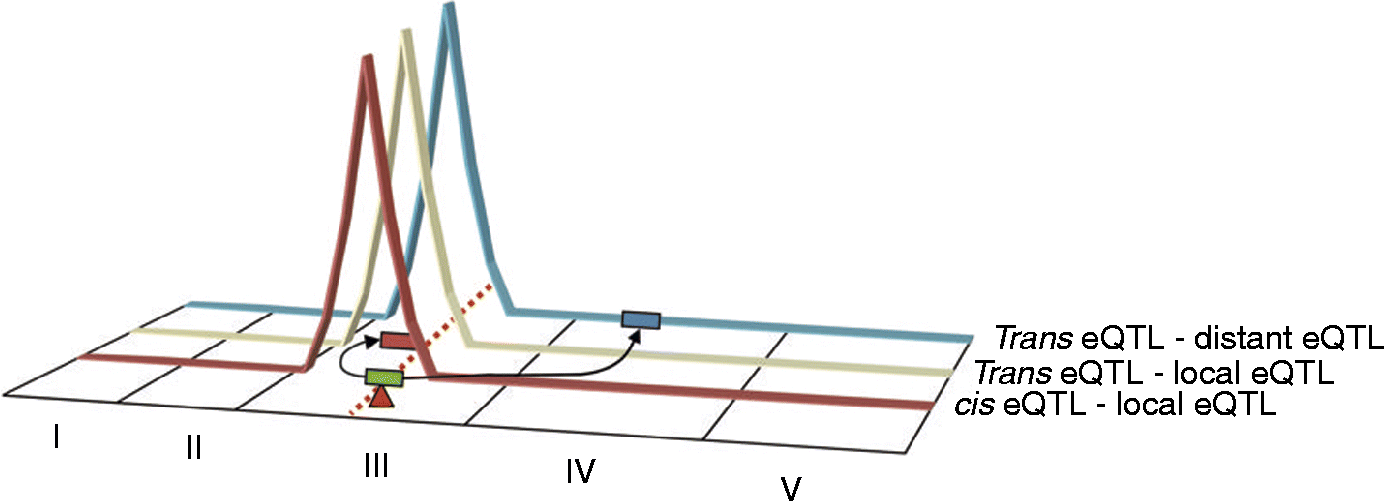
Fine mapping of QTL is a crucial step for plant breeding as genetic drag should be minimized in every step during the breeding process. Furthermore, cloning of genes responsible for the QTL can provide great insight into the molecular mechanism underlying the adaptation. Although the causal genes for several seed-quality QTLs have been cloned and more are under way (Salvi and Tuberosa, Reference Salvi and Tuberosa2005), fine-mapping and ultimate cloning of these genes is very labour-intensive and time-consuming. Therefore classical QTL analysis can be considered as a low-throughput technique. To help in candidate gene selection the concept of genetical genomics was developed (Jansen and Nap, Reference Jansen and Nap2001). In genetical genomics the traditional QTL analysis is combined with genome-wide expression profiling for all the lines of a RIL population. With these data, a QTL profile of the expression of every gene can be calculated, just like those for traditional physiological traits. The derived QTLs are termed ‘expression QTLs’ (eQTLs). When performed in organisms with a sequenced genome, the combination of the eQTL together with the known physical position of the genes provides great opportunities for dissecting molecular regulation. eQTLs are divided into two groups: cis- and trans-eQTLs. Cis-eQTLs are those eQTLs of which the causal polymorphism is inside the gene for which expression differences are measured. In contrast, trans-eQTLs are eQTLs of which the causal polymorphism is not in the gene for which expression differences are measured, but, for example, in a transcription factor causing these expression differences (West et al., Reference West, Kim, Kliebenstein, Van Leeuwen, Michelmore, Doerge and St. Clair2007) (Fig. 1). Although the expression is measured at the gene level, QTL mapping remains dependent on the recombination frequency in the population, resulting in a confidence interval for each QTL that often comprises a large genomic region. If a transcription factor, causing expression differences for a specific gene, is located inside the confidence interval of the eQTL for this particular gene, this trans-eQTL cannot be distinguished from a cis-eQTL for the same gene. Therefore, in the absence of allele-specific expression data (see elsewhere in this review), it is better to use the terms ‘local’ and ‘distant’ eQTL (Rockman and Kruglyak, Reference Rockman and Kruglyak2006) (Fig. 1).
Classification of eQTLs. Allelic variation of the gene under study results in a cis-eQTL. All other eQTLs are trans, but trans-eQTLs of genes located in the confidence interval of the eQTL cannot be distinguished from cis-eQTLs in the absence of allele-specific expression information and therefore both should be termed ‘local eQTLs’. (A colour version of this figure can be found online at http://journals.cambridge.org/ssr).

Several eQTL analyses have been conducted so far for Arabidopsis (Keurentjes et al., Reference Keurentjes, Fu, Terpstra, Garcia, van den Ackerveken, Snoek, Peeters, Vreugdenhil, Koornneef and Jansen2007; West et al., Reference West, Kim, Kliebenstein, Van Leeuwen, Michelmore, Doerge and St. Clair2007), but also for different crop species such as maize (Shi et al., Reference Shi, Uzarowska, Ouzunova, Landbeck, Wenzel and Lübberstedt2007), wheat (Jordan et al., Reference Jordan, Somers and Banks2007) and barley (Potokina et al., Reference Potokina, Druka, Luo, Wise, Waugh and Kearsey2008). Besides transcriptomic data, the data of other -omics technologies can also be used for the genetical genomics approach, for example proteomics (pQTL) and metabolomics (mQTL). The power and possibilities of large-scale untargeted metabolomics analysis of genetic populations to reveal mQTLs are reviewed by Keurentjes (Reference Keurentjes2009) and pQTL studies are described by Bourgeois et al. (Reference Bourgeois, Jacquin, Cassecuelle, Savois, Belghazi, Aubert, Quillien, Huart, Marget and Burstin2011) and references therein. An overview of the different aspects of genetical genomics in more depth is given by Joosen et al. (Reference Joosen, Ligterink, Hilhorst and Keurentjes2009) and Kliebenstein (Reference Kliebenstein2009).
A good example of the power of genetical genomics is described by Jiménez-Gómez et al. (Reference Jiménez-Gómez, Wallace and Maloof2010) who identified EARLY FLOWERING 3 (ELF3) as the most likely candidate gene affecting the shade avoidance response of Arabidopsis in a Bayreuth-0 × Shahdara population. To narrow down to ELF3 as the only candidate causal gene for a shade avoidance QTL identified in this population, they combined publicly available datasets to perform network analysis with eQTL data (West et al., Reference West, Kim, Kliebenstein, Van Leeuwen, Michelmore, Doerge and St. Clair2007), co-expression analysis (Winter et al., Reference Winter, Vinegar, Nahal, Ammar, Wilson and Provart2007) and functional classification (Ashburner et al., Reference Ashburner, Ball, Blake, Botstein, Butler, Cherry, Davis, Dolinski, Dwight, Eppig, Harris, Hill, Issel-Tarver, Kasarskis, Lewis, Matese, Richardson, Ringwald, Rubin and Sherlock2000). Drastically narrowing down the number of candidate genes with this kind of approach is feasible for all QTLs where the polymorphism(s) in the causal gene result in differential gene expression of the same gene. However, this approach will not be applicable to the cases where the alleles causal for a QTL do not have an effect on gene expression, but on activity or stability of the encoded protein. In these cases, other levels, such as pQTL or mQTL, and other data types, including protein–protein interactions and metabolic pathways, can help to narrow down to the causal genes.
One of the limitations of a standard genetical genomics approach is that it is only performed for a single developmental stage or environment. Since most phenotypes are not solely the result of the status of a transcriptome, proteome or metabolome at a single stage, it is difficult to choose the most suitable developmental stage. Li et al. (Reference Li, Breitling and Jansen2008) have proposed a generalized genetical genomics approach, which enables the analysis of several environments or developmental stages in a single -omics QTL approach. This enriches the genetical genomics approach with the potential to study the dynamics of molecular networks. This type of molecular network is complementary to co-expression networks (Usadel et al., Reference Usadel, Obayashi, Mutwil, Giorgi, Bassel, Tanimoto, Chow, Steinhauser, Persson and Provart2009) that are based on the correlation of gene expression. Co-expressed genes over a wide range of developmental stages and environments have a likelihood of being involved in the same biochemical/developmental pathways, as was shown elegantly for the co-expression network built from microarray data of 138 seed-related samples (Bassel et al., Reference Bassel, Lan, Glaab, Gibbs, Gerjets, Krasnogor, Bonner, Holdsworth and Provart2011). In addition to the information gained about genetic mechanisms underlying natural variation in gene expression, eQTL studies also provide additional genotypic marker information of every used line by the detection of transcript-derived markers (TDMs) (Potokina et al., Reference Potokina, Druka, Kearsey, Somers, Langridge and Gustafson2009) in the form of single-feature polymorphisms (SFPs) (Borevitz et al., Reference Borevitz, Liang, Plouffe, Chang, Zhu, Weigel, Berry, Winzeler and Chory2003) or gene expression markers (West et al., Reference West, Van Leeuwen, Kozik, Kliebenstein, Doerge, St. Clair and Michelmore2006) without the need for additional experiments.
The use of microarrays and next-generation sequencing in genetical genomics
All performed eQTL studies in plants so far have used microarray analysis or, in one case, cDNA-amplified fragment length polymorphism (AFLP) mapping (Vuylsteke et al., Reference Vuylsteke, Van Den Daele, Vercauteren, Zabeau and Kuiper2006). Depending on the type of array used, this allows the determination of the expression of most of the genes expressed for the studied organism. Most microarrays will give an expression value per gene, providing the basic information needed for an eQTL study. However, more information can be obtained when using whole genome tiling arrays (Mockler and Ecker, Reference Mockler and Ecker2005). Since these cover the whole genome, independent of any prior annotation of genes, they will be able to analyse expression of genes independent of their annotation. This will not only provide additional information about the expression of unannotated genes (Laubinger et al., Reference Laubinger, Zeller, Henz, Sachsenberg, Widmer, Naouar, Vuylsteke, Scholkopf, Ratsch and Weigel2008; Matsui et al., Reference Matsui, Ishida, Morosawa, Mochizuki, Kaminuma, Endo, Okamoto, Nambara, Nakajima, Kawashima, Satou, Kim, Kobayashi, Toyoda, Shinozaki and Seki2008), but also about alternative splicing (Zhang et al., Reference Zhang, Byrnes, Gal, Li and Borevitz2008), as was shown by an eQTL study for Caenorhabditis elegans which revealed heritable variation in alternative splicing (Li et al., Reference Li, Breitling, Snoek, van der Velde, Swertz, Riksen, Jansen and Kammenga2010a). For Arabidopsis thaliana a so-called SNPtile microarray was developed (Zhang et al., Reference Zhang, Richards and Borevitz2007). Besides tiling of the whole genome, this array also harbours probes for 250,000 SNPs (single nucleotide polymorphisms) and 130,000 CCGG sites for methylation analysis. A genetical genomics study using these arrays will reveal the genetic variation for gene expression and alternative splicing, but with a few additional hybridizations this array will also provide data about allele-specific expression (ASE) and epigenetic polymorphisms. ASE studies help in distinguishing cis-eQTLs from local trans-eQTLs, where the physical position of the gene under study is within its eQTL confidence interval (see Fig. 1). For this purpose, genome-wide allele-specific expression is measured in an F1 hybrid of the two parents of the RIL population under study. Since both parental alleles share the same genetic background in F1 hybrids and are therefore equally exposed to trans-acting factors, any difference in expression from the two different alleles will be the result of a cis-eQTL (Zhang and Borevitz, Reference Zhang and Borevitz2009).
Although eQTL studies using microarrays give a wealth of information, RNA sequencing for eQTL studies will increase even further the information that can be gained from this type of study. The first eQTL studies using RNA sequencing have already been performed to study gene expression in Drosophila and humans (McManus et al., Reference McManus, Coolon, Duff, Eipper-Mains, Graveley and Wittkopp2010; Montgomery et al., Reference Montgomery, Sammeth, Gutierrez-Arcelus, Lach, Ingle, Nisbett, Guigo and Dermitzakis2010; Pickrell et al., Reference Pickrell, Marioni, Pai, Degner, Engelhardt, Nkadori, Veyrieras, Stephens, Gilad and Pritchard2010). These studies show the power of this approach for the analysis of variation in transcription, and a more detailed analysis of variation in splicing and allele-specific expression in comparison to whole-genome tiling arrays. A further advantage of using sequence-based techniques for genetical genomics studies is that they do not rely on the availability of microarrays for the species under study. In fact, one doesn't even need any prior sequence knowledge.
In conclusion, genetical genomic approaches will prove to be especially powerful for model species with a known genome, such as Arabidopsis and tomato, but recent and future developments in second- and third-generation sequencing technologies (Metzker, Reference Metzker2010; Zhang et al., Reference Zhang, Chiodini, Badr and Zhang2011) will open the path towards a successful implementation of genetical genomics approaches for non-model organisms (Varshney et al., Reference Varshney, Nayak, May and Jackson2009).
Integrating genetical genomics with genome-wide association studies
An attractive complement to QTL mapping with the use of RIL populations is linkage disequilibrium (LD) or genome-wide association (GWA) mapping. GWA mapping connects particular ancestral haplotypes to variations in quantitative traits (Hamblin et al., Reference Hamblin, Buckler and Jannink2011; Ingvarsson and Street, Reference Ingvarsson and Street2011). In GWA studies, mapping populations are used that consist of several hundred to several thousand (wild) accessions or breeding lines. Compared to mapping with the help of RIL populations, where the variation is confined to the two parents of the population, the variation found in a GWA population is much higher. Furthermore, because of the large number of meiosis occurrences in the history of a GWA population, the resolution (linkage decay) of the mapping can be as small as 1–300 kb (Buckler and Gore, Reference Buckler and Gore2007) which is in huge contrast with the sometimes 10–30 cM confidence intervals for RIL populations, possibly harbouring thousands of genes. As a result of the increased resolution in GWA studies, the number of markers needed in these studies also increases dramatically. This number varies per species and/or population, but can rise up to 750,000 for various maize land races (Sorkheh et al., Reference Sorkheh, Malysheva-Otto, Wirthensohn, Tarkesh-Esfahani and Martínez-Gómez2008). Besides the obvious advantages of GWA studies, they have the problem that they generate false positives due to the often complex population structure that can strongly influence the estimation of linkage disequilibrium. Although several approaches have been developed for taking the population structure into account, it is still under debate how to distinguish between false and true positives (Shriner et al., Reference Shriner, Vaughan, Padilla and Tiwari2007). Furthermore, GWA studies have a reduced statistical power of finding associations as compared to RIL populations, especially for rare alleles that are only found in a few accessions. Besides this reduced power it is often also difficult to detect non-functional alleles in GWA studies (Atwell et al., Reference Atwell, Huang, Vilhjalmsson, Willems, Horton, Li, Meng, Platt, Tarone, Hu, Jiang, Muliyati, Zhang, Amer, Baxter, Brachi, Chory, Dean, Debieu, de Meaux, Ecker, Faure, Kniskern, Jones, Michael, Nemri, Roux, Salt, Tang, Todesco, Traw, Weigel, Marjoram, Borevitz, Bergelson and Nordborg2010; Brachi et al., Reference Brachi, Faure, Horton, Flahauw, Vazquez, Nordborg, Bergelson, Cuguen and Roux2010), caused by the fact that genes can become inactive through many independent deletions, insertions or other kinds of null mutations. Despite these disadvantages and the problems described in the literature for GWA studies in humans, GWA studies in plants have resulted in promising results, as shown in Arabidopsis (Atwell et al., Reference Atwell, Huang, Vilhjalmsson, Willems, Horton, Li, Meng, Platt, Tarone, Hu, Jiang, Muliyati, Zhang, Amer, Baxter, Brachi, Chory, Dean, Debieu, de Meaux, Ecker, Faure, Kniskern, Jones, Michael, Nemri, Roux, Salt, Tang, Todesco, Traw, Weigel, Marjoram, Borevitz, Bergelson and Nordborg2010; Baxter et al., Reference Baxter, Brazelton, Yu, Huang, Lahner, Yakubova, Li, Bergelson, Borevitz, Nordborg, Vitek and Salt2010; Brachi et al., Reference Brachi, Faure, Horton, Flahauw, Vazquez, Nordborg, Bergelson, Cuguen and Roux2010; Li et al., Reference Li, Huang, Bergelson, Nordborg and Borevitz2010b) and rice (Huang et al., Reference Huang, Wei, Sang, Zhao, Feng, Zhao, Li, Zhu, Lu, Zhang, Li, Fan, Guo, Wang, Wang, Deng, Li, Lu, Weng, Liu, Huang, Zhou, Jing, Lin, Buckler, Qian, Zhang, Li and Han2010b).
Concluding remarks
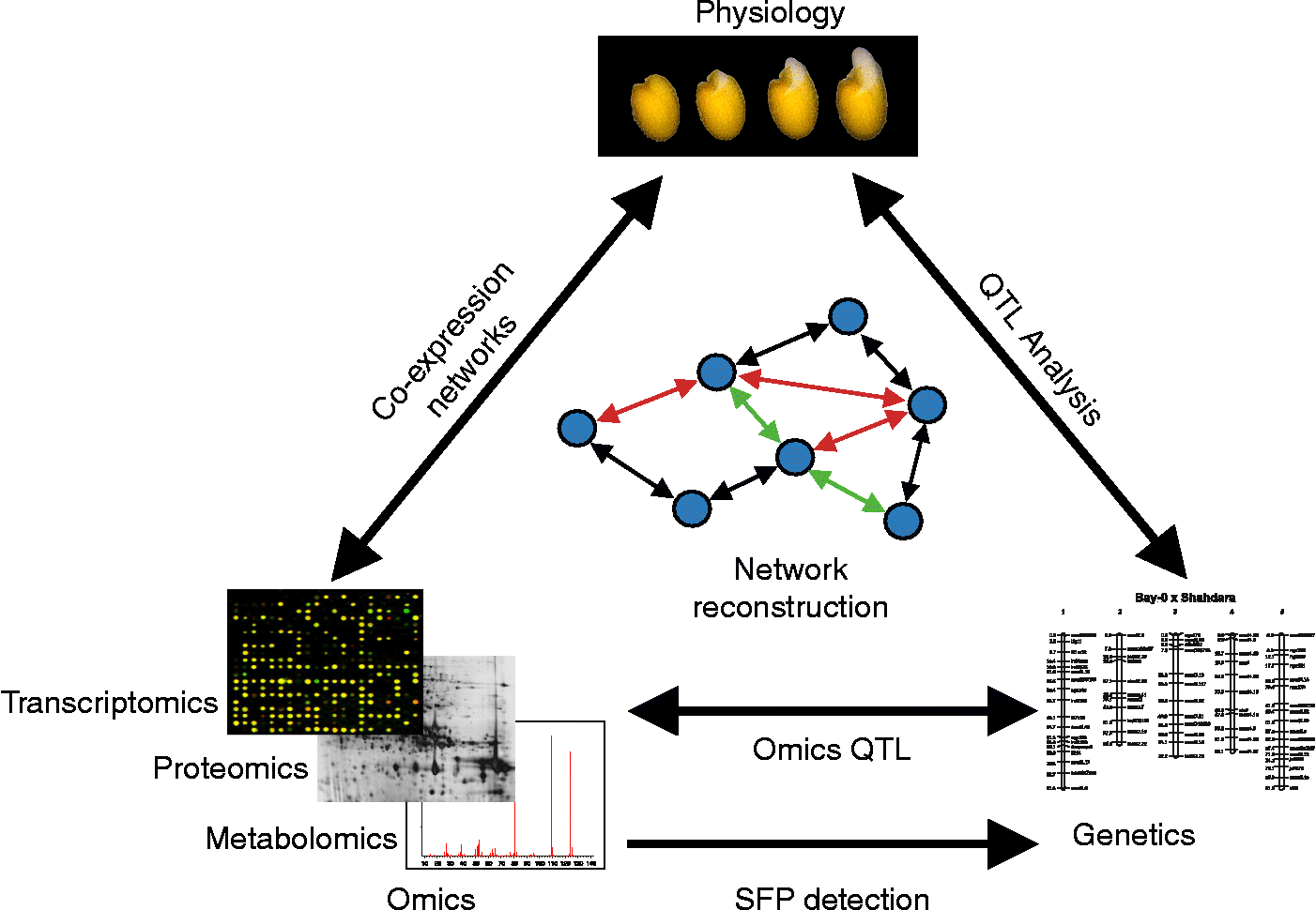
Since the introduction of the concept of genetical genomics, it has proved to be a powerful approach to dissect genetic variation. The genetical genomics studies in model species help us to understand the extent of genetic variation and support the development of tools for analysis. This information may then be applied to studies in crop species. The integration of extensive phenotyping with detailed genetic maps and -omics tools, such as transcriptomics, proteomics and metabolomics, will enable accurate and detailed network reconstruction and subsequent unravelling of the genetic and molecular mechanisms underlying complex physiological traits (Fig. 2).
The power of genetical genomics. Phenotypic data of experimental populations can be linked with genotype information to perform quantitative trait locus (QTL) analysis. Omics data linked with phenotypic data can be used to build phenotype related co-expression networks. Omics data can be used to extract genotypic data [single-feature polymorphism (SFP) detection]. The combination of -omics data with genotypic data results in -omics QTL and, finally, all the information together can be used for the reconstruction of molecular networks involved in the physiological phenomenon under study. (A colour version of this figure can be found online at http://journals.cambridge.org/ssr).

Recent developments in inexpensive high-throughput sequencing and development of tiling microarrays combined with SNP probes and CCGG sites for methylation will soon create opportunities to extend genetical genomics to unravel the genetic variation for gene expression, alternative splicing, allele-specific expression and epigenetic polymorphisms, and allow eQTL mapping in GWA studies. We believe that the combination of global analysis of phenotypic variation and its associated alleles in GWA studies, with a more detailed and in-depth study in populations obtained from experimental crosses, such as RIL populations, will be of tremendous value for unravelling the molecular mechanisms underlying complex traits such as seed quality. Ultimately, this increased knowledge about the factors influencing seed quality will open new possibilities for the breeding industry to understand and control the effects of the maternal environment on seed quality and, above all, allow breeding for high-quality seeds.
Acknowledgements
We greatly acknowledge funding provided by the Technology Foundation STW (W.L. and R.V.L.J.).