Introduction
Historically, schizophrenia has been regarded by many as ‘utter madness’ not amenable to understanding. Although this view has faded over the years and psychological treatments are being increasingly implemented (Bechdolf et al. Reference Bechdolf, Phillips, Francey, Leicester, Morrison, Veith, Klosterkotter and McGorry2006; Rollinson et al. Reference Rollinson, Haig, Warner, Garety, Kuipers, Freeman, Bebbington, Dunn and Fowler2007), the implications of this view continue. Schizophrenia patients, even if they have additional psychosis-unrelated severe psychological problems such as social phobia, are often deprived of psychotherapy. Treatment in many hospitals is confined to the administration of drug and occupational therapy. This is troubling because, notwithstanding the undoubtedly beneficial effects of neuroleptics on delusions, many patients show little or no symptom improvement under drugs and, even in the new era of atypical neuroleptics, medication non-compliance remains a serious problem (Lieberman et al. Reference Lieberman, Stroup, McEvoy, Swartz, Rosenheck, Perkins, Keefe, Davis, Davis, Lebowitz, Severe and Hsiao2005; Voruganti et al. Reference Voruganti, Baker and Awad2008). Cognitive behavioural therapy (CBT) and, more recently, metacognitive training for psychosis have been found to yield surplus effects on symptomatology over the effects of antipsychotics (Zimmermann et al. Reference Zimmermann, Favrod, Trieu and Pomini2005; Moritz & Woodward, Reference Moritz and Woodward2007; Lincoln et al. Reference Lincoln, Peter, Schäfer and Moritz2008b). However, such approaches are mostly implemented within a research context and not routine practice (for factors impeding the dissemination of psychological treatment, see Tarrier, Reference Tarrier2005).
The renewed interest in psychological treatments of schizophrenia is partly due to findings on cognitive biases associated with the disorder; that is, dysfunctional styles in the acquisition, processing and appraisal of delusion-neutral information (Garety & Freeman, Reference Garety and Freeman1999; Bentall et al. Reference Bentall, Corcoran, Howard, Blackwood and Kinderman2001; Bell et al. Reference Bell, Halligan and Ellis2006; van der Gaag, Reference van der Gaag2006). Whereas the psychological mechanisms of schizophrenia are far from being satisfactorily understood, several specific cognitive biases have been consistently replicated and shown to persist beyond the acute illness phase. Some of these biases are also present in biologically and psychometrically defined at-risk populations (i.e. those with high schizotypal symptoms) respectively (e.g. Van Dael et al. Reference Van Dael, Versmissen, Janssen, Myin-Germeys, van Os and Krabbendam2006; Broome et al. Reference Broome, Johns, Valli, Woolley, Tabraham, Brett, Valmaggia, Peters, Garety and McGuire2007; Ziegler et al. Reference Ziegler, Rief, Werner, Mehl and Lincoln2008). Deviances of attributional style (mono-causal reasoning and externalization; Kinderman et al. Reference Kinderman, Kaney, Morley and Bentall1992; Bentall et al. Reference Bentall, Kinderman and Kaney1994; Kinderman & Bentall, Reference Kinderman and Bentall1997, Reference Kinderman and Bentall2000; Bentall & Kaney, Reference Bentall and Kaney2005; Moritz et al. Reference Moritz, Woodward, Burlon, Braus and Andresen2007a), a bias against disconfirmatory evidence (Moritz & Woodward, Reference Moritz and Woodward2006b; Woodward et al. Reference Woodward, Moritz and Chen2006a, Reference Woodward, Moritz, Cuttler and Whitmanb, Reference Rollinson, Haig, Warner, Garety, Kuipers, Freeman, Bebbington, Dunn and Fowler2007, Reference Woodward, Moritz, Menon and Klinge2008) and especially a tendency to jump to conclusions (JTC) have received much attention in past research (Garety et al. Reference Garety, Freeman, Jolley, Dunn, Bebbington, Fowler, Kuipers and Dudley2005; Moritz & Woodward, Reference Moritz and Woodward2005; Peters & Garety, Reference Peters and Garety2006; Van Dael et al. Reference Van Dael, Versmissen, Janssen, Myin-Germeys, van Os and Krabbendam2006; Moritz et al. Reference Moritz, Woodward, Burlon, Braus and Andresen2007b; Peters et al. Reference Peters, Thornton, Siksou, Linney and MacCabe2008). A plethora of studies have revealed that patients rest decisions upon very little evidence. This may be fundamental not only to our understanding but also to the treatment of the disorder (for a review see Fine et al. Reference Fine, Gardner, Craigie and Gold2007). If patients are encouraged to weigh evidence more cautiously and collect additional pieces of evidence, this may decrease the probability of arriving at far-fetched (delusional) decisions, or help patients to contemplate them as options but not as undeniable and overarching truths (Moritz & Woodward, Reference Moritz and Woodward2007).
This line of research has been most consistently shown using the beads task in which the participant is consecutively presented with a sequence of beads drawn either from a jar that contains beads predominantly in colour A or from a jar that contains beads predominantly in colour B (Huq et al. Reference Huq, Garety and Hemsley1988). The chain of events is usually in strong favour of one of the jars. Compared to both healthy and psychiatric controls, schizophrenia patients make early, premature and incautious decisions in 40–70% of the cases. Several motivational factors have been put forward to account for JTC behaviour in the disorder. Impulsivity, poor motivation (i.e. making early decisions to shorten task duration) and memory problems have been ruled out (Dudley et al. Reference Dudley, John, Young and Over1997; Moritz & Woodward, Reference Moritz and Woodward2005). There is conflicting evidence of whether or not need for closure (i.e. problems tolerating ambiguity and unclear situations) is involved in the emergence of the effect (Bentall & Swarbrick, Reference Bentall and Swarbrick2003; Colbert et al. Reference Colbert, Peters and Garety2006; Freeman et al. Reference Freeman, Garety, Kuipers, Colbert, Jolley, Fowler, Dunn and Bebbington2006; McKay et al. Reference McKay, Langdon and Coltheart2007). Arousal and especially anxiety have been found to produce an increase in paranoid thoughts (Lincoln et al. Reference Lincoln, Peter, Schäfer and Moritz2008a) and to aggravate the JTC bias in schizophrenia patients (Mujica-Parodi et al. Reference Mujica-Parodi, Corcoran, Greenberg, Sackheim and Malaspina2002; Lincoln et al. Reference Lincoln, Peter, Schäfer and Moritz2008a).
Our group has hypothesized that JTC reflects liberal acceptance (LA; Moritz & Woodward, Reference Moritz and Woodward2004, Reference Moritz and Woodward2005; Moritz et al. Reference Moritz, Woodward and Hausmann2006, Reference Moritz, Woodward, Burlon, Braus and Andresen2007b, Reference Moritz, Woodward and Lambert2008b); that is, the acceptance threshold of patients is reduced, thereby leading to premature decisions. Using different paradigms including the beads task (Moritz & Woodward, Reference Moritz and Woodward2005; Moritz et al. Reference Moritz, Woodward, Burlon, Braus and Andresen2007b) and a variant of the ‘Who Wants to Be a Millionaire’ quiz show (Moritz et al. Reference Moritz, Woodward and Hausmann2006), we were able to show that patients base decisions on lower subjective probability ratings than controls. For example, in the quiz show paradigm, a minimal subjective probability of 54% was deemed sufficient by patients to decide on one out of four alternatives (base rate probability 25%), whereas healthy subjects had a minimal acceptance threshold of 70%.
The present study used a new paradigm with high comprehensibility. We confronted participants with relatively unknown classical paintings and asked them to rate the plausibility for each of the four alternative titles (one alternative was always correct) on a 10-point scale (from 0=impossible to 10=excellent). Because of the ambiguous nature of each item, any decision was judged as incautious and thus amounted to JTC. Subjects could decide on one title if they were certain that it was correct or reject one or more titles if they thought they were impossible. Only plausibility ratings were mandatory, whereas decisions or rejections were not. For one-third of the paintings happy music was played in the background, for another third anxiety-evoking music was played and one-third was not accompanied by any music. Mood induction has been reported to bias mood-congruent emotional responses (Bouhuys et al. Reference Bouhuys, Bloem and Groothuis1995).
We hypothesized, first, that patients with schizophrenia would display more decisions under conditions of continued uncertainty (i.e. JTC). Second, in line with prior studies we hypothesized that the decision threshold would be lowered. Third, we predicted that patients would be more easily misled by distracting cues (i.e. background music) than healthy subjects, resulting in a heightened rate of incorrect endorsement congruent with the atmosphere of the music (i.e. positive/happy versus negative/anxious mood). This hypothesis also builds on the finding that negative emotion, which is typically accompanied by higher arousal relative to other affective classes (e.g. Moritz et al. Reference Moritz, Voigt, Arzola and Otte2008b), enhances JTC in schizophrenia (Mujica-Parodi et al. Reference Mujica-Parodi, Corcoran, Greenberg, Sackheim and Malaspina2002; Lincoln et al. in press). The present study also tested several exploratory research questions and particularly investigated the impact of delusions on decision making.
Method
Participants
Twenty-seven psychiatric patients fulfilling DSM-IV criteria for schizophrenia were recruited from the University Medical Centre Hamburg Eppendorf, Department of Psychiatry and Psychotherapy, Germany. Diagnoses relied on the Structured Clinical Interview for DSM-IV (SCID) and the Mini International Neuropsychiatric Interview (MINI; Sheehan et al. Reference Sheehan, Lecrubier, Sheehan, Amorim, Janavs, Weiller, Hergueta, Baker and Dunbar1998). All schizophrenia patients currently displayed or had previously displayed paranoid beliefs. Symptom severity was assessed with the Positive and Negative Syndrome Scale (PANSS; Kay et al. Reference Kay, Opler and Lindenmayer1989). Thirty-two participants served as healthy controls. Healthy participants were recruited predominantly by advertisement; some healthy participants were recontacted after participation in other studies. Absence of diagnosis was verified with the MINI. All participants were screened for possible brain abnormalities (either by examining medical records, when available, or by self-report), substance dependency, and somatic problems conflicting with group assignment. All schizophrenia patients were prescribed neuroleptic medication. Sociodemographic characteristics are displayed in Table 1.
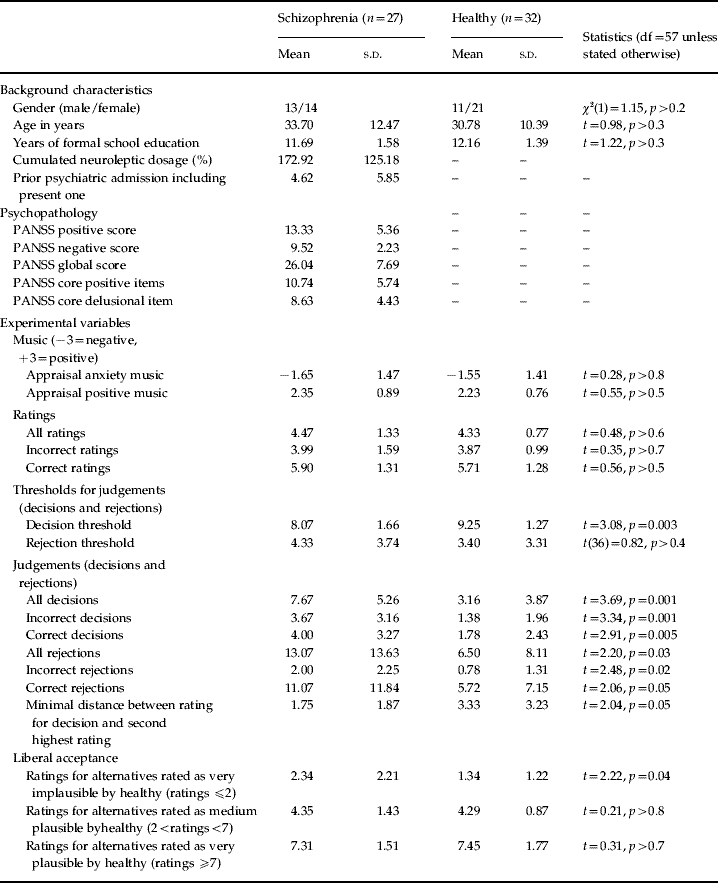
Comparisons between schizophrenia and healthy participants on background and experimental characteristics

PANSS, Positive and Negative Syndrome Scale; s.d., standard deviation; df, degrees of freedom.
Experiment
Subjects were individually tested in a quiet room. The experiment was administered on a personal computer using Microsoft PowerPoint. The participants were instructed that they would be confronted with 15 pictures and asked to appraise each of the four presented alternatives with regard to their likelihood of being the correct title on a 10-point scale from 0 (=impossible) to 10 (=excellent). Participants were free to make a decision to one option, or to reject one or more options; however, this was not obligatory (see Fig. 1). Thus, participants could make a maximum of 15 decisions and 45 rejections. Furthermore, they were instructed that for some pictures music would be played, whereby the music would not necessarily be in connection with the paintings, and that the appraisals should be made without taking the music into consideration. The positive/happy music was an instrumental version of the song ‘Take Five’ (composed by Paul Desmond for the Dave Brubeck Quartet) and the negative/anxious music was the Michael Myers' theme from the horror movie ‘Halloween’ (composed by the director of the movie, John Carpenter). Both songs have a time signature of 5/4. Music was played at a clearly audible volume level on an endless loop using Windows Media Player. Music–mood congruence was determined by consensus of a panel of five psychologists. The paintings and title alternatives were chosen by the same panel of psychologists. Inclusion criteria were (a) ambiguity: all paintings should be ambiguous regarding the correct title (mean rating <0.8 for all alternatives); (b) good visibility of paintings; (c) good comprehensibility of alternatives (no foreign words); (d) no sexual or offensive content; and (e) that the paintings were probably unknown to the participants.
Examples of two paintings. Title no. 2 (left painting) and no. 3 (right painting) are correct (the titles have been translated from German).

Participants were randomized into three conditions, whereby the sequence of pictures was the same for all subjects. Conditions differed only in the sequence of music (condition 1: negative/anxiety-provoking music was played for the first five pictures, no music was played for the next five pictures, positive/happy music was played for the final five pictures; condition 2: no music, positive/happy music, negative/anxiety music; condition 3: positive/happy music, negative/anxiety music, no music). Two examples are shown in Fig. 1. Each picture was presented in its original colour on a colour computer monitor. Subjects sat approximately 50 cm away from the monitor but were free to move their head in any direction and to approach the monitor to look for details. The alternative titles were presented next to the painting, the correct titles being at a random position. Response alternatives were displayed in font Verdana, size 24, black colour.
There were no time constraints and subjects were reminded from time to time that, although ratings were mandatory, rejections or decisions were optional. Ratings were filled in on a sheet of paper by the participant, on which decisions and rejections were marked. Decisions were marked with an ‘E’ (for Entscheidung, the German translation of the word decision) and rejections with an ‘A’ (for Ausschluss, the German translation of the word rejection). The participants then had to appraise both melodies on a seven-point scale ranging from −3 (negative/anxious) to +3 (positive/happy); 0 was the neutral midpoint. Finally, participants were asked if they had known the painting and the corresponding title before.
Strategy of data analyses
First, we looked at variables asserting the validity of the paradigm. This was followed by analyses of the number of rejections and decisions and also of decision and rejection thresholds using t tests. Subsequent analyses were conducted using mixed ANOVAs with Group as the between-subject factor. Mood (anxiety, positive, no music), Content of the Alternatives (neutral, positive and negative content) and Validity (correct, incorrect) served as within-subject factors. As some of the parameters were assumed to be of particular relevance to our understanding of delusions (see Introduction), we conducted subsidiary analyses for patients split for delusion status. Finally, we correlated core experimental variables with the PANSS syndrome scores.
Results
Sample characteristics
Table 1 shows that the groups did not differ on any major sociodemographic background variable. Likewise, no differences emerged when the schizophrenia group was split into patients with current delusions (n=14, a score of ⩾3 on the PANSS positive symptom 1 served as criterion) and those without (n=13).
Validity of experimental procedure
The paradigm was constructed according to consensus decision by experts (see Method section). Before comparing the groups, we analysed the ratings to verify the ambiguous nature of the task. In keeping with our construction criteria, none of the response alternatives (15 paintings×4 alternatives) surpassed the 80% plausibility criterion (i.e. a rating of 8 out of 10) and for six out of 15 pictures an incorrect alternative achieved a higher plausibility score than the correct title. As can be seen in Table 1, both groups rated the positive music as mostly positive and the negative music as mostly negative, confirming that the music captured the intended mood. Although some subjects had seen the pictures before, none of them were aware of the correct title prior to the task.
Decision making
In line with prior research, the groups did not differ on their ratings for alternatives that turned out to be correct or on their ratings for alternatives that were incorrect (see Table 1). However, because of a significantly reduced decision threshold (patients: 81% v. controls: 92.5%), the patients made more decisions. The rejection threshold was numerically different (patients more easily rejected alternatives, thresholds: 43% v. 34%). However, this difference did not achieve significance. For exploratory purposes we also considered the distance between the probability for decisions and second-best alternatives. As can be seen from Table 1, schizophrenia patients significantly more often decided on alternatives that were only marginally better appraised than competing alternatives, whereas healthy subjects only made decisions for clear ‘winners’ (i.e. greater rating distance between decision and second-best alternative). Table 1 shows that ratings for implausible alternatives (ratings ⩽2) were judged as significantly more likely by schizophrenia patients relative to healthy subjects.
To determine whether patients made more incorrect judgements we carried out a three-way mixed ANOVA with validity (correct, incorrect) and judgement (decision, rejection) as within-subject factors and group as the between-subject factor. The frequency of judgements served as the dependent variable. As already indicated by the t test statistics in Table 1, the group effect was significant, with more decisions and rejections in the schizophrenia group [F(1, 57)=9.22, p=0.004]. Overall, more correct judgements were made than incorrect ones [F(1, 57)=35.03, p<0.001] and more rejections than decisions [F(1, 57)=12.81, p=0.001]. The two-way interaction of validity and group achieved significance when tested one-tailed [F(1, 57)=2.66, p=0.05], indicating more incorrect decisions made by patients.
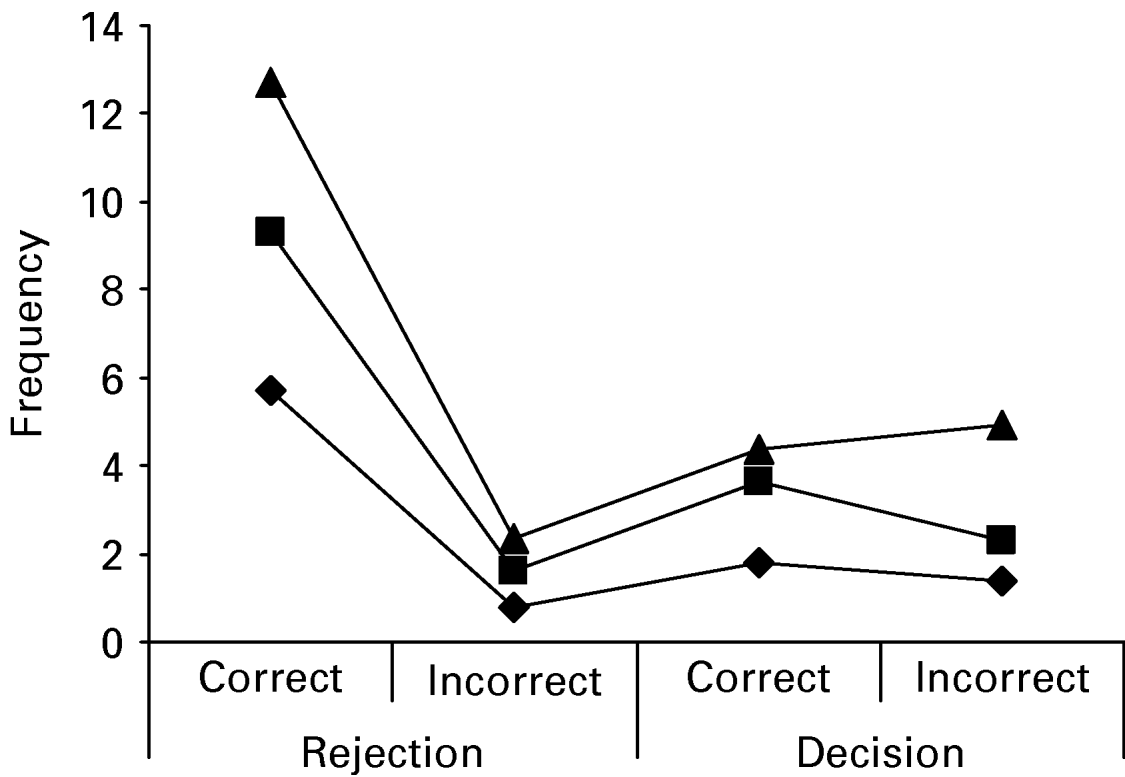
We then split the schizophrenia sample into those with current delusions (PANSS positive symptom 1, score ⩾3) and those without and repeated the three-way mixed ANOVA. Again, the factors validity [F(1, 56)=35.04, p<0.001] and judgement achieved significance [F(1, 56)=12.49, p=0.001]. The group factor was significant, reflecting more decisions in both patient subsamples than in healthy subjects [F(2, 56)=5.68, p=0.006]. Most importantly, the three-way interaction was significant [F(2, 56)=3.11, p=0.05]. Post-hoc comparisons revealed that deluded patients made significantly more incorrect decisions than both non-deluded patients (p=0.02) and healthy subjects (p<0.001, Bonferroni corrected, see Fig. 2).
Decisions and rejections, split for validity. Patients, particularly those with delusions, made more decisions and rejections than controls. –◆–, Healthy; –▪–, non-deluded; –▴–, deluded.

For decision and rejection thresholds, overall frequency of judgements, appraisal of positive versus anxiety-provoking music, rating distance between decision and second-best ratings no differences emerged between deluded and non-deluded patients (p>0.1).
Impact of music on decision making
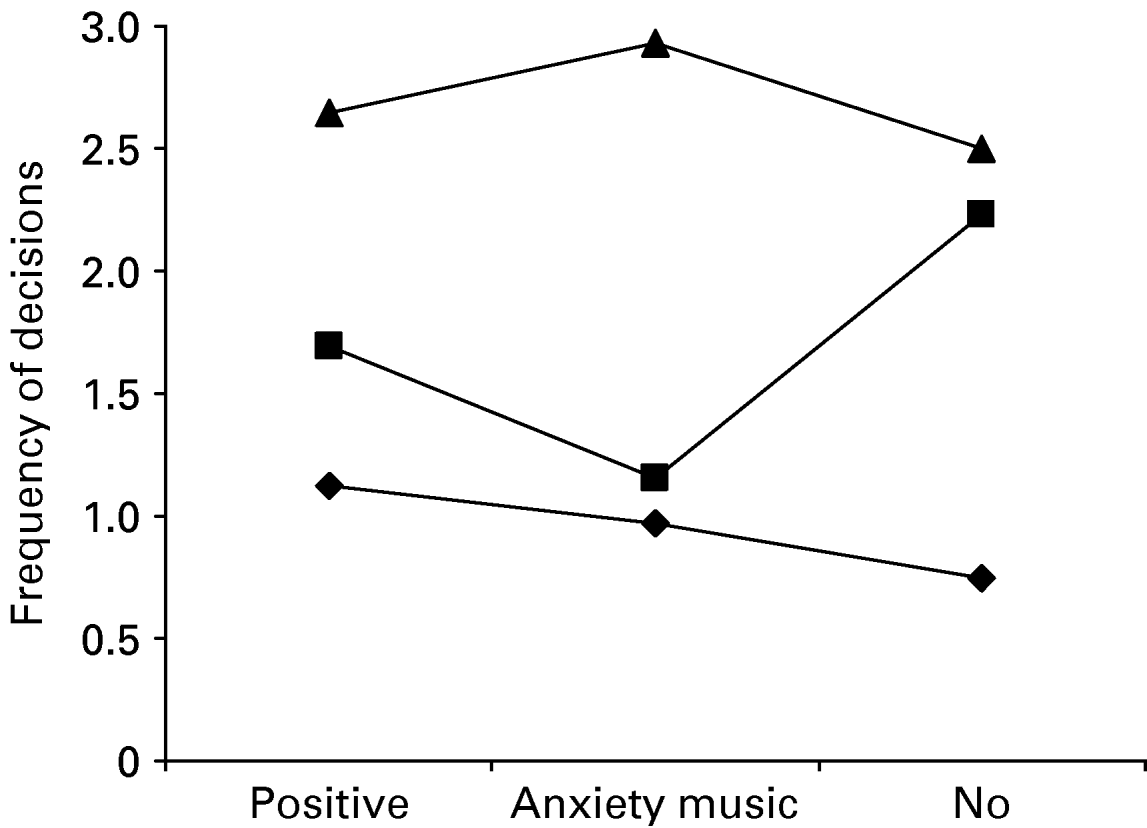
We calculated a two-way ANOVA with music (anxiety, positive, no music) as a within-subject factor and group as the between-subject factor. The number of decisions served as the dependent variable. Except for the overall effect of group (see above), no significant effects emerged (p>0.1), indicating no impact of music/mood on decision making. When we repeated the analysis with the patient group split for delusion, the interaction of music and group was significant [F(4, 112)=2.45, p=0.05]. As can be seen in Fig. 3, this was because deluded patients made more decisions under the anxiety-induction condition compared to both other groups, who were more cautious of this manipulation.
Currently deluded (–▴–) patients showed an excess of decisions under anxiety-provoking music, whereas the number of decisions decreased in the non-deluded (–▪–) and healthy (–◆–) groups for this condition relative to the positive condition.

Contents of alternatives
Blind to results, response alternatives were divided into those with neutral, positive and negative content. Allocation was made following consensus among three psychologists. A two-way ANOVA with group as the between-subject factor was not significant [F(2, 114)=1.48, p>0.2]. However, deluded patients made more decisions for negative alternatives relative to non-deluded (p=0.02, Bonferroni). The difference also achieved significance relative to healthy controls (p=0.001). For both positive and neutral alternatives, deluded and non-deluded were indistinguishable with regard to the frequency of decisions.
Correlations with symptoms
Correlations of PANSS core positive items (positive items 1, 3, 5 and 6 and global item 9) with experimental parameters were significant for frequency of incorrect decisions (r=0.49, p=0.007), whereas the correlation with correct decisions was insignificant (r=0.05, p>0.8). Further inspection revealed that this was especially pronounced for decisions with negative (r=0.52, p=0.004) but not positive content (r=0.08, p>0.6). For the core delusions items (positive items 1 and 6 and global item 9) similar relationships emerged (incorrect decisions and negative alternatives: both r=0.48, p=0.008).
Discussion
The present findings corroborate those of a large body of literature suggesting that patients with schizophrenia make hasty decisions; that is, make firm judgements under uncertainty (for a review see Fine et al. Reference Fine, Gardner, Craigie and Gold2007; Ziegler et al. Reference Ziegler, Rief, Werner, Mehl and Lincoln2008). We deliberately chose artwork over logical tasks to prevent that the correct solution could be deduced by logical inference. In fact, for six out of the 15 paintings the correct titles achieved lower plausibility scores than the lure titles. No title obtained a probability score beyond 8 out of 10 points, which underlines the ambiguity of the stimuli rendering any decision incautious. The results further strengthen our LA theory (Moritz & Woodward, Reference Moritz and Woodward2004, Reference Moritz and Woodward2005; Moritz et al. Reference Moritz, Woodward and Hausmann2006, Reference Moritz, Woodward, Burlon, Braus and Andresen2007b, Reference Moritz, Woodward, Jelinek and Klinge2008b). First, patients did not differ in plausibility ratings but made decisions on the basis of lower plausibility; expressed in percentage, the minimal decision threshold was 81% in patients and 92.5% in healthy subjects, which corresponds to prior findings. Because of the lowered threshold, more decisions were made, especially incorrect ones. Moreover, patients rejected alternatives more easily. However, presumably because of the lower power (not all participants rejected alternatives so that for these no threshold could be computed), the difference (43% v. 34%) did not reach significance. Second, patients gave significantly higher ratings for alternatives judged as very implausible by healthy subjects (rating ⩽2), whereas no differences occurred for alternatives judged as medium or very plausible by healthy participants (for similar results, see Moritz & Woodward, Reference Moritz and Woodward2004). As we emphasized previously, the contemplation of an initially weak hypothesis may promote the acceptance of fallible interpretations. Once an unlikely hypothesis that a healthy subject would dismiss immediately is taken into consideration, it may prevail, especially when the correct interpretation is difficult to verify. It is, for example, almost impossible to verify that sounds on the telephone line or misdialled calls are coincidental events, whereas a delusional interpretation may easily be strengthened through heightened alertness and mood-congruent interpretation.
Another interesting finding was that schizophrenia patients chose significantly more often alternatives that were only marginally better appraised than competing alternatives (i.e. ‘photo-finish’). By contrast, healthy subjects preferred decisions for clear ‘winners’. Although this finding is compatible with LA, it could also reflect a need for closure (Colbert & Peters, Reference Colbert and Peters2002; Bentall & Swarbrick, Reference Bentall and Swarbrick2003); however, this account has recently suffered some empirical setbacks (Freeman et al. Reference Freeman, Garety, Kuipers, Colbert, Jolley, Fowler, Dunn and Bebbington2006; McKay et al. Reference McKay, Langdon and Coltheart2007).
Somewhat surprisingly, we did not find evidence for an overall mood induction effect (Bouhuys et al. Reference Bouhuys, Bloem and Groothuis1995), although the music was rated congruent with the intended affective valence. Both groups did not make more errors under the influence of the emotional music. Of interest, however, patients with current positive symptoms made more decisions under anxiety-provoking music. This is congruent with the assumption that patients may show exaggerated JTC under stress and emotional arousal (Mujica-Parodi et al. Reference Mujica-Parodi, Corcoran, Greenberg, Sackheim and Malaspina2002; Lincoln et al. in press), which is typically more strongly elicited by negative than positive and neutral material (e.g. Moritz et al. Reference Moritz, Voigt, Arzola and Otte2008a). That the overall effect did not succeed, however, somewhat limits our conclusions regarding mood induction; the rationale of the music induction to mislead participants (distraction) might have been too obvious and participants from both groups may have tried to deliberately counteract its influence, perhaps even more as they were instructed that the music and the painting would not necessarily be connected to each other. In this regard, more subtle stress or mood induction that is terminated before test sessions and exerting arousal that is not cognisant to the subjects may have a greater seductive carryover effect. For example, research shows that healthy subjects are more prone to feel attracted to a person of the opposite sex when standing on a suspension bridge than when standing on a normal bridge, which is thought to reflect a misattribution of enhanced arousal to the person and not the situation (Dutton & Aron, Reference Dutton and Aron1974; Aronson et al. Reference Aronson, Wilson, Akert and Fehr2004). To conclude, the effect of mood/arousal/stress induction on cognitive biases was not thoroughly tested, and the results only tentatively speak for enhanced JTC in presently deluded patients under stress (see also Lincoln et al. Reference Lincoln, Lange, Burau, Exner and Moritzin press).
Some additional limitations need to be addressed. We did not assess a clinical control group, so that our claim that JTC and LA are specific to schizophrenia is not fully warranted. However, we would like to indicate studies that have observed such effects when comparing both healthy and psychiatric controls (Moritz & Woodward, Reference Moritz and Woodward2005, 2006 a). Although we claim that JTC is a precursor to delusions and not its consequence further research is needed to characterize the longitudinal course of bias in patients (Ziegler et al. Reference Ziegler, Rief, Werner, Mehl and Lincoln2008).
Evidence has been presented that patients with schizophrenia share cognitive deficits and biases that are presumably linked to the onset of delusions and hallucinations. Training that reduces the impact of these cognitive biases is a promising approach to alleviating the vulnerability of patients, and to prolonging phases of remission. If patients are encouraged to contemplate counter-arguments, avoid JTC and exchange their views with reliable others, relapses into delusional thinking may be prevented. Several treatment packages are currently available targeting cognitive biases and symptoms, such as CBT (Rollinson et al. Reference Rollinson, Haig, Warner, Garety, Kuipers, Freeman, Bebbington, Dunn and Fowler2007), Social Cognition and Interaction Training (SCIT; Combs et al. Reference Combs, Adams, Penn, Roberts, Tiegreen and Stem2007) and Metacognitive Training for schizophrenia patients (MCT; Moritz & Woodward, Reference Moritz and Woodward2007; Moritz et al. Reference Moritz, Woodward, Burlon, Braus and Andresen2007c) and there is accumulating evidence confirming the effectiveness of these interventions (Zimmermann et al. Reference Zimmermann, Favrod, Trieu and Pomini2005; Roder et al. Reference Roder, Mueller, Mueser and Brenner2006; Moritz & Woodward, Reference Moritz and Woodward2007).
Declaration of Interest
None.