INTRODUCTION
This article considers the rise of the derogatory term amaphara, roughly heroin-addicted criminals. The 2000s, and especially the 2010s, saw an explosion of a heroin-based drug on the streets of South Africa locally called whoonga/wunga or nyaope (the former more typical in this study's research area, the KwaZulu-Natal province, and the latter more typical in Gauteng). Although it is inherently difficult to trace the origins of words, internet searches suggest that amaphara (or the singular iphara) was first used online around 2013. Supporting this timeline, the popular isiZulu-medium newspaper Isolezwe surrounded the term with quotation marks (‘amaphara’) in 2014, before dropping this qualification in later articles.Footnote 1 Today, twitter feeds are called #amaphara and #amapharamustfall.Footnote 2 Radio stations even play a song ‘amaphara’ by DJ Tira and DJ Sox.
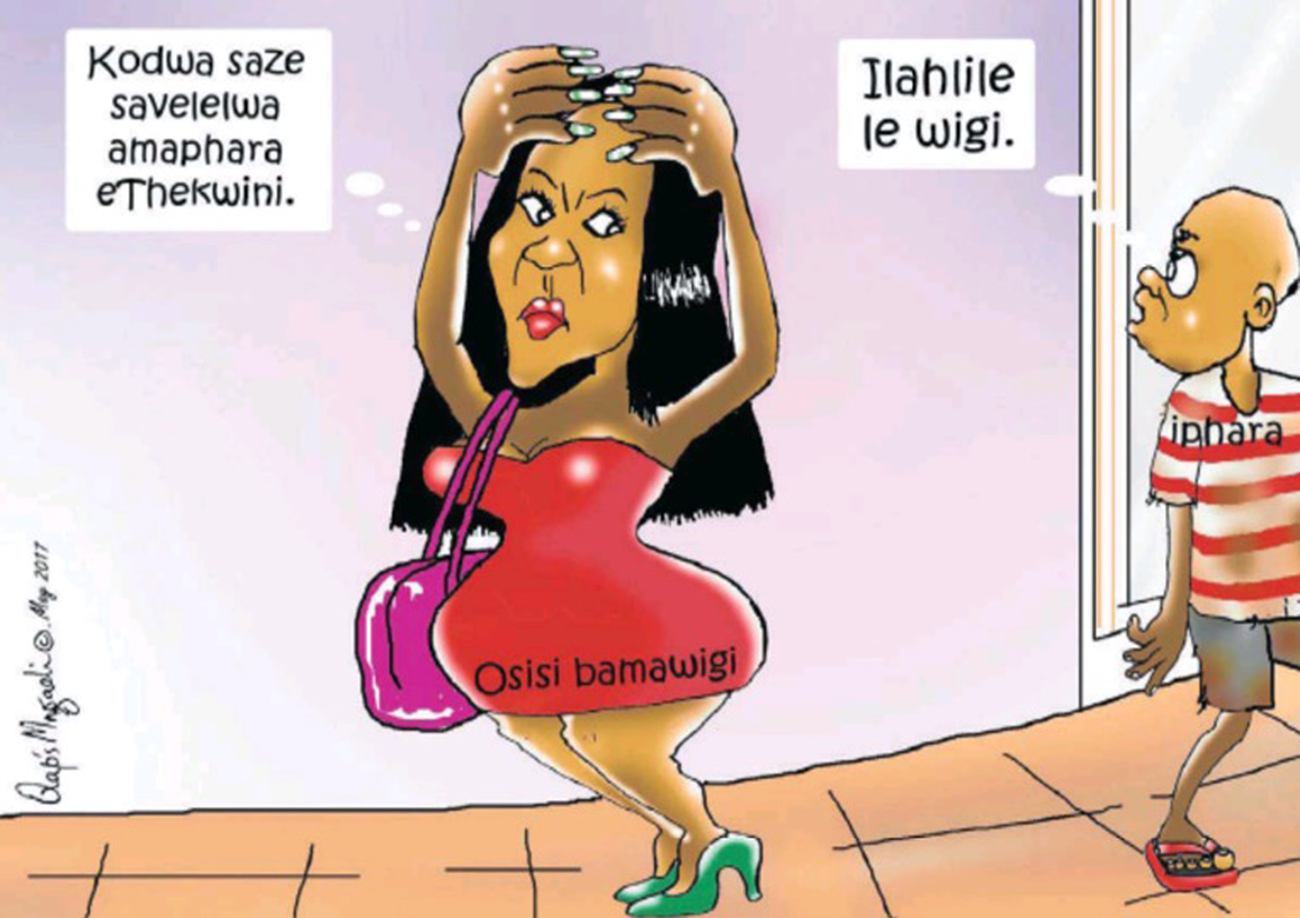
The 2017 cartoon by Isolezwe's popular contributor Qap's Mngadi (Figure 1) captures important aspects of amaphara's personification. The young man with iphara written on his t-shirt is dressed in dirty clothes and looks toward a voluptuous woman. The iphara does not, however, seem to see her as a sexual object; he is eying her wig, which she is protecting as she reflects on how tired she is of amaphara. The humorous image portrays the audacity of a group of young criminals who are willing to disrupt the intimate routines of everyday life – even a person's hair is not safe from petty thieves!
Cartoon by Qap's Mngadi, May 2017. Reproduced with permission from Isolezwe.

In this article I consider the rise of ‘amaphara’ and use the term as a window into the lives of young marginalised ‘black African’ (in South Africa's prevailing racial terminology) men who use heroin. Amaphara is first and foremost a derisory term, but in addition to giving context to this meaning I want to show the tensions and ambiguities inherent in the term. Berated for losing their humanness because they steal from families and neglect their appearance, heroin users may also invite sympathy. They are typically not violent criminals but are neighbours and family members who undertake piece work to attain money to buy R25 (US$1.50) ‘capsules’ of whoonga (pill capsules containing the drug). As I have documented elsewhere – and this point needs to be underlined given this paper's attention to crime – despite the fact that some heroin users, at some times, do commit petty thefts, their day-to-day incomes derive predominantly from undertaking piece work (Hunter Reference Hunter2020).
Consider the conversation I had with Mrs Mabuza who lives in a 2-bedroom house near Durban's Umlazi township. Her second-born son, Siyanda, dropped out of school in Grade 11 and has never held a formal job. He started smoking heroin in 2010 when the drug became readily available in the neighbourhood, but says that he is now trying to reduce his whoonga use. When he is labelled ‘iphara’, he laments, he feels as if he is being treated like a dog.
Mrs Mabuza recalls how painful it was to discover that Siyanda had started stealing small items from the house. The shopping could disappear slowly, even small tinned cans of food. She compares amaphara to rats at one point because of the small items that they both take. However, she is worried about the violence perpetrated against amaphara accused of stealing, and is careful to differentiate her son who ‘still has a heart’ and now earns money undertaking piece jobs. This reflects a common tension between the general term and the specific conduct of a loved one:
Amaphara are like rats because we are eating together with them, as we are staying in the same house … I remember my son when he started but he still had that heart to not steal everything. Other amaphara steal everything including blankets … they are thin and their bodies change and become like animals … they are not bathing.
Amaphara afana namagundane ngoba sidla nawo ndawonye futhi siphinde sihlale nawo endlini … ngiyakhumbula indodana yami yaqala kodwa usanayo inhliziyo yokuthi angantshontshi yonke into. Amanye amaphara antshontsha yonke into ngibala izingubo zokulala imibhede….futhi bancane ngemizimba bayashintsha bafane nezilwane … Abagezi futhi
I proceed by outlining the study's framing and method. I then set out briefly the gendered dimension of amaphara, specifically how the term came to focus attention on young men who are unable to support themselves and others. The article then turns to two groups who are often talked about as central to the lives of amaphara: families and communities. While there are considerable overlaps between the two, I separate them in order to sharpen our focus on the making of ‘amaphara’. Following this, I turn to forces, including family care and communities’ employment of whoonga users for piece work, that serve to unmake ‘amaphara’.
FRAMINGS AND METHOD
The rise of the term ‘amaphara’ represents what Stuart Hall and colleagues famously theorised in Britain as a ‘moral panic’ – a sense of fear targeted at a group portrayed as a threat to society (Hall et al. Reference Hall, Critcher, Jefferson and Roberts1978). These types of moral panics are not new to the African continent, for instance there have been many stereotypes of African youth as being ‘unruly, destructive, and dangerous’ (Durham Reference Durham2000: 113). Amaphara can also be seen in light of different words in southern Africa for those associated with criminality, including amalaita and Bo-tsotsi (La Hausse Reference La Hausse1990; Glaser Reference Glaser2000; Hansen Reference Hansen2005). Propelled by colonialism, long-standing racialised discourses that dehumanise Africans shape these discussions (Fanon Reference Fanon1963; McClintock Reference McClintock1994). Laws and tropes on drugs themselves have long been racialised, including those that focused on alcohol and cannabis (Klantschnig et al. Reference Klantschnig, Carrier and Ambler2014) and, more recently, methamphetamines (Howell Reference Howell2015).
In a number of other settings, most notably the USA, scholars have shown the central role of the state and media in producing and circulating discourses that vilify drug users. In the USA, in the early parts of the 20th century politicians and the media fuelled stereotypes about ‘drug-crazed’ African Americans and ‘degenerate’ marijuana-smoking Mexicans, and in the 1980s Ronald Reagan led a ‘crusade against drugs’ (Singer & Page Reference Singer and Page2014). As Singer & Page (Reference Singer and Page2014) show, the portrayal of drug users as useless is extremely useful to some people in power.
In this paper I recognise that the media as well as state actors scapegoat, and therefore help to make, ‘amaphara’. Indeed, South Africa's tough-talking Minister of Police, Bheki Cele, gave a speech in 2018 saying that he was determined to end the problem of ‘amaphara’.Footnote 3 This ‘tough on crime’ approach presents criminals as a dangerous group who impede citizens from realising the benefits of political freedom (see Forman Reference Forman2017 on the USA). The post-apartheid government's punitive approach to drugs serves to distract attention from its failure to reduce social inequality and unemployment.
Yet the argument that the South African state is a primary perpetrator of the stereotyping and criminalisation of ‘amaphara’ has limits, not least because the state's main instrument to address crime, the police, are often ineffective. Nor can the media be simply blamed for the trope, even though it played a pivotal role in exaggerating the connection between drugs and crime. The rise of amaphara, this paper will argue, is incomprehensible without detailed ground-level research, including on young men's marginalisation and the experience of intimate crimes in poor communities.
I first encountered the term ‘amaphara’ when I (a white man based outside South Africa) noticed its growing use while undertaking another research project in the 2010s in Umlazi township, Durban. When the heroin-based drug whoonga first appeared in townships in the 2000s, and especially the 2010s, a prominent media angle was that whoonga partly comprised antiretroviral (HIV) drugs. HIV patients, it was said, were ‘living in fear’ of dealers who robbed them of their life-saving medication (an assertion with little foundation and now largely disregarded).Footnote 4 Yet by the end of the 2010s the moral panic surrounding whoonga had, to a large extent, become personified in ‘amaphara’, a term routinely applied to refer to young thieves, or bedraggled young men thought to be thieves, especially those addicted to whoonga/heroin. The derogatory discourse of ‘amaphara’, and associated acts, sometimes violent, affect the very experience of using heroin. Opiates have powerful pharmacological effects but scholars of drugs have convincingly shown that these are always socially mediated: that is to say we should reject ‘pharmacological determinism’ (Zinberg Reference Zinberg1984; Reinarman & Levine Reference Reinarman, Levine, Reinarman and Levine1997; Klantschnig et al. Reference Klantschnig, Carrier and Ambler2014).
Integral to my method is not only documenting the everyday experiences of heroin users and their families and communities, but widening the window into heroin use in South Africa. Central parts of cities have been the frequent focus of media stories on whoonga, especially in the English-medium press that is quick to respond to the concerns of nearby middle-class residents. In Durban, so-called ‘Whoonga Park’, which is located between the central business district and the port, has attracted enormous attention because of its reputation as a den for drugs and criminal activity. However, the vast majority of South Africa's urban population, including heroin users, live in huge settlements built by apartheid's planners far from central urban areas, or in overcrowded shack settlements. Contrary to stereotypes of heroin users as homeless criminals, many reside with their families and diligently undertake piece work in communities.
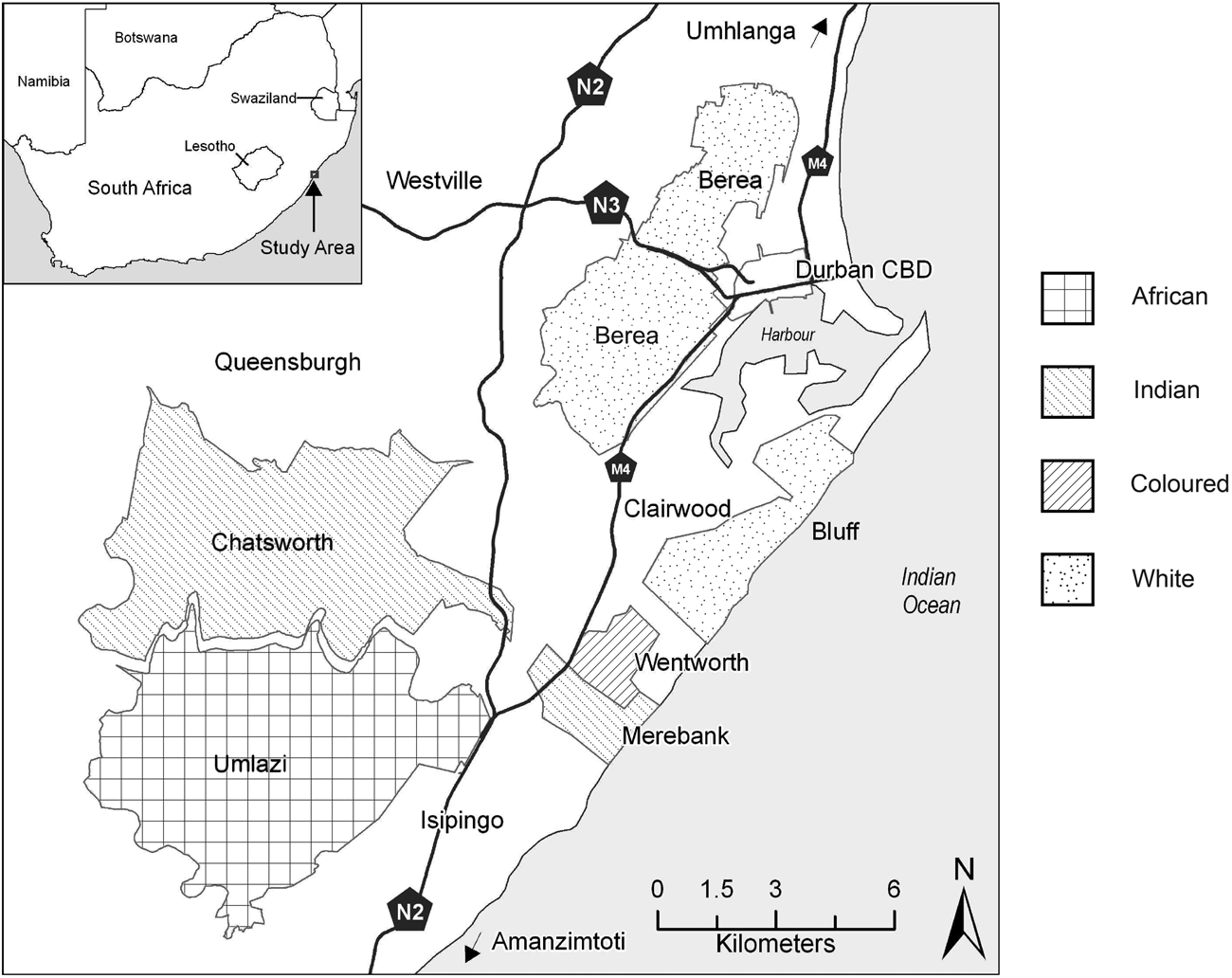
Specific research for this article was conducted from June–August 2018 in Durban/eThekwini, the country's third largest city, and with follow-up research in July and August 2019. Umlazi township, the first research site, was established in the era of high apartheid, the 1960s, as a residential area to house black ‘Africans’ removed from more central areas of Durban. The 1950 Group Areas Act divided cities into four separate racial residential zones (‘African’, ‘Indian’, ‘Coloured’ and ‘white’). ‘African’ townships were generally built furthest away from city centres whereas ‘Indian’ and ‘Coloured’ townships tended to be located between ‘African’ townships and ‘white’ suburbs (Figure 2). Today Umlazi township houses over 400,000 residents. The second research site, located some 15 km away from the township, was built in the early 1990s with the support of the state and local companies to house Africans working in south Durban's industrial basin (I don't give the name of this smaller location to protect the anonymity of interlocutors). Both areas house a great variety of family groupings, from single person renters to large multigenerational families who reside in formal houses that were typically built with two bedrooms, and are often now extended. There are also a large number of shack settlements in and around Umlazi township. It needs to be noted that I do not focus on heroin use elsewhere in the city, including in the sizable formerly ‘Indian’ township of Chatsworth, where the influence of heroin was reported earlier than in Umlazi (Tolsi Reference Tolsi2006). Notably, in ‘Indian’ areas the heroin-based drug is called ‘sugars’ rather than ‘whoonga’ and this racialised vocabulary, rooted in continued de facto segregation, can allow them to be seen as different drugs.
Durban with its suburbs shown by former racial classification.

I identified and interviewed heroin/whoonga users through a long-time research assistant, a woman in her thirties who lives in Umlazi township, as well as, at times, another local contact (hence I refer to ‘we’ on most occasions). The study particularly benefitted from my research assistant, whom I call by the pseudonym Lwandle (I also change all names of informants to protect their identities). Heroin users need a constant flow of piece work in order to buy the drug, and this makes them visible in the community. In general, users and their families were happy to talk, although we exercised caution to protect privacy and avoid antagonising drug dealers in the area. I create knowledge that is ‘situated’; I am able to conduct interviews in isiZulu but am a white outsider who cannot simply collect objective ‘facts’ (Haraway Reference Haraway1988). We interviewed, mostly in isiZulu but occasionally in English, 28 heroin users (17 individuals, 11 in groups), all male except one woman, and 14 relatives of heroin users, including fathers, sisters, aunts, grandmothers, and especially mothers. We also conducted eight interviews with community groups and private rehabilitation centres. Finally, in 2019 we conducted 43 interviews on drugs with schoolchildren and teachers in schools (these were mainly undertaken in Umlazi; we draw on them lightly because they focused not just on heroin but cannabis, Xanax, Mandrax, ecstasy and cocaine). In this article, quotes are kept as close as possible to the spoken words (as transcribed from recordings by my research assistant). Lwandle and at times Sibongile Buthelezi transcribed the interviews in isiZulu, and then I translated them into English (on occasion with help) and coded them using Nvivo software.
In drawing on South African media sources, I give particular attention to news and magazine articles and cartoons from the popular daily isiZulu-medium newspaper Isolezwe. Established in 2002, and rapidly growing in readership despite the general decline of the print media, Isolezwe portrays a certain kind of respectable ‘modernising Zulu’Footnote 5 and is part of a long history of isiZulu-language publications (see Buthelezi Reference Buthelezi2007; Mokoena Reference Mokoena2011). It publishes stories on local politics and international news as well as themes largely ignored by the ‘white press’, including discussions on township and rural life that might incorporate topics on crime, youth, and intimate matters such as bridewealth (see also Gunner Reference Gunner2019 on the isiZulu radio station Ukhozi FM).
HEROIN IN SOUTH AFRICA
Opiate use in South Africa has been typically – but never exclusively – segmented along race and gender lines, in keeping with other drugs (Leggett Reference Leggett2002). In the early 20th century men recruited from China to work in the country's gold mines were prominent smokers of opiates (Waetjen Reference Waetjen2017). A range of opiate medicines used by whites were exempted from the country's 1928 Pharmacy Act (Parle et al. Reference Parle, Hodes and Waetjen2018). After the election of the apartheid government in 1948, racial segregation reached new heights. Drug use was shaped by a person's proximity to drug markets, income from differentiated work opportunities, as well as the legal status of drugs – for instance ‘European alcohol’ was banned for ‘Africans’ until the 1960s (Mager Reference Mager1999; Parle et al. Reference Parle, Hodes and Waetjen2018). By the 1990s, heroin had become a relatively expensive drug primarily used by a small number of whites in South Africa.
What drove cheap heroin's rapid uptake in the 2000s, and especially the 2010s, was the drug's increased entry into the country as part of a ‘southern route’ of smuggling from Afghanistan via East and southern Africa to Europe and the USA (on the use of heroin from the 1980s in Tanzania see McCurdy et al. Reference McCurdy, Williams, Kilonzo, Ross and Leshabari2005; McCurdy Reference McCurdy, Klantschnig, Carrier and Ambler2014; McCurdy & Kaduri Reference McCurdy and Kaduri2016; and Kenya see Beckerleg & Hundt Reference Beckerleg and Hundt2004). These trade routes were aided because African economies opened up as part of World Bank and IMF-sponsored ‘structural adjustment’ programmes and South Africa, the region's largest economy, ended its economic isolation after 1994.
Linguistic evidence supports the view that heroin travelled from East Africa, where it took hold from the 1980s, to southern Africa, where it became prominent two decades later. McCurdy (Reference McCurdy, Klantschnig, Carrier and Ambler2014) notes that unga is the Kiswahili word for heroin; in Durban its isiZulu name is wunga. The name used for withdrawal symptoms is alosto in Kiswahili (McCurdy Reference McCurdy, Klantschnig, Carrier and Ambler2014); in isiZulu it is arosta (see also below on other linguistic similarities between Kiswahili and isiZulu words surrounding heroin).
Drugs arrive in the port city of Durban by maritime routes, by road from elsewhere in South Africa (especially cannabis, which was decriminalised for personal use in 2018), as well as overland from other countries. The rise of cheap heroin, which costs roughly as much as two loaves of bread for a ‘capsule’, is documented in newspapers, graduate theses (for instance Radebe Reference Radebe2015), and other reports (for instance Haysom et al. Reference Haysom, Gastrow and Shaw2018). Most of the whoonga users I interviewed first encountered heroin/whoonga when it was mixed with cannabis, which is widely smoked in the city. Almost all users, however, report that over time they began to ‘chase the dragon’ that is to burn whoonga on tin foil and inhale the fumes (in both cases a person is described as ‘smoking’ whoonga, in isiZulu the verb used being ukubhema). Users I spoke with said that the practice of injecting heroin is rare in Durban, whereas in East Africa this method of ingestion is common (see Beckerleg & Hundt Reference Beckerleg and Hundt2004; McCurdy et al. Reference McCurdy, Williams, Kilonzo, Ross and Leshabari2005, McCurdy & Kaduri Reference McCurdy and Kaduri2016). Deaths through overdoses in Durban are uncommon, because the drug is heavily cut with mixing agents, usually smoked and not injected, and dealers have not (as yet) mixed it with strong synthetic opioids such as fentanyl (the cause of tens of thousands of deaths in North America).
Heroin users typically suffer from painful withdrawal symptoms that include an upset stomach, headaches and insomnia, but these vary by person and context. The drug's meanings and experiences can be illuminated by discussion of other local drugs (see also Peltzer et al. Reference Peltzer, Ramlagan, Johnson and Phaswana-Mafuya2010: 2233). When I interviewed learners in Umlazi schools in 2019, almost all said that cannabis was the most commonly used drug. It is widely smoked, including at break times, or eaten in ‘space muffins’. In the last few years, Xanax has become a very popular drug among youth; the anti-anxiety pill is said to be obtained illegally by dealers from pharmacies and hospitals (in reality the pills are generic versions of ‘Xanax’). A joint of cannabis and a pill of Xanax can be bought in a school for as little as R5 (US$0.30). Even cheaper than this is a ‘loose’ (single) cigarette, although tobacco is not always spoken of as a drug because it is legal. Importantly, these three drugs are not seen as preventing learners from attending school. Then, there is a set of drugs that can be seen as party drugs used outside the school environment. Ecstasy and cocaine are both quite expensive, and might be used when young people attend night clubs. Bottled alcoholic drinks are quite expensive, relative to cannabis and Xanax, and associated with places such as taverns that are usually visited at the weekend.
From the perspective of schoolgoers, what distinguishes heroin/whoonga from the above drugs is its association with dropping out of school and almost wholly with men – the two points are connected because heroin creates a dependence that necessitates a person hustling to attain money for a regular supply and men are more able to find this work. In addition, almost all of the learners with whom I spoke disparaged the bedraggled look and aimlessness of heroin users/amaphara. Heroin's reputation as a dangerously strong drug has some similarities to that of Mandrax/ingidi (methaqualone) which has been illicitly used in the city since the 1970s, albeit now sold at a higher cost than heroin. In sum, while drug use is quite widespread in South Africa, whoonga quickly gained notoriety as a mostly-male drug that creates painful dependence and is incompatible with schooling and the chance, however slim, of finding desirable formal work.
MEN AND INTIMATE CRIMES
Consider these painful accounts of petty crimes undertaken by male heroin users. The first four are given by mothers of whoonga users, and the fifth is relayed by a grade 11 schoolboy:
My new blankets were stolen by him [her son]/bengilahlekelwa oblankethe amasha kanti bebentshontshwa uyena.
My neighbour hung out her washing and left and when she came back the washing was not on the line.
Some they arrive and say that they are hungry but they are lying. When food is being made in the kitchen they take your cell phone/amanye afike asho athi alambile aqambe amanga uthi usamenzela ukudla lana ekhishini akasekho usethathe umakhalekhukhwini.
He started by selling his clothes and stealing … meat, potatoes, anything he is going to sell.
It is so painful to buy something so expensive knowing very well that they get in the house and steal it.
A mark of the intimate nature of these crimes is that when we visited a house of a heroin user it was quite common to find that doors, for instance to a bedroom, were locked; in one case a mother had added a new security gate to protect the back door because her son sometimes slept at friends’ houses and she was worried he would return unannounced to steal items. Other intimate crimes reported to us included a son's theft of gifts bought for a family wedding; selling of a young sibling's clothes; taking of meat from the freezer to sell; and taking of money from the house. Every one of the family members with whom we spoke relayed how an early sign of their son's heroin use was his stealing from the house.
Intimate crimes are heart-rending because they signify a loved one's betrayal of trust and lack of respect. An important isiZulu concept is inhlonipho (respect) – a dynamic, contested, term that denotes respect for social hierarchies typically granted by age, status and gender (see Irvine & Gunner Reference Irvine and Gunner2018). Unlike some other criminal activities (see below), heroin-connected crimes don't bring money into families but redirect resources typically from an older generation to young men and drug dealers. Several older informants told us that the recent spike in petty crimes can be contrasted to a reduction in violent crime in their lifetimes (for discussion and statistics supporting this see Smith Reference Smith2019).
A common term that heroin users and family members use is that they are khathele (tired). This speaks to not just the frustrations of someone's substance dependence but the predicaments of young men more generally at a time of chronic unemployment. Mrs Dube, a 42-year-old mother of a young heroin user, turned to me in her lounge, sighed heavily, and said ‘I don't know, he is grown now, he 25 years old, he is going to be 30 … I told him he will wait for the pension/Angazi ngoba usekhulile njengoba uno 25 years nje uzofika ku 30 years manje … Ngiye ngimtshele ukuthi uzolinda impesheni.’ The ironic reference to the old-age pension, which provides not just income but status to those over 60, captures the seemingly endless burden placed on family members to support dependents – one amplified when a son actually steals from the family.
Thus, as many scholars have noted, drug dependence works through and intensifies existing social inequalities (Agar & Reisinger Reference Agar and Reisinger2002; Bourgois Reference Bourgois2003; Beckerleg & Hundt Reference Beckerleg and Hundt2004; Bourgois & Schonberg Reference Bourgois and Schonberg2009; McCurdy Reference McCurdy, Klantschnig, Carrier and Ambler2014; McCurdy & Kaduri Reference McCurdy and Kaduri2016). More than half of the heroin users we interviewed started smoking the drug while attending local schools that are poorly funded compared with suburban schools, especially former white schools. None of the heroin users we interviewed (or whose families told us about their lives) were either married or in formal employment. South Africa after apartheid witnessed the rapid rise of a multiracial middle class, many of whom live or school in middle-class suburbs, and yet more than 50% of South African youth (15–34-year-olds) are unemployed, the highest rate in the world.Footnote 6 Social inequalities manifest themselves in intimate domains. From the 1960s, the proportion of married black African people halved for reasons that include the rise of unemployment (Hunter Reference Hunter2010). Partly as a consequence, only 30% of black African children today live with their father, compared with 83% of white children (SAIRR 2011: 2).
Gender identities, sexual practices and masculinities are always fluid and disputed. However, when formal work and marriage are scarce the expectation that men will work and provide for others is brought into stark relief. A young man who doesn't support his girlfriend or child, or pay bridewealth necessary for marriage, can be presented as a failure (in isiZulu ‘isahluleki’) (Hunter Reference Hunter2010). Heroin users may say that they have fewer sexual partners compared with other men. There are of course significant variations in sexual relations, but Lungile in his late 20s explains that he has no time for women ‘There is no time, we are always thinking about money to buy whoonga. The mind is thinking about smoking all the time/Isikhathi asikho sihleze sicabangana nemali yokuyothenga iwunga. Umqondo uhleze ucabanga ngento ozoyibhema.’
Drugs, a diverse group of substances with pharmacological effects, can be used by persons of all ages and gender. Historically, though, many South African women have been castigated as ‘disrespectful’ or ‘loose’ for taking drugs (the commonly used isiZulu term for ‘drugs’ is izidakamizwa which broadly means ‘things that intoxicate’). Notwithstanding the differences in tracking changes over time, the new constitution's emphasis on gender equality and individual rights can be employed to justify a young person's drug use. The schoolchildren we spoke with were insistent that alcohol, cannabis and cigarettes are today quite widely used by schoolgirls (see also Hunter Reference Hunter2010). However, when it comes to heroin, the image of a whoonga user, dishevelled and without a future, can particularly offend dominant ideas of femininity, including expectations of motherhood. Practically, men are much more likely to obtain the necessary piece work in communities to fuel the habit, and housebreaking is carried out predominantly by men. We spoke with only one female heroin user because this group was much smaller than male users. Her parents had died and she told us that she earned money by styling women's hair and at times selling sex (I don't discuss further female heroin users, though see in Kenya, Beckerleg & Hundt Reference Beckerleg and Hundt2004).
In short, the surge of heroin in poor communities ignites a number of concerns when connected to young men: the fear that even small household items are not safe from theft, belief that generational respect is being undermined, and despair that a man is undermining his potential to support others. The opiate is a force that changes the most intimate aspects of a person, and its pharmacological properties tend to pull young people back for another capsule. Yet, heroin doesn't merely prey on poor communities, but has to be seen in the context of the challenges faced by young men in settings marked by chronic unemployment: it is in a sense a way that marginalised people self-medicate – an ‘antidespondent’ (Reinarman & Levine Reference Reinarman, Levine, Reinarman and Levine1997: 13). Heroin users do so, I will outline in more detail below, in intimate tensions with family members, with communities, and in ways that not only propel but undermine stereotypes of amaphara.
HEROIN AND FAMILIES
The most consistent explanation I found for the word ‘amaphara’ is that it is derived from the English word ‘parasites’ because amaphara are said to steal indiscriminately from their families and communities. Like rats or mosquitoes, whose presence requires a person's vigilance, a thieving son necessitates the reorganisation of the house to safeguard even the smallest goods. If the phrase umuntu ngumuntu ngabantu (‘a person is a person through other persons’) captures the relational nature of identity formation (Chasi Reference Chasi2014), a person stealing from their mother or sister implies a certain loss of humanness. From the perspective of many families, intimate crimes are by definition a violation of human relationships.
Supporting the association between amaphara and non-humans are linguistic characteristics of the word. Syntactically i/amaphara do not belong to the ‘people’ isiZulu noun types (um/aba, class 1 and 2). I/amaphara belong to noun classes 5 and 6 (ili/ama) typically used for borrowed words and ‘Natural phenomena, animals, body parts, collective nouns, undesirable people, augmentatives, derogatives’ (Ngcobo Reference Ngcobo2010: 12). Writing about stereotypes of heroin users in Tanzania, McCurdy noted similar themes in the syntax of related Kiswahili words. The Kiswahili words teja and mateja, derogatory words for heroin users, are noun types not typically used for humans, but animals and things (McCurdy Reference McCurdy, Klantschnig, Carrier and Ambler2014). Even when denoting humans, the term ‘amaphara’ can preclude the listener or reader from learning the name of, and therefore empathising with, the persons being referred to. Isolezwe reported that a young ‘iphara’ rescued a 5-year-old child who had wandered off from pre-school, but gave the child's name, Sinothando, but not the name of ‘iphara’.Footnote 7
Of course, this linguistic evidence is only indicative. When I asked informants for the origins of the term ‘amaphara’ most said they did not know; only several directly said ‘parasites’. A few informants did opine that amaphara came from ‘paramedics’ because of the speed by which whoonga addicts steal or undertake casual work to gain money for a fix. However, when I asked interlocutors unsure of amaphara's roots whether ‘parasites’ or ‘paramedics’ could be a possible English source, more people said that parasites fit the term better.
One way to gain insights into the meanings of ‘amaphara’ is to consider how it relates to other derogatory terms used for those outside of mainstream society. The petty crimes committed by amaphara can be contrasted with the sometimes more violent acts of izigebengu (‘thieves’). An isigebengu might be a car hijacker or someone involved in organised crime who lives locally and undertakes crime at another location. Feared by potential victims, izigebengu can also have a Robin Hood type status if they bring money from the rich into poorer homes. The proceedings from crime might be turned into swanky clothes or given to girlfriends: those are signs that a young person is living life to the full. Or they might be invested in family members and the future, to pay school fees, buy food or service a debt. Bongi says:
Izigebengu is a person who steals to help himself with the future in mind but iphara is a person who steals for now and doesn't think about the future.
Izigebengu umuntu otshontshayo ukuthi ufuna into ezomusiza kusasa ucabangela ikusasa iphara into yamanje kuyashesha okwabo utshontsha ezokusebenzisa manje akalicabangeli ikusasa
If amaphara are positioned differently to izigebengu, they are closer cousins to a long-standing figure, osikhotheni, which is a term for people who live on the streets or in the bush. Some interviewees described osikhotheni as direct precursors to amaphara. Mrs Cabe, in her late 50s, remembers that even when she was young osikhotheni was a word used for homeless people who were stereotypically dirty, smoked cannabis, drank beer, and might commit crimes. However, unlike osikhotheni, most (but not all) amaphara live with their families. And if amaphara are seen to be moving aimlessly through life they can also be observed diligently undertaking piece work.
UMPHAKHATHI (COMMUNITY) AGAINST AMAPHARA: PETTY CRIME AND VIGILANTISM
One day Sizwe nearly lost his life. Aged 19 when I spoke with him, he started smoking whoonga while at school and failed his final ‘matriculation’ exam. He fathered a child but his aunt, whom he lives with after the death of his mother, said that he now has a new girlfriend: whoonga. Sizwe was at home one day when community members came angrily to demand ‘the phara Sizwe’. Beating him, the men bundled him into a car, accusing him of stealing someone's television. Luckily for him, other young people from this area ran after the car and persuaded the assailants that it was a mistaken identity – the wrong Sizwe. The group of men set off to find the other Sizwe, and at his house found the stolen item. The Sizwe I interviewed was saved.
Almost all heroin users tell stories of being attacked by community members (umphakathi) and of knowing of someone who has been killed. They lament the fact that suspicion for any local theft quickly falls on ‘amaphara’ who are identified through their drug habit, bedraggled look, and constant search for piece work.
‘Umphakathi’ and ‘community’ are powerful concepts sometimes used interchangeably during interviews. According to the first isiZulu-English dictionary, umphakathi means ‘common people’ as in ‘call your people’ (Colenso Reference Colenso1861: 377). In the 1980s, the term could be employed by anti-apartheid activists to signal their collective interest in fighting against the apartheid state and its collaborators, and in modern legal terminology it is used to mean ‘public’ (Nguyen Reference Nguyen2019).
When amaphara were discussed in and around Umlazi, umphakathi was used in a similar way to that described by Cooper-Knock (Reference Cooper-Knock2014), that is ‘the community’ which has a ‘constitutive outsider’ namely ‘the criminal’. The construction of a moral boundary around the community legitimates ‘vigilante’ action against those who undermine the collective good (see also Smith Reference Smith2019). In reality, as Cooper-Knock (Reference Cooper-Knock2014: 564) found in Durban's KwaMashu township, ‘residents are bound by multiple, inter-personal relationships that tie them to others in the crowd and to their victims’.
A key context for ‘vigilante’/community justice actions is national drug policy. Countries’ approaches to drugs differ, with the USA's punitive criminalisation often contrasted with European countries such as the Netherlands that stress ‘harm reduction’ (Cohen Reference Cohen, Reinarman and Levine1997). South Africa generally follows the former approach, in part because its institutions have roots in the country's divided history. For instance, because rehabilitation was seen in the past as most appropriate for whites, there are only two public rehabilitation centres in KwaZulu-Natal, a province with a population of more than 10 million people, and neither offer opioid substitution therapy (e.g. methadone). Police practices, influenced by apartheid's authoritarian culture, can propel the inequalities that sustain drug use (Marks & Howell Reference Marks and Howell2016; Marks et al. Reference Marks, Howell and Shelly2017). Moreover, though the police do arrest drug users, and occasionally drug dealers, a persistent complaint is that police are ineffective when it comes to solving crimes – arriving late, not properly investigating crimes and being bought off by criminals, including drug dealers.
Because the criminal justice system under apartheid was primarily directed to upholding white minority rule, community policing has a long history, sometimes supported by the state (Super Reference Super2013). ANC-aligned youth could work together to curtail crime or present themselves as ‘comtsotsi’ who committed crimes in the interests of liberation (Kynoch Reference Kynoch1999; Glaser Reference Glaser2000; Xaba Reference Xaba and Morrell2001; Super Reference Super2013). (Note: comtsotsi is a portmanteau of the word ‘comrade’ and the word ‘tsotsi’ or thief.) In KwaZulu townships such as Umlazi, one example of a vigilante group in the 1970s and 1980s was older men called oqonda or abelungisi (those that ‘straighten’ or ‘put right’) who would patrol urban areas to stem crime (Hunter Reference Hunter2010). Tellingly, in the context of gender shifts that included women increasingly moving into paid work, oqonda also ‘straightened’ wayward women, including those who wore trousers – clothes meant for men.
Three points can be made about vigilantes/community justice groups and heroin users today. First, the targets of vigilantes are almost wholly young men, which is different from the women who could be disciplined by oqonda. Second, community members do not usually attack kingpin dealers – the latter are feared characters who can also provide material support for community members (this contrasts with the high-profile ‘vigilante’ attacks on drug dealers led by a group called People Against Guns and Drugs (PAGAD) based in the Western Cape in the late 1990s).
Third, communities can justify vigilantism because, it is argued, criminals have been given rights after apartheid that allow them to evade punishment. The liberal 1996 constitution, introduced to prevent a repeat of apartheid's abuses, can sometimes be juxtaposed to ‘traditional’ ways of disciplining individuals. As Smith (Reference Smith2015: 342) has argued, South Africa's modern rights-centred legal framework ‘may actually elicit anger and enable violence’. These dynamics played out in Durban when police arrested four men accused of violently beating an ‘iphara’ thought to have perpetrated local crimes. When community members were charged for their actions, their supporters campaigned outside the police station for them to be released. One told a journalist: ‘We feel bad because we don't have rights but ‘amaphara’ are more important than us/Siphatheke kabi ngoba kusho ukuthi thina asinawo amalungelo kodwa ‘amaphara’ yiwona abaluleke ukudlula thina’.Footnote 8
A similar sentiment was voiced at a demonstration against crime in Pinetown in 2016 where community members chanted ‘There is no place for iphara here, amaphara do not have a place here/Iphara alinandawo la, amaphara awanandawo la’. A demonstrator was quoted as blaming mothers for protecting criminals, saying: ‘The mothers should stop having (maternal) sympathy. If the child does something wrong they have to be punished so that they learn a lesson/Omama kumele bayeke ukuba nezinseka, ingane uma yonile (kumele) ijeze ukuze ifunde isifundo.Footnote 9
The interests of poor communities, these comments expose, are said to face opposition from sentimental family members and an out-of-touch constitution. Cooper-Knock notes that there is an understanding in KwaMashu township that the police should intervene during mob violence to stop someone being killed but not to arrest those who are punishing potential criminals (Cooper-Knock Reference Cooper-Knock2014). At other times, the police can mediate between victims of violence and communities and act as gatekeepers for whether or not a crime is even recorded. Zanele, the sister of a heroin user, in her 20s, gave an example of someone being beaten heavily and advised by his doctor to open a case against community members. The police asked him whether, instead, he would seek compensation from the perpetrators, suggesting that the victim should be given R1,500 to prevent prosecution. Members of the police force are therefore active agents in a wider web of relationships that connect accused and accusers.
Heroin plays a lesser role in rural areas because there are fewer dealers and fewer opportunities for users to earn the regular amounts needed for the drug. Sindiso Mnisi Weeks (Reference Mnisi Weeks2018) notes the importance of alcohol in fuelling rural disputes, including acts of violence or verbal offences. Disputes can be resolved or escalate and her work shows in detail how different pathways are shaped by an array of interacting actors: individuals, families, customary law institutions, criminal justice institutions, vigilante associations, and witchcraft accusers.
One further insight into the meaning of amaphara comes when we compare it with the term amakwerekwere (foreigners). As with the community/criminals dichotomy noted above, the term suggests a homogenised group of adversaries. Amakwerekwere gained prominence in the public realm in 2008 with a wave of xenophobic attacks against black immigrants from African countries. Like amaphara, amakwerekwere is a scapegoating term, and the state at times helps to circulate negative images of foreigners. Steinberg (Reference Steinberg2012: 346) argues that ‘state practices were in fact among the triggers of the [2008] violence’ (see also Smith Reference Smith2019). Linguistically, both amaphara and amakwerekwere are members of the class 5 and 6 groups also used for animals. Yet the power of the term amakwerekwere derives from its identification of outsiders seen to be damaging the future of South Africans. In contrast, the potency of amaphara derives from the fact that this group is located as insiders to communities and families: as ‘parasites’ who steal food, clothes and petty cash from mothers, sisters or neighbours.
UNMAKING ‘AMAPHARA’: THE AMBIGUOUS POSITION OF YOUNG MEN IN FAMILIES AND COMMUNITIES
Being cast as iphara can make a person a target of physical attack, but it is a slippery concept. A minority of heroin users are women. Some heroin users don't fit associated stereotypes when they dress well or get rich through selling the drug. Moreover, over time the term amaphara has become a more general term for young male criminals, as suggested by Qap's Mngadi's cartoon (Figure 1) which does not explicitly refer to heroin. Below I focus on some of the forces that help to unmake the idea of a homogeneous group of amaphara.
The love, sympathy and hope of families
When we visited homes, heroin users and family members sometimes encouraged one another to be present at interviews, and there appeared to be little difference in a family member's response whether or not they were alone. Interviews could at times resemble a group discussion, with researchers themselves being quizzed on treatment options. In one example, Mrs Ngcobo was happy to learn about a positive development in her son's life. Thami, a 22-year-old user, told us that he had recently started a relationship with a woman. His mother exclaimed – in an exaggerated way that produced a moment of humour – how happy she was to have a potential daughter in law. This person could help with the care of the house and provide her son with some hope for the future.
Though families are enormously varied, it is almost always women who struggle on a day-to-day basis with caring for heroin users. Family members like Mrs Ngcobo might call heroin users amaphara, but then dislike the term when it is directed at their own sons. The homogenising name places a loved one at risk of attack when a crime is committed in the community. Family members see the multiple sides of heroin users: they might steal but they can also participate in domestic life, including undertaking household chores. One heroin user we spoke with undertook errands for his grandmother who had limited mobility. Another sometimes cleaned the house after his morning heroin hit.
Moreover, the moral outrage that surrounds drug users must be placed in a context where, structurally, tens of thousands of young unemployed men are unable to fulfil societal obligations. In a setting of chronic unemployment, young fathers struggle to support their children and undertake important rituals around childbirth and death (White Reference White2010). Though Siyanda had stolen from his family to buy heroin, his mother spoke at length about the immorality of Thulani, his brother. Thulani was one of the few young men who found work, yet according to his mother he did not adequately support the family that had raised him. He had abandoned his home.
Heroin's pharmacological properties manifest themselves in different ways. Families, when living under the same roof as users, witness the gradational paths into and sometimes out of heroin use. At the family home, a person's slide into heroin use can be signposted by a number of actions that unravel over time, for instance a son asking for more money to take to school for snacks, then stealing small amounts of money, then lessening his care for his clothes and hygiene. However, just as these signs indicate that a son is making a wrong turn in life, when they are reversed they indicate that drug dependency can be overcome.
Families are given some hope when a small change signifies a heroin user's move away from the drug. Sizwe says that he regularly smoked cannabis but inadvertently ingested whoonga when his friend mixed it with their joints; several months later, he was experiencing withdrawal symptoms if he didn't smoke whoonga. We chatted with Sizwe and his aunt separately. As we left the discussion, Lwandle remarked to his aunt about his clean appearance, saying ‘uzoba right’ (‘he will be right’). His improved look differentiated him from other users and offered hope that he might reverse his decline.
The view that drug dependence follows neat, linear paths is captured by the term ‘gateway drugs’ that are said to propel young people in an inexorable way toward stronger drugs such as heroin. Yet, drugs such as cannabis and alcohol, which cause less unpleasant withdrawal symptoms, can be used as a means to reduce a person's dependence on heroin. Consider Siyanda who until recently regularly smoked three whoonga capsules a day (on the lower end of use among people with whom I spoke) but had reduced this to only one capsule a day. He says he drinks alcohol at night to help him sleep.
As indicated, some heroin users do have long-term relations with girlfriends. Langa stays with his girlfriend, Sindisiwe, and their child in an outhouse below the main two-bedroom house; Sindisiwe was raised by a poorer family and welcomed moving into this living situation. Langa wanted to quit and had bought methadone for a month from a local pharmacy to try, unsuccessfully, to end his dependence on heroin. He had developed a good reputation for undertaking itoho (casual work) in the community and his steady income brought some calm to the household. We visited the family several times and what was particularly notable was the close relationship between Sindisiwe and her boyfriend's mother. They both appeared somewhat resigned to Langa's absence in the day to hustle for money and smoke whoonga.
Langa is one of a number of users we spoke with who had accessed a rehabilitation centre or had bought methadone from a local pharmacy, sometimes without even a doctor's prescription. One whoonga user's mother paid 4,500 rand (US$300) for three days’ treatment at a private centre that dispensed methadone, a few used a parent's private medical aid plan to access other private clinics, some accessed a free Christian rehabilitation centre in KwaZulu, and a few attended government institutions. We also heard of heroin users being sent to live with rural relatives to break the habit. Yet, even if heroin users gave up the drug for some time, when they returned to a situation of unemployment and to friends who use heroin, the vast majority resumed drug use. On the one hand, heroin creates an intense, human, desire to be free of its addictive force – and almost all whoonga users do say that they want to quit using the drug. On the other hand, heroin offers a brief feeling of euphoria followed by a period of relaxation that allows someone to forget their everyday problems.
Finally, friends can form strong connections and help to mediate drug use, in the following case tragically without success. One day I accompanied Nhanhla to a clinic to speak to a social worker whom he hoped might help him to access one of the government's few rehabilitation centres. During a 3-hour wait, he told me about the death of his close friend who used heroin. The man, in his early 30s, had contracted tuberculosis and HIV and desperately needed medication – yet he refused to go to the hospital because he feared he would be identified as ‘iphara’ and treated badly by staff and, if admitted, suffer withdrawal symptoms because of his dependence on the opiate. Nhlanhla begged him to seek medical help. One day the man's main caregiver, his grandmother, went to the bathroom for a few minutes. When she returned she found him dead, slumped in the seat in front of the television.
Piece work in the community: the work of Whoonga
Despite the stereotypes of heroin users being engaged in criminal activities, those I interviewed and observed spent much of their time diligently undertaking piece-work jobs. The craving for heroin drives young men onto the streets at 7 or 8 in the morning and makes it important that they smoke before trying to sleep at night. The verb commonly used to describe how whoonga users earn money is ukuphanta. This is usually translated by my interlocutors as ‘to hustle’ and implies getting by through piece work or other casual ways (see Motsemme Reference Motsemme2007 on ukuphanta, a term which is also called ukuphanda).
The availability of cheap, flexible workers can be welcomed in communities. At the time I undertook research, in one settlement the piped water supply to houses faced frequent disruption and heroin users were being paid by households to collect containers of water from a communal pump. One practice is for heroin users to be part paid in advance so that they then smoke before returning to undertake casual work. This was described to us by Xolani who worked sometimes at a car repair outfit. Heroin users are willing to undertake low status work thought as more appropriate for women or children, for instance cleaning a yard, or washing a car. One mother of a whoonga user told me that neighbours sometimes phoned her to ask her to send her son to wash their clothes.
Thus, community members can advocate expelling amaphara from the area but families are also dependent on the same people to undertake useful work. This work is intimate, in or near the home, and not carried out by an abstract nameless group – not by iphara but by Siyanda or Bongi. Sometimes community members say that they employ whoonga users precisely so that the young men don't have to steal from the community.
Moreover, the fact that a group of young men share a similar social position, linked by not just heroin dependency but work, can engender a shared will to challenge the language of amaphara. Young men might hang out together at a shop hoping to be asked to undertake piece work, or share a heroin capsule when only one person finds work. When I interviewed a group of whoonga users in a house's front yard one of their friends walked past and commented in a joking way that they were too old for whoonga, to which the young men joked that the speaker was himself iphara. This humour works to reclaim the term and disturb its derogatory meaning.
CONCLUSION
The mid to late 2010s saw the term ‘amaphara’ burst into South African public culture. The derogatory name coincided with the rise of cheap heroin and portrays a homogeneous group of unkept ‘parasites’ who commit petty local crimes. The rise of amaphara is connected to trade liberalisation that enabled the flood of cheap heroin into the region and the structural violence whereby a generation of young black men are subjected to mass unemployment and poor schooling – all while a multiracial middle-class has grown in numbers. Overwhelmingly, the state's response to drugs has been punitive. Another context for why communities use the term is the state's inadequacy in addressing crime and the perception that the criminal justice system unfairly upholds the rights of criminals. Some families and communities can expel amaphara, forcing them into city centres, but despite the media attention to areas such as ‘Whoonga Park’, in reality most urban heroin users live in huge settlements distant from central areas.
However, amaphara is a label without guarantees. It is not determined by a person's geographic origins, as is the term amakwerekwere/foreigners. Amaphara are derided as ‘parasites’ because of their actions and scruffy appearance but these always vary and can be altered. Drug dependency cannot easily break family and community bonds. Moreover, most whoonga users work hard to hustle and undertake jobs that local people don't want to do. For families, their signs of dependency can be gradual, and there is hope that they can be reversed. Thus, families and communities all help to both make and unmake ‘amaphara’.