Introduction
Psychopathy is characterized by a set of affective, relational, and behavioral symptoms including egocentricity, impulsivity, irresponsibility, shallow emotions, pathological lying, manipulation, persistent violation of social norms and expectations, and lack of empathy, guilt and remorse (Hare, Reference Hare1996). Across the international classifications, disturbances in emotional processing are heralded as the core features of psychopathy.
An objective way to investigate emotional processing in vivo is to measure the amplitude of evoked response potentials (ERP) relative to an emotional stimulus using electroencephalography (EEG). Among ERPs of interest elicited through emotional stimuli, the latency and amplitude of the late positive potential (LPP) evoked by visual emotional stimuli have been investigated in numerous studies (Hajcak et al., Reference Hajcak, MacNamara and Olvet2010). The LPP is maximal at centro-parietal midline sites (Schupp et al., Reference Schupp, Cuthbert, Bradley, Cacioppo, Ito and Lang2000; Keil et al., Reference Keil, Bradley, Hauk, Rockstroh, Elbert and Lang2002; Hajcak et al., Reference Hajcak, Dunning and Foti2007; Foti and Hajcak, Reference Foti and Hajcak2008), with an approximate onset of greater amplitude at 200 ms (Cuthbert et al., Reference Cuthbert, Schupp, Bradley, Birbaumer and Lang2000; Codispoti et al., Reference Codispoti, Bradley and Lang2001; Schupp et al., Reference Schupp, Junghöfer, Weike and Hamm2004a; Foti et al., Reference Foti, Hajcak and Dien2009) with broader latency than the P300 (Gao and Raine, Reference Gao and Raine2009), outlasting stimulus onset up to 1800 ms (e.g. Hajcak et al., Reference Hajcak, MacNamara and Olvet2010). In healthy individuals, studies reported greater LPP amplitude for visual emotional stimuli of either negative or positive valence, compared to neutral stimuli (e.g. Cuthbert et al., Reference Cuthbert, Schupp, Bradley, Birbaumer and Lang2000; Schupp et al., Reference Schupp, Cuthbert, Bradley, Cacioppo, Ito and Lang2000; Schupp et al., Reference Schupp, Junghöfer, Weike and Hamm2004a; Hajcak and Nieuwenhuis, Reference Hajcak and Nieuwenhuis2006; Hajcak et al., Reference Hajcak, Dunning and Foti2007; Foti and Hajcak, Reference Foti and Hajcak2008; Hajcak and Olvert, Reference Hajcak and Olvet2008; Hajcak et al., Reference Hajcak, Dunning and Foti2009), and for negative stimuli compared to positive and neutral stimuli (e.g. Schupp et al., Reference Schupp, Öhman, Junghöfer, Weike, Stockburger and Hamm2004b; Zhu et al., Reference Zhu, He, Qi, Wang, Song, Zhan, Yi, Luo and Luo2015). Furthermore, LPP amplitude appears to be modulated by arousal and attentional processing. For instance, LPP amplitude was greater when subjects attended the arousing as compared to the neutral parts of unpleasant stimuli (Hajcak et al., Reference Hajcak, Dunning and Foti2009). Also, higher arousing stimuli elicited greater LPP amplitude than lower arousing stimuli of the same valence and neutral stimuli (Schupp et al., Reference Schupp, Junghöfer, Weike and Hamm2004a).
Subjects with psychopathic traits, compared to controls, display impaired emotional processing, especially in the processing of negative stimuli as revealed by deficits in recognition of negative emotion (Dawel et al., Reference Dawel, O'Kearney, McKone and Palermo2012; Schönenberg et al., Reference Schönenberg, Mayer, Christian, Louis and Jusyte2016; Jusyte and Schönenberg, Reference Jusyte and Schönenberg2017) and reduced autonomic responses following presentation of negative stimuli (Levenston et al., Reference Levenston, Patrick, Bradley and Lang2000; Flor et al., Reference Flor, Birbaumer, Herman, Ziegler and Patrick2002; Fairchild et al., Reference Fairchild, Stobbe, van Goozen, Calder and Goodyer2010; Vaidyanathan et al., Reference Vaidyanathan, Hall, Patrick and Bernat2011; Rothemund et al., Reference Rothemund, Ziegler, Hermann, Gruesser, Foell, Patrick and Flor2012; López et al., Reference López, Poy, Patrick and Moltó2013). Despite these observed behavioral deficits, recent studies on LPP amplitude evoked by visual emotional stimuli in subjects with psychopathic traits reported conflicting results. For instance, unpleasant stimuli evoked smaller LPP amplitude than neutral stimuli in healthy individuals with higher psychopathic traits compared to those with lower psychopathic traits. However, both groups displayed similar LPP amplitude in response to pleasant and neutral stimuli (Medina et al., Reference Medina, Kirilko and Grose–Fifer2016). In other studies, healthy individuals with high psychopathic traits showed no differences between emotional and neutral stimuli (Carolan et al., Reference Carolan, Jaspers-Fayer, Asmaro, Douglas and Liotti2014), but subjects with low psychopathic traits displayed greater LPP amplitude for emotional than for neutral stimuli (Hajcak et al., Reference Hajcak, MacNamara and Olvet2010; Carolan et al., Reference Carolan, Jaspers-Fayer, Asmaro, Douglas and Liotti2014). Finally, some studies revealed no differences between groups with high and low psychopathic traits in LPP amplitudes evoked by emotional stimuli (e.g. Eisenbarth et al., Reference Eisenbarth, Angrilli, Calogero, Harper, Olson and Bernat2013).
In sum, the influence of emotional valence on LPP amplitude appears to be significant in healthy subjects but remains unclear in subjects with psychopathic traits. The goal of this work was to evaluate the influence of emotion on LPP amplitude elicited by visual emotional stimuli in subjects with and without psychopathic traits.
After a systematic search of the current literature, we conducted a meta-analysis to compare the influence of emotional valence on LPP amplitude in subjects with and without psychopathic traits. We hypothesized that individuals with psychopathic traits would display smaller LPP amplitude than controls when presented with emotional stimuli, especially when they are presented with negative stimuli.
Methods
Search strategy
We conducted a systematic review following the recommendations of the Cochrane collaboration (Chandler et al., Reference Chandler, Churchill, Higgins, Lasserson and Tovey2012) and the Preferred Reporting Items for Systematic Reviews and Meta-analyses (PRISMA) guidelines (Moher et al., Reference Moher, Liberati, Tetzlaff and Altman2009).
Identification
We conducted a systematic search in the PubMed and Web of Science databases for full-length original articles (see details in online supplementary SM1).
Screening and eligibility
Two investigators (WV, JB) independently screened the results according to the eligibility criteria, first on titles and abstracts and then on full-text articles. Eligibility criteria are available in online supplementary material SM1.
Subjects characteristics
Regarding methods used for clinical diagnosis, subjects were assessed for psychopathy using the Psychopathy Checklist – Revised (PCL-R; Hare and Neumann, Reference Hare, Neumann and Patrick2006), the Psychopathy Checklist – Screening Version (PCL-SV; Hart et al., Reference Hart, Cox and Hare1995), or the Psychopathy Checklist – Youth Version (PCL-YV; Forth et al., Reference Forth, Kosson and Hare2003). We also included healthy subjects with psychopathic traits in the clinical group depending on the inclusion criteria from the respective studies. Such inclusion criteria were defined by scores in the upper tercile on the Psychopathy Personality Inventory-Revised (PPI-R; Lilienfeld and Widows, Reference Lilienfeld and Widows2005), or in the upper quartile on the Levenson Self-Report Psychopathy Scale (LRSP; Levenson et al., Reference Levenson, Kiehl and Fitzpatrick1995) or on the Self-Report of Youth Behavior (SRYB; Olweus, Reference Olweus and Klein1989) or between 75 and 50th percentile on the Triarchic Psychopathy Measure (TriPM; Patrick, Reference Patrick2010).
Data collection process
We have extracted data related to LPP amplitude within each group from each study (see online supplementary SM1). Then, we have computed effect sizes from the data for LPP amplitude. We also compiled the number of subjects and clinical characteristics of subjects (age, sex, clinical diagnoses, and incarceration status), as well as information on experimental designs. When studies reported several time windows for LPP (Pincham et al., Reference Pincham, Bryce and Pasco - Fearon2015; Medina et al., Reference Medina, Kirilko and Grose–Fifer2016), we selected the time windows closely corresponding with the range of other studies. When data were missing or not fully reported, we contacted the corresponding author for further information.
Data extraction and methods of meta-analysis
Our primary outcome was LPP amplitude evoked by visual stimuli. It was calculated as the mean positive signal amplitude compared to the mean amplitude during a baseline interval for each stimulus category (pooled emotional (aggregate positive and negative stimuli), negative, positive and neutral valence) and each group (subjects with psychopathic traits, control subjects). An effect size for each study was calculated based on the extracted LPP amplitude from electrodes tested in the included studies. When original studies reported continuous psychopathy scores, we calculated the effect size based on correlation coefficient (r) by converting them in Cohen's d and collecting effect sizes and variance (Cohen, Reference Cohen1988; Rosenthal, Reference Rosenthal, Cooper and Hedges1994; Borenstein et al., Reference Borenstein, Hedges, Higgins and Rothstein2009). Details on effect size calculation for included studies are given in the online supplementary material SM2.
Categorical moderator for emotional valence: meta-regression analysis
We assessed the impact of one categorical moderator in the meta-analysis to investigate whether LPP amplitude was different between individuals with psychopathic traits and controls regarding the emotional valence of stimuli. The datasets from the selected studies were divided into 4 categories according to the stimulus valence (pooled emotional, positive, negative, and neutral). The datasets were entered in separate categories in the meta-regression analysis model.
Results
Selection of studies
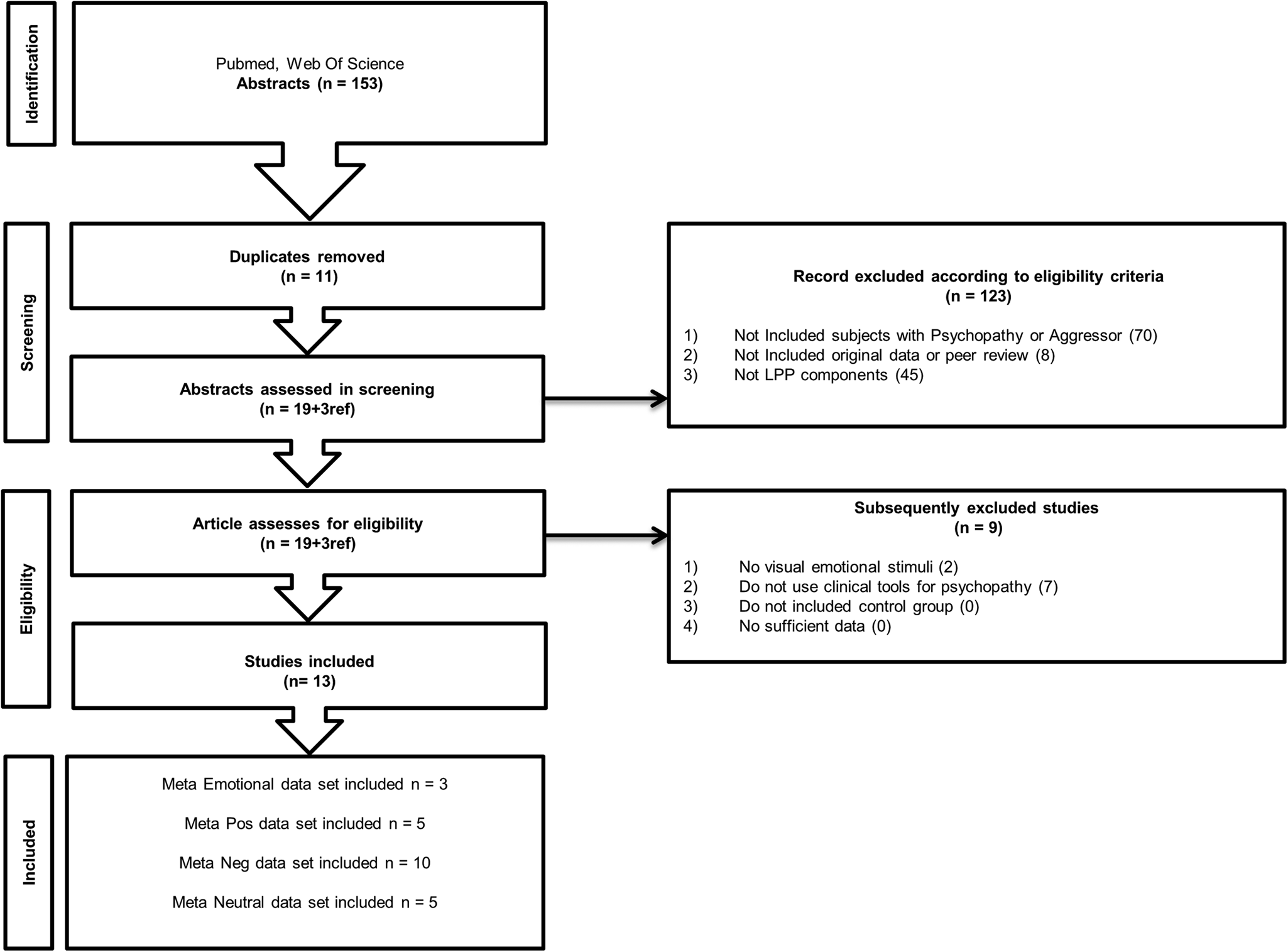
The primary search yielded 153 results. The flowchart diagram of the search is provided in Fig. 1. Among the 153 abstracts assessed for screening, 11 duplicates were removed, and 123 abstracts were excluded according to the eligibility criteria. The remaining 19 studies + 3 references were then assessed for eligibility based on full-length articles. Seven articles were excluded because they did not use clinical scales to assess psychopathy and 2 because they did not use visual emotional stimuli. Thirteen articles were then included in the meta-analysis.
PRISMA flow chart of the search process. Emo, emotional, Pos, positive, Neg, negative, and Neu, neutral. The supplementary references (Rothemund et al., Reference Rothemund, Ziegler, Hermann, Gruesser, Foell, Patrick and Flor2012; Brislin et al., Reference Brislin, Yancey, Perkins, Palumbo, Drislane, Salekin and Patrick2018 and Brennan et al., Reference Brennan, Crowley, Wu, Mayes and Baskin-Sommers2018), were not added due to characteristics of clinical measurement (externalizing scale) and absence of visual emotional stimuli.

Characteristics of selected studies
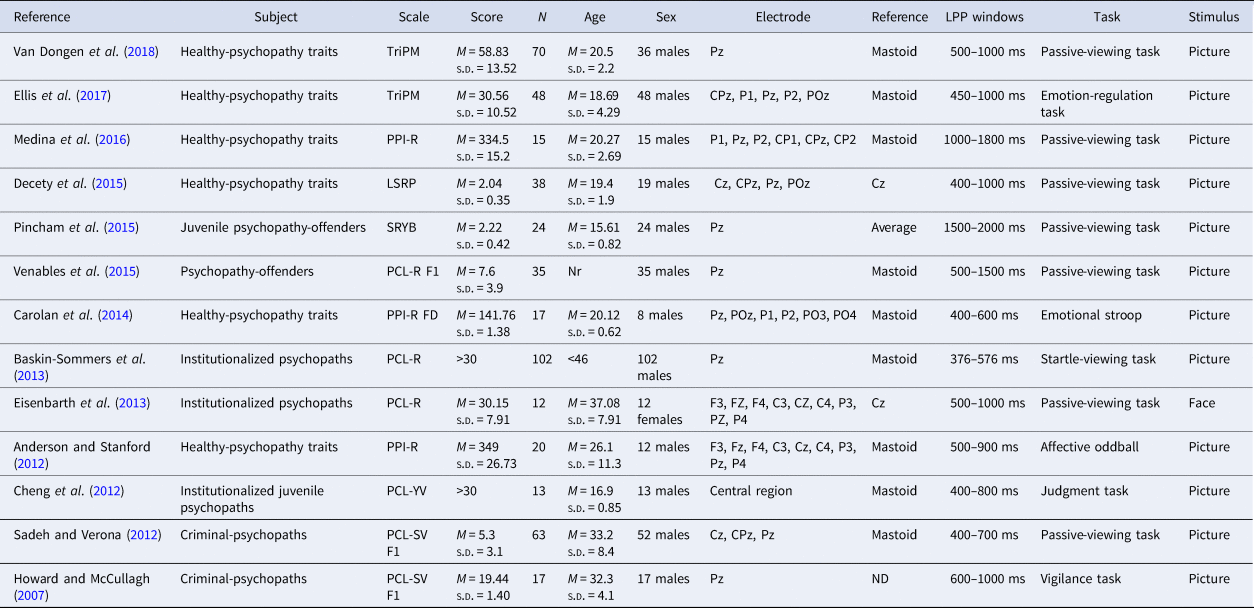
The 13 selected articles reported 23 datasets which were divided according to stimulus valence. Three datasets of emotional stimuli, 10 datasets of negative stimuli, 5 datasets of positive stimuli, and 5 datasets of neutral stimuli were included in the meta-analysis. Experimental paradigms used to measure LPP amplitude included picture-viewing paradigms, emotional Stroop task, and oddball target detection task. Stimuli were selected among Karolinska directed emotional faces (Lundqvist et al., Reference Lundqvist, Flykt and Öhman1998), emotional IAPS pictures (Lang et al., Reference Lang, Ohman and Vaitl1988), NimStim pictures (Decety et al., Reference Decety, Michalska, Akitsuki and Lahey2009) of negative, positive or neutral valence and Amazon's Mechanical Turk (https://www.mturk.com/). Details on characteristics of included studies are provided in Table 1.
Characteristics of the 13 studies included in the meta-analysis

M, mean; N, sample size; d’, Cohen's d; v, variance of d’; s.d., standard deviation.
Electrode sites are given according to the 10/20 EEG system.
Scales: PCL-R: Psychopathy Checklist – Revised; PCL-SV: Psychopathy Checklist – Screening Version; PCP-YV: Psychopathy Checklist – Youth Version; PPI-R: Psychopathy Personality Inventory-Revised; LRSP: Levenson Self-Report Psychopathy Scale; SRYB: Self-Report of Youth Behaviour; TriPM: Triarchic Psychopathy Measure. Please note that for Van Dongen et al. (Reference Van Dongen, Brazil, van der Veen and Franken2018); Ellis et al. (Reference Ellis, Schroder, Patrick and Moser2017); Sadeh and Verona, (Reference Sadeh and Verona2012) and Howard and McCullagh (Reference Howard and McCullagh2007), the effect was led and reported according to meanness, boldness and PCL-R F1, respectively.
The meta-analysis included 474 clinical subjects (75% male n = 356; 25% female n = 95). The clinical group consisted of 229 adults and 37 juveniles diagnosed with psychopathy (aged 15 to 17 years old) and 208 adults with high psychopathic traits. The control group consisted of 76 adults [56% males (n = 43); 44% females (n = 34)] and 24 males juveniles. Among the 13 studies, 9 studies reported information on medication and comorbidity as exclusion criteria (Howard and McCullagh, Reference Howard and McCullagh2007; Anderson and Stanford, Reference Anderson and Stanford2012; Carolan et al., Reference Carolan, Jaspers-Fayer, Asmaro, Douglas and Liotti2014; Cheng et al., Reference Cheng, Hung and Decety2012; Sadeh and Verona, Reference Sadeh and Verona2012; Baskin-Sommers et al., Reference Baskin-Sommers, Curtin and Newman2013; Decety et al., Reference Decety, Lewis and Cowell2015; Venable et al., Reference Venables, Hall, Yancey and Patrick2015; van Dongen et al., Reference Van Dongen, Brazil, van der Veen and Franken2018). Two studies included subjects with substance abuse (Howard and McCullagh, Reference Howard and McCullagh2007; Eisenbarth et al., Reference Eisenbarth, Angrilli, Calogero, Harper, Olson and Bernat2013) and 2 studies reported the cut-off for intelligence score under 70 IQ (Baskin-Sommers et al., Reference Baskin-Sommers, Curtin and Newman2013; Eisenbarth et al., Reference Eisenbarth, Angrilli, Calogero, Harper, Olson and Bernat2013).
Meta-regression model: impact of emotional valence on LPP modulation in clinical sample
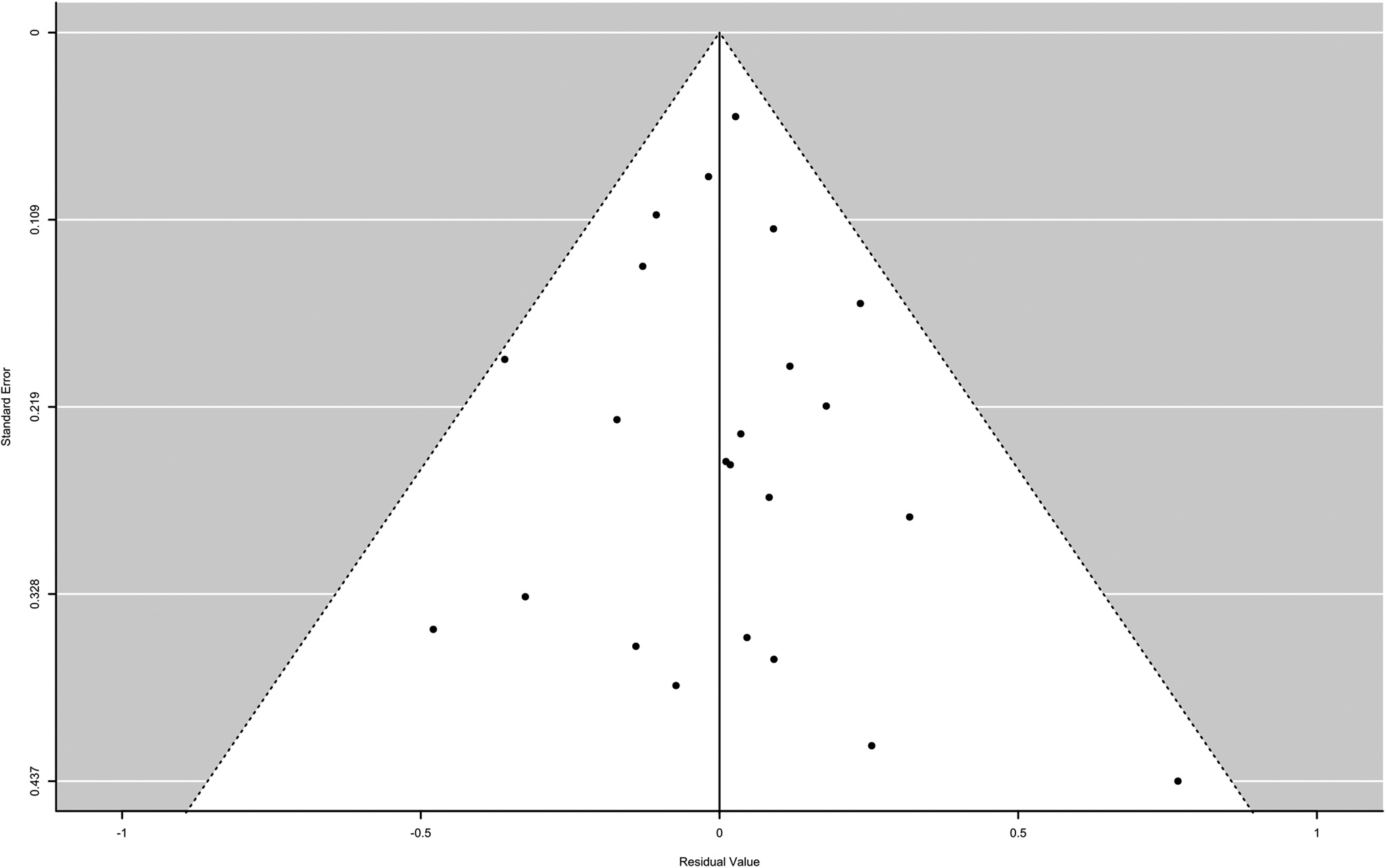
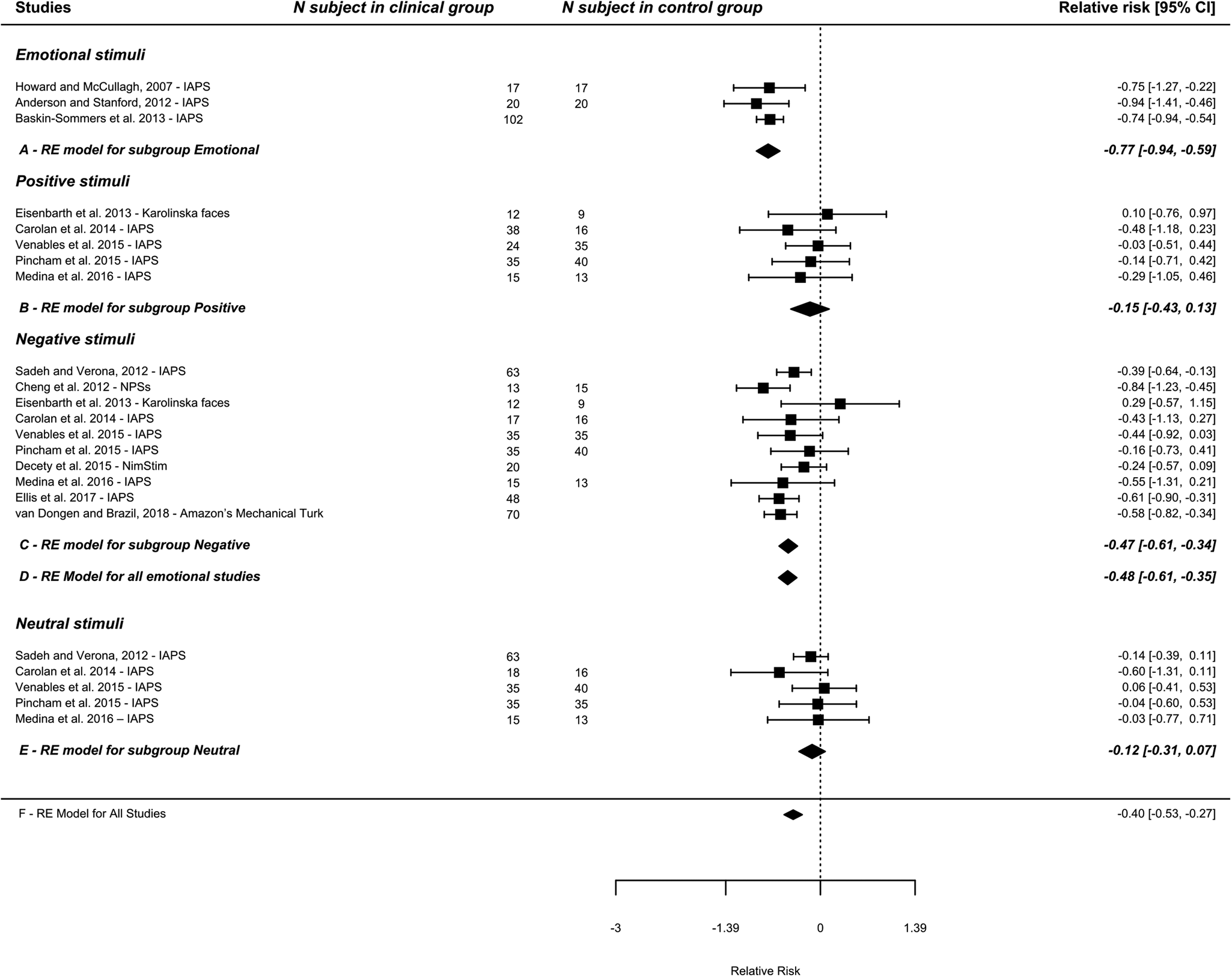
Regression model test for residual heterogeneity indicated that the categories of moderator were equally homogeneous [QE (df = 19) = 16.04, p = 0.65] and the omnibus test indicated a significant effect of the moderator [QM (df = 2) = 28.63, p < 0.005]. Tests for funnel plot asymmetry indicated no potential publication bias (t = 0.45, df = 18, p = 0.65; see Fig. 2). The effect of categorical moderator for LPP amplitude suggested the implication of negative emotional processing in reduction of LPP amplitude compared to processing of neutral and positive stimuli (β = −0.35, s.e. = 0.11, zval = −3.09, p < 0.005; see Fig. 3). Pooled emotional category was also significantly greater compared to neutral and positive categories (β = −0.64, s.e. = 0.13, zval = −4.89, p < 0.005).
Funnel plot for meta-analysis. Points represent the observed effect sizes with standard error. In the current meta-analysis, all points falling on the pseudo confidence interval region and Eggers test for funnel plot asymmetry reported no publication bias.

Forest plot for meta-analysis with categories depicting the results (sample size for clinical and control group, effect size and relative risk) of individual studies grouped according to emotional valence. For each category, a summary polygon shows the result of the random effect model according to the studies in each category.

Random effect model (RE): categories analysis
The analysis of LPP amplitude evoked by negative stimuli included 10 datasets. In line with the regression model, the clinical group displayed significant smaller LPP amplitude evoked by negative stimuli than the control group (mean effect size = −0.47; 95% CI −0.60 to −0.33; p < 0.005). The heterogeneity test suggested that the studies were homogeneous (Q = 11.46; p = 0.24). There was no significant effect at the Egger's test suggesting a symmetrical forest plot and no significant potential publication bias [(t) = 0.45; p = 0.65]. Pooled emotional category also provided significant effect between clinical and control groups with reduced LPP amplitude (mean effect size = −0.76; 95% CI −0.93 to −0.59; p < 0.005), homogeneity between studies (Q = 0.57; p = 0.74) and no publication bias [(t) = −0.86; p = 0.54].
The analysis of LPP amplitude evoked by positive stimuli included 5 datasets. The analysis reported no difference between clinical and control groups on LPP amplitude evoked by positive stimuli (mean effect size = −0.15; 95% CI −0.42 to 0.12; p = 0.28), and the heterogeneity test indicated that the studies were homogeneous (Q = 1.52; p = 0.82). There was no significant effect at the Egger's test suggesting a symmetrical forest plot and no significant potential publication bias [(t) = −0.50; p = 0.65]. The analysis on neutral stimuli reported no significant difference between clinical and control groups (mean effect size = −0.12; 95% CI 0.31 to 0.07; p = 0.21) and homogeneity was conserved (Q = 2.47; p = 0.65). Egger's test reported no publication bias [(t) = −0.22; p = 0.83].
Finally, we analyzed LPP amplitude when subjects were presented emotional stimuli only (positive, negative and pooled emotional). In line with previous findings, individuals with psychopathic traits displayed reduced LPP amplitude compared with controls (mean effect size = −0.48; 95% CI −0.61 to −0.34; p < 0.005) but homogeneity between studies was not found (Q = 28.46; p = 0.03).
Discussion
The goal of this meta-analysis was to examine the effect of emotion on LPP amplitude evoked by visual emotional stimuli between subjects with psychopathic traits and controls. Main results indicated that compared to the control group, the clinical group displayed smaller LPP amplitudes when presented with negative stimuli but not with positive or neutral stimuli.
Late positive potential and psychopathy
First, we observed smaller LPP amplitude in clinical as compared to control subjects when presented with emotional pooled stimuli or negative stimuli only. This can be interpreted in various ways. Aspects of pleasantness, arousing and affectivity of stimuli should be considered. Interestingly, LPP amplitudes elicited by low-arousal unpleasant, low-arousal pleasant and neutral stimuli were not different from each other, but LPP amplitude was greater for high-arousal unpleasant stimuli than high-arousal pleasant and neutral stimuli (Brown et al., Reference Brown, Goodman and Inzlicht2012). Furthermore, attention on non-arousing parts of unpleasant stimuli reduced LPP amplitude (Hajcak et al., Reference Hajcak, Moser and Simons2006) and latency (Dunning and Hajcak, Reference Dunning and Hajcak2009). Also, LPP amplitude was reduced when subjects made non-affective rather than affective judgments on emotional stimuli (Hajcak et al., Reference Hajcak, Moser and Simons2006). Thus, it is possible that the clinical group perceived emotional or negative stimuli as less arousing and affective than the control subjects. Future work should include self-reported pleasantness, arousal, and affectivity ratings when investigating LPP amplitude. Second, it is possible that this smaller LPP in the clinical group reflects such inter-individual ratings. Furthermore, it would be interesting to explore negative stimuli processing by including the processing of fearful stimuli. Indeed, a previous meta-analysis has reported that individuals with antisocial behaviors showed deficits (non-recognition) in processing fearful faces (Marsh and Blair, Reference Marsh and Blair2008). Results from the present work support the clinical relevance of LPP in psychopathy. Future work should also test for correlations between LPP amplitude and symptoms of psychopathy to determine whether LPP may carry such clinical relevance (Dennis and Hajcak, Reference Dennis and Hajcak2009).
LPP as a neuromarker for psychopathy?
The identification of a neuromarker for psychopathy, such as a specific modulation of an electrophysiological component, remains of major interest in clinical research for differential diagnosis and treatment optimization. First of all, EEG neuromarkers remain a potential and valuable clinical tool. For instance, the Food and Drug Administration (FDA) has validated EEG neuromarkers for the diagnosis of attention deficit hyperactivity disorder (FDA, 2013). Neuromarkers like LPP modulation could also contribute to the ethological exploration of psychopathy. In this perspective, the current analysis of the modulation of LPP seems to be mainly driven by affective traits of psychopathy. Second of all, available treatment for patients with psychopathic traits are often not enough to respond to patients needs and the disorder is difficult to treat (Salekin, Reference Salekin2002). Therefore, it is essential to lay a robust foundation on electrophysiological functioning and improve etiological knowledge from which new therapeutic approaches will be able to build upon. Fundamental approaches of the electrophysiological process underlying cognitive functioning in psychiatric disorders provide a supplementary framework for traditional classification based primarily on symptoms/signs used to diagnose the mental disorder. Indeed, the National Institute of Mental Health's Research Domain Criteria provides a framework that emphasizes the integration of basic behavioral and neuroscience research to deepen the understanding of mental disorder (Insel et al., Reference Insel, Cuthbert, Garvey, Heinssen, Pine, Quinn and Wang2010).
LPP amplitude has been shown to exhibit abnormal patterns across several psychiatric conditions as compared with controls. For example, conversely to those with psychopathy, individuals with risk for schizophrenia exhibited an increased LPP amplitude when presented with negative visual stimuli, suggesting an increase in affective reactivity to emotional stimuli (Martin et al., Reference Martin, Karcher, Bartholow, Siegle and Kerns2017). Abnormalities in LPP evoked by emotional stimuli were also observed in patients with anxiety and major depressive disorder, but with differential effects. Patients with anxiety disorders displayed an enhanced LPP amplitude evoked by negative stimuli (Kujawa et al., Reference Kujawa, MacNamara, Fitzgerald, Monk and Phan2015) whereas patients with major depressive disorder exhibited a reduced LPP for both positive and negative stimuli (Proudfit et al., Reference Proudfit, Bress, Foti, Kujawa and Klein2015; MacNamara et al., Reference MacNamara, Kotov and Hajcak2016). Our results suggest that a (1) reduction of LPP evoked by negative stimuli and a (2) normal LPP response to positive and neutral stimuli would be specific to individuals with psychopathy and psychopathy traits. Considering these studies, it should be further investigated if a reduction of LPP limited to negative stimuli could discriminate psychopathy from other clinical conditions. Thus, it could be possible to consider LPP as a potential neuromarker to characterize psychopathy.
Psychopathy: neurobiological correlates of disorder
Regarding the neural substrates that may underpin impairments in emotional processing, previous works have reported the implication of the occipital cortex, the amygdala, the temporal areas, the prefrontal cortex (PFC) and the orbitofrontal cortex (OFC) in the generation of LPP (Liu et al., Reference Liu, Huang, McGinnis-Deweese, Keil and Ding2012). Using functional magnetic resonance imaging (fMRI), studies have revealed several abnormalities in individuals with psychopathy across brain structures and connectivity implicated in the generation of LPP. Among them, a reduction of hemodynamic activity was observed in the OFC and the dorsolateral PFC (DLPFC), the amygdala, the anterior cingulate cortex (ACC), the ventro-medial PFC and the superior temporal gyrus (STS) (Kiehl, Smith and Hare, Reference Kiehl, Smith and Hare2001; Blair, Reference Blair2008; Dolan and Fullam, Reference Dolan and Fullam2009; Ermer et al., Reference Ermer, Cope, Nyalakanti, Calhoun and Kiehl2013; Lockwood et al., Reference Lockwood, Sebastian, McCrory, Hyde, Gu, De Brito and Viding2013; Cope et al., Reference Cope, Ermer, Nyalakanti, Calhoun and Kiehl2014). A reduced activity in the basolateral amygdala, especially during negative stimuli presentation has also been reported (Larson et al., Reference Larson, Baskin-Sommers, Stout, Balderston, Curtin, Schultz, Kiehl and Newman2013). Finally, a meta-analysis of brain imaging studies in individuals with psychopathy (Yang and Raine, Reference Yang and Raine2009) has reported functional and structural abnormalities in the right OFC, the left DLPFC and the ACC. Additionally, abnormalities in brain networks involved in attentional processes towards emotional stimuli, such as the amygdala-PFC network (Blair et al., Reference Blair, Mitchell and Blair2005; Contreras-Rodriguez et al., Reference Contreras-Rodríguez, Pujol, Batalla, Harrison, Soriano-Mas, Deus, López-Solà, Macià, Pera, Hernández-Ribas, Pifarré, Menchón and Cardoner2015), have been described in individuals with psychopathy. Moreover, in individuals with psychopathy, a reduced connectivity between the PFC and the amygdala has been previously observed (Blair, Reference Blair2008; Motzkin et al., Reference Motzkin, Newman, Kiehl and Koenigs2011). Such impairments in structural and functional brain connectivity may underpin the inability to correctly process negative emotional stimuli in individuals with psychopathic traits.
Discussion on the psychometric scales and psychopathy constructs
The majority of the scales for the assessment of psychopathic traits use a modern conception of psychopathy which suggests a pathological personality construct comprising factor conceptualization rather than a unitary construct. The PCL-R is a standard to assess psychopathy according to the factor conceptualization (Hare et al., Reference Hare, Harpur, Hakstian, Forth, Hart and Newman1990; Benning et al., Reference Benning, Patrick, Hicks, Blonigen and Krueger2003). The PCL-R and other versions [as PCL-YV is similar to PCL-R in terms of factor structure (Forth et al., Reference Forth, Kosson and Hare2003)] comprise interpersonal-affective Factor-1 (PCL-R F1), impulsive-antisocial Factor-2 (PCL-R F2) and 4 facets related to interpersonal, affective, lifestyle and antisocial traits (Hare and Neumann, Reference Hare, Neumann and Patrick2006). The PCL-R is a semi-structured interview scale dedicated to identifying personality traits and behavior related to psychopathy. However, the PCL-R is relatively limited regarding standardized administration, items tailored to individuals with criminal history and the need to access file information pertaining to official criminal records and institutional behavior (Benning et al., Reference Benning, Patrick, Hicks, Blonigen and Krueger2003). Based on factor conceptualization, several self-reported measures were developed from the PCL-R, as the LRSP, or separately, as the PPI-R. The LRSP, as the PCL-R, assesses psychopathy using a two-factor conceptualization. The primary factor of LSRP is related partly to interpersonal-affective factors of the PCL-R whereas the secondary factor is related to its impulsive-antisocial factors (Miller et al., Reference Miller, Gaughan and Pryor2008). The PPI-R conception is based on eight subscales which can be organized into two higher factors: fearless dominance (FD) and self-centered impulsivity (SCI). Regarding the validation studies for PPI-R, the FD factor is mainly associated to low emotional reactivity of the PCL-R F1, and the SCI factor is associated with anti-social behavior of the PCL-R F2 (Uzieblo et al., Reference Uzieblo, Verschuere, Van den Bussche and Crombez2010).
The severity of affective or antisocial traits in individuals with psychopathy related to these scales could be a confounding factor in the current analysis (Hare and Neumann, Reference Hare, Neumann and Patrick2006; Verona, Reference Verona2016). Indeed, previous studies have reported that deficits in attentional processing during emotional perception are linked to the severity of interpersonal affective traits (Sadeh and Verona, Reference Sadeh and Verona2008; Newman et al., Reference Newman, Curtin, Bertsch and Baskin–Sommers2010). Regarding the PPI-R, the factor results are clearly important because the FD and SCI factors are largely uncorrelated (Benning et al., Reference Benning, Patrick, Hicks, Blonigen and Krueger2003; Lilienfeld and Widows, Reference Lilienfeld and Widows2005). Among the studies included in the current article, Medina et al. (Reference Medina, Kirilko and Grose–Fifer2016) reporting results for both FD and SCI factors of the PPI-R showed that the emotional blunting to unpleasant images in the late LPP was associated with FD factor rather than SCI factor scores. In the same way, the correlation between factors of PCL-R is relatively weak (Hare, Reference Hare1991). The only study included in the current meta-analysis that has investigated this particular point reported a specific association between LPP amplitude and constructs of psychopathy of PCL-R F1 and PCL-R F2. The results showed negative correlation on PCL-R F1 and positive correlation on PCL-R F2 (Sadeh and Verona, Reference Sadeh and Verona2012). Regarding these results, the reduction of LPP toward negative emotional stimuli seems to be mainly led by affective traits of psychopathy. Importantly, several studies have previously described, relative to factors 1 and 2, the etiological heterogeneity of psychopathy construct for emotional processing (Venables et al., Reference Venables, Hall, Yancey and Patrick2015; Hicks and Patrick, Reference Hicks and Patrick2006; Schienle et al., Reference Schienle, Wabnegger, Leitner and Leutgeb2017), attentional processing (Verona et al., Reference Verona, Sprague and Sadeh2012) and conditioning (Veit et al., Reference Veit, Konicar, Klinzing, Barth, Yilmaz and Birbaumer2013).
A second model was used for assessing psychopathy and refers to the dimensional constructs of the triarchic model (Patrick et al., Reference Patrick, Fowles and Krueger2009). The main principle of this model is that psychopathy can be described with three distinct phenotypic constructs: disinhibition, boldness and meanness. The PCL-R F1 is associated with boldness and meanness phenotypic constructs but not with the disinhibition construct. The boldness subscale is also related to the FD construct indexed by the scores on the PPI-R. Meanness and disinhibition constructs, as PCL-R F2, are related to externalization features of psychopathy (Patrick et al., Reference Patrick, Hicks, Krueger and Lang2005). Previous works indicate that meanness and disinhibition have different etiological substrates (Frick and Marsee, Reference Frick, Marsee and Patrick2006). For the triarchic model, inclusion was coherent with the bi factorial conceptualization and the studies included in the current meta-analysis were based on boldness and meanness directly related to PPI-R FD and PCLR-F1.
Limitations
Limitations of this work should be acknowledged. First of all, the method of assessment can constitute a limitation between different clinical interviews (as for PCL-R and self-report as PPI-R). Whenever possible, in studies using clinical interviews, the analysis of moderating effect of mode assessment should be considered. In the current analysis, the heterogeneity of clinical scales and methods of assessment suggests that the results of this meta-analysis could not be caused by a screening effect. Regarding this limitation, the Triarchic Psychopathy measure (Patrick et al., Reference Patrick, Fowles and Krueger2009) was developed as an integrative framework to help integrate findings across research studies and reconcile differing conceptions of psychopathy (Drislane et al., Reference Drislane, Patrick and Arsal2014). Thus, the systematic use of the TriPM scale in combination with others scale from studies exploring psychopathy and electrophysiological signature will be particularly relevant to future studies. The TriPM was developed from established inventories and it allows to study psychopathy in existing datasets. Moreover, it provides a basis for establishing a latent variable operationalization of the triarchic model and could be used as an empirical referent in future meta-analytic investigations (Drislane and Patrick, Reference Drislane and Patrick2017).
The absence of systematic analyses and reports of factors and facets of psychopathy across clinical tools in the included studies is also a limitation of our work. It will be essential in future studies to systematically compare the differential effects of psychopathy dimensions.
In the current analysis, sex could not be included as moderator in analysis. Regarding the clinical sample used for this meta-analysis, the sex ratio [75% male (n = 356); 25% female] was consistent with epidemiological studies on psychopathy which predicts less prevalence of psychopathy in women. In general, analyses of sex ratio in psychopathy were very difficult to establish due to the heterogeneity in sample and study procedures, which prevented the use of statistical analyses. The last meta-analysis to date (Beryl et al., Reference Beryl, Chou and Völlm2014) concludes on sex ratio prevalence rates ranged from 1.05% to 31% in the female sample (using the PCL-R with cut off criterion of 30; or 0–16% when using the PCL: SV with a cut off criterion of 18). This is lower than the prevalence rates reported in male samples (15–30%). This difference in sex ratio may have slightly impacted the LPP modulation in a psychopathic clinical sample. Sex difference in the manifestation of psychopathy has been previously reported (for review see Cale and Lilienfeld, Reference Cale and Lilienfeld2002). At last, there seems to be a difference in LPP modulation between male and female samples during emotional regulation when presenting emotional stimuli (Gardener et al., Reference Gardener, Carr, MacGregor and Felmingham2013).
Regarding medication, it has been reported that antidepressant medication can enhance the performance of subjects in emotion recognition tasks (Harmer et al., Reference Harmer, Dawson, Dourish, Favaron, Parsons, Fiore and Goodwin2013). Benzodiazepine and psychotropic medications are known to affect EEG activity (Aiyer et al., Reference Aiyer, Novakovic and Barkin2016; Jobert and Wilson, Reference Jobert and Wilson2015). Medication was not systematically reported in the included studies. Thus, this potentially may have influenced performances at emotion recognition task and modulated EEG activity.
The relative heterogeneity of cognitive tasks and stimuli used to elicit LPP in the different included studies could also constitute a limitation. However, this heterogeneity reflects the variety of stimuli that subjects must process in ecological conditions and supports the transferability of the results in real-life situations.
Finally, a relative heterogeneity across sample tests should be addressed. In the current meta-analysis, we included incarcerated and non-incarcerated subjects. As the prevalence of psychopathy reaches approximately 1% in the general population and 15–20% in the inmate population (Ogloff, Reference Ogloff2006; Coid et al., Reference Coid, Yang, Ullrich, Roberts and Hare2009; Sullivan and Kosson, Reference Sullivan, Kosson and Patrick2009), the inclusion of non-incarcerated individuals with psychopathy traits could be considered as an ecological aspect, which added value to the current analysis.
Conclusion
The current meta-analysis highlights that individuals with psychopathy displayed abnormal processing of negative stimuli but not of neutral and positive ones. The current study constitutes a first step toward the identification of a neuromarker of abnormal emotional processing in individual with psychopathy. The development of LPP as a neuromarker for psychopathy will require further investigation in order to define its possible implication in diagnostic and how it would actually be measured and controlled in practice. The consideration of new models like the Triarchic model construct and the TriPM scale could be efficient tools that allow future meta-analysis to explore the implication of phenotypic constructs in electrophysiological modulation and symptomatology in individuals with psychopathy.
Supplementary material
The supplementary material for this article can be found at https://doi.org/10.1017/S0033291719002216
Acknowledgements
The authors thank Chantal Dufour from the ‘Centre de Documentation du CIUSSS de la Capitale’ and Dr Jean Leblond from the CIUSSS for their help in the literature search and statistical methodology, respectively.
Financial support
No financial support has been received for this work.
Conflict of interest
All authors declare that they have no conflicts of interest.