



When David Hasselhoff stepped up to address the protestors, the crowds went wild. In the shadow of the Berlin Wall they chanted, sang, waved their placards and, of course, uploaded photographs onto Twitter. For this was 2013 not 1989 and on this occasion ‘the Hoff’ had come to call not for the Wall's destruction but its preservation. The cause of the protests was a property developer's proposal to remove a section of the longest remaining stretch of the Berlin Wall in order to facilitate site access to the luxury apartments being built alongside the river Spree.Footnote 1 On one level, the issues at stake here are not too dissimilar to those that characterize debates around urban development in any western city. First, the tension between calls for the preservation of historical traces and the need to make space for the modern city. Secondly, the unfixed nature of meaning; within 25 years, this section of the Berlin Wall had been transformed from both an instrument and symbol of repression into the East Side Gallery, a celebrated open air art gallery begun in 1990 when artists painted images expressing ‘their own overjoyed optimistic mood’ onto the Berlin Wall itself.Footnote 2 Thirdly, the difficulty of striking a balance between a perceived economic imperative to attract corporate investment and citizens’ demands for spaces where non-commercial interests can flourish. In Berlin, however, these issues are particularly complex. In many respects, the built environment of that city has functioned as a microcosm of the complexities of unification. The challenge of merging two countries into one was magnified in the task of suturing two halves of the divided city back together. Practical issues such as re-establishing rail links, identifying and designing a single ‘city centre’ and bringing investment into the city have been complicated by recurring questions over how to negotiate the legacies of the past in the city that had served as the capital of both the Third Reich and the German Democratic Republic (GDR). These negotiations are often fraught with disagreement over what, exactly, should be remembered and how. This is the case even, or perhaps especially, at those places where changes of use have since led to shifts in wider perceptions of the meanings of the site in question. At such places, groups of veterans, victims and supporters battle to bring about confrontation with and commemoration of the events that occurred there. As the redevelopment of Berlin into a functional single city and the capital for the new, democratic united Germany gathered pace, citizens’ initiatives, survivors’ groups, historians and politicians competed with each other and with more pragmatically driven urban planners to shape the built environment. Certain buildings, sites and spaces have emerged as epicentres within these contests and functioned as battlegrounds upon which Germany's memory contests are fought.
As well as normalizing the situation within Germany, it had been hoped that unification would lead to the resolution of some of these disputes. On 9 November 1993, then president of the German Bundestag, Rita Süssmuth, announced it was now time to embark upon a period of ‘joint remembrance’.Footnote 3 However, Süssmuth's somewhat optimistic proclamation was undermined by a lack of consensus on how both National Socialism and the GDR should be remembered. A vast literature has developed, spanning disciplines including history, politics and cultural studies, which explores the complexities of German attempts to ‘deal with’ or ‘master’ its recent past.Footnote 4 A strong, cross-cutting urban studies subfield has explored how these memory contests have impacted upon the development of the urban fabric of Berlin. Prominent within this is the analysis of the range of responses to buildings considered ‘burdened’ through their construction or use by the Nazi and / or East German governments. Wise and Ladd highlight the extremely self-conscious way in which the fate of buildings such as the Nazi Aviation Ministry and Reich Bank have been negotiated in the unified Germany: the public debates over whether demolition or reuse would be a more effective way of confronting the past; the painstaking attention to architectural detail; and the political associations attributed to particular styles or materials.Footnote 5 The legacy of the Cold War and the west's victory is another key theme, one that is usually explored through the analysis of the post-unification treatment of the built environment of the former East Berlin. These studies of the memory contests around street names, memorials and buildings reveal East German resentment at perceived attempts to erase the traces of the GDR from the built environment or to conflate it with National Socialism through reducing its legacy to its most repressive elements.Footnote 6 One particularly high-profile catalyst for this was the 2008 demolition of the fondly remembered Palast der Republik, an East Berlin social and cultural hub as well as the seat of the East German parliament.Footnote 7 A third strand to the scholarship explores the development of the memorial landscape in Berlin and exposes its contingent nature. As the subject of one of the most virulent and public disputes about which victims of which atrocities should be commemorated where and in what way, the Memorial to the Murdered Jews of Europe, inaugurated in 2005 has attracted significant academic attention.Footnote 8 Nonetheless, studies by Jordan and Saunders are among those which demonstrate how such conflicts surround even much less prominent memorial sites.Footnote 9
This article will take as its focus a heavily contested site that overlaps all of these strands of scholarship: Tempelhofer Feld. Tempelhofer Feld is a green space of over 300 hectares in the heart of Berlin. Previously used for the grazing of cattle and for Prussian military exercises, the Feld became home to Berlin's first airport in the 1920s. After the Nazi seizure of power in 1933, a disused Prussian military prison on the site was used as a Gestapo prison and then a concentration camp. It was closed in 1936 and subsequently demolished to make way for the construction of the monumental airport building that currently stands in the north-west corner of the Feld. Throughout the war, the airport building was used for armament production and was staffed by forced labourers who were housed in wooden barracks on the Feld. After the war, the American Air Force was headquartered within the building and opened it up for civil aviation in 1950. Following unification, the Berlin Senate announced that Berlin's air traffic should be concentrated in one location and, as a result, Tempelhof would cease to function as an airport. The possibility of closing the popular city-centre airport sparked huge protests which saw the pro-closure Social Democratic Party (SPD), Left and Green parties and environmental and citizens’ groups pitted against the Christian Democratic Union (CDU), the Free Democratic Party, the Springer Press and other citizens’ groups. Despite the objections, flight operations ceased in 2008. The closure of the airport opened up questions over what to do with the vast site.
Through the former presence of the concentration camp and the forced labourers, Tempelhofer Feld is, theoretically, just as historically burdened as any other National Socialist building. However, as the example of the Berlin Wall makes apparent, the meanings attached to places are not immutable. Just as the post-unification change in function has transformed the meanings attached to the East Side Gallery, so too has Tempelhof's post-war use added an extra layer which significantly changes its meaning. Unlike the Cold War sites mentioned above, Tempelhof was in the western sector of the city and its connections with the west's victory have led to it being hailed as a symbol not of dictatorship but of freedom. A corollary of this is that confrontation with the site's use during the Third Reich has, until recently, been remarkably muted. The closure of the airport presented both the opportunity and the obligation to try and bring about the level of critical engagement with this period that has been seen at other National Socialist buildings in Berlin. However, the heavily contested nature of the airport's closure also created a strong political impetus to configure Tempelhof both as a site of recreation which would be attractive to Berliners and as a viable investment opportunity that would bring much-needed funds into the city. Through analysing the different strategies through which the past is negotiated and mediated at Tempelhof, this article will argue that the historicization of that site is currently at a crossroads: we can see evidence of a pedagogical approach to the site's multiple layers, designed to inform visitors and to encourage critical engagement with the site's National Socialist past, but we simultaneously see the fetishization of selected elements of the past and even the commodification of some aspects of the site's National Socialist layer. In the interaction between these two constructions of the site's history, we see a magnification of the tension that characterizes contemporary Berlin: that between the ‘post-dictatorship’ city shaped by ongoing memory politics; and the modern, western city where authorities need to strike a balance between attracting corporate investment and listening to citizens’ demands to determine how their city is constituted.
Tempelhof's multiple histories
That Tempelhof airport is a site of historical significance is almost universally accepted. It is listed as a protected monument and its history has been the subject of numerous popular history books, academic articles and exhibitions.Footnote 10 During the debate around the airport's closure, accounts of the site's history featured heavily in newspaper coverage and in the campaign materials produced by both sides.Footnote 11 Analysis of these materials reveals that the telling of the site's history has been dominated by two intertwining narratives. One foregrounds the site's connection to the history of flight, positing it as a space of modernity, of innovation, adventure and glamour. Prominent within this narrative are the pioneering flight demonstrations held on Tempelhofer Feld by the Wright brothers and Armand Zipfel in front of large crowds of spectators and Berlin's first airport which was constructed on the Feld in the 1920s as an ensemble comprised of Paul and Klaus Engler's terminal building and Heinrich Kosina and Paul Mahlberg's aircraft hangars and drew much praise for its modern, functional design.Footnote 12 Following the National Socialist seizure of power, Hitler wanted to consolidate Berlin's emerging position as a major hub in international transport networks. As part of this, he commissioned Ernst Sagebiel with the building of a new airport at Tempelhof which was to have a capacity of 30 times that of its predecessor and to be large and technologically advanced enough to stay in service until at least the year 2000.Footnote 13 It is this terminal building, begun in 1936, which now stands at the site. Intended to function as the ‘gateway to Germania’, the monumental ‘world capital’ into which Hitler and his architect Albert Speer envisaged transforming Berlin, Tempelhof is known for its architectural duality. From the front, it has the characteristics generally associated with National Socialist prestige architecture: over-sized proportions, rigid symmetry, strong axiality and stone-clad walls; yet from the back, it boasts modern materials and technical innovations that were cutting edge at the time and continue to attract praise today.Footnote 14
The second narrative highlights the site's post-war history, specifically its use during the Cold War. When Stalin severed the overland connections between West Berlin and the rest of the Federal Republic of Germany in the 1948–49 Berlin Blockade, the only way to sustain West Berlin was by bringing supplies in by air. Tempelhof became the main hub for the Berlin airlift with Allied planes laden with food, building supplies and other necessities landing there at two-minute intervals, cementing Tempelhof's status as West Berlin's ‘gateway to the world’.Footnote 15 Even after the blockade was lifted in May 1949, air travel was still valued as a means to bypass the East German control points that one would encounter if leaving West Berlin by land.Footnote 16 To West Berliners and to refugees from the GDR, Tempelhof represented a link outwards to freedom, providing a springboard from which they could access the rest of the Federal Republic as well as the wider western world. The airport's geographical proximity to the Eastern bloc meant that it also functioned as a gateway inwards for refugees from the other side of the iron curtain. Between 1963 and 1983, at least 13 Polish flights were hijacked and diverted to Tempelhof, earning the Polish LOT airline the nickname ‘Lands Often at Tempelhof’.Footnote 17
These narratives combine to construct Tempelhof as a ‘symbol of freedom’, where ‘freedom’ takes on myriad meanings: freedom of creativity, of experimentation, the physical freedom of flight and the political freedom of West Berlin and its access to the ‘free world’. Indeed, the overt assertion that ‘Tempelhof is a symbol of freedom’ has been repeated in numerous books, flyers and newspaper articles about the airport.Footnote 18 This is a performative statement that continually and actively constructs Tempelhof as this ‘symbol of freedom’. The connection between Tempelhof and ‘freedom’ has thus come to transcend the private memory of the individuals whose lives were directly impacted upon by its role in the Cold War and has become part of what Assmann refers to as cultural memory, a stabilized understanding of a particular past transmitted across generations through ‘reusable texts, images and rituals’.Footnote 19
Yet this telling of the airport's history skips over the detail of its use between 1933 and 1945. While it does acknowledge the role played by the National Socialists in shaping the site, it omits to highlight that the airport complex is not merely a symbol of Nazi megalomania but also a site where the violence, terror and brutality of Nazism was experienced first-hand by thousands of people. In particular, it minimizes or erases the existence of Berlin's only official SS-run concentration camp and of the forced labourers who toiled within the airport buildings and were housed in barracks on the airfield. Built in 1896, the Columbia-Haus, the dilapidated Prussian military prison that went on to hold the concentration camp, had been closed in the 1920s only to be reopened following the Nazi seizure of power in 1933. Initially used as a Gestapo prison, it was brought under the control of the Concentration Camp Inspectorate founded in 1934 and was officially designated ‘Concentration Camp Columbia’. Many of its internees were communists, social democrats, intellectuals, homosexuals and other ‘undesirables’ who were shuttled between the camp and the Gestapo Headquarters on Prinz-Albrecht Strasse for interrogation. It is estimated that 8,000 inmates were held in the Columbia-Haus from its reopening in 1933 until it was closed in 1936 and the building demolished to make way for the construction of Sagebiel's monumental airport building.Footnote 20 However, Sagebiel's building never actually functioned as an airport under the Third Reich. As materials and labour were increasingly diverted towards the war effort, Sagebiel's project was never completed. Instead, from 1939, companies such as Weser Flugzeugbau GmbH (Weserflug) and Lufthansa AG moved their armament production units into the building. Foreign workers from occupied territories began working at the site in 1940 and, by 1944, more than 2,000 worked for Weserflug alone. The official status of these workers varied: some were free civilian workers yet many more were forced labourers. Amongst the forced labourers, who were used by both Weserflug and Lufthansa, were French and Russian POWS, deportees from the Netherlands, Poland, the Ukraine, and conscripted Jews.Footnote 21 While the civilian workers were housed in nearby administration buildings, the forced labourers lived in extremely poor conditions in heavily guarded wooden barracks on Tempelhofer Feld.Footnote 22
It was not until the 1980s that details about the history of the Columbia-Haus started to emerge. Two SPD members who been persecuted by the Nazis, Erwin Beck and Heinz Dreibert, organized ‘anti-fascist walking tours’ which included the site of the former concentration camp,Footnote 23 and historians Kurt Schilde and Johannes Tuchel began research into what had occurred there. In 1987, Schilde brought together the biographies of some of the victims of National Socialism within the district of Tempelhof and, with the assistance of the local authorities, produced a book of remembrance.Footnote 24 That same year, he produced a book about the Columbia-Haus containing documents, photographs and testimony from former prisoners and argued that a memorial on the site of the camp was already ‘long overdue’.Footnote 25 Schilde's work led to the installation of a permanent exhibition in the local museum which in turn increased public interest in the concentration camp but it was not until 1994 that a memorial was finally erected at the site.Footnote 26 That memorial is discussed below. The fate of the forced labourers has long been even less visible. In 1993, the Berlin History Workshop, a group of researchers that endeavours to uncover an increase awareness of overlooked aspects of Berlin's history, began a project on forced labour under the Nazis in Berlin and Brandenburg. Identifying over 3,000 sites where forced labourers had been held and lamenting the lack of public awareness of this, they used archives and oral testimony to produce books and exhibitions in order to make the traces of this period of history more visible.Footnote 27 However, despite emerging revelations about Weserflug's use of forced labourers and the inclusion of documents and testimony relating to Tempelhof in exhibitions about forced labour in Berlin, memory activists found that the lack of any visible physical remnants of the barracks and the continued prominence of the airlift meant that they struggled to inscribe the forced labourers into collective memory.Footnote 28
Consolidating the ‘symbol of freedom’
As well as dominating the written materials about the history of Tempelhof, its status as ‘symbol of freedom’ has been reinforced at the site itself through memorials and symbols that were inaugurated there during the American use of the airport. Prominent amongst these are Eduard Ludwig's 1951 Luftbrückendenkmal and the head of the eagle which was installed on a ground-level plinth in 1985.
A listed monument, the Luftbrückendenkmal or Airlift Memorial (Figure 1) stands in Platz der Luftbrücke or Airlift Square, the square in front of the airport which was named in 1949. The memorial was built following a competition commissioned by the West Berlin City Assembly for the design of a monument to commemorate the airlift.Footnote 29 Ludwig, a former Bauhaus student, designed a 20 metre high reinforced concrete structure topped with three prongs and standing on a base inscribed with ‘Sie gaben ihr Leben für die Freiheit Berlins im Dienste der Luftbrücke 1948/9‘,Footnote 30 followed by the names of the 39 Britons, 33 Americans and 5 Germans who died assisting with the airlift. The three prongs represent the three air corridors which connected West Berlin with West Germany and have given rise to the structure's local nickname of Hungerharke or Hunger Rake.Footnote 31 The inauguration took place on 10 July 1951 at a ceremony attended by over 100,000 Berliners who were addressed by then mayor of West Berlin, Ernst Reuter. As the first major monument of the post-war era, it has been hailed as celebration of West Germany's new identity.Footnote 32 It has come to symbolize West Berlin's tenacity, desire for freedom and incorporation into the political west as well as friendship with the USA and to represent Tempelhof airport's transformation into ‘the gateway to the free world’.Footnote 33 The symbol has retained its salience and was incorporated into the logo of the ‘vote yes’ campaign during the referendum on Tempelhof's future as an airport (Figure 2).
Ludwig's 1951 Airlift Memorial on Platz der Luftbrücke

The Luftbrückendenkmal in the ‘vote yes’ campaign material

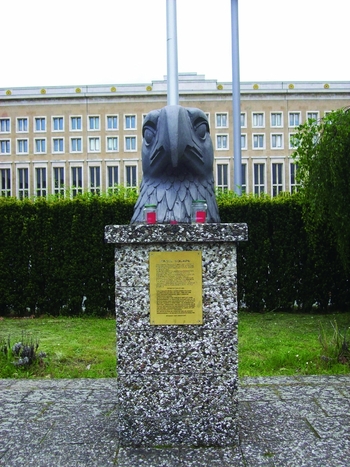
The eagle's head was taken from a 4.5 metre high aluminium eagle which was originally prominently situated on the roof of the building, above the main entrance. Made by Walter E. Lemcke to a design by Sagebiel, the eagle's significance in the building's original construction is clear: different plans and models show that Sagebiel experimented extensively with different sizes of eagle in a variety of poses in different locations on the building.Footnote 34 The eagle was removed by the Americans in 1962 in order to make room for radar equipment. The head was taken to the museum of the American Military Academy in West Point, New York, before being returned to Berlin and placed in its current position in 1985. Today, a plaque underneath the eagle's head explains that it was brought back so it could be ‘shared with the people of Berlin’ (Figure 3). The narratives that have been constructed around this eagle are telling. Originally deployed as a symbol of the power of the Third Reich, it was taken by the Americans ‘as a war trophy’ following their victory over Germany and has now been reinstated, on a low, unprepossessing stone plinth in sight of its original position, to bear testament to the new relationship between Americans and Germans as ‘brothers in arms’.Footnote 35 This transformation provides us with an insight into the process behind the reinscription of Tempelhof Airport from a National Socialist prestige building into a symbol of freedom and democracy. The eagle is conceptualized as having undergone a transformative process while it was in America; it then returned to Berlin having been ‘dealt with’, neutralized and exorcized. It is this diminished, decapitated form that was reinstated at Tempelhof in a visible but significantly demoted position as a physical manifestation of the deliberate subversion of the intentions of its creators. This encapsulates a process through which a highly potent symbol can be transformed through its reappropriation by a perceived force for good and reinscribed as a symbol of that good. In this way, the transformative process undergone by the eagle's head can be seen to encapsulate that undergone by the whole site: this building which could potentially serve as a symbol for National Socialism has, instead, come to function as a symbol of the overcoming of totalitarianism.
Eagle Square: the head of Lemcke's eagle, reinstalled on Platz der Luftbrücke in 1985
Since the 1980s, campaigners have sought to challenge what they consider to be the as-yet unwarranted rehabilitation of Tempelhof. It was the SPD faction in the local assembly who, in May 1988, requested the installation of a plaque or memorial at the site of the Columbia-Haus concentration camp and in 1990 the motion succeeded.Footnote 36 In 1994, the memorial was erected on Columbiadamm, the road running alongside the then-airfield (Figure 4). Designed by Georg Steibert, the structure resembles the cross-section of a building, the inside of which is divided into small cells. One of the gable walls stands slightly away from the main structure, bearing a distinct similarity to a headstone. It is engraved with the words: ‘Erinnern, Gedenken, Mahnen: Das Columbia-Haus war ab 1933 Gefängnis und vom 8.1.1935 bis 5.11.1936 ein Konzentrationslager der Nationalsozialistischen Machthaber. Hier wurden Menschen gefangengehalten, entwürdigt, gefoltert, gemordet’.Footnote 37
Steibert's 1994 Columbiahaus memorial on Columbiadamm

However, the memorial failed to satisfy many of those who had called for it. Measuring the efficacy of a particular memorial is a nebulous and largely subjective task but in his study of commemorative practice in Berlin, Czaplicka identifies four factors that contribute to the creation of the sense of authenticity that determines the power of commemorative sites: the ‘structural-material’ presence of physical remnants that make a particular history palpable and concrete; its location on the actual site that the event in question took place; the ‘factual augmentation’ of the site through photographs and documents; and, finally, the ‘aesthetic enticement’ which captures the imagination and encourages engagement.Footnote 38 In terms of aesthetics, Steibert's Columbia-Haus memorial certainly has the potential to provoke thought and engagement. The stylized representation of the cross-section of a prison strikes a balance between indicating to passers-by what the site was used for, and giving them an impression of the isolation, claustrophobia and imprisonment that pervaded it. The headstone extends this, suggesting death and an imperative to remember. However, much of this is only visible to people passing by the memorial on the pavement, those driving on the road are confronted only by its sheer side and could be forgiven for mistaking the structure for a poorly designed bus stop. With regards to ‘factual augmentation’, the inscription gives a clear and succinct summary of how the site was used and hints at the horror experienced there but this is only in German and is not enhanced by additional documentation or photographs. The elements of the memorial that would go on to provoke the most criticism were, however, beyond the control of Steibert. First, the demolition of the concentration camp building and construction of the airport precluded the incorporation of any physical remnants into the commemorative site. Secondly, as the airport was still operational in 1994 it was not possible to erect the memorial on the site of the camp itself. Instead, it is across the road. Although the ‘hier’ of the memorial's inscription suggests that it is located on the site of the camp it commemorates, this is misleading.
Once the airport closed and the reason for the dislocation of the memorial was removed, this issue featured prominently in campaigners’ renewed calls for enhanced engagement with the site's Nazi past. Labelling it ‘the memorial on the wrong side of the road’, Uwe Doering, Left party representative in the Berlin House of Representatives, contended that the reasons for the memorial not having been placed in the ‘historically correct place’ no longer applied. Together with fellow Left party members Thomas Flierl and Wolfgang Brauer, he called on the Senate to ensure that the plans for the future development of Tempelhofer Feld would incorporate a place for information and commemoration.Footnote 39 The SPD faction echoed this call for a place of commemoration and information in a motion to the Tempelhof-Schöneberg District Assembly. They asked that the 1994 memorial be integrated into a new arrangement that commemorated the prison, the concentration camp and the forced labourers on the sites where they had stood (‘am historischen Ort’).Footnote 40 These calls were welcomed by the Citizens’ Initiative for Commemoration of Nazi Crimes On and Around Tempelhofer Feld. Also known as THF 1933–1945, this organization was formed in 2010 to give coherence to the demands of the local citizens, members of the SPD youth wing and former victims of Nazi persecution who had been calling for increased visibility of Tempelhof's use during the Third Reich since the mid-1990s.Footnote 41
Challenging ‘the symbol of freedom’
In February 2011, Tempelhof-Schöneberg District Assembly announced that in summer 2010 the Senate Department for Urban Development, in conjunction with the Senate Department for Culture and the State Conservation Office, had formed a working group which was in the process of developing a ‘commemorative strategy’ for Tempelhofer Feld. The working group comprised representatives from a range of cultural institutions across Berlin including the Topography of Terror, The Allied Museum, the German Historical Museum and members of THF 1933–1945. The group had been tasked with identifying the most effective way to increase public understanding of the site's use during both the Nazi era and the post-war period.Footnote 42 This is an ongoing process. A panel continues to meet regularly in order to discuss how best to mediate the complex history of the site.Footnote 43 While the panel is keen to shed light on all of the layers of Tempelhof's history, from its use by the Knights Templar up to today, members who were present at its inaugural meeting reported that the negotiation of the site's National Socialist past had been a ‘central discussion point’.Footnote 44
There are two strands to this effort to improve the coverage of the past at the former Tempelhof airport: the first can be seen in the aim to expand the sum of knowledge of what actually constitutes that past; the second, in the efforts to communicate that knowledge to a wider audience. The former of these can be seen in archaeological excavations, the latter in the development of a history trail. The excavation, a joint enterprise between the State Conservation Office, the Freie Universität Berlin, the Senate Department for Urban Development, Grün Berlin and Tempelhof Projekt, formed part of a Berlin-wide project, Zerstörte Vielfalt (Destroyed Diversity) timed to mark 2013 as the 80th anniversary of the Nazi seizure of power and the 75th anniversary of the Night of Broken Glass. The excavations were carried out through 2012 and 2013 and focused on four areas of the site: two forced labourer camps, run by Lufthansa and Weser Flugzeugbau GmbH respectively; the airport building that Sagebiel's construction was to replace; and the Columbia-Haus Gestapo prison and concentration camp.Footnote 45 The co-ordinators of the excavation, Susan Pollack and Reinhard Bernbeck of the Freie Universität, explained that one of the core aims for the project was to ‘actively work against forgetting’ and that this would be achieved through making any traces of these aspects of the site's history ‘visible’ and gaining an insight into everyday life in areas that at present do not feature in much detail in historical documents or personal accounts.Footnote 46 While the results of the excavations are still emerging, initial reports list findings which give an indication of the living conditions of the forced labourers: building materials including poor-quality concrete and nails from thin, wooden walls suggest the labourers were housed in structures wholly inadequate for Berlin's severe winters; external lights indicate the level of surveillance the inmates were subjected to; the provision of hot water in the block's housing washing facilities points to the nature of the materials the forced labourers would have been working with as well as the preoccupation amongst German officials of preventing the spread of infectious diseases;Footnote 47 the personal effects of the inmates are largely notable through their absence.Footnote 48
The development of the history trail at Tempelhof has been led by Stefanie Endlich, Beate Rossié and Monica Geyler-von Bernus of the Berlin Forum for Past and Present, a group of museum professionals, historians and urban planners committed to fostering greater public awareness of the past and its links to the present.Footnote 49 With the support of the other members of the Tempelhof working group, they were commissioned by the Senate and Tempelhof Projekt GmhH to put together a historical commentary of Tempelhof's multilayered past. They have developed a history trail of 20 information boards which address different aspects of the site's history. To date, 10 have been installed and inform visitors about topics including the architectural history of the building, the site's connection with the history of flight and the use of the airport during the Cold War.Footnote 50 Given the prioritization of the site's National Socialist use, the first three boards which were unveiled in July 2012 deal with this period: two were installed at the site of the former concentration camp and one at that of the barracks that housed the forced labourers.
In some respects, these boards ameliorate the lack of authenticity identified in the Steibert memorial. Their primary function is, of course, the ‘factual augmentation’ of the site. This is achieved through text in both English and German giving information about these periods of the site's history and giving biographical and personal information about some of the individuals who experienced them. This text is complemented through copies of maps, photographs and documents. While there still cannot be a ‘structural-material’ presence of the former concentration camp or of the forced labourer barracks themselves, the distinctive curve of Sagebiel's building is instantly identifiable as the backdrop to some of these pictures, particularly as it is visible from the point at which the information board is situated. The specificity of the site is emphasized through the opening text on each of the boards: ‘during the Second World War, a large forced labour camp stood here’; ‘until 1938, Columbia-Haus stood here’. What is lacking, however, is the element of ‘aesthetic enticement’. The boards are, just that, functional-looking information boards and are not particularly visible on the vast terrain of Tempelhofer Feld. This has left some campaigners dissatisfied: Frank Schulz, then Kreuzberg's Green party district mayor, argues that an information panel would not go far enough to bring about active confrontation and learning.Footnote 51 Yet even if the measures are not universally considered to go far enough, the excavation and inauguration of the first three information boards have succeeded in bringing this facet of Tempelhof's past into popular discourse around the site: ‘Tempelhof's dark side’ was the headline in the Tageszeitung (TAZ) whereas the Tagesspiegel talked of ‘Tempelhofer Unfreiheit’.Footnote 52
Selling ‘freedom’
While the Berlin Senate was keen to demonstrate its commitment to bringing about increased engagement with Tempelhof's Nazi past, it has faced accusations that it has not been wholly consistent in this. Particularly provocative to campaigners was the naming of the public park that opened on the former airfield in 2010 ‘Tempelhofer Freiheit’ (Tempelhof Freedom). Historians and campaigners argue that framing the site so definitively in terms of its connection to ‘freedom’ exacerbates the selective emphasis on just one layer of the site's history and detracts from the fact that Tempelhof was for many years a site of suppression.Footnote 53 The Senate disputes this, contending that the name is about the site's future, not its past.Footnote 54 However, the campaigners’ scepticism gains credence due to the extent to which more positive aspects of Tempelhof's history are invoked in the site's development and in the marketing materials used to promote it. In contrast to the detailed, sober information which is provided about the National Socialist usage of the site, Tempelhof's other histories are framed more playfully, contributing to an aviation theme-park, or are marketed as aspects of the site that make it a viable commodity. The aviation ‘theme’ runs right through the site's development concept: it is seen in the old planes which are now atmosphere-enhancing ornaments scattered about the park; the signs containing ecological information about the park where the bees and wasps become ‘the flight crew’; the skylarks are ‘vertical take-off artists’ and other species of bird are ‘flight-guests’; the Biergarten or ‘Luftgarten’ invites visitors to ‘check-in’ at the counter of their facility which is adorned with large, blown-up versions of iconic photographs of the airlift.
The commodification of selected aspects of the site's history can be seen in the marketing materials which primarily comprise a high-quality, image-rich brochure and the ‘rent and invest’ section of the website. The marketing of the building's utility as an event location draws very heavily on its previous uses. On the front cover of the marketing brochure, it is named ‘Event Location Tempelhof Airport’ and sub-headings to photographs of different areas of the site take the reader on a passenger's journey through the airport: ‘go to departures’; ‘wait in lounge’; ‘go to gate’; ‘ready for boarding’ and ‘enjoy your flight’. On the website, the narratives constructed around different spaces within the building largely focus on their post-war usage: suggested locations for events include the restaurant ‘nicknamed “Air Base” by American GIs’; the transit areas ‘once used as passenger waiting rooms’ which now offer ‘generous areas for calm lounge areas or exhibitions, press conferences or lectures with extra special flair’; and the hangars that provide ‘a real airport atmosphere without the airport noise’.Footnote 55 In addition to the building itself, the marketing materials also thematize broader aspects of the site's history and create links to desirable traits one might look for in an ‘event location’ today. Through reference to early flight experiments on Tempelhofer Feld, the site is established as a ‘stage for the new’ in a double-page spread that informs potential investors that ‘the population of Berlin was always present at such events and thus, from early on, came to see the place as a stage for new inventions’.Footnote 56 On the very next page, the theme jumps from the early twentieth century to 1948–49 where it becomes ‘the symbol of freedom’ and is complemented by images and information about the airlift.Footnote 57 On the next page, the site is conceptualized as a glamorous ‘gateway to the world’ with images of Sophia Loren and Cary Grant at Tempelhof Airport in 1959 and 1960 respectively.Footnote 58 This particular construction of Tempelhof's past silences, or at least strongly muffles, its connection with dictatorship. Although the site's ‘historical significance’ is referred to repeatedly, its National Socialist phase is not lingered on. The only explicit reference to the building's origins is towards the very end of the brochure where we read that ‘when the National Socialists built the airport they had in mind a monument made of stone. The Americans, however, turned it into a symbol of freedom after World War 2’.Footnote 59 The dissonance between this statement and the challenges to the over-simplification of the site's history that have been explored above is indicative of the diverging approaches to the curation of the site's history.
What is particularly noteworthy is that in stark contrast to the highly considered, self-conscious responses developed to the materiality of other prestige National Socialist constructions, the key architectural features that identify Tempelhof as part of Hitler and Speer's masterplan for Berlin are actually used to sell this one. At the former Nazi party rally grounds in Nuremberg, for example, the glass and steel of Gunther Domenig's new Documentation Centre is described in the official literature as having been designed to function as a ‘stake . . . making a deconstructive slice through the building . . . and so breaking [its] monumentality and strong geometry’.Footnote 60 Back in Berlin, Heinrich Wolff's former Reich Bank, the first large-scale building project under National Socialism, now houses the Federal Foreign Office.Footnote 61 Since 1999, its stone-clad monumentality has been countered through the glass and travertine of Müller and Reimann's extension. The same width as the original building, the airy and modern new addition obscures the former Reich Bank when viewed directly from the front and provides an architectural juxtaposition when viewed at an angle. Containing publicly accessible facilities such as a café, and a visitors’ centre, the extension is seen as a ‘convincing gesture of democratic renewal’,Footnote 62 and as a ‘modern, metropolitan, appropriate new interpretation’ which provides a ‘pleasing contrast to the old building’.Footnote 63 In the marketing materials for Tempelhof, however, that site's monumentality is celebrated in a double-page spread in the brochure which shows the airport's front-entrance and then folds out into a four-page panorama of the airport's ‘spectacular entrée’.Footnote 64 On the website, the ‘imposing monumental architecture’ of the main hall is presented as providing the ‘perfect entrance gateway for your event’.Footnote 65 The testimonials from those who have held events in the building also highlight these elements: ‘the ample space and neo-classicist architecture are in themselves a unique selling point for any event’; ‘here, exhibitors don't need to boast with impressive stalls but can in fact make full use of the formidable visual background of the airport's architecture’.Footnote 66 This utilization of the traces of the site's National Socialist layer as part of the commodification of the site is a step beyond attempting to find a post-airport function for Tempelhof. It reconfigures those features which at other sites are seen as products of National Socialist megalomania, repackaging them as something praise-worthy and sellable. While this can be seen as indicative of a shift towards a point where economic and other issues begin to overtake the politics of the past as salient issues, this largely becomes possible through this particular site's post-National Socialist use which still seems to have transformed it into the antidote to, rather than the symbol of, totalitarianism.
Still looking for ‘freedom’?
David Hasselhoff and his fellow protesters were, ultimately, unsuccessful in their efforts to protect the Berlin Wall. In a move condemned by the head of an East Side Gallery artists’ group as ‘sneaky’, the bulldozers rolled in and began their work in the early hours of 27 March 2013 as the protesters slept.Footnote 67 Situating this within the wider context of Berlin's post-unification development, it seems to be the continuation of a depressingly familiar narrative: the destruction of the Palast der Republik; the construction of ‘Mediaspree’ and the protracted closure of the artists’ squats at the Hackesche Höfe and Tacheles have all seen the defeat of grass-roots protests against the erasure of culturally or historically significant sites. In May 2014, however, the trajectory that Berlin appeared to be on was disrupted through events at Tempelhofer Feld.
In a bid to create some much-needed housing stock, the Berlin Senate announced plans to develop the land around the edge of the park with the construction of 4,700 apartments, commercial spaces and a new public library.Footnote 68 This proposal was met with public outcry manifested in demonstrations, petitions and public meetings, many of which were co-ordinated by citizens’ initiative 100% Tempelhofer Feld.Footnote 69 In May 2014, a referendum organized by 100% Tempelhofer Feld saw 65 per cent of voters reject the proposal.Footnote 70 For the meantime at least, the former airfield will stay as it is. By this point, the challenge to the somewhat monolithic construction of Tempelhof as a ‘symbol of freedom’ had already some degree of success; as well as being written on to the fabric of the site through the installation of information boards, the concentration camp and forced labourer barracks had begun to feature more prominently in the discourse around it. However, through the success of the protests against the development of Tempelhof, that site's meaning shifted again. In a city where campaigners and residents’ groups have vocally, but often futilely, railed against gentrification, the freedom that now characterizes Tempelhofer Feld is that of Berliners to defend ‘their’ public assets and spaces against developers and market forces.



