Introduction
In February 1729, the Yongzheng emperor received an unusual report from one of his most trusted military advisors. The secret memorial came from Ortai (E'ertai 鄂爾泰, 1680–1745), governor-general of Yunnan, Guizhou, and Guangxi provinces, the emperor's eyes and ears in the Southwest. Whereas much of the correspondence between Ortai and the emperor centered on military strategy and the economic exploitation of China's southwestern frontier, now Ortai was instead reporting multiple sightings of a rare atmospheric phenomenon. The governor-general wrote that on the morning of November 30, 1728, just after celebrating the emperor's fiftieth birthday at Mt. Wuhua's Baiyun 拜雲 (“worshipping clouds”) Pavilion in the provincial capital of Kunming, he and the assembled civil and military officials bore witness to a gorgeous display of multicolored clouds blazing brightly in the sky for several hours.Footnote 1 “We all saw multicolored auspicious clouds shining brilliantly in support of the emperor,” Ortai declared, adding that the next day, the dazzling clouds reappeared. Unsure if the phenomenon was limited to the capital, he inquired with his officials in other districts of the province and received confirmation that the clouds had also been seen in four prefectures and three counties, whose officials all reported having witnessed polychrome clouds circling around the sun from morning to early afternoon, with the brilliance reoccurring the next day. Ortai went on to point out the remarkable auspiciousness of this phenomenon, highlighting its rarity by setting it in historical context. After initial remarks on multicolored clouds in antiquity and the Classics, he dug into gazetteers of Yunnan province for evidence of similar occurrences, finding only a handful of sightings before the Qing era. He continued:
In the fifth month of the twenty-first year of the Kangxi reign [1682], colored clouds were sighted in Yunnan counties, and in the tenth month, multicolored clouds were seen again in Chuxiong prefecture. That year, Yunnan became more peaceful than in any previous year, and [the clouds] were signs of peaceful and serene times, of harmonious years and abundance. As for [their appearance on] the birthday of the reigning emperor, lasting for hours and seen on two days, I have checked all historical records and there has never been an event such as the present one.Footnote 2
Ortai most likely consulted the edition of Yunnan tongzhi 雲南通志 compiled in 1691, where the two Kangxi-era sightings were recorded, along with a note that they coincided with the year in which the province was fully pacified.Footnote 3 Qing armies defeated the Wu Sangui 吳三桂 rebellion in Yunnan in December 1681, but the work of restoring order in the region extended into the following year. The gazetteer compilers were therefore drawing a causal link between the conquest of Yunnan and the appearance of auspicious phenomena. Ortai was tapping into the cultural significance of multicolored clouds to support the Yongzheng emperor's renewed efforts at the economic and political integration of the Southwest.
Cloud iridescence is a real optical phenomenon that can occur when a cloud containing ice crystals is in the general proximity of the sun, resulting in the diffraction of light waves (Figure 1). Since it requires the clouds to form below the ice frost point, the phenomenon is more often observed at high latitudes and altitudes; it is also more likely to occur in winter temperatures and downwind of mountain ranges, factors that would make Yunnan a particularly propitious place for its observation.Footnote 4
Iridescent clouds (iStock, Getty Images)

Between 1728 and 1730, Ortai reported not only on colored clouds, but also on his discoveries of colorful stones in the Southwest, often sending samples to the court in Beijing, where they were transformed into scholar's items for the emperor's personal use. These mineral discoveries operated in distinct yet complementary ways to the clouds by cementing the governor-general's role in resource extraction in the Southwest, and demonstrating the dynasty's civilizing agenda through the production of material culture.
Although Ortai has been the subject of some scholarly attention, studies have largely focused on his political actions and their impact on the Southwest.Footnote 5 His memorials on multicolored clouds and stones, and their connections to Qing decorative arts, remain entirely unexamined. In this article, I argue that in the Yongzheng period, clouds and rocks had political value, and the very fact that they were multicolored enhanced the legitimacy of the Yongzheng emperor's reign at a moment of crisis. In the midst of the Zeng Jing case (1728–36) and the backlash against forceful expansion into the Southwest, the proliferation of sightings of auspicious celestial and material phenomena conferred Heavenly approval onto the Yongzheng—and broader Manchu—rule. This article follows the trail of these auspicious polychrome occurrences through correspondence between Ortai and the Yongzheng emperor, as well as the archives of the imperial workshops in Beijing, to show that the emperor, high officials, and workshop supervisors had a shared understanding of the political needs of the court and knew how to leverage both celestial signs and material culture to convey imperial authority. Ortai, in particular, understood how to create this legitimating discourse, and used sightings of multicolored clouds and discoveries of polychrome stones as evidence of a well-administered realm.
Understanding the role of material culture in articulating this legitimating discourse pictorially and materially provides new avenues of inquiry into the arts produced under the Yongzheng emperor. The art and material culture of the Yongzheng period has remained relatively understudied, perhaps due to its interstitial position between two exceptionally long and prolific reigns, namely those of the Kangxi (1662–1722) and Qianlong (1736–1796) emperors. While historical research into Qing court art has significantly expanded in recent decades, the exploration of its connections to peripheral regions of the empire has largely been limited to Jiangnan and Guangdong provinces.Footnote 6 Notably, recent environmental and art-historical studies of the Northeast have turned to the significance of geographic space in the construction of Qing imperial ideology.Footnote 7 This study therefore contributes to these peripheral histories by considering how the material world of the Southwest was utilized and reframed at the court workshops in Beijing. Additionally, in a period that saw the continued deployment of new colorants in multiple mediums, this study also provides one way of interpreting a broader trend toward polychromy within the material culture produced for the Qing court, a trend that has long been recognized but rarely been explained beyond a “predilection” or a “taste” for color.Footnote 8 The objects and discourses presented in this article suggest that the proliferation of color can be considered as a mechanism of political legitimation, whereby the power of the Qing state to discover and extract raw materials, and to transform them into finished objects, evinces the political and technological proficiencies of an expanding Qing empire.
The first section examines why sightings of multicolored clouds were more frequently reported during the Yongzheng reign and looks at how this interest was translated as a prominent auspicious motif in Yongzheng-period decorative arts, jumping from background to foreground as a main design on certain objects. The second section centers on three reports by Ortai detailing his findings of eight new varieties of colored stones, which he sent as tribute to the court, where they were worked into finished objects at the imperial workshops. A third section considers the imperials gifts that Ortai received in return for his reports on clouds and stones, and the exchange of raw materials and objects between the capital and the Southwest, positing that the geographic nature of material production informed relations between the court and the periphery and demonstrated the power and reach of the Qing state. Polychrome clouds were not simply auspicious signs, but were discursive tools used to reinforce the broader rhetoric of a well-governed and integrative Qing empire, a rhetoric that was also articulated through the circulation of colorful new materials and objects between the capital and the provinces.
Multicolored Clouds as Signs and Designs
Throughout Chinese literature and historiography, auspicious clouds (qingyun 慶雲) were part of an array of favorable portents that could be interpreted to support dynastic rule. Commonly understood as Heaven's blessings in response to the emperor's rulership, these signs are included in the historical record, and they feature in some pictorial works. The Huizong emperor (1100–1126), for instance, ordered the production of a multi-volume compendium of auspicious signs witnessed during his reign, and his purported paintings of a five-colored parakeet, an auspicious dragon rock, and famously, flying cranes, survive in museum collections to this day.Footnote 9 Peter Sturman argues that Huizong's promotion of portents stemmed from his need to legitimize his reformation of Confucian rites, an effort that sought to align ceremonial elements such as ritual music and bronze vessels with those of the classical past.Footnote 10 Multicolored clouds were also witnessed in Nanjing in 1407 as part of a series of extraordinary celestial phenomena prompted by the visit of the Fifth Karmapa (1384–1417) to the court of the Yongle emperor (1402–1424), and they were extensively recorded in a painted handscroll.Footnote 11 In the early Ming dynasty, the Yongle emperor's legitimacy was thrown into question, as it was rumored that he was not the son of the Hongwu emperor and Empress Ma, but may have been born of a concubine of Korean or Mongol origin.Footnote 12 Conveniently, the prismatic celestial phenomena appeared as the Fifth Karmapa performed a mass of universal salvation honoring the Yongle emperor's putative parents, thereby validating the emperor's claim to the throne by conferring exalted status onto his progenitors.Footnote 13 The Huizong and Yongle emperors tapped into the power of portents to manifest Heaven's approval of their rule, thereby solidifying their emperorship at particularly sensitive times. Sightings of colored clouds were important enough to be recorded throughout Chinese history and were leveraged for political ends. Ortai, as a close advisor to the Yongzheng emperor, drew upon similar sets of auspicious phenomena in support of his sovereign.
Ortai was born a member of the Bordered Blue Banner. Educated in both Manchu and Chinese, he became a provincial degree holder (juren) in 1699. A bodyguard during the late Kangxi period, Ortai rose rapidly after 1723 after having impressed the Yongzheng emperor by refusing to participate in the political infighting surrounding the Kangxi emperor's succession. He soon became one of the emperor's most trusted advisors and military strategists, occupying the concurrent posts of governor of Yunnan and governor-general of Yunnan and Guizhou from 1726 until 1732, when he was recalled to Beijing to replace Prince Yi (怡親王, 1686–1730) as military advisor.Footnote 14 He later sat in the Grand Secretariat and on the newly created Grand Council, and acted as one of the chief compilers of several historical works, including the Veritable Records of the Yongzheng reign (Da Qing Shizong xianhuangdi shilu 大清世宗憲皇帝實錄), the Yongzheng Vermillion Edicts (Zhupi yuzhi 硃批諭旨), and the History of the Eight Banners (Baqi tongzhi 八旗通志). Ortai was so close to the Yongzheng emperor that he was one of two officials, along with Zhang Tingyu 張廷玉 (1672–1755), who were entrusted with the sealed letter containing the name of his successor, to be announced only after his death.
Ortai was an astute military planner and organizer who aligned himself with the Yongzheng emperor's administrative agenda and politics. In Yunnan, he worked to increase Qing control over areas inhabited mainly by non-Chinese populations, doing so partly through indirect measures such as administrative reforms and infrastructure building. For instance, he redrew administrative maps, reorganized the salt and mining industries, built new roads and canals, and reorganized tax structures, thereby reshaping the political and economic landscape of the Southwest.Footnote 15 As governor of Yunnan, he created an academy in Kunming to bring Chinese classical education to the region and increase the number of degree candidates from the province, and adapted the curriculum to promote the point of view of Qing rulers.Footnote 16 But Ortai's main task was to bring ethnic minorities in Yunnan and Guizhou under the Qing aegis by ending the hereditary native chieftain system (tusi zhidu 土司制度), and he elected to do so largely through forceful integration.Footnote 17 In the preceding Shunzhi and Kangxi reigns, native chieftains had been allies of the Qing when battling the forces of the Southern Ming and Wu Sangui rebellion, and had since tolerated several measures that would have slowly brought them into the fold of the Qing empire, such as accepting patrilineal succession or sending their children to Chinese public schools. But by the mid-1720s, the Yongzheng emperor was convinced by Ortai to adopt a more confrontational approach.Footnote 18 He began with campaigns against the Miao in Guizhou, and then took on the Lolo on the Yunnan–Sichuan frontier. He also campaigned aggressively in southern Yunnan, bringing large swaths of territory under centralized administration. The objective of these campaigns was to extend Qing bureaucratic rule to these regions and to make their inhabitants full subjects of the Qing empire. This policy, known as “transforming chieftainships into district administration” (gaitu guiliu 改土歸流), forcefully regularized the administration of the Southwest and effectively created the provinces of Yunnan and Guizhou.
In 1728, Ortai's ruthless approach to the Southwest was already facing criticism. One official wrote to the emperor “to inform of the devastation and misery caused by [Ortai's] actions, in hope this policy towards native chieftains will be brought to an end and we can resume the strategy of peaceful assimilation initiated during previous reigns.”Footnote 19 Ortai's report of multicolored clouds could not have come at a better time. The colored clouds served to justify the agenda of pacification propounded by Ortai and the Yongzheng emperor in the Southwest by showing Heaven's approval of the emperor's hardline policy.
The first of Ortai's reports on auspicious clouds, mentioned at the beginning of this article, was made public by the Office of History (shiguan 史館) with an edict by the emperor:
The governor-general [Ortai] now commands his subordinates and they all have loyal hearts, and hence the province has received good fortune and has been blessed with propitious omens. I hope that all officials … will follow Ortai's example. I also wish that all the officials and commoners in every province will hear this news and emulate good deeds in order to build up loyalty and filial piety. The appearance of the greatest of auspicious signs means that everyone will receive the blessing of Heaven.Footnote 20
By emphasizing the correspondence between Ortai's actions and a favorable response from Heaven, the Yongzheng emperor is interpreting the auspicious clouds as signs of an orderly realm in which Confucian values are followed. But he is also implying that the inhabitants of the Southwest have received these blessings because of their compliance with Qing rule. Additionally, his repeated emphasis on loyalty appears to betray a concern for the fealty of officials and commoners more broadly.
Compounded with the negative reactions to Qing encroachment in the Southwest, the Yongzheng emperor was also facing the early modern equivalent of a public relations crisis, triggered by Zeng Jing 曾靜 (1679–1735), a minor scholar from Hunan who in 1728 wrote a letter libeling the emperor, questioning his legitimacy, and calling for rebellion against Qing rule.Footnote 21 The case brought into sharp relief the Yongzheng emperor's sensitivity around the legitimacy of his succession to his father (his status as heir apparent was kept secret until Kangxi's death, eliciting suspicions) as well as the notion that the Manchus were nothing more than barbarians who had usurped the throne. In his public rebuttal to Zeng Jing, the Yongzheng emperor argued that the Qing had adopted all aspects of civilized Confucian government and were carrying out a righteous rule over a united China, and were therefore the legitimate inheritors of the Mandate of Heaven.Footnote 22 Yet these Confucian arguments only had limited reach, and drawing upon physical manifestations of Heavenly approval could go further in winning over some of the opponents to Qing rule—or at least those inclined to believe in omens. Because he depended on the Yongzheng emperor for his post and status, Ortai was well-positioned to leverage the political uses of auspicious phenomena. He was certainly aware of the Yongzheng emperor's troubles with anti-Qing sentiment, since Ortai was the first senior official to whom the emperor had sent a copy of Zeng Jing's libelous letter, along with a fifty-two-page edict in rebuke.Footnote 23
Ortai's reports of multicolored clouds functioned as proof that the Yongzheng emperor's actions were aligned with the will of Heaven, and as such, that he was not only the rightful heir to the throne but also a qualified ruler. A total of twenty-eight sightings of auspicious clouds were reported throughout the realm during the twelve years of the Yongzheng reign, including a few more by Ortai. While this frequency may have been due to the promotions and rewards that officials in Yunnan and Guizhou received after Ortai's first account, inciting officials from other provinces to write new memorials on auspicious clouds,Footnote 24 these promotions and rewards nonetheless demonstrate the emperor's appetite for such reports. Ortai also sent another memorial on colored clouds to the emperor on August 13, 1729, less than a year after writing the first. This account markedly stands out among similar ones for the evocative imagery and material metaphors Ortai employs to describe the event:
According to a report by Liu Tanbing [ ], prefect of Sizhou [思州] in Guizhou province, on the eighth day of the seventh month [August 2, 1729]: from before three o'clock in the afternoon to seven in the evening, due north of the prefectural seat, appeared lightly colored red clouds, which slowly spread out. After a few moments, a brilliance pierced the eyes and there were numerous blue-green clouds, circling left and right. Although there were light and dark red clouds swirling on all sides, a red cloud bent like a round palace fan was also seen straight upward, ten wei [圍] in circumference and blossoming in bright colors. Beside it, there was a light like brocaded silk. It was several zhang [丈] long and dimly discernible while winding upward. On one side was a yellow cloud, its color like that of pale gold or a gosling. In an instant, a red cloud appeared next to the yellow one, its shape and color as vivid and beautiful as coral. In the middle of the north sky, blue-green clouds piled up in six or seven layers; the bottom ones were all of a bluish jade color. And thus the clouds turned into multicolored bright patterned silks, exquisite beyond words or a painter's depiction. Enthused [local people] broke into dance, and for a short while [the area] filled up with town officials, military officers, old and young, and everyone without exception clapping hands. All those gathered to watch called this a truly unprecedented and especially auspicious token from above.Footnote 25
This type of “play-by-play” account of the event, describing the appearance and movement of each cloud, is quite unusual, and it may reflect a rhetorical strategy on Ortai's part to imbue his narrative with more veracity. Heaping on specific details adds substance to his report, making it more credible and truthful despite not being a first-person account. Particularly remarkable is Ortai's repeated use of metaphors borrowed from the material world to qualify the specific colors and shapes of each cloud formation: a red cloud shaped like a round fan, another yellow like pale gold or a gosling, red as coral, or blue-green like jade. A bright light is like brocaded silk, while the sky turns into “multicolored bright patterned silks.” Even the choice of word for “painter” (danqing tuhuazhe 丹青圖畫者) is deliberate, as it derives from an old appellation for painting, the art of “red and blue,” literally “cinnabar and azurite,” reflecting the use of mineral pigments in early Chinese painting.Footnote 26 Ortai employs a material language to describe something very ethereal, a literary device that none of the other memorialists use when reporting these phenomena. This vocabulary not only reflects Ortai's special attention to the material world around him, but also concretizes his account of auspicious cloud phenomena, enhancing its credibility, and therefore its political valence.
Ortai's description must have impressed the emperor, for it inspired him to pen an edict in response. After commenting on the magnificent nature of the event, he directly linked its manifestation with Ortai's success in the Southwest:
I have said previously that the principle of mutual response between Heaven and man is rapid and immediate. When governors and high officials serve their country with loyalty and sincerely love the people, they inspire harmony with Heaven. Good omens are bestowed in places over which they have jurisdiction, such that Ortai, being stationed in Yunnan over several years, has witnessed the auspicious clouds three times. This year he left for Guizhou on official business, and auspicious clouds promptly appeared there [as well].Footnote 27
The emperor is arguing that Heaven has vindicated Ortai's political and military actions in the Southwest, clearly imparting its rewards as the governor-general pacified one region after another. As it was made public, the decree served as a reminder to other high officials that their loyalty would similarly be rewarded.
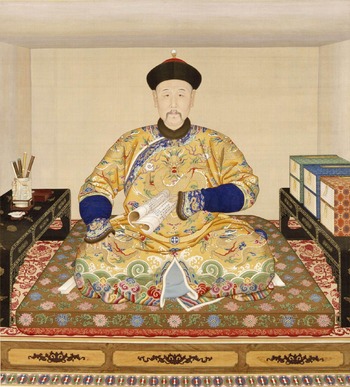
The proliferation of reports of multicolored cloud sightings in the Yongzheng period is matched by the profusion of these motifs on decorative art objects intended for court use. While multicolored flowing clouds already featured on imperial ceramics, cloisonné, and textiles at least since the Ming period (usually as a background motif), they flourished on objects created at the Yongzheng emperor's palace workshops. For instance, in the first year of his reign, applying a design of multicolored clouds over the emperor's entire official garment became an explicit rule. The section on ceremonial dress in the Da Qing Huidian 大清會典, a large corpus of legal and administrative statutes of the Qing dynasty, was expanded to require that, in addition to dragon and pearl patterns, the “entire body [of the robe be covered with] multicolored auspicious clouds.”Footnote 28 This type of robe is depicted in a portrait of the Yongzheng emperor reading a book, by an anonymous Qing court painter (Figure 2), which exhibits most of the elements mentioned in the Huidian rules, with the exception of the placement of the pearls relative to the dragons and the addition of marten fur trim.
Portrait of the Yongzheng Emperor (r. 1723–1735) reading a book. Ink and color on silk, 171.3 cm high by 156.5 cm wide. Palace Museum, Beijing.

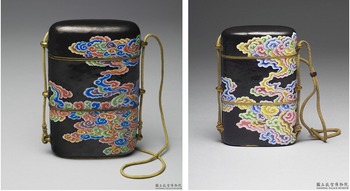
An entry in the archives of the imperial workshops dated to November 3, 1728, just two months before the Yongzheng emperor received Ortai's first report of multicolored clouds, orders the production of an enameled box with a special design: “Make a replica of the enameled black-ground chunsheng 春盛 with polychrome flowing clouds that was sent on [February 18, 1727].”Footnote 29 A chunsheng, which translates literally as “spring container,” is a term for a portable multi-tiered basket or box used to carry food on outdoor excursions. The box serving as model for the one cited above is described in the archives as a “polychrome enameled black-ground chunsheng box” with no mention of a cloud pattern.Footnote 30 These descriptions match two small, tiered boxes currently in the collection of the National Palace Museum, Taipei (Figure 3). What is special about these objects is that the clouds do not play a supporting role to the main design, they are the main design. Both are constructed with two tiers and a lid secured together by gold thread, resembling Japanese inrō containers, normally worn hanging from a belt.Footnote 31 Japanese lacquer objects, with their black sheen and penchant for asymmetrical compositions, are a likely source of inspiration. However, the two Yongzheng boxes were not made of lacquer, but of opaque enamels painted on a copper base, producing a high-contrast design. The introduction of arsenate white opacifiers in enamel compositions was still relatively new at this time, and the resulting visual effect was unprecedented. This new compound also makes the colors stand out against the lustrous black background, lending them a more immediate feel, more successfully capturing the nature of these extraordinary clouds.
Tiered containers: (a) opaque enamels painted on copper base, Yongzheng period (1723–35), Qing dynasty, H 13.3 cm (National Palace Museum, Taipei, Gufa-000509); (b) opaque enamels painted on copper base, Yongzheng period (1723–35), Qing dynasty, H 13.3 cm. National Palace Museum, Taipei, Gufa-000510.

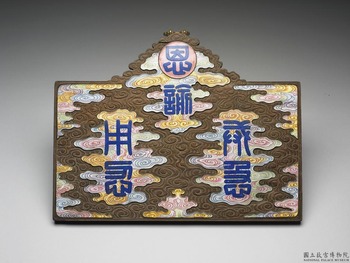
Yet another Yongzheng-period object of this group of enameled wares with a prominent design of multicolored clouds is a wood panel carved with low-relief vapor formations inset with nine enameled copper plaques painted with flowing cloud motifs (Figure 4). The enamel colors are light and delicate, the clouds seemingly illuminated by the pink sun at the top of the composition. Three of the enameled plaques feature blue seal-script characters reading, “Imperial grace instructs to overcome impulsiveness and exercise patience” (enyu jieji yongren 恩諭戒急用忍), a motto for good governance that the Kangxi emperor reportedly taught his son Yinzhen 胤禛, the future Yongzheng emperor.Footnote 32 The panel was hung in the Hall of Mental Cultivation (Yangxindian 養心殿), an imperial residence and also the location where the emperor reviewed state affairs, read memorials, and received his officials. This is the place where the Yongzheng emperor would have personally read and commented on Ortai's reports. Created in 1537, the Yangxindian was renovated during his reign. One can imagine that the plaque's display location was chosen to remind the emperor of these words of advice as he was conducting state affairs, but it also functioned as a form of reassurance by presenting the multicolored auspicious clouds as evidence that he was being both a filial and munificent ruler. This object is the most unambiguous illustration of multicolored clouds as signs of Heaven's satisfaction with the Yongzheng emperor's governance. While its date of production is unknown, it is possible that it would have been commissioned at the beginning of his reign.Footnote 33
Carved and lacquered wood hanging panel with inset enamel-painted copper plaques, Yongzheng period (1723–35), Qing dynasty, 36.4 x 27.9 x 1.3 cm. National Palace Museum, Taipei, Gufa-000759.

These objects show that multicolored clouds were already seen as an auspicious phenomenon at the Qing court years before Ortai's reports, and they were used in pictorial schemes of various forms of decorative arts produced by the imperial workshops. Importantly, Qing officials knew how to cater to the tastes and inclinations of the Yongzheng emperor.Footnote 34 Although the Yongzheng emperor claimed he did not usually speak of omens, in addition to his edicts regarding multicolored clouds, an auspicious snowfall coinciding with the onset of spring in 1734 led him to describe signs such as lingzhi 靈芝 fungi, auspicious clouds, qilin 麒麟, and phoenixes as showing Heaven's approval of human affairs.Footnote 35 Ortai, being close to the Yongzheng emperor, was likely already aware of his interest in tokens from above, and planned the retellings of his visions of multicolored clouds accordingly. The sustained production of objects decorated with designs of flowing clouds during the Yongzheng reign shows not only the emperor's demand for such designs, but also a tacit understanding among designers and workshop supervisors of his interest in good omens. Aware of the emperor's aesthetic and political sensibilities, they created objects that tapped into longstanding auspicious imagery to subtly remind viewers of the emperor's legitimacy. The discourse on multicolored clouds was given form on the material culture produced at the imperial workshops, often in bright enamel colors, their vividness echoing Ortai's dramatic accounts of iridescent clouds. But perhaps because of his attention to the natural world of the Southwest, Ortai also extended his search for useful manifestations of color not only to the skies, but underground, in the form of local minerals.
Transforming Yunnanese Colored Stones at the Imperial Workshops
Between 1729 and 1730, Ortai discovered several types of colored stones in Yunnan, and sent reports and samples to the Yongzheng emperor. While colorful minerals did not benefit from the same cultural legacy as auspicious clouds, the stones discovered by Ortai on the southwestern frontier can nonetheless be construed as material manifestations of the Yongzheng emperor's control over the borderlands. It is possible that local workers came across these stones when opening or expanding copper mines, as the new territories conquered by Ortai in Yunnan offered untapped mineral resources, including the richest copper deposits in China.Footnote 36 These were avidly exploited at a time when copper resources were severely restricted due to drastic cuts in Japanese imports in the early eighteenth century. Copper mining in Yunnan was a successful venture, and by the end of the Yongzheng reign, the province alone met the needs of all the mints in the capital. As resource extraction was a crucial factor in the Qing expansion into the Southwest, these minerals—and their transformation into objects at the court workshops—are emblematic of a broader imperial project.
On February 22, 1729, less than two months after his first memorial on auspicious clouds, Ortai sent a first report on his findings of new and eye-catching minerals. “I have found in Yunnan stones of entirely every color,”Footnote 37 Ortai informed the emperor, before listing his tribute of five pieces of white Santai 三台 stones, five pieces of acorn stones of a color resembling the purplish-brown ceramics known as Yixing 宜興 ware, three “slightly yellow” elephant-skin stones, and two “cloud-colored” Songhua 松花 stones. Ortai specified that all these stones were mined in Wuding 武定 or Quzhou 曲州 prefectures. He also presented agate stones of two colors: red and white; jadeite stones in a pure green color; and Gurong 姑絨 stones in “pale flesh-red” color, adding that all of these minerals “can be made into small objects for the scholar's studio at very low cost.” Ortai's discoveries were a response to an order from the Yongzheng emperor to look for stones that could be carved into items for the scholar's desk. The emperor had made clear his desire to obtain novel materials that could be turned into display objects at court, such as “inkstone cases, water droppers, or vases for incense sticks.” The memorial shows that there was an explicit mechanism in place for marshalling mineral resources from the remote corners of the realm, and attention to color was emphasized. The emperor's initial wish was for purplish-brown and pure white stones; Ortai not only fulfilled this order but found stones of new colors that were not even mentioned by the emperor.
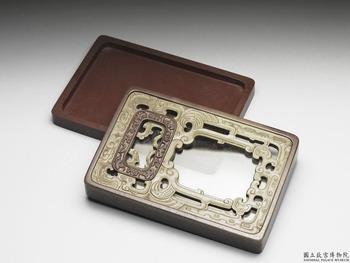
His fifteen stone samples did make their way to the imperial workshops in the capital. An entry in the workshop archives, dated to April 5, 1729 (just over a month later), acknowledges the receipt of fifteen pieces of Wuding stone from Ortai.Footnote 38 The ensuing imperial order to the inkstone workshop singles out one of these stones “with excellent patterning,” and instructs artisans to carve it into an inkstone case, while the other fourteen pieces can be made into any object at their discretion. Eight months later, bureau director Haiwang 海望 (d. 1755) placed the remaining fourteen pieces of Wuding stone into storage, suggesting that they did not meet the high-quality standards set by the Yongzheng emperor. Yet the follow-up from the inkstone workshop further informs us that on May 8, the Wuding inkstone case with the pleasing patterns was paired with a green Duan inkstone, a term used in the archives to designate green Songhua stone.Footnote 39
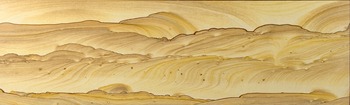
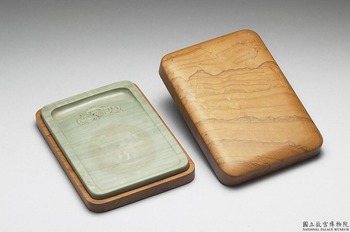
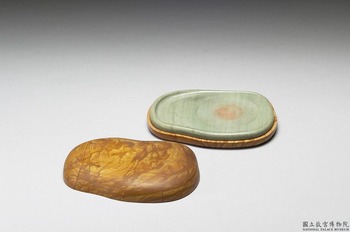
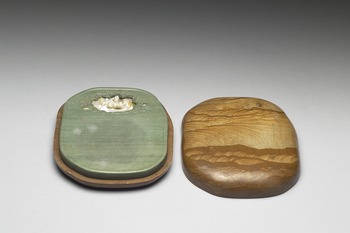
Mined in the Manchu homeland of the Northeast and highly valued by the Qing emperors, Songhua stone is a sedimentary formation composed of layers of rich green, yellow and purple tones. The Kangxi emperor praised the quality of Songhua stone as “both hard and warm, its color green and lustrous,” and first ordered court craftsmen to carve it into inkstones in 1702, producing cameo-like carvings that exploited its natural contrasting striations.Footnote 40 Due to the strong association of Songhua stones with the Songhua river and the Northeast, Ortai's identification of ‘Songhua stones’ from the Southwest was likely mistaken. The stones he ordered to be quarried in Wuding are now known as a type of sandstone, which like Dali marble (also from Yunnan but conspicuously absent from Ortai's reports), exhibit patterns evocative of landscapes or geological formations (Figure 5). Remarkably, two green Songhua inkstones set in what appears to be Wuding stone cases are in the collection of the National Palace Museum in Taipei (Figures 6–7). The cases are unmarked, but the inkstones bear an inscription and incised mark of the Yongzheng period. Both inkstones and their cases have been catalogued as entirely made of Songhua stone, but the patterning of the cases is very different from other Songhua stones mined in the Northeast, more closely resembling Wuding stone. Another inkstone case, produced to match a Kangxi-period green Songhua inkstone, exhibits patterns resembling a sandy landscape that closely resembles Wuding stone (Figure 8). Only the inkstones bear an incised reign mark, not their cases. Because the Kangxi emperor did not instigate extensive mining operations in Yunnan, and because the appearance of Wuding stone in the workshop archives of the Yongzheng period is limited to a period of about two years, from 1728 to 1730, it is likely that this case was produced in the Yongzheng period to fit an existing stone from the previous reign. It is therefore possible to chart the specific trajectory of these Wuding stones, which were mined in Yunnan and sent by Ortai to the Yongzheng emperor. After being received in the imperial workshops in Beijing, the best pieces were worked into inkstone cases. These stones literally pictured these far-away places by evoking landscapes and atmospheric conditions, and the objects carved from them made these places feel closer at hand. Wuding stones were evidence that these territories were coming under firm Qing control. Due to the slight wear on all three inkstones, they were most likely used at court, remaining in the imperial collection to this day.
Recently produced Wuding stone slab, Dali, Yunnan. Viewing Stone Association of North America.

Songhua inkstone in Wuding (?) stone case. Yongzheng period (1723–35), Qing dynasty. National Palace Museum, Taipei, Guwen-000197.

Songhua inkstone in Wuding (?) stone case. Yongzheng period (1723–35), Qing dynasty. National Palace Museum, Taipei, Guwen-000304.

Wuding (?) inkstone case. Contains a Songhua inkstone dated to the Kangxi period (1662–1722), Qing dynasty. National Palace Museum, Taipei, Guwen-000262.

In her analysis of inkstones commissioned by the Yongzheng emperor, Dorothy Ko notes that the distinguishing trait of the Yongzheng emperor's taste is “his conception of the ink-slab as a box-stone set, with his love of the container exceeding that of the implement inside.”Footnote 41 The emperor's instructions to the inkstone workshops concentrated mainly on the style and materials of the case, with the inkstone itself often left to the artisans’ discretion, an approach that stood in direct contrast to that of makers in Suzhou and Guangdong, who strove to enhance the natural shape and features of the inkstone itself. In this instance, there is something rather touching about encasing a Songhua inkstone in a Wuding stone case, not only bridging opposite geographical distances (Northeast and Southwest) but also establishing an intimate connection between the emperor and his loyal subject and friend. The object would have likely been kept for the Yongzheng emperor's private use, and it differs from his successor's public displays of stones quarried from remote and newly conquered corners of the empire.Footnote 42
Ortai's subcategories imply that there were at least four types and colors of Wuding stone, namely white, purplish brown, pale yellow, and ‘cloud color.’ This is confirmed by entries in the workshop archives listing four colors of Wuding stone, most often worked into plates or dishes (pan 盤).Footnote 43 Ortai's remark that Yunnan craftsmen were clumsy and could only produce dishes and saucers may refer to a previous tribute of stone dishes to the capital. An entry in workshop archives dated to November 12, 1728, just two months prior to his first recorded memorial on colored stones cited above, notes the receipt of twelve dishes carved from Wuding stone, along with several hundred bodhi beads and nine slabs of Dali marble.Footnote 44 The entry further instructs that wood stands be made for these stone dishes and that they be used to decorate various places in Yuanming Yuan. The entry lists four colors for Wuding stones: white, yellow, brown, and yellowish white, the latter perhaps equivalent to Ortai's ‘cloud color,’ thus matching his descriptions of Yunnan stones mined in Wuding prefecture.
The second part of Ortai's tribute included red and white agates, jadeite, and gurong 姑絨 stone, without specifying quantities. On August 15, 1729, approximately six months after Ortai sent this memorial, there was a note of their reception at in Beijing: “The eunuchs Zhang Yuzhu 張玉柱 and Wang Changgui 王常貴 brought eight pieces of jadeite, large and small, and four pieces of red and white Jingzhou agates, large and small. It is ordered that they be transferred to the workshop storehouses and used where needed.”Footnote 45 Taken together, Ortai's memorial and this entry in the workshop archives constitute some of the earliest mentions of jadeite in China. Both nephrite and jadeite are now commonly referred to as jade, but they are two chemically different minerals. Whereas nephritic jade occurs in several parts of China in different forms, the most important deposits of jadeite on the Eurasian continent are located in the Kachin state of Myanmar (Burma), which shares a border with Yunnan province.Footnote 46 The jadeite trade between the two regions started as early as the Yuan dynasty and continued during the Ming, when Burmese jadeite was simply designated by the general category baoshi 寶石, or “precious stone.”Footnote 47 Sun Laichen traces the first occurrence of the term feicui 翡翠 (jadeite) to the work Dian xiaoji 滇小紀, a 1719 historical account of Yunnan province by Ni Tui (倪蛻, b. 1668).Footnote 48 Sun states that “Burmese jade was not known to the Qing court until 1733,”Footnote 49 yet Ortai's memorials and the archives of the imperial workshops show that feicui was commonly used in court communications from at least 1726 onward. Years before Ortai even sent tributes of stones, there are two entries in the workshop archives that describe feicui jadeite being used for sets of stringed imperial beads (shuzhu 數珠), one dating to November 13, 1726, the other to March 22, 1727.Footnote 50 Moreover, the term cuisheng shi 催生石, which Sun argues is another word for Burmese jade, appears in the workshop archives as early as December 3, 1725.Footnote 51
Throughout Ortai's first memorial, the Yongzheng emperor clearly indicated his personal preferences through handwritten notes in red ink. He admired the pure white Wuding stones by noting that “they look excellent,” but initially did not hold the agates in high regard, deeming them ugly and asking Ortai not to send more.Footnote 52 This attitude is surprising and incongruent with the high volume of agate objects produced in the imperial workshops throughout his reign.Footnote 53 But in his next memorial, dated to August 12, 1729, Ortai cited the Yongzheng emperor's clarification on agates, namely that he mistook them for Jingzhou stones, but that red and white agates should be sent to the capital for him to review.Footnote 54 Ortai reported immediately sending a special envoy to Yunnan to quarry and select agate stones, and present them as additional tribute, along with a total of twenty pieces of jadeite, gurong stone, Santai stone, acorn stone, elephant-skin stone, and Songhua stone.Footnote 55 The Yongzheng emperor's comments convey his exacting taste as he judged the new stones that were sent to him by Ortai. Beyond color and patterning, the quality and nature of the stones were also important criteria. Now that the emperor knew that the Jingzhou stones were in fact colored agates, he ordered Ortai to include a few with other tribute from Yunnan. Undergirding this correspondence between Ortai and the emperor was an expanding transport infrastructure that connected remote lands to the rest of the empire.Footnote 56 The procurement of desirable minerals from the frontier demonstrated the capacity of the Qing state to marshal not only large amounts of minerals, but also to create communication networks to transport these heavy materials all the way to the capital, where they would be processed and reworked. These networks were utilized not only to haul copper ore out of Yunnan, but also to extract and transport smaller mineral samples for prospective purposes.
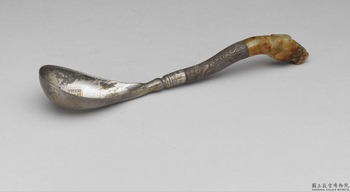
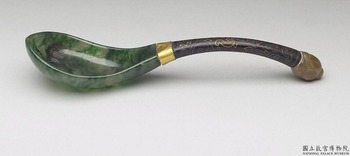
Once suitable stones from Yunnan were identified, the emperor ordered that they be carved and transformed into specific objects. The production of spoons, while seemingly trifling, illustrates the Yongzheng emperor's personal interest in the mineral resources of the frontier, and the sort of objects that were produced by combining materials from several locales and workshops within the realm. In August 1729, the emperor ordered imperial artisans to make spoons using different materials for each of the three components: head, handle, and knob. The production of parts using Yunnanese jadeite and agate was to be overseen by Ortai. Similar spoons survive in the imperial collection, but do not bear marks and can only be broadly dated to the Qing dynasty (Figures 9–10). A preexisting silver spoon was used to produce a wooden model that was sent to the governor-general. Based on this model, Ortai was instructed to use jadeite and red agate to produce a few spoon heads and knobs to be sent back to the court workshops, where they would be fitted with handles.Footnote 57 While it is hard to conceive that spoon parts were transported back and forth across the empire, this order shows that logistics were no obstacle to the emperor's desire to create objects from the newly discovered mineral resources of the border. Production notes following this entry state that the wooden model was indeed sent to Ortai on August 28, 1729.Footnote 58
Composite spoon made of silver, agate, and wood inlaid with silver and gold wire. Qing dynasty (1644–1911). National Palace Museum, Taipei, Guza-001341.

Composite spoon made of silver, agate, jadeite, and wood inlaid with silver and gold wire. Qing dynasty (1644–1911). National Palace Museum, Taipei, Guyu-002835.

Evidently, Ortai received the model and the instructions, since a few months later, he sent a third memorial on colored stones to the Yongzheng emperor.Footnote 59 He recounted having received an imperial order from a eunuch stating that, “Jinzhou 錦州 stone produced in Yunnan be made into spoon knobs, [delivered] along with a pair of designs for spoon knobs.” In his response, Ortai explained that the Jinzhou stones found in Yongchang 永昌 were of poor quality, and that despite having over 110 quarried pieces, local artisans were only able to carve a mere eight spoon knobs. To compensate for this mishap, Ortai also sent raw pieces of the mineral, in the hopes that court artisans would be more skilled at working with friable stone. Ortai then commented on other minerals available locally, namely Tengyue 騰越 jade, describing it as hard and smooth, and easily carved into spoons. Santai stone, he added, was also fine and smooth, and purple like Yixing ceramic wares. With his memorial he enclosed a total of fourteen spoon knobs (eight carved from Yongchang Jinzhou stone, and six from Tengyue jade), along with four pieces of Santai stone, and an equal amount of a type named Guyong stone.
It is likely that Ortai was mistakenly using the term “Jinzhou stone” to refer to what the emperor called “Jingzhou 荊州 agates,” which were known as red and white agates from Yunnan. Tengyue was a subprefecture of Yunnan and a place through which Burmese gems transited, and therefore it appears to have lent its name to this type of jade, which could very well be jadeite. Guyong stone (guyong shi 古永石) is interesting, as it is phonetically similar to the gurong stone (gurong shi 姑絨石) mentioned in Ortai's previous memorials, but this connection remains to be substantiated. Guyong stone is mentioned only once in the workshop archives, where four pieces are received in storage, along with an equal amount of yellow and white Wuding stones, reinforcing its provenance from Yunnan.Footnote 60 But importantly, the memorial also shows that Ortai was always on the lookout for new colored stones, and had already discovered a new type: Shiping 石屏 stone, emphasizing its deep purple color. He also unfavorably compared the skills of Yunnanese artisans to those of the artisans in the imperial workshops in Beijing. However, these failings show that mechanisms of quality control were working as they should. The pipeline for sending the best stones from the Southwest required that the vast majority of those deemed of inferior quality be rejected either initially by Ortai, by imperial workshop supervisors, or ultimately by the emperor himself. To compensate for the inability of local artisans to carve enough spoon knobs according to the models provided, Ortai sent large pieces of unfinished agate stones to the capital, knowing that the Yongzheng emperor had previously expressed interest in agates.
This stream of mineral resources circulating from the Southwest to the capital was enabled by an extensive communication infrastructure that facilitated the extraction of materials and their transportation to the capital, where they would be transformed. This correspondence between Ortai and the emperor shows that not only was this process conducted on a large scale, it was also highly selective. New mineral discoveries were reported to the emperor himself, who would assess their visual qualities before requesting that more be quarried or that they be carved into decorative objects. This combination of prospection, selection, and transport demonstrates the high level of control exerted by the Qing state over its provinces and frontier territories, making it clear that the Yongzheng emperor was a capable ruler.
Material Circulations Between Center and Periphery
The reverse flow of imperial gifts from the capital to the Southwest shows not only that Ortai was aware of the colorful material culture that was being developed at the Yongzheng court with materials gathered from all over the realm, but also that this awareness may have led him to report on auspicious clouds and harvest colorful stones. Between 1726 and 1728, well before his first report on multicolored clouds, the Yongzheng emperor showered Ortai with presents in return for his successful military campaigns in Yunnan and Guizhou provinces. These included three crates of imperial porcelain wares, a crate of silk gauze, a string of coral beads, four newly made glass vases, a foreign snuff utensil, an inkstone in a purple case inset with glass, and a set of enameled objects comprising spoons, chopsticks, a vase, and a box.Footnote 61 Not only were these objects likely quite colorful, but in some cases such as glass and porcelain, they were the newest and rarest items produced by the imperial workshops. The four glass vases are earmarked in the workshop archives as gifts to “Yunnan governor-general Ortai,” but their color is not specified.Footnote 62 Inkstone cases with inset glass are also mentioned twice in these archives (in 1724 and 1727), both times prior to the date Ortai received such an object, but without specifying their intended recipient.Footnote 63 Because inkstones—not their cases—tend to be dated by inscription, and all surviving cases with inset glass contain inkstones dated to the Kangxi reign, the cases have also been ascribed to this earlier period (Figure 11). The sets all similarly feature Songhua stone cases with an upper lid pierced with a central window-like opening inset with a plate of clear glass, allowing the viewer to see the color of the inkstone through the case. If Ortai indeed received such an inkstone, it would have been one of the most prestigious presents an official could ever hope to be given, since Songhua stone was normally reserved only for the emperor's personal use. The addition of clear glass provided an added layer of technological achievement in a novel material, producing a composite object that could only have originated from the imperial workshops.
Songhua inkstone case with inset clear glass pane. Kangxi period (1662–1722), Qing dynasty. National Palace Museum, Taipei, Guwen-000281.

On February 5, 1729, just two days after he first received Ortai's report on multicolored clouds,Footnote 64 the emperor ordered the wood workshops to create boxes for an outstanding set of presents destined for Ortai:
The eunuchs Zhang Yuzhu and Wang Changgui have brought over two ancient bronze incense burners, one ancient bronze ruyi 如意 paper weight, one double-happiness paper weight, one enamel snuff bottle, one Shoushan 壽山 stone lingzhi fungus paper weight, one green inkstone in a Shoushan stone case, two inlaid flintstone pouches, and one small black lacquer box inset with enameled plaques. By imperial order, make wood boxes to contain and adorn them, and give to governor-general Ortai. Also make a wood box for a belt buckle.Footnote 65
The order was completed two days later, with boxes of fir covered in yellow paper.Footnote 66 Given the very short period of time between the emperor's reception of Ortai's memorial and his order to prepare these presents, they were likely a reward for reporting auspicious clouds, an act construed as exceptionally meritorious by the emperor. On March 23, 1729, Ortai wrote a memorial in gratitude for the reception of the gifts, with slight discrepancies in their description giving us more information on their richness. He listed ten taels of silver, a brocaded box containing an imperially commissioned jeweled belt, a yellow box containing a Japanese-style lacquer box, itself containing a cake, an inkstone with an “agate” case, an agate carving of a ruizhi 瑞芝 fungus, an enameled snuff bottle, a silk pouch, and an incense burner.Footnote 67 In addition, he received various delicacies such as deer meats, ginseng, ground lotus seeds, Hami melons, tangerines, and mandarin oranges. These gifts were more lavish than any reward he had received prior to composing this memorial, or thereafter.Footnote 68 Over the next eighteen months, he received rewards after each subsequent report of clouds or colored stones, though never quite as sumptuous. They included, for instance, medicines, incense, painted fans, two porcelain vases, cakes, tea, dried meats and fish, fruits, furs, and one more snuff bottle, its material unspecified.Footnote 69 Thus the rewards that Ortai received after submitting his first memorial on colored clouds were unmatched by sets of presents received for his military actions in the Southwest. This shows the Yongzheng emperor's particular appreciation for these tokens from above, which appeared to vindicate his controversial agenda in a politically sensitive area of the Qing empire.
The Yongzheng emperor understood his bestowal of gifts as mirroring the rewards received from Heaven. In an edict later written in response to Ortai's repeated cloud sightings, he opined: “Heaven uses disasters and portents to show [its will] to the sovereign, just as the sovereign bestows rewards and punishments upon officials.”Footnote 70 Casting the act of rewarding in this light aligns the power of the emperor with that of Heaven. Just as Heaven had bestowed multicolored celestial phenomena in response to the meritorious governance of the Yongzheng emperor, the logic goes, the latter imparted the most sumptuous gifts to his governor-general. It is striking that he chose those particularly showcasing the new chromatic capacities of the Qing court workshops, in mediums as diverse as glass, enamels, stone, and lacquer.
The circulation of quarried stones and finished stone products between Yunnan and Beijing also inscribed itself within a logic that legitimated imperial power in a more worldly way. In an interlineal note in Ortai's first memorial on stones, the emperor wrote “Do not send finished objects,” strongly implying that Ortai send only raw materials.Footnote 71 The circulation of raw materials from the borderlands and finished products from the capital followed a well-known organizing principle between center and periphery.Footnote 72 The close relationship between emperor and governor, cemented through this extensive written and material exchange, helped spread knowledge of frontier areas (in this case, knowledge of atmospheric phenomena and mineral resources) to the Qing court, while the inverse flow of imperial gifts to the provinces became representative of the power of the court to marshal resources and transform them at the court workshops. In this way, raw materials from the periphery were “domesticated” in the capital. Just as copper ore was carried from Yunnan to Beijing, where it was melted and minted into coins, geological samples were carved and processed at the imperial workshops, demonstrating the integration of the Southwest into the Qing administrative fold visually and materially. The types of gifts that Ortai received were created from materials and colorants extracted from all over the empire, and possibly beyond. As such, these objects acted as material ambassadors for the power and reach of the Qing state, thereby concretizing its rulers’ claims as capable sovereigns and legitimate heirs of Chinese emperorship.
Conclusion
The official discourse formulated and publicized by the Yongzheng emperor was one of both diversity and grand unity (dayitong 大一統) in the imperial Chinese sense.Footnote 73 However, the reality of enforcing these grand ideals on the ground was quite different. The manifestation of multicolored natural phenomena in the Southwest lent legitimacy to the emperor's reign through both celestial and worldly channels. Beyond the military actions for which he is best known, Ortai strategically used auspicious phenomena to lend support to the Yongzheng emperor's southwestern expansion at a particularly sensitive moment in his reign. Knowing the emperor's favor for these signs, workshop supervisors also created a range of visually striking enameled objects featuring multicolored clouds front-and-center. Taken together, these reports and objects acted as tokens of the legitimacy of the Yongzheng emperor's rule, and of the Qing imperial project more broadly. The emperor—and those similarly aware of the political potential of favorable omens—were keen to read natural occurrences of color and polychromy as auspicious signs, casting these phenomena as physical manifestations of Heavenly approval.
Down on the ground, the bilateral exchange of raw materials and polychrome objects inserted itself into a logic that cast the Qing court as a diplomatic center, and the objects as material evidence of the geographical reach of the court. Ortai's stone samples demonstrate that some of the emperor's closest advisors were actively involved in selecting new materials for the Qing court workshops. The power of the Qing state to discover and extract raw materials, and to transform them into highly technical finished objects, evinced both political and technological prowess. Yunnanese stones were not only evidence that these territories were coming under firm Qing control, but also propitious signs, material echoes of the grand iridescent cloud displays that were witnessed in the same area. The objects picturing that world concretized a far-removed place, making it feel immediate and close at hand. They not only reflect the emperor's taste for colorful new materials, but also, by providing material evidence for the success of the Qing imperial project, embody his awareness of the power of visual and material culture to convey subtle political messages.
Competing interests
The author declares none.