Sidney Gifford Czira's application for a much-needed military service pension in 1938 caused confusion in the Department of Defence. Most of her activities ‘were out of Ireland’.Footnote 1 Did the Military Service Pensions Act, 1934, cover her service in the United States? Gifford had emigrated to New York in 1914 with the naïve hope of ‘gate-crashing into American journalism’, but soon found herself at the centre of the Irish-American republican effort.Footnote 2 Between 1914 and 1921, she co-founded the New York branch of Cumann na mBan, published and spoke widely to raise funds, and coordinated vital transatlantic intelligence. When Gifford's application was initially rejected, she protested by re-emphasising her smuggling of arms in New York, and also pointed out that another woman – Julia Foy – had been awarded a pension for ‘similar work done in Glasgow’.Footnote 3
Such doubts regarding the validity of Gifford's activism not only reflect the difficulties women encountered in proving ‘active service’; they also point to the uncertainties regarding the geographic remit of the Irish Revolution in the context of an evolving nation-state-administered model of compensation.Footnote 4 However, Gifford was one of many female revolutionaries who emigrated, permanently or temporarily, during the revolutionary period or in its immediate aftermath. While the First World War stifled emigration to the United States, the austerity which accompanied the foundation of the Free State produced a new wave of emigration which prevailed throughout the 1920s.Footnote 5 Studies by Gavin Foster, Brian Hanley and Gavin Wilk have begun to document the post-Civil War emigration of I.R.A. veterans which was long occluded from the dominant nation-state model of Irish history. As Foster notes, this republican exodus ‘falls between the cracks of political and migration history as each is typically conceived’.Footnote 6 Nevertheless, the emigration of female republicans remains largely neglected in these works, thus continuing the long-established motif of involuntary political exile which has generally been conceived in male terms.Footnote 7 This omission belies the fact that the majority of Irish emigrants from the latter half of the nineteenth century right through to the 1920s and 1930s were unchaperoned, single, young women.Footnote 8
Any attempt to create a global historical narrative demands the inclusion of women's histories, which are ‘especially important’, as Natalie Zemon Davis writes, in moving towards ‘decentering’ western historiography and refusing ‘to privilege a single path or geographical location as the model for assessing historical change’.Footnote 9 Even though the fields of world history, gender history and women's history emerged simultaneously from the social movements of the latter third of the twentieth century,Footnote 10 questions of gender remain marginalised in transnational histories which risk foregrounding narratives of privileged mobility – often associated with exploration, commerce or imperialismFootnote 11 – without giving due consideration to the cross-border movements of the working classes,Footnote 12 or to the possibility that peripheral communities, including women, could at once be geographically fixed and wield a global influence. Nevertheless, as Merry E. Wiesner-Hanks argues, transnational and gender histories interact in dynamic ways given their shared emphasis on hybridity, interdisciplinarity, multiple perspectives and destabilisation of binaries.Footnote 13
In that vein, this article examines the transatlantic movements of female revolutionaries and reconsiders Cumann na mBan as a decidedly global movement. Drawing on the Cumann na mBan nominal rolls and U.S. immigration records, it firstly considers the scale of post-Civil War Cumann na mBan emigration and evaluates the geographical origins, timing and push-pull factors that defined this migration. Focusing largely on emigration to the United States, it also traces the transatlantic trajectories of female revolutionaries and measures the impact of their emigration and return migration on the republican movement in Ireland. Furthermore, it assesses the varied contributions of female republican emigrants to the diverse, and often fractured, Irish-American diaspora. Ultimately, this article argues that the cooperative transatlantic exchange networks of Cumann na mBan, and the consciously gendered revolutionary discourse promoted in the diaspora, were integral to supporting the Irish Revolution at home and abroad.
I
Emigration and nationalism share a particularly fraught relationship. From the early nineteenth century, Irish political and religious leaders tried, to little avail, to oppose the steady tide of emigration which was by now a well-established aspect of Irish life.Footnote 14 Many hoped, as Seán O'Faoláin did in 1953, that ‘this national loss of blood’ would come to an end ‘once we got a native government’.Footnote 15 Yet even though Dáil Éireann banned emigration without written sanction in 1920,Footnote 16 an estimated 15,585 emigrants departed from Irish ports in 1920, the overwhelming majority of whom were female.Footnote 17 This wholesale female emigration posed a direct threat to the body politic of the nation, and women were specifically targeted in the widespread anti-emigration diatribes which dominated cultural-nationalist propaganda from the turn of the century.Footnote 18 This gendered discourse intensified in the context of the national struggle, with a correspondent in the Fermanagh Herald warning in 1921 that ‘the Irish girl emigrant’ would be rejected in the United States ‘as an Irish citizen running away from your country in her need’.Footnote 19 Ironically, reports from the other side of the Atlantic suggested that the conflict not only propelled young women to emigrate, but also galvanised public sympathy for their plight. In April of the same year, 500 ‘colleens from the Ould Sod’ disembarked in New York City, purportedly sent as ‘parents are worried over the attentions the Black and Tans are paying young Irish women’.Footnote 20 Indeed, there was at least one reported instance of Cumann na mBan members being threatened ‘to be shot or to leave the country’ by British forces.Footnote 21 Moreover, in symbolic terms, this reporting of fleeing ‘colleens’ drew on the ‘iconography’ of the rape of Ireland by Britain used in anti-colonial discourses;Footnote 22 notably, it set up the United States as a ‘benevolent protector’ at a time when American support was vital to the Irish republican movement.
These reports of women fleeing the Black and Tans, propagandist as they may be, might have prompted American journalist Genevieve Forbes to travel to Wexford during the Truce in September 1921. Not content to be confined to the gossip or recipe columns of the Chicago Tribune,Footnote 23 Forbes posed as an Irish emigrant in order to report undercover on the transatlantic experiences of female steerage passengers. In fact, she was one of a small coterie of international female journalists who travelled to Ireland to document the revolution and bring their interpretations of events to a global audience at time when the scope of women's journalistic roles was expanding.Footnote 24 Given the dearth of memoirs by female republican emigrants,Footnote 25 Forbes's thirteen-part exposé, published in the Chicago Tribune during October 1921, is one of the most comprehensive accounts of the practical challenges facing such female emigrants. As Anne O'Connell argues, these practicalities have often been overlooked in migration histories due to the emphasis on the female chain migration mechanism.Footnote 26
A key aspect of Forbes's exposé is the contrast between the patriotism of young emigrants and their desire to leave: ‘the young men and women sing of the shamrock, but they talk of the American pay envelope’.Footnote 27 Of the 180 intending emigrants who boarded the ocean liner in Queenstown, fifty-three were ‘young Irish girls waving Sinn Féin pennants, [with] Sinn Féin permits to leave the country buried in the heels of their shoes’.Footnote 28 One patriotic girl insisted that emigration did not compromise their loyalty to the nationalist cause: ‘We don't blame the Irish republican army for trying to keep us here, the boys to fight again if they have to, the girls to do cooking and nursing for them. But there's no chance for us to make a living here now, until real peace comes.’Footnote 29 Indeed, Forbes highlighted the great lengths taken by hopeful emigrants. In addition to acquiring $1 Sinn Féin permits, they required letters from parish priests, letters from sponsors in the United States, passport pictures, vaccines, and two sets of clean clothes ‒ one for passing inspection when embarking and another for disembarking. According to Forbes, the journey incurred an estimated expenditure of $122.10 for girls whose average monthly wage was under $10.Footnote 30
What appealed most to American readers was Forbes's report on the dehumanising conditions at Ellis Island which ultimately led her to testify at the House of Representatives.Footnote 31 Despite tipping the nurse at Queenstown, Forbes's claims that three of the girls had ‘their hair bobbed, two have it shaved, and twenty-eight of the forty-seven girls are warned to have a shampoo before the sailing’.Footnote 32 This humiliation paled, however, in comparison to their treatment at Ellis Island. The women, forced to strip to the waist, ‘are cursed and mauled at’, ‘goaded on with screams and threats’; ‘like a flock of cattle’, they are placed in quarantine for days and they endure ‘insulting remarks’ from the guardians ‘about underwear and anatomy’.Footnote 33 While certainly sensational, Forbes's allusions to the vulnerability of young women to hair-shearing and sexual humiliations nevertheless provide an important context in which to consider the prevalence of gender-based violence during the revolutionary period more generally.
Republican activists were merely one stream in a much larger outflow of emigrants from Ireland in the 1920s. But just how many republican women followed Forbes's journey through Ellis Island? Although some attention has been paid to the leading women who crossed the Atlantic to advance the aims of republican movement,Footnote 34 the emigration of rank-and-file Cumann na mBan members has been largely overlooked.
II
A number of commentators exaggerated the scale of post-Civil War emigration: Todd Andrews claimed that 100,000 republicans emigrated between 1924 and 1927, while Frank Gallagher went as far as to claim that 70 per cent of the pre-Truce I.R.A. ended up in the U.S. within several years of the revolution.Footnote 35 Dorothy Macardle specified that female republicans were among de Valera's ‘Wild Geese’. Writing in The Irish republic, she maintained that ‘young men and women leaving the Universities, who were Republicans, found the posts at home for which they were best fitted closed to them by this political test’.Footnote 36 While these figures are certainly inflated, the release of the Cumann na mBan nominal rolls sheds new light on the extent of emigration by female republicans. From 1936, some 165 nominal files were compiled at the request of Brighid O'Mullane, honorary secretary of the Association of Old Cumann na mBan, in order to aid the processing of military service pensions which members of Cumann na mBan qualified for under the 1934 Military Service Pensions Act. Districts across the country were requested to supply ‘names and, as far as may be possible, present addresses of Officers and numbers of each Branch or Squad on the 11th July 1921 and on the 1st July 1922’.Footnote 37 O'Mullane's reference to ‘as far as may be possible’ points, however, to the hopelessness of the task. Miss M. Aherne of Ballydonoghue, County Kerry, was one of many to complain that it was impossible to ‘provide the present addresses of this lot, as some are married, dead, nuns and emigrated’.Footnote 38 Often membership lists were compiled subsequent to a reunion meeting at which emigrants were undoubtedly absent.Footnote 39 Furthermore, many districts – such as South Wexford, where Forbes reported a keen eagerness to emigrate – provided no foreign addresses for their substantial memberships; even though immigration records show that Gretta Williams, Captain of the Taghmon branch, emigrated to Boston in May 1922.Footnote 40 Continuing internal and overseas migration further problematised the gathering of membership rolls. In South Tipperary, Mary Cooney lamented that ‘the girl who had charge of it is gone to Australia’;Footnote 41 in Kilkenny, Hannah Murphy struggled to compile the information as her co-verification officer was ‘now in London’.Footnote 42
Despite these significant gaps, the nominal rolls provide names for at least 2,182 individuals who had emigrated by the time the rolls were compiled, or almost 13 per cent of the total membership of 16,865 registered for 1921.Footnote 43 Given that nearly 43 per cent of all Irish-born men and women are believed to have been living abroad by the mid-1920s, the real figure is likely to be higher than the records suggest.Footnote 44 In many rural districts, high rates of Cumann na mBan emigration echo that of the I.R.A. By 1925, 82 of the original 113-strong battalion of the Number Two (Dingle Peninsula) I.R.A. had emigrated; this mirrors the high rates of female emigration from the same area.Footnote 45 Similarly high rates are evident along the western seaboard: 13 of 22 members, or nearly two-thirds of the Dungloe branch, County Donegal, had emigrated by February 1937;Footnote 46 on the Beara Peninsula in County Cork, 116 out of 166, or almost 70 per cent of the Eyeries branch relocated to North America, and in County Mayo, rates of emigration reached 52 per cent and 49 per cent in west Mayo and Newport respectively.Footnote 47
Although high rates of emigration would be expected from County Galway, particularly given that the entire West Galway Brigade had emigrated by 1925,Footnote 48 the Cumann na mBan rolls for Galway only identify three emigrants.Footnote 49 This points to both poor record-keeping, and also to the possibility that many rural republican women who aided men on the run, or ran dispatches, may not have been official members of Cumann na mBan. As Cal McCarthy illustrates, most rural Cumann na mBan members, as in mid-Cork and east Kerry, were farmers’ daughters who were formally educated.Footnote 50 The social hierarchies which characterised the organisation are evident by a scrawl in the Ardfert District, County Kerry, roll that ‘servants’ addresses not known’.Footnote 51 The most economically deprived – and perhaps most likely to emigrate – are thus more likely to be left out of the rolls.
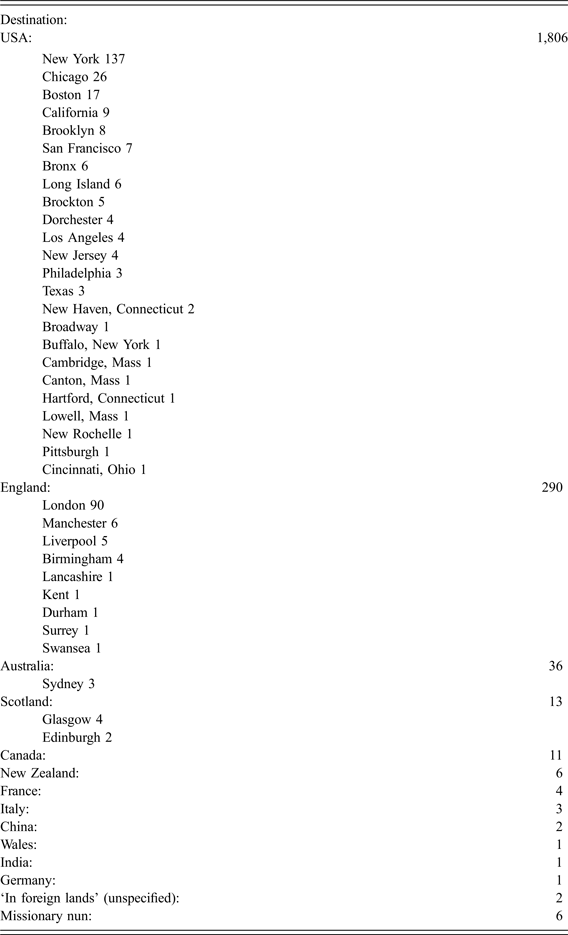
Notwithstanding these limitations, the rolls enable further research into the timing, destinations and reasons for emigrations when cross-referenced with U.S. immigration files, pension files and census records. The United States emerges as the most popular destination, accounting for almost 83 per cent of emigrants. This overwhelming pull towards the United States reflected the fact that up until the 1920s, 84 per cent of migrants from the Irish Free State went to the U.S.A.Footnote 52 Although addresses are seldom provided for emigrants, the destinations listed also indicate the broad dispersal of the female emigrants:
Destinations (n = 2,182)

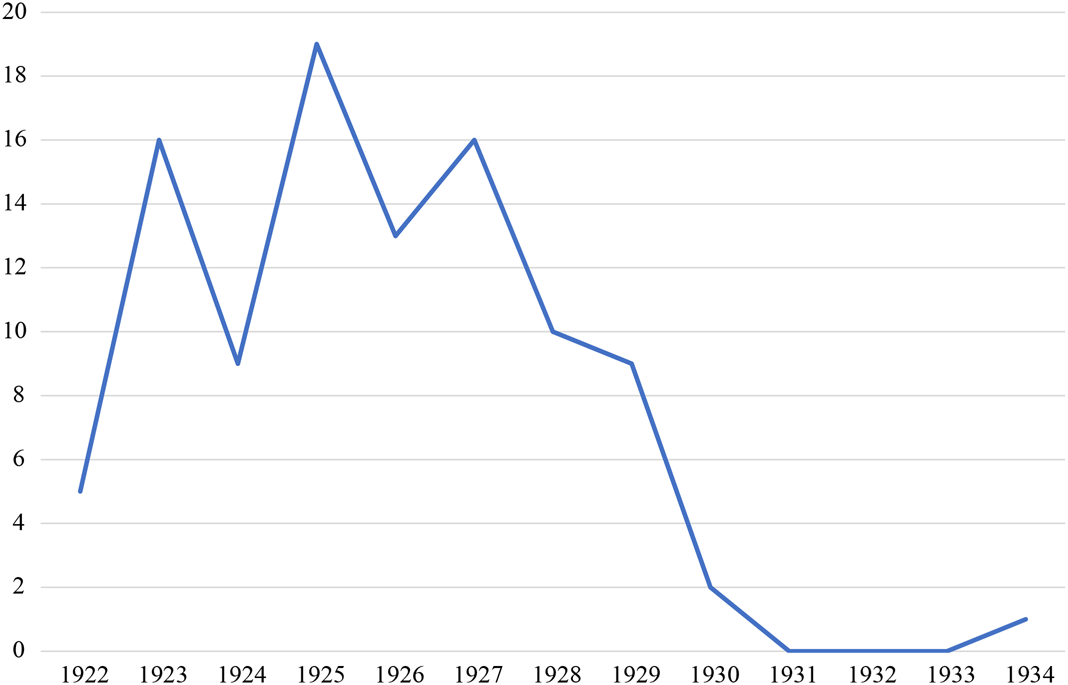
A sample of 100 immigration records of these Cumann na mBan emigrants, verified by other official census and U.S. naturalisation files, further elucidates the nature of their transatlantic journeys. The vast majority of emigrants travelled through New York (82 per cent), with 16 per cent debarking at Boston, and just 2 per cent destined for Canada. Ports of departure varied a little more: while 80 per cent departed from Cobh/Queenstown, emigrants also departed from Liverpool (9 per cent), Derry (5 per cent), Glasgow, Belfast, Southampton, Cherbourg and Marseille, France. Almost all of the women sampled left Ireland prior to 1930 (97 per cent), with emigration levels reaching their height in 1925 (19 per cent) (see figure 1). While Macardle noted that ‘It was not until the spring of 1925 that, abandoning hope, they began to emigrate in thousands’,Footnote 53 this mid-decade exodus may also be attributed to the feared impact of the 1924 Immigration Act which imposed quota limitations on entry to the United States.Footnote 54 Equally, the sample suggests high emigration in the immediate aftermath of the Civil War. These 1923 emigrants almost exclusively travelled in the latter half of the year; among them was Kathleen D'Arcy of Ranelagh branch, who made for New York just months after her release from the North Dublin Union.Footnote 55
Timing of emigration

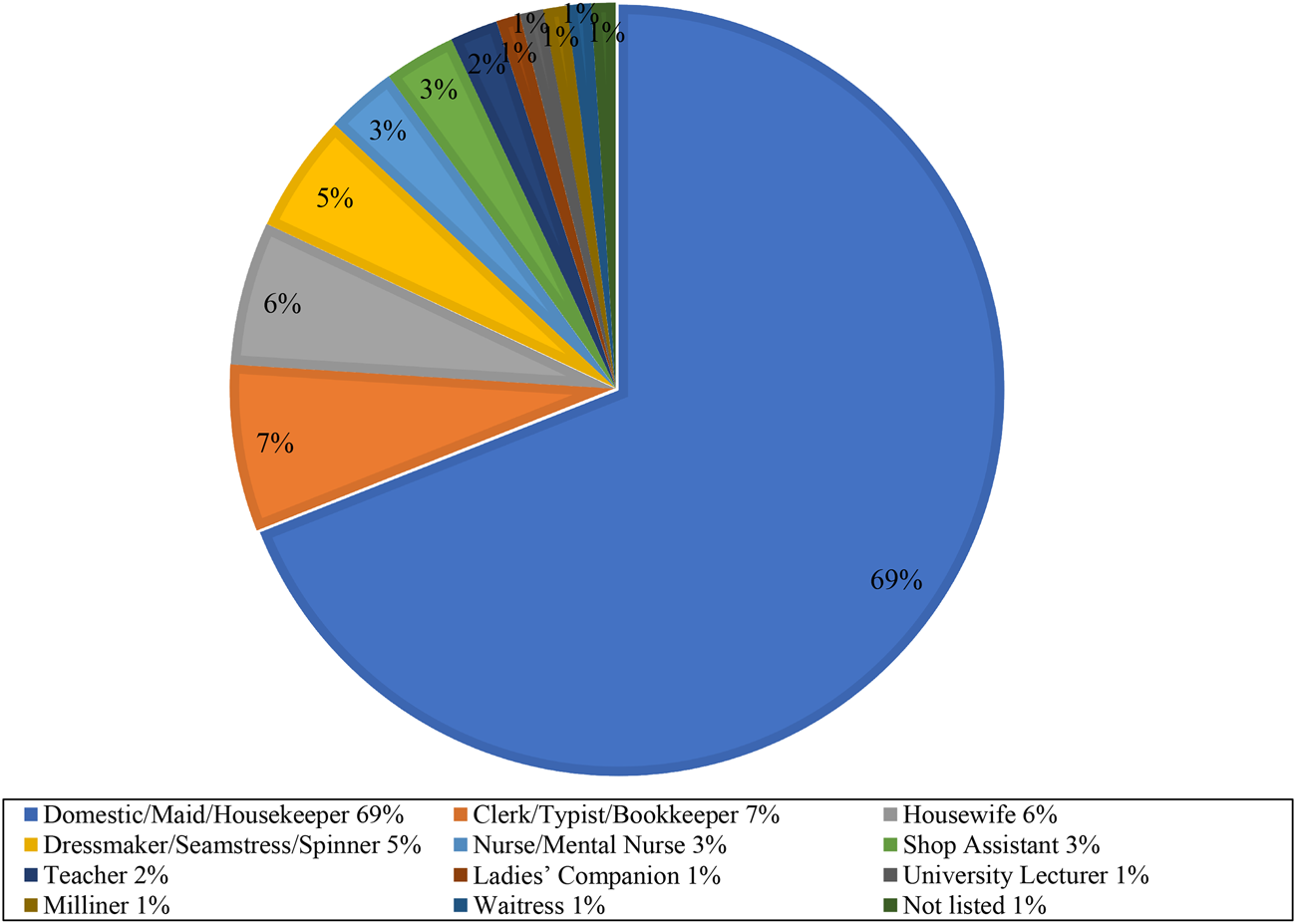
The overwhelming majority of emigrants were unmarried (93 per cent) and were mostly in their mid- to late-twenties on emigrating (the average age was twenty-seven). While Macardle referred to the difficulties for republican university graduates in securing employment, only the minority of emigrants registered as skilled workers; these included a number of clerks/bookkeepers (7 per cent), dressmakers/seamstresses (5 per cent), nurses/‘mental’ nurses (3 per cent), two teachers (both in religious orders) and one university lecturer. Rather, almost 70 per cent of emigrants registered their calling or occupation as ‘domestic servant’, ‘maid’ or ‘housekeeper’ (see figure 2). This prevalence of Irish women in American domestic service had been well established since the 1840s. Nevertheless, as Enda Delaney notes, the broad category of ‘domestic’ on official records often offered a catch-all term for those unsure about their employment prospects.Footnote 56 Later census and naturalisation records of those sampled demonstrate that while many remained in domestic service, others were soon employed as university administrators, nurses, cashiers and even as a switch board operator.
Calling/occupation on passenger crew lists

Official records also hint at the complicated and often difficult personal circumstances surrounding emigration. Margaret Dowling, Carlow branch, got married in April 1927. Her husband, Michael, emigrated three months after their marriage and two months after the birth of their first-born son; she joined him in Elizabeth, New Jersey, over two years later.Footnote 57 Kathleen Sweetman of Corran branch, County Cork, emigrated to New York with her two brothers on 15 July 1923. Their arrival was marked by tragedy: her brother Harry was ‘crushed to death’ in an elevator accident in Pennsylvania Station less than a month after their entry into the United States.Footnote 58
While the Sweetman family were strongly connected with the republican movement,Footnote 59 in many areas emigration appears to have been economically, as much as politically, driven. Emigrants often followed long-established patterns of chain migration, as activists from Castlegregory, County Kerry, flocked to Chicago; while San Francisco proved popular in Cúil Aodha, County Cork.Footnote 60 Although American-based emigrants are under-represented in the available military service pension applications, claimants tended to emphasise political motivations for emigration, perhaps to support their application by highlighting their sacrifice. It may simply have been easier to situate emigration within a narrative of political exile than to admit economic hardship. Nevertheless, a number of testimonies indicate that political allegiances directly infringed upon chances of economic and professional success. Mary Lytle, for example, relocated to New York (via Canada) with her children in 1926 due to the economic impact of her anti-Treaty politics: ‘I was a widow with two other children to educate & support & in our part of the country it was considered dangerous to be seen working for me even if I paid good wages. We never recovered from the financial loss & in the end were forced to sell out & try to make a new home here.’Footnote 61
The highly personal reasons for emigration are more difficult to gauge from official records. Annie Ford gave no explanation for her emigration in her pension application. However, her published memoir written in the late 1960s detailed that although she originally rejected the idea of emigration, the traumatic circumstances of her brother's death in 1927 meant she ‘didn't want to stay home’ any longer.Footnote 62 On the other hand, women's personal ambitions were hugely important pull factors. Already by the 1920s, Íde B. O'Carroll contends that female emigrants were aware of ‘the level of patriarchal oppression of women’ in the socially conservative Free State.Footnote 63 Indeed, activist Bridget Dirrane, who followed her fellow Aran Islanders to Boston in 1927, cited better employment situations for married women as an advantage to life in the U.S.Footnote 64 Pearl Flannery (née Egan) of Mullinahone branch, County Tipperary, emigrated in October 1923, at a time when her brothers were interned in the Curragh camp. However, her immigration record indicated that she was seeking work as a ‘university lecturer’ and that she even presented immigration officials with evidence of her Doctorate in Science from the University of Geneva.Footnote 65 She later worked as a research chemist and remained highly active in New York republican circles alongside her husband, I.R.A.-man Mick Flannery, who gained notoriety for his transatlantic gun-running activities and as a founder of Irish Northern Aid.Footnote 66
Even if political motivations may be overstated in pension applications, notable levels of emigration were evident among higher-ranking members of Cumann na mBan and anti-Treaty prisoners.Footnote 67 As returned migrant Seán Caomhánach (Seán a’ Chóta) indicated in his Curragh prison diary, for many anti-Treaty prisoners, the United States offered an imaginative safe haven from the oppressive policies of the Free State.Footnote 68 Indeed, many republican prisoners emigrated after their imprisonment, such as Máire Comerford, who fled to New York on her release from Cork jail in early 1924.Footnote 69 It is perhaps not coincidental that Macardle's short-story collection Earth-bound (1924), written during her time in Mountjoy and Kilmainham and published first in Worcester, Massachusetts, was based around a group of exiles in Philadelphia. The two fictional siblings, Frank and Úna, run a republican newspaper entitled Tri-Colour from their home; this is redolent of the activities of Kitty O'Doherty and her husband Séamus, who contributed to Joseph McGarrity's Irish-American newspaper the Irish Press in Philadelphia.Footnote 70
While Wilk documents the treatment received by ‘disabled’ male republicans in the United States from 1922 to 1935,Footnote 71 female revolutionaries were also encouraged to emigrate on medical grounds. Macardle, for example, had to consider moving overseas herself: on her release from Kilmainham on 30 April 1923 after participating in a week-long hunger strike the previous month, she was told by her doctor that she may never ‘live in Ireland due to the climate’.Footnote 72 In light of the highly gendered medical discourse of the era, women were readily prescribed rest-based therapies for ‘neurasthenia’ or ‘weak nerves’, and were often advised to resort to a warmer climate.Footnote 73 Traveling to the United States could prove a risky venture for ailing veterans given the stringent medical inspections outlined by Forbes. Mary Hickey O'Reilly failed her first medical test at the American consul, but the I.R.A. later helped her to travel to the U.S. for treatment for her rheumatic fever caused by ‘a very heavy wetting’ during the Civil War.Footnote 74 Bridget Sugrue, included in the sample, was hospitalised for nearly a week on her entry into Ellis Island in December 1924.Footnote 75
As I.R.A. veterans continued to emigrate against the wishes of the organisation, the I.R.A. relinquished its anti-emigration policy in July 1925 and instead established Foreign Reserve Lists whereby veterans could register for service abroad.Footnote 76 Although these lists are more often associated with male veterans, at least two women were included to provide intelligence, namely Celia McDonald and Emily McMahon, who were associated with the North Mayo Brigade and supposedly nurses in London.Footnote 77 Indeed, the republican movement had long used the preponderance of single female emigrants to conceal its activities, with key messages couriered across the Atlantic by Cumann na mBan women. Mimi Plunkett arrived in New York from Liverpool in March 1916 with a coded message for John Devoy, while Min Ryan made the same unaccompanied journey some months later to deliver the first report on the Rising.Footnote 78
These transatlantic journeys precipitated the establishment of New York Cumann na mBan, which was founded in December 1914 by newly-arrived Cumann na mBan members Sidney Gifford and Mary Colum, in collaboration with Irish-American suffragette and anti-war activist Dr Gertrude Kelly.Footnote 79 Branches soon emerged across the United States in many of the destinations where female revolutionaries later relocated, such as Brooklyn; Haverhill, Roxbury and Springfield, Massachusetts; San Francisco and Butte, Montana.Footnote 80 Eight Scottish branches and six English branches had emerged by 1922, in centres such as Liverpool, Glasgow, Manchester and London.Footnote 81 Branches of varying success also appeared in Sydney and Melbourne, illustrating the far-reaching global dimensions of the organisation.Footnote 82
The functions of branches varied depending on the location of the diasporic population. While Cumann na mBan branches closer to Ireland, as in London and Glasgow, contributed to gun-running, diasporic endeavours in America often centred on raising money for arms and relief.Footnote 83 However, their activism was not driven by selfless political motivations alone. Reports in the Brooklyn-based newspaper, The Eagle, outlined many of the activities of Cumann na mBan Inc., the second New York branch founded in 1915, which boasted an impressive 7,000 strong membership in 1919 under the leadership of Monaghan-born Gaelic Leaguer Sarah McKelvey.Footnote 84 They organised semi-monthly meetings, picnics, tag days, céilí dances, concerts, block parties, athletic carnivals, sewing circles and day trips to Staten Island, often for social as well as fundraising purposes. They also hosted lectures by Patrick McCartan and Liam Mellows, and held a requiem mass for Seán MacDermott whose two sisters, Rose and Kate, were Manhattan-based domestic workers and active members.Footnote 85 While the leaders of Cumann na mBan Inc. were long-time members of the more moderate Friends of Irish Freedom (F.O.I.F.), and thus perhaps less radical than Kelly who headed the more left-leaning Irish Progressive League (I.P.L.), McKelvey did not shy away from militarism either. In 1903, she was reportedly ‘manhandled’ during vigorous demonstrations against the stage-Irish play ‘McFadden's Row of Flats’.Footnote 86 In 1917, Cumann na mBan Inc. issued a statement on the arrest and intimidation of ‘Sister member’ Margaret Curley, stating resolutely that its members were ‘not the kind that can be terrorized’.Footnote 87
McKelvey's New York branch also tapped into its own network of branches across the United States: they hosted delegates from Philadelphia and corresponded with members in Springfield.Footnote 88 This transnational Cumann na mBan community could arguably pursue a more radical agenda than branches in Ireland which were characterised by greater deference to the male Volunteers. Veronica Ireland, secretary of the Ethna Carbery branch, Sydney, took great offence to the organisation being referred to as ‘the ladies section’ of the Australia Irish Nationalist Association, highlighting in a letter to the Sydney Freeman's Journal that the body was affiliated not with the men's organisation but with ‘Cumann na mBan headquarters in Dublin’.Footnote 89 Irish-American women similarly held a ‘progressive vision of Irish ethnicity that embraced gender equality’.Footnote 90 As Catherine Burns notes, New York Cumann na mBan under Kelly ‘did not see itself as a female aid society to a men's organization’.Footnote 91 This was met with resistance by Mary Jane O'Donovan Rossa, among others, who felt the women's organisations should be ‘animated by the sole desire of aiding and abetting, not rivalling them [Clan na Gael]’.Footnote 92 This may explain why Kathleen O'Doherty was encouraged by Joseph McGarrity to adopt the name of the ‘Ladies’ Auxiliary Clan na Gael’ when she founded a branch in Philadelphia.Footnote 93
III
The lecture tours between 1916 and 1926 of Nellie Gifford, Nora Connolly, Margaret Skinnider, Hanna Sheehy-Skeffington, Muriel MacSwiney, Mary MacSwiney, Countess Markievicz, Linda Kearns, Kathleen Boland, Margaret Pearse, Kathleen Brady, Máire Comerford and Ella Young contributed to an environment where women were respected representatives and valued activists of the republican movement. Minnie McCarthy of the Women's Irish Education League in San Francisco wrote that, ‘after Mary MacSwiney spoke here [1921], so many women were anxious to help spread the light, and when the Countess came they were delighted to get in with us and help in the movement’.Footnote 94 Indeed, women's strong presence at the 1921 New York St Patrick's day parade surprised planners: ‘there were as many women as men in the march’.Footnote 95
Even though Clan na Gael leaders felt that Sheehy-Skeffington would never be listened to, her lecture tour appealed to a broad base of ‘suffs, radicals and progressives’, as much as to Irish America.Footnote 96 Although she occasionally dealt with ‘the Ulster problem and with the labor movement’, her main lecture, ‘British militarism as I have known it’, focused on her husband's murder and the ‘horrors’ of everyday life under occupation.Footnote 97 Indeed, a highly gendered ‘Revolution from the inside’ narrative, emphasising the personal and familial sufferings of the female speakers, came to dominate the lecture tours.Footnote 98 Going against the directions of republican organiser Diarmuid Lynch, Gifford Czira quickly learnt that her ‘credentials’ as ‘a sister of two of the women who were married to two of the executed’ proved highly effective in attracting funds.Footnote 99 Press coverage also largely presented the women as bereaved wives and sisters rather than as activists, as illustrated in an advertisement in the Hartford Courant in 1923: ‘Mrs Hannah Sheehy-Skeffington, widow of one of the victims of the Easter Week uprising in Ireland in 1916, and Miss Kathleen Boland, sister of Harry Boland, envoy of the Irish Republic to America, who was shot by Free Staters last year, will speak at Red Men's Hall at 7:15 o'clock.’Footnote 100 As Dianne Hall notes, Linda Kearns and Kathleen Barry consciously supressed their militant backgrounds during their Australian tour, even more so than in the United States, in order to solicit funds and comply with ‘the prevailing ideologies of non-violent Irish nationalist women's roles’.Footnote 101
Indeed, Sheehy-Skeffington lamented that American journalists had a particular predilection for ‘sob stories’ characterised by ‘blatant appeals to the emotions’ and an eagerness for ‘thrills’.Footnote 102 One of the earliest examples was an interview by the poet and journalist Joyce Kilmer with a ‘Moira Regan’, published under the title ‘Irish girl rebel tells of Dublin fighting’ in the New York Times on 20 August 1916. Kilmer rather dramatically prefaced the newly-arrived emigrant's account of her experience in the G.P.O. by noting the ‘depth of tragic experience’ concealed by her ‘charming manner’. Nevertheless, Regan's narrative was notable for her emphasis on the ‘absolute equality between the men and women’ rebels, which undoubtedly resonated with a U.S. audience preoccupied by female suffrage, and for her descriptions of the mistreatment of the female 1916 prisoners. However, when the account was republished by the Roscommon Herald and Midland Reporter, it was deemed a ‘very grave offence’ by James Campbell, the attorney-general for Ireland, who threatened to seize ‘the printing type and plant of this paper’.Footnote 103
The publication of the mysterious Moira Regan's account illustrated that it was not just leading female figures who received attention as a culture of eye-witness reportage gained ground. In local communities across the United States, recently-arrived female emigrants often testified publicly to conditions in Ireland; the relatability of the experiences of ‘unknown’ figures arguably had a particular appeal.Footnote 104 During the sittings of the American Commission on Conditions in Ireland between 18 November 1920 and 21 January 1921, fourteen of the thirty-eight witnesses were women, including Mary and Muriel MacSwiney, and Susanna and Anna Walsh (the sisters-in-law of Tomás Mac Curtain). They were also joined by the lesser-known Nellie Craven who was an Irish-born maid based in Washington D.C.Footnote 105 Having seen a Black and Tan raid on her family home in Headford, County Galway during a return visit to Ireland, Craven bore witness to ‘the extent to which the sanctity of the Irish home is violated’.Footnote 106 Claimed as a local resident, her account was reprinted in the Washington Evening Star under the heading ‘D. C. woman tells of Ireland raids’.Footnote 107 That same winter, an unidentified female speaker returned to Springfield, Massachusetts, where she attested to the ‘murder and wanton destruction’ which terrorised her home village in County Kerry.Footnote 108 Although she did not reveal her identity for ‘fear of reprisals’, her extensive and incredibly graphic testimony appeared on the front page of the Springfield Republican, undoubtedly serving a useful propaganda purpose for the local Irish movement.
While funds from Irish-American emigrants are often associated with President Éamon de Valera's high-profile American tour in 1919–20,Footnote 109 the success of campaigns, such as the F.O.I.F. victory fund in 1919 and the bond drive in 1920, relied on a highly gendered discourse. The American Committee for Relief in Ireland, formed in late 1920, campaigned specifically to ‘feed women and children of Ireland, as we fed those of Belgium and Central Europe’.Footnote 110 Furthermore, relief and victory fund committees across the States actively recruited female fundraisers: as Harry Joseph of the Salt Lake City Irish Relief Committee declared, ‘a handsome young lady will get dollars, where a man can only get doughnuts’.Footnote 111 Women were not only enlisted as fundraisers, they were also targeted for funds, as illustrated perhaps by an ‘Irish Relief Fund’ Fashion Sale held in San Diego.Footnote 112 Indeed, ‘Irish Bridget’ maids were represented as keen subscribers to Irish nationalist causes since the Famine.Footnote 113 This stereotype has been corroborated by Robin Adams's research which shows that women constituted almost half of subscribers to the Irish bonds drive in Manhattan; more than half of these women were domestic servants.Footnote 114
IV
Financial assistance was not the only form of aid provided; the women's organisations in the United States also offered an important morale boost to their comrades in Ireland. As Lil Conlon wrote, the ‘women in America were just splendid and did trojan work, not sparing themselves … WE, IRISH, should never forget the sacrifices they made, their ready co-operation and their unfailing solicitude’.Footnote 115 These cooperative transatlantic relief efforts also directly influenced the activities of Cumann na mBan on the ground in Ireland. For example, Bridget ‘Baby’ Duffy of Castleblayney, County Monaghan, cooperated with Monaghan-born emigrant, Alice Carragher Comiskey, who was treasurer of the New York Cumann na mBan Relief Committee. Duffy claimed that she dispensed clothes and funds to I.R.A. men and prisoners on behalf of the ‘American Green Cross’ from 1918 to 1923, illustrating how geographic fixity did not preclude global action.Footnote 116
Scholars such as Margaret Lynch-Brennan, David Fitzpatrick and Bernadette Whelan point to the significant impact of the returned female emigrant, whether she came back temporarily or permanently, on social and cultural mores, particularly in rural Ireland.Footnote 117 This was equally the case during the revolution where a number of emigrants returned to offer assistance. Indeed, the Boston unit of the Irish White Cross had a membership of over 200 nurses ‘all pledged to go [to] Ireland for relief work on demand of the parent organization’.Footnote 118 Margaret McGann (née Hussey) returned to Longford in 1920 and attributed her prominent role in Cumann na mBan to the experience she had gained in the U.S.: ‘I was Vic. Capt as I had four years’ experience in American Red Cross and gave first aid instructions’.Footnote 119 Similarly, Alice Conlon (later Mahoney) founded the Wattlebridge, County Monaghan, Cumann na mBan branch in June 1920 on her return from New York, where she had been singled out by Harry Boland for her efforts to support the bond drive.Footnote 120 Throughout 1921 and 1922, Conlon couriered arms and ammunition across the recently enforced border between Northern Ireland and the Free State, and was particularly remembered for ‘keeping’ the I.R.A. ‘in clothes, money & cigs.’ at her own expense – savings, no doubt, earned in New York.Footnote 121 Conlon returned to America in December 1922, ostensibly to work as a domestic, where she married and stayed for the remainder of her life.Footnote 122
Not all returnees offering support to the republican movement were met with enthusiasm. Molly Flannery Woods recalled meeting Vivian Butler Burke, the wealthy daughter of New York-based Irish immigrants:
Of all the places in the world where should we meet but at 6 Harcourt Street some time after it had been wrecked by the British Soldiery during the Irish Independence war.Footnote 123 We, Cumann na mBan women, were working there secretly for the IRA, ostensibly for less seditious purposes. On leaving one night I saw a lady drying her eyes as if crying. I accosted her, enquiring if anything were the matter. She faltered and said, ‘Not really’. She was beautifully attired and had an airdele [sic] on a lead. She seemed rather nervous, good-looking and from appearance, wealthy.
She said, ‘I came here to help with work for your army, but they take me for a spy and will not give me any. I knew your men in Paris and Germany, I know Séan T. O'Kelly. My name is Vivian Butler Burke.’
‘And you are an American[?]’ I said.
‘An Irish American’ she corrected.Footnote 124
Flannery Wood's description of Butler Burke is reminiscent of popular cultural representations of the ‘returned Yank’ distinguished by ‘flashy clothes, conspicuous wealth, ignorance, bombast’.Footnote 125 Despite rumours of her espionage, Flannery Woods was aware of Butler Burke's fundraising for political prisoners. Described as a ‘world traveller’, Butler Burke wandered through Europe after her parents’ death until she received a calling in 1921, as Micheál Mac Liammóir theatrically recounted, to go to the ‘land of your fathers’.Footnote 126 Given her ‘guileless heart and open purse’,Footnote 127 she contributed greatly to the republican movement by sheltering anti-Treaty I.R.A. men in her Dublin home at 11 Harcourt Terrace and was even willing to travel to France during the Battle of the Four Courts to secure arms.Footnote 128 The eccentric Butler Burke remained in Ireland for some fourteen years before returning to the United States where she died in 1937, leaving $20,000 of her estate to ‘homes for dogs in various countries’.Footnote 129 Though hardly representative of most transnational revolutionary women, Butler Burke led a global life which eluded national boundaries and brought the Irish Revolution into conversation with other labour, anti-imperial and even spiritual movements. In 1921, she reported on the Irish situation for the leftist German paper Die Weltbühne, and she also corresponded with Mahatma Gandhi regarding her frustrated attempts to build up a Buddhist spiritual centre of ‘world brotherhood’ in her Dublin home in the face of ‘sectarianism, party-strife & faith in physical force’.Footnote 130
V
Although the majority of Irish-American organisations, such as the Self-Determination for Ireland League (S.D.I.L.), the F.O.I.F and the Ancient Order of Hibernians (A.O.H.) supported the Treaty, Irish-American women largely identified publicly with the anti-Treaty side. Gertrude Kelly denounced the settlement, claiming in the New York Times that women ‘of Irish extraction’ were ‘downhearted’ and that ‘most of them refused to believe the news’.Footnote 131 Reports that Irish-American women were vociferously anti-Treaty alarmed Jennie Wyse Power who lamented in the Mansion House on 13 March 1922 that ‘an idea had gone abroad that all women were against the Treaty’.Footnote 132 Rather intriguingly, the national women's auxiliary of the A.O.H., under the leadership of Chicago's Mary McWhorter, went against the main organisation in opposing the Treaty, demonstrating that the Ladies’ Auxiliary of the A.O.H. was capable of asserting an agency which transgressed the mantle of an auxiliary.
Post-Civil War Cumann na mBan emigrants, such as Brigid Kennedy, who felt there was ‘no other course open to me’,Footnote 133 thus arrived into a politically-fraught Irish America. As Alice Ginnell wrote in her diary on 27 December 1922, ‘There is friction everywhere … between various Irish-Americans and Irish-American Associations … between the Clan na Gael and the American Association for the Recognition of the Irish Republic [A.A.R.I.R.] … between the other ladies and Mrs. MacSwiney – that is on the anti-Treaty side – to say nothing of the division between the Free Staters and the Republicans!’Footnote 134 Indeed, the Irish-American movement suffered after the Treaty. In December 1922 Mary Agnes Davin, of Doon, County Limerick, arrived in New York where, she claimed, she tried to get money and other support from the ‘American associations’. However, ‘there was a split’, she recalled, and ‘it was all over’ at the ceasefire.Footnote 135
In his influential study Emigrants and exiles, Kerby Miller contends that Irish emigrants to North America often perceived themselves as ‘involuntary exiles’ which hindered their adaption to American life, but enabled the success of Irish-American nationalism.Footnote 136 The extent to which female emigrants self-identified as ‘political exiles’ in the same way as their male comrades is uncertain. Observing that nineteenth-century female immigrants assimilated well, Hasia R. Diner has suggested that they were less attracted to the Irish nationalist movement than to other social and religious outlets.Footnote 137
Indeed, for many republican women, their arrival in the United States marked a retreat from their activism. Mary Rigney, secretary of the Ardchraobh of Sinn Féin, who emigrated to America in 1926, claimed that she grew disillusioned with politics as ‘I had too many friends on both sides and I gave it up altogether’.Footnote 138 Mary and Dorothy Hannafin, who had run the anti-Treaty propaganda sheet ‘The Invincibles’ in Tralee, emigrated with their mother to the Bronx in 1926. Mary noted in 1947 that ‘for twenty years I have been in the United States and almost completely out of touch with Irish affairs’.Footnote 139 Aside from this post-Civil War demoralisation, women's political interests were often disrupted by more pressing economic affairs. Annie Ford struggled to raise a family in Medford, Massachusetts, as she and her husband lost their house and savings during the Great Depression.Footnote 140 Lily Kempson of the Irish Citizen Army, a teen courier during the Easter Rising, fled to America on her sister's passport in 1916. By the time of the Countess Markievicz's visit to Seattle in 1922, she was married with children. Her recorded memoirs emphasise Our Lady of Good Help Catholic Church, rather than any political organisation, as the focal point of social interactions for the Irish in Seattle.Footnote 141 Equally, an obituary for Elizabeth Whelan (née Hannigan) of Ballinalee branch, County Longford, and later resident of the Bronx, stresses her role in St. Anne's Catholic Church, the Rosary Society and the charity group the Longford Ladies’ Association.Footnote 142 Many emigrants also entered religious orders in the United States and further afield, channelling their revolutionary activism into social causes and teaching. Most notable, perhaps, was the ‘pioneering feminist’ Sister Joseph Teresa O'Sullivan whose advocacy for girls’ education in Kenya was attributed to her Cumann na mBan background.Footnote 143
Nevertheless, there were still avenues available for political women to continue their activism. While Cumann na mBan had become a remnant of its former self by the mid-1920s in the Irish Free State, certain branches remained more intact in the United States. In 1930, McKelvey, president of Cumann na mBan Inc., boasted ‘an enrolment of hundreds of Brooklyn and Long Island members’.Footnote 144 Active throughout the 1930s, Cumann na mBan Inc. marked a quarter of a century of activism in 1940 when Rose MacDermott launched its campaign against threats to Irish neutrality.Footnote 145 A number of emigrants sought out Cumann na mBan branches on arrival, illustrating how the organisation offered a means of ameliorating the disruption of emigration. Ellen Buckley of Macroom, County Cork, who joined Cumann na mBan on her arrival in Detroit, Michigan, in 1926, claimed she ‘was one of the ushers at [a] Reception held for Mr. De Valera’ in 1927.Footnote 146 She most likely encountered Mary Healy and Margaret Buckley of Manchester Cumann na mBan who were also active in Detroit's Kevin Barry Sisters branch of Cumann na mBan. As Buckley stated, they worked ‘hard getting up entertainments to make up money for Prisoners’ Dependants and members of the I.R.A. who were in this country unable to work and suffering from bad health’.Footnote 147 Shelia Nagle, who was interned for almost a year during the Civil War, also made for Detroit with her sisters and fellow Tralee branch members Eily and Joan;Footnote 148 she worked ‘as a cook in the home of the city's auto barons’.Footnote 149 While the presence of this particular republican community, situated in a thriving industrial midwestern city, suggests the prevalence of Cumann na mBan organisations in cities across the United States, few records exist to confirm their existence or provide further insights into their activities. This is further complicated by the fact that a number of often short-lived organisations referred to as ‘Cumann na mBan’ were in fact ladies’ auxiliaries of Clan na Gael or even the Gaelic League.Footnote 150 As Patrick Mannion noted in his study of Irish ethnic nationalism in Newfoundland, Nova Scotia, and Maine, even at the height of the bond drive ‘engagement with Ireland involved only a tiny percentage of the community’.Footnote 151 The impact of Irish North-American nationalism thus varied greatly from place to place.
Even so, Lynch-Brennan contends that life in America suited assertive female revolutionaries ‘for they found the United States to be a country where … every-body [is] for themselves’.Footnote 152 The idea, at least, that America offered political opportunities certainly appealed to Lizzie O'Reilly who emigrated to Chicago in 1926 in order to ‘establish a depot for Irish industries’. Tragically, O'Reilly died just a year later at the age of forty-eight. She was given full military honours, ‘including a firing squad’, by Chicago's Friends of the Irish Republic.Footnote 153 Bridie Halpin also emigrated to New York in 1946 to ‘continue her revolutionary work’, founding a short-lived branch of Clann na Poblachta. As O'Carroll notes, she hoped in America, more than anywhere else, ‘to gather support for the cause of an Irish Republic’.Footnote 154
Hanley notes that Clan na Gael I.R.A. veterans’ clubs emerged as one of the most vibrant social outlets for post-Civil War I.R.A. veterans in sturdy Irish enclaves in New York, Chicago, Cleveland, and Butte, Montana.Footnote 155 Although Clan na Gael was male-dominated, there were separate auxiliary clubs for women which hosted dances, social events, parades, and even a beauty contest.Footnote 156 Marriages between a number of I.R.A. and Cumann na mBan veterans in New York might hint to the social allure of such events.Footnote 157 Although membership records of ladies' auxiliaries are difficult to locate, I.R.A. emigrant Connie Neenan commented that in New York in 1927 ‘the women's Clubs [were] good’,Footnote 158 while Seán Ó Deoráin, of Riverside, New York, wrote to Mary MacSwiney in 1930 that the I.R.A. auxiliary organisation hosted a ‘great many … excellent Republican women and girls’.Footnote 159
In Springfield, the I.R.A. veterans’ club also organised social events and entertainments – and even an ‘IRA dramatic club’ – in collaboration with the Clan na Gael Ladies’ Auxiliary.Footnote 160 By cross-referencing the names of members of the Ladies' Auxiliary listed in The Springfield Republican with census records, it appears that many of these women were recently-arrived immigrants who had lived through the revolutionary period in Ireland, although they were perhaps too young to have been active in the ranks of Cumann na mBan.Footnote 161
Indeed, there was active competition to attract new members given the sudden decline of Irish-American organisations after the Civil War. In New Haven, Connecticut, the A.A.R.I.R.'s Miss Augusta Newton lamented in letters to Mary MacSwiney that efforts to maintain a ‘local women's organisation’ had folded, and that the pro-de Valera, anti-Treaty A.A.R.I.R. found itself competing with other organisations to entice new blood:
Here in New Haven, our chief means of getting money has been a series of annual dances. The boys and girls recently arrived from Ireland have in the past made up the crowd for our entertainment. Now the Irish American Social Clubs and ‘Gaelic Football’ groups, made up to a great extent of ex-members of the A.A.R.I.R. and the Clan, and too often run in the interest of liquor dealers here, have temporarily hypnotised the young people from Ireland.Footnote 162
The A.A.R.I.R., which tended to be more middle class and respectable than the Clan,Footnote 163 arguably provided post-Civil War female emigrants with greater opportunities to advance their republican political ideas than the Ladies’ Auxiliaries. Historically, the A.A.R.I.R. was more open to women than other organisations and a number of Boston branches were even dominated by women.Footnote 164 The decline of the A.A.R.I.R after the Treaty split led to the search for new recruits which, as Brundage observes, attracted prominent Americans from non-Irish backgrounds such as black rights advocate Charles E. Russell.Footnote 165 This also created a vacuum which women leaders could occupy. A number of overlooked, but significant, Irish-American women rose as national leaders of the A.A.R.I.R.; these include Elizabeth Needham of Boston,Footnote 166 Catherine Enright of South Boston,Footnote 167 New York's Annie O'Mahoney,Footnote 168 suffragist Evelyn Scanlan of the League of Catholic Women, Boston,Footnote 169 and leading militant suffragettes Catherine Flanagan and Edna Purtell, both of Hartford, Connecticut.Footnote 170
While many of these women were first- or second-generation Irish, the A.A.R.I.R. also provided platforms for newly-arrived immigrants. Josephine Cregan, who emigrated in 1916, served as financial secretary of the Springfield A.A.R.I.R. from 1921 to 1924. She claimed to have been on a trip home to Dublin during the Battle of the Four Courts, observing that Cumann na mBan provided ‘great aid at all times of stress’.Footnote 171 Nellie Hoyne Murray was perhaps the most significant Cumann na mBan veteran to find a home in the A.A.R.I.R. A native of Kilkenny, Hoyne went on hunger strike with Nora Connolly during the Civil War.Footnote 172 Her health suffered as a result, which may have led to her emigration under the name of British-born Agnes McNerney, from Southampton to Cleveland, Ohio in November 1925.Footnote 173 She soon relocated to Los Angeles where the city's A.A.R.I.R. was known for its provision of medical support to I.R.A. veterans.Footnote 174 The branch was headed by John Murray and his family, who covered much of the costs of this rehabilitation, and took numerous republican emigrants into their homes.Footnote 175
Nellie married John Murray's son, George, in 1930 and served as officer and secretary of the Los Angeles Council of the A.A.R.I.R. (later renamed the Peter Murray Council) for the next twenty-five years until her death in 1955.Footnote 176 Hoyne, who was remembered for having ‘an expert knowledge of parliamentary procedure’, was a typist by trade and penned much of the branch's propaganda.Footnote 177 The chapter initially supported de Valera in his fundraising attempts for the Irish Press, but broke from Fianna Fáil in response to the Irish government's suppression of the I.R.A. in 1936. The Los Angeles A.A.R.I.R. thus split into two branches, the ‘Conservative’ group led by John Byrne and Murray's ‘Southern California Chapter.’Footnote 178 Throughout the 1940s and 1950s, Hoyne coordinated numerous social events – such as an annual summer picnic, St Patrick's day festivities, and traditional music concerts – for the Irish community of Los Angeles.Footnote 179 She also used her platform to further her own political beliefs. In 1938, she vocally objected to the decision by mayor of Los Angeles Frank L. Shaw to celebrate ‘Irish Independence Day’ on 21 August on the grounds that Ireland was still not free.Footnote 180 In August 1942, she co-authored a letter to President Roosevelt urging him to use his influence to prevent the planned execution of six republicans.Footnote 181 According to Wilk, it was Hoyne's influence that underpinned the ‘distinctive militant spirit’ of the Murray branch.Footnote 182
While Hoyne remained in Los Angeles for the rest of her life, the impact of the Great Depression, as well as new political and employment opportunities engendered by the election of Fianna Fáil in 1932, led to the return migration of a number of republicans. Mary Rigney attributed her return to Ireland in 1932 to ‘the business recession’.Footnote 183 The welcome extended to such returned emigrants varied hugely.Footnote 184 Writing in her memoir, Children of the far flung, Deirdre O'Connell recounted that her father and mother – Michael Joe O'Connell and Nellie Taaffe, veterans of the I.R.A. and Cumann na mBan respectively – left New York in 1932 with the intention of starting a new life on the Taaffe family farm in Currarague, County Cork. However, the revolution had disrupted the anticipated familial inheritance, as Nellie's younger brother, Jackie, ‘the returning [I.R.A.] hero’, was deemed more deserving of the family farm than ‘the returning emigrant’. Furthermore, Michael Joe's anti-Treaty allegiance was called into question because his brother had joined the Irish Free State army. After two years the couple relinquished the land and sailed back to New York.Footnote 185
VI
The marginalisation of returned migrants like the O'Connells speaks to the unease surrounding emigration more generally in the newly-established Irish Free State. No longer attributable to the wrath of the British colonial system, emigration now served as reminder of the nation's own failures. The various ways in which emigration was linked with the revolution – simultaneously as a source of aid and support, as a feature of everyday life, and also as a consequence of the war – remain underplayed in historical studies. Emigration by female revolutionaries, like that of men, derived from a complex web of economic, familial, political, and personal motivations. The transatlantic trajectories and exchanges of these Cumann na mBan activists expanded the movement beyond national boundaries and contributed to the success of the revolution not only through the supply of funds, but also by providing vital intelligence, propaganda, and morale. Returned migrants pressed the experience they acquired abroad into the service of the revolutionary movement at home, while fundraising in the United States relied in part on a highly gendered discourse articulated by women. Women's experiences of emigration varied from that of men's in that their identification as emigrants was arguably less contingent upon the trope of involuntary exile. Even though many women retreated from their activism on emigrating, others found various platforms in the United States through which to further their own personal, political and social beliefs.