Introduction
Judicial dissents are paradoxical texts. They lack binding force and, unlike in Homeric times when the judge who rendered the most correct judgment received two talents of gold, modern jurists lack obvious incentives to issue dissents.Footnote 1 Yet international judges devote considerable energies to crafting dissents and other minority opinions.Footnote 2 Moreover, these opinions have recently become the object of intense scholarly fascination. In just the past few years, leading journals have published papers exploring dissents’ role at international criminal trials, impact upon compliance with human rights judgments, and effect on the International Court of Justice's authority.Footnote 3 Other scholars foreground dissents to gauge whether certain human rights courts are “backsliding,” to evaluate the legacy of prominent jurists, to consider gender and other forms of judicial diversity, and as the most visible example of a larger category of judicial speech acts.Footnote 4
This rapidly expanding literature usefully highlights the centrality and importance of dissent at many international courts. Yet this research tends to analyze dissents by a single jurist, at a specific court, or within a particular international legal regime. The lack of comparative analysis leaves us with, at best, a partial understanding of why judges at some international tribunals routinely issue judgments accompanied by forceful dissents while at other courts jurists refrain from issuing minority opinions, or the effects of these diverse practices.
Moreover, there is a curious gap in recent writings on dissent. These studies generally sidestep three central questions raised by minority opinions, namely their impact upon a court's legitimacy, judicial independence, and the development of legal doctrine.Footnote 5 This omission is even more striking because debates over dissent at international courts have a lengthy history—and this history focuses precisely upon the consequences of different dissent practices for judicial legitimacy, independence, and legal doctrine.
We seek to fill this gap by providing the first comparative study of dissent at international tribunals. Our goals are several. In excavating a rich history of contestation over dissent, we seek to recover a forgotten discourse and illuminate the central claims advanced in earlier debates. Our more important goal, however, is forward looking: we seek to advance these debates by examining anew the impact of separate opinions. To do so, we employ multiple methods, including analysis of debates when courts were established; court statutes and rules; dissent patterns over time; relevant secondary literature; interviews with current and former international judges; and analysis of expert and popular responses to prominent court judgments.
A dissent represents a road not taken. It typically sets out distinctions or doctrinal approaches that diverge from those adopted by the court's majority; the dissent's influence depends on its ability to articulate a more attractive vision of what the law could be. A dissent thus invites the reader to undertake a comparative exercise: which of the contrasting approaches to the issue before the court is most appealing? As befits an article on dissent, our approach is likewise comparative. Specifically, we pursue a scholarly road not previously taken and compare dissent practices at different international courts.
This comparative approach has several important benefits. First, as dissent practices at the courts we study have been remarkably stable over time, participants at and observers of any particular court may view the deeply embedded practices at “their” court as necessary or inevitable. A comparative approach helps to distinguish historically contingent practices of a single court from inevitable or general features of international law, and thus unsettle accepted categories and assumptions. A comparative perspective can also inform efforts to reform or create new international tribunals, as questions of institutional design and judicial practice should be based on informed choices among different institutional arrangements, including different dissent practices. Finally, a comparative approach can facilitate causal analysis, by allowing us to study the effects of different dissent practices while controlling for other, potentially confounding factors.
Our analysis proceeds in four parts. Part I surveys the most important and enduring claims in debates over the advantages and disadvantages of dissent. From this review, we foreground three important questions for closer examination. First, do dissents enhance or undermine a court's legitimacy? The question is particularly salient at international tribunals, which typically lack the democratic legitimation and enforcement capabilities associated with many of their domestic counterparts. Second, do separate opinions enhance or undermine the independence of international judges? Given persistent concerns over alleged national bias—and the structural reality that international judges are typically appointed, and reappointed, by the very states that appear before them as litigants—questions of judicial independence are endemic at international tribunals. Third, how do separate opinions impact the development of legal doctrine? The question is critical given the significant law-making role of international tribunals, and the strong claims that partisans and critics of dissent advance regarding its impact on the development of legal doctrine.
Part II reviews dissent practices and patterns at three prominent international courts: the International Court of Justice (ICJ), and its predecessor, the Permanent Court of International Justice (PCIJ); the European Court of Justice (ECJ); and the European Court of Human Rights (ECtHR). These courts, of course, do not exhaust the universe of international tribunals. They have, however, served as influential models for other international courts and tribunals,Footnote 6 and we provide a detailed rationale for our selection of these courts in Part II below. Most importantly, these courts have adopted, and maintained over many decades, a wide range of dissent practices. At one end of a continuum, the ICJ routinely issues judgments that are accompanied by one or more dissenting opinions. At the other end of the spectrum, judges at the ECJ always issue judgments in the name of the court, and have never released a judgment accompanied by a separate opinion. Dissent practices at the ECtHR fall somewhere between these two poles. At each court, moreover, judges advance substantially different understandings of the virtues and drawbacks of issuing dissents. In short, our investigation reveals what are effectively three different cultures of dissent at international tribunals.
In Part III, we draw on our case studies to assess the competing claims in the central debates over dissent. To preview our central claims: traditional debates over whether dissents enhance or undermine legitimacy are incomplete and misleading. Significantly, we find little support for long-standing claims that dissents undermine judicial legitimacy. Rather, critiques of the legitimacy of international courts, or of specific decisions, generally focus on a judgment's substance and are rarely if ever premised on the fact that judgments are non-unanimous. On the other hand, evidence that judicial votes or opinions are motivated by geopolitics or political ideology do appear to raise legitimacy concerns. Thus, we examine whether the link between legitimacy and dissent has less to do with the presence of dissent than with patterns of dissent. Moreover, we find that neither dissent nor unity provides the exclusive path to legitimacy. Indeed, courts with strikingly different dissent practices can be widely considered as legitimate, as evidenced by the two European courts which have both enjoyed high levels of legitimacy despite very different dissent practices.
Second, traditional debates over whether dissents enhance or undermine judicial independence are likewise misleading. In this case, however, the mistake is to foreground the relationship between two features of international courts (dissent and judicial independence) when the more relevant dynamics involve the complex inter-relationships among three features of international courts: dissent, judicial independence, and judicial reappointment practices. Specifically, we find that it is not dissent alone, but the combination of dissent with renewable terms, that poses the greatest threat to judicial independence.
Finally, traditional debates over dissents’ impact on law development are also mistaken, as they fail sufficiently to distinguish between different ways that dissents may contribute to legal doctrine. One way is by sharpening, and often limiting, the majority's arguments and rationale. In this respect, dissents almost certainly play an important and salutary role in shaping legal doctrine. Dissents can also send signals to appellate bodies, future litigants, and scholars that invite the development of alternative lines of argument. Whether dissents play the more ambitious role of persuading future courts to reverse a line of doctrine, however, is considerably less clear. The overwhelming majority of dissents are not cited in future judgments, and even in the relatively limited number of cases where a dissent's rationale is adopted by a future court, difficult questions of causation arise. Whether a dissent, in any meaningful way, “causes” future judges to shift course is often highly uncertain.
Thus, our unexpected conclusion is that each of the central debates over dissent at international courts—over legitimacy, judicial independence, and law development—is mistaken or significantly misleading in important respects. Yet these case studies only begin the comparative analysis of dissent at international tribunals. Specifically, while our findings subvert much of the conventional wisdom regarding dissent and demonstrate the existence of three long-standing and distinct cultures of dissent, much work remains to be done to understand the cultures, causes, and effects of dissent among the larger universe of international courts. While we cannot fully analyze dissent practices at all international courts in this Article, Part IV provides a brief overview of dissent at other courts, and outlines a preliminary research agenda for expanding the comparative study of international judicial dissent to this more diverse set of cases. A brief conclusion follows.
Our surprising findings can reorient and reframe decades of inconclusive debate over dissent at international tribunals. As importantly, they have significant methodological implications for those interested in the role of international courts in international affairs more broadly. First, our research breaks with dominant approaches by treating international courts as a “they,” not an “it.”Footnote 7 Most international courts are multi-member tribunals; judicial decision making thus involves individuals engaged in group processes. Adopting a group-level perspective has illuminated many conceptual and doctrinal puzzles arising out of collegial decision making in domestic courts, and promises to do the same for the study of international tribunals.
Moreover, much scholarship in this area focuses on the institutional design choices that states make, such as whether to make jurisdiction compulsory or grant standing to private parties. But the legal instruments that states draft to create international courts are necessarily incomplete, and many important questions are not addressed by either court statutes or court rules. Rather, these issues are addressed through practices created and shaped by international judges themselves. This study thus contributes to the nascent literature examining international judicial practices.Footnote 8
I. Theorizing Dissent
International tribunals have issued tens of thousands of judgments, many of which are accompanied by dissents, yet we lack a clear understanding of how separate opinions impact the legitimacy of international courts, the independence of their judges, and the development of legal doctrine. To frame our inquiry into these and related questions, in this Part we begin to theorize judicial dissent.
Our discussion proceeds in two Sections. First, we provide a necessarily selective review of the extant literature on the purported advantages and disadvantages of dissent. The most relevant starting point, and the source of the most extensive discussions on this question, is the sizable literature on dissent in U.S. federal courts. As we shall see, however, virtually the same claims, often offered in virtually identical terms, are found in arguments over dissent at international tribunals. At the same time, we recognize the limitations of the domestic analogy. Thus, in the second Section, we identify relevant distinctions between international and domestic tribunals, and corresponding limitations on transposing insights from the literature on domestic courts to the international plane.
A. The Advantages and Disadvantages of Dissent
While international legal scholars have generally not focused on the systemic implications of judicial dissent, participants at and observers of American federal courts have engaged for over two centuries in a spirited debate over the advantages and disadvantages of dissent. In the pages that follow, we draw widely, if necessarily selectively, on these writings, interspersed with references to writings on dissent at international courts. In both domains, judges and scholars have identified a relatively stable set of purported advantages and disadvantages of dissent.
1. The Advantages of Dissent
Dissent's champions have identified a number of related albeit distinguishable advantages that allegedly arise from the practice.
Improving the court's jurisprudence: The most immediate impact of a dissent is typically to improve the quality of the court's judgment, by prompting clarifications, refinements and modifications in the majority opinion.Footnote 9 Justice Scalia explains that dissents can “improve the majority opinion” in any of several ways. First, “the mere prospect of a separate writing renders the writer of the majority opinion more receptive to reasonable suggestions on major points.”Footnote 10 More specifically, according to Justice Scalia, “the first draft of a dissent often causes the majority to refine its opinion, eliminating the more vulnerable assertions and narrowing the announced legal rule.”Footnote 11 Because judges “greatly prefer the Court to be unanimous or almost so whenever possible,”Footnote 12 those in the majority will often modify their opinion in an effort to prevent the issuance of a dissent.
To the extent that dissents improve the opinion of the court, they serve important systemic interests; by “riding herd on the majority”Footnote 13 a dissent “safeguards the integrity of the judicial decision-making process by keeping the majority accountable for the rationale and consequences of its decision.”Footnote 14 This claim that dissents improve the quality of the majority opinion reflects the belief that “vigorous debate improves the final product by forcing the prevailing side to deal with the hardest questions urged by the losing side.”Footnote 15
Explaining the meaning and limiting the reach of the court's decision: Improving the quality of a majority opinion is typically not the intended effect of a dissent. In contrast, interpreting—and limiting the reach of—a majority decision often is. Minority opinions may shape the meaning of judgments by offering alternative interpretations of majority holdings or alternative arguments that support a result. Moreover, dissents can limit a judgment's scope and spend substantial time detailing the issues that a majority opinion did not decide. Thus, dissents are “commonly used to emphasize the limits of a majority decision . . . [and as] a sort of ‘damage control’ mechanism.”Footnote 16 In these ways, dissents can influence the ways that subsequent courts interpret and apply a decision.
Providing guidance to appellate courts, litigants, and legislators: Dissents are often intended for multiple audiences. In systems that permit appellate review, dissents can signal to higher courts that an issue “is difficult, important, and worthy of [the Court's] attention.”Footnote 17 Several international courts, including the European Court of Human Rights and the World Trade Organization, have appellate mechanisms and it is evident that, at times, dissents serve as a signaling device to superior tribunals.
Dissents may also be directed toward future litigants. Dissenting judges may identify issues upon which the majority was split and which might therefore generate different outcomes in future cases, and suggest alternative litigation strategies. This theme is echoed in writings on international courts; Judge Jennings, for example, notes that dissents serve the “broader function of expressing alternative legal arguments, or indeed alternative conclusions.”Footnote 18
Another genre of dissent aims to attract public attention and propel legislative change. One dramatic example from the United States involves the Ledbetter case, where a sharply divided Supreme Court rejected plaintiff's gender discrimination claim as time-barred. A powerful dissent charged that the majority ignored real-world employment practices.Footnote 19 Within days, bills were introduced to amend the relevant statutory language, and shortly thereafter legislation was adopted that effectively reversed the Court's decision.Footnote 20 International law's legislative processes are more diffuse than those in many domestic systems, yet dissents at international tribunals can likewise prompt legislative efforts. Kolb argues, for example, that “the dissenting opinions in the 1927 Lotus case directly influenced the adoption of the 1952 Brussels Convention,” which effectively overturned the PCIJ's judgment.Footnote 21
Promoting legitimacy: Dissent's defenders credit them with enhancing the transparency, and hence the legitimacy, of a court among multiple audiences, from litigants to the general public. Justice O'Connor claimed that the “most important” role of a dissenting opinion is to show “those . . . who disagree with the Court's disposition of a case that their views, while they did not prevail, were at least understood and taken seriously.”Footnote 22 Parallel claims have long been made regarding international courts. In the PCIJ context, Politis noted that a losing party might find consolation in the fact that its arguments had been fully considered,Footnote 23 and in the ICJ context Franck similarly notes that dissents “assure . . . the losing party that its arguments, far from being far from being overlooked, were considered extensively by the entire Court.”Footnote 24
Identifying alternative doctrinal paths and promoting development of legal doctrine: At the most fundamental level a dissent is a roadmap of a juridical path not taken. By definition, a dissent disagrees with both the result reached and the reasoning used by the majority; dissents detail alternative arguments that would produce different doctrine and outcomes. At a minimum, they signal that the majority's approach was not inevitable, its reasoning not uncontestable.
A more ambitious aspiration of dissents is to influence the future development of the law. Thus, Charles Evans Hughes—who sat on the PCIJ until he was appointed to the U.S. Supreme Court— famously characterized dissents as “appeal[s] to the brooding spirit of the law, to the intelligence of a future day, when a later decision may possibly correct the error into which the dissenting judge believes the court to have been betrayed.”Footnote 25 Justice Brennan likewise observed that “[t]he most enduring dissents . . . are the ones in which the authors speak . . . as ‘Prophets with Honor.’ These are the dissents that . . . seek to sow seeds for future harvest.”Footnote 26 A number of dissents in high-profile constitutional disputes have, in time, become the law of the land, and these dissents are among the most celebrated opinions in the U.S. constitutional tradition.Footnote 27
Similar arguments are made at international tribunals. International judges quote Justice Hughes's characterization of a dissent as an “appeal to the brooding spirit of the law” in their opinions and extrajudicial legal writings.Footnote 28 And various dissents from international court judgments have influenced subsequent jurisprudence. To name just a few examples, PCIJ Judge Anzilotti's separate opinion in the Austro-German customs union case is widely acknowledged as “a contribution of permanent value to international jurisprudence;”Footnote 29 Judge Lauterpacht's individual opinions on jurisdictional reservations are thought to have contributed to a decline in their use;Footnote 30 and a joint dissenting opinion in the Nuclear Tests Case is considered the “authoritative judicial statement” on the desuetude of treaties.Footnote 31
Enhancing judicial independence: The impact of dissent on judicial independence is not a prominent theme in writings on U.S. federal courts. In the international context, however, dissent's defenders have long argued that dissents enhance judicial independence. ICJ Judge Jennings sets out the basic claim, which we explore in detail below:
The fact that separate and dissenting opinions are appended to the judgment of the Court means that is it publicly demonstrated that decisions are, whatever their political importance and content, made essentially on the basis of juridical argument and considerations. In the present much-divided world, the fact that decisions—of the Court, in separate opinions, and in dissenting opinions—must be demonstrably juridical in form and argument, is a discipline of the greatest importance.Footnote 32
More recently, ICC judges have passionately argued that their right to issue minority opinions is “a bastion of judicial independence.”Footnote 33
2. Disadvantages of Dissent
The opponents of dissent reject the claims outlined above, and argue that dissent brings with it a formidable list of drawbacks. As we shall see, virtually all of the alleged disadvantages of dissent are mirror images of their alleged advantages.
Damage to a court's legitimacy: U.S. Supreme Court chief justices ranging from John Marshall to John Roberts argue that unanimous opinions enhance the Court's legitimacy and, conversely, that narrowly divided judgments damage that legitimacy. Brown v. Board of Education is a paradigmatic example for those who endorse the legitimacy-enhancing force of unanimity.Footnote 34 Although the Supreme Court was initially deeply divided, Chief Justice Warren's painstaking efforts to produce a unanimous opinion are widely celebrated, and the Court's unanimity is often cited as enhancing the then-controversial opinion's legitimacy.Footnote 35
This claim is echoed in writings on international courts. The ICJ's first registrar claimed that dissents at international tribunals can undermine “the authority of the judgment,” noting that “[i]f it is known that the judgment is not unanimous, it will carry less weight and be less respected,”Footnote 36 and Al-Qahtani writes that “a broadly supported judicial decision strengthens the authority of the Court, while lengthy elaborate and distinct alternative legal arguments appended by a strong minority of the Court, on the other hand, shakens this authority, independence and arguably the jurisprudence of the Court.”Footnote 37
Damage to quality of court jurisprudence: By highlighting gaps and flaws in the majority's reasoning, dissents can undermine the strength and clarity of the court's decision and create uncertainty in legal doctrine. Concern over the certainty and stability of opinions that result from divided courts takes three related, but distinguishable, forms. One is that opinions from divided courts are more likely to be overturned, thus undermining the stability of doctrine. Another is that such opinions are more likely to be limited to their facts, rendering the law less predictable. Finally, when a sharply divided court issues multiple opinions in a case, “litigants and lower courts are less likely to know what the law is; they are more likely to be confused.”Footnote 38
Parallel arguments are advanced in the international context. One study suggests that, in principle, dissent may not be harmful, but notes that “it is a different matter when dissenting opinions multiply, contradict each other, attack each other on the grounds of the majority decision itself, and affirm self-contradictory or obviously erroneous theories.”Footnote 39
Threatening judicial independence: The argument that dissent can threaten judicial independence is not prominent in the literature on U.S. federal courts, where there is a broad consensus that lifetime appointments and other protections largely ensure judicial independence. Yet judges at most international tribunals serve for limited terms, and are typically eligible for reappointment. In this context, many argue that a unitary judgment without dissent “increases the independence of the judges. If states cannot (or cannot easily) identify how each judge voted, they cannot punish a judge [when considering reappointment] for acting contrary to the state's interests. Judges are better able to make decisions on criteria other than the preferences of the state.”Footnote 40 Dissents, in contrast, permit a state to identify a judge's positions and potentially retaliate against the judge in the reappointment process.
Damage to compliance: Significantly, one concern that receives significant attention in the writings on international courts but is not prominent in the writings on U.S. courts is whether dissents decrease compliance rates. Some argue that dissents may empower recalcitrant domestic actors, who can argue that the court's position is not persuasive, and can claim that their position found sympathy within the court itself. Moreover, evidence of a closely divided court may strengthen arguments that a court's decision was “politicized” or otherwise unworthy of respect. Empirical research suggests that, at least in certain contexts, compliance rates with unanimous judgments by international tribunals are higher than they are for judgments accompanied by minority opinions.Footnote 41
B. Limits of the Domestic Analogy
The literature on dissent in domestic courts offers a broad set of observations regarding dissent, many of which apply to the international level. Yet the translation of insights from the domestic to the international plane must be done with care, and because these writings are primarily focused on U.S. federal courts, they do not discuss several features relevant to the question of dissent at international tribunals. First, the literature on U.S. courts presupposes that decisions regarding dissent occur within the common law tradition, without considering the practice of dissent in other legal traditions, in particular the civil law tradition common to much of Europe, Latin America, and other areas. Second, these writings are based on the assumption that judges serve lifetime appointments, and are therefore not subject to the prospect of reappointment, as are most international judges. Third, this literature takes as a given the Constitution's silence on the question of dissent, and therefore attributes variation in dissent practices entirely to judicial choices; in other systems, however, judicial choices are constrained by constitutional or statutory rules on dissent. We briefly consider each issue in turn.
With respect to legal tradition, it is common to distinguish between common law traditions, where dissent has long been commonplace, and civil law traditions, where it was (until recently) alien. There is, however, good reason to question the supposedly sharp distinction between civil and common law judges. Recent years have witnessed a growing number of European civil law systems adopt the practice of dissent within constitutional and/or supreme courts.Footnote 42 International courts, moreover, draw judges from both common law and civil law traditions, and these individuals are typically both familiar and comfortable with the practices of dissent at the international level.
Second, the U.S. literature largely ignores the interrelated questions of judicial terms of office, appointment, and (in some cases) reappointment, as U.S. federal judges enjoy lifetime appointments contingent only upon good behavior. For such judges, issuing individual opinions is unlikely to pose any significant threat to judicial independence. By contrast, individual opinions, including but not limited to dissents, “may sweep away judges who lack the cushion of life tenure.”Footnote 43 For this reason, as we shall see, the question of dissent at international courts has been intricately intertwined with the length and renewability of judicial terms of office.
A third and final difference between U.S. and international courts concerns which actors set the rules and norms for judicial dissent. Neither the U.S. Constitution nor federal statute address dissent, leaving that choice entirely to the judges. In other domestic legal systems, however, rules on dissent are laid down in constitutional and secondary laws, constraining judicial choices about whether to allow or prohibit dissent. Similar conditions typically obtain at international courts, where relevant treaties often provide at least some guidance to judges on the issuance of separate opinions. In these circumstances, the choice “to dissent or not” belongs not solely to the judges, but is typically a “design element” of the court, engineered by those who draft the Court's statute.
The existing literature on judicial dissent, of which we have only skimmed the surface, provides the backdrop for an ambitious research program into the causes and consequences of international judicial dissent. For current purposes, we focus on the three questions highlighted in the introduction, namely the impacts of dissent on judicial legitimacy, judicial independence, and the quality and development of the law. As a first step in doing so, we turn from normative theorizing to real-world empirics. Specifically, we undertake a comparative analysis of dissent practices across several international courts, looking to identify the historical roots, contemporary practices, and consequences of dissent at three leading tribunals.
II. Three Cultures of Dissent: A Comparative Analysis
Part I of this Article provided an overview of the broad claims that judges and scholars have made regarding the consequences of minority opinions. Yet strikingly little evidence is provided to support these assertions, despite the fact that judges and scholars of one court often put forward conventional wisdom that is strikingly at odds with those at other courts. To advance these long-standing debates, in this Part we undertake a systematic comparative analysis, exploring the origins, practices, and consequences of dissent across three international courts. These tribunals—the International Court of Justice, the European Court of Human Rights, and the European Court of Justice—run the gamut when it comes to the question of dissent, as dissents are ubiquitous at the ICJ, commonplace at the ECtHR, and absent from ECJ judgments. We acknowledge at the outset that these courts lack geographic diversity, as all three were established in Europe in the years after World War II, and two were created by treaties that included only European states. Nevertheless, the choice of these three courts offers multiple advantages, giving us a window on three diverse cultures of judicial dissent that have been largely stable over seven decades, while holding other factors constant to facilitate comparison and control for competing explanations of outcomes. We therefore pause to explain the bases for our selection of these three courts, before discussing how our analysis might apply to the full universe of international courts and tribunals in Part IV.
The decision to include the PCIJ/ICJ was not difficult.Footnote 44 The ICJ is the oldest of the international courts in existence today. Moreover, unlike more specialized and regional courts, the ICJ has general jurisdiction and universal membership. As the “principal judicial organ of the United Nations” it is commonly considered to be the “first among equals” within the universe of international courts.Footnote 45 And, while we might not go so far as to claim that “[t]he International Court of Justice stands at the centre of the world of the professional international lawyer,”Footnote 46 the Court surely occupies a prominent space in the international legal imaginary. Moreover, ICJ judges have been perhaps the most prolific and vigorous dissenters among the international judiciary, providing an excellent case study of the effects of frequent dissent.
Having selected a universal court of general jurisdiction, we wanted to analyze two other courts that featured diverse dissent practices, but which were otherwise similar in their geographic region and memberships. As discussed below, ECtHR judgments are frequently accompanied by dissents, yet ECJ judges never issue dissents, providing substantial variation with respect to the key variable of interest; yet their similar memberships and their contemporaneous origins facilitate comparison while controlling for a variety of contextual factors. In research design terms, these two European courts represent a most-similar systems design, exploring the effects of different dissent practices across two courts that are otherwise similar in terms of longevity, case load, and region, allowing us more confidently to attribute observed differences in outcomes to diverse dissent practices.Footnote 47 Selecting a more geographically diverse pair of courts, by contrast, would be more representative of the totality of international judicial bodies, but would raise questions concerning whether any variations we observe might reflect geographic differences in legal, political, social, and economic contexts rather than the effects of dissent.
The two European courts are also useful cases because they represent “[t]he first generation of regional courts.”Footnote 48 The two courts have issued tens of thousands of judgments over a period of decades, providing us with a rich trove of data, and both courts “have developed the law boldly and expansively, changed the behavior of governments significantly, and reshaped the law and politics of European integration and human rights profoundly.”Footnote 49 Just as importantly, “the ECJ and the ECtHR . . . have since served as models for economic and human rights courts in other regions.”Footnote 50 In particular, “later regional courts copied key design features” of the European courts, with regional integration courts following the design of the ECJ and human rights courts largely following the template of the ECtHR.Footnote 51 In research design terms, the two European courts thus constitute “index cases,” in the sense that each represents the “first instance of a phenomenon” of regional integration and human rights courts, respectively; by contrast, regional courts established in subsequent decades were likely influenced by those index cases. Thus, comparing one of the European courts with a court from another region would violate the research design principle of case independence.Footnote 52
To be clear, to claim that other regional courts drew upon institutional design elements of the two European courts is not to claim that non-Western courts should be understood simply as a response to European or Western tribunals. To the contrary, later regional courts have departed from their European predecessors in both statutory design and judicial practice, producing innovative jurisprudence that goes beyond that of their European counterparts.Footnote 53 These innovations, along with different contextual settings, mean that we cannot assume that the practices and impacts of dissent at the prototypical European courts are replicated in regional courts elsewhere, which is an empirical question for future research. In Part IV, therefore, we set out some conjectures regarding how our findings may travel to other courts and other regions, and a research agenda for such studies.
With respect to our three case studies, our analysis proceeds in three steps. First, we examine the statute and the rules of court for each tribunal, exploring the motivations of the states parties and the judges, respectively, in the design of rules addressing minority opinions. Next, we examine the practice of dissent (or non-dissent) at each court, using original data culled from court records and relevant secondary literature. Third, we draw on scholarly studies, judges’ off-the-bench writings, and our own interviews with current and former judges at each court to explore the impacts of judicial dissent and non-dissent on the legitimacy of each court, the independence of its judges, and the development of its jurisprudence.
A. The Permanent Court of International Justice/International Court of Justice
1. Negotiations and Statutes and Rules of Court
Participants at the 1919 Paris Peace Conference broadly agreed on the need for an international court, but lacked time to address questions of structure and organization. As a result, the League of Nations’ Council was tasked with formulating plans for the establishment of a Permanent Court of International Justice. The Council, in turn, appointed an Advisory Committee of Jurists, which met during 1920. The Advisory Committee concluded that a judge should be permitted to publish the fact of his dissent, but not a dissenting opinion.Footnote 54 During Council debates, the Swedish delegate argued that dissents would enhance the Court's jurisprudence. The Council eventually modified the Committee draft to permit judges to issue separate opinions,Footnote 55 and the League's Assembly adopted the Council's proposed language in the form of Article 57 of the PCIJ Statute. This article provided: “If the judgment does not represent in whole or in part the unanimous opinion of the judges, dissenting judges are entitled to deliver a separate opinion.”Footnote 56 Only the Dutch delegate Bernhard Loder—who would later serve on the PCIJ—opposed this provision.
Dissents were common during the Court's early years, yet the question of dissent returned in 1926, as PCIJ judges considered revisions to the Court's Rules. Judges Loder and Weiss proposed to eliminate the rule authorizing dissents in advisory opinions.Footnote 57 A majority of judges opposed the proposal given the interest in transparency and a concern that suppressing dissent “would create a disastrous impression” given that the Court had already been issuing dissents.Footnote 58 The issue returned at a 1929 Conference to revise the Court's Statute, where Judge Fromageot proposed to eliminate dissent, in part to support the independence of national judges: “a national judge knowing that his opinion was to be published might be tempted to defend his Government instead of delivering a judgment based on his independent opinion.”Footnote 59 Judge Huber responded that dissents improved the Court's judgments and helped protect against the introduction of political considerations into the Court's opinions, and Judge Hurst proclaimed that suppressing dissents would “destroy the Court.”Footnote 60 Given the opposition, Fromageot withdrew his proposal,Footnote 61 and the question of whether to permit dissent receded in importance.
Following the outbreak of World War II, the PCIJ conducted no further judicial business. As the war began to wind down, the UK organized an Informal Inter-Allied Committee on the Future of the PCIJ; the debate over dissent soon reemerged. Some Committee members sought to “abolish” dissents for fear that they were “liable to weaken the authority of the actual decision.”Footnote 62 Ultimately the Committee concluded that dissents strengthen a court's jurisprudence, and proposed to make it “obligatory on any Judge who dissents from the majority to state his reasons for so doing.”Footnote 63
During negotiations over the ICJ Statute, the UK argued that every judge should prepare a separate opinion in every case. This proposal attracted little support, however, and the Committee that drafted the ICJ Statute essentially reproduced the language of the PCIJ Statute. Article 57 of the ICJ Statute provides, “If the judgment does not represent in whole or in part the unanimous opinion of the judges, any judge shall be entitled to deliver a separate opinion.”
The 1946 Rules of Court, promulgated by the judges themselves, authorized any judge to issue a separate or dissenting opinion, or a “bare statement” of dissent.Footnote 64 A 1978 amendment requires that all judgments state both the number of judges in the majority and their names. This rule in effect identifies the judges who do not agree with the majority's disposition of an issue. No further changes have been made to these rules, and no significant effort to amend Article 57 of the Statute has been undertaken.
2. Judicial Practice
From the start, PCIJ judges engaged in frequent and vigorous dissent. Over its lifespan, the PCIJ issued fifty-eight judgments and advisory opinions, which were accompanied by 139 separate opinions or declarations, an average of nearly 2.4 separate opinions per decision.Footnote 65
With the shift from the PCIJ to the ICJ, the practice of writing separately became even more common. For example, the ICJ's first fifty-four judgments and advisory opinions were accompanied by 321 individual and joint opinions and declarations, or an average of 5.9 separate opinions per decision—a rate more than double the number of separate opinions issued during the PCIJ era. More broadly, in its first 243 decisions (ninety judgments, twenty-five advisory opinions, 128 orders), the Court released 1,017 individual opinions, including 349 dissenting opinions, 406 separate opinions, and 262 declarations, an average of 4.2 separate opinions per decision.Footnote 66 The practice of frequent dissent continues to this day.
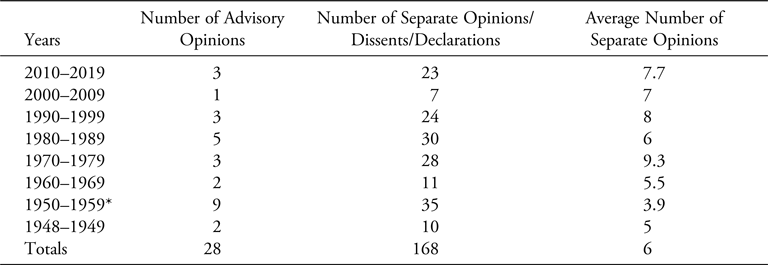
The differences in party structure, and long-standing debates over the differences, if any, in judicial function that exist between issuing judgments in contentious cases and issuing advisory opinions, suggest that it may be instructive to investigate whether the Court's dissent practices differ in these two contexts. Hence, we consider these two sets of cases in turn, starting with advisory opinions. It is notable that while several of the PCIJ's advisory opinions were unanimous and not accompanied by any separate opinions, each of the ICJ's twenty-eight advisory opinions has been accompanied by one or more separate opinions. The number of separate opinions has ranged from as few as two separate opinions to a high of fourteen declarations, separate opinions and dissenting opinions in Legality of the Threat of Nuclear Weapons. Overall, ICJ advisory opinions to date have been accompanied by an average of 6.0 separate opinions (see Table 1).
Separate Opinions in ICJ Advisory Proceedings

* Peace Treaties case had two phases, and two advisory opinions; each is treated as a separate advisory opinion.
Source: Data compiled from ICJ website.
ICJ judgments in contentious cases are virtually always accompanied by separate opinions, even when the judges are unanimous as to the result. The only exception, to date, occurred in Maritime Delimitation in the Black Sea, a unanimous judgment where no judge—including the two judges ad hoc—wrote separately. Previously, even unanimous merits judgments had been accompanied by one or more minority opinions.
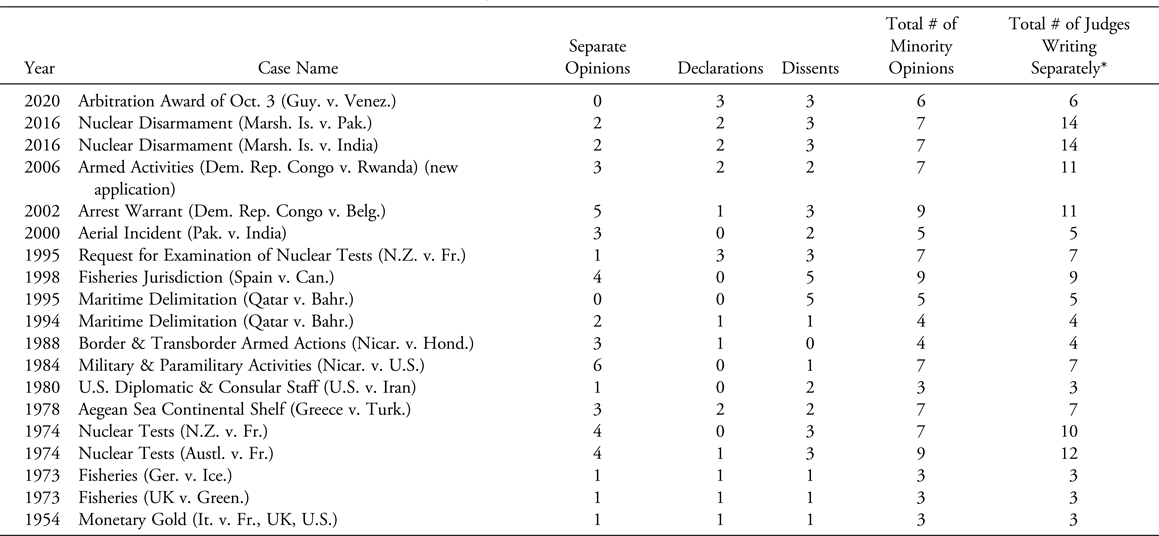
Much the same pattern holds in incidental proceedings. For example, one or more individual opinions accompany each of the ICJ's nineteen judgments addressing questions of jurisdiction and admissibility. In the aggregate, these decisions were accompanied by forty-six separate opinions, twenty-one declarations, forty-four dissents, for an average of 5.89 separate opinions, as set out more fully in Table 2.
ICJ Decisions on Questions of Jurisdiction and/or Admissibility

* Some opinions are joined by other judges
Source: Data derived from material available on ICJ website.
The Court's deliberation and opinion-writing procedures facilitate the publication of separate opinions.Footnote 67 Following the close of oral hearings, the president circulates a written list of the issues that she thinks the judgment should address, and each judge then prepares a written “note” outlining her tentative views regarding how the case should be resolved. These notes, which are anonymized and distributed to all judges, help judges identify lines of argument to pursue in deliberations. More importantly, the process of drafting a detailed note helps each judge crystallize their positions on the issues raised by the case, and the notes often serve as the basis for separate opinions.
After reviewing one another's notes, the judges meet to deliberate. At the conclusion of this meeting, a three-person drafting committee is formed to prepare and circulate a draft judgment. Following input from other judges, the committee circulates a revised draft judgment. This text receives a “first reading,” or a paragraph-by-paragraph review at a meeting attended by all judges. After the first reading, judges who wish to write separately are identified. An amended draft is then circulated, and following a second reading, the draft judgment is adopted (with or without amendments).
We note that this labor-intensive process is not required by the Court's Statute, but rather reflects a set of practices developed and refined over time by the judges themselves. Moreover, this process ensures that “the judgment or opinion of the Court is always the result of the work of all its members.”Footnote 68 Thus, ICJ opinion-writing practices result in dissenting judges working with their colleagues to improve and clarify the Court's judgment. Third, separate opinions are also circulated and discussed in deliberations, often prompting changes in both the majority and separate opinions. As a result, “the whole Court is much involved in the separate, even in dissenting, opinions, just as the judges making separate opinions are all the time involved in the Court's own decision.”Footnote 69
3. The Impact of Dissent
By virtually any metric, the frequency and number of separate opinions at the PCIJ/ICJ are extremely high. Counting the number of minority opinions, however, is easier than assessing their impact. The variables we are interested in, such as judicial legitimacy and independence, are complex and may not lend themselves to direct observation, let alone precise measurement. Nevertheless, by drawing on the long record of judicial dissents, the reception of those dissents among states and other stakeholders, and above all by engaging in comparative analysis across courts, we propose to identify patterns in how the practices of dissent and non-dissent impact legitimacy, independence, and doctrine across all three courts.
a. Dissent and Legitimacy
From the earliest negotiations over the PCIJ, concerns have been raised that fractured decisions can undermine a Court's legitimacy.Footnote 70 This folk hypothesis is exceedingly difficult to test, since doing so would require not only that we measure the Court's legitimacy in the eyes of a specific audience, but also that we determine the extent to which the existence of dissents affects the legitimacy of a decision or a court among either legal elites or mass publics. Moreover, even if one could measure whether decisions accompanied by dissents are correlated with lower levels of public legitimacy, a difficult causation problem would emerge. It is entirely possible, perhaps even likely, that it is the quality or content of the majority decision that prompts both judicial dissents and challenges to legitimacy. In that case, what initially appears to be the impact of dissent on legitimacy might in fact be the effects of the majority opinion on both.
In light of these formidable methodological challenges, we pursue an alternative strategy designed to disentangle whether legitimacy concerns are triggered by the substance of the Court's judgment or by the presence of dissents accompanying the judgment. Specifically, our research design involves selecting “most-likely” cases, namely cases in which the delegitimating effects of dissenting opinions were most likely to appear in scholarly and public responses to a ruling.Footnote 71 For both the ICJ and the ECtHR, therefore, we selected judgments that were (1) highly salient to both legal and mass audiences, (2) featured vigorous dissenting opinions, and (3) triggered strong legitimacy critiques. For those who argue that the presence of dissents undermines a court's legitimacy, these would be most likely cases to observe this phenomenon.
For our ICJ case study, we highlight two highly controversial judgments, South West Africa and Marshall Islands. Both involved issues of great political import. South West Africa addressed colonialism's continuing legacy, and specifically the apartheid systems in South Africa and in the mandate territory of South West Africa. Marshall Islands involves equally weighty issues; the Court was asked “to rule on some of the most crucial issues confronting the global community: nuclear weapons, war and peace, and perhaps ‘the fate of the earth.’”Footnote 72 In each case, the Court was evenly divided, and each was decided by the president's casting vote. South West Africa featured ten separate opinions; in Marshall Islands, fourteen judges wrote separately. Finally, each decision triggered robust legitimacy critiques. Our assumption is that if critics were ever to use the existence of numerous powerful dissents to delegitimize a judgment, or the Court, it would be in highly visible, politically significant, and vigorously disputed cases like these. Conversely, if the presence of dissent is not an element in legitimacy critiques of contentious cases like these, its presence is unlikely to trigger legitimacy concerns in cases with lower profiles.
We begin with South West Africa, perhaps the Court's most bitterly criticized judgment. In 1960, Ethiopia and Liberia filed suit claiming that South Africa's introduction of apartheid in South West Africa violated its authority as a mandatory power. In a 1962 judgment, the Court upheld jurisdiction by an eight to seven vote, a conclusion that seemingly entailed a finding that the applicants had standing to challenge South Africa's actions.Footnote 73 Yet in its 1966 judgment, the Court dismissed the action on the grounds that complainants lacked a legal interest in the subject matter of their claims.Footnote 74 In this decision, the judges were equally divided (7–7), and the judgment was decided by the president's casting vote. This second judgment, widely interpreted as an effort to protect a racist regime, was a “political disaster for the Court,”Footnote 75 and triggered a “crisis of confidence” in the Court's legitimacy.Footnote 76
Significantly, while many critiques of this judgment note the Court's vanishingly thin “majority,” they do not claim that the judgment's legitimacy was undermined by the existence of multiple separate opinions. Influential contemporaneous critiques offered by Rosalyn Higgins, W. Michael Reisman, and Richard Falk, are representative in this regard.
Higgins notes that the complainants were not given notice that the question of standing was in issue; that the Court effectively reversed its 1962 judgment, while claiming not to do so; and that the Court's analysis lacked textual or precedential support.Footnote 77 At the same time, she emphasizes that it is “not ‘justifiable or proper to disparage opinions or judgments of the Court by stressing the size of the majority.’”Footnote 78 In brief, Higgins focuses on the Court's legal analysis, and explicitly rejects criticizing the Court on the ground that the judges were divided or that the judgment was accompanied by a large number of dissents.
Reisman argues that the composition of the Court violated provisions of the ICJ Statute requiring that the judges represent “the main forms of civilization and . . . the principal legal systems of the world.”Footnote 79 Noting that Judge Badawi (Egypt) died pendent lite and his replacement did not participate, and that Judge Kahn (Pakistan) was disqualified, he argues that “two main forms of civilization were not represented in the decision,” even though the General Assembly had specifically elected judges from the Middle Eastern Arab-Islamic group and from the Indian subcontinent.Footnote 80 Significantly, Reisman never suggests that the presence of multiple dissents is relevant to the judgment's legitimacy or correctness. Indeed, despite offering a comprehensive attack on the legitimacy of the judgment, the terms “dissent” and “separate opinions” do not even appear in his article.
Falk likewise does not argue that the presence of separate opinions undermines the Court's authority.Footnote 81 Rather he claims that the majority and minority opinions reflect “conservative” and “progressive” views of the role of international adjudication. Falk argues that the Court risks undermining its legitimacy not when it issues split decisions, but when it purports to resolve questions where answers are “n[ot] provided by clearly relevant preexisting legal criteria” and where “a sufficient consensus on the underlying values at stake” does not exist. In such cases, Falk claims, the decision “will be received as nonauthoritative or arbitrary by an important segment of the legal community and . . . this reception will diminish the prestige of the Court . . . .”Footnote 82
It is notable that leading critiques of “the most controversial judgment in [the Court's] history,”Footnote 83 which was accompanied by seven dissents, two separate opinions, and one declaration, do not emphasize the fact of dissent. We read the reaction to the judgment as suggesting that questions over whether a judgment conforms to preexisting rules, the rules are applied consistently, and the outcome advances the Court's mission and its stakeholders’ needs are substantially more likely to trigger legitimacy critiques than the presence of dissents.
Examination of other sharply divided judgments lead to similar conclusions. Consider, for example, the Marshall Islands’ actions against the United Kingdom, India, and Pakistan, alleging that these states had violated obligations relating to nuclear disarmament. In each case, a closely divided Court dismissed the claims for lack of jurisdiction. These judgments have triggered sharp critique; Galindo's observation that the judgments highlight “a gap between legality and legitimacy,” captures an important strand of criticism.Footnote 84 Many observers focus on the Court's finding that it lacked jurisdiction due to the absence of a dispute between the parties,Footnote 85 or the political implications of the Court's inability (or unwillingness) to address nuclear disarmament issues.Footnote 86 Yet once again the bill of particulars against these judgments does not emphasize the presence of multiple separate opinions.
To find significance in arguments not offered may seem curious. But doing so is simply an application of the familiar insight that what is unsaid is often as important as what it is said. This truism is widely applicable in international legal settings. Numerous international court judgments,Footnote 87 treaties,Footnote 88 and other texts confirm that international legal actors have long imbued silence with legal significance.Footnote 89
Much the same is true in international legal scholarship; silence in a series of academic papers on the same topic points toward arguments that authors are unwilling to advance, or believe that their audience will not find persuasive. Within a context of long-standing debates over dissent and legitimacy we find the absence of claims that dissents undermine legitimacy in detailed critiques of controversial decisions featuring vigorous dissents to be notable.
Moreover, our review of dissent at the ICJ gives rise to a hypothesis not previously advanced in the literature on dissent at international courts. Specifically, to the extent that dissent impacts legitimacy, the crucial factor may be not the presence of dissent but rather the pattern of dissent—namely, which judges are dissenting and from which states they hail. Thus, Higgins uses the patterns of judicial voting and writing in South West Africa to bolster claims of legitimacy and independence:
The Court has always shown itself to be an independently-minded body . . . and the votes in this South-West Africa Case—with the Russian and United States Judges dissenting, and the Polish and British Judges voting with the majority—illustrate this principle. Infinitely more relevant are individual, intellectual differences of outlook concerning the scope and nature of international law . . . .Footnote 90
Conversely, in Marshall Islands, critics emphasize that each of the judges from nuclear powers (China, France, India, Russia, the United Kingdom, and the United States) voted to dismiss these cases.Footnote 91 In both cases, critics highlighted the pattern of voting, which in one case suggested a troubling influence of geopolitics on judicial decision making, as opposed to claiming that a fractured decision, with separate opinions, by itself undermines a judgment's legitimacy.
It is not possible directly to test this hypothesis, as we cannot compare empirically the impact on legitimacy of two judgments on identical issues released simultaneously by the Court, one decided unanimously and one with multiple dissents.Footnote 92 In circumstances like these, “counterfactuals” which posit alternative worlds that are identical to the real world in all but one relevant aspect, can help assess the validity of causal claims.Footnote 93
Let us consider the likely reactions if the judgments analyzed above had been rendered with no dissents, or with different patterns of dissent. Would critics have reacted differently to the outcome in South West Africa if the Court had issued a unitary judgment endorsed by all the ICJ judges? The answer to this question seems self-evident. Those who expressed dismay at the result surely would not have adopted a different perspective had the judgment been issued without dissent. Put differently, the substance of the ruling would almost certainly have guaranteed substantial controversy and critique, even if issued on behalf of a unanimous court.
In addition to comparing high-dissent and no-dissent judgments, we could imagine another type of counterfactual, involving the difference between a dissent pattern that has strong geopolitical overtones and one that does not. By way of example, how might reaction to the Marshall Islands judgment differ if, counterfactually, roughly half the judges from nuclear weapon states voted for the case to proceed, and roughly half voted for the case to be dismissed? It is reasonable to assume that those who hoped the case would serve as a vehicle to induce nuclear weapon states to fulfill their obligations for nuclear disarmament would be no less disappointed. At the same time, a judgment with a different pattern of dissent would likely not prompt a reaction identical to that triggered by the actual judgment. In particular, a decision that included a split among judges from nuclear weapon states would deprive critics of a powerful rhetorical argument seeking to delegitimate this judgment.
These counterfactuals do not, themselves, constitute evidence in support of our conjecture regarding patterns of dissent. Rather, they provide an additional method for assessing this claim. Thus, these counterfactuals should be seen—like dissents themselves—as roads not taken, alternative and plausible paths that help illuminate the implications of the real world course that the court pursued.
In sum, we see little evidence to support the claim that the presence of dissent undermines the legitimacy of ICJ judgments; we do, however, find evidence that patterns of dissent may call a court's legitimacy into question, an issue to which we return in Part III.
b. Dissent and Independence
The relationship between judicial independence and dissent was vigorously debated during the PCIJ era, and in the run-up to the ICJ. Judicial independence at the ICJ remains a salient topic, although current debates are rarely framed in terms of dissent. Some contemporary analyses of judicial independence rest upon statistical analysis of judicial voting patterns,Footnote 94 while others emphasize one of the Court's design features: namely that ICJ judges are elected for renewable nine-year terms. Specifically, to be appointed, or reappointed, an individual must secure majority support from both the UN Security Council and the General Assembly. The concern is that the need to stand for reappointment can, particularly near the end of a judge's term, put pressure on judicial independence. As Sir Gerald Fitzmaurice, who served on both the ICJ and ECtHR, noted:
frequent elections afford occasions on which various political and psychological pressures can be brought to bear on the Court and its members . . . . These are very far from being merely theoretical or hypothetical possibilities. They have caused uneasiness for many years—an uneasiness which time and intimate experience has only served to confirm.Footnote 95
Yet while the contemporary literature on judicial independence at the ICJ does not foreground the issue of dissent, we think that dissent—or, more broadly, transparency with respect to voting and opinion writing—is implicitly part of the analysis. The logic that states might retaliate against a judge for her votes or opinions at reelection time presupposes that states know a judge's positions on relevant issues and adjust their votes accordingly. Conversely, courts that issue per curiam opinions without dissents limit a state's ability to know any judge's position on any particular issue, and therefore a state's ability to retaliate at election time.
Testing these claims empirically is difficult. Reliable evidence that states retaliate against ICJ judges for their votes or opinions at reelection time is not easily obtained. States rarely provide public justifications for their votes for ICJ candidates, and ICJ elections frequently involve some level of “vote trading.” One memorable description of an ICJ election reports that “[e]xtensive wheeling and dealing took place, lobbying by and for candidates, promises to support candidates that were, and occasionally were not, kept, and links were made between these and other elections for international bodies.”Footnote 96
Likewise, there is little direct evidence that judges modify their behavior to retain support from voting states. Indeed, judges may not reveal—or even be aware of—all of the motivations behind a vote or opinion. Nor can we readily discern when a judge would have acted differently in a case, but for the prospect of an upcoming judicial election.
Perhaps for these reasons, the literature on the Court and our interviews with current and former ICJ judges reveal little evidence of states retaliating against judges at election time. One oft-cited example involves the aftermath of the South West Africa cases. Sir Percy Spender (Australia), the president judge who cast the tie-breaking vote, was thereafter severely criticized by delegates in the General Assembly.Footnote 97 Perhaps sensing his unpopularity, Sir Percy did not stand for reelection. Moreover, the Australian who was nominated, Sir Kenneth Bailey, was not elected; some argue that in the aftermath of Spender's tie-breaking vote, Bailey's “nationality automatically precluded any hope of a successful campaign.”Footnote 98
Other evidence on this point is indirect at best. Some suggest that Judge Weeramantry's “powerful Separate and Dissenting Opinions against many states which were at that time members of the Security Council” played “a decisive role in his unsuccessful bid for re-election.”Footnote 99 A groundbreaking work on judicial elections quotes one former judge as noticing on a number of occasions “colleagues thinking about how something would be received by the General Assembly,”Footnote 100 yet does not claim that judges write, or refrain from writing, separately with an eye to reappointment.
In short, the available evidence does not provide robust evidence of a pattern of states retaliating against judges due to their votes or opinions. Given that the motivations behind state votes are rarely clear, one should not assume that the lack of evidence is proof that retaliation does not occur. Rather, we think the record is consistent with three divergent interpretations.
First, the empirical record is consistent with claims that the threats of retaliation are real and effective. Judges are politically savvy and aware of this dynamic, and strategically craft opinions in ways that do not prompt retaliation when they stand for reelection. And, if judges sense that retaliation is likely, they do not stand for reelection.
An alternative reading would note that that any threat to judicial independence is premised on judges’ desire to be reappointed to their seats, and question whether this desire is widespread. A judicial term on the ICJ lasts nine years and the average term on the ICJ is ten years,Footnote 101 reflecting the fact that many ICJ judges do not stand for reelection. This may be because many ICJ judges join the bench near the end of their careers; that after a nine-year term some judges may wish to pursue other professional opportunities; or that certain seats are understood to “rotate” among states from a particular geographic region, rendering reappointment a remote possibility. Under this reading, the concern that writing separately might jeopardize reelection, and therefore threaten judicial independence, is exaggerated.
A third reading is that the ability to write separately increases judicial independence. Hoffman and Laubner opine that the ability to write separately is “an essential safeguard for judicial independence and impartiality.”Footnote 102 Kolb elaborates the point, stating that, with a right to dissent, “judges know they can always give free expression to the reasons that incline them in certain directions. . . . And, in formulating that dissenting opinion, they can ensure that their reasoning is cogent and coherent, and in the process, resist any surreptitious tendency of political considerations to intrude upon it.”Footnote 103
The available evidence does not allow us to adjudicate confidently among these alternatives. That said, we find the third reading less than fully persuasive, as we are skeptical that those who vote in ICJ elections would value legally persuasive dissents more than votes in favor of positions they support. In any event, the combination of very high dissent rates and renewable terms cause judges, member states, and scholarly observers to worry far more about threats to judicial independence at the ICJ than at the other courts we examine.
c. Dissent and Doctrine
How do dissents impact the development of legal doctrine? Despite initial concerns that fractured opinions would cause doctrinal disarray, virtually all close observers concur that separate opinions have substantially contributed to the Court's jurisprudence by sharpening majority opinions, clarifying judgments, and influencing future doctrine.
First, it is widely recognized that separate opinions—and even the possibility of separate opinions—improve the quality of the Court's judgment. In passages similar to those that Justice Scalia later wrote on the role of dissent that the Supreme Court, ICJ Judge Jennings reports that it is common for an ICJ drafting committee to amend a draft judgment “so as to deal specifically with arguments and comments made in [draft] separate opinions.”Footnote 104 He further states that “[i]f the drafting committee and/or the Court considers the attack [in a draft dissent] to be so cogent as seriously to weaken or even destroy that part of the draft judgment, [the drafting committee can] amend that part of the draft, or maybe . . . dispense with it altogether.”Footnote 105 As a result, Jennings notes, that “some of the most cogent and effective passages in separate opinions or dissents may never see the light of day, because they have, at an earlier stage, fully accomplished their work in modifying the judgment itself.”Footnote 106
In addition to improving judgments, there is wide recognition that separate opinions help clarify and elaborate the meaning of judgments. In an advisory opinion, the Court wrote that, “In order to interpret or elucidate a judgement [sic] it is both permissible and advisable to take into account any dissenting or other opinions appended to the judgment.”Footnote 107 Elsewhere, the Court has insisted that “individual opinions are or may be essential to the full understanding of the Court's decision.”Footnote 108 Close observers affirm that “the dissenting and individual opinions are always useful to appreciate the exact scope and meaning of the Judgment or Advisory Opinion to which they are attached.”Footnote 109
Dissent's defenders, therefore, appropriately emphasize dissents’ contributions to legal doctrine. At the same time, some overstate their case. In particular, dissents do not often persuade a future court to reverse course. ICJ judges have issued well over one thousand separate opinions, the overwhelming majority of which have never been cited in a future case, let alone persuade a majority of judges to shift the Court's doctrine. To be sure, a relatively small number of separate opinions are widely understood to have substantially contributed to the Court's development of legal doctrine, often on procedural matters. For example, Judge Anzilotti's analysis of the “res judicata” doctrine in his Chorzów Factory dissentFootnote 110 has been cited several times, and is viewed as “the classic enunciation of the law” on this point.Footnote 111 More frequently, separate opinions set out rationales that may not be adopted by the court, but are nonetheless highly influential. For example, the Arrest Warrant case raised difficult questions regarding the permissibility of universal jurisdiction. Although resolution of the case did not require addressing this issue, ten judges did so in separate or dissenting opinions that are widely acknowledged as having “made a significant contribution to elucidating existing law.”Footnote 112 Likewise, Judge Weeramantry's separate opinion in the Jan Mayan case is “an absolute ‘must’ for all those who wish to inform themselves on the role of equity in international law.”Footnote 113 Finally, Judge Lauterpacht's dissenting opinions addressing “Connally clause” reservations are considered “among the most outstanding judicial utterances ever to have issued from the International Court.”Footnote 114 Noting that the reasoning of a dissent was adopted in a later judgment, however, is not equivalent to demonstrating that the dissent caused the subsequent change in law. It is entirely possible that the later court would have pursued a particular doctrinal path even in the absence of an earlier dissent; thus citation to a dissent may indicate reliance, or may reflect other motivations.Footnote 115
On balance, while dissents are only rarely adopted by future majorities, they nonetheless play an important role in the development of legal doctrine. Our review of the use of minority opinions at the PCIJ and the ICJ seems to confirm Judge de Castro's observation that separate opinions “are evidence of the life and of the evolution of legal doctrine.”Footnote 116
B. The European Court of Human Rights
The European Court of Human Rights was established by the European Convention of Human Rights (ECHR) in 1950, began operations in 1959, and today is a standing court with the largest caseload of any international court. The Court enjoys compulsory jurisdiction over claims that member states have violated the ECHR and a right of individual petition from private parties. The Strasbourg court is considered a powerful and frequently activist body, whose judges interpret the Convention as a “living instrument” and have expanded the reach of the ECHR's core rights beyond those intended by the founders. ECtHR judges have, from the earliest days of the Court, frequently issued separate opinions.Footnote 117
1. Negotiations, Statutes, and Rules of Court
Both the Convention and the Court were products of post-war Europe, following upon the 1948 UN Declaration on Human Rights as well as the establishment of a European Movement advocating the creation, in 1949, of the Council of Europe. In this context, European Movement members circulated a draft Convention and a draft statute for a court of human rights, which became the basis for negotiations.Footnote 118 The negotiations were contentious, particularly regarding proposals for compulsory jurisdiction over member states and a right for individuals to file claims against their own governments, leading a number of member states to oppose the creation of any court at all.Footnote 119 In the end, both compulsory jurisdiction and individual petition were made optional in the Convention, and it would take decades before all member states would accept both.
The Council of Europe member states conceived the ECtHR as a traditional international court, and the Court's Statute was “modelled, with the minimum of adaptation, on the International Court of Justice.”Footnote 120 Specifically, the provision on separate opinions was drawn verbatim from Article 57 of the ICJ Statute and provides that, “If the judgment does not represent in whole or in part the unanimous opinion of the judges, any judge shall be entitled to deliver a separate opinion.”Footnote 121 The Convention's travaux préparatoires suggest that this provision was uncontroversial, as it passed unchanged and without comment from the European Movement's Draft Convention into the final draft of the Convention as Article 51(2).Footnote 122
The first ECtHR judges adopted a similar approach in drawing up their internal Rules of Court in 1959, providing that, “Any judge who has taken part in the consideration of the case shall be entitled to annex to the judgment either a separate opinion, concurring or dissenting with that judgment, or a bare statement of dissent.”Footnote 123 Here again, the rules are permissive, allowing but not requiring separate opinions. Hence, to understand dissent practices at the ECtHR, we need to look beyond the Convention and Rules of Court to the informal norms that govern the Court's operations.
2. Judicial Practice
The Strasbourg court got off to a famously slow start: nominally created in 1950, it did not take up its duties until 1959, when the majority of the Council of Europe's member states had accepted neither the compulsory jurisdiction of the Court nor the right of individual petition for their citizens.Footnote 124 By the later 1960s, the Court had received only a handful of cases, and was only beginning to issue its first judgments. From its earliest decisions, however, ECtHR judges followed the PCIJ/ICJ practice of issuing numerous, and sometimes vigorous, dissenting and concurring opinions. Its pioneering Belgian Linguistics judgment of 1968, for example, was decided by a narrowly divided 9–8 court, and featured a joint dissent from five judges and two partially dissenting opinions, all criticizing the majority's expansive interpretation of the Convention.Footnote 125
Later, the Court's landmark decisions issued during the second half of the 1970s, adopting a broad, teleological, and evolutive interpretation of the Convention as a “living instrument,” were all accompanied by at least one dissenting opinion, many issued by Sir Gerald Fitzmaurice, who famously argued for a more deferential interpretation of the treaty which explicitly took into account the intentions of the member governments.Footnote 126 Fitzmaurice, widely seen as the Court's first “great dissenter,” took part in only eleven decisions during his six years as a judge, reflecting the Court's modest caseload at the time, yet he issued vivid and often stinging dissents against the Court's bold interpretations in most of those cases.
Nor was Fitzgerald alone in dissenting from these landmark decisions; in the 1980 Guzzardi ruling, nine of the eighteen judges on the Court authored a total of eight dissenting or partly dissenting opinions.Footnote 127 None of these dissenting opinions served to deter the majorities of judges who, in case after case, reasserted broad, teleological readings of the Convention. They did, however, establish a practice of frequent and vigorous dissent.
These historical practices of dissent find confirmation in both aggregate statistics collected by scholars, and in our interviews with present and former ECtHR judges.Footnote 128 Arold reports that between 1959 and April 2001, the Court issued just over two thousand judgments, of which 602 were accompanied by one or more separate opinions.Footnote 129 Other studies have found similar results, albeit with significant differences among formations. Between 1960 and 1997, for example, some 42 percent of chamber judgments and 78 percent of Grand Chamber judgments were accompanied by one or more separate opinions, most likely reflecting the larger number of judges (seventeen as opposed to seven) and the more controversial cases heard by the Grand Chamber.Footnote 130
Our interviews with ECtHR judges revealed a generally permissive attitude toward dissent, and even a view that writing separately was expected and beneficial to the Court and the development of law.Footnote 131 Indeed, all of the judges we interviewed indicated that they issued separate opinions whenever they disagreed with the majority and that no stigma attaches to issuing separate opinions, although such opinions should be brief and respectful of both the Court and the majority.
3. The Impact of Dissent
We have seen that the ECtHR's judges have, from the earliest decisions of the Court to the present day, taken to the practice of dissent “like ducks to water.”Footnote 132 Unsurprisingly, judges on the court have defended their dissent practices. In the words of long-time President of the Court, Luzius Wildhaber,
Over time, the existence of separate opinions becomes the trademark of a court. In our Court, we are inclined to think that separate opinions contribute to the transparence of judicial law-making; that they express the reality that balancing different public and private interests will not automatically lead to identical results in pluralistic democracies; and that it will do no harm to the credibility and authority of the Court if such differences are brought into the open and are argued and explained as rationally as possible.Footnote 133
This strong belief in the beneficial effects of dissent stands in strong contrast to the deep concerns of ECJ judges examined below; to what extent does the empirical record of the ECtHR bear out this optimism?
a. Dissent and Legitimacy
As we have seen, many prominent judges and scholars argue that unified judgments enhance judicial legitimacy. Strasbourg judges tend to disagree. Many of the judges we interviewed argued that separate opinions can increase the Court's legitimacy, for example by making clear to losing parties that their concerns were fully considered, Footnote 134 or more generally by increasing the transparency of the Court.Footnote 135 Separate opinions also allow judges to detail the reasons for their vote, thus preemptively addressing potential accusations of biased or politicized voting.Footnote 136 Others qualified these claims, however, noting that dissenting opinions should remain respectful toward the Court, and that closely divided judgments of, say, 9–8 could potentially call into question the legitimacy of the majority judgment.Footnote 137
Whether issuing separate opinions actually decreases (or increases) the legitimacy of the Court and its rulings is an empirical question, which we cannot resolve definitively; nevertheless, we can, as in our ICJ case study, examine the reception of particularly controversial judgments, to determine whether observers call attention to the fact of a divided Court, and/or the arguments of the separate opinions, to undermine the legitimacy of the judgment or the Court. To do so, we have selected two cases that involve divided Grand Chamber rulings on highly salient and socially divisive issues. First, in Hirst v. United Kingdom (No. 2), a Grand Chamber majority ruled that a UK law disenfranchising the vast majority of UK prisoners violated the Convention, while a dissenting minority argued that the legislation fell within the UK's margin of appreciation. Second, in S.A.S. v. France, a Grand Chamber majority held that France's ban on the full-face veil in public spaces did not violate the Convention, while a dissenting minority argued vigorously that it did so.
Hirst and S.A.S. are “most likely” cases for the use of dissent to delegitimize the Court, since both involve controversial issues that are highly salient in legal circles, among political leaders, and in public opinion. Yet the two cases also differ in important respects: in Hirst, the majority found a violation, ruling in favor of an unpopular minority (prisoners), and producing outrage particularly on the political right. The S.A.S. majority found no violation, ruling against a different minority (Muslim women wearing the burqa), and producing outrage among portions of the left. In doctrinal terms, the Hirst majority ruled that the challenged law fell outside the state's margin of appreciation, while the S.A.S. majority held that the challenged law fell within that margin.
Because of their high salience among political leaders and public opinion, we can examine reactions to these decisions among two distinct audiences. First, as in the ICJ cases examined above, we review relevant legal scholarship, to assess whether and how legal elites invoked dissenting opinions. Second, we turn to the popular press, collecting a sample of relevant news articles published shortly after each ruling, and assessing whether and how those articles (and the public figures on whom they report) invoked (or ignored) separate opinions in their commentary for a mass audience.
In Hirst, perhaps the most controversial Strasbourg ruling in UK history, a twelve-judge majority of the Grand Chamber held that the UK's Representation of the People Act 1983 violated the Convention by disenfranchising the vast majority of UK prisoners.Footnote 138 While the Court acknowledged that the law pursued a legitimate aim, the majority held that the across-the-board nature of the ban was disproportionate, and that the margin of appreciation in this case, while wide, “is not all-embracing.”Footnote 139 The majority therefore found a violation of the Convention.
This judgment was, however, accompanied by four separate opinions. A joint dissenting opinion joined by five judges highlighted the diversity of practice among member states in respect of prisoner voting rights, and concluded that “the legislation in the United Kingdom cannot be claimed to be in disharmony with a common European standard.”Footnote 140 The dissenting judges noted that “the Court is not a legislator” and concluded, “we are not able to accept that it is for the Court to impose on national legal systems an obligation either to abolish disenfranchisement for prisoners or to allow it only to a very limited extent.”Footnote 141
Turning to the legal commentary, we find that although scholars made varied uses of the different separate opinions, few suggested that either the content or mere fact of dissent undermined the legitimacy of the Court or its judgment. First, several scholars, although critical of the judgment, make no or only passing reference to the separate opinions in Hirst.Footnote 142 More frequently, scholars critical of the judgment incorporate or adopt arguments found in one or more of the separate opinions into their own critique. For example, Bates, a leading scholar of the Court, uses arguments from the joint dissent to suggest that the majority did not afford Britain an appropriate margin of appreciation,Footnote 143 and Lewis endorses arguments in the dissent and concurrences regarding how the Court should account for the adequacy of legislative debate when evaluating legislation.Footnote 144 Yet neither challenges the legitimacy of the Court or the judgment. Dzehtsiarou, in contrast, identifies the fact that “five judges voted against the decision” as one of several factors that render Hirst a “major challenge to the Court's legitimacy.”Footnote 145 Yet even this paper emphasizes that the Court's “case law in prisoner voting is increasing its legitimacy as more and more States remove automatic disenfranchisement from their laws.”Footnote 146 Our review of the scholarship suggests that although the treatment of separate opinions varied considerably across the literature, there is little evidence that the fact or the content of such opinions is widely understood as undermining the legitimacy of the Court or its judgment.
Turning to the popular press, we identified and coded newspaper and newswire articles and editorials to examine how they reported on the dissenting opinions in Hirst.Footnote 147 The findings were surprising. Only twelve of twenty-eight articles reported that the Court was divided 12–5 in its judgment, while the other sixteen referred only to the ruling of the court. Similarly, only one article (in The Guardian) referred explicitly to a separate opinion, offering a brief summary; the other twenty-seven articles failed to mention any separate opinions at all. None of the articles, finally, used the fact of a less-than-unanimous ruling, or the arguments of the dissenters, as a means to attack either the legitimacy of the judgment or the Court—this despite the fact that many news articles, and nearly all the op-eds, strongly criticized the decision, referring to it as “ludicrous”Footnote 148 and to the judges as “ill-informed fools.”Footnote 149 Although our article sample here is relatively small, it suggests that it may be rare for politicians, editorialists, and reporters to invoke dissenting opinions, and even rarer for them to do so for the purpose of challenging the legitimacy of an international court.
We also examined scholarly and press responses to S.A.S., which involved the claims of an anonymous Muslim woman who argued that a French law prohibiting the covering of the face (including by the full-face veil) in public places violated the Convention. By a 15–2 vote, the Grand Chamber found that the law had limited petitioner's rights under Articles 8 (right to a private life) and 9 (freedom of religion), but that such limitations were permissible under ECHR provisions authorizing limitations on certain rights for the “protection of the rights and freedoms of others.”Footnote 150 Controversially, the majority accepted the French government's arguments that “the full-face veil represented a denial of fraternity . . . and a flagrant infringement of the French principle of living together (le ‘vivre ensemble’).”Footnote 151 The judgment was accompanied by a partially dissenting opinion that sharply disputed the fundamental reasoning as well as the outcome of the majority decision, which it accused of “sacrificing . . . individual rights to abstract principles.”Footnote 152
Turning to the legal commentary, we find that while scholars made varied uses of the dissent, few suggested that the content or fact of dissent undermined the legitimacy of the Court or its judgment. First, several critics make no or only passing reference to the S.A.S. dissent. For example, Janis critiques the Court's approach to minority religions without mentioning the dissent,Footnote 153 while Brems and Akram offer strong critiques of the Court's reasoning, yet each mentions the dissent only in passing.Footnote 154 Many scholars criticize the Court's conception of “living together” without relying on the dissent;Footnote 155 others cite arguments found in the dissent to buttress their own critique of the judgment including those who argue that the concept of “living together” is “largely unheard of in human rights language.”Footnote 156 Still other critics note that the Court purports to advance pluralism and tolerance, yet rely on the dissent to note that the judgment reflects “selective pluralism and restricted tolerance.”Footnote 157 Yet these scholars notably do not take the additional step of invoking the fact or content of the dissent to question the legitimacy of the Court or its judgment. Some scholars critique both the judgment and the dissent. For example, Trisplotis rejects the dissent's textual argument that the Convention does not mention “living together” as a grounds for limiting rights because “pluralism, tolerance and broadmindedness—three values invoked by the dissent—are also not mentioned as rationales for limiting rights,Footnote 158 and Millet criticizes the dissenters for failing to understand the sociological roots of the “living together” principle.Footnote 159 Surveying the literature, we find the S.A.S. dissent invoked in multiple ways, including in the service of a critique of that judgment. Once again, however, we find no evidence that even the most critical commentary uses the fact or content of the dissent to attack the legitimacy of the judgment or the Court.
Turning to the popular press, we again created and analyzed a sample of popular press coverage of the Grand Chamber decision. Using a similar search and coding system as for Hirst,Footnote 160 we identified thirty-nine relevant articles over two hundred words, of which twenty-eight were newspaper or wire-service stories (many of which featured expressions of support or criticism from public figures), six critical editorials, and five supportive editorials, with articles coming from all over the world (France, the UK, the United States, Australia, India, Pakistan, and elsewhere). Of these thirty-nine articles, only ten mention that the decision was not unanimous (referring to the “majority ruling” or listing the 15–2 vote tally); only six mention that there was a dissenting opinion; and only two (a Human Rights Watch press statementFootnote 161 and a critical Australian editorialFootnote 162) quote the dissent and use it to criticize the majority judgment. Thus, as in Hirst, we find no shortage of news stories reporting critical comments from public figures, or of critical editorials, but the vast majority of these accounts focus their critique on the outcome, and to a lesser extent on the majority's reasoning, while failing to reference, or only briefly mentioning, the fact of a divided vote or the existence of a dissenting opinion.
We should be careful not to make bold claims based on reactions to these two cases. Nevertheless, it is striking that, in both of these “most likely” cases, we find only rare invocations of dissent in public responses to these rulings, suggesting that the use of dissent to delegitimize international courts may be rarer than the critics may believe. Finally, once again employing counterfactual analysis, it seems likely that both the Hirst and S.A.S. judgments would have been similarly controversial even in the absence of dissent. Hirst, which handed a high-profile victory to a convicted axe murderer and potentially required the enfranchisement of thousands of convicted felons, was virtually certain to have elicited a strong backlash from British society, even had it been issued by a unanimous court. And S.A.S., by upholding a French law outlawing the wearing of the full-face veil, was overwhelmingly likely to produce a similarly strong response from minority-rights advocates, regardless of the number or content of dissenting opinions accompanying that ruling.
b. Dissent and Independence
Perhaps the most challenging question for judges is whether and how dissent practices at the ECtHR might influence judicial independence vis-à-vis the national governments who have the power to nominate—and, in the case of judges with renewable terms of office, renominate—them to judicial office. For most of its history, ECtHR judges served for renewable terms, initially set at nine years in the 1950 ECHR and then shortened to six years by Protocol 11 in 1998. In this context, the transparency of the Strasbourg court left judges open to retaliation from member governments, which could refuse to renominate judges in response to unwelcome votes or opinions.
That possibility appeared to be realized, at least in the late 1990s and early 2000s, when a number of member states failed to renominate judges who had disappointed their home governments with unfavorable rulings.Footnote 163 Faced with mounting evidence of governments seemingly punishing judges for unwelcome decisions, the Court's allies grew alarmed, and in 2001 the Evaluation Group appointed by the Council of Europe to study the Court's workings proposed to change judicial terms from a renewable six-year term to a non-renewable nine-year term, justifying the change explicitly in the interest of ensuring judicial independence.Footnote 164
This proposal was eventually adopted by the ECHR member states in 2004.Footnote 165 Court observers candidly acknowledge that the shift in judicial terms was intended “to offer more guarantees for the Court's independence,”Footnote 166 and “to reinforce the independence and impartiality of the judges,” insofar as the requirement that “judges had to resubmit their candidatures to the government was perceived as awkward and undignified.”Footnote 167
The elimination of renewable terms has not removed all forms of extralegal pressure on judges, since many are young enough to face the prospect of lengthy careers after the conclusion of their nine-year terms.Footnote 168 Nevertheless, the ECtHR judges we interviewed expressed satisfaction that they would not face a “campaign” for reappointment at the end of their terms.Footnote 169
c. Dissent and Doctrine
Finally, we address the impact of frequent dissents on the clarity and development of European human rights law. It is, as we have seen, a truism in the literature that the practice of dissent results in richer and more carefully reasoned judgments, as well as the progressive development of law. The Strasbourg judges we interviewed, together with the scholarship on European human rights law, agree that separate opinions can both clarify ECtHR judgments and promote the progressive development of the law, in several ways.
First, the practice of writing separately can produce judgments that are more sharply reasoned, insofar as the judges in the majority come under pressure to address difficult arguments from the minority, rather than paper them over in a vague, consensus decision.Footnote 170
Second, if and insofar as the threat of dissent does not motivate the majority to address key legal questions in the judgment, separate opinions can clarify those questions for the attentive public. In S.A.S., for example, the majority accepted, with little explanation, the French government's argument that “under certain conditions the ‘respect for the minimum requirements of life in society’ . . . can be linked to the legitimate aim of the ‘protection of the rights and freedoms of others,’”Footnote 171 and suggested that, in the absence of a clear European consensus on this question,Footnote 172 France enjoyed a wide margin of appreciation.Footnote 173 By contrast, the dissent highlighted the majority's failure to explain its reasoning on several fundamental issues. On the central question of whether the French law pursues a legitimate aim, the dissenters argued that the concept of “living together” was “far-fetched and vague,” and that the majority had not explained how that concept related to the Convention's list of principles that justify limitations on individual rights.Footnote 174 The dissenters also criticized the majority for its unexplained conclusion that no European consensus against the banning of a full-face veil existed, in the face of evidence that forty-seven of the forty-nine states failed to do so.Footnote 175 The point is not the dissenters were necessarily correct, but that their opinion encourages the reader to probe beneath the majority's sometimes vague reasoning.
This clarification function relates to yet another function of dissent, which is to signal that a majority ruling is neither universally accepted nor necessarily the final word on an issue. Strasbourg judges are very aware of the multiple audiences for separate opinions, which vary systematically across the seven-judge chamber versus the larger seventeen-judge Grand Chamber. Several judges noted that a dissenting judge in a chamber judgment may wish to signal to the losing party that an alternative outcome is possible and that they should appeal to the Grand Chamber. A carefully argued dissent, these judges continued, also serves as a signal to the Grand Chamber, suggesting that serious division exists on an important point of law.Footnote 176 In so doing, separate opinions can promote the progressive development of law by prompting additional litigation and new Grand Chamber judgments that can clarify and (sometimes) overturn chamber judgments.
Fourth and finally, it is common to suggest that today's dissents may be written “to the intelligence of a future day,” when future majorities will adopt the positions of today's minority. However, even the most fervent defenders of dissent concede that this “prophets with honor” scenario is relatively rare. In the words of President Wildhaber, “It is often claimed that dissenting opinions are the majority opinions of the future. While this can sometimes indeed be demonstrated (for instance in the Court's case-law concerning transsexualism), it clearly remains, statistically speaking, the exception.”Footnote 177
C. The European Court of Justice
By contrast with the ICJ and the ECtHR, where separate opinions are expressly authorized and have become the norm, the European Court of Justice represents the case of the dog that did not bark: the EU's constituent treaties are silent on the question of dissent, and the judges themselves have opted to present a unified face to the world and suppress any sign of internal dissent for seven decades.Footnote 178 This final case study therefore takes a somewhat different approach, exploring the statutory origins, practice, and consequences of the ECJ's practice of issuing only unsigned per curiam judgments. First, we look back to the founding of the Court and the negotiation of its statute, to understand why European countries (all of which had recently agreed to allow the ECtHR judges to write separately) failed to mention such a possibility in the ECJ statute. Next, we examine the judicial practice of non-dissent, focusing on the informal judicial norms that place a high premium on consensual decision making. Finally, we tackle the difficult task of assessing the consequences of a non-event, namely the impact of the ECJ's lack of public dissent on the legitimacy of the Court, the independence of its judges, and the clarity and development of its legal doctrine.
1. Negotiations, Statutes, and Rules of Court
We have already seen that the ECHR's negotiators drew heavily on the ICJ Statute, including its provisions on dissent. By contrast, the six member states of the proposed European Coal and Steel Community (ECSC), meeting contemporaneously, took a very different approach to the design of the ECJ, especially with respect to the issue of separate opinions, on which the 1951 ECSC Treaty is silent.
To understand why, we need to look to the negotiation of the ECSC Treaty.Footnote 179 The May 1950 Schuman Declaration, in which French Foreign Minister Robert Schuman first proposed placing the coal and steel industries of France, Germany, and other European countries under joint supranational control, called for only a single European institution, the High Authority. Schuman's proposal, which had been prepared by French Planning Commissioner Jean Monnet, also noted that “appropriate measures will be provided for means of appeal against the decisions of the Authority,” leading in turn to the negotiation of a Court of Justice.Footnote 180
Monnet took the view that, given its primary function of hearing appeals against the decisions of the High Authority, the proper model for the court would be, not an international court, but an administrative one. Hence, in the fall of 1950, Monnet recruited Maurice Lagrange, a member of the French Conseil d’État, to draw up a draft text on the proposed court's design and jurisdiction.Footnote 181 In keeping with this conception of the Court, Lagrange prepared a set of draft articles establishing a court based on the model of a French administrative court.Footnote 182
In this context, Lagrange reported that the possibility of allowing explicitly for judicial dissent was not raised until the very end of the negotiations, by the Dutch delegation, and was rejected. It was at this point that the French proposed the novel position of advocate general (AG), modeled on the French Commissaire du Governement, who would be charged with exploring the legal issues raised in a given case and issuing a preliminary opinion to the judges. The proposal was accepted, according to Lagrange, as a compensation for the ban on dissenting opinions.Footnote 183
We have provided only a capsule summary of the design of the original ECJ. Nevertheless, the available record points to a striking difference between the contemporaneous designs of the Strasbourg and Luxembourg courts. In the former case, all of the major participants viewed the ECtHR as an international court, and drew verbatim from the ICJ Statute, including its explicit authorization of separate opinions. By contrast, the ECJ was designed as an administrative court in the French civil law tradition, which provided no possibility of public dissent. The 1957 Rome Treaties would later establish two new communities (the European Economic Community and Euratom), and would expand the jurisdiction of the Court far beyond its original function as an administrative court for the High Authority. But neither the Rome Treaties nor any of the subsequent treaty amendments would break the statutory silence on the question of dissent.
2. Judicial Practice
ECJ judges thus took office under a statute that was silent on the question of dissent, but clear on the legal requirement, in Article 29, that “the deliberations of the Court shall be and shall remain secret.” For the founding generation of judges, and many ECJ judges and scholars since then, this provision precludes any possibility of dissent. This is, for example, the view of Josef Azizi, the former president of the General Court, who wrote that “the full secrecy of deliberations also excludes to reveal the mere number of judges who have adhered to the final judgment and to specify the reasons why they partly or entirely disagree with that judgment.”Footnote 184 Similarly, several of the judges we interviewed interpret the Court's statute as precluding any possibility of dissent, suggesting that the question was “not up to us.”Footnote 185
Provisions preserving the secrecy of deliberations, however, are common to many courts, including the ICJ and the ECtHR, both of which have interpreted secret deliberations to be consistent with the publication of separate opinions. The ECJ's statutory requirement of secret deliberations, then, does not logically entail a ban on dissent. Rather, the judges have adopted a particular reading of the statute informed by the civil law practices of continental European countries at the founding of the communities, and entrenched by seven decades of subsequent practice.
From the beginning, ECJ judges have issued unitary, per curiam judgments. Given the diversity of its judges, who hail from different legal traditions and diverse professional backgrounds, this apparent unanimity has not emerged spontaneously. Instead, it reflects a deliberate, decades-long practice of consensus decision making among the judges. As Judge Azizi explains:
EU courts . . . act by majority decisions. Even where more than superficial divergences have emerged, a judge who would not have succeeded in convincing the majority of the chamber would not retire from the deliberations like in a snail shell, but would continue to take part actively in the on-going discussion on the basis of the premise of a majority opinion he or she did not agree with (“stante concluso”), and contribute, with his or her best efforts, to render the final judgment's argumentation as consistent and convincing as possible.Footnote 186
The ECJ judges we interviewed expressed similar views. One judge, for example, commented that “not having dissenting opinions has . . . certain merits because we are forced to look for consensus,” noting that his chamber had voted explicitly only once in the previous four years.Footnote 187 Another noted that the lack of dissent strongly encouraged judges to “look for intermediate solutions,” and to “integrate legal arguments from either side” in the final judgment. By contrast, judges in a system with dissent might more readily abandon the search for consensus, knowing that they could express their views in separate opinions. The result of such a system, he said, was that, “You have the purest legal reasoning on either side, and you get the winner by counting heads.” But, he concluded, “this is not Europe.”Footnote 188
3. The Impact of Dissent
In the two previous case studies, we considered the effects of dissent on the legitimacy, independence, and doctrine of the ICJ and ECtHR. For the ECJ, our methodological approach must pivot, to assess the impact of the Court's practice of issuing per curiam rulings that obscure differences among the judges in favor of a unified “arrêt de la Cour.” We once again begin with the question of legitimacy, before turning to judicial independence, and finally the clarity and development of EU law.
a. Dissent and Legitimacy
The long-standing debates over the vices and virtues of dissent often pit those who claim that open dissent enhances the legitimacy of courts, by increasing the transparency of the process, against those who posit that judges enjoy the greatest public legitimacy when they speak with one voice. Among the ECJ judges, as well as the vast majority of scholars writing on the Court, the conventional wisdom has been that the practice of speaking with a single voice has increased the legitimacy of the Court's decisions. Conversely, they suggested, separate opinions would likely reduce the ECJ's legitimacy among national governments, national courts, and public opinion. The ECJ, one judge pointed out, was open to question in a way that domestic courts are not, with a controversial decision calling into question not only the wisdom of that decision, but the legitimacy of the Court as a whole.Footnote 189 Along similar lines, several judges noted that separate opinions would also call attention to judges’ nationality, and raise the prospect that national audiences would question any ruling against which “their” national judge had dissented.Footnote 190
Several judges highlighted structural reasons why their brethren were motivated to issue unitary judgments. First, EU law is directly effective in national legal orders, but it “percolates” or filters down into those orders primarily through national courts. This process requires clear and unambiguous signals from Luxembourg.Footnote 191 Furthermore, because the ECJ is responsible for interpreting and applying detailed economic regulations throughout the Union, it needs to be far more concerned about the unity of EU law than the ECtHR, which interprets a smaller number of human rights rules and explicitly allows member states a “margin of appreciation” for their application in national legal orders.Footnote 192 These considerations increased the importance of sending a single, clear message to national judges about the proper interpretation of EU law.Footnote 193
On a related note, one judge noted that although ECJ preliminary rulings are directed in the first instance to the referring court, they have de facto precedential and erga omnes effects for courts in all twenty-seven member states. In that context, ensuring that judges reach the broadest possible consensus, rather than a narrower majority judgment, is likely to ensure that the Court's interpretation will reflect awareness of the various national legal systems, and thus find acceptance among national judges.Footnote 194
In short, ECJ judges generally see the prospect of dissenting opinions as problematic for the Court's legitimacy. These beliefs are, however, largely folk wisdom, and it is unclear whether, counterfactually, the legitimacy of the ECJ would suffer among its various audiences if it were to adopt open voting and separate opinions. In fact, scholars know relatively little about the empirical or sociological legitimacy of the Court among its multiple audiences, which include national courts, EU member governments, the “invisible college” of the European legal profession, and the general public.
For example, we find a tension in the literature about the Court's legitimacy in the eyes of national courts. Much of the literature holds that domestic judges generally accept the Court's jurisdiction and jurisprudence, and that there is therefore no “crisis of legitimacy” for the ECJ.Footnote 195 Other scholars, however, highlight historic and persistent tensions in the Court's ongoing relationship with national courts, including the early reluctance of national high courts to accept the direct effect and supremacy of EC law in the 1960s and 1970s;Footnote 196 efforts by national courts to “contain” the unwelcome effects of ECJ rulings in national legal orders;Footnote 197 the continuing reluctance of some national courts to submit preliminary references;Footnote 198 and the ongoing and sometimes contentious constitutional dialogue between the ECJ and national high courts over the limits of EU law.Footnote 199 It is difficult counterfactually to assess whether the publication of dissenting views would aggravate these inter-court tensions and endanger the ECJ's legitimacy among national courts, although it is worth noting that many domestic constitutional courts, not to mention the ECtHR, regularly issue judgments featuring dissents, without inducing confusion in or resistance from lower courts.
With respect to broader European public opinion, existing studies suggest that public support for the ECJ, while traditionally high,Footnote 200 is based on low levels of knowledge of the Court and its activities. For example, Voeten examines Eurobarometer data on public trust in the ECJ from 1993 through early 2010 and finds that trust in the ECJ correlates strongly and positively with generalized trust in the EU and in national legal systems, rather than on specific knowledge of the Court's jurisprudence.Footnote 201 These findings suggest that international courts can “borrow” legitimacy from the organizations of which they form a part—yet it also leaves them vulnerable should those broader institutions suffer a legitimacy crisis.Footnote 202 Indeed, looking at responses to the same Eurobarometer question from 2010 to 2013, Pollack found that public support for the ECJ declined substantially in the aftermath of the European sovereign debt crisis. Given the absence of major EU-wide controversies over the Court's legal rulings during this period, it seems likely that the decline in support for the Court is attributable not to the behavior of the judges, but to the broader collapse in support for the EU during these difficult years.Footnote 203
Taken together with our findings about media reporting of controversial ECtHR cases, these studies suggest that mass media coverage of international courts seldom examines the substance of judgments or of dissenting opinions, and that members of the public, possessing little information about judicial behavior or reasoning, do not base their conclusions about the legitimacy of international courts on the intramural arguments among judges. In counterfactual terms, therefore, it seems possible, if not likely, that the introduction of dissenting opinions among ECJ judges would, as in the case of the ECtHR, go largely unnoticed among the mass public, who would continue to respond to the ECJ in terms of either the substance of its judgments or their more general attitudes about the EU.
b. Dissent and Independence
ECJ judges cite a concern for judicial independence as the central justification for the Court's de facto ban on dissent. Specifically, former judges have commented on the fragility of judicial independence, the dangers of short, renewable terms, and the issuing of per curiam rulings as a potential defense against external pressures.Footnote 204
The most extensive discussion of this point comes once again from Judge Azizi, who claims “the very fact that judges may be reappointed could be seen as putting at risk their independence.”Footnote 205 In that context, he suggests, “the obligation to keep the secrecy of deliberations is simply an appropriate means to guarantee judicial independence.”Footnote 206 Similar sentiments were expressed by nearly all of the judges we interviewed. Some noted that, if dissents were allowed, judges might feel pressure to dissent on cases of importance to their home states. Avoiding such a conflict was, accordingly, a major, although not the only, reason cited by the judges for avoiding public dissent.
It is clear, both from our interviews and from the Court's public actions, that ECJ judges have considered the conditions under which they would consider moving to open voting and separate opinions. Several judges mentioned the precedent, pursued by the Council of Europe for the ECtHR, of moving from short, renewable terms to longer, non-renewable terms of nine or (preferably) twelve years. Given the security of non-renewable terms of office, they speculated, ECJ judges might reconsider their de facto ban on open dissent.Footnote 207
Echoing the views of the judges, EU legal scholars have noted the tradeoffs among the judges’ renewable terms, the possibility of separate opinions, and the principle of judicial independence. Joseph Weiler, for example, has argued for the introduction of dissenting opinions in the Court, in order to improve the clarity of the Court's legal reasoning (see below),Footnote 208 but noted that a “precondition” to any such reform would be for the member states to eliminate renewable judicial terms, which he called “a continuous affront to the integrity of the European legal system.”Footnote 209 Other scholars agree that the introduction of separate opinions while the judges are subject to reappointment at six-year intervals would imperil the independence of the ECJ judiciary.Footnote 210
c. Dissent and Doctrine
Finally, we come to consider how the ECJ's lack of separate opinions has influenced the nature and development of EU law. In the previous two cases, we encountered widespread consensus that separate opinions serve to sharpen jurisprudence and advance the development of the law. Reflecting the same logic, we find a widespread view among ECJ observers, and even among some judges, that the absence of separate opinions has produced judicial rulings that are thinly reasoned, as a result of judges papering over differences in unitary judgments. Indeed, supporters as well as critics of the Court's jurisprudence regularly characterize its decisions as “magisterial,”Footnote 211 “clipped,”Footnote 212 “cryptic,”Footnote 213 and “uneven and unpredictable.”Footnote 214
More precisely, Court decisions follow the style of the French Cour de Cassation, with a single collegial decision of the Court rendered in an impersonal voice, characterized by short, highly abstracted legal reasoning which engages selectively with the arguments of the parties and almost never with academic writings.Footnote 215 The reasons for the terseness of ECJ decisions are manifold, relating in part to the continuing influence of the French civil law tradition, but also and especially to the Court's collegial style of deliberation and drafting, in which the judges strive to craft judgments that reflect the common views of the judges while suppressing any signs of disagreement.Footnote 216
To critics, these practices result in poorly reasoned judgments, and an impoverished dialogue with national courts. Former ECJ Judge David Edward famously commented that “a disadvantage of the collegiate approach is that the judgment may simply cloak an inability to reach a clear decision. A camel is said to be a horse designed by a committee, and some judgments of the Court of Justice are camels.”Footnote 217 These views were echoed in our interviews, as current judges acknowledged the problem while defending the practice: “It's really talking and trying to find reasoning to a judgement that everybody can live with. And that of course can have influence on the final outcome, things can be a bit blurred, at least that's what people say from both sides, it's not clear enough and it's a sort of consensual language which could have been put sharper.”Footnote 218 For this reason, Weiler has argued that:
[T]he Court should abandon the cryptic, Cartesian style which still characterizes many of its decisions and move to the more discursive, analytic, and conversational style associated with the common law world . . . . [E]specially in its Constitutional jurisprudence, it is crucial that the Court . . . amply explain and reason its decisions if they are not to be not only authoritarian but also authoritative.Footnote 219
One response to these criticisms is that the putative failings of the Court's judgments are ameliorated to some extent by the more elaborate opinions of advocates general, who in most cases prepare a detailed preliminary opinion for the judges.Footnote 220 AG opinions, it is argued, are more likely to engage with the arguments of the parties and the views of legal scholars, thus serving as a substitute for separate concurring or dissenting opinions.Footnote 221 Opinions are divided on this point, however, among both the judges and the commentariat. On the one hand, several judges noted in our interviews, the AG opinion frequently does provide richer and more detailed arguments than the Court's more terse decisions; furthermore, in the roughly 15 percent of cases in which the Court departs from the AG's views, that difference provides a sense of jurisprudential roads not taken.Footnote 222 Nevertheless, several of the judges pointed to the limits of the AG opinion as a substitute for dissent. Unlike separate opinions in judicial rulings, the AG opinion is formulated prior to judicial deliberation, meaning that it informs, but is not informed by, that deliberation.Footnote 223 Furthermore, the value of the AG opinion in clarifying alternative paths is limited to the minority of cases in which the Court departs from the AG's opinion; in the large majority of cases where the Court follows the AG opinion, the public sees few if any hints of alternative paths.Footnote 224 For these reasons, the opinions of the AG are at best an imperfect substitute for the kinds of rich judicial dialogue that might be sparked by the publication of separate opinions.
In sum, we find a consensus that the Court's commitment to speaking with a unified voice comes at the cost of judgments that can be less sharply rendered than they might be if the majority were, counterfactually, allowed to state its position clearly and required to respond to the publicly stated objections of the minority. This argument about the clarity of ECJ judgments need not, however, lead automatically to pessimistic views about the development of ECJ jurisprudence over time. Dissent is an important source, but not the only source, of dialogue or dynamism in the jurisprudence of a court. Indeed, the ECJ engages with a plethora of interlocutors, including not only the advocates general but also the European Commission, individual litigants, member governments and thousands of national courts that submit preliminary references to, and engage in an ongoing dialogue with, the Court.Footnote 225 Dialogues with these diverse actors, together with a large and ever-growing caseload, has allowed the Court to develop a dynamic body of jurisprudence, even without the spur of separate opinions.
III. Lessons from the Comparative Analysis of International Judicial Dissent
Having surveyed court statutes and rules, and their drafting histories, as well as dissent practices at three leading international courts, we now revisit the central debates over the impact of dissent on judicial legitimacy, independence, and legal doctrine. As explained below, our comparative analysis reveals that the conventional claims on each side of these long-standing debates is either mistaken or significantly misleading in important respects—and that each is misleading in a different way. By illuminating these mistakes, and applying the lessons of a systematic comparative analysis, we offer a new and more precise picture of the costs and benefits of dissent and of the very different tradeoffs that judges make at different international courts.
A. Dissent and Judicial Legitimacy
Does the presence of dissent support or undermine legitimacy? The question is critical: international courts possess neither the power of the sword nor the purse, and have few material means of inducing compliance with their rulings. Instead, they rely “on legitimation strategies that create pressure on governments to respect the rule of law and to adhere to judicial rulings.”Footnote 226
For these reasons, international courts deliberately seek to enhance their legitimacy, including when crafting their judgments.Footnote 227 As we have seen, one strand of thought argues that judicial legitimacy is strengthened when a court “speaks with one voice,” and that dissents undermine a court's authority. This position is prominent in the ECJ, where judges never issue separate opinions and the Court has generally enjoyed high levels of elite and public support. Many generalize from this experience to claim that international courts
can garner support for their decisions by speaking with a single voice, even when not formally required to do so. . . . Unanimous decisions might convey greater impartiality or the idea that judgments are not the product of ideological preferences or individual loyalties. Speaking with one voice indirectly illustrates to various audiences . . . that the position of the court holds across the various national, political, and legal identities of the judges. For this reason, issuing more unanimous decisions may be a way in which an IC [international court] legitimizes its outcomes.Footnote 228
Indeed, the ECJ's historically high levels of legitimacy seems to provide empirical support to those who claim that the absence of dissent is a key or even necessary condition to constructing and maintaining judicial legitimacy.
Yet a comparative approach problematizes this view. Specifically, the ECtHR provides a powerful counterexample of a high-profile European court that has engaged in frequent and vigorous dissent while maintaining high levels of legitimacy. Indeed, many ECtHR judges and observers go further and posit a causal relationship, arguing that because dissents increase transparency and demonstrate to losing parties that their arguments were seriously considered, dissenting opinions enhance a court's legitimacy.
Juxtaposing the experience of the two European courts suggests that neither of the stark, binary positions in conventional debates are entirely correct. Comparing the Luxembourg and Strasbourg courts opens the possibility that international courts can pursue multiple paths to legitimacy. For the ECJ, the road to legitimacy prominently included judicial unanimity; for the ECtHR, in contrast, the path included frequent dissent. The divergent paths of these two courts also suggests that multiple factors can contribute to legitimacy, and scholars have identified a court's origins, its decision-making processes, the independence and impartiality of its judges, the quality of its legal reasoning, and the substantive outcomes and impacts of its decisions as factors that can impact a court's legitimacy.Footnote 229
Do the contrasting experiences of the European courts, and the identification of other factors that contribute to perceptions of legitimacy, mean that dissent is irrelevant to legitimacy? Or can a comparative approach permit us to move beyond the inadequate explanations offered in the literature to date and generate an alternative explanation? Turning to the ICJ, where separate opinions are ubiquitous and the Court's legitimacy is challenged from time to time, suggests an intriguing hypothesis. Critiques of the South West Africa and Marshall Islands judgments suggest that legitimacy challenges rarely turn on the fact that controversial judgments are accompanied by dissents. On the other hand, legitimacy challenges do sometimes rest, at least in part, on the observation that dissenting votes or opinions are concentrated among judges who hail from states perceived as having particular geopolitical interests in a judgment, as underscored by the Marshall Islands case. Conversely, the absence of judicial disagreement falling along conventional geopolitical lines is sometimes offered as an indicia of legitimacy. Thus, then-Professor Higgins pointedly noted that judges from both sides of the Cold War divide found themselves on the same side of the Court's controversial South West Africa judgment.
The ECJ and ECtHR case studies shed little light on the hypothesis that patterns of dissent impact legitimacy, as the ECJ never issues judgments with dissents, and our review of ECtHR judgments did not reveal politically salient cases that featured geopolitically inflected judicial voting patterns. Thus, analysis of other courts would be necessary to further scrutinize whether the responses to polarized voting patterns found at the ICJ are replicated at other international tribunals. At the same time, the hypothesis can be understood as a novel extension of a well-established tradition of studying judicial voting patterns at international courts.Footnote 230 The intuition behind these studies is that empirical analysis of voting patterns can reveal whether judicial decision making is motivated by legal considerations, or by extralegal geopolitical motivations, with the latter undermining claims to judicial legitimacy. A similar intuition informs a burgeoning body of research arguing that politically polarized voting patterns in high salience cases negatively impact the sociological legitimacy of domestic courts.Footnote 231 Moreover, the hypothesis that patterns of dissent can impact legitimacy is consistent with recent scholarship finding that the “legitimacy of international courts heavily depends on their non-politicized decision-making process (process legitimacy)—i.e., on their independent and impartial mode of operation, which involves deciding cases on the basis of legal, not political, considerations.”Footnote 232
B. Dissent and Judicial Independence
Judicial independence is essential to the effective functioning of courts. States value judicial independence because they recognize that independent courts permit states to enhance the credibility of their commitments.Footnote 233 Since independent courts can detect, identify, and publicize violations, they are thought to increase the cost of violations and thus the probability that states will comply with their obligations.Footnote 234 For this reason, determining the impact of dissents upon judicial independence is deeply consequential.
Once again, long-standing debates revolve around stark and dichotomous positions. Many international jurists and scholars claim dissent is a hallmark of judicial independence. In the ICJ context, the argument is frequently made that separate opinions enable a judge to “demonstrate[ ] that decisions are, whatever their political importance and content, made essentially on the basis of juridical argument,” rather than political preference.Footnote 235 The opposing position, that dissents threaten judicial independence, is often associated with ECJ judges and scholars. The argument is that, as ECJ judges serve for renewable terms, the publication of separate opinions enables states to identify a judge's positions, and retaliate against judges during consideration for reappointment. This argument appears to have empirical support. The ECJ is widely seen as independent: it has historically served as the “engine of integration” and generated rulings advancing European integration.Footnote 236 Thus, many ECJ judges and scholars argue that the absence of dissent is a precondition for judicial independence.
The structure of this argument already begins to suggest that the relationship between independence and dissent is mediated by a third factor, namely judicial selection and retention procedures. Shifting attention to the ECtHR helps illuminate the point. ECtHR judges originally served for renewable terms. Over several decades, ECtHR judges demonstrated their independence, showing that judges would not hesitate to adopt bold decisions or rule against the states that nominated them. And ECtHR judgments were frequently accompanied by separate opinions. As discussed above, however, by the late 1990s some states began to use the reappointment procedure to retaliate against judges whose opinions they objected to. The threat to judicial independence was clear, and the Convention was amended to shift judicial terms from renewable six-year terms to non-renewable nine-year terms. The Court's judgments continued to be accompanied by frequent dissent. But with the prospect of judicial reelection off the table, the threat to judicial independence has been minimized.
Looking across courts, then, helps us reframe conventional debates over whether dissents enhance or threaten judicial independence. A comparative perspective suggests that the question cannot satisfactorily be answered without reference to a court's system of judicial reappointment. Judges at international courts with short, renewable terms may reasonably conclude that issuing separate opinions runs a non-trivial risk of threatening their reappointment. To be clear, this does not mean that judges at such courts lack independence or necessarily shade their opinions with an eye toward those who control their renomination and reelection. Rather, it means judges who serve on such courts face pressures that judges on other courts do not face. Conversely, international judges with longer or non-renewable terms do not face those same pressures (or, not as acutely). For decades, traditional debates over dissent and independence have been frustratingly inconclusive. Highlighting the various ways that different reappointment systems can impact the relationship between dissent and independence permits us to recast and better analyze these debates.
C. Dissent and Legal Doctrine
Finally, we return to the debate over the impact of dissent on the development of legal doctrine. Dissent's defenders claim that separate opinions help to sharpen and improve court judgments. They also make a larger claim that dissents are an “appeal to the future,” and that prophetic dissents can prompt future courts to recognize judicial errors, and inspire useful shifts in judicial doctrine. Critics claim that separate opinions, by highlighting weaknesses in the court's reasoning, undermine the strength and clarity of a judgment. Moreover, critics argue, fragmented opinions with multiple dissents can sow confusion among litigants and lower courts. Given the prominent role that international courts play in international law's development the stakes of this debate are particularly high.
Our comparative study suggests that neither side in these debates accurately captures dissent's impact on legal doctrine. To be sure, dissent's defenders correctly note that dissents prompt revisions and improvements in a court's judgments; as Hernández notes, “[t]he mere possibility of published dissent helps ensure maximum effort from the Court to ensure the quality of its judgments.”Footnote 237 Hence, as we have seen, scholars of the ICJ and ECtHR are in broad agreement that separate opinions have sharpened and clarified legal reasoning at both courts, while even the ECJ's defenders acknowledge that its practice of papering over judicial disagreements can lead to vague and thinly reasoned judgments.
At the same time, dissent's defenders overemphasize the extent to which dissents prompt future courts to reverse course. To be sure, some arguments made in a limited number of well-known separate opinions have influenced subsequent jurisprudence, and we have identified several of these above. Yet it is important to place these opinions in context. In the context of thousands of separate opinions that have been issued at the ICJ and ECtHR and never been cited let alone adopted by future courts, we might better understand the handful of well-known, “prophetic” dissents as exceptions that prove the rule: it is extraordinarily rare for a dissent to prompt a future court to reverse a body of doctrine. Thus, dissent's defenders correctly identify one mechanism through which dissent advances a court's jurisprudence, but substantially overstate the extent to which dissent causes a court to dramatically change its jurisprudential course.
On the other hand, dissent's critics also miss the mark. One of the critic's central claims is that “dissenting opinions may cause confusion as to the correct interpretation of law” and that “the absence of dissenting opinions ensures the clarity of judgments.”Footnote 238 Ensuring the clarity of judgments is often said to be particularly important in the ECJ context as that court's judgments must be interpreted and applied by domestic judges. Ironically, however, the ECJ experience demonstrates that the absence of dissent can disserve, rather than advance, the interest in clarity. As scholars emphasize—and as even some ECJ judges acknowledge—the effort to find consensus among the judges often leads to poorly reasoned decisions that reflect a “lowest common denominator” approach. As one prominent observer notes, “to a degree that is hard to square with the massively important issues at hand, ECJ decisions thus often remain remarkably uninformative and hence discursively unaccountable.”Footnote 239
Our comparative analysis leads to the conclusion that dissent significantly advances the clarity and the development of legal doctrine, and that per curiam judgments that suppress dissent are prone to thinly reasoned and unclear decision. It does not follow, however, that the lack of dissent necessarily leads to stagnant jurisprudence. Despite the absence of dissent, the ECJ has developed an extremely dynamic body of jurisprudence whose significance rivals that of any domestic or international tribunal. Our more limited conclusion is that dissent is a useful, albeit not necessary, feature for the development of judicial doctrine.
IV. The Road Ahead
The three case studies above represent a first step in the comparative analysis of dissent at international courts. There remains, however, a long road ahead in terms of extending this analysis to the much larger universe of international tribunals, spanning multiple world regions and diverse functional areas, summarized in Table 3. Many of the courts in this broader universe are relatively young, having adopted only a handful of rulings in their first decades of existence, and nearly all of them remain understudied. To illustrate how our analysis can be extended, we provide below a preliminary overview of dissent at these courts, with the intent of identifying both general patterns and some unexpected variations in dissent, and providing guideposts toward a research agenda for the study of dissent across international courts.
Dissent Rules at International Courts and Tribunals

Adapted from Karen J. Alter, The new Terrain of International Law: Politics, Courts, Rights 72–75 (2014); provisions on dissent derived in part from Adam Chilton & Dustin Tingley, The Doctrinal Paradox and International Law, 34 U. Pa. J. Int'l L. 67, 72–81 (2012); additional material derived from court statutes.
Even a cursory review of this table generates at least two interesting insights. First, the rules of dissent among these twenty-four courts do not vary systematically by geographic region: just as European courts are divided between those whose statutes explicitly authorize dissent (ECtHR) and those that do not (the ECJ, Benelux, and EFTA courts), so other regions reveal similar diversity. In Latin America, the Inter-American Court of Human Rights (IACtHR) both allows and vigorously practices dissent, while the statutes of other courts (ATJ, CACJ, and MERCOSUR) do not explicitly authorize separate opinions. Likewise, in Africa, the African Court of Human and People's Rights (ACtHPR) and the East African Court of Justice (EACJ) statutes explicitly authorize dissent, while those of six other regional courts prohibit or are silent on separate opinions.
This lack of clear geographic variation focuses our attention on an alternative pattern, which is that the statutory rules on dissent appear to vary most obviously based on the functional subject area addressed by the courts, which can be grouped loosely into five constellations. Four of these constellations—which we might label as global courts, regional human rights courts, criminal courts, and the WTO dispute settlement system—provide explicitly for dissent, and their judges practice dissent at varying frequencies (see below). By contrast, a fifth constellation of regional integration courts in Europe, Africa, Latin America, and the Caribbean, have statutes that (with one exception) follow that of the ECJ in providing no explicit authority for judges to dissent. While it is possible that functional demands of different subject areas elicit particular dissent practices, our preliminary research suggests instead a process of diffusion from early “index case” courts, which become templates for the rules and practice of dissent among later courts.
The first constellation of “global courts” includes our index case of the PCIJ and its successor, the ICJ, as well as the International Tribunal for the Law of the Sea (ITLOS), the statutory provisions of which are deliberately modeled on the ICJ, including its rules for separate opinions and the length and renewability of judicial terms of office. ITLOS judges, moreover, have followed the ICJ in many of their practices of deliberation, drafting, and dissent. In particular, like their brethren at the ICJ, ITLOS judges are expected to play an active role in the formulation and drafting of the judgment, even if they plan to dissent from that judgment.Footnote 240 While the Tribunal's caseload has been relatively light, in practice ITLOS is a high-dissent court, and observers suggest that the frequent separate opinions have been carefully drafted to “strengthen the reasoning of opinions” and enhance the Tribunal's legitimacy, in particular by emphasizing the need for procedural fairness.Footnote 241 The separate opinions are recognized as “undoubtedly enrich[ing] the jurisprudence” of the Court.Footnote 242
A second constellation of human rights courts, all of which both allow and practice dissent, includes the ECtHR and its regional successors, the IACtHR, and the ACtHPR. The Inter-American and African courts are governed by statutes modeled in large part on their European predecessor and feature virtually identical provisions allowing judges to file separate opinions.
The Inter-American Court, like its European counterpart, was created with a two-tiered structure beginning with a gatekeeping Inter-American Commission established to receive and rule upon human rights complaints, submitting selected cases to the Court only in cases of non-compliance. The Inter-American Court has received far fewer petitions than the ECtHR and issued fewer rulings, although it has innovated on a number of doctrinal issues and with respect to remedies and monitoring state compliance.Footnote 243 While early studies of the Court rarely addressed the role of dissent, recent data collection efforts provide the first comprehensive count of separate opinions at the IACtHR.Footnote 244 These data demonstrate that, while the Court most often rules unanimously, publicly dissenting votes are commonplace (567 in the period up to 2016), as are separate opinions (358 during the same period, primarily in merits judgments and less frequently in decisions on remedies or preliminary objections).Footnote 245 Moreover, recent studies suggest that dissents may decrease the likelihood of state compliance with IACtHR judgments,Footnote 246 and that recent dissents have become more strident, risking the delegitimation of the Court in the eyes of its publics.Footnote 247 These studies contend that dissents may be more harmful to international courts than our analysis suggests, but there is much yet to be learned about the patterns, practices, and outcomes of dissent at the Inter-American Court.
The same is true for the much younger ACtHPR. This Court, which became operational in 2006, has rapidly developed a dynamic interpretation of African human rights law and a favorable opportunity structure for would-be litigants.Footnote 248 We know of no scholarly study that has explored dissent at the African Court, but our review of case law data reveals a Court whose judges, like their European and American counterparts, engaged in open dissent from the earliest days of the Court. Hence, of the 270 decisions (141 judgments and 129 orders) adopted through late 2021, some sixty-two (or 23 percent) were accompanied by one or more separate and dissenting opinions, for a total of eighty-seven such opinions.Footnote 249 More interestingly—and in stark contrast to dissent practices at many other international courts—we also see a striking change in judicial practices, as the rate of publication of separate and dissenting opinions appears to have declined over time, from appearing in twenty-five of the earliest fifty cases decided to appearing in only five of the fifty most recently decided cases.Footnote 250 Whether this change reflects growing legal consensus, increasing caution among the judges, or other developments remains an intriguing topic for future study.
A third constellation consists of international criminal courts, including tribunals for the former Yugoslavia and for Rwanda, and the International Criminal Court (as well as “hybrid” criminal tribunals). Notably, from the time of the international criminal trials following World War II, international criminal law “has been a law characterized by dissents,”Footnote 251 and we can identify several notable features of dissent in this area. First, in sharp contrast to the early years of the PCIJ, the ability of international criminal judges to dissent has been largely uncontroversial.Footnote 252 Second, dissents are extremely common at international criminal tribunals. A recent empirical review of judgments at the ICTY, ICTR, ICC, and Special Court for Sierra Leone reveals that some 78 percent of appellate judgments are accompanied by one or more separate opinions.Footnote 253 Third, quantitative and qualitative analysis suggests that while a small number of separate opinions have had a limited impact on development of the law, the overwhelming majority of separate opinions have not influenced subsequent law development.Footnote 254
One notable feature of dissent in this area arises out of a particular feature of international criminal law; unlike standard domestic trials for ordinary crimes, “extraordinary criminality such as mass atrocity requires the construction of a broader context that provides meaning and content to the conduct of the individual accused in the courtroom. This contextual setting is necessitated by the fact that an international crime, unlike its domestic counterpart, is inherently collective in nature.”Footnote 255 Thus, in addition to determining guilt or innocence, international criminal tribunals can produce “a definitive and enduring historical account that would be accepted as accurate, balanced, complete and fair by all sides.”Footnote 256 Yet a subcategory of dissents in international criminal judgments seeks to challenge and undermine the contextual narratives created by majority opinions. A classic example is Justice Pal's dissent at the International Military Tribunal for the Far East, which sets out “a comprehensive challenge to the majority judgment's construction of the narrative of Japanese aggression involving a far-reaching conspiracy to dominate parts of Asia.”Footnote 257 Pal viewed the Pacific War, in contrast, as a “tragic contest” in which both sides “shared alike a common grammar of militaristic imperial aggression.”Footnote 258 Similar “radical” dissents, which set out alternative historical understandings, accompany judgments at other international criminal tribunals, and scholars suggest that these opinions create space for ongoing public dialogue over the construction of authoritative historical narratives.Footnote 259 This existence of “radical” dissents at international criminal tribunals reminds us that the impact of separate opinions reflects the specific roles and functions of trials in particular legal regimes.
Fourth, we come to the WTO's dispute settlement system, characterized by ad hoc first-level panels and a standing Appellate Body (AB). In design terms, the WTO system is unique among international courts, insofar as the DSU allows for separate opinions at both the panel and AB proceedings, but explicitly requires that they be anonymous. In practice, over the WTO's first twenty-five years separate opinions in both panel and AB proceedings have been extremely rare.
Structural factors help explain the lack of separate opinions. AB members serve for four-year renewable terms, and can only be appointed or reappointed by consensus of all WTO members. As dissents would reveal an AB member's position on contested legal issues, and hence potentially spark opposition from one or more WTO parties at reappointment time, the judges’ collective decision to generally issue unanimous reports can be seen as an effort to enhance AB members’ independence vis-à-vis WTO parties. Moreover, AB members report that the decision to issue unanimous decisions was intended to enhance the legitimacy of the dispute settlement process, particularly during its early years. One former AB chair revealed that the early AB members discussed the possibility of issuing dissents, but shared “a sense that, at least until the appellate system was more firmly established, the expression of . . . dissenting or concurring opinions might diminish the credibility and reliability of the appellate review process.”Footnote 260 Thus, notwithstanding treaty text authorizing dissent, the first AB members entered into a private agreement “not to render any separate opinion” and instead to issue only unanimous reports.Footnote 261
Some argue that dissents will advance the development of legal doctrine, and will not threaten the legitimacy of the WTO system.Footnote 262 Others counter that the handful of separate opinions issued to date have not had an appreciable impact on legal doctrine, and that the “collective intelligence of reasonable judges should lead them to common ground.”Footnote 263 Moreover, there is evidence that dissents, or the lack of dissents, were a factor in the failure to reappoint at least two AB members.Footnote 264 As the AB is not functioning at this time, the debate over dissent at the WTO is currently dormant, but will likely revive should a new appellate mechanism be formed.
By contrast with these four constellations of courts, all of which explicitly allow dissent, a fifth constellation, which we collect under the label of regional or economic integration courts, are generally characterized by statutory silence about, or explicit prohibition of, dissent.Footnote 265 This constellation includes the ECJ as well as 11 regional integration courts labelled by Alter as “ECJ copies,” together with the MERCOSUR, OHADA, and CIS courts.Footnote 266 Table 3 reveals that the statutes of all but one of these courts (the EACJ) are either silent on the question of issuing separate opinions or explicitly rule out the practice, supporting Alter's claim of strong institutional isomorphism among these courts.Footnote 267
We should not, however, too readily assume that these “ECJ copies” adopt uniform approaches to dissent: not only have later court designers adapted the ECJ model to accommodate specific regional concerns,Footnote 268 but the actual workings of these courts owe at least as much to their local context as to their European lineage.Footnote 269 Indeed, our research reveals one regional integration court whose statute authorized dissent and, remarkably, several others that have experimented with issuing dissents despite a lack of statutory authorization.
The East African Court of Justice, founded in 2001, has constructed a robust human rights jurisprudence that has dragged East African Community (EAC) member states “kicking and screaming” toward human rights protection;Footnote 270 in the process, however, it provoked a partial backlash by EAC members who imposed additional controls on the Court in 2006.Footnote 271 Unlike the other regional integration tribunals, the EACJ statute provides that “a Judge may deliver a dissenting judgment.”Footnote 272 In practice, however, the EACJ appears to be a low-dissent court: the Court generally issues per curiam judgments, and publishes its few dissenting opinions separately from the judgment of the Court.Footnote 273 Existing legal scholarship is almost entirely silent on the question of dissent at the EACJ,Footnote 274 marking the origins, practice, and impact of dissent at this Court as an underexplored yet promising area for future study.
If EACJ judges rarely exercise their right to dissent, judges at other regional integration courts have experimented with dissent despite a lack of statutory authorization. The Central American Court of Justice (CACJ) statute is modeled on the ECJ statute, and several early CACJ decisions adopted principles developed by the ECJ, including the doctrines of supremacy and direct effect.Footnote 275 In a divisive 2009 decision, the Court ruled that a treaty between Colombia and Honduras which purported to allocate sovereignty over certain islands and marine areas, violated Central American regional integration law. Notwithstanding the lack of statutory authority, the two Honduran judges dissented from the judgment.Footnote 276 The Statute creating MERCOSUR's Permanent Review Court (PRC) similarly does not authorize the issuance of dissenting opinions. Nonetheless, in a politically charged case involving Paraguay's suspension from MERCOSUR, one judge issued an anonymous dissenting opinion.Footnote 277 Judges at yet a third Latin American tribunal whose statute does not authorize dissent, the Andean Tribunal of Justice (ATJ), seriously debated whether to change their historic practice of issuing unanimous decisions, yet ultimately decided not to pursue this path.Footnote 278 Scholars have yet to analyze the dynamics that led judges at the CACJ and PRC to issue dissents, or that led the ATJ to consider, but ultimately reject, the proposal to publish dissenting opinions, or the consequences of these decisions.
Finally, the short-lived Southern African Development Community Tribunal likewise operated under a statute that made no provision for separate opinions. Yet the Tribunal's very first judgment, in a controversial case regarding Zimbabwe's seizure of land from white farmers, featured two dissents: one, a short, technical opinion on the issue of costs,Footnote 279 and a second and more provocative dissent addressing the core question of whether the land seizures constituted racial discrimination.Footnote 280 Neither dissent appears to have figured in Zimbabwe's subsequent attack on the Tribunal or its eventual suspension. In any event, the two dissents appear to have been the only ones in the Tribunal's history.Footnote 281
This necessarily brief survey is suggestive rather than exhaustive; it is intended to illuminate a path for future research on the diverse practices of dissent at international courts around the world. As this Article demonstrates, there are multiple methodological roads to pursue in this promising, if ambitious, research agenda. Scholars can fruitfully utilize careful micro-level histories of treaty negotiations, ethnographic interviews with current or former judges, cross-regional and time-series data on dissent rates, traditional doctrinal analysis, and other methodologies to understand the drivers of diverse dissent practices at different courts and their effects on judicial legitimacy, independence, and law development, as well as other features of interest.
Conclusion
Dissent has a long and controversial history in international adjudication. This Article has excavated a now-forgotten history of debate over dissent at three prominent international tribunals, and identified the key positions in ongoing disagreements over dissent's effects on judicial legitimacy, independence, and legal doctrine. To do so, we have adopted a methodological path not previously taken in the voluminous literature on dissent, relying heavily on comparative analysis. The diverse dissent practices we found prompted us to question largely unexamined assumptions that have flourished for decades at each court, and to explore three very different practices of dissent and their consequences.
Our comparative analysis reveals that the conventional wisdom regarding dissent is incomplete and misleading. For example, we find that both positions in the debate over whether dissents enhance or undermine legitimacy at international courts are mistaken, as courts with very different dissent practices can enjoy similar levels of legitimacy. Moreover, our findings generate the hypothesis that the key variable linking legitimacy and dissent is the pattern, rather than the presence, of dissent. Long-standing debates on dissent and independence are likewise misleading. Here, the mistake is to overlook a third relevant feature, judicial reappointment rules; specifically we find that it is not dissent alone but rather the combination of dissent with renewable terms that is most likely to threaten judicial independence. Finally, again departing from positions in traditional debates, we find that dissents contribute to law development by improving and often limiting a judgment's reasoning, but find little evidence that dissents often perform the more heroic role of inducing a court to reverse a line of doctrine.
Of necessity, this Article only begins the agenda for comparative research into dissent at international courts. To encourage others to pursue this path, we have briefly synthesized the current state of knowledge about dissent at other tribunals and outlined an agenda for future research. We have also identified multiple methodologies that can be used to expand our knowledge of dissent at these courts. Inquiry into dissent's impact is particularly important at this moment. In the aftermath of the Cold War, international courts proliferated and scholars could meaningfully speak of the judicialization of international relations. Yet international adjudication is currently under severe challenge, threatening international courts’ ability to maintain authority within larger systems of global governance. In this context, the success of efforts to maintain and enhance the legitimacy of international courts, the independence of their judges, and the quality of their doctrine, may help determine the future of international adjudication. Moving beyond stale and inconclusive debates over dissent to more accurately understand its causes and consequences can play a critical role in these efforts.