I. INTRODUCTION
Micro/Nanostructure plays important roles in living things.Reference Gu, Uetsuka and Takahashi1–Reference Kasukawa, Oshima and Fujii3 For example, the color of the butterfly wing originates from light diffraction and scattering, which results from the ordered microstructure of its scales. This form of color is usually known as structural color, which is utilized by animals. Today, the study of structural color has been extended from biology to optics.Reference John4–Reference Yablonovitch6
Structural color arises from the interaction of light with the surface of a periodic arrangement of micro/nanostructures.Reference Sharma, Crne, Park and Srinivasarao7–Reference Arsenault, Puzzo, Ghoussoub, Manners and Ozin18 Considering the unique characteristics of artificial structural color films (e.g., eye catchiness and energy conservation),Reference Kumano, Seki, Ishii, Nakamura and Takeoka19 their architecture is receiving considerable attention in recent years.Reference Kim, Ge, Kim, Choi, Lee, Park, Yin and Kwon20–Reference Ge, Hu and Yin30 However, the color is dull because of the disturbance of scattering light and background light.Reference Sato, Kubo and Gu31,Reference Subramania, Constant, Biswas, Sigalas and Ho32 This phenomenon is more significant when the material is irradiated by natural light due to its light intensity, which imposes a limit on the potential application of these films.Reference Sato, Kubo and Gu31 Moreover, some important applications (such as paint, photonic paper, display) need brilliant color under the natural light environment.
To obtain enough brilliant structural colors, many scientists have made a breakthrough in their treatment of this problem.Reference Shen, Shi, You, Wu and Zhao33,Reference Zhang, Zhao, Xu, Zhu and Gu34 Recently, Wu et al. introduced a small quantity of carbon black treated with concentrated sulfuric acid and silica particles into aqueous polymer colloids, and the large-scale polymer crystal films with intense structural colors and strong mechanical properties were obtained.Reference Shen, Shi, You, Wu and Zhao33 However, the homogeneous dispersion of carbon black is still a great challenge due to large surface area and high surface energy of particles. Gu et al. fabricate monodisperse nigrosine-doped poly(methyl methacrylate-co-divinylbenzene-co-methacrylic acid) nanoparticles at boiling status and swelling process, the polymer crystal films have good color brilliant and uniform.Reference Zhang, Zhao, Xu, Zhu and Gu34 But how to choose appropriate solvent is very important for avoiding to destroy the nanoparticle, at the same time, the scattering light from the surface of nanoparticle cannot be completely absorbed because the dye is in the interior of nanoparticle.
In this study, we reported another more simple and convenient strategy to created polymer opal with brilliant structural color. In this strategy, one water-soluble black dye solution was used as the dispersion medium for polystyrene spheres (Figs. 1 and 2), and the polystyrene structural color films (PSCFs) can be rapidly fabricated by the thermal assistance self-assembly method on numerous soft or hard substrates (Fig. 3).
The polystyrene suspension containing black dye of different weight fractions (0.0, 0.2, 0.6, 1.0, 1.4, and 1.8% from left to right).

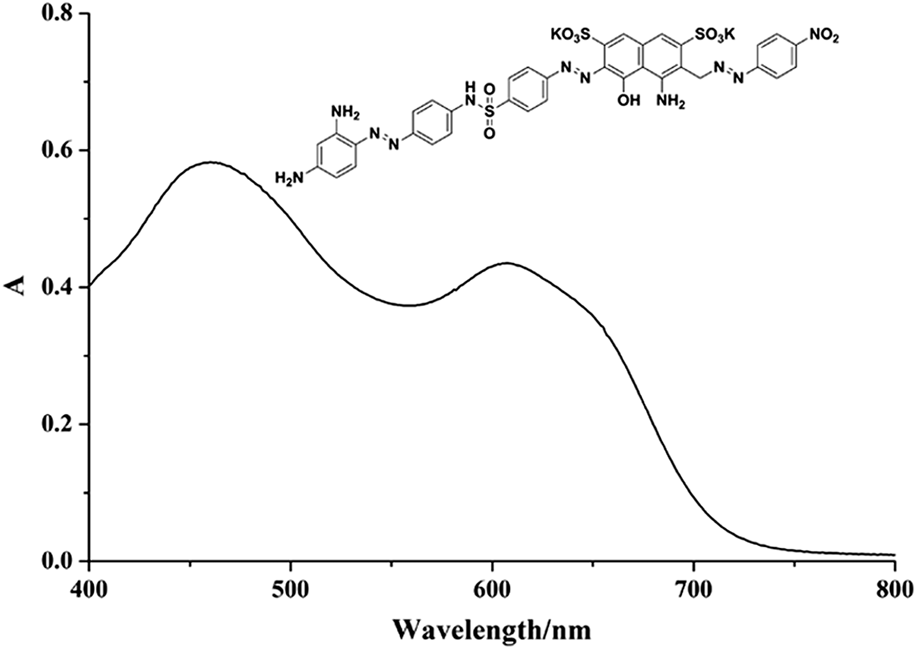
Absorption spectrum and structure of Acid Black 210 in deionized water.
Images of PSCFs with the polystyrene hydrodynamic sphere of 264.5 nm on various substrates: (a) fiber, (b) paper, (c) plastic, (d) glass, (e) Cu, and (f) Si.
The PSCFs are advantageous over previously reported materials because of their simple preparation and excellent color performances. The polystyrene emulsion containing black dye was easily obtained by simply mixing the polystyrene emulsion and dye solution. The scattering light and background light can be effectively absorbed because the water-soluble black dye molecules exited in the interstitial spaces between particles due to the electrostatic repulsion between the dye and the particles. So, in contrast to many other structural color films irradiated by an external light source in a black background,Reference Mocanu, Rusen, Marculescu and Cincu35–Reference Fudouzi and Xia38 PSCFs exhibit their brilliant color under natural light even under a white background which is very important for the actual application of PSCFs in paint, photonic paper, display, and bioassay.
II. EXPERIMENTAL
A. Materials
Styrene, sodium dodecyl sulfate and potassium peroxydisulfate were purchased from China Tianjin Kemiou Chemical Reagent Co., Ltd. C.I. Acid Black 210 was purchased from China Shangyu Guangming Chemical Co., Ltd. Deionized water was used in all the polymerization. The styrene was used after vacuum distillation. Other chemical reagents were used without further purification.
B. Preparation of monodisperse polystyrene emulsion
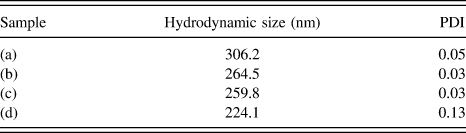
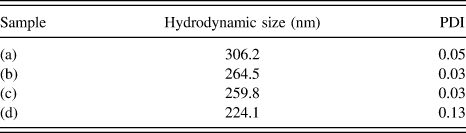
Monodisperse polystyrene spheres with different sizes were prepared by emulsion polymerization. A typical process was described as below: 100 mL deionized water, 10 g styrene, appropriate amount of sodium dodecyl sulfate were added into a 250 mL three-necked flask equipped with temperature indicator, mechanic stirrer, and reflux condenser. The system was kept at 85 °C by water bath under the protection of N2. 0.1 g potassium peroxydisulfate was added when the temperature was stable. The polystyrene microsphere emulsion was formed after another 5 h. The hydrodynamic size of microspheres ranged from 200 to 300 nm was obtained by adjusting the amount of sodium dodecyl sulfate [(a) 0.0361 g, (b) 0.0392 g, (c) 0.0417 g, (d) 0.060 g], the results were listed in Table I.
The hydrodynamic sizes and polydispersity index (PDI) of four kinds of polystyrene emulsions.
Monodisperse polystyrene emulsion containing black dye was prepared by incorporating black dye to the suspension of polystyrene. Typically, 0.1 g of black dye dissolved in 30 mL deionized water as dye solution. Weight fraction of polystyrene suspension was about 10%. The dye doped suspension was mixed and sonicated homogeneously for 10 min. The suspensions with different dye were obtained (Fig. 1). The absorption spectrum of dye displayed in Fig. 2. The absorption coefficient value of the organic dye used in this work was 2.70*104 L/(mol cm).
C. Preparation of PSCFs
Polystyrene containing black dye was added on substrate. After smearing and smoothing the suspension to spread across the substrate, the substrate was placed on the hot plate with 50 °C to assist self-assembly. About 3 min later, bright color could be observed on the surface of suspension. The ordered structure with large area was fabricated in several minutes as a result of quick water evaporation. The typical fraction of dye to polystyrene was 1%, unless specially specified.
D. Characterization
The average hydrodynamic sizes of the particles were measured by particlesize analyzer (Zetasizer 1000, Malvern, Malvern City, UK). Optical photos of polystyrene photonic crystals were taken with a Nikon digital camera. The microstructures of PSCFs were observed with scanning electron microscopy (SEM, NOVA NANOSEM 450, FEI, Hillsboro, OR). All the samples were coated with gold before observation. The reflection spectra of the materials were measured at the scan speed of 300 nm/min using HITACHI U-4100 spectrophotometer (HITACHI U-4100, HITACHI, Clarksburg, MD) with the slit width of 8.00 nm and an integral sphere.
III. RESULTS AND DISCUSSION
A. Preparation and characterization of emulsion
The key to PSCFs preparation was the use of a black dye water solution as the dispersion medium for polystyrene sphere emulsion. The mixture (Fig. 1) of monodisperse polystyrene sphere suspension and water-soluble black dye (C.I. Acid Black 210, Fig. 2) solution was added onto substrates (glass, Si, fiber, paper, and so on). The self-assembly process was completed within several minutes by heating the substrates.
The structural color films as prepared displayed an inherently brilliant structural color under a natural light environment because of the Bragg reflection of the periodic arrangement of polystyrene spheres for a specific wave length of visible lightReference Woltman, Jay and Crawford39 as well as the total absorption of the black dye for diffuse light and background light (Scheme 1), which was similar to the coloration mechanism of bluebird feathers and butterfly wings from the combination of photonic crystal films and melanine in the creatures.Reference Siefferman and Hill40,Reference Kinoshita, Yoshioka, Fujii and Okamoto41 Compared with nanoparticles fabrication on Si or glass, the quick thermal assistance assembly process is adopted to form PSCFs on numerous soft or hard substrates such as fiber, paper, plastic, glass, Si, and Cu (Fig. 3).
The mechanism of black dye absorption for diffuse light and background light. Different color stand for different kinds of light: yellow means stop band wave, blue means scattering light, green means background light.
Interestingly, the inherently brilliant structural color can be produced in natural light and white environments because of the addition of black dye. Figure 4 shows the optical images of structural color films without and with dye on the glass, and the glass is placed on a white sheet of paper. From the results in Figs. 4(a) and 4(b) (on the interior with an external light source), the inherently brilliant structural color was obtained when black dye was added. When the materials were placed in the interior under natural light (without an external light source), the color of the material without dye almost disappeared because of the strong disturbance of the scattering light and background light. By contrast, the material with dye retained its inherently brilliant structural color because of the strong absorption of the scattering light and background light by the dye [Figs. 4(c) and 4(d)]. When the material was placed outdoors, the contrast effect on the color brightness was likewise significant [Figs. 4(e) and 4(f)]. The red, yellow, green, and blue colors on the glass can be clearly observed by the naked eye under natural light in a white environment [Figs. 4(g) and 4(h)]. The color enhancement mechanism was the dye absorption for scattering light and background light because the black dye had total absorption for visible light (Fig. 2), which can be further proved by reflection spectrum.
Optical images on the glass of PSCFs with and without black dye under different conditions. (a) Without dye under an external light source; (b) with dye under an external light source; (c) without dye on the interior under natural light; (d) with dye on the interior under natural light; (e) without dye in outdoors; (f) with dye in outdoors; (g and h) photographs of polystyrene photonic crystal film with black dye (bottom) and without black dye (top) assembled on a glass with hydrodynamic particle sizes of 306.2, 264.5, 259.8, and 224.1 nm from left to right were taken (g) outdoors and (h) indoors under natural light.
The reflection spectra of these structural color films (Fig. 5) also proved that the black dye can considerably improve the optical properties of the structural color films. The color brightness of the crystal films depended on the reflectance intensity contrast between the stop band and the wave lengths outside the stop band. When the black dyes were added, the scattering light and background light were strongly absorbed by the dye [Fig. 5(a)], and the peak intensity was two or three times that of the crest [Fig. 5(b)]. However, when the dye was not used, the ratio was only 1.1. Hence, the bright color was obtained.
(a) Reflection spectra of four kinds of PSCFs on the glass with black dye (bottom regions) and without black dyes (upper regions) assembled using polystyrene sphere with different diameters on glass substrate, and (b) relative peak intensity of the reflection intensity of the four kinds of films.
To fabricate PSCFs rapidly, we used the thermal assistance self-assembly method. In this process, the black dye water solution was used as the dispersion medium of the polystyrene spheres, and structural color films can be easily developed via the quick thermal assistance assembly process. The mechanism underlying the rapid fabrication of photonic crystals with heating is illustrated in Scheme 2.
Schematic of polystyrene particle self-assembly.
A further explanation is described as follows. The polystyrene particles protruded toward the air–water surface because of the water evaporation caused by high temperature. Subsequently, the particles assemble into an ordered array through the strong capillary forces among the colloidal particles. When the ordered structure with voids of air was formed, the structure can become stable on the interface because of its low density.Reference Im, Lim, Auh and Park42 The ordered structure was extended as the effective transport of particles from the inner part to the surface of emulsion, which was powered by convective flow. Thus, the first layer of the orderly array with a large area was developed. The results were confirmed by using SEM, as shown in Figs. 6(a) and 6(b).
SEM image of ordered structures (a) with black dye and (b) without black dye. (c) Top region and (d) bottom region of cross section for PSCF.
With the evaporation of water, a second layer was fabricated sequentially under the first layer by capillary force, convective flow, and electrostatic repulsion. Multiple layers were fabricated from the top to the bottom according to this procedure [Fig. 6(c)]. So the polymer opal was obtained. When the process was almost finished, no time was left for the particles to assemble orderly. Thus, the process was terminated in a disorderly manner, which can be confirmed in [Fig. 6(d)]. In the entire assembly process, the water-soluble black dye molecules entered the interstitial spaces between particles with the evaporation of water because of the electrostatic repulsion between the dye and the particles. At the same time, the radius of the interstitial spaces changes from 30.9 to 46.4 nm when the radius of particle (R) ranges from 200 to 300 nm, but the size of dye molecule is only about 2 nm. So the black dye can easily enter the interstitial spaces between particles.
Likewise, we investigated the relationship between the dye dosage and the optical properties of the structural color films by reflectance spectroscopy. When the dye dosage was 0.1 g in 30 mL of water and the assembling temperature was 50 °C, the obtained structural color films were more brilliant and smooth (Figs. 7 and 8). To examine the generality of this strategy, we prepared the polyacrylate structural color film in a similar procedure. Similarly, we also could obtain bright structural color when black dye was used (Fig. 9).
Reflectance spectra of the PSCFs (264.5 nm) with different dye content.
Formation of structural color films under various temperatures, (a) 30 °C, (b) 40 °C, (c) 50 °C, (d) 60 °C.
The polyacrylate structural color films (a) with dye and (b) without dye.
IV. CONCLUSION
In summary, polymer opal with brilliant structural color under natural light and white environment was demonstrated for the first time using a water-soluble black dye solution as the dispersion medium of polystyrene spheres. As a result of their brilliant color under a white environment and the rapid assembly of the PSCFs on many substrates with the assistance of heating, the brilliant structural color film technology opens a possibility for the successful application of colloidal sphere self-assembly in paint, photonic paper, display, and bioassay.
ACKNOWLEDGMENTS
This work was supported by the National Natural Science Foundation of China (21276042), the National Science and Technology Pillar Program (2013BAF08B06), the Jiaogai Foundation of DUT (JGXM201224), and Fundamental Research Funds for the Central Universities of China (DUT13LK35).