

Background
Policy contexts in England relating to later life and social support are being neatly packaged under the banner of personalisation (see Carr, Reference Carr2009), applicable to people entitled to public support and other citizens. In relation to transfer of risk and responsibility to individuals, personalisation means:
that people can be responsible for themselves and can make their own decisions about what they require, but that they should also have information and support to enable them to do so. (Carr, Reference Carr2009: 2)
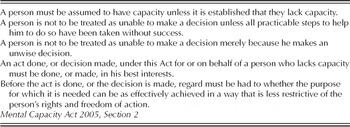
The Mental Capacity Act 2005 (MCA), implemented in England and Wales in 2007, introduced a variety of provisions (see Office of Public Sector Information, 2005; Ministry of Justice, 2007). It seeks to enhance the rights of individuals with compromised capacity through, for example, setting out a legal framework for advance decision-making about personal health and welfare (Dunn and Clare, Reference Dunn and Clare2007) and day-to-day support when decision-making capacity is reduced (Stanley and Manthorpe, Reference Stanley and Manthorpe2008). To an extent, individuals are becoming ‘self-governing welfare subjects’ (Newman, Reference Newman2007) with greater emphasis on choice and self-determination. Features of the Act (see Box 1) may have significant benefits for those whose decision-making ability may be compromised by ill-health and when expressing a choice may be difficult. Prior to the Act, there were problems ascertaining ‘mental capacity’ to make decisions (Okai et al., Reference Okai, Owen, McGuire, Singh, Churchill and Hotopf2007). A guiding principle of the Act is the presumption that, unless proven otherwise, adults have the capacity to make decisions themselves. Any surrogate decision-making must be made in the individual's best interests (Brown and Barber, Reference Brown and Barber2008). The provision of the new role of the Independent Mental Capacity Advocate (IMCA), to make major decisions regarding treatment or accommodation for a person ‘without capacity’ who lacks family and friends, is an important extension of protection and empowerment.
Five statutory principles of the Mental Capacity Act 2005

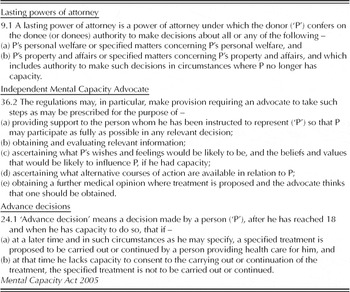
The MCA enables people to appoint surrogate decision-makers, for financial, health and welfare matters. In the United States, hospital staff are required to inform all new patients about their rights to draw up these directives (Tonelli, Reference Tonelli1996). This approach is less common in the UK where ‘advanced decisions’ or ‘living wills’ have sometimes been used to record health care wishes (Fullbrook and Saunders, Reference Fullbrook and Saunders2007), but adherence varies (Schiff et al., Reference Schiff, Rajkumar and Bulpitt2000). The MCA facilitates uptake of Advance Care Planning (ACP) in three forms: (1) statements of wishes and preferences for future care; (2) advance decisions to refuse certain treatment; and (3) granting Lasting Power of Attorney (LPA) to a surrogate decision-maker covering health and personal welfare. Surrogate decision-makers may also be granted the power to make decisions about life-sustaining treatment (see Box 2). The cost of registering a LPA is currently £120 (reduced from the original £150) and, with every new person who registers for it, the costs are being lowered.
Extracts from the Mental Capacity Act 2005

Evidence prior to the MCA suggested that some older people are keen to plan in advance (e.g. Schiff et al., Reference Schiff, Rajkumar and Bulpitt2000, found 74 per cent of a hospital in-patient sample expressed interest in writing a ‘living will’), although some medical practitioners question the applicability of these documents (Royal College of Physicians et al., 2009). While public information sets out procedures (Department for Constitutional Affairs, 2007), it is less clear how older people reach the stage of making such plans and arrangements. Is this, for instance, initiated when receiving diagnosis of a serious illness, or when planning more generally for later life? Where do older people acquire information and advice from when contemplating action in this area? While there is much interest in medical professionals’ roles in imparting information (Robinson et al., Reference Robinson, Elder, Emden, Lea, Turner and Vickers2009), little is known about the potential roles of community-based information services; although Sykes and Hedges (Reference Sykes and Hedges2008) observed that many older people do not deliberatively seek out information but tend to acquire it passively or consult informal sources. This paper explores how information services in north London may address the enquiries of older people regarding the MCA, particularly advance planning, covering possible lack of capacity arising from illnesses and other instances when decision-making abilities may be compromised.
Role of information and advice services
Information, advice and advocacy services secure the rights and interests of older people (Better Government for Older People, 2000) and there is widespread need for them in community settings (Dunning, Reference Dunning2005). Differentiating between ‘information’, ‘advice’ and ‘advocacy’ is important (Dunning, Reference Dunning2005), because this may help to determine specific voluntary sector roles and to reduce overlaps with legal service networks. Current information and advice services include websites, telephone help-lines, and high street presence of a range of voluntary sector organisations. Definitions of ‘quality’ in such services are accessibility, availability, awareness and appropriateness and provision of independent advice (Dunning, Reference Dunning2005). However, provision is reportedly inadequate in England (Age Concern, 2008) and affected by ‘personal networks connectivity’ (Sykes and Hedges, Reference Sykes and Hedges2008). A recent survey by Age Concern Hackney (inner city London) reported that as many as 71 per cent of older people needed advice; of these, 15 per cent had tried but failed to get it, with men and black and Asian older people reporting higher needs (Age Concern London, 2009). Overall, there is a knowledge gap of the reach and effectiveness of information, advice and practical support for older people regarding management of money and assets, especially under the MCA in England (Arksey et al., Reference Arksey, Corden, Glendinning and Hirst2006) and similarly elsewhere (e.g. Australia see Tilse et al., Reference Tilse, Setterland, Wilson and Rosenman2005).
Role of Age Concern groups
Age Concern groups are the largest independent information and advice providers to older people in England, reaching around half a million people each year (Age Concern, 2008), offering advice on benefits, social care, housing and other consumer issues (1). While they anticipate new generations of older people with different approaches and aspirations for later life (Phillipson et al., Reference Phillipson, Leach, Money and Biggs2008), the current need for information and advice is widely observed (Baxter et al., Reference Baxter, Glendinning and Clarke2008). A majority of groups offer social security (financial) advice and half provide legal advice. A quarter provides a separate advocacy service (Age Concern, 2008). Collectively, they are a source of support and guidance for older people and are likely to be a first point of contact for personalised face-to-face information and advice. Advisers at Age Concern have good community links and contact with socially excluded groups of older people, providing signposting services to guide older adults towards other organisations for more relevant or specialised support. Despite oversubscription to their information and advice services, the majority of Age Concern groups in London are facing reductions in their funding, or no rise in funding, with more labour-intensive services being threatened, such as home-visits and one-to-one advice (Age Concern London, 2009). In light of this risk to existing services, expansion to meet increasing demand may be compromised.
The ‘universal offer’
The interdepartmental Concordat, ‘Putting People First’ (Department of Health, 2007) outlines elements of personalisation. Individuals, it is argued, have a ‘right’ to good information and independent advice to enable informed decisions. This ‘universal offer’ (Counsel and Care, 2008) is available to all. In this context, much is being asked of existing providers. Government has outlined its expectations of older people's voluntary sector to improve the quality of information, being accessible and signposting enquires appropriately, with the notion that there will be ‘no wrong door’ for the public when seeking advice as ‘active consumers’ (Department of Work and Pensions, 2005). Pilot programmes (e.g. LinkAge Plus), have similarly sought to improve coordination and mutual understanding between voluntary and statutory sectors (Daly, Reference Daly2009). This research explores local Age Concern staff's understandings and knowledge regarding the MCA 2005. Their experiences, opinions and predictions of the Act were also investigated.
Method
The data presented here were generated in interviews that are part of a wider research programme focusing on implementation of the MCA, practitioners’ experiences and expectations of it and the Act's specific relevance to older people with dementia (2). This phase of the study explored aspects, specifically planning, of the Act relevant to older people living in the community at risk of major disabilities including dementia. Interviews also aimed to elicit their understanding, knowledge and use of the Act. Nine Age Concern groups (separate charities) across London were approached in mid-2008. A convenience-sampling-strategy sought group representatives, and staff members were asked for their opinions and experiences regarding the MCA, after full implementation in September 2007. Prospective participants were emailed the study's background and objectives. They were assured of confidentiality and that the study aimed to explore their experiences and understanding, not test them or their services. Interviews lasted an hour, were recorded and transcribed verbatim. Transcripts were analysed using framework analysis, involving a five-stage process of analysis (Pope et al., Reference Pope, Ziebland and Mays2000):
1. Familiarising – the researchers familiarised themselves with the data by reading the transcripts thoroughly. Early impressions were noted.
2. Identifying a thematic framework – the key themes embedded within the transcripts were identified and delineated. In this case, a priori issues and questions from the interview schedule were used to develop this thematic framework.
3. Indexing – each transcript was coded and annotated by applying the thematic framework to them.
4. Charting – the thematic framework was iteratively rearranged according to the emergent themes. Graphical charts and models were drawn up where relevant.
5. Mapping and interpretation – typologies are generally drawn up to explain the findings. However, in this study, the analysis stopped at the fourth stage, as the sample size was not large enough to draw comparisons.
Participant characteristics
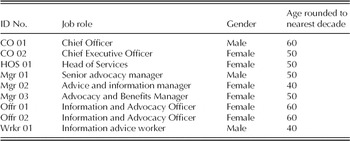
Ten Age Concern staff were interviewed, including one who worked at Head Office. The latter was excluded from the analysis, but their interview provided valuable contextual detail. The remaining nine participants were two Chief Executive Officers, one Head of Services, two senior Advocacy managers, one Advocacy and Benefits manager, two Information and Advocacy officers and one Information Advice worker. Their responsibilities include providing basic information and advice, welfare benefits, supporting ethnic minority older people, managing volunteers, outreach work, specific casework and signposting. The majority (six) of participants described themselves as white British, one as African Caribbean, one as black British and one as Asian British. Most of the participants were female and ranged in age from mid 30s to mid 60s. For purposes of confidentiality, no further identifying characteristics are presented (see Table 1).
Basic demographic characteristics of participants

Findings
Four broad themes were identified from the analysis. These included (1) MCA understanding, (2) the role of training, (3) the impact of the MCA on perceived organisational role and (4) predictions/expectations of the MCA in relation to older people.
Understanding of the MCA
All nine participants had heard of the Act, and a variety of responses was elicited about knowledge, understanding and experience that could not be accounted for entirely by job role. While some had only minimal knowledge, generally gained through the Age Concern information network, others understood most areas. These included change of the Enduring Power of Attorney provisions to Lasting Power of Attorney, the new role of the Independent Mental Capacity Advocate (IMCA), the legislative basis and definitions of capacity. Only two had experiences of specifics of the Act, for example one person described making a referral to the IMCA service. Many saw themselves as more practical than theoretical:
My knowledge is very limited just regarding issues of powers of attorney, appointees and donors being made for people not able to carry out their decisions, so it's the application of the Act rather than the legislation and articles related to it. (Wrkr 01)
Participants considered that the MCA was beneficial because it clarified and consolidated a previously confusing legal system that had generally baffled older people. They thought it would benefit people with impaired cognition, such as people with dementia, by assuming that older people are able to make decisions unless proved otherwise; encouraging professionals to better consider ability to make decisions, and ‘giving a voice to [older people at risk’ (Mgr 02). While recognising that individual decision-making was supported (even unwise or ‘eccentric’ decisions among older people), participants were also aware that the Act provided better safeguards for people who might be particularly vulnerable to neglect and abuse. Overall, the Act was seen as supporting the rights and dignity and decisions of people with dementia, the most common example of older people affected:
I think it would be that it maybe just allowed people to have more rights, be supported in terms of making their decisions, and so I think that is the key thing, and that people are able to retain rights more than they have been able to, and I think the Act is around the best interest of the individual more and something about it being less restrictive in terms of the intervention on behalf of people, so I think it is really about broadening people's rights. (CO 02)
The IMCA service for people with no immediate family or friends was also highlighted, with the hope that this would prevent abuse and that this provision would focus on the small number of individuals in this position whose rights could easily get overlooked by health and social care services. On the other hand, it was thought that the Act offered family carers (often older people themselves) and professionals some protection against false allegations of abuse and the provision of a more coherent framework within which they could operate:
I think it makes the professionals that's involved more responsible, it also, I think, it does put a safeguard in for carers so that there isn't any sort of questions around exploitation or even abuse, financial or physical. (Mgr 02)
Few disadvantages of the MCA were cited, however the LPA registration system was criticised for being complicated and more expensive than previously, potentially discouraging people:
One of the disadvantages, I think, is the cost of the LPA. People before would think about (the previous) EPA because it didn't cost much and they would go along with it, now a lot of people are just saying ‘no, I am just going to leave it’. (Mgr 03)
Attorneys being uncertain of their role was also highlighted as problematic and this appeared to prevent some from advocating on behalf of their relatives. The documents and processes resulting from the Act were perceived as lengthy and cumbersome, and basic information (such as leaflets) was said to be scarce. One participant (Mgr 02) felt that some care workers for older adults might not always know about the MCA and anticipated they could potentially breach it unintentionally.
Training – skills and system development
Training was available to all Age Concern staff. However, two participants had not undertaken any MCA training and another had not completed it; all three were therefore unable to report on this subject. There emerged a large variability in the level and type of training each participant had received. Some participants had undertaken in-house training, others had attended more detailed training provided by external consultants, geared towards health and social care workers.
Training was deemed useful, providing a good overview, being informative and helpful in outlining a defined formalised code of working. However, in terms of day-to-day work, one participant perceived minimal change and reported little benefit from training. Other accounts varied according to participants’ experiences. Some felt confident enough to give detailed advice, such as drawing up LPAs, and were able to differentiate between requests they could meet and those that were more applicable to legal practitioners. Ongoing training was considered important, as issues were discussed and case examples were shared. The IMCA service was highlighted as the most substantial provision of the Act, despite its very limited remit, and the need to understand this thoroughly was recognised. Representatives of organisations such as Age Concern groups often felt themselves to be part of a ‘safety net’ for older people (especially those without family and friends), who often tended to avoid official bodies.
Impact of the MCA on organisational roles
Participants had varying experiences with the MCA; most were knowledgeable and aware of the terms, but with little direct experience. Only one participant (Offr 01) had been involved in a local MCA Implementation Group set up by the local authority and NHS. The rest had not, and their access to resources available within the statutory sector appeared negligible. While some felt daily enquiries had remained the same, there were expressions of the MCA (such as IMCA) adding an ‘extra, sort of, weapon to the armoury’. As noted above, the role of an Age Concern worker to act as an advocate of last resort was longstanding, but the statutory basis of the IMCA role had strengthened the network of support to individuals in vulnerable situations, where Age Concern staff had no formal standing. But roles such as information provision remained, and perhaps were even more needed by older people; it was general awareness of rights and key principles of the Act that were deemed useful, given Age Concern's remit. Signposting to other more appropriate services was becoming a key task: many were dealing with basic enquiries from older people, as well as those closely involved with decision-making and encouraging drawing up of LPAs. For specialist advice, participants reported being most likely to turn to health practitioners or solicitors, as well as their own in-house national resources, such as the telephone helpline:
We don't tend to deal with people with dementia or mental health problems, only very mild problems. Before in the local authority we used to have a mental health advocate and we don't anymore, so it is important for us to know about the Act for the sake of directing people to the correct post of information or the person to speak to. (Mgr 03)
When participants were asked to rate their levels of confidence in knowledge of the MCA on a Likert type scale from 0 to 5 (where 0 = not at all confident and 5 = extremely confident), none reported feeling extremely confident. Some said that they would research information if the need arose:
My knowledge on a standard basis would be around 2, but if I were to do research for my clients then I would delve into it and on that specific issue, then I would be confident in getting the information. We just offer general advice and up to a level of 2 I would know general advice, and we could research if we don't know, that is more than adequate [for] my post. (Wrk 01)
Commonly raised areas
Telephone enquiries trying to understand LPAs were the main area of the MCA being raised by the public. In these and other areas, callers were advised to speak to a solicitor or signposted to another agency:
Well, I know that one concern for us was actually getting people assessed for mental capacity. We now have found a special department within social services for that, but in respect of the other parts of the MCA we would just signpost to services that could help in setting systems into place for wills and LPAs. (Mgr 02)
Two participants mentioned being erroneously consulted for IMCA services and referred these on. Of these, one family had contacted Age Concern seeking to challenge a capacity decision that had been issued for their relative. The Age Concern staff member had stepped in to reassure the client, and then referred the client to the IMCA service for further involvement:
We have had people in nursing homes who need to go to the EMI (dementia specific) type places, we have had queries from social workers sending the people to us saying you know, ‘we need to help them moving’ and we have to explain that this – not us – that is when an IMCA should be involved. (Mgr 03)
Role of Age Concern
Age Concern groups’ expertise and experience of working with older people were highlighted as a major strength. They perceived themselves to be approachable, reassuring and comforting, alongside providing information on subjects that older people were concerned about. Being more patient and having more time than statutory services were also mentioned. Providing information, enabling informed choice and offering free, independent advocacy were perceived as central to the role of a local service:
When people come in, we spend time with them, in other organisations they are time-restricted, they only have so long for interviews or to deal with people, whereas we will spend time. I suppose we are more cuddly-feely towards people, they feel we are not part of the establishment so they can speak quite openly with us and feel comfortable with us. (Mgr 03)
Participants also reported that Age Concern's good contacts with others in the locality, such as the fire service, repairs scheme, homecare services and crime prevention team, enabled their staff to provide overall support to older people. Good community contacts also facilitated effective signposting of older people to relevant agencies, if they were unable to help.
Predictions about the MCA
Participants hoped that interest in the MCA would continue to grow and that more people would make plans. However, the complexity of current legislation was seen as potentially excluding people from its benefits. Most participants anticipated that demand for basic information and advice services, such as those run by Age Concern, was likely to rise as a direct outcome of the MCA. Overall, participants predicted that demand for advocacy would increase and outreach work to support older adults generally, and people with dementia specifically, would need funding. Initial uncertainties of role, as outlined in the previous section, would resolve themselves:
I think as people get to know it more, and I think once people have got – are more aware of it, it will get used more, I mean it is a bit like people understanding the Mental Health Act, every time it changes there is a little bit of confusion of things, but I think once people get used to it and start using it on a regular basis or being aware of it, then I think things will improve. (HOS 01)
The new powers of LPA and the new IMCAs were judged to be the most significant changes of the MCA. Both were placed in the context of rights. One participant, however, was more cautious, as despite initial excitement there had been little demonstrable benefit as she saw it around the safety net of support. She referred to a verbal partnership set up locally with the IMCA service to encourage inappropriate referrals to be passed to Age Concern for them to provide support. At the time of interview, no referrals had been received, and this participant felt that initial excitement resulted in promises that carried little weight:
This IMCA business was all the rage, but, you know, I can't believe that they don't have clients that they should be referring to us and yet we hear nothing, so I wonder sort of, just how much is actually being done? (Offr 01)
Whether older people, worried about failing memory, were likely to use the MCA to make plans for their future was uncertain. Lack of awareness of the Act was identified as a significant barrier to such planning, but, based on their experiences in working with older people, others felt that people often are reluctant to face up to a situation and address legal arrangements until late in the day:
I think some might, some won't, some people assume they can carry on, it is like making a will, most people don't take out a LPA until the end, I think it is a difficult thing to come to terms with if you are losing your capacity. . . (Offr 02)
Others predicted that, as the MCA became better known, professionals were more likely to encourage people with worries about their memory or early dementia and their family to make plans while they could. One participant who had received a number of enquiries about LPAs believed that a referral to the Alzheimer's Society could facilitate this process. Most participants saw the Act as beneficial and thought it would serve as an impetus to older people to make plans outlining their wishes and decisions:
Yes . . . I think that things like advance directives (decisions), greater emphasis on making decisions early and making sure that they are incorporated into binding agreements, I think will become much more part of everyday life for the majority of people far more than ever in the past, and in that sense legislation should be enabling and again in that sense the MCA is making things easier for people. (CO 01)
Three participants still felt that the general public was likely to avoid issues such as advance planning. Lack of information, poor legal literacy and limited public awareness were seen as the largest barrier to older people in the community using the provisions of the MCA. Local authority, social services and other agencies’ provision of information was seen as crucial to countering factors that limited the ability of older people to access the rights available under the Act:
I think it will be used by older people and certainly as older people become more aware of it, and possibly social services will be passing information on, which may mean that more people become aware and will use it. (CO 02)
Discussion
This study sets out the understanding and experiences of implementing the MCA amongst local Age Concern staff in London. Nine members of staff participated and their roles, experiences, expectations and predictions of the Act were explored in-depth. Limitations of the study included the snapshot experiences captured in this small study and the risk of bias as participants may have been particularly well informed and therefore willing to participate. A typology from participant responses was not drawn and responses presented here represent the range and breadth of experience within Age Concern staff groups. Instead, the analytical approach adopted for this study encouraged the development of a thematic framework based on a priori issues and questions generated as a result of the aims of the study. Although most qualitative research (e.g. grounded theory) tends to be inductive, approaches such as framework analysis enable qualitative methods to be used for deductive pre-specified research questions as well (Pope et al., Reference Pope, Ziebland and Mays2000). The study took place in London and the views and experiences of Age Concern staff may differ from those of other groups in England and Wales. None of the participants, for example, was a member of the small pilot Age Concern programme related to Mental Capacity Advocacy volunteering and these groups’ experiences are likely to be very different (see Bradley, Reference Bradley2009). Furthermore, characteristics and job roles of participants were not explored as the small sample size meant that individuals could not necessarily be assumed to represent the group. These characteristics might be more important when considering practice within larger organisations with professional demarcations.
Varied experiences with training and implementation of MCA
A principal finding was the considerable variation in activity around the MCA among local Age Concern groups. While everyone knew the Act's basic tenets, some lacked specific detail of key principles and terms, while others had considerable knowledge. Training received could account for a part of this variation, as training sources and content differed. Good training was described as incorporating practical case studies in order to demonstrate greater transferability to day-to-day work, thus equipping staff with greater confidence. Training might be seen as an ongoing process, rather than one-off sessions, and regular opportunities to update information and enabling discussion of trends and cases might prove useful. Few opportunities to engage with local statutory services training had been given, despite government funding for implementation (Manthorpe and Samsi, Reference Manthorpe and Samsi2009).
This study offers further evidence of the role of Age Concern groups in providing accessible face-to-face contact and advice (Dunning, Reference Dunning2005; Age Concern, 2008), situated as they are in local communities and having a high and trusted public profile. The telephone help-line is frequently accessed by the general population, and also serves as a resource to staff members. It appeared, however, that the groups were not yet offering much direct practical assistance regarding the MCA. Short of advising relevant authorities and signposting people to other agencies and solicitors, the MCA had given Age Concern no greater role. Reported levels of confidence were at the halfway mark and participants discussed their job roles as not requiring them to be any higher.
Benefits of the MCA
Participants saw provisions of the new Act as benefiting older people with and without dementia, although its safeguarding measures were said to enhance the rights and dignity of individuals lacking capacity. While applicable only to a small group of people, participants thought the IMCA service a very beneficial resource for supporting best interest decision-making, in the absence of capacity, perhaps exposing the difficulties facing voluntary sector groups in providing advocacy without a legal framework. Overall, the MCA was seen as providing systemic benefits through its consolidation of legislation. Stronger contacts and better working between support and advocacy services were identified as another outcome of the MCA. However, increased costs to individuals and greater paperwork were cited as potential disadvantages.
Legal literacy amongst older adults
General lack of awareness of the MCA and confusion over basic terms amongst older adults living in the community were noted by participants as reasons for the slow take up of formal arrangements. Limited knowledge of legal rights has emerged from other studies of older people (Doron and Werner, Reference Doron and Werner2008). Some staff felt that local older people tended to turn to Age Concern, or similar, for support in many ‘official’ situations. This highlights the demands on Age Concern staff to provide reassurance, signposting and possibly advocacy (Bradley, Reference Bradley2009). Given mixed reports of hesitation or reluctance to consider future ill health, despite planning for death and funerals (Hill et al., Reference Hill, Kellard, Middleton, Cox and Pound2007), alongside general limited legal literacy amongst older adults, perhaps a greater public dissemination strategy is required to encourage individuals to consider these issues? Reaching out to older carers may have particular value, since there has long been concern that confusion reigns when trying to manage other people's money (Langan and Means, Reference Langan and Means1996; Brown et al., Reference Brown, Burns and Wilson2003; Arksey et al., Reference Arksey, Corden, Glendinning and Hirst2008). Participants in the study hoped that, as information about the MCA circulated, greater interest and more enquiries would be generated. As public services encourage approaches based on personal responsibility, demand for information and advice services will likely increase. Such an increase may be predicted with greater emphasis on early or timely recognition of dementia in the English National Dementia Strategy (Department of Health, 2009).
Conclusion
Local advice agencies like Age Concern have the capacity to provide personalised or tailored information. In relation to the MCA, their scope can be wide-ranging due to the nature of support they provide to older adults, as well as their good contacts with other local agencies. Data reported here suggest that the MCA has had little impact on the role of staff so far. The MCA and its applicability to people suspecting or diagnosed with dementia and their family may promote closer relationships between voluntary sector groups working with older people in general and specialist arenas. However, this connectivity should not be taken for granted. There is great deal of blurring of information and advice; in the context of the MCA, local older people's organisations may be much better and more expert at the former than the latter. Members of the public, policy makers and professionals need to be aware of the priorities, strengths, limitations and specialisms of voluntary sector groups.
Notes
(1) This study was conducted prior to the merger of Age Concern and Help the Aged in April 2009. The new charity Age UK will continue to develop advocacy and policy and promote the rights and needs of older people in the UK and overseas.
(2) Study details and contacts
This study forms part of the EVIDEM programme of research (www.evidem.org.uk) (evidence-based interventions in dementia) involving the Central and North West London (CNWL) Foundation NHS Trust together with Claire Goodman (University of Hertfordshire); Greta Rait, Jane Wilcock & Steve Iliffe (University College London); Vari Drennan (St George's University of London & Kingston University) and Martin Knapp (London School of Economic and Political Sciences).
Acknowledgements and disclaimer
This ongoing study of the Mental Capacity Act has received financial support from the Department of Health National Institute for Health Research (DH/NIHR) Programme Grants for Applied Research funding scheme. The views and opinions expressed therein do not necessarily reflect those of the CNWL, the NHS, the NIHR or the Departmetn of Health.