Climate change may increase the intensity of hurricanes (Emanuel Reference EMANUEL1987, Reference EMANUEL2003), and thus the size of disturbance in tropical forests. As a consequence, disturbance-specialist plants, such as lianas, may increase in abundance there (Phillips & Gentry Reference PHILLIPS and GENTRY1994). Putz (Reference PUTZ1984) hypothesized that lianas create larger treefall gaps by connecting trees together and pulling down multiple trees during storms. This positive-feedback cycle may increase the prevalence of lianas in disturbed tropical forests (Schnitzer & Bongers Reference SCHNITZER and BONGERS2002, Schnitzer & Carson Reference SCHNITZER and CARSON2001). Alternatively, Putz (Reference PUTZ1984) proposed that lianas tie and stabilize canopies together, resulting in less disturbance. Forest age may determine the role of lianas during disturbance because liana abundance and composition vary through secondary succession (De Walt et al. Reference DE WALT, SCHNITZER and DENSLOW2000, Schnitzer et al. Reference SCHNITZER, DALLING and CARSON2000). To test the two hypotheses of Putz (Reference PUTZ1984), we evaluated the effect of liana cutting between forests of different successional ages on tree damage by hurricane Wilma.
Studied areas are around the village of Solferino, north-east Yucatan Peninsula, Mexico, (21°26′N, 87°28′W; 10 m asl; INEGI 1993). Soils are poorly developed Luvisols, Rendzines and Vertisols upon a calcareous base that emerged after the Pleistocene (Bautista-Zúñiga et al. Reference BAUTISTA-ZÚÑIGA, BATLLORI-SAMPEDRO, ORTÍZ-PÉREZ, PALACIO-APONTE, CASTILLO-GONZÁLEZ, Colunga Garciamarín and Larqué-Saavedra2003, Olmsted et al. Reference OLMSTED, DURÁN, GONZÁLEZ-ITURBE, CALVO, REMOLINA and CANELA ROJO2000). Topography is flat, annual rainfall averages 1250 mm, most precipitation occurrs from May to November, including large storms and occasional hurricanes (Orellana et al. Reference ORELLANA, ISLEBE, ESPADAS, Colunga Garciamarín and Larqué Saavedra2003). Vegetation is seasonally dry semi-evergreen tropical forest (Tropical Dry Forest sensu Holdridge et al. Reference HOLDRIDGE, GRENKE, HATHEWAY, LIAN and TOSI1971). Between November 2003 and March 2004, twelve 20 × 20-m plots were established in areas with high density of lianas in forests of different ages of abandonment after shifting agriculture (Table 1). Plots were paired in order to establish the experimental treatments (liana cutting and control). Distance between paired plots was ≥ 20 m; no branches of lianas in a plot entered any other plot. Within each plot, all trees ≥ 10 cm girth (3.16 cm diameter) 1.3 m above ground were tagged and their diameters were measured as well as all climbers ≥ 1 cm diameter at ground level. Lianas rooted inside a plot but climbing on trees outside were excluded; lianas rooted outside and climbing on trees inside a plot were included.
Mean characteristics (± 1 SE) of trees ≥ 3.16 cm diameter at breast height and lianas ≥ 1 cm diameter at ground level in 12 experimental 20 m × 20-m plots in secondary tropical dry forest stands exposed to Hurricane Wilma in north-east Yucatan Peninsula, Mexico (n = 3).

On 22–23 May 2004 all climbers were cut in one of each of the paired of plots without removing cut lianas to avoid damaging trees. On 21 August 2005 all trees were re-visited to confirm that hurricane Emily (18 July 2005) did not affect tree mortality. On 23 October 2005 (17 mo after the initial census) hurricane Wilma, the most powerful registered to date in the Caribbean (minimum central pressure = 882 hPa; maximum winds = 295 km h−1), struck our plots. On 16–25 January 2006, all plots were re-visited and all substantially damaged (snapped or uprooted) trees quantified, to calculate the percentage of hurricane-felled trees per plot (%HFT; 100% = all trees that were alive and undamaged 2 mo before the hurricane). The effects of liana treatment (cutting vs control) and forest age (10–18 y old vs ≥ 55 y old) on plot-level parameters, including %HFT were evaluated using generalized linear models (factorial ANOVA). Among-plot differences in density, total and mean basal area of trees and lianas can influence damages to trees, so they were included as covariables (ANCOVA). General regression was used to explore relationships among the following variables: density, basal area and mean basal area (basal area/number of individuals) of trees and lianas, liana/tree ratios of density and basal area, and percentage of trees hosting lianas. When necessary, variables were transformed to meet normality and homoscedasticity.
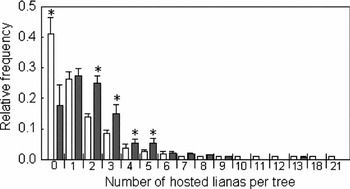
Total and mean basal area of trees were significantly higher in ≥ 55-y-old forest stands compared to 10–18-y-old stands (Table 1; F1, 8 = 6.7, P < 0.05, F1, 8 = 11.4, P < 0.01, respectively). In contrast, mean liana basal area, liana-to-tree basal area ratio, and the percentage of trees hosting lianas were all greater in young than in old forest (F1, 8 = 21.8, P < 0.005, F1, 8 = 5.3, P < 0.05, F1, 8 = 5.6, P < 0.05, respectively). The frequency distribution pattern for the number of hosted lianas per tree also differed between forest ages (Figure 1). In young forest, 82% of trees hosted 1–9 liana individuals, while few trees hosted either no lianas (17%) or ≥ 10 lianas (1%). In contrast, older forest had comparatively fewer trees hosting 1–9 lianas (56%), and more trees hosting either no lianas (38%) or ≥ 10 lianas (6%; Figure 1).
Frequency distribution of number of hosted lianas ≥ 1cm diameter at ground level per tree for trees ≥ 3.16 cm dbh in >55-y-old (white bars) and 10–18-y-old (dark bars) stands of secondary tropical dry forests in the Yucatan Peninsula (1 SE of the mean; n = six plots 20 × 20 m in both cases). Asterisks denote significant differences between forest successional ages (P < 0.05).

Interestingly, we found a significant interaction between liana cutting and forest age on %HFT (F1, 8 = 6.5, P < 0.05). The percentage of hurricane-felled trees was reduced by cutting lianas in ≥ 55-y-old forest, but enhanced in 10–18-y-old forest (Table 1). Lianas thus appear to increase tree-fall gap formation in old forest stands (consistent with hypothesis 1), but reduce gap formation in young stands (consistent with hypothesis 2). When we included either tree density, liana density, or mean liana basal area as a covariable, the interacting effect of liana cutting and forest age was no longer significant (F1, 7 ≥ 3.6, P > 0.1 in all cases), suggesting that this interaction is related to among-plot differences in these covariables. The percentage of hurricane-felled trees was overall negatively dependent on tree density (R2 = 0.52, P < 0.01).
The latter finding suggests that high densities of trees may help reduce tree felling by acting as a buffer against strong hurricane winds, regardless of forest age and liana size and distribution. Differences in total and mean tree basal area between young and old forests were consistent with the pattern reported in studies reviewed by Guariguata & Ostertag (Reference GUARIGUATA and OSTERTAG2001). The greater ratio of liana-to-tree basal area, and percentage of trees hosting lianas in young than in old stands is also consistent with the greater abundance of lianas found in young compared with old forest (DeWalt et al. Reference DE WALT, SCHNITZER and DENSLOW2000). But contrary to the findings of DeWalt et al. (Reference DE WALT, SCHNITZER and DENSLOW2000), mean liana basal area was higher in our young than in older stands. This result may be related to differences in land-use and liana species composition between our stands. According to local inhabitants, Dalbergia glabra Standl. is resistant to and proliferates after forest fires (Ermilio Rosado, pers. comm.). Slash-and-burn agriculture, which is common to the study region, may thus help explain the high relative abundance and size of D. glabra, by far the dominant liana species in our young stands. In contrast, our old forest was used for selective logging and latex extraction from Manilkara zapota (L.) P. Royen for chewing gum. Farmers cut lianas around these valuable trees (Garrido-Pérez & Gerold unpubl. data), which may explain the unexpected lower mean size of lianas in our older stands.
The interacting effect of forest age and liana-cutting treatment on %HFT supports both hypotheses of Putz (Reference PUTZ1984), and suggests that the impact of lianas on tree damage and forest disturbance depends on forest successional age. Differences in mean liana size, mechanical properties, and per-tree liana load distribution between young and older forest may help interpret these seemingly contradictory results. The 10–18-y-old stands had a high ratio of liana-to-tree basal area, and were dominated by comparatively large, heavy-wooded lianas representing on average (± SE) 79.3% (± 6.8%; n = 6) of the total basal area of lianas. These young stands were dominated by Dalbergia glabra (Leguminosae – Papilionoideae), but also by species of the genera: Celtis (Ulmaceae), Tournefortia (Boraginaceae) and Otopappus (Asteraceae). These lianas were fairly evenly distributed over trees (Figure 1), and could have formed a strong network binding canopies together (E. I. Garrido-Pérez, pers. obs.), thereby reducing tree uprooting and trunk snapping (hypothesis 2). Under these circumstances, the silvicultural practice of cutting large, heavy-wooded lianas without removing them can result in greater damage to trees during a hurricane compared with non-cutting, since the force exerted by large, heavy (and now loosely connected) lianas could exacerbate the force exerted by strong wind gusts. Cutting and removing such lianas may also be impractical and expensive (Parren & Bongers Reference PARREN and BONGERS2001, Pérez-Salicrup et al. Reference PÉREZ-SALICRUP, CARLOS, GUZMÁN, LICONA, LEDEZMA, PINARD and PUTZ2001). In contrast, the ≥ 55-y-old stands had a relatively low liana-to-tree basal area ratio, and were dominated by small, light-wooded lianas representing on average 79.9% (± 7.6%; n = 6) of the total basal area of lianas. They included species of Cydista, Arrabidaea, Melloa (Bignoniaceae), Serjania (Sapindaceae) and Cissus (Vitaceae). These lianas were patchily distributed over tree canopies (Figure 1, E. I. Garrido-Pérez, pers. obs.), were thereby less likely to form a stabilizing network, and could even contribute to treefall-gap formation, as predicted by hypothesis 1 (Putz Reference PUTZ1984). In this case, liana cutting is recommended because it can reduce tree-felling during a hurricane.
Whigham et al. (Reference WHIGHAM, OLMSTED, CABRERA CANO and HARMON1991) proposed that forests in hurricane zones do not reach successional maturity due to high levels of disturbance. Our results suggest that lianas may reduce hurricane-induced disturbance in young secondary forests. But in our older stands, this reduction is no longer present and lianas may increase gap dynamics, potentially increasing the relative abundance of both lianas and pioneer tree species (Schnitzer & Carson Reference SCHNITZER and CARSON2001, Schnitzer et al. Reference SCHNITZER, DALLING and CARSON2000). Thus, the increasing frequency of secondary forests (Cramer et al. Reference CRAMER, HOBBS and STANDISH2008), increasing abundance and size of lianas (Phillips et al. Reference PHILLIPS, VÁSQUEZ MARTINEZ, ARROYO, BAKER, KILLEEN, LEWIS, MALHI, MONTEAGUDO MENDOZA, NEILL, NÚÑEZ VARGAS, ALEXIADES, CERÓN, DI FIORE, ERWIN, JARDIM, PALACIOS, SALDIAS and VINCETI2002), and increasing intensity of large storms (Emanuel Reference EMANUEL2003) may affect tropical forest disturbance, dynamics and species turnover in a number of different ways, each of which may depend on local factors, such as liana composition, their mechanical properties, and their spatial distribution, making it difficult to generalize predictions to all forest types.
ACKNOWLEDGEMENTS
Land owners are Mario Ucan, Rosendo Can, Saúl Ancona, José ‘Pepe’ Quintal and Roberto Antonio Lara. Luz María Calvo and José Luis Hernández made helpful suggestions on statistical analyses. Sponsors were the Organization of American States (OAS), the Mexican Council for Science and Technology (CONACYT), the German Service for Academic Exchange (DAAD), and Mrs Kathrin Pahl. E. Garrido-Pérez also thanks Balbina Ancona de Ucan and his Maya friends Chak Mool and Alux Ob for their crucial help in the field.