Background
Concern about the abuse of older people grew rapidly at the end of the 20th century among professionals, campaigning organisations and policy makers in many developed countries (Wolf Reference Wolf1997), but while raised awareness of the phenomenon is evident (O'Neill Reference O'Neill2002), research on the public's knowledge of elder abuse is limited (McCreadie et al. Reference McCreadie, Bennett and Tinker1998). Various methods have been employed to examine understandings of the subject, with many focusing on professional perspectives (Harbison and Morrow Reference Harbison and Morrow1998), but the public's understanding – and particularly older people's – has been neglected. The few studies have employed disparate methods among different population groups and produced inconsistent findings.Footnote 1 For example, a large survey in Israel of 1,045 city-dwelling older people reported high levels of feelings of victimisation and distress (Siegel-Itzkovich Reference Siegel-Itzkovich2005), but Comijs et al.'s (Reference Comijs, Pot, Smit, Bouter and Jonker1998a, Reference Comijs, Smit, Pot, Bouter and Jonker1998b) prevalence study in Amsterdam found that only five per cent of 1,797 community-living older people interviewed had experienced abuse.
Many studies have estimated the extent of elder abuse but only partially explored people's knowledge of sources of help, of inter-group variations as by age or gender, or of the locations and types of abuse. Childs et al.'s (Reference Childs, Hayslip, Radika and Reinberg2000) United States study was one exception: their 422 student and 201 middle-aged respondents were asked to discuss elder abuse and family violence scenarios, from which they elicited relationships between the responses and socio-demographic variables. It was found that middle-aged female respondents judged abuse more harshly than younger respondents. The authors concluded that personal socio-demographic status and experiences play an important part in perceptions of the risk of elder abuse. In the United Kingdom, the House of Commons Health Select Committee (2004) observed that there was insufficient evidence about the extent of elder abuse, and limited knowledge of the perceptions of elder abuse by either the general public or older people themselves. The data reported in this paper from a large UK survey begin to redress this information gap. The main themes are perceptions and experiences of elder abuse and its types and locations, and knowledge of potential sources of help. We describe variations in such perceptions and knowledge by the respondents' gender, age, socio-economic status and geographical location.
Methods
There are numerous ways to estimate the scale of elder abuse but most have clear limitations, and likewise many approaches to the study of public perceptions of the subject (Hudson and Carlson Reference Hudson and Carlson1994; Hudson et al. Reference Hudson, Beasley, Benedict, Carlson, Craig and Mason1999). Surveys about sensitive, ill-defined subjects are difficult to administer and interpret, but they remain a key way of exploring public views of private problems and priorities (Ryan et al. Reference Ryan, Scott, Reeves, Bate, van Teijlingen, Russell, Napper and Robb2001). This article reports the findings of a survey that asked a representative sample of the general public about their views and experiences. While acknowledging that the contexts in which opinions about elder abuse form are indeterminate, the survey provides rare evidence of people's perceptions and constructions of elder abuse.
The survey was commissioned by Radio 2 of the British Broadcasting Corporation (BBC) to provide background information for the Respect Your Elders campaign run by the BBC Social Action Unit (see http://www.bbc.co.uk/radio2). This campaign preceded the ‘World Elder Abuse Awareness Day’ and its publicity (see International Network for the Prevention of Elder Abuse (INPEA) 2006). The sample frame for the survey was every telephone owner in the UK. The interviews used a structured questionnaire; respondents were asked to comment on the extent of neglect or mistreatment of older people in Britain and to say if they knew an older person who had such an experience. If they said they had such knowledge, they were requested to classify the type of neglect or mistreatment and to identify its setting and location. Finally, the interviewers asked all respondents about their knowledge of sources of help.
The use of the terms ‘neglect’ and ‘mistreatment’ in the survey attempted to render the concept of elder abuse understandable to the public. While the term ‘elder abuse’ is becoming widely known in Britain through the charity Action on Elder Abuse and the media, for example through the events associated with the popular fund-raising television Comic Relief in 2005, it has mainly professional currency and is not recognised by many lay people, unlike ‘child abuse’ (Help the Aged 2006). Use of the terms ‘neglect’ and ‘mistreatment’ was also consistent with the ‘UK Study of Mistreatment and Abuse of Older People’ (McCreadie et al. Reference McCreadie, O'Keeffe, Manthorpe, Tinker, Doyle, Hills, Erens and Biggs2006). Others have described elder mistreatment as synonymous with elder abuse (e.g. Swagerty et al. Reference Swagerty, Takahashi and Evans1999). It was the judgment of the BBC, which commissioned the survey, that the term would be more easily recognised by its listeners.
The survey sample
The survey used quotas for age, sex, class and region to ensure a nationally representative sample of those aged 16 or more years. The sample was obtained by using ‘random-digit dialling’ until 1,000 respondents were obtained. On average, 28 to 30 numbers were telephoned to recruit one respondent. The final sample was compared with the national demographic profile. To ensure that overall prevalence estimates reflected the national distributions of age, sex, social class and region, weights were specified to correct sub-group over- or under-representation.Footnote 2 The respondents provided basic demographic characteristics such as gender, age, marital status, socio-economic status, employment status, and the nation and region of the UK in which they lived, but not ethnicity, disability or sexuality (information on disability and sexuality is missing from many major UK surveys such as the British Social Attitudes Survey and the Labour Force Survey). The survey covered five main topics:
1. Views about the extent of neglect/mistreatment of older people;
2. Recalled instances of neglect/mistreatment of older people;
3. Place or location of neglect/mistreatment;
4. Type of neglect/mistreatment; and
5. Knowledge of sources of help when neglect/mistreatment of an older person is suspected.
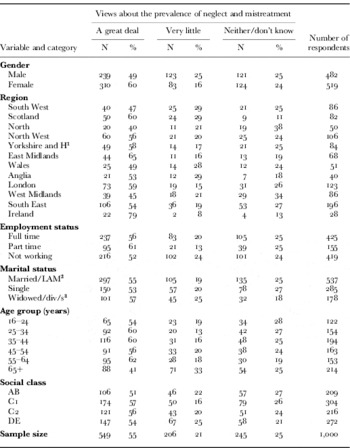
The respondents' ages ranged from 16 to 90 years, and nearly one-half (48%) were men, reproducing the national proportion. Nearly one-half (42%) were in full-time work and a similar percentage was not in paid employment, while 16 per cent worked part-time. Around one-fifth of the respondents were in the highest socio-economic groups (A and B) and 27 per cent in the lowest (D and E), while 30 and 22 per cent were in the middle classes (C1, C2).Footnote 3 More than one-half (54%) were married or living together, with 28 per cent single and 18 per cent widowed, divorced or separated (see Table 1 for further details).
Views about the prevalence of the abuse of older people by socio-demographic characteristics, United Kingdom

Notes: 1. Yorkshire and the Humber.
2. Married/living as married.
3. Widowed/divorced/separated.
Results
Views on neglect and mistreatment
Respondents were asked if they agreed with two opposing views about how much neglect and mistreatment there was of older people in the United Kingdom. The pre-determined response categories were ‘a great deal’, ‘very little’ and ‘neither or do not know’. Overall, 55 per cent of respondents said that there was ‘a great deal’ and only 21 per cent ‘very little’ (Table 1). The level of agreement varied by gender, age and region of residence. Women reported more neglect/mistreatment than men, while those aged 65 or more years were more likely to state that there was ‘very little’. The proportion of people who perceived neglect/mistreatment to be substantial varied regionally; it was highest among those from Northern Ireland (79%), the East Midlands (65%), and Scotland (60%), but was only 40 per cent in the North and 46 to 48 per cent in the West Midlands, the South West and Wales.
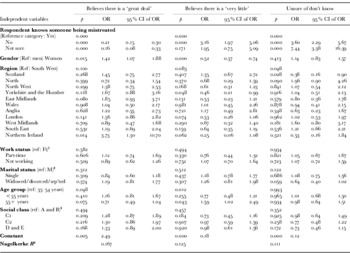
Logistic regression models were used to analyse the associations between the respondents' characteristics and the levels of agreement and disagreement with the opinions about the relative prevalence. It was suspected that knowing someone who had been subjected to neglect or mistreatment would affect perceptions. One-quarter (24%) of the respondents reported knowing an older person who had been neglected or mistreated, and four per cent were not sure. Table 2 shows that knowing someone who had been neglected or mistreated significantly altered a person's view about the prevalence. Those who did not know of a case were five times less likely to believe that there was a ‘great deal’ of it (Odds ratio (OR)=0.21, p=0.000). Age was also significantly associated but of marginal significance (p=0.048), with those aged 55 years or more least likely to believe that there was a great deal of neglect and mistreatment. Although the overall effect of region of residence was not significant, the Northern Ireland respondents were nearly four times more likely than those in the South West to believe that there was a ‘great deal’ of neglect and mistreatment (OR=3.73, p=0.014). Women were nearly one-and-a-half times more likely to hold this view than men (OR=1.42, p=0.015). None of the other characteristics (social class, marital status and employment status) generated significant odds ratios. The regression explained 17 per cent of the observed variance associated with the variables in the model. The low explanation is best understood as a function of the stronger influence of many other factors that the survey did not (and could not) collect data about.
Logistic regressions of the associations between views about the prevalence of mistreatment/neglect of older people and the respondents' socio-demographic characteristics

Notes: CI: confidence interval. 1. Ft: in full-time employment. 2. M: Married/living as married. 3. Refers to classification explained in Endnote Footnote 3.
The right-hand columns in Table 2 present the logistic model of ‘being not sure or not knowing’ with which view to agree. It shows that knowing an older person who had experienced neglect or mistreatment and the region of residence were significantly associated with the likelihood of being unsure of its prevalence. Those knowing an older person with experience of neglect/mistreatment were much more (and significantly) likely not to be unsure in their views. In comparison to those who knew an older person who had been neglected or mistreated (the base case), those who did not had an OR of 3.6 of being unsure, and those who were not sure if they knew an abused older person had an OR of 7.4 (p=0.000 for both groups). Although the overall effect of region was only marginally significant, respondents in Scotland were significantly less likely to be unsure (OR=0.38, p=0.028).
Personal knowledge of someone who has been neglected and mistreated
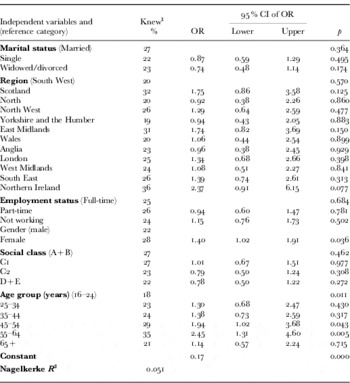
As mentioned, all respondents were asked if they knew an older person who they believed had been subject to neglect or mistreatment, whether in their own home, a hospital or a care home. One-quarter (N=245) said they did (some referred to themselves) and four per cent were not sure. As the first column of Table 3 shows, the proportion of respondents who reported knowing an older person who had been mistreated and neglected was lowest among those aged 16–24 years (18%), increased steadily with age to 35 per cent at 55–64 years of age, and dropped to 21 per cent among those aged 65 years or more. The proportion of people who reported knowing someone who had been neglected/mistreated was relatively low among lower socio-economic group respondents (22% for D and E, compared to 27% for A and B, the higher groups). Women reported more knowledge of neglect/mistreatment than men. Higher percentages of the respondents in Northern Ireland, East Midlands and Scotland had personal knowledge of neglect/mistreatment (36%, 31% and 32% respectively) than those in Wales and Yorkshire and Humberside (19%). Married respondents (or those living as married) reported relatively higher knowledge than other groups, while no major variations were observed by employment status.
Percentages that knew an older person who had been subject to neglect/mistreatment and odds ratios for socio-demographic attributes

Notes: The sample sizes in each sub-group are given in Table 1. OR: odds ratio. CI: confidence interval. 1. Percentage that knew of an older person who had been neglected or mistreated.
To discover if these variations were significant, logistic regressions were run of the probability of a respondent knowing an older person who suffered a form of neglect/mistreatment, with other background variables controlled. All the respondents' recorded characteristics were used as predictor variables. The results are shown in Table 3. Although being from Northern Ireland significantly raised the probability, the overall effect of region was not significant. Women were one-and-a-half-times and significantly more likely to have such knowledge than men. The odds ratio of knowing an older person who suffered neglect/mistreatment increased with age up to 45–64 years.
Location of neglect and mistreatment
Those who reported knowing an older person (themselves or others) who had experienced neglect/mistreatment were then asked to identify where it happened. Of the 245 people who knew of a case, just over one-half (53%) said that it occurred in a care home, just under one-half (48%) in a hospital, and 29 per cent in their own home. Three per cent were unsure or did not know the place of neglect/mistreatment. Because of the low frequencies in some categories, for further analysis the UK regions were grouped into ‘North’, ‘Midlands’ and ‘South’, and the broader age-groups regrouped as ‘under 35’, ‘35–54’, and ‘55 or more years’.Footnote 4 The bivariate cross-tabulations showed almost no difference between men's and women's identification of the locations of neglect/mistreatment. There was a positive association between social class and the likelihood of knowing of cases in care homes, from 68 per cent among those graded A and B, to 46 per cent among those graded D and E. This might arise from an interaction between socio-economic status and the use or knowledge of care homes, but such information was not collected. There was also an age relationship, with the percentage of people knowing someone who had been subjected to neglect/mistreatment rising from 44 per cent among those aged 16–34 years to 60 per cent among those aged 55 or more years. A higher proportion (34%) of the respondents from the Midlands reported neglect/mistreatment in a person's own home than those from the North (26%) or South (29%). A higher percentage (58%) of single people reported neglect/mistreatment in hospitals, in care homes or people's own homes than either married (42%) or widowed/divorced (53%) respondents.
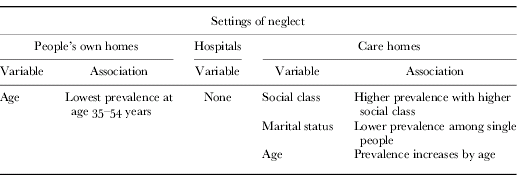
Chi-squared tests were used to test if any of the above-observed variations were significant. The analyses were restricted to the 245 respondents who reported knowing an older person who had suffered a form of neglect/mistreatment. With reference to abuse in older persons' own homes, only age produced a significant result (χ2=8.41, p=0.015), but the relationship was not linear.Footnote 5 This indicated that respondents in the oldest (55 or more years) and youngest (16–34 years) age groups were more likely to know an older person who had suffered neglect/mistreatment in his/her own home than those of intermediate ages. No significant associations were found with the likelihood of reporting neglect/mistreatment in hospitals, but socio-economic group was significantly, positively and linearly associated with identifying neglect/mistreatment in care homes (χ2=10.74, p=0.013 and Mantel-Haenzel χ2 for linear-by-linear association=8.21, p=0.004). A borderline line association with age was found (Mantel-Haenzel χ2=4.03, p=0.045); older respondents were significantly more likely to know someone who had experienced neglect/mistreatment in a care home. There were significant differences by marital status in reports of the location of neglect or mistreatment being a care home (χ2=13.90, p=0.001), with single people reporting the location significantly less often than other marital status groups. Other variables showed no significant association with reports of the care-home location. Table 4 presents a summary of the attributes of the respondents that were significantly associated with knowledge of neglect or mistreatment in each of the three locations.
Significant associations with the belief that neglect/mistreatment occurs in three settings
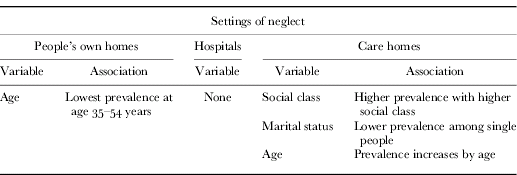
Note: Significance was established by chi-squared tests at p<0.05.
Types of neglect and mistreatment
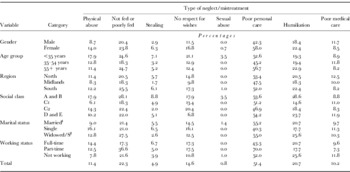
The survey also asked those who reported knowing an older person who had experienced neglect or mistreatment to identify the type or types from a pre-determined list of eight (specified in Table 5). The list was derived from previous research and definitions of mistreatment and neglect. The most frequently identified type was ‘poor personal care’ (51%), followed by being left ‘unfed or poorly fed’ (22%) and being shown ‘no respect or being humiliated’ (21%). ‘Physical abuse’, ‘poor medical treatment’ and ‘no respect for the older person's wishes’ were of intermediate prevalence, but only five per cent of the respondents reported theft and only a tiny proportion (0.8%) were aware of sexual abuse. Table 5 shows that women were more likely than men to have reported a ‘lack of personal care’ (58% versus 42%). Those who worked part-time reported this form of abuse unusually frequently (70%), and the differences with both full-time employment (43%) and those who did not work (52%) were significant (χ2=5.97, p=0.15 and χ2=8.30, p=0.016 respectively). None of the other variables generated significant associations between the categories and the likelihood of reporting a ‘lack of personal care’.
Percentages of people who have suffered or who knew an older person who had suffered neglect/mistreatment by type of mistreatment and socio-demographic characteristics

Notes: 1. Married or living as married.
2. Widowed, separated or divorced.
Turning to the reports of poor care with reference to eating and drinking, again only employment status produced a significant association and the respondents who worked part-time gave the most frequent reports (37%). No variable produced significant variations in the reports of either ‘lack of respect or humiliation’ or ‘no consideration of personal wishes’. Younger people (18%) cited physical abuse significantly more than older people (11%) (Mantel-Haenzel χ2 for linear-by-linear association=4.96, p=0.026).
Sources of help in case of neglect and mistreatment
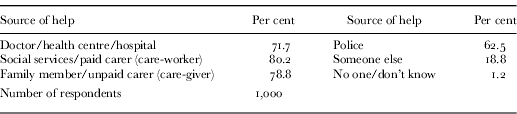
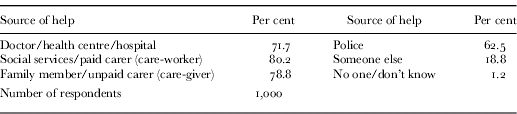
Finally, the survey asked the respondents what they believed to be the best source of help if neglect or mistreatment were suspected and to say whom they would contact for assistance. The respondents could identify more than one source of help (see Table 6). The bivariate associations showed no great variations except for the response of contacting the police. A high percentage of respondents in Wales (77%) but a low percentage in Scotland (52%) said they would do this. There was also a regular age relationship, with 71 per cent of those aged 16–24 years but only 54 per cent of those aged 65 or more years anticipating this response. Logistic regression models were run to test if the observed variations were significant. The multivariate analyses confirmed the lack of significant variation in the probabilities of contacting a doctor or health centre, social services, or a family member or friend for help. They also confirmed that, with reference to the propensity to contact the police, when other factors were controlled, age, socio-economic status and marital status were significantly associated (Negelkerke R 2=0.06, p=0.001, 0.048 and 0.048 respectively). Specifically, those aged 65 or more years were only half as likely to take this action than those aged 16–24 years (p=0.028). The respondents in the lower socio-economic groups (D and E) were 1.6 times more likely to anticipate contacting the police than those in the higher socio-economic groups (A and B).
Percentage of respondents that reported different sources of help when an older person was being neglected or mistreated
Discussion
The discussion of the key findings is framed around three issues: the implications for research on the problems of later life, the implications for health and social care practice, and the implications for pressure groups and campaigning organisations that represent older people.
Limitations of the study and implications for research
The principal limitations of the survey were the lack of detail about the experiences of neglect and mistreatment reported by the respondents, the lack of a timeframe, and that the collected information illustrated the respondents' views and perceptions rather than providing ‘objective’ records or detailed first-hand observers' accounts. The information cannot therefore be used to establish variations in absolute prevalence but rather indicates inter-group variations in perceived relative frequency.
The findings raise the question of how reporting and prevention may be tailored to different groups. The survey used a general definition of ‘neglect and mistreatment’, ‘lumping’ the two together but also ‘splitting’ by eight types that were not comparable directly with other classifications (see Table 5).Footnote 6 It is recommended that future studies, particularly those that do not have elder abuse as the main focus, use established classifications and questions. Bonnie and Wallace (Reference Bonnie and Wallace2003) cautioned against the over-simplistic piggy-backing of modules or questions in social surveys. Other limitations of the survey data include the lack of information on disability, ethnicity, religion, sexuality, or whether the respondent had experience of being an informal carer or had been involved in care work. Analysis of such characteristics might have altered some of the variations and associations. The fact that up to 30 telephone calls were necessary to recruit each respondent also suggests an element of self-selection that may have introduced bias (although the percentage that were ‘active’ lines is not known).
This survey did not distinguish the terms neglect and mistreatment unless or until the respondents identified specific types, which enabled differentiation (see Table 5). It did not ask what responses to mistreatment and neglect should be, but presented a specific list (without an ‘other’ option but allowed ‘don't know’). It was therefore not possible to identify if individuals perceived social-services staff or paid carers as the best option, or if they were seen as the most preferred source among the presented options. Epidemiological methodologists emphasise the importance of balancing feasibility, sensitivity and cost in the design of surveys (Acierno Reference Acierno, Bonnie and Wallace2003). Direct telephone inquiries facilitate access to wide social and geographical ranges and a large number of respondents, and although face-to-face interviews may be more sensitive, they are expensive and may elicit more refusals.
The great value of the BBC opinion survey is the revelation of the differences in the views of men and women, of older and younger people, and by region of the country. Why do women perceive more neglect and mistreatment, as other surveys have found? A study of US college students found that women were more likely than men to view elder abuse as serious (Fehr et al. Reference Fehr, Galla, April and Carr2004). It is generally observed that women have more experiences of abusive relationships (Nerenberg Reference Nerenberg2002). It may be that women have more expressive understandings of intimate and interpersonal relationships, which could impact on their perceptions of the extent and severity of violence, but this survey found it was in reports of defective personal care that the gender differential was greatest. Is this because many middle-aged women are family carers and that their social networks over-represent others with these roles (Hirst Reference Hirst2001)? It has been suggested that women are less likely to raise concerns than men (Commonwealth Office on the Status of Women 2000), and that older women do not know whom to contact or fail to recognise that they are being abused (Age Concern New Zealand 2005). Yet this survey indicated that to obtain assistance, more women than men would contact either social or health-care services, whilst similar proportions of men and women would contact either a family member or the police.
The survey also provided interesting evidence of age differences in the perceptions of neglect and mistreatment. Younger people tended to perceive more physical mistreatment than other age groups, whereas the perception of other types of mistreatment increased with age. While people aged 65 or more years identified more instances of a lack of personal care than any other type of mistreatment or neglect, they made few reports of instances of sexual abuse, financial abuse or physical abuse. These findings suggest that failings of personal care are more noticeable to older people: is this because they are more likely to have experienced such abuse, or because members of their social networks are recipients of care and report its occurrence? Do younger people transfer their own perceptions and experiences as victims of violence to older people, or are they influenced by media stories, and if so why? Why do older people perceive less neglect and mistreatment than the middle aged, particularly middle-aged women?
These variations expose the need to evaluate public awareness or social marketing campaigns in terms of the forms and content that are most effective and raise least unnecessary alarm (Elder Abuse Prevention Project 2005). Baseline data on attitudes need to be collected from diverse samples to identify the impact of advertising, prevention messages and community-safety initiatives. Work by British criminologists on elder abuse has confirmed the links between crime-victim support and elder abuse services, the role of perceptions of risk, and the possibility of having both victim and ‘perpetrator’ experiences (Brogden and Nijhar Reference Brogden, Nijhar, Wahidin and Cain2006).
Service implications
The British elder abuse literature relies heavily on impressions and ‘scandals’ because prevalence data are scarce. When professionals assert that, for example, ‘the institutional abuse of older people is common', the statement is hard to confirm or refute (Garner and Evans Reference Garner and Evans2002: 166). One of this survey's key findings is that the respondents believed that care homes and hospitals are the most frequent locations of neglect and mistreatment. The research literature suggests, however, that abuse in the older person's own home is more pervasive than in care homes and hospital settings (House of Commons 2004). Is this dissonance the product of the media focus on the shortcomings of formal care and the many reports of the ‘lack of dignity’ in the care of older residents and patients (seeCamden and Islington Community Health Services NHS Trust 1999; Commission for Health Improvement 2003; Department of Health 2006; Penhale and Manthorpe Reference Penhale, Manthorpe, Stanley and Manthorpe2004)? Or does it reflect the general views of older people (Calnan et al. Reference Calnan, Badcott and Woolhead2006)? Why do people think that hospitals do not provide good care for older people when older patients report relatively high levels of satisfaction (Healthcare Commission 2006)? The survey found that ‘personal care’ was the most frequently reported type of abuse. This lack of confidence in care provision is puzzling, in that most users of home care are satisfied with the quality of the service (Netten et al. Reference Netten, Francis, Jones and Bebbington2004), and that according to a study by the Office of Fair Trading (2005), 72 per cent of the residents of older people's care homes were not dissatisfied with the service. Of course ‘quality of service’ may not refer specifically to ‘personal care’ and expectations may be low.
Service initiatives that promote Dignity in Care (Department of Health 2006) may need to ensure that issues of neglect and mistreatment are within their remit if they are to address widely-held perceptions among the public and professionals. The BBC survey suggests that the British public does not have confidence in the current personal-care services or in the quality of care for older people in care homes and hospitals. The geographical variations are puzzling and require further research. An analysis of referrals to English local authorities showed that very few adult protection cases involved hospital care, and that almost one-third applied to care homes and a similar number to domestic settings (Action on Elder Abuse 2006). The implication is that adult protection and adult safeguarding services should ascertain if those in contact with hospital patients and care-home residents feel that service providers are receptive to their concerns. Inspectorates may also need to assess levels of public confidence in their role to promote the wellbeing and safety of patients and residents.
Public policy implications
The questions that arise from the findings for campaigning organisations are whether the general public ‘needs’ more education about abuse, and whether the ‘veil of silence’ has been lifted (Council of Europe 1992). Most public-education campaigns are ‘universal’ initiatives rather than preventive strategies for the general public or older people (Wolfe Reference Wolfe, Bonnie and Wallace2003: 518), although there are targeted approaches, mainly towards professionals. Others refer in general terms to the need for more fundamental changes in social attitudes (House of Commons 2004: para. 107). There is, however, some reluctance to undertake publicity campaigns, partly because the capacity to respond is usually restricted (Age Concern New Zealand 2005). The BBC survey responses suggest that public knowledge in this area is reasonably high in the United Kingdom and so too is the public's knowledge of helping resources. This raises the question of how far elder abuse remains a ‘hidden topic’, particularly amongst older people (Harding, in House of Commons 2004).
Other questions were unanswered by the survey. If people know whom to contact when the need arises, do they do this? We learn nothing about which of the interviewees had close or direct experiences of neglect and mistreatment and which, if any, had sought help, and nothing about the outcomes. Since all the respondents answered this question, including young adults, for many the question was probably hypothetical. Much might also have depended on the timing of the events to which the respondents referred. As observed earlier, one lesson is that future research needs to ask people to report their knowledge of events over a defined period such as the previous year.
The survey found that people in mid-life were more worried than older people about the neglect and mistreatment of older people. This tallies with the findings of a study by Neikrug (Reference Neikrug2003), that older people in Israel were less likely to fear being a victim of elder abuse than younger people, and better able to cope than younger people expect. People in mid-life were more concerned about what might befall them in later life than those who had reached old age. This survey also raises questions about the nature of the public's responsibility to report suspected neglect and mistreatment, and whether people feel obliged to do so (Elder Abuse Prevention Project 2005). It found that most knew appropriate means of seeking help. The Government of Victoria in Australia proposed a community-education programme to raise awareness of the risk of elder abuse, to change attitudes, or at least to reinforce the ideas that elder abuse is unacceptable, and to encourage public referrals to helping agencies (Elder Abuse Prevention Project 2005). More research into decisions to report elder abuse in varied contexts would be useful. Wolfe (Reference Wolfe, Bonnie and Wallace2003) found that public-awareness campaigns on child abuse and domestic violence had to counter both the view that such behaviour is excusable and uncertainty about the feasibility of reporting suspicions of the likely outcomes. This suggests that campaigning organisations might give more attention to those instances in which a ‘public referral’ has led to benefits or positive outcomes. Lessons from educational initiatives about elder abuse with care staff suggest that these can promote more referrals to helping resources (Richardson et al. Reference Richardson, Kitchen and Livingston2002).
Conclusions
This analysis of public attitudes to the neglect and mistreatment of older people in the United Kingdom has provided the first evidence of important variations by gender, age and region of the country. These variations suggest that it would be useful to develop an ecological model that incorporates the individual, social and contextual factors that structure people's perceptions (Schiamberg and Gans Reference Schiamberg and Gans1999). Public-awareness campaigns need to have a clear purpose, clear messages and to target specified audiences. The survey suggests that the British public has low expectations of the quality of care in both hospitals and care homes and believes that neglect and mistreatment occur frequently within them. Such views are most prevalent among middle-aged women and in certain regions. These findings may provide valuable guidance for the services that seek to target their assistance and advice. Those working in care home and hospital services may not be fully aware of the anxiety that surrounds the quality of care and treatment of vulnerable older people in these settings. Not only do all those working in formal care have to strive constantly for better standards, but they also have to combat the tendency of public opinion to focus on the failings in care. How to instil greater confidence among older people and the public at large is a considerable challenge.
Acknowledgements
We thank all the respondents to the BBC survey, the interviewers and staff at GfK/NOP who conducted the survey, David Barber and colleagues at BBC Radio 2, who commissioned the survey, and the referees and editor for helpful comments. The views and interpretations of the data presented in the paper are the authors', and not necessarily those of any of the organisations involved in the survey.