


How effective are international institutions at enforcing international agreements? Scholars have been studying this question with regards to international adjudicatory bodies (courts) for decades (e.g., Chayes and Chayes Reference Chayes and Chayes1993; Burley and Mattli Reference Burley and Mattli1993; Alter Reference Alter2001; Sweet and Brunell Reference Sweet and Brunell1998; Rosendorff Reference Rosendorff2005; Rosendorff and Milner Reference Rosendorff and Milner2001; Carrubba Reference Carrubba2005; Carrubba and Gabel Reference Carrubba and Gabel2015; Keohane Reference Keohane1984; Simmons Reference Simmons2009; Simmons and Danner Reference Simmons and Danner2010).Footnote 1 The consensus is that these courts are effective at curtailing state noncompliance. What has received less attention is what happens after an agreement is signed and before a case gets to court. International agreements can also empower international bureaucracies to monitor and enforce international law. Given international courts’ limited time and resources, such agencies can be invaluable partners in helping promote compliance. But to what degree and in what ways is little explored to date. Are they simply able to catch and correct unintentional noncompliance, or can their investigatory procedures accomplish more? What does it mean for a multistaged investigation to be wrapped up early versus late? Is one or the other an indication of institutional efficacy? In this paper, we examine the capacity of one particular international bureaucracy, the European Commission, to help promote compliance with international law.
The European Commission—the executive body of the EU—is responsible for monitoring and implementing EU law.Footnote 2 One of the most important mechanisms by which it does so is the infringement procedure. This procedure is a multistage process in which the Commission first raises concerns over whether a member state is properly implementing EU legislation and, if the EU and the member state government cannot come to terms, can eventually lead to a legal challenge by the Commission in front of the Court of Justice of the European Union (CJEU).
Is the Commission effective at enforcing EU law? This is no simple question. The Commission initiates many investigations, some of which ultimately go to trial and some of which do not. Of those that go to trial, the Commission usually wins. From this fact, we might conclude that the Commission is effective at ensuring compliance with EU law. However, compliance with an adverse court decision is no sure thing (Garrett, Kelemen, and Schulz Reference Garrett, Kelemen and Schulz1998; Alter Reference Alter2000; Slepcevic Reference Slepcevic2009; Conant Reference Conant2002; Panke Reference Panke2010; Carrubba and Gabel Reference Carrubba and Gabel2015). And even more importantly, most infringement cases never get to court. Rather, they are resolved during the Commission’s pretrial investigatory process. Between 2003 and 2013, the Commission initiated at least 13,616 infringement investigations with a letter of formal notice. The Commission deemed the government response inadequate and followed up with a reasoned opinion in 4,065 of those cases. And finally, of those reasoned opinions, 1,032 actually went to court.Footnote 3
Cases might resolve pretrial for any number of reasons. The Commission might be convinced by the government that no violation of EU law has occurred, the Commission might give up on trying to get the government to come into compliance (as suggested by König and Mäder Reference König and Mäder2014, 249–50), or the government might concede the Commission’s point and fall into line. Further, the government might fall into line because it agrees with the Commission and wants to be in compliance, or the government might fall into line despite the fact that it does not want to comply.
Disentangling why cases are resolved pretrial is critical for understanding what the Commission is accomplishing. If cases are resolving pretrial primarily because governments are backing down, that is a good sign for the efficacy of the Commission and EU law. If the Commission is primarily backing down, it is not such a good sign. Further, when governments are backing down, it matters whether the government is backing down because it agrees with the Commission’s assessment or despite that fact. If governments are only backing down when they agree, then the Commission’s ability to get compliance in the face of government resistance comes into question.
In this paper, we propose and test a model of the Commission’s infringement procedure to evaluate the efficacy of the process for bringing member state governments into compliance with EU law. The model has three critical features. First, we do not assume governments are willfully disobeying EU law. Rather, unlike previous work, we allow government violation to arise by strategic choice or not. Second, we model the entire infringement procedure from the Commission’s letter of formal notice to its ultimate decision to refer the case to the CJEU. Finally, we explicitly model how a court decision is going to be a function, at least in part, of the political processes that lead to the investigation coming in front of the Court. Specifically, relying on Carrubba and Gabel (Reference Carrubba and Gabel2015, 33–9), we allow the likelihood of the Court ruling against the defendant government to depend upon the costs the government would face if it were to come into compliance with EU law, and thereby the likelihood the government will comply if ruled against.
These modeling decisions are highly consequential. At each step of the investigatory process, both the Commission and the government being investigated must make decisions that ultimately lead to the investigation continuing to the next stage or not. Most immediately, the government must first decide if it agrees with, and wants to accommodate, the Commission’s position. If not, the government and the Commission are fundamentally at odds, and the attributes of the case that are most likely to make the Commission want to pursue the investigation are also the attributes most likely to make the government want to end it (and vice versa). This challenge is exacerbated by the fact that the investigations the government is most likely to resist, and therefore the investigations that are most likely to continue, are the ones in which the Court is least likely to hold governments accountable. As such, the investigatory process is rife with selection issues that can quickly confound empirical work.Footnote 4
In this paper, we engage in both a model testing and inferential exercise. We test three predictions of the model and find evidence consistent with our expectations. We then interpret a pair of ancillary results, conditional on the model representing the true data-generating process, that allows us to address two questions.
First, we examine why we see noncompliance (e.g., Chayes and Chayes Reference Chayes and Chayes1993; Downs, Rocke, and Barsoom Reference Downs, Rocke and Barsoom1996; Tallberg Reference Tallberg2002; Beach Reference Beach2005; Carrubba Reference Carrubba2005). One group of scholars, referred to as the management school, argues that governments generally want to implement the laws they pass, they just fail to do so sometimes because of legal complexity/ambiguity, bottlenecks in implementation, or other constraints (Ziller and Siedentopf Reference Ziller and Siedentopf1988; Mbaye Reference Mbaye2001; Börzel and Risse Reference Börzel, Risse, Featherstone and Radaelli2003; Giuliani Reference Giuliani2003; Borghetto, Franchino, and Giannetti Reference Borghetto, Franchino and Giannetti2006; Hille and Knill Reference Hille and Knill2006; Haverland and Romeijn Reference Haverland and Romeijn2007; Jensen Reference Jensen2007; Sedelmeier Reference Sedelmeier2008). Other scholars argue that noncompliance is a strategic choice made by governments for domestic political reasons (Borzel Reference Borzel2000; Falkner Reference Falkner2005; Thomson, Torenvlied, and Arregui Reference Thomson, Torenvlied and Arregui2007; König and Luetgert Reference König and Luetgert2009; Luetgert and Dannwolf Reference Luetgert and Dannwolf2009; Zhelyazkova and Torenvlied Reference Zhelyazkova and Torenvlied2009; König and Mäder Reference König and Mäder2012; Zhelyazkova Reference Zhelyazkova2013). Previous work has tended to, at most, test predictions from both perspectives as competing hypotheses (e.g., Toshkov Reference Toshkov2008, 384–6).Footnote 5 Here we explicitly theorize over alternative causes of noncompliance, explore how each should play out within the infringement investigatory process, and identify the evidence that can help determine how much of each is driving noncompliance.Footnote 6 Note that we rely upon the fact that the infringement procedure is multistage to identify why noncompliance is occurring.
Then we examine when the Commission is going to be more effective at ensuring compliance with EU law. To answer this question, we examine the conditions under which the national government is going to be more disposed toward backing down upon being challenged by the Commission and the conditions under which the Commission is going to be more disposed toward abandoning an investigation in the face of government recalcitrance. This question is important to empirical work on infringement cases because self-selection by the Commission in prosecuting cases could introduce significant bias, an often-cited concern (Mbaye Reference Mbaye2001; Börzel and Risse Reference Börzel, Risse, Featherstone and Radaelli2003; Thomson, Torenvlied, and Arregui Reference Thomson, Torenvlied and Arregui2007; Hartlapp and Falkner Reference Hartlapp and Falkner2009; Steunenberg and Rhinard Reference Steunenberg and Rhinard2010). Our model will provide a first-cut answer to this question. If we take the model as the true data-generating process, we can use comparative statics from the equilibrium to answer this question with regards to the three key parameters: the likelihood of unintentional noncompliance, the benefit to the Commission of successfully completing an investigation, and the government’s expected value of compliance.
FORMALIZATION
Treaties task the European Commission with monitoring the behavior of member states to ensure they carry out their legal obligations. This is accomplished through a formal infringement procedure, which is outlined in Article 258 of the Treaty on the Functioning of the EU (TFEU):
If the Commission considers that a Member State has failed to fulfill an obligation under the Treaties, it shall deliver a reasoned opinion on the matter after giving the State concerned the opportunity to submit its observations. If the State concerned does not comply with the opinion within the period laid down by the Commission, the latter may bring the matter before the Court of Justice of the European Union.
The formal infringement procedure consists of three stages: (1) the Commission sends a government a letter of formal notice in which the Commission informs the member state of a suspected infringement and requires that the member state comment on the matter; (2) if the member state does not respond or fails to comply, the Commission may send a reasoned opinion in which it provides a legal argument for why the member state has committed an infringement; (3) if the member state does not comply within two months, the Commission may refer the cases to the CJEU. If the Court rules in favor of the Commission, the member state is legally obligated to comply. The Article 258 TFEU infringement procedure ends with the ruling of the Court. Although Article 260(2) allows the Commission to return a case to the Court if the member state does not comply with the initial judgment, these cases are exceptionally rare.
We intentionally model the full infringement procedure as it operates in practice. By doing so, we will be able to evaluate which cases resolve early, which matriculate through the process but end before court, and which ultimately end up in court.
We can think of this procedure as a bargaining process consisting of a finite sequence of discrete offers (that is, the government of a member state can comply or not comply and the Commission can move forward with the case or not).Footnote 7 There is no evidence that the Commission and member states bargain outside of the formal procedure.Footnote 8
Let t = 0 be the initial compliance stage, t = 1 the letter of formal notice stage, t = 2 the reasoned opinion stage, and t = 3 the referral stage. There are two players: the Commission, C, and the government of a member state, G. Rather than explicitly modeling the Court as a strategic actor, we allow nature, N, to determine how the Court rules. We allow the probability that the Court rules against the government and gets compliance with its decision, denoted q 3, to be endogenous to the government’s expected payoff from compliance (formally defined below); the more costly compliance, the less likely the Court is to rule against the government and the less likely the government is to comply with an adverse ruling. The function, q 3, is common knowledge.
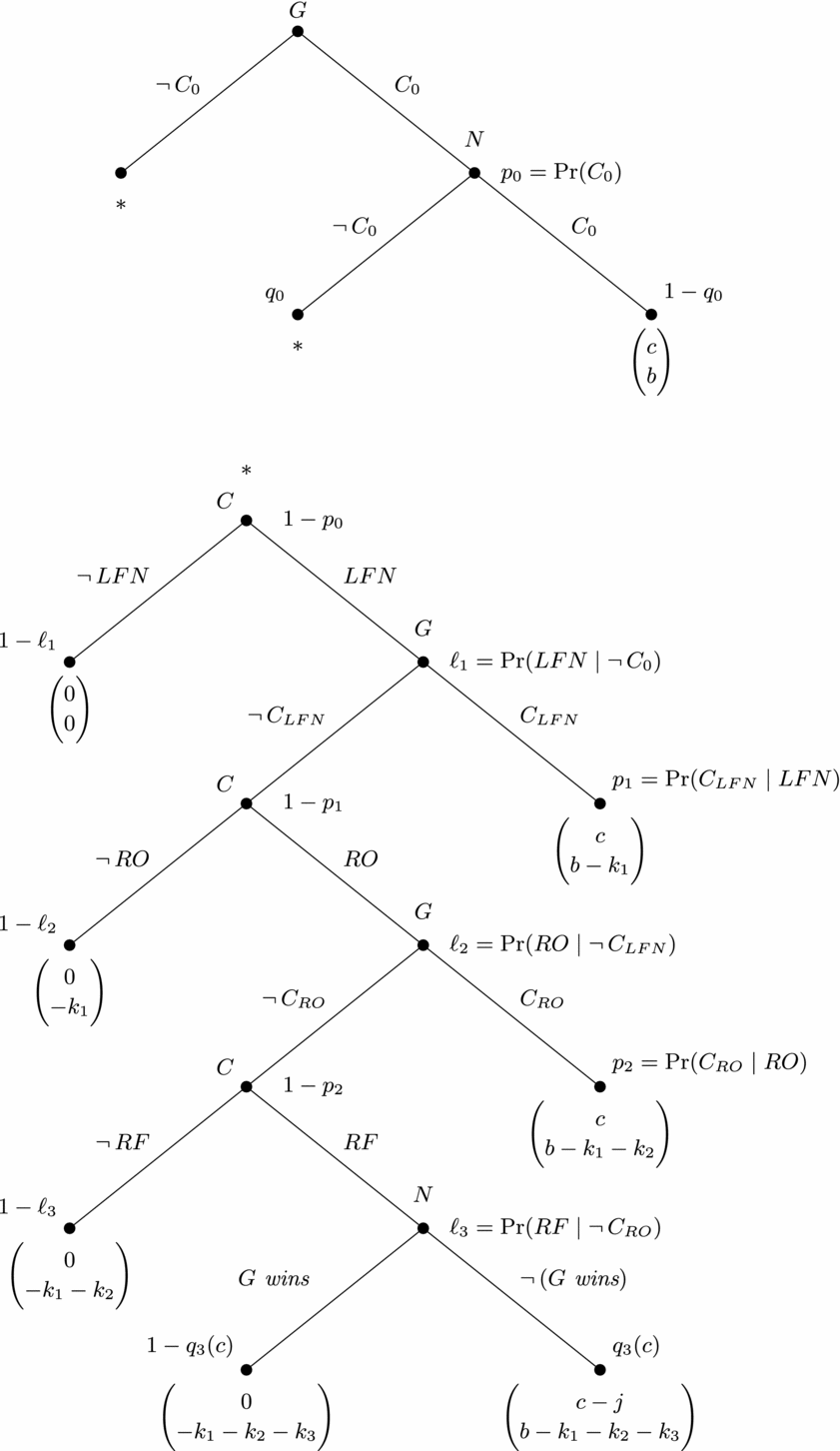
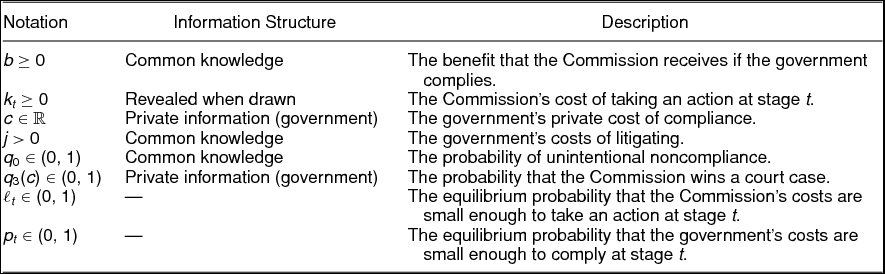
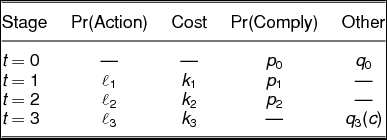
This is a fully consistent, reduced-form approach to modeling the Court as a strategic actor and compliance with the Court’s ruling as endogenous to the game [see Carrubba and Gabel (Reference Carrubba and Gabel2015, 21–56)]. Intuitively, governments are less likely to comply with adverse court rulings, the more costly compliance. Because the Court prefers to not have its decisions evaded, the Court is also less likely to rule against a government, the more likely that government has high costs. For ease of exposition, we will simply refer to q 3 as the probability of the Court ruling against the government from here on. Figure 1 outlines the structure of the game. For reference, Table 1 summarizes our notation. Table 2 charts out the parameters that are indexed to a specific stage of the infringement process.
Game Tree

Summary of Model Notation

Summary of Parameters by Stage

The government makes the first move: it can attempt to comply with some obligation, C 0, or intentionally violate it, ¬C 0. If the government attempts to comply, a violation may still occur with probability q 0 ∈ [0, 1]. The violation may be the result of unintentionally misunderstanding what was required by the law, it may be the result of some underling or substate actor not executing the government’s will, or otherwise. Whatever the cause, the point is that a government attempting to comply in good faith may fail.Footnote 9 The Commission observes if a violation occurs, but does not observe if it was intentional or not.
Upon observing a violation, the Commission can send a letter of formal notice, LFN, or ignore the violation, ¬LFN. In response, the government can correct the violation, C LFN, or reject the letter of formal notice, ¬C LFN. If the government fails to comply a second time, the Commission can choose to drop the case, ¬RO, or send a reasoned opinion, RO. The government has one last opportunity to comply, C RO, or it can continue to resist, ¬C RO. At this stage, the Commission can again choose to drop the case, ¬RF, or refer it to the Court, RF. If the case reaches the Court, the outcome is determined by a lottery. Payoffs are then realized. The game also ends whenever the government complies.
If the government complies, it receives a payoff from compliance,  $c \in \mathbb {R}$. Nature draws this payoff at the start of the game. This payoff is immediately revealed to the government; it is never revealed to the Commission. We make no assumption over whether the payoff is a benefit or a cost; c > 0 indicates that compliance is beneficial and c < 0 indicates that compliance is costly. This flexibility allows us to explore how often cases are instances of intentional versus unintentional noncompliance, when those cases get resolved in the multistage investigation, and if they end in compliance or not. Later, we will leverage the multistage process to empirically evaluate how much of each type of noncompliance is occurring. If the government complies, the Commission receives a fixed benefit, b > 0. This benefit is common knowledge.
Every time the Commission takes an action, like sending a letter of formal notice, it incurs a cost k t ≥ 0, where t is the stage in the infringement process. Note that the Commission does not have a move at t = 0. This cost is drawn when the Commission is confronted with having to decide whether to advance the investigation. For example, at the point a government does not comply with a letter of formal notice, the Commission draws a cost that it must pay it if wishes to send a reasoned opinion. Once drawn, the cost is common knowledge. Substantively, this cost represents the opportunity cost for the Commission of allocating further time and resources to an investigation. All of these parameters are random variables with full support. The distributions of these random variables are common knowledge.
The government’s belief that the Commission will not find taking action at stage t too costly is ℓt. The Commission’s belief that government compliance is costly enough that it will comply at stage t is p t. Because there are no off-path strategies in the game, ℓt and p t will represent both the true probabilities and the actors beliefs about those probabilities.
If the government complies at any stage in the game prior to a referral to the Court, thus ending the game, it receives its payoff from compliance c, and the Commission receives its benefit from compliance b, less any costs the Commission paid to get to that point in the game. If a government does not comply and the Commission does not open a case, drops the case at any point in the game, or loses the case at the Court, the Commission does not receive its benefit of compliance, but still incurs any costs it has paid to get to that point; the government receives a payoff of 0. If the Commission refers the case to the Court, the Commission wins—and the government loses—with probability q 3(c). The Commission does not know c, and thus relies on the expectation of q 3(c) (conditional on any information that is revealed about c through the government’s moves) in making its decisions. The probability of the Commission winning, q 3(c), is strictly monotonically increasing in c. If the government wins, it does not receive its payoff from compliance c; if it loses, it does. The government pays the costs of litigating, j > 0, if it loses the case.
EQUILIBRIUM ANALYSIS
We derive a unique perfect Bayesian equilibrium in cut-points. Formal proof is reserved for the Appendix. We discuss the equilibrium as a series of propositions in reverse-chronological order. The propositions are stated in terms of cut-point strategies.
Proposition 1. The Commission refers the case to the Court when the cost of doing so is sufficiently low, k 3 ⩽ k*3, where k*3 = E[q 3(c)∣c ⩽ c*]b, and drops the case otherwise.
Referring a case is a lottery for the Commission. If the Commission wins, with expected probability E[q 3(c) ∣ c ≤ c*], it enjoys the benefit of bringing the government into compliance, b, but it also has to pay the cost of referring the case, k 3. If the Commission loses the court case, with expected probability 1 − E[q 3(c) ∣ c ≤ c*], it does not gain any benefit. Thus, the Commission only refers the case to the Court when the cost of doing so is smaller than the expected benefit, or k 3 ⩽ k*3.
Proposition 2. The government complies with the reasoned opinion when compliance is not too costly, c ≥ c*, where  $c^* = - \frac{\ell _3(c^*) q_3(c^*) j}{1-\ell _3(c^*) q_3(c^*)}$, and rejects the reasoned opinion otherwise.
If the government complies with the reasoned opinion, it receives a payoff of c. If it does not comply, the government is taking a gamble. There is some chance the Commission decides to take the government to court and some chance the Court rules against the government. If compliance is beneficial, then the government just wants to comply now. If compliance is only somewhat costly, the government also prefers to comply, because the chance of winning is not worth the cost of going to court. If compliance is sufficiently costly, that calculus flips and the government decides to take the chance of ignoring the reasoned opinion. The cut-point c* is the value at which the government is indifferent over complying. The more likely the Commission is to take the government to court (ℓ3(c*)), the higher the costs of going to court (j), and the more likely the government is to lose at court (q 3(c*)), the more costly compliance can be and the government will still choose to comply.
Proposition 3. The Commission issues a reasoned opinion when the cost of doing so is sufficiently low, k 2 ⩽ k*2, where k*2 = p 2(c*)b + (1 − p 2(c*))ℓ3(c*)(E[q 3(c)∣c ⩽ c*]b − E[k 3∣k 3 ⩽ k*3]), and drops the case otherwise.
At a cost k 2, the Commission can continue a case against a government by issuing a reasoned opinion. Doing so is a gamble. With probability p 2(c*), the government is expected to comply with the reasoned opinion and yield a benefit of b to the Commission. With probability (1 − p 2(c*)), the government is not expected to comply and so the Commission will have to decide whether to go to court or not. With probability ℓ(c*), the Commission expects to draw a small enough cost of continuing the case, k 3, such that it will choose to refer to court, win with expected probability E[q 3(c) ∣ c ≤ c*], and pay expected cost E[k 3∣k 3 ⩽ k*3].Footnote 10 Otherwise, the Commission drops the case. When the government draws a cost, k 2, below k*2, the odds of a beneficial outcome are high enough that the Commission sends a reasoned opinion.
Proposition 4. The government complies with a letter of formal notice when compliance is beneficial, c ≥ 0, and rejects the formal notice otherwise.
In Proposition 2, the government had to decide whether to comply with a reasoned opinion or risk going to court. Here, the government must decide whether to comply with a letter of formal notice or risk the Commission following up with a reasoned opinion. The key difference in the two decisions is that not complying with a reasoned opinion leads to court and a potentially costly outcome, whereas here the risk is only that the Commission will not drop the investigation. The government can still avoid court by coming into compliance once the reasoned opinion is filed. Thus, the decision the government is left with at this stage is whether to come into compliance now, or delay coming into compliance (or not) until a reasoned opinion is filed. When c ≥ 0, delay is not beneficial. In fact, it risks the Commission not following through and the government being strictly worse off. When c < 0, delay is beneficial, at least until the Commission brings a reasoned opinion. Not coming into compliance is costless, and there is some chance the Commission will not pursue the case. Thus, the government only complies when c ≥ 0.
Proposition 5. The Commission issues a letter of formal notice when the cost of doing so is sufficiently low, k 1 ⩽ k*1, where k*1 = p 1b + (1 − p 1)(ℓ2(c*)(p 2(c*)b + (1 − p 2(c*))(ℓ3(c*)(E[q 3(c)∣c ⩽ c*]b − E[k 3∣k 3 ⩽ k*3])) − E[k 2∣k 2 ⩽ k*2])), and drops the case otherwise.
Given what may transpire, the Commission must decide whether to issue a letter of formal notice. Doing so entails weighing the cost of a letter of formal notice, k 1, against the expected value of an uncertain investigation. The logic of the gamble of pursuing the investigation is equivalent to that described in Proposition 3, just with an additional choice over whether to issue a letter of formal notice or not. When k 1 is below the cut-point, k*1, the Commission will send a letter of formal notice.
Proposition 6. The government complies ex ante when compliance is beneficial, c ≥ 0, and commits an infringement when compliance is costly, c < 0.
Finally, the government only complies ex ante when c ≥ 0. When c ≥ 0, the government benefits from compliance, and so wants to try to comply if possible. When c < 0, the government does not benefit from compliance and, since there is a chance the Commission will drop the case before going to court, the government always has an incentive to at least delay compliance. Note that the probability that the government actually complies, when it intends to, is the joint probability that it attempts to comply and that it successfully executes its strategy:  $\Pr (C_0) = p_0 = \Pr (c\ge 0)(1-q_0)$.
Put together, what do these propositions tell us about how intentional and unintentional noncompliance are likely to resolve in the infringement procedure? Intentional noncompliance is late to resolve. Governments who chose not to comply because it was costly will delay coming into compliance as long as possible. That means they will not change behavior upon receiving a letter of formal notice, and they will only do so upon receiving a reasoned opinion if the cost of coming into compliance is not too severe. Otherwise they will take their chances with a court case. The model predicts that unintentional noncompliance will resolve earlier. These are cases in which the government actually wants to be in compliance, and so it will try to accommodate the Commission upon receiving a letter of formal notice.
Note that within the context of the model, intentional and unintentional noncompliance do not map perfectly to enforcement versus management school expectations. The enforcement school expectations for strategic defection are certainly cases of intentional noncompliance. However, the management school mapping is more complex. The management school posits two causes for noncompliance (Tallberg Reference Tallberg2002, 613–614, 630–632). The first is simple inadvertent noncompliance. Executives, legislatures, and/or bureaucracies may be failing to correctly implement because of confusion over what the directive is asking, or because bureaucratic structures are inefficient. It is not a product of willful avoidance by the government. This notion maps well to unintentional noncompliance and, for that reason, we would expect these sorts of cases to typically resolve quickly.Footnote 11 The second are cases where the government cannot ensure that domestic actors meet the directive’s commitments, because it is physically outside of the control of the government, or because, at least in the short run, the cost to do so is prohibitive. In one sense, this scenario is outside the context of the model, because the compliance decision is not up to the government (for example, the legislature will not pass the law). That is, even if the government wanted to come into compliance, it may not be able to in response to a Commission investigation. In another sense, one could think about this as a case of extremely costly compliance, such that the government would never comply. In this conception, it would operate like intentional noncompliance does in the model.
In the next section, we derive the comparative statics that will be the basis for the empirical estimation.
COMPARATIVE STATICS
Our empirical analysis, and therefore the comparative statics, focuses on the conditional probability of a case moving from one stage in the infringement procedure to the next.Footnote 12 These conditional probabilities are a product of the government not complying, 1 − p t−1, and the Commission advancing the investigation, ℓt.Footnote 13 We focus our analysis on three measurable parameters: the benefit to the Commission of bringing the member state into compliance, b; the probability of unintentional noncompliance, q 0; and the expected value of compliance, E[c]. See the Appendix for derivation of these results.
First, we demonstrate an important empirical limitation implied by the model. Specifically, we cannot test the model by examining Commission decisions to refer cases to court.Footnote 14 The conditional probability of a referral to the Court is  $\Pr (RF \mid RO) = (1-p_2(c^*))(\ell _3(c^*))$. Unintentional noncompliance is already resolved, so q 0 does not enter into these equations. Both probabilities, p 2(c*) and ℓ3(c*), are increasing in the Commission’s benefit from compliance, b, and the government’s expected payoff from compliance, E[c]. Intuitively, the government is more likely to comply with the reasoned opinion as its chances of being brought to court (increasing in b) and losing (increasing in E[c]) go up. At the same time, those two factors also make it more likely the Commission will bring a case if the government does not comply with the reasoned opinion. As a result, these parameters have an ambiguous effect on the conditional probability of a referral,
 $\Pr (RF \mid RO)$. This finding yields Result 1.
Result 1. The probability of a referral conditional on a reasoned opinion,  $\Pr (RF \mid RO) = (1 - p_2(c^*)) (\ell _3(c^*))$, is constant in the probability of accidental noncompliance, q0; the effects of changes in the benefit to the Commission of bringing the government into compliance, b, and the government’s expected value of compliance, E[c], are ambiguous.
This is an important result, since it would seem natural to test predictions over the use of the infringement procedure by looking at what goes to court. However, if one explicitly takes into account the countervailing strategic selection effects, we must look elsewhere for evaluative tests.
We can test the model by examining the conditional probability of observing a reasoned opinion,  $\Pr (RO \mid LFN) = (1-p_1)(\ell _2(c^*))$. First, consider the effect of the probability of unintentional noncompliance, q o, on the conditional probability of observing a reasoned opinion. The probability the government complies with a letter of formal notice, p 1, is increasing in the probability of unintentional noncompliance. This is the first opportunity for the government to correct unintentional noncompliance, and that is something governments want to do. Conversely, the probability the Commission issues a reasoned opinion, ℓ2(c*), does not depend upon q 0. The Commission knows that the government will clean up any unintentional noncompliance upon receiving a letter of formal notice, so it no longer factors into their calculations. Result 2 therefore provides a testable prediction.
Result 2. The conditional probability of a reasoned opinion,  $\Pr (RO \mid LFN) = (1-p_1)(\ell _2(c^*))$, is decreasing in the probability of accidental noncompliance, q0.
From this result we also get an intuitive, associated corollary; the more likely government noncompliance is unintentional, the more likely the investigations are terminating because the government is coming into line with Commission demands, than because the Commission is backing down.
Corollary 1. Pretrial resolutions of investigations are more likely the product of a government coming into compliance, the more likely the government is engaged in unintentional noncompliance.
Next, consider the effect of the expected value of compliance, E[c]. As with the referral stage, the direct effect is ambiguous. As the expected value of compliance increases, the Commission becomes more willing to pursue the case, because the odds of winning the case increase. However, for the same reason, the government also becomes more likely to comply with a letter of formal notice. Thus, we cannot get a clean prediction on E[c]. However, we can say that pretrial terminations are more likely to be indicators of noncompliance, the more costly compliance is expected to be. The government is more likely to resist the Commission’s investigation and the Commission is more likely to back down since it does not anticipate as strong a chance of winning if things go to court.
Corollary 2. Pretrial resolutions of investigations are more likely the product of the Commission backing down, the smaller the expected value of compliance.
We can also look at how the effect of the probability of unintentional noncompliance, q 0, because it only affects the government’s probability of compliance, p 1, changes with the government’s expected payoff from compliance, E[c]. From our discussion of Proposition 4, p 1 depends on the probability that compliance is costly,  $\Pr (c < 0)$. This is decreasing in the government’s expected payoff from compliance, E[c].Footnote 15 We find that the negative effect of q 0 on
 $\Pr (RO \mid LFN)$ is decreasing in
 $\Pr (c < 0)$ as long as
 $\Pr (c < 0)$ is sufficiently large (see Appendix for proof).
We can use that estimate to examine the relative likelihoods of intentional and unintentional noncompliance. Intentional noncompliance is more likely than unintentional noncompliance when the probability of observing intentional noncompliance,  $\Pr (c < 0)$, is greater than the probability of observing unintentional noncompliance,
 $q_0 \Pr (c \ge 0)$, which is equivalent to the condition
 $\Pr (c < 0) > \frac{q_0}{1 + q_0}$. This condition holds when the negative effect of q 0 on
 $\Pr (RO \mid LFN)$ is decreasing in
 $\Pr (c < 0)$ (see Appendix for proof). Thus, conditional on taking the model as the true data-generating process, if we see evidence of this positive marginal effect, we can infer that the probability of intentional noncompliance is strictly greater than the unconditional probability of unintentional noncompliance.
Result 3. If  $\Pr (c < 0) > \frac{q_0}{1 + q_0}$, the negative effect of q0 on
 $\Pr (RO \mid LFN) = (1 - p_1) \ell _2(c^*)$ is decreasing in
 $\Pr (c < 0)$, otherwise it is increasing. If
 $\Pr (c < 0) > \frac{q_0}{1 + q_0}$, the probability of intentional noncompliance is also greater than the probability of observing an instance of unintentional noncompliance,
 $\Pr (c < 0) >\break q_0 \Pr (c \ge 0)$.
Next, consider the effect of the Commission’s benefit of bringing the government into compliance, b, on the conditional probability of observing a reasoned opinion. As b increases, the Commission becomes more likely to move the case forward by sending a reasoned opinion [ℓ2(c*) is increasing]. This relationship is intuitive; the greater the benefit of getting compliance, the more aggressively the Commission will seek it. Because b does not enter the government’s calculation over whether to comply with a letter of formal notice, p 1, Result 4 directly follows.
Result 4. The conditional probability of a reasoned opinion,  $\Pr (RO \mid LFN) = (1-p_1)(\ell _2(c^*))$, is increasing in the benefit to the Commission, b, of bringing the government into compliance.
Again, from this result we can identify an intuitive associated corollary; the greater the benefit to the Commission of gaining government compliance, the more likely the investigations are terminating because the government is coming into line with Commission demands, rather than because the Commission is backing down.
Corollary 3. Pretrial resolutions of investigations are more likely the product of a government coming into compliance, the greater the Commission’s benefit from gaining compliance.
Finally, we consider how the expected value of compliance, E[c], interacts with the Commission’s benefit from compliance, b. The second-order cross-partial derivative cannot be signed analytically. Instead we run a numerical simulation using randomly generated, in-equilibrium values for exogenous parameters.Footnote 16 The cross-partial is positive, indicating that b acts as a multiplier on the effect of E[c]. This is an intuitive result: the Commission is more likely to act on a given expected likelihood of winning when the benefit of success is high. This yields a testable prediction, Result 5, because p 1 is not a function of b.
Result 5. The marginal effect of a change in the expected value of compliance, E[c], on the conditional probability a reasoned opinion,  $\Pr (RO \mid LFN) = (1 - p_1)(\ell _2(c^*))$ is ambiguous; however, the effect of E[c] is increasing in the benefit to the Commission, b, of bringing the government into compliance.
In sum, from the model, we can derive three testable predictions and a result that can shed light on some of the hidden politics of compliance if we find evidence for the three testable predictions. These tests discriminate from existing theories of the infringement procedure since no other theory, to our knowledge, makes the combination of predictions that this argument generates, particularly over the reasoned opinion stage.
RESEARCH DESIGN AND MEASUREMENT
One contribution of our model is that it clarifies what we can and cannot infer from compliance data. If a monitoring agency has the discretion to self-select out of infringement cases, observable levels of noncompliance are not necessarily informative. The literature often treats the selection bias that results from strategic or otherwise inconsistent monitoring as a nuisance empirical problem (Hartlapp and Falkner Reference Hartlapp and Falkner2009; Mbaye Reference Mbaye2001; Börzel and Risse Reference Börzel, Risse, Featherstone and Radaelli2003; Sverdrup Reference Sverdrup2004; Hartlapp Reference Hartlapp, Tömmel and Verdun2008) instead of theorizing over it. Consequently, many studies draw inferences from observable levels of compliance (Mendrinou Reference Mendrinou1996; Mbaye Reference Mbaye2001; Börzel Reference Börzel2001; Bursens Reference Bursens2002; Tallberg Reference Tallberg2002; Giuliani Reference Giuliani2003; Sverdrup Reference Sverdrup2004; Beach Reference Beach2005; Thomson, Torenvlied, and Arregui Reference Thomson, Torenvlied and Arregui2007; Perkins and Neumayer Reference Perkins and Neumayer2007).
Our model, however, tells us that we can only reliably learn from observable compliance data about actual compliance behavior, and the efficacy of the infringement procedure, from analyzing the conditional probability of reaching sequential steps in the infringement procedure, and only certain steps at that. Yet even this approach, by itself, is sometimes insufficient. Because the parameters often generate countervailing effects, we must turn our attention to more complex, interactive relationships.
Drawing on these insights, we test the predictions based upon the comparative statics by estimating an empirical model of the progression of Commission infringement cases through the Article 258 infringement procedure. Since we cannot observe initial compliance decisions by member states, and our theory does not make clean predictions about referrals to the Court, we focus attention on the probability of a case moving from the letter of formal notice stage to the reasoned opinion stage. Our dependent variable is opinion, a dichotomous measure of whether the Commission issues a reasoned opinion, conditional on having already issued a letter of formal notice. We estimate  $\Pr (\textsc {opinion}=1)$ as a function of a set of measures that operationalize key parameters in our formal model.
We analyze a novel dataset of 13,616 unique infringement cases—every completed case (that is, every case in which we observe a letter of formal notice and the closing of the case) between January 1, 2003 and December 31, 2013. This sample covers 33,021 unique actions taken by the Commission (for example, letter of formal notice, reasoned opinion, referral, closing).Footnote 17 The unit of analysis is an infringement case. We collected the data from a recently published database on the Commission’s website using text analysis techniques to convert the raw text into a workable dataset.Footnote 18 The Commission issued a reasoned opinion in 4,065 of these 13,616 cases (29.85%). Of the 4,065 cases that reached the reason opinion stage, 1,032 proceeded to the referral stage (25.39%). There is clearly substantial attrition as cases progress through the procedure.
First, we construct two measures for q 0, the probability of unintentional noncompliance. We measure the factor most often highlighted in the literature: administrative capacity. The logic behind this proxy is simple: a member state with high administrative capacity is more capable of preventing unintentional infringements and vice versa (Ciavarini Azzi Reference Ciavarini Azzi, Neunreither and Wiener2000; Borzel Reference Borzel2000; Mbaye Reference Mbaye2001; Dimitrova Reference Dimitrova2002; Steunenberg Reference Steunenberg2006; Thomson Reference Thomson2010; Hille and Knill Reference Hille and Knill2006; Toshkov Reference Toshkov2008; Börzel et al. Reference Börzel, Hofmann, Panke and Sprungk2010; König and Mäder Reference König and Mäder2012; Bohmelt and Freyburg Reference Bohmelt and Freyburg2012).
Our first measure is a government effectiveness index (effectiveness) developed by the World Bank (Kaufmann, Kraay, and Mastruzzi Reference Kaufmann, Kraay and Mastruzzi2009; Kaufmann, Kraay, and Mastruzzi Reference Kaufmann, Kraay and Mastruzzi2011). This widely used measure (e.g., König and Mäder Reference König and Mäder2012, 53), which varies over time and across countries, aggregates indicators of the quality and performance of national bureaucratic institutions from a wide range of sources.
Our second measure is total government expenditures per capita (expenditures).Footnote 19 Maintaining administrative capacity is expensive; it requires high fiscal capacity (Bohmelt and Freyburg Reference Bohmelt and Freyburg2012, 261–2). To the limited extent they fund the bureaucracy, government expenditures strengthen capacity directly. In addition, expenditures are a lagging indicator of administrative capacity; to support large expenditures in public goods, a government needs to develop and support the type of bureaucratic institutions that are also capable of avoiding accidental noncompliance. To make the interpretation of substantive effects easier, we standardize effectiveness and expenditures to have a mean of zero and a standard deviation of one.
From Result 2, we know that a decrease in the probability of unintentional noncompliance, q 0, leads to an increase in the probability of an investigation advancing to a reasoned opinion,  $\Pr (RO \mid LFN)$. Because effectiveness and expenditures map inversely to q 0, the model predicts that an increase in either measure will be associated with an increase in
 $\Pr (\textsc {opinion}=1)$.
Hypothesis 1. As effectiveness increases,  $\Pr (\textsc {opinion}$ = 1) will increase. Alternatively, as expenditures increases,
 $\Pr (\textsc {opinion}=1)$ will increase.
Second, we construct a measure for b, the benefit to the Commission of bringing the government into compliance. Ideally, we want a measure that varies by case. However, we have to be careful to select a proxy for b that does not tap into other model parameters, in particular c, the government’s payoff from compliance. This constraint is a challenge since many factors that might drive how important an infringement case is to the Commission would also drive how important, and costly (or beneficial), it is to the government as well. For example, one potentially important attribute of a case—the policy area—cannot be used. Policy salience can vary for both the government and the Commission.
The measure we employ is each member state’s normalized qualified majority voting (QMV) weight in the Council of the EU (influence).Footnote 20 This captures the overall influence of a member state in the EU legal system. The influence of a member state in the EU does not vary with the government’s payoff from compliance, c. However, it does map onto the Commission’s benefit, b, as long as the Commission benefits more from compliance by more powerful member states. This is plausible because compliance by more powerful member states means that more politically important countries, that control a larger part of the economy, society, and population of the EU, are complying with EU rules as the Commission wishes them to be applied. We also standardize influence to have a mean of zero and a standard deviation of one.
From Result 4, we know that the Commission’s benefit, b, is positively related to the probability of an investigation advancing to a reasoned opinion,  $\Pr (RO \mid LFN)$. Higher normalized QMV weights indicate larger values of b, so the model predicts that influence will be positively correlated with
 $\Pr (\textsc {opinion}=1)$.
Hypothesis 2. As influence increases,  $\Pr (\textsc {opinion}=1)$ will increase.
Third, we construct two measures for E[c], the government’s expected payoff from compliance. Ideally, we want a measure that varies by infringement case. However, any such measure must meet two criteria: it must provide a useful indication of the likely distribution of costs a government might face, and that the Commission, since Commission decisions are conditioned on this distribution, would potentially cue off of.
We are unaware of a feasible, case-specific measure that meets these criteria. The only publicly available information about specific infringement cases comes from the online Commission database that we use to construct out dataset. The only information we have on specific cases—apart from the movement of the case through the infringement procedure—is the policy area (that is, the directorate-general that initiated the case) and, in 69.15% of the cases, the number of the directive in question. We do not know why some cases are missing this information; there is no obvious pattern.Footnote 21 This severely constrains our ability to develop a case-specific measure. As with b, we cannot use a measure for E[c] based on the policy area of the case because policy salience taps into the Commission’s benefit of bringing the member state into compliance, b, and the expected costs to the government of coming into compliance, E[c].
As a result of these data constraints, we necessarily employ a more aggregate measure that meets our two critical criteria. We use two approaches: a measure of public support for the EU (support) and a measure of the ideological distance of the government from the political center of gravity in the EU (distance). Consider our first criterion. With regard to support, member state governments are responsive to public opinion over EU policy (Carrubba Reference Carrubba2001, 152–4). Thus, we would expect that public support for the EU is going to affect the distribution of costs a government is going to face in complying with EU law. The lower EU support, the more likely, on average, the government is to find compliance especially costly. With regard to distance, the larger the ideological distance of the government from the political center of gravity (that is, the average government ideological position), the more likely the government will find compliance costly in any given case. Both of these measures also meet the second criterion; public opinion and the ideological position of the government are certainly things the Commission is aware of.
To create support, we use the annual aggregate level of public support for the EU in each member state, based on Eurobarometer survey data. The Standard Eurobarometer, administered biannually, asks respondents: “In general, does the European Union conjure up for you a very positive, fairly positive, neutral, fairly negative or very negative image?” This question broadly captures the degree to which a domestic public supports the EU, and therefore, likely political costs of complying with EU law.Footnote 22 We pool the positive and negative response categories and then subtract the percentage of negative responses from the percentage of positive responses, dividing by the total percentage of respondents that articulated an opinion (that is, we drop nonresponses from the denominator).
To create distance, we use data from ParlGov (Doring Reference Doring2013) to calculate the left/right position of the government at the time of the letter of formal notice (to the day, to ensure we use the correct government’s position around elections). First, we identify the parties in each unique government. Then, we calculate the government’s position by taking the mean of the parties’ positions. We weight the mean by seat share. For the parties’ positions, we use a ParlGov measure that averages measures of left/right positions from expert surveys. The surveys included in the average depend on the time period, but for our sample (2003–2013), the measure averages the left/right positions from Benoit and Laver (Reference Benoit and Laver2007) and the Chapel Hill Expert Survey (Hooghe et al. Reference Hooghe, Bakker, Brigevich, de Vries, Edwards, Marks, Rovny and Steenbergen2010; Bakker et al. Reference Bakker, de Vries, Edwards, Hooghe, Jolly, Marks, Polk, Rovny, Steenbergen and Vachudova2015). To calculate the ideological distance of a government from the political center of gravity, we calculate the absolute distance between each government’s position and the average position across the entire sample. As with the previous measures, we standardize support and distance to have a mean of zero and a standard deviation of one.
We evaluate the interactive prediction from Result 5, which states that the magnitude of the effect of an increase in the government’s expected payoff from compliance, E[c], on the probability of a reasoned opinion,  $\Pr (RO \mid LFN)$, increases as the benefit to the Commission of bringing the member state into compliance, b, increases (recall that bigger negative values of c indicate that compliance is more costly). As such, the model predicts that the magnitude of the effect of support on
 $\Pr (\textsc {opinion}=1)$, wherever it is, will increase with influence (recall that the model does not predict the sign of the effect). The same is true for distance.Footnote 23
Hypothesis 3. As influence increases, the magnitude of the effect of support on  $\Pr (\textsc {opinion}=1)$ will increase. Alternatively, as influence increases, the magnitude of the effect of distance on
 $\Pr (\textsc {opinion}=1)$ will increase.
Finally, we also use these measures to draw an additional inference by examining the interaction between the probability of unintentional noncompliance, q 0, and the probability of compliance being costly,  $\Pr (c<0)$. Result 3 states that if governments are more likely to engage in intentional noncompliance,
 $\Pr (c<0)$, than unintentional noncompliance,
 $[1-\Pr (c<0)]q_0$, then the negative effect of the probability of unintentional noncompliance, q 0, on the conditional probability of observing a reasoned opinion, Pr(RO∣LFN), should decrease as
 $\Pr (c<0)$ increases. Thus, if this conditional relationship holds in the data, it is consistent with observable noncompliance more likely being the product of intentional noncompliance, rather than unintentional noncompliance. The opposite sign would imply the opposite inference. Since q 0 maps inversely to effectiveness (or expenditures) and Pr(c < 0) maps inversely to support (directly to distance), we want to know if the positive effect of effectiveness (or expenditures) on
 $\Pr (\textsc {opinion}=1)$ increase as support increases (or distance decreases).
Inference 1. If the positive marginal effect of effectiveness (expenditures) on  $\Pr (\textsc {opinion}=1)$ increases as support increases (distance decreases), then the probability of intentional noncompliance is at least as large as the probability of unintentional noncompliance.
We operationalize several control variables. The first is pilot, a dummy variable that captures the participation of member states in EU Pilot, an initiative by the Commission to address alleged instances of noncompliance prior to resorting to the formal Article 258 procedure. EU Pilot is an online platform that facilitates communication between member state governments and Commission officials. EU Pilot started in 2008 as a voluntary program. All member states have participated since 2013. Participation could be a confounder (that is, it may be correlated with both our dependent and independent variables). Member states that are more likely to comply for other reasons—such as those we have theorized—may be more likely to self-select into the program. Moreover, if the program is effective, the Commission will open fewer infringement cases against participants.
We also control for several attributes of directives that the literature expects will affect compliance. Note that including these controls reduces the sample from 13,616 observations to 9,415 (in the specification using effectiveness and support), as we only know the directive for 69.15% of cases. To create these controls, we create a novel dataset of directives. We collect the full text of each of the 1,249 unique directives that appear in our sample (and any associated metadata) from EUR-Lex, an online database of documents published by the Commission’s Directorate-General of Communication. Then, we use text analysis techniques to code the measures we need. We control for the complexity of the directive by taking the log of the word count (length). We control for the legislative instrument using a dummy variable indicating whether the directive was enacted by the Commission instead of the Council (commission) and a dummy variable indicating whether the directive has specific addressees, instead of being addressed to all member states (addressee). Lastly, we control for the scope of the effect of the directive on existing EU law using a variable that counts how many previous directives the directive in question amends, if any (scope). In some specifications (see the robustness checks), we control for the policy area by including fixed effects on the directorate-general.
EMPIRICAL ANALYSIS
We model the conditional probability that a case will progress from one stage in the infringement process to the next as a logistic function of the covariates. Our default specification includes an interaction between support and influence, to test Hypothesis 3, and an interaction between capacity and support, to evaluate Inference 1.Footnote 24 Our specification also includes the constituent terms and our set of control variables. To show robustness to alternative measures, we replace effectiveness with expenditures and support with distance, for a total of four specifications. We use heteroskedasticity-robust standard errors. Robustness checks (see below) include alternative specifications. We reserve the regression tables for the Appendix and focus on the marginal effects of interest.
To test Hypothesis 1, we calculate the marginal effect of effectiveness, holding all other variables at their means.Footnote 25 Our results are consistent with the model’s prediction. The average marginal effect of effectiveness is 0.0308, with p < 0.01. Since effectiveness is standardized to have a mean of zero and a standard deviation of one, a one-standard deviation increase in effectiveness corresponds to a 3.08% increase in the probability of observing a reasoned opinion. This is a modest, but not insignificant, substantive effect. We then replace effectiveness with expenditures. A one-standard deviation increase in expenditures corresponds to a 4.56% increase in the probability of observing a reasoned opinion (p < 0.01). The results are substantively the same if we include distance instead of support.
To test Hypothesis 2, we calculate the marginal effect of influence, again holding all other variables at their means. A one-standard deviation increase in influence corresponds to a 4.93% increase in the probability of observing a reasoned opinion (p < 0.01). Again, our results are consistent with the model’s prediction. The results are substantively the same for all combinations of our measures.
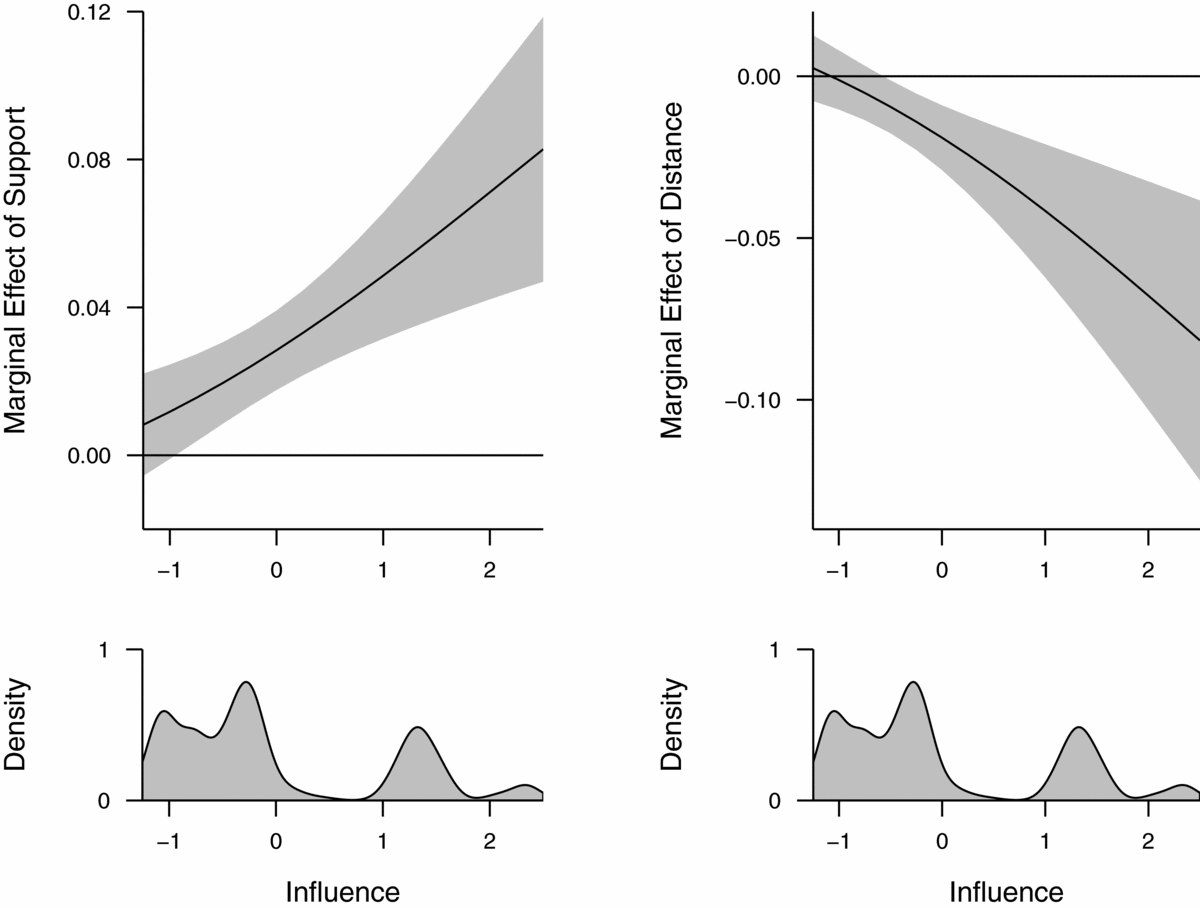
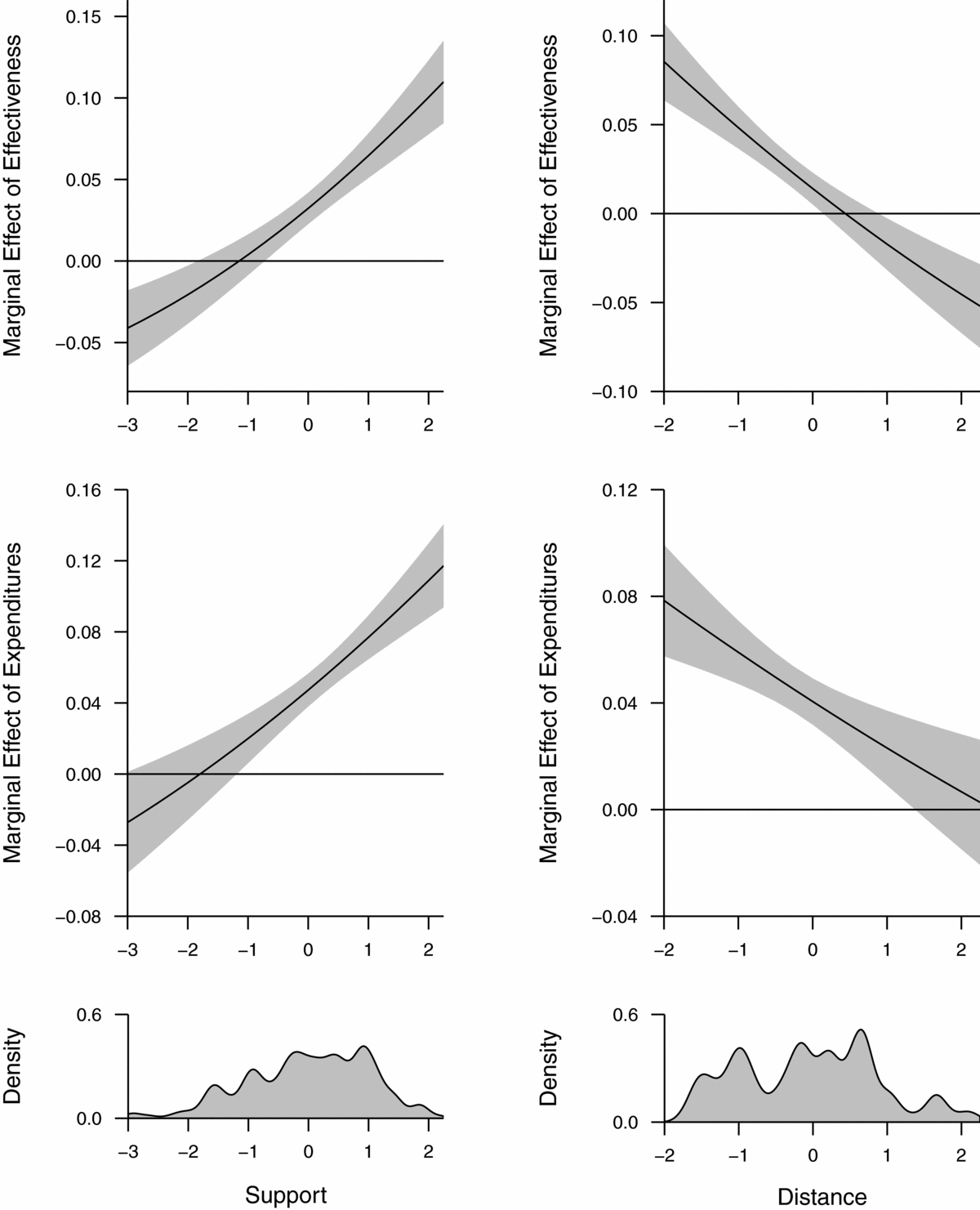
Next, consider Hypothesis 3. To properly interpret our results, we create two marginal effect plots with the appropriate confidence intervals (Brambor, Clark, and Golder Reference Brambor, Clark and Golder2006, 73–6). On the y-axis of each plot is the marginal effect of one of the constituent terms (say X) on the dependent variable (Y) and on the x-axis are the values of the other constituent term (Z). Underneath each plot, we provide the empirical distribution of whichever term is on the x-axis (Z). This makes it easy to compare the size and statistical significance of each marginal effect across values of Z. If X has a large marginal effect only for values of Z where its density is low, that effect is not substantively significant (Berry, Golder, and Milton Reference Berry, Golder and Milton2012, 10-12).
To test Hypothesis 3, we plot the marginal effect of support as a function of influence. We then substitute distance for support. We expect the magnitude of the effect, whatever the sign, to be increasing. Figure 2 shows these marginal effects along with the empirical distribution of influence.Footnote 26 Consistent with Hypothesis 3, the positive effect of support is increasing in magnitude as influence increases. The coefficient on the interaction term is statistically significant (β = 0.078; p < 0.01). The negative effect of distance is increasing in magnitude as influence increases, which is also consistent with Hypothesis 3. Again, the coefficient on the interaction term is statistically significant (β = −0.096; p < 0.01). The results are substantively the same if we use expenditures instead of effectiveness.
Results for Hypothesis 3

To get a sense of the upper bound on the substantive significance of the effects, we calculate the marginal effects of support and distance while holding influence at two standard deviations above the mean. A one-standard deviation increase in support corresponds to a 7.11% increase in the probability of observing a reasoned opinion. Switching out distance for support, a one-standard deviation increase in distance leads to a 6.78% decrease in the probability of observing a reasoned opinion.
Finally, we evaluate Inference 1 by examining the marginal effect of effectiveness, conditional on support. As shown in Figure 3, the positive marginal effect of effectiveness increases as support increases. The interaction term is statistically significant (β = 0.151; p < 0.01). When support is two standard deviations above the mean, a one-standard deviation increase in effectiveness corresponds to a 10.04% increase in the probability of observing a reasoned opinion. When we substitute distance for support, the positive marginal effect of effectiveness on  $\Pr (\textsc {opinion})$ is decreasing as distance increases (recall that distance maps inversely to E[c], unlike support). Again, the interaction term is statistically significant (β = −0.179; p < 0.01). When distance is two standard deviations below the mean, a one-standard deviation increase in effectiveness leads to an 8.54% increase in the probability of observing a reasoned opinion. As shown in Figure 3, the results are substantively the same if we use expenditures instead of effectiveness. Thus, the empirical evidence is consistent with intentional noncompliance being more common than accidental noncompliance.
Results for Inference 1

We conduct a variety of robustness checks to increase confidence in our results.Footnote 27 First, we consider alternative specifications of the empirical model. Although our sample is cross-sectional, observations occur at different points in time. As such, we estimate specifications that account for time dynamics (using polynomials of time and then including year fixed effects in a linear probability model). To ensure that our coefficient estimates are not biased due to unobserved heterogeneity, we estimate a model with year and directorate-general fixed effects (using ordinary least squares).Footnote 28 The error term may vary systematically by year, member state, the directorate-general, or the directive (if applicable). These clusters are non-nested. The nonindependence of the errors due to clustering violates the assumptions of the standard robust variance estimator. Failure to take into account clustering can lead to downward-biased standard errors, so we also estimate one specification that uses multiway non-nested clustering by year, member state, and directorate-general (Cameron, Gelbach, and Miller Reference Cameron, Gelbach and Miller2012, 238) and another that also clusters on the directive. We also estimate a linear probability model with time fixed effects and errors clustered by member state, directorate-general, and directive. Our results are robust to these alternative specifications.
Second, we consider missingness in our sample of infringement cases. Recall that including control variables based on the directive cuts the sample from 13,616 observations to 9,415 (in the specification with effectiveness and support) because the Commission does not report the number of the directive for all infringement cases. Because we do not know why this information is missing, we do not know whether our sample after listwise deletion is representative. To ensure that the construction of the sample is not affecting our results, we drop the control variables based on the directive to recover our full sample. Our results are fully robust.
Third, we explore the possibility that the Commission does not always publish complete data on letters of formal notice (as suspected by Steunenberg and Rhinard Reference Steunenberg and Rhinard2010, 506). If the Commission fails to publish letters that are not followed by reasoned opinions, we could be missing some observations in our dataset and it could bias our findings. To evaluate the possible effect, we weight up observations where opinion is coded zero by a variety of factors, up to a factor of five—far beyond any plausible degree of missingness (Greene Reference Greene2012).Footnote 29 All of our independent variables of interest, including the interaction terms, are statistically significant (p < 0.01). This is true across a wide variety of different model specifications. Thus, missing data due to bias in Commission reporting does not appear to be affecting the conclusions we draw from our findings.
CONCLUSION
Why do states infringe on EU law? How much are infringements strategic versus a product of easily correctable administrative failures? How strategic is the Commission in its monitoring and enforcement of EU law? Answering these questions is no simple matter because of the complex process that is the infringement procedure. We have proposed a model that allows for a full specification of the infringement procedure, the various potential causes of EU law violations, and the complex, countervailing strategic incentives of the government and Commission throughout the procedure.
Through the model and empirical analysis we seek to make two sets of contributions. First, we demonstrate what empirical evidence can and cannot be used to test theories of Commission enforcement. We find that, due to strategic selection by states and monitoring agencies, we cannot simply examine counts of observable noncompliance cases (e.g., Börzel Reference Börzel2001; Mbaye Reference Mbaye2001; Bursens Reference Bursens2002; Tallberg Reference Tallberg2002; Giuliani Reference Giuliani2003; Börzel and Risse Reference Börzel, Risse, Featherstone and Radaelli2003; Sverdrup Reference Sverdrup2004; Beach Reference Beach2005; Thomson, Torenvlied, and Arregui Reference Thomson, Torenvlied and Arregui2007; Perkins and Neumayer Reference Perkins and Neumayer2007). Rather, we need to look at the likelihood that a case will progress from one stage to the next in an institutional process. Moreover, we demonstrate that we cannot test strategic theories of compliance and enforcement on the decision to issue letters of formal notice or on the decision to make referrals to the Court (Mbaye Reference Mbaye2001, 268; Beach Reference Beach2005, 116). Instead we must focus on Commission decisions to issue reasoned opinions. Second, we find a number of results when we take the model to data.
First, our evidence does not falsify the model. As such, it is consistent with an argument that governments are failing to comply both because they are intentionally choosing not to comply and because they sometimes fail to implement even when they do try to comply, and that the governments and the Commission are engaged in a complex strategic interaction through the infringement investigatory process.
Second, if we are willing to treat the model as the data-generating process, we can shed some light on a core question in the literature: how much is intentional versus unintentional noncompliance happening? The evidence is at least weakly consistent with the probability of intentional noncompliance being at least as large as the probability of unintentional noncompliance. If correct, initiatives aimed at improving the administrative capacity of member states or facilitating communication between member states and the Commission may improve compliance records to a certain extent, but strategic defection would remain, and infringement investigations only do so much to contain it.
We can also learn something about when pretrial termination is a good or a bad sign for compliance. The more the Commission benefits from bringing governments into compliance, the more likely complinace is unintentional, and the larger the expected value of compliance, the more likely pretrial termination of an investigation is the product of the Commission bringing the government into compliance.
It is important to reiterate that this conclusion requires first accepting that the model is the true data-generating process, and believing that the measures are adequately capturing the concepts embedded in the model. These are both important assumptions to acknowledge. As such, we should take due caution in how strongly we draw, particularly Inference 1, without future work to confirm it.
There is also an interesting subtlety to these results worth future investigation. Scholars have found evidence consistent with the claim that the Court of Justice of the European Union is sensitive to threats of legislative override by the Council (Carrubba, Gabel, and Hankla Reference Carrubba, Gabel and Hankla2008). If correct, legislative override could also be affecting the Commission’s decision to pursue investigations.
To see how this could show up in our results, consider the following. The EU popularity support measure could in part be capturing the threat of override. The lower EU popularity, the more likely the government wants to take action to override an adverse decision. Now consider the interaction term used to test Hypothesis 3. It shows that the larger and more important the member state, the more likely the investigation is to advance, and that this effect is magnified the higher the support for the EU in that member state.
An alternative interpretation of this result is that the Commission benefits more from bringing larger states in line (same as before), but these are also the same states that are more likely to be able to form an override coalition. These two effects work in countervailing directions; the Commission wants to bring big states in line, but it does not want to pursue a case just to be overridden. EU popularity moderates this second effect. The more popular the EU is in that member state, the less likely the government is to follow through with an override threat. Thus, we also expect a positive coefficient on the interaction term. This interpretation suggests interesting new ground to explore in future work. To what degree are threats of override influencing the Commission’s actions?
That said, this interpretation does not apply equally to our other measure of the expected payoff from compliance: how much a member state government is an outlier compared to the EU center of political gravity. In this case, threats of override would be more likely the more central the government is, that is, when it can get allies. However, the more central the government, the more likely the government is to concede to the Commission (the higher the payoff of compliance).
In sum, we return to the motivating question: Is the Commission effective at enforcing EU law? The answer is mixed. If the target is for the Commission to eliminate noncompliance, the answer appears to be no. Our analysis suggests that both intentional and unintentional noncompliance are occurring, and even if the Commission found a way to cooperatively minimize unintentional noncompliance, substantial intentional noncompliance would remain.
However, perhaps that is not the right target. If instead the goal is a system that helps manage noncompliance within politically realistic constraints, then the Commission comes out much more favorably. The Commission is successfully enforcing costly compliance on member states. It can just only do so to a certain extent. Further, the Commission is backing off on cases when it thinks the odds of getting compliance even if it brings a court case are low and it has better things to do with its time and resources. And the Commission is catching unintentional noncompliance early in the process simply with letters of formal notice. This picture is a lot rosier, and consistent with broader evidence on the CJEU, even if it does not meet some normative standard of excellence. It also suggests that an international bureaucracy can facilitate compliance with international agreements.
SUPPLEMENTARY MATERIAL
To view supplementary material for this article, please visit https://doi.org/10.1017/S0003055418000096.
Replication material can be found on Dataverse at: https://doi.org/10.7910/DVN/GJIRV0.






Comments
No Comments have been published for this article.