

Objective/Introduction
When symptoms fail to improve after a first course of pharmacological treatment, available second-line strategies are dose-increase, treatment combination, add-on treatment, and switching.Reference Stahl 1 , Reference Connolly and Thase 2 Considering the different modalities for treatment switches, clinicians and patients need case-by-case recommendations. For example, immediate substitution gives the patient the opportunity to rapidly start the new treatment but may increase the risk of discontinuation symptoms. These symptoms can be incorrectly diagnosed as side effects of the new antidepressant,Reference Haddad and Qureshi 3 which may be stopped based on the claim that it is not tolerated by the patient. Therefore, rather than abrupt stoppage of the previous treatment, tapering of antidepressants at the end of treatment has been recommended,Reference Anderson, Nutt and Deakin 4 but suggestions regarding the length of the taper vary. Gradual tapering may reduce the risk of discontinuation syndrome, but this strategy leaves the patient without an active treatment when switching between antidepressants because of insufficient efficacy. Alternatively, a start–taper switch, which refers to starting the new antidepressant and simultaneously gradually tapering off of the previous one, may be preferable. Recommendations for the modalities of the switch can vary depending on pharmacokinetics and dynamic features of the previous treatment and the treatment to be introduced, patient characteristics and medical history, and whether a within- or across-class switch is used.Reference Haddad and Anderson 5
The mechanism of action of the antidepressant agomelatine (Valdoxan) differs from that of other currently approved medicationsReference de Bodinat, Guardiola-Lemaitre and Mocaer 6 and may be an attractive option for a drug-switch for that reason. To date, clinical trials with agomelatine have mainly included drug naïve patients or patients that washed out of previous antidepressant treatments, which does not mimic real-life situations. The present study compared 3 switching options when initiating agomelatine (25 mg/day p.o.) in depressed outpatients after failure of treatment with either the selective serotonin reuptake inhibitor (SSRI) paroxetine or the serotonin–norepinephrine reuptake inhibitor (SNRI) venlafaxine.
We have assessed immediate substitution or initiation of agomelatine with either short- or long-tapering of the previous drug. The primary outcome measure was the total number of discontinuation-emergent symptoms according to the Discontinuation-Emergent Signs and Symptoms checklist (DESS).Reference Rosenbaum, Fava, Hoog, Ascroft and Krebs 7 The objective was to check whether symptoms reported after switching from an SSRI or SNRI to agomelatine could be due to discontinuation of the initial drug and not to side effects of agomelatine. Secondary objectives included tolerability and safety assessments and determination of the early clinical benefits following the switch.
Methods
This safety study was initiated only after the Ethics Committee's approval was obtained, and the study was conducted in accordance with the principles of Good Clinical Practice and the Declaration of Helsinki. Patients signed informed consent in accordance with the guidelines of the relevant institutional review boards.
Participants
A total of 316 male and female outpatients, aged 19–65, with a primary diagnosis of a moderate to severe episode of a major depressive disorder (MDD) (single or recurrent) according to the Diagnostic and Statistical Manual of Mental Disorders, 4th edition, text revision (DSM-IV-TR) were recruited from 54 centers in Belgium, Brazil, France, Germany, Hungary, Italy, Portugal, and Spain. The Mini Neuropsychiatric Interview (MINI)Reference Sheehan, Lecrubier and Sheehan 8 was used to identify a major depressive episode. Participants completed a Hospital and Depression Anxiety (HAD) scale.Reference Zigmond and Snaith 9 The current episode of MDD must have lasted at least 6 weeks with or without melancholic features and seasonal patterns, without psychotic features, and without catatonic features.
The patients must have taken either paroxetine (≥20 mg/d) or venlafaxine (≥75 mg/d) for at least 6 weeks, with an insufficient treatment efficacy as demonstrated by a score ≥4 on item 1 of the Clinical Global Impression (CGI) scaleReference Guy 10 at the selection visit (associated or not with poor acceptability).
Patients had to be physically healthy or to have had stabilized from significant illnesses on the basis of medical history, physical examination, and clinical laboratory tests (biochemistry and hematology, thyroid hormones, and hepatitis A, B, and C markers).
Patients were excluded if they had transaminase values ≥3 times the upper normal limit (ULN). Patients with any of the following disorders as indicated by the DSM-IV-TR were excluded: (1) bipolar disorder I and II, major depressive disorder superimposed on dysthymic disorder, current panic disorder, obsessive compulsive disorder, posttraumatic stress disorder, acute stress disorder, schizoaffective disorder of depressive type, acute or chronic psychosis, or antisocial or borderline personality disorders; or (2) alcohol or drug abuse or dependence within the past 12 months. Patients were excluded if they were at risk of suicide according to the investigator or according to the MINI 5.0.0.
Patients were excluded if they were treated within the 6 weeks before the selection visit with either paroxetine or venlafaxine at subtherapeutic doses for more than 3 days. Patients were excluded if they were treated by at least 2 antidepressants for more than 3 days within the 2 weeks prior to selection.
Patients with neurologic disorders (dementia, seizure, and stroke) or severe or uncontrolled organic disorders (neoplasic, cardiovascular, pulmonary, or digestive disorders, or unstabilized type I or II diabetes) were excluded.
Patients were excluded if they had received any of the following recent/concomitant therapies: light therapy started within 2 weeks, oral antipsychotic drugs within 4 weeks, mood stabilizers within 2 weeks, depot neuroleptics within 2 injection-period times before the selection visit (eg, within 30 days for intramuscular risperidone), or electroconvulsive therapy or transcranial magnetic stimulation within the last 3 months. Treatments with benzodiazepines were authorized during the study if started at least 2 weeks before inclusion and used at stable dosages up to week 3.
Design
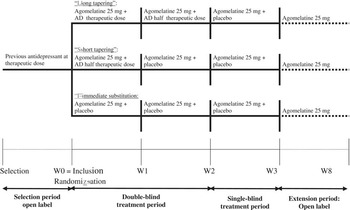
Following a 3–10 day selection period during which patients continued taking paroxetine 20 mg/d or venlafaxine 75 mg/d, all patients started agomelatine 25 mg/d at the inclusion visit (week 0). A treatment sequence was assigned in double-blind conditions at inclusion by a balanced (non-adaptive) randomization (stratified on the center and the previous antidepressant) with a 1:1:1 ratio (Figure 1). Patients were assigned 1 week of treatment in one of the following treatment arms:
Design of the study. AD = antidepressant, ie, paroxetine (therapeutic dose = 20 mg/d) or venlafaxine (therapeutic dose = 75 mg/d); W = week.

-
• “Long tapering”: agomelatine 25 mg/d + paroxetine 20 mg/d or venlafaxine 75 mg/d
-
• “Short tapering”: agomelatine 25 mg/d + paroxetine 10 mg/d or venlafaxine 37.5 mg/d
-
• “Immediate substitution”: agomelatine 25 mg/d +placebo
At week 1, patients in the “long tapering” group received agomelatine 25 mg/d, and the dosage of the previous treatment was decreased to a half dose (double-blind conditions); patients in the other groups received agomelatine 25 mg/d and placebo. At week 2, all patients received agomelatine 25 mg/d + placebo (blind conditions for the patient).
At week 3, patients with satisfactory efficacy (according to the investigator's judgment) and acceptability results entered a 5-week open-label extension period and were given agomelatine 25 mg/d for up to 8 weeks of treatment.
Measures
The primary safety outcome measure was the total number of discontinuation-emergent, ie, new or worsening, symptoms according to the DESS.Reference Rosenbaum, Fava, Hoog, Ascroft and Krebs 7 The DESS was assessed at each visit from inclusion to week 3 (most antidepressant discontinuation-emergent reactions resolve spontaneously between 1 day and 3 weeks after onset.Reference Warner, Bobo, Warner, Reid and Rachal 11 ) To ensure the reliability of the rating of the DESS, investigators were trained and received recommendations to administer the DESS.
Secondary safety measures included adverse events reported at each visit, hematology and biochemistry parameters (weeks 0 and 3; week 8 for liver function), vital signs (blood pressure, heart rate), body weight, and BMI (selection, weeks 0, 3, 8).
Regarding efficacy measurements, CGI item 1 (severity of illness, CGI-S) was assessed at all visits, and CGI item 2 (global improvement, CGI-I) was assessed at all but the selection and week 0 visits.
Statistical analyses
The primary safety criterion was expressed as a value at each visit and as a cumulative value. The different methods of initiating agomelatine after paroxetine or venlafaxine were compared 2 by 2 on the primary criterion in the DESS Set (all included patients having taken at least 1 dose of agomelatine and having at least 1 value of the primary criterion) using a single negative binomial regression (modeled for count data) with the group and previous antidepressant as explanatory variables at the following times: (i) weeks 1, 2, and 3; (ii) week 3 in terms of cumulative value; and (iii) 1 week after stopping the previous antidepressant treatment (weeks 1, 2, and 3 for the “immediate substitution,” “short tapering,” and “long tapering” groups, respectively). A description of the primary safety criterion was also performed at each visit according to the previous antidepressant treatment. The percentage of patients reporting at least 3 new discontinuation symptoms was provided.Reference Tint, Haddad and Anderson 12
For the secondary safety criteria and for the efficacy criteria, descriptive statistics were provided by the group during the 3- or 8-week study periods: in the Safety Set for the secondary safety criteria (all included patients that had taken at least 1 dose of agomelatine) and in the full analysis set (FAS) for efficacy criteria (all included and randomized patients that had taken at least 1 dose of agomelatine and that had at least 1 post-baseline efficacy assessment). The CGI-I scores were described in the subset of patients with at least 1 discontinuation-emergent symptom 1 week after cessation of the previous antidepressant treatment and in the subset of patients without discontinuation symptoms.
Statistical analysis was performed using SAS software, version 9.1.3 (Cary, NC, USA). The type I error was set at 5% (2-sided tests) for each statistical analysis performed on the primary safety criterion because no predefined hypothesis could be stated.
Results
Patients
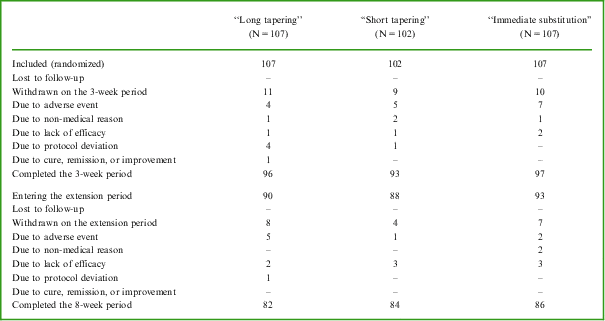
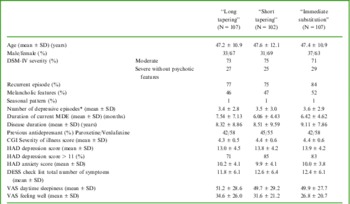
Three hundred sixteen patients were randomized (107 in the “long tapering” group, 102 in the “short tapering” group, and 107 in the “immediate substitution” group); overall 286 patients (90.5%) and 252 patients (79.7%) completed the 3-week and 8-week periods, respectively. The disposition of the patients by group is presented in Table 1. There were no clinically relevant differences between the groups for demographic criteria or MDD characteristics at baseline (Table 2). The mean ± SD severity of the illness by CGI was 4.4 ± 0.6, and 80% of patients had a HAD depression sub-score ≥11, indicating that patients felt at least moderately depressed. The mean ± SD number of symptoms on the DESS check list was 12.3 ± 6.2, which was found in patients who had previously received either paroxetine (12.0 ± 6.6) or venlafaxine (12.5 ± 5.9).
Disposition of patients over 3 and 8 weeks of treatment (number of patients)

Baseline patient demography and clinical characteristics—randomized set

*Including the current one.
Primary criterion
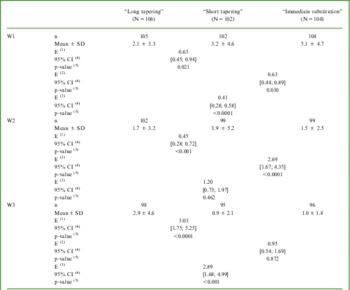
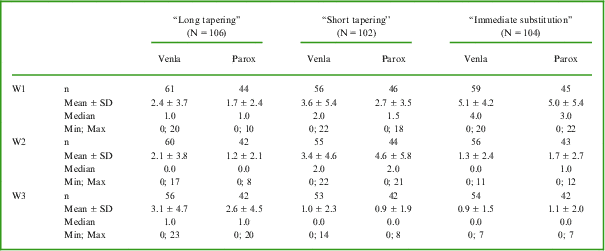
For the 3 switching options, discontinuation-emergent symptoms were observed 1 week after the cessation of the SSRI/SNRI treatment. The mean total number of discontinuation-emergent symptoms was significantly higher in patients who stopped the previous antidepressant treatment the preceding week (Table 3) than in other patients. Similar results were generally obtained when considering the previous antidepressant taken, except in patients on short venlafaxine tapering, who reported a similar number of discontinuation symptoms at weeks 1 and 2 (Table 4).
Total number of discontinuation emergent symptoms at W1, W2, and W3 and between-group comparison—DESS set

Negative binomial regression with group and previous antidepressant treatment (paroxetine or venlafaxine) as explanatory variables.
(1) Estimate of the adjusted ratio between group means: ‘‘long’’ versus ‘‘short’’ tapering groups.
(2) Estimate of the adjusted ratio between group means: ‘‘short’’ tapering group versus ‘‘immediate substitution’’ group.
(3) Estimate of the adjusted ratio between group means: ‘‘long’’ tapering group versus ‘‘immediate substitution’’ group.
(4) Two-sided 95% confidence interval of the estimate.
(5) Two-sided p-value.
Total number of discontinuation emergent symptoms at W1, W2, and W3 according to previous antidepressant treatment—DESS set

The cumulative numbers of discontinuation symptoms (mean ± SD) at week 3 (taking into account only patients present at week 3) were 6.8 ± 6.2 (median: 5) after “immediate substitution,” 7.6 ± 8.0 (median: 6) after “short tapering,” and 6.6 ± 7.0 (median: 4) after “long tapering”; there were no significant differences between groups. One week after cessation of the SSRI/SNRI treatment, 48.1% of patients in the “immediate substitution” group reported the onset of 3 or more new symptoms on the DESS checklist, while such symptom rates were found in 32.3% and 20.4% of patients after “short tapering” and “long tapering,” respectively.
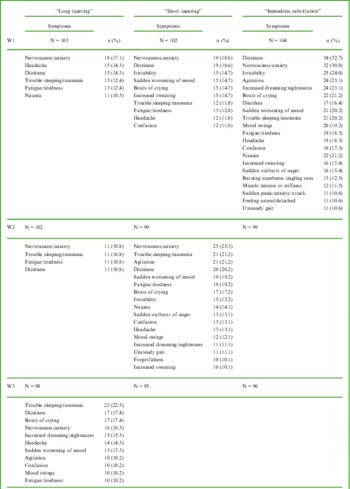
Psychic symptoms were the most frequently reported (nervousness/anxiety, agitation, increased dreaming/nightmares, bouts of crying, sudden worsening of mood, trouble sleeping/insomnia) (Table 5). Somatic symptoms were quite few except dizziness, fatigue/tiredness, and, to a lesser extent, nausea. Similar results were obtained when taking into account the previous antidepressant taken.
Discontinuation emergent symptoms (reported by ≥10% of patients)—DESS set

%: n/N; N: number of patients at the visit; n: number of patients with at least 1 emergent symptom.
Adverse event (secondary criteria)
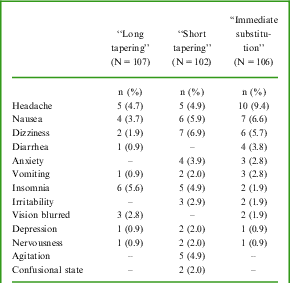
During the 3-week study period, 38.7% of patients in the “immediate substitution” group reported at least 1 emergent adverse event (EAE); 32.4% and 25.2% of patients reported EAEs in the “short tapering” and “long tapering” groups, respectively. Headache, nausea, dizziness, and insomnia were the most frequent EAEs reported by patients in each group. EAEs were generally less reported in the “long tapering” group than in the 2 other groups (Table 6). Most EAEs were rated as mild or moderate. Some patients experienced at least 1 EAE rated as severe: 4 patients (3.8%) in the “immediate substitution” group, 2 patients (2.0%) in the “short tapering” group, and 4 patients (3.7%) in the “long tapering” group. Five patients (1.6%) had severe EAEs leading to study-drug withdrawal, including 3 patients (2.8%) in the “immediate substitution” group and 2 patients (1.9%) in the “long tapering” group.
Most frequently reported emergent adverse events (restricted to at least 2% of patients in any group) during the 3-week treatment period—Safety set

n: Number of patients with at least one EAE.
A similar safety profile was observed over the 8-week period: 46.2% of patients reported at least 1 EAE after immediate substitution; 36.3% and 29.9% of patients reported at least 1 EAE in the “short” and “long” tapering groups, respectively. EAEs were generally of mild or moderate intensity; 15.9% of EAEs were rated as severe in the “immediate substitution” group, 9.1% in the “long tapering” group, and 3.4% in the “short tapering” group. No death was reported during the study.
There were neither clinically relevant between-group difference nor changes over time in groups for the biochemical and hematological parameters, sitting blood pressure, heart rate, weight, or BMI.
Over the 8-week study period, 5 patients (1 in the “immediate substitution” group, 1 in the “short tapering” group, and 3 in the “long tapering” group) had emergent transaminases increases under treatment ≥3 ULN, and one patient had a potentially clinically significant abnormal bilirubin value, most likely related to treatment. All values normalized after agomelatine cessation.
CGI-I scores and response rates
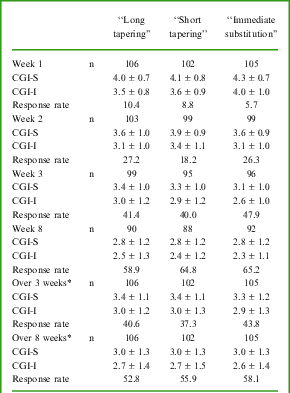
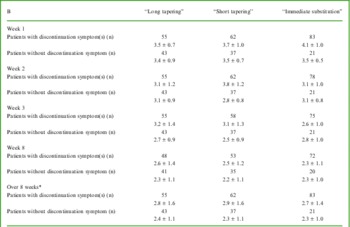
Overall, the mean CGI-S scores and CGI-I scores decreased between baseline/week 1 and the last post-baseline assessment in the three groups in the FAS (Table 7). At the last post-baseline value over 8 weeks, the results were clinically relevant in all groups, and there were no between-group differences at the last post-baseline value over 3 or 8 weeks. A descriptive analysis showed numerically higher mean CGI-I scores in patients who had stopped the SSRI/SNRI the preceding week (ie, at week 1 for the immediate substitution group, at week 2 for the “short-tapering” group, and at week 3 for the “long tapering” group) than in the 2 other groups (Table 7A). The mean CGI-I scores were also numerically higher in the subset of patients who reported at least 1 discontinuation-emergent symptom (1 week after the cessation of the previous antidepressant treatment) than in the subset of patients without discontinuation emergent symptoms (Table 7B).
CGI severity of illness (CGI-S) and global improvement (CGI-I) scores (mean ± SD):rates of responders by CGI-I (%) at weeks 1, 2, 3, 8 and last post-baseline values over 3- and 8-week periods—FAS

*Last post baseline value.
CGI-I scores (mean ± SD) in patients of the FAS with and without at least 1 discontinuation emergent symptom 1 week after previous antidepressant treatment stop

*Last post baseline value.
Over the 8-week period, the percentage of patients who responded to treatment according to the CGI scale (CGI-I score = 1 or 2) for the last value was 52.8% in the “long tapering” group, 55.9% in the “short tapering” group, and 58.1% in the “immediate substitution” group.
Discussion
The present controlled trial has been specifically designed to provide clinicians with useful information regarding switching conditions with the antidepressant agomelatine after an initial 6-week treatment failure with therapeutic doses of paroxetine or venlafaxine. Patients who benefit from such a switch were moderately or severely depressed, and this study provides a picture of those patients seen in everyday practice after unsuccessful antidepressant treatment. To our knowledge, this is the first study in the field to provide a basis for everyday clinical decision-making. A number of pieces of information arise from our data.
First, regardless of the switching option that was used, discontinuation-emergent symptoms were systematically observed the week following the discontinuation of SSRI/SNRI treatment. The number of discontinuation-emergent symptoms was not dependent on the class of the previous antidepressant taken. Psychic symptoms were the most frequently reported, and somatic symptoms were comparatively few. The nature and rate of discontinuation symptoms in this study compare with those observed previously.Reference Dominguez and Goodnick 13 – Reference Judge, Parry, Quail and Jacobson 15 Tapering did delay but did not significantly lessen the symptoms, which were reported as frequent by all patients in all groups. Only a slight reduction in the number of symptoms was observed at the time of paroxetine/venlafaxine cessation upon long-term tapering. Paroxetine or venlafaxine rapidly induce discontinuation symptoms on abrupt stoppage, and a spontaneous resolution within approximately 7–10 days is the norm.Reference Rosenbaum, Fava, Hoog, Ascroft and Krebs 7 , Reference Tint, Haddad and Anderson 12 , Reference Fava, Mulroy, Alpert, Nierenberg and Rosenbaum 14 – Reference Price, Waller, Wood and MacKay 19 Intuitively, symptoms should be less frequent if paroxetine or venlafaxine were tapered down rather than stopped abruptly. We therefore assessed whether a start–taper switch, which refers to starting agomelatine and simultaneously gradually tapering the previous antidepressant, may be preferable. Surprisingly, short- and long-term tapering of paroxetine and venlafaxine were not very beneficial in reducing symptoms.
Second, there was no clear benefit of long tapering over short tapering regarding the incidence of discontinuation syndrome, which agrees with the assumption that taper duration has no significant effect. When assessed on the week following the SSRI/SNRI treatment cessation, patients who reported at least 3 new DESS symptoms were numerically lower when they had the previous antidepressant tapered down for 2 weeks than in the 2 other groups. During the study period, EAEs were also generally less frequently reported in the group of patients on “long tapering.” To our knowledge, only 1 open study has assessed the effect of the duration of tapering on discontinuation symptoms in patients with MDD in whom the clinician wanted to switch the existing antidepressant (either an SSRI or venlafaxine).Reference Tint, Haddad and Anderson 12 Tint etal's conclusions were that if tapering is beneficial in reducing symptoms, then its duration should be in excess of 14 days for most patients.Reference Tint, Haddad and Anderson 12 However, many factors may influence the duration of tapering, including the propensity of the antidepressant to cause discontinuation symptoms, whether the patient has a previous history of discontinuation symptoms, and the degree of urgency associated with stopping the antidepressant.Reference Haddad and Anderson 5
Third, it is important to consider that CGI-I scores were elevated in patients who stopped the SSRI/SNRI during the preceding week, particularly in patients reporting at least 1 discontinuation symptom at that time. Such descriptive findings may reflect that early discontinuation symptoms after SSRI/SNRI cessation can be incorrectly regarded as side effects or as a lack of efficacy of the new antidepressant.Reference Haddad and Qureshi 3 In real practice, patients are not seen weekly by the practitioner, and they could discontinue use of the new antidepressant because of the incorrect belief that they cannot tolerate it. This scenario of a “bad switch” most often occurs when switching across antidepressant classes. Many of the adverse events reported in real practice by patients switching to agomelatine because of a failure to respond adequately to another class of antidepressant treatment have never been observed in agomelatine clinical studies. One can reasonably question whether this is a scenario of a bad switch or a good switch after a preceding treatment with residual discontinuation symptoms.
Some study limitations deserve mention when interpreting the present findings. First, a number of exclusion criteria have been used, and individuals vary in their propensity to experience discontinuation symptoms. Therefore, the findings reported in our sample of patients may not be generalizable to patients presenting with additional criteria and/or a different sensitivity to antidepressant discontinuation. Second, recommendations for the modality of switching can vary depending on the pharmacokinetic and dynamic features of the previous treatment. Therefore, our conclusions regarding clinical decision-making when switching for agomelatine could be different with antidepressants other than venlafaxine and paroxetine. Finally, we examined only some options of agomelatine switching and do not provide a complete picture of the managed care options available for this antidepressant.
Conclusions
In everyday practice, both abrupt and start–taper switching with agomelatine are options for patients who have not responded to either paroxetine or venlafaxine. An immediate switch is feasible depending on whether the patient has no history of severe discontinuation symptoms. A start–taper switch may appear to be a good solution because it allows agomelatine to be started immediately, and there are no potential drug interactions with agomelatine that could warrant a wash-out period.Reference McAllister-Williams, Baldwin, Haddad and Bazire 20 However, this may be considered costly and too complicated for the patient (risks of mistakes or noncompliance). For any switching strategy, our findings underscore the importance of warning patients about early withdrawal symptoms. Both the patient and clinician must be aware that discontinuation symptoms that arise upon cessation of paroxetine or venlafaxine may be confounded with a lack of early clinical benefit. As long as the patient and clinician are informed, discontinuation symptoms will not prejudice the antidepressant efficacy and tolerability of agomelatine over time.
Disclosures
Michel Lejoyeux has no conflict of interest. Sophie Matharan and Christian De Bodinat are employees at Servier.