

INTRODUCTION
Several publications have reported the increasing threat to food security from root rot disease of cassava (Mskita et al. Reference Mskita, James, Ahounou, Baimey, Facho and Fagbemisi1998; Reference Mskita, Bissang, James, Baimey, Wilkinson, Ahounou and Fagbemisi2005; Onyeka et al. Reference Onyeka2002; Reference Onyeka, Ekpo and Dixon2005) in the sub-Saharan region of Africa. This region grows 55% of the world production of cassava roots and Nigeria alone contributes 21% of the total (FAO, 2007). Cassava is a major food staple for humans, provides feed for livestock and is currently a major source of industrial raw material for high quality cassava flour, starch and ethanol.
In 2004 and 2005, through field trials in over 2500 locations, 40 new varieties were introduced in Nigeria. Three old improved varieties were included as controls. The aim of the introduction of these new varieties was to pre-emptively manage cassava mosaic disease (CMD), avert an imminent threat from the Ugandan strain of the pathogen and prevent damage to the Nigerian cassava economy. In 2006, 10 varieties were officially released to farmers; the varieties were selected following the field trials on the basis of resistance/tolerance to CMD, fresh root yield (FYLD) of more than 20 t ha−1, dry matter content (DM) of more than 30% and their acceptability by farmers. These new varieties were TME 419, TMS 97/2205, TMS 98/0505, TMS 98/0510, TMS 98/0581, NR 87184, TMS 92/0057, TMS 92/0326, TMS 96/1632 and TMS 98/0002.
Since the introduction of these new varieties there has been an increase in cultivation of cassava because of the new markets offered to farmers by the non-staple food industries such as starch, high quality cassava flour and ethanol enterprises spread over the country. In addition the farmers have learnt improved production techniques to increase their yields with the hope of reaping enhanced income from sales of roots to industry. Since this is an emerging market, farmers often have limited information about which company is buying, the purchase price and volume requirements. Even when these are known, the price might not be favourable to the farmer when the costs of manual harvest and transportation are considered. Thus, many farmers leave the cassava in the field for up to 15 months, hoping for a better price from the industries. It is known that when they eventually harvest, much of the yield is lost to root rot disease. Msikita et al. (Reference Mskita, Bissang, James, Baimey, Wilkinson, Ahounou and Fagbemisi2005) reported yield losses could be up to 80%.
The objective of this paper is to evaluate the relative resistance to root rot disease of the 43 varieties introduced to farmers during the formal trials. Since the trials were conducted in several agroecological zones (AEZs) of Nigeria, the paper will also show the effect of root rot on yield parameters within and across AEZs.
MATERIALS AND METHODS
Data on root rot disease were collected in 2003/2004 and 2004/2005 from 25 field trials conducted in the following locations: Abeokuta, Abuja, Akure, Amukpe-songhai, Yenagoa, Biase, Calabar, Egbema, Ekiti, Ibadan, Ikenne, Ilesha, Ilorin, Ishiagu, Kaduna, Malam-madori, Mokwa, Nsukka, Onne, Otobi, Ubiaja, Umudike, Uyo, Warri and Zaria. In each of these trials, 40 new varieties were assessed along with three known controls (TMS 30572, TMS 4(2)1425, TMS 82/00058). All varieties used in the trials are shown in Table 4.
The experimental design was a randomized complete block design, partitioned into three sets and each set was replicated four times. Set I consisted of 14 new varieties plus three controls, Set II consisted of 13 new varieties plus three controls and Set III consisted of 16 new varieties plus three controls randomly partitioned. The three controls were repeated in each set to enable adjustment of variations between varieties within and across sets during statistical analysis (Wolfinger et al., Reference Wolfinger, Federer and Cordero-Brano1997). Replicates 1 and 3 were fertilized at the rate of 400 kg ha−1; replicates 2 and 4 were not fertilized. The sets were introduced to reduce experimental error due to the large experimental plot size.
All trials were under rain-fed conditions and managed by scientists, who came from the International Institute of Tropical Agriculture, National Root Crops Research Institute, Umudike, some universities and private companies, and by agricultural extension workers.
Each plot consisted of 40 plants with four plant ridges. Ridges were 10 m long and spaced 1 m apart. Spacing between plants was 1 m, giving a total plant population of 10 000 plants ha−1. Weeds were controlled by spraying pre-emergence herbicide at recommended rates and weeding manually twice.
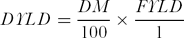
Data were collected from the two inner ridges within each plot on several traits, such as foliar disease incidence, foliar disease severity, agronomic features (establishment ability at harvest, FYLD, number of roots per variety, number of roots with root rot, and percentage DM of roots). Data on root rot were collected 12 months after planting, at harvest. Root rot was the proportion of rotten roots to the total number of roots. Dry yield (DYLD) was derived as a product of DM and FYLD expressed in t ha−1.
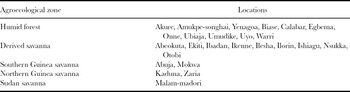
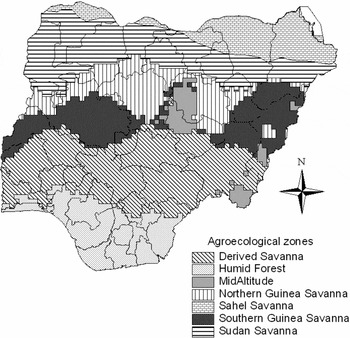
Data on root rot and yield parameters were analysed with the MIXED model procedure using SAS software, version 9 (SAS, 2003). Year and replication were fitted as random effects, while genotypes (G), locations (L), genotype × location interaction (GL) were fitted as fixed effects. The 25 locations where data on root rot disease had been collected were further partitioned by AEZs (Table 1; Figure 1), and a MIXED model procedure was used to fit the fixed effects of genotypes (G), environments (E) and genotype × environment interaction (G × E). Deductions from a genotype's reaction within an agroecological zone will help assist in decisions about the broad application of such a genotype in the zone.
Grouping of the 25 test locations into agroecological zones.

Agroecological zones where trials were conducted in Nigeria.

Genotypes were partitioned into various classes of susceptibility using a rank-sum method based on the means of each genotype across the 25 locations for two years. The RANK procedure of SAS (SAS, 2003) with option average for handling ties was used to assign ranks to genotypes in each location from the smallest to the largest (Egesi et al. Reference Egesi, Ogbe, Akoroda, Ilona and Dixon2006; Onyeka et al., Reference Onyeka, Ekpo and Dixon2005). The sum of the ranks (Xn) was calculated for each genotype and compared to the grand mean of the rank sums across all genotypes (Gn). Deviation of each genotype from the grand mean was calculated as [(Xn–Gn)/standard deviation] × 2. Deviations to the right (positive) of the grand mean on the mean distribution curve were rated susceptible while deviations to the left (negative) of the grand mean were rated resistant (Onyeka et al., Reference Onyeka, Ekpo and Dixon2005). A genotype is considered highly resistant (HR) to root rot disease if it is lower than −3 standard deviations from the grand mean (Gn), resistant (R) if it is between −2 and −3, moderately resistant (MR) if it is between −2 and zero, moderately susceptible (MS) if it is between zero and 2, susceptible (S) if it is between 2 and 3, and highly susceptible if it is greater than 3 standard deviations from Gn (Onyeka et al., Reference Onyeka, Ekpo and Dixon2005). SAS correlation and regression analysis procedures were used to examine the effect of root rot on FYLD, DYLD and DM.
RESULTS AND DISCUSSION
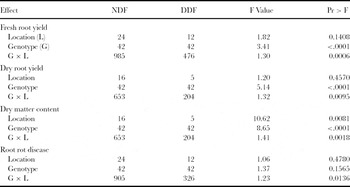
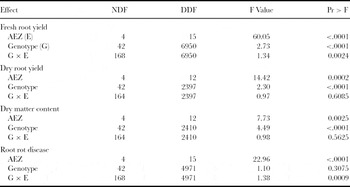
The analysis of variance table of the 43 genotypes across the 25 locations is shown (Table 2). Unlike the yield traits such as FYLD, DM and DYLD, where genotype main effect was significant (p ≤ 0.05), root rot disease trait did not show significant differences among genotypes. This implies that no single genotype distinguished itself in terms of resistance or susceptibility to root rot across the 25 locations. However, for all the traits, G × L was significant (p ≤ 0.05). Thus, the reaction of genotypes to root rot and yield was subject to environmental influence in the different locations. The G × E interaction effect was also significant (p ≤ 0.05) for root rot and FYLD traits when the locations are grouped into AEZs (Table 3). Thus the environment in terms of agroecology plays a key role in how long it takes for root rot to manifest itself in different genotypes.
Generalized linear mixed model of cassava yield parameters and root rot for 43 varieties evaluated in 25 locations in two years in Nigeria

NB: The tests of the fixed effects provides us with a summary of an analysis of variance table.
NDF: Numerator degree of freedom; DDF: Denominator degree of freedom.
Generalized linear mixed model of cassava yield parameters and root rot for 43 varieties evaluated in five agroecological zones (AEZs) in two years in Nigeria

NB: The tests of the fixed effects provide a summary of an analysis of variance table (NDF: Numerator degree of freedom; DDF: Denominator degree of freedom).
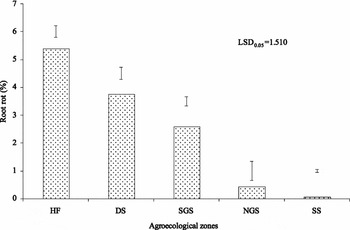
There was no genotype that had zero root rot for all 25 locations. The highest mean root rot disease incidence was at Ibadan (10%) and the lowest was at Malam-madori (0.04%). The maximum incidence of the rot was observed at Warri (70%) followed by Yenagoa (67%), both in the humid forest AEZ (high rainfall). Within the humid forest AEZ, Biase, Egbema and Ubiaja had the lowest root rot incidence of 10–11%. Based on AEZs, the highest level of root rot was recorded in the humid forest (5.4%) followed by the derived savanna zone (3.8%), Southern Guinea savanna (2.6%), Northern Guinea savanna (0.5%) and Sudan savanna (0.1%) (Figure 2).
Mean cassava root rot in five agroecological zones of Nigeria (n = 43). Error bars show standard error. LSD: Least significance difference.

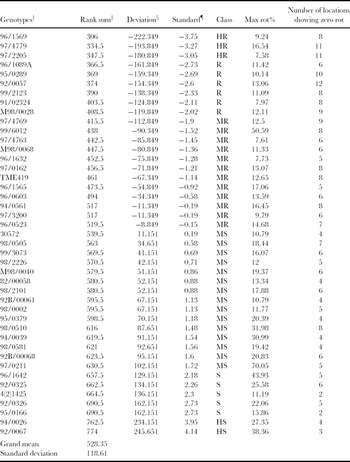
Table 4 shows the ranking for the 43 genotypes using the rank sum method. One may ask if those in the R and HR classes are really resistant to root rot. In some locations these genotypes had an incidence as high as 17% (Table 4), but the mean number of locations where there was no disease was nine (range 6–12). So the genotypes in these two classes are better in more locations than their counterparts. It should be noted, however, that the classification using rank sum does not replace assessment by screening. Dixon et al. (Reference Dixon, Akoroda, Okechukwu, Ogbe, Ilona, Sanni, Lemchi, Ssemakula, Yomeni, Okoro and Tarawali2007) showed that these genotypes, irrespective of location, gave yields of more than 15 t ha−1, which is above the baseline farmer yields of 9 t ha−1. Thus, all the genotypes are tolerant to root rot, but greater yields are obtainable if the disease is diminished.
Ranking by susceptibility to root rot disease across 25 locations and the frequency of locations without disease for each of the 43 genotypes.

†TMS 30572, TMS 4(2)1425, TMS 82/00058 are known controls; all other genotypes are new varieties.
‡Sum of ranks for each clone; §: Deviation from grand mean; ¶: standardized mean ([deviation/standard deviation] × 2).
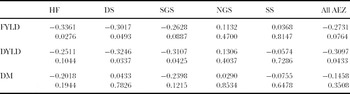
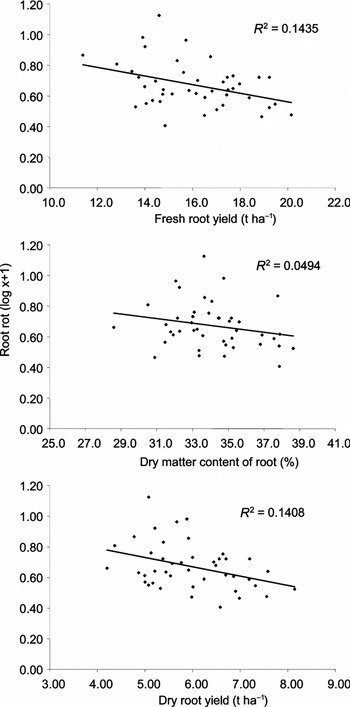
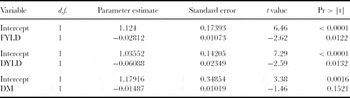
The correlation analysis showed a negative relationship between root rot disease and yield traits (Table 5). This result agrees with earlier reports of Miskita et al. (Reference Mskita, Bissang, James, Baimey, Wilkinson, Ahounou and Fagbemisi2005) and Onyeka et al. (Reference Onyeka, Ekpo and Dixon2005). While this relationship was significant (p ≤ 0.05) with FYLD and DYLD, it was not for DM. This agrees with previous reports expressing stability of the cassava DM trait. Figure 3 shows the pattern of the relationship with significant slopes for FYLD and DYLD (Table 6).
Correlation analysis between cassava root rot and yield parameters in the agroecological zones (AEZs) of Nigeria.

HF: Humid forest; DS: Derived savanna; SGS: Southern Guinea savanna; NGS: Northern Guinea savanna; SS: Sudan savanna.
FYLD: Fresh root yield; DYLD: Dry yield; DM: Dry matter.
Relationship between root rot, fresh root yield, dry matter content and dry root yield.

Regression analyses of cassava root rot to yield parameters

FYLD: Fresh root yield; DYLD: Dry yield; DM: Dry matter.
There was no location where any genotype showed zero incidence of rot, implying that farmers cannot leave their cassava for over 12 months in the soil without incurring serious losses from rot, even though these are high-yielding genotypes. Early bulking has been suggested as a solution. This means that breeders should continue to develop genotypes that will mature early so that farmers can grow two crop cycles in the year. This way they can vary the volume they produce, based on demand from the market, and switch to another crop within the year if there is no favourable price for cassava without having a total failure in business. It is also important to advise farmers to add value to the roots by processing, so that they will not be so vulnerable to industrial price changes.
CONCLUSIONS
No completely resistant variety was found, indicating that early harvest (9–11 months after planting) is still the best way to reduce losses from root rot. Farmers need to add value to their roots without depending totally on open market for sales.
Root rot is significantly (p ≤ 0.05) influenced by G × E interaction. It is also negatively correlated with FYLD, DYLD and DM across all AEZs. Most rots were recorded in the humid forest and the least in the Sudan savanna.
Using a rank-sum method, the 43 varieties were separated into six categories: highly resistant (3), resistant (6), moderately resistant (12), moderately susceptible (15), susceptible (5) and highly susceptible (2). While TMS 92/0067 and TMS 94/0026 were highly susceptible, TMS 96/1569, TMS 97/4779 and TMS 97/2205 were highly resistant across most of the locations tested. In descending order, varieties TMS 96/1569, TMS 97/4779, TMS 97/2205, TMS 96/1089A, TMS 95/0289, TMS 92/0057, TMS 99/2123, TMS 91/02324, TMS M98/0028, TMS 97/4769, TMS 99/6012, TMS 97/4763, TMS M98/0068, TMS 96/1632, TMS 97/0162, TME 419, TMS 96/1565, TMS 96/0603, TMS 94/0561, TMS 97/3200 and TMS 96/0523 are tolerant across most AEZs in Nigeria.
Though this paper did not identify the causes of the root rot disease, Nattrassia mangiferae (Miskita et al. Reference Mskita, Bissang, James, Baimey, Wilkinson, Ahounou and Fagbemisi2005), Botrydiplodia theobromae (Onyeka, Reference Onyeka2002), nematodes and bacteria acting singly or in combination have been reported to induce this disease.
Acknowledgements
The authors are appreciative of the following development investors: Federal Government of Nigeria, the Niger Delta Development Commission, Shell Petroleum Development Company of Nigeria, the United States Agency for International Development and the state governments in Nigeria for co-operation and support. Special thanks also go to the Programme Managers and staff of Agricultural Development Programmes in states where these trials were conducted, the staff of National Root Crops Research Institute, Umudike, the staff of Root and Tuber Expansion Programme and participating farmers for their assistance in conducting experiments.