In Australia, the inclusion of Aboriginal and Torres Strait Islander perspectives in school curricula has long been identified in educational policy as a priority area of development in order to promote understanding and mutual respect between Indigenous and non-Indigenous members of society (Department of Education and the Arts, 2006). The education authority in each state has required teachers to embed Indigenous perspectives; however, many teachers express concern that they lack the necessary knowledge and skills to implement this (Harrison & Greenfield, Reference Harrison and Greenfield2011). The Australian Curriculum developed by the Australian Curriculum and Assessment Reporting Authority (ACARA) (2011b) includes a concern for reconciliation through education. The curriculum contains both a Cross-Curricular Priority (CCP) and a General Capability that work towards promoting intercultural understanding in students (ACARA, 2014). One of three CCPs, the Aboriginal and Torres Strait Islander Histories and Cultures CCP aims to deepen students’ knowledge of Australia through engaging with Indigenous cultures (ACARA, 2011a). Within the science curriculum, this involves investigating ‘the ways traditional knowledge and western scientific knowledge can be complementary’ (ACARA, 2011c).
This paper elucidates the position of a group of science teachers as they prepared to engage with the new Australian Curriculum requirements of the CCP and General Capability in their classrooms. Firstly, the complexities and advantages of science education inclusive of Indigenous knowledges are considered. Secondly, literature related to teachers’ attitudes and beliefs to such inclusions is discussed. This is followed by the presentation of teachers’ vision and aspirations in relation to a science education that is inclusive of Indigenous knowledges. The article concludes by discussing teachers’ perceived problems and issues in classroom implementation of the CCP along with some suggestions as to how professional development programs may be formulated to assist teachers in understanding their position and meeting the curriculum requirements.
Science Education and Indigenous Knowledges
Introducing differing ways of knowing into a classroom may present epistemological challenges for teachers. Increasingly, the culturing of knowledges within science education is being recognised (Chigeza, Reference Chigeza2007; Lewis & Aikenhead, Reference Lewis and Aikenhead2001; Roth, Reference Roth2009). Drawing on Phelan, Davidson and Cao's definition of culture, Aikenhead (Reference Aikenhead1996) categorises canonical scientific knowledge as cultural ‘beliefs’ and recognises science as ‘itself a subculture of Western or Euro-American culture’ (p. 9). If science is recognised as a sub-culture, learning science can be viewed as cultural acquisition. As a sub-culture, science exhibits a well-defined system of symbols and meanings that have their origins in a Western patriarchy. The project of acquisition of the sub-culture of science may necessitate a cultural ‘border-crossing’ (Aikenhead & Jegede, Reference Aikenhead and Jegede1999). For people from non-Western cultures, making the crossing into Western science requires assimilation that can marginalise or replace their own world-view. Similarly, as Aikenhead (Reference Aikenhead1996, Reference Aikenhead1998) notes, those from a Western background are also required to cross cultural borders between their life-world and the world of science.
There are differences in the underlying epistemologies of knowing between Indigenous knowledge systems and Western knowledge systems. Science as it is traditionally understood can be framed as Western modern science (Ogawa, Reference Ogawa1995). Based on a Cartesian–Newtonian epistemology that deploys strict empirical method to discover universal truths (Semali & Kincheloe, Reference Semali, Kincheloe, Semali and Kincheloe1999), Western modern science is often positioned in contrast to many Indigenous knowledge systems. Indigenous knowledges are more holistic than Western modern science, linked to unified cosmologies of being, collectively generated and contextually, rather than universally understood (Chigeza, Reference Chigeza2007; Maurial, Reference Maurial, Semali and Kincheloe1999; Mwadime, Reference Mwadime, Semali and Kincheloe1999).
Science and Indigenous knowledges can also be viewed in terms of their synergies and shared conversations (Nakata, Reference Nakata2008, Reference Nakata2010). In order to integrate Western modern science and Indigenous knowledges, Aikenhead (Reference Aikenhead2001) suggests there is a challenge to move beyond the scientism that is commonly held by non-Indigenous teachers and their attempts to enculturate all students into the value system of Western modern science. As Nakata (Reference Nakata2008) puts it, the presentation of Indigenous knowledges is often ‘as a system of knowledge understood in terms of its distance from “scientific knowledge”’ (p. 185). The space where Indigenous knowledges and Western ways of knowing connect and overlap can be understood as the ‘cultural interface’ (Nakata, Reference Nakata2002). This can be a contested space, but can also be a space where different ways of knowing work together synergistically (Nakata, Reference Nakata2010).
Study incorporating Indigenous knowledges allows for the epistemological interrogation of knowledge production. In science education and research, it may ‘shake the Western scientific faith in Cartesian–Newtonian epistemological foundation as well as the certainty and ethnocentrism that often accompany it’ (Semali & Kincheloe, Reference Semali, Kincheloe, Semali and Kincheloe1999, p. 137). Kincheloe and Steinberg (Reference Kincheloe, Steinberg, Denzin, Lincoln and Smith2008) discuss the opportunity to challenge ‘the academy’ and its ‘normal science’ to ask questions about the ‘globalised imperial future that faces all peoples of the planet at this historical juncture’ (p. 136). Sefa Dei (Reference Sefa Dei2000) describes his learning objective in studying Indigenous knowledges as ‘to develop a critical epistemology to account for the production and validation of critical knowledge for decolonisation purposes’ (p. 113). Aligning with the theoretical framework and critical intent of this project, Semali and Kincheloe (Reference Semali, Kincheloe, Semali and Kincheloe1999) raise the possibility that ‘Westerners of diverse belief structures and vocational backgrounds may experience a fundamental transformation of both outlook and identity, resulting in a much more reflective and progressive consciousness’ (p. 137). Further, they link the introduction of Indigenous knowledges to an education reform that is part of a sociopolitical struggle that promotes a reconceptualisation of science, and struggles for justice and environmental protection. They argue that this allows for a transformative impact on critical consciousness that encounters the possibility that the de/legitimation of knowledge is ‘more a sociopolitical process than an exercise of a universal form of disinterested abstract reasoning’ (p. 16).
The benefits to education, teachers and students of curriculum inclusive of Indigenous knowledges and ways of knowing are multifaceted and numerous. Sefa Dei (Reference Sefa Dei and Sefa Dei2011) suggests current educational issues such as questions of integration, whole child education, multiple intelligence-based instruction, environmental education and holistic pedagogy are all assisted through the consideration of Indigenous knowledges in the classroom. Using Indigenous perspectives such as ‘[I]ndigenous conceptions of the learner who never walks alone, and who is indeed accountable to the world around her (including the environment)’ (Sefa Dei, Reference Sefa Dei and Sefa Dei2011, p. 9), and ‘learning as community’ considering learners’ rights and responsibilities and learning as a cooperative and collaborative undertaking (Sefa Dei, Reference Sefa Dei2008), enriches pedagogy for all students. Non-Indigenous students benefit from learning Indigenous knowledge, through experiencing different perspectives on the natural world, which enhances their creative problem-solving capabilities. If students move into professional scientific careers they may be more well-rounded and reflective scientists, engineers, resource managers, or health professionals (Aikenhead & Michell, Reference Aikenhead and Michell2011).
In order for non-Indigenous people to work effectively with multiple ways of knowing, there needs to be a preparedness to engage in knowledge from multiple perspectives. Kinchloe and Steinberg (Reference Kincheloe, Steinberg, Denzin, Lincoln and Smith2008) suggest that the concept of multilogicality is central to non-Indigenous people's understanding of Indigenous knowledges. Mulitlogicality can be described as a critical complex concept that focuses on transcending reductionism by gaining access to a wide diversity of perspectives when involved with research, knowledge work and pedagogy (Kincheloe, Reference Kincheloe2008). Kincheloe and Steinberg (Reference Kincheloe, Steinberg, Denzin, Lincoln and Smith2008) explain enacting multilogicality as replacing the single photograph of Cartesian thinking with the multiple angles of the holographic photograph. Austin (Reference Austin, Brock, Malott and Villaverde2011) suggests that in order to work with diverse ways of knowing, it is first necessary to see the boundedness of Western knowledge systems and then embrace multiple epistemological viewpoints.
Teacher Attitudes and Beliefs
In the Australian context, some authors have reported on work conducted with teachers and schools around the incorporation of Indigenous (or specifically Aboriginal) perspectives and cultural knowledge (Burridge, Whalan, & Vaughn, Reference Burridge, Whalan and Vaughn2012; Harrison & Greenfield, Reference Harrison and Greenfield2011). These discussions focus on a whole school level and consider how quality teaching can be promoted through engagement with local Aboriginal communities to improve educational outcomes for both Indigenous and non-Indigenous students.
In his 2011 article, ‘Pathways for Indigenous education in the Australian Curriculum framework’, Nakata sets out questions and concerns teachers and schools have surrounding the Australian curriculum initiative. These included issues such as, ‘what does the inclusion of Indigenous perspectives look like and how do teachers embed these in meaningful ways?’ and ‘how can non-Indigenous teachers do this when they have their biases and may already be challenged in this area?’ (p. 2). As Nakata points out, these are not new questions, but are challenges that remain from past curriculum approaches.
Harrison and Greenfield (Reference Harrison and Greenfield2011) report on a project looking at how schools incorporate Indigenous perspectives and noted that teachers ‘lament that they do not possess the knowledge to teach about Aboriginal Australia’ (p. 74). Michie (Reference Michie2002) recognises that teachers ‘do not have much knowledge about Indigenous science’ (p. 39) and identifies a lack of resources and access to professional development as problematic. Also identified is confusion surrounding what constitutes Indigenous cultural knowledge (Burridge, Chodkiewicz, & Whalan, Reference Burridge, Chodkiewicz, Whalan, Burridge, Whalan and Vaughn2012), and the differences between Indigenous perspectives and Indigenous knowledges (Harrison & Greenfield, Reference Harrison and Greenfield2011).
Teachers are also reportedly hesitant about incorporating Indigenous content when they feel that they do not have the expertise to do this in an authentic way (Quince, Reference Quince, Burridge, Whalan and Vaughn2012). In a school of largely Indigenous students, Yunkaporta and McGinty (Reference Yunkaporta and McGinty2009, p. 63) found that non-Indigenous teachers avoid Indigenous perspectives as they felt uncomfortable and were ‘fearful of overstepping’ cultural boundaries, whether real or imagined. Burridge and Evans (Reference Burridge, Evans, Burridge, Whalan and Vaughn2012) showed that participation in an action learning-based professional development programs increased teacher inclusion of Indigenous cultural knowledge in their teaching. Teachers were reassured through the professional development process that ‘Aboriginal cultural knowledge could form part of the mainstream curriculum’ (p. 67). In their project, teachers recognised the challenges of being time poor and struggled to sustain the project in among the usual pressures of a school day. However, while time constraints were recognised as a challenge and participation in their project was perceived as an increase in workload, these issues were not seen as a deterrent to being part of the project.
The issues of teachers overcoming their own biases might be intensified in canonical subject areas such as science. Specifically considering secondary science teachers and Heads of Departments (HoDs) of Science, Baynes and Austin (Reference Baynes and Austin2012) report on the initial reactions to the proposed Indigenous cross-curriculum perspective in the draft Australian curriculum documents. HoD reactions were generally pessimistic, asking questions such as ‘Is this really science?’ (p. 61). HoDs also suggested that teacher apathy and a lack of knowledge would be challenges. However, teachers offered positive responses in the face of the HoDs’ attitudes, overcoming their own initial concerns around epistemology and lack of knowledge to produce beneficial outcomes for students.
In the Canadian context, Kanu (Reference Kanu2005, Reference Kanu2011) offers in-depth, critical discussions on integrating (Canadian) Aboriginal perspectives into the school curriculum. Kanu's (Reference Kanu2011) book devotes a chapter to teachers’ perceptions of integration and starts with the observation that ‘an important dimension. . . that has rarely been addressed in previous research is the voices of teachers on this issue’ (p. 165). From data collected through ethnographic work, she outlines the reasons the teachers in the study regarded the integration of Aboriginal knowledge and perspectives as critical. The reasons cited were: the need to learn from Aboriginal peoples, to provide culturally relevant curriculum to all students, to improve the images and perceptions Aboriginal students have of themselves, and to limit the economic implications of school dropout of Aboriginal students, representation of all Canadian peoples and benefits to Aboriginal and non-Aboriginal students through learning about Aboriginal cultural heritage and history (pp. 169–171).
Like the Australian authors (Quince, Reference Quince, Burridge, Whalan and Vaughn2012; Yunkaporta & McGinty, Reference Yunkaporta and McGinty2009), Kanu (Reference Kanu2011) reports that teachers perceived their own lack of knowledge about Aboriginal culture, and a resultant lack of confidence, as challenges to the inclusion of Indigenous knowledges. She goes on to identify the exclusion of teachers from discussions about integration, a lack of resources, racist attitudes, lack of support from school administrators and incompatibility between school structures and some Aboriginal cultural values as also impeding meaningful integration.
Aikenhead and Huntley (Reference Aikenhead and Huntley1999) identified numerous barriers, from the perspectives of teachers, to accommodating both Western and Aboriginal (in the Canadian context) cultures in the science classroom. Conceptually, teachers did not recognise the cultural nature of science. Pedagogically, a lack of accommodating and understanding Aboriginal students’ worldviews was apparent. Ideologically, teachers tended to blame the students for their disinterest in senior levels of science. Psychologically, cultural conflict in the classroom elicited varied responses from teachers. Culturally, at the school level, Aboriginal ways of knowing were not supported. And finally, practically, a lack of institutional support resulted in a lack of teaching resources.
In order to consider the practical implementation of Indigenous knowledges in the science classroom, teachers may need opportunities to consider the ways in which mainstream science marginalises Indigenous knowledges (Chinn, Reference Chinn2007). Through sharing personal stories, critiquing curricula and discussing issues of power and knowledge, teachers in Chinn's study reconceptualised their considerations of the purpose of science education to include serving the common good. The opportunity to engage in action research using decolonising methodologies assisted teachers to recognise the potential for Indigenous knowledges in their teaching practice.
The literature indicates the profound benefits of including Indigenous knowledges in science education. At the same time, there are numerous challenges for teachers in enacting curriculum inclusive of Indigenous content. The study reported here engaged with both the perceived benefits of the CCP and teacher-identified impediments to classroom implementation. The participatory process enacted allowed teachers to navigate their own path through these complexities to understand what visions and hopes they had for classroom praxis.
The Project
This paper reports on the initial stages of a PAR project with a group of science teachers as they considered how to develop a teaching practice inclusive of Indigenous knowledges. As such, the teacher participants drove the direction of the research and their perspectives and voices were privileged in decision-making. Teachers identified their own needs in relation to implementing the CCP and defined research cycles within the project. While the project as a whole consisted of multiple cycles of reflection and action through collaboration (Griffiths, Reference Griffiths, Noffke and Somekh2009), this paper reports on the first cycle through which participants defined their vision of science education as inclusive of Indigenous knowledges. Significant learnings about teachers’ processes when engaging with the mandated curriculum were gained, even from this initial stage of the project. By reporting these learnings, this paper aims to add to the literature on teachers’ voices on the issue.
As the researcher-participant, I conducted semistructured interviews with the participants to elucidate their positions as they entered the project and to begin to establish a relationship with them. I started interviews by inviting participants to reflect on their previous experiences with Indigenous knowledges in their science teaching. An open-ended conversation followed in which I engaged with the participants' experiences, thoughts and ideas, asking for clarification or for further detail or information if needed. Interviews ran for between one and one and a half hours each and were digitally recorded. These conversations, due to the nature of the project, included discussion of how the participant saw science as a discipline and their hopes for the inclusion of the CCP as well as their perceived problems around incorporating Indigenous Knowledges in science. Interviews were transcribed using a minimalist approach (Fairclough, Reference Fairclough1992) and provided to the participants for checking. Participants were given the opportunity to add or remove any comments in the transcripts (although only one slight change was made by one participant).
In addition to initial interviews, data are drawn from the first two group meetings of the participants (approximately 1 hour each). Where direct quotes from the participants are cited, pseudonyms have been used to protect the participants’ anonymity. Data from Cristy, Isabelle and Allen are included in this paper. From the initial interviews I had gained an understanding of what experience each participant had with engaging Indigenous knowledges and perspectives in their teaching and how they felt they were situated to commence the project. Each interview was summarised from the transcript and the participants checked summaries for accuracy of representation. I compiled a summary of the themes from across the interviews to act as a talking point in the first meeting with the group of participants.
The first meetings of the PAR group offered a chance for participants to dialogue about what they saw as the intent of the inclusion of the CCP and how the initiative might increase student engagement and to generate ideas about how they might know if they were successful in their efforts. After reflecting on the first meeting, participants decided it would be helpful to write a Collective Vision Statement to have a document that could form the basis of what we wanted to achieve and the group's intentions. The Statement then acted as a guide for the rest of the research process and presented a way of keeping the research on track and staying mindful of our intentions. The Statement was an articulation of the teachers’ dialogues around the complexities of merging knowledge systems and what that might mean for student learning and engagement and for broader issues of social justice.
In the research process, data analysis took place on two levels. Firstly, data were analysed by the participants as part of the project. Secondly, data were analysed by me as the researcher-participant (McIntyre, Reference McIntyre2008). In this paper, as the researcher-participant I have connected the participants’ analysis of what science education that is inclusive of Indigenous knowledges might look like with relevant literature.
Participants
In addition to myself as the university-based researcher-participant, five secondary school science teachers volunteered to be part of the project. All teachers held an interest in including Indigenous knowledges in their science teaching practice. I have a background in scientific research and university- and school-based science education and conducted this work as part of my doctoral research. Teachers’ classroom experience ranged from being in their first year of teaching to teachers with more than 20 years of experience. Of the five participants, three were employed by Catholic schools, two of these in a co-educational setting and the other in a boys’ school. The other two teachers were from public, co-educational schools. All participants (including myself) identified as non-Indigenous Australians. Participants’ educational backgrounds varied with two participants having had careers in science-based disciplines prior to obtaining additional teaching qualifications. The other three participants completed education degrees specialising in teaching science.
The participant teachers’ experiences with Indigenous knowledge and Indigenous Australian peoples were limited. Some participants had taught in schools that had what they considered to be high Indigenous student enrolments (but not schools with majority Indigenous enrolments). However, all participants described their knowledge and understanding of Indigenous knowledges and cultures as lacking and mainly coming from academic sources rather than engagement in or with Indigenous communities.
The project also had three ‘critical friends’ who acted in assisting and advising roles and who all self-identified as Indigenous people. The professional roles that these critical friends held were diverse with one working in the public education system as a teacher at an environmental education centre, another acting as an Embedding Aboriginal and Torres Strait Island Perspectives Officer with the Department of Education and Training and the final friend working in a university-based Indigenous support and research centre. Their role throughout the project was to offer support and guidance to me as the researcher-participant and to the teachers. Although, in this initial reported stage of the project their role was mainly supporting me, later in the project they offered support to the teachers during the implementation processes.
While participant numbers in this project were small, the relationships built between the teacher-participants and the researcher-participant allowed an in-depth understanding of the data that were collected. The small participant numbers also allowed the teachers to form relationships with each other and to be comfortable discussing issues that they may not have otherwise presented. The qualitative nature of this project means that I make no claims to generalisability of findings, but instead I offer a contextually situated interpretative understanding (Denzin & Lincoln, Reference Denzin, Lincoln, Denzin and Lincoln2011) of the position of the teachers at a time of national curriculum upheaval. The approach used to assist teachers to elucidate their positions may be helpful to other teachers’/schools/projects considering similar issues.
Teachers’ Vision of Science Education Inclusive of Indigenous Knowledges
Initial Reactions and Concerns
At the start of the project, teachers questioned the political motivations of the inclusion of the CCP in the Australian Curriculum. While the emergent themes from the initial interviews suggested that teachers understood the CCP as an opportunity to promote intercultural understanding, some teachers were still suspicious of its intent. Some of the teachers expressed concern about the implementation becoming more of an administrative exercise to satisfy government requirements (a ‘box-ticking’ exercise) than a genuine attempt to improve the lives and status of Indigenous peoples and cultures. Despite this, the teachers showed resolve to implement the CCP in a meaningful way in their own classrooms.
Not only did the teachers come to the conclusion that the CCP was going to be important for all students regardless of Indigeneity or ethnicity, they recognised that, to be successful, any implementation needed to be valuable, worthwhile and useful. Teacher participant, Allen, highlighted this need, which became a guiding principle through the project. Allen centred his idea on both teachers and students gaining nourishment from the teaching and learning experience, implying a relationship to student engagement. Adding to the idea of what was valuable, worthwhile and useful, teacher participant Cristy argued that the objective of the curriculum inclusion was broader than just improving Indigenous students’ and peoples’ outcomes. She did not see the CCP as an opportunity to just improve outcomes for Indigenous students, instead focusing on the opportunity for all students to benefit from having a wider perspective.
Defining the Path
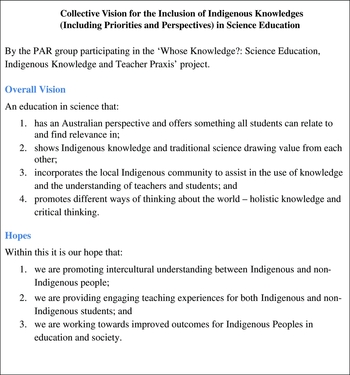
The Collective Vision Statement, which is shown in Figure 1, was developed in the first two PAR group meetings. The teachers wanted to have a set of goals to keep the project focused and on-track. The Statement allowed the teachers to work individually in each of their schools with the confidence that they were all still working towards the group's objectives. We aimed to capture the intellectual and personal engagement with socially just concerns for education that had emerged through the opportunity to engage in generative dialogue around the educational possibilities of Indigenous knowledges in science education. The Statement was generated in order to inform future classroom implementation. Teachers considered it important that there was consistency between intentions of the project and actions within the classroom.
The collective vision statement developed by the PAR participants.

The Statement articulates a position that was not, and did not claim to be, politically neutral. The statement clearly articulated the social justice and humanising intent of a practice emerging from the group's work. It reflected ideas in Smith's (Reference Smith1999) work, where she describes 25 projects that Indigenous peoples have embarked on as acts of ‘reclaiming, reformulating and reconstituting indigenous cultures and languages’ (p. 142). One of these projects, ‘Envisioning’, works from a Freirean sense of hope and is similar in its process and intent to the production of the Collective Vision Statement. Envisioning is ‘a strategy which asks that people imagine a future, that they rise above present day situations which are generally depressing, dream a new dream and set a new vision’ (p. 142). Smith describes the importance of a politics of resistance for Indigenous people to change their own lives and set new directions despite their impoverished and oppressed conditions. The production of the Collective Vision Statement also represented a politics of resistance where the members of the group were addressing their perceived deficiencies in traditional science education and ensuring that the project addressed power differentials between Indigenous and Western knowledges as well as reclaiming science education as ‘education for all’ (Roth, Reference Roth2009, p. 1).
A number of similarities are apparent between the positions of the teachers entering this project and other Australian and international findings (Aikenhead & Huntley, Reference Aikenhead and Huntley1999; Harrison & Greenfield, Reference Harrison and Greenfield2011; Kanu, Reference Kanu2011; Nakata, Reference Nakata2011). Both the hopes and visions of this PAR group of science teachers align with Kanu's (Reference Kanu2011) findings in Canada about teacher attitudes and beliefs. Like the Canadian teachers, the Australian teachers said that benefits to both Indigenous and non-Indigenous students were of high priority. Both studies featured the importance of an inclusive national identity recognising how the incorporation of Indigenous knowledge into curriculum could benefit Indigenous students’ educational outcomes and society more broadly.
The final vision, to promote holistic and critical thinking in students, was expressed strongly by several of the participants. This vision speaks to social justice orientated outcomes. Teaching is framed in connection to an act of knowing, rather than merely an act of transferring knowledge (Freire, Reference Freire1970). In particular, Cristy saw the inclusion as an opportunity to expand the educational value of science lessons, beyond just learning about science, to developing critical thinking and questioning abilities that could apply beyond the classroom. Cristy recognised the opportunity to interrogate knowledge production as Semali and Kincheloe (Reference Semali, Kincheloe, Semali and Kincheloe1999) had suggested:
We’re not just there for kids to regurgitate information to us. It's about having a holistic knowledge and to be able to be critical thinkers without our world. And to ask questions of our world and question the status quo. (Cristy, Initial Interview)
The Statement also expresses the ‘hopes’ of the group in relation to achieving their described ‘vision’. Drawing on critical theorists such as Paulo Freire and Stuart Hall, Giroux (Reference Giroux2000) describes hope as ‘an act of moral imagination and political passion that partly enables educators and other cultural workers to think otherwise in order to act otherwise’ (p. 345). Freire (Reference Freire2008) describes hope as an existential concrete imperative and hopelessness as leading to paralysis, immobilising our ability to recreate the world. The group's sense of hope centred on the ability to effect change through working with Indigenous knowledges in their science teaching practice.
Teachers clearly articulated their ideas of what the project and the incorporation of Indigenous knowledges might be able to achieve. The Statement shows a concern for science pedagogies that promote student engagement in relevant and interesting ways (‘has an Australian perspective and offers something all students can relate to and find relevance in’), as well as a commitment to presenting science and Indigenous knowledges as complementary, rather than opposing, ways of understanding the world (‘Indigenous Knowledge and traditional science drawing value from each other’). The importance of the involvement of the local Indigenous community grew from a desire to avoid tokenism and knowledge appropriation. The Statement also recognises the potential in Indigenous knowledges to encourage ‘holistic knowledge and critical thinking’ alluding to the opportunity to interrogate knowledge construction. The ‘hopes’ in the Statement, linked to the pedagogical concerns of the ‘visions’, speak to a concern for issues of social justice. They move from a focus on teaching practice to a concern with teaching praxis, which Freire (Reference Freire2009) understood as the action of people on their world in order to change it. He linked praxis to a rejection of the ‘Banking Model’ of education and to a more socially just pedagogy.
Perceived Problems and Issues
While the hopes and vision for science education containing Indigenous knowledges were in the forefront of participant teachers’ minds, these were not held without trepidation about possible impediments, concerns and fears. Teachers identified a number of problems and issues that they saw standing in the way of successful classroom implementation. These issues stood to advance an atrophy of good intentions if not addressed.
The main issues raised were as follows:
-
• How do we make teaching both respectful and meaningful? How do we avoid tokenism and ‘stepping on cultural toes’?
-
• How do we make sense of different ways of understanding the world and knowledges? How do we reconcile Indigenous understandings, which are multilayered, with scientific understandings, which tend to be reductionist? (Not all participants saw this as a problem, but those who mentioned it saw it as quite significant.)
-
• How do we find the time (inside and outside of the classroom) to commit to developing effective teaching strategies?
Many of these concerns mirror those described by Harrison and Greenfield (Reference Harrison and Greenfield2011), Kanu (Reference Kanu2005, Reference Kanu2011) and Nakata (Reference Nakata2011). In particular, there was concern about avoiding tokenism and a fear of ‘stepping on cultural toes’ related to a lack of resources, cultural knowledge and protocols. The fear of ‘making a mess of it and appearing disrespectful’ (Isabelle, Initial Interview) had presented as a major barrier to teachers’ past efforts in teaching science that included Indigenous knowledges. Teachers identified that prior to joining the project, little or no information had been available to them to assist in their efforts.
As implementation of the Australian Curriculum was/is the responsibility of the States and Territories, each jurisdiction decided its own timeline. In Queensland, the implementation process commenced in 2011 with teachers and schools becoming familiar with the English, Maths and Science curriculums with full classroom implementation from 2012 (ACARA, 2012). The State-based education authority, Education Queensland, (Department of Education, Training and Employment (DETE)), had responsibility for implementation but stated that it was the responsibility of each school to arrange appropriate professional development. This proved challenging, with tight budgets, short timeframes and several subject disciplines to implement (Lowe & Appleton, Reference Lowe and Appleton2014). The data collection phase of this project ran during this time when schools and teachers were facing major systemic changes and were offered little institutional support. As such, the project served as much needed professional development in curriculum implementation.
In terms of epistemologies, teachers expressed ideas of incommensurability (on epistemological and ontological grounds) as well as recognition of the synergies of Western modern science and Indigenous knowledge systems. In order to bring different ways of knowing into the classroom, teachers needed considered reflection as to how these epistemologies fitted into their own understanding of science as a body of knowledge and factors influencing their own epistemologies. The participatory and cyclical nature of the PAR methodology allowed for inter-participant dialogue around these epistemological issues. Teachers’ epistemological positions on including Indigenous knowledges within the science curriculum were broad. One teacher, Cristy, expressed no problems with combining the two knowledge systems, as she saw science as primarily about asking questions about the natural world:
And I think you’re a scientist if you question how something works, if you question why is that red? You know? I think if you’re asking questions you’re a scientist. (Cristy, Initial Interview)
The holistic nature of Indigenous knowledges was problematic for another teacher, Isabelle. Isabelle's concerns related not only to the underlying epistemological differences between the knowledge systems but also her desire to be respectful, non-tokenistic and not ‘step on cultural toes’.
I think parts of the Indigenous knowledge, I don't even know if that's the umbrella term of what it is, but I think parts of it are scientific and parts of it are mythology which to me in my definition, in my head, that's not science. So like, I don't see how I’m going to be able to . . . but then I can't really just cut it, can I? Cut it in bits? (Isabelle, Initial Interview)
A compounding issue for the teachers from Catholic schools was the marginalisation of Indigenous knowledges through competing spirituality and epistemological/ontological bases. Indigenous knowledges operate from what was considered by some to be a conflicting ontology to that of Christianity. In a school system operated from a specifically Catholic, Christian epistemology, teachers identified an additional pressure to be sensitive to particular spiritual (and political) positions. Pressure manifested as anxiety about being challenged on the basis of spiritual grounds by students and their parents. For example:
Because as scientists, are we thinking as scientists, we’re going to have a different perspective than say our creative arts counterpart. And being in a Catholic education school as well, it's very difficult being a scientist and talking about, some of these Indigenous knowledges, because they’re not respected. Because of the Catholic faith, you know, this is how we do things. Sometimes I find those tensions very difficult to counterpart so it's productive. (Isabelle, Initial Interview)
Issues of perceived epistemological conflicts may be linked to challenges to teacher identities. Teachers’ identity positions are constructed within social norms and school structures that maintain and give authority to Western cultural values and ways of knowing (Kanu, Reference Kanu2011). Unease with epistemological issues has the potential to challenge teachers in terms of understanding their own identity locations within the education system. This challenge may be what is necessary to engage positively within the cultural interface (Nakata, Reference Nakata2008) in order to be able to plan lessons with Indigenous content without lapsing into tokenism. By allowing considered reflection and generative dialogue between participants, teachers were able to recognise the epistemological issues particular to them and their teaching context. Before specifically identifying the complexities for themselves and their schools, teachers were more likely to see the perceived problems as insurmountable.
A very strong theme that emerged from the project was teachers’ concerns with the limited amount of time available to them to implement curriculum initiatives. All participants spoke of the many out of school hours they devoted to administrative tasks related to teaching, such as marking and preparing for moderation, as well as planning lessons. They explained that this had been intensified through the introduction of the new curriculum.
Time pressures were also recognised in Burridge and Evan's (Reference Burridge, Evans, Burridge, Whalan and Vaughn2012) work with teachers to include Indigenous cultural knowledge in the curriculum in Australia. However, time constraints were not seen as a deterrent to participation in Burridge and Evan's project. In our project, a lack of access to funding meant that it was not possible to ‘buy out’ teachers’ time. Consequently, when the teachers decided to participate in the PAR project, they had to find the time in their already busy schedules to make that commitment. Burridge and Evans (Reference Burridge, Evans, Burridge, Whalan and Vaughn2012) suggest that funding provisions to allow staff to participate in projects such as these are necessary to allow for adequate professional development. While compensating participants for their time would have been ideal, the reality for the teachers participating in the project was that they were operating at a time of substantial change with little institutional support. The project did, however, offer participants support through interactions with myself as the researcher-participant, the project's critical friends and a group of peers.
The increasing complexity and workloads of teachers is recognised as impacting on job satisfaction, personal lives and good health (Gardner & Williamson, Reference Gardner and Williamson2006; Timms, Graham, & Cotrell, Reference Timms, Graham and Cotrell2007). In order to meet the expectations of their job, in terms of planning, marking and administration, teachers work extensive amounts of time outside of school hours (Gardner & Williamson, Reference Gardner and Williamson2006). Indeed, the participants in this study were committing out-of-school time to attend PAR group meetings and perform tasks associated with the project in order to extend their professional learning. The important work required to challenge teachers’ epistemologies and identity locations needs time to develop in order to move towards the more inclusive vision of science education. While the teachers said that they would have preferred to have had more time to commit to the project, they were still able to engage in meaningful and productive ways.
The Collective Vision Statement provided an insight into how the teachers perceived their engagement with the Aboriginal and Torres Strait Islander Histories and Cultures CCP in the Australian Curriculum. The PAR methodology allowed in-depth engagement with considerations of how the required Indigenous content and perspectives might fit with teachers’ beliefs about science teaching and pedagogy. This provided the necessary personal engagement to discover new ways of conceptualising science education inclusive of Indigenous knowledges. As Chinn (Reference Chinn2007) found, such engagement can lead to teachers finding a new respect for Indigenous knowledges and being more willing to move towards implementing classroom lessons with Indigenous content and perspectives. The participatory approach also allowed teachers to forge their own path in this respect, giving them a larger sense of ownership over the process and ensuring that the work matched their needs. As the work of these teachers showed, the incorporation of Indigenous knowledges in the classroom may result in critical science education with socially just and reconciliatory outcomes. With targeted institutional support and funding, participatory approaches such as this may assist other teachers and schools to develop their own understandings of the importance, epistemological considerations and educational advantages of successful implementation of the CCP in school science.
Conclusion
Teachers in this project continued to work through the PAR to implement their vision of science praxis inclusive of Indigenous knowledges. The ways in which they came to understand their positions at the start of the project formed the basis of their individual efforts in their own classrooms. The participatory approach allowed for generative dialogue to produce the Collective Vision Statement that guided the process and kept the group true to its critical intent. This envisioning process, imagining a future teaching praxis (Smith, Reference Smith1999), allowed the teachers to rise above the day-to-day concerns of classroom/teaching pressures and plan for science lessons with socially just aims.
The recognition of both the visions and hopes for science education that would be inclusive of Indigenous knowledges required an investment of teachers’ time and a willingness to grapple with epistemological issues. A lack of cultural knowledge and a ‘fear of stepping on cultural toes’ had acted as major impediments in the past for many of the teachers in the study. While they were sympathetic to the inclusion of Indigenous knowledges and held concerns for enacting social justice through education, epistemological challenges were required in order for them to understand their own teaching contexts and beliefs about science. Change, whether it is epistemological or curriculum-based, takes time. In the busy professional lives of the teachers involved in the PAR project, time to make change while meeting the complicated and conflicting demands of their positions was not easy. Even so, the teachers saw the issues and possibilities as important enough to engage in thoughtful, practical and theoretical ways. A sense of hope (Giroux, Reference Giroux2000) allowing thinking and acting otherwise presented in the teachers’ attitudes to science education offers an important starting point to presenting multiple ways of knowing in school science education.
The PAR process allowed teachers to contextualise and conceptualise their science teaching praxis inclusive of Indigenous knowledges. The ability to dialogue with peers from outside of their own schools added to the reflective nature of the method, in turn promoting an understanding of each teacher's own position, beliefs and context. As the group as a whole was in control of the direction of the research, teachers chose their own starting point and set the agenda in terms of what visions, hopes and impediments were important to them. As such, the resultant Collective Vision Statement is a representation of their personal engagement with the issues and acted as an anchor that allowed the classroom implementation phase of the project to proceed. It is suggested that this methodological approach may assist other teachers, schools or projects to define what is necessary for successful engagement with issues that surround Indigenous knowledges in the curriculum.
About the Author
Renee Baynes is a lecturer with the College for Indigenous Studies, Education and Research at the University of Southern Queensland. Renee teaches in the area of Indigenous Studies, teaching courses on Indigenous Perspectives and Indigenous Knowledge. Research interests focus on Indigenous Knowledges in the school curriculum, particularly in the area of science education. Renee is a member of the International Institute of Critical Pedagogy and Transformative Leadership.