In 1948, the fathers of UN peacekeeping had a strange but simple idea: use military troops not to fight and win wars, but to help implement peace accords. Today, in conflict zones, the UN has the largest deployed force in the world.Footnote 1 For decades, and especially since the end of the Cold War, UN peacekeepers have succeeded in fulfilling even multidimensional mandates using nonlethal means; they have not, however, wielded compellent force well.Footnote 2 Despite this track record, and breaking with previous policy and doctrine, since 1999, the UN Security Council (UNSC) has mandated every multidimensional UN peacekeeping operation to use force under Chapter VII of the UN Charter.
The council's repetition of force mandates constitutes a major, perplexing shift. Creating a genuine UN peace enforcement capacity is not in the national interests of any of the UN's permanent five (P-5), veto-wielding Security Council members, nor do these states express normative commitments to the UN's use of force.Footnote 3 The UN Secretariat and troop contributors tend to resist Chapter VII mandates as well.Footnote 4 The use-of-force mandates’ negative effects on peacekeeping are manifold: they undermine peacekeepers’ claims to impartiality; they open peacekeepers and humanitarian workers to attack; and they generate false expectations about the UN's abilities to achieve goals by forceful means. These mandates are also often poor fits for the conflicts receiving them. Nevertheless, the P-5 continually, puzzlingly, vote to authorize force mandates in UN multidimensional peacekeeping operations. What is the origin of this shift to the authorization to use force? Why has the shift endured?
Employing a constructivist causal sequence, we argue that the shift to use-of-force mandates began with norm entrepreneurs advocating Chapter VII to protect civilians in conflict. However, the repetition of force mandates stems from neither normative change nor the pursuit of instrumental goals in the UNSC. Council members do not view a UN force as desirable, and use-of-force mandates are not serving to achieve the council's stated goals of maintaining international peace. The P-5 currently disagree about policies for Ukraine and Syria, but for all other conflicts before the council—conflicts that do not involve first-order national P-5 interests—its members agree to repeat the same Chapter VII language in every complex peacekeeping resolution.Footnote 5 In other words, despite deep differences between its members, the council repeatedly issues the same force mandates.
Rationalist and constructivist analyses of the UN and the use of force have explained the UNSC's authorization of other actors’ use of force. But they do not account for the UNSC's repeated authorization of the UN itself to act under Chapter VII force provisions. Scholars of organizational processes have fruitfully explored similarly iterative, irrational results. Because power over peacekeeping mandates is located in the P-5, and not in the UN Secretariat, our work extends these arguments from the organizational realm to the narrower domain of small-group decision-making. We argue that the invariant decision outcomes follow a logic of small-group psychology. Accordingly, we forward the new concept of “group preserving.”
While the members of the P-5 have divergent interests and beliefs, they each seek to increase their individual status vis-à-vis other states, which is enhanced by their permanent membership on the exclusive, high-status UNSC.Footnote 6 To maintain its status, the group must have more than exclusivity—it must also have legitimacy.Footnote 7 Observers agree that the P-5's “leverage resides almost entirely in the perceived legitimacy its decisions grant to forceful actions.”Footnote 8 To preserve legitimacy, the council must issue decisions on the use of force. To issue decisions, members must keep their numbers small and cooperate regularly; otherwise, UN member states both in and outside the UNSC will seek cooperation in other forums.Footnote 9 In sum, the veto-wielding P-5 strives to maintain its status and legitimacy by foreclosing membership change and by issuing decisions. These conditions enable a phenomenon whereby once members agree upon a solution, their agreement is applied in future rounds of negotiations—even when the solution does not fit the new context and may appear suboptimal, illogical, or even pathological. The essence of group preserving is privileging the achievement and repetition of agreement over the content of the agreement to maintain group status and legitimacy.
Group preserving occurs among highly “entitative” groups.Footnote 10 Indicators of entitativity include frequency of interaction, clear boundaries, and shared goals such as maintaining group status and legitimacy. Highly entitative groups like the UNSC tend to resist change while privileging unity of decisions. As P-5 entitativity increased with the end of the Cold War, so did its members’ interests in preserving their group.
The phenomenon of group preserving best explains why, once the P-5 reached agreement on language authorizing force in peacekeeping, it became very difficult for this group of unlike-minded actors to alter the language of precedent—even when conflicts warranted a different type of response; even when the Secretariat requested variation; even when the P-5 did not share beliefs about the appropriateness of UN force; and even when great power interests varied. When there is a threat to international peace, the UNSC must act to retain its status and legitimacy. As a top American policymaker explained, “if the UNSC does nothing, their relevance is questioned.”Footnote 11 A policy advisor on peacekeeping from China concurred: “a lack of action damages the reputation of the UNSC.”Footnote 12 But given the difficulty of obtaining great power agreement, “it's easier to use the same language next time even if it doesn't make sense.”Footnote 13
We begin by outlining the differences between peacekeeping and peace enforcement. Second, we present our outcomes of interest—the shift to force mandates and their persistence thereafter—in an original data set of all UN peacekeeping missions and mandates. Third, we survey the rationalist, constructivist, and organizational process literatures on the UN and the use of force, and offer our own social-psychological theory about group preserving. We then explain our qualitative methods and provide indicators of expected causal process observations stemming from four types of theoretical explanations: rationalist, constructivist, organizational, and psychological. We subsequently present our argument in two parts, marshalling evidence from extensive primary source documents, written accounts by lead decision makers, and author interviews with more than three dozen key figures in peacekeeping, including representatives of all permanent members of the UNSC. Part I of our evidence examines trends across peacekeeping operations leading to 1999; the shift that year during the mandate drafting for Sierra Leone; and the puzzling mandates for Democratic Republic of the Congo (DRC) and Haiti. Part II explores P-5 interests in maintaining individual and group status and legitimacy, and their behavior vis-à-vis UN peacekeeping. We conclude by summarizing our findings and suggesting areas of future research.
Defining Peacekeeping and Peace Enforcement
Although the UN Charter does not explicitly mention it, peacekeeping has become the UN's largest task.Footnote 14 Article I of the charter charges the UN to “maintain international peace and security.” Chapter VI outlines diplomatic strategies, while Chapter VII delineates coercive measures, including sanctions and the use of force, to stop aggression. Peacekeeping operations are authorized under Chapter VI or VII.
In the absence of a formal international agreement governing the conduct and purposes of peacekeeping, the UN developed three doctrinal “rules.” (1) Missions may use limited force (in self-defense); (2) missions must obtain the consent of the warring parties before deploying; and (3) peacekeeping operations must maintain impartiality in the implementation of agreements, akin to the functioning of a judge who is not neutral or passive, but delivers judgments impartially.Footnote 15 These rules establish peacekeeping as a separate endeavor from war fighting, with political and humanitarian rather than military goals.
The purpose of peacekeeping is to implement peace accords. As a former commander of UN peacekeeping troops explains, “If there's no peace to keep, then there's no purpose in sending peacekeepers. If you go, you will be a part of the war.”Footnote 16 Peacekeepers come from dozens of different countries; they do not speak common languages; and they do not train together before deployment. They are purposefully not designed to be war fighters. In contrast, the purposes of peace enforcement operations are to protect civilians and convince noncomplying parties to sign peace accords by using compellent force.Footnote 17 Peace enforcers must be able to fight as coherent units. The UN conducts the vast majority of peacekeeping operations and has been very effective at implementing peace accords. Successful peace enforcers include single states, small coalitions, and regional organizations, not the UN.
Although we can distinguish peacekeeping from peace enforcement along these lines, distinctions have, problematically, been fading. As one drafter of peacekeeping mandates noted, “there's genuine confusion between peacekeeping and peace enforcement.”Footnote 18 Mandating UN peacekeepers to enforce the peace, even if only to protect civilians, engenders four central difficulties. First, to protect civilians, peacekeepers must at times fight directly with rebels, complicating their claim to impartiality and opening them to counterattack. Impartiality provided the bedrock of peacekeepers’ legitimacy, and its loss imperils missions—the death rate for peacekeepers has increased over time; today it is roughly one peacekeeper every three days.Footnote 19 Second, the mandate shift opens humanitarian workers to attack because they often rely on the UN for transportation. Third, Chapter VII mandates generate false expectations about UN peacekeepers’ ability to stop spoilers and end wars by military means. Fourth, of all nine ongoing UN multidimensional operations, very few are moving toward mandate implementation. Unlike past operations, successful exit is not in sight for the majority of missions. Why do all current multidimensional operations have Chapter VII force mandates given the myriad problems associated with such mandates? The next section examines our two outcomes of interest—the shift to Chapter VII mandates in 1999 and their persistence thereafter.
The Rise and Persistence of Use-of-Force Mandates
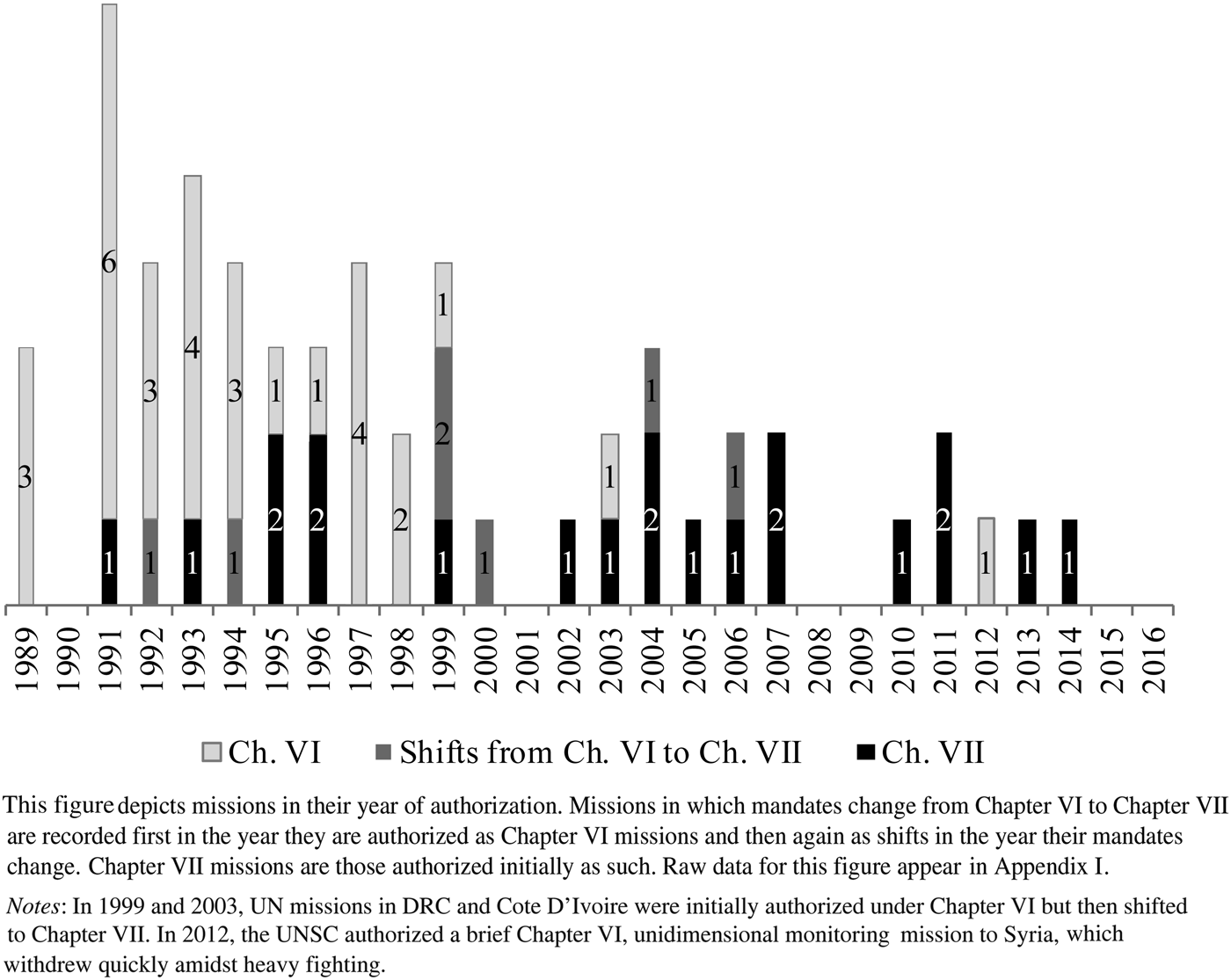
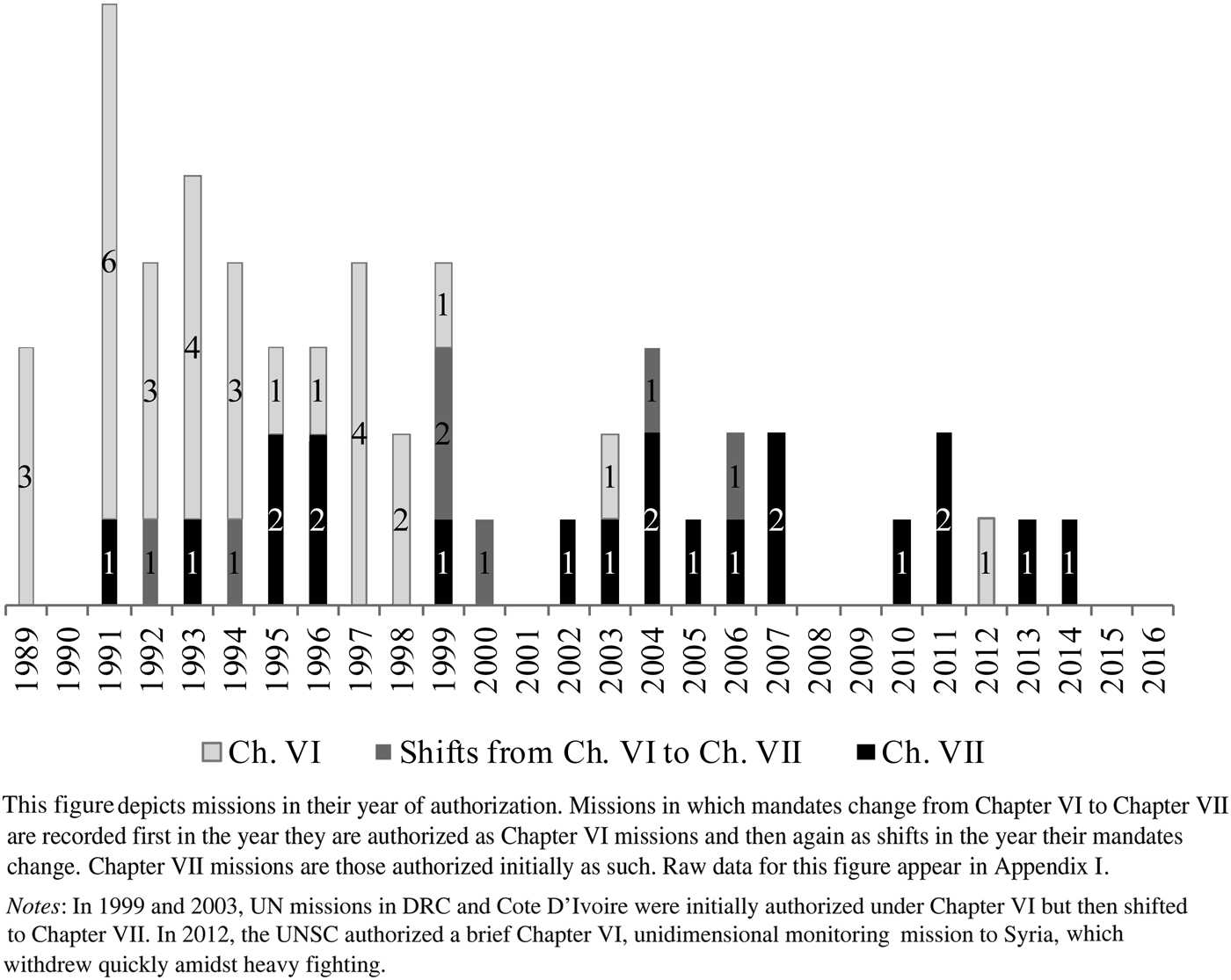
At the end of the Cold War, the number of UN peacekeeping operations and personnel increased dramatically. Mandates evolved alongside this expansion. Figure 1 depicts the mandates of newly authorized UN peacekeeping missions between 1989 and 2016. It reveals substantial variation between the end of the Cold War in 1989 and 1998. Most missions were authorized with Chapter VI “pacific” means provisions, others were authorized under Chapter VII “force” means, and some changed from one authorization to the other. Beginning in 1999, however, multidimensional peacekeeping mandates became more homogenous, until all eventually referenced Chapter VII, authorizing UN peacekeepers to use force. Figure 1 illustrates this clear change.
Mandates of UN missions in civil wars, 1989–2016
Explanations
Theoretical debate on the UN is divided roughly between rationalist, constructivist, and organizational scholarly traditions.Footnote 20 Recent rationalist scholarship investigates the sources of UNSC legitimacy and why states seek UN approval for the use of force. The UN lacks enforcement capabilities and thus cannot coerce compliance in an anarchical interstate system. Yet powerful states—even the US—seek the UNSC's approval before they use force. Erik Voeten argues that the council's ability to legitimize the use of force stems from its functioning as an “elite pact.” The council's legitimacy therefore derives from its ability to facilitate cooperative efforts among its diverse members. In elite-pact governments, a set of select actors “seeks to neutralize threats to stability by institutionalizing nonmajoritarian mechanisms for conflict resolution.”Footnote 21 Thus, the council's legitimacy to authorize the use of force rests on its ability to produce “favorable outcomes” and to provide “the public with a shortcut on the likely consequences of foreign adventures.”Footnote 22
Extending Voeten's argument, Alexander Thompson and Terrence Chapman elaborate which “publics” are key.Footnote 23 Thompson argues the US seeks UNSC approval to signal its benign intentions to foreign leaders and their publics. In this framework, states receive greater benefits by working through more “independent” international organizations such as the UN, but also risk greater “variance in outcomes.”Footnote 24 Chapman demonstrates states use UNSC approval to garner domestic public support.Footnote 25 Both scholars assume UNSC approval is difficult to acquire and expect to see variation in UNSC decisions. However, the empirical reality across a broad set of authorizations is one of frequent ease of passage and homogeneity of force mandates, neither of which scholars in this tradition anticipate.
Most rationalist work seeks to explain outcomes where states have strong interests. In our important set of cases, however, states do not have first-order national interests—accordingly, we posit that states are primarily interested in reaching any agreement. In this sense, our argument complements rationalist accounts that depict UNSC decision making as a coordination game among powerful states. The cases we examine constitute mixed-motive games with multiple equilibria—strategic situations for which strictly rationalist accounts offer few solutions. Building on rationalist scholars of convention and precedent,Footnote 26 we agree past action serves as a guide to reaching solutions in potentially indeterminate, difficult political negotiations. We supplement these insights by specifying the social psychological reasons that states might want to reach and repeat solutions.
Like rationalist accounts, current constructivist scholarship does not seek to explain the repetition of Chapter VII mandates to use force. Constructivists are frequently interested in behavior driven by nonmaterial forces such as shared beliefs, culture, ideas, norms, identities, and symbols,Footnote 27 with arguments largely structured around logics of “appropriateness” rather than logics of “consequences.”Footnote 28 Writing in this tradition, Ian Hurd, like Voeten, argues that the UNSC's key function is to underwrite the use of force in the international system with legitimate authority. However, where Voeten sees the council's authority stemming from its coordination function, Hurd argues the UNSC's authority “is fought over by states who believe in its symbols and seek to increase their power by being associated with them.”Footnote 29 He argues that the UNSC's power may be better explained by symbolic payoffs than material gains. Building on Hurd's work, we specify the psychological nature of symbolic payoffs, arguing that states seek to maintain or increase their status and legitimacy vis-à-vis other states by cooperating through the UNSC.
Constructivism is a heterogeneous branch of international relations. Here we explore the variant of constructivism that would most likely explain our outcomes of interest—change and the maintenance of change. Martha Finnemore and Kathryn Sikkink argue change in international life often originates with specific “norm entrepreneurs” who then convince others in positions of power to advocate the new belief, idea, or principle, and to institutionalize it in law or bureaucratic institutions.Footnote 30 The institutionalization results in a “norm cascade,” after which the new belief acquires a taken-for-granted quality. We find causal process evidence supporting a constructivist explanation for the shift to Chapter VII mandates in 1999. The change began with norm entrepreneurs advocating robust UN peacekeeping and framing the use of the force to protect civilians as an appropriate task for UN peacekeepers. However, the repetition of force mandates does not indicate a norm cascade. Interviews with representatives of the P-5 do not suggest that the great powers believe the UN's use of force in peacekeeping is appropriate. Moreover, mandates are not designed for genuine protection of civilians or to end civil wars, but are rather empty repetitions of previously agreed language.
Scholars of organizational and bureaucratic politics present a third type of argument, although this literature is less developed regarding the UN and the use of force. Graham Allison argues that organizations divide labor and establish routines, norms, and standard operating procedures to produce more efficient outcomes, but the intent does not consistently mirror the results.Footnote 31 Organizational processes help to explain “deviations from ideal rationality at the moment of decision by highlighting the ways in which organizational routines constrain the formation of options, and … how routines affect implementation.”Footnote 32 Bureaucracies “formulate rules that are politically safe and comfortably routine rather than efficient or effective,” and they often display “a façade of action.”Footnote 33 Once selected, policy instruments may confine organizations, producing “isomorphic” responses even when organizations encounter new circumstances.Footnote 34 Better peacekeeping is possible when members of the Secretariat learn in the field while implementing mandates.Footnote 35 In the absence of this field-based learning, standard arguments about bureaucratic pathologies appear consonant with our outcomes, but not their cause: decisions on mandates flow from the UNSC to the Secretariat; the UNSC is not a bureaucracy; and the Secretariat does not override UNSC mandate decisions. Accordingly we cannot locate Chapter VII mandate repetition in the UN bureaucracy.Footnote 36 Because rationalist, constructivist, and organizational logics only partially explain our outcomes, we turn to a somewhat forgotten tradition in the study of international organization: group psychology.
The Social Psychology of Small Groups and “Group Preserving”
Social psychologists have theorized about group behavior for over 100 years, contending that “the tendency to join with others is perhaps the most important single characteristic of humans.”Footnote 37 By the mid-1950s, small-group experiments enjoyed “runaway growth” because they were cheap (subjects were often students or members of the armed services), and the experiments could be conducted and published quickly. But they were critiqued for “neglect[ing] crucial societal variables.”Footnote 38 Acknowledging this well-founded criticism, we argue that some important small-group phenomena intersect with the crucial societal variables of legitimacy and status in the UNSC to produce what we call group preserving. Highly entitative groups tend to resist change and privilege unity of decisions. We define “entitativity,” “status,” and “legitimacy,” and explain how they give rise to group preserving: privileging achievement and repetition of agreement over the content of agreement. We also delineate differences with concepts like groupthink.
Groups differ from “mere aggregates of individuals” according to their degree of entitativity.Footnote 39 Indicators of entitativity include frequent interactions among members, clear boundaries between group and nongroup members, and common goals.Footnote 40 Since the end of the Cold War, the UNSC rates as a group high in entitativity on all markers.
First, in terms of frequency of interaction, the UNSC did not often meet or act during the Cold War, but interactions increased dramatically after its end.Footnote 41 There is also evidence of a widening diplomatic gap between P-5 members and other states: the P-5 meet more with one another than with outsiders.Footnote 42 Bosco measures this gap by collecting data on the frequency of bilateral US Secretary of State visits to other countries and finds:
There is significant diplomatic premium accorded to other permanent Council members … both Britain and France received more US visits than the much larger and more economically powerful Germany. That China led Japan is also striking, given the closeness of the US–Japan relationship. China received more visits even between 1990–2000, before the country's economic rise.Footnote 43
In short, this powerful group interacts more with the other members of the group than with nonmembers—including larger economic powers and close allies.Footnote 44
Second, the council maintains clear and highly exclusive boundaries: no other states have been allowed to join for over seventy years. The maintenance of exclusive boundaries has both psychological and rational functions: exclusivity is a common means of maintaining high status, and having fewer actors around the table facilitates decision making. Debate over UNSC reform has stagnated.Footnote 45 Many states have demanded the UNSC expand its membership. Although P-5 members occasionally recommend an ally join the council, they do so knowing full well that regional groups are deadlocked over representation, and that other UNSC members would veto the addition of another veto-wielding state. The P-5 remains more concerned with preserving the boundaries of this exclusive group than with expanding them.
Finally, the council's common goals are central for explaining the puzzling rise of peace enforcement mandates. The Security Council's stated goal is to maintain international peace and security and its members must accordingly produce decisions on peacekeeping missions. If peacekeeping efficacy itself were a first-order goal, then we would expect to see the P-5 bearing the costs of their decisions. However, P-5 militaries do not bear the unintended consequences of repetitive Chapter VII decisions directly because the P-5 contribute very few, if any, of their own troops to UN missions.Footnote 46 Troop contributors, who hail primarily from the “global south,” bear the material costs of UN combat deaths.Footnote 47 Any reputational costs from operations going awry are borne collectively by the UN as a whole. Moreover, the places where the UN sends troops tend not to be of first-order interest to the P-5. Given these factors, the P-5's goal is not necessarily bettering peacekeeping—indeed, its decisions appear to come at the expense of producing fruitful and tailored peacekeeping decisions—but rather maintaining their status and legitimacy through issuing decisions.
Status, like power and security, is a primary goal for states.Footnote 48 Whereas much of the literature on status concerns competition over the quest for international status, here we see great powers cooperating over a second-order problem (peacekeeping) with the goal of preserving their individual and group status and legitimacy. Status refers to collective beliefs about prestige and rank; it “informs patterns of deference and expectations of behavior, rights, and responsibilities.”Footnote 49 Status has “ontological priority” over both authority and legitimacy.Footnote 50 In other words, one must have a notion of hierarchical social status before one can determine which states have the right to issue commands (authority), and whether subordinate states feel those decisions ought to be followed (legitimacy).
Legitimate domination is the “probability that certain specific commands (or all commands) will be obeyed by a given group of persons.”Footnote 51 The UNSC is the highest international authority for determining the legitimacy of the use of international force.Footnote 52 One of the primary means of maintaining the status and legitimacy of small groups is “by behaving in ways that suggest high levels of … commitment to the group.”Footnote 53 The council has met frequently since the end of the Cold War, and veto use has plummeted, indicating group commitment.Footnote 54 As one inside observer notes, “There is a clear interest in maintaining the council. Members don't always agree, but no one wants to damage it too much.”Footnote 55 Despite current disagreement over Syria and Ukraine, the council continues to issue frequent, regular decisions on almost all other matters of peace and security in its domain.Footnote 56
We have argued that the UNSC is a group that is high in entitativity, as indicated by its frequent interactions, clear and exclusive boundaries, and common goals. In Parts I and II of our evidence, we further demonstrate that some of this group's primary goals are not necessarily bettering peacekeeping outcomes (Part I), but rather maintaining its own status and legitimacy by cooperating on peacekeeping mandates (Part II). We turn now to explore several common small-group phenomena that mirror what we see in the UNSC.
Kurt Lewin, founder of the field of social psychology, noted that “understanding the dynamics of group life requires insight into … resistance to change.”Footnote 57 The council resists change both in its composition and in its decision outcomes. Another common small-group phenomenon is that high entitativity tends to lead to unity of decision making.Footnote 58 Often, unfortunately, resistance to change and unity of decision making produce flawed group decisions.
Scholars have attempted to explain repeated poor decisions using group-level explanations such as Social Identity Theory (SIT), social habit, and groupthink. We have not found substantial evidence that the P-5 view UNSC membership as an integral dimension to their individual “self-concept,” thus undermining a standard SIT analysis.Footnote 59 Nor can the behavior be described as habitual because the UNSC actively debates the language of each mandate each time, producing a set of informed choices that nevertheless results in the same, repeated decisions.Footnote 60
We can distinguish group preserving from groupthink, as well. They are similar in that they operate in a number of different small-group settings; they help explain some unintended consequences of group decision-making processes; their origins are more psychological than normative or material; they operate as consequentialist variables; and, most notably, members privilege unity of decision.Footnote 61 The concepts differ, however, in two crucial ways. The distinctive quality of groupthink is a collective confirmation bias that renders members of the group more confident in their chosen outcome than those outside the group. Here, the P-5 do not appear overconfident in the efficacy of peace enforcement mandates. Second, in groupthink, agreement is propelled by a collective desire to please the head of state. For the P-5, in the absence of formal hierarchy, the forces compelling consensus are the pursuit of status and legitimacy.
The UNSC is unlike any other group in the history of international politics. Its permanent members have the largest militaries in the world; it enjoys unparalleled legal authority; and its reach is global. Although each member has its own identity and interests, the P-5 are collectively invested in keeping the international decision-making locus on the use of force within this body.Footnote 62
While the UNSC is unique, we expect to find the phenomenon of group preserving in other international settings, such as among ad hoc “groups of friends” working toward a peace agreement, and among states in regional organizations, such as the European Union (EU). We also anticipate the phenomenon operates in other UNSC areas of work, such as sanctions regimes, rule-of-law initiatives, and gender mainstreaming.Footnote 63
We expect to observe group preserving most often where members of a group are tasked with producing policy decisions despite different interests, and where they value the status and legitimacy of the body to which they belong. We expect group preserving to operate less in groups low in entitativity, where members are hierarchically organized, and where members are not tasked with producing specific policy outputs. While the desire to reach and maintain agreement is unlikely to trump strong national interests in group-preserving situations, it can expand the bounds of those interests and drive policy on second-order interests.
In sum, we argue that the P-5 is a highly entitative group whose legitimacy stems primarily from its ability to issue regular and swift decisions on the use of force. During the Cold War, the council's legitimacy waned in part because of its inability to make decisions. None of the P-5 wants to decrease the council's legitimacy or status, even though they disagree on some matters vital to their national interests (such as Syria and Ukraine). To maintain its privileged status in international affairs, the council must remain exclusive and make decisions on most issues under its purview. These conditions enable group-preserving dynamics. Where group preserving operates, once a solution or precedent is achieved, the text of the agreement is applied in future rounds of negotiations, even when the solution may not fit the new context, and even when the solution may appear suboptimal, irrational, or even pathological.
Methodological Approach
Our data set of all peacekeeping operations enables us to fully describe the variation in our dependent variables.Footnote 64 We then use qualitative methods to evaluate which of our four contending logics best explains our two outcomes of interest—the mandate shift in 1999 (wherein we must account for change), and the iteration of mandates after that date (which concerns continuity).
We employ process tracing, a method that enables both theory development and plausibility probing.Footnote 65 We focus on causal process observations, “diagnostic pieces of evidence that yield insight into causal connections and mechanisms, providing leverage for adjudicating among hypotheses.”Footnote 66 As Brady and Collier explain, “qualitative research uses causal process observations to … slowly but surely rule out alternative explanations until they come to one that stands up to scrutiny.”Footnote 67
Most of our evidence derives from primary sources: UNSC resolutions, verbatim records of Security Council meetings, and nearly forty interviews with elites who have participated in and observed peacekeeping and the UNSC for many years. We single out evidence that confirms or disconfirms the plausibility of propositions stemming from the contending logics of instrumental rationality, constructivism, organizational processes, and group psychology. We examine crucial turning points in several cases of UN peacekeeping—Sierra Leone, DRC, and Haiti—as well as the actions of the P-5—China, Russia, the United States, the United Kingdom, and France. We divide our evidence into two parts: the first traces changes in peacekeeping mandates in general, and some negative results of repeating Chapter VII mandates. The second analyzes P-5 interests and actions regarding UN peacekeeping. Before turning to our evidence, we elaborate the causal process observations we would expect to make given our contending theoretical lenses.
Causal Process Observations Predicted by Rationalist, Constructivist, Organizational, and Group Psychological Theoretical Frames
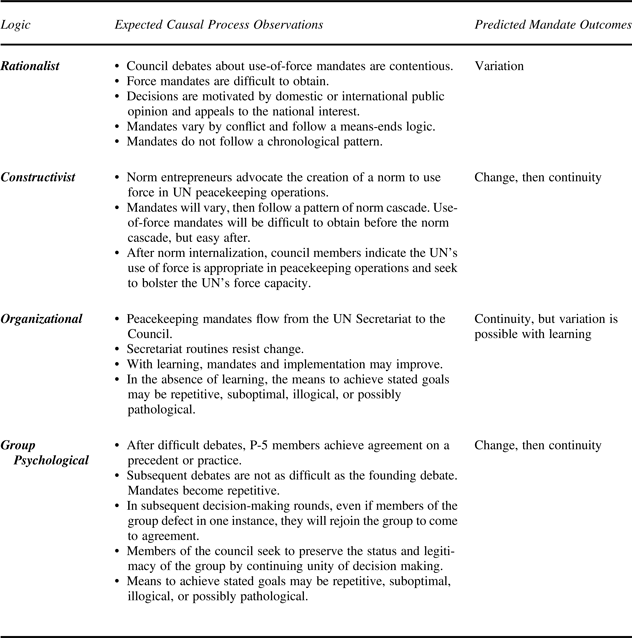
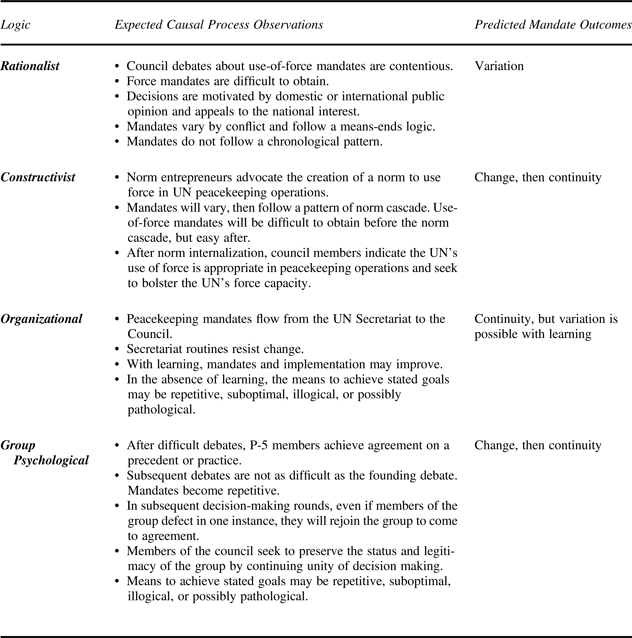
The rationalist lens dominates today's literature. While there are many variants, we focus on utilitarian, means-ends relations, and derive causal process observations from existing research on the UNSC. The UNSC's primary stated goal since 1945 has been the maintenance of international peace and security. Individual council members have divergent national security goals, which will lead them to satisfice or make suboptimal decisions. While such outcomes do not contradict the rationalist framework, we consider here the process of coming to those decisions. Rationalist arguments struggle to explain the repeated use of means (UN peace enforcement) that have clearly failed to help actors achieve their stated ends—the classical trope of doing the same thing over and over but expecting a different outcome applies.
Previous rationalist work on the UNSC and the use of force suggests that we will witness five causal process observations: first, council debates about use-of-force mandates will be contentious. Second, mandates will be difficult to obtain. Third, decisions will be motivated by domestic and international public opinion and will appeal to the P-5's stated national interests. Fourth, the means to achieve goals will vary depending on the nature of the problem, and mandates will follow means-ends calculations. Thus, fifth, we would not expect a clear chronological pattern to mandates.
The most applicable variant of constructivism suggests causal process observations that concern change and stickiness. If this logic holds, we would expect, first, that specific norm entrepreneurs will advocate a new norm for UN peacekeeping operations to use force. Second, mandates will vary, but then follow the pattern of a “norm cascade,” after which the norm will acquire a “taken for granted” quality. Use-of-force mandates will be difficult to obtain before the cascade, but easy after. Third, and most importantly, if the norm has become broadly internalized, we anticipate the P-5 would express public support for the appropriateness of the new “UN force” norm; in other words, we would expect the great powers to indicate the UN ought to be in the business of using force in peacekeeping operations. Finally, we would see significant efforts to match peace operations’ capabilities to their mandates, motivated by the shared belief in a UN force.
If organizational processes are dominant, we would see evidence that peacekeeping mandates flow to the UNSC from the UN Secretariat and its leaders in peacekeeping—the UN Secretary-General and Under-Secretary-General for Peacekeeping. Second, the Secretariat's decision-making processes would resist change, but results of organizational processes are not easily predictable. Organizational routines could constrain the formation of options recommended to the UNSC, resulting in repeated mandates and poor results. However, the organization could engage in first-level learning with positive results if it also manages to exercise agency in the field.
Alternatively, if group preserving operates, we would expect to make five causal process observations. First, after difficult debates, members of the group will achieve agreement on a foundational norm, legal precedent, institution, or all three. Second, the substance of this agreement will carry over into future rounds of negotiations. Successive debates will be less contentious than the founding debate. States will repeat the original language of agreement rather than altering it. Third, even if group members defect in one instance, they will rejoin the group to maintain cooperation in future decision-making rounds. Fourth, members of the group will seek to maintain the group to enhance both individual and group status and legitimacy. Finally, future decisions may appear irrational or not goal oriented. Our theoretical proposition is easily falsifiable: if members embark on a pattern of defection from group decisions, or if mandates and means are revised to more closely match stated goals, then group preserving does not hold.
We summarize these alternative logics, causal process observations, and predicted mandate outcomes in Table 1. The next two sections present causal process evidence about the shift to Chapter VII mandates and their repetition thereafter. We home in on data that confirms or disconfirms alternative expected causal process observations.
Four alternative logics: Expected causal process observations and outcomes
The Evidence Part I: Peacekeeping in the Early 1990s, the Critical Juncture in 1999, and the Post-1999 Missions
Peacekeeping in the Early to Mid 1990s
During peacekeeping's first thirty years, from 1948 to 1978, the UN launched thirteen missions. Between 1978 and 1988, as Cold War differences hardened, the UN did not initiate a single new peacekeeping mission. The P-5 could not agree on most matters of peace and security, and the council's status and legitimacy suffered. However, with the end of the Cold War, the UN and peacekeeping were reborn. Beginning in 1989, with the first successful multidimensional mission in Namibia, the great powers began to work regularly through the UN. In 1991, the UNSC authorized the US and its allies to force the withdrawal of the Iraqi military from Kuwait in the successful Operation Desert Storm. Riding the wave of cooperation and accomplishment, the UNSC set out to extinguish conflicts around the globe. By 1995, it had launched a staggering twenty new UN peacekeeping missions.Footnote 68
In the early 1990s, the UNSC authorized many multidimensional missions under Chapter VI of the UN Charter that implemented their mandates while hewing to the three rules of peacekeeping. Complex missions in Namibia, El Salvador, Guatemala, Cambodia, and Mozambique all concluded successfully.Footnote 69 However, spoilers and fighting shadowed even these successful missions. These operations’ leadership did not have the option of using force, employing instead nonlethal means—diplomatic tools and organizational learning—to implement their mandates.Footnote 70 None of these early recipients of complex missions has reverted back to war.Footnote 71 Thus by the early 1990s, there were five examples of successful multidimensional peacekeeping missions with Chapter VI “pacific” settlement of dispute mandates.
The three important failures of the early-mid 1990s in Somalia, Rwanda, and Srebrenica/Bosnia, however, were tremendously influential for future decision making. In Somalia, the council authorized the United Nations Operation in Somalia (UNOSOM II) to use force, but the mission failed. When confronted by genocidaires in Rwanda, the council voted unanimously to decrease the mission's troop numbers from 2,500 to 270;Footnote 72 that mission also failed. In Bosnia-Herzegovina, the council authorized both the UN and NATO to use force; only NATO was successful in implementing its mandate.
During the 1990s, peacekeeping mandates varied by context. The Secretariat's ground operations engaged in organizational learning in numerous theaters, resulting in the successful implementation of five complex missions mandated under Chapter VI. Meanwhile, NATO established itself as an effective peace enforcer. However, the devastating failures in Somalia, Rwanda, and Srebrenica propelled many analysts and practitioners to advocate a greater use of force to protect civilians. Precisely which organization would use force was unclear.
1999 and Sierra Leone
The last year of the millennium proved a significant turning point for the UN and use-of-force mandates. For three years after Srebrenica's fall in 1995, short-term paralysis reigned; the UNSC ceased fielding new complex peacekeeping operations. In 1999, the UN commissioned analyses of its failures in Rwanda and Srebrenica, and the drafting of the “Brahimi” report on UN peacekeeping. Each report focused on learning from failure, rather than success, and identified a Chapter VII enforcement mandate as a condition for success in future peacekeeping.Footnote 73 The Brahimi report emphasized speed of deployment, which is predicated on quick UNSC decision making. As conflicts across the globe raged, and demand for peacekeeping grew, failure to act threatened the UN's legitimacy. Pressure mounted within the Clinton, Blair, and Chirac administrations to end the conflicts; the UN Secretariat, under Kofi Annan's leadership, urged action.Footnote 74
In 1999 alone, the UN launched four large peacekeeping missions in Kosovo, Sierra Leone, Timor Leste, and DRC. The shift toward Chapter VII in UN peacekeeping commenced with the Sierra Leone mandate, which set the pattern for subsequent UN enforcement mandates. We therefore devote special attention to the decision processes in this case.
By 1999, war in Sierra Leone had raged for nearly a decade at tremendous human cost: of a pre-war population of 4.5 million people, 3 million were displaced, thousands of children were abducted into combat, and 50,000 people perished in the fighting.Footnote 75 Nevertheless, a leader was elected democratically; all major parties signed a US and UK-backed peace agreement in July 1999; and 13,000 Economic Community of West African States Monitoring Group (ECOMOG) troops, mainly from Nigeria, were enforcing the peace. Alongside ECOMOG troops, the UN deployed a small, unarmed peacekeeping observation mission authorized under Chapter VI.
In May 1999, Nigerian citizens elected a president who had campaigned on the promise to remove Nigerian troops from Sierra Leone. A potential security vacuum loomed. However, all members of the UNSC, including the UK, Sierra Leone's former colonial power, supported continuing a UN Chapter VI peacekeeping operation. Given conditions on the ground and promises made in the peace agreement, equivalent past situations had not led to a shift to a Chapter VII UN mandate.Footnote 76 Only Canada, taking a turn as a nonpermanent UNSC member, dissented from this consensus. The Canadian mission to the UN was hosting Canadian Armed forces generals, including General Romeo Dallaire, the UN's force commander during the 1994 Rwandan genocide. Dallaire testified before the UN's enquiry into the genocide and offered first-hand accounts of the effects of an inadequate mandate and resources.Footnote 77 He contended he would have been able to save thousands of lives had he been granted the mandate to use force to protect civilians and borrowed a few thousand troops.Footnote 78 In the weeks leading up to the council meeting on Sierra Leone, the body had authorized missions under Chapter VII in Timor Leste and Kosovo, but not for the UN to use force—rather for an Australian-led regional coalition and NATO, respectively. The elected government of Sierra Leone requested a Chapter VII mandate for the UN to use force in the absence of alternatives. The UN Special Representative of the Secretary-General for Children and Armed Conflict, Olara Otunnu, presented an impassioned and shaming report to the council, pointing to the high level of international support for Kosovo and requesting greater UN involvement—“in order to maintain credibility and solidarity—for the international community to be seen to be responding with the same level of concern.”Footnote 79
The emotional appeals to parity, and threats of decreased UNSC legitimacy if the P-5 failed to act, proved persuasive. The UNSC authorized the United Nations Mission in Sierra Leone (UNAMSIL) as a Chapter VII UN mission with 6,000 troops, granting it the responsibility to take “necessary action to ensure the security and freedom of movement of its personnel and … to afford protection to civilians under imminent threat of physical violence.”Footnote 80 Although the wording and troop numbers appeared robust, authorizing UN peacekeepers with a Chapter VII mandate did not transform them into a capable enforcement force. Members of the UN Secretariat warned of the mismatch between mandate and means.Footnote 81 Less than one year later, rebels took 500 members of the UN's force hostage, and the UN was unable and unequipped to secure their release. With council approval, UK Prime Minister Tony Blair sent British Special Forces to conduct an efficacious peace enforcement action: they freed the UN hostages and defeated the rebels.Footnote 82 Once there was a peace to keep, and the numbers of UN peacekeepers increased to 17,500, the UN was able to implement its mandate. By December 2005, the mission departed a peaceful, recovering Sierra Leone.
In this pivotal case we observe causal processes that partially support all four logics: rational, organizational, group psychological, and constructivist. Debates about the use of force were contentious and the Chapter VII mandate in Sierra Leone was difficult to obtain. In the interests of maintaining international peace and security, members of the UNSC, especially the UK, wanted war in Sierra Leone to stop. However, neither domestic nor international public opinion was a clear driver in favor of UN force. Thus, the rational approach only partly accounts for the result. Organizational processes can account for the successful implementation of previous Chapter VI complex missions, but organizational processes did not drive the Security Council's decision to augment to a Chapter VII mandate; the Secretariat was more comfortable with the existing Chapter VI routines. No amount of learning, or adherence to organizational routines, can override a UNSC decision. The Chapter VII mandate in Sierra Leone emerged in an emotional atmosphere, permeated by fear of past failures, an absence of discussion about the sources of past success, and concerns about council's legitimacy if it failed to act quickly. The group psychological lens thus helps us understand the P-5's quest to seek agreement and maintain the group's legitimacy, but it cannot account for the details of the shift from Chapter VI to Chapter VII.
We find a constructivist logic best accounts for the specifics of the shift to a Chapter VII mandate. Norm entrepreneurs convinced others with political power to change their ideas about the appropriateness of a UN Chapter VII mandate in Sierra Leone. Three high-level, public reports about the UN's past failures provided a backdrop for Dallaire and Otunu's emotional testimonies. After the hearings, first the UK government, then France, then the rest of the P-5 agreed to the Chapter VII mandate, although reluctantly.Footnote 83 The enforcement mandate fell to the UN Secretariat more by default than by design: UN peacekeepers attempted to fill the military vacuum left by ECOMOG's departure, but could not. In the end, the UK, not the UN, effectively enforced the peace. While council members voted in favor of the Chapter VII mandate for UN peacekeepers, they did not approve an actual UN force in principle or practice. Thus, although the constructivist argument about the role of norm entrepreneurs best explains the achievement of a Chapter VII mandate in Sierra Leone, we do not have evidence of a broader norm cascade or normative shift. We must, therefore, look to another type of logic to explain why Chapter VII force mandates held in all subsequent UN peacekeeping cases.
Post-1999 Missions: “It may look like war, but it's peacekeeping.”Footnote 84
Since issuing the Chapter VII force mandate in Sierra Leone, the UNSC has replicated the mandate in all sixteen post-1999 multidimensional UN peacekeeping operations. During the 1990s, force mandates were generally issued by the UNSC for other, non-UN actors to use force. Now they are issued for the UN itself, often authorizing “all means” to protect civilians and in defense of the mandate.Footnote 85 As one French expert on peacekeeping explains, “After Sierra Leone, the Security Council became caught in the practice of issuing Chapter VII mandates. It became a reflex … no one thinks about the rationale.”Footnote 86 Once Chapter VII is invoked, even if only to protect civilians, it can unleash a host of problems. The Chapter VII mandate has been authorized even in places—most notably in the DRC and Haiti—where its repetition seems nearly pathological given conditions on the ground. We briefly describe these cases.
Violent conflict broke out in the DRC in 1997. The death toll has been higher than in any other post-Cold War conflict, and keeping the peace—beginning with the small UN Organization Mission in the Democratic Republic of the Congo (MONUC) in 1999—has proven very difficult for the UN. “Postconflict” fighting continued after the mission's deployment (and continues as of this writing).Footnote 87 When fighting reignited in the Ituri region in 2003, UN peacekeepers were unable and unequipped to respond. France reacted with a UNSC-approved, EU-composed “Artemis” peace enforcement mission. At the operation's conclusion, the EU sent Javier Solana to the UNSC to advocate moving MONUC to a more robust mandate: “it must, in our view, have a mandate and rules of engagement similar to those of the European Union Force—in other words, a mandate under Chapter VII.”Footnote 88 The US, previously a holdout against the Chapter VII mandate in the DRC, eventually agreed.Footnote 89 Under-Secretary-General for Peacekeeping Jean-Marie Guéhenno dissented, arguing “the ultimate responsibility for the protection of civilians will remain with the parties.”Footnote 90 The P-5 did not agree with the Secretariat's recommendation.
In the end, MONUC received roughly the same Chapter VII civilian protection mandate and roughly the same number of troops as UNAMSIL in Sierra Leone. Given, however, that the DRC’s population is approximately ten times that of Sierra Leone’s, and its land mass more than thirty times larger, parity was not a rational response. The DRC's problems are vast and deep, after decades of abusive rulers, astounding state mismanagement, the rise of dozens of nonstate armed groups, and neighboring countries fighting over its riches; a small, “robust” UN mission is no match.Footnote 91 UN peacekeeping troops in DRC have the mandate to kill rebels (which they do with extreme reluctance), but not the authorization to negotiate with or arrest them. Of all the means available to peacekeepers, members of the Secretariat proposed that these latter two may best enable troops to protect civilians, and possibly conclude the conflict, but neither is part of the cookie-cutter mandate.
In short, the UN began its peacekeeping missions in DRC nearly twenty years ago, yet the war has dragged on, millions of people have perished, and violence against civilians—including rape—has not abated. Rather than tailoring mandates and means to adapt to the conflict, the UNSC opts instead to agree and re-agree to past mandates.
DRC is not alone in the mismatch. Just as in Sierra Leone and all other post-1999 multidimensional peacekeeping operations, Haiti received a Chapter VII mandate for the UN to use force to protect civilians in 2004. Haiti struggled with development and leadership crises for decades, but had never descended into a state of civil war. There were never any massacres approaching the scale of those in Sierra Leone or the DRC; Haiti's crisis was characterized by crime and economic underdevelopment, not civil war. In this context, a civilian-protection mandate, which requires distinguishing combatants from civilians, was inappropriate and irrelevant. In the months leading up to the 2004 mandate, unrest and limited violence broke out, fueled by a diverse, fluid collection of former members of the armed forces, gangs, and escaped convicts, but violence was neither organized nor entrenched.Footnote 92 Voices in favor of a Chapter VII mission were absent during UNSC debates.Footnote 93 Some discussed the idea of creating a civilian policing force under Chapter VI, but the council shuffled this idea aside.Footnote 94 Again, rather than tailoring the mandate and means to fit the problem, previously agreed-upon language reigned: “Since the legal language had already been agreed, we [the P-5] didn't think much of it [the Chapter VII mandate].”Footnote 95 More than a decade later, MINUSTAH (United Nations Stabilization Mission in Haiti) continues to struggle with its mandate. The Chapter VII mandate did not fulfill a normative agenda—no one was arguing that a UN force was a morally appropriate response. Neither does it reflect an instrumentally rational or organizationally driven response to Haiti's problems—the country needed better policing and economic development, not armed UN troops. Rather, it reflects P-5 decision making where group preserving drives decisions.
Our interviews revealed that even key actors charged with evaluating peace operations struggle to articulate why the council invariably repeats Chapter VII mandates. For example, when we asked Ambassador Lakdhar Brahimi, one of the world's leading authorities on peacekeeping and mediation, whose interest the shift to Chapter VII represents, he responded, “I don't know.”Footnote 96 The shift to UN peace enforcement is not clearly in the interests of any one state or region, the victims of conflict, troop contributors, humanitarian workers, the UN Secretariat, or the collective interests of UNSC members. Few, if any, of these actors express a normative belief that the UN ought to use force. The outcome appears to be the result of group-preserving dynamics. To better assess this phenomenon we turn next to the P-5, exploring their interests in peacekeeping and the causal processes at work in UNSC decision-making.
The Evidence Part II: China, Russia, and the “P-3” (the US, France, and the UK)
China and Russia
Why would China and Russia repeatedly agree to use-of-force mandates when such mandates contradict their long-standing public positions on three important principles: state sovereignty, consent in peacekeeping operations, and nonintervention? Can we characterize the repeated agreement to authorize Chapter VII mandates for UN peacekeeping most accurately in instrumental, normative, organizational, or group-psychological terms? Neither country is particularly concerned with domestic or international public opinion and neither has embraced a Western normative shift on issues of sovereignty and intervention. However, both are interested in advancing their international status vis-à-vis other states. Larson and Schevchenko posit that “Chinese and Russian foreign policies since the end of the Cold War have been motivated by a consistent objective—to restore both countries’ great power status.”Footnote 97 Foot explicitly links China's interest in furthering its “responsible Great Power status” to cooperating through the UN, especially in peacekeeping;Footnote 98 Chinese officials do as well.Footnote 99 Cooperation was not always the dominant strategy. In 1999, after a spate of defection culminating with the non-UNSC-approved NATO operation in Kosovo, Chinese and Russian foreign policy shifted dramatically in favor of cooperating through the UNSC on Chapter VII mandates. We start here with China because the shift in its policies clearly influenced the council's subsequent decision course.
In 1951, China was the target of the first US-led, UN-sanctioned enforcement action during the Korean War, predisposing China against peace enforcement from the concept's inception. In 1955, the Chinese government issued its “five principles of peaceful coexistence,” which were designed to guide its foreign policy. The most important of the principles was respect for the neo-Westphalian notion of state sovereignty.Footnote 100 After China joined the UNSC in 1971, it refrained from participating in peacekeeping votes for decades.Footnote 101
With the end of the Cold War and the start of violent conflict in the former Yugoslavia, China reluctantly agreed to a limited use of force mandate for Bosnia in June 1993. But after the failure of the US-sponsored “all means necessary” peace enforcement mission in Somalia, China concluded that “a deviation from traditional peacekeeping should be avoided in the future.”Footnote 102 China abstained on subsequent Chapter VII votes with one exception. In the fall of 1995, China voted in favor of the NATO-led enforcement mission in Bosnia, although its representative at the UN remonstrated, “China has all along disapproved of operations authorized by the Security Council when at every turn it invokes Chapter VII of the Charter.”Footnote 103 This position, however, shifted dramatically in 1999.Footnote 104
The year began ominously with China's February veto of the extension of the re-authorization for a preventive mission in Macedonia. This mission had been successful at preventing war in Macedonia. But in January 1999, the government of Macedonia recognized Taiwan. China retaliated in the form of a veto.
At the same time, war in nearby Kosovo was intensifying. Forces from Russia's ally, Serbia, were ethnically cleansing Kosovo Albanians from the territory. Given that any forceful action was sure to face a Russian, and possibly a Chinese veto, the US and its allies did not attempt to secure UN approval for the use of force to stop Serbian aggression. Instead, they devised a response through NATO, which led a successful seventy-eight-day drive to reverse the tide of ethnic cleansing.
On 7 May 1999, during the NATO mission, an American plane bombed the Chinese embassy in Belgrade. Surprisingly, this action did not drive China from cooperating through the UN. Instead, China began to “go along to get along.”Footnote 105 Subsequently, China supported every new, multidimensional mission mandated under Chapter VII in 1999: the UN transitional administration in Kosovo;Footnote 106 the UN peacekeeping mission in Sierra Leone; the Australian-led INTERFET enforcement action in Timor Leste followed by a complex UN peacekeeping mission; and finally, the mandate augmentation for the mission in DRC. Why?
Several scholars contend that having the UNSC sidelined by NATO in Kosovo convinced Chinese officials to take a more active and flexible role in UNSC decisions: China wanted the council to remain at the center of international decision making on the use of force.Footnote 107 Being sidelined by NATO hurt China's status as a rising world power, so China shifted toward working through the UN to build its international status. During subsequent votes on peace enforcement missions, China “explicitly supported the revision of peacekeeping mandates, ‘including the use of enforcement measures.’”Footnote 108 As a Chinese expert on peacekeeping explained, “the principles of nonintervention, sovereignty, and consent are still important to us, but we must also adapt to the circumstances.”Footnote 109 China “wants to be considered an upstanding member of the council.”Footnote 110 It also wants to foster an identity as a “responsible great power.”Footnote 111 Recently China became the top troop contributor to UN peacekeeping among the P-5, and the number two financial contributor overall.Footnote 112 China is a “contributor to world peace … UN peacekeeping … and proponent of international order and system with the purposes and principle [sic] of the UN Charter at its core.”Footnote 113
In short, there are no indications China supports a normative agenda of UN peace enforcement, though it does see peacekeeping as a means of promoting peace and security. China's interest is maintaining its peaceful rise while increasing its status on the world stage; these entail contributing to UN peacekeeping and preserving unity of decision making on the UNSC.Footnote 114
Russia shares some of China's goals in its quest for status through membership in the elite group of global great powers. Whereas China seeks to rise in stature, Russia is recovering from having fallen from its Cold War peak. Despite these different trajectories, “since the end of the Cold War, China and Russia have been more likely to contribute to global governance when they believed that doing so would enhance their prestige.”Footnote 115 In other words, the psychological motivation of wanting to belong to the high-status, exclusive UNSC leads them to contribute to its smooth functioning.
In peacekeeping, Russian (and Chinese) foreign policy is publicly motivated by principles of sovereignty, consent, and nonintervention. At the same time, starting with Gorbachev's “new thinking” in Soviet foreign policy, the USSR, and later Russia, became steadfast supporters of the UNSC and UN peacekeeping.Footnote 116 Panagiotou explains that after the Cold War:
Russian foreign policy priorities focused on finding the means to compensate for the loss of its superpower status. In this context, permanent membership on the UNSC was seen as one of the strongest foreign policy tools to allow Russia to maintain its position in global affairs and to demonstrate its clout internationally … As Soviet and Russian power on the global scene progressively decreased, the importance of the UN in its foreign policy increased, as did its desire to strengthen the UN.Footnote 117
There is a large and growing literature arguing that “status” is a driving force in Russian foreign policy in general,Footnote 118 and that cooperation with the UNSC and participation in UN peacekeeping operations are important mechanisms “for maintaining Russian great power status.”Footnote 119 Moreover, Russia has consistently opposed UNSC enlargement since it could “dilute the country's power and have serious consequences for its international status and prestige.”Footnote 120 As the late Russian Ambassador to the UN stated, “We are against everything which is tampering with the veto powers of the Security Council. I am sure that all other members of the P-5 are not enthusiastic about these reform proposals—whether they say it or not.”Footnote 121
The American-led efforts to bomb Serbia/Kosovo in 1999, and invade Iraq in 2003, challenged Russian support of the UNSC. As Clunan explains, “in acting without the UN Security Council, NATO and the US rejected Russia's status as a great power, in particular its right to decide with other great powers when wars would be fought.”Footnote 122 Disagreement at the UNSC led observers to announce the UN's “death,” claiming that great powers would never again cooperate through the organization.Footnote 123 And yet the P-5 resumed cooperation after both episodes of disagreement. Following initial objections to US and NATO enforcement action in Kosovo, Russian leaders eventually even agreed to send ground troops to participate in NATO operations. After the 2003 effort to topple Saddam Hussein, Russia urged the UNSC to find a mutually acceptable solution to the problem of a US occupation that lacked an international mandate. Russia's foreign minister Igor Ivanov explained, “The Russian position is that the UN Security Council must be united, especially the permanent members.”Footnote 124 The council subsequently approved the US occupation of Iraq.Footnote 125
Since 2012, Russia and China have dissented on UNSC resolutions on Ukraine, and some on Syria. Concurrently, however, they have continued agreeing on most other issues before the council. All P-5 members agreed to every single proposed new Chapter VII force authorization, including those in the DRC,Footnote 126 South Sudan,Footnote 127 Mali,Footnote 128 and the Central African Republic.Footnote 129 While the council has struggled to find common ground over the Syrian civil war, riven by disagreements between Russia and the US, neither country has sought to bypass the UN or the UNSC in their decision processes and they continue to try to make collective decisions.Footnote 130 A member of the Russian Ministry of Defense with more than twenty years of peacekeeping experience explained, “the strength of the UN depends on the P-5 … Russia and China support the UN and all Security Council nations want to demonstrate the UN's strength and success.”Footnote 131 In a subsequent interview, he added: “The United Nations is the Security Council. The image of the Security Council comes from its consensus … we have to find consensus.”Footnote 132 An expert on peacekeeping in the UK Ministry of Foreign Affairs elaborates: “Russia and China always recognize that it's better to have a bad result that comes out of the UNSC than an even worse result if the decision occurs outside the council.”Footnote 133 Russia and China want the UNSC to remain legitimate in the eyes of other states by achieving consensus. China and Russia have not internalized a norm of UN force; they do not support creating a UN peace enforcement force; and they are not motivated by domestic or public opinion. There is no evidence that their agreement stems from organizational processes in the UN Secretariat. They are, however, motivated by status and legitimacy concerns to cooperate through the UNSC. In the midst of periods of extreme disagreement where interests clearly diverge, the P-5 nevertheless agree on the majority of Chapter VII peacekeeping matters in their domain, and they repeat those agreements. The group psychological mode of explanation best accounts for these outcomes.
The P-3: France, the UK and the US
P-3 motivations for supporting Chapter VII operations are less difficult to understand since they were the architects of the shift to peace enforcement mandates. Much like Russia and China, France and the UK rely on the UNSC to enhance their international status.Footnote 134 In an article about France's commitments to UN peacekeeping, a leading French scholar of security explains: “France's permanent seat at the UN Security Council simultaneously offers an irreplaceable platform for French foreign policy and gives France an international status that it would not enjoy otherwise;”Footnote 135 the same can be said of the UK. Both countries experienced the height of their global power in previous centuries. Having a permanent seat on the UNSC is a significant asset in being perceived as important in an increasingly multipolar world.Footnote 136
While the US is less driven by the quest for international recognition, status is “an important and independent motivator of behavior.”Footnote 137 Moreover, since the Cold War's end, the US has consistently sought council approval for its uses of force abroad.Footnote 138 The US seeks to maintain the council's status and legitimacy, which in turn enhances its own.
Peacekeeping mandates are written by the P-3.Footnote 139 According to all of our interviewees, the P-3 have been at the forefront of the move toward Chapter VII force mandates in peacekeeping operations, and “no countries from the south have been pushing the Chapter VII agenda.”Footnote 140 When we asked representatives of the P-3 about the shift to Chapter VII mandates, most discussed a desire to fortify UN peacekeeping after previous humiliating episodes when peacekeepers were taken hostage, killed, or unable to protect civilians. In the US, civilian protection became a hallmark of the Obama administrations, although the concept emerged in the late 1990s. In the UK, a top policy planner explains, “We authorize the UN to use force in order to protect civilians, but not for genuine peace enforcement.”Footnote 141 Several experts from France further clarify that the robustness agenda is about protecting the mission and civilians from spoilers, not necessarily coercing spoilers to stop fighting, even if on the ground, UN troops sometimes seek to defeat rebels to protect civilians.Footnote 142
Our interviewees were uncertain how to explain why the use of force was falling to the UN itself. Victoria Holt, a senior American policymaker who has written two influential books on the protection of civilians said, “We believe deeply in the protection of civilians … But I don't think there was a conscious effort to tie the protection of civilians to Chapter VII mandates … it just happened.”Footnote 143 Annie Pforzheimer, who also held a senior position in the US State Department, elaborated, “The US is more comfortable with a war footing. We have an idea that if you're gonna do it, do it tough … but we don't want the UN to actually develop a force capacity.”Footnote 144 A representative from the UK further explained, “We don't want peacekeepers to cave, so we have to toughen up their mandates.”Footnote 145 Despite these statements about strong force postures for peacekeepers, however, no representatives from the US or UK articulated a foreign policy goal that would lead to a genuine UN peace enforcement capacity.
French representatives expressed similar ideas. France has held the leadership of the UN's Department of Peacekeeping Operations since Kofi Annan stepped down in 1997 to become UN Secretary-General, and thus enjoys particular influence over the direction of UN peacekeeping. France has taken the lead in many enforcement actions such as in Central African Republic (CAR), Côte d'Ivoire, DRC, Libya, and Mali. Although it strongly objected to the US invasion of Iraq, it eventually rejoined the other P-5 members in support of the occupation. As one member of the French Ministry of Defense involved in drafting peacekeeping mandates explains, “no one wants to be singled out for going against the tide, so we all keep voting for Chapter VII.”Footnote 146 A French official further specified: “Especially for France and the UK, a permanent seat on the council is the last vestige of international status. If the countries cannot agree, that delegitimizes and discredits the council. The P-5 do not want to delegitimize their role.”Footnote 147
In sum, the process of achieving UNSC resolutions has risked becoming an “end in itself, not a means to an end.”Footnote 148 Council debates about the use of force are not particularly contentious and Chapter VII mandates are easy and quick to achieve. P-5 members are not motivated by domestic or international publics to vote invariably for force mandates, and since they do not send their own forces, the costs of Chapter VII decisions are indirect. Chapter VII mandates do not vary according to the nature of the problem, but since 1999, they do follow a chronological pattern. The repeated resort to Chapter VII enforcement means have not fulfilled stated goals. Moreover, no UNSC member sees the development of a UN force to be in its interest—thus, the expectations of the rationalist frame are not fulfilled. Nor can a constructivist logic account for the repetition of mandates, since none of the UNSC members expresses a belief in UN force, either in principle or in practice. Organizational processes in the UN Secretariat cannot explain the outcomes because the P-5, not the UN Secretariat, have driven the move to peace enforcement mandates. The group psychological lens best accounts for the maintenance of the shift to Chapter VII. While members defected in debates over Kosovo and Iraq, they simultaneously agreed to Chapter VII mandates in all other civil wars under debate at the time; moreover, they eventually achieved agreement for those two conflicts. Although Ukraine remains off the agenda as of this writing, the P-5 have arrived at some agreements on Syria, and they continue to agree on Chapter VII force mandates in all civil wars where there is some sort of a peace to keep. China and Russia reluctantly agreed to the Chapter VII language in 1999 and, in the quest to maintain the council's status and legitimacy, the P-5 continue to issue Chapter VII force authorizations in all UN peacekeeping operations despite the mismatch of means and ends and unintentional negative consequences. Group preserving reigns.
Conclusion
We demonstrate a shift in 1999 toward mandating UN peacekeeping operations under Chapter VII of the UN Charter, and document the repetition of this mandate in every subsequent multidimensional operation. These mandates are not designed to genuinely protect civilians or end civil wars. Rather, they appear to be follow repetitions of a template. We derived a set of expected causal process observations stemming from rationalist, constructivist, organizational, and psychological theories to explain these phenomena and sought evidence for the different logics. We sifted through thousands of documents, conducted dozens of interviews, and found solid evidence that the shift in 1999 can be attributed in large part to a constructivist logic. However, we argue that the group-psychological explanation is the most plausible for the maintenance of that shift.
The mandate repetition is the result of group preserving: to preserve the status and legitimacy of a highly entitative group, achieving and repeating agreements are privileged over the content of agreement. The results of such processes may appear suboptimal, illogical, or even pathological. Further research could explore whether group preserving operates in other issue areas under the purview of the UNSC, such as rule-of-law programs, or in organizations with an elite group of decision makers, such as in the EU, or the BRICS bank, where status and legitimacy are bound to the ability to issue agreements. Agreement is often a desirable outcome, but group-preserving logic demonstrates how agreement may lock highly entitative groups into a fixed pattern that produces suboptimal policy.
When it was invented after World War II, peacekeeping was considered a major innovation in war and peace. Peacekeepers carried light weapons for defensive purposes and were deployed “to help everyone and to harm no one.”Footnote 149 Today, peacekeeping is at a crossroads: although “designed to restrain the use of force,” it is “pushing toward war.”Footnote 150 After the Cold War, the UN established a successful track record of multidimensional peacekeeping founded on Chapter VI “pacific settlement” mandates; Chapter VII enforcement mandates were generally allocated to actual militaries. Today, however, the differences between peacekeeping and peace enforcement are fading. Peacekeepers are coming increasingly under attack, the impartiality of UN peacekeepers is threatened, and almost all current UN multidimensional operations are struggling to implement their mandates. Chapter VII mandates are not the sole cause of failure—the causes are complex—but the two trends are intertwined in ways that future research should investigate.
Peacekeeping practitioners contend that “peacekeeping does not attempt to achieve its objectives by force, therefore, more force does not mean more effectiveness.”Footnote 151 How the UN and others might become more effective at peacekeeping is also a question for further research. It is related to the ethical and practical questions of which entities in the international system ought to wield force in internal conflicts. If the UNSC continues to privilege the reproduction of mandates irrespective of their applicability to the conflict context for which they are authorized, the future legitimacy of peace operations, and indeed the UNSC, are far from guaranteed. The current lock on Chapter VII mandates satisfies neither international interests in maintaining security, nor the goals of saving lives and ending civil wars.
Supplementary Material
Supplementary material for this article is available at <https://doi.org/10.1017/S0020818317000431>.