Introduction
Arguably one of the most important scientific concepts of the second half of the twentieth century is that of emergence.Footnote 1 Emergence refers to the observation that the whole is greater than the sum of the parts; furthermore, the whole is different. A complex system composed of many constituent parts has properties which are often not anticipated, or even predictable from a knowledge of the properties of the individual parts. This concept is very evident in many phenomena at the heart of condensed matter physics, chemistry and molecular biology.
Recently the scientific concept of emergence has attracted considerable attention in both popular books,Footnote 2 and in scientific journals.Footnote 3 How emergence may be relevant to the relationship between science and theology has also been explored.Footnote 4 A major purpose of this work is to explore the relationship between theology and work on emergence in condensed matter physics, chemistry and biophysics. The theological discussion attempts a dialogue with Karl Barth. Consequently, this exploration has a complementary emphasis to other work on the relationship between theology and emergence which is more influenced by process thought and strong emergence. My perspective is closer to recent writings of Alister McGrath.Footnote 5
Most scientists would agree that reality is stratified and hierarchical. An example of hierarchic progression in biology is single cell → multi-cellular organism → tissue → organ → organism. An example from social science is individual → family → community → city → nation. As one goes to higher strata there are increases in the numbers of degrees of freedom, the magnitude of the relevant length and time scales, and in the complexity of the systems involved. Scientists have divergent views about how to relate the strata, what is fundamental and the extent to which phenonema at one stratum can be reduced to or deduced from laws describing phenomena at lower level strata. Some scientists and philosophers argue that the stratification of reality means that for each stratum it is legitimate (and sometimes essential) to develop unique methods and concepts which are only appropriate and relevant for that strata. These methods and concepts are determined by the object under study for that specific stratum, rather than by methods and techniques which are applicable for other strata. Ontology determines epistemology. Although reductionism does have important and impressive successes as a scientific method it does have a limited scope in science. For example, understanding the molecular basis of genetics (the genetic code) gives little insight or understanding into psychology. Understanding string theory does not help us understand chemistry. Thus, we might not be surprised if a reductionist epistemology and/or methodology has limited scope in theology or in understanding the relation between science and theology. Barth stressed that theology is a legitimate discipline in its own right and requires concepts and methods appropriate to the object under study, God.
The goal of this article is to explore the extent to which the concept of emergence in science is relevant to theology, particularly theology which aims to have a ‘scientific’ character. First, I briefly review some of the previous approaches to this issue. Next, I attempt to give a clear definition of what emergence is in science, using concrete examples from a range of fields. I then turn to drawing parallels between Barth's theology and the epistemological and methodological issues associated with emergent phenomena in science.
Other perspectives on emergence and theology
McGrath has previously emphasised the importance for theology of the stratification of reality and recently further explored this in the context of emergence. In the context of the social sciences Bhaskar used the existence of strata of reality to support his case for critical realism. This perspective influenced McGrath's argument for critical realism in theology and the legitimacy of theology as a discipline in its own right.Footnote 6 Early in the twentieth century Barth engaged in a debate with Heinrich Scholz about the existence of a universal scientific method which Scholz claimed must be used in theology. McGrath recently reviewed this debate in light of the stratification of knowledge and emergence.
Arthur Peacocke had a distinctly different theological perspective than Barth but there are some parallels in their rejection of reductionism. Murphy and Stoeger recount how Peacocke argued for a non-reductionist view of the sciences.Footnote 7 He considered that, since complexity increases as one moves to higher strata, theology must occupy the highest stratum. Several consequences follow, including: (a) theology is an autonomous discipline; (b) God cannot be reduced to the structures of the material world; (c) the relation between theology and particular sciences is analogous to the relation between distinct sciences at different strata.
In The Emergence of Everything, biophysicist Harold Morowitz presents an ambitious work following ‘Pierre Teilhard de Chardin, a Jesuit palaeontologist who is [his] role model in this kind of speculative scholarship’ (p.15). Morowitz presents
in outline some 28 examples of emergence, which, while different in character, form a sequence in time from the earliest beginnings of the universe to the future of mankind . . . One such view . . . can make contact with the religious philosophies . . . If we identify the immanent God, the mysterious laws of nature, with God the father, then emergence will be the efficient operation of that god, which Christianity views as the Holy Spirit . . . Everything changed with the emergence of the human mind and human culture; even God changed as transcendence emerged. That startling idea, which some will find heretical, is a main theme of this book.Footnote 8
He further states that ‘Transcendence is an emergent property of God's immanence . . . We Homo sapiens are the mode of action of divine transcendence.’Footnote 9
Clayton states:
The Oxford Universal Dictionary says emergence means nothing more than ‘that which is produced by a combination of causes, but cannot be regarded as the sum of their individual effects’. As used today, emergence refers to the theory that cosmic evolution repeatedly includes unpredictable, irreducible and novel appearances. Evolution produces ever new levels of reality, and each must be understood in terms appropriate to that particular level.Footnote 10
However, in condensed matter physics emergent phenomena are reducible. For example, we can explain superconductivity in terms of the microscopic interactions between electrons in metals.Footnote 11 The point is that emergent phenomena and concepts such as symmetry-breaking are principles which describe phenomena at one level of reality, and seem to be unpredictable from lower levels.
Clayton uses a number of scientific examples to promote the idea of ‘minimal emergence’ which presents problems for ‘strong reductionism’. However, I am not convinced that any of the examples he gives are appropriate. For example, he cites Heisenberg's uncertainty principle and the Copenhagen interpretation of quantum mechanics. But Steven Weinberg is a strong reductionist and would not consider that either presents a problem for this view. The examples given by Clayton just show that the laws which operate on the atomic level are quite different from those which operate at the everyday level. Clayton claims: ‘But nothing in minimal emergence challenges a thoroughgoing physicalism and determinism, a universe without meaning or significance.’ But ‘meaning’ and ‘significance’ (and ‘purpose’, ‘understanding’ and ‘explanation’) are cultural, social and personal values, which cannot be universally defined or agreed upon. In contrast, we could claim that these terms refer to noetic phenomena which operate at the human level and cannot be extrapolated from the atomic level or deduced from scientific descriptions of reality. Two different people may make very different conclusions from the discovery that all the forces of nature can be described by one single mathematical equation. One will say it shows that the universe is meaningless and has no purpose. Another will say, ‘Praise the God who designed and created such an amazing universe.’Footnote 12
Clayton also claims that emergence is against timeless knowledge claims.Footnote 13 Given the universality of emergent phenomena and the associated laws one could take the opposite view. The independence of ‘laws’ at each stratum from the details of the laws at the lower levels suggests a robustness of certain truths. For example, I would claim that within its domain of validity (which we can quantify) Newtonian mechanics does represent a ‘timeless truth’.
My exploration of the relevance of emergence to theology is quite different to Clayton, Morowitz and Peacocke. They seem to be trying to use the concept of emergence to provide a scientific justification for spiritual realities and concepts such as a soul and spirit. An underlying and uncontested presupposition seems to be a positivist epistemology which claims that intellectual legitimacy is gained by something which has a ‘scientific’ basis. An oversimplified summary of the argument is that emergence in science gives support to strong emergence, this means that transcendent realities can exist, and so religion is scientifically acceptable.
Similar concerns were raised by Proctor:
Emergence has also been offered as a way to situate theology in a scientifically-valid framework . . . Philip Clayton's forthcoming The Emergence of Spirit: God Beyond Theism and Physicalism (2004) argues that emergence theory in recent science offers an important opening for language about the spiritual dimension of human existence, including the concept of spirit and perhaps even the idea of God . . . In its theological extensions, emergence can, if not carefully articulated, become an inspiring but fuzzy ‘God of the gaps’ argument.Footnote 14
Given the above concerns, I present an alternative approach which I hope is less speculative and presents a concrete engagement with Barth. Before doing so, it is important to clarify what emergence in science is and its significance.
Reductionism in science
In order to understand the role and implications of emergence it is helpful first to define different forms of reductionism in science. It is also important to make a distinction between reductionism as a practice in science and reductionism as a philosophical outlook. As a method, reductionism has been extremely powerful. Examples of successes include the understanding obtained by reducing genetics to molecular biology, atomic spectra to quantum mechanics and planetary motion to Newtonian mechanics. In each case, a reductionist approach gave a unifying description of a diverse range of phenomena. This approach also elucidated ‘cause and effect’, that is, if one component or variable of the system is changed one can predict the resulting change in other components or properties. In terms of popular books, advocates of the primacy of reductionism in science include Francis Crick, Steven Weinberg,Footnote 15 Stephen Hawking and Richard Dawkins. They appear to presuppose that, because reductionism is a fruitful strategy for certain scientific problems, this means that a philosophical reductionism must be universally valid.
The Oxford Companion to Philosophy Footnote 16 considers three aspects of philosophical reductionism: ontological, methodological and theory. Ontological reductionism ‘refers to the belief that the whole of reality consists of a minimal number of entities’. For example, humans are really just self-organising biochemical systems or that the world is just a collection of quarks, leptons and gauge fields. Such views were parodied by Donald MacKay as ‘nothing buttery’.Footnote 17
Methodological reductionism claims that ‘the best scientific strategy is always to attempt explanation in terms of ever more minute entities’. One can differentiate this methodology further in terms of micro-reductionism and macro-reductionism. The former focuses on explaining phenomena at one stratum in terms of the next lowest level strata. For example, genetics can be understood in terms of DNA. Macro-reductionism goes much further, claiming to explain phenomena at one level in terms of phenomena at a much lower stratum. Socio-biology is an example of macro-reductionism. Micro-reductionism has proven to be an extremely successful and fruitful strategy; it has led to a simplification of ideas and unification of knowledge. However, it is contentious whether it is always the best scientific strategy. Although macro-reductionism has prominent, articulate and passionate advocates I am unable to think of any specific cases where it has actually been able to produce knowledge which has been accepted by a majority of scientists in the associated field.
Theory reduction considers how one theory which replaces a prior one reduces to it in an appropriate limit. For example, Einstein's theory of special relativity reduces to classical Newtonian mechanics in the limit of objects moving much less than the speed of light. Similarly, the equations of quantum physics reduce to those of classical mechanics in the limit of large objects. Thomas Kuhn argued that theory reduction is not possible because new theories often involve concepts and modes of explanation which are ‘incommensurate’ with prior theories. For example, although in appropriate mathematical limits quantum theory reduces to classical mechanics, they do not agree on whether one can ascribe a definite position and momentum to a single particle.
A concrete example: emergence in geometry
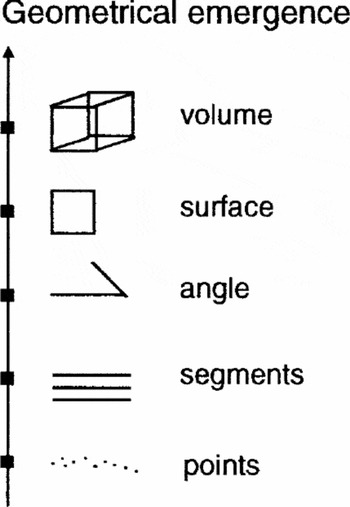
Geometry can be used to illustrate emergent properties and particular issues they raise.Footnote 18 The figure illustrates how there is an increase of complexity as one goes from points to line segments to two-dimensional shapes to three-dimensional objects with volume. Note that the notion of angle has no meaning at the stratum of points and segments, and the notion of volume is not present at the stratum of surfaces or of angles. The first issue this illustrates is that at each higher stratum there are unique properties and concepts which are not present at the level of the lower strata.
P. L. Luisi, ‘Emergence in Chemistry: Chemistry as the Embodiment of Emergence’, Foundations of Chemistry 4 (2002), p. 183.

Although emergent properties can sometimes be rationalised a posteriori they are difficult to anticipate or foresee. For example, it is not clear that a cube can be predicted in a flat world where a cube has not been seen before. A cube can be rationalised a posteriori in terms of right angles and of eight segments of equal length. However, a priori these segments can be assembled into many different structures with dimensionality one, two or three. A cube is just one of many possibilities.
The third issue that emergence in geometry illustrates is: emergent properties at one stratum are associated with a modification of the properties of and the relationships between the constituent components which are from the lower stratum. For example, defining a cube leaves the eight constituent line segments in a very particular relationship and they no longer have open ends.Footnote 19
The symmetry of the cube is also an emergent property. We note that it is independent of structural details such as whether the cube is solid, or made of line segments of a particular thickness, or whether the cube represents a specific spatial arrangement of eight atoms. Furthermore, the most insight into cubic symmetry and its consequences is achieved by regarding the cube as a three-dimensional object rather than an assemblage of line segments.
Emergence in philosophy
The concept of emergence received significant attention in philosophical circles from early in the twentieth century.Footnote 20 Here, it is important to make the distinction between ‘weak’ emergence and ‘strong’ emergence. Philosophers such as Broad and Alexander were advocates of what would be now called ‘strong’ emergence.Footnote 21 A position of strong emergence holds that emergent properties cannot, even in principle, be deduced from the properties of the constituents of the system. Vitalism, the notion that living matter is not purely physical, is an example of such a view.
A reductionist would claim we can always understand all the properties of a complex system in terms of the properties of its constituent particles and their interactions. Given sufficient computational resources we can predict properties of the whole system. In contrast, someone advocating ‘weak’ emergence acknowledges that it may be possible ‘in principle’ to deduce emergent properties from properties of the constituents of the system. However, it would emphasise that in practice (at least, at this point in time) we cannot make such deductions. Furthermore, such deductions do not necessarily provide significant insight or allow one to deduce the organising principles of the system under study.
Emergence enters philosophical discussions in many different formats. Sometimes a ‘strong’ emergence position is associated with ‘top–down causation’ or ‘downward causation’, in contrast to the notion of ‘bottom–up causation’ which a reductionist advocates. ClaytonFootnote 22 summarises different ‘emergent hypotheses’: ontological physicalism, novel property emergence, irreducibility of emergent properties and downward causation. Marxists ‘argue that the world is ordered hierarchically, and that entities at upper levels can never be analysed entirely in terms of entities at lower levels’.Footnote 23 The epistemology of Michael Polanyi was motivated by the stratification of reality. He considered that one used different ways of knowing to relate knowledge at the different strata. For example, before considering the meaning of individual words in a sentence one considers the sentence as a whole.Footnote 24
The distinction between ‘weak’ and ‘strong’ emergence can also be viewed as a distinction between epistemological emergence and ontological emergence:
A property of an object or system is epistemologically emergent if the property is reducible to or determined by the intrinsic properties of the ultimate constitutents of the object or system, while at the same time it is very difficult for us to explain, predict or derive the property on the basis of the ultimate constituents.
Ontologically emergent features are neither reducible to nor determined by more basic features. Ontologically emergent features are features of systems or wholes that possess causal capacities not reducible to any of the intrinsic causal capacities of the parts nor to any of the (reducible) relations between the parts.Footnote 25
Emergence in science
Reality is stratified and science is hierarchical: from physics to chemistry to biochemistry to biology to psychology. Generally, as one goes up the strata the complexity of the system under study increases and the relevant length and timescales become greater. At each stratum or level of hierarchy, science seeks to illuminate what the principles are which describe the phenomena under study. Sometimes principles can be reduced to and understood in terms of principles from the strata below. For example, genetics can be understood in terms of molecular biology. Rules of chemical bonding can be understood in terms of quantum physics. However, it should be stressed that there are very few specific cases where phenomena at one stratum have been predicted from a knowledge of the laws underlying strata below. In almost all cases, one observes (NB, not deduces) phenomena at one level, develops concepts to understand them at that level, and then a posteriori tries to understand them in terms of the laws from the level below.
It is not appreciated enough just how hard it is to predict properties of quantum many-body systems. New phases of matter continue to be discovered: liquid crystals, quasicrystals, antiferromagnets, superfluids . . . Yet I am only aware of one case where a new state of matter was predicted theoretically and then discovered: Bose-Einstein condensates. Quantum chemistry involves using Schrodinger's equation to calculate properties of molecules. It has many successes at calculating observed properties of small molecules. However, a measure of its limitations is the citation that one of the world leaders in the field, Fritz Schaefer, received for the award of the Centenary Medal of the Royal Society of Chemistry in 1992: ‘the first theoretical chemist successfully to challenge the accepted conclusions of a distinguished experimental group for a polyatomic molecule, namely methylene’.
AndersonFootnote 26 emphasised that the success of methodological micro-reductionism does not imply a constructivist hypothesis: if we know the laws of one stratum we can deduce the laws of the next strata above. Since making predictions from one stratum to the next is so difficult, if not impossible, an a posteriori approach rather than an a priori approach is often necessary.
Emergence in condensed matter physics
Emergent properties
Mass and energy are examples of additive properties of matter. The mass of a material is the sum of the masses of the constituent atoms. By contrast, the rigidity, hardness and colour of a material are emergent properties. Assembling different collections of atoms (and sometimes changing that assembly only slightly) we find diverse phases of matter. These can have very different properties ranging from metals to superconductors to insulators to magnets to liquid crystals.Footnote 27 To make the idea of emergence more concrete, consider the differences between graphite and diamond. Graphite is black and soft. Diamond is transparent and hard. Yet both diamond and graphite are composed of carbon atoms. The atoms are just in a different geometric arrangement in graphite and diamond. Furthermore, colour and hardness are not properties which can be associated with individual atoms, but are properties which can only be defined for collections of atoms.
Emergent phenomena
Many properties of quantum many-body systems can be understood in terms of ‘quasiparticles’.Footnote 28 These can have properties (mass, charge, spin, statistics) which are distinctly different from the properties of the constituent particles. Examples include holes, phonons, magnons, spinons and polarons. This raises questions about what is the ‘fundamental’ entity?Footnote 29 Other examples of emergent phenomena include topological order, discontinuities associated with first-order phase transitions and the universality associated with continuous phase transitions and critical points.
Organisational principles associated with emergent phenomena
Laughlin argues that a major focus of scientific research should be finding and elucidating such principles. Specific examples of such principles include broken symmetry, Goldstone bosons, gauge invariance and conservation laws.Footnote 30 For example, the rigidity of a solid is associated with broken symmetry and an order parameter.
Laughlin and Pines introduce the term protectorate to describe the insensitivity of higher level laws (organising principles) to the details of lower level laws. For example, the laws of thermodynamics are the same regardless of whether the microscopic dynamics of the constituent particles are quantum or classical. Universality in the theory of continuous phase transitions is another example. Near the liquid–vapour critical point the critical exponents are independent of the chemical composition of the system or of the interatomic forces between the constituent atoms and molecules.
Emergent phenomena can present significant paradoxes. Laughlin considers two paradoxes associated with the Integer Quantum Hall effect. First, there is ‘perfection due to imperfection’: the precision of the quantisation of the Hall resistance improves as the sample quality decreases, that is, the number of impurities which scatter the electrons increases. Second, the Quantum Hall effect provides a very precise means to determine properties of elementary particles from measurements on macroscopic samples. It measures the fine structure constant, which is defined in terms of the properties of single electrons: the electronic charge, Planck's constant and the speed of light.Footnote 31
Laughlin and Pines point out that in principle Schrodinger's equation from quantum mechanics and Coulomb's law of electrostatics is ‘The Theory of Everything’ since these equations determine all of chemistry and all the properties of all matter which we encounter everyday. Yet, due to limited computational resources, the most powerful supercomputer can only solve these equations and make predictions for systems containing at most ten particles. Even if we had a supercomputer which could do the relevant calculation modelling Avogadro's number (i.e. of the order of 1023) of particles, that would not help. Such a computer would require more atoms than there are in the universe. Some scientists would argue that doing the calculations on the computer would be just like doing an experiment (albeit, on the computer one usually has more control over varying system variables). It would be a ‘black box’ which might give little insight into the origin of the phenomena. Morever, such calculations on finite systems cannot predict phenomena such as broken symmetry and the exact quantisation of quantities such as the Quantum Hall resistance, the magnetic flux associated with a vortex in a type II superconductor, or the circulation associated with a vortex in superfluid helium. If we ‘know the answer’, that is, expect broken symmetry, then we can ‘jig’ the equations so we can get the answer out. But this is a posteriori not a priori reasoning
Emergence in chemistry
Roald Hoffmann shared the Nobel Prize in Chemistry in 1981 and has spent his career using quantum theory to gain insight into molecular structures and reactivity. Yet, he argues against a reductionist perspective and for the autonomy of different disciplines:
Scientists have bought the reductionist mode of thinking as their guiding ideology. Yet this philosophy bears so little relationship to the reality within which scientists themselves operate. And it carries potential danger to the discourse of scientists with the rest of society . . .
There are vertical and horizontal ways of understanding. The vertical way is by reducing a phenomenon to something deeper – classical reductionism. The horizontal way is by analysing the phenomenon within its own discipline and seeing its relationships to other concepts of equal complexity.
. . . there are concepts in chemistry which are not reducible to physics. Or if they are so reduced, they lose much that is interesting about them. I would ask the reader who is a chemist to think of ideas such as aromaticity, acidity and basicity, the concept of a functional group, or a substituent effect. Those constructs have a tendency to wilt at the edges as one tries to define them too closely. They cannot be mathematicised, they cannot be defined unambiguously. But they are of fantastic utility to our science.Footnote 32
Others who have also emphasised the importance of concepts and the limitations of reductionism in chemistry include Malrieu,Footnote 33 SchaeferFootnote 34 and Shaik.Footnote 35 Following Crick, LuisiFootnote 36 discusses several examples of emergence in chemistry, including the liquid properties of water, aromaticity in benzene, and protein folding and function. Proteins have a hierarchical structure (primary, secondary, tertiary and quartenary). The specificity with which haemoglobin can bind and release oxygen can be viewed as an emergent property due to the highly specific structural arrangement of the constituent atoms. Furthermore, emergence in chemistry illustrates top–down causation (in the sense defined by SchroderFootnote 37): the constituent atoms in a molecule have different properties than when they are not part of the molecule. For example, the light absorption and emission properties of the amino acid residues which make up a folded protein are modified by the particular folding arrangement.
Emergence in molecular biology
A key framework for molecular biophysics is that structure determines property, which in turn determines function. But ‘function’ is not a reducible concept. John Hopfield is a Professor of Molecular Biology at Princeton University and was recently president of the American Physical Society. In the context of physicists working in molecular biology, Hopfield recently stated ‘The word “function” does not exist in physics, but physicists need to learn about it, otherwise they will be in a sandbox playing by themselves.’Footnote 38 In molecular biology, a dramatic, puzzling and fascinating manifestation of emergence is how differences in a string of letters (the nucleotides A, G, T and C) encoded at the molecular level in DNA lead to different cell types, different acquired characteristics and even different species. The limitations of reductionism and the importance of emergence in molecular biology have also been emphasised by PeacockeFootnote 39 and by Noble.Footnote 40
Implications of emergence for the philosophy of science
I now briefly mention some implications of the limitations of reductionism and the significance of emergence for the philosophy of science, since they are not unrelated to associated issues in theology. I will give a more detailed discussion elsewhere.Footnote 41 As Laughlin emphasises, emergence raises such questions as ‘What is an explanation?’Footnote 42 ‘What is the ultimate cause?’ ‘What is fundamental?’ It affirms that truth is objective but multi-faceted and contextual. The limitations of reductionism affirm non-foundationalism and values induction over deduction. At each stratum the objects under study should determine the methods and concepts used. Thus ontology should determine epistemology. Anderson argues that the interplay of emergence and reduction affirms a critical realism in science.Footnote 43 Yet the existence of emergent properties can both clarify and confuse ontology. For example, liquid water can be viewed as both a collection of fluctuating molecules and a continuous static fluid. Questions of the classification of processes as either random or deterministic (and particularly whether they have meaning and purpose) become ambiguous when one sees how random motion, such as Brownian motion, can arise from deterministic microscopic dynamics.Footnote 44
Reductionism in theology
The success of reductionism as a practice in modern science has arguably led to a strong undercurrent of reductionism in theology in the modern era. Attempts have been made to reduce theology to just one discipline, such as history, literary criticism, anthropology, psychology or sociology. The choice of which discipline is ‘fundamental’ to understanding theology has been heavily influenced by the view as to what the object under study is. For example, Schleiermacher considered that the spiritual experience of the individual Christian was the object under study, leading to a focus on the psychological makeup of humans, rather than on the God in whom the individual Christian believes. On the conservative side, a reductionist approach has tended to equate revelation with the printed words on the pages of the Bible (cf. Carl Henry, Cornelius van Til) and to reduce doctrine to a set of propositional statements.Footnote 45 This approach can be contrasted to Barth's threefold form of the Word of God. One should not deny that there are elements of these reductionist approaches which may have some value. But the key question for theology (as for science) is just how important and valuable are the insights resulting from such reductionism. Furthermore, can a focus on one element eventually lead one away from an accurate understanding of the object under study?
Insights for theology from emergence in science
As discussed earlier, much of recent discussion on emergence in theology is framed in terms of strong emergence, and appears to attempt to consider God, spirit and soul as emergent concepts and/or objectsFootnote 46 in order to justify a particular theology, usually some variant of process theology. These discussions also presuppose a particular view of God and doctrine of creation. They appear to be more concerned with ontology than with epistemology. My perspective is distinctly different, focusing instead on epistemological issues.
Emergence in science (even at the level of weak emergence) tells us something about the relationship between reality, ontology and epistemology. The discussion below attempts to explore the extent of parallels and analogies, including their limitations, particularly with regard to theological method and the development of theological concepts.
A dialogue partner in the following discussion is Karl Barth, arguably the most influential theologian of the twentieth century.Footnote 47 His magnum opus, the thirteen-volume Church Dogmatics, has a scope, originality, exegetical engagement and historical depth which makes it a model for scholarship in any field.Footnote 48 Barth's theology has often been regarded as an unpromising avenue for dialogue between science and theology. He was sharply opposed to natural theologyFootnote 49 and he declined to participate in any formal dialogue with the natural sciences.Footnote 50 Further, his conception of the ‘scientific’ (wissenschaftlich) character of theologyFootnote 51 has often been interpreted as an attempt to isolate theological knowledge from other branches of learning, so that an interdisciplinary dialogue becomes impossible.Footnote 52 However, T. F. TorranceFootnote 53 and Alister McGrathFootnote 54 have sought to develop a ‘scientific theology’ using a methodology which is strongly influenced by Barth. Ben Myers and I recently considered parallels and differences between the epistemological issues raised by quantum physics and by Barth's theology.Footnote 55
For Barth, the doctrine of creation is an article of faith: it is an indemonstrable belief in the relationship between God and the empirical world. This principle serves to help demarcate the respective domains of theology and science; but it should not be interpreted as a reactionary attempt to insulate faith from the challenges of scientific knowledge. On the contrary, Barth's approach affirms the ‘free scope’ of natural science to develop without any theological a priori. In the preface to his extensive treatment of the doctrine of creation Barth also makes the qualification that ‘future workers in the field of the Christian doctrine of creation will find many problems worth pondering in defining the point and manner of this . . . boundary [between theology and science]’.Footnote 56
Barth's concerns about reductionism as a theological method
Barth's concern with not reducing theology to other disciplines is evident at the beginning of his break with the liberal theology of his teachers. In the preface to the first edition of Der Romerbrief, in 1918, Barth stated:
The historical-critical method of Biblical investigation has its rightful place . . . But, were I driven to choose between it and the venerable doctrine of Inspiration, I should without hesitation adopt the latter, which has a broader, deeper, more important justification. The doctrine of Inspiration is concerned with the labour of apprehending, without which no technical equipment, however complete, is of any use whatever. Fortunately, I am not compelled to choose between the two. Nevertheless, my whole energy of interpreting has been expended in an endeavour to see through and beyond history into the spirit of the Bible, which is the Eternal Spirit.Footnote 57
In the editors’ preface to the first volume of Church Dogmatics, Bromiley and Torrance suggest that one of the main features of the volume is Barth's intention ‘to deliver theology from its persistent tendency to become reduced to some form of anthropology’.Footnote 58
Affirmation of theology as an autonomous discipline
The stratification of reality naturally leads to a stratification of disciplines and fields of study. Each is concerned with its own distinct object and so develops appropriate concepts and methods to study and understand that object. Similarly, theology is concerned with its own distinct object, God.Footnote 59 Consequently, theology should not be beholden to any particular discipline such as philosophy, anthropology, sociology, natural science or history. If it does become so beholden it is no longer theology. Theology can be considered to be a science in the sense of faithfully pursuing knowledge about its object, but need not strive to be accepted by other sciences to be legitimate. These three points closely parallel the views of Barth, clearly propounded in the opening pages of the Church Dogmatics.
[W]hat is required is . . . criticism and correction [of the Church's talk about God] in the light of the being of the Church, of Jesus Christ as its basis, goal and content . . . even those historians, pedagogues, etc., and especially philosophers who kindly take this aspect into account always miss the real problem by setting it within the sphere of their own sciences, judging the utterance of the Church about God in accordance with alien principles than its own principle. (p. 6)
If theology allows itself to be called, and calls itself, a ‘science’, in so doing it declares: 1. that like all other so-called sciences it is a human concern with a definite object of knowledge, 2. that like all others it treads a definite and self-consistent path of knowledge, and 3. that like all others it must give an account of this path to itself and to all others who are capable of concern for this object and therefore of treading this path . . . to the discharge of its own task it must absolutely subordinate and if necessary sacrifice all concern for what is called science elsewhere. The existence of other sciences, and the praiseworthy fidelity with which many of them at least pursue their own axioms and methods, can and must remind it that it must pursue its own task in due order and with the same fidelity. (pp. 7–8)Footnote 60
The last sentence can be interpreted as affirming the potential fruitfulness of a dialogue between science and theology.
A more extended discussion is contained in section 7.2, entitled ‘Dogmatics as a Science’:
Scientific dogmatics – and now we come to the decisive point – enquires into the agreement of Church proclamation with the revelation which is attested in Holy Scripture . . . Dogmatic work stands or falls by whether the standard by which Church proclamation is measured is the revelation attested in Holy Scripture and not a philosophical, ethical, psychological or political theory.
The irreducibility of theological concepts
Revelation provides an example of a theological concept (and reality) that is not simply reducible to history, scripture, culture, religion or sociology. God cannot be described and understood in purely human terms. I now explore some parallels with both the ontology and epistemology of emergent phenomena in science, before turning to differences.
Barth states, ‘Revelation in the Bible means the self-unveiling, imparted to men, of the God who by nature cannot be unveiled to men.’ He then expounds this statement from three points of view,Footnote 61 with a particular emphasis on the significance of the name of God, YHWH and of Jesus. God is himself both in concealment and ‘in manifestation, i.e., in the form of something He Himself is not’. Anthropomorphic concepts such as
His arm, His right hand . . . are not just [all too human] descriptions and representations of the reality of Yahweh; they are themselves the reality of Yahweh . . . He has objectivity for those to whom He is manifest. Religious science usually defines concepts used in this way as hypostases, i.e., realities of the one God which are both distinguishable and yet also indistinguishable from Him.
[T]his revelation of the name (Exodus 3:13ff.) is in fact, in content, the refusal to give a name, for ‘I am that I am’ can hardly mean more than that ‘I am He whose true name no one can utter’ . . . But under this name, God does reveal himself to His people, i.e., He begins, as Exodus 3 instructively shows, to have dealings with Israel through the announcing by Moses of its deliverance out of Egypt.
[T]he picture which the New Testament itself sets before us is that of the self-disclosure of this Father in which He is not the Father but the Son, the historical figure of this Man on His way from Bethlehem to Golgotha, the ‘name’ of Jesus. Again, the concreteness and actuality of the self-unveiling of God for man, and the enigma of the self-distinction in God Himself which makes this self-unveiling possible, has not just increased quantitatively here in comparison with the Old Testament.
Hence, revelation cannot be reduced to a historical event. In revelation we find at the same time the greatest identification and the greatest difference between the person of God and the event of revelation.
How are there parallels to the irreducibility of scientific concepts? Earlier I discussed the discontinuity between descriptions of water at the macroscopic and at the molecular level. Water cannot be described exclusively as a continuous fluid nor as a collection of individual molecules. The collective properties hide the molecular properties but the latter are also a reality. Both are a manifestation of the other.
Previously I discussed how the laws describing emergent phenomena are independent of the laws which govern the behaviour of the lower strata (the protectorates of Laughlin and PinesFootnote 62). For example, the laws of thermodynamics are independent of whether the laws of atomic motion are described by classical or quantum mechanics. Furthermore, these higher level laws (thermodynamics) to some extent obscure the content of the underlying microscopic laws (quantum mechanics). So, by analogy, we might consider the notion that theological truth is ‘robust’ and independent of the laws or concepts which govern behaviour at lower strata levels, such as anthropology, psychology and biology.
I briefly mention some other issues which have been or might be explored elsewhere. McGrath discusses the threefold form of the Word of God advocated by Barth, in light of the stratification of reality. Classically the Trinity was viewed as one essence in three substances and it was denied that there were parts which make up a whole and so an analogy with emergence might be inappropriate. On the other hand, the individual three persons of the Trinity cannot be understood in isolation but only in relation to each of the others.
The sinful nature of humanity might be viewed as an emergent concept and a reality which cannot be reduced solely to (or explained in terms of) lower level concepts (such as social behaviour, psychology or genetics). The ‘law of sin and death’ (Romans) might be viewed as an ‘emergent law’ which cannot be reduced to laws of biology. Hence the preoccupation of some with understanding the causal connection between the fall of Adam and biological death is neither necessary nor fruitful.
Ontology determines epistemology
The object (and stratum) under study determine the methods to be used, the nature and the reliability of the knowledge which can be gained, and the organising principles of the discipline. Methods or concepts from one stratum might not be appropriate for other strata. Thus we should not be surprised at the inadequacy of historical, sociological or psychological approaches to theology. These disciplines and their methods may give some (albeit limited) insights. Emergence affirms the relative autonomy of theology as an intellectual discipline. In turn, this parallels Barth's emphasis that theology is free to enter into creative dialogue with other disciplines without sacrificing its own distinctiveness as a ‘science’ (Wissenschaft).
Barth particularly emphasised that, in theology, ontology determines epistemology. Because the triune God is the object under study in theology, the methods of theology must be wholly constrained by this unique object. And it is in exactly this sense that theology can be described as a ‘science’. As Barth writes:
Theology is one among those human undertakings traditionally described as ‘sciences’. Not only the natural sciences are ‘sciences’. Humanistic sciences also seek to apprehend a specific object and its environment in the manner directed by the phenomenon itself; they seek to understand it on its own terms and to speak of it along with all the implications of its existence.Footnote 63
Discontinuities and reality
Emergent phenomena in science illustrate the discontinuities present within physical reality. The collective properties of groups of particles can be discontinuous with the properties of the constituents. For example, softness and colour are not properties of individual atoms, but are properties of the solids comprising those atoms. One cannot continuously connect the fractional charges of the quasiparticles associated with the fractional Quantum Hall effect with the integer charges of the constituent particles of the electron gas from which they emerge.Footnote 64 Similarly, theology conceives of the reality of God as singular, unpredictable and strictly unanticipatible. As Barth argued, and Brüggemann emphasises, many Christian doctrinal themes are constructed dialectically around points of fundamental tension and discontinuity: God creates from nothingness, justifies by condemning, brings life from death and reveals deity in humanness.Footnote 65
Creation ex-nihilo and science
Emergence in science illustrates how in a sense something can come out of nothing and how order can come from chaos. It shows the ambiguity of notions of ‘nothing’ and a ‘vacuum’. As discussed above, Laughlin argues that the ‘vacuum’ in quantum field theory is actually an emergent object. Such ambiguity should temper those who have a rigid interpretation of the doctrine of creatio ex nihilo, or who agonise about connecting the doctrine to scientific theories of the origin of the universe.Footnote 66 The ambiguity here affirms a view that instead the doctrine of creation is a formulation of discontinuity – a statement that God acts in discontinuous and singular ways.
Liberation from a preoccupation with causality (and first cause)
John Webster's masterful summary of Barth's doctrine of creationFootnote 67 emphasises that a major contribution of Barth was to liberate modern theological discussions of creation from a preoccupation with abstract notions of ‘causality’, and particularly ‘first cause’. Barth's approach articulates a relationship between God and creation which is not based on any causal necessity. He critiques all attempts to secure a place for God by locating the divine activity at a particular point of the causal nexus. Barth states:
The mystery of creation on the Christian interpretation is not primarily . . . the problem whether there is a God as the Originator of the world; for in the Christian sense it cannot be that first of all we presuppose the reality of the World and then ask whether there is also a God. But the first thing, the thing we begin with, is God the Father and the Son and the Holy Spirit. And from that standpoint the great Christian problem is propounded, whether it can really be the case that God wishes to be not only for Himself, but that outside Him there is the world, that we exist alongside and outside Him? That is the riddle.Footnote 68
Thus, while an emergent perspective in science emphasises contingency and challenges the model of a closed causal system, Barth offers a parallel theological critique of the same model. More radically, Barth critiques any attempt to conceptualise the God–world relationship in causal terms: as the creator, God liberates the world to be itself, so that God's relationship to the creation transcends the framework of necessity and causality, a framework which has been over-emphasised in many considerations of the relation between science and religion.
Primacy of relationship
Previously we discussed how we cannot understand the unusual properties of liquid water solely by focusing on the properties of individual water molecules. Furthermore, emergent properties modify the properties of the constituents. For example, there is a parallel in theology, particularly emphasised by Barth. God cannot be understood in isolation from the Trinity. Creation and humanity cannot be understood out of the context of the covenantal relation between God and man. Theology is about relationships. Gunton states:
The tragic side of the matter is Augustine's failure to appropriate the Cappadocian conceptual advance according to which relations are between persons – as the Aristotelian concept suggests – yet are at the same time constitutive of what those persons are – here against Aristotle. The persons are not persons who then enter into relations, but are mutually constituted, made what they are, by virtue of their relations to one another.Footnote 69
Conclusion
Emergent phenomena and concepts in science raise questions about the presuppositions of much academic theology, which has forlornly tried to become more intellectually respectable by adopting Enlightenment methods, concepts and presuppositions. Emergence affirms those who consider theology (in the tradition of Barth, Torrance and McGrath) to be a legitimate discipline in its own right. It can and should dialogue with other disciplines, but should not be intimidated into changing its methods or content by intellectual imperialists from other disciplines. Furthermore, as Barth emphasised, theology can only claim to be ‘scientific’ if its content and methods are constrained by the object under study, the triune God: Father, Son and Holy Spirit.Footnote 70