One of the central goals of SLA research is to understand the systematic nature of the linguistic system that second language (L2) learners develop, on the one hand, and the limits of L2 ultimate attainment, on the other hand. A common theme in the field of generative language acquisition is to compare and contrast first language (L1) acquisition by monolingual children with adult SLA. Faced with a logical problem for language acquisition, children must acquire a complex linguistic system efficiently. However, the information available from the linguistic environment (input) is not always reliable for allowing the child to figure out the abstract and subtle properties of the system to be acquired: This is the poverty-of-the-stimulus problem. There is also another logical problem of mismatch between input evidence and knowledge much less discussed in the literature—namely, the lack of knowledge in the face of abundant evidence to support that knowledge or the abundance of the stimulus problem (Borer & Wexler, Reference Borer, Wexler, Roeper and Williams1987; Wexler, Reference Wexler, Lightfoot and Hornstein1994). During development, children make systematic errors with aspects of language highly frequent in the input, such as inflectional morphology on verbs and aspects of argument structure. As a solution to these two logical problems, many researchers assume that children must be guided by innate knowledge of language, or Universal Grammar (UG). Presumably assisted by UG, the eventual outcome of L1 acquisition is successful and uniform because all normally developing children eventually overcome developmental errors and become fully competent speakers of their language. Children reach native speaker (NS) competence and can use the language fluently, without detectable errors.
If the process of L1 acquisition is efficient and its outcome is successful and complete, the same cannot be said about SLA in adulthood. Addressing the question of whether there is a logical problem for SLA as well, Bley-Vroman (Reference Bley-Vroman1990) discussed 10 characteristics of SLA (see the Appendix) to suggest that, at least descriptively, the processes and outcomes of L1 and L2 acquisition are fundamentally distinct. If linguistic success characterizes L1 acquisition, at least six of the factors suggest that incompleteness and failure—now rephrased as lack of convergence and unreliability in Bley-Vroman (this issue)—are the main characterizing features of adult SLA. Although L2 learners are faced with the same logical problem as L1 learners, Bley-Vroman suggested that the gap between abstract knowledge and experience in SLA is not bridged by UG or a domain-specific linguistic system. The main claim of Bley-Vroman’s (Reference Bley-Vroman1990) version of the fundamental difference hypothesis (FDH) is that the innate linguistic system that operates in childhood is no longer efficient in adult foreign language learning, an idea consistent with Lenneberg’s (Reference Lenneberg1967) critical period hypothesis. Because L2 learners have already acquired their L1 through the domain-specific innate linguistic system (UG), they can rely on their L1 knowledge (a particular instantiation of UG but not the full spectrum of options).Footnote 1 Unable to utilize domain-specific linguistic mechanisms exclusively due to the late onset of SLA, the L2 learner deploys instead the domain-general cognitive system unrelated to UG. Similar overall views are shared by other researchers within the generative framework (Bley-Vroman, Felix, & Ioup, Reference Bley-Vroman, Felix and Ioup1988; Clahsen & Muysken, Reference Clahsen and Muysken1986; Hawkins & Chan, Reference Hawkins and Chan1997; Meisel, Reference Meisel1997; Schachter, Reference Schachter1990; Sorace, Reference Sorace1993; Tsimpli & Roussou, Reference Tsimpli and Roussou1991) and by researchers who work with other cognitive approaches to SLA (DeKeyser, Reference DeKeyser2000, Reference DeKeyser, Doughty and Long2003; Paradis, Reference Paradis2004; Ullman, Reference Ullman2001).
What empirical evidence would provide support for the FDH? Leaving affective and motivational factors aside, research in support of the FDH needs to show that the nature of the linguistic system acquired and the outcome of L1 and L2 acquisition are qualitatively different due to the deployment of very different learning mechanisms in children and adults. In particular, research has to demonstrate that the role of the L1 is deterministic in L2 ultimate attainment, which leads to fossilization and incomplete or divergent linguistic representations. In other words, it needs to be shown that L2 learners cannot learn properties of the L2 absent in their L1, especially when input underdetermines the grammatical property, principle, or parameter to be acquired (a poverty-of-the-stimulus situation). If it turns out that L2 learners are successful in acquiring a property of the L2 for which there is no equivalent in the L1, to support the FDH, it has to be convincingly demonstrated that acquisition took place on the basis of input and the operation of domain-general cognitive mechanisms. Interestingly, however, the abundance of the stimulus problem is also very common in adult SLA, perhaps more common than in L1 acquisition, because L2 learners tend to fossilize aspects of the L2 grammar that may or may not be shared by the L1. Fossilization may occur even when the evidence from the L2 input is substantial and when L2 learners receive explicit and implicit negative evidence, as in the specific case of inflectional morphology. It is precisely fossilization under these more optimal input conditions that points to the potential inefficiency of the learning mechanisms involved in adult SLA.
One of the first studies conducted to confirm that L2 learners cannot acquire properties of the L2 not represented in their L1 was by Bley-Vroman and Yoshinaga (Reference Bley-Vroman and Yoshinaga1991), who examined knowledge of lexicosemantic constraints on the English dative alternation by English NSs and Japanese L2 learners of English. The dative alternation allows verbs like give to alternate (Mary gave money to her church, Mary gave her church money), whereas Latinate verbs with the same meaning do not alternate (Mary donated money to her church, *Mary donated her church money). The FDH predicts that the L1 Japanese speakers would be successful in acquiring the possession constraint (Pinker, Reference Pinker1989) in English because a similar constraint applies to Japanese dative verbs. However, the FDH also predicts that the Japanese learners would have difficulty acquiring the verbal semantics and morphophonological constraints on the basis of input. Results of two experiments (one with novel verbs and one with real English verbs) showed that the Japanese learners of English were very accurate with the possession constraint and less accurate with the verbal semantics and morphophonological constraints, as predicted. However, because the learners were not totally insensitive to the latter, the study could only provide weak support for the FDH.
More recent incarnations of the FDH are Hawkins and Chan’s (Reference Hawkins and Chan1997) failed functional features hypothesis and Tsimpli and Dimitrakopoulou’s (Reference Tsimpli and Dimitrakopoulou2007) interpretability hypothesis. According to these hypotheses, L2 learners can access principles of UG (including operations like merge, agree, and economy constraints) but are unable to acquire parameterized features of the functional lexicon once L1 acquisition is complete. Under Tsimpli and Dimitrakopoulou’s hypothesis, uninterpretable features, where parameters reside, are subject to maturational effects. Hawkins and Chan investigated the acquisition of restrictive relative clauses by French and Cantonese learners of English, whereas Tsimpli and Dimitrakopoulou examined the incorrect acceptance of resumptive pronouns in wh-extraction in English questions by Greek learners of English. Relative clauses in English involve a [±wh] uninterpretable feature in the complementizer (C). Resumptive clitics in Greek are also the spell-out of an uninterpretable [+wh-agreement] feature. Hawkins and Chan and Tsimpli and Dimitrakopoulou predicted that the L2 learners would also have problems recognizing the ungrammaticality of resumptive pronouns and subjacency (i.e., a principle that forbids movement across more than one bounding node) violations. Both studies showed that the L2 learners did not have Englishlike representations, and that their interlanguages were constrained and determined by the parametric options of their L1s.
As for research investigating the role of domain-general learning in SLA, DeKeyser (Reference DeKeyser2000) specifically tested the FDH by focusing on age effects in the ultimate attainment of English morphosyntax and analytical verbal aptitude. According to DeKeyser, “the Fundamental Difference Hypothesis predicts that those adults who appear to be successful at learning a second language will necessarily have a high level of verbal ability” (p. 501). Fifty-seven NSs of Hungarian participated in the study. All participants had resided in the United States for a minimum of 10 years, with an average length of residence of 34 years. Forty-two participants emigrated after age 16 (adult L2 learners), whereas 15 emigrated before age 16 (child L2 learners). Average age at testing was 55 (range: 16–81). Participants were administered a modified version of the oral grammaticality judgment task (GJT) used in Johnson and Newport’s (Reference Johnson and Newport1989) study (a seminal study that supports maturational effects in L2 learning). Additionally, all participants took a Hungarian Language Aptitude test. Results showed a strong negative correlation between age of arrival and scores on the GJT: Although the younger acquirers all reached a native or near-native level in the GJT regardless of their verbal aptitude score, only the adults with above-average verbal aptitude eventually performed at the near-native level in the GJT. DeKeyser maintained that this study provides strong evidence for the FDH, because only those adults who had been able to rely on explicit, analytic, problem-solving capacities reached a nativelike level of competence in morphosyntax:
If the Critical Period is constrained, however, to implicit learning mechanisms, early age confers an absolute not just a statistical advantage […] somewhere between the ages of 6–7 and 16–17, everybody loses the mental equipment required for implicit language induction of the abstract patterns underlying human language, and the critical period really deserves its name. (p. 518)
What these studies have demonstrated is that L2 learners do not all reach the level of ultimate attainment of NSs, especially when the L1 and the L2 differ with respect to some lexicosemantic rule, uninterpretable feature, or other grammatical property; that is, L2 grammars do not necessarily converge on the target. This is the classic critical period argument also maintained by many others (e.g., Abrahamsson & Hyltenstam, 2008; Hyltenstam & Abrahamsson, Reference Hyltenstam, Abrahamsson, Doughty and Long2003; Long, Reference Long1990, Reference Long2007).
However, is nonconvergence on the target, as opposed to uniform convergence in L1 acquisition, sufficient evidence for the FDH? Research in the last two decades has shown that many L2 learners possess knowledge of poverty-of-the-stimulus phenomena (Dekydtspotter, this issue; Dekydtspotter & Sprouse, Reference Dekydstpotter and Sprouse2001; Dekydtspotter, Sprouse, & Anderson, Reference Dekydstpotter, Sprouse and Anderson1997; Kanno, Reference Kanno1998; Pérez Leroux & Glass, Reference Pérez Leroux and Glass1999), reset parameters or acquire features and feature values not instantiated in their L1 (Schwartz & Sprouse, Reference Schwartz and Sprouse1996; White, Valenzuela, Kozlowska-Macgregor, & Leung, 2004), and achieve nativelike attainment (Bruhn de Garavito, Reference Bruhn de Garavito, Perez-Leroux and Glass1997; Montrul & Slabakova, Reference Montrul and Slabakova2003; White & Genesee, Reference White and Genesee1996). These studies document cases of successful SLA because the L2 learners demonstrate behavior qualitatively similar to (although not necessarily quantitatively identical) and, in some cases, within the range of variability of the NS control groups. For all of these researchers, successful acquisition in these cases is due to the full operation of UG past puberty. Although the potential role of input and the L1 is discussed to some extent, few have considered whether the same results may have been arrived at through exclusive reliance on domain-general problem-solving skills that emulate UG-type knowledge—or verbal aptitude for DeKeyser (Reference DeKeyser2000) and Abrahamsson and Hyltenstam (Reference Abrahamsson and Hyltenstam2008)—as the FDH maintains, or rather through different processing procedures. In short, a cursory look at a few studies that focus on L2 linguistic knowledge conducted in the last two decades suggests that whereas the glass is half-full for some, it is half-empty for others, and evidence in favor of the FDH is at best mixed.
Rather than focusing exclusively on SLA, as most previous studies have done, here I suggest a different, albeit indirect, strategy to examine the validity of the FDH. In particular, I will compare the linguistic abilities of adult L2 learners in some key areas of syntax and inflectional morphology with those of early bilinguals exposed to a L1 and a L2 in early childhood but whose L1 is the weaker language at the time of testing.Footnote 2 Because all L1-acquiring children are successful and converge on the target, incomplete L1 acquisition seems odd under the FDH. Yet, there are many early bilinguals who—for a variety of environmental circumstances—fail to receive adequate input to reach nativelike competence in their adult L1. Given that the FDH suggests that fossilization and nontargetlike achievement are related to acquisition after puberty in L2 learners, adult early bilinguals with incomplete knowledge of their L1 are an interesting population to address the claims of the FDH. At first glance, the existence of this population renders claims of the FDH essentially false, given that all of the characteristics of L2 learning discussed by Bley-Vroman (Reference Bley-Vroman1990) also apply to them.
Let us leave the issue of nonconvergence aside for the moment to focus instead on potential causes behind nonconvergence in these two populations. Because early bilinguals were exposed to the target language since infancy and before puberty—when UG was presumably still available under the FDH—their knowledge of the L1 should have been acquired with the specific-linguistic learning and processing mechanisms assumed to operate in childhood. Hence, nonconvergent acquisition in the case of early bilinguals could be strictly due to insufficient input and use. In contrast, nonconvergence in L2 learners may arise due to both input and less efficient learning mechanisms than those deployed in childhood. If this is the case, under the FDH, early bilinguals with incomplete knowledge of their L1 may still differ from full NSs but should show evidence of having set relevant parameters early in life. In contrast, L2 learners should not show evidence of resetting the same parameters in the L2 or of having done so through different means and processes. In other words, the FDH predicts that despite nonconvergence in the two cases, the early bilinguals should still approximate NSs more than L2 learners.
This prediction is examined here in light of the results of some recent studies that compare these two adult populations (i.e., early bilinguals and L2 learners) on aspects of syntax and morphology. Unfortunately, fewer empirical studies that compare populations of adults with different ages of onset of acquisition are available for review than studies comparing L1 and L2 acquisition, or successful and unsuccessful learning in SLA. Additionally, despite the fact that a strict comparison of L2 learners and incomplete L1 learners (or early bilinguals whose L1 is the weaker language) presents a number of methodological challenges (see Montrul, Reference Montrul2008, for a discussion), this particular early bilingual population, nonetheless, offers tremendous potential to inform perennial issues in theoretical SLA from a different angle, such as the limits and possibilities of grammatical competence acquired before and after a certain age.
The present review highlights the following: (a) Both early and late bilinguals have incomplete knowledge of the target language (the L1 in one case and the L2 in the other)—that is, their behavior is quantitatively different from that of NSs; (b) both early and late bilinguals make similar kinds of errors in morphology, regardless of age of acquisition; and (c) taken together, the incidence of nativelike performance is much higher in the early bilinguals than in the late bilinguals. I will speculate on the type of linguistic knowledge (implicit or explicit) and processing that some of the tasks used in these studies may be tapping in each population. Because the evidence I present is suggestive but far from conclusive, I will conclude with a call for more processing-oriented research, which, I believe, is crucial to understanding potential fundamental differences between convergent and nonconvergent L1 and L2 acquisition as a function of age and context of acquisition.
EARLY AND LATE BILINGUALS
In the field of bilingualism, bilinguals are classified along a number of parameters, two of which are the age of acquisition and the sequence of acquisition of two or more languages. Although SLA is an independent field of study, L2 learners are a specific type of bilinguals in the broad sense of the word. On the one hand, adult L2 learners are late bilinguals because they started the acquisition of the L2 late, after the L1 matured. On the other hand, early bilingualism typically refers to the acquisition of two languages in childhood—either simultaneously since birth (bilingual L1 acquisition) or sequentially (SLA in childhood)—after the foundations of the L1 are in place. Although many bilingual individuals are capable of achieving very high levels of proficiency in all of the languages they use (Grosjean, Reference Grosjean2008), it is also the case that bilingual proficiency varies greatly depending on a variety of circumstances. In other words, not all bilinguals exposed to two or more languages in childhood develop full command of both languages in adulthood. In fact, it is not uncommon for bilingual speakers to have a weaker and a stronger language. This situation is particularly true of many bilingual speakers of minority languages who acquire high proficiency in the majority language through interaction with peers and schooling. Due to restricted opportunities to use the minority language beyond the home, the language of the family may not reach full linguistic development, resembling a L2. Indeed, most of the characteristics of foreign language learning discussed by Bley-Vroman (Reference Bley-Vroman1990) have been argued to apply to this population as well (Montrul, Reference Montrul, Slabakova, Montrul and Prévost2006; Polinsky, Reference Polinsky2006). A testament to their incompletely acquired knowledge is the fact that in recent years, especially in the United States, Canada, and Western Europe, early bilinguals of minority languages (also referred to as heritage language speakers by Valdés, Reference Valdés and Valdés2000) have been turning to foreign language classrooms to learn or regain knowledge of the family language.
Because some adult early bilinguals exhibit incomplete knowledge of a language acquired at home in childhood, this suggests that characteristics such as incomplete acquisition, indeterminate judgments in GJTs, and variability, among others, may not be exclusively caused by late acquisition, as argued for L2 learners. Rather than age alone, it appears that inadequate amounts of input may also contribute to these linguistic outcomes in L1 acquisition in a dual language environment. Does this mean that the original formulation of the FDH is untenable? I believe that incomplete acquisition itself cannot be a defining characteristic of the FDH. However, even when the two populations show many of the characteristics described by Bley-Vroman (Reference Bley-Vroman1990), it is still possible to assess the FDH by asking whether early bilinguals have advantages over L2 learners because they possess whatever linguistic knowledge retained from the family language—acquired as a L1—as well as the alleged efficient and reliable learning and processing systems and mechanisms assumed to operate in childhood.
In general, adult L2 learners have been shown to be less likely to achieve nativelike attainment in aspects of phonology and pronunciation (Flege, Yeni-Komshian, & Liu, Reference Flege, Yeni-Komshian and Liu1999; Oyama, Reference Oyama1976) than in morphology and syntax (Patkowski, Reference Patkowsky1980). How do early and late bilinguals compare in these domains? Even if both early and late bilinguals do not exhibit nativelike performance, are early bilinguals closer to NSs than late bilinguals, as the extension of the FDH to this population would predict? Au, Knightly, Jun, and Oh (Reference Au, Knightly, Jun and Oh2002; see also Knightly, Jun, Oh, & Au, Reference Knightly, Jun, Oh and Au2003) tested NSs, early bilinguals of very low proficiency in Spanish (what they call childhood overhearers), and typical L2 learners enrolled in second-year Spanish language classes at the University of California at Los Angeles. The early bilinguals had spoken and had been spoken to in Spanish at home before age 3 but less frequently after that age. The typical L2 learners started learning Spanish after age 14. Participants were asked to read aloud sentences in Spanish containing words with the voiceless stops /p, t, k/ and the voiced stops /b, d, g/. The results of this task were analyzed at the phonetic level (i.e., voice onset time [VOT] in voiceless stops), the phonological level (i.e., lenition with the voiced stops in intervocalic position), and accent in general (i.e., accent ratings). Morphosyntax was assessed with an elicited production task for gender agreement and an oral 66-item GJT, which contained 33 ungrammatical sentences with violations of gender, tense, aspect, mood, negation, and pronouns. Results of the phonological assessments showed that the early bilinguals were virtually nativelike with VOT, lenition rules, and overall accent in general, whereas the L2 learners differed significantly from the two other groups. However, on both tasks that assessed knowledge of morphosyntax, the early bilinguals and the L2 learners did not differ from each other: Both groups performed far less targetlike than the NSs on both the gender production task and on the GJT. Au et al. concluded that although childhood exposure confers benefits in phonology, there are no measurable advantages in morphosyntax.
Although Au et al.’s (2002) conclusions are consistent with findings on maturational effects in the SLA of phonology, the study also raises questions about the methodology employed to test morphosyntax because the GJT used, for example, lumped together many different grammatical structures with few items per type. As linguistic theory and linguistically oriented acquisition studies have demonstrated, not all aspects of morphology and syntax are created equal, nor do they present the same magnitude of difficulty to L1 and L2 learners.
There are many recent studies of early bilinguals that focus on the grammars of heritage language speakers in their own right from a linguistic (although not necessarily a UG) perspective (Montrul, Reference Montrul2002, Reference Montrul2004, Reference Montrul, Slabakova, Montrul and Prévost2006; Montrul & Bowles, Reference Montrul and & Bowlesin press; Polinsky, Reference Polinsky2006, Reference Polinsky, Brinton, Kagan and Bauckus2008a, Reference Polinsky2008b). However, there are relatively few studies within this approach that directly compare L2 learners (late bilinguals) and early bilinguals using the same methodologies.Footnote 3 Of the available studies, Bruhn de Garavito’s (Reference Bruhn de Garavito, Skarabela, Fish and Do2002) study of verb movement in Spanish and O’Grady, Lee, and Choo’s (Reference O’Grady, Lee and Choo2001) study of case markers and relative clauses in Korean found no differences between L2 learners and heritage language learners, which echoes the findings of Au et al. (Reference Au, Knightly, Jun and Oh2002) and Knightly et al. (Reference Knightly, Jun, Oh and Au2003). In contrast, Montrul’s (Reference Montrul2005) study of unaccusativity in Spanish found advantages for heritage language learners over L2 learners when proficiency level, as measured through a written test, was taken into account. Next, I will review in detail the results of three recent studies that found informative differences between early and late bilinguals’ knowledge of syntax—as the FDH would predict—and will conclude with a discussion of what these collective findings suggest for the FDH. Additionally, I will call for more processing-based research to disentangle potential differences between early and late bilinguals as a function of age and context of acquisition.
THREE EXAMPLES
Verb Second (V2) and Nominal Agreement in Swedish
To the best of my knowledge, Håkansson’s (Reference Håkansson1995) small-scale study of attrition in five Swedish bilingual expatriates is one of the first studies that compared morphosyntactic knowledge in early bilinguals and L2 learners and showed an advantage for the early bilinguals in syntax. The main purpose of this study was to tease apart the potential selectivity of attrition in syntax and morphology. However, because the study also included a group of L2 learners of Swedish, I am now extending the FDH to make predictions for the linguistic behavior of the two groups. The prediction is that the early bilinguals should have more nativelike knowledge of Swedish than the L2 learners. Three of the five early bilingual Swedish speakers grew up and were schooled in the United States; the two others grew up in France and Sweden but were schooled in French. Four of these bilinguals were simultaneous bilinguals raised under the one parent and one language approach. At age 20, the five bilingual Swedish speakers returned to Sweden to start college and were taking Swedish as a foreign language class at the time of testing. As Håkansson described, these speakers had the advanced oral skills of a Swedish NS, yet they failed the vocabulary and grammar parts of a written Swedish placement test. (The L2 learners seemed to have passed this test.) Following Sharwood-Smith (Reference Sharwood-Smith, Hyltenstam and Obler1989), Håkansson hypothesized that parameter values set early in L1 acquisition should not undergo attrition and focused on an analysis of knowledge of V2 and nominal agreement.
Like all Germanic languages except English, Swedish is a V2 language, obtained through movement of the verb from the inflectional (I) phrase to the complementizer phrase (CP; I to C movement); that is, subject (S)-verb (V) inversion is obligatory whenever a nonsubject is in sentence-initial position (e.g., a topic [adverbial or object]), and in yes/no questions, as shown in (1) and (2). If there is no adverbial in (1) or the adverbial is not a topic, the order is S-V, as in (3) and (4). In subordinate clauses, such as the negative (Neg) subordinate clause provided in (5), there is no S-V inversion. Thus, Swedish has sentences with a constituent (X) followed by V-S order and sentences with S-V-(X) order. Håkansson (Reference Håkansson1995) speculated that because sentences like (1)–(4) are very frequent in both spoken and written Swedish, they constitute an obvious trigger for the V2 parameter.
(1) X-V-Sword order
Nu kommer han.
now come she
“He comes now.” (Håkansson, p. 155)
(2) V-S word order
Kommer han?
come she
“Does he come? (Håkansson, p. 156)
(3) S-V word order
Han kommer.
he comes
“He comes.” (Håkansson, p. 156)
(4) S-V-X word order
Han kommernu.
he comes now
“He comes now.” (Håkansson, p. 156)
(5) S-Neg-V word order
…eftersom han inte kommer
since he not comes
“… since he is not coming” (Håkansson, p. 156)
Swedish nouns are inflected for gender (common vs. neuter), number, and definiteness. Determiners and adjectives agree with the noun, as illustrated in (6) and (7). Swedish also marks definiteness on the article and noun when there is an attributive adjective in the noun phrase (NP), as shown by the contrasts in (8)–(10).
(6) En god kaka
a-common good-common cake
“A good cake”
(7) Ett gott vin
a-neuter good-neuter wine
“A good wine”
(8) Mina goda kakor
my-plural good-plural cake-plural
“My good cakes”
(9) Mitt goda vin
my-neuter good-definite wine
“My good wine”
(10) Kakorna är goda.
cake-plural-definite are good-plural
“The cakes are good.”
Gender assignment in nouns and gender agreement (concord) in NPs cause persistent difficulty to L2 learners of other gender-marking languages, especially when the L2 learners’ L1 does not mark gender (see Bruhn de Garavito & White, Reference Bruhn de Garavito, White, Pérez-Leroux and Liceras2003; Franceschina, Reference Franceschina2005; Hawkins & Franceschina, Reference Hawkins, Franceschina, Prévost and Paradis2004; White et al., Reference White, Valenzuela, Kozlowska-Macgregor and Leung2004, for Spanish and French). Some researchers assume that gender is an uninterpretable formal feature and argue that uninterpretable formal features are not acquirable when SLA starts late (Franceschina; Hawkins & Franceschina). Gender has also been shown to be a vulnerable area for language attrition in Russian heritage speakers (Polinsky, Reference Polinsky2006, Reference Polinsky2008b) and in Spanish-English bilingual children who were exposed to the language at an early age (Anderson, Reference Anderson1999; Montrul & Potowski, Reference Montrul and Potowski2007). If early bilinguals have advantages over late bilinguals due to an earlier onset of acquisition, the FDH predicts that the Swedish expatriates in Håkansson’s (Reference Håkansson1995) study should be more accurate on gender-marking than L2 learners if the uninterpretable gender feature was selected in childhood.
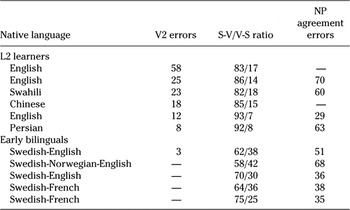
Håkansson (Reference Håkansson1995) collected written tests and free compositions from all of the participants as well as spontaneous production data from recorded interviews. The results of the Swedish heritage speakers were compared to those of six L2 learners of Swedish whose L1s were English, Chinese, Swahili, and Persian. Although it was not expected that L2 learners would speak like Swedish NSs, it is not clear whether the L2 learners and the Swedish heritage speakers were comparable in their written proficiency because no clear information was provided. If the V2 parameter and gender agreement (a formal feature checked in nouns, determiners, and adjectives under some current approaches) are set early in childhood, but parameters cannot be reset in adult SLA because L2 learners no longer have access to UG, my FDH-based prediction is that despite exhibiting attrition or incomplete knowledge of Swedish, the early bilinguals should have more solid command of these two aspects of Swedish than the L2 learners. This is precisely what Håkansson found, at least to some extent, as illustrated in Table 1.
Percentage of errors in word order and NP agreement by learner

Note
From “Syntax and Morphology in Language Attrition: A Study of Five Bilingual Expatriate Swedes” by G. Håkansson, Reference Håkansson1995, International Journal of Applied Linguistics, 5, p. 159. Adapted with permission.
The results showed revealing differences between the L2 learners and the Swedish heritage speakers in V2 but less so with nominal agreement. The V2 pattern is regarded as one of the most difficult structures for L2 learners of non-V2 languages to acquire (Hyltenstam, Reference Hyltenstam1977). Although statistics are not provided in the original article due to the small number of subjects, the Swedish early bilinguals were more targetlike than the L2 learners: Whereas the L2 learners made an average of 24% errors with X-V-S in declarative clauses (e.g., *I England vi har många tidningar “In England we have many newspapers” instead of I England har vi många tidningar “In England have we many newspapers”), the average error rate for the early bilinguals was close to zero (0.6%). With respect to the ratio of S-V and V-S order, which is in the 60% and 40% range, respectively, for NSs as reported in Håkansson (Reference Håkansson1995), the analysis also revealed differences between the two groups. The Swedish bilinguals were more like Swedish NSs in their production rate of S-V (66%) and V-S order (34%), whereas the L2 learners produced S-V 87% of the time and V-S order 15% of the time. Thus, in terms of syntax, not only have the Swedish early bilingual speakers retained knowledge and use of the V2 parameter from their L1, but they also outperformed the L2 learners. In Håkansson’s words, “This implies that the bilingual expatriates still use native-like variation in word order patterns in their Swedish, even though they have lost other parts of their grammar” (p. 160).
What these bilinguals seem to have lost, or perhaps never fully acquired, is gender agreement on NPs. Here, the L2 learners (average: 37% errors) outperformed the Swedish heritage speakers (average: 53% errors). Errors were made with gender and number, with possessives, and in predicative structures with adjectives after a verb. Rather than errors of omission, as is common in L1 acquisition, the Swedish early bilinguals made more errors of commission (i.e., using wrong morphemes in different contexts), common in SLA. There were also different error types among those early bilinguals who spoke French and those who spoke English as well as for those with English background who reduced the form of the adjective and those with French background who added definite suffixes on nouns. Håkansson (Reference Håkansson1995) concluded that the bilinguals have not lost the syntactic rule for agreement; they simply had trouble retrieving the right affixes for a given function.
Although the number of participants that took part in Håkansson’s (Reference Håkansson1995) study was very small, the findings are still relevant to the claim that childhood attrition, or what Polinsky (Reference Polinsky, Browne, Dornisch, Kondrashova and Zec1997) and Montrul (Reference Montrul2002) have characterized as incomplete L1 acquisition, affects different aspects of morphosyntax selectively. Clearly, the V2 phenomenon is a purely syntactic rule, whereas gender agreement is a syntactic rule that also depends on lexical knowledge. It may be the case that the reason why early bilingual speakers do not display advantages in gender has to do with lexical retrieval and frequency effects rather than with the abstract syntactic rule of agreement. Håkansson’s study also speaks to the FDH. Despite exhibiting nonconvergence when compared to NSs, the early bilinguals in Håkansson’s study have solid command of the V2 parameter set in childhood, presumably through UG. In contrast, the L2 learners, who turned out to be more proficient in Swedish according to a Swedish university entrance requirement test, were still struggling with the V2 rule. This study thus shows advantages for syntax but not necessarily for inflectional morphology. We now turn to the results of a large-scale study of Spanish L2 learners and early bilinguals that tested wh-movement and gender agreement, among other structures.Footnote 4, Footnote 5
Wh-Movement and That-Trace in Spanish
Montrul, Foote, and Perpiñán (Reference Montrul, Foote, Perpiñán, Almazán, Bruhn de Garavito and Valenzuela2008b) investigated knowledge of wh-movement in Spanish by 70 L2 learners and 63 Spanish heritage speakers ranging from low to advanced written proficiency. All of the L2 learners of Spanish were English NSs, born and raised in English-speaking families, who started the acquisition of Spanish around or after puberty and were enrolled in third-semester to advanced (graduate level) Spanish language classes. Many of these learners, especially the most advanced ones, had also spent time in Spanish-speaking countries and even had significant study-abroad experience, so their exposure to Spanish was not restricted to an instructional setting. The heritage speakers were recruited from Spanish language classes at the same institution. In general, heritage speakers form a very heterogeneous group, but, for this study, measures were taken to control some factors and reduce some of this inherent variability; for example, only heritage speakers who were exposed to Spanish and English before age 5 (i.e., preschool) and were schooled in English were included. This is because sequential bilinguals with longer exposure to their L1 tend to fall within the range of NSs (Kim, Montrul, & Yoon, Reference Kim, Montrul and Yoon2009; Montrul, Reference Montrul2002). In 80% of the cases, the two parents spoke Spanish, and in the remaining 20%, only one parent spoke Spanish and the other spoke English. More than half of the heritage speakers reported using mainly Spanish at home, whereas 38% reported using English and Spanish, and 8% reported using mostly English. Despite the fact that they were exposed to and used Spanish from birth, the heritage speakers rated their ability in Spanish between 1 and 4 (M = 3.9) on a 5-point rating scale (1 = nonnative, 5 = native), whereas they rated their English between 4 and 5 (M = 4.88). Because course placement and self-rating scales are not ideal proficiency measures, all participants also completed a written Spanish proficiency test that included a cloze passage and a multiple-choice vocabulary task. The percentage accuracy scores were 70.68% for L2 learners (range: 32–100%) and 73.6% for heritage speakers (range: 30–96%). There were no differences between the two groups, t(139) = 1.3, p = 0.1.
Spanish and English have overt wh-movement in questions (and obey the subjacency principle) as illustrated in (11) with object extraction from embedded clauses and in (13) with extraction out of an adjunct island. In parametric terms, both languages select the uninterpretable feature [+wh]. However, the two languages differ with respect to the acceptability of subject extraction from embedded clauses, as shown in (12).
(11) a. ¿Qué pensó José que María compró?
what thought José that Maria bought
b. What did Joe think that Mary bought?
(12) a. ¿Quién dijo Ana que rompió la puerta?
who said Ana that broke the door
b. *Who did Ana say that broke the door?
(13) a. *¿A quién habló Miguel con Patricia después de ver?
dom who talk to Miguel with Patricia after to seeFootnote 6
b. *Who did Miguel talk to Patricia after seeing?
It is possible to extract a subject from an embedded clause in Spanish when there is a trace in subject position (12a), whereas English does not allow a wh-trace in subject position to follow an overt complementizer (12b): This is the that-trace effect (Chomsky, Reference Chomsky1986; Chomsky & Lasnik, Reference Chomsky and Lasnik1977) argued by Rizzi (Reference Rizzi1982) to be related to the inflectional and null subject properties of Spanish as well as the availability of free subject inversion. Thus, in Spanish, the trace satisfies the empty category principle (ECP), whereas in English it does not.Footnote 7 The purpose of the study by Montrul et al. (Reference Montrul, Foote, Perpiñán, Almazán, Bruhn de Garavito and Valenzuela2008b) was to test whether early and late bilinguals acquired knowledge of that-trace effect in Spanish in sentences such as illustrated in (12).
Although perhaps unrelated, one salient difference between Spanish and English that might affect L2 learners’ judgments of sentences like (12) is that, in Spanish, the complementizer que “that” is typically obligatory in sentences like (14a) and in complement clauses, whereas in English, the complementizer that is ungrammatical in (12b) but optional with some verbs, as in (14c).
(14) a. María dijo que ella es de Colombia.
Maria said that she is from Colombia
b. *María dijo ella es de Colombia.
Maria said she is from Colombia
c. Maria said (that) she is from Colombia.
Because constraints on wh-movement are very similar in the two languages, at issue was whether L1 influence would play a role in the case of complementizers and embedded sentences with subject extractions. If there is transfer from the dominant language in this grammatical domain, then both L2 learners and heritage speakers were expected to accept sentences with no complementizer, as in English, and expected to reject sentences with subject extraction due to the obligatory presence of the complementizer in Spanish. However, in the context of L2 theories that regard age of acquisition as an obstacle for successful SLA in late learners, transfer from English was hypothesized to be more pronounced in late bilinguals than in early bilinguals.
Participants completed a written GJT, which included a total of 50 sentences (25 grammatical and 25 ungrammatical), of which 30 were target sentences and 20 were fillers. Overall results showed that the NSs were 93.6% accurate at accepting grammatical sentences and 96.3% accurate at rejecting ungrammatical sentences. The L2 learners and the heritage speakers differed from the NSs but did not differ from each other because both groups scored at around 70% accuracy.
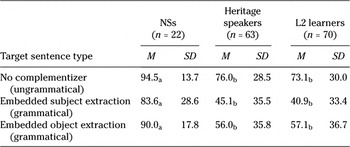
The results showed that all groups correctly rejected extraction from adjunct islands, which are ungrammatical in both English and Spanish (NSs’ mean accuracy was 97.2%, heritage speakers’ mean accuracy was 83.6%, and L2 learners’ mean accuracy was 72.5%). Nevertheless, the L2 learners and heritage speakers were quite inaccurate at accepting embedded object and subject extractions, both of which are grammatical in Spanish. Rejection of embedded subject extractions does not seem to be related to the obligatory presence of the complementizer because the two experimental groups rejected ungrammatical sentences with no complementizers with above 70% accuracy, as illustrated in Table 2.
Wh-movement: Mean percentage accuracy on target sentence types

Note
Means in the same row that do not share subscripts differ at p < .05 according to ANOVA and the Tukey honestly significant difference comparison. From “Knowledge of Wh-Movement in Spanish L2 Learners and Heritage Speakers,” by S. Montrul, R. Foote, and S. Perpiñán, 2008b, Language Learning, 58, pp. 101–102. Adapted with permission.
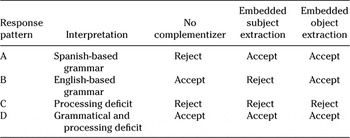
What is salient in Table 2 is that the NSs also judged embedded subject extractions (mean accuracy: 83.6%) as statistically less acceptable than embedded object extraction (mean accuracy: 90%). Because the strength of acceptance for subject extraction sentences was also statistically weaker for the NSs, this result is consistent with other SLA studies that showed that the problem with this type of subject extractions may be due to complexity of processing or parsing rather than transfer of grammatical elements (Juffs, Reference Juffs2005; Juffs & Harrington, Reference Juffs and Harrington1995; White & Juffs, Reference White, Juffs, Flynn, Martohardjono and O’Neil1998). In the absence of online processing data, individual participants’ responses on sentences with no complementizers and embedded sentences with subject and object extractions were analyzed more closely. If a participant correctly judged three of five sentences within each type, it was considered that that particular individual consistently accepted or rejected those sentences on the basis of their grammaticality. Table 3 summarizes the possible response patterns.
Wh-movement: Possible response patterns

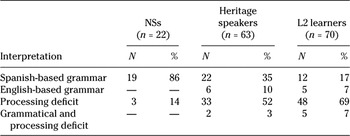
Participants who conformed to pattern A can be deemed to have no difficulty because this is the expected response pattern for Spanish. If participants incorrectly accept sentences with optional complementizers in Spanish, correctly accept embedded sentences with object extractions, and reject embedded sentences with subject extractions, then this pattern of response is consistent with the adoption of an English-based grammar (i.e., full transfer, or pattern B). Pattern C, which correctly rejects sentences with optional complementizers but also rejects embedded sentences with extractions, may be taken to suggest that participants know the grammatical distribution of complementizers in Spanish but have difficulty accepting sentences with extractions out of embedded clauses in general due to processing cost, as suggested in the L2 literature (Juffs, Reference Juffs2005; Juffs & Harrington, Reference Juffs and Harrington1995; Juffs & White, 1998). Finally, pattern D, which is theoretically the least expected pattern, is consistent with a number of interpretations: Participants can have a grammatical deficit, a processing deficit, or both, or the pattern can simply be response bias because participants are accepting everything. Table 4 quantifies the number of participants per group—including the NSs—who fall under each of these patterns.
Wh-movement: Number of participants per group falling under each response pattern

Table 4 illustrates that most of the NSs displayed the Spanish response pattern (A), whereas only 14% displayed pattern C, which is consistent with having difficulty processing embedded sentences with extractions. In contrast, the majority of L2 learners and heritage speakers present a pattern of response consistent with having processing difficulties (i.e., pattern C). The most significant finding of this analysis is that very few individuals responded in a manner consistent with having an English-based grammar, and even fewer participants fell under the unexpected D pattern. However, almost twice the number of heritage speakers (35%) than L2 learners (17%) displayed the same response pattern as the Spanish NSs.
When individual results were examined in this way, the incidence of nativelike performance was higher in early bilinguals than in late bilinguals, which suggests that acquisition of a language early in childhood—when compared to acquisition postpuberty—is more “reliable,” to use Bley-Vroman’s term (this issue, p. 177).
Gender Agreement in Spanish
As demonstrated in Håkansson’s (Reference Håkansson1995) study of nominal agreement in Swedish, the problem of morphological variability—a case of the abundance-of-the-stimulus problem—must be revisited.
Spanish classifies nouns as either masculine or feminine (el libro “the-masculine book-masculine,”la casa “the-feminine house-feminine”), and, according to some theories of SLA (e.g., Hawkins & Chan, Reference Hawkins and Chan1997), gender in gender-marking languages is a parameterized uninterpretable feature selected in childhood. If early bilinguals have advantages over late bilinguals due to an earlier onset of acquisition, Montrul, Foote, and Perpiñán (Reference Montrul, Foote and Perpiñán2008a) hypothesized that Spanish heritage speakers should be more accurate on gender-marking than L2 learners.
Participants were the same as in the Montrul et al. (Reference Montrul, Foote, Perpiñán, Almazán, Bruhn de Garavito and Valenzuela2008b) study on wh-movement. For this study, the participants completed three tasks: a written picture identification task (based on the methodology used by White et al., Reference White, Valenzuela, Kozlowska-Macgregor and Leung2004), a written elicited production task, and an oral picture description task. In the written picture identification task, participants matched a sentence with a determiner inflected for gender and number (and a null nominal) with one of three pictures. In the written elicited production task, participants read a paragraph and selected the correct masculine or feminine form of the missing determiner or adjective. Finally, in the oral picture description task, participants were presented with photographs of objects, animals, and people and orally described each photograph using the phrase Veo un / una / el / la... “I see a / the...” followed by a noun and an adjective.
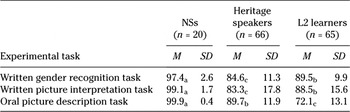
The results of the three tasks demonstrated that both L2 learners and heritage speakers made gender errors, whereas the NSs hardly made any. Consistent with what has been found in previous studies on the acquisition of gender, accuracy on the feminine were lower than on the masculine forms, with significant overgeneralization of masculine forms in feminine contexts. In terms of domain of agreement, agreement on the determiner was more accurate than agreement on adjectives, and in terms of word ending, agreement on canonical-ending nouns (-a-feminine and -o-masculine) was more accurate than on nouns with an unclear ending (consonant, -e, or opposite word marker).
There were statistical differences between the two experimental groups as well, but these differed by task (resulting in a Group × Task interaction). Overall, the L2 learners were significantly more accurate than the heritage speakers in the two written tasks, whereas the heritage speakers were significantly more accurate than the L2 learners in the oral picture description task. These accuracy scores are summarized in Table 5.
Overall percentage accuracy on gender agreement in the three experimental tasks by group

Note
Means in the same row that do not share subscripts differ at p < .05 according to ANOVA and the Tukey honestly significant difference comparison. From “Gender Agreement in Adult Second Language Learners and Spanish Heritage Speakers: The Effects of Age and Context Of Acquisition,” by S. Montrul, R. Foote, and S. Perpiñán, 2008a, Language Learning, 58, p. 537. Adapted with permission.
Because the L2 learners were more accurate on the two comprehension-based tasks than on the oral production task, these results are consistent with the missing surface inflection hypothesis (MSIH; Prévost & White, Reference Prévost and White2000). According to this theoretical position, L2 learners have acquired the abstract uninterpretable gender feature (as demonstrated by their accuracy on the written tasks) but have significant difficulty realizing gender morphology in production—in other words, a processing or performance problem. This explanation does not work for the heritage speakers, however. The MSIH does not apply to the early bilinguals because they showed exactly the opposite pattern: Better accuracy on oral production than on the written tasks.
The results indicated that both L2 learners and heritage speakers have knowledge of gender because accuracy averages above 70% cannot be dismissed as lack of knowledge. Additionally, both L2 learners and heritage speakers make morphological errors, like the participants in Håkansson’s (Reference Håkansson1995) study. However, the errors are manifested quantitatively differently in written comprehension and oral production. When it comes to assessing incidence of nativelike performance in the two groups, analysis of individual participants showed advantages for the early bilinguals. Many L2 learners, including many of low proficiency, scored above 90% accuracy on the two written tasks, whereas only 4 of 66 (3 advanced, 1 intermediate) performed above 95% accuracy (the range of variation of the NSs) in the three tasks. However, 28 of 65 heritage speakers (4 low, 5 intermediate, and 19 advanced) performed at the NS level in the three tasks. Despite incomplete knowledge of gender in Spanish, heritage speakers have an advantage over L2 learners when it comes to oral production and incidence of nativelike knowledge.
DISCUSSION
I have argued that incomplete acquisition and nonconvergence, as encoded by at least 6 of the 10 characteristics listed by Bley-Vroman (Reference Bley-Vroman1990), cannot be the defining characteristic of the FDH. The results of the three studies (Håkansson, Reference Håkansson1995; Montrul et al., Reference Montrul, Foote and Perpiñán2008a, Reference Montrul, Foote, Perpiñán, Almazán, Bruhn de Garavito and Valenzuela2008b) suggest that many early and late bilinguals differ quantitatively from NSs, especially in nominal morphology. Because the major premise of the FDH is founded on child-adult acquisition differences (i.e., age), nontargetlike performance by early bilinguals in their L1 could be taken to straightforwardly refute the FDH without further discussion. However, I am considering another possibility here, which would still provide partial support for the FDH. In essence, it is also likely that nontargetlike attainment in these cases is due to different underlying causes—namely, inefficient learning mechanisms in L2 learners and insufficient input in early bilinguals with incomplete knowledge of their L1. Under this assumption, it is still possible to assess the FDH by asking whether early bilinguals have advantages over L2 learners because their family language was acquired as a L1 (with the alleged efficient and reliable learning and processing system and mechanisms assumed to operate in childhood for L1 acquisition): Additionally, the FDH predicts they should have such advantages. The FDH has been largely confirmed for phonology (Au et al., Reference Au, Knightly, Jun and Oh2002; Au, Knightly, Jun, Oh, & Romo, Reference Au, Knightly, Jun, Oh and Romo2008; Knightly et al., Reference Knightly, Jun, Oh and Au2003), and here I have extended the hypothesis to syntax and morphology—as conceptualized by the theory of UG—upon which the FDH was founded.
Incidence of Nativelike Performance
Contrary to what Au et al. (Reference Au, Knightly, Jun and Oh2002) and Knightly et al. (Reference Knightly, Jun, Oh and Au2003) concluded, the age-advantage hypothesis is also largely confirmed for syntax and, to a lesser extent, for nominal morphology. The early bilinguals in Håkansson’s (Reference Håkansson1995) study possessed nativelike command of V2 in Swedish, whereas the L2 learners were still struggling with word order. In Montrul et al. (Reference Montrul, Foote, Perpiñán, Almazán, Bruhn de Garavito and Valenzuela2008b), the early bilinguals and the late bilinguals did not differ in the overall ratings for the GJT testing aspects of wh-movement, but, at the individual level, more early bilinguals than L2 learners patterned with the NSs. Additionally, although the results of Håkansson and Montrul et al. studies showed different accuracy patterns with nominal morphology, the overall results of the latter study also revealed that, at the individual level, the incidence of nativelike performance was higher in the early bilingual group than in the L2 learners.
In the syntactic domain, and especially in the study by Håkansson (Reference Håkansson1995), the early bilinguals have the V2 parameter set in place, whereas the L2 learners, who did not come from V2-language backgrounds, have not yet entirely reset the parameter or may be said to be in the process of resetting it (because we have no information about their proficiency). A reason why no group differences were found in the wh-movement study is perhaps because Spanish and English are very similar in that they both instantiate a [+wh] feature and have wh-movement. Additionally, it appears that the that-trace effect, which is grammatical in Spanish but not in English, is not very problematic.Footnote 8
According to Yang (Reference Yang2002) and Meisel (Reference Meisel1986), Germanic-speaking children acquire V2 by age 3;00. Although Håkansson’s (Reference Håkansson1995) study was not conceived with the FDH in mind, her results are relevant to the FDH because the Swedish NSs in this study have solid command of the V2 parameter set in childhood, presumably through UG. Under the FDH, the L2 learners may have arrived at their less reliable knowledge of V2 through other peripheral, non-UG-related learning procedures and processing mechanisms, according to Bley-Vroman (Reference Bley-Vroman1990), Meisel (Reference Meisel1997), and DeKeyser (Reference DeKeyser2000).
In addition to Håkansson’s (Reference Håkansson1995) findings, there is further empirical evidence that early bilinguals set crucial parameters of their L1 early, whereas L2 learners take more time. Another example comes from Montrul’s (Reference Montrul, Slabakova, Montrul and Prévost2006) study on knowledge of verbal agreement, production of overt versus null subjects, and postverbal subjects in Spanish—all structures related to the null subject parameter—in intermediate and advanced Spanish L2 learners and heritage speakers, who were matched for proficiency with the L2 learners on a written task. Analysis of spoken Spanish elicited through a narrative production task showed that intermediate-proficiency L2 learners produced significantly more agreement errors (12.55%) than intermediate heritage speakers (3%). Although the two groups produced comparable rates of overt (around 68%) and null subjects (around 32%), the intermediate heritage speakers produced around 20% of postverbal subjects like the NSs, whereas the intermediate L2 learners produced none (100% of preverbal subjects). Montrul, Foote, Perpiñán, Thornhill, and Vidal (Reference Montrul, Foote, Perpiñán, Thornhill, Vidal, Sagarra and Toribio2006) and Montrul (in press) also showed that when it comes to the acquisition of object clitics and topicalizations in Spanish, L2 learners are able to select features and functional categories for clitics, but heritage speakers outperform the L2 learners on several tasks. Therefore, when it comes to syntactic parameters set very early in childhood (e.g., pro-drop, V2), early bilinguals appear to have an advantage over late bilinguals perhaps because the learning mechanisms used by early bilinguals are more reliable. This is consistent with some of the basic tenets of the FDH.
If some advantages for early bilinguals were revealed in areas of syntax, the results of nominal agreement in Swedish and Spanish are less conclusive for the hypothesis tested here. This is not surprising in the face of overwhelming empirical evidence that confirms that inflectional morphology is highly problematic for SLA (Schwartz, Reference Schwartz, Beachley, Brown and Conlin2003; Slabakova, Reference Slabakova2008; White, Reference White, Liceras, Zobl and Goodluck2008) and also volatile in L1 attrition and incomplete acquisition (Montrul, Reference Montrul2008). Gender agreement, subsumed under a parameterized uninterpretable feature, lies at the lexicosyntax-morphosyntax interface. There are aspects of gender agreement that are purely syntactic and others, like gender assignment, that are lexicalized and, hence, learned by memory. Håkansson (Reference Håkansson1995) and Montrul et al. (Reference Montrul, Foote and Perpiñán2008a) demonstrated that both early bilinguals and L2 learners make significantly more gender errors (of assignment and of agreement) than Spanish NSs (although Håkansson did not include a control group of NSs). However, regarding advantages for the early bilinguals, the results are mixed: Håkansson found that the early bilinguals made more errors than the L2 learners, whereas Montrul et al. found advantages for the early bilinguals only in an oral task.
In sum, despite the differences in the backgrounds of the bilinguals discussed here, the pairs of languages involved, and the methodologies employed in the three studies (Håkansson, Reference Håkansson1995; Montrul et al., Reference Montrul, Foote and Perpiñán2008a, Reference Montrul, Foote, Perpiñán, Almazán, Bruhn de Garavito and Valenzuela2008b), the generalization that emerges is that there are advantages in receiving early exposure to the language for morphosyntax as well, even when input in a bilingual situation is less abundant than in L1 acquisition. The early bilinguals show evidence of convergent parameter setting in early childhood; the late bilinguals may still be said to be in the process of resetting parameters. If these findings hold, the question is why early bilinguals have such an advantage. Is the advantage related to the deployment of different learning mechanisms by early bilinguals and L2 learners? More precisely, is there evidence for the claim that knowledge of V2 in Swedish and wh-movement and gender agreement in Spanish were acquired through UG and implicit learning mechanisms by the early bilinguals, whereas this same knowledge was acquired through general problem-solving mechanisms by the L2 learners? This question is impossible to answer directly. The best we can do is to examine the performance of the participants on different tasks and indirectly conclude what each task may reflect about type of linguistic knowledge.
Task Effects and Types of Knowledge
The results of Håkansson (Reference Håkansson1995) and Montrul et al. (Reference Montrul, Foote and Perpiñán2008a, Reference Montrul, Foote, Perpiñán, Almazán, Bruhn de Garavito and Valenzuela2008b) also show that if advantages for early bilinguals are found, these do not occur across the board but also depend on the type of task. This is easier to see in the two Spanish studies (Montrul et al., Reference Montrul, Foote and Perpiñán2008a, Reference Montrul, Foote, Perpiñán, Almazán, Bruhn de Garavito and Valenzuela2008b), which tested the same subjects. The wh-movement study (Montrul et al., Reference Montrul, Foote, Perpiñán, Almazán, Bruhn de Garavito and Valenzuela2008b) used a written GJT and found no overall differences between the experimental groups. The gender study (Montrul et al., Reference Montrul, Foote and Perpiñán2008a) used two written tasks and one oral task. Although the L2 learners were more accurate than the early bilinguals on the two written tasks, the early bilinguals were more accurate than the L2 learners on the oral task. Håkansson used written production and also found that the L2 learners made fewer errors in nominal agreement than the early bilinguals.
These task effects with inflectional morphology may be related to other experiential factors confounded with age, such as context and mode of acquisition in the two populations. The early bilinguals were exposed to the language naturalistically at home, received mainly aural input, and may or may not have spoken the language since childhood, after extensive exposure and use of the majority language began. In high school and college, these learners received some formal instruction in their L1, as a foreign language. In contrast, all of the L2 learners tested in these studies (Håkansson, Reference Håkansson1995; Montrul et al., Reference Montrul, Foote and Perpiñán2008a, Reference Montrul, Foote, Perpiñán, Almazán, Bruhn de Garavito and Valenzuela2008b) were instructed learners whose main exposure to the language was in a classroom setting, although the Spanish L2 learners also had some study-abroad experience. These different contexts of acquisition may also impinge upon how language is attended to, internalized, practiced, and more efficiently processed from naturalistic input.
Although constraints on wh-movement and the obligatory presence of complementizers in Spanish are rarely taught, V2 and gender agreement are the objects of instruction and practice in language classes. It may be the case that exposure to written input and written practice with limited opportunity for oral production—typical of language instruction—is not sufficient for L2 learners to reach higher levels of accuracy with V2 and gender agreement. It can be argued, therefore, that whatever knowledge of V2 and gender L2 learners have at their current stage of development is metalinguistic and explicit, acquired inductively in a piecemeal manner, and primarily stored in declarative memory. In contrast, all of the early bilinguals received aural input and used the language predominantly in oral production until they enrolled in foreign language classes to regain command of their L1. As a result, the knowledge that early bilinguals bring to the classroom is more implicit and integrated because it was mainly acquired in childhood and is primarily stored in procedural memory. This would be consistent with the position taken by DeKeyser (Reference DeKeyser2000) and Ullman (Reference Ullman2001; see also Paradis, Reference Paradis2004, for an elaboration of these ideas in a neurolinguistic framework).Footnote 9
Just as it is impossible to tap linguistic knowledge directly, it is equally difficult to test whether something was acquired with one cognitive linguistic mechanism or another, retrospectively. The only way to understand linguistic competence is through linguistic performance, which may vary from task to task, especially in individuals with unstable or less proficient command of the target language. Birdsong (Reference Birdsong1989; citing Bialystok & Ryan, Reference Bialystok, Ryan, Forrester-Pressley, MacKinnon and Waller1985) and Ellis (Reference Ellis2005) explained how different tasks used to assess linguistic knowledge in SLA require different degrees of awareness as well as analyzed and controlled knowledge. In his study that attempted to operationalize and measure implicit and explicit learning, Ellis compared the results of five tasks: Three of the tasks were designed as measures of implicit knowledge and two were designed as measures of explicit knowledge. The three implicit knowledge tasks were an oral imitation task of grammatical and ungrammatical sentences, an oral narrative task, and a timed GJT. The explicit knowledge tasks were an untimed GJT and a metalinguistic knowledge test. Applying Ellis’s guidelines for eliciting implicit versus explicit knowledge to the tasks used in the studies of early and late bilinguals reported here, the oral task used by Montrul et al. (Reference Montrul, Foote and Perpiñán2008a) would be a measure of more automatic and implicit knowledge (with a low degree of awareness, performed with a focus on meaning under time pressure, which minimizes access to metalinguistic knowledge), whereas the untimed GJT used in the wh-movement study and the two written tasks used in the gender study would tap more explicit knowledge, as would the compositions and tests used by Håkansson (Reference Håkansson1995). With no time pressure to respond, L2 learners, in particular, have the opportunity to access metalinguistic knowledge, leading to higher accuracy: This would explain why the L2 learners were more accurate than the early bilinguals on nominal morphology.
A continuum of accuracy was found, as predicted, for the early bilinguals depending on task: They were more accurate than the L2 learners, performing at the NS level in the oral task, equally accurate as the L2 learners in the wh-movement GJT, and less accurate than the L2 learners in the written comprehension and production tasks used by Håkansson (Reference Håkansson1995) and Montrul et al. (Reference Montrul, Foote and Perpiñán2008a). (The fact that a disadvantage for the early bilinguals did not show up for V2 in the written task further confirms that knowledge of syntax is more resilient and robust than knowledge of morphology.) According to Birdsong (Reference Birdsong1989), a GJT with no correction requires moderate analyzed knowledge, whereas fill-in-the-blank cloze-type tasks, like the written gender elicitation task, require analyzed knowledge, attention to structure, and form-meaning coordination.
The results of Håkansson (Reference Håkansson1995) and Montrul et al. (Reference Montrul, Foote and Perpiñán2008a) show that L2 learners were more successful than early bilinguals at tasks that maximized explicit knowledge and metalinguistic awareness, whereas the early bilinguals were more successful at tasks that required automatized and integrated implicit linguistic knowledge. To the extent that the relationship between type of task and type of knowledge holds, the early bilinguals may have more implicit knowledge of the language than the L2 learners. Early bilinguals appear to make substantially less use of explicit and metalinguistic knowledge than the adult L2 learners, which, in turn, indirectly suggests that early bilinguals may have approached the processing of input and the related language learning process through different learning mechanisms, as the FDH maintains.
Focus on Processing
Although these studies (Håkansson, Reference Håkansson1995; Montrul et al., Reference Montrul, Foote and Perpiñán2008a, Reference Montrul, Foote, Perpiñán, Almazán, Bruhn de Garavito and Valenzuela2008b) were conceptualized to test grammatical knowledge, I believe that a very fruitful and promising way of approaching and disentangling these issues is by embarking in more online processing research. According to Newport’s (Reference Newport1988) less is more hypothesis, differences in linguistic achievement between adults and children are related to the way adults and children perceive and store (i.e., process) linguistic input and perhaps not from differences in their knowledge of linguistic constraints or in their ability to perform linguistic analyses once the input is stored. According to this hypothesis, the very limitations of the young child’s information processing abilities provide the basis on which successful language acquisition occurs. Additionally, because it is impossible to arrive at an understanding of mental representations without some type of performance measure, more research on SLA and the validity of the FDH, in general, should focus on oral and written language processing triangulated with offline behavioral measures. Whereas research on L2 processing has been steadily gaining ground in the last decade, little is known about how L2 learners differ from L1 learners, NSs, and other early bilinguals during production and comprehension of the target language in real time (see Clahsen & Felser, Reference Clahsen and Felser2006, for more discussion and related commentaries).
An interesting study in this context, which lines up very nicely with the conclusions reached so far, is that by Guillelmon and Grosjean (Reference Guillelmon and Grosjean2001). They tested early and late French-English bilinguals in Switzerland on their sensitivity to gender errors in French in a spoken word recognition task. Participants were asked to listen to phrases presented aurally over headphones and repeat a word after a target NP in three gender-marking conditions (correct, incorrect, or neutral). They found that like the French NSs tested, early bilinguals were sensitive to gender mismatches (as measured through reaction times), whereas the late L2 learners were not. Guillelmon and Grosjean concluded that certain processing mechanisms will never be acquired or will only be partially acquired after a certain age. However, they went on to add that this does not preclude that L2 learners do better in tasks like GJTs, in which more metalinguistic skills are recruited. Therefore, it is imperative to tease apart how much of L2 learners’ linguistic performance is observed due to integrated knowledge and how much is coming from metalinguistic, studied knowledge, which early bilinguals seem to lack.
Guillelmon and Grosjean’s (Reference Guillelmon and Grosjean2001) explanation resonates with Clahsen and Felser’s (Reference Clahsen and Felser2006) shallow structure hypothesis (SSH), a recent language processing reincarnation of the FDH. According to the SSH, L2 learners rely more on less detailed processing routines than NSs and child L1 learners (although these shallow routines are also available to NSs whenever appropriate). Whereas little work on the viability of this hypothesis exists to date, extended to the early bilingual population discussed in this article, the SSH also predicts that early bilinguals should not engage in as much shallow processing as late bilinguals; or, if there is a continuum of use for deep and shallow processing, with NSs at one end (deep processing) and L2 learners at the opposite end (shallow processing), early bilinguals with incomplete knowledge of their L1 should fall in between, as Håkansson (Reference Håkansson1995) and Montrul et al. (Reference Montrul, Foote and Perpiñán2008a, Reference Montrul, Foote, Perpiñán, Almazán, Bruhn de Garavito and Valenzuela2008b) have illustrated. However, this, naturally, calls for further research.
CONCLUSION
Håkansson (Reference Håkansson1995) and Montrul et al. (Reference Montrul, Foote and Perpiñán2008a, Reference Montrul, Foote, Perpiñán, Almazán, Bruhn de Garavito and Valenzuela2008b) demonstrated that lack of success; general failure; variation in success, course, and strategy; fossilization; and indeterminate intuitions cannot be taken as the main argument for the FDH because incomplete acquisition is not always the result of having acquired a L2 later in life through different cognitive mechanisms. The early bilinguals also show nonconvergent grammars in their L1. The key question that needs to be addressed more directly is whether you can have different types of nonconverging grammatical systems: some that still deploy specific linguistic mechanisms (as in early bilinguals) and others that mainly deploy other general-purpose mechanisms (as in L2 learners). To the extent that performance in tasks that rely on more implicit types of linguistic knowledge could be taken as indirect evidence for more nativelike or integrated linguistic knowledge, the acquisition of a language early in childhood—even if it turns out to be nontargetlike in adulthood, as in the case of early bilinguals—may have occurred through the use of implicit, specific-linguistic learning mechanisms, or UG. From a processing perspective, this knowledge may be stored in a different memory system and may be accessed more automatically under time pressure. Because adult L2 learners are similar to or better than early bilinguals with tasks that maximized explicit learning and metalinguistic awareness, there is some validity to the original postulation of the FDH, if the FDH only applies to implicit knowledge, as suggested by DeKeyser (Reference DeKeyser2000). However, this needs to be further explored.
In conclusion, future linguistic research needs to place more emphasis on establishing whether the type of linguistic knowledge and the processing mechanisms utilized to acquire and use that knowledge are indeed fundamentally different in early bilinguals with incomplete knowledge of their L1 and in L2 learners, both children and adults, even when the outcome of acquisition may look similar on the surface. Although the implicit versus explicit learning distinction has not been part of the research agenda of the generative approach to SLA espoused by the FDH, it should be taken into account. Properly incorporated in a theory of linguistic representation, processing, and use, this distinction may be crucial to understanding the linguistic processes and outcomes in different types of adult language learners at initial stages of learning. Ultimately, this distinction may demonstrate the fundamentally different or similar nature of adult SLA as well as convergent and nonconvergent L1 acquisition. It may also be the case that UG can be accessed in several ways, both implicitly and explicitly.
APPENDIX
CHARACTERISTICS OF FOREIGN LANGUAGE LEARNING (BLEY-VROMAN, 1990)
1. Lack of success
2. General failure
3. Variation in success, course, and strategy
4. Variation in goals
5. Correlation of age and proficiency
6. Fossilization
7. Indeterminate intuitions
8. Importance of instruction
9. Negative evidence
10. Role of affective factors