Introduction
Seasonal allergic rhinitis is an inflammatory disease, in which the primary symptoms are sneezing, rhinorrhoea, nasal congestion, and nasal and nasopharyngeal itching.Reference Horak and Zieglmayer1 It has associated ocular symptoms such as itchy, watery, and red or burning eyes.Reference Horak and Zieglmayer1 Intranasal antihistamines are medicines that can be used for allergic rhinitis treatment.Reference Bousquet, Khaltaev, Cruz, Denburg, Fokkens and Togias2 Azelastine nasal spray is a second-generation antihistamine which promotes H1 receptor antagonist activity.Reference Zechel, Brock, Lenke and Achterrath-Tuckermann3
Azelastine nasal spray has benefits as a systemic antihistamine. According to a study by Greiff and colleagues, azelastine nasal spray has a rapid effect that continues for at least 12 hours; therefore, it is sufficient for the medicine to be used twice in a day.Reference Greiff, Andersson, Svensson and Persson4 With topical usage, systemic effects are minimised, and the risks of interaction with concomitant medicines are reduced.Reference Davies, Bagnall, McCabe, Calderon and Wang5 With topical application, higher concentrations are feasible in the nasal mucosa, with lower usage of the medicine.Reference Horak, Jager, Toth, Kavina, Marschall and Munzel6
In addition to its antihistaminic effects, azelastine nasal spray also affects some chemical mediators. It inhibits the effects of some inflammatory response mediators such as leukotriene,Reference Chand, Pillar, Nolan, Diamantis and Sofia7, Reference Hamasaki, Shafigeh, Yamamoto, Sato, Zaitu and Muro8 substance P,Reference Nieber, Baumgarten, Rathsack, Furkert, Laake and Müller9, Reference Shinoda, Watanabe, Suko, Mogi and Takeyama10 cytokinesReference Ito, Nakamura, Takagi and Sakai11 and intercellular adhesion molecules.Reference Ciprandi, Pronzato, Passalacqua, Ricca, Grögen and Mela12 The effects of azelastine nasal spray on the immune system, and on nasal and nasopharyngeal microflora, are not known. This study aimed to examine the effects of azelastine nasal spray, used twice a day for one month, on nasal and nasopharyngeal microflora, by comparing culture results before treatment and after one month of treatment.
Materials and methods
This prospective, cross-sectional study investigated the effects of azelastine nasal spray on nasal and nasopharyngeal microbial flora in patients with persistent allergic rhinitis complaints for at least one year and with nasal concha hypertrophy. The study was carried out in the Department of Otorhinolaryngology and Head and Neck Surgery at Bezmialem Vakif University, Istanbul, Turkey.
All patients were recruited during the spring season when there is a peak in allergic reactions. Allergic rhinitis was diagnosed using the skin prick test. Exclusion criteria included: any evidence of nasal mucosal erosion; nasal ulceration or nasal septal perforation; nasal diseases; nasal or sinus surgery within the previous year; chronic sinusitis; respiratory tract infection (with or without antibiotic treatment) within 14 days; asthma; clinically significant arrhythmia; or significant pulmonary disease. Females who were pregnant, lactating or intending to become pregnant were not enrolled. Participants with a history of hypersensitivity to azelastine, loratadine or cetirizine, or who were known to be non-responsive to antihistamines, were excluded.
In total, 25 patients (10 females and 15 males), aged between 18 and 45 years, were included in the study. The study protocol was reviewed by the Bezmialem Vakif University Ethics Committee. All patients were informed about the study, and completed approval forms were obtained.
Nasal and nasopharyngeal swab samples were collected from the patients just before and after one month of treatment. Treatment consisted of the administration of azelastine nasal spray (Allergodil; Meda AB, Stockholm, Sweden) twice daily per nostril. Swab samples were collected after the treatment course was complete.
Nasal and nasopharyngeal swabs were collected from the patient in the seated position. Nasal swab samples were collected from each nasal cavity and near the middle meatus with a nasal endoscope by the same doctor (ES). Nasopharyngeal swab samples were collected via the oral route, under the uvula. The uvula was pulled forward and a curved swab touched against the nasopharynx. If the swab touched the nares or nasopharynx, the sample was retaken with a new swab to reduce contamination. A local anaesthetic was not used to take the swab because this might change the microflora present. Nasal and nasopharyngeal swabs were transferred to and maintained in Stuart's medium, and were sent to the Department of Microbiology and Clinical Microbiology of the Cerrahpasa Medical Faculty within 30 minutes.
After collection, each swab was transferred to a tube containing 1 ml of a sterile saline solution. The swab was discarded after agitation of the tube on a vortex mixer (500 revolutions per minute) for 1 minute. A loop containing 0.01 ml of sample solution was transferred to 5 per cent sheep blood agar, and another 0.01 ml of the same solution was transferred to a chocolate agar plate. The inoculate was spread homogeneously over the entire surface of the medium and the plates were incubated under 5 per cent carbon dioxide at 37 °C. The agar plates were examined at 24 and 48 hours. The numbers of each type of colony grown on the agar plates, multiplied by 100, represented the total number of each bacteria found in the different nasal and nasopharyngeal regions, and were referred to as colony-forming units.Reference Berdal, Bjørnholt, Blomfeldt, Smith-Erichsen and Bukholm13, Reference Montagnini, Mamizuka, Pereira and Srougi14
Isolates were identified using conventional methods.Reference Koneman, Allen, Janda, Schreckenberger and Win15 Beta-lactamase production by Haemophilus influenzae was assessed using the nitrocefin disk assay (Cefinase; BBL Microbiology Systems, Cockeysville, Maryland, USA).
Statistical analysis
Statistical analysis was carried out using the Statistical Package for the Social Sciences software, version 16.0 for Windows (SPSS, Chicago, Illinois, USA). All quantitative variables were estimated using measures of central location (i.e. mean and median) and measures of dispersion (i.e. standard deviation). Data normality was checked using the Kolmogorov–Smirnov tests of normality. The paired t-test was used to compare within-group variable data. A value of p < 0.05 was accepted as statistically significant.
Results
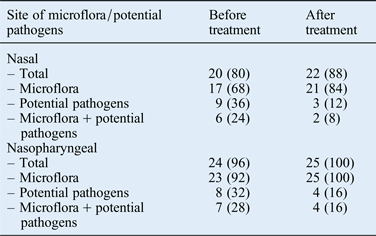
Twenty-five patients' swab samples were evaluated to determine any possible effect on the numbers of nasal and nasopharyngeal microbial flora after the use of azelastine. Methicillin-sensitive coagulase-negative staphylococci, methicillin-resistant coagulase-negative staphylococci, Gram-positive rods, neisseria species, alpha-haemolytic streptococci and non-haemolytic streptococci were detected and considered to be normal nasal and nasopharyngeal microflora. In contrast, methicillin-sensitive Staphylococcus aureus, methicillin-resistant S aureus (MRSA), beta-haemolytic streptococci, Moraxella catarrhalis, Streptococcus pneumoniae, H influenzae, candida species, Escherichia coli, enterobacter species, pseudomonas species, proteus species and enterococci were detected and considered potential pathogens (Tables I–III).
Nasal cavity
Cultures from 20 patients produced at least 1 species of bacterial growth before the azelastine treatment. Seventeen of these patients had normal microflora, nine had potentially pathogenic bacteria, and six patients had both normal and pathogenic bacteria in their isolates. After the treatment, the number of patients with at least 1 species of bacterial growth increased to 22. Twenty-one of these patients had normal microflora, three had potentially pathogenic bacteria and two had both (Table I). One patient did not show any type of bacterial growth in any culture (before or after the treatment). This may be because of errors in swab sampling. Some microflora should be present in all isolates.
Overview of normal flora and potential pathogens isolated from patients' mucosa

Data represent numbers (and percentages) of patients (n = 25).
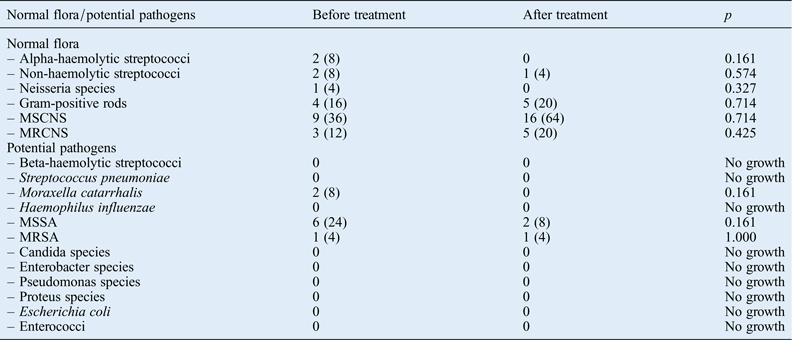
The most frequently isolated bacteria in normal nasal microflora, both before and after treatment with azelastine, was methicillin-sensitive coagulase-negative staphylococci (Table II). The most frequently isolated potential pathogen was methicillin-sensitive S aureus, both before and after the treatment. Among the pathogenic bacteria, both methicillin-sensitive S aureus and MRSA were found before and after the treatment. Neisseria species, non-haemolytic streptococci, alpha-haemolytic streptococci and M catarrhalis were isolated in different patients before the treatment, but, apart from non-haemolytic streptococci (isolated in one patient), these bacteria were not isolated after the treatment. H influenzae, S pneumoniae, Pseudomonas species, E coli, proteus species, enterococci, beta-haemolytic streptococci, candida species and enterobacter species were not found in the nasal cavity of any patient, either before or after the treatment (Table II). The patients growing pathogens were the same before and after treatment.
Normal flora and potential pathogens isolated from patients' nasal mucosa
Data represent numbers (and percentages) of patients (n = 25) unless indicated otherwise. MSCNS = methicillin-sensitive coagulase-negative staphylococci; MRCNS = methicillin-resistant coagulase-negative staphylococci; MSSA = methicillin-sensitive Staphylococcus aureus; MRSA = methicillin-resistant S aureus
Overall, the types of bacteria in the nasal cavity changed in 22 patients receiving the azelastine treatment.
Nasopharynx
The nasopharynx was colonised by at least 1 species of bacteria in 24 patients before azelastine treatment. Twenty-three of these patients had normal microflora bacteria, eight had potentially pathogenic bacteria, and seven had both normal and pathogenic bacterial growth. After treatment, 25 patients had at least 1 species of bacteria in the nasopharynx. All of these patients had normal microflora. Four patients had pathogenic bacterial growth, and these patients had both normal and pathogenic bacterial growth (Table I).
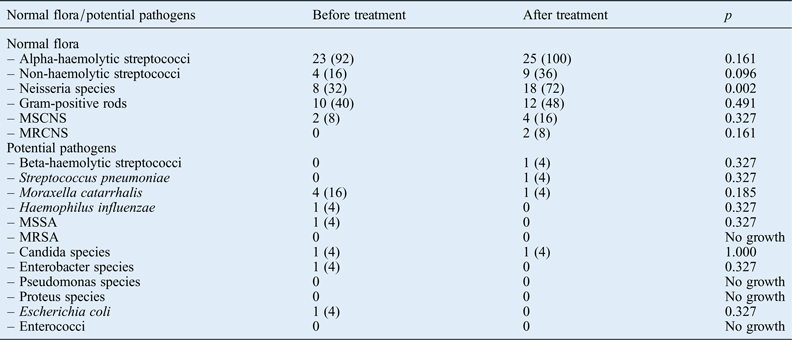
Most patients had colonisation by alpha-haemolytic streptococci in the nasopharyngeal mucosa, both before and after treatment (Table III). Before treatment, the most frequently isolated potential pathogen was M catarrhalis. The potential pathogens beta-haemolytic streptococci, candida species and S pneumoniae were isolated in three different patients only after the use of azelastine. H influenza, methicillin-sensitive S aureus, E coli, candida species and enterobacter species were observed in five different patients before the treatment, but these patients also showed new colonisation by normal bacterial microflora after the treatment (Table III).
Normal flora and potential pathogens isolated from patients' nasopharyngeal mucosa
Data represent numbers (and percentages) of patients (n = 25) unless indicated otherwise. MSCNS = methicillin-sensitive coagulase-negative staphylococci; MRCNS = methicillin-resistant coagulase-negative staphylococci; MSSA = methicillin-sensitive Staphylococcus aureus; MRSA = methicillin-resistant S aureus
Overall, the types of bacteria in the nasopharynx changed in 22 patients receiving the azelastine treatment.
Discussion
Azelastine nasal spray is a second-generation antihistamine, which is applied topically and which selectively antagonises H1 receptors.Reference Zechel, Brock, Lenke and Achterrath-Tuckermann3 Azelastine nasal spray has been shown to have a significant effect on nasal symptom scores compared with placebo in patients with seasonal allergic rhinitis.Reference Ratner, Findlay, Hampel, van Bavel, Widlitz and Freitag16 Even though topical treatment is more reliable than systemic usage,Reference Salib and Howarth17 it has some undesirable effects, such as bitter taste, nasal discomfort, somnolence, epistaxis and sinus headache, depending on the frequency of application.Reference Shah, Berger, Lumry, La Force, Wheeler and Sacks18
Azelastine has many other effects on the immune system, in addition to its antihistaminic effect. It blocks the release of interleukin (IL)-6 and tryptase by inhibiting cultured mast cell activation.Reference Kempuraj, Huang, Kandere, Boucher, Letourneau and Jeudy19 It suppresses the production of leukotrienes B4 and C4 by inhibiting the enzymes which synthesise phospholipase A2 and leukotriene C4.Reference Hamasaki, Shafigeh, Yamamoto, Sato, Zaitu and Muro8 It reduces substance P and bradykinin concentrations in nasal secretions.Reference Shinoda, Watanabe, Suko, Mogi and Takeyama10 In addition, it suppresses tumour necrosis factor-α secretion,Reference Matsuo and Takayama20 and suppresses the production of granulocyte macrophage colony-stimulating factor, IL-1B, IL-4 and IL-8.Reference Ito, Nakamura, Takagi and Sakai11, Reference Beck, Mansur and Afzal21, Reference Yoneda, Yamamoto, Ueta, Ueta and Osaki22 It also leads to a decrease in the number of eosinophils and neutrophils, and a decrease in the expression of intercellular adhesion molecule-1 on nasal epithelial cell surfaces in the earlier and later phases of allergic rhinitis.Reference Ciprandi, Pronzato, Passalacqua, Ricca, Grögen and Mela12 It suppresses the production of free radicals, which may be required for the bactericidal effect and which are produced by the neutrophils and eosinophils.Reference Busse, Randley and Sedgwick23, Reference Umeki24 The effects of azelastine nasal spray on nasal and nasopharyngeal microflora have not been studied previously.
This is the first quantitative study examining the levels of bacteria (in terms of colony-forming units per millilitre) in the nasal and nasopharyngeal mucosa of allergic rhinitis patients treated with azelastine spray, a nasal antihistamine. We investigated the levels of bacterial microflora isolated before and after the administration of azelastine nasal spray for one month. There was no statistically significant difference in overall bacterial colonisation numbers in nasal and nasopharyngeal cultures before and after treatment. However, data from the nasal or nasopharyngeal mucosa of several patients showed noteworthy increases in the growth of some normal microbial flora and potential pathogens.
Although there was no statistically significant difference in the levels of microbial flora or potential pathogens before and after use of azelastine nasal spray, there was an increase in colonisation of the nasal cavity by Gram-positive rods, methicillin-sensitive coagulase-negative staphylococci and methicillin-resistant coagulase-negative staphylococci. In addition, there was colonisation of the nasopharynx by alpha-haemolytic streptococci, non-haemolytic streptococci, neisseria species, Gram-positive rods and methicillin-sensitive coagulase-negative staphylococci.
Nasal and nasopharyngeal microflora are important in the pathogenesis of allergic rhinitis. In a study by Glück and Gebbers, the incidence of pathogenic bacteria in the nasopharyngeal microflora had increased in allergic patients whose skin prick test against aeroallergens was positive.Reference Glück and Gebbers25 In another study, the increased incidence of nasal S aureus in perennial allergic patients was greater than in healthy volunteers.Reference Smith and Kreutner26 In the same study, it was also shown that the nasal symptom scores of allergic rhinitis patients who were carriers of S aureus were higher than in patients who were not. In addition, in our study, MRSA was only evident in the nasal cultures of one patient before and after the treatment. The findings indicate that azelastine nasal spray does not increase the incidence of pathogenic bacteria such as MRSA. All patients were recruited at the same time with respect to the allergy season, so the microflora present should be similar in all patients.
• Azelastine nasal spray did not change nasal and nasopharyngeal flora significantly after administration for one month
• The treatment is safe from a microbiological viewpoint
Microbial florae are also important for keeping the immune system active against exogenous infections. Hence, investigations of the effects of anti-allergic nasal sprays on nasal and nasopharyngeal microflora are important to enhance understanding. Although previous microflora studies have investigated nasal corticosteroids,Reference Aksoy, Demirhan, Bayraktar, Yıldırım, Ozturan and Gönüllü27 this is the first study to examine nasal antihistamines.
Conclusion
Nasal antihistamines are topical treatments that have been frequently used in recent years for allergic rhinitis. They have many advantages, such as decreasing systemic effects and eliciting a rapid response. In addition to their antihistaminic effects, they have other effects on the immune system.
Microflorae are important in the pathogenesis of allergic rhinitis; therefore, we studied the effects of azelastine nasal spray on nasal and nasopharyngeal microflora after administration for one month. We observed that this treatment increases the production of nasal and nasopharyngeal microflora bacteria, though not statistically significantly. In addition, although it decreases the production of some pathogenic bacteria, the production of others was unchanged. The use of azelastine nasal spray is safe from a microbiological viewpoint. However, for long-term use, further studies are required. The effects of azelastine on microflora should also be examined under laboratory conditions.