


Introduction
For over a century, archaeologists have been working to understand how and why cities arise. Explanations for the origins of cities have tended to fluctuate with the theoretical winds of the discipline, but (with a few notable exceptions, e.g. Alt & Pauketat Reference Alt and Pauketat2019) the question of urbanization has been by-passed by archaeologists interested in post-humanism, the animal turn and alternative ontologies. In this paper, I argue that a focus on the non-human world—and specifically on the behavioural affordances of herded caprinesFootnote 1 (i.e. sheep and goats)—might provide productive new avenues for thinking about urbanization.
The herding of ungulates has given shape to human–animal relationships in many parts of Africa, Eurasia and South America for millennia (Honeychurch & Makarewicz Reference Honeychurch and Makarewicz2016). As such, the goals and methods of ungulate husbandry have been the subject of intense archaeological and, particularly, zooarchaeological focus. The usual zooarchaeological approach to explaining herding focuses on one particular end goal: the identification of an economic product (labour, milk, meat, hair) for which the animals were raised (e.g. Murra Reference Murra, Leeds and Vayda1966; Payne Reference Payne1973). This approach, however, radically constricts the scope of zooarchaeological analysis. The pursuit of an end-point product as explanation, as if this identification exhausts the possibilities of the evidence, has kept us from asking other kinds of questions. It is clear that the act of herding itself is important and transformative for both people and animals. However, there are many more questions that can and should be asked about herding dynamics beyond the economic value of the animals’ bodily outputs.
This paper draws on two bodies of work that have rarely been brought into conversation with one another: social zooarchaeology and the archaeology of urbanization. Social zooarchaeology as a theoretical approach draws on the animal turn in the social sciences (see review by Boyd Reference Boyd2017), itself an outgrowth of both the ontological turn and post-humanism. The animal turn (Haraway Reference Haraway1991; Ritvo Reference Ritvo1995) raised new questions that encourage us to think differently about animals. Should we view animals, for example, as a source of calories, raw materials and labour for human use, or, instead, as co-producers of the worlds we inhabit? The animal turn would have us take the latter perspective seriously. While social zooarchaeology has tackled some of the big questions in archaeology, such as domestication (e.g. Cassidy & Mullin Reference Cassidy and Mullin2020; Mlekuž Reference Mlekuž2013; Oma Reference Oma2010), it has not yet been part of the broader discussion about how and why cities develop. To rectify this, I take up the call issued by Naomi Sykes in her Beastly Questions: Animal answers to archaeological issues (Reference Sykes2014) for zooarchaeology to tackle, more actively, the big unanswered questions in the field.
Here I chart a path for thinking differently about the archaeology of early cities, one that is explicitly rooted in a social zooarchaeology and, therefore, in a multispecies explanatory framework. I argue first that studies of the first cities have failed to take into account the multispecies nature of cities and animals as co-creators of urban space. In order to develop a framework for thinking about the role of animals in urbanization, I draw on the concept of affordances. I argue that explicit engagement with animal affordances offers a means of developing a new methodological toolkit for social zooarchaeological research. I focus in particular on behavioural affordances to explain how the sociality of herds underpins the world’s first cities. A case study based on zooarchaeological analysis conducted at the site of Hamoukar in northern Mesopotamia illustrates the potential of a multispecies approach to the world’s first cities. My goal is to reinvigorate studies of urbanism and urbanization by opening up space for thinking differently about who builds and inhabits cities. So I begin with a provocation: What if the origins of urbanism in ancient southwest Asia might be found in the new, multispecies socialities that emerged in the context of large-scale caprine pastoralism? That is, what if the unique social dynamics of sheep and goat herds helped humans create the world’s first cities?
Animals and urbanization
In 2014, a group of archaeologists posed a series of ‘grand scientific challenges’ for the discipline in the new century (Kintigh et al. Reference Kintigh, Altschul and Beaudry2014). Near the top of the list was this: ‘How can systematic investigations of prehistoric and historic urban landscapes shed new light on the social and demographic processes that drive urbanismFootnote 2 and its consequences?’ It is not a new question—archaeologists have been grappling with how to explain the rise of urbanism for more than a century (e.g. Adams Reference Adams1966; Childe Reference Childe1950; Cowgill Reference Cowgill2004). However, the discussion of urbanization has historically been couched as a human-driven process, whether a matter of human innovation, ingenuity and exceptionalism (e.g. Glaeser Reference Glaeser2012; Smith Reference Smith2019) or, in more recent years, a scalar shift that emerges from the basic principles of human social interaction (e.g. Bettencourt Reference Bettencourt2021; Smith Reference Smith2023). All such explanations fail to account for the prominent roles played by animals; that is, they envision urban formations as fundamentally human in nature.
When animals have been brought into discussions of urbanization, they have been discussed almost exclusively as resources, that is, sources of products valued by humans (Crabtree Reference Crabtree1990; deFrance Reference deFrance2009). The broad wave of multispecies studies that has swept across the social sciences in recent decades has had a substantial impact in archaeology (see e.g. Pilaar Birch Reference Pilaar Birch2018) but has had little to say about the role of animals in the process of urbanization. It is somewhat surprising that studies of urban origins have remained so resolutely anthropocentric, even as archaeology has grappled regularly with the multispecies nature of cities after their initial establishment (MacKinnon Reference MacKinnon and Pilaar Birch2018). That said, recent work by Kanne et al. (Reference Kanne, Haughton and Lash2024) has dealt with the multispecies nature of settlement in general, arguing that human–animal sociality was what made sedentism possible.
This article addresses this animal absence by treating the earliest cities in Mesopotamia as not only multispecies communities (Reese Reference Reese2021), but also multispecies products, the result of new relationships forged between humans and animals. A multispecies approach allows us to see urbanization as an instance of human–animal mutual becoming, perhaps even, in some cases, a process of ‘becoming sheep’. In discussions of urbanization, archaeologists regularly consider and highlight the social challenges faced by humans living in new kinds of massive, dense settlements. What if the process of navigating these challenges was not just a human problem with a human solution? What if both problem and solution were entangled with caprine social dynamics? My social zooarchaeological approach draws together the concept of affordances and consideration of cross-species semiotics to provide an expansive new avenue for rethinking the origins of cities in Mesopotamia.
A method for social zooarchaeology?
Social zooarchaeology is a relatively recent concept; the term first appears in the academic literature in the early 2000s and was popularized within archaeology by the publication of Nerissa Russell’s Reference Russell2012 book, Social Zooarchaeology. However, the term itself encompasses a wide variety of theoretical approaches. For Russell (Reference Russell2012), social zooarchaeology should be built on a holistic understanding of the role of animals in human society; that is, it should move beyond conceptualizing animals as merely a source of protein and calories. For many archaeologists since, social zooarchaeology has been explicitly this—an avenue for understanding animals as more than just food and other economic products.
Just a year after Russell’s book was published, however, Overton and Hamilakis (Reference Overton and Hamilakis2013) expressed dismay at the degree to which the nascent social zooarchaeology had failed to dismantle the anthropocentrism at the heart of archaeological thinking. They argued that what was instead needed was a ‘zoontology of mutual becomings’, a means of bypassing the nature/culture dichotomy that they saw at the heart of most archaeological research. The social zooarchaeology that they proposed treated animals as active agents on equal footing with human and other non-human actors. In the decade since, their call has been taken up only intermittently, with most social zooarchaeological publications retaining a human-centred perspective (e.g. Grossman & Paulette Reference Grossman and Paulette2020) and only a few more explicitly drawing on alternative ontologies that reject anthropocentrism (see e.g. Oma & Birke Reference Oma and Birke2013).
A key question for social zooarchaeology is the relationship between our data (animal bones recovered from archaeological sites), our methods and our interpretations. Traditional zooarchaeological methods study archaeologically recovered assemblages of animal bones (our primary data). For each bone or bone fragment, zooarchaeologists compile information about taxa, sex, age, pathology, etc. This is typically then quantified into data sets (a fraught task, see e.g. Grayson Reference Grayson1984) that can be subjected to statistical analysis and interpretation. Interpretation of the derived data sets is a matter of seeking to understand the processes that led to the bones entering the archaeological record and, more broadly, the significance of any patterns recognized (Reitz & Wing Reference Reitz and Wing1999). Many zooarchaeologists employing a social zooarchaeology framework have argued that these traditional methods of zooarchaeological analysis are sufficient as they stand (e.g. Russell Reference Russell and Smith2014) and that what is required, instead, is a new way of thinking about the same data.
My argument here is that, for decades, both traditional zooarchaeology and most social zooarchaeology have relied on a specific method: an interpretive lens focused on the affordances offered by particular animals (particularly bodily affordances). I argue that this largely implicit method based on animal affordances should be made explicit, that the range of affordances under consideration should be substantially broadened, and that exploration of this expanded range of affordances should be treated as the ‘method’ for social zooarchaeology. In this article I focus, in particular, on behavioural affordances—that is, animal behaviours that open up relational possibilities with other species.
The concept of affordance comes from psychologist J.J. Gibson’s Reference Gibson1979 book The Ecological Approach to Visual Perception. The term has seen a particularly broad and varied usage. In anthropology, the idea of affordance has found most resonance in landscape studies, brought into the conversation by Tim Ingold more than 30 years ago (Ingold Reference Ingold, Croll and Parkin1992). More recently, Ingold (Reference Ingold2018)Footnote 3 articulated the theory of affordances for anthropology thus:
Affordances are the ways in which things come into the immediate presence of perceivers, not as objects-in-themselves, closed in and contained, but in their potential for the continuation of a form of life. Thus perceiving an affordance, and acting in its realization, are not distinct and sequential but one and the same: to act is to attend.
Affordances, then, as envisioned by Ingold, are fundamentally relational. This point is central to my argument.
Traditional zooarchaeology has drawn heavily, but implicitly, on a notion of bodily affordances. Countless barrels of zooarchaeological ink have been spilled on the topic of how herders maximized the production of bodily affordances such as meat, milk, hair, or labour by carefully slaughtering animals of one sex or another at a particular point in their life-cycle. This focus on maximization has often been explicitly economic in its focus and has relied on formalist understandings of pastoral production. Some recent work in social zooarchaeology has included more explicit discussion of bodily affordances, with the intention of moving beyond a focus on the economic potential of these affordances. Chazin (Reference Chazin2025), for example, deploys the concept of bodily affordance as a path to understand herding strategies without an assumed dichotomy between the economic and symbolic value of caprine and cattle products.
I argue, however, that we should also allow space for many other kinds of affordances, that is, many different animal features that open up relational possibilities with other beings. For example, age-related affordances might change the pace at which an animal or group of animals moves across a landscape or through a settlement. Age-related affordances might also impact where an animal sits within a social hierarchy of conspecifics. Sex-related affordances might structure sexual availability. We know that in ancient Mesopotamia, for example, there was a ritual for dispelling the negative consequences of a human having had sex with a goat (Maul Reference Maul, Charpin and Joannès1992). Sex-related affordances, therefore, might lead to sexual violence and rape across the species boundary. On the other hand, pathological affordances such as zoonotic diseases can, as Covid has recently shown us, fundamentally reshape the course of human (and animal: see Kretchmer Reference Kretchmer2020) societies.
In this article, though, I am particularly concerned with exploring behavioural affordances—that is, understanding how animal behaviour opens up relational possibilities with other beings (including humans). Attention to behavioural affordances is not an entirely new direction for social zooarchaeology, but the approach has not been theorized in this fashion. Overton and Hamilakis (Reference Overton and Hamilakis2013, 122–4), for example, highlight the affordances offered by swan behaviour—both in flocks and as individuals—but they do not frame their method of analysis through the lens of affordances. Similarly, Newman (Reference Newman2025) has argued that the cultural affordances (again, without labelling them as such) of animals are integral to human cultural developments. Alaica (Reference Alaica2018) has drawn on behavioural affordances in domesticates and wild taxa to illustrate their distinct roles in human societies, but again without drawing explicitly on the concept of affordances.
How can we operationalize behavioural affordances as a method for social zooarchaeology? I suggest a two-step procedure. First, we turn to ethology to understand the range of possible (or, at least, documented) behaviours for the members of a particular species. Zooarchaeologists have regularly drawn on ethology in building our models (see e.g. Redding Reference Redding1981), but the move here is to consider behaviour through the lens of affordances. To do that, the second step is to turn to critical animal studies—that is, critical studies that centre human–animal relations and multispecies entanglements—to help broaden our thinking about the significance of specific behaviours. This method brings both new kinds of questions and new kinds of answers into the zooarchaeological fold and, in my case study, into the Mesopotamian sheepfold. The herding of caprines is transformed from a goal-oriented, economizing, human pursuit into a more complicated, multispecies social entanglement, one that is grounded in specific caprine behavioural affordances.
Ingold (Reference Ingold2018) adamantly asserts that affordances offer us a way to theorize relations without semiosis. I contend, however, that a focus on animal behavioural affordances requires us to rethink the nature of intra-action in a multispecies community and, therefore, forces us to confront the possibility that non-human animals are in fact semiotic beings, engaged in both within- and cross-species semiotic processes. This is not a completely new notion, especially for scholars who draw on the work of Charles S. Peirce. Carl Knappett (Reference Knappett and Smith2020), for example, has argued that there is an intersection in archaeology between Gibsonian affordance and Peircean semiotics, what he calls a ‘situated semiotics’. Knappett’s move to intersect affordance and semiotics is largely concerned with archaeological objects and materials, but his approach could be extrapolated out to describe a semiotics across the species boundary. This concept of semiotics across the species boundary has found traction in cultural anthropology in the work of (among others) Eduardo Kohn (Reference Kohn2007), for whom all living things are inherently semiotic. Building on this work, I argue that we must treat animals in the past as sentient beings entangled in multifaceted, multispecies semiotic relations—relations based upon a particular set of affordances (behavioural, bodily, etc.). A social zooarchaeology, therefore, that relies on affordances as a method must also take seriously Kohn’s statement that ‘Life … is a sign process’ (Reference Kohn2007, 6). In so doing, we can begin to think of affordances as ‘biotic interactions … based on the ways in which different kinds of selves represent each other’ (Reference Kohn2007, 7). Semiosis, I argue, is one mechanism by which behavioural affordances become legible across the species boundary.
Case study: herding, caprine behaviour and urban origins at Hamoukar
Mesopotamia—the lands between and surrounding the Tigris and Euphrates rivers in modern Iraq, Syria and Türkiye—has long been held up as the classic case of urbanization (Adams Reference Adams1966; Childe Reference Childe1950). Southern Mesopotamia, the region of modern Iraq south of Baghdad, was traditionally thought of as the locus of the first experiments in urbanism during the fourth millennium bc (Liverani Reference Liverani2006). Thanks to decades of work in Syria and northern Iraq, however, it is now clear that cities developed simultaneously, if not earlier, in northern Mesopotamia (McMahon Reference McMahon2020; Ur Reference Ur2010a). The case study for this paper is one of the earliest of these northern cities: the site of Hamoukar, located in the northeastern corner of Syria (Fig. 1). At Hamoukar, we have evidence for a discontinuous, patchy urbanism during the Late Chalcolithic 1–2 period (c. 4500–3800 bc), a settlement form that appears to have been bound up with caprine herding patterns both within and external to the site.
Regional map showing the location of Hamoukar (Ur Reference Ur2010b, fig. 1.1).

Figure 1 Long description
A regional map showing the location of Hamoukar and other key archaeological sites in Syria and surrounding areas. The map highlights various archaeological sites and cities, including Mardin, Ras al-Ain, Amuda, Qamishli, Hassake, Tell Mozan, Chagar Bazar, Tell Beydar, Tell Brak, Tell Barri, Tell Leilan, Ain Sinu, Tell Taya, Tell al-Rimah, Tell al-Hawa, Grai Resh, Tell Khoshi, Ain Diwar, and Nineveh. The map also shows major geographic features such as the Tur Abdin Mountains, Jebel Sinjar, and the Tigris River. Elevation is indicated by shading, with different shades representing various elevation ranges: under 500 meters, 501-700 meters, 701-900 meters, and over 900 meters. An inset map in the top right corner shows the broader context within Syria, Türkiye, and Iraq, highlighting the locations of major cities like Aleppo, Damascus, and Mosul. The map provides a detailed overview of the geographic and archaeological landscape of the region.
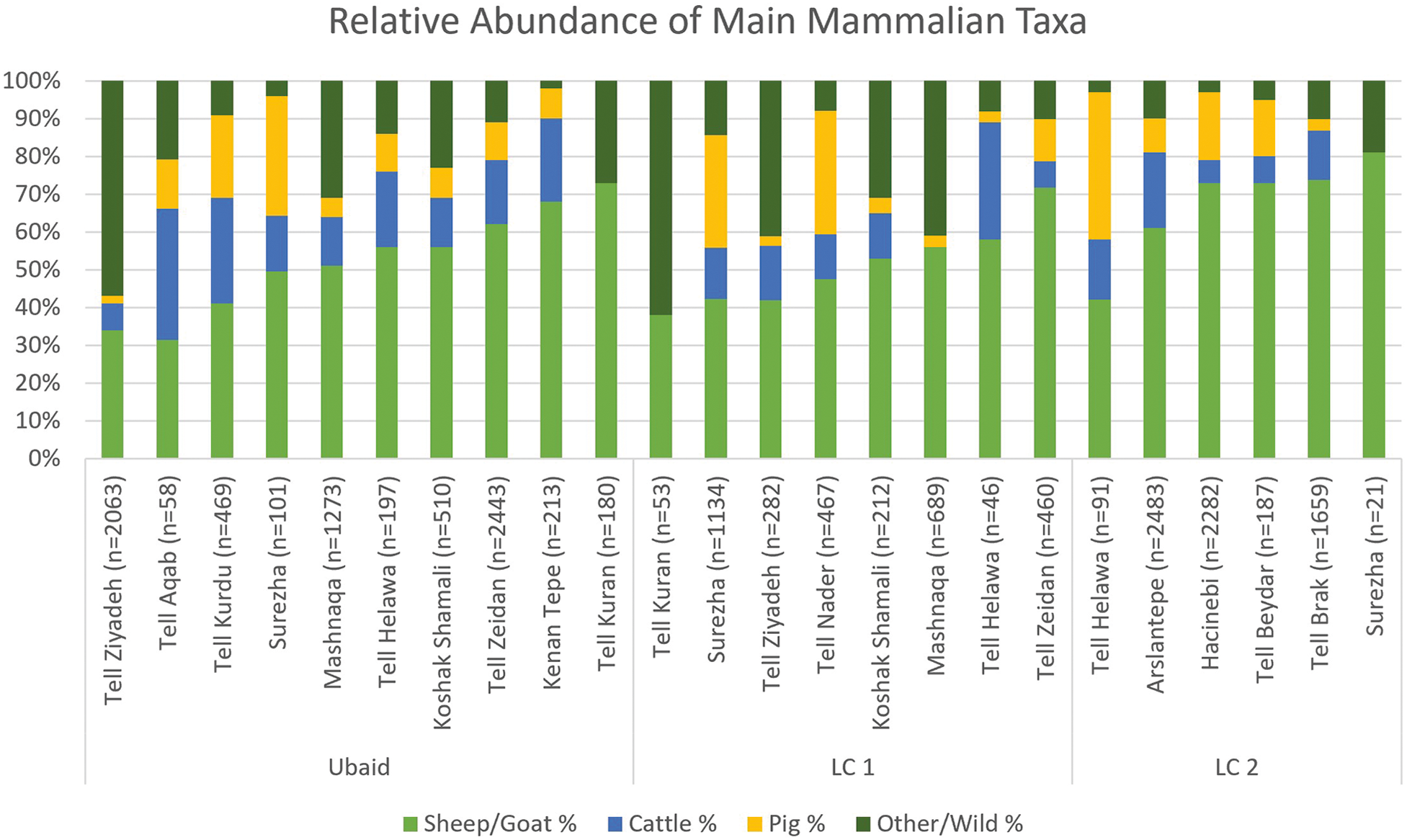
Caprine herding has a long history in southwest Asia. Although it is clear that, during the earlier Chalcolithic (Ubaid) period, at some sites, herd animals were more common than hunted game, this pattern was by no means ubiquitous (Grossman & Hinman Reference Grossman and Hinman2013; Price et al. Reference Price, Fisher and Stein2021; Zeder Reference Zeder1995). By the beginning of the Late Chalcolithic period (LC 1), however, herd animals had become more common across northern Mesopotamia, and by the LC 2, sheep and goats were making up the majority of mammals at most sites. Figure 2 shows that over the course of the Chalcolithic period in general, we see an increase in the abundance of caprines relative to other mammals. Does the mere presence of ever larger percentages of sheep and goats mean that large-scale mobile herding was taking place? Not necessarily, but Arbuckle (Reference Arbuckle2006) has argued that, at least in central Anatolia, by the early Late Chalcolithic period there is a shift to specialized and mobile sheep husbandry. I see little reason not to suspect the same in northern Mesopotamia. While isotopic studies that might shed light on this issue are not yet available, results from much earlier, at the Neolithic site of Jarmo, have suggested seasonal transhumance for caprines on a limited scale (de Groene et al. Reference de Groene, Bendrey, Müldner, Coogan and Matthews2023). We also have reasonable evidence that, not only were sheep and goats being herded on a large scale and moved around on the landscape, but the use of woollen textiles was also increasing across the Ubaid and early Late Chalcolithic period (Price & Wolfhagen Reference Price and Wolfhagen2024). What was the motivation for assembling these caprine herds during the Chalcolithic period? At Hamoukar, as I will show below, caprine herding might have been related to a long-distance trading network that connected Hamoukar to the Lake Van region in Türkiye.
Bar graph showing relative taxonomic abundances (%NISP) across Chalcolithic Mesopotamia. Sources for graph: Arslantepe: Vignola et al. Reference Vignola, Balossi Restelli, Masi, Sadori and Siracusano2014; Hacinebi: Bigelow (Reference Bigelow2011); Kenan Tepe: Parker et al. (Reference Parker, Foster and Heneck2008); Koshak Shamali: Gourichon & Helmer (Reference Gourichon, Helmer, Yoshihiro and Toshio2003); Mashnaqa: Zeder (Reference Zeder, Fortin and Aurenche1998); Surezha: Price et al. (Reference Price, Fisher and Stein2021); Tell Aqab: Bartosiewicz (Reference Bartosiewicz, Marom, Yeshurun, Weissbrod and Bar-Oz2016); Tell Brak: Price et al. (Reference Price, Fisher and Stein2021); Tell Beydar: Van Neer & De Cupere (Reference Van Neer, De Cupere, Van Lerberghe and Voet2001); Tell Helawa: Minniti et al. (Reference Minniti, Naime, Perego, Marchetti, Campeggi, Cavaliere, D’Orazio, Giacosa and Mariani2021); Tell Kuran: Zeder (Reference Zeder, Fortin and Aurenche1998); Tell Kurdu: Yener et al. (Reference Yener, Edens and Casana2000); Tell Nader: Hadjikoumis (Reference Hadjikoumis, Kopanias and MacGinnis2016); Tell Zeidan: Fisher (Reference Fisher2017); Grossman & Hinman (Reference Grossman and Hinman2013); Tell Ziyadeh: Zeder (Reference Zeder, Fortin and Aurenche1998).
Hamoukar’s Southern Extension
The archaeological site of Hamoukar (ancient name unknown) is located in the northeastern tip of Syria in the Hasseke province, sandwiched between Iraq and Türkiye (Fig. 1). The site is composed of two parts: 1) a 98 ha main mound with evidence for a dense urban settlement dating to the Late Chalcolithic 3–5 (LC 3–5, 3800–3100 bc) periods and Early Jezireh 2–4 (EJZ 2–4, c. 2600–2200 bc) periods (Grossman Reference Grossman2025) and 2) the Southern Extension, which is the focus of this paper. In the discussion that follows, reference to Hamoukar should be taken as reference to the Southern Extension. The Southern Extension is a 300 ha area with its centre located roughly 3 km to the south of the main mound. Occupation in this area dates primarily to the Late Chalcolithic 1–2 periods, as indicated by ceramic chronologies (radiocarbon dates are not available, but dating to roughly 4500–3900 bc). From 2005 to 2010, a team led by Salam Al Quntar and Khaled Abu Jayyab excavated eight broad exposures and two deep soundings in the Southern Extension. The author conducted the zooarchaeological analysis for this team.
The Southern Extension includes a central mounded area roughly 31 ha in extent and a surrounding, lower-lying area that covers 270 ha (Ur Reference Ur2010b). The site stands out from other settlements in the region for two reasons. First, during the early Late Chalcolithic, sites in northern Mesopotamia typically do not exceed 50 ha, and the majority fall in the range between 1 and 10 ha (McMahon Reference McMahon2020). At 300 ha, therefore, early Late Chalcolithic Hamoukar is truly an anomaly for the period. The next largest site during the LC 1–2 is Tell Brak, which features a similar pattern of discontinuous, patchy settlement (Ur Reference Ur, McMahon and Crawford2014). Second, obsidian, which does not occur locally, makes up 97% of the chipped stone assemblage at Hamoukar during the LC 1–2. At no other site in the region does obsidian make up nearly such a high percentage of the chipped stone assemblage. The source for the majority of the Hamoukar obsidian was Nemrut Dag near Lake Van, roughly 240 km away (Khalidi & Gratuze Reference Khalidi and Gratuze2013), with smaller portions coming from even further afield.
Patchy, or low-density, urbanism is common in many parts of the world (see e.g. the papers in the Journal of Urban Archaeology’s 2023 themed issue ‘Anomalous Giants’). In Mesopotamia, later urban sites have traditionally been thought of as dense, but new research is highlighting variations in urban density at the height of urbanism in the Bronze Age (see e.g. McMahon et al. Reference McMahon, Pittman and al-Rawi2023 and Hammer Reference Hammer2022 for further discussion of Mesopotamian urban density). At Hamoukar, the overall size and low density of the site as well as the large amounts of obsidian found are central factors in hypotheses about the nature of settlement there. Tony Wilkinson (Reference Wilkinson2002) hypothesizes that the site served as a seasonal market and camp for mobile groups engaged in obsidian trade and obsidian working. He argues that the location of the site, away from permanent water sources and between two other large, contemporary settlements—Tell al Hawa and Tell Brak—made it ideal as a meeting place for mobile groups. In a similar vein, Al Quntar (Reference Al Quntar2009) suggests that the site included both a permanent settlement—the 31 ha mounded area—and a surrounding settlement of seasonal encampments for mobile pastoral groups that frequented the site from highland Anatolia and engaged in obsidian distribution and exchange. Abu Jayyab (Reference Abu Jayyab2026) has recently argued that the mobility of the site’s inhabitants played a unique role in both community cohesion and the eventual disintegration of this proto-urban settlement. Wilkinson, Al Quntar and Abu Jayyab’s interpretations all suggest that occupation at the site was heavily shaped by the activities of mobile pastoral groups with links to the Anatolian highlands. Ur (Reference Ur2010b), on the other hand, argues that the presence of large storage jars found during surface survey suggests a more permanent occupation in at least part of the settlement, with both a densely occupied portion in the mounded area and an area of more dispersed occupation in the remainder of the 300 ha.
Discussions of the nature of settlement in Hamoukar’s Southern Extension have hinged on the ubiquity of obsidian and the fact that it had to be procured from Anatolia. But movement of animals and animal products was also likely a part of the circulation network. Caprines may have been used at least occasionally as pack animals; the other traditional pack animals of this region, the domesticated donkey and camel, do not appear until the third millennium bc (Vila Reference Vila and Mashkour2006) and second millennium bc respectively (Arbuckle Reference Arbuckle and Potts2012). Although we do not have isotopic evidence that would more definitively indicate that caprine herds were moving to and from the Nemrut Dag region with Hamoukar’s obsidian procurers, it seems likely that the animals (or their textiles) were one key component in a suite of goods circulating between Anatolia and the Syrian Jezirah.
Many of the archaeological features in the Southern Extension have been taken by the excavators as evidence of temporary structures and pens used by mobile pastoralists, and ceramics from the earliest phases of the site’s occupation show clear links to Anatolian ceramic traditions (Abu Jayyab Reference Abu Jayyab2019; Reference Abu Jayyab2026). Low, linear features comprising bricks and sherds, for example, have been interpreted as structures for stabilizing tents. Large objects (grinding stones, whole vessels, etc.) left in situ next to these structures have been interpreted as objects owned by mobile pastoralists who intended to return and reclaim or reuse them. The perceived patchiness of the occupation in the Southern Extension, suggested by archaeological survey results (Ur Reference Ur2010b), has been taken as a further indicator of the transient nature of some of the inhabitation. Despite such archaeological signatures of impermanence and patchiness, this massive area has nevertheless been described as a locus of ‘proto-urbanism’ (Al Quntar et al. Reference Al Quntar, Khalidi and Ur2011). In the discussion section below, I argue that this claim becomes more believable and more interesting when we add caprines to the conversation.
Results of traditional zooarchaeological analysis at Hamoukar
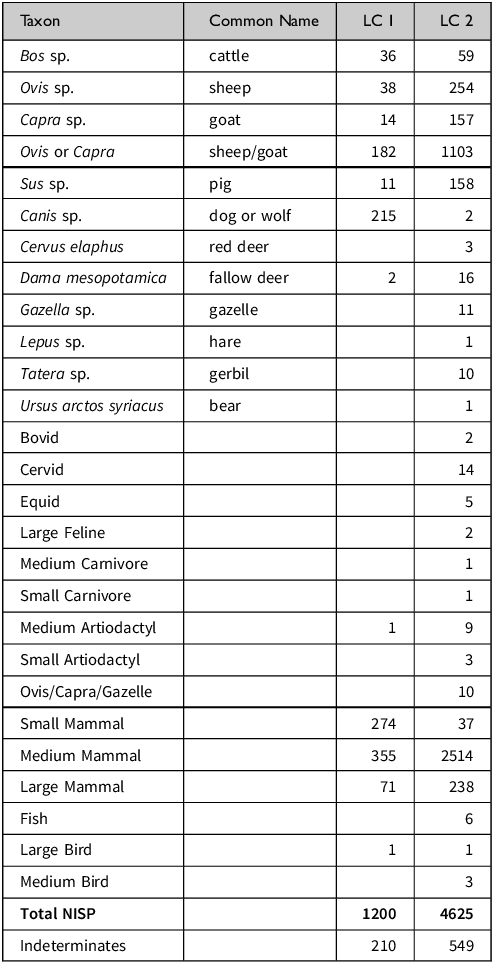
Over the course of four seasons from 2006 to 2010, I analysed 6584 bones and bone fragments recovered from Hamoukar’s Southern Extension and dating to the LC 1 and LC 2 (Table 1).Footnote 4 Faunal remains were recovered by hand, in sieving, and in flotation from limited primary contexts. Time constraints called for a sampling strategy for faunal analysis, with primary and secure secondary contexts (especially clearly defined rubbish-filled pits) prioritized. All analysed fauna were recorded in Excel using the author’s modification of the BoneSort II coding system (Redding et al. Reference Redding, Wheeler Pires-Ferreira and Zeder1975), while measurements (following Von den Driesch Reference Von den Driesch1976), information on tooth wear (following Grant Reference Grant, Wilson, Grigson and Payne1982; Payne Reference Payne1973) and descriptions of butchery marks were recorded in separate tables. The following features were also recorded for all faunal remains: archaeological context, taxonomic class, lowest possible level of taxonomic identification, element, side, epiphyseal fusion status, fragmentation, modification, butchery, burning, sex, domestication, pathologies, osteometrics, weight, associations and articulations.
Number of identified specimens (NISP) from Hamoukar’s Southern Extension.

Table 1 Long description
A table listing the number of identified specimens from Hamoukar’s Southern Extension. The table has 33 rows and 4 columns. The columns are labeled ‘Taxon’, ‘Common Name’, ‘LC 1’, and ‘LC 2’. The rows list different taxa and their common names, followed by the number of identified specimens in LC 1 and LC 2. Row 1: Bos sp., cattle, 36, 59. Row 2: Ovis sp., sheep, 38, 254. Row 3: Capra sp., goat, 14, 157. Row 4: Ovis or Capra, sheep/goat, 182, 1103. Row 5: Sus sp., pig, 11, 158. Row 6: Canis sp., dog or wolf, 215, 2. Row 7: Cervus elaphus, red deer, 3. Row 8: Dama mesopotamica, fallow deer, 2, 16. Row 9: Gazella sp., gazelle, 11. Row 10: Lepus sp., hare, 1. Row 11: Tatera sp., gerbil, 10. Row 12: Ursus arctos syriacus, bear, 1. Row 13: Bovid. Row 14: Cervid, 14. Row 15: Equid, 5. Row 16: Large Feline, 2. Row 17: Medium Carnivore, 1. Row 18: Small Carnivore, 1. Row 19: Medium Artiodactyl, 9. Row 20: Small Artiodactyl, 3. Row 21: Ovis/Capra/Gazelle, 10. Row 22: Small Mammal, 274, 37. Row 23: Medium Mammal, 355, 2514. Row 24: Large Mammal, 71, 238. Row 25: Fish, 6. Row 26: Large Bird, 1, 1. Row 27: Medium Bird, 3. Row 28: Total NISP, 1200, 4625. Row 29: Indeterminates, 210, 549.
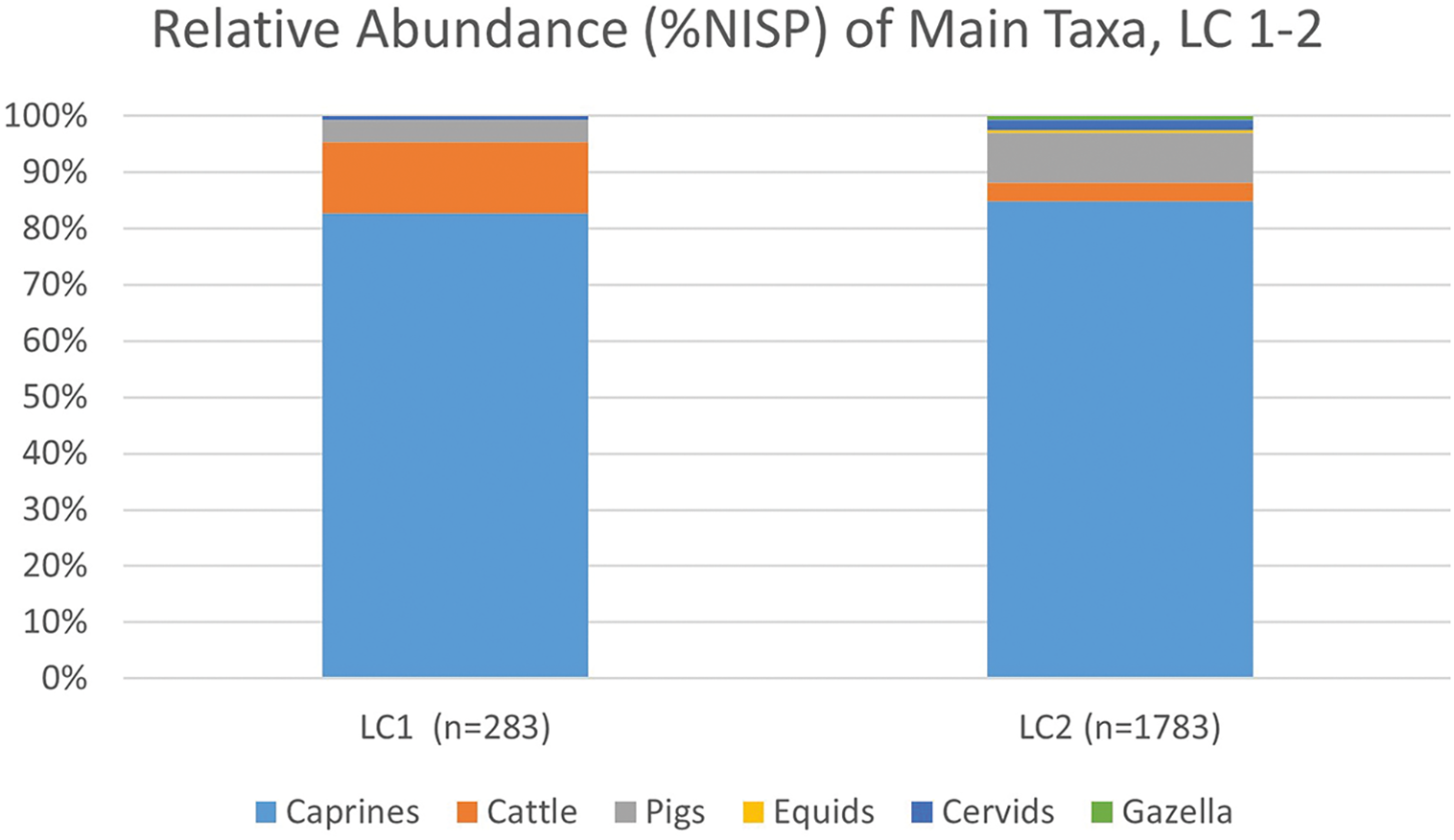
The traditional zooarchaeological analysis based on a macroscopic visual and metrical analysis of the bones recovered from these excavations provides some basic details of taxonomic identification. First, as we would expect from this period, based on contemporary trends at other sites in the region already shown in Figure 2, caprines make up the majority of the analysed assemblage (Fig. 3). However, the relative abundance of caprines from Hamoukar’s Southern Extension far exceeds that of any other site in the region during the LC 1 period, at 82.7% of the main identified taxa, and somewhat exceeds that for most sites during the LC 2 period, at 84.9% of the main identified taxa (compare Fig. 3 and Fig. 2). Sheep outnumber goats about 2:1 across the LC 1 and 2 periods. Second, dogsFootnote 5 are also well represented in the Hamoukar assemblage (12.7% in the LC 1 and 3.3% in the LC 2). The vast majority of the dog bones were individual elements and not articulated skeletal sections. However, two-thirds of the dog bones were found in just three loci, and while the bones were not found in articulation, the assemblage of recovered elements from those loci represents the relatively complete skeletons of four adult dogs. Given the sparse representation of hunted game within the Hamoukar faunal assemblage, dogs were probably not serving as hunting companions, but rather were working as sheep herders. Butchery marks on dog bones also suggest that some might have been eaten.
Relative abundance (%NISP) of main taxa, LC 1–2.
The age-at-death for the caprines in the assemblage was determined by analysing patterns in epiphyseal fusion and in tooth eruption and wear. Both analyses show that at least half of the caprines were kept alive past 3 years of age. Tooth-wear data, for example, indicate that approximately 50% of caprines survived past c. 3 years (Payne Reference Payne1973, stage E). According to fusion data, on the other hand, 94% of the elements that fuse at 0–18 months are fused, and 59% of the elements that fuse between 2.5 and 4 years are fused. This pattern suggests that approximately half of the sheep and goats were living past 2.5 years. Taken together, the tooth-wear and fusion data indicate that animals were being slaughtered later than we would expect if herders were attempting to optimize meat production. Pastoralists seeking to maximize meat production typically slaughter young males around 1 year of age (Payne Reference Payne1973). Clearly, at least some of these caprines were eaten, as approximately 1% of the bones retain marks from butchery, and the vast majority of those butchered bones are fused. It is possible that some sheep or goats were being raised for wool or hair during the fifth millennium bc, as Price and Wolfhagen (Reference Price and Wolfhagen2024) suggest, but evidence for substantial woolliness in sheep is generally thought to appear in the fourth millennium bc. At Hamoukar, the caprines from the Southern Extension do not exhibit the kind of size reduction (see Grossman et al. Reference Grossman, Price, Fennimore, al Kuntar and Reichel2025 for discussion of osteometrics at Hamoukar) that Vila and Helmer (Reference Vila, Helmer, Breniquet and Michel2014) argue is a marker for woolly sheep populations.
Important for our study of affordances, however, is the suggestion of mixed herds of sexually mature caprines. Sex could be determined in 58 fragments of pelvii. Of these fragments, 26 were female, and 32 were male. We also have evidence that more than half of the herds were surviving past 2.5 years of age. Caprines reach sexual maturity between 4 and 12 months (although of course with variation by sex and species). If more than 50% of caprines being herded at Hamoukar survived past 2.5 years of age, then the herds comprised both sexually mature male and female caprines. While it is difficult to tell from just the archaeologically recovered assemblage if mixed sexes were herded together, ethnographic research (Redding Reference Redding1981) suggests that mixed-sex herds have been common in West Asia in recent times. Of course it is also possible that herds were kept sexually segregated until mating season, but even this would have been an artificial herd structure (see next section for discussion of herd demographics) maintained by humans. The herding of sheep and goats together is also an artificial herd structure maintained by humans. The fact that humans maintained a herd structure that differed from wild flocks is key to thinking about behavioural affordances.
Herding and caprine behavioural affordances
For insight about caprine behavioural affordances, I am not drawing on the archaeological data from Hamoukar but, instead, on critical animal studies and ethology. In English we say colloquially that caprines are herd animals, and they are, at least in Mlekuž’s sense of the word (‘a historically specific assembly of non-human animals, humans, and things that appeared in the Neolithic’: Mlekuž Reference Mlekuž2013, 150). However, caprines are appropriately classed as flocking animals. We have a tendency to think of sheep as passive followers (‘serfs’, as Tani Reference Tani2017 designates them) managed by humans and dogs. But the herd social composition is more nuanced than that. Caprines are social innovators, accepting new members into the herd—often members who belong to entirely different species—while maintaining a recognition of the herd as a social group despite regular ingress and egress of individuals. Yes, humans make decisions about herd composition, movement, breeding and maintenance, but the very possibility of the herd is ultimately dependent on caprine behavioural affordances.
Ethological research has shown that the social structure of flocks (of both sheep and goats) can be highly variable and is dependent on factors such as group size, sexual composition, habitat, etc. (Shackleton & Shank Reference Shackleton and Shank1984). The adaptability of caprine sociality to varied flock compositions and environments is key to assembling herds, because caprine social structure can adapt to align with new multispecies engagements that bring them into close and regular contact with potential predators (that is, humans and dogs). Sheep, in particular, are also capable of remembering up to 50 individual faces—faces of other caprines, humans, and presumably canines (Kendrick et al. Reference Kendrick, da Costa, Leigh, Hinton and Peirce2001). This allows them to remember a diverse cast of characters and, crucially, to remember how those characters fit into the social order of the herd. Tani (Reference Tani, Ellen and Fukui2021) notes that when two herds of sheep commingle, they are able to separate themselves back into their original herds unaided—something that reindeer herds are not able to do. While Tani does not directly attribute this to sheep’s facial recognition capabilities, that is most likely the mechanism.
Recently, work in critical animal studies has shown that large conglomerations of caprines brought together by human pastoralists develop a sociality that recognizes the herd as a unit while simultaneously and constantly renegotiating social sub-groups within it (Mlekuž Reference Mlekuž2013). Incorporation of human and canine members into the herd requires intense engagement with caprine group dynamics (see e.g. Orton Reference Orton2010). The traditional zooarchaeological methods employed in studying the Hamoukar assemblage indicated that caprine herds were composed of a mix of ages and sexes. Herd social dynamics would, therefore, need to account for the agonistic tendencies of adult male sheep, as well as mixed-sex socialities. Although caprines are situationally capable of mixed-sex flocking for specific needs (usually protection from predation) in the wild (Meldrum & Ruchstuhl Reference Meldrum and Ruckstuhl2009), flocks are typically sex-segregated outside of breeding seasons. The mixed-sex herds that probably existed at Hamoukar would have required constant and intense social negotiation both within the bounds of the settlement and while herds were being moved across the landscape (near or far) for grazing. This social negotiation would have been carried out through caprine behaviours (Ginelli et al. Reference Ginelli, Peruani, Pillot, Chaté, Theraulaz and Bon2015) that herders would have observed and to which they would situationally have had to respond. The behavioural affordances offered by caprines’ flexible sociality, then, underpinned the possibilities for large-scale herding.
Discussion
We may be tempted to think of the ancient Mesopotamians as having a world view fundamentally similar to our own. Indeed, formalist assumptions about the rational utilization of limited resources—leaving aside the question of whether or not ‘we’ ourselves actually operate according to such formalist assumptions—underpin many archaeological models. In these scenarios, animals are usually treated as one of those limited resources, as objects rather than subjects, as the ‘other’ in the Cartesian duality that separates humans and animals (Thomas Reference Thomas2020). However, the assumption that Mesopotamians in the prehistoric periods recognized animals as fundamentally different from humans is merely that—an assumption. There is no reason to assume that the people of prehistoric Mesopotamia conceived of animals solely as objects to be mobilized in pursuit of rational economic action and not, for example, as people themselves. Jettisoning that assumption opens up space for new ways of thinking about human–animal interactions at the dawn of urbanism.
‘Empty’ cities and the archaeological invisibility of animals
Hamoukar, like its northern Mesopotamian neighbors Tell Brak and Tell al-Hawa (also occupied during the LC 1–2 periods), has been described as exemplifying a patchy, discontinuous form of urbanism. But the idea of patchy urbanism needs reconsideration in light of caprine socialities. If we are to take seriously and operationalize the multispecies nature of early cities, we need to rethink the use of space. The ‘low-density’ label applied to these sites may be a matter of archaeological visibility. The low density is not necessarily a comment on the use of space in the past—it is an indication of the low density of artifacts, architecture, and other features. In antiquity these were probably densely occupied cities, but a multispecies density, with caprines (and probably other animals) filling in the open spaces between patchy traces of human occupation. Perhaps these early ‘empty’ cities, then, when animals are taken into account, were in fact quite full. In a sense, they were cities of animals.
New possibilities engendered by caprine herding at Hamoukar
Zooarchaeological data show us that caprine herds were being assembled at Hamoukar. These new herds would have presented opportunities for mutually dependent relationships based on both care (Oma Reference Oma2010; Reference Oma and Pilaar Birch2018) and domination (Ingold Reference Ingold1980). Such relationships would have been constantly challenged, renegotiated and remade among the constituent members of the herd. While many have long recognized that these sorts of negotiations were key to pastoral mobility (e.g. Tani Reference Tani2017), I posit that these negotiations also formed the social basis of the world’s first cities.
I offer here a speculative scenario—a speculative scenario based on social zooarchaeological data—about the connections between herding and urbanization at Hamoukar. As a first step, humans decided to bring together larger and denser caprine herds than would have existed in the wild, herds with demographic profiles that were also unlike wild flocks. Then, within the newly assembled caprine herds, new caprine socialities emerged to manage the forced proximity and new demographics. But the new socialities were not only caprine. As an outgrowth of their own herding decisions, humans and their canine associates were also integrated into this multispecies community, a community that developed its own, unique multispecies socialities. These herds may have been a physical component of the population residing at Hamoukar, with caprines filling the spaces that seem archaeologically empty. The social organization of this proto-city was not a solely human innovation—it was learned, in part, from caprines. That is, humans learned to navigate the complicated social realties of urban living from their experiences herding sheep and goats: observing, managing, responding to and becoming enmeshed within the social lives of the flocks they tended.
In the same way that a sheep herd, in comparison with a sheep flock in the wild, is a new multispecies community, early mega-sites such as Hamoukar were also new multispecies communities: communities filled with caprines (and canines) who were bound to each other and to people by new multispecies socialities. This odd type of ‘patchy’ urbanism that characterizes the world’s first cities—though patchy only in the sense of archaeological visibility—might be seen as a ‘becoming sheep’ (sensu Deleuze & Guattari Reference Deleuze, Guattari and Massumi2009) of the community. That is, these low-density or patchy sites, the world’s first experiments in urbanism, are in fact multispecies communities built on caprine socialities. The character of social organization in these early cities was distinctly caprine; that is, it was underpinned by caprine behavioural affordances, in particular their flexible, incorporative and gregarious social behaviour when negotiating herd dynamics—affordances were made legible through interspecies semiotics.
Caprine herding and the idea of the city in ancient Mesopotamia
The idea that cities were fundamentally caprine had an enduring legacy in the Mesopotamian imagination. Metaphors of caprine herding appear regularly in the cuneiform record and appear to have been central to indigenous narratives about urbanism. And urbanism was, by the Bronze Age, considered the most ‘civilized’ way of living, according to the inhabitants of these early Mesopotamian cities (van de Mieroop Reference van de Mieroop1997). Even though later Mesopotamian cities were often so densely built up that caprine herds could not have been accommodated within them, caprine herding was nevertheless central to being a true Mesopotamian urbanite (Grossman & Paulette Reference Grossman and Paulette2020).
Uruk, one of the earliest and longest-lived Mesopotamian cities, famously the home of the mythological king Gilgamesh, goes by the epithet ‘Uruk-the-Sheepfold’. Cities are also frequently referred to as cattle-pens, another pastoral metaphor, and one that refers to cattle in a general sense—the Mesopotamians referred to caprines as ‘small cattle’ (Salleberger Reference Sallaberger, Breniquet and Michel2014). In hymns from the Ur III period (2112–2004 bc), the king is not just a ‘shepherd’ of the people but also someone well acquainted with the methods of actual herding (Garfinkle Reference Garfinkle, Frame, Jeffers and Pittman2021). Harmanşah (Reference Harmanşah and Ragavan2013) has described the cattle-pen and sheep-fold as ‘historically charged spatial metaphors … that characterize the Mesopotamian city in between economies of pasturage and agriculture, between movement and settlement, between regimes of care and exercise of power’. These regimes of care and exercises of power, playing out in patterns of movement local and distant, are the same kinds of relationships described by animal studies scholars (Ingold Reference Ingold1980; Oma Reference Oma2010) in their descriptions of the new socialities engendered by herding. Recent zooarchaeological research has shown that, in many periods (and especially for the architecturally dense cities of the Early Bronze Age, c. 2600–2200 bc), pigs were at least as prevalent, if not more so, than sheep in Mesopotamian cities (Price Reference Price2020; Price et al. Reference Price, Grossman and Paulette2017). Despite that fact, cities are never called ‘pig-sties’ in cuneiform documents.
Conclusions
Early fourth-millennium bc Hamoukar must have been an astonishing place. It was a massive settlement, and it was rife with shiny objects made of obsidian from far-off lands. But it may also have been filled with animals, herds of caprines on a scale not seen before. Was this early city ‘becoming sheep’ as multispecies socialities played out across it? Certainly, the idea of cities as sheep-folds is a central metaphor for Mesopotamians in later periods, and that metaphor must have become ingrained in some deeper Mesopotamian past. Herding was at the very heart of Mesopotamian urbanism.
We cannot know for certain why humans assembled these herds. We might ask if the assembling of herds was a method of kinning? Wealth display? Might it have been a ritual or religious obligation? Was it related to landscape modification? Or was it perhaps at the behest of the animals themselves? We cannot know all of the motivations for assembling herds. But the upshot of this assembling was that human entanglement with the new socialities of herd life—large, socially complex, multispecies—created a new kind of settlement. By considering a broader range of interpretative possibilities based on different kinds of caprine affordances, we can learn something interesting about both the multispecies origins of urbanism and the intimate connection between herding and place-making. I have presented here what I see as intriguing preliminary evidence from northern Mesopotamia that at least opens up space for this alternative perspective. Understanding how and why cities developed has preoccupied archaeologists for decades. The time is ripe to look for explanations that more explicitly centre the experiences and relationships of the non-human inhabitants that moved through, lived within and helped create these early cities.
Acknowledgements
Thanks to Tate Paulette for being a sounding board and editor; Khaled Abu Jayyab for long discussions about the Southern Extension at Hamoukar; Christine Mikeska and Theo Kassebaum for inviting me and Khaled Abu Jayyab to give a paper in their ASOR session ‘New Approaches to Ancient Animals’, which provided the impetus for me to begin thinking about this topic; Salam Al Quntar and Clemens Reichel for bringing me on 20 years ago to work on the Hamoukar faunal material; Max Price and Hannah Chazin for their very helpful suggestions; David Ambaras for the pun in the title and the anonymous reviewers who provided valuable feedback. The study of faunal remains from Hamoukar during the 2006–10 seasons was funded by the Institute for the Study of Ancient Cultures at the University of Chicago, with permission from the Syrian Directorate General of Antiquities and Museums.




 Open access

