Introduction
Melon (Cucumis melo L., 2n = 24) is ubiquitous by its cultivation and consumption worldwide, with an area of 1.04 M ha and production of 27.5 million tonnes (FAO, 2019). The crop is not only consumed as a dessert fruit, but also as a vegetable for cooking, salads and pickling. According to a recent classification (Pitrat, Reference Pitrat, Grumet, Katzir and Garcia-Mas2016), melon species are divided into 19 botanical groups and further subgroups. The botanical groups comprise chito (mango melon), flexuosus (snake melon), tibish, acidulus, conomon (oriental pickling melon), kachri and momordica (snap melon or Phut) among the non-sweet types, and adana, ameri, cantalopensis (cantaloupe), reticulatus, chandalak, inodorus (winter melon), casaba, ibericus, indicus, makuwa and chinensis among the sweet ones. The free exchange of genes across botanical groups within the species (Parthasarathy and Sambandam, Reference Parthasarathy and Sambandam1980; Mathew et al., Reference Mathew, Gopalakrishnan and Peter1986) has resulted in many intermediate forms. Melons, in reference to their morphological traits, exhibit wide genetic variations among different botanical groups (Pitrat, Reference Pitrat, Grumet, Katzir and Garcia-Mas2016). It was believed that East Africa is the centre of origin of melons (Pitrat, Reference Pitrat, Prohens and Nuez2008), but later data revealed about their Asian origin (Sebastian et al., Reference Sebastian, Schaefer, Telford and Renner2010). India is one of the areas of melon diversification (Bisognin, Reference Bisognin2002) and several melon landraces are cultivated in different geographical locations (Nandpuri, Reference Nandpuri1989; Fergany et al., Reference Fergany, Kaur, Monforte, Pitrat, Rys, Lecoq, Dhillon and Dhaliwal2011; Reddy et al., Reference Reddy, Sudarshini, Reddy, Aswath, Avinash, Nandini and Rao2016; Shivapriya et al., Reference Shivapriya, Kavya and Sudhakara2019). Various melons of cooking, salad, dessert and pickling types are cultivated in Karnataka state of southern India under diverse geographical conditions like hilly (Western Ghat), coastal, transitional and dry/arid zones. Improved melons of cantaloupe type are cultivated commercially, but still, many landraces are being marketed locally. Some indicus and chandalak melon landraces, used as dessert, are cultivated traditionally on the lake and river beds based on residual moisture. These are of great demand in local markets, but the area under cultivation is receding remarkably. Cultivation of melon varieties of superior yield and quality, bred for bigger markets, is narrowing down, their genetic variability. Among the dessert type, indicus melon are very unique to sandy loam soils of the river bed and hence, their cultivation is very limited, thus gradually becoming vulnerable to extinction (Shivapriya et al., Reference Shivapriya, Kavya and Sudhakara2019). Apart from commercial varieties and landraces, some wild/weedy melons are also seen in the rainy season. Clean cultivation practices such as herbicidal application in the agriculture field are a threat to the survival of weedy melons.
Locally adapted melons may be repositories of useful genes thus contributing to the widening of the crop genetic diversity as indicated by the use of Indian melon landraces worldwide, for their disease resistance genes (Thomas et al., Reference Thomas, Cohen, McCreight, Jourdain and Cohen1988; Epinat and Pitrat, Reference Epinat, Pitrat and Thomas1989; Balass et al., Reference Balass, Cohen and Bar-Joseph1992; Dogimont et al., Reference Dogimont, Slama, Martin, Lecoq and Pitrat1996; Seshadri and More, Reference Seshadri and More1996; Pitrat, Reference Pitrat, Prohens and Nuez2008; Pitrat and Besombes, Reference Pitrat and Besombes2008; Liu et al., Reference Liu, Chen, Su Zhang and Zhu2010; Fergany et al., Reference Fergany, Kaur, Monforte, Pitrat, Rys, Lecoq, Dhillon and Dhaliwal2011; Dhillon et al., Reference Dhillon, Monforte, Pirate, Pandey and Singh2012; Vashisht et al., Reference Vashisht, Lal, Sharma and Thind2019). Some of the weedy melons and landraces included in the present study showed resistance to powdery and downy mildew in our previous disease screening studies (Kavya, Reference Kavya2017; Shivapriya et al., Reference Shivapriya, Kavya and Sudhakara2019). The heterogeneous nature of locally adapted landraces makes them less attractive in appearance compared with commercial varieties. However, superior selections made among landraces have been released for cultivation (Pandey et al., Reference Pandey, Rai, Prasanna and Kalloo2008; Malik et al., Reference Malik, Vashisht, Kuldeep, Abhishek, Singh, Hira, Monforte, James and Narinder2014; Reddy et al., Reference Reddy, Sudarshini, Reddy, Aswath, Avinash, Nandini and Rao2016) and are also being used as parents in hybrid development (Gurav et al., Reference Gurav, Wavhal and Navale2000). Hence, the objective of this study was necessarily to scout for the unexplored and endemic melons of Karnataka state, for their genetic variations in reference to sex expression, growth and fruit traits that will help in characterizing the germplasm. The present study adds a new germplasm for melon crop improvement and will help in documenting the previously unexplored genetic resources of Karnataka state.
Materials and methods
Samples of melon landraces and wild relatives of various botanical groups (Table 1 and online Supplementary Fig. S1) were sourced directly from eight agro-climatic zones of Karnataka state. Representative lines of botanical groups, i.e. two momordica, four kachri, five chandalak, one reticulatus, two acidulus, two indicus, four intermediate of acidulus and momordica, and three melons of the unknown group from our collection were included in the study. Improved varieties of flexuosus, chandalak and indicus and presently cultivated kachri were used as reference varieties. The melon landraces and wild relatives were selfed under insect-proof polyhouse for four generations. The phenotyping of landraces and wild relatives was done during June–September of 2016 at the College of Horticulture, University of Horticultural Sciences, Bagalkot campus, Bengaluru in a randomized block design with three replications. Seeds were sown in protrays and seedlings thus raised were transplanted at two true leaf stages with a spacing of 0.45 m within rows and 2 m between rows. Observations recorded include ovary length and width (cm), pubescence, sex expression and days taken to first fruit maturity (the number of days from planting to harvest). With respect to fruit, length (cm), weight (kg), diameter (cm), shape in longitudinal section (the ratio between length and maximum diameter), strength of attachment of peduncle at maturity, fruit cracking (splitting) on maturity, seed cavity diameter (cm), rind colour, grooves, patches, sutures, suture colour, surface netting, flesh thickness (cm), colour, firmness and aroma. In the case of accessions, Yeresavathe and flexuosus, where the immature fruits are used for salad purposes, five plants in each of these two genotypes were harvested at the immature stage. Most of the floral and morphological observations were recorded according to the Protection of Plant Varieties and Farmers' Rights Act (PPV and FRA) DUS (distinctiveness, uniformity and stability) guidelines for melon (Choudhary et al., Reference Choudhary, Pandey, Rao and Sharma2015) except for the traits such as the number of fruits per plant, fruit cracking at maturity, fruit weight, diameter, presence of hollow and seed cavity. The flesh firmness was assessed by pressing the flesh with the blunt end of a pencil, midway between the skin and the mucilage, and recorded as firm, medium and soft (crispy, intermediate and mealy). Flesh thickness was recorded at the position of maximum diameter of fruit. The number of days from harvest till the fruits retain freshness is considered indicating for shelf-life. Homogenized flesh was used for measuring total soluble solids in °Brix, with a hand refractometer (Atago digital pocket refractometer). Acidity was measured by titration of a fruit juice sample (Ranganna, Reference Ranganna1986).
Description of melon accessions and reference genotypes included in the study

Results
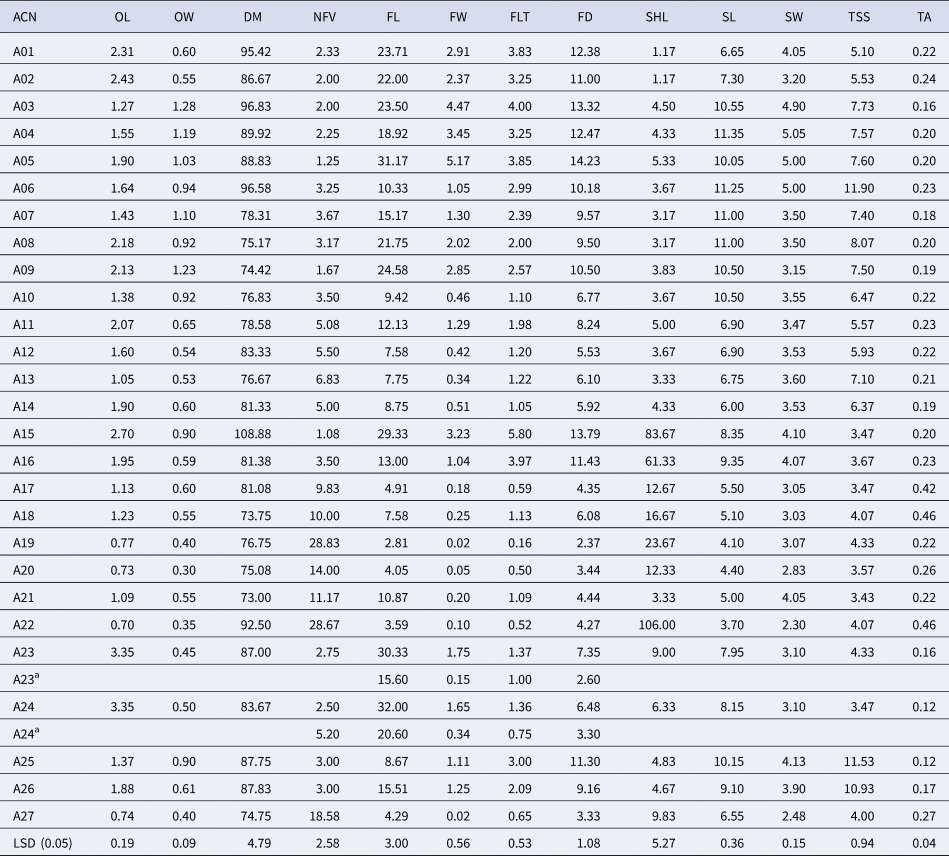
Phenotypic traits were significantly varied among accessions (Table 2). All accessions except indicus melon were monoecious in their sex expression. Reference varieties (Kashi Madhu and IC 321371) and the indicus melon were andromonoecious. Ovary length ranged from less than 1 cm in melon wild relatives (Mekkekaayi 2, Small melon, Budamekaayi and reference variety Kachri) to more than 3 cm in salad-type melons (Yeresavathe and flexuosus melon). Ovary width ranged from 0.30 (Small melon) to 1.28 cm (Banaspathre) with a mean of 0.71 cm. The wild relatives of melon, A21 produced the first fruit on the 73rd day, whereas Magekaayi, the landrace recorded delayed fruit maturity (108 days). The fruit number per vine ranged from 1.08 (Magekaayi) to 28.85 (Budamekaayi) with a mean of 6.8. Salad-type melons, Yeresavathe and flexuosus melon produced five to seven fruits when harvested at an immature stage (7 days after pollination) but two to three at maturity stage (Table 2). With reference to fruit length, minimum was observed in Budamekaayi (2.81 cm) and maximum in Karbooja (31.17 cm) followed by Yeresavathe (30.33 cm).
Characterization of melon accessions and reference varieties based on quantitative descriptors of the sex expression, ovary and fruit traits

ACN, accession; OL, ovary length (cm); OW, ovary width (cm); DM, days to maturity; NFV, No. of fruits per vine; FL, fruit length (cm); FW, fruit weight (kg); FLT, flesh thickness (cm); FD, fruit diameter (cm); SHL, shelf life (days); SL, seed length (mm); SW, seed width (mm); TSS, total soluble solids (°Brix); TA, titratable acidity (%).
a Immature fruits traits for the salad type melons.
Fruit weight differences exhibited a wide range from 0.02 kg (Budamekaayi and Kachri) to 5.17 kg (Karbooja). Flesh thickness was minimum in a wild relative, Budamekaayi (0.16 cm) and maximum in a cooking-type melon, Magekaayi (5.80 cm). Magekaayi showed a very small seed cavity (2.19 cm) and Karbooja recorded the maximum seed cavity diameter (6.72 cm). Fruit diameter (cm) was maximum in Karbooja (14.23 cm) followed by Magekaayi (13.79 cm) and minimum in Budamekaayi (2.70 cm) and the mean was 8.33 cm. Regarding the fruit shape, Kashi Madhu (0.77) and wild relative of melon (0.84) were having less than one length to width ratio. Salad-type melons, flexuosus (4.93) and Yeresavathe (4.14) exhibited more than four length to width ratio (Table 2) indicating cylindrical shape. Seven different fruit shapes were observed with one elongated globe, three oblate, five obovate, 10 oval, four ovate and two round fruits among the 27 melon accessions. Regarding shelf life, minimum shelf life of 1 day was observed in Snapmelon that bursts on maturity. Cooking-type acidulous melon accessions, Mekkekaayi 2 (106 days) and Magekaayi (84 days) recorded long shelf life. The total soluble solids (°B) ranged from 3.43 in a wild relative of melon followed by Magekaayi and Mekkekayi 1 (3.47) to 11.90 in a landrace, Sidoota. Titratable acidity (%) was minimum in Kashi Madhu (0.12), followed by Banaspathre and Yeresavathe (0.16). Mekkekaayi 2 and Giriyaala, the pickling-type melon, recorded the highest acidity of 0.46.
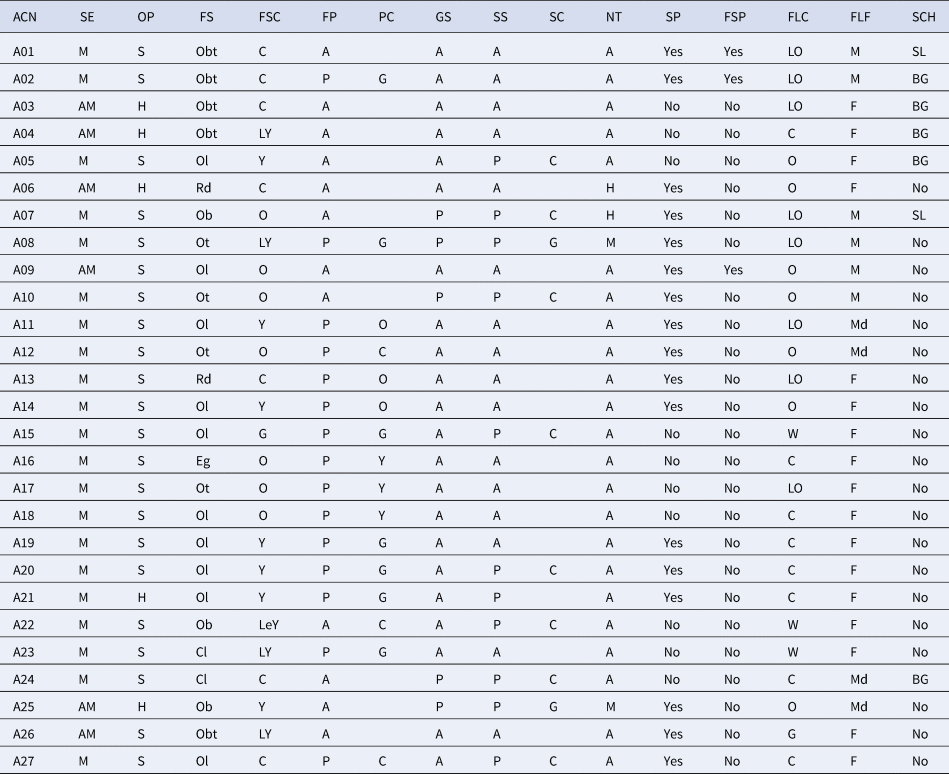
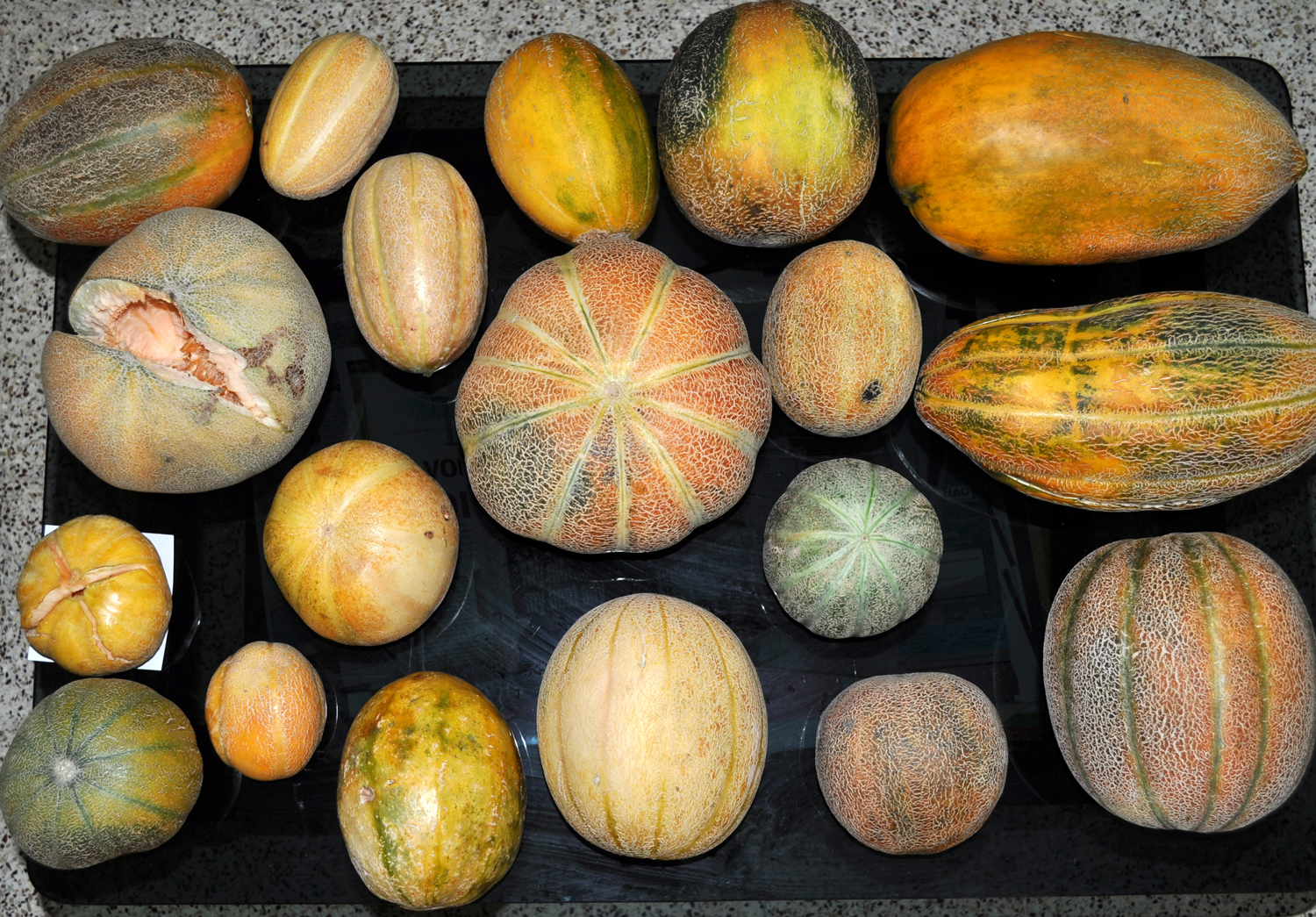
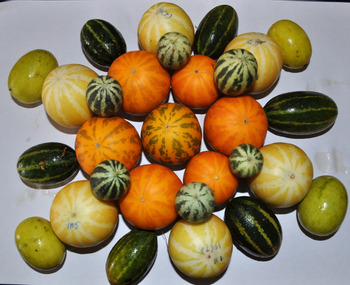
The melon accessions exhibited variation in rind colour (Table 3, Fig. 1 and online Supplementary Fig. S2). There were creamy white (26%), yellow (26%), orange (26%), yellow-green (19%) and light green (4%) rind colours observed. The flesh colour was cream (30%), light green (4%), light orange (30%), orange (26%) and white (11%) among the 27 melon accessions. Netting on fruit was absent in the majority (85.2%) of the melon accessions. Dense netting and moderate netting were observed in 7.4% melons each. Grooves and sutures were also absent in the majority of melons (81.5 and 59.3%, respectively). Patches on rind were observed in 55.6% of accessions, and the rest did not show any patches. Orange, cream, and yellow-coloured patches were found in 20% of melons, and 40% of them showed green-coloured patches. Non-slippable fruits were observed in 37% lines and the remaining melons were of slippable type. Fruit bursting on maturity was noticed only in 11% of melon accessions, and 89% of lines did not show this trait. Firm (63%), medium (15%) and mealy (22%) fruit flesh were observed among the 27 accessions evaluated. All dessert-type melon and Budamekaayi were aromatic, and the remaining ones did not have any aroma.
Variation for fruit traits in Momordica, indicus, chandalak, acidulus and unknown botanical group melons.

Characterization of melon accessions and reference varieties based on qualitative descriptors of the sex expression, ovary and fruit traits

ACN, accession; SE, sex expression (M, monoecious; AM, andromonoecious); OP, ovary pubescence (S, sparce; H, high); FS, fruit shape (Obt, obovate; Ot, ovate; Ob, oblate; Ol, oval; R, round; Eg, elongated globe; Cl, cylindrical); FSC, fruit skin colour (O, orange; C, cream; LY, light yellow; Le Y, lemon yellow; Y, yellow; G, green); FP, fruit patches (P, present; A, absent); PC, patch colour (O, orange; C, cream; Y, yellow; G, green); GS, grooves (P, present; A, absent); SS, sutures (P, present; A, absent); SC, suture colour (C, cream; G, green); NT, netting (H, high; M, moderate); SP, slippable peduncle; FSP, fruit splitting; FLC, flesh colour (O, orange; LO, light orange; C, cream; W, white; G, green); FLF, flesh firmness (M, mealy; F, firm; Md, medium); SCH, seed cavity hallow (SL, small; BG, big).
Discussion
Cultivated and wild relatives of melon belonging to various botanical groups, characterized in our study, exhibited significant variation for all the traits.
Dessert-type melons
The Snapmelon accessions characterized in our study were collected from the hilly zone (IC632170) and dry zone and collection from diverse places indicates their wider adaptability to different climates. Both Snapmelon accessions exhibited mealy textured, slightly acidic flesh with a mild aroma and very short shelf life but fruit bursting patterns were different. Being a native to India, Snapmelon exhibited a wide genetic variability for fruit cracking and peeling patterns and other traits (Garcia-Mas et al., Reference Garcia-Mas, Oliver, Gómez-Paniagua and de Vicente2000; Dhillon et al., Reference Dhillon, Ranjana, Singh, Eduardo, Monforte, Pitrat, Dhillon and Singh2007, Reference Dhillon, Singh, Fergany, Monforte and Sureja2009; Pandey et al., Reference Pandey, Kashya, Jha, Choudhary, Kumar, Singh and Rai2009; Fergany et al., Reference Fergany, Kaur, Monforte, Pitrat, Rys, Lecoq, Dhillon and Dhaliwal2011; Pandey et al., Reference Pandey, Singh, Singh, Jha and Raghuwanshi2011; Singh et al., Reference Singh, Sanjeev, Singh, Rai, Singh and Pandey2015; Pasha et al., Reference Pasha, Marker and Sarath Chandra2019).
Banaspathre and Ganjam (IC632178) of indicus botanical group are highly adapted to the river bed (online Supplementary Fig. S3) and difficult to cultivate on other soils (personal observation as well as the information shared by farmers). These melons are in great demand in local markets but due to ease of cultivation, Karabooja of chandalak group and Sidoota (IC632181) of reticulatus melon, which are recently introduced in this area, are being cultivated in larger areas (information shared by farmers). The cross-pollinating nature and crossing ability between botanical groups of melon (Parthasarathy and Sambandam, Reference Parthasarathy and Sambandam1980; Mathew et al., Reference Mathew, Gopalakrishnan and Peter1986) are a threat to conserve the uniqueness of Banaspathre and Ganjam. Both these landraces differed from reference indicus melon, IC321371 for all traits except their andromonocious sex form and soft rind texture.
The chandalak melon landraces of the present study varied in their fruit traits. Accession A05 weighed up to 7 kg. Minake (Chandalak) melons (IC632184) (Fig. 2) are cultivated on the residual moisture of lakes with no/low-cost cultivation. They are adapted to sandy loam soil but can also perform well under moisture limited conditions as observed in our previous studies (Sudhakara, Reference Sudhakara2014). All the accessions of chandalak melon were monoecious with orange coloured pulp. Most of them were oval in shape with different rind colours and netting but chandalak melons are reported as andromonoecious, round or flat fruit-shaped with medium fruit weight, green/orange or white flesh colour, having thin mesocarp with medium sugar content (Pitrat, Reference Pitrat, Grumet, Katzir and Garcia-Mas2016). Chandalak melons of northern parts of the country, including reference variety Kashi Madhu were andromonoecious with sweet pulp (Mamatha, 2016).
The chandalak-type melons (Minake) from Chamarajanagar, Karnataka State.

An intermediate form of acidulus and momordica-type melon (locally called Puttikaayi) grows like a weed in sorghum fields of the northern part of the State. The ripened fruits are sold at local markets. Some of the Puttikaayi accessions (IC632172) have shown multiple disease resistance in our previous disease screening experiment (Shivapriya et al., Reference Shivapriya, Kavya and Sudhakara2019).
Vegetable-type melons
Magekaayi (acidulus group) is one of the widely cultivated cooking-type melons in the southern states of India (Fergany et al., Reference Fergany, Kaur, Monforte, Pitrat, Rys, Lecoq, Dhillon and Dhaliwal2011; Mukunda Lakshmi et al., Reference Mukunda Lakshmi, Lingaiah, Rao, Raju, Pitchaimuthu and Gowda2017; Shet et al., Reference Shet, Kamagoud, Hongal and Nishani2019) and are known for their long shelf life (Pitrat, Reference Pitrat, Grumet, Katzir and Garcia-Mas2016). Fruits are stored for a very long duration following the traditional way (online Supplementary Fig. S4). In our study, wide variation was observed within acidulus type for fruit traits. Magekaayi 1 from the coastal region showed the highest flesh thickness with a very small seed cavity.
Landraces of Yeresavathe (IC632176) are localized in their cultivation and usage in the northern districts of Karnataka state (online Supplementary Fig. S5). Tender fruits are consumed as a salad, similar to flexuosus melon. The matured fruits of flexuosus melon are usually not used for cooking (Ahlawat et al., Reference Ahlawat, Pandey, Malav, Bhardwaj and Dhariwal2018) but both tender and matured fruits (with skin) of Yeresavathe are used in cooking. Yeresavathe has elongated shape, smooth skin and crunchy flesh like another vegetable-type melon ‘Arya’ from Rajasthan and Haryana states (Ahlawat et al., Reference Ahlawat, Pandey, Malav, Bhardwaj and Dhariwal2018) but fruits of Yeresavathe do not detach at maturity from the plant and ripen fruits are not used like dessert fruits.
Melon wild relatives
Fruits of smallest size were recorded in the accession Budamekaayi (IC632171) (Fig. 3) with a minimum of flesh thickness. This melon is not cultivated but grows as a weed in finger millet fields (online Supplementary Fig. S6). Fruits are very bitter in taste and generally are not used for consumption. Ripened fruits have a very strong aroma. Budamekaayi differs from the reference variety kachri (cultivated type) of Rajasthan state, for ovary pubescence and aroma. Budamekaayi ovaries possess very thin and short hair. Kachri of Rajasthan state is one of the morphotypes of wild melons (Roy et al., Reference Roy, Bal, Fergany, Kaur, Singh, Malik, Singh, Monforte and Dhillon2011) and are considered as an intermediate between wild melons of group agrestis and locally cultivated melons of different groups (Pitrat, Reference Pitrat, Grumet, Katzir and Garcia-Mas2016). Accession, Mekkekaayi and Giriyaala (IC632177) are cultivated for their small, very sour, orange-coloured fruits which are used for cooking and pickling. Landraces of Mekkekaayi are available in various shapes (Karadi et al., Reference Karadi, Ganiger, Bhuvaneshwari, Hadimani, Madalageri and Pallavi2017). They are drought-tolerant, have wider adaptability and long shelf life (unpublished data). One of the accessions of Mekkekaayi (A22) showed the longest shelf life of 106 days in our present study.
Variation for fruit traits in wild relatives of melons.

All the wild relatives characterized in the study were monoecious in their sex expression, possessed small ovaries with appressed hairs, and fruits exhibited very thin pulp with bitter or sour taste, indicating their probable relatedness with wild melons. It is well established that monoecious sex expression, light green thin flesh with bitter taste are the characteristic of wild melons (Pitrat, Reference Pitrat, Grumet, Katzir and Garcia-Mas2016).
All the landraces and wild relatives characterized in our study are endemic for cultivation and usage. Many research groups have studied the regional differentiation among Indian melon accessions and identified their distinctiveness. The genetic diversity among the melon landraces of North and Central India (McCreight et al., Reference McCreight, Staub, Koppar and Srivastava1993; Lal and Singh, Reference Lal and Singh1997; Tomar et al., Reference Tomar, Kulkarni and Kakade2008; Pandey et al., Reference Pandey, Rai and Singh2005, Reference Pandey, Kashya, Jha, Choudhary, Kumar, Singh and Rai2009; Choudhary et al., Reference Choudhary, Kumar and Sharma2012; Malik et al., Reference Malik, Vashisht, Kuldeep, Abhishek, Singh, Hira, Monforte, James and Narinder2014; Reddy et al., Reference Reddy, Sudarshini, Reddy, Aswath, Avinash, Nandini and Rao2016; Singh, Reference Singh2016), Eastern India (Dhillon et al., Reference Dhillon, Singh, Fergany, Monforte and Sureja2009), Gujarat (Mehta et al., Reference Mehta, Singh and Bhalala2010), Maharashtra (Gurav et al., Reference Gurav, Wavhal and Navale2000; Torkadi et al., Reference Torkadi, Musmade and Mangave2007; Patekar et al., Reference Patekar, Nagre and Sawant2014), Southern Indian states, Tamilnadu and Kerala (Fergany et al., Reference Fergany, Kaur, Monforte, Pitrat, Rys, Lecoq, Dhillon and Dhaliwal2011), Andhra Pradesh (Reddy et al., Reference Reddy, Begum, Sunil, Reddy, Jampala, Reddy and Reddy2012, Reference Reddy, Sudarshini, Reddy, Aswath, Avinash, Nandini and Rao2016; Indraja et al., Reference Indraja, Syed, Madhumathi, TanujaPriya and Sekhar2018) has been studied earlier but a very minimum representation of germplasm of Karnataka State is observed (Reddy et al., Reference Reddy, Sudarshini, Reddy, Aswath, Avinash, Nandini and Rao2016; Shivapriya et al., Reference Shivapriya, Kavya and Sudhakara2019; Shet et al., Reference Shet, Kamagoud, Hongal and Nishani2019). The global gene banks like USDA have representation of melon accessions originating from the north (Rajasthan) and central (Madhya Pradesh) parts of India (Staub and McCreight, Reference Staub and McCreight2004; Reddy et al., Reference Reddy, Sudarshini, Reddy, Aswath, Avinash, Nandini and Rao2016) but lack collections from southern India (McCreight, Reference McCreight2004). The melon landraces of Karnataka state (except acidulus melon) are unexplored for research purposes, and literature about their documentation and usage is also very limited. In this regard, the present study succeeded in assessing the wide genetic variability in valuable genetic reservoir of melon that could be used in melon improvement. The outcome of the study also serves in documenting the previously unexplored germplasm. The wild relatives of melon especially, Budamekaayi that resembles agrestis melon (Pitrat, Reference Pitrat, Grumet, Katzir and Garcia-Mas2016) except aroma, could be used in establishing taxonomic relationships with other melon. The desert fruit-type landraces found cultivated on the river beds are at risk of losing their uniqueness and hence serious efforts have to be made in their management through creating awareness among growers and in situ conservation. Recently we have deposited the seeds of some of the landraces and wild relatives of melons used in the present study at the seed bank of the National Bureau of Plant Genetic Resources, New Delhi for their conservation and utilization by researchers.
Supplementary material
The supplementary material for this article can be found at https://doi.org/10.1017/S1479262121000496
Acknowledgement
The authors would like to acknowledge the help of Dr Pitrat, M from GAFL, INRA, Domaine Saint Maurice, CS 60094, 84143 Montfavet Cedex, France, for helping in the identification of different botanical groups of melon and relevant literature. The authors also would like to acknowledge farmers for the landraces seeds and ICAR-NBPGR, New Delhi, for providing the seed material of reference genotypes for research.
Financial support
This study was conducted using the funds from the Directorate of Research, University of Horticultural Sciences, Bagalkot, India.
Conflict of interest
None.